Role of Adjunct devices in PCI
Dr Mahadeva Swamy B
SR Cardiology, JIPMER
Adjunct devices in PCI
 Plaque modification
 Cutting Balloon (CBA)
 Laser (ELCA)
 Atherectomy (DCA, PTRA)
 Thrombectomy
 EPD
Plaque modification
 Atheroablative devices during PCI → facilitate
procedural success and reduce restenosis
 Plaque modification is valuable tool for treatment of
complex lesions
 Vessel pretreatment → larger MLD and lower TLR rate
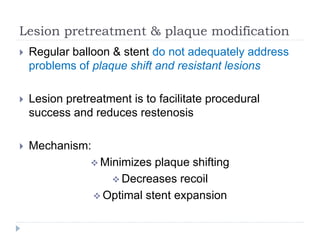
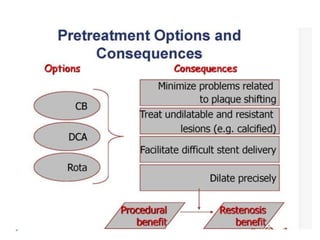
Lesion pretreatment & plaque modification
 Regular balloon & stent do not adequately address
problems of plaque shift and resistant lesions
 Lesion pretreatment is to facilitate procedural
success and reduces restenosis
 Mechanism:
 Minimizes plaque shifting
 Decreases recoil
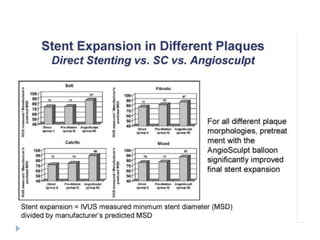
 Optimal stent expansion
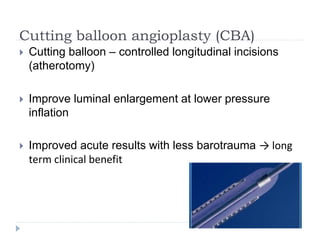
Cutting balloon angioplasty (CBA)
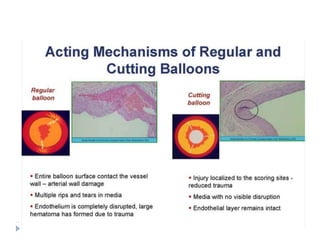
 Cutting balloon – controlled longitudinal incisions
(atherotomy)
 Improve luminal enlargement at lower pressure
inflation
 Improved acute results with less barotrauma → long
term clinical benefit
Mechanism of action of CBA
 Controlled microincisions in atheroma at lower
pressure – reduced barotrauma
 Better luminal enlargement at lower pressures
 In calcified lesions, CBA achieves larger lumen gain
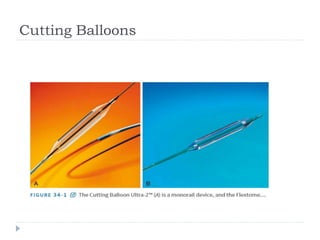
Cutting Balloons
Equipment
 Cutting balloons – 6, 10 & 15 mm
 Atherotomes (3-4)are mounted longitudinally along
the balloon surface
Atherotomes Balloon diameter
3 2 & 3.25 mm
4 3.5 & 4 mm
Technique
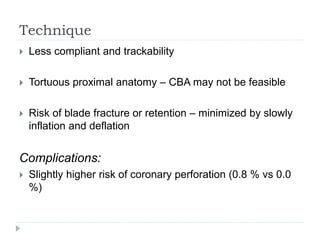
 Less compliant and trackability
 Tortuous proximal anatomy – CBA may not be feasible
 Risk of blade fracture or retention – minimized by slowly
inflation and deflation
Complications:
 Slightly higher risk of coronary perforation (0.8 % vs 0.0
%)
Conclusion: Cutting/scoring balloon
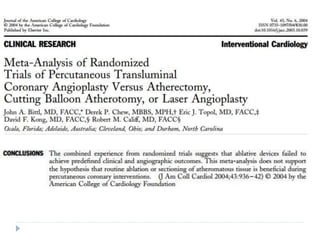
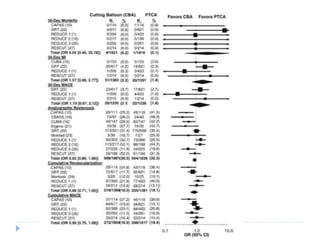
 In RCT, cutting balloon alone has not shown to
improve outcomes compared to balloon angioplasty
 CBA – Plaque modification in complex procedures
 Bifurcation lesions
 Ostial lesions
 Mild to moderately calcified lesions
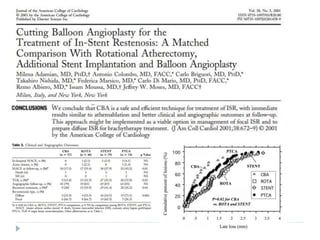
 Instent restenosis
Lesion selection
 Bifurcation lesion – plaque shift and high
restenosis
CBA lower restenosis (40 % vs 67%)
 Instent restenosis (REDUCE 3 trial )
Reduced balloon slippage
Plaque extension through the stent struts
 Ostial lesions
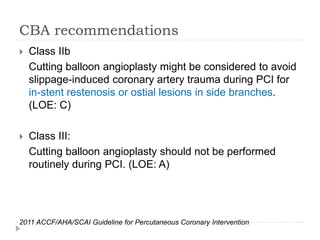
CBA recommendations
 Class IIb
Cutting balloon angioplasty might be considered to avoid
slippage-induced coronary artery trauma during PCI for
in-stent restenosis or ostial lesions in side branches.
(LOE: C)
 Class III:
Cutting balloon angioplasty should not be performed
routinely during PCI. (LOE: A)
2011 ACCF/AHA/SCAI Guideline for Percutaneous Coronary Intervention
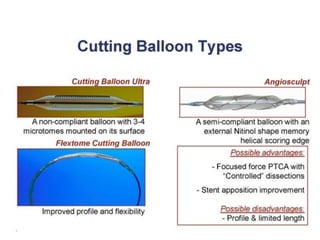
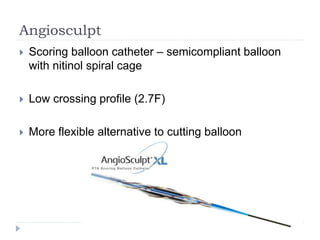
Angiosculpt
 Scoring balloon catheter – semicompliant balloon
with nitinol spiral cage
 Low crossing profile (2.7F)
 More flexible alternative to cutting balloon
Laser angioplasty
 ELCA – precise plaque removal
 Infrequently used (high cost, lack of benefit over PCI
alone)
 Adjunctive method for debulking
Excimer laser
Excimer laser in UV wavelength is well absorbed by both
atheromatous plaques and thrombi
Laser :
 Thrombolysis
 Inhibit platelet aggregation
 May ablate atherosclerotic plaque
Tissue ablation mechanisms:
 Vaporization of tissue (Photothermal effect)
 Ejection of debris (Photoacoustic effect)
 Direct breakdown of molecules (Photochemical dissociation)
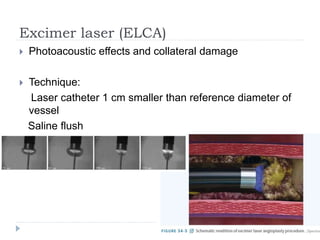
Excimer laser (ELCA)
 Photoacoustic effects and collateral damage
 Technique:
Laser catheter 1 cm smaller than reference diameter of
vessel
Saline flush
Slow catheter advancement at 0.2 mm/s → maximal
ablation
ECLA: Lesion selection
 Long lesions
 Moderately calcified lesions
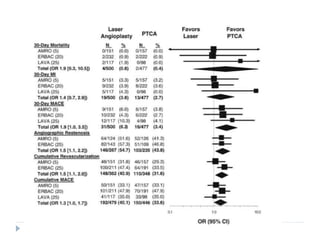
 Total occlusions (AMRO trial – successful recanalization
in 60 % of uncrossable total occlusions with conventional
guidewires)
 Undilatable lesions ( ECLA has similar success rate as
PTRA)
 No benefit in ISR
ECLA recommendations
 Class IIb .
Laser angioplasty might be considered for fibrotic or
moderately calcified lesions that cannot be crossed
or dilated with conventional balloon
angioplasty.(LOE: C)
 Class III.
Laser angioplasty should not be used routinely
during PCI. (LOE: A)
2011 ACCF/AHA/SCAI Guideline for Percutaneous Coronary Intervention
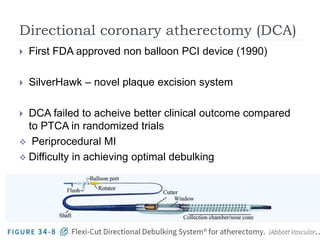
Directional coronary atherectomy (DCA)
 First FDA approved non balloon PCI device (1990)
 SilverHawk – novel plaque excision system
 DCA failed to acheive better clinical outcome compared
to PTCA in randomized trials
 Periprocedural MI
 Difficulty in achieving optimal debulking
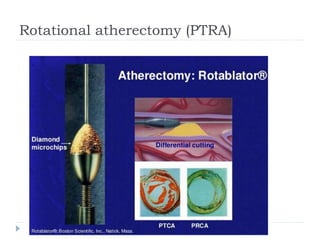
Rotational atherectomy (PTRA)
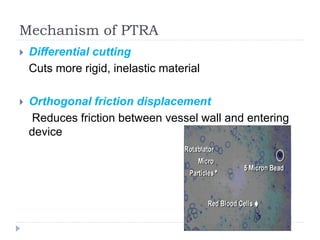
Mechanism of PTRA
 Differential cutting
Cuts more rigid, inelastic material
 Orthogonal friction displacement
Reduces friction between vessel wall and entering
device
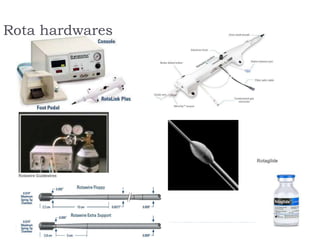
Rota hardwares
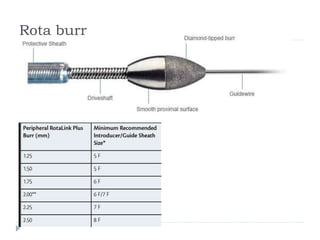
Rota burr
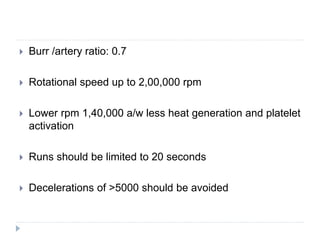
 Burr /artery ratio: 0.7
 Rotational speed up to 2,00,000 rpm
 Lower rpm 1,40,000 a/w less heat generation and platelet
activation
 Runs should be limited to 20 seconds
 Decelerations of >5000 should be avoided
Contraindications to Rotablation
 Dissection
 Angulated lesions (> 60-90⁰)
 Thrombus containing lesion
 Saphenous venous grafts
 Acute MI
Indications for PTRA
 Calcified lesions
 Undilatable lesions
 Bifurcation lesion
 Ostial lesion
Complications
 Slow flow, no reflow
 Non QWMI
 Coronary perforation
 Dissection
 Bradycardia & AV block
 Vasospasm
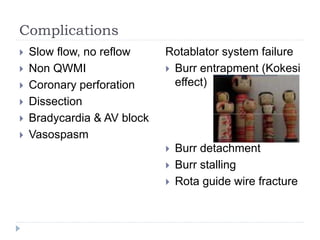
Rotablator system failure
 Burr entrapment (Kokesi
effect)
 Burr detachment
 Burr stalling
 Rota guide wire fracture
PTRA recommendations
 Class IIa
Rotational atherectomy is reasonable for fibrotic or
heavily calcified lesions that might not be crossed by a
balloon catheter or adequately dilated before stent
implantation. (LOE: C)
 Class III:
Rotational atherectomy should not be performed routinely
for de novo lesions or in-stent restenosis. (LOE: A)
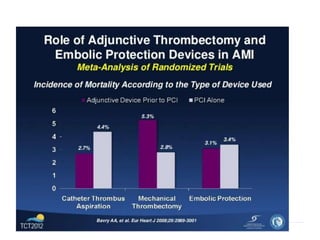
Mechanical thrombectomy
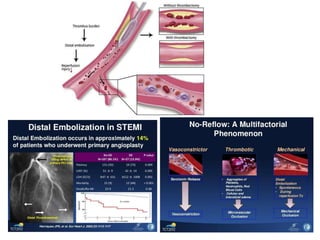
 PCI in acute MI @ distal emboli, no reflow & abrupt
closure
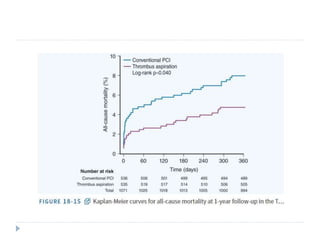
 Thrombectomy in primary PCI was a/w improved
myocardial perfusion (TIMI III flow, MBG 3, & ST
resolution)
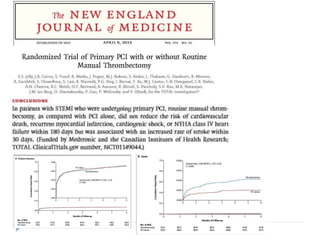
 No difference in overall 30 day mortality
 Increased risk of stroke
 Survival benefit with manual aspiration catheters and
worse outcome with mechanical devices
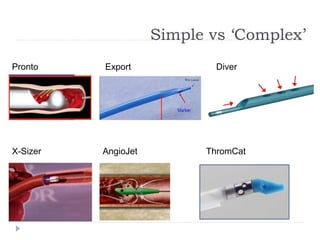
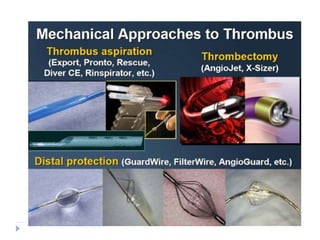
Simple vs ‘Complex’
X-Sizer AngioJet ThromCat
Pronto Export Diver
Manual thrombus aspiration
 Reduction of thrombotic burden
 Prevents of thrombus embolization
 Preservation of microvascular integrity
 Reduction of infarct size
 Improved myocardial tissue perfusion
 Improved LV function recovery and modelling
Limitations:
 Difficult delivery along tortuous vessels
 Reduced ability to aspirate at distal segment
 Dissection/perforation
 Distal embolization
 Insufficient thrombus removal
Power sourced thrombectomy devices
 Angiojet rheolytic thrombectomy
 Excimer laser
 X-Sizer
 Higher extraction yield in large thrombus burden
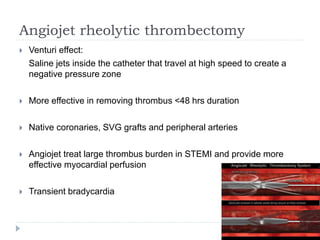
Angiojet rheolytic thrombectomy
 Venturi effect:
Saline jets inside the catheter that travel at high speed to create a
negative pressure zone
 More effective in removing thrombus <48 hrs duration
 Native coronaries, SVG grafts and peripheral arteries
 Angiojet treat large thrombus burden in STEMI and provide more
effective myocardial perfusion
 Transient bradycardia
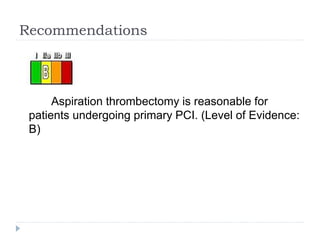
Recommendations
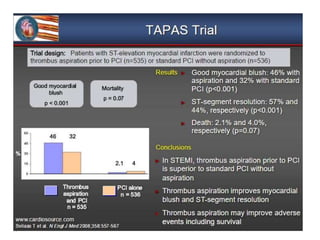
Aspiration thrombectomy is reasonable for
patients undergoing primary PCI. (Level of Evidence:
B)
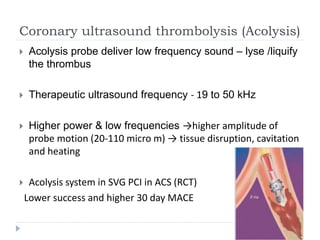
Coronary ultrasound thrombolysis (Acolysis)
 Acolysis probe deliver low frequency sound – lyse /liquify
the thrombus
 Therapeutic ultrasound frequency - 19 to 50 kHz
 Higher power & low frequencies →higher amplitude of
probe motion (20-110 micro m) → tissue disruption, cavitation
and heating
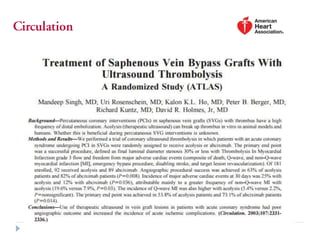
 Acolysis system in SVG PCI in ACS (RCT)
Lower success and higher 30 day MACE
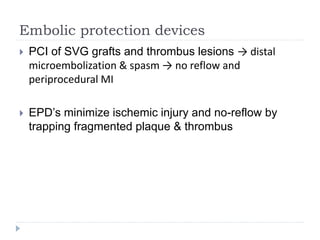
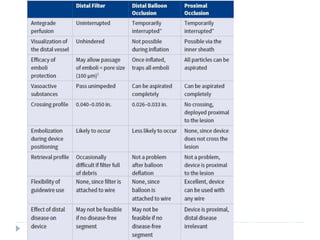
Embolic protection devices
 PCI of SVG grafts and thrombus lesions → distal
microembolization & spasm → no reflow and
periprocedural MI
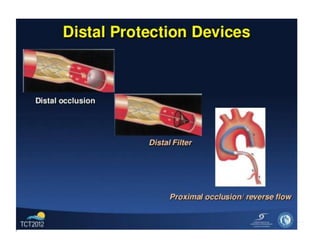
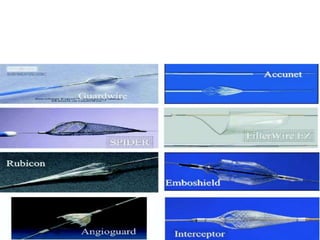
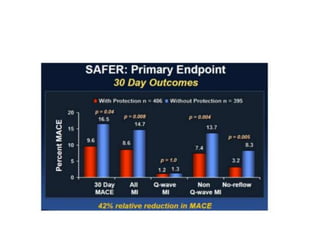
 EPD’s minimize ischemic injury and no-reflow by
trapping fragmented plaque & thrombus
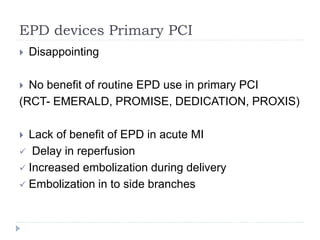
EPD devices Primary PCI
 Disappointing
 No benefit of routine EPD use in primary PCI
(RCT- EMERALD, PROMISE, DEDICATION, PROXIS)
 Lack of benefit of EPD in acute MI
 Delay in reperfusion
 Increased embolization during delivery
 Embolization in to side branches
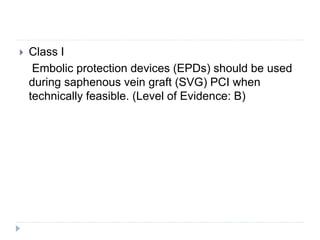
 Class I
Embolic protection devices (EPDs) should be used
during saphenous vein graft (SVG) PCI when
technically feasible. (Level of Evidence: B)
THANK YOU

Adjunct devices in pci

  • 1.
    Role of Adjunctdevices in PCI Dr Mahadeva Swamy B SR Cardiology, JIPMER
  • 2.
    Adjunct devices inPCI  Plaque modification  Cutting Balloon (CBA)  Laser (ELCA)  Atherectomy (DCA, PTRA)  Thrombectomy  EPD
  • 4.
    Plaque modification  Atheroablativedevices during PCI → facilitate procedural success and reduce restenosis  Plaque modification is valuable tool for treatment of complex lesions  Vessel pretreatment → larger MLD and lower TLR rate
  • 5.
    Lesion pretreatment &plaque modification  Regular balloon & stent do not adequately address problems of plaque shift and resistant lesions  Lesion pretreatment is to facilitate procedural success and reduces restenosis  Mechanism:  Minimizes plaque shifting  Decreases recoil  Optimal stent expansion
  • 7.
    Cutting balloon angioplasty(CBA)  Cutting balloon – controlled longitudinal incisions (atherotomy)  Improve luminal enlargement at lower pressure inflation  Improved acute results with less barotrauma → long term clinical benefit
  • 10.
    Mechanism of actionof CBA  Controlled microincisions in atheroma at lower pressure – reduced barotrauma  Better luminal enlargement at lower pressures  In calcified lesions, CBA achieves larger lumen gain
  • 11.
  • 12.
    Equipment  Cutting balloons– 6, 10 & 15 mm  Atherotomes (3-4)are mounted longitudinally along the balloon surface Atherotomes Balloon diameter 3 2 & 3.25 mm 4 3.5 & 4 mm
  • 13.
    Technique  Less compliantand trackability  Tortuous proximal anatomy – CBA may not be feasible  Risk of blade fracture or retention – minimized by slowly inflation and deflation Complications:  Slightly higher risk of coronary perforation (0.8 % vs 0.0 %)
  • 15.
    Conclusion: Cutting/scoring balloon In RCT, cutting balloon alone has not shown to improve outcomes compared to balloon angioplasty  CBA – Plaque modification in complex procedures  Bifurcation lesions  Ostial lesions  Mild to moderately calcified lesions  Instent restenosis
  • 16.
    Lesion selection  Bifurcationlesion – plaque shift and high restenosis CBA lower restenosis (40 % vs 67%)  Instent restenosis (REDUCE 3 trial ) Reduced balloon slippage Plaque extension through the stent struts  Ostial lesions
  • 18.
    CBA recommendations  ClassIIb Cutting balloon angioplasty might be considered to avoid slippage-induced coronary artery trauma during PCI for in-stent restenosis or ostial lesions in side branches. (LOE: C)  Class III: Cutting balloon angioplasty should not be performed routinely during PCI. (LOE: A) 2011 ACCF/AHA/SCAI Guideline for Percutaneous Coronary Intervention
  • 19.
    Angiosculpt  Scoring ballooncatheter – semicompliant balloon with nitinol spiral cage  Low crossing profile (2.7F)  More flexible alternative to cutting balloon
  • 21.
    Laser angioplasty  ELCA– precise plaque removal  Infrequently used (high cost, lack of benefit over PCI alone)  Adjunctive method for debulking
  • 22.
    Excimer laser Excimer laserin UV wavelength is well absorbed by both atheromatous plaques and thrombi Laser :  Thrombolysis  Inhibit platelet aggregation  May ablate atherosclerotic plaque Tissue ablation mechanisms:  Vaporization of tissue (Photothermal effect)  Ejection of debris (Photoacoustic effect)  Direct breakdown of molecules (Photochemical dissociation)
  • 23.
    Excimer laser (ELCA) Photoacoustic effects and collateral damage  Technique: Laser catheter 1 cm smaller than reference diameter of vessel Saline flush Slow catheter advancement at 0.2 mm/s → maximal ablation
  • 25.
    ECLA: Lesion selection Long lesions  Moderately calcified lesions  Total occlusions (AMRO trial – successful recanalization in 60 % of uncrossable total occlusions with conventional guidewires)  Undilatable lesions ( ECLA has similar success rate as PTRA)  No benefit in ISR
  • 26.
    ECLA recommendations  ClassIIb . Laser angioplasty might be considered for fibrotic or moderately calcified lesions that cannot be crossed or dilated with conventional balloon angioplasty.(LOE: C)  Class III. Laser angioplasty should not be used routinely during PCI. (LOE: A) 2011 ACCF/AHA/SCAI Guideline for Percutaneous Coronary Intervention
  • 27.
    Directional coronary atherectomy(DCA)  First FDA approved non balloon PCI device (1990)  SilverHawk – novel plaque excision system  DCA failed to acheive better clinical outcome compared to PTCA in randomized trials  Periprocedural MI  Difficulty in achieving optimal debulking
  • 28.
  • 29.
    Mechanism of PTRA Differential cutting Cuts more rigid, inelastic material  Orthogonal friction displacement Reduces friction between vessel wall and entering device
  • 30.
  • 31.
  • 32.
     Burr /arteryratio: 0.7  Rotational speed up to 2,00,000 rpm  Lower rpm 1,40,000 a/w less heat generation and platelet activation  Runs should be limited to 20 seconds  Decelerations of >5000 should be avoided
  • 33.
    Contraindications to Rotablation Dissection  Angulated lesions (> 60-90⁰)  Thrombus containing lesion  Saphenous venous grafts  Acute MI
  • 34.
    Indications for PTRA Calcified lesions  Undilatable lesions  Bifurcation lesion  Ostial lesion
  • 35.
    Complications  Slow flow,no reflow  Non QWMI  Coronary perforation  Dissection  Bradycardia & AV block  Vasospasm Rotablator system failure  Burr entrapment (Kokesi effect)  Burr detachment  Burr stalling  Rota guide wire fracture
  • 37.
    PTRA recommendations  ClassIIa Rotational atherectomy is reasonable for fibrotic or heavily calcified lesions that might not be crossed by a balloon catheter or adequately dilated before stent implantation. (LOE: C)  Class III: Rotational atherectomy should not be performed routinely for de novo lesions or in-stent restenosis. (LOE: A)
  • 40.
    Mechanical thrombectomy  PCIin acute MI @ distal emboli, no reflow & abrupt closure  Thrombectomy in primary PCI was a/w improved myocardial perfusion (TIMI III flow, MBG 3, & ST resolution)  No difference in overall 30 day mortality  Increased risk of stroke  Survival benefit with manual aspiration catheters and worse outcome with mechanical devices
  • 41.
    Simple vs ‘Complex’ X-SizerAngioJet ThromCat Pronto Export Diver
  • 42.
    Manual thrombus aspiration Reduction of thrombotic burden  Prevents of thrombus embolization  Preservation of microvascular integrity  Reduction of infarct size  Improved myocardial tissue perfusion  Improved LV function recovery and modelling
  • 45.
    Limitations:  Difficult deliveryalong tortuous vessels  Reduced ability to aspirate at distal segment  Dissection/perforation  Distal embolization  Insufficient thrombus removal
  • 46.
    Power sourced thrombectomydevices  Angiojet rheolytic thrombectomy  Excimer laser  X-Sizer  Higher extraction yield in large thrombus burden
  • 47.
    Angiojet rheolytic thrombectomy Venturi effect: Saline jets inside the catheter that travel at high speed to create a negative pressure zone  More effective in removing thrombus <48 hrs duration  Native coronaries, SVG grafts and peripheral arteries  Angiojet treat large thrombus burden in STEMI and provide more effective myocardial perfusion  Transient bradycardia
  • 51.
    Recommendations Aspiration thrombectomy isreasonable for patients undergoing primary PCI. (Level of Evidence: B)
  • 52.
    Coronary ultrasound thrombolysis(Acolysis)  Acolysis probe deliver low frequency sound – lyse /liquify the thrombus  Therapeutic ultrasound frequency - 19 to 50 kHz  Higher power & low frequencies →higher amplitude of probe motion (20-110 micro m) → tissue disruption, cavitation and heating  Acolysis system in SVG PCI in ACS (RCT) Lower success and higher 30 day MACE
  • 54.
    Embolic protection devices PCI of SVG grafts and thrombus lesions → distal microembolization & spasm → no reflow and periprocedural MI  EPD’s minimize ischemic injury and no-reflow by trapping fragmented plaque & thrombus
  • 58.
    EPD devices PrimaryPCI  Disappointing  No benefit of routine EPD use in primary PCI (RCT- EMERALD, PROMISE, DEDICATION, PROXIS)  Lack of benefit of EPD in acute MI  Delay in reperfusion  Increased embolization during delivery  Embolization in to side branches
  • 59.
     Class I Embolicprotection devices (EPDs) should be used during saphenous vein graft (SVG) PCI when technically feasible. (Level of Evidence: B)
  • 61.