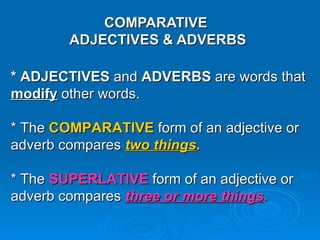
COMPARATIVE  ADJECTIVES & ADVERBS * ADJECTIVES  and  ADVERBS  are words that  modify   other words.  * The  COMPARATIVE  form of an adjective or adverb compares  two things .   * The  SUPERLATIVE  form of an adjective or adverb compares  three or more things .
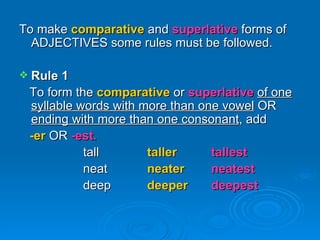
To make  comparative  and  superlative  forms of ADJECTIVES some rules must be followed. Rule 1  To form the  comparative  or  superlative   of one syllable words with more than one vowel  OR  ending with more than one consonant , add  -er  OR  -est.   tall  taller   tallest   neat  neater   neatest   deep  deeper   deepest  
Rule 2   To form the  comparative  or  superlative  of  a one syllable word  ending in  “e”  add  -r  OR  -st .  wid e wider widest fin e finer finest   cut e   cuter   cutest
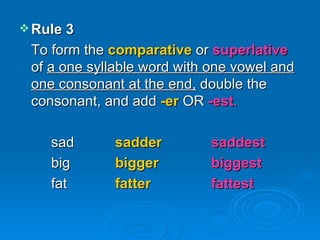
Rule 3  To form the  comparative  or  superlative  of  a one syllable word with one vowel and one consonant at the end,  double the consonant, and add  -er  OR  -est .   sad  sadder   saddest   big  bigger  biggest   fat  fatter   fattest
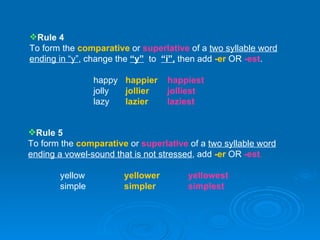
Rule 4  To form the  comparative  or  superlative  of a  two syllable word ending in “y” , change the  “y”   to  “i”,  then add  -er  OR  -est .  happy  happier   happiest   jolly  jollier     jolliest lazy  lazier     laziest Rule 5  To form the  comparative  or  superlative  of a  two syllable word ending a vowel-sound that is not stressed , add  -er  OR  -est .   yellow yellower yellowest simple simpler simplest
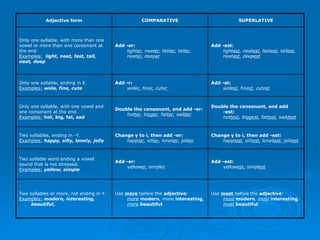
Use  most  before the  adjective : most   modern ,  most   interesting ,  most   beautiful  Use  more  before the  adjective : more   modern ,  more   interesting ,  more   beautiful   Two syllables or more, not ending in Y.  Examples:   modern, interesting, beautiful ,   Add -est: yellow est , simpl est Add -er: yellow er , simple r Two syllable word ending a vowel sound that is not stressed. Examples:   yellow, simple Change y to i, then add -est: happ iest , sill iest , lonel iest , joll iest Change y to i, then add -er: happ ier , sill ier , lonel ier , joll ier Two syllables, ending in -Y.  Examples:   happy, silly, lonely, jolly Double the consonant, and add -est: hot test , big gest , fat test , sad dest Double the consonant, and add -er: hot ter , big ger , fat ter , sad der Only one syllable, with one vowel and one consonant at the end.  Examples:   hot, big, fat, sad Add -st: wide st , fine st , cute st   Add -r: wide r , fine r , cute r   Only one syllable, ending in E.  Examples:   wide, fine, cute   Add -est: light est , neat est , fast est , tall est , neat est , deep est Add   -er: light er , neat er , fast er , tall er , neat er , deep er Only one syllable, with more than one vowel or more than one consonant at the end.  Examples:   light, neat, fast, tall, neat, deep SUPERLATIVE COMPARATIVE Adjective form
Like adjectives  some adverbs  can take  comparative  and  superlative  forms,  with  -er  and   -est :    highest higher high brightest brighter bright earliest earlier early quickest quicker quick slowest slower slow fastest faster fast proudest prouder proud Superlative  Comparative  Adverb
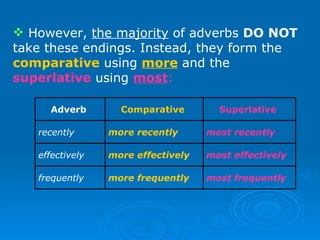
However,  the majority  of adverbs  DO NOT  take these endings. Instead, they form the  comparative  using  more   and the  superlative  using  most :     most frequently more frequently frequently most effectively more effectively effectively most recently more recently recently Superlative  Comparative  Adverb
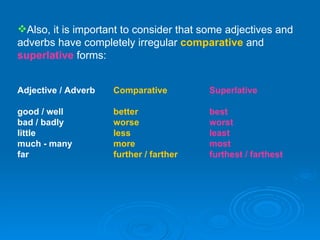
Also, it is important to consider that some adjectives and adverbs have completely irregular  comparative  and  superlative  forms: Adjective / Adverb Comparative Superlative good / well better best bad / badly worse worst little less least much - many more most far further / farther furthest / farthest
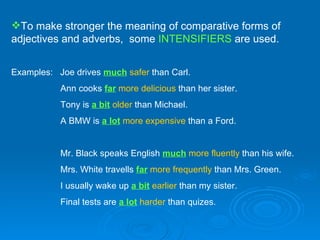
To make stronger the meaning of comparative forms of adjectives and adverbs,  some  INTENSIFIERS  are used. Examples:  Joe drives  much   safer  than Carl.   Ann cooks  far   more delicious  than her sister.   Tony is  a bit   older  than Michael.   A BMW is  a lot   more expensive  than a Ford.     Mr. Black speaks English  much   more fluently  than his wife.   Mrs. White travells  far   more frequently  than Mrs. Green.   I usually wake up  a bit   earlier  than my sister.   Final tests are  a lot   harder  than quizes.
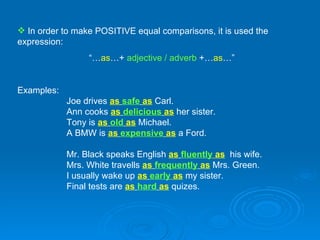
In order to make POSITIVE equal comparisons, it is used the expression:  “… as …+  adjective / adverb  +… as …” Examples:   Joe drives  as   safe   as  Carl.   Ann cooks  as   delicious   as   her sister.   Tony is  as   old   as  Michael.   A BMW is  as   expensive   as  a Ford.     Mr. Black speaks English  as   fluently   as   his wife.   Mrs. White travells  as   frequently   as  Mrs. Green.   I usually wake up  as   early   as   my sister.   Final tests are  as   hard   as  quizes.
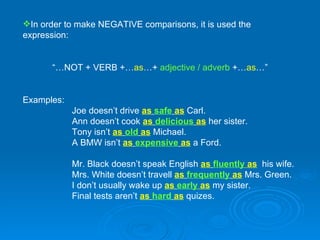
In order to make NEGATIVE comparisons, it is used the expression:  “… NOT + VERB +… as …+  adjective / adverb  +… as …” Examples:   Joe doesn’t drive  as   safe   as  Carl.   Ann doesn’t cook  as   delicious   as   her sister.   Tony isn’t  as   old   as  Michael.   A BMW isn’t  as   expensive   as  a Ford.     Mr. Black doesn’t speak English  as   fluently   as   his wife.   Mrs. White doesn’t travell  as   frequently   as  Mrs. Green.   I don’t usually wake up  as   early   as   my sister.   Final tests aren’t  as   hard   as  quizes.

Adjectives and adverbs

  • 1.
    COMPARATIVE ADJECTIVES& ADVERBS * ADJECTIVES and ADVERBS are words that modify other words. * The COMPARATIVE form of an adjective or adverb compares two things . * The SUPERLATIVE form of an adjective or adverb compares three or more things .
  • 2.
    To make comparative and superlative forms of ADJECTIVES some rules must be followed. Rule 1 To form the comparative or superlative of one syllable words with more than one vowel OR ending with more than one consonant , add -er OR -est. tall taller tallest neat neater neatest deep deeper deepest  
  • 3.
    Rule 2 To form the comparative or superlative of a one syllable word ending in “e” add -r OR -st . wid e wider widest fin e finer finest cut e cuter cutest
  • 4.
    Rule 3 To form the comparative or superlative of a one syllable word with one vowel and one consonant at the end, double the consonant, and add -er OR -est . sad sadder saddest big bigger biggest fat fatter fattest
  • 5.
    Rule 4 To form the comparative or superlative of a two syllable word ending in “y” , change the “y” to “i”, then add -er OR -est . happy happier happiest jolly jollier jolliest lazy lazier laziest Rule 5 To form the comparative or superlative of a two syllable word ending a vowel-sound that is not stressed , add -er OR -est . yellow yellower yellowest simple simpler simplest
  • 6.
    Use most before the adjective : most modern , most interesting , most beautiful Use more before the adjective : more modern , more interesting , more beautiful Two syllables or more, not ending in Y. Examples: modern, interesting, beautiful , Add -est: yellow est , simpl est Add -er: yellow er , simple r Two syllable word ending a vowel sound that is not stressed. Examples: yellow, simple Change y to i, then add -est: happ iest , sill iest , lonel iest , joll iest Change y to i, then add -er: happ ier , sill ier , lonel ier , joll ier Two syllables, ending in -Y. Examples: happy, silly, lonely, jolly Double the consonant, and add -est: hot test , big gest , fat test , sad dest Double the consonant, and add -er: hot ter , big ger , fat ter , sad der Only one syllable, with one vowel and one consonant at the end. Examples: hot, big, fat, sad Add -st: wide st , fine st , cute st Add -r: wide r , fine r , cute r Only one syllable, ending in E. Examples: wide, fine, cute Add -est: light est , neat est , fast est , tall est , neat est , deep est Add -er: light er , neat er , fast er , tall er , neat er , deep er Only one syllable, with more than one vowel or more than one consonant at the end. Examples: light, neat, fast, tall, neat, deep SUPERLATIVE COMPARATIVE Adjective form
  • 7.
    Like adjectives some adverbs can take comparative and superlative forms, with -er and -est :  highest higher high brightest brighter bright earliest earlier early quickest quicker quick slowest slower slow fastest faster fast proudest prouder proud Superlative Comparative Adverb
  • 8.
    However, themajority of adverbs DO NOT take these endings. Instead, they form the comparative using more and the superlative using most :     most frequently more frequently frequently most effectively more effectively effectively most recently more recently recently Superlative Comparative Adverb
  • 9.
    Also, it isimportant to consider that some adjectives and adverbs have completely irregular comparative and superlative forms: Adjective / Adverb Comparative Superlative good / well better best bad / badly worse worst little less least much - many more most far further / farther furthest / farthest
  • 10.
    To make strongerthe meaning of comparative forms of adjectives and adverbs, some INTENSIFIERS are used. Examples: Joe drives much safer than Carl. Ann cooks far more delicious than her sister. Tony is a bit older than Michael. A BMW is a lot more expensive than a Ford. Mr. Black speaks English much more fluently than his wife. Mrs. White travells far more frequently than Mrs. Green. I usually wake up a bit earlier than my sister. Final tests are a lot harder than quizes.
  • 11.
    In order tomake POSITIVE equal comparisons, it is used the expression: “… as …+ adjective / adverb +… as …” Examples: Joe drives as safe as Carl. Ann cooks as delicious as her sister. Tony is as old as Michael. A BMW is as expensive as a Ford. Mr. Black speaks English as fluently as his wife. Mrs. White travells as frequently as Mrs. Green. I usually wake up as early as my sister. Final tests are as hard as quizes.
  • 12.
    In order tomake NEGATIVE comparisons, it is used the expression: “… NOT + VERB +… as …+ adjective / adverb +… as …” Examples: Joe doesn’t drive as safe as Carl. Ann doesn’t cook as delicious as her sister. Tony isn’t as old as Michael. A BMW isn’t as expensive as a Ford. Mr. Black doesn’t speak English as fluently as his wife. Mrs. White doesn’t travell as frequently as Mrs. Green. I don’t usually wake up as early as my sister. Final tests aren’t as hard as quizes.