Comparative and Superlative
Adjectives and Adverbs
Identify the correct use of adjectives (i.e.,
common/proper, comparative forms, predicate
adjectives) and adverbs (i.e., comparative forms,
negatives) within context.
Adjectives and adverbs are words that describe or modify other words.
*The comparative form of an adjective or adverb compares two things.
*The superlative form of an adjective or adverb compares three or more
things.
Examples
Adjectives
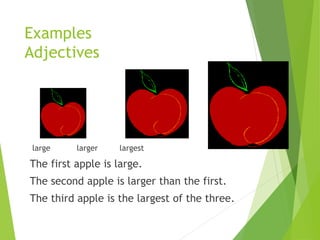
large larger largest
The first apple is large.
The second apple is larger than the first.
The third apple is the largest of the three.
The jalopy is a fastcar.
The racecar is the fastercar.
The dragster is the fastestcar.
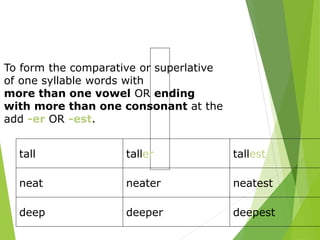
tall taller tallest
neat neater neatest
deep deeper deepest
To form the comparative or superlative
of one syllable words with
more than one vowel OR ending
with more than one consonant at the
add -er OR -est.
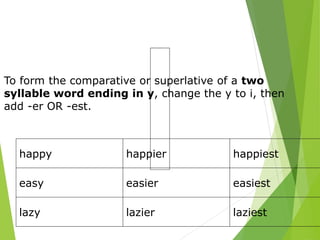
happy happier happiest
easy easier easiest
lazy lazier laziest
To form the comparative or superlative of a two
syllable word ending in y, change the y to i, then
add -er OR -est.
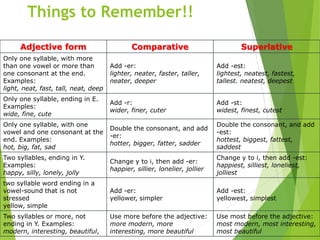
Things to Remember!!
Adjective form Comparative Superlative
Only one syllable, with more
than one vowel or more than
one consonant at the end.
Examples:
light, neat, fast, tall, neat, deep
Add -er:
lighter, neater, faster, taller,
neater, deeper
Add -est:
lightest, neatest, fastest,
tallest. neatest, deepest
Only one syllable, ending in E.
Examples:
wide, fine, cute
Add -r:
wider, finer, cuter
Add -st:
widest, finest, cutest
Only one syllable, with one
vowel and one consonant at the
end. Examples:
hot, big, fat, sad
Double the consonant, and add
-er:
hotter, bigger, fatter, sadder
Double the consonant, and add
-est:
hottest, biggest, fattest,
saddest
Two syllables, ending in Y.
Examples:
happy, silly, lonely, jolly
Change y to i, then add -er:
happier, sillier, lonelier, jollier
Change y to i, then add -est:
happiest, silliest, loneliest,
jolliest
two syllable word ending in a
vowel-sound that is not
stressed
yellow, simple
Add -er:
yellower, simpler
Add -est:
yellowest, simplest
Two syllables or more, not
ending in Y. Examples:
modern, interesting, beautiful,
Use more before the adjective:
more modern, more
interesting, more beautiful
Use most before the adjective:
most modern, most interesting,
most beautiful
Like adjectives, some adverbs can take comparative
and superlative forms, with -er and –est.
Sally works hard.
Steve works harder than Sally.
Kathy and Sue work hardest of all.
The bird sings loudly.
The children sing more loudly than the bird.
Of all three, Pete sings most loudly.
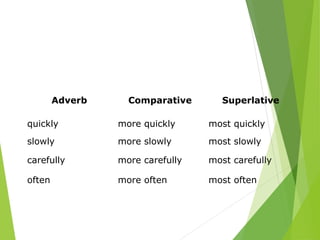
For adverbs ending in –ly, add “more” to the original adverb to
form the comparative, and “most” to form the superlative.
Adverb Comparative Superlative
quickly more quickly most quickly
slowly more slowly most slowly
carefully more carefully most carefully
often more often most often
Irregular Comparative and
Superlative Adjectives and
Adverbs
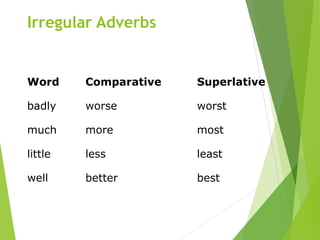
Some comparative and superlative forms are irregular and
do not follow any rules or patterns. These must be
memorized.
Irregular Adverbs
Word Comparative Superlative
badly worse worst
much more most
little less least
well better best
Irregular Adjectives
Word Comparative Superlative
good better best
bad worse worst
much more most
little less least
old
older
elder
oldest
eldest
Example:
Comparative and Superlative of GOOD
Nathan made good stew.
Molly's stew was better than Nathan's.
Ezra made the best stew of all.
Comparative and Superlative of WELL
Joana drives well.
Jenny drives better than Joana.
Lisa drives the best.
 We use as … as to say that things are equal
or unequal.
Our house is as big as yours.
It isn’t as cold as yesterday.
 We often use a phrase with “than” after a
comparison.
The steak is more expensive than the fish.
 After “than” we use an object pronoun or a
subject pronoun + a verb.
She is older than me / than I am.
COMPARATIVE AND SUPERLATIVE PATTERNS I
 We normally use the before a superlative.
The last question is the most difficult.
 Note the pattern with one of.
He is one of the best lawyers.
 After a superlative we can use in or of. We use
in with places and groups of people.
It’s the coolest hotel in Oxford.
Who’s the best player in the team?
August is the hottest month of the year.
COMPARATIVE AND SUPERLATIVE
PATTERNS II
 Less and least are the opposites of more and
most. We use them with both long and short
words.
I’m the least musical person in the world.
I go out less often these days.
 We can modify the comparative with much, a
lot, far, slightly, a bit.
It’s much faster by tube.
Business is a bit better this year.
I got up far later than usually.
COMPARATIVE AND SUPERLATIVE
PATTERNS III
 When something is increasing all the time we
use a double comparative.
The queue was getting longer and longer.
Everything gets more and more expensive
these days.
 We use two comparatives with “the” to
express that a change in one thing goes with a
change in another.
The sooner we leave, the sooner we’ll get
there.
The faster, the better.
COMPARATIVE AND SUPERLATIVE
PATTERNS IV
Exercises:
 https://www.ego4u.com/en/cram-
up/grammar/adjectives-adverbs/three-pigs

comparatve.ppt

  • 1.
    Comparative and Superlative Adjectivesand Adverbs Identify the correct use of adjectives (i.e., common/proper, comparative forms, predicate adjectives) and adverbs (i.e., comparative forms, negatives) within context.
  • 2.
    Adjectives and adverbsare words that describe or modify other words. *The comparative form of an adjective or adverb compares two things. *The superlative form of an adjective or adverb compares three or more things.
  • 3.
    Examples Adjectives large larger largest Thefirst apple is large. The second apple is larger than the first. The third apple is the largest of the three.
  • 4.
    The jalopy isa fastcar. The racecar is the fastercar. The dragster is the fastestcar.
  • 5.
    tall taller tallest neatneater neatest deep deeper deepest To form the comparative or superlative of one syllable words with more than one vowel OR ending with more than one consonant at the add -er OR -est.
  • 6.
    happy happier happiest easyeasier easiest lazy lazier laziest To form the comparative or superlative of a two syllable word ending in y, change the y to i, then add -er OR -est.
  • 7.
    Things to Remember!! Adjectiveform Comparative Superlative Only one syllable, with more than one vowel or more than one consonant at the end. Examples: light, neat, fast, tall, neat, deep Add -er: lighter, neater, faster, taller, neater, deeper Add -est: lightest, neatest, fastest, tallest. neatest, deepest Only one syllable, ending in E. Examples: wide, fine, cute Add -r: wider, finer, cuter Add -st: widest, finest, cutest Only one syllable, with one vowel and one consonant at the end. Examples: hot, big, fat, sad Double the consonant, and add -er: hotter, bigger, fatter, sadder Double the consonant, and add -est: hottest, biggest, fattest, saddest Two syllables, ending in Y. Examples: happy, silly, lonely, jolly Change y to i, then add -er: happier, sillier, lonelier, jollier Change y to i, then add -est: happiest, silliest, loneliest, jolliest two syllable word ending in a vowel-sound that is not stressed yellow, simple Add -er: yellower, simpler Add -est: yellowest, simplest Two syllables or more, not ending in Y. Examples: modern, interesting, beautiful, Use more before the adjective: more modern, more interesting, more beautiful Use most before the adjective: most modern, most interesting, most beautiful
  • 8.
    Like adjectives, someadverbs can take comparative and superlative forms, with -er and –est. Sally works hard. Steve works harder than Sally. Kathy and Sue work hardest of all.
  • 9.
    The bird singsloudly. The children sing more loudly than the bird. Of all three, Pete sings most loudly. For adverbs ending in –ly, add “more” to the original adverb to form the comparative, and “most” to form the superlative.
  • 10.
    Adverb Comparative Superlative quicklymore quickly most quickly slowly more slowly most slowly carefully more carefully most carefully often more often most often
  • 11.
    Irregular Comparative and SuperlativeAdjectives and Adverbs Some comparative and superlative forms are irregular and do not follow any rules or patterns. These must be memorized.
  • 12.
    Irregular Adverbs Word ComparativeSuperlative badly worse worst much more most little less least well better best
  • 13.
    Irregular Adjectives Word ComparativeSuperlative good better best bad worse worst much more most little less least old older elder oldest eldest
  • 14.
    Example: Comparative and Superlativeof GOOD Nathan made good stew. Molly's stew was better than Nathan's. Ezra made the best stew of all. Comparative and Superlative of WELL Joana drives well. Jenny drives better than Joana. Lisa drives the best.
  • 15.
     We useas … as to say that things are equal or unequal. Our house is as big as yours. It isn’t as cold as yesterday.  We often use a phrase with “than” after a comparison. The steak is more expensive than the fish.  After “than” we use an object pronoun or a subject pronoun + a verb. She is older than me / than I am. COMPARATIVE AND SUPERLATIVE PATTERNS I
  • 16.
     We normallyuse the before a superlative. The last question is the most difficult.  Note the pattern with one of. He is one of the best lawyers.  After a superlative we can use in or of. We use in with places and groups of people. It’s the coolest hotel in Oxford. Who’s the best player in the team? August is the hottest month of the year. COMPARATIVE AND SUPERLATIVE PATTERNS II
  • 17.
     Less andleast are the opposites of more and most. We use them with both long and short words. I’m the least musical person in the world. I go out less often these days.  We can modify the comparative with much, a lot, far, slightly, a bit. It’s much faster by tube. Business is a bit better this year. I got up far later than usually. COMPARATIVE AND SUPERLATIVE PATTERNS III
  • 18.
     When somethingis increasing all the time we use a double comparative. The queue was getting longer and longer. Everything gets more and more expensive these days.  We use two comparatives with “the” to express that a change in one thing goes with a change in another. The sooner we leave, the sooner we’ll get there. The faster, the better. COMPARATIVE AND SUPERLATIVE PATTERNS IV
  • 19.