COMPARATIVES AND SUPERLATIVES ENGLISH CLASS
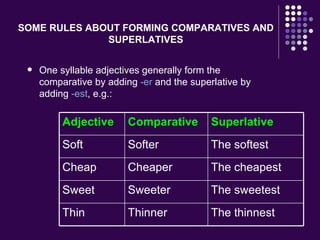
SOME RULES ABOUT FORMING COMPARATIVES AND SUPERLATIVES One syllable adjectives generally form the comparative by adding  -er  and the superlative by adding  -est , e.g.: Adjective Comparative Superlative Soft  Softer  The softest Cheap  Cheaper  The cheapest Sweet  Sweeter  The sweetest Thin  Thinner  The thinnest
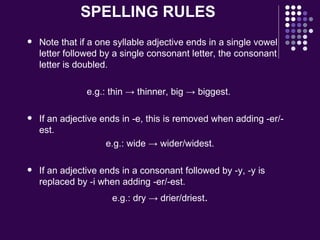
SPELLING RULES Note that if a one syllable adjective ends in a single vowel letter followed by a single consonant letter, the consonant letter is doubled. e.g.: thin -> thinner, big -> biggest.  If an adjective ends in -e, this is removed when adding -er/-est. e.g.: wide -> wider/widest.  If an adjective ends in a consonant followed by -y, -y is replaced by -i when adding -er/-est. e.g.: dry -> drier/driest .
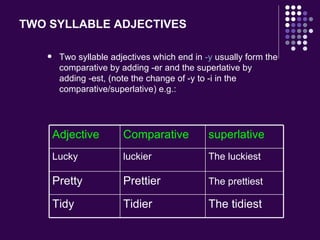
TWO SYLLABLE ADJECTIVES Two syllable adjectives which end in  -y  usually form the comparative by adding -er and the superlative by adding -est, (note the change of -y to -i in the comparative/superlative) e.g.: Adjective  Comparative  superlative Lucky  luckier The luckiest Pretty  Prettier  The prettiest   Tidy  Tidier  The tidiest
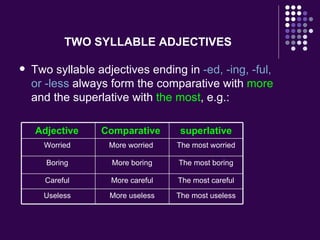
TWO SYLLABLE ADJECTIVES Two syllable adjectives ending in  -ed, -ing, -ful, or -less  always form the comparative with  more  and the superlative with  the most , e.g.:  Adjective  Comparative  superlative Worried  More worried  The most worried Boring  More boring The most boring Careful  More careful The most careful Useless  More useless The most useless
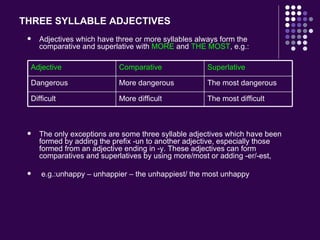
THREE SYLLABLE ADJECTIVES Adjectives which have three or more syllables always form the comparative and superlative with  MORE  and  THE MOST , e.g.: The only exceptions are some three syllable adjectives which have been formed by adding the prefix -un to another adjective, especially those formed from an adjective ending in -y. These adjectives can form comparatives and superlatives by using more/most or adding -er/-est, e.g.:unhappy – unhappier – the unhappiest/ the most unhappy Adjective  Comparative  Superlative  Dangerous  More dangerous  The most dangerous Difficult  More difficult The most difficult
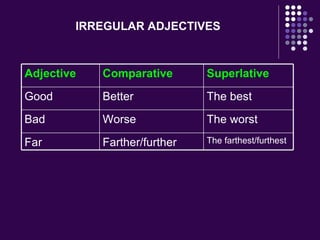
IRREGULAR ADJECTIVES Adjective  Comparative  Superlative  Good  Better  The best Bad  Worse  The worst Far  Farther/further The farthest/furthest
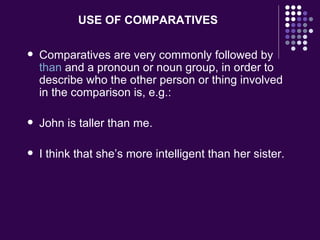
USE OF COMPARATIVES Comparatives are very commonly followed by  than  and a pronoun or noun group, in order to describe who the other person or thing involved in the comparison is, e.g.: John is taller than me. I think that she’s more intelligent than her sister.
BrainPop Adjectives http://www.brainpop.com/english/grammar/adjectives/
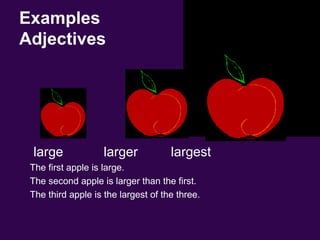
Examples  Adjectives large  larger  largest The first apple is large.  The second apple is larger than the first. The third apple is the largest of the three.
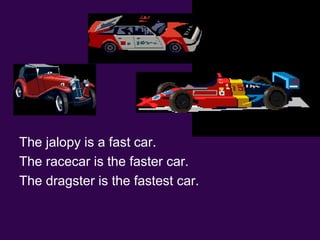
The jalopy is a fast car. The racecar is the faster car. The dragster is the fastest car.
REMEMBER To make comparative and superlative forms of adjectives some rules must be followed.
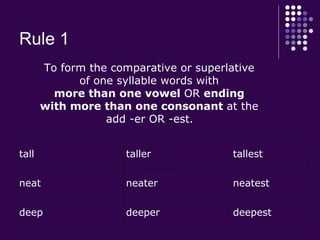
Rule 1     To form the comparative or superlative  of one syllable words with  more than one vowel  OR  ending  with more than one consonant  at the  add -er OR -est.   tall taller tallest neat neater neatest deep deeper deepest
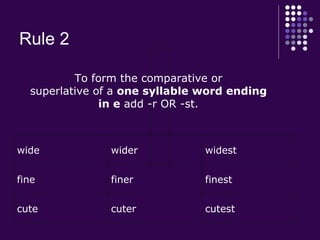
Rule 2     To form the comparative or  superlative of a  one syllable word ending  in e  add -r OR -st.  wide  wider widest fine  finer finest cute cuter  cutest
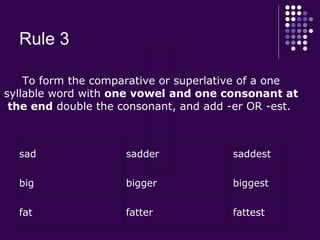
Rule 3     To form the comparative or superlative of a one syllable word with  one vowel and one consonant at the end  double the consonant, and add -er OR -est.  sad  sadder saddest big  bigger biggest fat fatter fattest
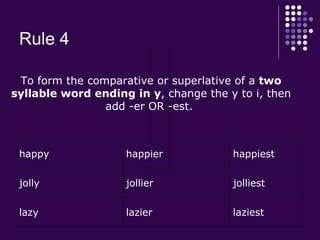
Rule 4     To form the comparative or superlative of a  two syllable word ending in y , change the y to i, then add -er OR -est.  happy  happier happiest jolly jollier jolliest lazy lazier laziest
Rule 5     To form the comparative or superlative of a  two syllable word ending a vowel-sound that is not stressed  then add -er OR -est.  Adjectives ending in –le, -ow, er frequently take –er and –est. yellow  yellower yellowest gentle gentler gentlest simple simpler simplest
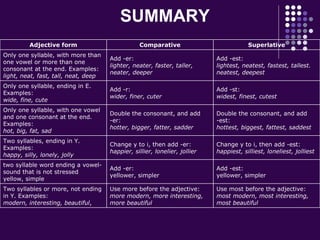
SUMMARY   Adjective form Comparative Superlative Only one syllable, with more than one vowel or more than one consonant at the end. Examples: light, neat, fast, tall, neat, deep Add -er: lighter, neater, faster, taller, neater, deeper Add -est: lightest, neatest, fastest, tallest. neatest, deepest Only one syllable, ending in E. Examples: wide, fine, cute   Add -r: wider, finer, cuter   Add -st: widest, finest, cutest   Only one syllable, with one vowel and one consonant at the end. Examples: hot, big, fat, sad Double the consonant, and add -er: hotter, bigger, fatter, sadder Double the consonant, and add -est: hottest, biggest, fattest, saddest Two syllables, ending in Y. Examples: happy, silly, lonely, jolly Change y to i, then add -er: happier, sillier, lonelier, jollier Change y to i, then add -est: happiest, silliest, loneliest, jolliest two syllable word ending a vowel-sound that is not stressed yellow, simple Add -er: yellower, simpler Add -est: yellower, simpler Two syllables or more, not ending in Y. Examples: modern, interesting, beautiful ,  Use more before the adjective: more modern, more interesting, more beautiful   Use most before the adjective: most modern, most interesting, most beautiful
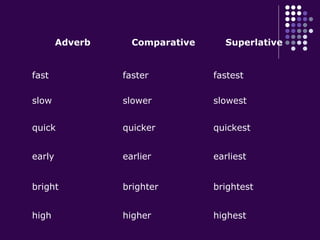
Adverb   Comparative   Superlative   fast faster fastest slow slower slowest quick quicker quickest early earlier earliest bright brighter brightest high higher highest
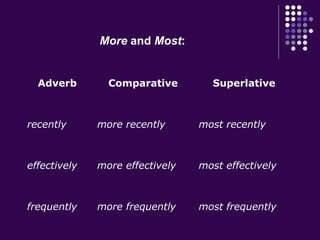
More  and  Most :     Adverb   Comparative   Superlative   recently more recently most recently effectively more effectively most effectively frequently more frequently most frequently
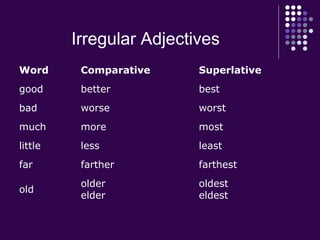
Irregular Adjectives   Word Comparative Superlative good better best bad worse worst much more most little less least far farther farthest old older elder oldest eldest
PRACTICE Write similar sentences -Nathan made  good  stew. -Molly's stew was  better  than Nathan's. -Ezra made the  best  stew of all.
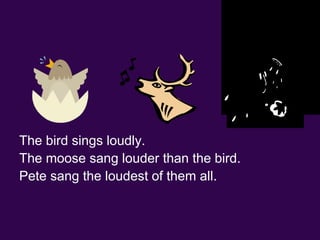
The bird sings loudly. The moose sang louder than the bird. Pete sang the loudest of them all.                                                   loud louder loudest
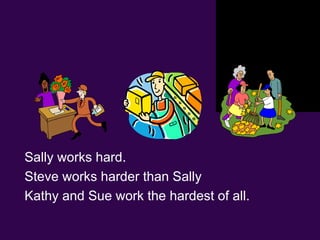
    Sally works hard. Steve works harder than Sally Kathy and Sue work the hardest of all.
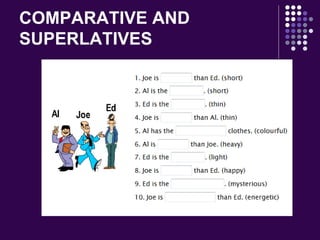
COMPARATIVE AND SUPERLATIVES
Resources Using Adjectives and Adverbs Correctly (16 pages of rules)  http://admissionok.com/Flash%20paper/Adjectives_and_Adverbs.swf

Comparatives and superlatives gen

  • 1.
  • 2.
    SOME RULES ABOUTFORMING COMPARATIVES AND SUPERLATIVES One syllable adjectives generally form the comparative by adding -er and the superlative by adding -est , e.g.: Adjective Comparative Superlative Soft Softer The softest Cheap Cheaper The cheapest Sweet Sweeter The sweetest Thin Thinner The thinnest
  • 3.
    SPELLING RULES Notethat if a one syllable adjective ends in a single vowel letter followed by a single consonant letter, the consonant letter is doubled. e.g.: thin -> thinner, big -> biggest. If an adjective ends in -e, this is removed when adding -er/-est. e.g.: wide -> wider/widest. If an adjective ends in a consonant followed by -y, -y is replaced by -i when adding -er/-est. e.g.: dry -> drier/driest .
  • 4.
    TWO SYLLABLE ADJECTIVESTwo syllable adjectives which end in -y usually form the comparative by adding -er and the superlative by adding -est, (note the change of -y to -i in the comparative/superlative) e.g.: Adjective Comparative superlative Lucky luckier The luckiest Pretty Prettier The prettiest Tidy Tidier The tidiest
  • 5.
    TWO SYLLABLE ADJECTIVESTwo syllable adjectives ending in -ed, -ing, -ful, or -less always form the comparative with more and the superlative with the most , e.g.: Adjective Comparative superlative Worried More worried The most worried Boring More boring The most boring Careful More careful The most careful Useless More useless The most useless
  • 6.
    THREE SYLLABLE ADJECTIVESAdjectives which have three or more syllables always form the comparative and superlative with MORE and THE MOST , e.g.: The only exceptions are some three syllable adjectives which have been formed by adding the prefix -un to another adjective, especially those formed from an adjective ending in -y. These adjectives can form comparatives and superlatives by using more/most or adding -er/-est, e.g.:unhappy – unhappier – the unhappiest/ the most unhappy Adjective Comparative Superlative Dangerous More dangerous The most dangerous Difficult More difficult The most difficult
  • 7.
    IRREGULAR ADJECTIVES Adjective Comparative Superlative Good Better The best Bad Worse The worst Far Farther/further The farthest/furthest
  • 8.
    USE OF COMPARATIVESComparatives are very commonly followed by than and a pronoun or noun group, in order to describe who the other person or thing involved in the comparison is, e.g.: John is taller than me. I think that she’s more intelligent than her sister.
  • 9.
  • 10.
    Examples Adjectiveslarge larger largest The first apple is large. The second apple is larger than the first. The third apple is the largest of the three.
  • 11.
    The jalopy isa fast car. The racecar is the faster car. The dragster is the fastest car.
  • 12.
    REMEMBER To makecomparative and superlative forms of adjectives some rules must be followed.
  • 13.
    Rule 1   To form the comparative or superlative of one syllable words with more than one vowel OR ending with more than one consonant at the add -er OR -est. tall taller tallest neat neater neatest deep deeper deepest
  • 14.
    Rule 2   To form the comparative or superlative of a one syllable word ending in e add -r OR -st. wide wider widest fine finer finest cute cuter cutest
  • 15.
    Rule 3   To form the comparative or superlative of a one syllable word with one vowel and one consonant at the end double the consonant, and add -er OR -est. sad sadder saddest big bigger biggest fat fatter fattest
  • 16.
    Rule 4   To form the comparative or superlative of a two syllable word ending in y , change the y to i, then add -er OR -est. happy happier happiest jolly jollier jolliest lazy lazier laziest
  • 17.
    Rule 5   To form the comparative or superlative of a two syllable word ending a vowel-sound that is not stressed then add -er OR -est. Adjectives ending in –le, -ow, er frequently take –er and –est. yellow yellower yellowest gentle gentler gentlest simple simpler simplest
  • 18.
    SUMMARY   Adjectiveform Comparative Superlative Only one syllable, with more than one vowel or more than one consonant at the end. Examples: light, neat, fast, tall, neat, deep Add -er: lighter, neater, faster, taller, neater, deeper Add -est: lightest, neatest, fastest, tallest. neatest, deepest Only one syllable, ending in E. Examples: wide, fine, cute Add -r: wider, finer, cuter Add -st: widest, finest, cutest Only one syllable, with one vowel and one consonant at the end. Examples: hot, big, fat, sad Double the consonant, and add -er: hotter, bigger, fatter, sadder Double the consonant, and add -est: hottest, biggest, fattest, saddest Two syllables, ending in Y. Examples: happy, silly, lonely, jolly Change y to i, then add -er: happier, sillier, lonelier, jollier Change y to i, then add -est: happiest, silliest, loneliest, jolliest two syllable word ending a vowel-sound that is not stressed yellow, simple Add -er: yellower, simpler Add -est: yellower, simpler Two syllables or more, not ending in Y. Examples: modern, interesting, beautiful , Use more before the adjective: more modern, more interesting, more beautiful Use most before the adjective: most modern, most interesting, most beautiful
  • 19.
    Adverb Comparative Superlative fast faster fastest slow slower slowest quick quicker quickest early earlier earliest bright brighter brightest high higher highest
  • 20.
    More and Most :   Adverb Comparative Superlative recently more recently most recently effectively more effectively most effectively frequently more frequently most frequently
  • 21.
    Irregular Adjectives Word Comparative Superlative good better best bad worse worst much more most little less least far farther farthest old older elder oldest eldest
  • 22.
    PRACTICE Write similarsentences -Nathan made good stew. -Molly's stew was better than Nathan's. -Ezra made the best stew of all.
  • 23.
    The bird singsloudly. The moose sang louder than the bird. Pete sang the loudest of them all.                                                   loud louder loudest
  • 24.
      Sally works hard. Steve works harder than Sally Kathy and Sue work the hardest of all.
  • 25.
  • 26.
    Resources Using Adjectivesand Adverbs Correctly (16 pages of rules) http://admissionok.com/Flash%20paper/Adjectives_and_Adverbs.swf