1
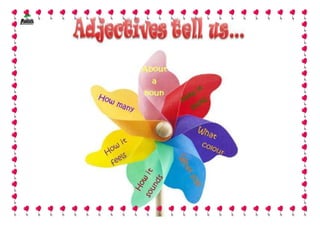
Adjectives are describing words. They tell us about the colour, size, shape, nature, quality or condition of a
noun. Examples are: blue, green, round, square, good, old, tall, brave, beautiful, tired, happy, exhausted
etc.

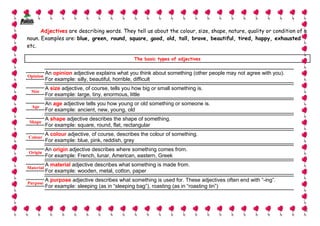
                                                  The basic types of adjectives


           An opinion adjective explains what you think about something (other people may not agree with you).
Opinion
           For example: silly, beautiful, horrible, difficult
           A size adjective, of course, tells you how big or small something is.
  Size
           For example: large, tiny, enormous, little
           An age adjective tells you how young or old something or someone is.
  Age
           For example: ancient, new, young, old
           A shape adjective describes the shape of something.
 Shape
           For example: square, round, flat, rectangular
           A colour adjective, of course, describes the colour of something.
Colour
           For example: blue, pink, reddish, grey
           An origin adjective describes where something comes from.
Origin
           For example: French, lunar, American, eastern, Greek
           A material adjective describes what something is made from.
Material
           For example: wooden, metal, cotton, paper
           A purpose adjective describes what something is used for. These adjectives often end with “-ing”.
Purpose
           For example: sleeping (as in “sleeping bag”), roasting (as in “roasting tin”)


                                                                                                                   2
Where a number of adjectives are used together, the order depends on the function of the adjective. The usual order is:
Value/opinion, Size, Age/Temperature, Shape, Colour, Origin, Material/Purpose


                                                                                                                          3
Positive Adjectives

The positive adjective is the simple form of the adjective without expressing increase or diminution of the
original quality: big.

Comparative Adjectives (+er)

The comparative adjective is that form of the adjective which expresses increase or diminution of the quality:
bigger. Examples are older than or more expensive than or bigger than or faster than or taller than etc.
Adjectives are compared in two ways, either by adding -er to the positive to form the comparative and -est to
the positive to form the superlative. The following adjectives are exceptions to this rule ( irregular ):

  1.- good becomes better or best.        2.- bad becomes worse or worst

   Superlative Adjectives (+est)

The superlative adjective is that form which expresses the greatest increase or diminution of the quality:
biggest. An adjective is in the superlative form when it expresses a comparison between one and a number of
individuals taken separately; "John is the richest man in Boston."


                                                                                                                 4
An adjective is also in the positive form when it does not express comparison; as, "A rich man." Adjectives of
two or more syllables are generally compared by prefixing more and most. Example: Paris is the most romantic
city in the world.


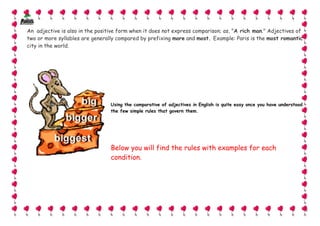
                                 Using the comparative of adjectives in English is quite easy once you have understood
                                 the few simple rules that govern them.


                                 Below you will find the rules with examples for each
                                 condition.


                                                                                                                         5
Number of Comparative                 Superlative
syllables
one syllable + -er                    + -est
tall           taller                 tallest
one syllable with the spelling consonant + single vowel + consonant: double the final
consonant:
fat            fatter                 fattest
big            bigger                 biggest
sad            sadder                 saddest
two syllables + -er OR more +
                                      + -est OR most + adj
              adj
happy          happier/ more happy happiest/ most happy
simple         simpler/ more          simplest/ most simple
               simple
If you are not sure, use MORE + OR MOST +
Note: Adjectives ending in '-y' like happy, pretty, busy, sunny, lucky etc:. replace the -y with -
ier or -iest in the comparative and superlative form
busy           busier                 busiest
three          more + adj             most + adj
syllables or
more
important      more important         most important

expensive      more expensive         most expensive


                                                                                                     6
Examples

  •   A cat is fast, a tiger is faster but a cheetah is the fastest
  •   A car is heavy, a truck is heavier, but a train is the heaviest
  •   A park bench is comfortable, a restaurant chair is more comfortable, but a sofa is the most comfortable

These adjectives have completely irregular comparative and superlative forms:

         Adjective             Comparative                          Superlative
         good                  better                               best
         bad                   worse                                worst
         little                less                                 least
         much                  more                                 most
         far                   further / farther                    furthest / farthest


                                                                                                                7
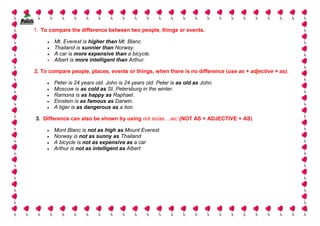
1. To compare the difference between two people, things or events.

     •   Mt. Everest is higher than Mt. Blanc.
     •   Thailand is sunnier than Norway.
     •   A car is more expensive than a bicycle.
     •   Albert is more intelligent than Arthur.

2. To compare people, places, events or things, when there is no difference (use as + adjective + as).

     •   Peter is 24 years old. John is 24 years old. Peter is as old as John.
     •   Moscow is as cold as St. Petersburg in the winter.
     •   Ramona is as happy as Raphael.
     •   Einstein is as famous as Darwin.
     •   A tiger is as dangerous as a lion.

3. Difference can also be shown by using not so/as ...as: (NOT AS + ADJECTIVE + AS)

     •   Mont Blanc is not as high as Mount Everest
     •   Norway is not as sunny as Thailand
     •   A bicycle is not as expensive as a car
     •   Arthur is not as intelligent as Albert


                                                                                                         8

Adjectives blog 12 13

  • 1.
  • 2.
    Adjectives are describingwords. They tell us about the colour, size, shape, nature, quality or condition of a noun. Examples are: blue, green, round, square, good, old, tall, brave, beautiful, tired, happy, exhausted etc. The basic types of adjectives An opinion adjective explains what you think about something (other people may not agree with you). Opinion For example: silly, beautiful, horrible, difficult A size adjective, of course, tells you how big or small something is. Size For example: large, tiny, enormous, little An age adjective tells you how young or old something or someone is. Age For example: ancient, new, young, old A shape adjective describes the shape of something. Shape For example: square, round, flat, rectangular A colour adjective, of course, describes the colour of something. Colour For example: blue, pink, reddish, grey An origin adjective describes where something comes from. Origin For example: French, lunar, American, eastern, Greek A material adjective describes what something is made from. Material For example: wooden, metal, cotton, paper A purpose adjective describes what something is used for. These adjectives often end with “-ing”. Purpose For example: sleeping (as in “sleeping bag”), roasting (as in “roasting tin”) 2
  • 3.
    Where a numberof adjectives are used together, the order depends on the function of the adjective. The usual order is: Value/opinion, Size, Age/Temperature, Shape, Colour, Origin, Material/Purpose 3
  • 4.
    Positive Adjectives The positiveadjective is the simple form of the adjective without expressing increase or diminution of the original quality: big. Comparative Adjectives (+er) The comparative adjective is that form of the adjective which expresses increase or diminution of the quality: bigger. Examples are older than or more expensive than or bigger than or faster than or taller than etc. Adjectives are compared in two ways, either by adding -er to the positive to form the comparative and -est to the positive to form the superlative. The following adjectives are exceptions to this rule ( irregular ): 1.- good becomes better or best. 2.- bad becomes worse or worst Superlative Adjectives (+est) The superlative adjective is that form which expresses the greatest increase or diminution of the quality: biggest. An adjective is in the superlative form when it expresses a comparison between one and a number of individuals taken separately; "John is the richest man in Boston." 4
  • 5.
    An adjective isalso in the positive form when it does not express comparison; as, "A rich man." Adjectives of two or more syllables are generally compared by prefixing more and most. Example: Paris is the most romantic city in the world. Using the comparative of adjectives in English is quite easy once you have understood the few simple rules that govern them. Below you will find the rules with examples for each condition. 5
  • 6.
    Number of Comparative Superlative syllables one syllable + -er + -est tall taller tallest one syllable with the spelling consonant + single vowel + consonant: double the final consonant: fat fatter fattest big bigger biggest sad sadder saddest two syllables + -er OR more + + -est OR most + adj adj happy happier/ more happy happiest/ most happy simple simpler/ more simplest/ most simple simple If you are not sure, use MORE + OR MOST + Note: Adjectives ending in '-y' like happy, pretty, busy, sunny, lucky etc:. replace the -y with - ier or -iest in the comparative and superlative form busy busier busiest three more + adj most + adj syllables or more important more important most important expensive more expensive most expensive 6
  • 7.
    Examples • A cat is fast, a tiger is faster but a cheetah is the fastest • A car is heavy, a truck is heavier, but a train is the heaviest • A park bench is comfortable, a restaurant chair is more comfortable, but a sofa is the most comfortable These adjectives have completely irregular comparative and superlative forms: Adjective Comparative Superlative good better best bad worse worst little less least much more most far further / farther furthest / farthest 7
  • 8.
    1. To comparethe difference between two people, things or events. • Mt. Everest is higher than Mt. Blanc. • Thailand is sunnier than Norway. • A car is more expensive than a bicycle. • Albert is more intelligent than Arthur. 2. To compare people, places, events or things, when there is no difference (use as + adjective + as). • Peter is 24 years old. John is 24 years old. Peter is as old as John. • Moscow is as cold as St. Petersburg in the winter. • Ramona is as happy as Raphael. • Einstein is as famous as Darwin. • A tiger is as dangerous as a lion. 3. Difference can also be shown by using not so/as ...as: (NOT AS + ADJECTIVE + AS) • Mont Blanc is not as high as Mount Everest • Norway is not as sunny as Thailand • A bicycle is not as expensive as a car • Arthur is not as intelligent as Albert 8