Adjective Form, Position,
         and Agreement
(La forma, posición, y concordancia de los adjetivos)
       Essentially, an adjective is a word
      that describes or tells us more about
          a noun than we knew before.
       Spanish adjectives normally agree,
       or have corresponding forms, with
             the nouns they modify.
Adjectives
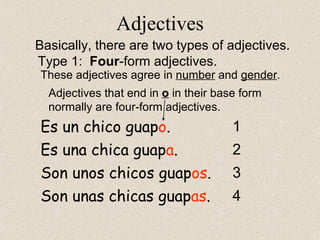
Basically, there are two types of adjectives.
Type 1: Four-form adjectives.
These adjectives agree in number and gender.
  Adjectives that end in o in their base form
  normally are four-form adjectives.
Es un chico guapo.                     1
Es una chica guapa.                    2
Son unos chicos guapos.                3
Son unas chicas guapas.                4
Adjectives
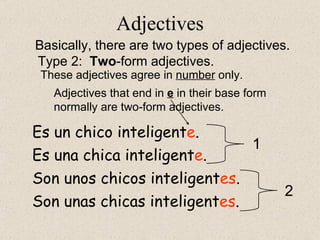
Basically, there are two types of adjectives.
Type 2: Two-form adjectives.
 These adjectives agree in number only.
   Adjectives that end in e in their base form
   normally are two-form adjectives.

Es un chico inteligente.
                              1
Es una chica inteligente.
Son unos chicos inteligentes.
                                                 2
Son unas chicas inteligentes.
Adjectives
  Basically, there are two types of adjectives.
  Type 2: Two-form adjectives.
   These adjectives agree in number only.
Adjectives that end in a consonant are also two-form,
normally.
       Es un chico fiel.
                               1
       Es una chica fiel.
       Son unos chicos fieles.
                                               2
       Son unas chicas fieles.
Adjectives
  Basically, there are two types of adjectives.
  Type 2: Two-form adjectives.
   These adjectives agree in number only.
Adjectives that end in a consonant are also two-form,
normally.
    Es un chico audaz.
                             1
    Es una chica audaz.
    Son unos chicos audaces.
                                               2
    Son unas chicas audaces.
Adjectives
Basically, there are two types of adjectives.
Type 2: Two-form adjectives.
These adjectives agree in number only.
Adjectives that end in ista also are two-form.


Es un chico optimista.
                            1
Es una chica optimista.
Son unos chicos optimistas.
                                                 2
Son unas chicas optimistas.
Summary
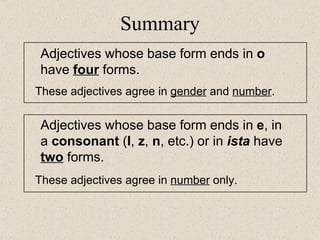
 Adjectives whose base form ends in o
 have four forms.
These adjectives agree in gender and number.

 Adjectives whose base form ends in e, in
 a consonant (l, z, n, etc.) or in ista have
 two forms.
These adjectives agree in number only.
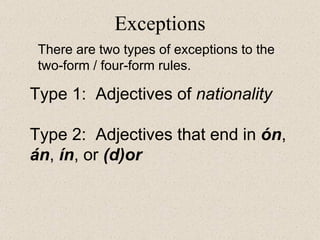
Exceptions
 There are two types of exceptions to the
 two-form / four-form rules.

Type 1: Adjectives of nationality

Type 2: Adjectives that end in ón,
án, ín, or (d)or
Exceptions
   There are two types of irregular adjectives.
  Type 1: Adjectives of nationality
 Many adjectives of nationality are already the four-
 form type, since their base form ends in o.

                Vladimir Putin es ruso.          1
                Su esposa es rusa.               2
                Sus hijos son rusos.             3
                Sus hijas son rusas.             4

Notice that adjectives of nationality are not capitalized in Spanish.
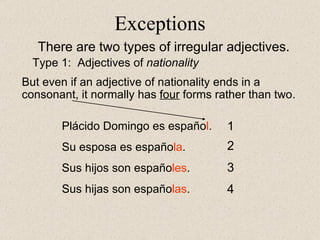
Exceptions
   There are two types of irregular adjectives.
  Type 1: Adjectives of nationality
But even if an adjective of nationality ends in a
consonant, it normally has four forms rather than two.

       Plácido Domingo es español.      1
       Su esposa es española.           2
       Sus hijos son españoles.         3
       Sus hijas son españolas.         4
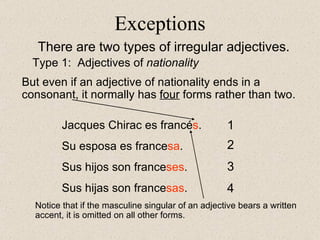
Exceptions
   There are two types of irregular adjectives.
  Type 1: Adjectives of nationality
But even if an adjective of nationality ends in a
consonant, it normally has four forms rather than two.

         Jacques Chirac es francés.                 1
         Su esposa es francesa.                     2
         Sus hijos son franceses.                   3
         Sus hijas son francesas.                   4
  Notice that if the masculine singular of an adjective bears a written
  accent, it is omitted on all other forms.
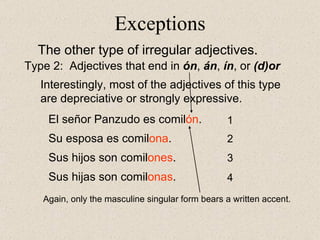
Exceptions
  The other type of irregular adjectives.
Type 2: Adjectives that end in ón, án, ín, or (d)or
   Interestingly, most of the adjectives of this type
   are depreciative or strongly expressive.
    El señor Panzudo es comilón.                 1
    Su esposa es comilona.                       2
    Sus hijos son comilones.                     3
    Sus hijas son comilonas.                     4
   Again, only the masculine singular form bears a written accent.
Exceptions
  The other type of irregular adjectives.
Type 2: Adjectives that end in ón, án, ín, or (d)or
   Interestingly, most of the adjectives of this type
   are depreciative or strongly expressive.
    El señor Flojo es holgazán.                  1
    Su esposa es holgazana.                      2
    Sus hijos son holgazanes.                    3
    Sus hijas son holgazanas.                    4
   Again, only the masculine singular form bears a written accent.
Exceptions
  The other type of irregular adjectives.
Type 2: Adjectives that end in ón, án, ín, or (d)or
   Interestingly, most of the adjectives of this type
   are depreciative or strongly expressive.
    El señor Boca es parlanchín.                 1
    Su esposa es parlanchina.                    2
    Sus hijos son parlanchines.                  3
    Sus hijas son parlanchinas.                  4
   Again, only the masculine singular form bears a written accent.
Exceptions
  The other type of irregular adjectives.
Type 2: Adjectives that end in ón, án, ín, or (d)or
   Interestingly, most of the adjectives of this type
   are depreciative or strongly expressive.
   El profesor Obrero es trabajador.     1
    Su esposa es trabajadora.            2
    Sus alumnos son trabajadores.        3
    Sus alumnas son trabajadoras.        4
Summary
 Adjectives whose base form ends in o have
 four forms.
These agree in gender and number.
 Adjectives whose base form ends in e, in a
 consonant (l, z, n, etc.) or in ista have only
 two forms.
These agree in number only.
There are two groups of exceptions, which are four-form
adjectives even though they end in a consonant:
     Adjectives of nationality
     Adjectives that end in ón, án, ín or (d)or
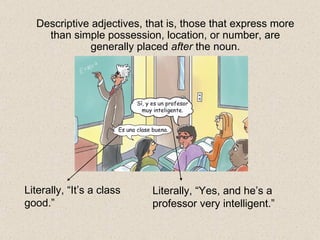
Descriptive adjectives, that is, those that express more
    than simple possession, location, or number, are
              generally placed after the noun.


Literally, “It’s a class   Literally, “Yes, and he’s a
good.”                     professor very intelligent.”
FIN

Adjective form, position, and agreement

  • 1.
    Adjective Form, Position, and Agreement (La forma, posición, y concordancia de los adjetivos) Essentially, an adjective is a word that describes or tells us more about a noun than we knew before. Spanish adjectives normally agree, or have corresponding forms, with the nouns they modify.
  • 2.
    Adjectives Basically, there aretwo types of adjectives. Type 1: Four-form adjectives. These adjectives agree in number and gender. Adjectives that end in o in their base form normally are four-form adjectives. Es un chico guapo. 1 Es una chica guapa. 2 Son unos chicos guapos. 3 Son unas chicas guapas. 4
  • 3.
    Adjectives Basically, there aretwo types of adjectives. Type 2: Two-form adjectives. These adjectives agree in number only. Adjectives that end in e in their base form normally are two-form adjectives. Es un chico inteligente. 1 Es una chica inteligente. Son unos chicos inteligentes. 2 Son unas chicas inteligentes.
  • 4.
    Adjectives Basically,there are two types of adjectives. Type 2: Two-form adjectives. These adjectives agree in number only. Adjectives that end in a consonant are also two-form, normally. Es un chico fiel. 1 Es una chica fiel. Son unos chicos fieles. 2 Son unas chicas fieles.
  • 5.
    Adjectives Basically,there are two types of adjectives. Type 2: Two-form adjectives. These adjectives agree in number only. Adjectives that end in a consonant are also two-form, normally. Es un chico audaz. 1 Es una chica audaz. Son unos chicos audaces. 2 Son unas chicas audaces.
  • 6.
    Adjectives Basically, there aretwo types of adjectives. Type 2: Two-form adjectives. These adjectives agree in number only. Adjectives that end in ista also are two-form. Es un chico optimista. 1 Es una chica optimista. Son unos chicos optimistas. 2 Son unas chicas optimistas.
  • 7.
    Summary Adjectives whosebase form ends in o have four forms. These adjectives agree in gender and number. Adjectives whose base form ends in e, in a consonant (l, z, n, etc.) or in ista have two forms. These adjectives agree in number only.
  • 8.
    Exceptions There aretwo types of exceptions to the two-form / four-form rules. Type 1: Adjectives of nationality Type 2: Adjectives that end in ón, án, ín, or (d)or
  • 9.
    Exceptions There are two types of irregular adjectives. Type 1: Adjectives of nationality Many adjectives of nationality are already the four- form type, since their base form ends in o. Vladimir Putin es ruso. 1 Su esposa es rusa. 2 Sus hijos son rusos. 3 Sus hijas son rusas. 4 Notice that adjectives of nationality are not capitalized in Spanish.
  • 10.
    Exceptions There are two types of irregular adjectives. Type 1: Adjectives of nationality But even if an adjective of nationality ends in a consonant, it normally has four forms rather than two. Plácido Domingo es español. 1 Su esposa es española. 2 Sus hijos son españoles. 3 Sus hijas son españolas. 4
  • 11.
    Exceptions There are two types of irregular adjectives. Type 1: Adjectives of nationality But even if an adjective of nationality ends in a consonant, it normally has four forms rather than two. Jacques Chirac es francés. 1 Su esposa es francesa. 2 Sus hijos son franceses. 3 Sus hijas son francesas. 4 Notice that if the masculine singular of an adjective bears a written accent, it is omitted on all other forms.
  • 12.
    Exceptions Theother type of irregular adjectives. Type 2: Adjectives that end in ón, án, ín, or (d)or Interestingly, most of the adjectives of this type are depreciative or strongly expressive. El señor Panzudo es comilón. 1 Su esposa es comilona. 2 Sus hijos son comilones. 3 Sus hijas son comilonas. 4 Again, only the masculine singular form bears a written accent.
  • 13.
    Exceptions Theother type of irregular adjectives. Type 2: Adjectives that end in ón, án, ín, or (d)or Interestingly, most of the adjectives of this type are depreciative or strongly expressive. El señor Flojo es holgazán. 1 Su esposa es holgazana. 2 Sus hijos son holgazanes. 3 Sus hijas son holgazanas. 4 Again, only the masculine singular form bears a written accent.
  • 14.
    Exceptions Theother type of irregular adjectives. Type 2: Adjectives that end in ón, án, ín, or (d)or Interestingly, most of the adjectives of this type are depreciative or strongly expressive. El señor Boca es parlanchín. 1 Su esposa es parlanchina. 2 Sus hijos son parlanchines. 3 Sus hijas son parlanchinas. 4 Again, only the masculine singular form bears a written accent.
  • 15.
    Exceptions Theother type of irregular adjectives. Type 2: Adjectives that end in ón, án, ín, or (d)or Interestingly, most of the adjectives of this type are depreciative or strongly expressive. El profesor Obrero es trabajador. 1 Su esposa es trabajadora. 2 Sus alumnos son trabajadores. 3 Sus alumnas son trabajadoras. 4
  • 16.
    Summary Adjectives whosebase form ends in o have four forms. These agree in gender and number. Adjectives whose base form ends in e, in a consonant (l, z, n, etc.) or in ista have only two forms. These agree in number only. There are two groups of exceptions, which are four-form adjectives even though they end in a consonant: Adjectives of nationality Adjectives that end in ón, án, ín or (d)or
  • 17.
    Descriptive adjectives, thatis, those that express more than simple possession, location, or number, are generally placed after the noun. Literally, “It’s a class Literally, “Yes, and he’s a good.” professor very intelligent.”
  • 18.