Adjectives
Words that describe people and things are
called adjectives (adjetivos).
Adjectives
• In Spanish, most adjectives have both
masculine and feminine forms. The
masculine form usually ends in the
letter -o and the feminine form usually
ends in the letter -a.
Adjectives
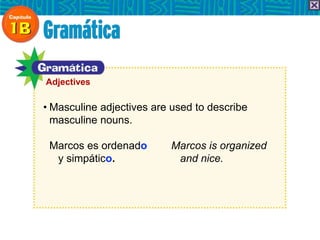
• Masculine adjectives are used to describe
masculine nouns.
Marcos es ordenado Marcos is organized
y simpático. and nice.
Adjectives
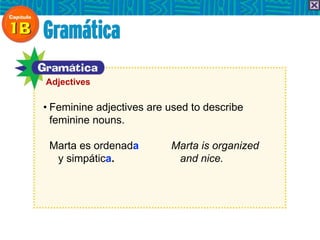
• Feminine adjectives are used to describe
feminine nouns.
Marta es ordenada Marta is organized
y simpática. and nice.
Adjectives
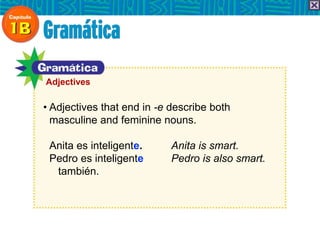
• Adjectives that end in -e describe both
masculine and feminine nouns.
Anita es inteligente. Anita is smart.
Pedro es inteligente Pedro is also smart.
también.
Adjectives
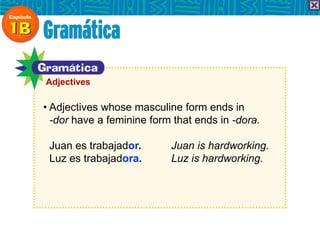
• Adjectives whose masculine form ends in
-dor have a feminine form that ends in -dora.
Juan es trabajador. Juan is hardworking.
Luz es trabajadora. Luz is hardworking.
Adjectives
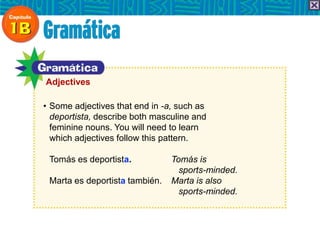
• Some adjectives that end in -a, such as
deportista, describe both masculine and
feminine nouns. You will need to learn
which adjectives follow this pattern.
Tomás es deportista. Tomás is
sports-minded.
Marta es deportista también. Marta is also
sports-minded.
Adjectives
Adjectives
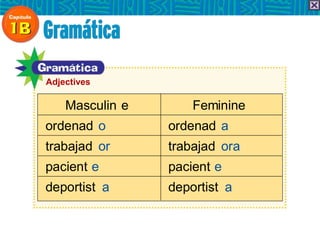
Masculin e Feminine
ordenad o ordenad a
trabajad or trabajad ora
pacient e pacient e
deportist a deportist a

Adjectives ppt

  • 1.
  • 2.
    Words that describepeople and things are called adjectives (adjetivos). Adjectives
  • 3.
    • In Spanish,most adjectives have both masculine and feminine forms. The masculine form usually ends in the letter -o and the feminine form usually ends in the letter -a. Adjectives
  • 4.
    • Masculine adjectivesare used to describe masculine nouns. Marcos es ordenado Marcos is organized y simpático. and nice. Adjectives
  • 5.
    • Feminine adjectivesare used to describe feminine nouns. Marta es ordenada Marta is organized y simpática. and nice. Adjectives
  • 6.
    • Adjectives thatend in -e describe both masculine and feminine nouns. Anita es inteligente. Anita is smart. Pedro es inteligente Pedro is also smart. también. Adjectives
  • 7.
    • Adjectives whosemasculine form ends in -dor have a feminine form that ends in -dora. Juan es trabajador. Juan is hardworking. Luz es trabajadora. Luz is hardworking. Adjectives
  • 8.
    • Some adjectivesthat end in -a, such as deportista, describe both masculine and feminine nouns. You will need to learn which adjectives follow this pattern. Tomás es deportista. Tomás is sports-minded. Marta es deportista también. Marta is also sports-minded. Adjectives
  • 9.
    Adjectives Masculin e Feminine ordenado ordenad a trabajad or trabajad ora pacient e pacient e deportist a deportist a