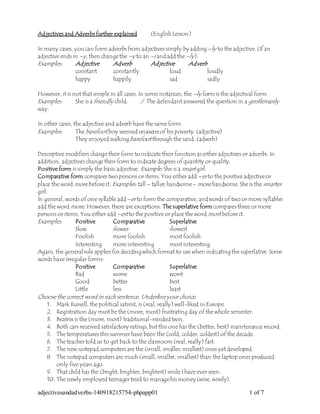
Adjectives and Adverbs further explained (English Lesson) 
In many cases, you can form adverbs from adjectives simply by adding –ly to the adjective. (If an 
adjective ends in –y , then change the –y to an –i and add the –ly ). 
Examples: Adjective Adverb Adjective Adverb 
constant constantly loud loudly 
happy happily sad sadly 
However, it is not that simple in all cases. In some instances, the –ly form is the adjectival form. 
Examples: She is a friendly child. / The defendant answered the question in a gentlemanly 
way. 
In other cases, the adjective and adverb have the same form. 
Examples: The barefoot boy seemed unaware of his poverty. (adjective) 
They enjoyed walking barefoot through the sand. (adverb) 
Descriptive modifiers change their form to indicate their function as either adjectives or adverbs. In 
addition, adjectives change their form to indicate degrees of quantity or quality. 
Positive form is simply the basic adjective. Example: She is a smart girl. 
Comparative form compares two persons or items. You either add –er to the positive adjective or 
place the word more before it. Examples: tall – taller; handsome – more handsome. She is the smarter 
girl. 
In general, words of one syllable add –er to form the comparative, and words of two or more syllables 
add the word more. However, there are exceptions. The superlative form compares three or more 
persons or items. You either add –est to the positive or place the word most before it. 
Examples: Positive Comparative Superlative 
Slow slower slowest 
Foolish more foolish most foolish 
Interesting more interesting most interesting 
Again, the general rule applies for deciding which format to use when indicating the superlative. Some 
words have irregular forms: 
Positive Comparative Superlative 
Bad worse worst 
Good better best 
Little less least 
Choose the correct word in each sentence. Underline your choice. 
1. Mark Russell, the political satirist, is (real, really) well-liked in Europe. 
2. Registration day must be the (more, most) frustrating day of the whole semester. 
3. Beatrix is the (more, most) traditional-minded twin. 
4. Both cars received satisfactory ratings, but this one has the (better, best) maintenance record. 
5. The temperatures this summer have been the (cold, colder, coldest) of the decade. 
6. The teacher told us to get back to the classroom (real, really) fast. 
7. The new notepad computers are the (small, smaller, smallest) ones yet developed. 
8. The notepad computers are much (small, smaller, smallest) than the laptop ones produced 
only five years ago. 
9. That child has the (bright, brighter, brightest) smile I have ever seen. 
10. The newly employed teenager tried to manage his money (wise, wisely). 
adjectivesandadverbs-140918215754-phpapp01 1 of 7
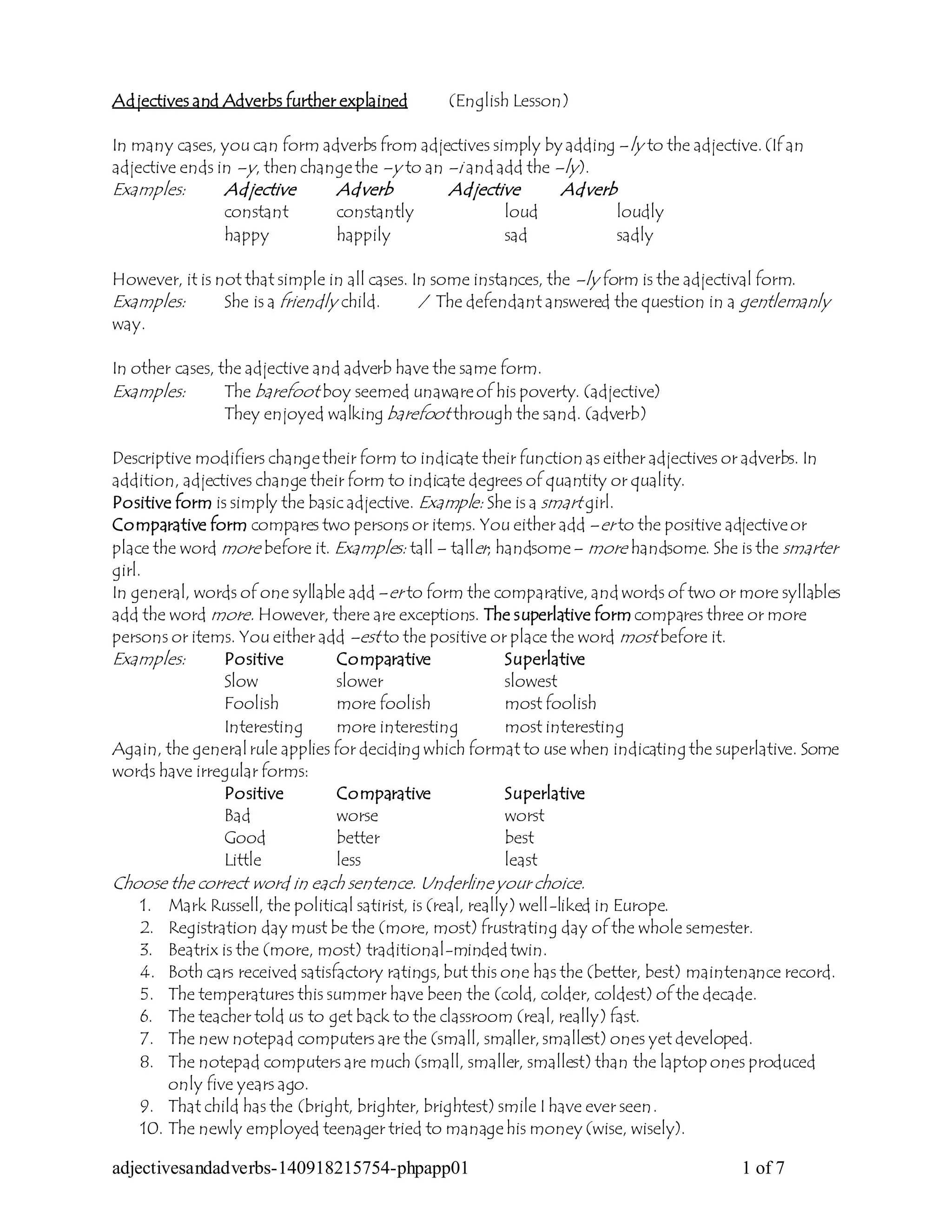
(key to answer): 
ADJECTIVES MODIFY NOUNS/PRONOUNS 
ADVERBS MODIFY ADJECTIVE, VERB, ADVERB, PARTICIPLES, CLAUSE 
Broken -==adj, broken hearted man ,,, talking mayna present participle, 
Broken vow> , burnt offering, 
1. Really > well-like: adjective 
2. Most > a registration day is compared to all the days in a semester 
3. More > 2 persons are compared : TWIN 
4. Better > both = two, 2 things are compared 
5. Coldest > THIS SUMMER compared to all years in a DECADE 
6. Really > adv modifying the VERB TOLD, adjective FAST 
7. Smallest > NEW compared to old , EVER, OF ALL 
8. Smaller > notepad vs. laptop,,, THAN 
9. Brightest > ever,,,, 
10. Wisely > tried to manage 
adjectivesandadverbs-140918215754-phpapp01 2 of 7
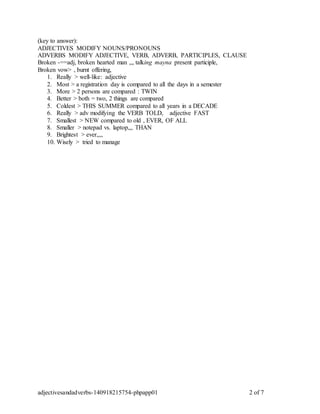
Using Adjectives and Adverbs Correctly 
What are adjectives? 
• Adjectives modify nouns or pronouns 
• These words are all adjectives 
 A hot day 
 A happy camper 
 A silly twit 
 A big, bloody mess (both “big” and “bloody” modify “mess”) 
 She is creative (“creative” is a subject complement that follows the 
linking verb “is”) 
 A boring course (present participle used as an adjective 
So what are adverbs? 
• Adverbs modify verbs, adjectives and other adverbs 
• Many adverbs end with ly 
• Many adverbs answer the question “How?” 
• These are adverbs 
Eating quickly (modifying a verb) 
Trying very hard (modifying an adverb) 
A really big show (modifying an adjective) 
Recognizing Adjectives & Adverbs 
• Many words have both an adjective and adverb form 
Adjective Adverb 
Happy kids Playing happily 
Smooth rock Running smoothly 
Good night Eating Well 
Efficient workers Working efficiently 
Casual dress Dressing casually 
Quick meeting Talking quickly 
Hopeful children Waiting hopefully 
Real butter Really hot 
adjectivesandadverbs-140918215754-phpapp01 3 of 7
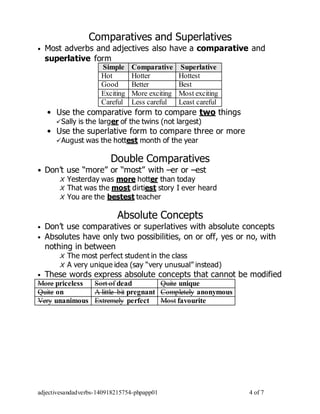
Comparatives and Superlatives 
• Most adverbs and adjectives also have a comparative and 
superlative form 
Simple Comparative Superlative 
Hot Hotter Hottest 
Good Better Best 
Exciting More exciting Most exciting 
Careful Less careful Least careful 
• Use the comparative form to compare two things 
Sally is the larger of the twins (not largest) 
• Use the superlative form to compare three or more 
August was the hottest month of the year 
Double Comparatives 
• Don’t use “more” or “most” with –er or –est 
X Yesterday was more hotter than today 
X That was the most dirtiest story I ever heard 
X You are the bestest teacher 
Absolute Concepts 
• Don’t use comparatives or superlatives with absolute concepts 
• Absolutes have only two possibilities, on or off, yes or no, with 
nothing in between 
X The most perfect student in the class 
X A very unique idea (say “very unusual” instead) 
• These words express absolute concepts that cannot be modified 
More priceless Sort of dead Quite unique 
Quite on A little bit pregnant Completely anonymous 
Very unanimous Extremely perfect Most favourite 
adjectivesandadverbs-140918215754-phpapp01 4 of 7
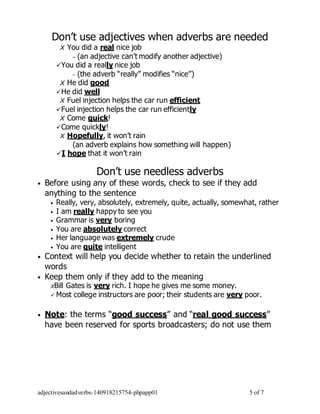
Don’t use adjectives when adverbs are needed 
X You did a real nice job 
– (an adjective can’t modify another adjective) 
You did a really nice job 
– (the adverb “really” modifies “nice”) 
X He did good 
He did well 
X Fuel injection helps the car run efficient 
Fuel injection helps the car run efficiently 
X Come quick! 
Come quickly! 
X Hopefully, it won’t rain 
(an adverb explains how something will happen) 
I hope that it won’t rain 
Don’t use needless adverbs 
• Before using any of these words, check to see if they add 
anything to the sentence 
• Really, very, absolutely, extremely, quite, actually, somewhat, rather 
• I am really happy to see you 
• Grammar is very boring 
• You are absolutely correct 
• Her language was extremely crude 
• You are quite intelligent 
• Context will help you decide whether to retain the underlined 
words 
• Keep them only if they add to the meaning 
X Bill Gates is very rich. I hope he gives me some money. 
 Most college instructors are poor; their students are very poor. 
• Note: the terms “good success” and “real good success” 
have been reserved for sports broadcasters; do not use them 
adjectivesandadverbs-140918215754-phpapp01 5 of 7
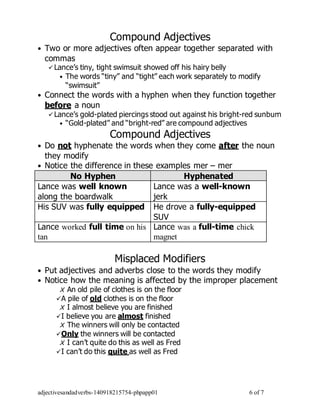
Compound Adjectives 
• Two or more adjectives often appear together separated with 
commas 
 Lance’s tiny, tight swimsuit showed off his hairy belly 
• The words “tiny” and “tight” each work separately to modify 
“swimsuit” 
• Connect the words with a hyphen when they function together 
before a noun 
 Lance’s gold-plated piercings stood out against his bright-red sunburn 
• “Gold-plated” and “bright-red” are compound adjectives 
Compound Adjectives 
• Do not hyphenate the words when they come after the noun 
they modify 
• Notice the difference in these examples mer – mer 
No Hyphen Hyphenated 
Lance was well known 
along the boardwalk 
Lance was a well-known 
jerk 
His SUV was fully equipped He drove a fully-equipped 
SUV 
Lance worked full time on his 
tan 
Lance was a full-time chick 
magnet 
Misplaced Modifiers 
• Put adjectives and adverbs close to the words they modify 
• Notice how the meaning is affected by the improper placement 
X An old pile of clothes is on the floor 
A pile of old clothes is on the floor 
X I almost believe you are finished 
I believe you are almost finished 
X The winners will only be contacted 
Only the winners will be contacted 
X I can’t quite do this as well as Fred 
I can’t do this quite as well as Fred 
adjectivesandadverbs-140918215754-phpapp01 6 of 7
adjectivesandadverbs-140918215754-phpapp01 7 of 7

Grammar Lesson - Adjective & Adverb

  • 1.
    Adjectives and Adverbsfurther explained (English Lesson) In many cases, you can form adverbs from adjectives simply by adding –ly to the adjective. (If an adjective ends in –y , then change the –y to an –i and add the –ly ). Examples: Adjective Adverb Adjective Adverb constant constantly loud loudly happy happily sad sadly However, it is not that simple in all cases. In some instances, the –ly form is the adjectival form. Examples: She is a friendly child. / The defendant answered the question in a gentlemanly way. In other cases, the adjective and adverb have the same form. Examples: The barefoot boy seemed unaware of his poverty. (adjective) They enjoyed walking barefoot through the sand. (adverb) Descriptive modifiers change their form to indicate their function as either adjectives or adverbs. In addition, adjectives change their form to indicate degrees of quantity or quality. Positive form is simply the basic adjective. Example: She is a smart girl. Comparative form compares two persons or items. You either add –er to the positive adjective or place the word more before it. Examples: tall – taller; handsome – more handsome. She is the smarter girl. In general, words of one syllable add –er to form the comparative, and words of two or more syllables add the word more. However, there are exceptions. The superlative form compares three or more persons or items. You either add –est to the positive or place the word most before it. Examples: Positive Comparative Superlative Slow slower slowest Foolish more foolish most foolish Interesting more interesting most interesting Again, the general rule applies for deciding which format to use when indicating the superlative. Some words have irregular forms: Positive Comparative Superlative Bad worse worst Good better best Little less least Choose the correct word in each sentence. Underline your choice. 1. Mark Russell, the political satirist, is (real, really) well-liked in Europe. 2. Registration day must be the (more, most) frustrating day of the whole semester. 3. Beatrix is the (more, most) traditional-minded twin. 4. Both cars received satisfactory ratings, but this one has the (better, best) maintenance record. 5. The temperatures this summer have been the (cold, colder, coldest) of the decade. 6. The teacher told us to get back to the classroom (real, really) fast. 7. The new notepad computers are the (small, smaller, smallest) ones yet developed. 8. The notepad computers are much (small, smaller, smallest) than the laptop ones produced only five years ago. 9. That child has the (bright, brighter, brightest) smile I have ever seen. 10. The newly employed teenager tried to manage his money (wise, wisely). adjectivesandadverbs-140918215754-phpapp01 1 of 7
  • 2.
    (key to answer): ADJECTIVES MODIFY NOUNS/PRONOUNS ADVERBS MODIFY ADJECTIVE, VERB, ADVERB, PARTICIPLES, CLAUSE Broken -==adj, broken hearted man ,,, talking mayna present participle, Broken vow> , burnt offering, 1. Really > well-like: adjective 2. Most > a registration day is compared to all the days in a semester 3. More > 2 persons are compared : TWIN 4. Better > both = two, 2 things are compared 5. Coldest > THIS SUMMER compared to all years in a DECADE 6. Really > adv modifying the VERB TOLD, adjective FAST 7. Smallest > NEW compared to old , EVER, OF ALL 8. Smaller > notepad vs. laptop,,, THAN 9. Brightest > ever,,,, 10. Wisely > tried to manage adjectivesandadverbs-140918215754-phpapp01 2 of 7
  • 3.
    Using Adjectives andAdverbs Correctly What are adjectives? • Adjectives modify nouns or pronouns • These words are all adjectives  A hot day  A happy camper  A silly twit  A big, bloody mess (both “big” and “bloody” modify “mess”)  She is creative (“creative” is a subject complement that follows the linking verb “is”)  A boring course (present participle used as an adjective So what are adverbs? • Adverbs modify verbs, adjectives and other adverbs • Many adverbs end with ly • Many adverbs answer the question “How?” • These are adverbs Eating quickly (modifying a verb) Trying very hard (modifying an adverb) A really big show (modifying an adjective) Recognizing Adjectives & Adverbs • Many words have both an adjective and adverb form Adjective Adverb Happy kids Playing happily Smooth rock Running smoothly Good night Eating Well Efficient workers Working efficiently Casual dress Dressing casually Quick meeting Talking quickly Hopeful children Waiting hopefully Real butter Really hot adjectivesandadverbs-140918215754-phpapp01 3 of 7
  • 4.
    Comparatives and Superlatives • Most adverbs and adjectives also have a comparative and superlative form Simple Comparative Superlative Hot Hotter Hottest Good Better Best Exciting More exciting Most exciting Careful Less careful Least careful • Use the comparative form to compare two things Sally is the larger of the twins (not largest) • Use the superlative form to compare three or more August was the hottest month of the year Double Comparatives • Don’t use “more” or “most” with –er or –est X Yesterday was more hotter than today X That was the most dirtiest story I ever heard X You are the bestest teacher Absolute Concepts • Don’t use comparatives or superlatives with absolute concepts • Absolutes have only two possibilities, on or off, yes or no, with nothing in between X The most perfect student in the class X A very unique idea (say “very unusual” instead) • These words express absolute concepts that cannot be modified More priceless Sort of dead Quite unique Quite on A little bit pregnant Completely anonymous Very unanimous Extremely perfect Most favourite adjectivesandadverbs-140918215754-phpapp01 4 of 7
  • 5.
    Don’t use adjectiveswhen adverbs are needed X You did a real nice job – (an adjective can’t modify another adjective) You did a really nice job – (the adverb “really” modifies “nice”) X He did good He did well X Fuel injection helps the car run efficient Fuel injection helps the car run efficiently X Come quick! Come quickly! X Hopefully, it won’t rain (an adverb explains how something will happen) I hope that it won’t rain Don’t use needless adverbs • Before using any of these words, check to see if they add anything to the sentence • Really, very, absolutely, extremely, quite, actually, somewhat, rather • I am really happy to see you • Grammar is very boring • You are absolutely correct • Her language was extremely crude • You are quite intelligent • Context will help you decide whether to retain the underlined words • Keep them only if they add to the meaning X Bill Gates is very rich. I hope he gives me some money.  Most college instructors are poor; their students are very poor. • Note: the terms “good success” and “real good success” have been reserved for sports broadcasters; do not use them adjectivesandadverbs-140918215754-phpapp01 5 of 7
  • 6.
    Compound Adjectives •Two or more adjectives often appear together separated with commas  Lance’s tiny, tight swimsuit showed off his hairy belly • The words “tiny” and “tight” each work separately to modify “swimsuit” • Connect the words with a hyphen when they function together before a noun  Lance’s gold-plated piercings stood out against his bright-red sunburn • “Gold-plated” and “bright-red” are compound adjectives Compound Adjectives • Do not hyphenate the words when they come after the noun they modify • Notice the difference in these examples mer – mer No Hyphen Hyphenated Lance was well known along the boardwalk Lance was a well-known jerk His SUV was fully equipped He drove a fully-equipped SUV Lance worked full time on his tan Lance was a full-time chick magnet Misplaced Modifiers • Put adjectives and adverbs close to the words they modify • Notice how the meaning is affected by the improper placement X An old pile of clothes is on the floor A pile of old clothes is on the floor X I almost believe you are finished I believe you are almost finished X The winners will only be contacted Only the winners will be contacted X I can’t quite do this as well as Fred I can’t do this quite as well as Fred adjectivesandadverbs-140918215754-phpapp01 6 of 7
  • 7.