1/13/2021 Frozen Shoulder by Dr. Shazia Khalfe 1
Adhesive Capsulitis
By
Dr. Shazia Abdul Hamid Khalfe, PT
Objectives
At the end of webinar students will be able to:
• Define Adhesive Capsulitis.
• Explain the types of Adhesive Capsulitis.
• Epidemiology of Adhesive Capsulitis.
• Identify the Clinical Presentation of Adhesive Capsulitis.
• Assess Adhesive Capsulitis.
• Identify different Physiotherapeutic Options for Treatment
of Adhesive Capsulitis.
• Plan the Physical Therapy Treatment for Adhesive
Capsulitis.
• Exercises for Adhesive Capsulitis.
1/13/2021 Frozen Shoulder by Dr. Shazia Khalfe 3
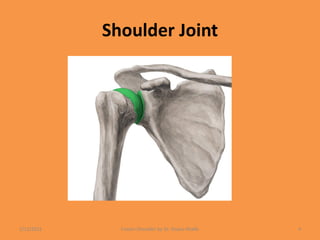
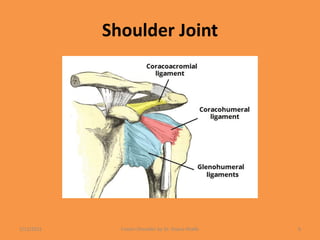
Shoulder Joint
1/13/2021 Frozen Shoulder by Dr. Shazia Khalfe 4
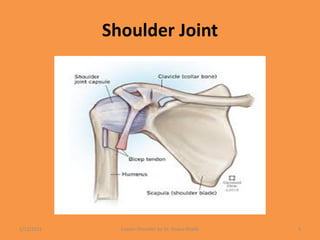
Shoulder Joint
1/13/2021 Frozen Shoulder by Dr. Shazia Khalfe 5
Shoulder Joint
1/13/2021 Frozen Shoulder by Dr. Shazia Khalfe 6
Capsular pattern of Shoulder
• The shoulder joint has a capsular
pattern where external rotation is more
limited than abduction which is more limited
than internal rotation (ER limitations > ABD
limitations > IR limitations).
[https://www.physio-pedia.com]
1/13/2021 Frozen Shoulder by Dr. Shazia Khalfe 7
What is Adhesive Capsulitis?
1/13/2021 Frozen Shoulder by Dr. Shazia Khalfe 8
Adhesive Capsulitis
The first recorded description of a frozen
shoulder was reported by Duplay [Duplay 1872]
in 1872, though the term frozen shoulder was
first used in 1934 by Codman[Codman 1934].
1/13/2021 Frozen Shoulder by Dr. Shazia Khalfe 9
Adhesive Capsulitis
Adhesive capsulitis, also known as frozen
shoulder, is a condition characterized by pain
and significant loss of both active range of
motion (AROM) and passive range of motion
(PROM) of the shoulder.
[David et al, 2009]
1/13/2021 Frozen Shoulder by Dr. Shazia Khalfe 10
Adhesive Capsulitis
• It is the condition of uncertain etiology,
characterized by significant restriction of both
active and passive shoulder motion that
occurs in the absence of a known intrinsic
shoulder disorder.
[Zuckerman JD, 2011]
1/13/2021 Frozen Shoulder by Dr. Shazia Khalfe 11
Types of Adhesive
Capsulitis
1/13/2021 Frozen Shoulder by Dr. Shazia Khalfe 12
Types of Adhesive Capsulitis
• Primary Adhesive Capsulitis.
• Secondary Adhesive Capsulitis.
[Chan HBY et al, 2017]
1/13/2021 Frozen Shoulder by Dr. Shazia Khalfe 13
Primary Adhesive Capsulitis
Primary frozen shoulder is idiopathic in nature.
It is characterized by the development of dense
adhesions, capsular thickening, and capsular
restrictions, especially in the dependent folds of
the capsule, rather than arthritic changes in the
cartilage and bone.
[Kisner & Colby 5th Ed]
1/13/2021 Frozen Shoulder by Dr. Shazia Khalfe 14
Stages of Primary Adhesive Capsulitis
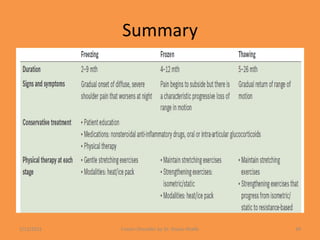
• “Freezing.” Characterized by intense pain even
at rest and limitation of motion by 2 to 3
weeks after onset. These acute symptoms may
last 10 to 36 weeks.
[Kisner & Colby 5th Ed]
1/13/2021 Frozen Shoulder by Dr. Shazia Khalfe 15
Stages of Primary Adhesive Capsulitis
• “ Frozen” there is a decrease in
hypervascularity and synovitis however,
capsular contraction and thickening is noted
on arthroscopic evaluation. There is pain
during movement. Atrophy of the deltoid,
rotator cuff, biceps, and triceps brachii
muscles occurs. This stage lasts 4 to 12
months.
[Kisner & Colby 5th Ed, Mohanty & Pattnaik, 2015]
1/13/2021 Frozen Shoulder by Dr. Shazia Khalfe 16
Stages of Primary Adhesive Capsulitis
• “Thawing.” Characterized by no pain and no
synovitis but significant capsular restrictions
from adhesions. This stage lasts 5 to 26
months or longer. Some patients never regain
normal ROM.
[Kisner & Colby 5th Ed]
1/13/2021 Frozen Shoulder by Dr. Shazia Khalfe 17
Secondary Adhesive Capsulitis
Secondary adhesive capsulitis can occur after
shoulder injuries or immobilisation (e.g. rotator
cuff tendon tear, subacromial impingement,
biceps tenosynovitis and calcific tendonitis).
These patients develop pain from the shoulder
pathology, leading to reduced movement in that
shoulder and thus developing frozen shoulder.
[Chan HBY et al, 2017]
1/13/2021 Frozen Shoulder by Dr. Shazia Khalfe 18
Epidemiology
1/13/2021 Frozen Shoulder by Dr. Shazia Khalfe 19
Epidemiology
• Adhesive capsulitis is often more prevalent in
women, as approximately 70% of individuals
who present with a frozen shoulder, are
females.
• 35-65 years old, approximately 2-5% in the
general population, and 20% within the
diabetic population.
[Gasper et al, 2009, Kelle et al 2009, Bal et al 2008]
1/13/2021 Frozen Shoulder by Dr. Shazia Khalfe 20
In Pakistan
• The estimated prevalence of FS in diabetics
from this data was 41.3%. (Lahore)
• A positive family history were associated with
a significantly higher prevalence of Adhesive
Capsulitis.
[Faisal et al, 2017]
• Frequency of shoulder adhesive capsulitis was
24.9% among diabetic subjects. (Karachi)
[ Shakeel A, et al 2012]
1/13/2021 Frozen Shoulder by Dr. Shazia Khalfe 21
Clinical Presentation
1/13/2021 Frozen Shoulder by Dr. Shazia Khalfe 22
[Sarah Walmsley, et al, 2014, Kisner & Colby]
1/13/2021 Frozen Shoulder by Dr. Shazia Khalfe 23
Assessment
1/13/2021 Frozen Shoulder by Dr. Shazia Khalfe 24
Subjective Data
• Medical History:
• Social History:
• Medications:
• History of Present Illness:
[The Brigham and Women's Hospital, Inc. Department of
Rehabilitation Services 2010]
1/13/2021 Frozen Shoulder by Dr. Shazia Khalfe 25
Objective Data
• Pain:
• Observation:
• Postural Assessment:
• Palpation:
• Upper Quarter Neuro screen including reflexes,
myotomes, dermatomes
• Range of Motion
• Muscle Performance/Strength:
• Joint Integrity and Mobility:
• Special tests:
[The Brigham and Women's Hospital, Inc. Department of
Rehabilitation Services 2010]
1/13/2021 Frozen Shoulder by Dr. Shazia Khalfe 26
Differential Diagnosis
• A plain X-ray is needed to exclude other
pathologies, such as glenohumeral
osteoarthritis, locked dislocations and
tumours, that can present with active and
passive movement restriction and therefore,
mimic frozen shoulder.
[Luise Hollmann, 2017]
1/13/2021 Frozen Shoulder by Dr. Shazia Khalfe 27
Differential Diagnosis
• Shoulder Dislocation:
• Tendonitis or bursitis:
• Acromioclavicular joint dysfunction:
• Malignancy:
[The Brigham and Women's Hospital, Inc. Department of
Rehabilitation Services 2010]
1/13/2021 Frozen Shoulder by Dr. Shazia Khalfe 28
Evaluation / Assessment:
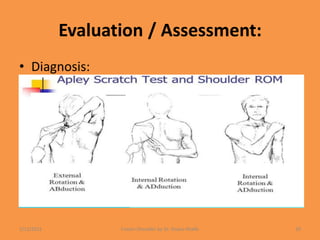
• Diagnosis:
1/13/2021 Frozen Shoulder by Dr. Shazia Khalfe 29
Problem List
• Pain
• Impaired joint play and ROM in capsular pattern
• Postural deviations such as protracted scapula
and anterior tipping of the scapula and rounded
shoulders
• Decreased arm swing during gait
• General muscle weakness, poor endurance in
glenohumeral (GH) musculature with resultant
overuse of the scapular muscles.
[The Brigham and Women's Hospital, Inc. Department of
Rehabilitation Services 2010]
1/13/2021 Frozen Shoulder by Dr. Shazia Khalfe 30
Functional Limitations and Disabilities
• Difficulty with ADLs requiring reaching
overhead, behind head and behind back
• Unable to lift weighted objects
• Unable to sustain repetitive UE activities.
[Kisner & Colby Ed 5]
1/13/2021 Frozen Shoulder by Dr. Shazia Khalfe 31
Prognosis:
Adhesive capsulitis can last 12 to 18 months,
with 3 distinct phases. The first phase can last 2-
9 months, the second phase 4-12 months and
the last phase, the thawing phase, from 6-9
months.
[The Brigham and Women's Hospital, Inc. Department of
Rehabilitation Services 2010]
1/13/2021 Frozen Shoulder by Dr. Shazia Khalfe 32
Goals
• Demonstrate knowledge of self management of
symptoms
• Demonstrate independent knowledge of home exercise
program
• Increase ROM of all affected motions to equal ROM on
the unaffected side
• Demonstrate normal postural alignment
• Demonstrate normal UE motion during gait
• Demonstrate highest level of muscular performance on
involved UE and scapular musculature
[The Brigham and Women's Hospital, Inc. Department of
Rehabilitation Services 2010]
1/13/2021 Frozen Shoulder by Dr. Shazia Khalfe 33
Interventions most commonly used
• ROM exercises including pendulum exercises, PROM, AAROM,
AROM
• TENS for pain relief
• Strengthening exercises within pain free range
• Joint mobilization: grades I-II used in the early stages to inhibit pain
and to improve joint nutrition, grades III-IV to increase tissue
extensibility
• Moist heat
• Stretching
• Muscle reeducation to regain normal GH and scapulothoracic
biomechanics
[The Brigham and Women's Hospital, Inc. Department of
Rehabilitation Services 2010]
1/13/2021 Frozen Shoulder by Dr. Shazia Khalfe 34
Frequency & Duration
• Frequency and duration of treatment are both
dependent on the stage that the patient is in.
[The Brigham and Women's Hospital, Inc. Department of
Rehabilitation Services 2010]
1/13/2021 Frozen Shoulder by Dr. Shazia Khalfe 35
Patient / family education
• Time Frames of healing and of each stage
• Pathology and natural history of the disorder
• Role of PT in rehabilitation
• Home exercise program including strengthening
and AROM/AAROM/PROM
• Pain management techniques
• Postural awareness education
[The Brigham and Women's Hospital, Inc. Department of
Rehabilitation Services 2010]
1/13/2021 Frozen Shoulder by Dr. Shazia Khalfe 36
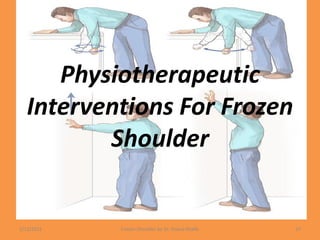
Physiotherapeutic
Interventions For Frozen
Shoulder
1/13/2021 Frozen Shoulder by Dr. Shazia Khalfe 37
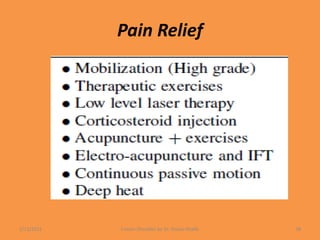
Pain Relief
1/13/2021 Frozen Shoulder by Dr. Shazia Khalfe 38
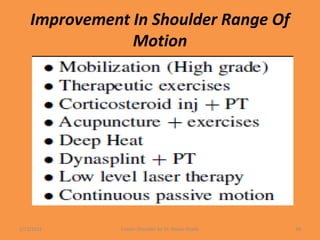
Improvement In Shoulder Range Of
Motion
1/13/2021 Frozen Shoulder by Dr. Shazia Khalfe 39
Improvement In Shoulder Function
[Jain & Sharma, 2013]
1/13/2021 Frozen Shoulder by Dr. Shazia Khalfe 40
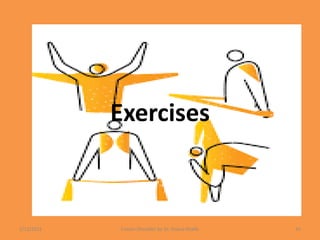
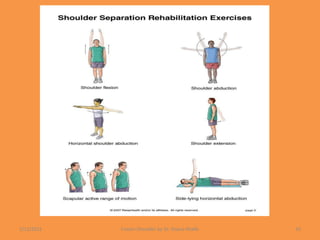
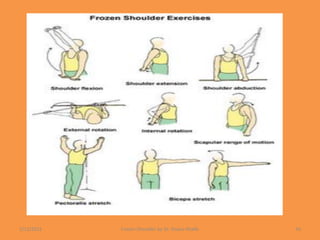
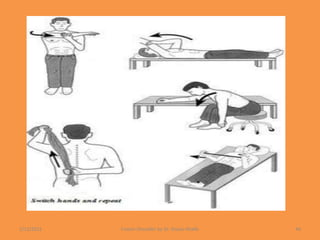
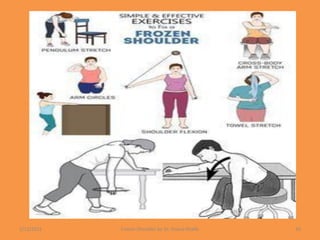
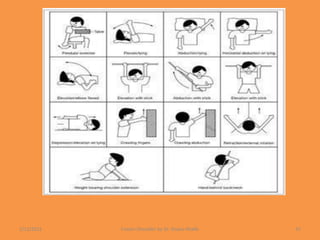
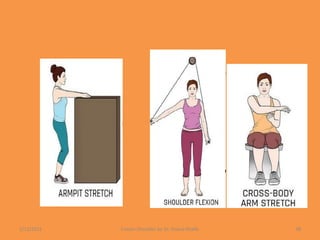
Exercises
1/13/2021 Frozen Shoulder by Dr. Shazia Khalfe 41
1/13/2021 Frozen Shoulder by Dr. Shazia Khalfe 42
1/13/2021 Frozen Shoulder by Dr. Shazia Khalfe 43
1/13/2021 Frozen Shoulder by Dr. Shazia Khalfe 44
1/13/2021 Frozen Shoulder by Dr. Shazia Khalfe 45
1/13/2021 Frozen Shoulder by Dr. Shazia Khalfe 46
1/13/2021 Frozen Shoulder by Dr. Shazia Khalfe 47
1/13/2021 Frozen Shoulder by Dr. Shazia Khalfe 48
Summary
1/13/2021 Frozen Shoulder by Dr. Shazia Khalfe 49
References
• Bal A, Eskioglu E, Gulec B, Aydog E, Gurcay E, Cakci A. Effectiveness of
corticosteroid injection in adhesive capsulitis. Clinical Rehabilitation 2008;
22:503-512.
• Codman EA. Tendinitis of the Short Rotators. In: The Shoulder: Rupture of
the Supraspinatus Tendon and Other Lesions in or about the Subacromial
Bursa. Boston MA: Thomas Todd, 1934
• David et al, Frozen shoulder: A clinical review Article in British journal of
hospital medicine (London, England: 2005) · June 2009
• DOI: 10.12968/hmed.2009.70.5.42225 · Source: PubMed
• Duplay E. De la periarthrite scapulo-humérale et des raideurs de l`épaule
qui en sont la conséquence. Arch Gen Med 1872; 20: 513-542
• Faisal Inayat,1 Nouman Safdar Ali,2 Haroon Shahid,3 and Fariha Younus4,
2017 Prevalence and Determinants of Frozen Shoulder in Patients with
Diabetes: A Single Center Experience from Pakistan, Cureus. 2017 Aug;
9(8): e1544.
1/13/2021 Frozen Shoulder by Dr. Shazia Khalfe 50
References
• Gaspar P, Willis B. Adhesive capsulitis and dynamic
splinting: a controlled, cohort study. BMC
Musculoskeletal Disorders 2009;10:111.
• Hui Bin Yvonne Chan, Pek Ying Pua, MManipPhty,
Choon How How,2017, Physical therapy in the
management of frozen shoulder, Singapore Med J
2017; 58(12): 685-689 doi: 10.11622/smedj.2017107.
• Kelley M, Mcclure P, Leggin B. Frozen shoulder:
Evidence and a proposed model guiding rehabilitation.
J Orthop Sports Phys Ther 2009;39:135-148.
• Kisner & Colby 5th Ed. Chapter 17.
1/13/2021 Frozen Shoulder by Dr. Shazia Khalfe 51
References
• Luise Hollmann , 2017, Solving the Enigma of Frozen
Shoulder, Sydney School of Medicine The University of Sydney
• Mohanty & Pattnaik, 2015, Physiotherapy for the Shoulder,
Chapter 4.
• Sarah Walmsley, Peter G. Osmotherly, Darren A. Rivett, 2014,
Clinical Identifiers for Early-Stage Primary/Idiopathic Adhesive
Capsulitis: Are We Seeing the Real Picture? Physical Therapy
Volume 94 Number 7
• Shakeel Ahmad, Dr. Mohammad Sohail Rafi, Iqbal Ahmed
Siddiqui, Khurram Hamidi, Nabiha Mujahid Faruq, 2012 The
Frequency Of Adhesive Capsulitis in Diabetes Mellitus
Patients. Pakistan Journal of Rehabilitation 2012 Volume 1
(Issue 2).
1/13/2021 Frozen Shoulder by Dr. Shazia Khalfe 52
References
• The Brigham and Women's Hospital, Inc.
Department of Rehabilitation Services 2010
• www.physio-
pedia.com/Capsular_and_Noncapsular_Patterns#
:~:text=%5B17%5D%20The%20shoulder%20joint
%20has,ABD%20limitations%20%3E%20IR%20lim
itations, Assessed on 9th July 2020]
• Zuckerman JD, Rokito A. Frozen shoulder: a
consensus definition. J Shoulder Elbow Surg
2011; 20:322-5.
1/13/2021 Frozen Shoulder by Dr. Shazia Khalfe 53
1/13/2021 Frozen Shoulder by Dr. Shazia Khalfe 54

Adhesive capsulitis

  • 1.
    1/13/2021 Frozen Shoulderby Dr. Shazia Khalfe 1
  • 2.
    Adhesive Capsulitis By Dr. ShaziaAbdul Hamid Khalfe, PT
  • 3.
    Objectives At the endof webinar students will be able to: • Define Adhesive Capsulitis. • Explain the types of Adhesive Capsulitis. • Epidemiology of Adhesive Capsulitis. • Identify the Clinical Presentation of Adhesive Capsulitis. • Assess Adhesive Capsulitis. • Identify different Physiotherapeutic Options for Treatment of Adhesive Capsulitis. • Plan the Physical Therapy Treatment for Adhesive Capsulitis. • Exercises for Adhesive Capsulitis. 1/13/2021 Frozen Shoulder by Dr. Shazia Khalfe 3
  • 4.
    Shoulder Joint 1/13/2021 FrozenShoulder by Dr. Shazia Khalfe 4
  • 5.
    Shoulder Joint 1/13/2021 FrozenShoulder by Dr. Shazia Khalfe 5
  • 6.
    Shoulder Joint 1/13/2021 FrozenShoulder by Dr. Shazia Khalfe 6
  • 7.
    Capsular pattern ofShoulder • The shoulder joint has a capsular pattern where external rotation is more limited than abduction which is more limited than internal rotation (ER limitations > ABD limitations > IR limitations). [https://www.physio-pedia.com] 1/13/2021 Frozen Shoulder by Dr. Shazia Khalfe 7
  • 8.
    What is AdhesiveCapsulitis? 1/13/2021 Frozen Shoulder by Dr. Shazia Khalfe 8
  • 9.
    Adhesive Capsulitis The firstrecorded description of a frozen shoulder was reported by Duplay [Duplay 1872] in 1872, though the term frozen shoulder was first used in 1934 by Codman[Codman 1934]. 1/13/2021 Frozen Shoulder by Dr. Shazia Khalfe 9
  • 10.
    Adhesive Capsulitis Adhesive capsulitis,also known as frozen shoulder, is a condition characterized by pain and significant loss of both active range of motion (AROM) and passive range of motion (PROM) of the shoulder. [David et al, 2009] 1/13/2021 Frozen Shoulder by Dr. Shazia Khalfe 10
  • 11.
    Adhesive Capsulitis • Itis the condition of uncertain etiology, characterized by significant restriction of both active and passive shoulder motion that occurs in the absence of a known intrinsic shoulder disorder. [Zuckerman JD, 2011] 1/13/2021 Frozen Shoulder by Dr. Shazia Khalfe 11
  • 12.
    Types of Adhesive Capsulitis 1/13/2021Frozen Shoulder by Dr. Shazia Khalfe 12
  • 13.
    Types of AdhesiveCapsulitis • Primary Adhesive Capsulitis. • Secondary Adhesive Capsulitis. [Chan HBY et al, 2017] 1/13/2021 Frozen Shoulder by Dr. Shazia Khalfe 13
  • 14.
    Primary Adhesive Capsulitis Primaryfrozen shoulder is idiopathic in nature. It is characterized by the development of dense adhesions, capsular thickening, and capsular restrictions, especially in the dependent folds of the capsule, rather than arthritic changes in the cartilage and bone. [Kisner & Colby 5th Ed] 1/13/2021 Frozen Shoulder by Dr. Shazia Khalfe 14
  • 15.
    Stages of PrimaryAdhesive Capsulitis • “Freezing.” Characterized by intense pain even at rest and limitation of motion by 2 to 3 weeks after onset. These acute symptoms may last 10 to 36 weeks. [Kisner & Colby 5th Ed] 1/13/2021 Frozen Shoulder by Dr. Shazia Khalfe 15
  • 16.
    Stages of PrimaryAdhesive Capsulitis • “ Frozen” there is a decrease in hypervascularity and synovitis however, capsular contraction and thickening is noted on arthroscopic evaluation. There is pain during movement. Atrophy of the deltoid, rotator cuff, biceps, and triceps brachii muscles occurs. This stage lasts 4 to 12 months. [Kisner & Colby 5th Ed, Mohanty & Pattnaik, 2015] 1/13/2021 Frozen Shoulder by Dr. Shazia Khalfe 16
  • 17.
    Stages of PrimaryAdhesive Capsulitis • “Thawing.” Characterized by no pain and no synovitis but significant capsular restrictions from adhesions. This stage lasts 5 to 26 months or longer. Some patients never regain normal ROM. [Kisner & Colby 5th Ed] 1/13/2021 Frozen Shoulder by Dr. Shazia Khalfe 17
  • 18.
    Secondary Adhesive Capsulitis Secondaryadhesive capsulitis can occur after shoulder injuries or immobilisation (e.g. rotator cuff tendon tear, subacromial impingement, biceps tenosynovitis and calcific tendonitis). These patients develop pain from the shoulder pathology, leading to reduced movement in that shoulder and thus developing frozen shoulder. [Chan HBY et al, 2017] 1/13/2021 Frozen Shoulder by Dr. Shazia Khalfe 18
  • 19.
  • 20.
    Epidemiology • Adhesive capsulitisis often more prevalent in women, as approximately 70% of individuals who present with a frozen shoulder, are females. • 35-65 years old, approximately 2-5% in the general population, and 20% within the diabetic population. [Gasper et al, 2009, Kelle et al 2009, Bal et al 2008] 1/13/2021 Frozen Shoulder by Dr. Shazia Khalfe 20
  • 21.
    In Pakistan • Theestimated prevalence of FS in diabetics from this data was 41.3%. (Lahore) • A positive family history were associated with a significantly higher prevalence of Adhesive Capsulitis. [Faisal et al, 2017] • Frequency of shoulder adhesive capsulitis was 24.9% among diabetic subjects. (Karachi) [ Shakeel A, et al 2012] 1/13/2021 Frozen Shoulder by Dr. Shazia Khalfe 21
  • 22.
    Clinical Presentation 1/13/2021 FrozenShoulder by Dr. Shazia Khalfe 22
  • 23.
    [Sarah Walmsley, etal, 2014, Kisner & Colby] 1/13/2021 Frozen Shoulder by Dr. Shazia Khalfe 23
  • 24.
    Assessment 1/13/2021 Frozen Shoulderby Dr. Shazia Khalfe 24
  • 25.
    Subjective Data • MedicalHistory: • Social History: • Medications: • History of Present Illness: [The Brigham and Women's Hospital, Inc. Department of Rehabilitation Services 2010] 1/13/2021 Frozen Shoulder by Dr. Shazia Khalfe 25
  • 26.
    Objective Data • Pain: •Observation: • Postural Assessment: • Palpation: • Upper Quarter Neuro screen including reflexes, myotomes, dermatomes • Range of Motion • Muscle Performance/Strength: • Joint Integrity and Mobility: • Special tests: [The Brigham and Women's Hospital, Inc. Department of Rehabilitation Services 2010] 1/13/2021 Frozen Shoulder by Dr. Shazia Khalfe 26
  • 27.
    Differential Diagnosis • Aplain X-ray is needed to exclude other pathologies, such as glenohumeral osteoarthritis, locked dislocations and tumours, that can present with active and passive movement restriction and therefore, mimic frozen shoulder. [Luise Hollmann, 2017] 1/13/2021 Frozen Shoulder by Dr. Shazia Khalfe 27
  • 28.
    Differential Diagnosis • ShoulderDislocation: • Tendonitis or bursitis: • Acromioclavicular joint dysfunction: • Malignancy: [The Brigham and Women's Hospital, Inc. Department of Rehabilitation Services 2010] 1/13/2021 Frozen Shoulder by Dr. Shazia Khalfe 28
  • 29.
    Evaluation / Assessment: •Diagnosis: 1/13/2021 Frozen Shoulder by Dr. Shazia Khalfe 29
  • 30.
    Problem List • Pain •Impaired joint play and ROM in capsular pattern • Postural deviations such as protracted scapula and anterior tipping of the scapula and rounded shoulders • Decreased arm swing during gait • General muscle weakness, poor endurance in glenohumeral (GH) musculature with resultant overuse of the scapular muscles. [The Brigham and Women's Hospital, Inc. Department of Rehabilitation Services 2010] 1/13/2021 Frozen Shoulder by Dr. Shazia Khalfe 30
  • 31.
    Functional Limitations andDisabilities • Difficulty with ADLs requiring reaching overhead, behind head and behind back • Unable to lift weighted objects • Unable to sustain repetitive UE activities. [Kisner & Colby Ed 5] 1/13/2021 Frozen Shoulder by Dr. Shazia Khalfe 31
  • 32.
    Prognosis: Adhesive capsulitis canlast 12 to 18 months, with 3 distinct phases. The first phase can last 2- 9 months, the second phase 4-12 months and the last phase, the thawing phase, from 6-9 months. [The Brigham and Women's Hospital, Inc. Department of Rehabilitation Services 2010] 1/13/2021 Frozen Shoulder by Dr. Shazia Khalfe 32
  • 33.
    Goals • Demonstrate knowledgeof self management of symptoms • Demonstrate independent knowledge of home exercise program • Increase ROM of all affected motions to equal ROM on the unaffected side • Demonstrate normal postural alignment • Demonstrate normal UE motion during gait • Demonstrate highest level of muscular performance on involved UE and scapular musculature [The Brigham and Women's Hospital, Inc. Department of Rehabilitation Services 2010] 1/13/2021 Frozen Shoulder by Dr. Shazia Khalfe 33
  • 34.
    Interventions most commonlyused • ROM exercises including pendulum exercises, PROM, AAROM, AROM • TENS for pain relief • Strengthening exercises within pain free range • Joint mobilization: grades I-II used in the early stages to inhibit pain and to improve joint nutrition, grades III-IV to increase tissue extensibility • Moist heat • Stretching • Muscle reeducation to regain normal GH and scapulothoracic biomechanics [The Brigham and Women's Hospital, Inc. Department of Rehabilitation Services 2010] 1/13/2021 Frozen Shoulder by Dr. Shazia Khalfe 34
  • 35.
    Frequency & Duration •Frequency and duration of treatment are both dependent on the stage that the patient is in. [The Brigham and Women's Hospital, Inc. Department of Rehabilitation Services 2010] 1/13/2021 Frozen Shoulder by Dr. Shazia Khalfe 35
  • 36.
    Patient / familyeducation • Time Frames of healing and of each stage • Pathology and natural history of the disorder • Role of PT in rehabilitation • Home exercise program including strengthening and AROM/AAROM/PROM • Pain management techniques • Postural awareness education [The Brigham and Women's Hospital, Inc. Department of Rehabilitation Services 2010] 1/13/2021 Frozen Shoulder by Dr. Shazia Khalfe 36
  • 37.
  • 38.
    Pain Relief 1/13/2021 FrozenShoulder by Dr. Shazia Khalfe 38
  • 39.
    Improvement In ShoulderRange Of Motion 1/13/2021 Frozen Shoulder by Dr. Shazia Khalfe 39
  • 40.
    Improvement In ShoulderFunction [Jain & Sharma, 2013] 1/13/2021 Frozen Shoulder by Dr. Shazia Khalfe 40
  • 41.
    Exercises 1/13/2021 Frozen Shoulderby Dr. Shazia Khalfe 41
  • 42.
    1/13/2021 Frozen Shoulderby Dr. Shazia Khalfe 42
  • 43.
    1/13/2021 Frozen Shoulderby Dr. Shazia Khalfe 43
  • 44.
    1/13/2021 Frozen Shoulderby Dr. Shazia Khalfe 44
  • 45.
    1/13/2021 Frozen Shoulderby Dr. Shazia Khalfe 45
  • 46.
    1/13/2021 Frozen Shoulderby Dr. Shazia Khalfe 46
  • 47.
    1/13/2021 Frozen Shoulderby Dr. Shazia Khalfe 47
  • 48.
    1/13/2021 Frozen Shoulderby Dr. Shazia Khalfe 48
  • 49.
    Summary 1/13/2021 Frozen Shoulderby Dr. Shazia Khalfe 49
  • 50.
    References • Bal A,Eskioglu E, Gulec B, Aydog E, Gurcay E, Cakci A. Effectiveness of corticosteroid injection in adhesive capsulitis. Clinical Rehabilitation 2008; 22:503-512. • Codman EA. Tendinitis of the Short Rotators. In: The Shoulder: Rupture of the Supraspinatus Tendon and Other Lesions in or about the Subacromial Bursa. Boston MA: Thomas Todd, 1934 • David et al, Frozen shoulder: A clinical review Article in British journal of hospital medicine (London, England: 2005) · June 2009 • DOI: 10.12968/hmed.2009.70.5.42225 · Source: PubMed • Duplay E. De la periarthrite scapulo-humérale et des raideurs de l`épaule qui en sont la conséquence. Arch Gen Med 1872; 20: 513-542 • Faisal Inayat,1 Nouman Safdar Ali,2 Haroon Shahid,3 and Fariha Younus4, 2017 Prevalence and Determinants of Frozen Shoulder in Patients with Diabetes: A Single Center Experience from Pakistan, Cureus. 2017 Aug; 9(8): e1544. 1/13/2021 Frozen Shoulder by Dr. Shazia Khalfe 50
  • 51.
    References • Gaspar P,Willis B. Adhesive capsulitis and dynamic splinting: a controlled, cohort study. BMC Musculoskeletal Disorders 2009;10:111. • Hui Bin Yvonne Chan, Pek Ying Pua, MManipPhty, Choon How How,2017, Physical therapy in the management of frozen shoulder, Singapore Med J 2017; 58(12): 685-689 doi: 10.11622/smedj.2017107. • Kelley M, Mcclure P, Leggin B. Frozen shoulder: Evidence and a proposed model guiding rehabilitation. J Orthop Sports Phys Ther 2009;39:135-148. • Kisner & Colby 5th Ed. Chapter 17. 1/13/2021 Frozen Shoulder by Dr. Shazia Khalfe 51
  • 52.
    References • Luise Hollmann, 2017, Solving the Enigma of Frozen Shoulder, Sydney School of Medicine The University of Sydney • Mohanty & Pattnaik, 2015, Physiotherapy for the Shoulder, Chapter 4. • Sarah Walmsley, Peter G. Osmotherly, Darren A. Rivett, 2014, Clinical Identifiers for Early-Stage Primary/Idiopathic Adhesive Capsulitis: Are We Seeing the Real Picture? Physical Therapy Volume 94 Number 7 • Shakeel Ahmad, Dr. Mohammad Sohail Rafi, Iqbal Ahmed Siddiqui, Khurram Hamidi, Nabiha Mujahid Faruq, 2012 The Frequency Of Adhesive Capsulitis in Diabetes Mellitus Patients. Pakistan Journal of Rehabilitation 2012 Volume 1 (Issue 2). 1/13/2021 Frozen Shoulder by Dr. Shazia Khalfe 52
  • 53.
    References • The Brighamand Women's Hospital, Inc. Department of Rehabilitation Services 2010 • www.physio- pedia.com/Capsular_and_Noncapsular_Patterns# :~:text=%5B17%5D%20The%20shoulder%20joint %20has,ABD%20limitations%20%3E%20IR%20lim itations, Assessed on 9th July 2020] • Zuckerman JD, Rokito A. Frozen shoulder: a consensus definition. J Shoulder Elbow Surg 2011; 20:322-5. 1/13/2021 Frozen Shoulder by Dr. Shazia Khalfe 53
  • 54.
    1/13/2021 Frozen Shoulderby Dr. Shazia Khalfe 54