PT IN
MUSCULOSKELETAL
SCIENCES
By,
Dr. VARSHA PAWAR
BPTH, MPTH, MIAP
ASSOCIATE PROFESSOR
PURPOSE
At the end of lecture students should be
able to learn about shoulder joint
pathologies
OBJECTIV
ES
At the end of lecture
students should be able to
Define adhesive capsulitis
Describe clinical presentation
of adhesive capsulitis
Enlist causes of adhesive
capsulitis
HISTORY
Duplay and Putnam provided the first
reported descriptions of frozen shoulder in
the late 1800s.
They used the label scapulohumeral
periarthritis to describe a broad spectrum of
pathologies of the shoulder pain, stiffness,
and dysfunction
Rotator cuff tendonitis and tears
Biceps tendonitis and tears
Calcific deposits
Acromioclavicular arthritis
Other painful shoulder syndromes.
FROZEN
SHOULDE
R
1934 by Codman
As involving a slow onset
Pain near the deltoid insertion
Inability to sleep on the affected side
Painful and restricted elevation and external
rotation
A normal radiological appearance.
ADHESIVE
CAPSULITI
S
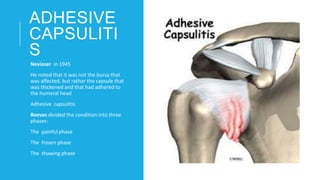
Neviaser in 1945
He noted that it was not the bursa that
was affected, but rather the capsule that
was thickened and that had adhered to
the humeral head
Adhesive capsulitis
Reeves divided the condition into three
phases:
The painful phase
The frozen phase
The thawing phase
FREEZIN
G PHASE
(PAINFUL)
Duration: 10-36 weeks/3-6 MONTHS
Pain and stiffness around the shoulder
No history of injury
Nagging, constant pain that is worse at Night
Most patients will position the arm in adduction and
internal rotation.
Little or no response to NSAlDs
ADHESIVE/RESTRIC
TIVE PHASE/
Progressive stiffness or frozen phase
Duration: 4- 1 2 weeks/3-18 MONTHS
Pain gradually subsides
Stiffness remains
Pain apparent only at extremes of movement
Gross reduction of glenohumeral movements with near
total loss of
external rotation
Activities of daily living become severely restricted.
Pain at night is a common complaint
Not easily treated with medications or physical modalities.
RESOLUTI
ON
PHASE/
THAWING"
PHASE.
Duration : 12-42 weeks/ 3-6 MONTHS
Spontaneous improvement in ROM
Mean duration from onset of frozen shoulder to
greatest resolution
exceeds 30 weeks
RECENT
Zuckerman and Cuomo
Frozen shoulder or idiopathic adhesive capsulitis
As a condition of uncertain etiology
Characterized by substantial restriction of both
active and passive shoulder motion
Occurs in the absence of a known intrinsic
shoulder disorder
CAUSES
The onset of an "idiopathic" frozen shoulder has been
associated
Extended immobilization,
Relatively mild trauma (e.g., strain or contusion)
Surgical trauma- breast or chest wall procedures
Diabetes
Hyperthyroidism
ischemic heart disease
Inflammatory arthritis
cervical spondylosis.
The most significant association is with insulin-dependent
diabetes.
PATIENT’S HISTORY
ON THE ONSET AND
DURATION OF SYMPTOMS,
A DESCRIPTION OF ANY
ANTECEDENT TRAUMA,
ANY ASSOCIATED
MEDICAL CONDITIONS
CLINICAL
PRESENT
ATION
Patients 40 to 60 years of age,
Higher incidence in females.
Pain
Restricted range of motion ( RO M )
A slow, progressive loss of shoulder mobility
A loss of shoulder motion almost overnight
Capsular pattern of restriction
A greater loss first of lateral rotation, followed by abduction, and then
medial rotation
Actively and passively
Secondary weakness as a result of disuse and poor use of deep
stabilizers of the glenohumeral joint
Reversal of normal scapulohumeral rhythm
The loss of external rotation with the arm at the patient's side is a
hallmark of this condition.
FUNCTIONAL IMPAIRMENTS
Pain at night
Disturbed sleep
Decreased mobility
 ROM
 joint play
Posture
 Protracted shoulder
Gait
Decreased arm swing
Muscle performance
 Decreased strength
 Decreased endurance
Overuse of scapular muscles & Cx muscles
ACTIVITY LIMITATION
Inability to
reach overhead
Difficulty in
dressing
Self grooming
Difficulty in
eating
Difficulty lifting
heavy objects
overhead
Decreased
endurance
RELATED PATHOLOGIES
Osteoarthritis of shoulder joint
Traumatic arthritis
Post-immobilization arthritis
Post immobilization stiff shoulder
OA SHOULDER JOINT
ADHESIVE CAPSULITIS
SUMMARY
ADHESIVE CAPSULITIS CLINICAL
PRESENTATION
DIFFERENTIAL /
RELATED PATHOLOGIES
DIAGNOSTIC CRITERIA
REFERENC
ES
Essentials of orthopedics &
applied physiotherapy : J J
Therapeutic exercises :
Carolyn Kisner
Pathology & intervention in
Musculoskeletal
rehabilitation: David J
Magee
THANK YOU

Adhesive Capsulitis

  • 1.
    PT IN MUSCULOSKELETAL SCIENCES By, Dr. VARSHAPAWAR BPTH, MPTH, MIAP ASSOCIATE PROFESSOR
  • 2.
    PURPOSE At the endof lecture students should be able to learn about shoulder joint pathologies
  • 3.
    OBJECTIV ES At the endof lecture students should be able to Define adhesive capsulitis Describe clinical presentation of adhesive capsulitis Enlist causes of adhesive capsulitis
  • 4.
    HISTORY Duplay and Putnamprovided the first reported descriptions of frozen shoulder in the late 1800s. They used the label scapulohumeral periarthritis to describe a broad spectrum of pathologies of the shoulder pain, stiffness, and dysfunction Rotator cuff tendonitis and tears Biceps tendonitis and tears Calcific deposits Acromioclavicular arthritis Other painful shoulder syndromes.
  • 5.
    FROZEN SHOULDE R 1934 by Codman Asinvolving a slow onset Pain near the deltoid insertion Inability to sleep on the affected side Painful and restricted elevation and external rotation A normal radiological appearance.
  • 6.
    ADHESIVE CAPSULITI S Neviaser in 1945 Henoted that it was not the bursa that was affected, but rather the capsule that was thickened and that had adhered to the humeral head Adhesive capsulitis Reeves divided the condition into three phases: The painful phase The frozen phase The thawing phase
  • 7.
    FREEZIN G PHASE (PAINFUL) Duration: 10-36weeks/3-6 MONTHS Pain and stiffness around the shoulder No history of injury Nagging, constant pain that is worse at Night Most patients will position the arm in adduction and internal rotation. Little or no response to NSAlDs
  • 8.
    ADHESIVE/RESTRIC TIVE PHASE/ Progressive stiffnessor frozen phase Duration: 4- 1 2 weeks/3-18 MONTHS Pain gradually subsides Stiffness remains Pain apparent only at extremes of movement Gross reduction of glenohumeral movements with near total loss of external rotation Activities of daily living become severely restricted. Pain at night is a common complaint Not easily treated with medications or physical modalities.
  • 9.
    RESOLUTI ON PHASE/ THAWING" PHASE. Duration : 12-42weeks/ 3-6 MONTHS Spontaneous improvement in ROM Mean duration from onset of frozen shoulder to greatest resolution exceeds 30 weeks
  • 10.
    RECENT Zuckerman and Cuomo Frozenshoulder or idiopathic adhesive capsulitis As a condition of uncertain etiology Characterized by substantial restriction of both active and passive shoulder motion Occurs in the absence of a known intrinsic shoulder disorder
  • 11.
    CAUSES The onset ofan "idiopathic" frozen shoulder has been associated Extended immobilization, Relatively mild trauma (e.g., strain or contusion) Surgical trauma- breast or chest wall procedures Diabetes Hyperthyroidism ischemic heart disease Inflammatory arthritis cervical spondylosis. The most significant association is with insulin-dependent diabetes.
  • 12.
    PATIENT’S HISTORY ON THEONSET AND DURATION OF SYMPTOMS, A DESCRIPTION OF ANY ANTECEDENT TRAUMA, ANY ASSOCIATED MEDICAL CONDITIONS
  • 13.
    CLINICAL PRESENT ATION Patients 40 to60 years of age, Higher incidence in females. Pain Restricted range of motion ( RO M ) A slow, progressive loss of shoulder mobility A loss of shoulder motion almost overnight Capsular pattern of restriction A greater loss first of lateral rotation, followed by abduction, and then medial rotation Actively and passively Secondary weakness as a result of disuse and poor use of deep stabilizers of the glenohumeral joint Reversal of normal scapulohumeral rhythm The loss of external rotation with the arm at the patient's side is a hallmark of this condition.
  • 14.
    FUNCTIONAL IMPAIRMENTS Pain atnight Disturbed sleep Decreased mobility  ROM  joint play Posture  Protracted shoulder Gait Decreased arm swing Muscle performance  Decreased strength  Decreased endurance Overuse of scapular muscles & Cx muscles
  • 15.
    ACTIVITY LIMITATION Inability to reachoverhead Difficulty in dressing Self grooming Difficulty in eating Difficulty lifting heavy objects overhead Decreased endurance
  • 16.
    RELATED PATHOLOGIES Osteoarthritis ofshoulder joint Traumatic arthritis Post-immobilization arthritis Post immobilization stiff shoulder
  • 17.
  • 18.
  • 19.
    SUMMARY ADHESIVE CAPSULITIS CLINICAL PRESENTATION DIFFERENTIAL/ RELATED PATHOLOGIES DIAGNOSTIC CRITERIA
  • 20.
    REFERENC ES Essentials of orthopedics& applied physiotherapy : J J Therapeutic exercises : Carolyn Kisner Pathology & intervention in Musculoskeletal rehabilitation: David J Magee
  • 21.