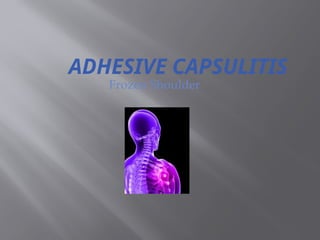
ADHESIVE CAPSULITIS
Frozen Shoulder
What do we mean by adhesive
capsulitis ?
Frozen shoulder medically referred to as Adhesive
capsulitis is a very painful and debilitating
condition of the shoulder characterised by pain
and severe stiffness of more than 50% in all
directions, (i.e. you can’t move the arm freely in
any direction, especially behind your back).
Stages of FS
The Three Stages of Adhesive Capsulitis
 Freezing (Painful stage)
Pain with movement
Generalized ache that is difficult to pinpoint
Muscle spasm
Increasing pain at night and at rest
 Frozen (Adhesive stage)
Less pain
Increasing stiffness and restriction of movement
Decreasing pain at night and at rest
Discomfort felt at extreme ranges of movement
 Thawing (Recovery stage)
Decreased pain
Marked restriction with slow, gradual increase in range of motion
Recovery is spontaneous but frequently incomplete.
Presenting complains
Frozen Shoulder can be very distressing as it can make
you feel mildly disabled. You may well be suffering from:
• Severe night pain and waking
• Inability to lie on your side at night
• Can’t brush your hair
• Can’t brush your teeth
• Can’t reach to your back pocket
• Can’t lift your arm
• Increased sweating
Pathophysiology
At this time there is no accepted complete
understanding of the pathophysiological basis for
the development of adhesive capsulitis.
Pathological process originating in the
glenohumeral capsule was responsible for
shoulder stiffness.
 perivascular infiltration,
 capsular fibrosis,
 capsular thickening
 Abnormal type 3 collagen populated with
fibroblasts and myoblasts.
History
Patient may be suffering from following condition
who present with FS
 Diabetes
 HTN
 Stroke
 Immobilization (Colle’s fracture)
Facts about frozen shoulder
 More common in women (60%)
 At least five times more common in diabetics
 Slightly more common in patients with Dupytren’s
contracture and shares some of the same pathology
 May have a genetic component i.e. it can run in the family
 Seems to affect 40-70 year olds
 About 15% of people develop frozen shoulder on both sides
(commonly within 6-12 months of the first occurrence)
 Can occur after shoulder surgery
 Can occur after breast reconstruction surgery
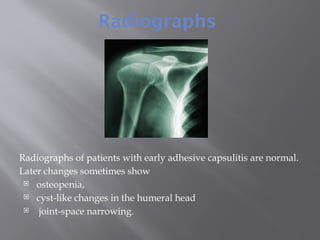
Radiographs
Radiographs of patients with early adhesive capsulitis are normal.
Later changes sometimes show
 osteopenia,
 cyst-like changes in the humeral head
 joint-space narrowing.
There is no particular screening test for frozen
shoulder other than loss of ROM but there should
be a differential diagnosis to exclude other causes
such as rotator cuff lesion and instability.
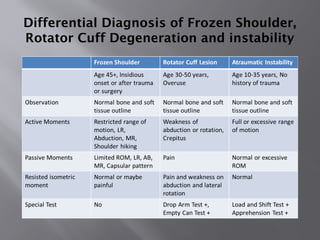
Differential Diagnosis of Frozen Shoulder,
Rotator Cuff Degeneration and instability
Myotomes Affected: These myotomes are tested in frozen
shoulder.
C4 Myotome:
Muscles include:
Deltoid, Supraspinatus, Pect Major( clavicular part)
How to test:
Patient in sitting position, Both arms in scapular plane,
therapist apply resistance on the upper aspect of arm while the
patient hold it for 5 seconds,, Patient may feel pain.
C5 Myotome:
Muscles include:
Subscapularis, Bicep, Brachialis, Brachioradialis.
How to test:
Pt in sitting, arms by side the therapist apply resistance on
volar aspect of forearm while the pt try to hold it,
movement is painful.
C6 myotome:
Muscles include:
Infraspinatus, teres minor, Tricep, Pect major(sternal part).
How to test:
Pt in sitting, therapist apply resistance on dorsal aspect of
forearm while the pt try to hold it, movement is painful.
Reflexes:
 If frozen shoulder occur due to
stroke(hemiplegia) then following are
exaggerated
 Bicep Reflex
 Tricep Reflex
 Pect major Reflex
 In other causes of frozen shoulder (trauma or
surgery)
 Above reflexes are normal
MOBILIZATIONS
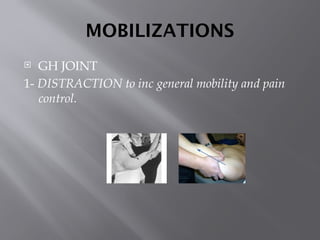
 GH JOINT
1- DISTRACTION to inc general mobility and pain
control.
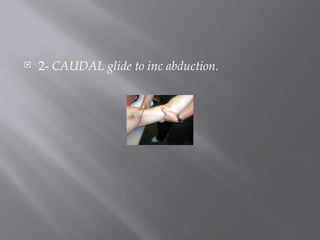
 2- CAUDAL glide to inc abduction.
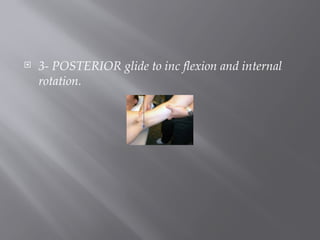
 3- POSTERIOR glide to inc flexion and internal
rotation.
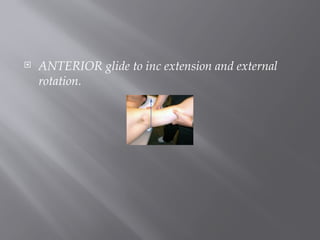
 ANTERIOR glide to inc extension and external
rotation.
 AC JOINT
1- ANTERIOR glide to inc mobility of jt.
 SC JOINT
1-POSTERIOR glide to inc retraction.
 3- ANTERIOR glide to inc protraction.
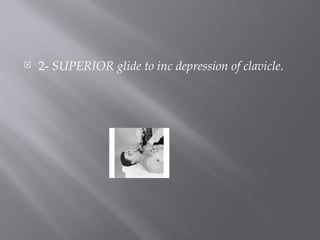
 2- SUPERIOR glide to inc depression of clavicle.
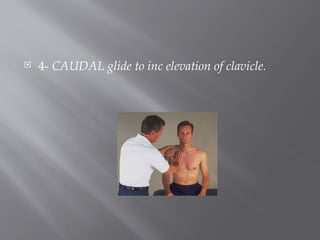
 4- CAUDAL glide to inc elevation of clavicle.
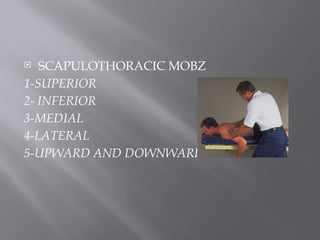
 SCAPULOTHORACIC MOBZ
1-SUPERIOR
2- INFERIOR
3-MEDIAL
4-LATERAL
5-UPWARD AND DOWNWARD ROTATION
 They are to inc scapular
- Elevation
- Depression
- Protraction
- Retraction
- Winging
- Upward and downward rotation
Thank you

frozen shoulderr for physical therapist.pptx

  • 1.
  • 2.
    What do wemean by adhesive capsulitis ? Frozen shoulder medically referred to as Adhesive capsulitis is a very painful and debilitating condition of the shoulder characterised by pain and severe stiffness of more than 50% in all directions, (i.e. you can’t move the arm freely in any direction, especially behind your back).
  • 3.
    Stages of FS TheThree Stages of Adhesive Capsulitis  Freezing (Painful stage) Pain with movement Generalized ache that is difficult to pinpoint Muscle spasm Increasing pain at night and at rest  Frozen (Adhesive stage) Less pain Increasing stiffness and restriction of movement Decreasing pain at night and at rest Discomfort felt at extreme ranges of movement  Thawing (Recovery stage) Decreased pain Marked restriction with slow, gradual increase in range of motion Recovery is spontaneous but frequently incomplete.
  • 4.
    Presenting complains Frozen Shouldercan be very distressing as it can make you feel mildly disabled. You may well be suffering from: • Severe night pain and waking • Inability to lie on your side at night • Can’t brush your hair • Can’t brush your teeth • Can’t reach to your back pocket • Can’t lift your arm • Increased sweating
  • 5.
    Pathophysiology At this timethere is no accepted complete understanding of the pathophysiological basis for the development of adhesive capsulitis. Pathological process originating in the glenohumeral capsule was responsible for shoulder stiffness.  perivascular infiltration,  capsular fibrosis,  capsular thickening  Abnormal type 3 collagen populated with fibroblasts and myoblasts.
  • 6.
    History Patient may besuffering from following condition who present with FS  Diabetes  HTN  Stroke  Immobilization (Colle’s fracture)
  • 7.
    Facts about frozenshoulder  More common in women (60%)  At least five times more common in diabetics  Slightly more common in patients with Dupytren’s contracture and shares some of the same pathology  May have a genetic component i.e. it can run in the family  Seems to affect 40-70 year olds  About 15% of people develop frozen shoulder on both sides (commonly within 6-12 months of the first occurrence)  Can occur after shoulder surgery  Can occur after breast reconstruction surgery
  • 8.
    Radiographs Radiographs of patientswith early adhesive capsulitis are normal. Later changes sometimes show  osteopenia,  cyst-like changes in the humeral head  joint-space narrowing.
  • 9.
    There is noparticular screening test for frozen shoulder other than loss of ROM but there should be a differential diagnosis to exclude other causes such as rotator cuff lesion and instability.
  • 10.
    Differential Diagnosis ofFrozen Shoulder, Rotator Cuff Degeneration and instability
  • 11.
    Myotomes Affected: Thesemyotomes are tested in frozen shoulder. C4 Myotome: Muscles include: Deltoid, Supraspinatus, Pect Major( clavicular part) How to test: Patient in sitting position, Both arms in scapular plane, therapist apply resistance on the upper aspect of arm while the patient hold it for 5 seconds,, Patient may feel pain. C5 Myotome: Muscles include: Subscapularis, Bicep, Brachialis, Brachioradialis.
  • 12.
    How to test: Ptin sitting, arms by side the therapist apply resistance on volar aspect of forearm while the pt try to hold it, movement is painful. C6 myotome: Muscles include: Infraspinatus, teres minor, Tricep, Pect major(sternal part). How to test: Pt in sitting, therapist apply resistance on dorsal aspect of forearm while the pt try to hold it, movement is painful.
  • 13.
    Reflexes:  If frozenshoulder occur due to stroke(hemiplegia) then following are exaggerated  Bicep Reflex  Tricep Reflex  Pect major Reflex  In other causes of frozen shoulder (trauma or surgery)  Above reflexes are normal
  • 14.
    MOBILIZATIONS  GH JOINT 1-DISTRACTION to inc general mobility and pain control.
  • 15.
     2- CAUDALglide to inc abduction.
  • 16.
     3- POSTERIORglide to inc flexion and internal rotation.
  • 17.
     ANTERIOR glideto inc extension and external rotation.
  • 18.
     AC JOINT 1-ANTERIOR glide to inc mobility of jt.
  • 19.
     SC JOINT 1-POSTERIORglide to inc retraction.
  • 20.
     3- ANTERIORglide to inc protraction.
  • 21.
     2- SUPERIORglide to inc depression of clavicle.
  • 22.
     4- CAUDALglide to inc elevation of clavicle.
  • 23.
     SCAPULOTHORACIC MOBZ 1-SUPERIOR 2-INFERIOR 3-MEDIAL 4-LATERAL 5-UPWARD AND DOWNWARD ROTATION
  • 24.
     They areto inc scapular - Elevation - Depression - Protraction - Retraction - Winging - Upward and downward rotation
  • 25.