Addressing Vaccine Hesitancy:
Media, Web Page, Person to Person,
and Target Populations
March 3, 2021
Continuing Education Credits
This activity has been planned and implemented
by the Community Health Center, Inc./Weitzman
Institute and is accredited to provide continuing
education for the healthcare team.
This series is intended for physicians, nurse
practitioners, physician assistants, pharmacists,
and nurses.
Please complete the survey – linked in the chat,
and emailed to all attendees – to request your
continuing education credit
A comprehensive certificate will be sent out at the
end of the series.
This week’s COVID-19 ECHO session
is a collaboration with
This resource is supported by the Health Resources and Services Administration (HRSA) of the U.S. Department of Health and Human Services (HHS) under grant
number U30CS29049 entitled "Training and Technical Assistance National Cooperative Agreements (NCAs)" for grant amount $2,045,000 with 0% financed with
non-governmental funds. This information or content and conclusions are those of the author and should not be construed as the official position or policy of, nor
should any endorsements be inferred by HRSA, HHS or the U.S. Government.
Disclosure
• With respect to the following presentation, there has been no
relevant (direct or indirect) financial relationship between the party
listed above (or spouse/partner) and any for-profit company in the
past 12 months which would be considered a conflict of interest.
• The views expressed in this presentation are those of the presenter
and may not reflect official policy of Community Health Center, Inc.
and its Weitzman Institute.
• We are obligated to disclose any products which are off-label,
unlabeled, experimental, and/or under investigation (not FDA
approved) and any limitations on the information hat I present,
such as data that are preliminary or that represent ongoing
research, interim analyses, and/or unsupported opinion.
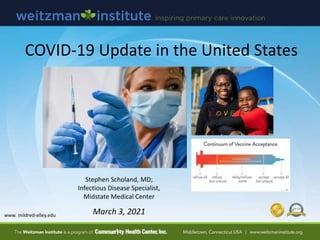
COVID-19 Update in the United States
Stephen Scholand, MD;
Infectious Disease Specialist,
Midstate Medical Center
March 3, 2021
www. mildred-elley.edu
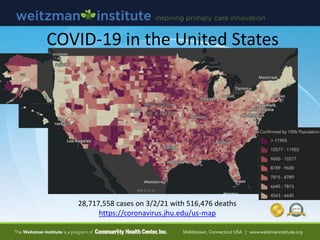
28,717,558 cases on 3/2/21 with 516,476 deaths
https://coronavirus.jhu.edu/us-map
COVID-19 in the United States
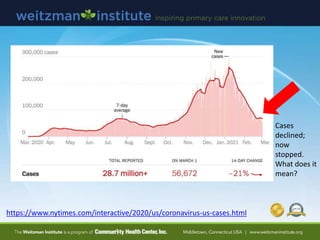
https://www.nytimes.com/interactive/2020/us/coronavirus-us-cases.html
Cases
declined;
now
stopped.
What does it
mean?
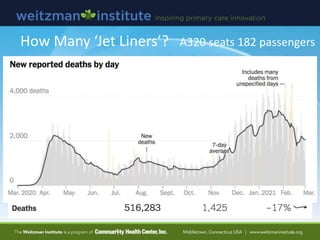
How Many ‘Jet Liners’? A320 seats 182 passengers
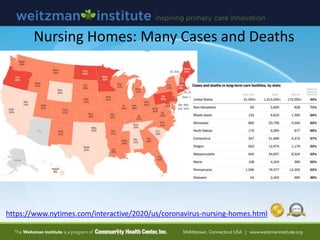
Nursing Homes: Many Cases and Deaths
https://www.nytimes.com/interactive/2020/us/coronavirus-nursing-homes.html
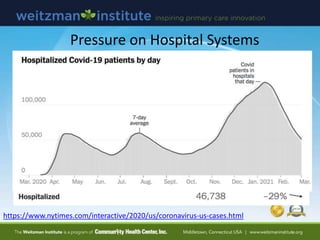
Pressure on Hospital Systems
https://www.nytimes.com/interactive/2020/us/coronavirus-us-cases.html
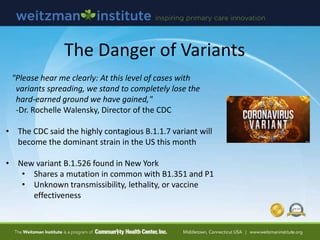
The Danger of Variants
"Please hear me clearly: At this level of cases with
variants spreading, we stand to completely lose the
hard-earned ground we have gained,"
-Dr. Rochelle Walensky, Director of the CDC
• The CDC said the highly contagious B.1.1.7 variant will
become the dominant strain in the US this month
• New variant B.1.526 found in New York
• Shares a mutation in common with B1.351 and P1
• Unknown transmissibility, lethality, or vaccine
effectiveness
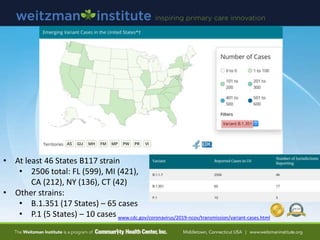
• At least 46 States B117 strain
• 2506 total: FL (599), MI (421),
CA (212), NY (136), CT (42)
• Other strains:
• B.1.351 (17 States) – 65 cases
• P.1 (5 States) – 10 cases www.cdc.gov/coronavirus/2019-ncov/transmission/variant-cases.html
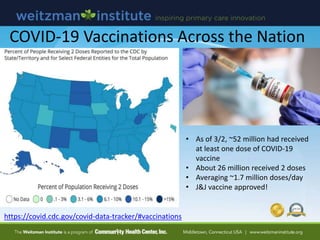
COVID-19 Vaccinations Across the Nation
https://covid.cdc.gov/covid-data-tracker/#vaccinations
• As of 3/2, ~52 million had received
at least one dose of COVID-19
vaccine
• About 26 million received 2 doses
• Averaging ~1.7 million doses/day
• J&J vaccine approved!
J&J Vaccine
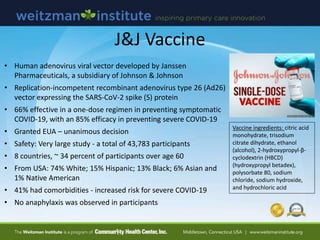
• Human adenovirus viral vector developed by Janssen
Pharmaceuticals, a subsidiary of Johnson & Johnson
• Replication-incompetent recombinant adenovirus type 26 (Ad26)
vector expressing the SARS-CoV-2 spike (S) protein
• 66% effective in a one-dose regimen in preventing symptomatic
COVID-19, with an 85% efficacy in preventing severe COVID-19
• Granted EUA – unanimous decision
• Safety: Very large study - a total of 43,783 participants
• 8 countries, ~ 34 percent of participants over age 60
• From USA: 74% White; 15% Hispanic; 13% Black; 6% Asian and
1% Native American
• 41% had comorbidities - increased risk for severe COVID-19
• No anaphylaxis was observed in participants
Vaccine ingredients: citric acid
monohydrate, trisodium
citrate dihydrate, ethanol
(alcohol), 2-hydroxypropyl-β-
cyclodextrin (HBCD)
(hydroxypropyl betadex),
polysorbate 80, sodium
chloride, sodium hydroxide,
and hydrochloric acid
J&J Vaccine
• ~72% efficacy rate against mild to severe/critical
disease in US trials
• Yes, slightly lower numbers vs other [mRNA]
vaccines but it was tested later - new variants were
spreading (i.e. the troubling B.1.351 strain)
• Still gave strong protection against severe illness
• ~3.9 million doses started distribution!
• ~16 million more doses expected by the end March
• Does not need to be frozen, a refrigerator is OK
• Easy to transport
• Allows for expanded availability in most community
settings and mobile sites as supply scales up
Resources
• Nuvance health 2300+ articles reviewed:
https://spark.adobe.com/page/cisEJsZBgFEiG/
• CDC:
https://www.cdc.gov/coronavirus/2019-ncov/index.html
https://emergency.cdc.gov/coca/calls/2021/
https://emergency.cdc.gov/coca/calls/2021/callinfo_030221.asp
• WHO:
https://www.who.int/emergencies/diseases/novel-coronavirus-2019
• Johns Hopkins:
https://coronavirus.jhu.edu/map.html
• Others
https://www.thelancet.com/coronavirus
https://covidactnow.org/
Addressing Vaccine Hesitancy
at Community Health Center, Inc.
Karoline Oliveira, EdD – Chief of Diversity, Equity, and Inclusion,
Community Health Center, Inc.
Erica Addison – Digital Marketing Director, Community Health Center, Inc.
Community Health Center Chartbook 2020. National Association of Community Health Centers. Published January 2020. Accessed February 9, 2021. https://www.nachc.org/wp-
content/uploads/2020/01/Chartbook-2020-Final.pdf
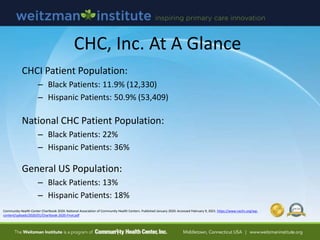
CHC, Inc. At A Glance
CHCI Patient Population:
– Black Patients: 11.9% (12,330)
– Hispanic Patients: 50.9% (53,409)
National CHC Patient Population:
– Black Patients: 22%
– Hispanic Patients: 36%
General US Population:
– Black Patients: 13%
– Hispanic Patients: 18%
Szilagyi PG, Thomas K, Shah MD, et al. National trends in the US public's likelihood of getting a COVID-19 vaccine-April 1 to December 8, 2020. JAMA. 2020;325(4):396-398.
https://pubmed.ncbi.nlm.nih.gov/33372943
Hamel L, Kirzinger A, Lopes L, Kearney A, Sparks G, Brodie M. KFF COVID-19 vaccine monitor: January 2021. Kaiser Family Foundation. Published January 22, 2021. Accessed February
3, 2021. https://www.kff.org/coronavirus-covid-19/report/kff-covid-19-vaccine-monitor-january-2021
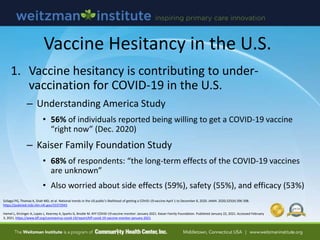
Vaccine Hesitancy in the U.S.
1. Vaccine hesitancy is contributing to under-
vaccination for COVID-19 in the U.S.
– Understanding America Study
• 56% of individuals reported being willing to get a COVID-19 vaccine
“right now” (Dec. 2020)
– Kaiser Family Foundation Study
• 68% of respondents: “the long-term effects of the COVID-19 vaccines
are unknown”
• Also worried about side effects (59%), safety (55%), and efficacy (53%)
Szilagyi PG, Thomas K, Shah MD, et al. National trends in the US public's likelihood of getting a COVID-19 vaccine-April 1 to December 8, 2020. JAMA. 2020;325(4):396-398.
https://pubmed.ncbi.nlm.nih.gov/33372943
Painter EM, Ussery EN, Patel A, et al. Demographic characteristics of persons vaccinated during the first month of the COVID-19 vaccination program — United States, December 14,
2020–January 14, 2021. MMWR Morb Mortal Wkly Rep. ePub:1 February 2021. https://www.cdc.gov/mmwr/volumes/70/wr/mm7005e1.htm
Vaccine Hesitancy in the U.S.
2. Vaccine hesitancy is pronounced in high-risk
groups such as Black, Hispanic, and low-income
populations
– 37.6% of Black respondents, 52.7% of Hispanic respondents, and 47.6% of
individuals with a high school education or less indicated a willingness to
get vaccinated (Dec. 2020)
– Black individuals are 4 times more likely to be hospitalized and 3 times more
likely to die than White individuals with COVID
– Of those people vaccinated for COVID-19, only 5.6% are Black as compared to
60% who are White
COVID vaccine distribution in Connecticut as of 2/4/2021. Connecticut Open Data. Updated February 4 2021. Accessed February 9, 2021.
https://data.ct.gov/stories/s/CoVP-COVID-Vaccine-Distribution-Data/bhcd-4mnv
Vaccine Hesitancy in C.T.
• Black and Hispanic communities are underrepresented in first
dose vaccinations
• Hartford, New Britain, and Waterbury (large non-white
populations) rank among the lowest in vaccination rates among
those 75 years and older, compared with smaller cities with
larger white populations
• New Britain
– Black community: 11.1% of population
– Hispanic community: 39.9% of population
– Only 5.2% of the total population in New Britain have receive their first vaccine
dose
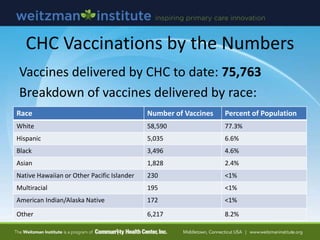
CHC Vaccinations by the Numbers
Vaccines delivered by CHC to date: 75,763
Breakdown of vaccines delivered by race:
Race Number of Vaccines Percent of Population
White 58,590 77.3%
Hispanic 5,035 6.6%
Black 3,496 4.6%
Asian 1,828 2.4%
Native Hawaiian or Other Pacific Islander 230 <1%
Multiracial 195 <1%
American Indian/Alaska Native 172 <1%
Other 6,217 8.2%
CHC Approach to Strengthening
Community Connections
1. A Grassroots Approach
– Mapping out counties, key populations, and community
leaders
– Leveraging personal social networks,
i.e. Who do we know?
– Cold Calling
CHC Approach to Strengthening
Community Connections
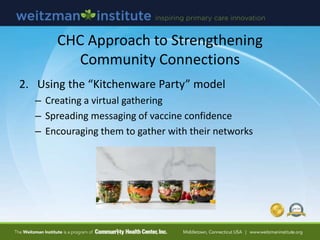
2. Using the “Kitchenware Party” model
– Creating a virtual gathering
– Spreading messaging of vaccine confidence
– Encouraging them to gather with their networks
CHC Communication Strategy
to Build Vaccine Confidence
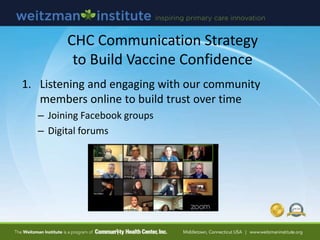
1. Listening and engaging with our community
members online to build trust over time
– Joining Facebook groups
– Digital forums
CHC Communication Strategy
to Build Vaccine Confidence
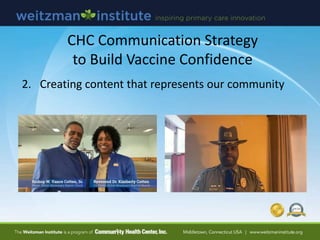
2. Creating content that represents our community
CHC Communication Strategy
to Build Vaccine Confidence
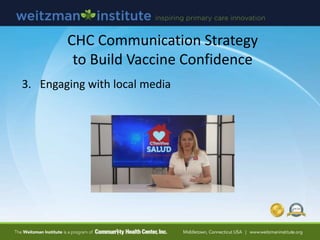
3. Engaging with local media
CHC Communication Strategy
to Build Vaccine Confidence
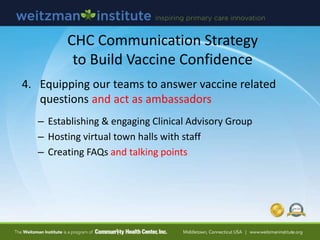
4. Equipping our teams to answer vaccine related
questions and act as ambassadors
– Establishing & engaging Clinical Advisory Group
– Hosting virtual town halls with staff
– Creating FAQs and talking points
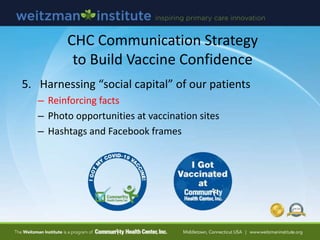
5. Harnessing “social capital” of our patients
– Reinforcing facts
– Photo opportunities at vaccination sites
– Hashtags and Facebook frames
CHC Communication Strategy
to Build Vaccine Confidence
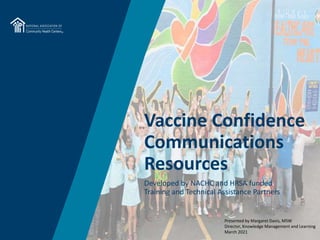
Developed by NACHC and HRSA funded
Training and Technical Assistance Partners
Vaccine Confidence
Communications
Resources
Presented by Margaret Davis, MSW
Director, Knowledge Management and Learning
March 2021
@NACHC
www.nachc.org | 2
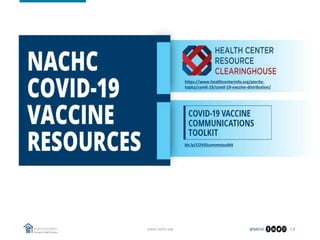
https://www.healthcenterinfo.org/piority-
topics/covid-19/covid-19-vaccine-distribution/
bit.ly/COVIDcommstoolkit
Developed for Health Center Staff
COVID-19
Communications
Toolkit
@NACHC
www.nachc.org | 4
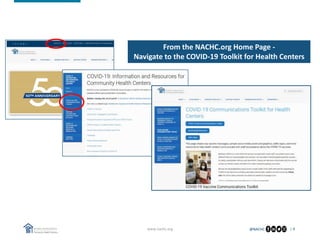
From the NACHC.org Home Page -
Navigate to the COVID-19 Toolkit for Health Centers
@NACHC
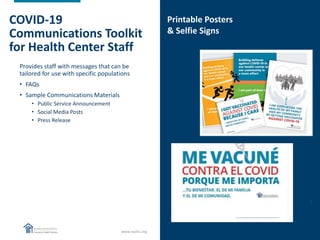
COVID-19
Communications Toolkit
for Health Center Staff
Provides staff with messages that can be
tailored for use with specific populations
• FAQs
• Sample Communications Materials
• Public Service Announcement
• Social Media Posts
• Press Release
www.nachc.org
| 34
Printable Posters
& Selfie Signs
New Resources and Functionality
Supporting Peer-Sharing across
Health Centers
@NACHC
www.nachc.org | 7
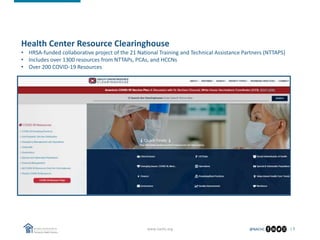
Health Center Resource Clearinghouse
• HRSA-funded collaborative project of the 21 National Training and Technical Assistance Partners (NTTAPS)
• Includes over 1300 resources from NTTAPs, PCAs, and HCCNs
• Over 200 COVID-19 Resources
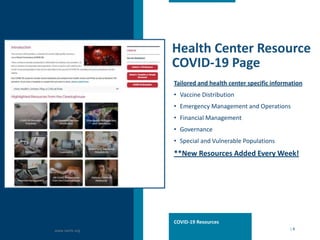
Health Center Resource
COVID-19 Page
Tailored and health center specific information
• Vaccine Distribution
• Emergency Management and Operations
• Financial Management
• Governance
• Special and Vulnerable Populations
**New Resources Added Every Week!
COVID-19 Resources
| 8
www.nachc.org
@NACHC
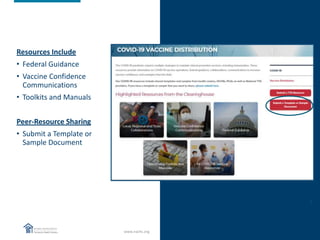
Resources Include
• Federal Guidance
• Vaccine Confidence
Communications
• Toolkits and Manuals
Peer-Resource Sharing
• Submit a Template or
Sample Document
www.nachc.org
| 38
Thank You!
To learn more about The Path Forward series
WeitzmanLearning.org/the-path-forward
To view previous COVID-19 sessions:
WeitzmanLearning.org/coronavirus

Addressing Vaccine Hesitancy

  • 1.
    Addressing Vaccine Hesitancy: Media,Web Page, Person to Person, and Target Populations March 3, 2021
  • 2.
    Continuing Education Credits Thisactivity has been planned and implemented by the Community Health Center, Inc./Weitzman Institute and is accredited to provide continuing education for the healthcare team. This series is intended for physicians, nurse practitioners, physician assistants, pharmacists, and nurses. Please complete the survey – linked in the chat, and emailed to all attendees – to request your continuing education credit A comprehensive certificate will be sent out at the end of the series.
  • 3.
    This week’s COVID-19ECHO session is a collaboration with This resource is supported by the Health Resources and Services Administration (HRSA) of the U.S. Department of Health and Human Services (HHS) under grant number U30CS29049 entitled "Training and Technical Assistance National Cooperative Agreements (NCAs)" for grant amount $2,045,000 with 0% financed with non-governmental funds. This information or content and conclusions are those of the author and should not be construed as the official position or policy of, nor should any endorsements be inferred by HRSA, HHS or the U.S. Government.
  • 4.
    Disclosure • With respectto the following presentation, there has been no relevant (direct or indirect) financial relationship between the party listed above (or spouse/partner) and any for-profit company in the past 12 months which would be considered a conflict of interest. • The views expressed in this presentation are those of the presenter and may not reflect official policy of Community Health Center, Inc. and its Weitzman Institute. • We are obligated to disclose any products which are off-label, unlabeled, experimental, and/or under investigation (not FDA approved) and any limitations on the information hat I present, such as data that are preliminary or that represent ongoing research, interim analyses, and/or unsupported opinion.
  • 5.
    COVID-19 Update inthe United States Stephen Scholand, MD; Infectious Disease Specialist, Midstate Medical Center March 3, 2021 www. mildred-elley.edu
  • 6.
    28,717,558 cases on3/2/21 with 516,476 deaths https://coronavirus.jhu.edu/us-map COVID-19 in the United States
  • 7.
  • 8.
    How Many ‘JetLiners’? A320 seats 182 passengers
  • 9.
    Nursing Homes: ManyCases and Deaths https://www.nytimes.com/interactive/2020/us/coronavirus-nursing-homes.html
  • 10.
    Pressure on HospitalSystems https://www.nytimes.com/interactive/2020/us/coronavirus-us-cases.html
  • 11.
    The Danger ofVariants "Please hear me clearly: At this level of cases with variants spreading, we stand to completely lose the hard-earned ground we have gained," -Dr. Rochelle Walensky, Director of the CDC • The CDC said the highly contagious B.1.1.7 variant will become the dominant strain in the US this month • New variant B.1.526 found in New York • Shares a mutation in common with B1.351 and P1 • Unknown transmissibility, lethality, or vaccine effectiveness
  • 12.
    • At least46 States B117 strain • 2506 total: FL (599), MI (421), CA (212), NY (136), CT (42) • Other strains: • B.1.351 (17 States) – 65 cases • P.1 (5 States) – 10 cases www.cdc.gov/coronavirus/2019-ncov/transmission/variant-cases.html
  • 13.
    COVID-19 Vaccinations Acrossthe Nation https://covid.cdc.gov/covid-data-tracker/#vaccinations • As of 3/2, ~52 million had received at least one dose of COVID-19 vaccine • About 26 million received 2 doses • Averaging ~1.7 million doses/day • J&J vaccine approved!
  • 14.
    J&J Vaccine • Humanadenovirus viral vector developed by Janssen Pharmaceuticals, a subsidiary of Johnson & Johnson • Replication-incompetent recombinant adenovirus type 26 (Ad26) vector expressing the SARS-CoV-2 spike (S) protein • 66% effective in a one-dose regimen in preventing symptomatic COVID-19, with an 85% efficacy in preventing severe COVID-19 • Granted EUA – unanimous decision • Safety: Very large study - a total of 43,783 participants • 8 countries, ~ 34 percent of participants over age 60 • From USA: 74% White; 15% Hispanic; 13% Black; 6% Asian and 1% Native American • 41% had comorbidities - increased risk for severe COVID-19 • No anaphylaxis was observed in participants Vaccine ingredients: citric acid monohydrate, trisodium citrate dihydrate, ethanol (alcohol), 2-hydroxypropyl-β- cyclodextrin (HBCD) (hydroxypropyl betadex), polysorbate 80, sodium chloride, sodium hydroxide, and hydrochloric acid
  • 15.
    J&J Vaccine • ~72%efficacy rate against mild to severe/critical disease in US trials • Yes, slightly lower numbers vs other [mRNA] vaccines but it was tested later - new variants were spreading (i.e. the troubling B.1.351 strain) • Still gave strong protection against severe illness • ~3.9 million doses started distribution! • ~16 million more doses expected by the end March • Does not need to be frozen, a refrigerator is OK • Easy to transport • Allows for expanded availability in most community settings and mobile sites as supply scales up
  • 16.
    Resources • Nuvance health2300+ articles reviewed: https://spark.adobe.com/page/cisEJsZBgFEiG/ • CDC: https://www.cdc.gov/coronavirus/2019-ncov/index.html https://emergency.cdc.gov/coca/calls/2021/ https://emergency.cdc.gov/coca/calls/2021/callinfo_030221.asp • WHO: https://www.who.int/emergencies/diseases/novel-coronavirus-2019 • Johns Hopkins: https://coronavirus.jhu.edu/map.html • Others https://www.thelancet.com/coronavirus https://covidactnow.org/
  • 17.
    Addressing Vaccine Hesitancy atCommunity Health Center, Inc. Karoline Oliveira, EdD – Chief of Diversity, Equity, and Inclusion, Community Health Center, Inc. Erica Addison – Digital Marketing Director, Community Health Center, Inc.
  • 18.
    Community Health CenterChartbook 2020. National Association of Community Health Centers. Published January 2020. Accessed February 9, 2021. https://www.nachc.org/wp- content/uploads/2020/01/Chartbook-2020-Final.pdf CHC, Inc. At A Glance CHCI Patient Population: – Black Patients: 11.9% (12,330) – Hispanic Patients: 50.9% (53,409) National CHC Patient Population: – Black Patients: 22% – Hispanic Patients: 36% General US Population: – Black Patients: 13% – Hispanic Patients: 18%
  • 19.
    Szilagyi PG, ThomasK, Shah MD, et al. National trends in the US public's likelihood of getting a COVID-19 vaccine-April 1 to December 8, 2020. JAMA. 2020;325(4):396-398. https://pubmed.ncbi.nlm.nih.gov/33372943 Hamel L, Kirzinger A, Lopes L, Kearney A, Sparks G, Brodie M. KFF COVID-19 vaccine monitor: January 2021. Kaiser Family Foundation. Published January 22, 2021. Accessed February 3, 2021. https://www.kff.org/coronavirus-covid-19/report/kff-covid-19-vaccine-monitor-january-2021 Vaccine Hesitancy in the U.S. 1. Vaccine hesitancy is contributing to under- vaccination for COVID-19 in the U.S. – Understanding America Study • 56% of individuals reported being willing to get a COVID-19 vaccine “right now” (Dec. 2020) – Kaiser Family Foundation Study • 68% of respondents: “the long-term effects of the COVID-19 vaccines are unknown” • Also worried about side effects (59%), safety (55%), and efficacy (53%)
  • 20.
    Szilagyi PG, ThomasK, Shah MD, et al. National trends in the US public's likelihood of getting a COVID-19 vaccine-April 1 to December 8, 2020. JAMA. 2020;325(4):396-398. https://pubmed.ncbi.nlm.nih.gov/33372943 Painter EM, Ussery EN, Patel A, et al. Demographic characteristics of persons vaccinated during the first month of the COVID-19 vaccination program — United States, December 14, 2020–January 14, 2021. MMWR Morb Mortal Wkly Rep. ePub:1 February 2021. https://www.cdc.gov/mmwr/volumes/70/wr/mm7005e1.htm Vaccine Hesitancy in the U.S. 2. Vaccine hesitancy is pronounced in high-risk groups such as Black, Hispanic, and low-income populations – 37.6% of Black respondents, 52.7% of Hispanic respondents, and 47.6% of individuals with a high school education or less indicated a willingness to get vaccinated (Dec. 2020) – Black individuals are 4 times more likely to be hospitalized and 3 times more likely to die than White individuals with COVID – Of those people vaccinated for COVID-19, only 5.6% are Black as compared to 60% who are White
  • 21.
    COVID vaccine distributionin Connecticut as of 2/4/2021. Connecticut Open Data. Updated February 4 2021. Accessed February 9, 2021. https://data.ct.gov/stories/s/CoVP-COVID-Vaccine-Distribution-Data/bhcd-4mnv Vaccine Hesitancy in C.T. • Black and Hispanic communities are underrepresented in first dose vaccinations • Hartford, New Britain, and Waterbury (large non-white populations) rank among the lowest in vaccination rates among those 75 years and older, compared with smaller cities with larger white populations • New Britain – Black community: 11.1% of population – Hispanic community: 39.9% of population – Only 5.2% of the total population in New Britain have receive their first vaccine dose
  • 22.
    CHC Vaccinations bythe Numbers Vaccines delivered by CHC to date: 75,763 Breakdown of vaccines delivered by race: Race Number of Vaccines Percent of Population White 58,590 77.3% Hispanic 5,035 6.6% Black 3,496 4.6% Asian 1,828 2.4% Native Hawaiian or Other Pacific Islander 230 <1% Multiracial 195 <1% American Indian/Alaska Native 172 <1% Other 6,217 8.2%
  • 23.
    CHC Approach toStrengthening Community Connections 1. A Grassroots Approach – Mapping out counties, key populations, and community leaders – Leveraging personal social networks, i.e. Who do we know? – Cold Calling
  • 24.
    CHC Approach toStrengthening Community Connections 2. Using the “Kitchenware Party” model – Creating a virtual gathering – Spreading messaging of vaccine confidence – Encouraging them to gather with their networks
  • 25.
    CHC Communication Strategy toBuild Vaccine Confidence 1. Listening and engaging with our community members online to build trust over time – Joining Facebook groups – Digital forums
  • 26.
    CHC Communication Strategy toBuild Vaccine Confidence 2. Creating content that represents our community
  • 27.
    CHC Communication Strategy toBuild Vaccine Confidence 3. Engaging with local media
  • 28.
    CHC Communication Strategy toBuild Vaccine Confidence 4. Equipping our teams to answer vaccine related questions and act as ambassadors – Establishing & engaging Clinical Advisory Group – Hosting virtual town halls with staff – Creating FAQs and talking points
  • 29.
    5. Harnessing “socialcapital” of our patients – Reinforcing facts – Photo opportunities at vaccination sites – Hashtags and Facebook frames CHC Communication Strategy to Build Vaccine Confidence
  • 30.
    Developed by NACHCand HRSA funded Training and Technical Assistance Partners Vaccine Confidence Communications Resources Presented by Margaret Davis, MSW Director, Knowledge Management and Learning March 2021
  • 31.
  • 32.
    Developed for HealthCenter Staff COVID-19 Communications Toolkit
  • 33.
    @NACHC www.nachc.org | 4 Fromthe NACHC.org Home Page - Navigate to the COVID-19 Toolkit for Health Centers
  • 34.
    @NACHC COVID-19 Communications Toolkit for HealthCenter Staff Provides staff with messages that can be tailored for use with specific populations • FAQs • Sample Communications Materials • Public Service Announcement • Social Media Posts • Press Release www.nachc.org | 34 Printable Posters & Selfie Signs
  • 35.
    New Resources andFunctionality Supporting Peer-Sharing across Health Centers
  • 36.
    @NACHC www.nachc.org | 7 HealthCenter Resource Clearinghouse • HRSA-funded collaborative project of the 21 National Training and Technical Assistance Partners (NTTAPS) • Includes over 1300 resources from NTTAPs, PCAs, and HCCNs • Over 200 COVID-19 Resources
  • 37.
    Health Center Resource COVID-19Page Tailored and health center specific information • Vaccine Distribution • Emergency Management and Operations • Financial Management • Governance • Special and Vulnerable Populations **New Resources Added Every Week! COVID-19 Resources | 8 www.nachc.org
  • 38.
    @NACHC Resources Include • FederalGuidance • Vaccine Confidence Communications • Toolkits and Manuals Peer-Resource Sharing • Submit a Template or Sample Document www.nachc.org | 38
  • 39.
    Thank You! To learnmore about The Path Forward series WeitzmanLearning.org/the-path-forward To view previous COVID-19 sessions: WeitzmanLearning.org/coronavirus