Addressing Culture in EFL Classrooms:
The Challenge of Shifting from
a Traditional to an Intercultural
Stance
Diasna Marta Siwi 16202241003
Adrian Bahri 16202241028
Our Topics :
1. Introduction
2. Background
3. Metodology
4. Discussion
5. Limitations and Future Directions
6. The Conclusion
INTRODUCTION
• Intercultural language learning is a stance on language teaching
and learning that emphasizes the interdependence of language
and culture and the importance of intercultural understanding as a
goal of language education.
• The importance of developing intercultural communicative
competence alongside linguistic competence has resulted from
learners’ needs for acquiring intercultural skills for cross-cultural
communication in which they may encounter linguistic and
cultural barriers.
BACKGROUND
1. Language and Culture
Language and culture have an inextricable and interdependent relationship.
2. Intercultural Communicative Competence
Intercultural communicative
competence refers to the “ability to
ensure a shared understanding by
people of different social identities,
and [the] ability to interact with
people as complex human beings
with multiple identities and their
own individuality”
The
Components
Attitude/Affective
Capacities
Behavior
Cognitive
Capacities
3. Intercultural Language Learning
The process of acquiring the culture-
specific and culture-general knowledge,
skills, attitudes required for effective
communication and interaction with
individuals from other cultures.
It is a dynamic, developmental, and
ongoing process which engages the
learner cognitively, behaviorally, and
affectively.
The Cultural Iceberg
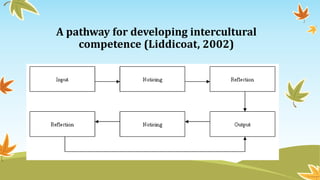
A pathway for developing intercultural
competence (Liddicoat, 2002)
METHODOLOGY
1. Intercultural language learning
The intercultural com-municative tasks should then be designed
appropriately for each target group of students so that they can actively engage in
the discussion of cultural issues in the units that require both their knowledge of
home and target culture and skills of culture learning
2. Methodological considerations
The development of the cultural components is based on learners’
construction of own knowledge through cultural ex-ploration and an
understanding of their own and the target culture’s values and beliefs.
DISCUSSION
1. Methodological considerations
• Families (Speaking unit)
Learners need to be exposed to different family issues and de-velop an
understanding of the family values in their own and the target culture.
• Food and drinks (British Culture unit)
Learners also need to explore the target culture themselves and reflect on
the values of food and drinking norms in their own and the target culture in
order to develop an understanding of the shared meanings of these values for
culture learning.
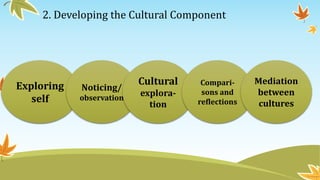
2. Developing the Cultural Component
Exploring
self
Noticing/
observation
Cultural
explora-
tion
Compari-
sons and
reflections
Mediation
between
cultures
Learners engage in group discussion activities about
the differences in ideas that make up a family in their own
family trees. This task can increase awareness of the
diversity within learners’ own culture as well as their
individual concepts of family.
Learners can also develop their cultural awareness
through cultural connotations of vocabulary which may
draw different pictures for people from different cultures.
Exploring
self
Noticing/
observation
Cultural
exploration
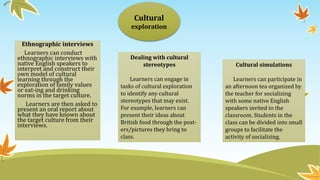
Ethnographic interviews
Learners can conduct
ethnographic interviews with
native English speakers to
interpret and construct their
own model of cultural
learning through the
exploration of family values
or eat-ing and drinking
norms in the target culture.
Learners are then asked to
present an oral report about
what they have known about
the target culture from their
interviews.
Cultural simulations
Learners can participate in
an afternoon tea organized by
the teacher for socializing
with some native English
speakers invited to the
classroom. Students in the
class can be divided into small
groups to facilitate the
activity of socializing.
Dealing with cultural
stereotypes
Learners can engage in
tasks of cultural exploration
to identify any cultural
stereotypes that may exist.
For example, learners can
present their ideas about
British food through the post-
ers/pictures they bring to
class.
learners need to have an understanding of their own culture
first. learners can participate in group discussions and reflections
on cultural similarities and differences in family values between
English-speaking cultures and their home culture.
Comparisons
and
reflections
Learners can engage in problem-solving
activities as a way to mediate between cultures.
For example, students can discuss dilemmas
about par-ents’ decision on career choice or
eating norms.
Mediation
between
cultures
Limitations and future directions
The development of the cultural components in English language classes
in Vietnam may be influenced by a number of constraints. The Vietnamese
teacher has been considered the expert knower of the language.
Future research can look into the assessment of students’ acquisition of
cultural knowledge, skills and attitudes towards culture learning
Potential ways of assessment may include pre-tests and post-tests,
interviews or portfolios to measure students’ development of intercultural
communicative competence and the effect of intercultural language learning on
their EFL learning
Conclusions
A shift from a traditional to intercultural stance in EFL
classrooms will contribute to teachers’ professional development for a
long-term plan for language teaching. It enhances their awareness of
the inextricable and interdependent relationship between language
and culture and teaching culture as an integral component of language
teaching. It also helps to develop teachers’ intercul-tural perspectives
that may have an impact on their language teaching methodology and
syllabus design. This shift is a challenge that EFL teachers and learners
have to deal with to meet the goals of foreign language education in
our modern world.
Question ?
THANK
YOU

Addressing Culture in EFL Classrooms

  • 1.
    Addressing Culture inEFL Classrooms: The Challenge of Shifting from a Traditional to an Intercultural Stance Diasna Marta Siwi 16202241003 Adrian Bahri 16202241028
  • 2.
    Our Topics : 1.Introduction 2. Background 3. Metodology 4. Discussion 5. Limitations and Future Directions 6. The Conclusion
  • 3.
    INTRODUCTION • Intercultural languagelearning is a stance on language teaching and learning that emphasizes the interdependence of language and culture and the importance of intercultural understanding as a goal of language education. • The importance of developing intercultural communicative competence alongside linguistic competence has resulted from learners’ needs for acquiring intercultural skills for cross-cultural communication in which they may encounter linguistic and cultural barriers.
  • 4.
    BACKGROUND 1. Language andCulture Language and culture have an inextricable and interdependent relationship.
  • 5.
    2. Intercultural CommunicativeCompetence Intercultural communicative competence refers to the “ability to ensure a shared understanding by people of different social identities, and [the] ability to interact with people as complex human beings with multiple identities and their own individuality” The Components Attitude/Affective Capacities Behavior Cognitive Capacities
  • 6.
    3. Intercultural LanguageLearning The process of acquiring the culture- specific and culture-general knowledge, skills, attitudes required for effective communication and interaction with individuals from other cultures. It is a dynamic, developmental, and ongoing process which engages the learner cognitively, behaviorally, and affectively. The Cultural Iceberg
  • 7.
    A pathway fordeveloping intercultural competence (Liddicoat, 2002)
  • 8.
    METHODOLOGY 1. Intercultural languagelearning The intercultural com-municative tasks should then be designed appropriately for each target group of students so that they can actively engage in the discussion of cultural issues in the units that require both their knowledge of home and target culture and skills of culture learning 2. Methodological considerations The development of the cultural components is based on learners’ construction of own knowledge through cultural ex-ploration and an understanding of their own and the target culture’s values and beliefs.
  • 9.
    DISCUSSION 1. Methodological considerations •Families (Speaking unit) Learners need to be exposed to different family issues and de-velop an understanding of the family values in their own and the target culture. • Food and drinks (British Culture unit) Learners also need to explore the target culture themselves and reflect on the values of food and drinking norms in their own and the target culture in order to develop an understanding of the shared meanings of these values for culture learning.
  • 10.
    2. Developing theCultural Component Exploring self Noticing/ observation Cultural explora- tion Compari- sons and reflections Mediation between cultures
  • 11.
    Learners engage ingroup discussion activities about the differences in ideas that make up a family in their own family trees. This task can increase awareness of the diversity within learners’ own culture as well as their individual concepts of family. Learners can also develop their cultural awareness through cultural connotations of vocabulary which may draw different pictures for people from different cultures. Exploring self
  • 12.
  • 13.
    Cultural exploration Ethnographic interviews Learners canconduct ethnographic interviews with native English speakers to interpret and construct their own model of cultural learning through the exploration of family values or eat-ing and drinking norms in the target culture. Learners are then asked to present an oral report about what they have known about the target culture from their interviews. Cultural simulations Learners can participate in an afternoon tea organized by the teacher for socializing with some native English speakers invited to the classroom. Students in the class can be divided into small groups to facilitate the activity of socializing. Dealing with cultural stereotypes Learners can engage in tasks of cultural exploration to identify any cultural stereotypes that may exist. For example, learners can present their ideas about British food through the post- ers/pictures they bring to class.
  • 14.
    learners need tohave an understanding of their own culture first. learners can participate in group discussions and reflections on cultural similarities and differences in family values between English-speaking cultures and their home culture. Comparisons and reflections
  • 15.
    Learners can engagein problem-solving activities as a way to mediate between cultures. For example, students can discuss dilemmas about par-ents’ decision on career choice or eating norms. Mediation between cultures
  • 16.
    Limitations and futuredirections The development of the cultural components in English language classes in Vietnam may be influenced by a number of constraints. The Vietnamese teacher has been considered the expert knower of the language. Future research can look into the assessment of students’ acquisition of cultural knowledge, skills and attitudes towards culture learning Potential ways of assessment may include pre-tests and post-tests, interviews or portfolios to measure students’ development of intercultural communicative competence and the effect of intercultural language learning on their EFL learning
  • 17.
    Conclusions A shift froma traditional to intercultural stance in EFL classrooms will contribute to teachers’ professional development for a long-term plan for language teaching. It enhances their awareness of the inextricable and interdependent relationship between language and culture and teaching culture as an integral component of language teaching. It also helps to develop teachers’ intercul-tural perspectives that may have an impact on their language teaching methodology and syllabus design. This shift is a challenge that EFL teachers and learners have to deal with to meet the goals of foreign language education in our modern world.
  • 18.
  • 19.