Intercultural foreign language learning (ICFLL) through international web collaboration in  Moodle With the support of the EU Lifelong Learning Programme Grant 142672-LLP-1-2008-1-DE-COMENIUS-CMP Claudia Warth University of Tübingen (Germany) [email_address] www.ael.uni-tuebingen.de www.iceurope-project.eu   CALICO 2010 June 8-12, 2010 Amherst, MA
The icEurope project & its background Analysis: Students’ language means and strategies Discussion: Web collaboration for ICFLL Overview
The icEurope Project
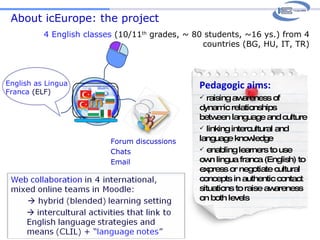
About icEurope: the project 4 English classes  (10/11 th  grades, ~ 80 students, ~16 ys.) from 4 countries (BG, HU, IT, TR) Pedagogic aims:   raising awareness of dynamic relationships between language and culture linking intercultural and language knowledge enabling learners to use own lingua franca (English) to express or negotiate cultural concepts in authentic contact situations to raise awareness on both levels  Forum discussions Chats Email English as Lingua Franca  (ELF)
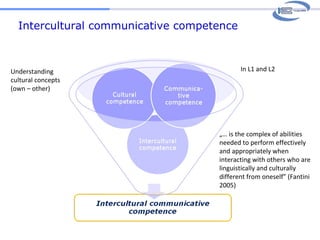
Intercultural communicative competence Understanding cultural concepts (own – other) In L1 and L2 „…  is the complex of abilities needed to perform effectively and appropriately when interacting with others who are linguistically and culturally different from oneself” (Fantini 2005)
Intercultural communicative competence & the intercultural speaker A working definition (based on Byram): Someone with some degree of intercultural competence … is someone who is  able   to see relationships  between different cultures is able to  mediate , that is interpret and explain each culture in terms of the other it is also someone who has a  critical  or  analytical   understanding   of (parts of) their own and other cultures is  conscious of their own perspective , of the way in which their thinking is culturally determined, rather than believing that their understanding and perspective is natural
ICC, yes, but: How can we realize all this in our foreign language? How do we show attitudes in English as a foreign language? What are linguistic strategies to mediate interculturally with the help of EFL/ELF? How can we express understanding, curiosity or awareness in a language that is not our first language and in a culture that is not our own? How does “communicative competence” come in here?
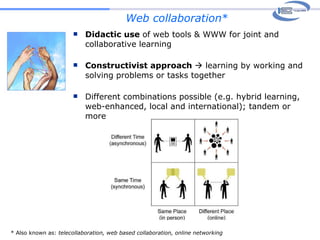
Web collaboration * Didactic use  of web tools & WWW for joint and collaborative learning Constructivist approach    learning by working and solving problems or tasks together  Different combinations possible (e.g. hybrid learning, web-enhanced, local and international); tandem or more * Also known as:  telecollaboration, web based collaboration, online networking
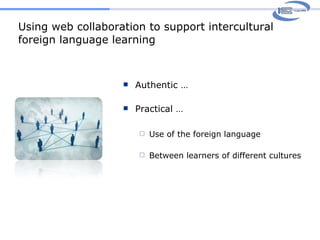
Using web collaboration to support intercultural foreign language learning Authentic … Practical … Use of the foreign language Between learners of different cultures
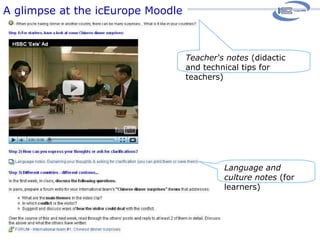
A glimpse at the icEurope Moodle Language and culture notes  (for learners) Teacher‘s notes  (didactic and technical tips for teachers)
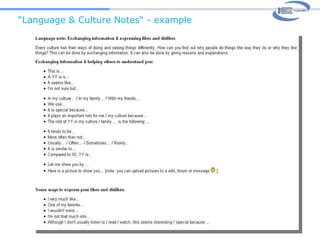
“ Language & Culture Notes“ - example
icEurope – Data Analysis Approach and first results
icEurope - Research approach and questions How do students  use   their English  to  negotiate   meaning  in  intercultural web collaboration ? CALL  / SLA pedagogy & activity design Intercultural communication from linguistic-communicative  perspective    language used & needed by “ intercultural speaker ” and actual production in CMC setting? [ what did they make of the tasks?    pedagogic implications ]
CMIDA as main approach [ C omputer- M ediated  I ntercultural Communication  D iscourse  A nalysis] CMD  [computer-mediated discourse] “ Computer-mediated discourse is the communication produced when human beings interact  with one another by transmitting messages via networked computers. The study of  computer-mediated discourse  (henceforth CMD) is  a specialization within the broader interdisciplinary study of computer-mediated communication (CMC),  distinguished by its  focus on  language and language use  in computer networked environments, and by its use  of  methods of  discourse analysis  to address that focus.” (Herring 2003: 612; my highlights) CM I D  [computer-mediated intercultural discourse] Communication produced in an intercultural online environment, i.e. by people from different linguacultural backgrounds; the focus is on investigating the language used to communicate the ‘cultural’ / ‘intercultural’ [‘culturing’] or to create a ‘third space’ within a CMC-setting with the help of discourse analysis.  (own working definition)
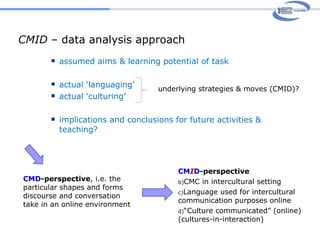
assumed aims & learning potential of task actual ‘languaging’ actual ‘culturing’ implications and conclusions for future activities & teaching? CMID  – data analysis approach underlying strategies & moves (CMID)? CMD -perspective , i.e. the particular shapes and forms discourse and conversation take in an online environment CM I D -perspective CMC in intercultural setting Language used for intercultural communication purposes online “ Culture communicated” (online) (cultures-in-interaction)
Excursus:  Intercultural communicative awareness Signaling intercultural communicative awareness – a working hypothesis: Noticing, identifying and recording differences or similarities Comparing and contrasting own and other culture(s) Discovering and increasing knowledge (cultural and linguistic) Limiting the possibility of misinterpretation Negotiating meaning and dealing with ambiguities on cultural and linguistic knowledge levels: e.g. signaling problems of understanding, asking for clarification, checking comprehension, linguistic simplification, recontextualizing, rephrasing, meta communication  … Trying to interpret messages in relation to own-other culture(s) Trying to take on others’ points of view or perspectives  
Preliminary findings: Use of English in intercultural web collaboration Intercultural Communication Strategies  (based on icEurope web collaboration data samples) Imitation or adaptation (‘copying’ and ‘repeating’ language features) Avoidance   (of topic) Stating thoughts directly or bluntly Differentiating & comparing concepts Mitigating Asking for clarification Asking for help (re technical problems, cultural understanding)  Reflecting on how to express s.th. / making suggestions for communicative moves Humor Code-switching (and thereby introducing cultural facts)
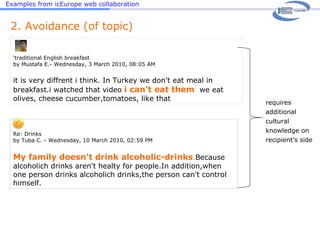
Examples from icEurope web collaboration ‘ traditional English breakfast by Mustafa E.- Wednesday, 3 March 2010, 08:05 AM it is very diffrent i think. In Turkey we don't eat meal in breakfast.i watched that video  i can't eat them   we eat olives, cheese cucumber,tomatoes, like that 2. Avoidance (of topic) Re: Drinks by Tuba C. - Wednesday, 10 March 2010, 02:59 PM   My family doesn't drink alcoholic-drinks . Because alcoholich drinks aren't healty for people.In addition,when one person drinks alcoholich drinks,the person can't control himself. requires additional cultural knowledge on recipient’s side
4. Differentiating & comparing concepts About the traditional English breakfast by Kiril K. - Wednesday, 17 March 2010, 06:54 AM    Well,  in my opinion  the full English breakfast is quite big. I am not sure how English people can eat so much in the morning.  I suppose  that  they   don't eat this  breafast every morning(especially when they have to get up early) as it is pretty time-consuming to make.  However, it looks very delicious. I haven't tried a full English breakfast yet. Breakfast in Bulgaria might  […]
Re: 3.) What would you suggest to your intercultural team mates as a fantastic dish, pastry etc. that is typical in your culture? by Rocco C. - Saturday, 27 February 2010, 06:41 PM Culture in Italy  is a  quite different from place to place , and expecially from northern Italy to southern Italy.  In my country , for example, there is a long tradition about food that I'm always glad to hear from my grandmother.  So, when my  extended family  is together (expecially at Christmas or at days like this), we use to eat a lot of tasty things ( according to us obviously!   ) For example, in my culture , during special events, is not unusual to eat spaghetti with clams and seafood as main course, and fried fish (expecially prawns and cuttle fish) as second course. They are  important for my culture because Neaples  is important  expecially for its sea!  Let me show you some pictures. […]
5. Mitigating  Re: Intnat'l team #1: Music guesses - song Bulgaria by Merve S. - Tuesday, 20 April 2010, 06:09 PM Sorry,I don't want to be too offensive,but  I don't like it because it is very slow and the women doesn't say very good  (Edited by [ own teacher’s name ]- original submission Tuesday, 20 April 2010, 08:17 AM) Re: Intnat'l team #1: Music guesses - song Bulgaria by Zsofia P. - Thursday, 22 April 2010, 07:19 PM […] Um...don't get me wrong, but  it seems a bit stilted and silly for me.  Well, it's possible that it has to be .  […]
8. Reflecting on how to express s.th. / making suggestions for communicative moves Re: What should you when you don't like the served food? by Nicola C. - Tuesday, 16 March 2010, 07:38 PM   I think this is a very embarrassing situation, especially when you're a guest in another family. Of course  you can't say anything like "I don't like that" .  Unfortunately you have to taste the food or  you may say "even if I don't like the foreign dishes ,that is very good". […]
Discussion: Web collaboration for ICFLL Complex learning in relatively little time Increase in intercultural awareness and in FL intercultural communication skills Increase in how to express this awareness  High motivation and fascination in authentic communication Consideration and interconnectedness of all domains:  Communication    interaction competence and teaching how to communicate (e- and non-e) Intercultural communicative awareness  <-> Language strategies and moves ICT and digital literacy  “ Guided autonomy” & pushed output
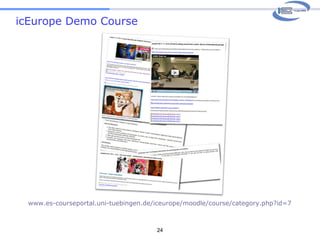
icEurope Demo Course www.es-courseportal.uni-tuebingen.de/iceurope/moodle/course/category.php?id=7
References Belz, J. (2003). Linguistic perspectives on the development of intercultural competence in telecollaboration. Language Learning and Technology, 7(2), 68–117. Bredella, L. et al (Ed.) (1999). Giessener Beiträge zur Fremdsprachendidaktik. Wie ist Fremdverstehen lehr- und lernbar? Vorträge aus dem Graduiertenkolleg &quot;Didaktik des Fremdverstehens&quot;. Tübingen: Gunter Narr. Byram, M. (1997).  Teaching and Assessing Intercultural Communicative Competence.   Clevedon: Multilingual Matters. Fantini, A. E. (2005).  About Intercultural Communicative Competence: A Construct.  VT: Brattleboro. School for International Training.  http://www.worldlearning.org/SITOccasionalPapers/feil_appendix_e.pdf Herring, S. (2003).  Computer-Mediated Discourse . In: Schiffrin, D. et al. The Handbook of Discourse Analysis. 612f. INCA – Framework & Manuals (LdV project, 2004)  http://www.incaproject.org/   Kohn, K. (2006).  Blended Language Learning. Potential und Herausforderung . In: Jung, U.O.H. (Ed.).  Praktische Handreichung für Fremdsprachenlehrer . Frankfurt/M: Peter Lang.  Kohn, K. (2009). Computer assisted foreign language learning. In: K. Knapp & B. Seidlhofer (Ed.).  Foreign Language Communication and Learning. Handbooks of Applied Linguistics, vol. 6.  Mouton de Gruyter.  Kramsch, C. (1998). The privilege of the intercultural speaker. In M. Byram & M. Fleming (Eds.), Language learning in an intercultural perspective (pp. 16–31). Cambridge: CUP. Project info & demo www.iceurope-project.eu
Lázár, I., Huber-Kriegler, M., Lussier, D., Matei, G. S. & Peck, C. (Eds.) (2007). Developing and assessing intercultural communicative competence. A guide for language teachers and teacher educators. European Centre for Modern Languages. Strasbourg: Council of Europe. O'Dowd, R. and Ware, P. (2009).  Critical issues in telecollaborative task design . In: Computer Assisted Language  Learning, 22:2,173-188. O'Dowd, R. (2007).  Online Intercultural Exchange: An Introduction for Foreign Language Teachers . Bristol:  Multilingual Matters. Pölzl, U. (2003). Signalling cultural identity: the use of L1/Ln in ELF. Views, 12(2), 3–23. Retrieved January 29, 2009, from www.univie.ac.at/Anglistik/views/03_2/POEL_SGL.pdf. Seidlhofer, B. (2002). The shape of things to come? Some basic questions about English as a lingua franca. In K. Knapp & C. Meierkord (Eds.), Lingua Franca Communication (pp. 269–302). Frankfurt/M., Berlin, New York, Wien u.a.: Peter Lang. Warth, C., Kohn. K., et al (2009).  Grassroots & context analysis: Intercultural competence, foreign language learning, assessment and e-learning for intercultural web collaboration projects.  Research report within the Comenius project icEurope. Tübingen: Universität Tübingen. Warth, C. (2009). Interkulturelles Englischlernen mit Moodle - E-Learning Aktivitäten in einer deutsch-amerikanischen Web-Kollaboration. In: Zeitschrift für e-learning. / Special ed.: E-Learning in der Schule. 3/2009. Innsbruck: Studienverlag. Yassine, S. (2006). Culture issues in FL teaching. Towards the fostering of intercultural awareness. In: Annales du patrimoine / Annals of Legacy.  No. 05 / 2006 University of Tizi-Ouzou: Mostaganem.
Thank you for your attention and feedback! This project has been funded with support from the European Commission. This  presentation   reflects the views only of the author, and the Commission cannot be held responsible for any  use which may be made of the information contained therein.

icEurope CALICO 2010 Web collab for ICFLL (Warth)

  • 1.
    Intercultural foreign languagelearning (ICFLL) through international web collaboration in Moodle With the support of the EU Lifelong Learning Programme Grant 142672-LLP-1-2008-1-DE-COMENIUS-CMP Claudia Warth University of Tübingen (Germany) [email_address] www.ael.uni-tuebingen.de www.iceurope-project.eu CALICO 2010 June 8-12, 2010 Amherst, MA
  • 2.
    The icEurope project& its background Analysis: Students’ language means and strategies Discussion: Web collaboration for ICFLL Overview
  • 3.
  • 4.
    About icEurope: theproject 4 English classes (10/11 th grades, ~ 80 students, ~16 ys.) from 4 countries (BG, HU, IT, TR) Pedagogic aims: raising awareness of dynamic relationships between language and culture linking intercultural and language knowledge enabling learners to use own lingua franca (English) to express or negotiate cultural concepts in authentic contact situations to raise awareness on both levels Forum discussions Chats Email English as Lingua Franca (ELF)
  • 5.
    Intercultural communicative competenceUnderstanding cultural concepts (own – other) In L1 and L2 „… is the complex of abilities needed to perform effectively and appropriately when interacting with others who are linguistically and culturally different from oneself” (Fantini 2005)
  • 6.
    Intercultural communicative competence& the intercultural speaker A working definition (based on Byram): Someone with some degree of intercultural competence … is someone who is able to see relationships between different cultures is able to mediate , that is interpret and explain each culture in terms of the other it is also someone who has a critical or analytical understanding of (parts of) their own and other cultures is conscious of their own perspective , of the way in which their thinking is culturally determined, rather than believing that their understanding and perspective is natural
  • 7.
    ICC, yes, but:How can we realize all this in our foreign language? How do we show attitudes in English as a foreign language? What are linguistic strategies to mediate interculturally with the help of EFL/ELF? How can we express understanding, curiosity or awareness in a language that is not our first language and in a culture that is not our own? How does “communicative competence” come in here?
  • 8.
    Web collaboration *Didactic use of web tools & WWW for joint and collaborative learning Constructivist approach  learning by working and solving problems or tasks together Different combinations possible (e.g. hybrid learning, web-enhanced, local and international); tandem or more * Also known as: telecollaboration, web based collaboration, online networking
  • 9.
    Using web collaborationto support intercultural foreign language learning Authentic … Practical … Use of the foreign language Between learners of different cultures
  • 10.
    A glimpse atthe icEurope Moodle Language and culture notes (for learners) Teacher‘s notes (didactic and technical tips for teachers)
  • 11.
    “ Language &Culture Notes“ - example
  • 12.
    icEurope – DataAnalysis Approach and first results
  • 13.
    icEurope - Researchapproach and questions How do students use their English to negotiate meaning in intercultural web collaboration ? CALL / SLA pedagogy & activity design Intercultural communication from linguistic-communicative perspective  language used & needed by “ intercultural speaker ” and actual production in CMC setting? [ what did they make of the tasks?  pedagogic implications ]
  • 14.
    CMIDA as mainapproach [ C omputer- M ediated I ntercultural Communication D iscourse A nalysis] CMD [computer-mediated discourse] “ Computer-mediated discourse is the communication produced when human beings interact with one another by transmitting messages via networked computers. The study of computer-mediated discourse (henceforth CMD) is a specialization within the broader interdisciplinary study of computer-mediated communication (CMC), distinguished by its focus on language and language use in computer networked environments, and by its use of methods of discourse analysis to address that focus.” (Herring 2003: 612; my highlights) CM I D [computer-mediated intercultural discourse] Communication produced in an intercultural online environment, i.e. by people from different linguacultural backgrounds; the focus is on investigating the language used to communicate the ‘cultural’ / ‘intercultural’ [‘culturing’] or to create a ‘third space’ within a CMC-setting with the help of discourse analysis. (own working definition)
  • 15.
    assumed aims &learning potential of task actual ‘languaging’ actual ‘culturing’ implications and conclusions for future activities & teaching? CMID – data analysis approach underlying strategies & moves (CMID)? CMD -perspective , i.e. the particular shapes and forms discourse and conversation take in an online environment CM I D -perspective CMC in intercultural setting Language used for intercultural communication purposes online “ Culture communicated” (online) (cultures-in-interaction)
  • 16.
    Excursus: Interculturalcommunicative awareness Signaling intercultural communicative awareness – a working hypothesis: Noticing, identifying and recording differences or similarities Comparing and contrasting own and other culture(s) Discovering and increasing knowledge (cultural and linguistic) Limiting the possibility of misinterpretation Negotiating meaning and dealing with ambiguities on cultural and linguistic knowledge levels: e.g. signaling problems of understanding, asking for clarification, checking comprehension, linguistic simplification, recontextualizing, rephrasing, meta communication … Trying to interpret messages in relation to own-other culture(s) Trying to take on others’ points of view or perspectives  
  • 17.
    Preliminary findings: Useof English in intercultural web collaboration Intercultural Communication Strategies (based on icEurope web collaboration data samples) Imitation or adaptation (‘copying’ and ‘repeating’ language features) Avoidance (of topic) Stating thoughts directly or bluntly Differentiating & comparing concepts Mitigating Asking for clarification Asking for help (re technical problems, cultural understanding) Reflecting on how to express s.th. / making suggestions for communicative moves Humor Code-switching (and thereby introducing cultural facts)
  • 18.
    Examples from icEuropeweb collaboration ‘ traditional English breakfast by Mustafa E.- Wednesday, 3 March 2010, 08:05 AM it is very diffrent i think. In Turkey we don't eat meal in breakfast.i watched that video i can't eat them   we eat olives, cheese cucumber,tomatoes, like that 2. Avoidance (of topic) Re: Drinks by Tuba C. - Wednesday, 10 March 2010, 02:59 PM   My family doesn't drink alcoholic-drinks . Because alcoholich drinks aren't healty for people.In addition,when one person drinks alcoholich drinks,the person can't control himself. requires additional cultural knowledge on recipient’s side
  • 19.
    4. Differentiating &comparing concepts About the traditional English breakfast by Kiril K. - Wednesday, 17 March 2010, 06:54 AM   Well, in my opinion the full English breakfast is quite big. I am not sure how English people can eat so much in the morning. I suppose that they don't eat this breafast every morning(especially when they have to get up early) as it is pretty time-consuming to make. However, it looks very delicious. I haven't tried a full English breakfast yet. Breakfast in Bulgaria might […]
  • 20.
    Re: 3.) Whatwould you suggest to your intercultural team mates as a fantastic dish, pastry etc. that is typical in your culture? by Rocco C. - Saturday, 27 February 2010, 06:41 PM Culture in Italy is a quite different from place to place , and expecially from northern Italy to southern Italy. In my country , for example, there is a long tradition about food that I'm always glad to hear from my grandmother. So, when my extended family is together (expecially at Christmas or at days like this), we use to eat a lot of tasty things ( according to us obviously! ) For example, in my culture , during special events, is not unusual to eat spaghetti with clams and seafood as main course, and fried fish (expecially prawns and cuttle fish) as second course. They are important for my culture because Neaples is important expecially for its sea! Let me show you some pictures. […]
  • 21.
    5. Mitigating Re: Intnat'l team #1: Music guesses - song Bulgaria by Merve S. - Tuesday, 20 April 2010, 06:09 PM Sorry,I don't want to be too offensive,but  I don't like it because it is very slow and the women doesn't say very good (Edited by [ own teacher’s name ]- original submission Tuesday, 20 April 2010, 08:17 AM) Re: Intnat'l team #1: Music guesses - song Bulgaria by Zsofia P. - Thursday, 22 April 2010, 07:19 PM […] Um...don't get me wrong, but it seems a bit stilted and silly for me. Well, it's possible that it has to be . […]
  • 22.
    8. Reflecting onhow to express s.th. / making suggestions for communicative moves Re: What should you when you don't like the served food? by Nicola C. - Tuesday, 16 March 2010, 07:38 PM   I think this is a very embarrassing situation, especially when you're a guest in another family. Of course you can't say anything like &quot;I don't like that&quot; . Unfortunately you have to taste the food or you may say &quot;even if I don't like the foreign dishes ,that is very good&quot;. […]
  • 23.
    Discussion: Web collaborationfor ICFLL Complex learning in relatively little time Increase in intercultural awareness and in FL intercultural communication skills Increase in how to express this awareness High motivation and fascination in authentic communication Consideration and interconnectedness of all domains: Communication  interaction competence and teaching how to communicate (e- and non-e) Intercultural communicative awareness <-> Language strategies and moves ICT and digital literacy “ Guided autonomy” & pushed output
  • 24.
    icEurope Demo Coursewww.es-courseportal.uni-tuebingen.de/iceurope/moodle/course/category.php?id=7
  • 25.
    References Belz, J.(2003). Linguistic perspectives on the development of intercultural competence in telecollaboration. Language Learning and Technology, 7(2), 68–117. Bredella, L. et al (Ed.) (1999). Giessener Beiträge zur Fremdsprachendidaktik. Wie ist Fremdverstehen lehr- und lernbar? Vorträge aus dem Graduiertenkolleg &quot;Didaktik des Fremdverstehens&quot;. Tübingen: Gunter Narr. Byram, M. (1997). Teaching and Assessing Intercultural Communicative Competence. Clevedon: Multilingual Matters. Fantini, A. E. (2005). About Intercultural Communicative Competence: A Construct. VT: Brattleboro. School for International Training. http://www.worldlearning.org/SITOccasionalPapers/feil_appendix_e.pdf Herring, S. (2003). Computer-Mediated Discourse . In: Schiffrin, D. et al. The Handbook of Discourse Analysis. 612f. INCA – Framework & Manuals (LdV project, 2004) http://www.incaproject.org/ Kohn, K. (2006). Blended Language Learning. Potential und Herausforderung . In: Jung, U.O.H. (Ed.). Praktische Handreichung für Fremdsprachenlehrer . Frankfurt/M: Peter Lang. Kohn, K. (2009). Computer assisted foreign language learning. In: K. Knapp & B. Seidlhofer (Ed.). Foreign Language Communication and Learning. Handbooks of Applied Linguistics, vol. 6. Mouton de Gruyter. Kramsch, C. (1998). The privilege of the intercultural speaker. In M. Byram & M. Fleming (Eds.), Language learning in an intercultural perspective (pp. 16–31). Cambridge: CUP. Project info & demo www.iceurope-project.eu
  • 26.
    Lázár, I., Huber-Kriegler,M., Lussier, D., Matei, G. S. & Peck, C. (Eds.) (2007). Developing and assessing intercultural communicative competence. A guide for language teachers and teacher educators. European Centre for Modern Languages. Strasbourg: Council of Europe. O'Dowd, R. and Ware, P. (2009). Critical issues in telecollaborative task design . In: Computer Assisted Language Learning, 22:2,173-188. O'Dowd, R. (2007). Online Intercultural Exchange: An Introduction for Foreign Language Teachers . Bristol: Multilingual Matters. Pölzl, U. (2003). Signalling cultural identity: the use of L1/Ln in ELF. Views, 12(2), 3–23. Retrieved January 29, 2009, from www.univie.ac.at/Anglistik/views/03_2/POEL_SGL.pdf. Seidlhofer, B. (2002). The shape of things to come? Some basic questions about English as a lingua franca. In K. Knapp & C. Meierkord (Eds.), Lingua Franca Communication (pp. 269–302). Frankfurt/M., Berlin, New York, Wien u.a.: Peter Lang. Warth, C., Kohn. K., et al (2009). Grassroots & context analysis: Intercultural competence, foreign language learning, assessment and e-learning for intercultural web collaboration projects.  Research report within the Comenius project icEurope. Tübingen: Universität Tübingen. Warth, C. (2009). Interkulturelles Englischlernen mit Moodle - E-Learning Aktivitäten in einer deutsch-amerikanischen Web-Kollaboration. In: Zeitschrift für e-learning. / Special ed.: E-Learning in der Schule. 3/2009. Innsbruck: Studienverlag. Yassine, S. (2006). Culture issues in FL teaching. Towards the fostering of intercultural awareness. In: Annales du patrimoine / Annals of Legacy. No. 05 / 2006 University of Tizi-Ouzou: Mostaganem.
  • 27.
    Thank you foryour attention and feedback! This project has been funded with support from the European Commission. This presentation reflects the views only of the author, and the Commission cannot be held responsible for any use which may be made of the information contained therein.

Editor's Notes

  • #11 Main elements of icEurope web collaboration
  • #12 “ Language and culture notes” as pedagogic support to teachers and learners, as starters for learning and communication Language means in the sense of communicative functions (e.g. expressing likes and dislikes, asking for clarification) build on insight from research and were thought of as not only presenting some first strategies but also to link intercultural and linguistic aspects to raise awareness on both levels.