Chapter 1:
Procedural Programming
vs
Object Oriented Programming
MTS 3033
Procedural
Programming
2
• Programming in procedural languages
involves choosing data structures
(appropriate ways to store data), designing
algorithms, and translating algorithm into
code.
• Example of procedural programming
languages: C, Pascal, BASIC, Ada and
COBOL.
Procedural Programming
3
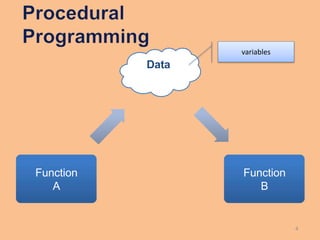
• In procedural programming, data and
operations on the data are separated.
• This methodology requires sending data to
procedure/functions.
Function
A
Data
Function
B
4
variables
Object-Oriented Programming
5
• Object-oriented programming is centered
on creating objects rather than
procedures/ functions.
• Objects are a melding of data and
procedures that manipulate that data.
• Data in an object are known as attributes.
• Procedures/functions in an object are
known as methods.
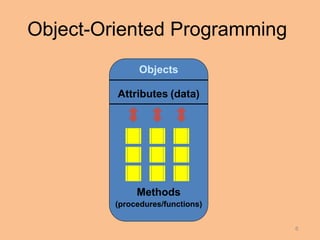
Object-Oriented Programming
Objects
Attributes (data)
Methods
(procedures/functions)
6
Object-Oriented Programming
7
• Object-oriented programming combines data and
behavior (or method).This is called encapsulation.
• Data hiding is the ability of an object to hide data from
other objects in the program.
• Only an object’s methods should be able to
directly manipulate its attributes.
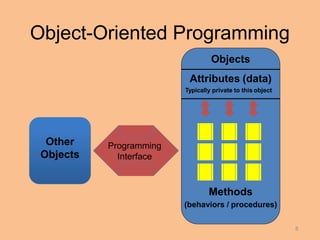
• Other objects are allowed to manipulate an object’s attributes
via the object’smethods.
• This indirect access is known as a programming
interface.
Object-Oriented Programming
Methods
(behaviors / procedures)
Objects
Attributes (data)
Typically private to this object
Other
Objects
Programming
Interface
8
Benefits of Object-oriented
programming
9
• Save development time (and cost) by reusing code
– once an object class is created it can be
used in other applications
• Easier debugging
– classes can be tested independently
– reused objects have already been tested
 Pure OO Languages: Smalltalk,
Actor, Java
 Hybrid OO Languages:
C++, Objective-C, Object-Pascal
10
Object-Oriented Programming
Languages

Oop chapter 1 procedural vs oop