DATA MINING; APPLICATIONS OF DATA
MINING
Data Miniing
› Semi-automatically analyzing large databases
› Discover rules and patterns from data
› Knowledge discovery from database
Data Mining - Tasks
› Data mining deals with the kind of patterns that can be mined.
› There are two categories of functions involved in Data Mining-
A. Descriptive
B. Classification and Prediction
Descriptive Function
The descriptive function deals with the general properties of
data in the database. Here is the list of descriptive functions :−
Class/Concept
Mining of Frequent Patterns
Mining of Associations
Mining of Correlations
Mining of Clusters
Classification and Prediction
› Classification is the process of finding a model that
describes the data classes or concepts
 Classification (IF-THEN) Rules
 Decision Trees
 Mathematical Formulae
 Neural Networks
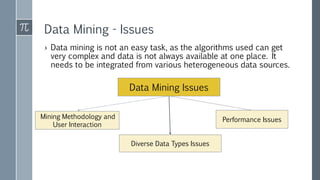
Mining Methodology and
User Interaction
Data Mining - Issues
› Data mining is not an easy task, as the algorithms used can get
very complex and data is not always available at one place. It
needs to be integrated from various heterogeneous data sources.
Data Mining Issues
Performance Issues
Diverse Data Types Issues
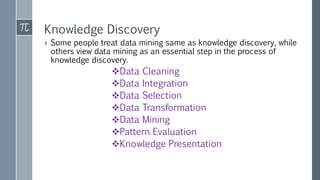
Knowledge Discovery
› Some people treat data mining same as knowledge discovery, while
others view data mining as an essential step in the process of
knowledge discovery.
Data Cleaning
Data Integration
Data Selection
Data Transformation
Data Mining
Pattern Evaluation
Knowledge Presentation
Applications Of Data Mining
• Here is the list of areas where data mining is widely used −
Financial Data Analysis
Retail Industry
Telecommunication Industry
Biological Data Analysis
Data Warehouses and data preprocessing.
Graph-based mining.
Visualization and domain specific knowledge.
Intrusion Detection
STATISTICAL DATA
MINING
oRegression
oGeneralized Linear Models
oAnalysis of Variance
oMixed-effect Models
oFactor Analysis
oTime Series Analysis
THEORETICAL
FOUNDATIONS OF
DATA MINING
oData Reduction
oData Compression
oPattern Discovery
oProbability Theory
oMicroeconomic View
oInductive databases

Data mining

  • 1.
  • 2.
    Data Miniing › Semi-automaticallyanalyzing large databases › Discover rules and patterns from data › Knowledge discovery from database
  • 3.
    Data Mining -Tasks › Data mining deals with the kind of patterns that can be mined. › There are two categories of functions involved in Data Mining- A. Descriptive B. Classification and Prediction
  • 4.
    Descriptive Function The descriptivefunction deals with the general properties of data in the database. Here is the list of descriptive functions :− Class/Concept Mining of Frequent Patterns Mining of Associations Mining of Correlations Mining of Clusters
  • 5.
    Classification and Prediction ›Classification is the process of finding a model that describes the data classes or concepts  Classification (IF-THEN) Rules  Decision Trees  Mathematical Formulae  Neural Networks
  • 6.
    Mining Methodology and UserInteraction Data Mining - Issues › Data mining is not an easy task, as the algorithms used can get very complex and data is not always available at one place. It needs to be integrated from various heterogeneous data sources. Data Mining Issues Performance Issues Diverse Data Types Issues
  • 7.
    Knowledge Discovery › Somepeople treat data mining same as knowledge discovery, while others view data mining as an essential step in the process of knowledge discovery. Data Cleaning Data Integration Data Selection Data Transformation Data Mining Pattern Evaluation Knowledge Presentation
  • 8.
    Applications Of DataMining • Here is the list of areas where data mining is widely used − Financial Data Analysis Retail Industry Telecommunication Industry Biological Data Analysis Data Warehouses and data preprocessing. Graph-based mining. Visualization and domain specific knowledge. Intrusion Detection
  • 9.
    STATISTICAL DATA MINING oRegression oGeneralized LinearModels oAnalysis of Variance oMixed-effect Models oFactor Analysis oTime Series Analysis
  • 10.
    THEORETICAL FOUNDATIONS OF DATA MINING oDataReduction oData Compression oPattern Discovery oProbability Theory oMicroeconomic View oInductive databases