LEED 2009 for New Construction and Major Renovations
21
WE Prerequisite 1: Water Use Reduction
Required
Intent
To increase water efficiency within buildings to reduce the burden on municipal water supply and wastewater
systems.
Requirements ’xb
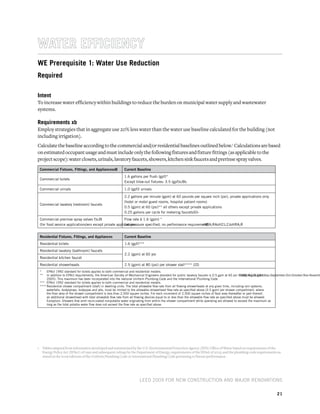
Employ strategies that in aggregate use 20% less water than the water use baseline calculated for the building (not
including irrigation).
Calculatethebaselineaccordingtothecommercialand/orresidentialbaselinesoutlinedbelow.1
Calculationsarebased
onestimatedoccupantusageandmustincludeonlythefollowingfixturesandfixturefittings(asapplicabletothe
projectscope):waterclosets,urinals,lavatoryfaucets,showers,kitchensinkfaucetsandprerinsesprayvalves.
Commercial Fixtures, Fittings, and Appliancesx£JÜÛðB Current Baseline
Commercial toilets
1.6 gallons per flush (gpf)*
Except blow-out fixtures: 3.5 (gpf)x£jÜÛðBs
Commercial urinals 1.0 (gpf)l urinals
Commercial lavatory (restroom) faucets
2.2 gallons per minute (gpm) at 60 pounds per square inch (psi), private applications only •€€ÿÿÿ•ÿÿÿ•€€ÿÿÿ•¨œ
(hotel or motel guest rooms, hospital patient rooms)
0.5 (gpm) at 60 (psi)** all others except private applications
0.25 gallons per cycle for metering faucets)•Ãþ0)ï¾-Þï¾-Þï¾-Þï¾-Þ
Commercial prerinse spray valves f)x£jÜÛðB
(for food service applications)ers except private applications
Flow rate ãϰãÏ≤ 1.6 (gpm) °ãÏ ´
(no pressure specified; no performance requiremoHýrèa;ÖrèaoHý2j;Ö2joHýrèa;Örèent)
Residential Fixtures, Fittings, and Appliances Current Baseline
Residential toilets 1.6 (gpf)***
Residential lavatory (bathroom) faucets
2.2 (gpm) at 60 psi
Residential kitchen faucet
Residential showerheads 2.5 (gpm) at 80 (psi) per shower stall**** )œÿ2D
*	 EPAct 1992 standard for toilets applies to both commercial and residential models.
**	In addition to EPAct requirements, the American Society of Mechanical Engineers standard for public lavatory faucets is 0.5 gpm at 60 psi (l:july:aug:august:sep:september:oct:october:Nov:NovembASME A112.18.1-
2005). This maximum has been incorporated into the national Uniform Plumbing Code and the International Plumbing Code.
***	 EPAct 1992 standard for toilets applies to both commercial and residential models.
****	Residential shower compartment (stall) in dwelling units: The total allowable flow rate from all flowing showerheads at any given time, including rain systems,
waterfalls, bodysprays, bodyspas and jets, must be limited to the allowable showerhead flow rate as specified above (2.5 gpm) per shower compartment, where
the floor area of the shower compartment is less than 2,500 square inches. For each increment of 2,500 square inches of floor area thereafter or part thereof,
an additional showerhead with total allowable flow rate from all flowing devices equal to or less than the allowable flow rate as specified above must be allowed.
Exception: Showers that emit recirculated nonpotable water originating from within the shower compartment while operating are allowed to exceed the maximum as
long as the total potable water flow does not exceed the flow rate as specified above.
1	 Tables adapted from information developed and summarized by the U.S. Environmental Protection Agency (EPA) Office of Water based on requirements of the
Energy Policy Act (EPAct) of 1992 and subsequent rulings by the Department of Energy, requirements of the EPAct of 2005, and the plumbing code requirements as
stated in the 2006 editions of the Uniform Plumbing Code or International Plumbing Code pertaining to fixture performance.
LEED 2009 for New Construction and Major Renovations
22
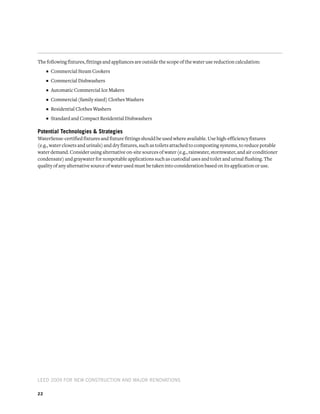
The following fixtures, fittings and appliances are outside the scope of the water use reduction calculation:
n	 Commercial Steam Cookers
n	 Commercial Dishwashers
n	 Automatic Commercial Ice Makers
n	 Commercial (family sized) Clothes Washers
n	 Residential Clothes Washers
n	 Standard and Compact Residential Dishwashers
Potential Technologies & Strategies
WaterSense-certified fixtures and fixture fittings should be used where available. Use high-efficiency fixtures
(e.g., water closets and urinals) and dry fixtures, such as toilets attached to composting systems, to reduce potable
water demand. Consider using alternative on-site sources of water (e.g., rainwater, stormwater, and air conditioner
condensate) and graywater for nonpotable applications such as custodial uses and toilet and urinal flushing. The
quality of any alternative source of water used must be taken into consideration based on its application or use.
LEED 2009 for New Construction and Major Renovations
25
WE Credit 2: Innovative Wastewater Technologies
2 Points
Intent
To reduce wastewater generation and potable water demand while increasing the local aquifer recharge.
Requirements
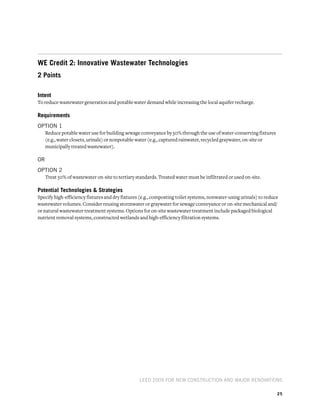
OPTION 1
Reduce potable water use for building sewage conveyance by 50% through the use of water-conserving fixtures
(e.g., water closets, urinals) or nonpotable water (e.g., captured rainwater, recycled graywater, on-site or
municipally treated wastewater).
OR
OPTION 2
Treat 50% of wastewater on-site to tertiary standards. Treated water must be infiltrated or used on-site.
Potential Technologies & Strategies
Specify high-efficiency fixtures and dry fixtures (e.g., composting toilet systems, nonwater-using urinals) to reduce
wastewater volumes. Consider reusing stormwater or graywater for sewage conveyance or on-site mechanical and/
or natural wastewater treatment systems. Options for on-site wastewater treatment include packaged biological
nutrient removal systems, constructed wetlands and high-efficiency filtration systems.
LEED 2009 for New Construction and Major Renovations
26
WE Credit 3: Water Use Reduction
2–4 Points
Intent
To further increase water efficiency within buildings to reduce the burden on municipal water supply and wastewater
systems.
Requirements
Employ strategies that in aggregate use less water than the water use baseline calculated for the building (not
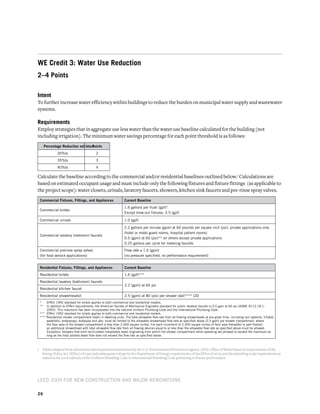
including irrigation). The minimum water savings percentage for each point threshold is as follows:
Percentage Reduction ext blocksPoints
30%ts 2¦
35%ts 3¦
40%ts 4¦
Calculate the baseline according to the commercial and/or residential baselines outlined below.1
Calculations are
based on estimated occupant usage and must include only the following fixtures and fixture fittings (as applicable to
the project scope): water closets, urinals, lavatory faucets, showers, kitchen sink faucets and pre-rinse spray valves.
Commercial Fixtures, Fittings, and Appliances Current Baseline
Commercial toilets
1.6 gallons per flush (gpf)*
Except blow-out fixtures: 3.5 (gpf)
Commercial urinals 1.0 (gpf)
Commercial lavatory (restroom) faucets
2.2 gallons per minute (gpm) at 60 pounds per square inch (psi), private applications only
(hotel or motel guest rooms, hospital patient rooms)
0.5 (gpm) at 60 (psi)** all others except private applications
0.25 gallons per cycle for metering faucets
Commercial prerinse spray valves
(for food service applications)
Flow rate ≤ 1.6 (gpm)
(no pressure specified; no performance requirement)
Residential Fixtures, Fittings, and Appliances Current Baseline
Residential toilets 1.6 (gpf)***
Residential lavatory (bathroom) faucets
2.2 (gpm) at 60 psi
Residential kitchen faucet
Residential showerheadsl˜l 2.5 (gpm) at 80 (psi) per shower stall**** )œÿ2Dè
*¬	 EPAct 1992 standard for toilets applies to both commercial and residential models.
**	In addition to EPAct requirements, the American Society of Mechanical Engineers standard for public lavatory faucets is 0.5 gpm at 60 psi (ASME A112.18.1-
2005). This maximum has been incorporated into the national Uniform Plumbing Code and the International Plumbing Code.
***	 EPAct 1992 standard for toilets applies to both commercial and residential models.
****	Residential shower compartment (stall) in dwelling units: The total allowable flow rate from all flowing showerheads at any given time, including rain systems, ©))%&£¢)ï¾-Þï¾-Þï¾-Þï¾-ÞdÈ.
waterfalls, bodysprays, bodyspas and jets, must be limited to the allowable showerhead flow rate as specified above (2.5 gpm) per shower compartment, where
the floor area of the shower compartment is less than 2,500 square inches. For each increment of 2,500 square inches of floor area thereafter or part thereof,
an additional showerhead with total allowable flow rate from all flowing devices equal to or less than the allowable flow rate as specified above must be allowed.
Exception: Showers that emit recirculated nonpotable water originating from within the shower compartment while operating are allowed to exceed the maximum as
long as the total potable water flow does not exceed the flow rate as specified above.
1	 Tables adapted from information developed and summarized by the U.S. Environmental Protection Agency (EPA) Office of Water based on requirements of the
Energy Policy Act (EPAct) of 1992 and subsequent rulings by the Department of Energy, requirements of the EPAct of 2005, and the plumbing code requirements as
stated in the 2006 editions of the Uniform Plumbing Code or International Plumbing Code pertaining to fixture performance.
LEED 2009 for New Construction and Major Renovations
27
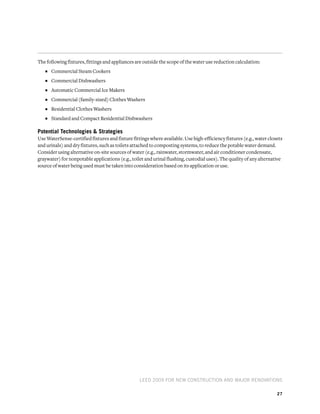
The following fixtures, fittings and appliances are outside the scope of the water use reduction calculation:
n	 Commercial Steam Cookers
n	 Commercial Dishwashers
n	 Automatic Commercial Ice Makers
n	 Commercial (family-sized) Clothes Washers
n	 Residential Clothes Washers
n	 Standard and Compact Residential Dishwashers
Potential Technologies & Strategies
Use WaterSense-certified fixtures and fixture fittings where available. Use high-efficiency fixtures (e.g., water closets
and urinals) and dry fixtures, such as toilets attached to composting systems, to reduce the potable water demand.
Consider using alternative on-site sources of water (e.g., rainwater, stormwater, and air conditioner condensate,
graywater) for nonpotable applications (e.g., toilet and urinal flushing, custodial uses). The quality of any alternative
source of water being used must be taken into consideration based on its application or use.

Leed Water Efficiency Credits V3

  • 1.
    LEED 2009 forNew Construction and Major Renovations 21 WE Prerequisite 1: Water Use Reduction Required Intent To increase water efficiency within buildings to reduce the burden on municipal water supply and wastewater systems. Requirements ’xb Employ strategies that in aggregate use 20% less water than the water use baseline calculated for the building (not including irrigation). Calculatethebaselineaccordingtothecommercialand/orresidentialbaselinesoutlinedbelow.1 Calculationsarebased onestimatedoccupantusageandmustincludeonlythefollowingfixturesandfixturefittings(asapplicabletothe projectscope):waterclosets,urinals,lavatoryfaucets,showers,kitchensinkfaucetsandprerinsesprayvalves. Commercial Fixtures, Fittings, and Appliancesx£JÜÛðB Current Baseline Commercial toilets 1.6 gallons per flush (gpf)* Except blow-out fixtures: 3.5 (gpf)x£jÜÛðBs Commercial urinals 1.0 (gpf)l urinals Commercial lavatory (restroom) faucets 2.2 gallons per minute (gpm) at 60 pounds per square inch (psi), private applications only •€€ÿÿÿ•ÿÿÿ•€€ÿÿÿ•¨œ (hotel or motel guest rooms, hospital patient rooms) 0.5 (gpm) at 60 (psi)** all others except private applications 0.25 gallons per cycle for metering faucets)•Ãþ0)ï¾-Þï¾-Þï¾-Þï¾-Þ Commercial prerinse spray valves f)x£jÜÛðB (for food service applications)ers except private applications Flow rate ãϰãÏ≤ 1.6 (gpm) °ãÏ ´ (no pressure specified; no performance requiremoHýrèa;ÖrèaoHý2j;Ö2joHýrèa;Örèent) Residential Fixtures, Fittings, and Appliances Current Baseline Residential toilets 1.6 (gpf)*** Residential lavatory (bathroom) faucets 2.2 (gpm) at 60 psi Residential kitchen faucet Residential showerheads 2.5 (gpm) at 80 (psi) per shower stall**** )œÿ2D * EPAct 1992 standard for toilets applies to both commercial and residential models. ** In addition to EPAct requirements, the American Society of Mechanical Engineers standard for public lavatory faucets is 0.5 gpm at 60 psi (l:july:aug:august:sep:september:oct:october:Nov:NovembASME A112.18.1- 2005). This maximum has been incorporated into the national Uniform Plumbing Code and the International Plumbing Code. *** EPAct 1992 standard for toilets applies to both commercial and residential models. **** Residential shower compartment (stall) in dwelling units: The total allowable flow rate from all flowing showerheads at any given time, including rain systems, waterfalls, bodysprays, bodyspas and jets, must be limited to the allowable showerhead flow rate as specified above (2.5 gpm) per shower compartment, where the floor area of the shower compartment is less than 2,500 square inches. For each increment of 2,500 square inches of floor area thereafter or part thereof, an additional showerhead with total allowable flow rate from all flowing devices equal to or less than the allowable flow rate as specified above must be allowed. Exception: Showers that emit recirculated nonpotable water originating from within the shower compartment while operating are allowed to exceed the maximum as long as the total potable water flow does not exceed the flow rate as specified above. 1 Tables adapted from information developed and summarized by the U.S. Environmental Protection Agency (EPA) Office of Water based on requirements of the Energy Policy Act (EPAct) of 1992 and subsequent rulings by the Department of Energy, requirements of the EPAct of 2005, and the plumbing code requirements as stated in the 2006 editions of the Uniform Plumbing Code or International Plumbing Code pertaining to fixture performance.
  • 2.
    LEED 2009 forNew Construction and Major Renovations 22 The following fixtures, fittings and appliances are outside the scope of the water use reduction calculation: n Commercial Steam Cookers n Commercial Dishwashers n Automatic Commercial Ice Makers n Commercial (family sized) Clothes Washers n Residential Clothes Washers n Standard and Compact Residential Dishwashers Potential Technologies & Strategies WaterSense-certified fixtures and fixture fittings should be used where available. Use high-efficiency fixtures (e.g., water closets and urinals) and dry fixtures, such as toilets attached to composting systems, to reduce potable water demand. Consider using alternative on-site sources of water (e.g., rainwater, stormwater, and air conditioner condensate) and graywater for nonpotable applications such as custodial uses and toilet and urinal flushing. The quality of any alternative source of water used must be taken into consideration based on its application or use.
  • 3.
    LEED 2009 forNew Construction and Major Renovations 25 WE Credit 2: Innovative Wastewater Technologies 2 Points Intent To reduce wastewater generation and potable water demand while increasing the local aquifer recharge. Requirements OPTION 1 Reduce potable water use for building sewage conveyance by 50% through the use of water-conserving fixtures (e.g., water closets, urinals) or nonpotable water (e.g., captured rainwater, recycled graywater, on-site or municipally treated wastewater). OR OPTION 2 Treat 50% of wastewater on-site to tertiary standards. Treated water must be infiltrated or used on-site. Potential Technologies & Strategies Specify high-efficiency fixtures and dry fixtures (e.g., composting toilet systems, nonwater-using urinals) to reduce wastewater volumes. Consider reusing stormwater or graywater for sewage conveyance or on-site mechanical and/ or natural wastewater treatment systems. Options for on-site wastewater treatment include packaged biological nutrient removal systems, constructed wetlands and high-efficiency filtration systems.
  • 4.
    LEED 2009 forNew Construction and Major Renovations 26 WE Credit 3: Water Use Reduction 2–4 Points Intent To further increase water efficiency within buildings to reduce the burden on municipal water supply and wastewater systems. Requirements Employ strategies that in aggregate use less water than the water use baseline calculated for the building (not including irrigation). The minimum water savings percentage for each point threshold is as follows: Percentage Reduction ext blocksPoints 30%ts 2¦ 35%ts 3¦ 40%ts 4¦ Calculate the baseline according to the commercial and/or residential baselines outlined below.1 Calculations are based on estimated occupant usage and must include only the following fixtures and fixture fittings (as applicable to the project scope): water closets, urinals, lavatory faucets, showers, kitchen sink faucets and pre-rinse spray valves. Commercial Fixtures, Fittings, and Appliances Current Baseline Commercial toilets 1.6 gallons per flush (gpf)* Except blow-out fixtures: 3.5 (gpf) Commercial urinals 1.0 (gpf) Commercial lavatory (restroom) faucets 2.2 gallons per minute (gpm) at 60 pounds per square inch (psi), private applications only (hotel or motel guest rooms, hospital patient rooms) 0.5 (gpm) at 60 (psi)** all others except private applications 0.25 gallons per cycle for metering faucets Commercial prerinse spray valves (for food service applications) Flow rate ≤ 1.6 (gpm) (no pressure specified; no performance requirement) Residential Fixtures, Fittings, and Appliances Current Baseline Residential toilets 1.6 (gpf)*** Residential lavatory (bathroom) faucets 2.2 (gpm) at 60 psi Residential kitchen faucet Residential showerheadsl˜l 2.5 (gpm) at 80 (psi) per shower stall**** )œÿ2Dè *¬ EPAct 1992 standard for toilets applies to both commercial and residential models. ** In addition to EPAct requirements, the American Society of Mechanical Engineers standard for public lavatory faucets is 0.5 gpm at 60 psi (ASME A112.18.1- 2005). This maximum has been incorporated into the national Uniform Plumbing Code and the International Plumbing Code. *** EPAct 1992 standard for toilets applies to both commercial and residential models. **** Residential shower compartment (stall) in dwelling units: The total allowable flow rate from all flowing showerheads at any given time, including rain systems, ©))%&£¢)ï¾-Þï¾-Þï¾-Þï¾-ÞdÈ. waterfalls, bodysprays, bodyspas and jets, must be limited to the allowable showerhead flow rate as specified above (2.5 gpm) per shower compartment, where the floor area of the shower compartment is less than 2,500 square inches. For each increment of 2,500 square inches of floor area thereafter or part thereof, an additional showerhead with total allowable flow rate from all flowing devices equal to or less than the allowable flow rate as specified above must be allowed. Exception: Showers that emit recirculated nonpotable water originating from within the shower compartment while operating are allowed to exceed the maximum as long as the total potable water flow does not exceed the flow rate as specified above. 1 Tables adapted from information developed and summarized by the U.S. Environmental Protection Agency (EPA) Office of Water based on requirements of the Energy Policy Act (EPAct) of 1992 and subsequent rulings by the Department of Energy, requirements of the EPAct of 2005, and the plumbing code requirements as stated in the 2006 editions of the Uniform Plumbing Code or International Plumbing Code pertaining to fixture performance.
  • 5.
    LEED 2009 forNew Construction and Major Renovations 27 The following fixtures, fittings and appliances are outside the scope of the water use reduction calculation: n Commercial Steam Cookers n Commercial Dishwashers n Automatic Commercial Ice Makers n Commercial (family-sized) Clothes Washers n Residential Clothes Washers n Standard and Compact Residential Dishwashers Potential Technologies & Strategies Use WaterSense-certified fixtures and fixture fittings where available. Use high-efficiency fixtures (e.g., water closets and urinals) and dry fixtures, such as toilets attached to composting systems, to reduce the potable water demand. Consider using alternative on-site sources of water (e.g., rainwater, stormwater, and air conditioner condensate, graywater) for nonpotable applications (e.g., toilet and urinal flushing, custodial uses). The quality of any alternative source of water being used must be taken into consideration based on its application or use.