Water Use Licensing Workshop
Water Use Licence
General conditions
Angelika Möhr
General Conditions
• Conditions that apply generally to whole site/all
water uses
• Instructive conditions
• Licensee has the right to request amendments
to any conditions but these may or may not be
accepted by DWS
General Conditions -
Regulatory
• Licensee is subject to all provisions of the NWA, the
licensee is responsible for complying to the licence:
• Appointment of a responsible person to
undertake/oversee the activities in the licence
(suitably qualified) is critical
• The WUL does not exempt the licensee from other legal
obligations or regulatory conditions. Licensee to be
aware of:
• Section 19 of NWA – minimising & addressing
impacts to the water resource
• Acts - National Environmental Management Act (Act
107 of 1998)
• Ordinances (temporary laws)
• By-laws – municipal
• Regulations – Regulation 704 (specific conditions
ask for compliance to Reg 704)
General Conditions -
Instructions
• Licensee to
• inform DWS of changes of names,
addresses, premises, legal status or farms
• pay the charges for water uses as invoiced
• undertake internal audit
• appoint an independent external auditor
• report on incidents within 24hours
• maintain & calibrate flow meters
General Conditions – Specific
Examples of Changes
• The water use authorised in this licence could be subject
to appropriate reduction
• The Licensee must improve to a level 4 BBBEE
contributor and report on progress must be submitted to
the Department
• Inform the Department at least 90 days before the
expiring date whether the licence must be considered for
another term.
• Regulation 704 exemptions for specific infrastructure
have been included
• This licence supersedes all Permits and Exemptions
issued in terms of the Water Act, 1956.
• If the water use authorised cannot be carried out
responsibly, all activities must be immediately ceased
and licensee to take preventative action
General Conditions -
Challenges and Suggestions
• Some reserve determinations have not been made
available or undertaken as desktop, Licensee to assist
DWS
• Calibration of flow meters not practical, suggest
verification
• Lack of established water user associations, suggest
other associations recognised by DWS
• Discrepancies in charges or no charges, will DWS back
date invoices? DWS has administrative challenges
• Reporting ALL incidents, how to deem what should be
reported – incident risk level
• Duplication of conditions within licence – integrate
conditions into Licence Implementation Plan (LIP) for
internal compliance and reporting
General conditions -
Suggestions
• Propose an amendment application to integrate
duplicated conditions into General Conditions
• Suggestions to DWS - consolidate management
requirements from all appendices into General
Conditions to incorporate entire site:
• Stormwater management
• Pollution prevention/minimisation
• General monitoring requirements e.g. SABS
methods, sample sheets
• Site notices & access – general vs specific
• Chemical & materials storage
• Reporting
• General conditions associated with construction and
operation
• Rehabilitation and budgetary provisions
• Auditing
Water Use Licensing Workshop
Water use licence -
Section 21(a), (b) and (j) water use
Didi Masoabi
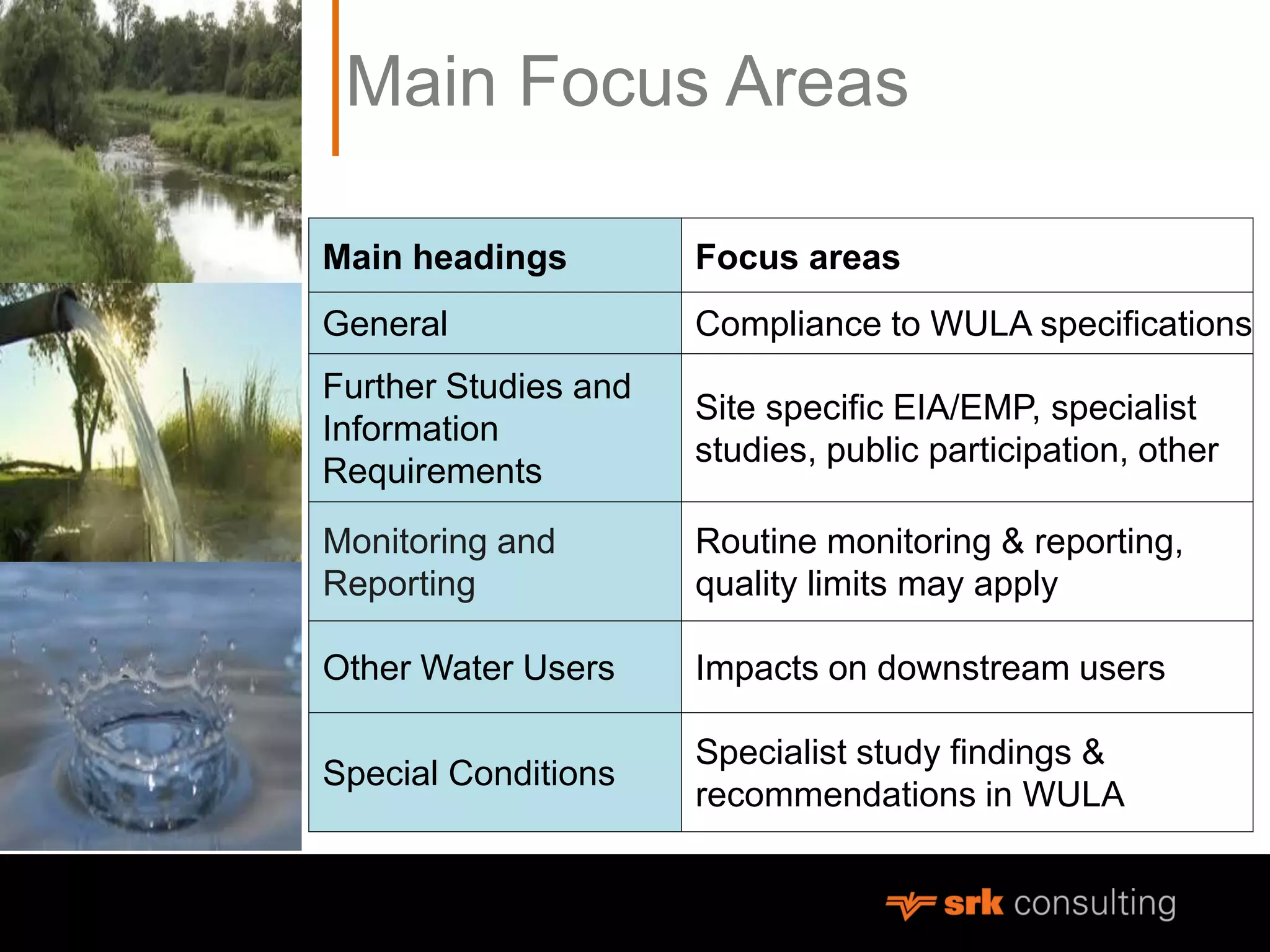
Main Focus Areas
Main headings Focus areas
General Compliance to WULA specifications
Further Studies and
Information
Requirements
Site specific EIA/EMP, specialist
studies, public participation, other
Monitoring and
Reporting
Routine monitoring & reporting,
quality limits may apply
Other Water Users Impacts on downstream users
Special Conditions
Specialist study findings &
recommendations in WULA
Section 21 (a) Water Use
• Taking water from a water resource
• This use involves pumping of water from a dam or
river, or from a borehole
• The intent is to use water efficiently
• It also applies to water removed from underground
in terms of section 21(j) and which is not discharged
into a water resource, i.e. water used by mines in
their processes, for irrigation of golf courses, or for
other uses
NB
Water taken from a municipal supply network OR Water Services Provider such as a
Water Board is NOT a S21 water use.
Please note that the water use occurs at the point where the water is
taken from the resource and not at the point where it is applied
Approach to Comply
• Ensure the following:
• water taken from the resource is metered daily with a
total recorded monthly
• records are kept and forward copy of records to the
Provincial Head usually by 25 of January & July each
year
• appropriate measuring devices are installed
• abstract ONLY what has been authorised
Section 21 (b) Water Use
• Storing water
• This includes water that is stored in a dam, reservoir, or
other impoundment, either in a watercourse, or off-
channel
NB
This water use does not include water that contains waste, for
example water collected through a sewer system, or wastewater from
an industrial plant -Section 21 (g)
Approach to Comply
• Ensure the following:
• measure flows entering and leaving the
dam
• levels in the dam to be recorded monthly,
• storage structures have to comply with
Dam Safety Regulations
• dam size (wall height ≥ 5m high & capacity
≥ 50 000m3) – safety risk – classification
Section 21 (j) Water Use
• Removing, discharging or disposing of water found
underground for the continuation of an activity or for
the safety of persons
• The pumping of water from underground in a mine
or construction site to ensure continued production
and safety in underground workings
“”Safety should be priority””
If part of the water removed for this reason is not disposed off – Section
21(g) - or discharged –Section 21(f) - into a water resource, but used for
some purpose, this water use will be considered to be the taking of water
in terms of section 21(a).
Approach to Comply
• Ensure the following:
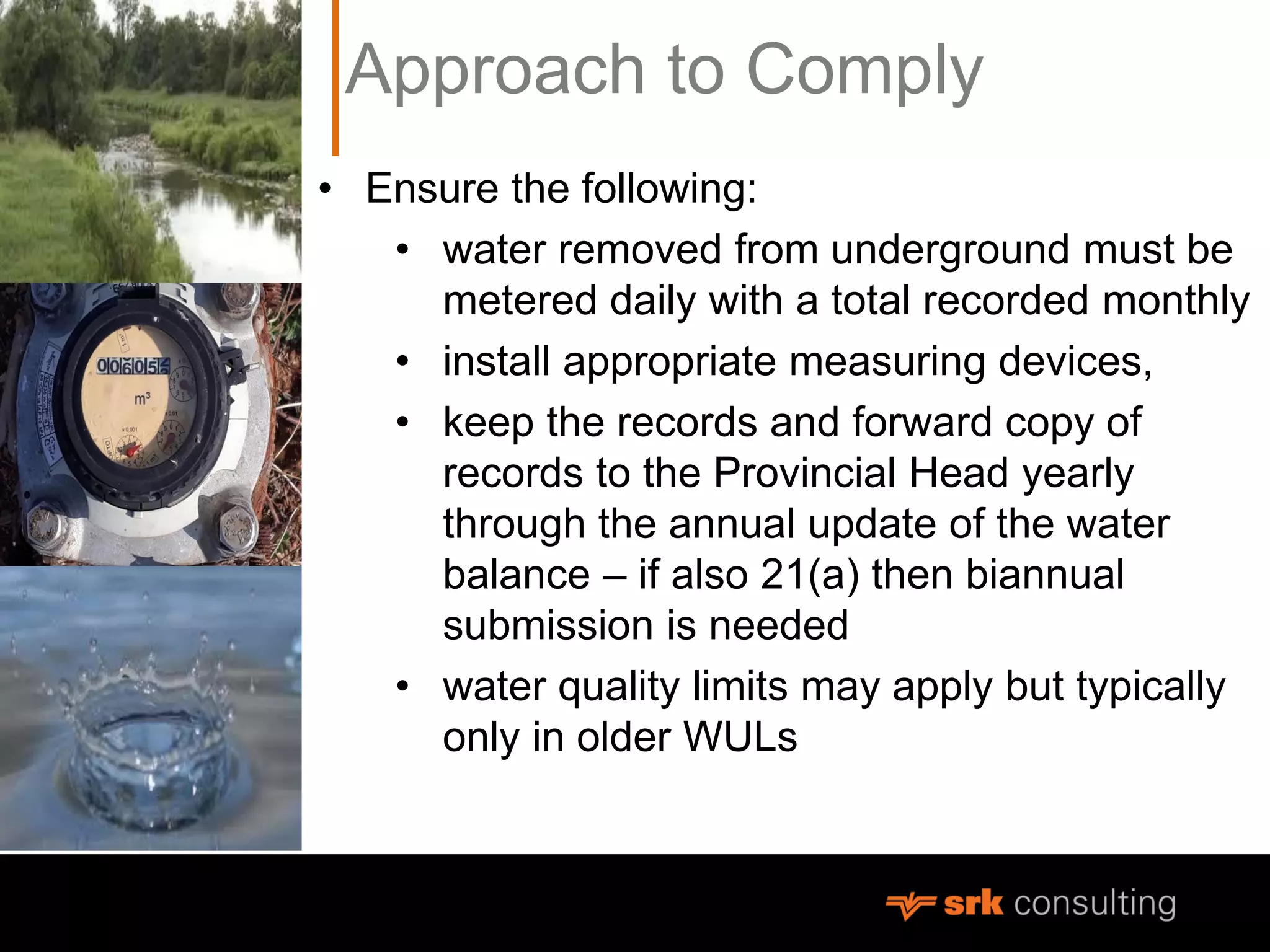
• water removed from underground must be
metered daily with a total recorded monthly
• install appropriate measuring devices,
• keep the records and forward copy of
records to the Provincial Head yearly
through the annual update of the water
balance – if also 21(a) then biannual
submission is needed
• water quality limits may apply but typically
only in older WULs
Water Use Licensing Workshop
Water use licence -
Section 21(c) and (i) water use
Jacky Burke
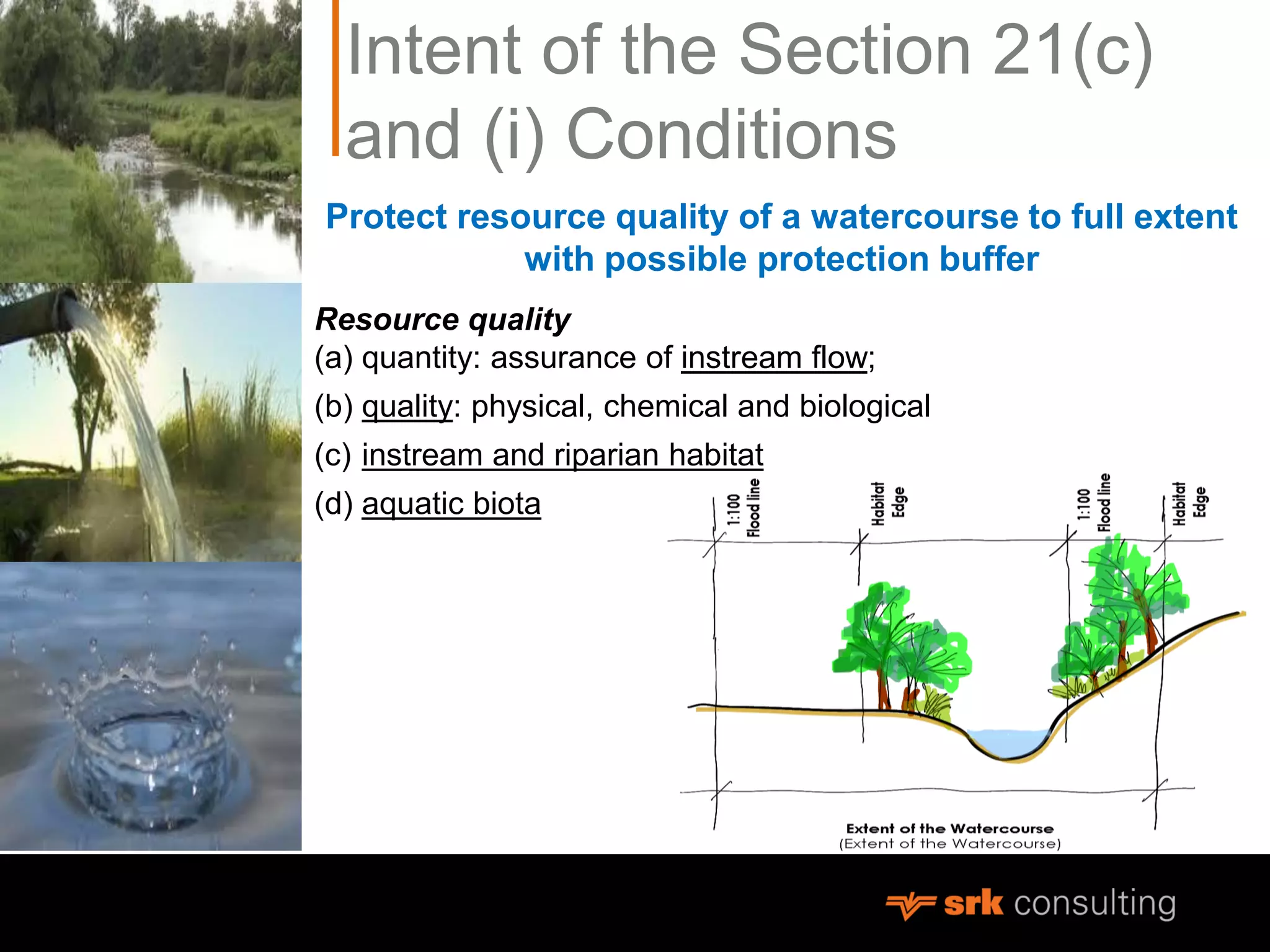
Intent of the Section 21(c)
and (i) Conditions
Protect resource quality of a watercourse to full extent
with possible protection buffer
Resource quality
(a) quantity: assurance of instream flow;
(b) quality: physical, chemical and biological
(c) instream and riparian habitat
(d) aquatic biota
Main Focus Areas
Main headings Focus areas
General Compliance to WULA design specifications
Further Studies and
Information
Requirements
Method statements, site specific EIA/EMP,
specialist audit, landscape & plant species plan,
other
Protective Measures Erosion controls, vegetation management,
structural integrity
Stability of U/G workings for undermining near
watercourses
REQUIRES
 GN704 compliance
 Effective Stormwater Management Plan
 Alien vegetation control program
 Inspections & scheduled maintenance
 Stability/subsidence monitoring & protective
measures U/G
Storm Water
Management
Structures and Materials
Water Quality
Flow
Riparian and lnstream
Habitat (Vegetation and
Morphology)
Biota
Main Focus Areas Cont.
Main headings Focus areas
Rehabilitation and
Management
Rehabilitation program (RSIP)
Photographic records
Monitoring and
Reporting
Routine monitoring & reporting, quality limits may
apply
Other Water Users Impacts on downstream users
Pollution Prevention,
Incidents and
Malfunctions
Effective housekeeping & management of 21(e), (f)
and (g) water uses:
REQUIRES emphasis on source controls &
behavior change
Budgetary Provisions Budget must consider riparian zone
Special Conditions
Specialist study findings & recommendations in
WULA
Annual public participation on compliance
Approach to Comply
• Ensure crossing & diversion design is
compliant with best practices and/or GN704 –
concrete OR vegetation
• Ensure a good WULA at the outset – high
quality specialist input to ensure site specific
conditions in licence are practical and
reasonable
• Have a system of inspections and scheduled
maintenance in place
Integrated
hydrologist &
aquatic specialist
input, possibly also
hydropedologist
FRESHWATER
ASSESSMENT
REQUIREMENTS
TO ALIGN WITH
WULA
REQUIREMENTS
Presented by:
Stephen van Staden Pr. Sci. Nat.
Scientific Aquatic Services
WHAT ENCOMPASSES A WATER RESOURCE
• NWA defines water as a renewable natural resource
• Means the water resource and not just the water itself is
the resource and must be treated as an integrated
component.
• The ecological integrity of a resource is therefore
considered an essential part of the resource. Included in
the definition of this resource is:
The physical and structural aquatic habitats (both
in stream and riparian), the water, the biota and
the physical, chemical and ecological; processes
that link habitat and biota
THE BUSINESS CASE?
Legal compliance
Group policy and ethics requirements
Social licence to operate
Manage impact on natural resources and
the communities that rely on them
Prevent project delays
Prevent costs of reworking and
resubmission
WHEN IS A WUL REQUIRED?
Section 21 of NWA
a) Taking water from a water resource
b) Storing water
c) Impeding/diverting the flow of water in a watercourse
d) Engaging in streamflow reduction activities (e.g. plantations) (Section 36)
e) Engaging in controlled activities (Section 37(1) and 38(1))
f) Discharging waste/water containing waste into a water resource
g) Disposing of waste in a manner which may have a negative impact on a water resource
h) Disposing of water which contains waste from, or which has been heated in, and industrial/power generation process
i) Altering bed/banks/course/characteristics of a watercourse
j) Removing/discharging/disposing of water found underground if it is necessary for the efficient continuation of an activity or
for the safety of people
k) Recreational use
GN-509 relates
specifically to 21c & 21i
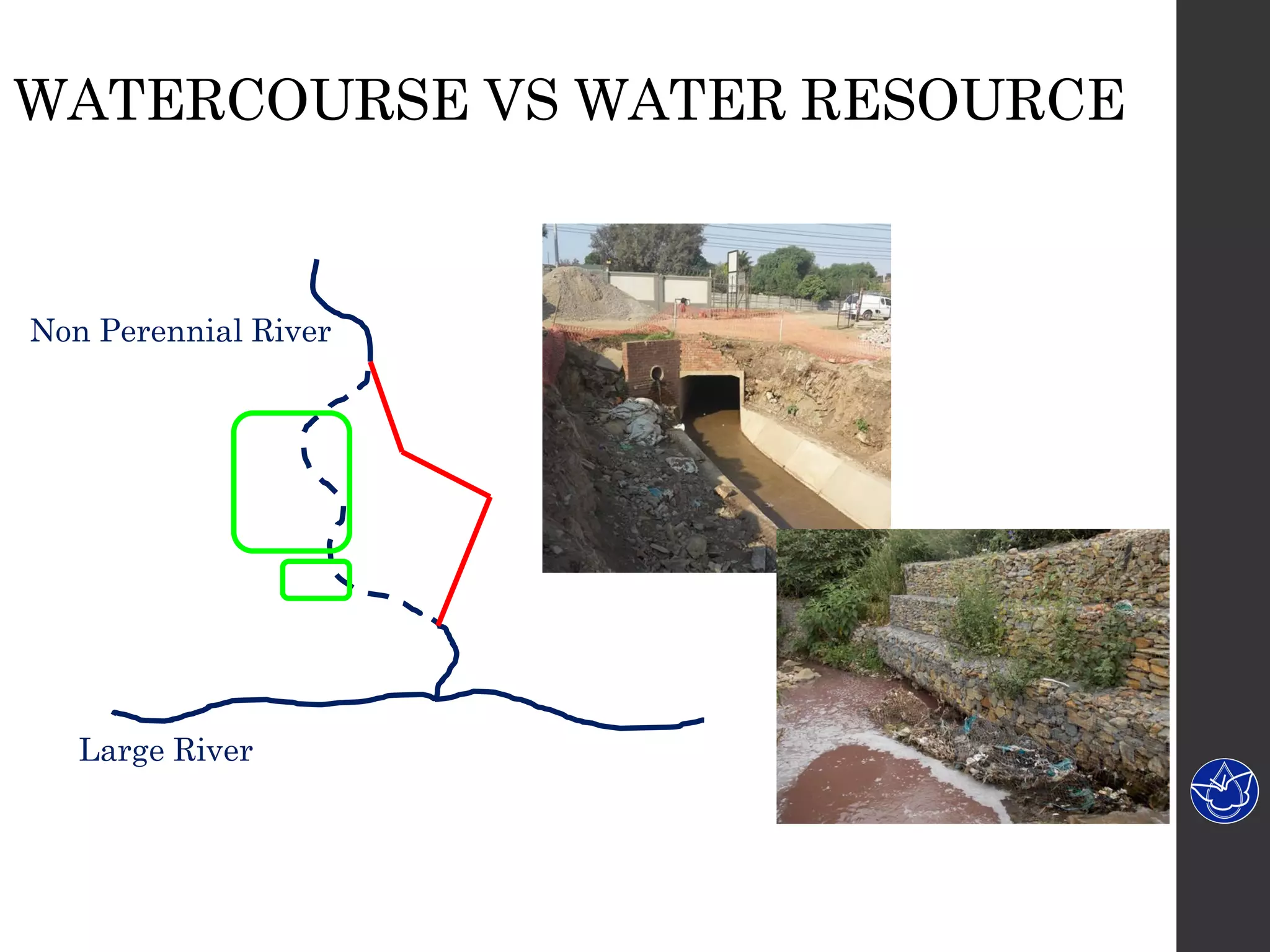
WATERCOURSE VS WATER RESOURCE
Freshwater Baseline Studies
Watercourse Water resource
• Canal
• Reservoir
• Groundwater
• Drainage line
• River (& Riparian Zone)
• Spring
• Natural channel
• Wetland/lake/dam
Legal protection
(covered under c & i)
Water
flow
No legal protection
(not covered under
c & i) but other uses apply
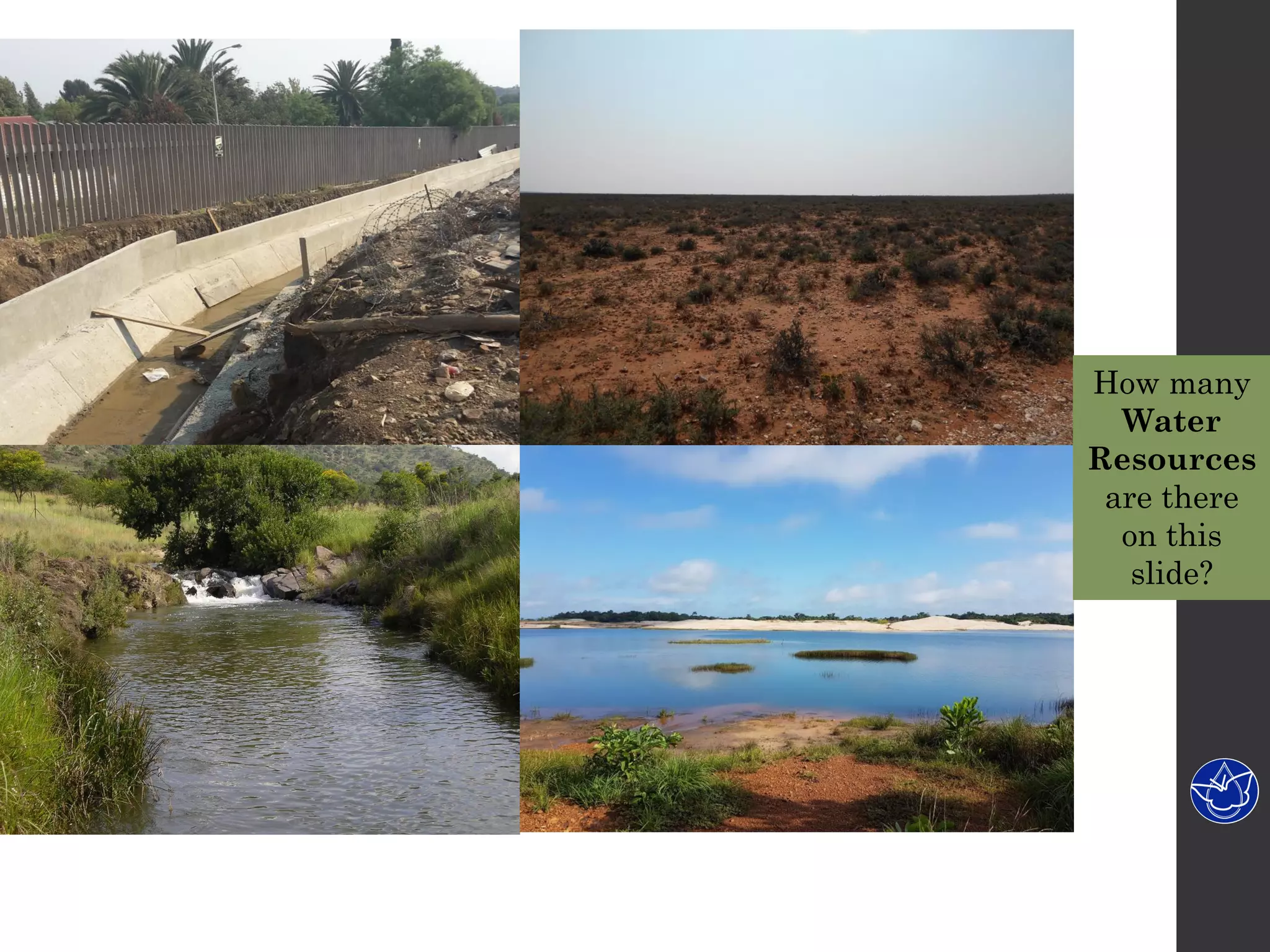
How many
Water
Resources
are there
on this
slide?
WATERCOURSE EXAMPLE
Original channel
Encroached channel
Diverted channel
Pollution control/tailings dams
Legend
Large River
Non Perennial River
Large River
Non Perennial River
WATERCOURSE VS WATER RESOURCE
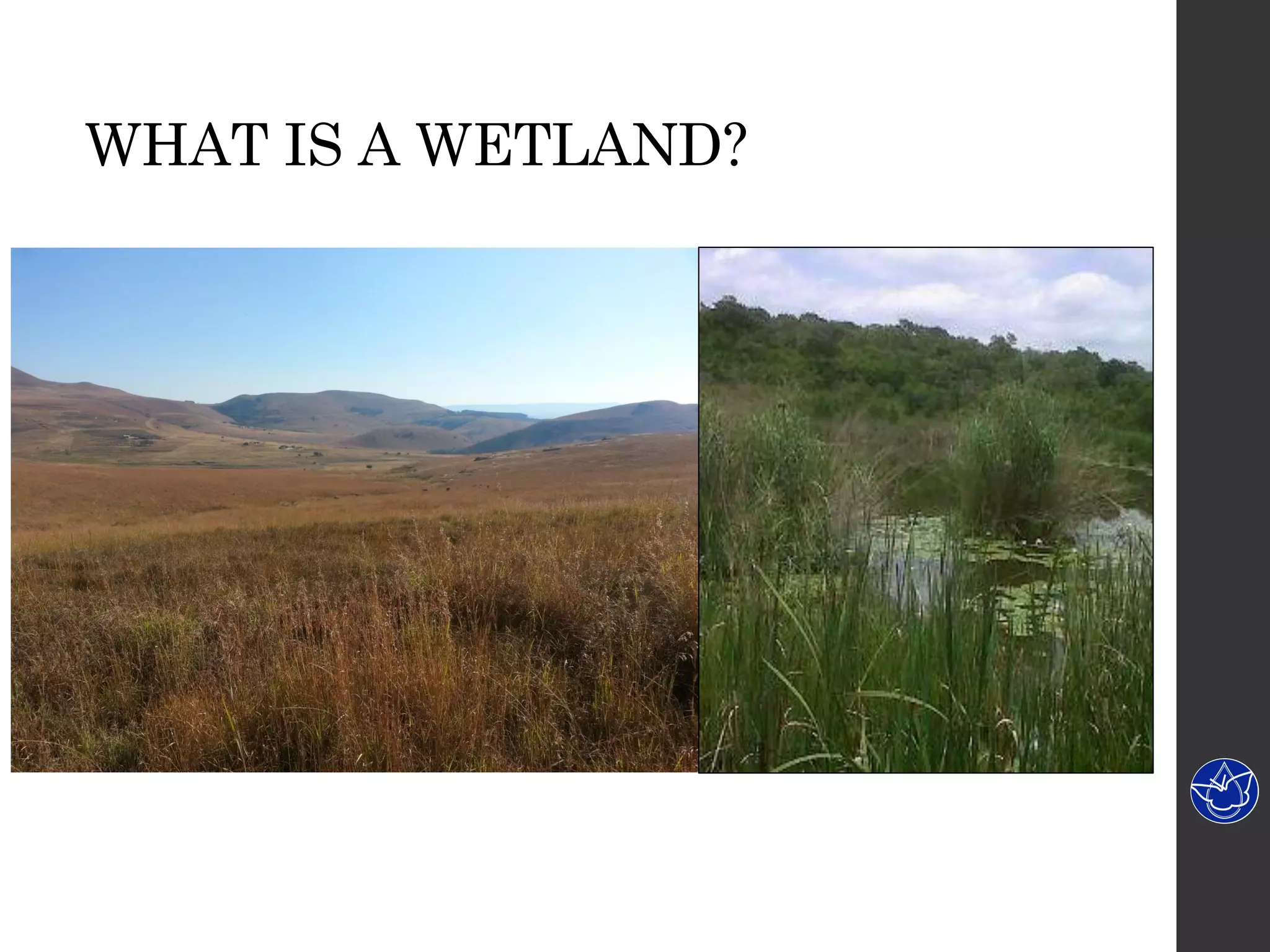
WHAT IS A WETLAND?
• Four indicators:
Position in landscape
Crest
Scarp
Midslope
Footslope Valley
bottom
Most likely
but not
exclusive
IDENTIFYING AND DELINEATING A
WETLAND
• Four indicators:
Position in landscape
Soil form and wetness
Champagne/Katspruit/Willowbrook/Rensburg*
ALWAYS denote wetlands
BUT
G Horizon within 50cm of NGL
IDENTIFYING AND DELINEATING A
WETLAND
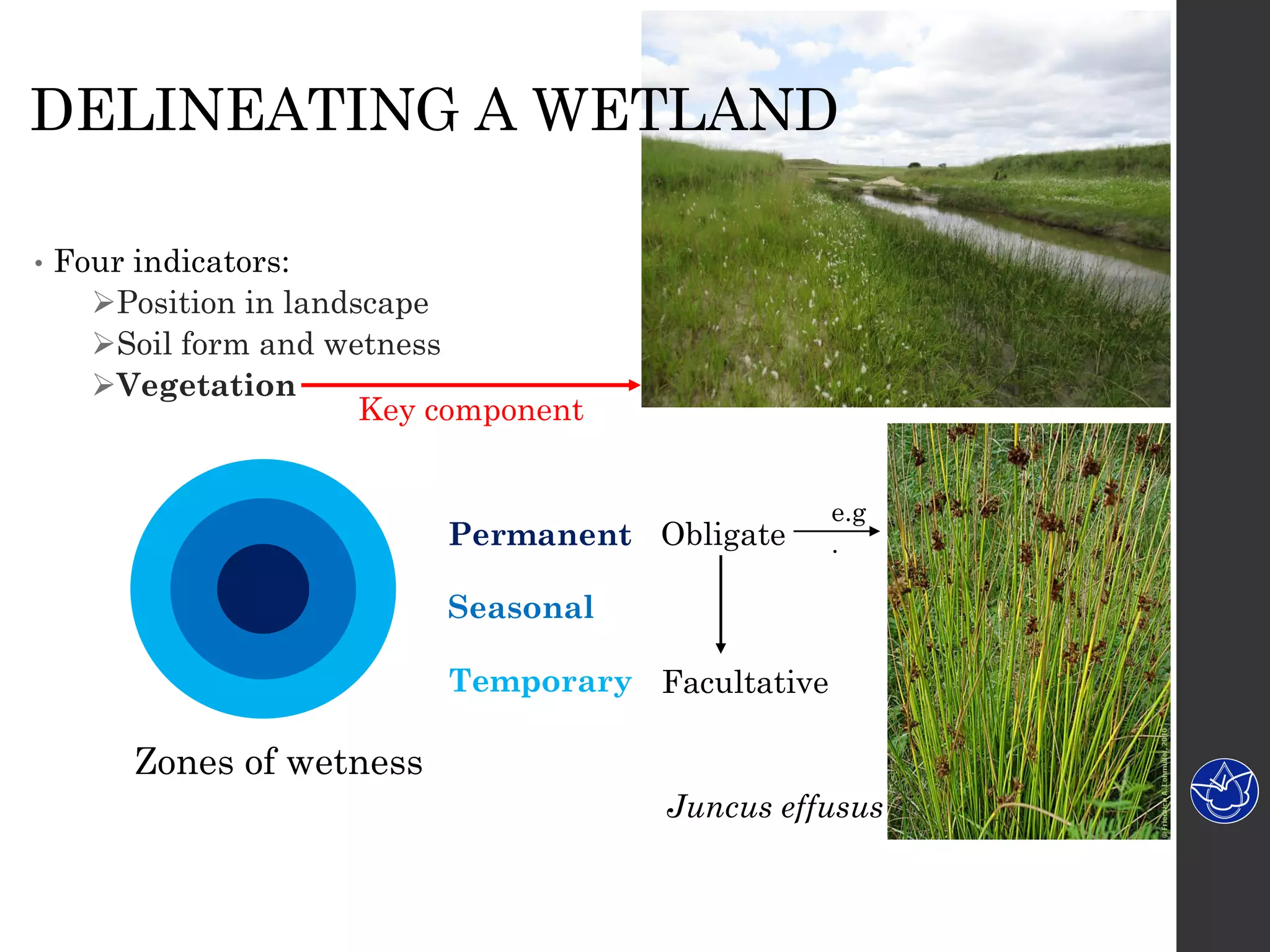
• Four indicators:
Position in landscape
Soil form and wetness
Vegetation
Key component
Permanent
Seasonal
Temporary Facultative
Obligate
Juncus effusus
e.g
.
Zones of wetness
DELINEATING A WETLAND
• Four indicators:
Position in landscape
Soil form and wetness
Vegetation
Redoxymorphic features
Gleying Mottling
Most reliable
DELINEATING A WETLAND
WHAT IS THE RIPARIAN ZONE?
DELINEATING THE RIPARIAN ZONE
•Four indicators:
Landscape position
Alluvial soils
• Four indicators:
Landscape position
Alluvial soils
Topography
Alluvial
deposits
DELINEATING THE RIPARIAN ZONE
• Four indicators:
Landscape position
Alluvial soils
Topography
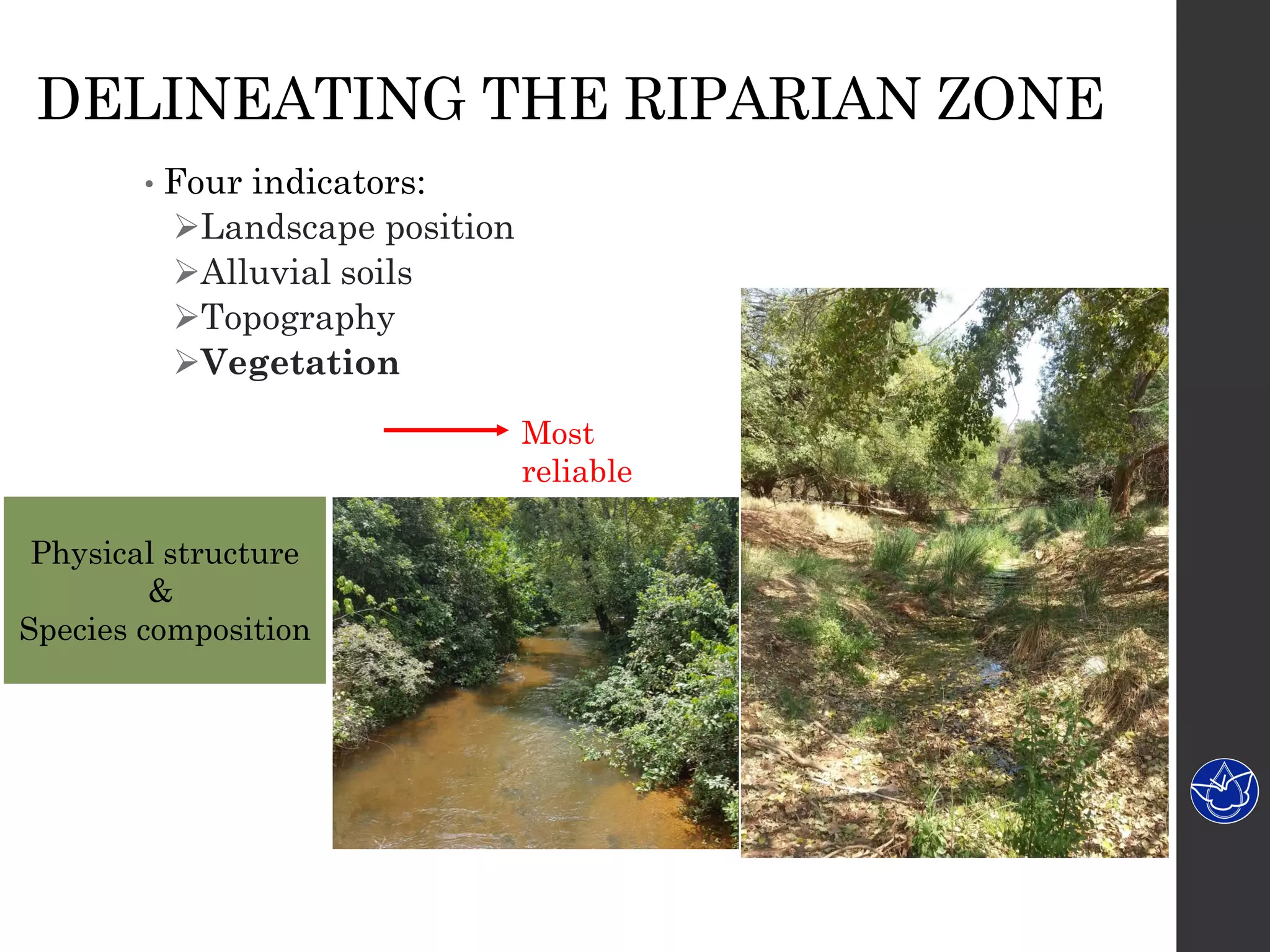
Vegetation
Physical structure
&
Species composition
Most
reliable
DELINEATING THE RIPARIAN ZONE
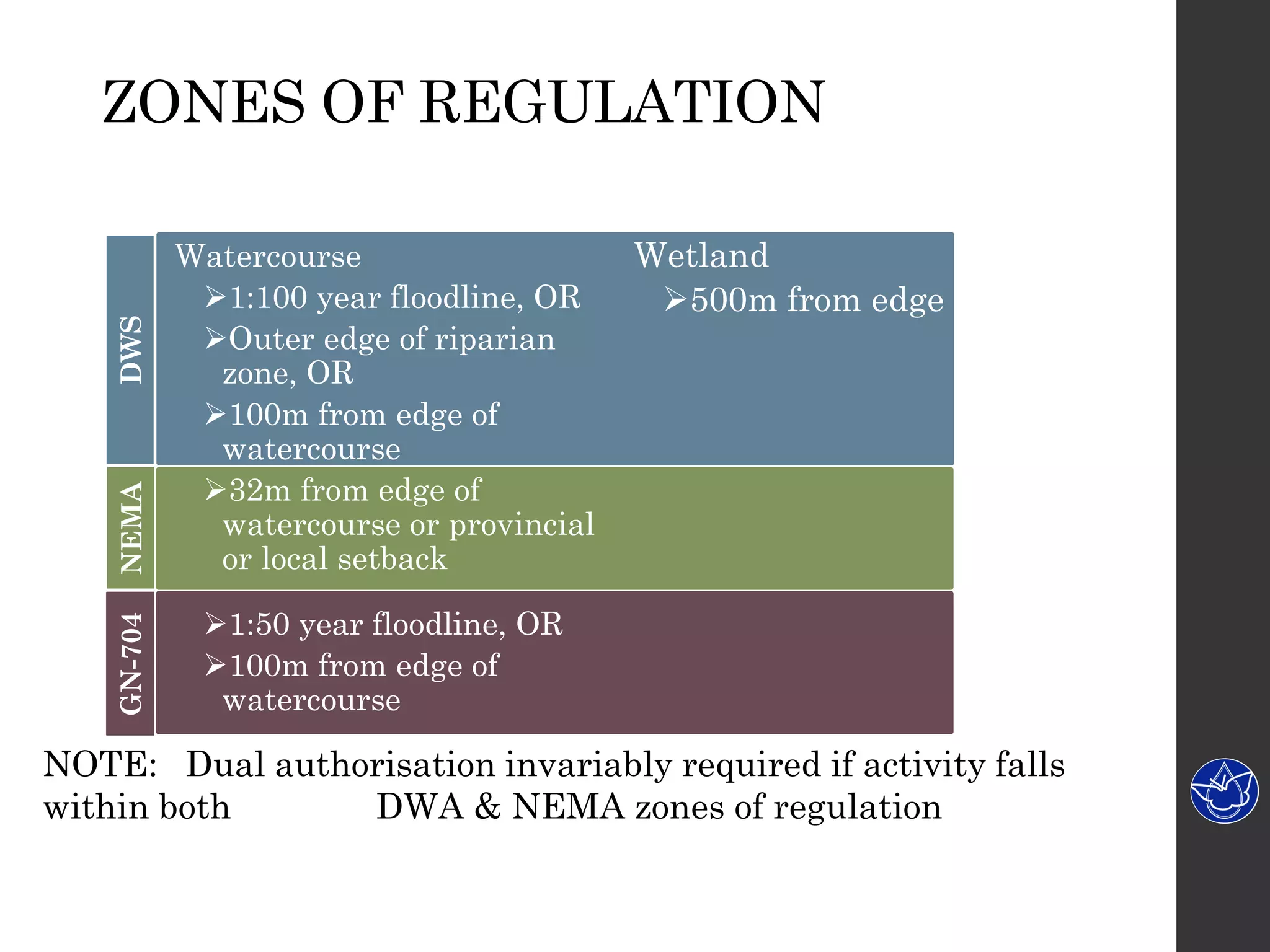
ZONES OF REGULATION
Watercourse
1:100 year floodline, OR
Outer edge of riparian
zone, OR
100m from edge of
watercourse
32m from edge of
watercourse or provincial
or local setback
1:50 year floodline, OR
100m from edge of
watercourse
Wetland
500m from edge
DWSNEMA
NOTE: Dual authorisation invariably required if activity falls
within both DWA & NEMA zones of regulation
GN-704
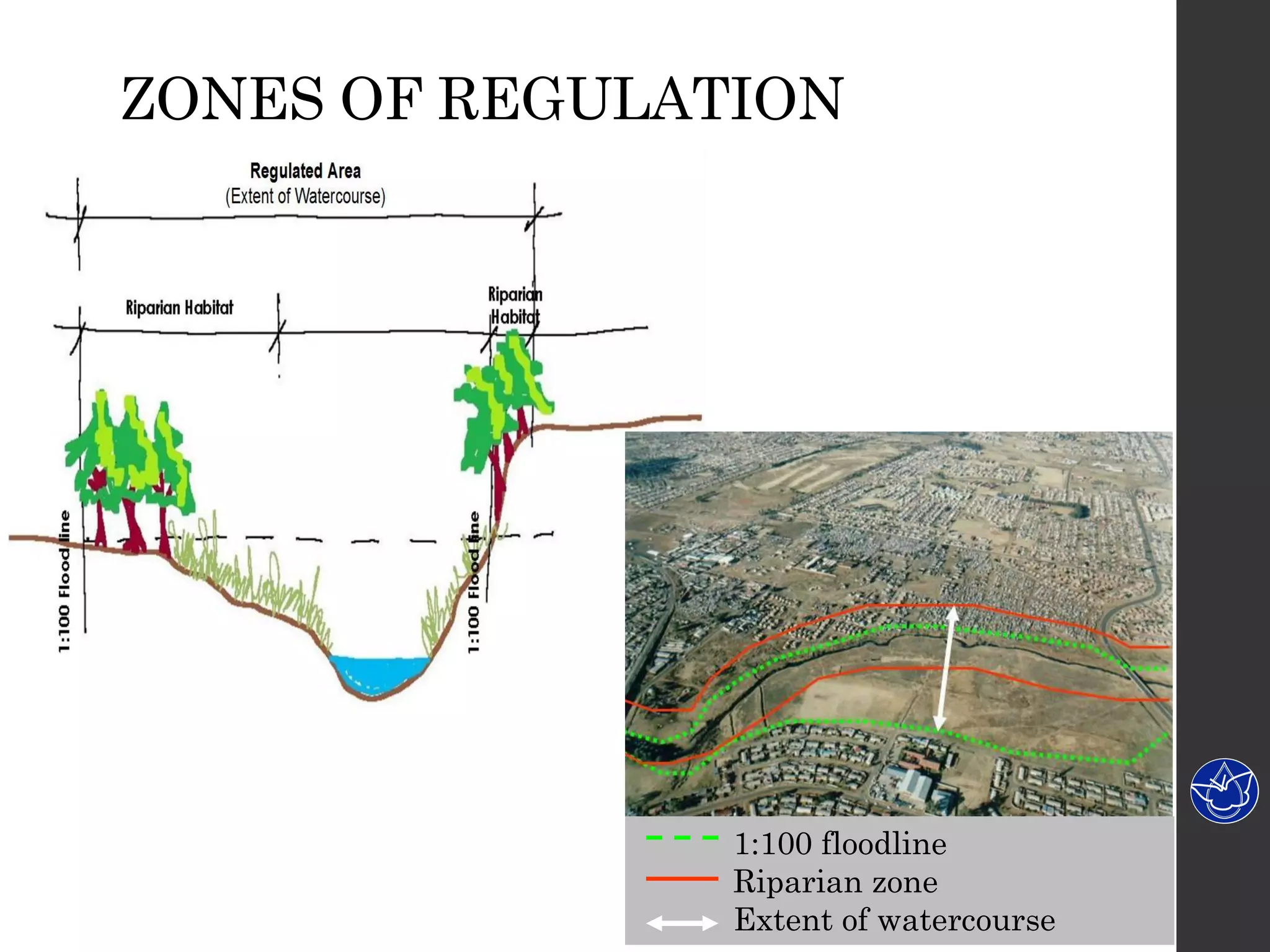
1:100 floodline
Riparian zone
Extent of watercourse
ZONES OF REGULATION
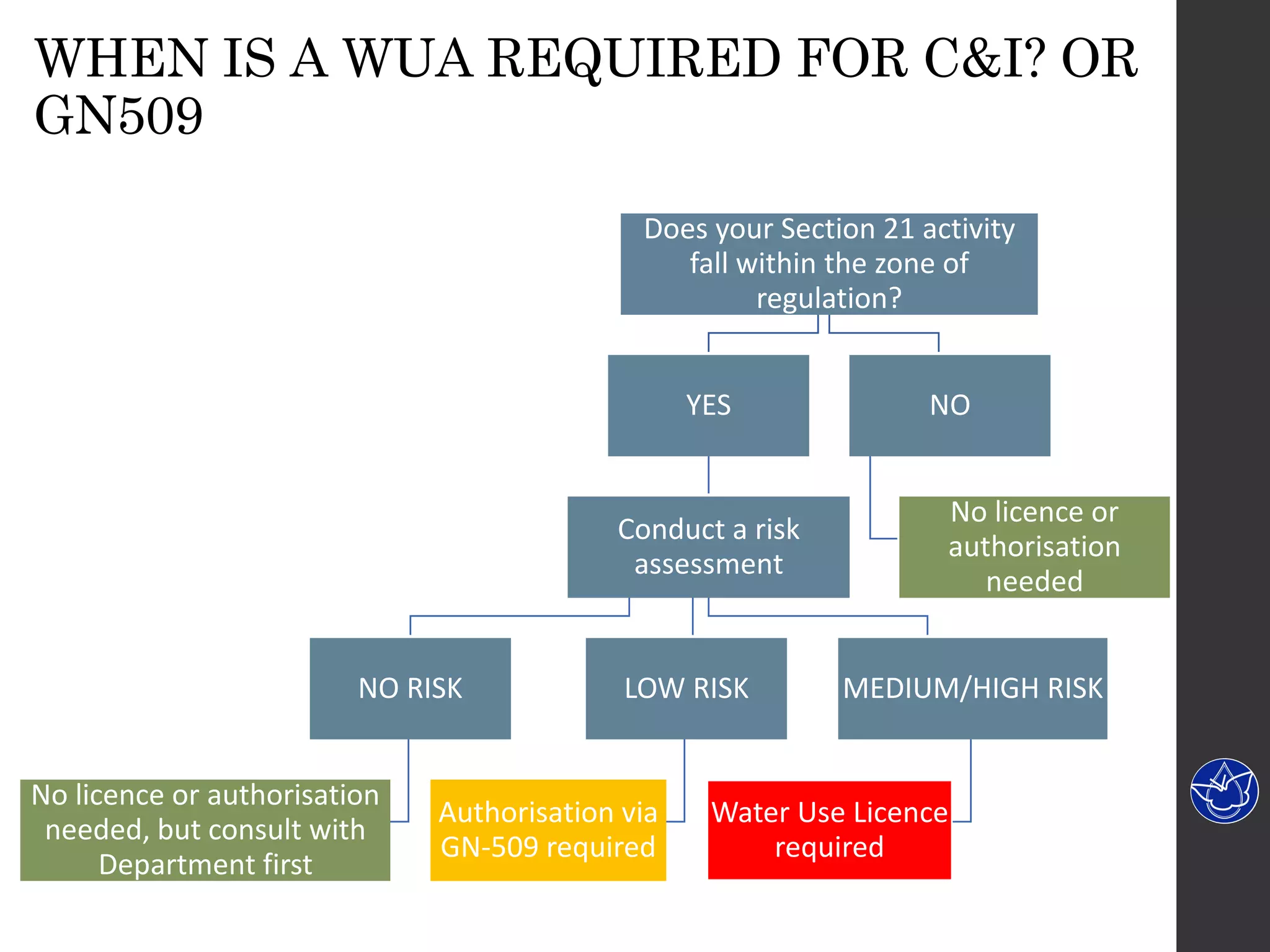
WHEN IS A WUA REQUIRED FOR C&I? OR
GN509
Does your Section 21 activity
fall within the zone of
regulation?
YES
Conduct a risk
assessment
NO RISK
No licence or authorisation
needed, but consult with
Department first
LOW RISK
Authorisation via
GN-509 required
MEDIUM/HIGH RISK
Water Use Licence
required
NO
No licence or
authorisation
needed
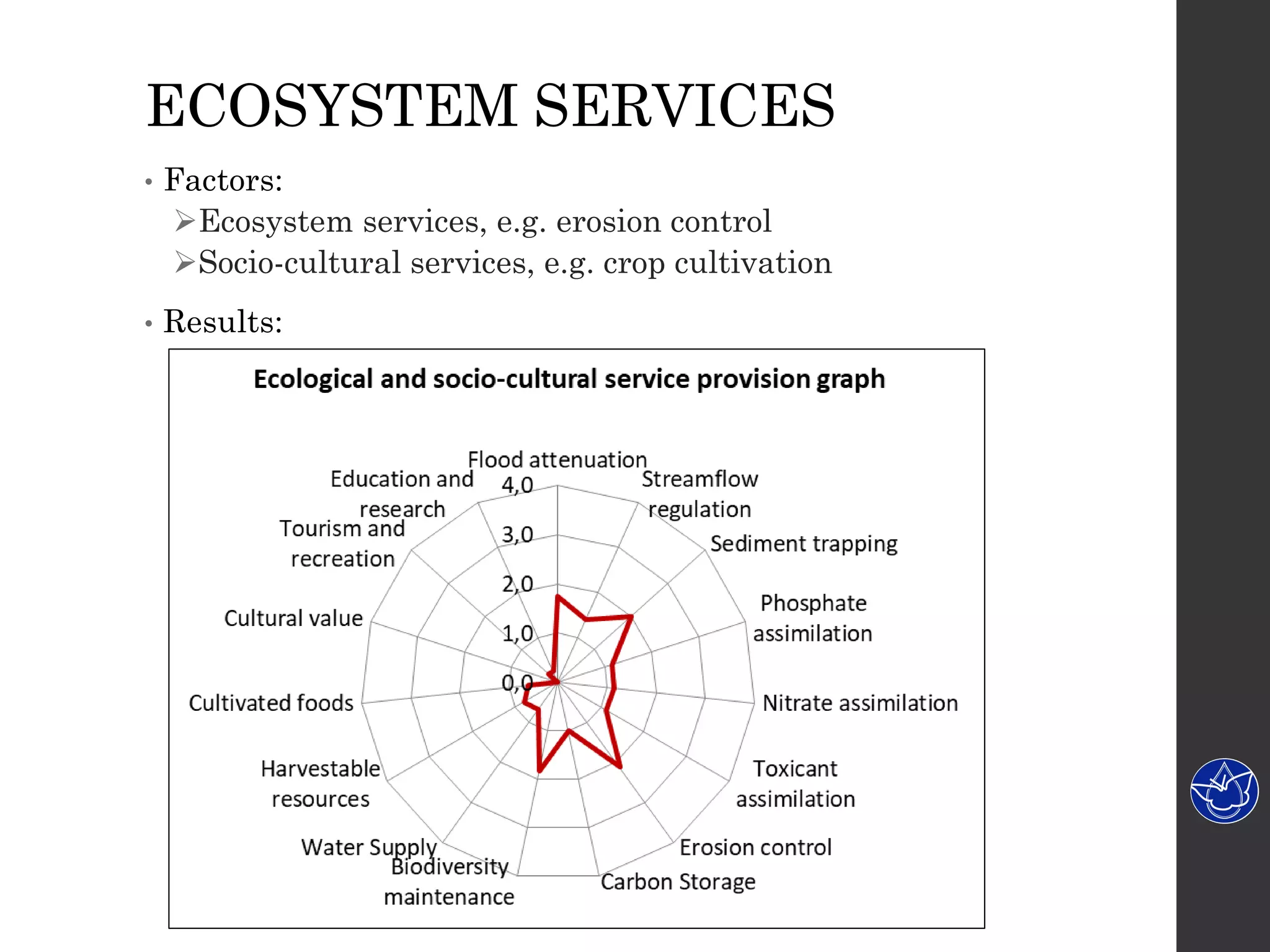
ECOSYSTEM SERVICES
• Factors:
Ecosystem services, e.g. erosion control
Socio-cultural services, e.g. crop cultivation
• Results:
RISK ASSESSMENT
• Takes into account:
Drivers & receptors
Phase (Planning/Construction/Operational/Post-
closure)
Activities & related factors (see next)
Drivers Receptors
Hydrology Habitat
Geomorphology
Biota
Water quality
Drivers impact on receptors
RISK ASSESSMENT
Factors to consider per activity
Factor Description Score
Severity
Severity of impact on resource quality.
(flow regime, water quality, geomorphology, biota & habitat)
1-5
Spatial scale Size of area being impacted on.
Duration How long does aspect impact on resource quality?
Frequency of activity How often does the activity occur?
Frequency of impact
How often does the activity impact on resource quality?
Detection
How quickly/easily can the impacts on resource quality be
observed?
Legal issues Is the activity governed by legislation? 1 OR 5
RISK ASSESSMENT
Rating Risk Class Description
1 – 55 Low GA required
56 – 169 Medium WUL required
170 - 300 High WUL required
NOTE: Risk classes may be altered by subtracting a
maximum of 25 points from the rating score where
applicable (risk reduction rule)
RISK ASSESSMENT
• Example:
Phase: Construction
Activity
Severity
Spatialscale
Duration
Consequence
Frequencyof
activity
Frequencyof
impact
Legalissues
Detection
Likelihood
Significance
Channel excavation
& berm construction
2.75 1 2 5.75 1 3 5 1 10 57.5
Consequence = Severity + Spatial Scale + Duration
Likelihood = Frequency of Activity + Frequency of Impact + Legal Issues + Detection
Significance = Consequence x Likelihood
RISK ASSESSMENT
• Example:
Phase: Construction
Activity
Severity
Spatialscale
Duration
Consequence
Frequencyof
activity
Frequencyof
impact
Legalissues
Detection
Likelihood
Significance
Channel excavation
& berm construction
2.75 1 2 5.75 1 3 5 1 10 57.5
Rating Risk Class Description
56 – 169 Medium WUL required
RISK ASSESSMENT
• Example:
Phase: Construction
Activity
Severity
Spatialscale
Duration
Consequence
Frequencyof
activity
Frequencyof
impact
Legalissues
Detection
Likelihood
Significance
Channel excavation
& berm construction
2.75 1 2 5.75 1 3 5 1 10 55
Rating Risk Class Description
1 – 55 Low GA required
Applied risk reduction rule
(-2.5)
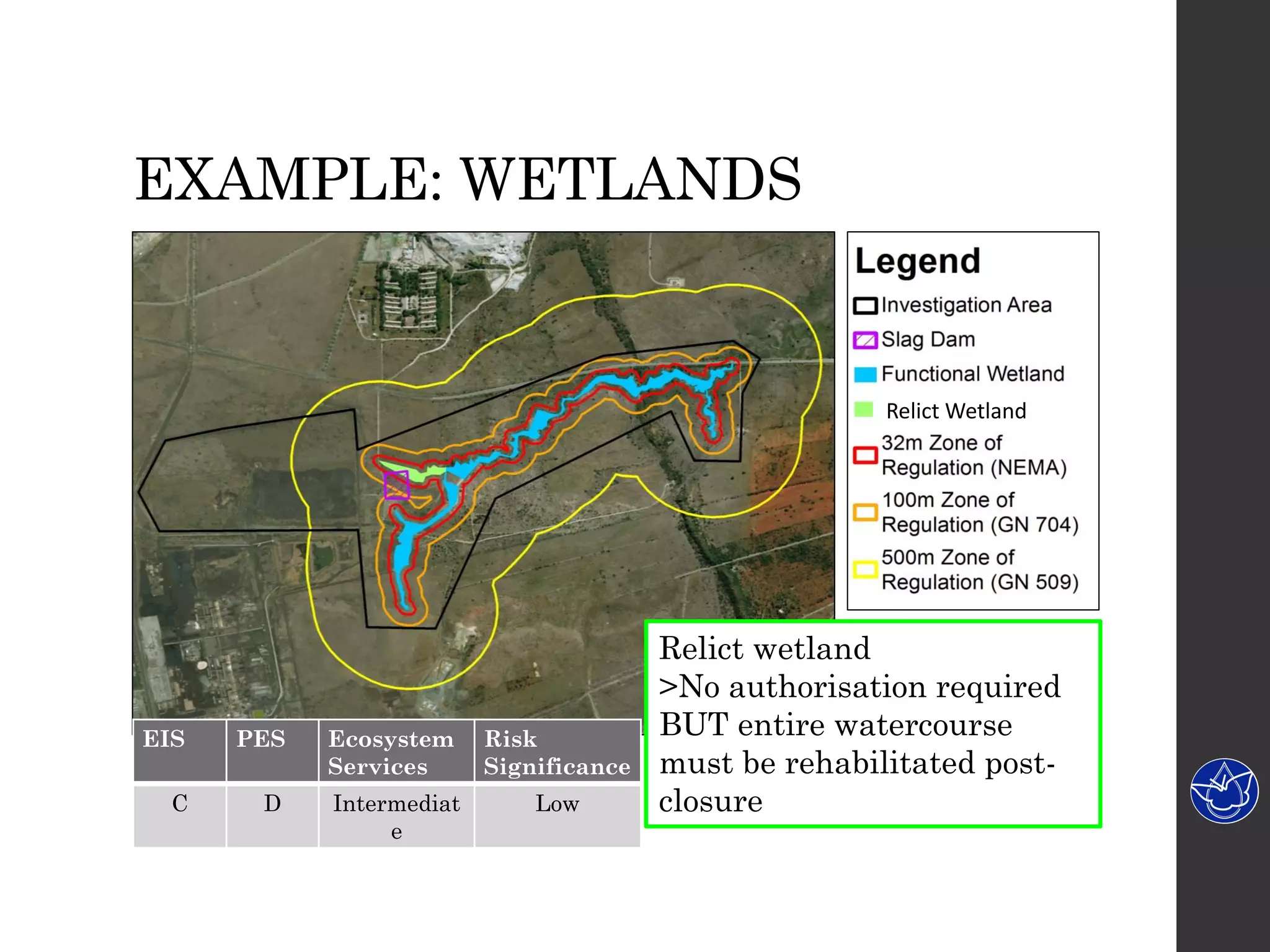
EIS PES Ecosystem
Services
Risk
Significance
C D Intermediat
e
Low
Relict Wetland
Relict wetland
>No authorisation required
BUT entire watercourse
must be rehabilitated post-
closure
EXAMPLE: WETLANDS
EIS PES Ecosystem
Services
Risk
Significance
C C/D Moderately low Medium
Medium risk, within 100m
ZOR
>WUL required
BUT betterment of channel
> Motivation for GA
EXAMPLE: RIPARIAN ZONE
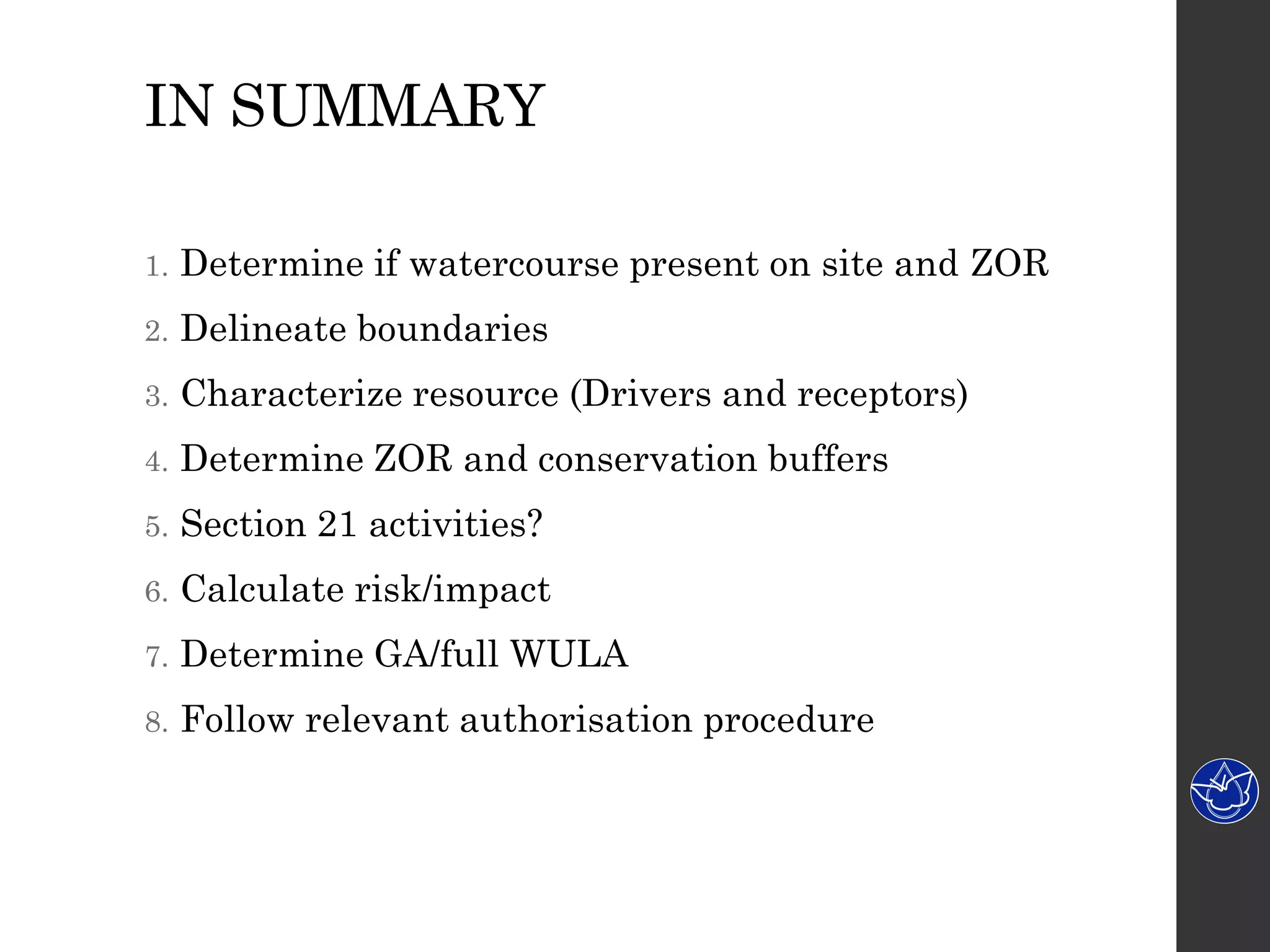
IN SUMMARY
1. Determine if watercourse present on site and ZOR
2. Delineate boundaries
3. Characterize resource (Drivers and receptors)
4. Determine ZOR and conservation buffers
5. Section 21 activities?
6. Calculate risk/impact
7. Determine GA/full WULA
8. Follow relevant authorisation procedure
Water Use Licensing Workshop
Water Use Licence
Section 21 (e), (f) and (g)
Avril Owens
Section 21 (e) Water Use
• Engaging in a controlled activity
• Intended for specific activities such as irrigation & aquifer
recharge
• Could be associated with benefitting others e.g.
surrounding communities receiving or selling the
vegetables and water self-sufficiency
• For mines and industry the irrigation with wastewater
(treated effluent / PCD / RWD) is often a means to
• manage excess water or
• rehabilitation
• NOT agricultural (to grow crops)
Complying to Conditions
• Conditions specific with regards to “crop” that will be
irrigated – specialist to identify the veld type and plants
• Irrigation practices noted in WUL in accordance to
guidelines – not always relevant to the site
• Ensure site personnel are aware of guidelines and the
latest updates
Apply if and where applicable
Complying to Conditions
• Develop an Irrigation Plan for WULA
• Define irrigation area – relates to how irrigation
will be done e.g. rotation of irrigated areas,
prevention of seepage & runoff
• Design of infrastructure and layout - easy
access to measuring volume actually irrigated
and sampling for quality of water irrigated
• Protect natural plants and water resources
• Carefully planned monitoring programme so
any impact can be detected
• Anticipate mitigation required upfront and
include in the plan – WUL conditions include
corrective action (reactive approach is costly)
Section 21 (f) Water Use
• Discharging waste or water containing waste
into a water resource through a pipe, canal,
sewer, sea outfall or other conduit
• Last resort - pollution should be contained and
managed (Section 19 of NWA & DWS
management hierarchy)
• Maximise reuse to minimise discharge
• Manage water resources where discharge is
taking place (specialist study input)
• Manage discharge quality in order to add
good quality water to the natural system to
improve the water resources
Complying to Conditions
Some conditions may relate specifically to municipal
treatment works and are not applicable to WWTW at mines
and industries:
• Pump stations
• Manholes
• Environmental call and reporting centre
Inform DWS immediately and apply for an amendment
• Conditions not applicable or not site specific
• Copy and paste from another licence
Complying to Conditions
Management of treatment works
• Must meet design criteria for water quality
• Suitably qualified personnel required to operate works
Upfront specialist input
• engineering design
• protection of the water resource
• stormwater management & erosion control
• monitoring programme including quantity and quality of
wastewater discharged, receiving surface water,
biomonitoring
Section 21 (g) Water Use
• Disposing of waste in a manner which may
detrimentally impact on a water resource
• Intention is for facilities with potentially
contaminated material, either liquids or solids, to
contain the pollution sources and through the
management thereof prevent degradation of the
water resources
• Facilities include process water dams, pollution
control dams including stormwater dams, tailings
storage facilities, waste rock dumps, ore stockpiles
Complying to Conditions
• WULA – ensure separate design
volume/capacity and annual disposal volumes
in water use tables – apply for an amendment
if figures are captured incorrectly in a WUL
• Ensure as-built drawings are completed &
signed by registered engineer
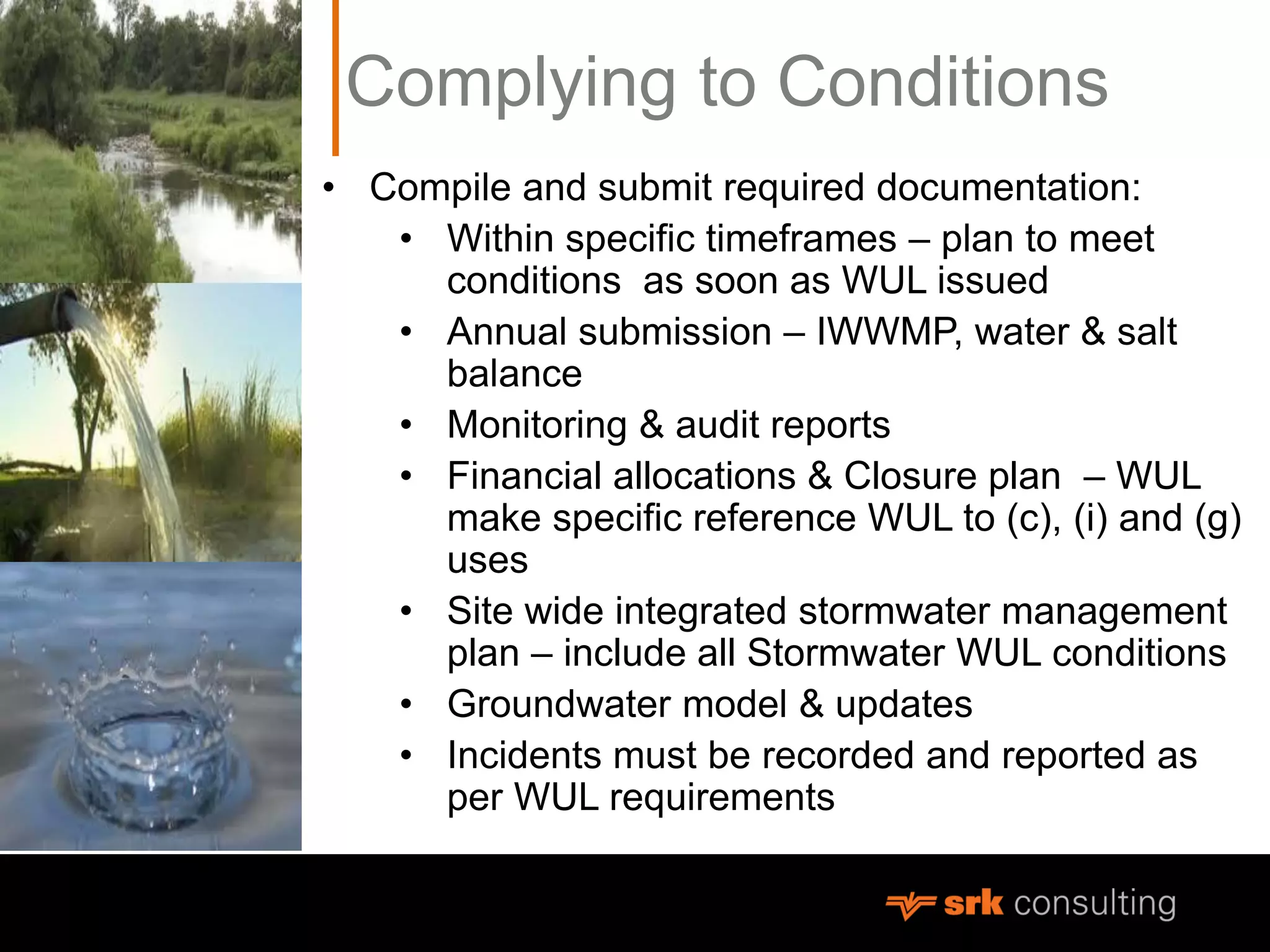
• Undertake facility management: freeboard
(operational vs engineered), liner
Complying to Conditions
• Compile and submit required documentation:
• Within specific timeframes – plan to meet
conditions as soon as WUL issued
• Annual submission – IWWMP, water & salt
balance
• Monitoring & audit reports
• Financial allocations & Closure plan – WUL
make specific reference WUL to (c), (i) and (g)
uses
• Site wide integrated stormwater management
plan – include all Stormwater WUL conditions
• Groundwater model & updates
• Incidents must be recorded and reported as
per WUL requirements
Complying to Conditions
• Undertake sufficient conveyance management
especially at crossings
• Reagent storage tanks bunding (110%
capacity) – keep design drawings & note
capacity on bunding
• Hazardous substances storage, transport and
handling according to relevant legislation
(Hazardous Substances Act (Act 15 of 1973) –
ensure contractor is disposing correctly (cradle
to grave responsibility)
• Appropriate site specific signage and notices
visible at each facility
Challenges
• Quality limits overly stringent, specifically when
water should not be released
• Prescribed analysis methods (Standards Act)
are out dated and not correct – labs should be
accredited
• Freeboard not understood, monitored and
recorded properly therefore not maintained –
lack of knowledge of operational levels
• Stormwater dams should not be used as PCD
• Management, training
What has Changed in Recent
Licences
• Increased reporting and submission
requirements to demonstrate compliance and
corrective actions.
• Site specific conditions can come from
specialist recommendations – carefully
consider all specialist recommendations:
• Geochemistry
• Dam safety
• Additional monitoring
• Additional pollution controls
Have a system of inspections and scheduled
maintenance in place
Conclusion
• Initial work (EIA/EMP/WULA) is very important -
ensures a proactive approach which can
improve compliance and decrease operational
and closure costs
 Make use of known WUL conditions when
preparing for WULA to assist with
compliance:
o specialist scope of work
o design of systems/infrastructure
 Review specialist recommendations
• Plan when, where and how to ensure
compliance once WUL issued e.g. LIP
• Apply for amendment to address not applicable,
not site specific, unreasonable conditions
Conclusion
Amendment requirements could be reduced if the
Department considers the following:
• Licences need to be site specific for ALL water uses
• Minimise errors by avoiding copy & paste conditions
• Conditions that promote integrated management
rather than ‘silo’ management conditions e.g.
stormwater for the whole site rather than specific
areas that may not apply for all applicants
• More integration of conditions to avoid duplication:
a lot of conditions within each WUL appendix can
be general conditions
Questions & discussions

3 WUL appendices

  • 1.
    Water Use LicensingWorkshop Water Use Licence General conditions Angelika Möhr
  • 2.
    General Conditions • Conditionsthat apply generally to whole site/all water uses • Instructive conditions • Licensee has the right to request amendments to any conditions but these may or may not be accepted by DWS
  • 3.
    General Conditions - Regulatory •Licensee is subject to all provisions of the NWA, the licensee is responsible for complying to the licence: • Appointment of a responsible person to undertake/oversee the activities in the licence (suitably qualified) is critical • The WUL does not exempt the licensee from other legal obligations or regulatory conditions. Licensee to be aware of: • Section 19 of NWA – minimising & addressing impacts to the water resource • Acts - National Environmental Management Act (Act 107 of 1998) • Ordinances (temporary laws) • By-laws – municipal • Regulations – Regulation 704 (specific conditions ask for compliance to Reg 704)
  • 4.
    General Conditions - Instructions •Licensee to • inform DWS of changes of names, addresses, premises, legal status or farms • pay the charges for water uses as invoiced • undertake internal audit • appoint an independent external auditor • report on incidents within 24hours • maintain & calibrate flow meters
  • 5.
    General Conditions –Specific Examples of Changes • The water use authorised in this licence could be subject to appropriate reduction • The Licensee must improve to a level 4 BBBEE contributor and report on progress must be submitted to the Department • Inform the Department at least 90 days before the expiring date whether the licence must be considered for another term. • Regulation 704 exemptions for specific infrastructure have been included • This licence supersedes all Permits and Exemptions issued in terms of the Water Act, 1956. • If the water use authorised cannot be carried out responsibly, all activities must be immediately ceased and licensee to take preventative action
  • 6.
    General Conditions - Challengesand Suggestions • Some reserve determinations have not been made available or undertaken as desktop, Licensee to assist DWS • Calibration of flow meters not practical, suggest verification • Lack of established water user associations, suggest other associations recognised by DWS • Discrepancies in charges or no charges, will DWS back date invoices? DWS has administrative challenges • Reporting ALL incidents, how to deem what should be reported – incident risk level • Duplication of conditions within licence – integrate conditions into Licence Implementation Plan (LIP) for internal compliance and reporting
  • 7.
    General conditions - Suggestions •Propose an amendment application to integrate duplicated conditions into General Conditions • Suggestions to DWS - consolidate management requirements from all appendices into General Conditions to incorporate entire site: • Stormwater management • Pollution prevention/minimisation • General monitoring requirements e.g. SABS methods, sample sheets • Site notices & access – general vs specific • Chemical & materials storage • Reporting • General conditions associated with construction and operation • Rehabilitation and budgetary provisions • Auditing
  • 8.
    Water Use LicensingWorkshop Water use licence - Section 21(a), (b) and (j) water use Didi Masoabi
  • 9.
    Main Focus Areas Mainheadings Focus areas General Compliance to WULA specifications Further Studies and Information Requirements Site specific EIA/EMP, specialist studies, public participation, other Monitoring and Reporting Routine monitoring & reporting, quality limits may apply Other Water Users Impacts on downstream users Special Conditions Specialist study findings & recommendations in WULA
  • 10.
    Section 21 (a)Water Use • Taking water from a water resource • This use involves pumping of water from a dam or river, or from a borehole • The intent is to use water efficiently • It also applies to water removed from underground in terms of section 21(j) and which is not discharged into a water resource, i.e. water used by mines in their processes, for irrigation of golf courses, or for other uses NB Water taken from a municipal supply network OR Water Services Provider such as a Water Board is NOT a S21 water use. Please note that the water use occurs at the point where the water is taken from the resource and not at the point where it is applied
  • 11.
    Approach to Comply •Ensure the following: • water taken from the resource is metered daily with a total recorded monthly • records are kept and forward copy of records to the Provincial Head usually by 25 of January & July each year • appropriate measuring devices are installed • abstract ONLY what has been authorised
  • 12.
    Section 21 (b)Water Use • Storing water • This includes water that is stored in a dam, reservoir, or other impoundment, either in a watercourse, or off- channel NB This water use does not include water that contains waste, for example water collected through a sewer system, or wastewater from an industrial plant -Section 21 (g)
  • 13.
    Approach to Comply •Ensure the following: • measure flows entering and leaving the dam • levels in the dam to be recorded monthly, • storage structures have to comply with Dam Safety Regulations • dam size (wall height ≥ 5m high & capacity ≥ 50 000m3) – safety risk – classification
  • 14.
    Section 21 (j)Water Use • Removing, discharging or disposing of water found underground for the continuation of an activity or for the safety of persons • The pumping of water from underground in a mine or construction site to ensure continued production and safety in underground workings “”Safety should be priority”” If part of the water removed for this reason is not disposed off – Section 21(g) - or discharged –Section 21(f) - into a water resource, but used for some purpose, this water use will be considered to be the taking of water in terms of section 21(a).
  • 15.
    Approach to Comply •Ensure the following: • water removed from underground must be metered daily with a total recorded monthly • install appropriate measuring devices, • keep the records and forward copy of records to the Provincial Head yearly through the annual update of the water balance – if also 21(a) then biannual submission is needed • water quality limits may apply but typically only in older WULs
  • 16.
    Water Use LicensingWorkshop Water use licence - Section 21(c) and (i) water use Jacky Burke
  • 17.
    Intent of theSection 21(c) and (i) Conditions Protect resource quality of a watercourse to full extent with possible protection buffer Resource quality (a) quantity: assurance of instream flow; (b) quality: physical, chemical and biological (c) instream and riparian habitat (d) aquatic biota
  • 18.
    Main Focus Areas Mainheadings Focus areas General Compliance to WULA design specifications Further Studies and Information Requirements Method statements, site specific EIA/EMP, specialist audit, landscape & plant species plan, other Protective Measures Erosion controls, vegetation management, structural integrity Stability of U/G workings for undermining near watercourses REQUIRES  GN704 compliance  Effective Stormwater Management Plan  Alien vegetation control program  Inspections & scheduled maintenance  Stability/subsidence monitoring & protective measures U/G Storm Water Management Structures and Materials Water Quality Flow Riparian and lnstream Habitat (Vegetation and Morphology) Biota
  • 19.
    Main Focus AreasCont. Main headings Focus areas Rehabilitation and Management Rehabilitation program (RSIP) Photographic records Monitoring and Reporting Routine monitoring & reporting, quality limits may apply Other Water Users Impacts on downstream users Pollution Prevention, Incidents and Malfunctions Effective housekeeping & management of 21(e), (f) and (g) water uses: REQUIRES emphasis on source controls & behavior change Budgetary Provisions Budget must consider riparian zone Special Conditions Specialist study findings & recommendations in WULA Annual public participation on compliance
  • 20.
    Approach to Comply •Ensure crossing & diversion design is compliant with best practices and/or GN704 – concrete OR vegetation • Ensure a good WULA at the outset – high quality specialist input to ensure site specific conditions in licence are practical and reasonable • Have a system of inspections and scheduled maintenance in place Integrated hydrologist & aquatic specialist input, possibly also hydropedologist
  • 21.
    FRESHWATER ASSESSMENT REQUIREMENTS TO ALIGN WITH WULA REQUIREMENTS Presentedby: Stephen van Staden Pr. Sci. Nat. Scientific Aquatic Services
  • 22.
    WHAT ENCOMPASSES AWATER RESOURCE • NWA defines water as a renewable natural resource • Means the water resource and not just the water itself is the resource and must be treated as an integrated component. • The ecological integrity of a resource is therefore considered an essential part of the resource. Included in the definition of this resource is: The physical and structural aquatic habitats (both in stream and riparian), the water, the biota and the physical, chemical and ecological; processes that link habitat and biota
  • 23.
    THE BUSINESS CASE? Legalcompliance Group policy and ethics requirements Social licence to operate Manage impact on natural resources and the communities that rely on them Prevent project delays Prevent costs of reworking and resubmission
  • 24.
    WHEN IS AWUL REQUIRED? Section 21 of NWA a) Taking water from a water resource b) Storing water c) Impeding/diverting the flow of water in a watercourse d) Engaging in streamflow reduction activities (e.g. plantations) (Section 36) e) Engaging in controlled activities (Section 37(1) and 38(1)) f) Discharging waste/water containing waste into a water resource g) Disposing of waste in a manner which may have a negative impact on a water resource h) Disposing of water which contains waste from, or which has been heated in, and industrial/power generation process i) Altering bed/banks/course/characteristics of a watercourse j) Removing/discharging/disposing of water found underground if it is necessary for the efficient continuation of an activity or for the safety of people k) Recreational use GN-509 relates specifically to 21c & 21i
  • 25.
    WATERCOURSE VS WATERRESOURCE Freshwater Baseline Studies Watercourse Water resource • Canal • Reservoir • Groundwater • Drainage line • River (& Riparian Zone) • Spring • Natural channel • Wetland/lake/dam Legal protection (covered under c & i) Water flow No legal protection (not covered under c & i) but other uses apply
  • 26.
  • 27.
    WATERCOURSE EXAMPLE Original channel Encroachedchannel Diverted channel Pollution control/tailings dams Legend Large River Non Perennial River
  • 28.
    Large River Non PerennialRiver WATERCOURSE VS WATER RESOURCE
  • 29.
    WHAT IS AWETLAND?
  • 30.
    • Four indicators: Positionin landscape Crest Scarp Midslope Footslope Valley bottom Most likely but not exclusive IDENTIFYING AND DELINEATING A WETLAND
  • 31.
    • Four indicators: Positionin landscape Soil form and wetness Champagne/Katspruit/Willowbrook/Rensburg* ALWAYS denote wetlands BUT G Horizon within 50cm of NGL IDENTIFYING AND DELINEATING A WETLAND
  • 32.
    • Four indicators: Positionin landscape Soil form and wetness Vegetation Key component Permanent Seasonal Temporary Facultative Obligate Juncus effusus e.g . Zones of wetness DELINEATING A WETLAND
  • 33.
    • Four indicators: Positionin landscape Soil form and wetness Vegetation Redoxymorphic features Gleying Mottling Most reliable DELINEATING A WETLAND
  • 34.
    WHAT IS THERIPARIAN ZONE?
  • 35.
    DELINEATING THE RIPARIANZONE •Four indicators: Landscape position Alluvial soils
  • 36.
    • Four indicators: Landscapeposition Alluvial soils Topography Alluvial deposits DELINEATING THE RIPARIAN ZONE
  • 37.
    • Four indicators: Landscapeposition Alluvial soils Topography Vegetation Physical structure & Species composition Most reliable DELINEATING THE RIPARIAN ZONE
  • 38.
    ZONES OF REGULATION Watercourse 1:100year floodline, OR Outer edge of riparian zone, OR 100m from edge of watercourse 32m from edge of watercourse or provincial or local setback 1:50 year floodline, OR 100m from edge of watercourse Wetland 500m from edge DWSNEMA NOTE: Dual authorisation invariably required if activity falls within both DWA & NEMA zones of regulation GN-704
  • 39.
    1:100 floodline Riparian zone Extentof watercourse ZONES OF REGULATION
  • 41.
    WHEN IS AWUA REQUIRED FOR C&I? OR GN509 Does your Section 21 activity fall within the zone of regulation? YES Conduct a risk assessment NO RISK No licence or authorisation needed, but consult with Department first LOW RISK Authorisation via GN-509 required MEDIUM/HIGH RISK Water Use Licence required NO No licence or authorisation needed
  • 42.
    ECOSYSTEM SERVICES • Factors: Ecosystemservices, e.g. erosion control Socio-cultural services, e.g. crop cultivation • Results:
  • 43.
    RISK ASSESSMENT • Takesinto account: Drivers & receptors Phase (Planning/Construction/Operational/Post- closure) Activities & related factors (see next) Drivers Receptors Hydrology Habitat Geomorphology Biota Water quality Drivers impact on receptors
  • 44.
    RISK ASSESSMENT Factors toconsider per activity Factor Description Score Severity Severity of impact on resource quality. (flow regime, water quality, geomorphology, biota & habitat) 1-5 Spatial scale Size of area being impacted on. Duration How long does aspect impact on resource quality? Frequency of activity How often does the activity occur? Frequency of impact How often does the activity impact on resource quality? Detection How quickly/easily can the impacts on resource quality be observed? Legal issues Is the activity governed by legislation? 1 OR 5
  • 45.
    RISK ASSESSMENT Rating RiskClass Description 1 – 55 Low GA required 56 – 169 Medium WUL required 170 - 300 High WUL required NOTE: Risk classes may be altered by subtracting a maximum of 25 points from the rating score where applicable (risk reduction rule)
  • 46.
    RISK ASSESSMENT • Example: Phase:Construction Activity Severity Spatialscale Duration Consequence Frequencyof activity Frequencyof impact Legalissues Detection Likelihood Significance Channel excavation & berm construction 2.75 1 2 5.75 1 3 5 1 10 57.5 Consequence = Severity + Spatial Scale + Duration Likelihood = Frequency of Activity + Frequency of Impact + Legal Issues + Detection Significance = Consequence x Likelihood
  • 47.
    RISK ASSESSMENT • Example: Phase:Construction Activity Severity Spatialscale Duration Consequence Frequencyof activity Frequencyof impact Legalissues Detection Likelihood Significance Channel excavation & berm construction 2.75 1 2 5.75 1 3 5 1 10 57.5 Rating Risk Class Description 56 – 169 Medium WUL required
  • 48.
    RISK ASSESSMENT • Example: Phase:Construction Activity Severity Spatialscale Duration Consequence Frequencyof activity Frequencyof impact Legalissues Detection Likelihood Significance Channel excavation & berm construction 2.75 1 2 5.75 1 3 5 1 10 55 Rating Risk Class Description 1 – 55 Low GA required Applied risk reduction rule (-2.5)
  • 49.
    EIS PES Ecosystem Services Risk Significance CD Intermediat e Low Relict Wetland Relict wetland >No authorisation required BUT entire watercourse must be rehabilitated post- closure EXAMPLE: WETLANDS
  • 50.
    EIS PES Ecosystem Services Risk Significance CC/D Moderately low Medium Medium risk, within 100m ZOR >WUL required BUT betterment of channel > Motivation for GA EXAMPLE: RIPARIAN ZONE
  • 51.
    IN SUMMARY 1. Determineif watercourse present on site and ZOR 2. Delineate boundaries 3. Characterize resource (Drivers and receptors) 4. Determine ZOR and conservation buffers 5. Section 21 activities? 6. Calculate risk/impact 7. Determine GA/full WULA 8. Follow relevant authorisation procedure
  • 52.
    Water Use LicensingWorkshop Water Use Licence Section 21 (e), (f) and (g) Avril Owens
  • 53.
    Section 21 (e)Water Use • Engaging in a controlled activity • Intended for specific activities such as irrigation & aquifer recharge • Could be associated with benefitting others e.g. surrounding communities receiving or selling the vegetables and water self-sufficiency • For mines and industry the irrigation with wastewater (treated effluent / PCD / RWD) is often a means to • manage excess water or • rehabilitation • NOT agricultural (to grow crops)
  • 54.
    Complying to Conditions •Conditions specific with regards to “crop” that will be irrigated – specialist to identify the veld type and plants • Irrigation practices noted in WUL in accordance to guidelines – not always relevant to the site • Ensure site personnel are aware of guidelines and the latest updates Apply if and where applicable
  • 55.
    Complying to Conditions •Develop an Irrigation Plan for WULA • Define irrigation area – relates to how irrigation will be done e.g. rotation of irrigated areas, prevention of seepage & runoff • Design of infrastructure and layout - easy access to measuring volume actually irrigated and sampling for quality of water irrigated • Protect natural plants and water resources • Carefully planned monitoring programme so any impact can be detected • Anticipate mitigation required upfront and include in the plan – WUL conditions include corrective action (reactive approach is costly)
  • 56.
    Section 21 (f)Water Use • Discharging waste or water containing waste into a water resource through a pipe, canal, sewer, sea outfall or other conduit • Last resort - pollution should be contained and managed (Section 19 of NWA & DWS management hierarchy) • Maximise reuse to minimise discharge • Manage water resources where discharge is taking place (specialist study input) • Manage discharge quality in order to add good quality water to the natural system to improve the water resources
  • 57.
    Complying to Conditions Someconditions may relate specifically to municipal treatment works and are not applicable to WWTW at mines and industries: • Pump stations • Manholes • Environmental call and reporting centre Inform DWS immediately and apply for an amendment • Conditions not applicable or not site specific • Copy and paste from another licence
  • 58.
    Complying to Conditions Managementof treatment works • Must meet design criteria for water quality • Suitably qualified personnel required to operate works Upfront specialist input • engineering design • protection of the water resource • stormwater management & erosion control • monitoring programme including quantity and quality of wastewater discharged, receiving surface water, biomonitoring
  • 59.
    Section 21 (g)Water Use • Disposing of waste in a manner which may detrimentally impact on a water resource • Intention is for facilities with potentially contaminated material, either liquids or solids, to contain the pollution sources and through the management thereof prevent degradation of the water resources • Facilities include process water dams, pollution control dams including stormwater dams, tailings storage facilities, waste rock dumps, ore stockpiles
  • 60.
    Complying to Conditions •WULA – ensure separate design volume/capacity and annual disposal volumes in water use tables – apply for an amendment if figures are captured incorrectly in a WUL • Ensure as-built drawings are completed & signed by registered engineer • Undertake facility management: freeboard (operational vs engineered), liner
  • 61.
    Complying to Conditions •Compile and submit required documentation: • Within specific timeframes – plan to meet conditions as soon as WUL issued • Annual submission – IWWMP, water & salt balance • Monitoring & audit reports • Financial allocations & Closure plan – WUL make specific reference WUL to (c), (i) and (g) uses • Site wide integrated stormwater management plan – include all Stormwater WUL conditions • Groundwater model & updates • Incidents must be recorded and reported as per WUL requirements
  • 62.
    Complying to Conditions •Undertake sufficient conveyance management especially at crossings • Reagent storage tanks bunding (110% capacity) – keep design drawings & note capacity on bunding • Hazardous substances storage, transport and handling according to relevant legislation (Hazardous Substances Act (Act 15 of 1973) – ensure contractor is disposing correctly (cradle to grave responsibility) • Appropriate site specific signage and notices visible at each facility
  • 63.
    Challenges • Quality limitsoverly stringent, specifically when water should not be released • Prescribed analysis methods (Standards Act) are out dated and not correct – labs should be accredited • Freeboard not understood, monitored and recorded properly therefore not maintained – lack of knowledge of operational levels • Stormwater dams should not be used as PCD • Management, training
  • 64.
    What has Changedin Recent Licences • Increased reporting and submission requirements to demonstrate compliance and corrective actions. • Site specific conditions can come from specialist recommendations – carefully consider all specialist recommendations: • Geochemistry • Dam safety • Additional monitoring • Additional pollution controls Have a system of inspections and scheduled maintenance in place
  • 65.
    Conclusion • Initial work(EIA/EMP/WULA) is very important - ensures a proactive approach which can improve compliance and decrease operational and closure costs  Make use of known WUL conditions when preparing for WULA to assist with compliance: o specialist scope of work o design of systems/infrastructure  Review specialist recommendations • Plan when, where and how to ensure compliance once WUL issued e.g. LIP • Apply for amendment to address not applicable, not site specific, unreasonable conditions
  • 66.
    Conclusion Amendment requirements couldbe reduced if the Department considers the following: • Licences need to be site specific for ALL water uses • Minimise errors by avoiding copy & paste conditions • Conditions that promote integrated management rather than ‘silo’ management conditions e.g. stormwater for the whole site rather than specific areas that may not apply for all applicants • More integration of conditions to avoid duplication: a lot of conditions within each WUL appendix can be general conditions
  • 67.