3/9/2016 Page 1
RTR Flare Provisions
Flares
Stephen Walls
Air Permitting Engineer
Trihydro Corporation
3/9/2016 Page 2
RTR Flare Provisions
Presentation Topics
• General Overview
• Definitions
• Applicability
• Enhanced Operational Standards Flares
• Flare Pilot Flame
• Visible Emissions
• Flare Tip Velocity
• Combustion Zone Heating Value
• Dilution Parameter
3/9/2016 Page 3
RTR Flare Provisions
Rule Overview
• Current 40 CFR 63.11 and 40 CFR 60.18 insufficient to ensure flares meet
control requirements
• Focus on destruction efficiency
• Flare destruction efficiency confirmed by compliance with enhanced operational
and work practice standards (§63.670)
• Enclosed combustion device destruction efficiency (98 percent) or outlet
concentration (20 ppmv) confirmed via testing (§63.645)
• PFTIR monitoring to confirm 98 percent destruction efficiency technically
infeasible to apply on continuous basis
• Existing flare compliance date – January 30, 2019
• Incorrect to assume FGR cost-effective for all flares (case-by-case)
• Did not finalize ban on flaring halogenated vent streams
3/9/2016 Page 4
RTR Flare Provisions
Definitions
• Regulated material - contains HAP listed in Table 1,
likely includes fuel gas used as sweep or purge gas
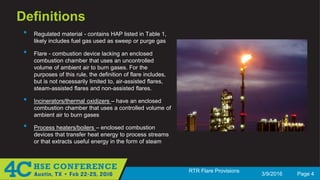
• Flare - combustion device lacking an enclosed
combustion chamber that uses an uncontrolled
volume of ambient air to burn gases. For the
purposes of this rule, the definition of flare includes,
but is not necessarily limited to, air-assisted flares,
steam-assisted flares and non-assisted flares.
• Incinerators/thermal oxidizers – have an enclosed
combustion chamber that uses a controlled volume of
ambient air to burn gases
• Process heaters/boilers – enclosed combustion
devices that transfer heat energy to process streams
or that extracts useful energy in the form of steam
3/9/2016 Page 5
RTR Flare Provisions
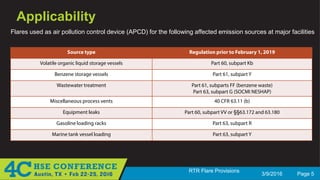
Applicability
Flares used as air pollution control device (APCD) for the following affected emission sources at major facilities
Source type Regulation prior to February 1, 2019
Volatile organic liquid storage vessels Part 60, subpart Kb
Benzene storage vessels Part 61, subpart Y
Wastewater treatment Part 61, subparts FF (benzene waste)
Part 63, subpart G (SOCMI NESHAP)
Miscellaneous process vents 40 CFR 63.11 (b)
Equipment leaks Part 60, subpart VV or §§63.172 and 63.180
Gasoline loading racks Part 63, subpart R
Marine tank vessel loading Part 63, subpart Y
3/9/2016 Page 6
RTR Flare Provisions
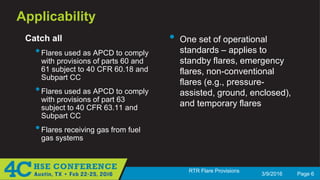
Applicability
Catch all
•Flares used as APCD to comply
with provisions of parts 60 and
61 subject to 40 CFR 60.18 and
Subpart CC
•Flares used as APCD to comply
with provisions of part 63
subject to 40 CFR 63.11 and
Subpart CC
•Flares receiving gas from fuel
gas systems
• One set of operational
standards – applies to
standby flares, emergency
flares, non-conventional
flares (e.g., pressure-
assisted, ground, enclosed),
and temporary flares
3/9/2016 Page 7
RTR Flare Provisions
Pilot Flame Presence
Requirement/Deviation
[§63.670 (b)]
• A pilot flame present at all times
when regulated material is routed
to flare
• Deviation – each 15-min block with
at least 1-min where no pilot flame
is present
• No pilot flame in different 15-min
blocks from the same event are
separate deviations (could apply if
refinery fails to re-light pilot in same
15-min block)
Monitoring [§63.670 (g)]
• Continuously monitor for
presence of a flame with
thermocouple, ultraviolet beam
sensor, infrared sensor, or other
device capable of detecting if
flame is present
• Rule does not specify
thermocouple set point, but
Table 13 indicates temperature
monitor does not need to be
accurate to ± 1 percent
3/9/2016 Page 8
RTR Flare Provisions
Visible Emissions
• First letter of each bullet should be
capitalized, and any proper nouns
following should be capitalized also.
Any other words should be lower case.
Requirement/Deviation [§63.670 (c)]
• No visible emissions (VE) when
• Vent gas flow is below smokeless capacity
and
• Regulated material is routed to flare
• Deviation – greater than 5-min with
VE during any 2 consecutive hours
3/9/2016 Page 9
RTR Flare Provisions
Visible Emissions - Continued
Monitoring [§63.670 (h)]
• Observe while regulated material is being routed to flare
• Initial demonstration Method 22 observation for 2 hours – newly-
affected flares
• Subsequent observations
•Method 22 (40 CFR part 60, Appendix A-7)
• At least daily observation for 5-min
• Initiate 5-min observation when visible emissions routinely observed
• If observed for more than one minute, extend observation to 2 hours
• 2 hour observation period is complete if 5-minutes of visible emissions observed
3/9/2016 Page 10
RTR Flare Provisions
Visible Emissions - Continued
Monitoring [§63.670 (h)]
• Video surveillance
• Continuously record (at least one frame every 15 seconds with time and date stamps)
• Cameras positioned suitable for observations
• Output routed to control room or other continuously manned area
3/9/2016 Page 11
RTR Flare Provisions
Flare Tip Velocity, Vtip
Requirement/Deviation [§63.670 (d)]
• Actual Vtip less than 60 feet per second or
• Vtip must be less than 400 fps and also the maximum
allowable flare tip velocity (Vmax) calculated per
𝑳𝑳𝑳𝑳𝑳𝑳𝟏𝟏𝟏𝟏 𝑽𝑽 𝒎𝒎𝒎𝒎𝒎𝒎 =
𝑵𝑵𝑵𝑵𝑵𝑵𝒗𝒗𝒗𝒗 + 𝟏𝟏, 𝟐𝟐𝟐𝟐𝟐𝟐
𝟖𝟖𝟖𝟖𝟖𝟖
where NHVvg is the net heating value of the flare vent gas
• Applies when regulated material is routed to flare for at least
15-min and vent gas flow less than smokeless design
capacity
• Could present an issue when flaring heavier gases combined
with lower Btu gases (Vmax < 400 fps)
3/9/2016 Page 12
RTR Flare Provisions
Flare Tip Velocity, Vtip - Continued
Monitoring [§63.670 (i)]
• Flare vent gas flow (Qcum or Qvg)
• Continuously measure, calculate, and record volumetric flow in header
or sub headers, including supplemental fuel
• STP correction – 68 °F and 1 atm
• Other monitoring options when molecular weight determined from
compositional analysis, paragraph (j)
• Mass flow meters acceptable, convert to volumetric flow
𝑸𝑸𝒗𝒗𝒗𝒗𝒗𝒗 =
𝑸𝑸 𝒎𝒎𝒎𝒎𝒎𝒎𝒎𝒎
𝑴𝑴𝑴𝑴𝒕𝒕
× 𝟑𝟑𝟑𝟑𝟑𝟑. 𝟑𝟑
3/9/2016 Page 13
RTR Flare Provisions
Flare Tip Velocity, Vtip - Continued
Monitoring [§63.670 (i)]
• Continuous pressure/temperature monitoring systems and engineering
calculations acceptable
• Different methods can be used for different streams, as long as all streams
are included
3/9/2016 Page 14
RTR Flare Provisions
Flare Tip Velocity, Vtip - Continued
Monitoring [§63.670 (i)]
Assist steam flow (Qs)
• Continuously measure, calculate, and record volumetric flow of steam
• STP correction – 68 °F and 1 atm
• Other monitoring options, MWt = 18 lb/lb-mol
• Mass flow meters acceptable, convert to volumetric flow using same equation
• Continuous pressure/temperature monitoring systems and engineering
calculations acceptable
3/9/2016 Page 15
RTR Flare Provisions
Flare Tip Velocity, Vtip - Continued
Monitoring [§63.670 (i)]
• Assist air (Qa,premix and Qa,perimeter)
• Continuously measure, calculate, and record volumetric flow of air
• Pre-mix and perimeter assist air monitored separately
• STP correction – 68 °F and 1 atm
• Continuously monitoring fan speed or power and using fan curves is
acceptable
• Other monitoring options, MWt = 29 lb/lb-mol
• Mass flow meters acceptable, convert to volumetric flow using same equation
• Continuous pressure/temperature monitoring systems and engineering calculations
acceptable
3/9/2016 Page 16
RTR Flare Provisions
Flare Tip Velocity, Vtip - Continued
Calculation [§63.670 (k)]
• Calculate cumulative flow (Qcum) and Vtip for each 15-min period starting
at 12 midnight (i.e., “block”)
𝑽𝑽𝒕𝒕𝒕𝒕 𝒕𝒕 =
𝑸𝑸𝒄𝒄𝒄𝒄𝒄𝒄
𝑨𝑨𝑨𝑨𝑨𝑨𝑨𝑨 × 𝟗𝟗𝟗𝟗𝟗𝟗
• Design and engineering principles to determine unobstructed cross
sectional area
• Qcum only required to include flow during period of regulated material flow
• Direct compositional or net heating value monitoring used to determine
NHVvg for Vmax method
3/9/2016 Page 17
RTR Flare Provisions
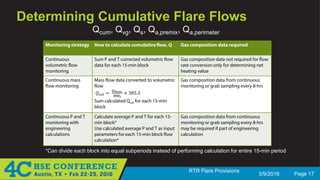
Determining Cumulative Flare Flows
Qcum, Qvg, Qs, Qa,premix, Qa,perimeter
*Can divide each block into equal subperiods instead of performing calculation for entire 15-min period
Monitoring strategy How to calculate cumulative flow, Q Gas composition data required
Continuous
volumetric flow
monitoring
Sum P and T corrected volumetric flow
data for each 15-min block
Gas composition data not required for flow
rate conversion only for determining net
heating value
Continuous mass
flow monitoring
Mass flow data converted to volumetric
flow
𝑄𝑄𝑣𝑣𝑣𝑣𝑣𝑣 =
𝑄𝑄 𝑚𝑚𝑚𝑚𝑚𝑚𝑚𝑚
𝑀𝑀𝑀𝑀𝑡𝑡
× 385.3
Sum calculated Qvol for each 15-min
block
Gas composition data from continuous
monitoring or grab sampling every 8-hrs
Continuous P and T
monitoring with
engineering
calculations
Calculate average P and T for each 15-
min block*
Use calculated average P and T as input
parameters for each 15-min block flow
calculation*
Gas composition data from continuous
monitoring or grab sampling every 8-hrs
may be required if part of engineering
calculation
3/9/2016 Page 18
RTR Flare Provisions
Net Heating Value Flare Combustion Zone
Gas, NHVcz
Requirement/Deviation [§63.670 (e)]
• NHVcz at or above 270 British thermal units per standard cubic foot
(Btu/scf)
Monitoring [§63.670 (j)]
• Determine concentration of individual components in flare vent gas by
• Continuous measurement (at least once every 15-min)
• Evacuated canister grab sampling and subsequent analysis at least every 8-hrs
• Calorimeter capable of continuous monitoring of vent gas net heating value
(NHVvg) at standard conditions – with or without continuous hydrogen monitoring
3/9/2016 Page 19
RTR Flare Provisions
Net Heating Value Flare Combustion Zone Gas,
NHVcz - Continued
NHVvg Calculation [§63.670 (l)]
• Calculate 15-min block averages for set 15-min blocks starting at 12 midnight using:
1. Feed-forward calculation method
2. Direct calculation method
• Use grab sample analytical results from 15-min block when sample was collected to
the 15-min block prior to block when subsequent sample is collected
• Can use different calculation methods for different flares
• Elect one calculation method for all vent streams associated with a single flare
• 15-minute block average net heating value shall be determined separately for each measurement location and
cumulative NHVvg is flow-weighted average
• Notify Administrator of calculation method changes 30-days prior
3/9/2016 Page 20
RTR Flare Provisions
Net Heating Value Flare Combustion Zone
Gas, NHVcz - Continued
Flares that
• Use feed-forward calculation
methodology
• Monitor gas composition or net
heating value in a location
representative of the cumulative
vent gas stream, and
• Directly monitor supplemental
natural gas flow additions
𝑵𝑵𝑵𝑵𝑵𝑵𝒄𝒄𝒄𝒄 =
𝑸𝑸𝒗𝒗𝒗𝒗 − 𝑸𝑸𝑵𝑵𝑵𝑵𝑵𝑵 + 𝑸𝑸𝑵𝑵𝑵𝑵𝑵𝑵 𝑵𝑵𝑵𝑵𝑵𝑵𝒗𝒗𝒗𝒗 + 𝑸𝑸𝑵𝑵𝑵𝑵𝑵𝑵 − 𝑸𝑸𝑵𝑵𝑵𝑵𝑵𝑵 𝑵𝑵𝑵𝑵𝑵𝑵𝑵𝑵𝑵𝑵
𝑸𝑸𝒗𝒗𝒗𝒗 + 𝑸𝑸𝒔𝒔 + 𝑸𝑸𝒂𝒂,𝒑𝒑𝒑𝒑𝒑𝒑𝒑𝒑𝒑𝒑𝒑𝒑
NHVcz Calculation [§63.670 (m)]
• Other flares, use calculated 15-min
block cumulative values for flow (vent
gas, steam and premix air) and 15-
min block average for NHVvg
𝑵𝑵𝑵𝑵𝑵𝑵𝒄𝒄𝒄𝒄 =
𝑸𝑸𝒗𝒗𝒗𝒗 × 𝑵𝑵𝑵𝑵𝑵𝑵𝒗𝒗𝒗𝒗
𝑸𝑸𝒗𝒗𝒗𝒗 + 𝑸𝑸𝒔𝒔 + 𝑸𝑸𝒂𝒂,𝒑𝒑𝒑𝒑𝒑𝒑𝒑𝒑𝒑𝒑𝒑𝒑
NHVcz = NHVvg when there is not assist steam or
premix air
3/9/2016 Page 21
RTR Flare Provisions
Net Heating Value Dilution Parameter, NHVdil
Requirement/Deviation [§63.670 (f)]
• NHVdil at or above 22 British thermal units per square feet (Btu/ft2)
• Flares with perimeter assist air
• Do not calculate for 15-min blocks with no perimeter assist air
Monitoring
• Nothing additional to parameter monitoring for Vtip and NHVcz compliance
3/9/2016 Page 22
RTR Flare Provisions
Net Heating Value Dilution Parameter, NHVdil
Continued
NHVdil Calculation [§63.670 (n)]
• Flares that
• Use feed-forward calculation methodology
• Monitor gas composition or net heating value in a location representative of the cumulative vent gas stream,
and
• Directly monitor supplemental natural gas flow additions
𝑵𝑵𝑵𝑵𝑵𝑵𝒅𝒅𝒅𝒅𝒅𝒅 =
𝑸𝑸𝒗𝒗𝒗𝒗 − 𝑸𝑸𝑵𝑵𝑵𝑵𝑵𝑵 + 𝑸𝑸𝑵𝑵𝑵𝑵𝑵𝑵 𝑵𝑵𝑵𝑵𝑵𝑵𝒗𝒗𝒗𝒗 + 𝑸𝑸𝑵𝑵𝑵𝑵𝑵𝑵 − 𝑸𝑸𝑵𝑵𝑵𝑵𝑵𝑵 𝑵𝑵𝑵𝑵𝑵𝑵𝑵𝑵𝑵𝑵 × 𝑫𝑫𝑫𝑫𝑫𝑫𝑫𝑫
𝑸𝑸𝒗𝒗𝒗𝒗 + 𝑸𝑸𝒔𝒔 + 𝑸𝑸𝒂𝒂,𝒑𝒑𝒑𝒑𝒑𝒑𝒑𝒑𝒑𝒑𝒑𝒑 + 𝑸𝑸𝒂𝒂,𝒑𝒑𝒑𝒑𝒑𝒑𝒑𝒑𝒑𝒑𝒑𝒑𝒑𝒑𝒑𝒑𝒑𝒑
• Other flares, use calculated 15-min block cumulative values for flow (vent
gas, steam and premix air) and 15-min block average for NHVvg
𝑵𝑵𝑵𝑵𝑵𝑵𝒅𝒅𝒅𝒅𝒅𝒅 =
𝑸𝑸𝒗𝒗𝒗𝒗 × 𝑵𝑵𝑵𝑵𝑵𝑵𝒗𝒗𝒗𝒗 × 𝑫𝑫𝑫𝑫𝑫𝑫𝑫𝑫
𝑸𝑸𝒗𝒗𝒗𝒗 + 𝑸𝑸𝒔𝒔 + 𝑸𝑸𝒂𝒂,𝒑𝒑𝒑𝒑𝒑𝒑𝒑𝒑𝒑𝒑𝒑𝒑 + 𝑸𝑸𝒂𝒂,𝒑𝒑𝒑𝒑𝒑𝒑𝒑𝒑𝒑𝒑𝒑𝒑𝒑𝒑𝒑𝒑𝒑𝒑
3/9/2016 Page 23
RTR Flare Provisions
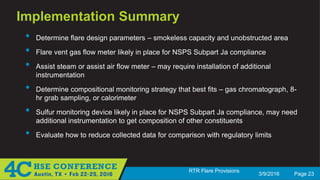
Implementation Summary
• Determine flare design parameters – smokeless capacity and unobstructed area
• Flare vent gas flow meter likely in place for NSPS Subpart Ja compliance
• Assist steam or assist air flow meter – may require installation of additional
instrumentation
• Determine compositional monitoring strategy that best fits – gas chromatograph, 8-
hr grab sampling, or calorimeter
• Sulfur monitoring device likely in place for NSPS Subpart Ja compliance, may need
additional instrumentation to get composition of other constituents
• Evaluate how to reduce collected data for comparison with regulatory limits
3/9/2016 Page 24
RTR Flare Provisions
Stephen Walls
Air Permitting Engineer
swalls@trihydro.com

Refinery Flares

  • 1.
    3/9/2016 Page 1 RTRFlare Provisions Flares Stephen Walls Air Permitting Engineer Trihydro Corporation
  • 2.
    3/9/2016 Page 2 RTRFlare Provisions Presentation Topics • General Overview • Definitions • Applicability • Enhanced Operational Standards Flares • Flare Pilot Flame • Visible Emissions • Flare Tip Velocity • Combustion Zone Heating Value • Dilution Parameter
  • 3.
    3/9/2016 Page 3 RTRFlare Provisions Rule Overview • Current 40 CFR 63.11 and 40 CFR 60.18 insufficient to ensure flares meet control requirements • Focus on destruction efficiency • Flare destruction efficiency confirmed by compliance with enhanced operational and work practice standards (§63.670) • Enclosed combustion device destruction efficiency (98 percent) or outlet concentration (20 ppmv) confirmed via testing (§63.645) • PFTIR monitoring to confirm 98 percent destruction efficiency technically infeasible to apply on continuous basis • Existing flare compliance date – January 30, 2019 • Incorrect to assume FGR cost-effective for all flares (case-by-case) • Did not finalize ban on flaring halogenated vent streams
  • 4.
    3/9/2016 Page 4 RTRFlare Provisions Definitions • Regulated material - contains HAP listed in Table 1, likely includes fuel gas used as sweep or purge gas • Flare - combustion device lacking an enclosed combustion chamber that uses an uncontrolled volume of ambient air to burn gases. For the purposes of this rule, the definition of flare includes, but is not necessarily limited to, air-assisted flares, steam-assisted flares and non-assisted flares. • Incinerators/thermal oxidizers – have an enclosed combustion chamber that uses a controlled volume of ambient air to burn gases • Process heaters/boilers – enclosed combustion devices that transfer heat energy to process streams or that extracts useful energy in the form of steam
  • 5.
    3/9/2016 Page 5 RTRFlare Provisions Applicability Flares used as air pollution control device (APCD) for the following affected emission sources at major facilities Source type Regulation prior to February 1, 2019 Volatile organic liquid storage vessels Part 60, subpart Kb Benzene storage vessels Part 61, subpart Y Wastewater treatment Part 61, subparts FF (benzene waste) Part 63, subpart G (SOCMI NESHAP) Miscellaneous process vents 40 CFR 63.11 (b) Equipment leaks Part 60, subpart VV or §§63.172 and 63.180 Gasoline loading racks Part 63, subpart R Marine tank vessel loading Part 63, subpart Y
  • 6.
    3/9/2016 Page 6 RTRFlare Provisions Applicability Catch all •Flares used as APCD to comply with provisions of parts 60 and 61 subject to 40 CFR 60.18 and Subpart CC •Flares used as APCD to comply with provisions of part 63 subject to 40 CFR 63.11 and Subpart CC •Flares receiving gas from fuel gas systems • One set of operational standards – applies to standby flares, emergency flares, non-conventional flares (e.g., pressure- assisted, ground, enclosed), and temporary flares
  • 7.
    3/9/2016 Page 7 RTRFlare Provisions Pilot Flame Presence Requirement/Deviation [§63.670 (b)] • A pilot flame present at all times when regulated material is routed to flare • Deviation – each 15-min block with at least 1-min where no pilot flame is present • No pilot flame in different 15-min blocks from the same event are separate deviations (could apply if refinery fails to re-light pilot in same 15-min block) Monitoring [§63.670 (g)] • Continuously monitor for presence of a flame with thermocouple, ultraviolet beam sensor, infrared sensor, or other device capable of detecting if flame is present • Rule does not specify thermocouple set point, but Table 13 indicates temperature monitor does not need to be accurate to ± 1 percent
  • 8.
    3/9/2016 Page 8 RTRFlare Provisions Visible Emissions • First letter of each bullet should be capitalized, and any proper nouns following should be capitalized also. Any other words should be lower case. Requirement/Deviation [§63.670 (c)] • No visible emissions (VE) when • Vent gas flow is below smokeless capacity and • Regulated material is routed to flare • Deviation – greater than 5-min with VE during any 2 consecutive hours
  • 9.
    3/9/2016 Page 9 RTRFlare Provisions Visible Emissions - Continued Monitoring [§63.670 (h)] • Observe while regulated material is being routed to flare • Initial demonstration Method 22 observation for 2 hours – newly- affected flares • Subsequent observations •Method 22 (40 CFR part 60, Appendix A-7) • At least daily observation for 5-min • Initiate 5-min observation when visible emissions routinely observed • If observed for more than one minute, extend observation to 2 hours • 2 hour observation period is complete if 5-minutes of visible emissions observed
  • 10.
    3/9/2016 Page 10 RTRFlare Provisions Visible Emissions - Continued Monitoring [§63.670 (h)] • Video surveillance • Continuously record (at least one frame every 15 seconds with time and date stamps) • Cameras positioned suitable for observations • Output routed to control room or other continuously manned area
  • 11.
    3/9/2016 Page 11 RTRFlare Provisions Flare Tip Velocity, Vtip Requirement/Deviation [§63.670 (d)] • Actual Vtip less than 60 feet per second or • Vtip must be less than 400 fps and also the maximum allowable flare tip velocity (Vmax) calculated per 𝑳𝑳𝑳𝑳𝑳𝑳𝟏𝟏𝟏𝟏 𝑽𝑽 𝒎𝒎𝒎𝒎𝒎𝒎 = 𝑵𝑵𝑵𝑵𝑵𝑵𝒗𝒗𝒗𝒗 + 𝟏𝟏, 𝟐𝟐𝟐𝟐𝟐𝟐 𝟖𝟖𝟖𝟖𝟖𝟖 where NHVvg is the net heating value of the flare vent gas • Applies when regulated material is routed to flare for at least 15-min and vent gas flow less than smokeless design capacity • Could present an issue when flaring heavier gases combined with lower Btu gases (Vmax < 400 fps)
  • 12.
    3/9/2016 Page 12 RTRFlare Provisions Flare Tip Velocity, Vtip - Continued Monitoring [§63.670 (i)] • Flare vent gas flow (Qcum or Qvg) • Continuously measure, calculate, and record volumetric flow in header or sub headers, including supplemental fuel • STP correction – 68 °F and 1 atm • Other monitoring options when molecular weight determined from compositional analysis, paragraph (j) • Mass flow meters acceptable, convert to volumetric flow 𝑸𝑸𝒗𝒗𝒗𝒗𝒗𝒗 = 𝑸𝑸 𝒎𝒎𝒎𝒎𝒎𝒎𝒎𝒎 𝑴𝑴𝑴𝑴𝒕𝒕 × 𝟑𝟑𝟑𝟑𝟑𝟑. 𝟑𝟑
  • 13.
    3/9/2016 Page 13 RTRFlare Provisions Flare Tip Velocity, Vtip - Continued Monitoring [§63.670 (i)] • Continuous pressure/temperature monitoring systems and engineering calculations acceptable • Different methods can be used for different streams, as long as all streams are included
  • 14.
    3/9/2016 Page 14 RTRFlare Provisions Flare Tip Velocity, Vtip - Continued Monitoring [§63.670 (i)] Assist steam flow (Qs) • Continuously measure, calculate, and record volumetric flow of steam • STP correction – 68 °F and 1 atm • Other monitoring options, MWt = 18 lb/lb-mol • Mass flow meters acceptable, convert to volumetric flow using same equation • Continuous pressure/temperature monitoring systems and engineering calculations acceptable
  • 15.
    3/9/2016 Page 15 RTRFlare Provisions Flare Tip Velocity, Vtip - Continued Monitoring [§63.670 (i)] • Assist air (Qa,premix and Qa,perimeter) • Continuously measure, calculate, and record volumetric flow of air • Pre-mix and perimeter assist air monitored separately • STP correction – 68 °F and 1 atm • Continuously monitoring fan speed or power and using fan curves is acceptable • Other monitoring options, MWt = 29 lb/lb-mol • Mass flow meters acceptable, convert to volumetric flow using same equation • Continuous pressure/temperature monitoring systems and engineering calculations acceptable
  • 16.
    3/9/2016 Page 16 RTRFlare Provisions Flare Tip Velocity, Vtip - Continued Calculation [§63.670 (k)] • Calculate cumulative flow (Qcum) and Vtip for each 15-min period starting at 12 midnight (i.e., “block”) 𝑽𝑽𝒕𝒕𝒕𝒕 𝒕𝒕 = 𝑸𝑸𝒄𝒄𝒄𝒄𝒄𝒄 𝑨𝑨𝑨𝑨𝑨𝑨𝑨𝑨 × 𝟗𝟗𝟗𝟗𝟗𝟗 • Design and engineering principles to determine unobstructed cross sectional area • Qcum only required to include flow during period of regulated material flow • Direct compositional or net heating value monitoring used to determine NHVvg for Vmax method
  • 17.
    3/9/2016 Page 17 RTRFlare Provisions Determining Cumulative Flare Flows Qcum, Qvg, Qs, Qa,premix, Qa,perimeter *Can divide each block into equal subperiods instead of performing calculation for entire 15-min period Monitoring strategy How to calculate cumulative flow, Q Gas composition data required Continuous volumetric flow monitoring Sum P and T corrected volumetric flow data for each 15-min block Gas composition data not required for flow rate conversion only for determining net heating value Continuous mass flow monitoring Mass flow data converted to volumetric flow 𝑄𝑄𝑣𝑣𝑣𝑣𝑣𝑣 = 𝑄𝑄 𝑚𝑚𝑚𝑚𝑚𝑚𝑚𝑚 𝑀𝑀𝑀𝑀𝑡𝑡 × 385.3 Sum calculated Qvol for each 15-min block Gas composition data from continuous monitoring or grab sampling every 8-hrs Continuous P and T monitoring with engineering calculations Calculate average P and T for each 15- min block* Use calculated average P and T as input parameters for each 15-min block flow calculation* Gas composition data from continuous monitoring or grab sampling every 8-hrs may be required if part of engineering calculation
  • 18.
    3/9/2016 Page 18 RTRFlare Provisions Net Heating Value Flare Combustion Zone Gas, NHVcz Requirement/Deviation [§63.670 (e)] • NHVcz at or above 270 British thermal units per standard cubic foot (Btu/scf) Monitoring [§63.670 (j)] • Determine concentration of individual components in flare vent gas by • Continuous measurement (at least once every 15-min) • Evacuated canister grab sampling and subsequent analysis at least every 8-hrs • Calorimeter capable of continuous monitoring of vent gas net heating value (NHVvg) at standard conditions – with or without continuous hydrogen monitoring
  • 19.
    3/9/2016 Page 19 RTRFlare Provisions Net Heating Value Flare Combustion Zone Gas, NHVcz - Continued NHVvg Calculation [§63.670 (l)] • Calculate 15-min block averages for set 15-min blocks starting at 12 midnight using: 1. Feed-forward calculation method 2. Direct calculation method • Use grab sample analytical results from 15-min block when sample was collected to the 15-min block prior to block when subsequent sample is collected • Can use different calculation methods for different flares • Elect one calculation method for all vent streams associated with a single flare • 15-minute block average net heating value shall be determined separately for each measurement location and cumulative NHVvg is flow-weighted average • Notify Administrator of calculation method changes 30-days prior
  • 20.
    3/9/2016 Page 20 RTRFlare Provisions Net Heating Value Flare Combustion Zone Gas, NHVcz - Continued Flares that • Use feed-forward calculation methodology • Monitor gas composition or net heating value in a location representative of the cumulative vent gas stream, and • Directly monitor supplemental natural gas flow additions 𝑵𝑵𝑵𝑵𝑵𝑵𝒄𝒄𝒄𝒄 = 𝑸𝑸𝒗𝒗𝒗𝒗 − 𝑸𝑸𝑵𝑵𝑵𝑵𝑵𝑵 + 𝑸𝑸𝑵𝑵𝑵𝑵𝑵𝑵 𝑵𝑵𝑵𝑵𝑵𝑵𝒗𝒗𝒗𝒗 + 𝑸𝑸𝑵𝑵𝑵𝑵𝑵𝑵 − 𝑸𝑸𝑵𝑵𝑵𝑵𝑵𝑵 𝑵𝑵𝑵𝑵𝑵𝑵𝑵𝑵𝑵𝑵 𝑸𝑸𝒗𝒗𝒗𝒗 + 𝑸𝑸𝒔𝒔 + 𝑸𝑸𝒂𝒂,𝒑𝒑𝒑𝒑𝒑𝒑𝒑𝒑𝒑𝒑𝒑𝒑 NHVcz Calculation [§63.670 (m)] • Other flares, use calculated 15-min block cumulative values for flow (vent gas, steam and premix air) and 15- min block average for NHVvg 𝑵𝑵𝑵𝑵𝑵𝑵𝒄𝒄𝒄𝒄 = 𝑸𝑸𝒗𝒗𝒗𝒗 × 𝑵𝑵𝑵𝑵𝑵𝑵𝒗𝒗𝒗𝒗 𝑸𝑸𝒗𝒗𝒗𝒗 + 𝑸𝑸𝒔𝒔 + 𝑸𝑸𝒂𝒂,𝒑𝒑𝒑𝒑𝒑𝒑𝒑𝒑𝒑𝒑𝒑𝒑 NHVcz = NHVvg when there is not assist steam or premix air
  • 21.
    3/9/2016 Page 21 RTRFlare Provisions Net Heating Value Dilution Parameter, NHVdil Requirement/Deviation [§63.670 (f)] • NHVdil at or above 22 British thermal units per square feet (Btu/ft2) • Flares with perimeter assist air • Do not calculate for 15-min blocks with no perimeter assist air Monitoring • Nothing additional to parameter monitoring for Vtip and NHVcz compliance
  • 22.
    3/9/2016 Page 22 RTRFlare Provisions Net Heating Value Dilution Parameter, NHVdil Continued NHVdil Calculation [§63.670 (n)] • Flares that • Use feed-forward calculation methodology • Monitor gas composition or net heating value in a location representative of the cumulative vent gas stream, and • Directly monitor supplemental natural gas flow additions 𝑵𝑵𝑵𝑵𝑵𝑵𝒅𝒅𝒅𝒅𝒅𝒅 = 𝑸𝑸𝒗𝒗𝒗𝒗 − 𝑸𝑸𝑵𝑵𝑵𝑵𝑵𝑵 + 𝑸𝑸𝑵𝑵𝑵𝑵𝑵𝑵 𝑵𝑵𝑵𝑵𝑵𝑵𝒗𝒗𝒗𝒗 + 𝑸𝑸𝑵𝑵𝑵𝑵𝑵𝑵 − 𝑸𝑸𝑵𝑵𝑵𝑵𝑵𝑵 𝑵𝑵𝑵𝑵𝑵𝑵𝑵𝑵𝑵𝑵 × 𝑫𝑫𝑫𝑫𝑫𝑫𝑫𝑫 𝑸𝑸𝒗𝒗𝒗𝒗 + 𝑸𝑸𝒔𝒔 + 𝑸𝑸𝒂𝒂,𝒑𝒑𝒑𝒑𝒑𝒑𝒑𝒑𝒑𝒑𝒑𝒑 + 𝑸𝑸𝒂𝒂,𝒑𝒑𝒑𝒑𝒑𝒑𝒑𝒑𝒑𝒑𝒑𝒑𝒑𝒑𝒑𝒑𝒑𝒑 • Other flares, use calculated 15-min block cumulative values for flow (vent gas, steam and premix air) and 15-min block average for NHVvg 𝑵𝑵𝑵𝑵𝑵𝑵𝒅𝒅𝒅𝒅𝒅𝒅 = 𝑸𝑸𝒗𝒗𝒗𝒗 × 𝑵𝑵𝑵𝑵𝑵𝑵𝒗𝒗𝒗𝒗 × 𝑫𝑫𝑫𝑫𝑫𝑫𝑫𝑫 𝑸𝑸𝒗𝒗𝒗𝒗 + 𝑸𝑸𝒔𝒔 + 𝑸𝑸𝒂𝒂,𝒑𝒑𝒑𝒑𝒑𝒑𝒑𝒑𝒑𝒑𝒑𝒑 + 𝑸𝑸𝒂𝒂,𝒑𝒑𝒑𝒑𝒑𝒑𝒑𝒑𝒑𝒑𝒑𝒑𝒑𝒑𝒑𝒑𝒑𝒑
  • 23.
    3/9/2016 Page 23 RTRFlare Provisions Implementation Summary • Determine flare design parameters – smokeless capacity and unobstructed area • Flare vent gas flow meter likely in place for NSPS Subpart Ja compliance • Assist steam or assist air flow meter – may require installation of additional instrumentation • Determine compositional monitoring strategy that best fits – gas chromatograph, 8- hr grab sampling, or calorimeter • Sulfur monitoring device likely in place for NSPS Subpart Ja compliance, may need additional instrumentation to get composition of other constituents • Evaluate how to reduce collected data for comparison with regulatory limits
  • 24.
    3/9/2016 Page 24 RTRFlare Provisions Stephen Walls Air Permitting Engineer swalls@trihydro.com