Acute Phase Proteins
Slides for use in lectures/presentations on:
▪ The acute phase
▪ Acute phase proteins
▪ Veterinary acute phase proteins
Includes slides on:
▪ Historical origins of the term ‘acute phase’
▪ The publications that have used ‘acute phase’, ‘acute phase proteins
and ‘veterinary acute phase protein’
▪ Mild – moderate – major acute phase proteins
This material is licenced under Creative Commons Attribution-NonCommercial-ShareAlike 4.0
International (CC BY-NC-SA 4.0). To view this license visit here:
https://creativecommons.org/licenses/by-nc-sa/4.0/
CC BY-NC-SA 4.0 EmilyLO’ReillyUofEdinburgh
Emily O’Reilly BVMS MSc PhD
Teaching Fellow
University of Edinburgh
@PsittacineQueen
The Acute Phase
• Acute phase – first used in 1925 in
The Lancet
Halliday (1925) Lancet 205:763-766
1948
1925
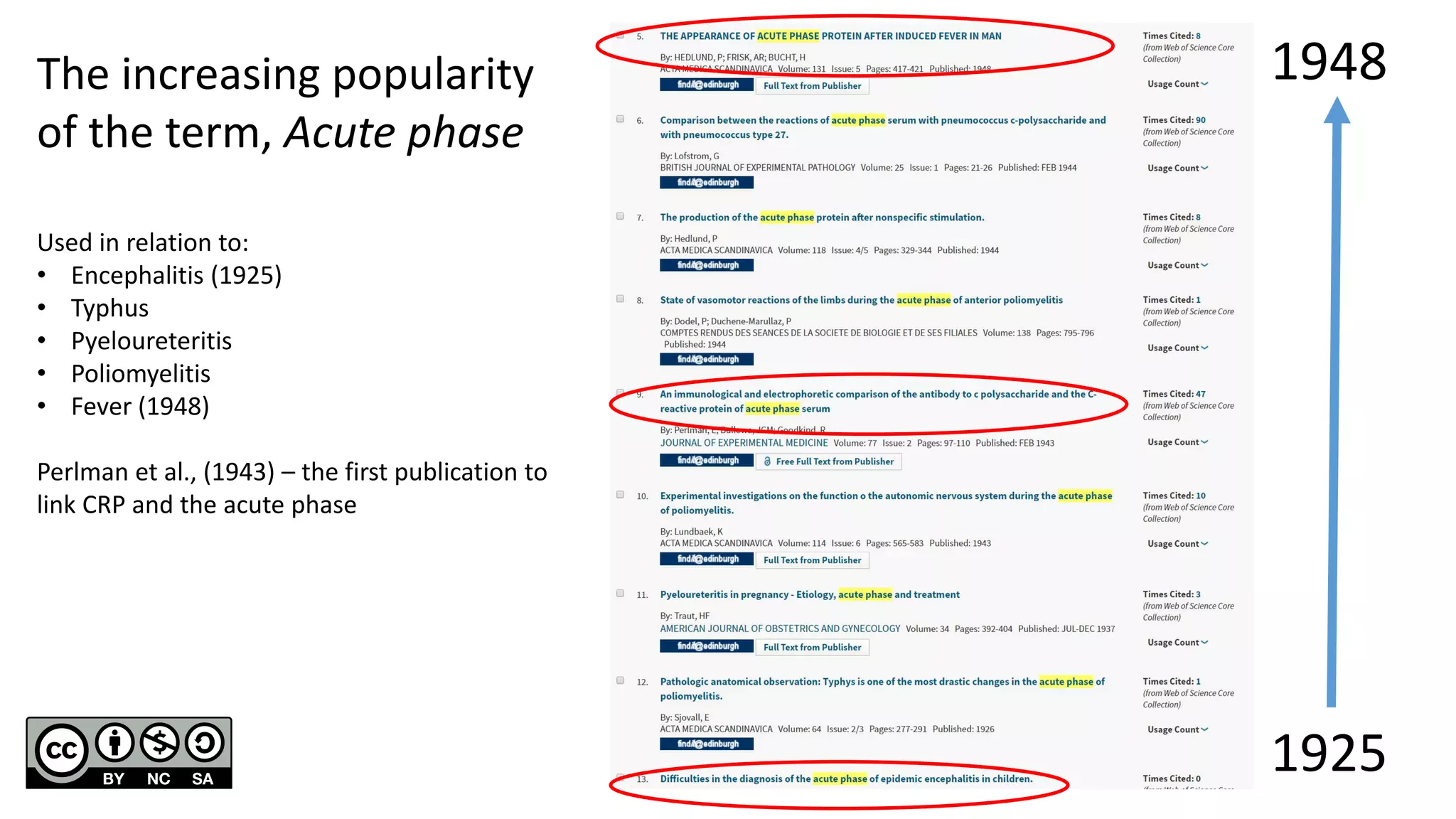
The increasing popularity
of the term, Acute phase
Used in relation to:
• Encephalitis (1925)
• Typhus
• Pyeloureteritis
• Poliomyelitis
• Fever (1948)
Perlman et al., (1943) – the first publication to
link CRP and the acute phase
Tillett & Francis (1930)
• Serum from patients with pneumonia
precipitated with the C-polysaccharide of
Streptococcus pneumonia
• “C-precipitins” also reacted with sera from
patients with different diseases.
The Protein…. “C-precipitins”
Tillett & Francis (1930) J Exp Med. 52:561-71.
0
20
40
60
80
100
120
140
160
180
200
0
200
400
600
800
1000
1200
1400
1600
1800
2000
1925 1930 1935 1940 1945 1950 1955 1960 1965 1970 1975 1980 1985 1990 1995 2000 2005 2010 2015
Acutephaseprotein
Acutephase
Year
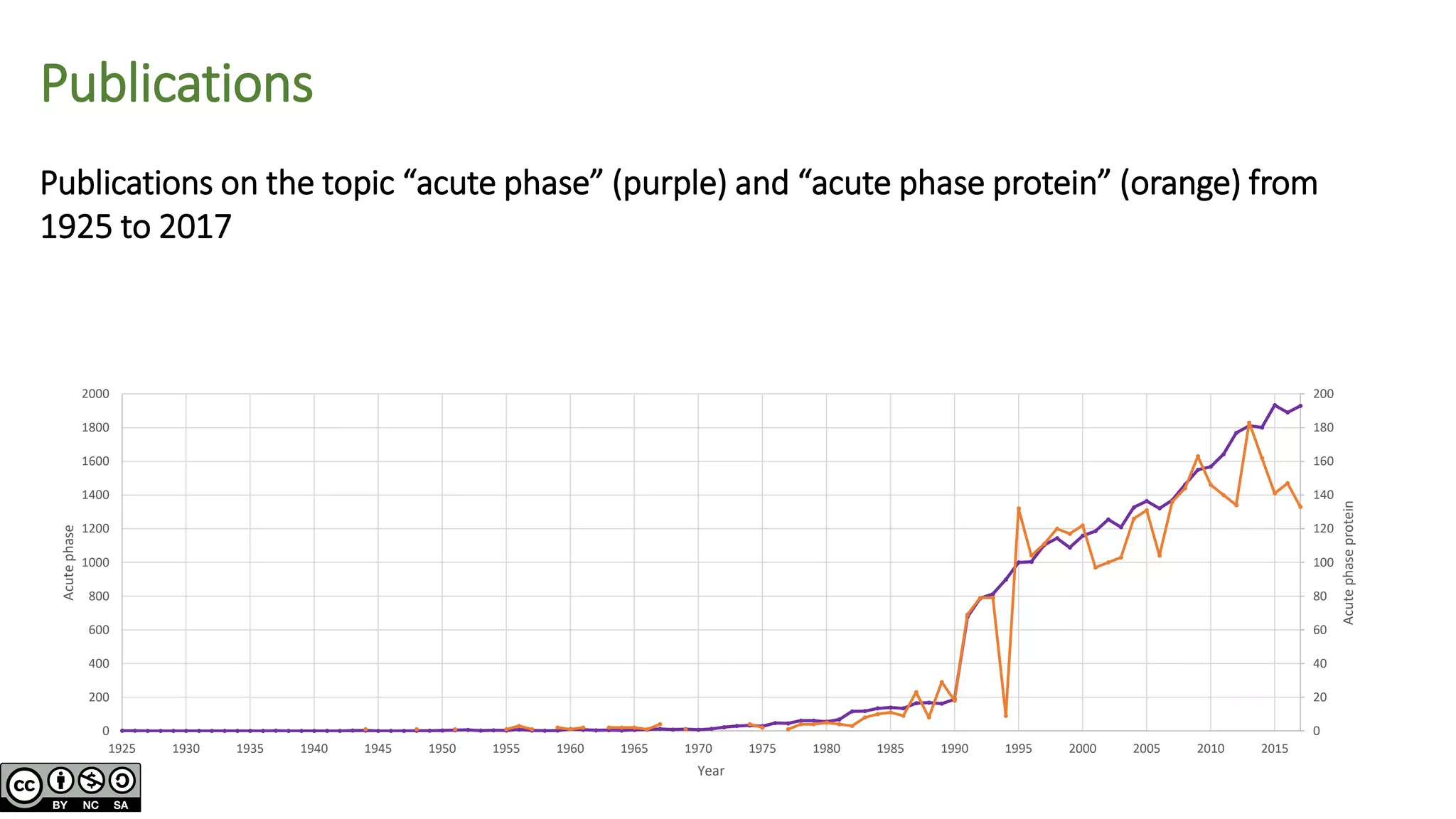
Publications
Publications on the topic “acute phase” (purple) and “acute phase protein” (orange) from
1925 to 2017
0
10
20
30
40
50
60
70
1984 1985 1986 1987 1988 1989 1990 1991 1992 1993 1994 1995 1996 1997 1998 1999 2000 2001 2002 2003 2004 2005 2006 2007 2008 2009 2010 2011 2012 2013 2014 2015 2016 2017
Publicationnumber
Year
Publications
Publications on the topic “acute phase protein” and “veterinary” and veterinary species
names 1984 to 2017
Cause
Trauma
Infection
Tissue injury
Stress
Surgery
Neoplasia
Inflammation
Cytokines
IL-1β
IL-6
TNF-α,
Hepatic Acute Phase Response
Acute Phase Proteins
Protein synthesis
and hepatocytic
secretion is
drastically altered
Macrophages
Monocytes
The Acute Phase Response
Non-specific systemic reaction to local or systemic disturbances caused by trauma, infection, stress, surgery, neoplasia or
inflammation the goal of which is re-establishment of homeostasis and healing.
At the site of infection or place of tissue injury pro-inflammatory cytokines and chemokines are released by a variety of
cell types, but mainly by macrophages
The cytokines that play a key role in the induction of the APR are the pro-inflammatory cytokines: TNF-α, IL-1β and IL-6
Cause
Trauma
Infection
Tissue injury
Stress
Surgery
Neoplasia
Inflammation
Cytokines
IL-1β
IL-6
TNF-α,
Hepatic Acute Phase Response
Acute Phase Proteins
Protein synthesis
and hepatocytic
secretion is
drastically altered
Macrophages
Monocytes
The Acute Phase Response
Extra-Hepatic Acute Phase Proteins
Mammary tissue
Intestine
Adipose tissue
Serum
Plasma
Other biological matrices
Milk
Meat juice
Saliva
Positive APPs Negative APPs
Major = 10-1000 fold change
Moderate = 4-10 fold change
Minor = 2-3 fold change
Pyrexia
Anorexia
Increased catabolism
of muscle cells
Acute phase response (APR)
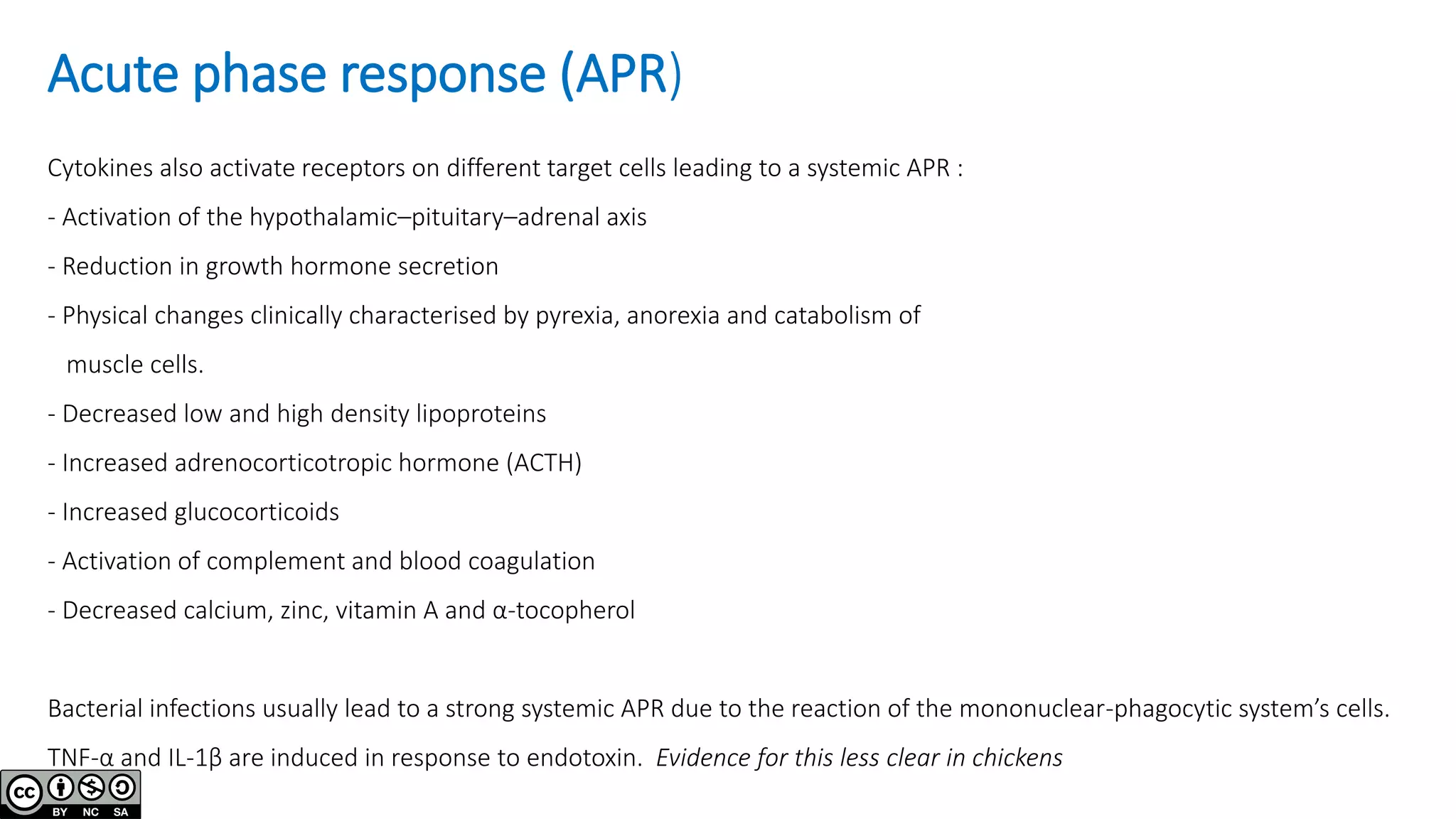
Cytokines also activate receptors on different target cells leading to a systemic APR :
- Activation of the hypothalamic–pituitary–adrenal axis
- Reduction in growth hormone secretion
- Physical changes clinically characterised by pyrexia, anorexia and catabolism of
muscle cells.
- Decreased low and high density lipoproteins
- Increased adrenocorticotropic hormone (ACTH)
- Increased glucocorticoids
- Activation of complement and blood coagulation
- Decreased calcium, zinc, vitamin A and α-tocopherol
Bacterial infections usually lead to a strong systemic APR due to the reaction of the mononuclear-phagocytic system’s cells.
TNF-α and IL-1β are induced in response to endotoxin. Evidence for this less clear in chickens
Positive APPs
• C-reactive protein
• Serum amyloid A
• Haptoglobin
• Alpha-1-acid glycoprotein
• Ovotransferrin (birds)
Negative APPs
• Albumin
• Transthyretin
• Transferrin (mammals)
The major, moderate and minor APPs in the domestic species (adapted from Tizard’s Veterinary Immunology, (2013)
Species differences in APPs
• SAA major in all species, except mouse (SAP)/ rat
(alpha2-macroglobulin)
• Albumin – major negative in all species
• Transthyretin – negative in all species in which it’s
been evaluated
• Significant species differences in transferrins, chickens
OVT positive, serum transferrins negative in other
species.
Acute phase
proteins
SAA
Lipoprotein transport and
metabolism
Recruit
immune cells
Immunomodulatory
Ceruloplasmin
Copper storage and transport
Antioxidant
Haptoglobin
Bind
haemoglobin
Antioxidant
Transferrins
Sequester, store
and transport iron
Antibacterial
Immunomodulatory
AGP
Anti-
inflammatory
Inhibit neutrophil
activation
Clear LPS
Immunomodulatory
Plasma transport
Albumin
Regulate plasma
osmotic pressure
TransportAntioxidant
CRP
Activate
complement
Opsonin
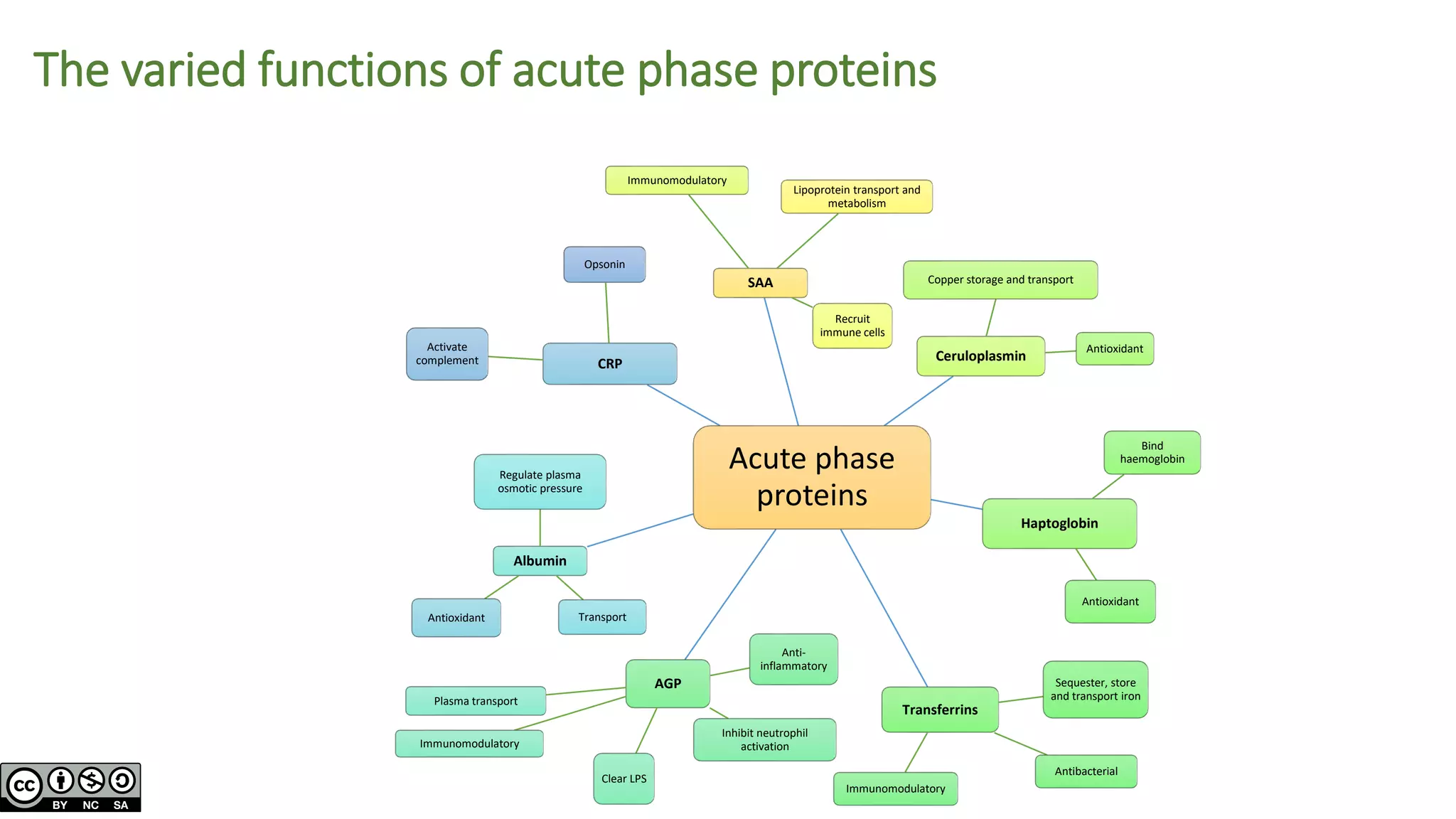
The varied functions of acute phase proteins

Acute phase proteins an open educational resource

  • 1.
    Acute Phase Proteins Slidesfor use in lectures/presentations on: ▪ The acute phase ▪ Acute phase proteins ▪ Veterinary acute phase proteins Includes slides on: ▪ Historical origins of the term ‘acute phase’ ▪ The publications that have used ‘acute phase’, ‘acute phase proteins and ‘veterinary acute phase protein’ ▪ Mild – moderate – major acute phase proteins
  • 2.
    This material islicenced under Creative Commons Attribution-NonCommercial-ShareAlike 4.0 International (CC BY-NC-SA 4.0). To view this license visit here: https://creativecommons.org/licenses/by-nc-sa/4.0/ CC BY-NC-SA 4.0 EmilyLO’ReillyUofEdinburgh Emily O’Reilly BVMS MSc PhD Teaching Fellow University of Edinburgh @PsittacineQueen
  • 3.
    The Acute Phase •Acute phase – first used in 1925 in The Lancet Halliday (1925) Lancet 205:763-766
  • 4.
    1948 1925 The increasing popularity ofthe term, Acute phase Used in relation to: • Encephalitis (1925) • Typhus • Pyeloureteritis • Poliomyelitis • Fever (1948) Perlman et al., (1943) – the first publication to link CRP and the acute phase
  • 5.
    Tillett & Francis(1930) • Serum from patients with pneumonia precipitated with the C-polysaccharide of Streptococcus pneumonia • “C-precipitins” also reacted with sera from patients with different diseases. The Protein…. “C-precipitins” Tillett & Francis (1930) J Exp Med. 52:561-71.
  • 6.
    0 20 40 60 80 100 120 140 160 180 200 0 200 400 600 800 1000 1200 1400 1600 1800 2000 1925 1930 19351940 1945 1950 1955 1960 1965 1970 1975 1980 1985 1990 1995 2000 2005 2010 2015 Acutephaseprotein Acutephase Year Publications Publications on the topic “acute phase” (purple) and “acute phase protein” (orange) from 1925 to 2017
  • 7.
    0 10 20 30 40 50 60 70 1984 1985 19861987 1988 1989 1990 1991 1992 1993 1994 1995 1996 1997 1998 1999 2000 2001 2002 2003 2004 2005 2006 2007 2008 2009 2010 2011 2012 2013 2014 2015 2016 2017 Publicationnumber Year Publications Publications on the topic “acute phase protein” and “veterinary” and veterinary species names 1984 to 2017
  • 8.
    Cause Trauma Infection Tissue injury Stress Surgery Neoplasia Inflammation Cytokines IL-1β IL-6 TNF-α, Hepatic AcutePhase Response Acute Phase Proteins Protein synthesis and hepatocytic secretion is drastically altered Macrophages Monocytes The Acute Phase Response Non-specific systemic reaction to local or systemic disturbances caused by trauma, infection, stress, surgery, neoplasia or inflammation the goal of which is re-establishment of homeostasis and healing. At the site of infection or place of tissue injury pro-inflammatory cytokines and chemokines are released by a variety of cell types, but mainly by macrophages The cytokines that play a key role in the induction of the APR are the pro-inflammatory cytokines: TNF-α, IL-1β and IL-6
  • 9.
    Cause Trauma Infection Tissue injury Stress Surgery Neoplasia Inflammation Cytokines IL-1β IL-6 TNF-α, Hepatic AcutePhase Response Acute Phase Proteins Protein synthesis and hepatocytic secretion is drastically altered Macrophages Monocytes The Acute Phase Response Extra-Hepatic Acute Phase Proteins Mammary tissue Intestine Adipose tissue Serum Plasma Other biological matrices Milk Meat juice Saliva Positive APPs Negative APPs Major = 10-1000 fold change Moderate = 4-10 fold change Minor = 2-3 fold change Pyrexia Anorexia Increased catabolism of muscle cells
  • 10.
    Acute phase response(APR) Cytokines also activate receptors on different target cells leading to a systemic APR : - Activation of the hypothalamic–pituitary–adrenal axis - Reduction in growth hormone secretion - Physical changes clinically characterised by pyrexia, anorexia and catabolism of muscle cells. - Decreased low and high density lipoproteins - Increased adrenocorticotropic hormone (ACTH) - Increased glucocorticoids - Activation of complement and blood coagulation - Decreased calcium, zinc, vitamin A and α-tocopherol Bacterial infections usually lead to a strong systemic APR due to the reaction of the mononuclear-phagocytic system’s cells. TNF-α and IL-1β are induced in response to endotoxin. Evidence for this less clear in chickens
  • 11.
    Positive APPs • C-reactiveprotein • Serum amyloid A • Haptoglobin • Alpha-1-acid glycoprotein • Ovotransferrin (birds) Negative APPs • Albumin • Transthyretin • Transferrin (mammals)
  • 12.
    The major, moderateand minor APPs in the domestic species (adapted from Tizard’s Veterinary Immunology, (2013) Species differences in APPs • SAA major in all species, except mouse (SAP)/ rat (alpha2-macroglobulin) • Albumin – major negative in all species • Transthyretin – negative in all species in which it’s been evaluated • Significant species differences in transferrins, chickens OVT positive, serum transferrins negative in other species.
  • 13.
    Acute phase proteins SAA Lipoprotein transportand metabolism Recruit immune cells Immunomodulatory Ceruloplasmin Copper storage and transport Antioxidant Haptoglobin Bind haemoglobin Antioxidant Transferrins Sequester, store and transport iron Antibacterial Immunomodulatory AGP Anti- inflammatory Inhibit neutrophil activation Clear LPS Immunomodulatory Plasma transport Albumin Regulate plasma osmotic pressure TransportAntioxidant CRP Activate complement Opsonin The varied functions of acute phase proteins