OBJECTIVES
 At the end of this presentation, one should be able
to:
 Mention systemic effects of inflammation
 Explain different systemic effects of inflammation
OUTLINE
 Introduction
 Systemic effects of inflammation
 Fever
 Elevated acute phase proteins
 Anaemia
 Leukocytosis
 Leukopenia
 Sepsis
 ARDS
 Wasting syndrome
 References
Introduction
 The effects of inflammation can be both local and
systemic .
 The effects are usually clearly beneficial (crp-opsonin)
or may be harmful
 Are chemical and pathological changes due to
inflammation process
 Known also as systemic inflammatory syndrome
Introduction…
 Mediated by pyrogens
 Produced by Leukocytes in response to infection or
immune reaction
 Released systemically
 Other pyrogens are pathogens LPS
Systemic effects of inflammation
 Fever
 Elevated levels acute phase proteins
 Anaemia
 Leukocytosis
 Leukopenia
 Sepsis
 ARDS (acute respiratory distress syndrome)
 Wasting syndrome
Fever
 Elevation of body temperature ; usually by
1°C t0 4°C
 Especially when inflammation is due to
infection
 Produced in response to substances called
pyrogens
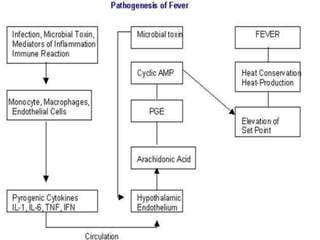
Fever…
 Bacterial products, such as Lipopolysacchrides
(LPS) in gram negative bacteria (exogenous
pyrogens)
 Stimulate leukocytes to release cytokines such as IL-
1 and TNF (endogenous pyrogens)
 increase the enzymes cyclooxygenases that
convert Arachidonic acid into prostaglandins.
Fever…
 In the hypothalamus, the prostaglandins, especially
PGE 2 , stimulate the production of
neurotransmitters such as cyclic AMP
 Which function to reset the temperature set-point at a
higher level.
Fever…
 NSAIDS ; like Aspirin, Ibuprofen, reduce fever by
inhibiting Cyclooxygenases thus blocking the
Prostaglandins synthesis
 An elevated body temperature has been shown to help
amphibians to ward off microbial infections
 Is assumed to do so in mammals though the
mechanism is not known
Fever
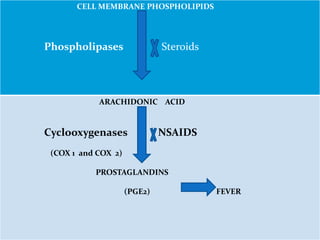
CELL MEMBRANE PHOSPHOLIPIDS
Phospholipases Steroids
ARACHIDONIC ACID
Cyclooxygenases NSAIDS
(COX 1 and COX 2)
PROSTAGLANDINS
(PGE2) FEVER
Elevated acute phase proteins
 These are plasma proteins synthesized in the liver,
 Their plasma concentrations may increase several
hundred-fold as part of the response to
inflammatory stimuli.
 Three of the best-known examples of these
proteins are
 C-reactive protein (CRP),
 Fibrinogen,
 Serum Amyloid A protein (SAA).
Elevated acute phase proteins…
 C reactive protein:(CRP)
 Pentameric polypeptide produced by the
hepatocytes in response to inflammatory
cytokines such as IL-6,
 Involved in variety of disorders which mediated by
inflammatory process;
Elevated acute phase proteins…
 Stimulate secretion of proinflamatory cytokines e.g.
IL-6,TNF,adhesion molecule, endothelin 1, by
endothelial cells
 Can bind to apoliprotein B contain lipoprotein and
opsonize LDL for uptake by monocyte-derived
macrophages (useful to show increased risk of
cardiovascular disease)
 CRP bind to microbial cell walls, and they may act as
opsonins and fix complement
Elevated acute phase proteins…
 Synthesis of these molecules by hepatocytes is up
regulated by cytokines, especially IL-6 (for CRP and
fibrinogen) and IL-1 or TNF (for SAA).
 CRP bind to microbial cell walls, and they may act as
opsonins and fix complement
 Thus promoting the elimination of microbes
Elevated acute phase proteins…
 Fibrinogen (factor I) is
a glycoprotein in vertebrates that helps in the
formation of blood clot.
 Is converted by thrombin into fibrin during blood clot
formation.
 Fibrinogen binds to erythrocytes and causes them to
form stacks (rouleaux) that sediment more rapidly at
unit gravity than do individual erythrocytes
Elevated acute phase proteins…
 This is the basis for measuring the erythrocyte
sedimentation rate (ESR) as simple test for
systematic inflammation response by number of
stimuli e.g.. Lipopolysacchrides
Elevated acute phase proteins…
 Serum amyloid A (SAA)
 Are secreted dug the acute phase of inflammation
 Have several roles including recruitment of immune
cells to inflammatory sites, induction of enzymes that
degrade extracellular matrix
 Also acute phase marker that respond rapidly,
associated more with joint disease early inflamation.eg
rheumatoid arthritis
Anaemia
 Due to increases levels of Hepcidin
 Peptide hormone regulating Fe metabolism in the
body
 It controls absorption Fe from the gut and release from
macrophages
 It binds ferroportin which leads to its degradation
then reduce Fe release from cells
 The net effect is Anaemia
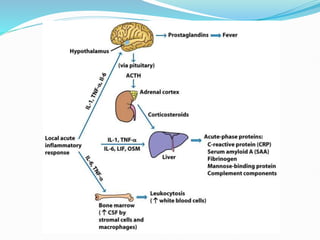
Leukocytosis
 Leukocytosis is a common feature of inflammatory
reactions, especially those induced by bacterial
infection.
 The leukocyte count usually climbs to 15,000 or 20,000
cells/µl, but sometimes it may reach extraordinarily
high levels of 40,000 to 100,000 cells/µl. [normal
4,000-11000 cells/µl]
 These extreme elevations are referred to as
leukemoid reactions because they are similar to the
white cell counts obtained in leukemia.
Leukocytosis…
 The leukocytosis occurs initially because of accelerated
release of cells from the bone marrow (caused by
cytokines, including IL-1 and TNF)
 Therefore associated with a rise in the number of more
immature neutrophils in the blood.
Leukocytosis…
 Prolonged infection also induces proliferation of
precursors in the bone marrow, caused by increased
production of colony stimulating factors (CSFs).
 Bone marrow output of leukocytes is increased to
compensate for the loss of these cells in the
inflammatory reaction.
 Neutrophilia refers to an increase in the blood
neutrophil count. Most bacterial infections
Leukocytosis..
 Lymphocytosis ;Viral infections such as
infectious mononucleosis, mumps, and German
measles produce a leukocytosis by virtue of an
absolute increase in the number of lymphocytes
 Eosinophilia ; the group of disorders, which
includes bronchial asthma, hay fever, and parasitic
infestations, there is an absolute increase in the
number of eosinophills
Leukopenia
 Decreased number of white blood cells
 Seen in certain infections like typhoid fever; and
infections caused by viruses, rickettsiae, and certain
protozoa
 is also encountered in infections that overwhelming
and in patients debilitated by disseminated cancer or
rampant tuberculosis.
 Likely because of cytokine-induced sequestration of
lymphocytes in lymph nodes.
Sepsis
 In severe bacterial infections (sepsis), the large amounts of
organisms and LPS in the blood stimulate the production
of large quantities of several cytokines, notably TNF , IL-1
and IL-12
 As a result, circulating levels of these cytokines increase
and the form of the host response changes.
 High levels of TNF cause disseminated intravascular
coagulation (DIC).
 Thrombosis results from two simultaneous reactions:
Sepsis…
 LPS and TNF induce tissue factor (TF) expression
on endothelial cells, which initiates coagulation;
the same agents inhibit natural anticoagulation
mechanisms, by decreasing the expression of
tissue factor pathway inhibitor (TFPI) and
endothelial cell thrombomodulin.
Sepsis…
 Hypoglycemia; cytokines cause liver injury and
impaired liver function, resulting in a failure to
maintain normal blood glucose levels due to a
lack of gluconeogenesis from stored glycogen.
 Cardiac failure; Overproduction of NO by
cytokine-activated cardiac myocytes and vascular
smooth muscle cells leads to heart failure and loss
of perfusion pressure, respectively, resulting in
hemodynamic shock.
 The clinical triad of DIC, hypoglycemia, and
cardiovascular failure is described as septic
shock.
ARDS
 Lung damage in the systemic inflammatory
response
 Commonly called the adult respiratory distress
syndrome (ARDS)
 Results when neutrophil-mediated endothelial
injury allows fluid to escape from the blood into
the airspace.
ARDS…
 Tissue injury in response to LPS (exogenous
pyrogen) can also result from the activation of
neutrophils before they exit the vasculature
 Thus causing damage to endothelial cells and
reduced blood flow.
Wasting syndrome
 It is a loss of weight, muscle atrophy ,fatigue,
weakness in someone who is not actively trying to
lose weight
 It is mainly the results of TNF:
-Mediated appetite suppression and
mobilization of fat stores
-Altering circulating levels of hormones that
regulate muscle growth and affects tissue
sensitivity to such factors
References
 Acute Phase Reactants
www.tip.hacettepe.edu.tr/actamedica/2013/Acta13(
2).pdf
 Kumar, V., Abbas, A. K., Fausto, N., & Aster, J. C.
(2009, June 10). Robbins & Cotran Pathologic Basis
of Disease E-Book. Elsevier Health Sciences.
 Mohan, H. (2018, November 30). Textbook of
Pathology. Jaypee Brothers Medical Publishers.
THANK YOU

Systemic effects of inflammation.pptx

  • 2.
    OBJECTIVES  At theend of this presentation, one should be able to:  Mention systemic effects of inflammation  Explain different systemic effects of inflammation
  • 3.
    OUTLINE  Introduction  Systemiceffects of inflammation  Fever  Elevated acute phase proteins  Anaemia  Leukocytosis  Leukopenia  Sepsis  ARDS  Wasting syndrome  References
  • 4.
    Introduction  The effectsof inflammation can be both local and systemic .  The effects are usually clearly beneficial (crp-opsonin) or may be harmful  Are chemical and pathological changes due to inflammation process  Known also as systemic inflammatory syndrome
  • 5.
    Introduction…  Mediated bypyrogens  Produced by Leukocytes in response to infection or immune reaction  Released systemically  Other pyrogens are pathogens LPS
  • 6.
    Systemic effects ofinflammation  Fever  Elevated levels acute phase proteins  Anaemia  Leukocytosis  Leukopenia  Sepsis  ARDS (acute respiratory distress syndrome)  Wasting syndrome
  • 7.
    Fever  Elevation ofbody temperature ; usually by 1°C t0 4°C  Especially when inflammation is due to infection  Produced in response to substances called pyrogens
  • 8.
    Fever…  Bacterial products,such as Lipopolysacchrides (LPS) in gram negative bacteria (exogenous pyrogens)  Stimulate leukocytes to release cytokines such as IL- 1 and TNF (endogenous pyrogens)  increase the enzymes cyclooxygenases that convert Arachidonic acid into prostaglandins.
  • 9.
    Fever…  In thehypothalamus, the prostaglandins, especially PGE 2 , stimulate the production of neurotransmitters such as cyclic AMP  Which function to reset the temperature set-point at a higher level.
  • 11.
    Fever…  NSAIDS ;like Aspirin, Ibuprofen, reduce fever by inhibiting Cyclooxygenases thus blocking the Prostaglandins synthesis  An elevated body temperature has been shown to help amphibians to ward off microbial infections  Is assumed to do so in mammals though the mechanism is not known
  • 12.
    Fever CELL MEMBRANE PHOSPHOLIPIDS PhospholipasesSteroids ARACHIDONIC ACID Cyclooxygenases NSAIDS (COX 1 and COX 2) PROSTAGLANDINS (PGE2) FEVER
  • 13.
    Elevated acute phaseproteins  These are plasma proteins synthesized in the liver,  Their plasma concentrations may increase several hundred-fold as part of the response to inflammatory stimuli.  Three of the best-known examples of these proteins are  C-reactive protein (CRP),  Fibrinogen,  Serum Amyloid A protein (SAA).
  • 14.
    Elevated acute phaseproteins…  C reactive protein:(CRP)  Pentameric polypeptide produced by the hepatocytes in response to inflammatory cytokines such as IL-6,  Involved in variety of disorders which mediated by inflammatory process;
  • 15.
    Elevated acute phaseproteins…  Stimulate secretion of proinflamatory cytokines e.g. IL-6,TNF,adhesion molecule, endothelin 1, by endothelial cells  Can bind to apoliprotein B contain lipoprotein and opsonize LDL for uptake by monocyte-derived macrophages (useful to show increased risk of cardiovascular disease)  CRP bind to microbial cell walls, and they may act as opsonins and fix complement
  • 16.
    Elevated acute phaseproteins…  Synthesis of these molecules by hepatocytes is up regulated by cytokines, especially IL-6 (for CRP and fibrinogen) and IL-1 or TNF (for SAA).  CRP bind to microbial cell walls, and they may act as opsonins and fix complement  Thus promoting the elimination of microbes
  • 17.
    Elevated acute phaseproteins…  Fibrinogen (factor I) is a glycoprotein in vertebrates that helps in the formation of blood clot.  Is converted by thrombin into fibrin during blood clot formation.  Fibrinogen binds to erythrocytes and causes them to form stacks (rouleaux) that sediment more rapidly at unit gravity than do individual erythrocytes
  • 18.
    Elevated acute phaseproteins…  This is the basis for measuring the erythrocyte sedimentation rate (ESR) as simple test for systematic inflammation response by number of stimuli e.g.. Lipopolysacchrides
  • 19.
    Elevated acute phaseproteins…  Serum amyloid A (SAA)  Are secreted dug the acute phase of inflammation  Have several roles including recruitment of immune cells to inflammatory sites, induction of enzymes that degrade extracellular matrix  Also acute phase marker that respond rapidly, associated more with joint disease early inflamation.eg rheumatoid arthritis
  • 20.
    Anaemia  Due toincreases levels of Hepcidin  Peptide hormone regulating Fe metabolism in the body  It controls absorption Fe from the gut and release from macrophages  It binds ferroportin which leads to its degradation then reduce Fe release from cells  The net effect is Anaemia
  • 21.
    Leukocytosis  Leukocytosis isa common feature of inflammatory reactions, especially those induced by bacterial infection.  The leukocyte count usually climbs to 15,000 or 20,000 cells/µl, but sometimes it may reach extraordinarily high levels of 40,000 to 100,000 cells/µl. [normal 4,000-11000 cells/µl]  These extreme elevations are referred to as leukemoid reactions because they are similar to the white cell counts obtained in leukemia.
  • 22.
    Leukocytosis…  The leukocytosisoccurs initially because of accelerated release of cells from the bone marrow (caused by cytokines, including IL-1 and TNF)  Therefore associated with a rise in the number of more immature neutrophils in the blood.
  • 23.
    Leukocytosis…  Prolonged infectionalso induces proliferation of precursors in the bone marrow, caused by increased production of colony stimulating factors (CSFs).  Bone marrow output of leukocytes is increased to compensate for the loss of these cells in the inflammatory reaction.  Neutrophilia refers to an increase in the blood neutrophil count. Most bacterial infections
  • 24.
    Leukocytosis..  Lymphocytosis ;Viralinfections such as infectious mononucleosis, mumps, and German measles produce a leukocytosis by virtue of an absolute increase in the number of lymphocytes  Eosinophilia ; the group of disorders, which includes bronchial asthma, hay fever, and parasitic infestations, there is an absolute increase in the number of eosinophills
  • 26.
    Leukopenia  Decreased numberof white blood cells  Seen in certain infections like typhoid fever; and infections caused by viruses, rickettsiae, and certain protozoa  is also encountered in infections that overwhelming and in patients debilitated by disseminated cancer or rampant tuberculosis.  Likely because of cytokine-induced sequestration of lymphocytes in lymph nodes.
  • 27.
    Sepsis  In severebacterial infections (sepsis), the large amounts of organisms and LPS in the blood stimulate the production of large quantities of several cytokines, notably TNF , IL-1 and IL-12  As a result, circulating levels of these cytokines increase and the form of the host response changes.  High levels of TNF cause disseminated intravascular coagulation (DIC).  Thrombosis results from two simultaneous reactions:
  • 28.
    Sepsis…  LPS andTNF induce tissue factor (TF) expression on endothelial cells, which initiates coagulation; the same agents inhibit natural anticoagulation mechanisms, by decreasing the expression of tissue factor pathway inhibitor (TFPI) and endothelial cell thrombomodulin.
  • 29.
    Sepsis…  Hypoglycemia; cytokinescause liver injury and impaired liver function, resulting in a failure to maintain normal blood glucose levels due to a lack of gluconeogenesis from stored glycogen.  Cardiac failure; Overproduction of NO by cytokine-activated cardiac myocytes and vascular smooth muscle cells leads to heart failure and loss of perfusion pressure, respectively, resulting in hemodynamic shock.  The clinical triad of DIC, hypoglycemia, and cardiovascular failure is described as septic shock.
  • 30.
    ARDS  Lung damagein the systemic inflammatory response  Commonly called the adult respiratory distress syndrome (ARDS)  Results when neutrophil-mediated endothelial injury allows fluid to escape from the blood into the airspace.
  • 31.
    ARDS…  Tissue injuryin response to LPS (exogenous pyrogen) can also result from the activation of neutrophils before they exit the vasculature  Thus causing damage to endothelial cells and reduced blood flow.
  • 32.
    Wasting syndrome  Itis a loss of weight, muscle atrophy ,fatigue, weakness in someone who is not actively trying to lose weight  It is mainly the results of TNF: -Mediated appetite suppression and mobilization of fat stores -Altering circulating levels of hormones that regulate muscle growth and affects tissue sensitivity to such factors
  • 33.
    References  Acute PhaseReactants www.tip.hacettepe.edu.tr/actamedica/2013/Acta13( 2).pdf  Kumar, V., Abbas, A. K., Fausto, N., & Aster, J. C. (2009, June 10). Robbins & Cotran Pathologic Basis of Disease E-Book. Elsevier Health Sciences.  Mohan, H. (2018, November 30). Textbook of Pathology. Jaypee Brothers Medical Publishers.
  • 34.