UTHSCSA
PediatricResidentCurriculumforthePICU
MANAGEMENT AND
EVALUATION
OF THE COMATOSE CHILD
REF : 1. INDIAN JOURNAL OF PEDIATRICS , SEPT 2010
2. SWAIMAN’S PEDIATRIC NEUROLOGY
3. swartz clinical handbook of pediatrics
5th ed. 2013
4. Roger’s text book of critical care
pediatrics
UTHSCSA
PediatricResidentCurriculumforthePICU
OBJECTIVES
• Primary Objective: The pediatrician
should be able to stabilize, evaluate, and
treat the comatose patient in the
emergent setting.
• The pediatrician should understand this
involves an organized, sequential,
prioritized approach.
UTHSCSA
PediatricResidentCurriculumforthePICU
The Comatose Patient
Primary Objectives
• Airway
• Breathing
• Circulation
• Treatment of rapidly progressive, dangerous
metabolic causes of coma (hypoglycemia)
• Evaluation as to whether there is
significant increased ICP or mass lesions.
• Treatment of ICP to temporize until
surgical intervention is possible.
UTHSCSA
PediatricResidentCurriculumforthePICU
The Comatose Patient
Secondary Objectives
• The pediatrician should understand and
recognize:
• Coma
• Herniation syndromes
• Signs of supratentorial mass lesions
• Signs of subtentorial mass lesions
• The pediatrician should be able to develop
the differential diagnosis of metabolic
coma.
UTHSCSA
PediatricResidentCurriculumforthePICU
consciousness
• Spontaneous occuring state of awareness of
self and environment.
• Two componant
1. Wakefulness
2. Awareness
Awareness require wakefulness, wakefulness can be present
without awareness (eg. Vegetative state)
UTHSCSA
PediatricResidentCurriculumforthePICU
The Comatose Patient
Neurophysiology
• Consciousness requires:
• An intact pontine reticular activating
system
• An intact cerebral hemisphere, or at
least part of a hemisphere
• Coma requires dysfunction of either the:
• Pontine reticular activating system, or
• Bihemispheric cerebral dysfunction
UTHSCSA
PediatricResidentCurriculumforthePICU
Stage of consciousness
• Clouding of consciousness
• Confusion
• Delirium
• Somnolence
• Obtundation
• Stupor
• Coma
UTHSCSA
PediatricResidentCurriculumforthePICU
Consciousness
• Spontaneous occurring state of awareness
of self and environment.
• Two component
1. Wakefulness
2. Awareness
Awareness require wakefulness,
wakefulness can be present without awareness
(eg. Vegetative state)
UTHSCSA
PediatricResidentCurriculumforthePICU
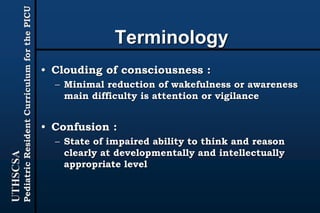
Terminology
• Clouding of consciousness :
– Minimal reduction of wakefulness or awareness
main difficulty is attention or vigilance
• Confusion :
– State of impaired ability to think and reason
clearly at developmentally and intellectually
appropriate level
UTHSCSA
PediatricResidentCurriculumforthePICU
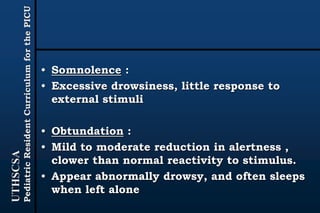
• Somnolence :
• Excessive drowsiness, little response to
external stimuli
• Obtundation :
• Mild to moderate reduction in alertness ,
clower than normal reactivity to stimulus.
• Appear abnormally drowsy, and often sleeps
when left alone
UTHSCSA
PediatricResidentCurriculumforthePICU
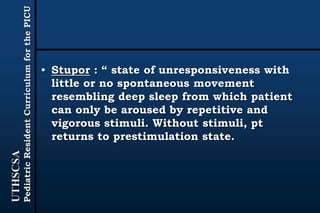
• Stupor : “ state of unresponsiveness with
little or no spontaneous movement
resembling deep sleep from which patient
can only be aroused by repetitive and
vigorous stimuli. Without stimuli, pt
returns to prestimulation state.
UTHSCSA
PediatricResidentCurriculumforthePICU
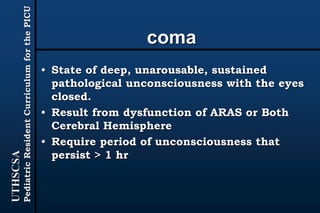
coma
• State of deep, unarousable, sustained
pathological unconsciousness with the eyes
closed.
• Result from dysfunction of ARAS or Both
Cerebral Hemisphere
• Require period of unconsciousness that
persist > 1 hr
UTHSCSA
PediatricResidentCurriculumforthePICU
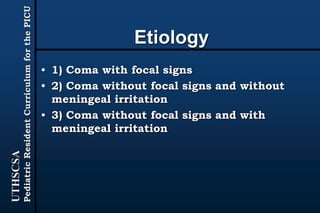
Etiology
• 1) Coma with focal signs
• 2) Coma without focal signs and without
meningeal irritation
• 3) Coma without focal signs and with
meningeal irritation
UTHSCSA
PediatricResidentCurriculumforthePICU
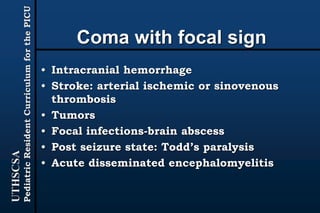
Coma with focal sign
• Intracranial hemorrhage
• Stroke: arterial ischemic or sinovenous
thrombosis
• Tumors
• Focal infections-brain abscess
• Post seizure state: Todd’s paralysis
• Acute disseminated encephalomyelitis
UTHSCSA
PediatricResidentCurriculumforthePICU
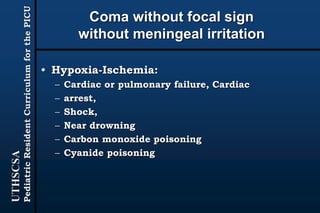
Coma without focal sign
without meningeal irritation
• Hypoxia-Ischemia:
– Cardiac or pulmonary failure, Cardiac
– arrest,
– Shock,
– Near drowning
– Carbon monoxide poisoning
– Cyanide poisoning
UTHSCSA
PediatricResidentCurriculumforthePICU
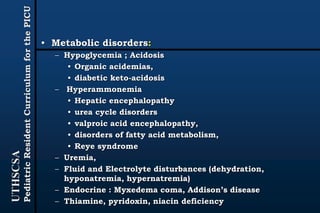
• Metabolic disorders:
– Hypoglycemia ; Acidosis
• Organic acidemias,
• diabetic keto-acidosis
– Hyperammonemia
• Hepatic encephalopathy
• urea cycle disorders
• valproic acid encephalopathy,
• disorders of fatty acid metabolism,
• Reye syndrome
– Uremia,
– Fluid and Electrolyte disturbances (dehydration,
hyponatremia, hypernatremia)
– Endocrine : Myxedema coma, Addison’s disease
– Thiamine, pyridoxin, niacin deficiency
UTHSCSA
PediatricResidentCurriculumforthePICU
Systemic infections
gram-negative sepsis,
meningitis,
toxic shock syndrome,
cat-scratch disease,
Shigella encephalopathy,
Enteric encephalopathy
• Post infectious disorders:
Acute necrotizing encephalopathy,
ADEM,
Hemorrhagic shock and encephalopathy
syndrome
UTHSCSA
PediatricResidentCurriculumforthePICU
• Post immunization encephalopathy:
– Whole cell pertussis vaccine,
– Semple Rabies vaccine
• Drugs and toxins
• Cerebral malaria
• Rickettsial: Lyme disease, Rocky mountain
spotted fever
• Hypertensive encephalopathy (PRES)
• Post seizure states
• Non-convulsive status epilepticus
• Post migraine
UTHSCSA
PediatricResidentCurriculumforthePICU
Coma without focal sign with
meningeal irritation
• Meningitis,
• Encephalitis
• Subarachnoid hemorrhage
UTHSCSA
PediatricResidentCurriculumforthePICU
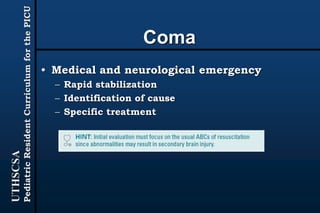
Coma
• Medical and neurological emergency
– Rapid stabilization
– Identification of cause
– Specific treatment
UTHSCSA
PediatricResidentCurriculumforthePICU
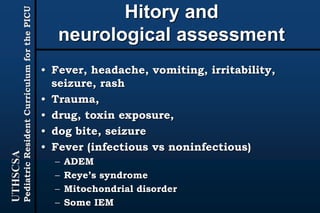
Hitory and
neurological assessment
• Fever, headache, vomiting, irritability,
seizure, rash
• Trauma,
• drug, toxin exposure,
• dog bite, seizure
• Fever (infectious vs noninfectious)
– ADEM
– Reye’s syndrome
– Mitochondrial disorder
– Some IEM
UTHSCSA
PediatricResidentCurriculumforthePICU
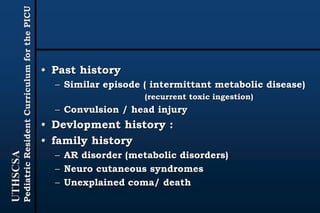
• Past history
– Similar episode ( intermittant metabolic disease)
(recurrent toxic ingestion)
– Convulsion / head injury
• Devlopment history :
• family history
– AR disorder (metabolic disorders)
– Neuro cutaneous syndromes
– Unexplained coma/ death
UTHSCSA
PediatricResidentCurriculumforthePICU
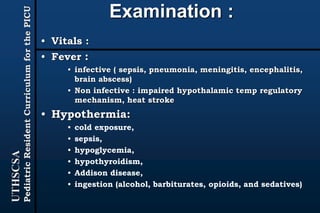
Examination :
• Vitals :
• Fever :
• infective ( sepsis, pneumonia, meningitis, encephalitis,
brain abscess)
• Non infective : impaired hypothalamic temp regulatory
mechanism, heat stroke
• Hypothermia:
• cold exposure,
• sepsis,
• hypoglycemia,
• hypothyroidism,
• Addison disease,
• ingestion (alcohol, barbiturates, opioids, and sedatives)
UTHSCSA
PediatricResidentCurriculumforthePICU
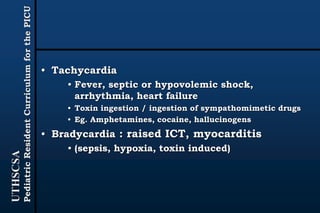
• Tachycardia
• Fever, septic or hypovolemic shock,
arrhythmia, heart failure
• Toxin ingestion / ingestion of sympathomimetic drugs
• Eg. Amphetamines, cocaine, hallucinogens
• Bradycardia : raised ICT, myocarditis
• (sepsis, hypoxia, toxin induced)
UTHSCSA
PediatricResidentCurriculumforthePICU
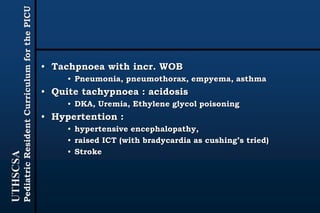
• Tachpnoea with incr. WOB
• Pneumonia, pneumothorax, empyema, asthma
• Quite tachypnoea : acidosis
• DKA, Uremia, Ethylene glycol poisoning
• Hypertention :
• hypertensive encephalopathy,
• raised ICT (with bradycardia as cushing’s tried)
• Stroke
UTHSCSA
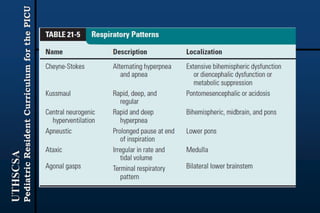
PediatricResidentCurriculumforthePICU
UTHSCSA
PediatricResidentCurriculumforthePICU
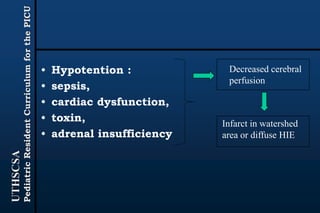
• Hypotention :
• sepsis,
• cardiac dysfunction,
• toxin,
• adrenal insufficiency
Decreased cerebral
perfusion
Infarct in watershed
area or diffuse HIE
UTHSCSA
PediatricResidentCurriculumforthePICU
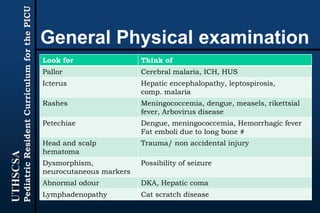
General Physical examination
Look for Think of
Pallor Cerebral malaria, ICH, HUS
Icterus Hepatic encephalopathy, leptospirosis,
comp. malaria
Rashes Meningococcemia, dengue, measels, rikettsial
fever, Arbovirus disease
Petechiae Dengue, meningococcemia, Hemorrhagic fever
Fat emboli due to long bone #
Head and scalp
hematoma
Trauma/ non accidental injury
Dysmorphism,
neurocutaneous markers
Possibility of seizure
Abnormal odour DKA, Hepatic coma
Lymphadenopathy Cat scratch disease
UTHSCSA
PediatricResidentCurriculumforthePICU
G/E cont…
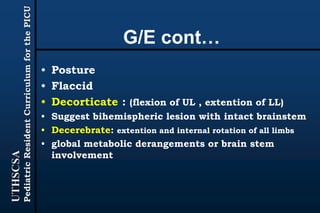
• Posture
• Flaccid
• Decorticate : (flexion of UL , extention of LL)
• Suggest bihemispheric lesion with intact brainstem
• Decerebrate: extention and internal rotation of all limbs
• global metabolic derangements or brain stem
involvement
UTHSCSA
PediatricResidentCurriculumforthePICU
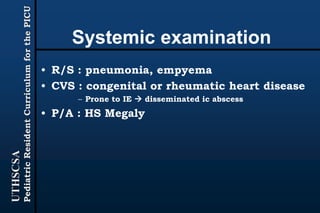
Systemic examination
• R/S : pneumonia, empyema
• CVS : congenital or rheumatic heart disease
– Prone to IE  disseminated ic abscess
• P/A : HS Megaly
UTHSCSA
PediatricResidentCurriculumforthePICU
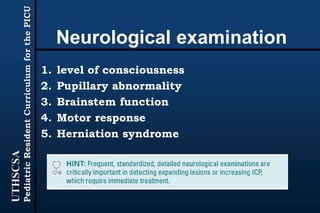
Neurological examination
1. level of consciousness
2. Pupillary abnormality
3. Brainstem function
4. Motor response
5. Herniation syndrome
UTHSCSA
PediatricResidentCurriculumforthePICU
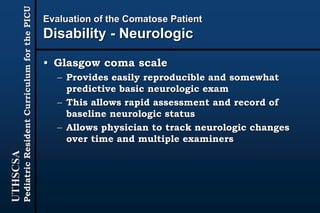
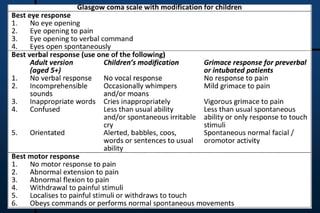
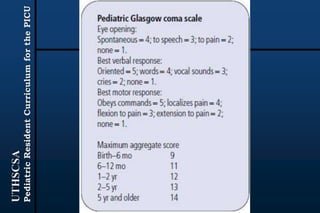
Evaluation of the Comatose Patient
Disability - Neurologic
• Glasgow coma scale
– Provides easily reproducible and somewhat
predictive basic neurologic exam
– This allows rapid assessment and record of
baseline neurologic status
– Allows physician to track neurologic changes
over time and multiple examiners
UTHSCSA
PediatricResidentCurriculumforthePICU
UTHSCSA
PediatricResidentCurriculumforthePICU
Epidemiology
UTHSCSA
PediatricResidentCurriculumforthePICU
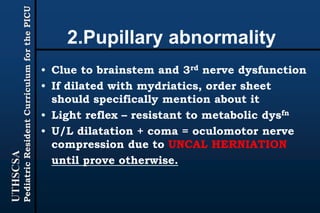
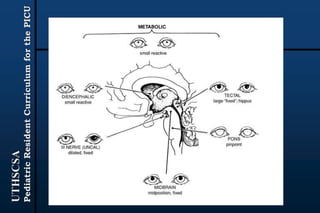
2.Pupillary abnormality
• Clue to brainstem and 3rd nerve dysfunction
• If dilated with mydriatics, order sheet
should specifically mention about it
• Light reflex – resistant to metabolic dysfn
• U/L dilatation + coma = oculomotor nerve
compression due to UNCAL HERNIATION
until prove otherwise.
UTHSCSA
PediatricResidentCurriculumforthePICU
UTHSCSA
PediatricResidentCurriculumforthePICU
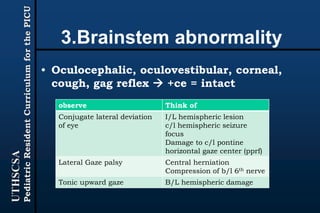
3.Brainstem abnormality
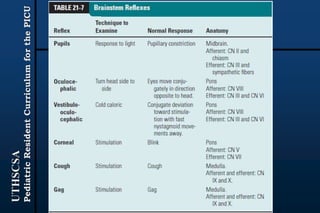
• Oculocephalic, oculovestibular, corneal,
cough, gag reflex  +ce = intact
observe Think of
Conjugate lateral deviation
of eye
I/L hemispheric lesion
c/l hemispheric seizure
focus
Damage to c/l pontine
horizontal gaze center (pprf)
Lateral Gaze palsy Central herniation
Compression of b/l 6th nerve
Tonic upward gaze B/L hemispheric damage
UTHSCSA
PediatricResidentCurriculumforthePICU
UTHSCSA
PediatricResidentCurriculumforthePICU
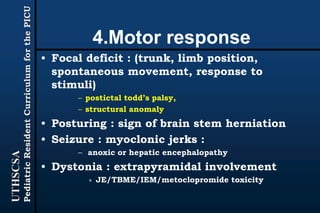
4.Motor response
• Focal deficit : (trunk, limb position,
spontaneous movement, response to
stimuli)
– postictal todd’s palsy,
– structural anomaly
• Posturing : sign of brain stem herniation
• Seizure : myoclonic jerks :
– anoxic or hepatic encephalopathy
• Dystonia : extrapyramidal involvement
Âť JE/TBME/IEM/metoclopromide toxicity
UTHSCSA
PediatricResidentCurriculumforthePICU
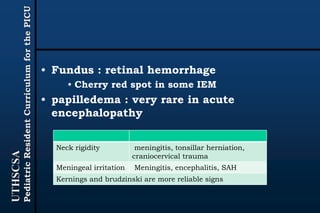
• Fundus : retinal hemorrhage
• Cherry red spot in some IEM
• papilledema : very rare in acute
encephalopathy
Neck rigidity meningitis, tonsillar herniation,
craniocervical trauma
Meningeal irritation Meningitis, encephalitis, SAH
Kernings and brudzinski are more reliable signs
UTHSCSA
PediatricResidentCurriculumforthePICU
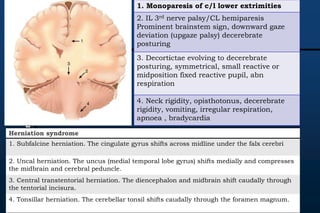
Herniation syndrome
1. Subfalcine herniation. The cingulate gyrus shifts across midline under the falx cerebri
2. Uncal herniation. The uncus (medial temporal lobe gyrus) shifts medially and compresses
the midbrain and cerebral peduncle.
3. Central transtentorial herniation. The diencephalon and midbrain shift caudally through
the tentorial incisura.
4. Tonsillar herniation. The cerebellar tonsil shifts caudally through the foramen magnum.
1. Monoparesis of c/l lower extrimities
2. IL 3rd nerve palsy/CL hemiparesis
Prominent brainstem sign, downward gaze
deviation (upgaze palsy) decerebrate
posturing
3. Decortictae evolving to decerebrate
posturing, symmetrical, small reactive or
midposition fixed reactive pupil, abn
respiration
4. Neck rigidity, opisthotonus, decerebrate
rigidity, vomiting, irregular respiration,
apnoea , bradycardia
UTHSCSA
PediatricResidentCurriculumforthePICU
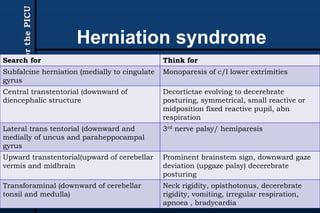
Herniation syndrome
Search for Think for
Subfalcine herniation (medially to cingulate
gyrus
Monoparesis of c/l lower extrimities
Central transtentorial (downward of
diencephalic structure
Decortictae evolving to decerebrate
posturing, symmetrical, small reactive or
midposition fixed reactive pupil, abn
respiration
Lateral trans tentorial (downward and
medially of uncus and paraheppocampal
gyrus
3rd nerve palsy/ hemiparesis
Upward transtentorial(upward of cerebellar
vermis and midbrain
Prominent brainstem sign, downward gaze
deviation (upgaze palsy) decerebrate
posturing
Transforaminal (downward of cerebellar
tonsil and medulla)
Neck rigidity, opisthotonus, decerebrate
rigidity, vomiting, irregular respiration,
apnoea , bradycardia
UTHSCSA
PediatricResidentCurriculumforthePICU
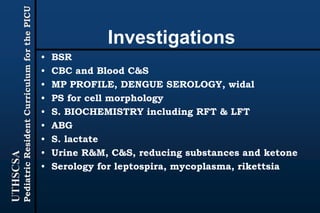
Investigations
• BSR
• CBC and Blood C&S
• MP PROFILE, DENGUE SEROLOGY, widal
• PS for cell morphology
• S. BIOCHEMISTRY including RFT & LFT
• ABG
• S. lactate
• Urine R&M, C&S, reducing substances and ketone
• Serology for leptospira, mycoplasma, rikettsia
UTHSCSA
PediatricResidentCurriculumforthePICU
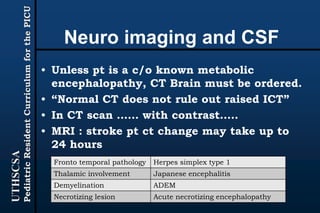
Neuro imaging and CSF
• Unless pt is a c/o known metabolic
encephalopathy, CT Brain must be ordered.
• “Normal CT does not rule out raised ICT”
• In CT scan …… with contrast…..
• MRI : stroke pt ct change may take up to
24 hours
Fronto temporal pathology Herpes simplex type 1
Thalamic involvement Japanese encephalitis
Demyelination ADEM
Necrotizing lesion Acute necrotizing encephalopathy
UTHSCSA
PediatricResidentCurriculumforthePICU
CT Brain
UTHSCSA
PediatricResidentCurriculumforthePICU
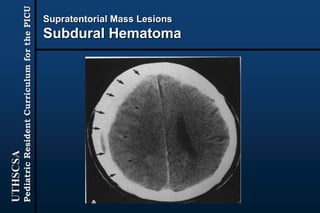
Supratentorial Mass Lesions
Subdural Hematoma
UTHSCSA
PediatricResidentCurriculumforthePICU
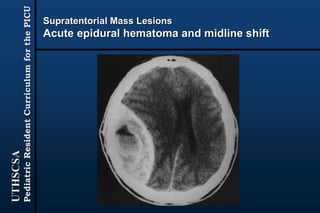
Supratentorial Mass Lesions
Acute epidural hematoma and midline shift
UTHSCSA
PediatricResidentCurriculumforthePICU
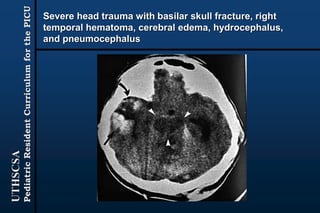
Severe head trauma with basilar skull fracture, right
temporal hematoma, cerebral edema, hydrocephalus,
and pneumocephalus
UTHSCSA
PediatricResidentCurriculumforthePICU
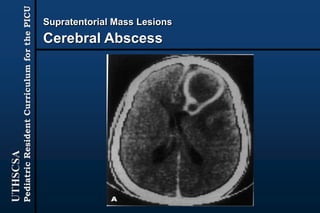
Supratentorial Mass Lesions
Cerebral Abscess
UTHSCSA
PediatricResidentCurriculumforthePICU
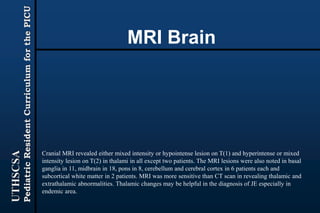
MRI Brain
Cranial MRI revealed either mixed intensity or hypointense lesion on T(1) and hyperintense or mixed
intensity lesion on T(2) in thalami in all except two patients. The MRI lesions were also noted in basal
ganglia in 11, midbrain in 18, pons in 8, cerebellum and cerebral cortex in 6 patients each and
subcortical white matter in 2 patients. MRI was more sensitive than CT scan in revealing thalamic and
extrathalamic abnormalities. Thalamic changes may be helpful in the diagnosis of JE especially in
endemic area.
UTHSCSA
PediatricResidentCurriculumforthePICU
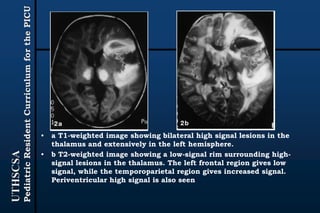
• a T1-weighted image showing bilateral high signal lesions in the
thalamus and extensively in the left hemisphere.
• b T2-weighted image showing a low-signal rim surrounding high-
signal lesions in the thalamus. The left frontal region gives low
signal, while the temporoparietal region gives increased signal.
Periventricular high signal is also seen
UTHSCSA
PediatricResidentCurriculumforthePICU
Second line investigations
• Metabolic Testing
• (before stopping feed and starting treatment)
– Blood ammonia and lactate
– S. amino acid
– Urine for organic acid
– Plasma free fatty acid and carnitine levels
• Cause of hyperammonemia
– IEM - liver failure
– Reye’s syndrome - valproate toxicity
• Urine for toxicological screen
• Thyroid function test
• Workup for CNS vasculitis
UTHSCSA
PediatricResidentCurriculumforthePICU
Ix cont…
• Drug levels ( suspected anti epileptic
toxicity)
• ESR and autoimmune screen for cerebral
vasculitis
UTHSCSA
PediatricResidentCurriculumforthePICU
EEG IN COMATOSE CHILD
• Diffuse theta and delta activity, absence of
faster frequency, intermittent rhythmic
delta activity  characteristic of severe
encephalopathy
• Specific epileptiform activity of absence
seizure or complex partial seizure
• Triphasic wave of hepatic or uremic
encephalopathy
• PLED of herpes encephalitis
UTHSCSA
PediatricResidentCurriculumforthePICU
Approach to the Comatose Patient
Initial Treatment
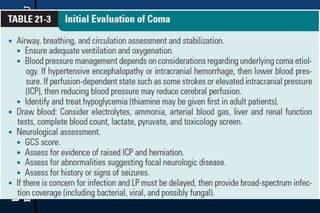
• Airway
• Breathing
• Circulation
• ABC - identify and address life threatening
inadequacies
• Treat rapidly progressive metabolic
disorders -- hypoglycemia
• Evaluate for intracranial hypertension and
imminent herniation and treat
UTHSCSA
PediatricResidentCurriculumforthePICU
Management of the Comatose Patient
Airway
• Evaluate -- is airway patent. Can patient
move air without obstruction. Is there
trauma or foreign body obstructing airway
• Try chin lift to help open airway -- protect
cervical spine
• Place airway if indicated - nasal or oral
airway, intubation, or surgical airway
UTHSCSA
PediatricResidentCurriculumforthePICU Management of the Comatose Patient
Airway
• Intubate (protecting neck) “anyone who
will let you”
– Any of the following are adequate criteria
• GCS < 9
• Airway not secure or open
• Respiration not adequate
• Any significant respiratory failure
• Uncertainty regarding direction or rate of
mental status changes, particularly if
constant observation not available (during
CT scans, etc..)
• Fluid refractory shock
UTHSCSA
PediatricResidentCurriculumforthePICU
Management of the Comatose Patient
Breathing
• Evaluate - is patient moving adequate air,
is respiratory rate appropriate, is gas
exchange adequate, are breath sounds
adequate and symmetrical
• Must assure oxygenation and ventilation
• If intubated don’t forget to ventilate
• Identify and immediately treat problems
- pneumothorax, airway obstruction, etc..
UTHSCSA
PediatricResidentCurriculumforthePICU
Management of the Comatose Patient
Circulation
• Is patient in shock?
• Check pulses, heart rate, blood pressure,
perfusion
• Remember hypotension is late sign of
shock
• Start treatment for shock
• Do not restrict fluids in comatose patient
with inadequate intravascular volume.
• Cardiac output and cerebral perfusion are
much more important than fluid restriction
UTHSCSA
PediatricResidentCurriculumforthePICU
Management of the Comatose Patient
Circulation
• Use isotonic solutions and blood, as
indicated.
• Do not use hypotonic solutions to treat
shock, particularly patients with coma or
possible cerebral edema
• Identify life threatening hemorrhage and
control it.
UTHSCSA
PediatricResidentCurriculumforthePICU
Management and Evaluation of the Comatose Patient
Practicalities
• During ABC’s and secondary survey:
– Have someone start IV and obtain labs
• ABG’s
• Chem 7, LFT’s, ammonia, coagulation studies
• Toxin screens
• Dextrostick
– As soon as IV in and labs drawn, give
• Glucose (D25, 2 - 4 cc per kilogram)
• Consider thiamin
UTHSCSA
PediatricResidentCurriculumforthePICU
Management of the Comatose Patient
Secondary Survey
• Do a quick general exam of the entire
body to identify acute life threatening
conditions
• In general, major thoracic or abdominal
trauma takes precedence after ABC’s
• Only very rarely is acute neurosurgical
intervention appropriate before other
acute life threatening injuries are
stabilized (except protection of c spine by
immobilization)
UTHSCSA
PediatricResidentCurriculumforthePICU
Neurologic Examination
Secondary Survey
• General motor exam
– look for focal deficits, posturing (decerebrate or
decorticate)
• Reflexes, tone
• Cranial nerve and brainstem function
– Pupillary response - diencephalon, midbrain,
brainstem, CN’s II and III
– Corneal Reflex - CN’s V, VII, brainstem
– Oculocephalic Reflex - not if neck injury possible.
Tests CN’s III, IV, VI, VIII, and brainstem.
– Oculovestibular (calorics) can be done if neck
questionable.
UTHSCSA
PediatricResidentCurriculumforthePICU
Neurologic Exam
Oculovestibular Testing
• Check for tympanic perforation
• Instill 120 cc cold water over 2 minutes
• Conscious patient - COWS
• Coma with intact pathways - tonic eye
deviation to side of cold
UTHSCSA
PediatricResidentCurriculumforthePICU
Management and Evaluation of the
Comatose Patient
• Does the patient have a rapidly
progressive intracranial lesion?
• Assume yes, if:
– 1. Any evidence of brainstem abnormality
– 2. Any evidence of rostral caudal progression
– 3. Any focal deficits
– 4. Progression of motor exam from withdrawal
to posturing
UTHSCSA
PediatricResidentCurriculumforthePICU
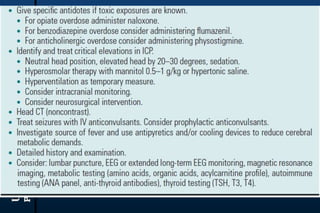
Does the patient have a rapidly
progressive intracranial lesion?
1. Identification of herniation syndrome and
raised ICP
• Positioning (elevated head end of bed)
• Neutral position of head
• Hyperventilation
• Mannitol ( 0.25-1 gm / kg bolus followed by
0.25-0.5 g/kg bolus repeated every 2-6 hrly
• 3%NS as continuous infusion 0.1-1.0
ml/kg/hr to target sodium level 145-155
meq/L
UTHSCSA
PediatricResidentCurriculumforthePICU
2. Identify and treat hypoglycemia BSR< 50
(2ml/kg D-10%, then GIR 6-8 mg/kg/min)
3. Identify seizure and start treatment
– Lorazepam 0.1mg/kg
– Phenytoin 20 mg/kg loading
“Non convulsive status epilepticus should be looked for in all
children with unexplained encephalopathy”
4. Treat electrolyte and acid base disorder
UTHSCSA
PediatricResidentCurriculumforthePICU
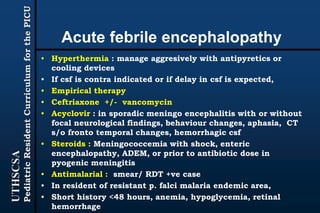
Acute febrile encephalopathy
• Hyperthermia : manage aggresively with antipyretics or
cooling devices
• If csf is contra indicated or if delay in csf is expected,
• Empirical therapy
• Ceftriaxone +/- vancomycin
• Acyclovir : in sporadic meningo encephalitis with or without
focal neurological findings, behaviour changes, aphasia, CT
s/o fronto temporal changes, hemorrhagic csf
• Steroids : Meningococcemia with shock, enteric
encephalopathy, ADEM, or prior to antibiotic dose in
pyogenic meningitis
• Antimalarial : smear/ RDT +ve case
• In resident of resistant p. falci malaria endemic area,
• Short history <48 hours, anemia, hypoglycemia, retinal
hemorrhage
UTHSCSA
PediatricResidentCurriculumforthePICU
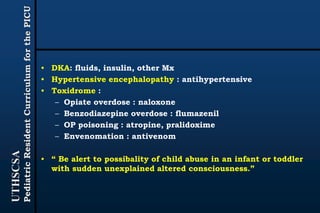
• DKA: fluids, insulin, other Mx
• Hypertensive encephalopathy : antihypertensive
• Toxidrome :
– Opiate overdose : naloxone
– Benzodiazepine overdose : flumazenil
– OP poisoning : atropine, pralidoxime
– Envenomation : antivenom
• “ Be alert to possibality of child abuse in an infant or toddler
with sudden unexplained altered consciousness.”
UTHSCSA
PediatricResidentCurriculumforthePICU
UTHSCSA
PediatricResidentCurriculumforthePICU
UTHSCSA
PediatricResidentCurriculumforthePICU

Approach to child with coma