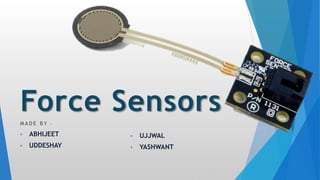
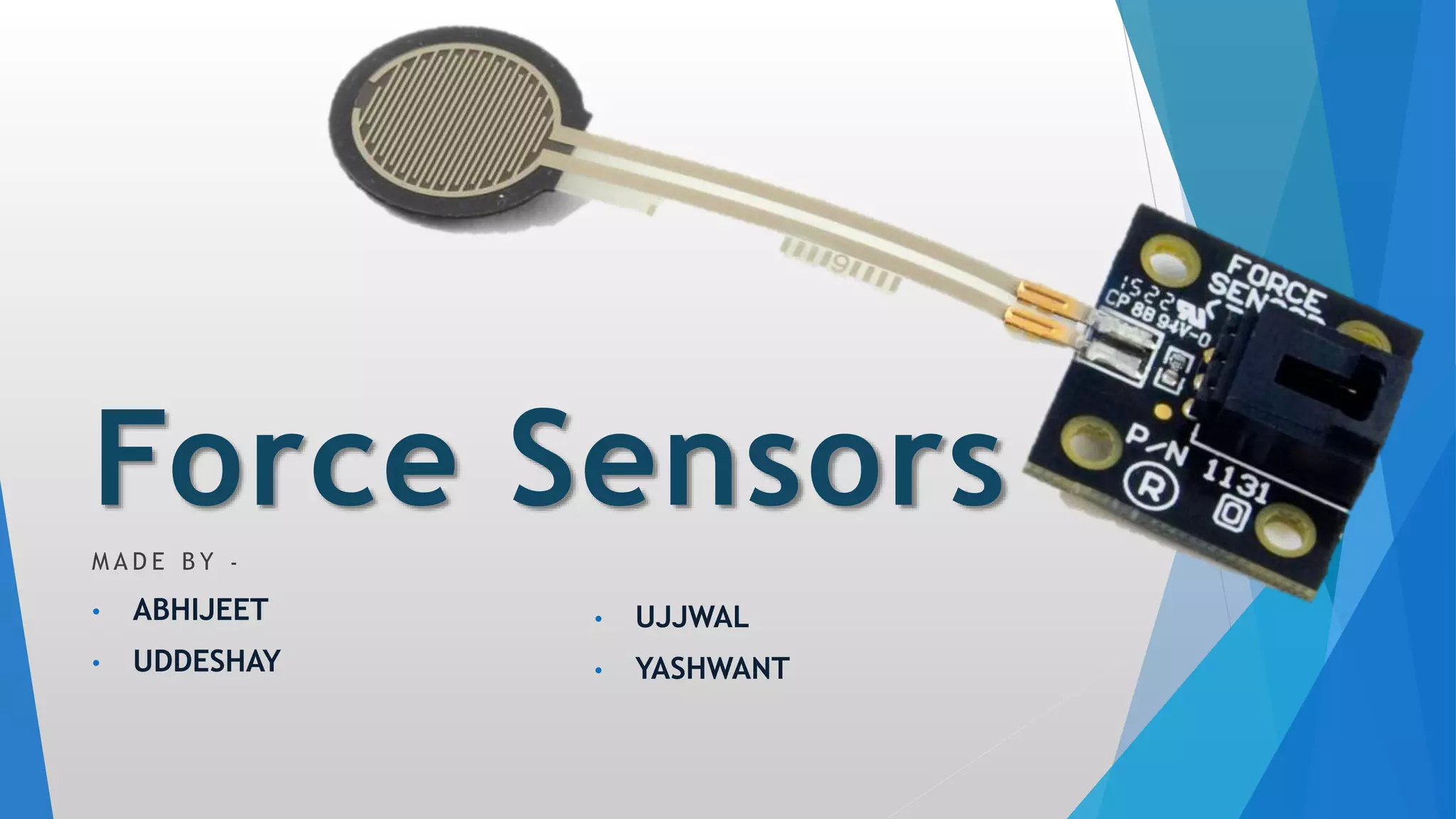
Force Sensors
M A D E B Y -
• ABHIJEET
• UDDESHAY
• UJJWAL
• YASHWANT
SENSOR
•Thepurposeofasensoristorespondtosome
kindofaninputphysicalpropertyandtoconvert
itintoanelectricalsignalwhichiscompatiblewith
electroniccircuits.Thesensoroutputsignalmay
beintheformofvoltage,current,orcharge.
FORCE SENSOR
•Force sensor is a type of transducer, specifically
a force transducer. It converts an input mechanical
force such as load, weight, tension, compression or
pressure into another physical variable, in this case, into an
electrical output signal that can be measured, converted
and standardized. As the force applied to the force sensor
increases, the electrical signal changes proportionally.
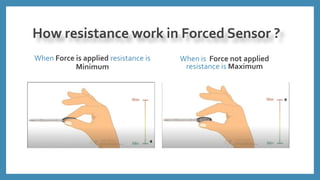
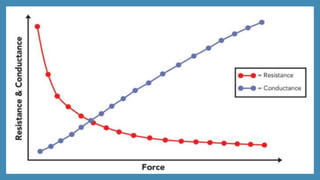
How resistance work in Forced Sensor ?
When Force is applied resistance is
Minimum
When is Force not applied
resistance is Maximum
CONSTRUCTION AND
WORKING PRINCIPAL OF
FORCED SENSOR
To explain how a force sensor works, we first
have to understand how does a strain
gauge (or SG) work ? For most common force
transducers have strain gauges inside them
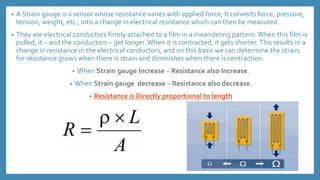
• A Strain gauge is a sensor whose resistance varies with applied force; It converts force, pressure,
tension, weight, etc., into a change in electrical resistance which can then be measured.
• They are electrical conductors firmly attached to a film in a meandering pattern.When this film is
pulled, it – and the conductors – get longer. When it is contracted, it gets shorter.This results in a
change in resistance in the electrical conductors, and on this basis we can determine the strain,
for resistance grows when there is strain and diminishes when there is contraction.
• When Strain gauge Increase – Resistance also Increase.
• When Strain gauge decrease – Resistance also decrease.
• Resistance is Directly proportional to length
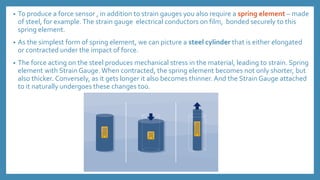
• To produce a force sensor , in addition to strain gauges you also require a spring element – made
of steel, for example.The strain gauge electrical conductors on film, bonded securely to this
spring element.
• As the simplest form of spring element, we can picture a steel cylinder that is either elongated
or contracted under the impact of force.
• The force acting on the steel produces mechanical stress in the material, leading to strain. Spring
element with Strain Gauge.When contracted, the spring element becomes not only shorter, but
also thicker. Conversely, as it gets longer it also becomes thinner. And the Strain Gauge attached
to it naturally undergoes these changes too.
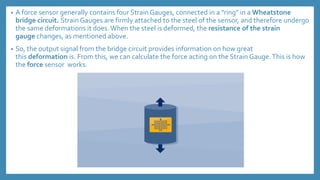
• A force sensor generally contains four Strain Gauges, connected in a "ring" in a Wheatstone
bridge circuit. Strain Gauges are firmly attached to the steel of the sensor, and therefore undergo
the same deformations it does.When the steel is deformed, the resistance of the strain
gauge changes, as mentioned above.
• So, the output signal from the bridge circuit provides information on how great
this deformation is. From this, we can calculate the force acting on the Strain Gauge.This is how
the force sensor works.
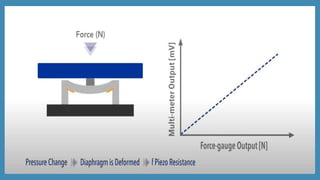
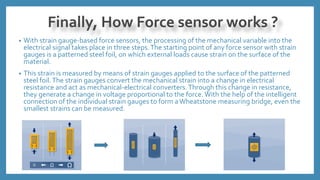
• With strain gauge-based force sensors, the processing of the mechanical variable into the
electrical signal takes place in three steps.The starting point of any force sensor with strain
gauges is a patterned steel foil, on which external loads cause strain on the surface of the
material.
• This strain is measured by means of strain gauges applied to the surface of the patterned
steel foil.The strain gauges convert the mechanical strain into a change in electrical
resistance and act as mechanical-electrical converters.Through this change in resistance,
they generate a change in voltage proportional to the force. With the help of the intelligent
connection of the individual strain gauges to form aWheatstone measuring bridge, even the
smallest strains can be measured.
Finally, How Force sensor works ?
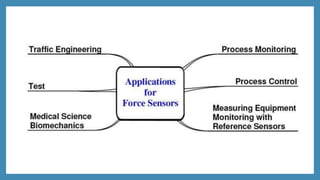
Applications of
ForceSensor
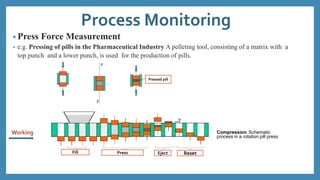
Process Monitoring
• Press Force Measurement
• e.g. Pressing of pills in the Pharmaceutical Industry A pelleting tool, consisting of a matrix with a
top punch and a lower punch, is used for the production of pills.
F
F
Pressed pill
Fill Press Eject Reset
Working Compression: Schematic
process in a rotation pill press
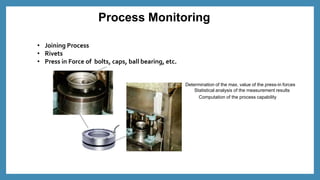
Process Monitoring
• Joining Process
• Rivets
• Press in Force of bolts, caps, ball bearing, etc.
Determination of the max. value of the press-in forces
Statistical analysis of the measurement results
Computation of the process capability
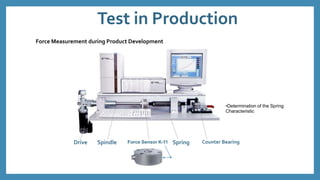
Test in Production
Force Measurement during Product Development
Drive Spindle Spring Counter Bearing
Force Sensor K-11
•Determination of the Spring
Characteristic
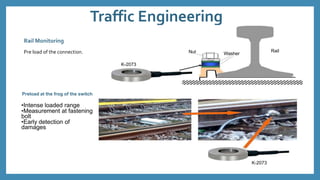
Traffic Engineering
Rail Monitoring
Pre load of the connection.
K-2073
Nut Washer
Rail
Preload at the frog of the switch
•Intense loaded range
•Measurement at fastening
bolt
•Early detection of
damages
K-2073
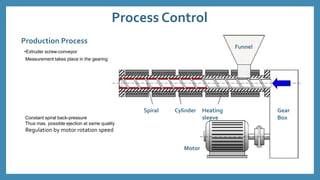
Process Control
Spiral Cylinder Heating
sleeve
Gear
Box
Motor
Funnel
Production Process
•Extruder screw-conveyor
Measurement takes place in the gearing
Constant spiral back-pressure
Thus max. possible ejection at same quality
Regulation by motor rotation speed
Medical Science Biomechanics
• Dynamometry
• Legs Force measurement
Medical Diagnostics
Sports Medicine
Hand Force Measurement
K-2565
The handgrip force is basis for dressing, eating,
cooking etc.
Reduced handgrip force reduced muscularity (e.g. used for elderly people)
For example, measurement of the hand force after an
injury of the hand shows considerably smaller values
(comparison between injured and healthy hand)
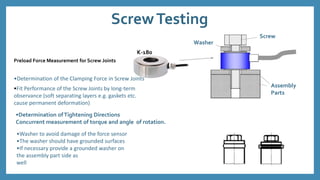
ScrewTesting
Preload Force Measurement for Screw Joints
Washer
K-180
Screw
Assembly
Parts
•Determination of the Clamping Force in Screw Joints
•Fit Performance of the Screw Joints by long-term
observance (soft separating layers e.g. gaskets etc.
cause permanent deformation)
•Determination ofTightening Directions
Concurrent measurement of torque and angle of rotation.
•Washer to avoid damage of the force sensor
•The washer should have grounded surfaces
•If necessary provide a grounded washer on
the assembly part side as
well
Thank you

Forced sensor (Sensor)

  • 1.
    Force Sensors M AD E B Y - • ABHIJEET • UDDESHAY • UJJWAL • YASHWANT
  • 2.
  • 3.
    FORCE SENSOR •Force sensoris a type of transducer, specifically a force transducer. It converts an input mechanical force such as load, weight, tension, compression or pressure into another physical variable, in this case, into an electrical output signal that can be measured, converted and standardized. As the force applied to the force sensor increases, the electrical signal changes proportionally.
  • 5.
    How resistance workin Forced Sensor ? When Force is applied resistance is Minimum When is Force not applied resistance is Maximum
  • 7.
  • 8.
    To explain howa force sensor works, we first have to understand how does a strain gauge (or SG) work ? For most common force transducers have strain gauges inside them
  • 9.
    • A Straingauge is a sensor whose resistance varies with applied force; It converts force, pressure, tension, weight, etc., into a change in electrical resistance which can then be measured. • They are electrical conductors firmly attached to a film in a meandering pattern.When this film is pulled, it – and the conductors – get longer. When it is contracted, it gets shorter.This results in a change in resistance in the electrical conductors, and on this basis we can determine the strain, for resistance grows when there is strain and diminishes when there is contraction. • When Strain gauge Increase – Resistance also Increase. • When Strain gauge decrease – Resistance also decrease. • Resistance is Directly proportional to length
  • 10.
    • To producea force sensor , in addition to strain gauges you also require a spring element – made of steel, for example.The strain gauge electrical conductors on film, bonded securely to this spring element. • As the simplest form of spring element, we can picture a steel cylinder that is either elongated or contracted under the impact of force. • The force acting on the steel produces mechanical stress in the material, leading to strain. Spring element with Strain Gauge.When contracted, the spring element becomes not only shorter, but also thicker. Conversely, as it gets longer it also becomes thinner. And the Strain Gauge attached to it naturally undergoes these changes too.
  • 11.
    • A forcesensor generally contains four Strain Gauges, connected in a "ring" in a Wheatstone bridge circuit. Strain Gauges are firmly attached to the steel of the sensor, and therefore undergo the same deformations it does.When the steel is deformed, the resistance of the strain gauge changes, as mentioned above. • So, the output signal from the bridge circuit provides information on how great this deformation is. From this, we can calculate the force acting on the Strain Gauge.This is how the force sensor works.
  • 12.
    • With straingauge-based force sensors, the processing of the mechanical variable into the electrical signal takes place in three steps.The starting point of any force sensor with strain gauges is a patterned steel foil, on which external loads cause strain on the surface of the material. • This strain is measured by means of strain gauges applied to the surface of the patterned steel foil.The strain gauges convert the mechanical strain into a change in electrical resistance and act as mechanical-electrical converters.Through this change in resistance, they generate a change in voltage proportional to the force. With the help of the intelligent connection of the individual strain gauges to form aWheatstone measuring bridge, even the smallest strains can be measured. Finally, How Force sensor works ?
  • 13.
  • 15.
    Process Monitoring • PressForce Measurement • e.g. Pressing of pills in the Pharmaceutical Industry A pelleting tool, consisting of a matrix with a top punch and a lower punch, is used for the production of pills. F F Pressed pill Fill Press Eject Reset Working Compression: Schematic process in a rotation pill press
  • 16.
    Process Monitoring • JoiningProcess • Rivets • Press in Force of bolts, caps, ball bearing, etc. Determination of the max. value of the press-in forces Statistical analysis of the measurement results Computation of the process capability
  • 17.
    Test in Production ForceMeasurement during Product Development Drive Spindle Spring Counter Bearing Force Sensor K-11 •Determination of the Spring Characteristic
  • 18.
    Traffic Engineering Rail Monitoring Preload of the connection. K-2073 Nut Washer Rail Preload at the frog of the switch •Intense loaded range •Measurement at fastening bolt •Early detection of damages K-2073
  • 19.
    Process Control Spiral CylinderHeating sleeve Gear Box Motor Funnel Production Process •Extruder screw-conveyor Measurement takes place in the gearing Constant spiral back-pressure Thus max. possible ejection at same quality Regulation by motor rotation speed
  • 20.
    Medical Science Biomechanics •Dynamometry • Legs Force measurement Medical Diagnostics Sports Medicine Hand Force Measurement K-2565 The handgrip force is basis for dressing, eating, cooking etc. Reduced handgrip force reduced muscularity (e.g. used for elderly people) For example, measurement of the hand force after an injury of the hand shows considerably smaller values (comparison between injured and healthy hand)
  • 21.
    ScrewTesting Preload Force Measurementfor Screw Joints Washer K-180 Screw Assembly Parts •Determination of the Clamping Force in Screw Joints •Fit Performance of the Screw Joints by long-term observance (soft separating layers e.g. gaskets etc. cause permanent deformation) •Determination ofTightening Directions Concurrent measurement of torque and angle of rotation. •Washer to avoid damage of the force sensor •The washer should have grounded surfaces •If necessary provide a grounded washer on the assembly part side as well
  • 22.