Actuarial Science as Data Science
Actuarial Modeling in R


Revolution Analytics Webinar   Jim Guszcza, FCAS, MAAA

                               Deloitte Consulting LLP
                               University of Wisconsin-Madison
March 28, 2012
About Your Presenter


•    James Guszcza, PhD, FCAS, MAAA
•    National Predictive Analytics Lead – Deloitte Consulting Actuarial, Risk, Analytics practice
•    Assistant professor of actuarial science & risk management – U. Wisconsin-Madison
•    PhD in Philosophy – The University of Chicago
•    Fellow of the Casualty Actuarial Society
•    Lots experience building predictive models / analyzing data in and outside of insurance

    jguszcza@deloitte.com
    jguszcza@bus.wisc.edu
     2   Deloitte Analytics Institute                                                      © 2011 Deloitte LLP
Agenda
         Introduction

         Actuarial Science and Data Science

         R Background

         Case Studies

         • Fitting a complex size of loss model

         • Loss Reserving

         • Bayesian Hierarchical Modeling

         • Revolution: Tweedie Regression on big data
Actuarial Science and
Data Science
Not Just Hype


“Perhaps the most important cultural trend today: The
 explosion of data about every aspect of our world and
 the rise of applied math gurus who know how to use it.”

    -- Chris Anderson, editor-in-chief of Wired

• So behavioral economics is important in insurance for two
  classes of reasons:

     • Decision-makers at insurance companies are human
     • People making insurance purchasing decisions are human


5    Deloitte Analytics Institute                             © 2010 Deloitte LLP
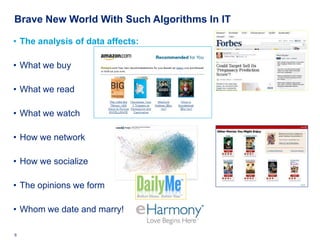
Brave New World With Such Algorithms In IT

• The analysis of data affects:

• What we buy

• What we read

• What we watch

• How we network

• How we socialize

• The opinions we form

• Whom we date and marry!

6   Deloitte Analytics Institute             © 2010 Deloitte LLP
Clinical vs Actuarial Judgment – the Motion Picture


7   Deloitte Analytics Institute                      © 2010 Deloitte LLP
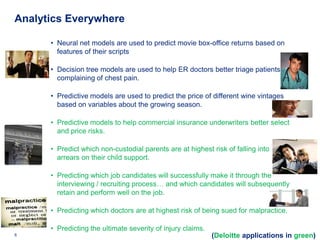
Analytics Everywhere

                 • Neural net models are used to predict movie box-office returns based on
                   features of their scripts

                 • Decision tree models are used to help ER doctors better triage patients
                   complaining of chest pain.

                 • Predictive models are used to predict the price of different wine vintages
                   based on variables about the growing season.

                 • Predictive models to help commercial insurance underwriters better select
                   and price risks.

                 • Predict which non-custodial parents are at highest risk of falling into
                   arrears on their child support.

                 • Predicting which job candidates will successfully make it through the
                   interviewing / recruiting process… and which candidates will subsequently
                   retain and perform well on the job.

                 • Predicting which doctors are at highest risk of being sued for malpractice.

                 • Predicting the ultimate severity of injury claims.
8   Deloitte Analytics Institute                                        (Deloitte applications in green)
                                                                                             © 2010 Deloitte LLP
At the Center of It All: Data Science
      Or: “The Collision between Statistics and Computation”


• Today the analytics world is
  different largely due to
  exponential growth in
  computing power.

• The skill set underlying
  business analytics is
  increasingly called
  data science.

• Data science goes beyond:
    • Traditional statistics
    • Business intelligence [BI]
                                                       Image borrowed from Drew Conway’s blog
    • Information technology                http://www.dataists.com/2010/09/the-data-science-venn-diagram

9   Deloitte Analytics Institute                                                             © 2010 Deloitte LLP
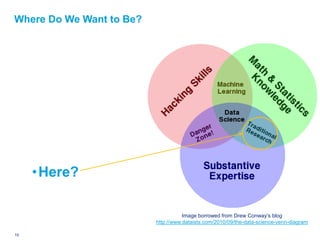
Where Do We Want to Be?


       •Here?

                                               Image borrowed from Drew Conway’s blog
                                    http://www.dataists.com/2010/09/the-data-science-venn-diagram

10   Deloitte Analytics Institute                                                    © 2010 Deloitte LLP
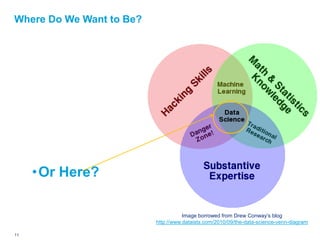
Where Do We Want to Be?


       •Or Here?

                                               Image borrowed from Drew Conway’s blog
                                    http://www.dataists.com/2010/09/the-data-science-venn-diagram

11   Deloitte Analytics Institute                                                    © 2010 Deloitte LLP
On then, on to R


12   Deloitte Analytics Institute   © 2010 Deloitte LLP
R Background
R Overview

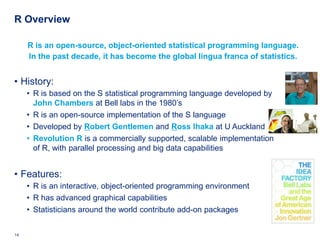
     R is an open-source, object-oriented statistical programming language.
     In the past decade, it has become the global lingua franca of statistics.


• History:
     • R is based on the S statistical programming language developed by
       John Chambers at Bell labs in the 1980’s
     • R is an open-source implementation of the S language
     • Developed by Robert Gentlemen and Ross Ihaka at U Auckland
     • Revolution R is a commercially supported, scalable implementation
       of R, with parallel processing and big data capabilities


• Features:
     • R is an interactive, object-oriented programming environment
     • R has advanced graphical capabilities
     • Statisticians around the world contribute add-on packages


14   Deloitte Analytics Institute                                          © 2010 Deloitte LLP
On the Shoulders of Giants

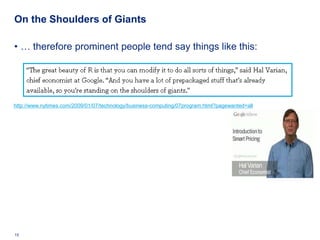
• … therefore prominent people tend say things like this:


http://www.nytimes.com/2009/01/07/technology/business-computing/07program.html?pagewanted=all


15   Deloitte Analytics Institute                                                               © 2010 Deloitte LLP
Facets of R

• In a recent article John Chambers discussed 6 “Facets of R”
     1.    An interface to computational procedures of many kinds
     2.    Interactive, hands-on in real time
     3.    Functional in its model of programming
     4.    Object-oriented, “everything is an object”
     5.    Modular, built from standardized pieces
     6.    Collaborative, a world-wide, open-source effort


• Interactive interface: Chambers was influenced by APL
     • In the days before spreadsheets, APL was very popular in the actuarial
       community
     • One of the rare interactive scientific computing environments
     • Gives user ability to express novel computations
     • Heavy emphasis on matrices and arrays
     • But: unlike R, APL had no interface to procedures

16   Deloitte Analytics Institute                                          © 2010 Deloitte LLP
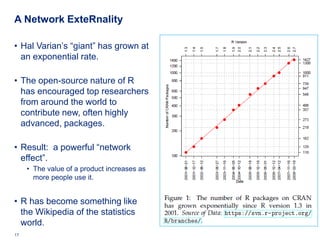
A Network ExteRnality

• Hal Varian’s “giant” has grown at
  an exponential rate.

• The open-source nature of R
  has encouraged top researchers
  from around the world to
  contribute new, often highly
  advanced, packages.

• Result: a powerful “network
  effect”.
     • The value of a product increases as
       more people use it.


• R has become something like
  the Wikipedia of the statistics
  world.
17   Deloitte Analytics Institute            © 2010 Deloitte LLP
Adoption in the Actuarial World


18   Deloitte Analytics Institute   © 2010 Deloitte LLP
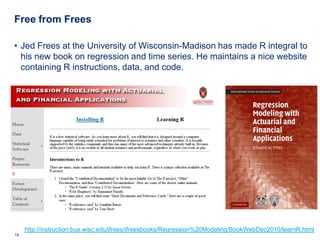
Free from Frees

• Jed Frees at the University of Wisconsin-Madison has made R integral to
  his new book on regression and time series. He maintains a nice website
  containing R instructions, data, and code.


     http://instruction.bus.wisc.edu/jfrees/jfreesbooks/Regression%20Modeling/BookWebDec2010/learnR.html
19    Deloitte Analytics Institute                                                         © 2010 Deloitte LLP
Case Studies
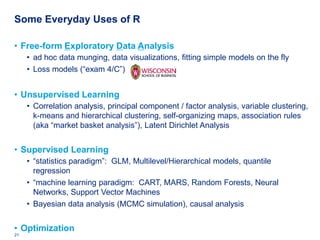
Some Everyday Uses of R

• Free-form Exploratory Data Analysis
     • ad hoc data munging, data visualizations, fitting simple models on the fly
     • Loss models (“exam 4/C”)


• Unsupervised Learning
     • Correlation analysis, principal component / factor analysis, variable clustering,
       k-means and hierarchical clustering, self-organizing maps, association rules
       (aka “market basket analysis”), Latent Dirichlet Analysis


• Supervised Learning
     • “statistics paradigm”: GLM, Multilevel/Hierarchical models, quantile
       regression
     • “machine learning paradigm: CART, MARS, Random Forests, Neural
       Networks, Support Vector Machines
     • Bayesian data analysis (MCMC simulation), causal analysis


• Optimization
21   Deloitte Analytics Institute                                              © 2010 Deloitte LLP
Case Study #1
Loss Distribution Modeling
Modeling a Non-Trivial Loss Distribution


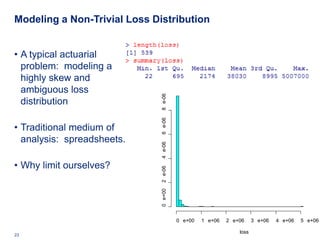
• A typical actuarial
  problem: modeling a
  highly skew and
  ambiguous loss


                                    8 e-06
  distribution


                                    6 e-06
• Traditional medium of
  analysis: spreadsheets.

                                    4 e-06
• Why limit ourselves?              2 e-06
                                    0 e+00


                                             0 e+00   1 e+06   2 e+06     3 e+06   4 e+06         5 e+06

                                                                   loss
23   Deloitte Analytics Institute                                                  © 2010 Deloitte LLP
Case Study #2
Loss Reserving
Three Approaches to Loss Reserving

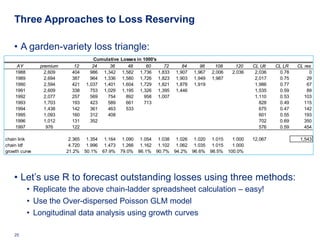
    • A garden-variety loss triangle:
                                               Cumulative   Losses in 1000's
     AY           premium             12      24     36        48      60    72      84      96     108     120   CL Ult   CL LR         CL res
    1988            2,609            404     986 1,342      1,582 1,736 1,833     1,907   1,967   2,006   2,036    2,036     0.78             0
    1989            2,694            387     964 1,336      1,580 1,726 1,823     1,903   1,949   1,987            2,017     0.75            29
    1990            2,594            421   1,037 1,401      1,604 1,729 1,821     1,878   1,919                    1,986     0.77            67
    1991            2,609            338     753 1,029      1,195 1,326 1,395     1,446                            1,535     0.59            89
    1992            2,077            257     569    754       892     958 1,007                                    1,110     0.53           103
    1993            1,703            193     423    589       661     713                                            828     0.49           115
    1994            1,438            142     361    463       533                                                    675     0.47           142
    1995            1,093            160     312    408                                                              601     0.55           193
    1996            1,012            131     352                                                                     702     0.69           350
    1997             976             122                                                                             576     0.59           454

chain link                         2.365 1.354 1.164 1.090 1.054 1.038 1.026 1.020 1.015  1.000                   12,067                   1,543
chain ldf                          4.720 1.996 1.473 1.266 1.162 1.102 1.062 1.035 1.015  1.000
growth curve                      21.2% 50.1% 67.9% 79.0% 86.1% 90.7% 94.2% 96.6% 98.5% 100.0%


    • Let’s use R to forecast outstanding losses using three methods:
           • Replicate the above chain-ladder spreadsheet calculation – easy!
           • Use the Over-dispersed Poisson GLM model
           • Longitudinal data analysis using growth curves

    25     Deloitte Analytics Institute                                                                                     © 2010 Deloitte LLP
What Do You See?

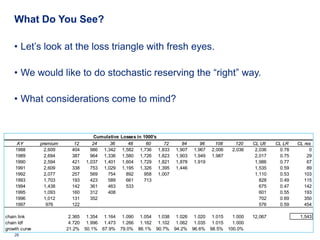
    • Let’s look at the loss triangle with fresh eyes.

    • We would like to do stochastic reserving the “right” way.

    • What considerations come to mind?


                                               Cumulative   Losses in 1000's
     AY           premium             12      24     36        48      60    72      84      96     108     120   CL Ult   CL LR         CL res
    1988            2,609            404     986 1,342      1,582 1,736 1,833     1,907   1,967   2,006   2,036    2,036     0.78             0
    1989            2,694            387     964 1,336      1,580 1,726 1,823     1,903   1,949   1,987            2,017     0.75            29
    1990            2,594            421   1,037 1,401      1,604 1,729 1,821     1,878   1,919                    1,986     0.77            67
    1991            2,609            338     753 1,029      1,195 1,326 1,395     1,446                            1,535     0.59            89
    1992            2,077            257     569    754       892     958 1,007                                    1,110     0.53           103
    1993            1,703            193     423    589       661     713                                            828     0.49           115
    1994            1,438            142     361    463       533                                                    675     0.47           142
    1995            1,093            160     312    408                                                              601     0.55           193
    1996            1,012            131     352                                                                     702     0.69           350
    1997             976             122                                                                             576     0.59           454

chain link                         2.365 1.354 1.164 1.090 1.054 1.038 1.026 1.020 1.015  1.000                   12,067                   1,543
chain ldf                          4.720 1.996 1.473 1.266 1.162 1.102 1.062 1.035 1.015  1.000
growth curve                      21.2% 50.1% 67.9% 79.0% 86.1% 90.7% 94.2% 96.6% 98.5% 100.0%
    26     Deloitte Analytics Institute                                                                                     © 2010 Deloitte LLP
Some Essential Features of Loss Reserving
                                                                                                 Cumulative   Losses in 1000's
                                                                  AY        premium     12      24     36        48      60    72      84      96     108     120   CL Ult   CL LR    CL res
                                                                 1988         2,609    404     986 1,342      1,582 1,736 1,833     1,907   1,967   2,006   2,036    2,036     0.78        0
                                                                 1989         2,694    387     964 1,336      1,580 1,726 1,823     1,903   1,949   1,987            2,017     0.75       29
                                                                 1990         2,594    421   1,037 1,401      1,604 1,729 1,821     1,878   1,919                    1,986     0.77       67
                                                                 1991         2,609    338     753 1,029      1,195 1,326 1,395     1,446                            1,535     0.59       89


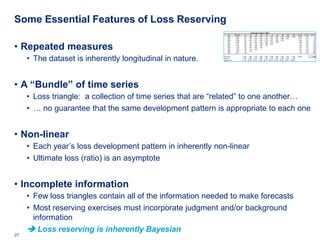
• Repeated measures
                                                                 1992         2,077    257     569    754       892     958 1,007                                    1,110     0.53      103
                                                                 1993         1,703    193     423    589       661     713                                            828     0.49      115
                                                                 1994         1,438    142     361    463       533                                                    675     0.47      142
                                                                 1995         1,093    160     312    408                                                              601     0.55      193
                                                                 1996         1,012    131     352                                                                     702     0.69      350
                                                                 1997          976     122                                                                             576     0.59      454


     • The dataset is inherently longitudinal in nature.     chain link
                                                             chain ldf
                                                             growth curve
                                                                                       2.365 1.354 1.164 1.090 1.054 1.038 1.026 1.020 1.015
                                                                                       4.720 1.996 1.473 1.266 1.162 1.102 1.062 1.035 1.015
                                                                                                                                              1.000
                                                                                                                                              1.000
                                                                                      21.2% 50.1% 67.9% 79.0% 86.1% 90.7% 94.2% 96.6% 98.5% 100.0%
                                                                                                                                                                    12,067             1,543


• A “Bundle” of time series
     • Loss triangle: a collection of time series that are “related” to one another…
     • … no guarantee that the same development pattern is appropriate to each one


• Non-linear
     • Each year’s loss development pattern in inherently non-linear
     • Ultimate loss (ratio) is an asymptote


• Incomplete information
     • Few loss triangles contain all of the information needed to make forecasts
     • Most reserving exercises must incorporate judgment and/or background
       information
      Loss reserving is inherently Bayesian
27   Deloitte Analytics Institute                                                                                                       © 2010 Deloitte LLP
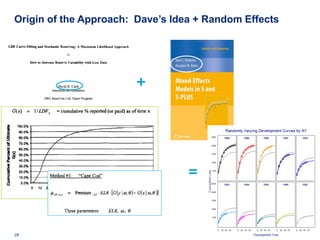
Origin of the Approach: Dave’s Idea + Random Effects


                                    +


                                        =


28   Deloitte Analytics Institute                  © 2010 Deloitte LLP
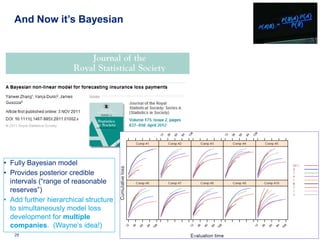
And Now it’s Bayesian


• Fully Bayesian model
• Provides posterior credible
  intervals (“range of reasonable
  reserves”)
• Add further hierarchical structure
  to simultaneously model loss
  development for multiple
  companies. (Wayne’s idea!)
   29   Deloitte Analytics Institute   © 2010 Deloitte LLP
Case Study #3
Hierarchical Bayes Ratemaking
Workers Comp Ratemaking

• We have 7 years of Workers Comp data
     •   Data from Klugman [1992 Bayes book]
     •   128 workers comp classes (types of business)
     •   7 years of summarized data
     •   Given: total payroll, claim count by class
     •   (payroll is a measure of “exposure” in this domain)

     • Problem: use years 1-6 data to predict year 7


31   Deloitte Analytics Institute                              © 2010 Deloitte LLP
Empirical Bayes “Credibility” Approach

• Naïve approach:
     • Calculate average year 1-6 claim frequency by class
     • Use these 128 averages as estimates for year 7.


• Better approach: build empirical Bayes hierarchical model.
     • “Bühlmann-Straub credibility model”
     • “Shrinks” low-credibility classes towards the grand mean
     • Use Douglas Bates’ lme4 package (UW-Madison again!)


                               clmcnti ~ Poi ( payrolli λ j[ i ] )
                                               (
                                    λ j ~ N µλ , σ λ
                                                   2
                                                         )
32   Deloitte Analytics Institute                                    © 2010 Deloitte LLP
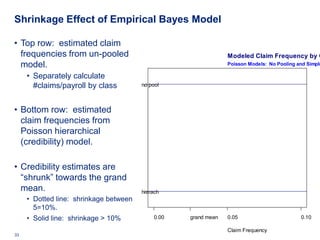
Shrinkage Effect of Empirical Bayes Model

• Top row: estimated claim
  frequencies from un-pooled                                     Modeled Claim Frequency by C
  model.                                                         Poisson Models: No Pooling and Simple

     • Separately calculate
       #claims/payroll by class         no pool


• Bottom row: estimated
  claim frequencies from
  Poisson hierarchical
  (credibility) model.

• Credibility estimates are
  “shrunk” towards the grand
  mean.                                 hierach
     • Dotted line: shrinkage between
       5=10%.
     • Solid line: shrinkage > 10%           0.00   grand mean   0.05                              0.10

                                                                 Claim Frequency
33   Deloitte Analytics Institute                                                   © 2010 Deloitte LLP
clmcnti ~ Poi ( payrolli λ j[ i ] )
Now Specify a Fully Bayesian Model                                                             (
                                                                                    λ j ~ N µλ , σ λ
                                                                                                   2
                                                                                                             )

• Here we specify a fully Bayesian model.
     • Use the rjags package
     • JAGS: Just Another Gibbs Sampler
          • We’re standing on the shoulders of giants named David Spiegelhalter, Martyn Plummer, …


34   Deloitte Analytics Institute                                                                  © 2010 Deloitte LLP
clmcnti ~ Poi ( payrolli λ j[ i ] )
Now Specify a Fully Bayesian Model                          (
                                                 λ j ~ N µλ , σ λ
                                                                2
                                                                          )

• Here we specify a fully Bayesian model.
     • Poisson regression with an offset


35   Deloitte Analytics Institute                               © 2010 Deloitte LLP
clmcnti ~ Poi ( payrolli λ j[ i ] )
Now Specify a Fully Bayesian Model                          (
                                                 λ j ~ N µλ , σ λ
                                                                2
                                                                          )

• Here we specify a fully Bayesian model.
     • Allow for overdispersion


36   Deloitte Analytics Institute                               © 2010 Deloitte LLP
clmcnti ~ Poi ( payrolli λ j[ i ] )
Now Specify a Fully Bayesian Model                          (
                                                 λ j ~ N µλ , σ λ
                                                                2
                                                                          )

• Here we specify a fully Bayesian model.
     • Allow for overdispersion


37   Deloitte Analytics Institute                               © 2010 Deloitte LLP
clmcnti ~ Poi ( payrolli λ j[ i ] )
Now Specify a Fully Bayesian Model                                                (
                                                                       λ j ~ N µλ , σ λ
                                                                                      2
                                                                                                )

• Here we specify a fully Bayesian model.
     • “Credibility weighting” (aka shrinkage) results from giving class-level intercepts
       a probability sub-model.


38   Deloitte Analytics Institute                                                     © 2010 Deloitte LLP
clmcnti ~ Poi ( payrolli λ j[ i ] )
Now Specify a Fully Bayesian Model                                         (
                                                                λ j ~ N µλ , σ λ
                                                                               2
                                                                                         )

• Here we specify a fully Bayesian model.
     • Put a diffuse prior on all of the hyperparameters
     • Fully Bayesian model
     • Bayes or Bust!


39   Deloitte Analytics Institute                                              © 2010 Deloitte LLP
clmcnti ~ Poi ( payrolli λ j[ i ] )
Now Specify a Fully Bayesian Model                                          (
                                                                 λ j ~ N µλ , σ λ
                                                                                2
                                                                                          )

• Here we specify a fully Bayesian model.
     • Replace year-7 actual values with missing values
     • We model the year-7 results … produce 128 posterior density estimates
     • Can compare actual claims with Bayesian posterior probabilities


40   Deloitte Analytics Institute                                               © 2010 Deloitte LLP
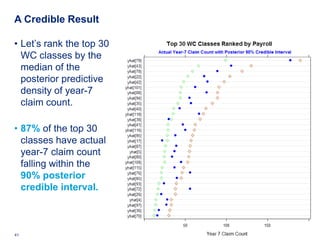
A Credible Result

• Let’s rank the top 30
  WC classes by the
  median of the
  posterior predictive
  density of year-7
  claim count.

• 87% of the top 30
  classes have actual
  year-7 claim count
  falling within the
  90% posterior
  credible interval.


41   Deloitte Analytics Institute   © 2010 Deloitte LLP
Case Study #4
Big Data in Revolution R
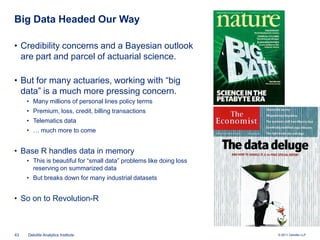
Big Data Headed Our Way

• Credibility concerns and a Bayesian outlook
  are part and parcel of actuarial science.

• But for many actuaries, working with “big
  data” is a much more pressing concern.
     • Many millions of personal lines policy terms
     • Premium, loss, credit, billing transactions
     • Telematics data
     • … much more to come


• Base R handles data in memory
     • This is beautiful for “small data” problems like doing loss
       reserving on summarized data
     • But breaks down for many industrial datasets


• So on to Revolution-R


43   Deloitte Analytics Institute                                    © 2011 Deloitte LLP
The kaggle Allstate Claim Prediction Challenge Data


44   Deloitte Analytics Institute                     © 2011 Deloitte LLP
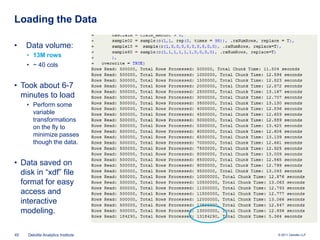
Loading the Data

•    Data volume:
     • 13M rows
     • ~ 40 cols


• Took about 6-7
  minutes to load
     • Perform some
       variable
       transformations
       on the fly to
       minimize passes
       though the data.


• Data saved on
  disk in “xdf” file
  format for easy
  access and
  interactive
  modeling.

45   Deloitte Analytics Institute   © 2011 Deloitte LLP
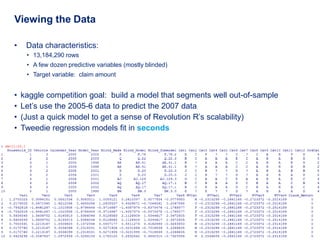
Viewing the Data

•     Data characteristics:
      • 13,184,290 rows
      • A few dozen predictive variables (mostly blinded)
      • Target variable: claim amount


•    kaggle competition goal: build a model that segments well out-of-sample
•    Let’s use the 2005-6 data to predict the 2007 data
•    (Just a quick model to get a sense of Revolution R’s scalability)
•    Tweedie regression models fit in seconds


46     Deloitte Analytics Institute                                        © 2011 Deloitte LLP
Helpful Resources

•    Edward (Jed) Frees – Regression modeling with actuarial and financial
     applications http://www.amazon.com/Regression-Actuarial-Financial-Applications-
     International/dp/0521135966
•    Andrew Gelman / Jennifer Hill - Data Analysis using Regression and
     Multilevel/Hierarchical Models http://www.amazon.com/Analysis-Regression-Multilevel-
     Hierarchical-
     Models/dp/052168689X/ref=sr_1_1?s=books&ie=UTF8&qid=1332961819&sr=1-1
•    Venables and Ripley – Modern Applied Statistics in S http://www.amazon.com/Modern-
     Applied-Statistics-
     Computing/dp/1441930086/ref=sr_1_1?s=books&ie=UTF8&qid=1332961867&sr=1-1
•    Hastie, Tibshirani, Friedman – the Elements of Statistical
     Learning http://www.amazon.com/The-Elements-Statistical-Learning-
     Prediction/dp/0387848576/ref=sr_1_1?s=books&ie=UTF8&qid=1332961913&sr=1-1
•    Gelman, Carlin, Stern, Ruin – Bayesian Data Analysis http://www.amazon.com/Bayesian-
     Analysis-Edition-Chapman-Statistical/dp/158488388X/ref=tag_dpp_lp_edpp_ttl_in
•    John Kruschke – Doing Bayesian Data Analysis http://www.amazon.com/Doing-Bayesian-
     Data-Analysis-
     Tutorial/dp/0123814855/ref=sr_1_3?s=books&ie=UTF8&qid=1332961975&sr=1-3


47   Deloitte Analytics Institute                                               © 2011 Deloitte LLP

Actuarial Analytics in R

  • 1.
    Actuarial Science asData Science Actuarial Modeling in R Revolution Analytics Webinar Jim Guszcza, FCAS, MAAA Deloitte Consulting LLP University of Wisconsin-Madison March 28, 2012
  • 2.
    About Your Presenter • James Guszcza, PhD, FCAS, MAAA • National Predictive Analytics Lead – Deloitte Consulting Actuarial, Risk, Analytics practice • Assistant professor of actuarial science & risk management – U. Wisconsin-Madison • PhD in Philosophy – The University of Chicago • Fellow of the Casualty Actuarial Society • Lots experience building predictive models / analyzing data in and outside of insurance jguszcza@deloitte.com jguszcza@bus.wisc.edu 2 Deloitte Analytics Institute © 2011 Deloitte LLP
  • 3.
    Agenda Introduction Actuarial Science and Data Science R Background Case Studies • Fitting a complex size of loss model • Loss Reserving • Bayesian Hierarchical Modeling • Revolution: Tweedie Regression on big data
  • 4.
  • 5.
    Not Just Hype “Perhapsthe most important cultural trend today: The explosion of data about every aspect of our world and the rise of applied math gurus who know how to use it.” -- Chris Anderson, editor-in-chief of Wired • So behavioral economics is important in insurance for two classes of reasons: • Decision-makers at insurance companies are human • People making insurance purchasing decisions are human 5 Deloitte Analytics Institute © 2010 Deloitte LLP
  • 6.
    Brave New WorldWith Such Algorithms In IT • The analysis of data affects: • What we buy • What we read • What we watch • How we network • How we socialize • The opinions we form • Whom we date and marry! 6 Deloitte Analytics Institute © 2010 Deloitte LLP
  • 7.
    Clinical vs ActuarialJudgment – the Motion Picture 7 Deloitte Analytics Institute © 2010 Deloitte LLP
  • 8.
    Analytics Everywhere • Neural net models are used to predict movie box-office returns based on features of their scripts • Decision tree models are used to help ER doctors better triage patients complaining of chest pain. • Predictive models are used to predict the price of different wine vintages based on variables about the growing season. • Predictive models to help commercial insurance underwriters better select and price risks. • Predict which non-custodial parents are at highest risk of falling into arrears on their child support. • Predicting which job candidates will successfully make it through the interviewing / recruiting process… and which candidates will subsequently retain and perform well on the job. • Predicting which doctors are at highest risk of being sued for malpractice. • Predicting the ultimate severity of injury claims. 8 Deloitte Analytics Institute (Deloitte applications in green) © 2010 Deloitte LLP
  • 9.
    At the Centerof It All: Data Science Or: “The Collision between Statistics and Computation” • Today the analytics world is different largely due to exponential growth in computing power. • The skill set underlying business analytics is increasingly called data science. • Data science goes beyond: • Traditional statistics • Business intelligence [BI] Image borrowed from Drew Conway’s blog • Information technology http://www.dataists.com/2010/09/the-data-science-venn-diagram 9 Deloitte Analytics Institute © 2010 Deloitte LLP
  • 10.
    Where Do WeWant to Be? •Here? Image borrowed from Drew Conway’s blog http://www.dataists.com/2010/09/the-data-science-venn-diagram 10 Deloitte Analytics Institute © 2010 Deloitte LLP
  • 11.
    Where Do WeWant to Be? •Or Here? Image borrowed from Drew Conway’s blog http://www.dataists.com/2010/09/the-data-science-venn-diagram 11 Deloitte Analytics Institute © 2010 Deloitte LLP
  • 12.
    On then, onto R 12 Deloitte Analytics Institute © 2010 Deloitte LLP
  • 13.
  • 14.
    R Overview R is an open-source, object-oriented statistical programming language. In the past decade, it has become the global lingua franca of statistics. • History: • R is based on the S statistical programming language developed by John Chambers at Bell labs in the 1980’s • R is an open-source implementation of the S language • Developed by Robert Gentlemen and Ross Ihaka at U Auckland • Revolution R is a commercially supported, scalable implementation of R, with parallel processing and big data capabilities • Features: • R is an interactive, object-oriented programming environment • R has advanced graphical capabilities • Statisticians around the world contribute add-on packages 14 Deloitte Analytics Institute © 2010 Deloitte LLP
  • 15.
    On the Shouldersof Giants • … therefore prominent people tend say things like this: http://www.nytimes.com/2009/01/07/technology/business-computing/07program.html?pagewanted=all 15 Deloitte Analytics Institute © 2010 Deloitte LLP
  • 16.
    Facets of R •In a recent article John Chambers discussed 6 “Facets of R” 1. An interface to computational procedures of many kinds 2. Interactive, hands-on in real time 3. Functional in its model of programming 4. Object-oriented, “everything is an object” 5. Modular, built from standardized pieces 6. Collaborative, a world-wide, open-source effort • Interactive interface: Chambers was influenced by APL • In the days before spreadsheets, APL was very popular in the actuarial community • One of the rare interactive scientific computing environments • Gives user ability to express novel computations • Heavy emphasis on matrices and arrays • But: unlike R, APL had no interface to procedures 16 Deloitte Analytics Institute © 2010 Deloitte LLP
  • 17.
    A Network ExteRnality •Hal Varian’s “giant” has grown at an exponential rate. • The open-source nature of R has encouraged top researchers from around the world to contribute new, often highly advanced, packages. • Result: a powerful “network effect”. • The value of a product increases as more people use it. • R has become something like the Wikipedia of the statistics world. 17 Deloitte Analytics Institute © 2010 Deloitte LLP
  • 18.
    Adoption in theActuarial World 18 Deloitte Analytics Institute © 2010 Deloitte LLP
  • 19.
    Free from Frees •Jed Frees at the University of Wisconsin-Madison has made R integral to his new book on regression and time series. He maintains a nice website containing R instructions, data, and code. http://instruction.bus.wisc.edu/jfrees/jfreesbooks/Regression%20Modeling/BookWebDec2010/learnR.html 19 Deloitte Analytics Institute © 2010 Deloitte LLP
  • 20.
  • 21.
    Some Everyday Usesof R • Free-form Exploratory Data Analysis • ad hoc data munging, data visualizations, fitting simple models on the fly • Loss models (“exam 4/C”) • Unsupervised Learning • Correlation analysis, principal component / factor analysis, variable clustering, k-means and hierarchical clustering, self-organizing maps, association rules (aka “market basket analysis”), Latent Dirichlet Analysis • Supervised Learning • “statistics paradigm”: GLM, Multilevel/Hierarchical models, quantile regression • “machine learning paradigm: CART, MARS, Random Forests, Neural Networks, Support Vector Machines • Bayesian data analysis (MCMC simulation), causal analysis • Optimization 21 Deloitte Analytics Institute © 2010 Deloitte LLP
  • 22.
    Case Study #1 LossDistribution Modeling
  • 23.
    Modeling a Non-TrivialLoss Distribution • A typical actuarial problem: modeling a highly skew and ambiguous loss 8 e-06 distribution 6 e-06 • Traditional medium of analysis: spreadsheets. 4 e-06 • Why limit ourselves? 2 e-06 0 e+00 0 e+00 1 e+06 2 e+06 3 e+06 4 e+06 5 e+06 loss 23 Deloitte Analytics Institute © 2010 Deloitte LLP
  • 24.
  • 25.
    Three Approaches toLoss Reserving • A garden-variety loss triangle: Cumulative Losses in 1000's AY premium 12 24 36 48 60 72 84 96 108 120 CL Ult CL LR CL res 1988 2,609 404 986 1,342 1,582 1,736 1,833 1,907 1,967 2,006 2,036 2,036 0.78 0 1989 2,694 387 964 1,336 1,580 1,726 1,823 1,903 1,949 1,987 2,017 0.75 29 1990 2,594 421 1,037 1,401 1,604 1,729 1,821 1,878 1,919 1,986 0.77 67 1991 2,609 338 753 1,029 1,195 1,326 1,395 1,446 1,535 0.59 89 1992 2,077 257 569 754 892 958 1,007 1,110 0.53 103 1993 1,703 193 423 589 661 713 828 0.49 115 1994 1,438 142 361 463 533 675 0.47 142 1995 1,093 160 312 408 601 0.55 193 1996 1,012 131 352 702 0.69 350 1997 976 122 576 0.59 454 chain link 2.365 1.354 1.164 1.090 1.054 1.038 1.026 1.020 1.015 1.000 12,067 1,543 chain ldf 4.720 1.996 1.473 1.266 1.162 1.102 1.062 1.035 1.015 1.000 growth curve 21.2% 50.1% 67.9% 79.0% 86.1% 90.7% 94.2% 96.6% 98.5% 100.0% • Let’s use R to forecast outstanding losses using three methods: • Replicate the above chain-ladder spreadsheet calculation – easy! • Use the Over-dispersed Poisson GLM model • Longitudinal data analysis using growth curves 25 Deloitte Analytics Institute © 2010 Deloitte LLP
  • 26.
    What Do YouSee? • Let’s look at the loss triangle with fresh eyes. • We would like to do stochastic reserving the “right” way. • What considerations come to mind? Cumulative Losses in 1000's AY premium 12 24 36 48 60 72 84 96 108 120 CL Ult CL LR CL res 1988 2,609 404 986 1,342 1,582 1,736 1,833 1,907 1,967 2,006 2,036 2,036 0.78 0 1989 2,694 387 964 1,336 1,580 1,726 1,823 1,903 1,949 1,987 2,017 0.75 29 1990 2,594 421 1,037 1,401 1,604 1,729 1,821 1,878 1,919 1,986 0.77 67 1991 2,609 338 753 1,029 1,195 1,326 1,395 1,446 1,535 0.59 89 1992 2,077 257 569 754 892 958 1,007 1,110 0.53 103 1993 1,703 193 423 589 661 713 828 0.49 115 1994 1,438 142 361 463 533 675 0.47 142 1995 1,093 160 312 408 601 0.55 193 1996 1,012 131 352 702 0.69 350 1997 976 122 576 0.59 454 chain link 2.365 1.354 1.164 1.090 1.054 1.038 1.026 1.020 1.015 1.000 12,067 1,543 chain ldf 4.720 1.996 1.473 1.266 1.162 1.102 1.062 1.035 1.015 1.000 growth curve 21.2% 50.1% 67.9% 79.0% 86.1% 90.7% 94.2% 96.6% 98.5% 100.0% 26 Deloitte Analytics Institute © 2010 Deloitte LLP
  • 27.
    Some Essential Featuresof Loss Reserving Cumulative Losses in 1000's AY premium 12 24 36 48 60 72 84 96 108 120 CL Ult CL LR CL res 1988 2,609 404 986 1,342 1,582 1,736 1,833 1,907 1,967 2,006 2,036 2,036 0.78 0 1989 2,694 387 964 1,336 1,580 1,726 1,823 1,903 1,949 1,987 2,017 0.75 29 1990 2,594 421 1,037 1,401 1,604 1,729 1,821 1,878 1,919 1,986 0.77 67 1991 2,609 338 753 1,029 1,195 1,326 1,395 1,446 1,535 0.59 89 • Repeated measures 1992 2,077 257 569 754 892 958 1,007 1,110 0.53 103 1993 1,703 193 423 589 661 713 828 0.49 115 1994 1,438 142 361 463 533 675 0.47 142 1995 1,093 160 312 408 601 0.55 193 1996 1,012 131 352 702 0.69 350 1997 976 122 576 0.59 454 • The dataset is inherently longitudinal in nature. chain link chain ldf growth curve 2.365 1.354 1.164 1.090 1.054 1.038 1.026 1.020 1.015 4.720 1.996 1.473 1.266 1.162 1.102 1.062 1.035 1.015 1.000 1.000 21.2% 50.1% 67.9% 79.0% 86.1% 90.7% 94.2% 96.6% 98.5% 100.0% 12,067 1,543 • A “Bundle” of time series • Loss triangle: a collection of time series that are “related” to one another… • … no guarantee that the same development pattern is appropriate to each one • Non-linear • Each year’s loss development pattern in inherently non-linear • Ultimate loss (ratio) is an asymptote • Incomplete information • Few loss triangles contain all of the information needed to make forecasts • Most reserving exercises must incorporate judgment and/or background information  Loss reserving is inherently Bayesian 27 Deloitte Analytics Institute © 2010 Deloitte LLP
  • 28.
    Origin of theApproach: Dave’s Idea + Random Effects + = 28 Deloitte Analytics Institute © 2010 Deloitte LLP
  • 29.
    And Now it’sBayesian • Fully Bayesian model • Provides posterior credible intervals (“range of reasonable reserves”) • Add further hierarchical structure to simultaneously model loss development for multiple companies. (Wayne’s idea!) 29 Deloitte Analytics Institute © 2010 Deloitte LLP
  • 30.
  • 31.
    Workers Comp Ratemaking •We have 7 years of Workers Comp data • Data from Klugman [1992 Bayes book] • 128 workers comp classes (types of business) • 7 years of summarized data • Given: total payroll, claim count by class • (payroll is a measure of “exposure” in this domain) • Problem: use years 1-6 data to predict year 7 31 Deloitte Analytics Institute © 2010 Deloitte LLP
  • 32.
    Empirical Bayes “Credibility”Approach • Naïve approach: • Calculate average year 1-6 claim frequency by class • Use these 128 averages as estimates for year 7. • Better approach: build empirical Bayes hierarchical model. • “Bühlmann-Straub credibility model” • “Shrinks” low-credibility classes towards the grand mean • Use Douglas Bates’ lme4 package (UW-Madison again!) clmcnti ~ Poi ( payrolli λ j[ i ] ) ( λ j ~ N µλ , σ λ 2 ) 32 Deloitte Analytics Institute © 2010 Deloitte LLP
  • 33.
    Shrinkage Effect ofEmpirical Bayes Model • Top row: estimated claim frequencies from un-pooled Modeled Claim Frequency by C model. Poisson Models: No Pooling and Simple • Separately calculate #claims/payroll by class no pool • Bottom row: estimated claim frequencies from Poisson hierarchical (credibility) model. • Credibility estimates are “shrunk” towards the grand mean. hierach • Dotted line: shrinkage between 5=10%. • Solid line: shrinkage > 10% 0.00 grand mean 0.05 0.10 Claim Frequency 33 Deloitte Analytics Institute © 2010 Deloitte LLP
  • 34.
    clmcnti ~ Poi( payrolli λ j[ i ] ) Now Specify a Fully Bayesian Model ( λ j ~ N µλ , σ λ 2 ) • Here we specify a fully Bayesian model. • Use the rjags package • JAGS: Just Another Gibbs Sampler • We’re standing on the shoulders of giants named David Spiegelhalter, Martyn Plummer, … 34 Deloitte Analytics Institute © 2010 Deloitte LLP
  • 35.
    clmcnti ~ Poi( payrolli λ j[ i ] ) Now Specify a Fully Bayesian Model ( λ j ~ N µλ , σ λ 2 ) • Here we specify a fully Bayesian model. • Poisson regression with an offset 35 Deloitte Analytics Institute © 2010 Deloitte LLP
  • 36.
    clmcnti ~ Poi( payrolli λ j[ i ] ) Now Specify a Fully Bayesian Model ( λ j ~ N µλ , σ λ 2 ) • Here we specify a fully Bayesian model. • Allow for overdispersion 36 Deloitte Analytics Institute © 2010 Deloitte LLP
  • 37.
    clmcnti ~ Poi( payrolli λ j[ i ] ) Now Specify a Fully Bayesian Model ( λ j ~ N µλ , σ λ 2 ) • Here we specify a fully Bayesian model. • Allow for overdispersion 37 Deloitte Analytics Institute © 2010 Deloitte LLP
  • 38.
    clmcnti ~ Poi( payrolli λ j[ i ] ) Now Specify a Fully Bayesian Model ( λ j ~ N µλ , σ λ 2 ) • Here we specify a fully Bayesian model. • “Credibility weighting” (aka shrinkage) results from giving class-level intercepts a probability sub-model. 38 Deloitte Analytics Institute © 2010 Deloitte LLP
  • 39.
    clmcnti ~ Poi( payrolli λ j[ i ] ) Now Specify a Fully Bayesian Model ( λ j ~ N µλ , σ λ 2 ) • Here we specify a fully Bayesian model. • Put a diffuse prior on all of the hyperparameters • Fully Bayesian model • Bayes or Bust! 39 Deloitte Analytics Institute © 2010 Deloitte LLP
  • 40.
    clmcnti ~ Poi( payrolli λ j[ i ] ) Now Specify a Fully Bayesian Model ( λ j ~ N µλ , σ λ 2 ) • Here we specify a fully Bayesian model. • Replace year-7 actual values with missing values • We model the year-7 results … produce 128 posterior density estimates • Can compare actual claims with Bayesian posterior probabilities 40 Deloitte Analytics Institute © 2010 Deloitte LLP
  • 41.
    A Credible Result •Let’s rank the top 30 WC classes by the median of the posterior predictive density of year-7 claim count. • 87% of the top 30 classes have actual year-7 claim count falling within the 90% posterior credible interval. 41 Deloitte Analytics Institute © 2010 Deloitte LLP
  • 42.
    Case Study #4 BigData in Revolution R
  • 43.
    Big Data HeadedOur Way • Credibility concerns and a Bayesian outlook are part and parcel of actuarial science. • But for many actuaries, working with “big data” is a much more pressing concern. • Many millions of personal lines policy terms • Premium, loss, credit, billing transactions • Telematics data • … much more to come • Base R handles data in memory • This is beautiful for “small data” problems like doing loss reserving on summarized data • But breaks down for many industrial datasets • So on to Revolution-R 43 Deloitte Analytics Institute © 2011 Deloitte LLP
  • 44.
    The kaggle AllstateClaim Prediction Challenge Data 44 Deloitte Analytics Institute © 2011 Deloitte LLP
  • 45.
    Loading the Data • Data volume: • 13M rows • ~ 40 cols • Took about 6-7 minutes to load • Perform some variable transformations on the fly to minimize passes though the data. • Data saved on disk in “xdf” file format for easy access and interactive modeling. 45 Deloitte Analytics Institute © 2011 Deloitte LLP
  • 46.
    Viewing the Data • Data characteristics: • 13,184,290 rows • A few dozen predictive variables (mostly blinded) • Target variable: claim amount • kaggle competition goal: build a model that segments well out-of-sample • Let’s use the 2005-6 data to predict the 2007 data • (Just a quick model to get a sense of Revolution R’s scalability) • Tweedie regression models fit in seconds 46 Deloitte Analytics Institute © 2011 Deloitte LLP
  • 47.
    Helpful Resources • Edward (Jed) Frees – Regression modeling with actuarial and financial applications http://www.amazon.com/Regression-Actuarial-Financial-Applications- International/dp/0521135966 • Andrew Gelman / Jennifer Hill - Data Analysis using Regression and Multilevel/Hierarchical Models http://www.amazon.com/Analysis-Regression-Multilevel- Hierarchical- Models/dp/052168689X/ref=sr_1_1?s=books&ie=UTF8&qid=1332961819&sr=1-1 • Venables and Ripley – Modern Applied Statistics in S http://www.amazon.com/Modern- Applied-Statistics- Computing/dp/1441930086/ref=sr_1_1?s=books&ie=UTF8&qid=1332961867&sr=1-1 • Hastie, Tibshirani, Friedman – the Elements of Statistical Learning http://www.amazon.com/The-Elements-Statistical-Learning- Prediction/dp/0387848576/ref=sr_1_1?s=books&ie=UTF8&qid=1332961913&sr=1-1 • Gelman, Carlin, Stern, Ruin – Bayesian Data Analysis http://www.amazon.com/Bayesian- Analysis-Edition-Chapman-Statistical/dp/158488388X/ref=tag_dpp_lp_edpp_ttl_in • John Kruschke – Doing Bayesian Data Analysis http://www.amazon.com/Doing-Bayesian- Data-Analysis- Tutorial/dp/0123814855/ref=sr_1_3?s=books&ie=UTF8&qid=1332961975&sr=1-3 47 Deloitte Analytics Institute © 2011 Deloitte LLP