Lincy P. T.
Definition – Insurance pricing
 A rate is the price per unit of insurance.

 An exposure unit is the unit of measurement used in insurance

pricing. It varies by line of insurance.

 The pure premium refers to that portion of the rate needed to

pay losses and loss adjustment expenses.

 Loading refers to the amount that must be added to the pure

premium for other expenses, profit and a margin for
contingencies.

 The gross rate consists of the pure premium and a loading

element. Finally, the gross premium paid by the insured consists
of the gross rate multiplied by the number of exposure units.
Objectives of
Insurance Pricing or Rate Making
Regulatory Objectives

Business Objectives

 Adequate Rates

 Simplicity

 Not Excessive

 Stability

 Not unfairly Discriminatory

 Responsiveness
 Encouragement of loss

control
Types of Rating
 Judgment Rating
 Class rating
 Merit rating
 Schedule rating
 Experience rating
 Retrospective rating
Judgment Rating
 Judgment Rating means that each exposure is

individually evaluated, and the rate is determined
largely by the underwriter’s judgment.
 This method is used when the loss exposures are so

diverse that a class rate cannot be calculated or when
credible loss statistics are not available.
 Eg: Ocean marine insurance.
Class Rating or Manual Rating
 Class Rating means that exposures with similar

characteristics are placed in the same underwriting
class, and each is charged the same rate.
 The rate charged reflects the average loss experience

for the class as a whole.
 Class rating is based on the assumption that future

losses to the insureds will be determined largely by the
same set of factors.
Advantages of Class rating
 Simple to apply.
 Premium quotations can be quickly obtained.
 Ideal for personal lines market.
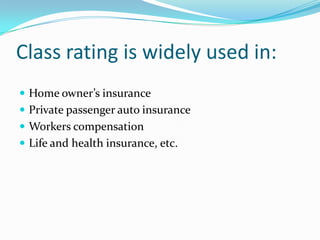
Class rating is widely used in:
 Home owner’s insurance
 Private passenger auto insurance
 Workers compensation

 Life and health insurance, etc.
Methods of Class Rating
 Pure Premium Method
 Loss Ratio Method
Pure Premium Method
 The pure premium can be determined by dividing the

amount of incurred losses and loss adjustment expenses by
the number of exposure units.
 First step:

Pure premium =
Incurred losses and loss adjustment expenses
Number of exposure units
 Final step:

Gross Rate = Pure Premium
1 – Expense Ratio
Illustration
 Assume that in auto collision insurance, 500,000

automobiles in a given underwriting class generate
incurred losses and loss adjustment expenses of Rs.30
million over a one year period. Expenses ratio expected
to be 40%.
Illustration
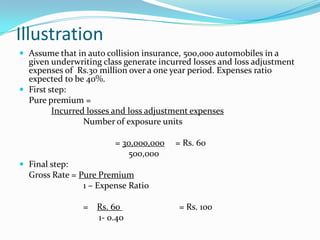
 Assume that in auto collision insurance, 500,000 automobiles in a

given underwriting class generate incurred losses and loss adjustment
expenses of Rs.30 million over a one year period. Expenses ratio
expected to be 40%.
 First step:
Pure premium =
Incurred losses and loss adjustment expenses
Number of exposure units
= 30,000,000
500,000

= Rs. 60

 Final step:

Gross Rate = Pure Premium
1 – Expense Ratio
= Rs. 60
1- 0.40

= Rs. 100
Loss Ratio Method
 Under the loss ratio method, the actual loss ratio compared

with the expected loss ratio, and the rate is adjusted
accordingly.
 The actual loss ratio is the ratio of incurred losses and loss-

adjustment expenses to earned premiums.
 The expected loss ratio is the percentage of the premiums

that is expected to be used to pay losses.
 Rate Change = A – E

E

where A= Actual loss ratio
E = Expected loss ratio
Illustration
 A line of insurance has incurred losses and loss-

adjustment expenses in the amount of Rs.800,000 and
earned premiums are Rs.1 million. The actual loss
ratio is 80%. The expected loss rate to be 70%.
Calculate the rate.
Illustration
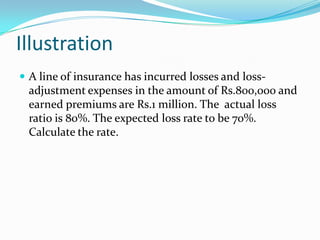
 A line of insurance has incurred losses and loss-

adjustment expenses in the amount of Rs.800,000 and
earned premiums are Rs.1 million. The actual loss
ratio is 80%. The expected loss rate to be 70%.
Calculate the rate.
 Rate Change = A – E

E

= 0.80 – 0.70
0.70
= 0.143 or 14.3%

where A= Actual loss ratio
E = Expected loss ratio
Merit Rating
 Merit rating is a rating plan by which class rates

(manual rates) are adjusted upward and downward
based on individual loss experience.
 Merit rating is based on the assumption that the loss

experience of a particular insured will differ
substantially from the loss experience of other insureds.
 Thus class rates are modified upward and downward
depending on individual loss experience.
Merit rating - Types
Schedule rating
2. Experience rating
3. Retrospective rating
1.
Merit rating - Types
1.

Schedule rating
Under a schedule rating plan, each exposure is individually
rated. A basis rate is determined for each exposure, which is
then modified by debits or credits for undesirable or
desirable physical features.
Merit rating - Types
2. Experience rating

Under experience rating , the class or manual rate
is adjusted upward or downward based on past
loss experience.
Insured’s past loss experience is used to determine
the premium for the next policy period.
Merit rating - Types
3. Retrospective rating
Under a retrospective rating plan, the insured’s loss
experience during the current policy period determines
the actual premium paid for that period.
Under this rating plan, a provisional premium is paid
at the beginning of the policy period. At the end of the
period, a final premium is calculated based on actual losses
that occur during the policy period.

Insurance pricing

  • 1.
  • 2.
    Definition – Insurancepricing  A rate is the price per unit of insurance.  An exposure unit is the unit of measurement used in insurance pricing. It varies by line of insurance.  The pure premium refers to that portion of the rate needed to pay losses and loss adjustment expenses.  Loading refers to the amount that must be added to the pure premium for other expenses, profit and a margin for contingencies.  The gross rate consists of the pure premium and a loading element. Finally, the gross premium paid by the insured consists of the gross rate multiplied by the number of exposure units.
  • 3.
    Objectives of Insurance Pricingor Rate Making Regulatory Objectives Business Objectives  Adequate Rates  Simplicity  Not Excessive  Stability  Not unfairly Discriminatory  Responsiveness  Encouragement of loss control
  • 4.
    Types of Rating Judgment Rating  Class rating  Merit rating  Schedule rating  Experience rating  Retrospective rating
  • 5.
    Judgment Rating  JudgmentRating means that each exposure is individually evaluated, and the rate is determined largely by the underwriter’s judgment.  This method is used when the loss exposures are so diverse that a class rate cannot be calculated or when credible loss statistics are not available.  Eg: Ocean marine insurance.
  • 6.
    Class Rating orManual Rating  Class Rating means that exposures with similar characteristics are placed in the same underwriting class, and each is charged the same rate.  The rate charged reflects the average loss experience for the class as a whole.  Class rating is based on the assumption that future losses to the insureds will be determined largely by the same set of factors.
  • 7.
    Advantages of Classrating  Simple to apply.  Premium quotations can be quickly obtained.  Ideal for personal lines market.
  • 8.
    Class rating iswidely used in:  Home owner’s insurance  Private passenger auto insurance  Workers compensation  Life and health insurance, etc.
  • 9.
    Methods of ClassRating  Pure Premium Method  Loss Ratio Method
  • 10.
    Pure Premium Method The pure premium can be determined by dividing the amount of incurred losses and loss adjustment expenses by the number of exposure units.  First step: Pure premium = Incurred losses and loss adjustment expenses Number of exposure units  Final step: Gross Rate = Pure Premium 1 – Expense Ratio
  • 11.
    Illustration  Assume thatin auto collision insurance, 500,000 automobiles in a given underwriting class generate incurred losses and loss adjustment expenses of Rs.30 million over a one year period. Expenses ratio expected to be 40%.
  • 12.
    Illustration  Assume thatin auto collision insurance, 500,000 automobiles in a given underwriting class generate incurred losses and loss adjustment expenses of Rs.30 million over a one year period. Expenses ratio expected to be 40%.  First step: Pure premium = Incurred losses and loss adjustment expenses Number of exposure units = 30,000,000 500,000 = Rs. 60  Final step: Gross Rate = Pure Premium 1 – Expense Ratio = Rs. 60 1- 0.40 = Rs. 100
  • 13.
    Loss Ratio Method Under the loss ratio method, the actual loss ratio compared with the expected loss ratio, and the rate is adjusted accordingly.  The actual loss ratio is the ratio of incurred losses and loss- adjustment expenses to earned premiums.  The expected loss ratio is the percentage of the premiums that is expected to be used to pay losses.  Rate Change = A – E E where A= Actual loss ratio E = Expected loss ratio
  • 14.
    Illustration  A lineof insurance has incurred losses and loss- adjustment expenses in the amount of Rs.800,000 and earned premiums are Rs.1 million. The actual loss ratio is 80%. The expected loss rate to be 70%. Calculate the rate.
  • 15.
    Illustration  A lineof insurance has incurred losses and loss- adjustment expenses in the amount of Rs.800,000 and earned premiums are Rs.1 million. The actual loss ratio is 80%. The expected loss rate to be 70%. Calculate the rate.  Rate Change = A – E E = 0.80 – 0.70 0.70 = 0.143 or 14.3% where A= Actual loss ratio E = Expected loss ratio
  • 16.
    Merit Rating  Meritrating is a rating plan by which class rates (manual rates) are adjusted upward and downward based on individual loss experience.  Merit rating is based on the assumption that the loss experience of a particular insured will differ substantially from the loss experience of other insureds.  Thus class rates are modified upward and downward depending on individual loss experience.
  • 17.
    Merit rating -Types Schedule rating 2. Experience rating 3. Retrospective rating 1.
  • 18.
    Merit rating -Types 1. Schedule rating Under a schedule rating plan, each exposure is individually rated. A basis rate is determined for each exposure, which is then modified by debits or credits for undesirable or desirable physical features.
  • 19.
    Merit rating -Types 2. Experience rating Under experience rating , the class or manual rate is adjusted upward or downward based on past loss experience. Insured’s past loss experience is used to determine the premium for the next policy period.
  • 20.
    Merit rating -Types 3. Retrospective rating Under a retrospective rating plan, the insured’s loss experience during the current policy period determines the actual premium paid for that period. Under this rating plan, a provisional premium is paid at the beginning of the policy period. At the end of the period, a final premium is calculated based on actual losses that occur during the policy period.