The Continental Drift
Hypothesis
Chapter 14 Lesson 1
p494-500
New Vocabulary
• Pangaea (495) – The supercontinent that
all continents today were once a part of
• Continental Drift (495) – A hypothesis
that suggests that continents are in
constant motion on the surface of Earth
Pangaea
• Each year, North America moves a few centimeters
farther away from Europe and closer to Asia.
• Nearly 100 years ago Alfred Wegener began an
important investigation to know whether Earth’s
continents were fixed in their positions.
– He proposed that all continents were once part of a
supercontinent called Pangaea.
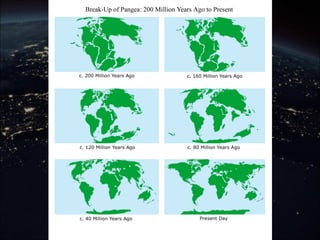
– Over time Pangaea began breaking apart, and the continents
slowly moved to their present positions.
• Wegener proposed the hypothesis of continental drift,
which suggested that continents are in constant motion
on the surface of Earth.
Evidence That Continents Move
• The most obvious evidence for continental
drift is that the continents appear to fit
together like pieces of a puzzle.
• However, scientists were skeptical, and
Wegener needed additional evidence
– 1. Apparent fit of the continents
– 2. Fossil Correlation
– 3. Rock and Mountain Correlation
– 4. Past Climate Data
Climate Clues
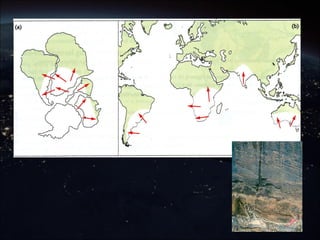
• When Wegener pieced Pangaea together, he proposed
that South America, Africa, India, and Australia were
located closer to Antarctica 280 million years ago.
• He suggested the climate of the Southern Hemisphere
was much cooler at the time.
– Glaciers covered most of these continents
• Wegener studied the sediments deposited by glaciers in
South America, Africa, India, and Australia.
• He discovered glacial grooves, or deep scratches in
rocks made as the glaciers moved across the land on
neighboring continents today.
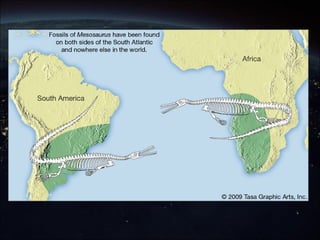
Fossil Clues
Fossil Clues
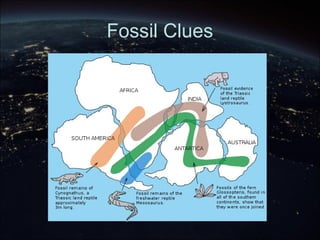
• Animals and plants that lived on different
continents can be unique to the continent alone.
– Kangaroos are exclusive to Australia. Lions live in
Africa but not S. America.
– Because oceans separate continents, these animals
cannot travel from one continent to another by natural
means
• However, fossils of similar organisms have been
found on several continents separated by
oceans.
Fossil Clues
• Fossils of a plant called Glossopteris have been
discovered in rocks from South America, Africa,
India, Australia, and Antarctica.
• Evidence suggests these plants grew in a
swampy environment. Therefore, the climate of
this region, including Antarctica, was different
than it is today
– Antarctica had a warm and wet climate and changed
drastically from 55 milllion years earlier when glaciers
existed.
Rock Clues
• Wegener also observed that mountain
ranges and rock formations on different
continents had common origins.
– Today geologists have determined that large-
scale volcanic eruptions occurred on the
western coast of Africa and the eastern coast
of South America at about the same time
hundreds of millions of years ago
• These volcanic rocks are identical in both
chemistry and age
Rock Clues
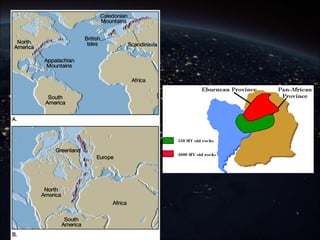
• The Caledonian mountain range in
northern Europe and the Appalachian
Mountains in eastern N. America are
similar in age, structure, and composition.
• If you place the continents together, these
mountains would meet and form on long,
continuous mountain belt.
What is missing?
• Wegener continued to support the continent drift hypothesis
until his death in 1930
• His ideas were not widely accepted until nearly 4 decades
later, because he could not explain how they moved
• One reason scientists questioned continental drift was
because it is a slow process
• It was not possible for Wegener to measure how fast the
continents moved
– How could continents push their way through the solid rock of
the sea floor?
– However at that time, the world was only beginning to
understand what the seafloor looked like.
– It took many years after Wegener died before the evidence of
plate tectonics hidden in the rifts on the seafloor to be
discovered.

Chapter 14.1: The Continental Drift Hypothesis

  • 1.
  • 2.
    New Vocabulary • Pangaea(495) – The supercontinent that all continents today were once a part of • Continental Drift (495) – A hypothesis that suggests that continents are in constant motion on the surface of Earth
  • 4.
    Pangaea • Each year,North America moves a few centimeters farther away from Europe and closer to Asia. • Nearly 100 years ago Alfred Wegener began an important investigation to know whether Earth’s continents were fixed in their positions. – He proposed that all continents were once part of a supercontinent called Pangaea. – Over time Pangaea began breaking apart, and the continents slowly moved to their present positions. • Wegener proposed the hypothesis of continental drift, which suggested that continents are in constant motion on the surface of Earth.
  • 5.
    Evidence That ContinentsMove • The most obvious evidence for continental drift is that the continents appear to fit together like pieces of a puzzle. • However, scientists were skeptical, and Wegener needed additional evidence – 1. Apparent fit of the continents – 2. Fossil Correlation – 3. Rock and Mountain Correlation – 4. Past Climate Data
  • 6.
    Climate Clues • WhenWegener pieced Pangaea together, he proposed that South America, Africa, India, and Australia were located closer to Antarctica 280 million years ago. • He suggested the climate of the Southern Hemisphere was much cooler at the time. – Glaciers covered most of these continents • Wegener studied the sediments deposited by glaciers in South America, Africa, India, and Australia. • He discovered glacial grooves, or deep scratches in rocks made as the glaciers moved across the land on neighboring continents today.
  • 8.
  • 10.
    Fossil Clues • Animalsand plants that lived on different continents can be unique to the continent alone. – Kangaroos are exclusive to Australia. Lions live in Africa but not S. America. – Because oceans separate continents, these animals cannot travel from one continent to another by natural means • However, fossils of similar organisms have been found on several continents separated by oceans.
  • 11.
    Fossil Clues • Fossilsof a plant called Glossopteris have been discovered in rocks from South America, Africa, India, Australia, and Antarctica. • Evidence suggests these plants grew in a swampy environment. Therefore, the climate of this region, including Antarctica, was different than it is today – Antarctica had a warm and wet climate and changed drastically from 55 milllion years earlier when glaciers existed.
  • 12.
    Rock Clues • Wegeneralso observed that mountain ranges and rock formations on different continents had common origins. – Today geologists have determined that large- scale volcanic eruptions occurred on the western coast of Africa and the eastern coast of South America at about the same time hundreds of millions of years ago • These volcanic rocks are identical in both chemistry and age
  • 13.
    Rock Clues • TheCaledonian mountain range in northern Europe and the Appalachian Mountains in eastern N. America are similar in age, structure, and composition. • If you place the continents together, these mountains would meet and form on long, continuous mountain belt.
  • 15.
    What is missing? •Wegener continued to support the continent drift hypothesis until his death in 1930 • His ideas were not widely accepted until nearly 4 decades later, because he could not explain how they moved • One reason scientists questioned continental drift was because it is a slow process • It was not possible for Wegener to measure how fast the continents moved – How could continents push their way through the solid rock of the sea floor? – However at that time, the world was only beginning to understand what the seafloor looked like. – It took many years after Wegener died before the evidence of plate tectonics hidden in the rifts on the seafloor to be discovered.