Listening
PROCESS, TYPES, TECHNIQUES AND BARRIERS
“
”
We have but two ears and
mouth so that we may listen
twice as much as we speak
- THOMAS ALVA EDISON
Listening, despite being one of the most important part of communication is often the
most undervalued one.
Writing
10%
Reading
15%
Talking
30%
Listening
45%
Writing Reading Talking Listening
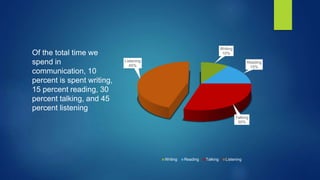
Of the total time we
spend in
communication, 10
percent is spent writing,
15 percent reading, 30
percent talking, and 45
percent listening
Hearing vs. Listening
 Hearing is an involuntary process that starts with
noise, vibrations, the movement of fluid in the ears
and sound sent to the brain.
 Listening is a voluntary act where we try to make
sense out of the noise our ear receives.
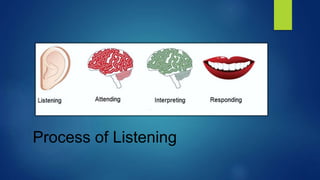
Process of Listening
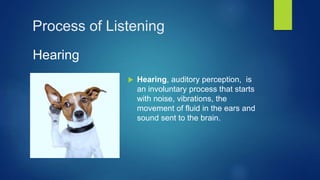
 Hearing, auditory perception, is
an involuntary process that starts
with noise, vibrations, the
movement of fluid in the ears and
sound sent to the brain.
Hearing
Process of Listening
 Here we are actually gathering the
words and sentences in our brain
to be used in the next stage.
 Think of the words and sentences
as if they are packages on a store
shelf. You just toss what you want
into your shopping cart.
Attending
Process of Listening
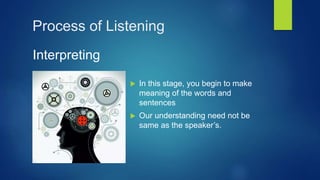
 In this stage, you begin to make
meaning of the words and
sentences
 Our understanding need not be
same as the speaker’s.
Interpreting
Process of Listening
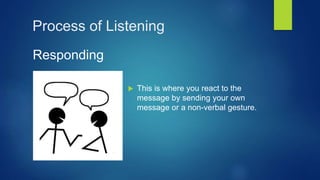
 This is where you react to the
message by sending your own
message or a non-verbal gesture.
Responding
Types of Listening
…….FOR DIFFERENT
SITUATIONS
Discriminative Listening
• This is the most basic form of listening and does not involve the
understanding of the meaning of words or phrases but merely the
different sounds that are produced.
• If you cannot hear differences, you can’t understand it.
• Body languages and gestures play much role here.
Comprehensive listening
• Comprehensive listening involves understanding the
message or messages that are being communicated.
• To comprehend the meaning requires first having basic
knowledge of words and rules of grammar.
• Also known as Informative listening.
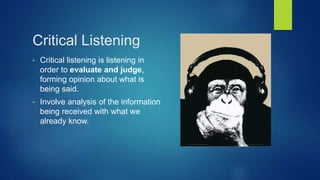
Critical Listening
• Critical listening is listening in
order to evaluate and judge,
forming opinion about what is
being said.
• Involve analysis of the information
being received with what we
already know.
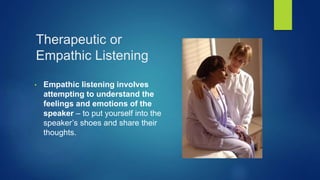
Therapeutic or
Empathic Listening
• Empathic listening involves
attempting to understand the
feelings and emotions of the
speaker – to put yourself into the
speaker’s shoes and share their
thoughts.
Other types of listening……
 Appreciative listening -It is listening
for enjoyment. Usually music or other
forms of entertainment.
 Dialogic listening -When trying to
build rapport with others we can engage in
a type of listening that encourages the
other person to trust and like us.
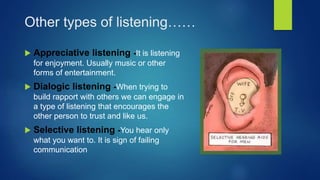
 Selective listening -You hear only
what you want to. It is sign of failing
communication
Techniques of effective listening
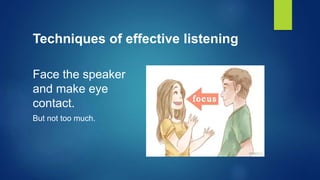
Face the speaker
and make eye
contact.
But not too much.
Techniques of effective listening
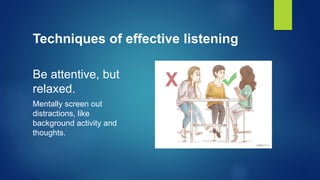
Be attentive, but
relaxed.
Mentally screen out
distractions, like
background activity and
thoughts.
Techniques of effective listening
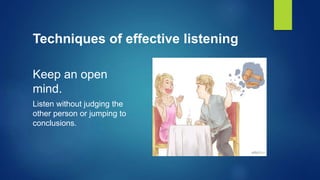
Keep an open
mind.
Listen without judging the
other person or jumping to
conclusions.
Techniques of effective listening
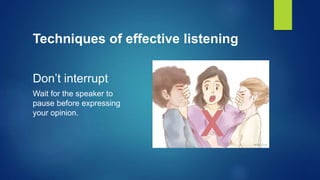
Don’t interrupt
Wait for the speaker to
pause before expressing
your opinion.
Techniques of effective listening
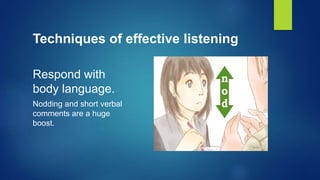
Respond with
body language.
Nodding and short verbal
comments are a huge
boost.
Techniques of effective listening
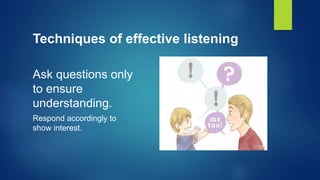
Ask questions only
to ensure
understanding.
Respond accordingly to
show interest.
Techniques of effective listening
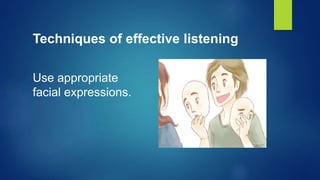
Use appropriate
facial expressions.
Techniques of effective listening
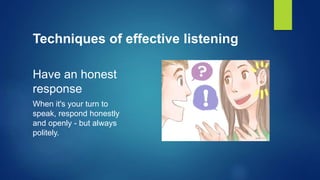
Have an honest
response
When it's your turn to
speak, respond honestly
and openly - but always
politely.
Barriers to effective listening
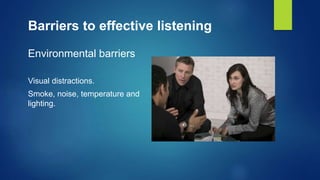
Environmental barriers
Visual distractions.
Smoke, noise, temperature and
lighting.
Barriers to effective listening
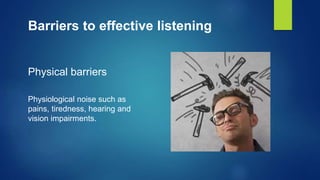
Physical barriers
Physiological noise such as
pains, tiredness, hearing and
vision impairments.
Barriers to effective listening
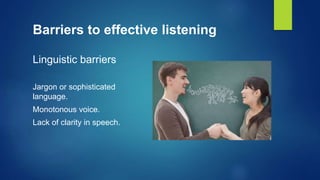
Linguistic barriers
Jargon or sophisticated
language.
Monotonous voice.
Lack of clarity in speech.
Barriers to effective listening
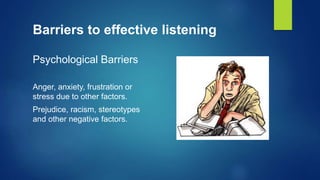
Psychological Barriers
Anger, anxiety, frustration or
stress due to other factors.
Prejudice, racism, stereotypes
and other negative factors.
Barriers to effective listening
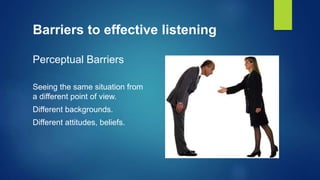
Perceptual Barriers
Seeing the same situation from
a different point of view.
Different backgrounds.
Different attitudes, beliefs.
Barriers to effective listening
Content Barrier
The content itself, is not
interesting or too difficult.
Too long.
Too repetitive.
Summary
 Process of Listening
 Hearing
 Attending
 Interpreting
 Responding
 Types of Listening
 Discriminative Listening
 Comprehensive Listening
 Critical Listening
 Empathetic Listening
 Appreciative, Dialogic and Selective Listening
Summary
 Techniques of effective listening
 Makin eye contact
 Keeping an open mind
 Not interrupting
 Responding using gestures and comments
 Barriers to effective listening
 Environmental Barriers
 Physical Barriers
 Linguistic & Perceptual Barriers
 Psychological Barriers
 Content Barriers

Listening ppt

  • 1.
  • 2.
    “ ” We have buttwo ears and mouth so that we may listen twice as much as we speak - THOMAS ALVA EDISON Listening, despite being one of the most important part of communication is often the most undervalued one.
  • 3.
    Writing 10% Reading 15% Talking 30% Listening 45% Writing Reading TalkingListening Of the total time we spend in communication, 10 percent is spent writing, 15 percent reading, 30 percent talking, and 45 percent listening
  • 4.
    Hearing vs. Listening Hearing is an involuntary process that starts with noise, vibrations, the movement of fluid in the ears and sound sent to the brain.  Listening is a voluntary act where we try to make sense out of the noise our ear receives.
  • 5.
  • 6.
    Process of Listening Hearing, auditory perception, is an involuntary process that starts with noise, vibrations, the movement of fluid in the ears and sound sent to the brain. Hearing
  • 7.
    Process of Listening Here we are actually gathering the words and sentences in our brain to be used in the next stage.  Think of the words and sentences as if they are packages on a store shelf. You just toss what you want into your shopping cart. Attending
  • 8.
    Process of Listening In this stage, you begin to make meaning of the words and sentences  Our understanding need not be same as the speaker’s. Interpreting
  • 9.
    Process of Listening This is where you react to the message by sending your own message or a non-verbal gesture. Responding
  • 10.
    Types of Listening …….FORDIFFERENT SITUATIONS
  • 11.
    Discriminative Listening • Thisis the most basic form of listening and does not involve the understanding of the meaning of words or phrases but merely the different sounds that are produced. • If you cannot hear differences, you can’t understand it. • Body languages and gestures play much role here.
  • 12.
    Comprehensive listening • Comprehensivelistening involves understanding the message or messages that are being communicated. • To comprehend the meaning requires first having basic knowledge of words and rules of grammar. • Also known as Informative listening.
  • 13.
    Critical Listening • Criticallistening is listening in order to evaluate and judge, forming opinion about what is being said. • Involve analysis of the information being received with what we already know.
  • 14.
    Therapeutic or Empathic Listening •Empathic listening involves attempting to understand the feelings and emotions of the speaker – to put yourself into the speaker’s shoes and share their thoughts.
  • 15.
    Other types oflistening……  Appreciative listening -It is listening for enjoyment. Usually music or other forms of entertainment.  Dialogic listening -When trying to build rapport with others we can engage in a type of listening that encourages the other person to trust and like us.  Selective listening -You hear only what you want to. It is sign of failing communication
  • 16.
  • 17.
    Techniques of effectivelistening Face the speaker and make eye contact. But not too much.
  • 18.
    Techniques of effectivelistening Be attentive, but relaxed. Mentally screen out distractions, like background activity and thoughts.
  • 19.
    Techniques of effectivelistening Keep an open mind. Listen without judging the other person or jumping to conclusions.
  • 20.
    Techniques of effectivelistening Don’t interrupt Wait for the speaker to pause before expressing your opinion.
  • 21.
    Techniques of effectivelistening Respond with body language. Nodding and short verbal comments are a huge boost.
  • 22.
    Techniques of effectivelistening Ask questions only to ensure understanding. Respond accordingly to show interest.
  • 23.
    Techniques of effectivelistening Use appropriate facial expressions.
  • 24.
    Techniques of effectivelistening Have an honest response When it's your turn to speak, respond honestly and openly - but always politely.
  • 25.
  • 26.
    Barriers to effectivelistening Environmental barriers Visual distractions. Smoke, noise, temperature and lighting.
  • 27.
    Barriers to effectivelistening Physical barriers Physiological noise such as pains, tiredness, hearing and vision impairments.
  • 28.
    Barriers to effectivelistening Linguistic barriers Jargon or sophisticated language. Monotonous voice. Lack of clarity in speech.
  • 29.
    Barriers to effectivelistening Psychological Barriers Anger, anxiety, frustration or stress due to other factors. Prejudice, racism, stereotypes and other negative factors.
  • 30.
    Barriers to effectivelistening Perceptual Barriers Seeing the same situation from a different point of view. Different backgrounds. Different attitudes, beliefs.
  • 31.
    Barriers to effectivelistening Content Barrier The content itself, is not interesting or too difficult. Too long. Too repetitive.
  • 32.
    Summary  Process ofListening  Hearing  Attending  Interpreting  Responding  Types of Listening  Discriminative Listening  Comprehensive Listening  Critical Listening  Empathetic Listening  Appreciative, Dialogic and Selective Listening
  • 33.
    Summary  Techniques ofeffective listening  Makin eye contact  Keeping an open mind  Not interrupting  Responding using gestures and comments  Barriers to effective listening  Environmental Barriers  Physical Barriers  Linguistic & Perceptual Barriers  Psychological Barriers  Content Barriers