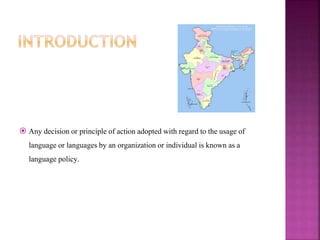
 Any decision or principle of action adopted with regard to the usage of
language or languages by an organization or individual is known as a
language policy.
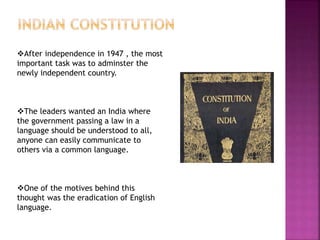
After independence in 1947 , the most
important task was to adminster the
newly independent country.
The leaders wanted an India where
the government passing a law in a
language should be understood to all,
anyone can easily communicate to
others via a common language.
One of the motives behind this
thought was the eradication of English
language.
•Thus on Sept. 14 th, 1949, the Constituent Assembly passed
the Constitutional provision regarding the Official Languages.
Hindi was made an official language instead of national
language.
•The provisions of the official language of India may be divided
into nine parts:
1.Official language of the Union.
2. Official languages of the State
3. Language of inter-communication.
4. Language of the Supreme Court.
5. Formation of a language commission.
6. Language to be used in Union Parliament and State
legislatures.
7. Safeguards for Linguistic Minorities.
8. Miscellaneous provisions for the promotion, development
and use of Hindi language.
9. Specification of some important languages as the national
languages.
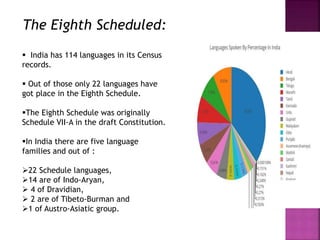
The Eighth Scheduled:
 India has 114 languages in its Census
records.
 Out of those only 22 languages have
got place in the Eighth Schedule.
The Eighth Schedule was originally
Schedule VII-A in the draft Constitution.
In India there are five language
families and out of :
22 Schedule languages,
14 are of Indo-Aryan,
 4 of Dravidian,
 2 are of Tibeto-Burman and
1 of Austro-Asiatic group.
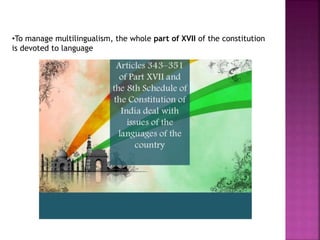
•To manage multilingualism, the whole part of XVII of the constitution
is devoted to language
ARTICLE 29:
It enunciates the fundamental rights of any section
of citizens residing anywhere in India to conserve it’s distinct
language , Script or culture.
ARTICLE 30:
It seeks to protect the rights of all minorities based
on religion or language to establish and administer educational
institutions of their choice.
ARTICLE 120:
*It lays down the official language of parliament.
* It says business in Parliament may be transacted in
English or in Hindi.
*Member of the Parliament can address in his/her
Mother tongue under special circumstances.
ARTICLE 210:
It lays down the corresponding language provision for
State Legislature.
At the Union level various Commissions and boards have been
formed to look after the Language development programs.
Parliamentary Committee.
The Commission for Scientific and Technical Terminology.
Central Institute of Indian Languages.
National Council for the promotion of Urudu Language.
Central Institute of Hindi or Kendriya.
National Council for the promotion of Sindhi Language.
Central Translation Bureau.
National Council of Educational Research and Training.
Sahitya Akademi.
Language policy as specified in indian constitution

Language policy as specified in indian constitution

  • 2.
     Any decisionor principle of action adopted with regard to the usage of language or languages by an organization or individual is known as a language policy.
  • 3.
    After independence in1947 , the most important task was to adminster the newly independent country. The leaders wanted an India where the government passing a law in a language should be understood to all, anyone can easily communicate to others via a common language. One of the motives behind this thought was the eradication of English language.
  • 4.
    •Thus on Sept.14 th, 1949, the Constituent Assembly passed the Constitutional provision regarding the Official Languages. Hindi was made an official language instead of national language. •The provisions of the official language of India may be divided into nine parts: 1.Official language of the Union. 2. Official languages of the State 3. Language of inter-communication. 4. Language of the Supreme Court. 5. Formation of a language commission. 6. Language to be used in Union Parliament and State legislatures. 7. Safeguards for Linguistic Minorities. 8. Miscellaneous provisions for the promotion, development and use of Hindi language. 9. Specification of some important languages as the national languages.
  • 5.
    The Eighth Scheduled: India has 114 languages in its Census records.  Out of those only 22 languages have got place in the Eighth Schedule. The Eighth Schedule was originally Schedule VII-A in the draft Constitution. In India there are five language families and out of : 22 Schedule languages, 14 are of Indo-Aryan,  4 of Dravidian,  2 are of Tibeto-Burman and 1 of Austro-Asiatic group.
  • 6.
    •To manage multilingualism,the whole part of XVII of the constitution is devoted to language
  • 13.
    ARTICLE 29: It enunciatesthe fundamental rights of any section of citizens residing anywhere in India to conserve it’s distinct language , Script or culture. ARTICLE 30: It seeks to protect the rights of all minorities based on religion or language to establish and administer educational institutions of their choice. ARTICLE 120: *It lays down the official language of parliament. * It says business in Parliament may be transacted in English or in Hindi. *Member of the Parliament can address in his/her Mother tongue under special circumstances. ARTICLE 210: It lays down the corresponding language provision for State Legislature.
  • 14.
    At the Unionlevel various Commissions and boards have been formed to look after the Language development programs. Parliamentary Committee. The Commission for Scientific and Technical Terminology. Central Institute of Indian Languages. National Council for the promotion of Urudu Language. Central Institute of Hindi or Kendriya. National Council for the promotion of Sindhi Language. Central Translation Bureau. National Council of Educational Research and Training. Sahitya Akademi.