EDUCATIONAL EQUITY
&
SOCIAL JUSTICE
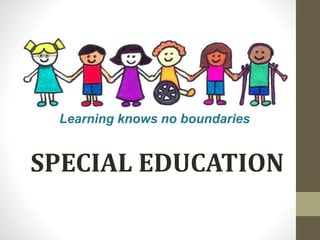
SPECIAL EDUCATION
Learning knows no boundaries
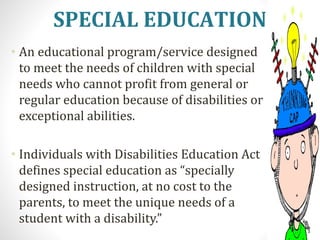
• An educational program/service designed
to meet the needs of children with special
needs who cannot profit from general or
regular education because of disabilities or
exceptional abilities.
• Individuals with Disabilities Education Act
defines special education as “specially
designed instruction, at no cost to the
parents, to meet the unique needs of a
student with a disability.”
SPECIAL EDUCATION
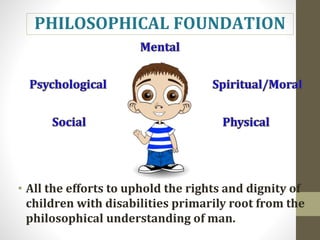
• All the efforts to uphold the rights and dignity of
children with disabilities primarily root from the
philosophical understanding of man.
PHILOSOPHICAL FOUNDATION
These persons may be gifted/talented, fast learner, mentally
retarded, visually impaired, hearing impaired, with behavior
problems, orthopedically handicapped, with special health
problems, learning disabled, speech impaired or multiply
handicapped.
Special Education Division Philippines
Memorandum:
Special education refers to the education of persons who are
GIFTED OR TALENTED and those who have PHYSICAL, MENTAL,
SOCIAL OR SENSORY IMPAIRMENT AND CULTURAL DIFFERENCES so
as to require modifications of the school curricula, programs
and special services and physical facilities to develop them to
their maximum capacity
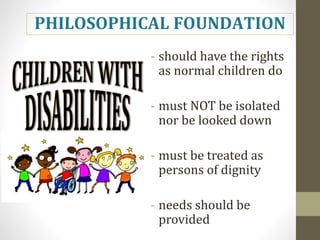
- should have the rights
as normal children do
- must NOT be isolated
nor be looked down
- must be treated as
persons of dignity
- needs should be
provided
PHILOSOPHICAL FOUNDATION
• “Every child with special needs has a right to
an educational program that is suitable to
his needs.”
• “Special education shares with regular
education basic responsibilities of the
educational system to fulfill the right of the
child to develop to his full potential.”
BASIC PHILOSOPHY OF
SPECIAL EDUCATION
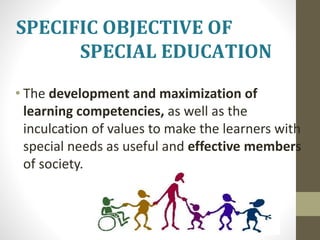
SPECIFIC OBJECTIVE OF
SPECIAL EDUCATION
• The development and maximization of
learning competencies, as well as the
inculcation of values to make the learners with
special needs as useful and effective members
of society.
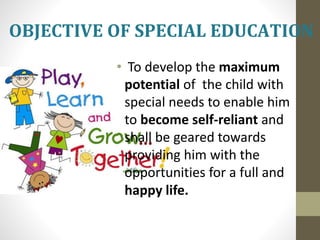
• To develop the maximum
potential of the child with
special needs to enable him
to become self-reliant and
shall be geared towards
providing him with the
opportunities for a full and
happy life.
OBJECTIVE OF SPECIAL EDUCATION
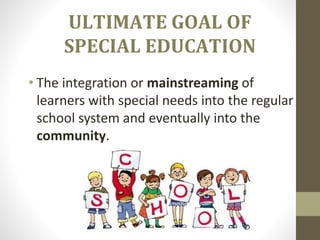
ULTIMATE GOAL OF
SPECIAL EDUCATION
• The integration or mainstreaming of
learners with special needs into the regular
school system and eventually into the
community.
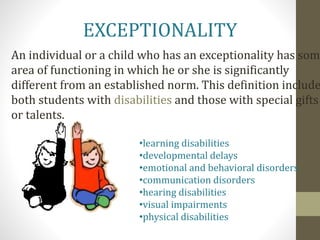
EXCEPTIONALITY
An individual or a child who has an exceptionality has some
area of functioning in which he or she is significantly
different from an established norm. This definition include
both students with disabilities and those with special gifts
or talents.
•learning disabilities
•developmental delays
•emotional and behavioral disorders
•communication disorders
•hearing disabilities
•visual impairments
•physical disabilities
CULTURALLY RESPONSIVE
TEACHING
- is the idea that culture is central to
student learning. It utilizes cultural
referents to impart knowledge,
skills, and attitudes.
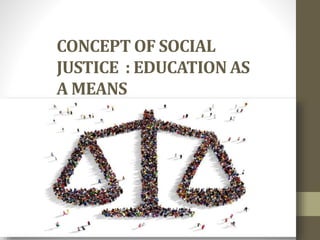
CONCEPT OF SOCIAL
JUSTICE : EDUCATION AS
A MEANS
According to National Association
Of Social Workers, “ Social justice
is the view that everyone deserves
equal economic, political and
social rights and opportunities.”
Social justice is the equal access to
wealth, opportunities, and
privileges within a society
Social justice is a dynamic devise to
mitigate the sufferings of the poor, weak,
dalits, tribal and deprived sections of the
society and to elevate them to the level
of equality to live life with dignity.
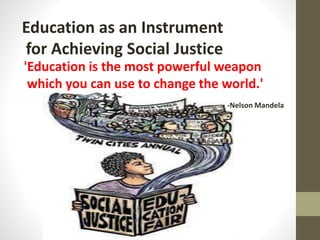
Education as an Instrument
for Achieving Social Justice
'Education is the most powerful weapon
which you can use to change the world.'
-Nelson Mandela
Education provides the tools to improve
the quality of life in modern society both
economically and sociologically.
Education is power
Education has the power to change the
entire life.
e.g., promoting gender equality to
reducing poverty.
Education as an Instrument
for Achieving Social Justice
Social justice education
The goal of social justice education is full and equal
participation of all groups in society that is mutually
shaped to meet their needs.
A prominent social justice education theorist,
Lee Ann Bell (1997) puts it:
“… [S]ocial justice education is both a process and a goal. Social
justice includes a vision of society in which the distribution of
resources is equitable and all members are physically and
psychologically safe and secure. We envision a society in which
individuals are both self-determining
(able to develop their full capacities) and interdependent (capable of
interacting democratically with others).”
TECHNOLOGY
&
ACCESS
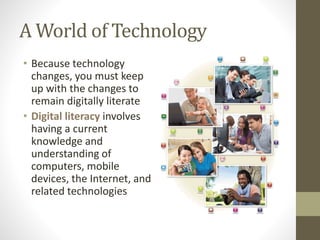
A World of Technology
• Because technology
changes, you must keep
up with the changes to
remain digitally literate
• Digital literacy involves
having a current
knowledge and
understanding of
computers, mobile
devices, the Internet, and
related technologies
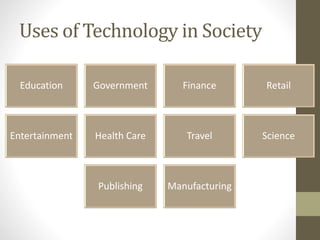
Uses of Technology in Society
Education Government Finance Retail
Entertainment Health Care Travel Science
Publishing Manufacturing
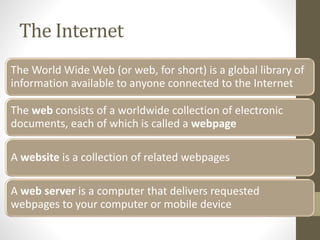
The Internet
The World Wide Web (or web, for short) is a global library of
information available to anyone connected to the Internet
The web consists of a worldwide collection of electronic
documents, each of which is called a webpage
A website is a collection of related webpages
A web server is a computer that delivers requested
webpages to your computer or mobile device
EQUITY IN EDUCATION
Concept:
• Raising the Achievement of all students While
narrowing the gap between the highest & Lowest
performing students & eliminating the racial
predictability & disproportionality of which student
groups occupy the highest & lowest achievement
categories.
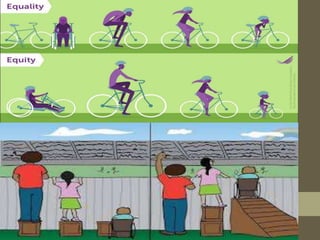
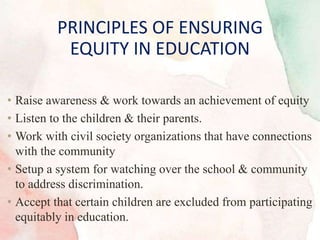
• Equity means that every child gets what he or she needs
to succeed as opposed to everyone gets the same thing.
EQUALITY & EQUITY
• Raise awareness & work towards an achievement of equity
• Listen to the children & their parents.
• Work with civil society organizations that have connections
with the community
• Setup a system for watching over the school & community
to address discrimination.
• Accept that certain children are excluded from participating
equitably in education.
PRINCIPLES OF ENSURING
EQUITY IN EDUCATION
STEPS FOR EQUITY IN
EDUCATION
working with
parents
Local & relevant
curriculum
Data Collection,
Monitoring &
Evaluation
The Role of
Teachers
POLICY AND
ADVOCACY
What is advocacy?
Process to:
• Influence policy and decision makers, fight for social change,
transform public perceptions and attitudes, modify behaviors,
or mobilize resources. (GAVI)
• Use information strategically to change policies that affect the
lives of disadvantaged people. (BOND)
• Change attitudes, actions, policies and laws by influencing
people and organizations with power. (India HIV/AIDS
Alliance, 2002)
• Speak up, draw attention to an issue, win the support of key
constituencies in order to influence policies and spending, and
bring about change. (WHO TB Programme)
• Advocacy is about influencing or changing relationships of
power.
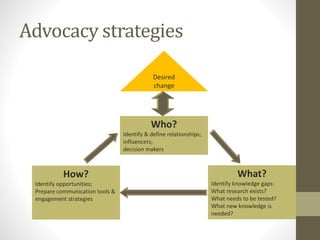
Advocacy strategies
Desired
change
Who?
Identify & define relationships;
influencers;
decision makers
How?
Identify opportunities;
Prepare communication tools &
engagement strategies
What?
Identify knowledge gaps:
What research exists?
What needs to be tested?
What new knowledge is
needed?
Policy brief – an effective tool
• What are policy briefs
• Types of basic policy briefs
• An advocacy brief argues in favor of a particular
• An objective brief – balanced information for
policy markers
• What should a policy brief do:
• Enough background
• Convince the problem must address urgently
• Information about alternatives (objective brief)
and evidence to support one alternative (advocacy
brief)
• Stimulate reader to make a decision

EDUCATIONAL EQUITY & SOCIAL JUSTICE.pptx

  • 1.
  • 2.
  • 3.
    • An educationalprogram/service designed to meet the needs of children with special needs who cannot profit from general or regular education because of disabilities or exceptional abilities. • Individuals with Disabilities Education Act defines special education as “specially designed instruction, at no cost to the parents, to meet the unique needs of a student with a disability.” SPECIAL EDUCATION
  • 4.
    • All theefforts to uphold the rights and dignity of children with disabilities primarily root from the philosophical understanding of man. PHILOSOPHICAL FOUNDATION
  • 5.
    These persons maybe gifted/talented, fast learner, mentally retarded, visually impaired, hearing impaired, with behavior problems, orthopedically handicapped, with special health problems, learning disabled, speech impaired or multiply handicapped. Special Education Division Philippines Memorandum: Special education refers to the education of persons who are GIFTED OR TALENTED and those who have PHYSICAL, MENTAL, SOCIAL OR SENSORY IMPAIRMENT AND CULTURAL DIFFERENCES so as to require modifications of the school curricula, programs and special services and physical facilities to develop them to their maximum capacity
  • 6.
    - should havethe rights as normal children do - must NOT be isolated nor be looked down - must be treated as persons of dignity - needs should be provided PHILOSOPHICAL FOUNDATION
  • 7.
    • “Every childwith special needs has a right to an educational program that is suitable to his needs.” • “Special education shares with regular education basic responsibilities of the educational system to fulfill the right of the child to develop to his full potential.” BASIC PHILOSOPHY OF SPECIAL EDUCATION
  • 8.
    SPECIFIC OBJECTIVE OF SPECIALEDUCATION • The development and maximization of learning competencies, as well as the inculcation of values to make the learners with special needs as useful and effective members of society.
  • 9.
    • To developthe maximum potential of the child with special needs to enable him to become self-reliant and shall be geared towards providing him with the opportunities for a full and happy life. OBJECTIVE OF SPECIAL EDUCATION
  • 10.
    ULTIMATE GOAL OF SPECIALEDUCATION • The integration or mainstreaming of learners with special needs into the regular school system and eventually into the community.
  • 11.
    EXCEPTIONALITY An individual ora child who has an exceptionality has some area of functioning in which he or she is significantly different from an established norm. This definition include both students with disabilities and those with special gifts or talents. •learning disabilities •developmental delays •emotional and behavioral disorders •communication disorders •hearing disabilities •visual impairments •physical disabilities
  • 12.
    CULTURALLY RESPONSIVE TEACHING - isthe idea that culture is central to student learning. It utilizes cultural referents to impart knowledge, skills, and attitudes.
  • 13.
    CONCEPT OF SOCIAL JUSTICE: EDUCATION AS A MEANS
  • 14.
    According to NationalAssociation Of Social Workers, “ Social justice is the view that everyone deserves equal economic, political and social rights and opportunities.” Social justice is the equal access to wealth, opportunities, and privileges within a society
  • 16.
    Social justice isa dynamic devise to mitigate the sufferings of the poor, weak, dalits, tribal and deprived sections of the society and to elevate them to the level of equality to live life with dignity.
  • 17.
    Education as anInstrument for Achieving Social Justice 'Education is the most powerful weapon which you can use to change the world.' -Nelson Mandela
  • 18.
    Education provides thetools to improve the quality of life in modern society both economically and sociologically. Education is power Education has the power to change the entire life. e.g., promoting gender equality to reducing poverty. Education as an Instrument for Achieving Social Justice
  • 19.
    Social justice education Thegoal of social justice education is full and equal participation of all groups in society that is mutually shaped to meet their needs. A prominent social justice education theorist, Lee Ann Bell (1997) puts it: “… [S]ocial justice education is both a process and a goal. Social justice includes a vision of society in which the distribution of resources is equitable and all members are physically and psychologically safe and secure. We envision a society in which individuals are both self-determining (able to develop their full capacities) and interdependent (capable of interacting democratically with others).”
  • 20.
  • 21.
    A World ofTechnology • Because technology changes, you must keep up with the changes to remain digitally literate • Digital literacy involves having a current knowledge and understanding of computers, mobile devices, the Internet, and related technologies
  • 22.
    Uses of Technologyin Society Education Government Finance Retail Entertainment Health Care Travel Science Publishing Manufacturing
  • 23.
    The Internet The WorldWide Web (or web, for short) is a global library of information available to anyone connected to the Internet The web consists of a worldwide collection of electronic documents, each of which is called a webpage A website is a collection of related webpages A web server is a computer that delivers requested webpages to your computer or mobile device
  • 25.
    EQUITY IN EDUCATION Concept: •Raising the Achievement of all students While narrowing the gap between the highest & Lowest performing students & eliminating the racial predictability & disproportionality of which student groups occupy the highest & lowest achievement categories. • Equity means that every child gets what he or she needs to succeed as opposed to everyone gets the same thing.
  • 26.
  • 27.
    • Raise awareness& work towards an achievement of equity • Listen to the children & their parents. • Work with civil society organizations that have connections with the community • Setup a system for watching over the school & community to address discrimination. • Accept that certain children are excluded from participating equitably in education. PRINCIPLES OF ENSURING EQUITY IN EDUCATION
  • 28.
    STEPS FOR EQUITYIN EDUCATION working with parents Local & relevant curriculum Data Collection, Monitoring & Evaluation The Role of Teachers
  • 29.
  • 30.
    What is advocacy? Processto: • Influence policy and decision makers, fight for social change, transform public perceptions and attitudes, modify behaviors, or mobilize resources. (GAVI) • Use information strategically to change policies that affect the lives of disadvantaged people. (BOND) • Change attitudes, actions, policies and laws by influencing people and organizations with power. (India HIV/AIDS Alliance, 2002) • Speak up, draw attention to an issue, win the support of key constituencies in order to influence policies and spending, and bring about change. (WHO TB Programme) • Advocacy is about influencing or changing relationships of power.
  • 31.
    Advocacy strategies Desired change Who? Identify &define relationships; influencers; decision makers How? Identify opportunities; Prepare communication tools & engagement strategies What? Identify knowledge gaps: What research exists? What needs to be tested? What new knowledge is needed?
  • 32.
    Policy brief –an effective tool • What are policy briefs • Types of basic policy briefs • An advocacy brief argues in favor of a particular • An objective brief – balanced information for policy markers • What should a policy brief do: • Enough background • Convince the problem must address urgently • Information about alternatives (objective brief) and evidence to support one alternative (advocacy brief) • Stimulate reader to make a decision

Editor's Notes

  • #4 Special educators provide instruction specifically tailored to meet individualized needs, making education available to students who otherwise have limited access to education. Specially designed instruction to meet the unique needs and abilities of exceptional students. Special education as intervention Preventive: Designed to keep minor problems from becoming a disability Remedial: Attempt to eliminate the effects of a disability Compensatory: Enable successful functioning in spite of the disability Special education as instruction Individually planned Specialized Intensive Goal-directed
  • #5 Philosophy is the study of general and fundamental problems, such as those connected with reality, existence, knowledge, values, reason, mind, and language. Therefore, whatever defects of the body cannot reduce the humanity and dignity of a person.
  • #7 In order that they can interact meaningfully with others in the society.
  • #8 Every child with special needs has a right to an educational program that is suitable to his needs. Special education shares with regular education basic responsibilities of the educational system to fulfill the right of the child to develop to his full potential. 
  • #11 Mainstreaming means participation in the general education environment when deemed academically or emotionally ready. Inclusion means participation by all children with or without disabilities in a supportive general education environment that includes appropriate educational and social supports and services.
  • #12 We consider a child to be exceptional when the child requires either a modification of school practices or special educational services to develop his or her unique capabilities. Exceptional children differ from the norm (either below or above) to such an extent that they require an individualized program of special education There are 13 different legal categories for exceptionalities (IDEA 2004) IDEA is an acronym that refers to the Individuals with Disabilities Education Act. This law provides the federal mandate for special education services in each state. It outlines the system of funding employed for special education and related services. The law also establishes a framework for "due process" procedures in special education.  In 2004, IDEA was reauthorized and modified to align more closely with the goals of the No Child Left Behind (NCLB) Act; the resultant legislation is entitled the Individuals with Disabilities Education Improvement Act (IDEIA). Four key terms Impairment - The loss or reduced function of a body part or organ Disability - Exists when an impairment limits the ability to perform certain tasks Handicap - A problem encountered when interacting with the environment Not all children with a disability are handicapped At risk - Children who have a greater-than-usual chance of developing a disability