Visit https://ebookultra.com to download the full version and
explore more ebooks
Joyful Learning Active and Collaborative
Strategies for Inclusive Classrooms 2nd Edition
Alice Udvari-Solner
_____ Click the link below to download _____
https://ebookultra.com/download/joyful-learning-active-
and-collaborative-strategies-for-inclusive-
classrooms-2nd-edition-alice-udvari-solner/
Explore and download more ebooks at ebookultra.com
Here are some suggested products you might be interested in.
Click the link to download
Better Behaviour in Classrooms A Framework for Inclusive
Behaviour Management Kay Mathieson
https://ebookultra.com/download/better-behaviour-in-classrooms-a-
framework-for-inclusive-behaviour-management-kay-mathieson/
Learning to program with Alice 2nd ed Edition Dann
https://ebookultra.com/download/learning-to-program-with-alice-2nd-ed-
edition-dann/
Psychology Modules for Active Learning 11th Edition Dennis
Coon
https://ebookultra.com/download/psychology-modules-for-active-
learning-11th-edition-dennis-coon/
Sociology Through Active Learning Student Exercises 2nd
Edition Kathleen Mckinney
https://ebookultra.com/download/sociology-through-active-learning-
student-exercises-2nd-edition-kathleen-mckinney/
Feature Engineering for Machine Learning Principles and
Techniques for Data Scientists 1st Edition Alice Zheng
https://ebookultra.com/download/feature-engineering-for-machine-
learning-principles-and-techniques-for-data-scientists-1st-edition-
alice-zheng/
English in Urban Classrooms A Multimodal Perspective on
Teaching and Learning 2nd Edition Gunther Kress
https://ebookultra.com/download/english-in-urban-classrooms-a-
multimodal-perspective-on-teaching-and-learning-2nd-edition-gunther-
kress/
International Student Engagement Strategies for Creating
Inclusive Connected and Purposeful Campus Environments 1st
Edition Chris R. Glass
https://ebookultra.com/download/international-student-engagement-
strategies-for-creating-inclusive-connected-and-purposeful-campus-
environments-1st-edition-chris-r-glass/
The Principles of Learning and Behavior Active Learning
Edition Sixth Edition Michael P. Domjan
https://ebookultra.com/download/the-principles-of-learning-and-
behavior-active-learning-edition-sixth-edition-michael-p-domjan/
Motivation and Learning Strategies for College Success A
Self management Approach 2nd Edition Myron H. Dembo
https://ebookultra.com/download/motivation-and-learning-strategies-
for-college-success-a-self-management-approach-2nd-edition-myron-h-
dembo/
Joyful Learning Active and Collaborative Strategies for
Inclusive Classrooms 2nd Edition Alice Udvari-Solner
Digital Instant Download
Author(s): Alice Udvari-Solner, Paula M. Kluth
ISBN(s): 9781506375687, 1506375685
Edition: 2
File Details: PDF, 14.67 MB
Year: 2017
Language: english
Joyful Learning
Second Edition
Joyful Learning
Active and Collaborative
Strategies for Inclusive
Classrooms
Second Edition
Alice Udvari-Solner
Paula Kluth
FOR INFORMATION:
Corwin
A SAGE Company
2455 Teller Road
Thousand Oaks, California 91320
(800) 233-9936
www.corwin.com
SAGE Publications Ltd.
1 Oliver’s Yard
55 City Road
London EC1Y 1SP
United Kingdom
SAGE Publications India Pvt. Ltd.
B 1/I 1 Mohan Cooperative Industrial Area
Mathura Road, New Delhi 110 044
India
SAGE Publications Asia-Pacific Pte. Ltd.
3 Church Street
#10-04 Samsung Hub
Singapore 049483
Copyright © 2018 by Corwin
All rights reserved. When forms and sample documents
are included, their use is authorized only by educators,
local school sites, and/or noncommercial or nonprofit
entities that have purchased the book. Except for that
usage, no part of this book may be reproduced or utilized
in any form or by any means, electronic or mechanical,
including photocopying, recording, or by any information
storage and retrieval system, without permission in
writing from the publisher.
All trademarks depicted within this book, including
trademarks appearing as part of a screenshot, figure,
or other image, are included solely for the purpose of
illustration and are the property of their respective
holders. The use of the trademarks in no way indicates
any relationship with, or endorsement by, the holders of
said trademarks.
Printed in the United States of America
Library of Congress Cataloging-in-Publication Data
Names: Udvari-Solner, Alice, author. | Kluth, Paula, author.
Title: Joyful learning : active and collaborative strategies
for inclusive classrooms / Alice Udvari-Solner, Paula Kluth.
Description: Second edition. | Thousand Oaks : Corwin,
[2017] | Includes bibliographical references and index.
Identifiers: LCCN 2017014861 | ISBN 9781506375663
(pbk. :acid-free paper)
Subjects: LCSH: Inclusive education—United States.
| Activity programs in education—United States.
Classification: LCC LC1201 .U38 2017 | DDC
371.9/0460973—dc23 LC record available at https://lccn.
loc.gov/2017014861
This book is printed on acid-free paper.
17 18 19 20 21 10 9 8 7 6 5 4 3 2 1
Program Director: Jessica Allan
Senior Associate Editor: 
Kimberly
Greenberg
Senior Editorial Assistant: Katie Crilley
Production Editor: 
Veronica Stapleton
Hooper
Copy Editor: Amy Hanquist Harris
Typesetter: Hurix Systems Pvt. Ltd.
Proofreader: Barbara Coster
Indexer: Molly Hall
Cover Designer: Anupama Krishnan
Marketing Manager: Charline Maher
DISCLAIMER: This book may direct you to access third-party content via Web links, QR codes, or other scannable
technologies, which are provided for your reference by the author(s). Corwin makes no guarantee that such third-party
content will be available for your use and encourages you to review the terms and conditions of such third-party content.
Corwin takes no responsibility and assumes no liability for your use of any third-party content, nor does Corwin approve,
sponsor, endorse, verify, or certify such third-party content.
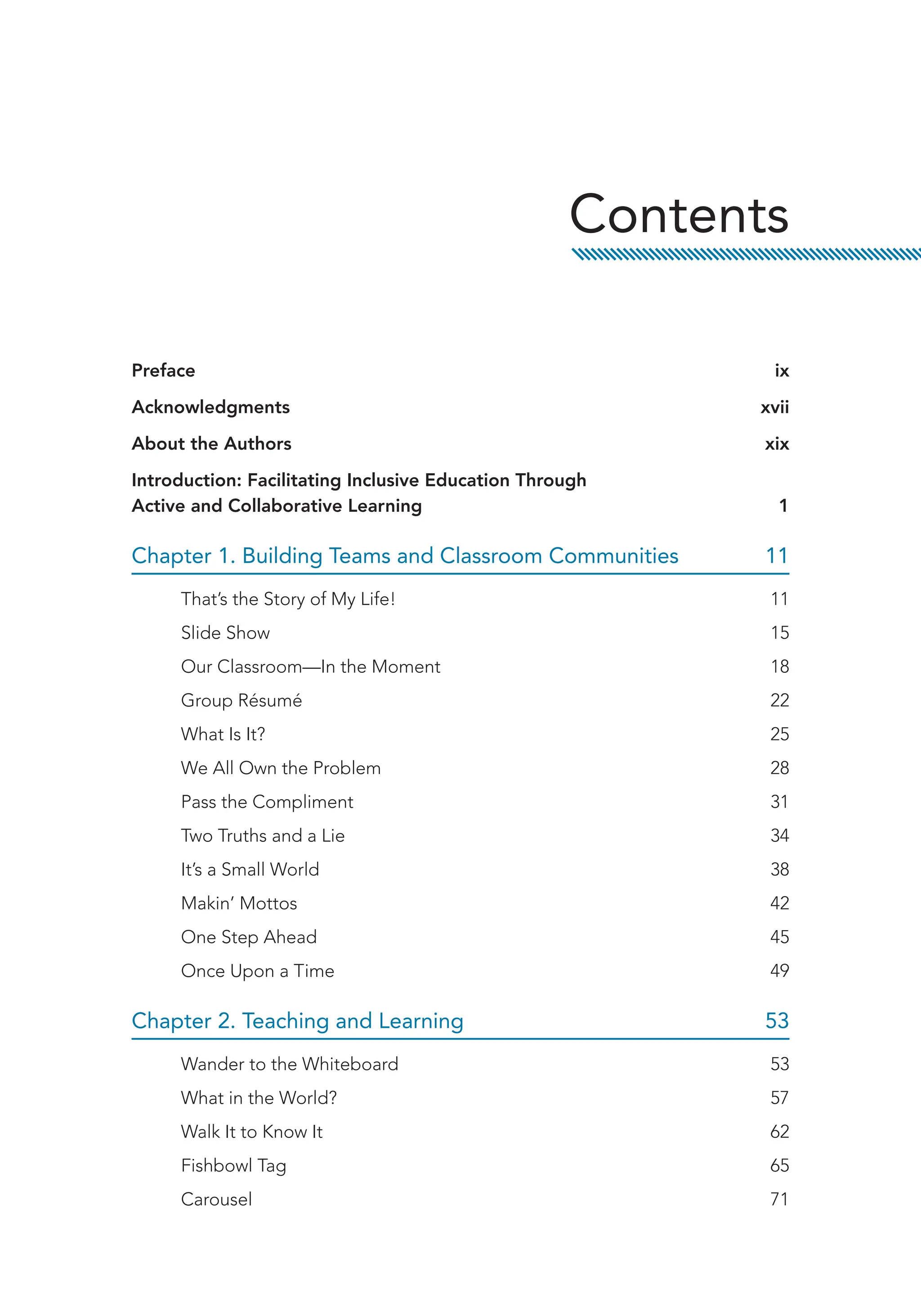
Preface ix
Acknowledgments xvii
About the Authors xix
Introduction: Facilitating Inclusive Education Through
Active and Collaborative Learning 1
Chapter 1. Building Teams and Classroom Communities 11
That’s the Story of My Life! 11
Slide Show 15
Our Classroom—In the Moment 18
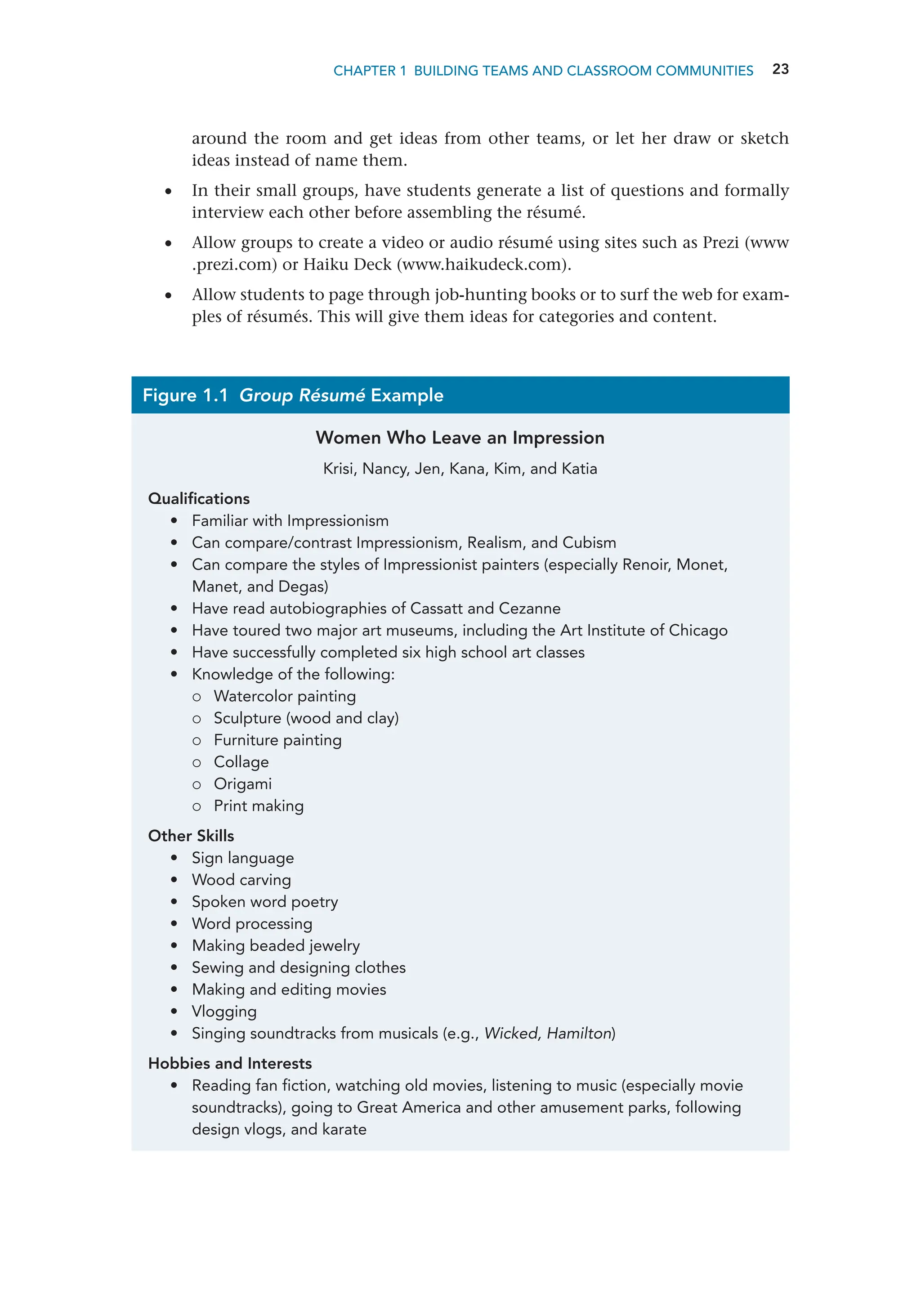
Group Résumé 22
What Is It? 25
We All Own the Problem 28
Pass the Compliment 31
Two Truths and a Lie 34
It’s a Small World 38
Makin’ Mottos 42
One Step Ahead 45
Once Upon a Time 49
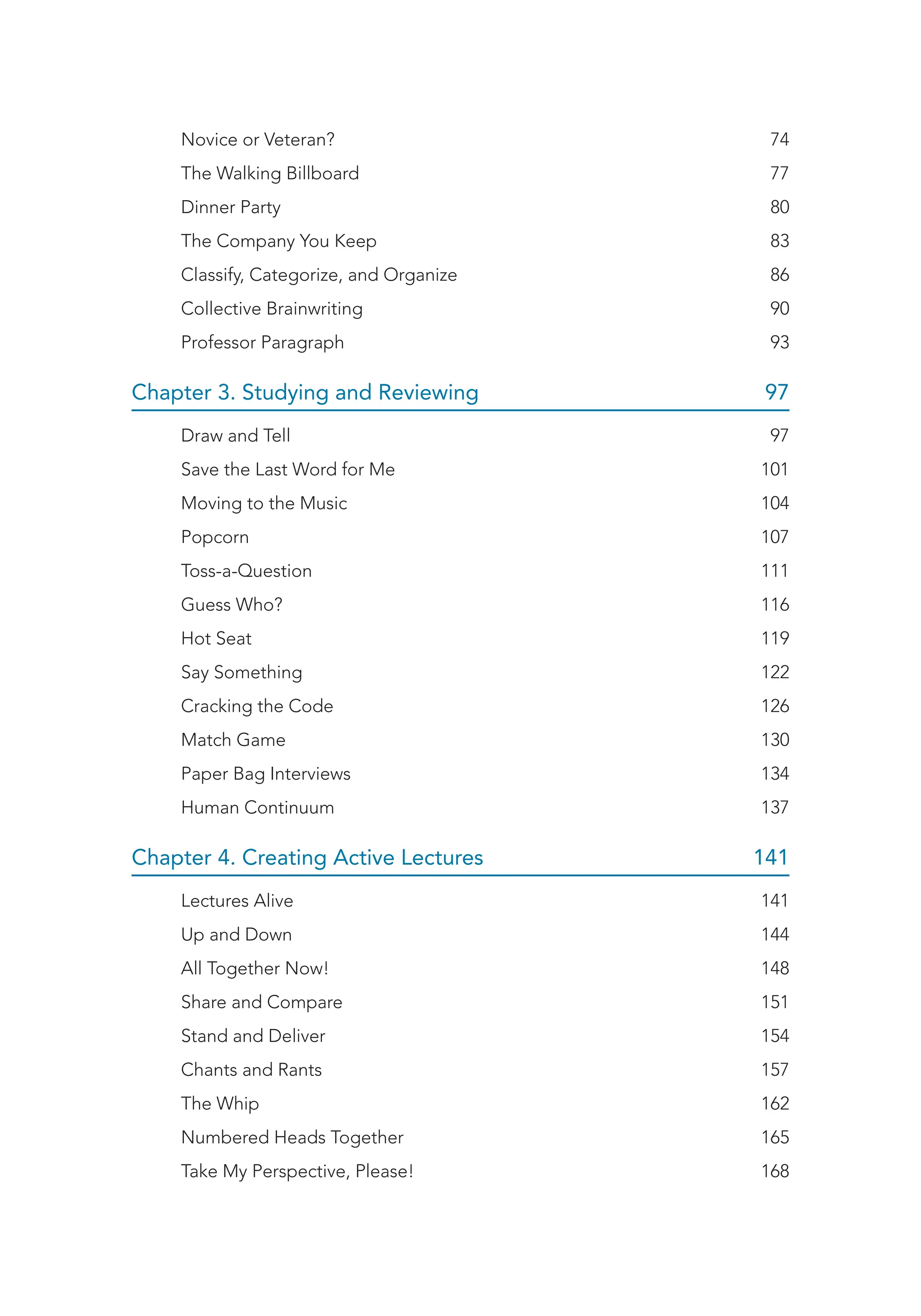
Chapter 2. Teaching and Learning 53
Wander to the Whiteboard 53
What in the World? 57
Walk It to Know It 62
Fishbowl Tag 65
Carousel 71
Contents
Novice or Veteran? 74
The Walking Billboard 77
Dinner Party 80
The Company You Keep 83
Classify, Categorize, and Organize 86
Collective Brainwriting 90
Professor Paragraph 93
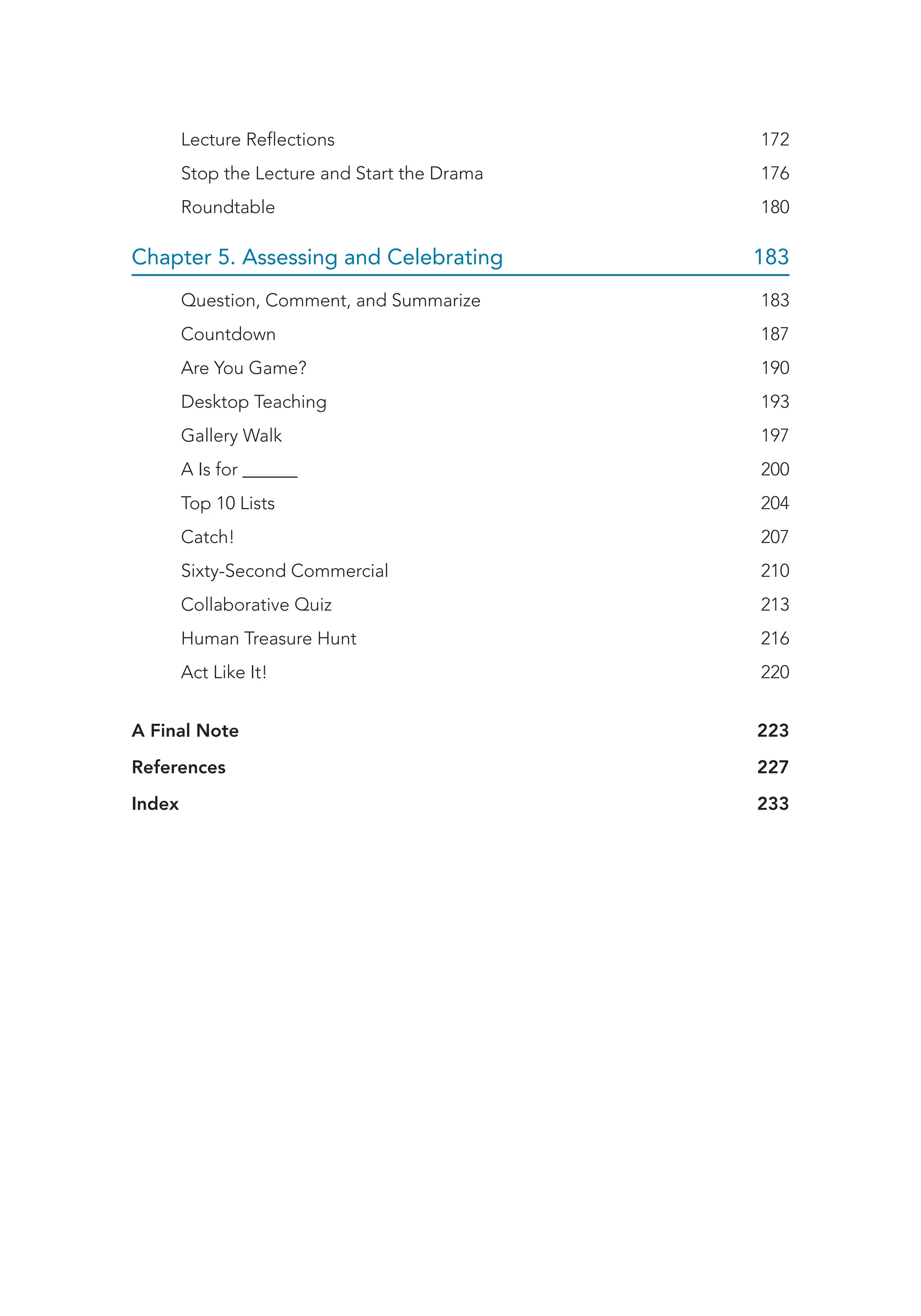
Chapter 3. Studying and Reviewing 97
Draw and Tell 97
Save the Last Word for Me 101
Moving to the Music 104
Popcorn 107
Toss-a-Question 111
Guess Who? 116
Hot Seat 119
Say Something 122
Cracking the Code 126
Match Game 130
Paper Bag Interviews 134
Human Continuum 137
Chapter 4. Creating Active Lectures 141
Lectures Alive 141
Up and Down 144
All Together Now! 148
Share and Compare 151
Stand and Deliver 154
Chants and Rants 157
The Whip 162
Numbered Heads Together 165
Take My Perspective, Please! 168
Lecture Reflections 172
Stop the Lecture and Start the Drama 176
Roundtable 180
Chapter 5. Assessing and Celebrating 183
Question, Comment, and Summarize 183
Countdown187
Are You Game? 190
Desktop Teaching 193
Gallery Walk 197
A Is for ______ 200
Top 10 Lists 204
Catch! 207
Sixty-Second Commercial 210
Collaborative Quiz 213
Human Treasure Hunt 216
Act Like It! 220
A Final Note 223
References 227
Index 233
ix
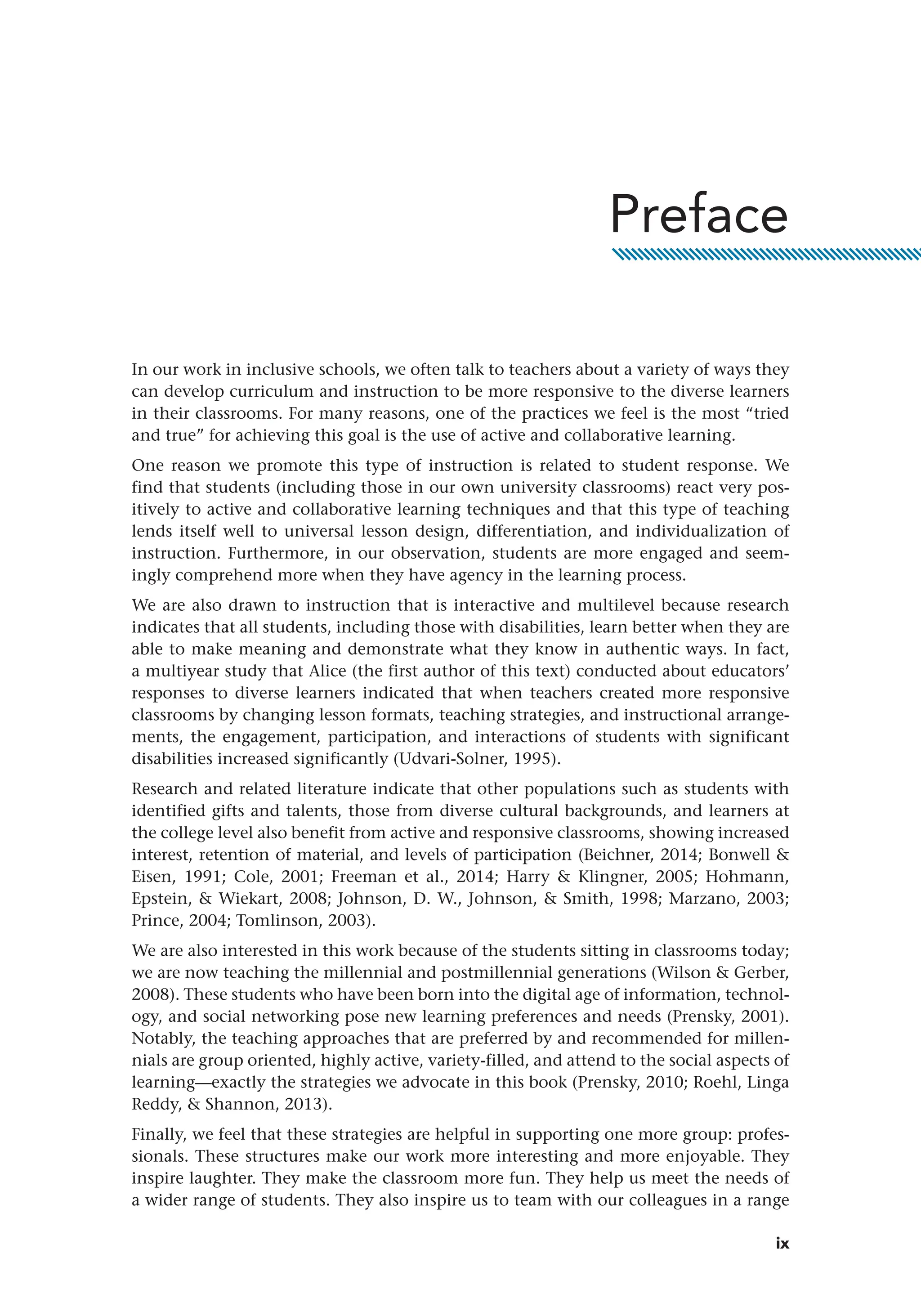
In our work in inclusive schools, we often talk to teachers about a variety of ways they
can develop curriculum and instruction to be more responsive to the diverse learners
in their classrooms. For many reasons, one of the practices we feel is the most “tried
and true” for achieving this goal is the use of active and collaborative learning.
One reason we promote this type of instruction is related to student response. We
find that students (including those in our own university classrooms) react very pos-
itively to active and collaborative learning techniques and that this type of teaching
lends itself well to universal lesson design, differentiation, and individualization of
instruction. Furthermore, in our observation, students are more engaged and seem-
ingly ­
comprehend more when they have agency in the learning process.
We are also drawn to instruction that is interactive and multilevel because research
indicates that all students, including those with disabilities, learn better when they are
able to make meaning and demonstrate what they know in authentic ways. In fact,
a multiyear study that Alice (the first author of this text) conducted about educators’
responses to diverse learners indicated that when teachers created more responsive
classrooms by changing lesson formats, teaching strategies, and instructional arrange-
ments, the engagement, participation, and interactions of students with significant
disabilities increased significantly (Udvari-Solner, 1995).
Research and related literature indicate that other populations such as students with
identified gifts and talents, those from diverse cultural backgrounds, and learners at
the college level also benefit from active and responsive classrooms, showing increased
interest, retention of material, and levels of participation (Beichner, 2014; Bonwell 
Eisen, 1991; Cole, 2001; Freeman et al., 2014; Harry  Klingner, 2005; Hohmann,
Epstein,  Wiekart, 2008; Johnson, D. W., Johnson,  Smith, 1998; Marzano, 2003;
Prince, 2004; Tomlinson, 2003).
We are also interested in this work because of the students sitting in classrooms today;
we are now teaching the millennial and postmillennial generations (Wilson  Gerber,
2008). These students who have been born into the digital age of information, technol-
ogy, and social networking pose new learning preferences and needs (Prensky, 2001).
Notably, the teaching approaches that are preferred by and recommended for millen-
nials are group oriented, highly active, variety-filled, and attend to the social aspects of
learning—exactly the strategies we advocate in this book (Prensky, 2010; Roehl, Linga
Reddy,  Shannon, 2013).
Finally, we feel that these strategies are helpful in supporting one more group: profes-
sionals. These structures make our work more interesting and more enjoyable. They
inspire laughter. They make the classroom more fun. They help us meet the needs of
a wider range of students. They also inspire us to team with our colleagues in a range
Preface
x JOYFUL LEARNING 
of ways. When we use active and collaborative learning structures in elementary and
secondary classrooms, it is easy to plan ways for related service providers (e.g., speech
therapists, occupational therapists), fellow classroom teachers (e.g., English language
[EL] professionals, general and special educators), and paraprofessionals to coteach
and support all students. When students engage in a very busy and social structure
such as Dinner Party (p. 80), for instance, we often ask speech therapists to work with
small groups on pragmatics and vocabulary development. When we use text-based
techniques such as Say Something (p. 122), we often collaborate with reading specialists,
asking them to work with different groups of students throughout the lesson so that all
learners can gain more powerful comprehension strategies.
For all of these reasons, we began collecting active and collaborative learning struc-
tures and working with practicing educators and preservice teachers to adapt these
different structures to meet the needs of a wider variety of students. As we shared these
techniques in our classes and inservice presentations, teachers and university students
alike asked us where they could find more information on using the structures in their
inclusive classes. For instance, they wanted to use Dinner Party, but they were curious
about how to use it in a classroom where one or two students used augmentative
communication systems. They were interested in Say Something, but were unsure how
to use it with a student who was an emerging reader. These requests led us to develop
this resource, which includes active learning techniques appropriate for use in K–12
classrooms and beyond. We explicitly designed structures that allow a wide range of
students to participate, contribute, learn, collaborate with peers, and succeed.
Although some of the structures featured are not new in the sense that we created
or named them (in fact, a number are purposely included because they are already
popular with teachers and used widely in elementary and secondary classrooms), we
feel this book is unique in that many texts related to active learning, differentiated
instruction, or universal design do not include information or ideas appropriate for
some inclusive classrooms; contain few examples related to learners with disabilities—
especially those with significant disabilities; and lack specific suggestions for designing
activities for the range of learners in a typical class. Alternatively, Joyful Learning focuses
explicitly on inclusive classrooms; provides unique suggestions for meeting the needs
of students with disabilities, including those with learning, intellectual, physical, and
sensory differences; contains dozens of familiar and novel activities that all students
can access; and illustrates ways all students can participate in them.
Using This Book
The activities in this book are clearly intended for or are at least well suited for use in
classrooms in which students may have marked differences in ability, need, language,
culture, or learning profile. We are hoping that by creating this resource, we are also
promoting the idea that students with such differences can and should learn side by side.
How the Text Is Organized
The introduction to the book explores how inclusive schooling, differentiated instruc-
tion, and active learning are (or should be) linked and related. The five chapters that
xi
PREFACE
follow describe 60 structures that can be used with students in both elementary and
secondary schools, and in a final note at the very end of the book, we reflect on the
nature of joyful learning with recommendations for its cultivation in the classroom.
Please note that we have attempted to organize the structures into logical categories
to help the reader locate techniques that match an instructional purpose. However,
we don’t believe the categories are mutually exclusive, and many structures can be
employed for multiple instructional uses. Therefore, consider the chapter headings
simply as a guide. The five chapters are as follows:
1. “Building Teams and Classroom Communities.” This initial chap-
ter includes techniques that help teachers build community and team-
ing. These structures promote relationship building, listening, sharing, and
interdependence.
2. “Teaching and Learning.” This chapter contains structures that help stu-
dents of all ages learn standards-based content in meaningful, interesting,
and compelling ways. This collection of ideas will help learners remember
information, teach content to one another, and make discoveries about course
content.
3. “Studying and Reviewing.” The study and review structures give teachers
ideas for supporting students as they work independently or with small groups
to prepare for assessments or learn familiar content in a deeper way.
4. “Creating Active Lectures.” Every teacher needs to engage in whole-class
instruction and lecture-based instruction at some point during the school
day. This instruction does not need to be formal and dry, however. By using
the structures outlined in this chapter, teachers can involve their students in
whole-class learning without losing those who need a more dynamic or per-
sonalized approach.
5. “Assessing and Celebrating.” Structures offered in this chapter will give
educators active-learning options for assessing student understanding, encour-
aging learners to teach and share, and celebrating growth.
Each one of these chapters features 12 activities. Each structure is outlined in detail
with directions, reproducible handouts (when applicable), classroom-tested examples,
and guidelines for maximizing the participation of students. Some structures also fea-
ture tips for implementation and ideas for extending or varying the structure. Each
description is followed by space to record notes and ideas for using the structure in
your classroom. We encourage you to log how you used the structure and then reflect
on any of the following elements:
•
• Did the students learn what I had intended?
•
• Were the students able to carry out the structure, or are changes needed in the
way I organized it or provided directions?
•
• Were all students engaged?
•
• What additional changes might be needed to maximize engagement and par-
ticipation for particular students?
xii
•
• If coteaching with another adult, how can we facilitate or guide our students
more effectively as a team?
•
• Where else in my teaching can I use this strategy?
Using the Structures
This book is best used as a coplanning tool between general educators and specialists
(e.g., special educators, EL educators, occupational therapists, speech therapists, physi-
cal therapists). We recommend that all team members who share responsibility for the
same students become familiar with the structures and the associated procedures. In our
research, we found that when members of educational teams used the same language
and understood the same techniques, joint planning for differentiation was expedited
(Udvari-Solner, 1996a). Effective supports for students with learning differences occur
when instructional teams meet on a consistent basis (i.e., weekly or biweekly) and deter-
mine what is important for students to learn and how best to organize that learning.
Familiarity with the structures in this book by all team members will provide an abun-
dance of options for reaching those students who challenge us the most as educators.
If you don’t currently have strong collaborative partnerships, using these structures
can be an effective way to begin such a relationship. In our preservice courses, we often
suggest that special educators or therapists seeking to coteach or to further develop
their inclusive education model should offer to demonstrate active and collaborative
structures as a way into the general education classroom. A general education class-
room teacher who seems less than enthusiastic about making changes in curriculum
or instruction can often be inspired to do so when alternatives to traditional teaching
are not only suggested but also modeled. Such an offer illustrates that all adults in the
building can and should teach and design instruction and that it is not just the job of
the general educator to take on new roles.
Having shared how important it is for teaching teams to use these structures, we can
now turn to another important group of instructors: students. We feel strongly that as
educators we are modeling techniques that we want students to use and incorporate
into their own instructional repertoire. There may be times when it is appropriate for a
student or group of students to lead a class discussion or present reports or individual
research. These techniques can be used to enliven this process and give students yet
another arena for building skills and developing competencies.
Administrators are yet another audience for this material. If you are a principal,
department chairperson, or even superintendent, consider using these structures in
your meetings and staff development activities. Because teachers are learners too,
you are likely to get a higher quality of participation in meetings when you are
using techniques that will reach and interest larger numbers of “students.” Further,
there is no better way to emphasize a commitment to and enthusiasm for active
and collaborative learning than to model it in your own work. For instance, a mid-
dle school principal had his staff try out the Group Résumé activity (p. 22) during a
summer staff development institute. Teachers were mixed into groups with those
from different grade levels and specialty areas and asked to construct the résumé on
large pieces of chart paper. This activity gave the teachers the opportunity to learn
about the skills and competencies of one another and, ultimately, helped them get
JOYFUL LEARNING 
xiii
and give support to one another on topics ranging from cooperative learning to
flipping classrooms to conducting classroom meetings to developing a schoolwide
service learning ­
program. The résumés were then posted around the room and used
as springboards for the next activity, which was to develop an action plan for learn-
ing from colleagues.
Finally, consider this book as a vehicle for professional development. As authors,
we have been asked by innumerable school districts and organizations to work with
­
specific teaching teams or entire buildings or districts to learn and integrate these strat-
egies into daily practice. Teaching has been called one of the loneliest professions,
and unfortunately—in some schools—trying something new in the classroom can feel
risky. We believe there is strength in numbers and that being creative in the classroom
should be supported and celebrated in the school community. In healthy organiza-
tions, new information and innovative practices are shared in collaborative ways. One
way to facilitate this shift in school culture is to initiate professional development that
focuses on the use of active and collaborative structures to differentiate instruction or
inspire the universal design of lessons.
This type of staff development can be as simple as a book study group or as organized
as a formal action research project. Some schools with which we have worked arranged
for a group of interested faculty to meet weekly or biweekly to read and discuss the
ideas in this book. In these groups, teachers select structures of interest and agree to
implement one or two within the week. In each subsequent meeting, teachers share
their successes and challenges. This informal arrangement also provides a time for
educators to discuss student progress and concerns and to collectively generate ways to
teach, support, and challenge all learners through the use of the structures.
Getting Started: Tips for Implementing the Structures
Begin using these structures in your unit or lesson planning with particular students
in mind. Effective differentiation occurs when we consider our learners and find
out about their abilities, preferences, and areas of intelligence as a starting point in
instructional design. Then, look for structures that will allow you to teach the content
you have identified while you address student needs, teach skills you want to foster,
and potentially provide opportunities to address social and academic goals that are
a part of a learner’s individualized education plan (IEP). For example, if a student
with learning disabilities needs multiple trials to retain information and also has an
IEP goal to paraphrase key concepts from texts, Popcorn (p. 107) might be chosen as
a review strategy for the entire class. This structure allows students to summarize
learning in their own words and then teach or share the same content several times
to various partners. By using this structure, the teaching team can provide avenues
for the student with learning disabilities to work on critical goals identified by his or
her educational team.
Keep in mind that all of the structures can be used individually, or they can be “stacked”
to create new and different classroom experiences. For instance, a teacher might use
Popcorn to get students talking about content and follow that activity with The Whip
(p. 162) to find out one thing that each student learned from his or her classmates
during the interview process. Or Take My Perspective, Please! (p. 168) could be used
PREFACE
xiv
to elicit opinions or impressions about a topic, and it could be followed with Stand
 Deliver (p. 154) to allow students to share one thing they learned from their
interactions.
Making Them Work for All: Tips for Adapting and Teaching the Structures
These structures are not subject or grade-level specific. We offer examples with each
structure; however, if the example does not mirror your exact teaching experience,
we encourage you to be inventive. The structures can be used in different ways across
subject areas and with students of different ages, so they should definitely be edited,
changed, and modified to fit not only your grade level but also your unique group of
students.
Our suggestions throughout this book for adapting and otherwise altering the activ-
ities are not comprehensive; we intend these ideas simply to serve as examples of
how certain activities might be changed for various types of learners and, perhaps
more important, to suggest that they should be changed! In other words, we hope
to communicate that adaptation, differentiation, and personalization of lessons for
all students is what good teachers do. Furthermore, we are striving to demonstrate
that when we expand or alter an activity to meet the needs of a single learner or a
small group of learners, the result is almost always a lesson that is more comprehen-
sive, responsive, and appropriate—for all. In Table 0.1, we have provided a short list
of simple and quick ways to differentiate or design more universal learning experi-
ences when using active and collaborative learning structures. More extensive ideas
are offered in the section of each structure titled “Methods to Maximize Engagement
and Participation.”
To further increase your chances of meeting the needs of all learners, we recommend
that you practice, practice, and practice. Avoid the common error of using these
structures as beginning-of-the-year icebreakers—and only as beginning-of-the-year
icebreakers. These structures, in most cases, are designed to be used as tools for deliv-
ering daily instruction, and with regular use, students will become more proficient
and self-directed in their participation. So try a structure once, revise your plan, and
try it again.
Keep in mind that during this process you may need to break down the structures into
steps and spend some time teaching students how to participate in them. This may
be particularly important for students with learning difficulties or those who struggle
with change or novelty. Be explicit with directions, and be sure to teach both the rules
and the social and communication requirements for working well in groups (e.g., shar-
ing materials, paraphrasing a classmate’s statement, expressing an opinion).
Further, you will want to explain to students why you are doing what you are doing
and how it is relevant to the content. And always leave time at the end of an activity to
debrief about what worked well or what might need to be changed to be more respon-
sive to students’ learning needs. You may even want students to reflect on the strategy
so you can gather written feedback. Figure 0.1 is a student reflection form that can be
used with learners in intermediate elementary grades to secondary settings. This same
feedback can be solicited in a large-group feedback session or individual conferencing
with younger children.
JOYFUL LEARNING 
xv
Figure 0.1 Student Reflection
Active and Collaborative Learning Structures
Name: _______________________________________________________________________________________
What structure did your teacher use?
________________________________________________________________________________________________
What content did he or she teach or review using the structure (e.g., fractions, Spanish
vocabulary)?
________________________________________________________________________________________________
What did you like about using the structure? For example, was it fun, did you learn
something new, or did it make learning easier?
________________________________________________________________________________________________
________________________________________________________________________________________________
________________________________________________________________________________________________
What was difficult or challenging about using the structure?
________________________________________________________________________________________________
________________________________________________________________________________________________
________________________________________________________________________________________________
What did you learn from participating in the structure? Be as specific as you can.
________________________________________________________________________________________________
________________________________________________________________________________________________
________________________________________________________________________________________________
________________________________________________________________________________________________
________________________________________________________________________________________________
Would you want your teacher to use this structure again? Why or why not?
________________________________________________________________________________________________
________________________________________________________________________________________________
________________________________________________________________________________________________
________________________________________________________________________________________________
________________________________________________________________________________________________
Copyright © 2018 by Corwin. All rights reserved. Reprinted from Joyful Learning: Active and Collaborative Strategies for Inclusive
Classrooms, Second Edition, by Alice Udvari-Solner and Paula Kluth. Thousand Oaks, CA: Corwin, www.corwin.com
PREFACE
xvi
Students may—at first—resist participating in active and collaborative structures, par-
ticularly if they have not had opportunities to do so in the past; this is a natural part
of the learning process. Once they are familiar with several strategies we encourage
you, whenever possible, to enlist their input in selecting methods to incorporate into
upcoming lessons. Doing so will likely increase your students’ sense of agency in their
own learning and willingness to engage in the structures.
Finally, be sure to enjoy the process of this new and more joyful way of doing business
in the classroom.
• Have students work in pairs or in small groups.
• Bring therapists, paraprofessionals, other teachers, or volunteers into the
classroom to help facilitate the activities and to give all students more adult
support.
• Give directions or review the content in advance (preteach).
• Teach the structure to students first with less complex, familiar, or low-stakes
content so that they can focus on how to engage in the process before applying
it with higher-stakes material.
• Allow all or some students to practice the activity in advance, or video record the
structure so the learner can see and hear what is expected.
• Allow students to have cue cards and preview materials during activities. Or let
them use their phones or tablets to access the material, visuals, or supports they
need.
• Allow students to have different roles in the activities; if most students are
talking in small groups, one or two students might document responses they
hear or serve as facilitators of groups.
• Ask or allow all students to use alternative or augmentative communication
(AAC); you might, for instance, give all students the option to either speak or
write a response during a group-sharing activity.
• Give choices in the activity (e.g., let students switch partners or stay with the
same partner).
• Provide “wait time” or “think time” to one or all students before expecting a
response.
• Use more than one output strategy (e.g., use pictures as well as words) when
giving directions or providing instruction.
• Ask students to help in preparing the lessons so they can take active roles in
leading activities, generating questions or content, and even creating supports
for one another.
• Offer a range of tools for writing and expression, including paper and pencil,
laptops, and tablets.
Table 0.1 
Using Active and Collaborative Learning: Quick and Easy Ways
to Differentiate and Design Lessons for All
JOYFUL LEARNING 
xvii
Many people helped us in the conceptualization and completion of this manuscript,
but before we thank those who made the writing of the book possible, we must share
our gratitude for the students with disabilities and many other learners with unique
learning styles who have helped us think critically about Universal Design of Learning,
differentiating instruction, and adapting curriculum. Although we have both taught
dozens of learners who have guided our thinking in this respect, we are especially
indebted to Mattie, Mark, Sarah, Sherrie, Paul, Jason, Franklin, Joe, Andrew, and Bob.
We would also like to thank the schools that have welcomed us into their classrooms
to teach and be taught. Many educators field tested these strategies with us and fear-
lessly entered into an exploration of their own practice with students and colleagues
alike. We are especially grateful to the staff members and administrators from Chicago
Public Schools; Greenwich Public Schools in Greenwich, Connecticut; Madison Met-
ropolitan School District in Madison, Wisconsin; Highland Park High School in High-
land Park, Illinois; Deerfield High School in Deerfield, Illinois; Middleton High School
in Middleton, Wisconsin; Oconomowoc School District in Oconomowoc, Wisconsin;
and Verona High School in Verona, Wisconsin. In particular, we want to acknowledge
the creativity and innovation of Matthew Armfield and Dr. Jeff Hoyer, teachers who
contributed several ideas to this text and inspire us with their creativity, and the staffs
of the Maryland Coalition for Inclusive Education (MCIE) and the Christopher and
Susan Gust Foundation, who have used and promoted the book for years, given help-
ful feedback, and suggested helpful changes.
The work of many colleagues has shaped our thinking about curricular adaptations,
differentiating instruction, active learning, and inclusive schooling, but we would like
to acknowledge a few of them in particular. Dr. Lou Brown acted as our teacher and
guide as we trained to be educators. He acknowledged and fostered our ability and
desire to teach all children and to hold a steadfast vision of an inclusive society. He
cultivated an urgent sense of advocacy in us to question the status quo, to reinvent
conceptions of schooling, and to keep children with disabilities and their families at
the center of decision-making.
Dr. Jacqueline Thousand and Dr. Richard Villa have been generous mentors in our pro-
fessional lives. Their prolific work in the development of inclusive education provided
not only the big ideas but also the practical steps to make change happen in complex
systems. We thank them for inviting us along in the journey, sharing professional
opportunities, and asking us to contribute our work to their publications early in our
careers.
We extend extra-special gratitude to our friend and colleague, Patrick “Paco” Schwarz,
who constantly inspires us to think differently, to innovate, to ask better questions,
Acknowledgments
xviii JOYFUL LEARNING
and to bring energy and fun to the classroom and into our lives. You are the best! You
help us dream of possibilities!
The inspiration for the content of this book emanated from the ideas and the writings
of Mel Silberman, Merrill Harmin, Jeanne Gibbs, Spencer Kagan, and Mara Sapon-­
Shevin. We are grateful for the work they have done that has made such a positive
impact in the fields of teaching and learning, as well as in curriculum and instruction.
These acknowledgments would not be complete without mentioning the hard work
and innovation of our undergraduate and graduate students from the University of
Wisconsin–Madison and Syracuse University. So much of this material comes from our
experiences teaching future educators; we are grateful to our students for field-testing
these strategies in the college classroom, asking critical questions, and for working as
change agents in public schools every day.
Our spouses and children supported our work on this project by allowing us to write,
proofread, edit, and chat on the phone on evenings and weekends. Paula’s daughters
Erma and Willa were our resident experts on what is cool, what is interesting, and what
helps kids learn in elementary and middle school. As Alice’s daughters Madda and
Haven moved on to high school and college, they have been able to share more critical
opinions about what might or might not work in secondary settings.
Finally, we are grateful to those at Corwin for the time and care they invested in this
project. In particular, we extend our very best to acquisitions editor Jessica Allan,
senior associate editor Kimberly Greenberg, editorial assistant Katie Crilley, project
editor Veronica Stapleton Hooper, copy editor Amy Hanquist Harris, cover designer
Anupama Krishnan, and marketing manager Charline Maher.
Publisher’s Acknowledgments
Corwin gratefully acknowledges the contributions of the following reviewers:
Joel Amidon
Assistant Professor
University of Mississippi, Department of Teacher Education
University, Mississippi
Sarah L. Schlessinger
Assistant Professor of Adolescent Inclusive Education
Long Island University–Brooklyn Campus
Brooklyn, New York
Melissa Sherfinski
Assistant Professor of Elementary and Early Childhood Education
West Virginia University
Morgantown, West Virginia
xix
Dr. Alice Udvari-Solner is a national consul-
tant in education and holds an appointment at the
University of Wisconsin–Madison in the Depart-
ment of Curriculum and Instruction where she has
prepared preservice teachers to work in inclusive
settings for over three decades. The graduate and
undergraduate courses she teaches on the topic of
accommodating diverse learners in general educa-
tion settings are integral to the elementary, sec-
ondary, and special education teacher certification
programs. Universal Design for Learning (UDL),
differentiation, assistive technologies, collaborative
teamwork among educators and paraprofessionals,
and systems change toward inclusive education are
areas that are central to her research and teaching.
Dr. Udvari-Solner’s research has focused on the development of the Universal Design
Process for Differentiation—a method used to promote coplanning among educators
to design responsive strategies for diverse learners. She has authored numerous jour-
nal articles, and her work has been featured in multiple texts that include Leading
Inclusive Schools, Educating Students With Severe and Multiple Disabilities: A Collaborative
Approach, Creating the Inclusive School, Inclusive Urban High Schools, Quick Guides to
Inclusion, Restructuring for Caring and Effective Education, and Creativity and Collabora-
tive Learning.
Dr. Paula Kluth is a consultant, author,
advocate, and independent scholar who works
with teachers and families to provide inclusive
opportunities for students with disabilities and
to create more responsive and engaging school-
ing experiences for all learners. Paula is a former
special educator who has served as a classroom
teacher and inclusion facilitator. She is the author
or coauthor of more than 15 books, including
Universal Design Daily, 30 Days to the Co-Taught
Classroom (with Julie Causton), From Text Maps to
Memory Caps: 100 Ways to Differentiate Instruction
in K–12 Inclusive Classrooms (with Sheila Dana-
her), “Don’t We Already Do Inclusion?”: 100 Ways
About the Authors
xx JOYFUL LEARNING
to Improve Inclusive Schools, You’re Welcome: 30 Innovative Ideas for the Inclusive Class-
room (with Patrick Schwarz), and “You’re Going to Love This Kid”: Teaching Students
With Autism in Inclusive Classrooms. To learn more about Paula, visit her personal web-
site, www.paulakluth.com. You can also connect with her on social media, including
on Facebook (www.facebook.com/paulakluth), Twitter (twitter.com/PaulaKluth), and
­Pinterest (www.pinterest.com/paulapin).
1
During a visit to a parent advocacy group, we spoke with the mother of a young man with
Down syndrome who was frustrated about her son’s experience in middle school. Bryan,
the young man, had been learning and fully participating in all aspects of classroom life
at his inclusive middle school when the family moved across town to a different school
that was also deemed inclusive. Before the move, the family was incredibly impressed
with the education Bryan was receiving. His mother explained that Bryan was asking
and answering questions during whole-class instruction, working effectively in coop-
erative groups, completing assigned projects, taking a leadership role in class meetings,
entering the science fair annually, participating in school concerts and performances,
and establishing positive social relationships with classmates without disabilities.
After the move, however, the young man’s interest in school faded. The new school,
although in the same district as the old and serving essentially the same population
of learners, had a more traditional educational philosophy. Students were expected to
sit in their desks for longer periods of time during large-group instruction and engage
in more independent work. The principal explained that although the school was
committed to inclusive education, they recommended it only for learners who “could
handle it.” In this school, he explained that learning “was taken seriously,” and the
teachers taught in more traditional ways to “cover all the material.” Bryan began strug-
gling, and before long, teachers were recommending that he be pulled out of their
classes. Bryan’s attitude toward school changed, and for the first time ever, he started
resisting doing his homework, getting up in the morning, and even going to school.
Unfortunately, the scenario described by this mother is all too common; under one
set of circumstances, her son is learning, meeting individual goals, and being effec-
tively included. Yet in another setting, he is seemingly unable to negotiate the ­
general
education curriculum and instruction. As researchers and teacher educators in the
field of inclusive schooling, we have been interested in and concerned about why
these discrepancies in outcomes for students occur between different classrooms. Over
the course of our work with educators across the country, we have attempted to exam-
ine what conditions, practices, and approaches facilitate the effective inclusion of
students with diverse learning needs (Causton, Udvari-Solner,  Richmond, 2016; Kasa-­
Hendrickson  Kluth, 2005; Kluth, 2003; Kluth, Straut,  Biklen, 2003; Udvari-Solner,
1993, 1995, 1996a, 1996b, 2003; Udvari-Solner, Ahlgren-Bouchard,  Harell, 2016;
Udvari-Solner  Thousand, 1996; Udvari-Solner, Villa,  Thousand, 2002, 2005).
Introduction
Facilitating Inclusive Education Through
Active and Collaborative Learning
2 JOYFUL LEARNING
We have consistently observed that students struggle not because they cannot learn the con-
tent but because they cannot learn in the way they are being taught. Too often, we expect
students to change or to leave our classrooms when they experience failure or are disen-
gaged. More often, we should be examining the classroom itself, questioning our teaching
approaches and curriculum, and evaluating all the ways we might support, engage, respond
to, and challenge every student. In other words, we should be following the key principles
that underlie inclusive education (Falvey  Givner, 2005; Falvey, Givner, Villa,  Thou-
sand, 2017; Fisher  Roach, 1999; Fisher, Sax,  Pumpian, 1999; Jorgensen, 1998; Kluth,
2003; Sapon-Shevin, 2007; Thousand, Udvari-Solner,  Villa, 2017; Udvari-Solner et al.,
2016; Udvari-Solner  Thousand, 1996; Villa  Thousand, 2005, 2017).
What Is Inclusive Schooling?
Udvari-Solner and Thousand (1996) defined inclusive education as “a value-based prac-
tice that attempts to bring all students, including those with disabilities, into full
membership with their local school” (p. 230). Inclusive education complements other
school reform efforts by calling for a critique of existing school, teaching, and class-
room culture. Administrators, parents, and educators are encouraged to question and
reinvent traditional teaching paradigms and replace them with practices that value
and encourage every student as a participatory member of the classroom community
(Udvari-Solner, 1997). This progressive educational movement has evolved over the
course of over 40 years, and key principles or tenets are well established to guide its
practice. Specifically, in inclusive schools, we should see separate or segregated settings
for instruction of students with differences dismantled. We should also notice that
support services are being brought to the general education classroom and support
personnel are integral members of teaching teams in general education environments.
Most important to daily classroom practice, in inclusive schools we should observe
that curriculum and instruction are collaboratively and universally designed by spe-
cial and general educators (and, when appropriate, therapists, English language (EL)
teachers, facilitators of enrichment programs, and reading specialists) with the intent
to support every learner in the classroom.
What Is Differentiated Instruction?
Scholars and practitioners have used many different terms to describe differentiation, or
the design of curriculum, instruction, and assessment that meets the needs of diverse
learners. In 1995, Udvari-Solner proposed a reflective decision-making model for
rethinking classroom practices and creating what was then referred to as “curricular
adaptations” to better accommodate all students. Oyler (2001) used the term accessible
instruction to describe the use of democratic practices and the development of challeng-
ing learning experiences. During this same time period, Rose and Meyer (2002) were
introducing educators to Universal Design for Learning, a model that focuses on three
different aspects of lesson planning: methods of engagement, methods of action and
expression, and methods of representation. Udvari-Solner and colleagues (2002, 2005)
extended this thinking by proposing a framework for differentiation called the Univer-
sal Design Process, which requires advance decisions about the content, process, and
products of learning so that flexible and multiple approaches for teaching and learning
are incorporated at the onset of lesson design.
3
INTRODUCTION
In the mid-1990s, Tomlinson (1995) was promoting similar ideas and methods in her
seminal book Differentiating Instruction in a Mixed-Ability Classroom. It was this text
that popularized the phrase differentiated instruction, and soon thereafter, research-
ers, educators, and school leaders began using this term as a catchall for methods
that are designed to reach, teach, and challenge a wide range of learners. Specifically,
­
Tomlinson (1995) defined differentiation in this way:
At its most basic level, differentiating instruction means “shaking up” what
goes on in the classroom so that students have multiple options for taking in
information, making sense of ideas, and expressing what they learn. In other
words, a differentiated classroom provides different avenues to acquiring
content, processing or making sense of ideas, and to developing products. (p. 3)
We like Tomlinson’s definition and feel it has moved educators beyond thinking
about curricular change as something that happens only in relation to disability. This
definition also demystified the idea of differentiation, making change less threaten-
ing and more “do-able” in classrooms. However, we have been inspired to expand on
Tomlinson’s (1995) definition of differentiation. Throughout our careers, we have asked
educators to articulate the influences and philosophies that have guided their work in
inclusive education (Kasa-Hendrickson  Kluth, 2005; Udvari-Solner, 1996b; Udvari-
Solner, 2003; Udvari-Solner  Keyes, 2000). When asked about their practices, teachers
have provided a fairly complex and political picture of what it means to meet the needs
of all learners. From those conversations, we have constructed this ­
definition:
Differentiation requires a desire to honor the individual. It is a conscious
and critical act that calls into question what we teach, why we should
teach it, and how we expect students to learn. Teachers attend not only
to curriculum, instruction, and assessment but also to issues of relevance,
meaning, and respect. A student’s individual needs, experiences, and
interests influence the design of learning experiences. The presence of
difference in the classroom is not viewed as a liability but as the necessary
catalyst for changes that will improve instruction for all.
Inherent in this definition and in Tomlinson’s (1995) version is the need to look closely
at and reconsider the process of teaching and learning. Specifically, we should attend
to how we understand and respond to our learners and how students experience their
education. Do they feel they are giving or only getting information? Do they have
opportunities to demonstrate what they know and can do? Do they care about what
they are learning? Are daily experiences fun or at least satisfying? These questions have
caused us to turn our attention specifically to differentiating via collaborative and
active learning.
Some form of active or collaborative learning is identified as a core tenet of most dif-
ferentiation or curricular adaptation models. There are certainly many other methods
used to differentiate that should be employed regularly, including using ­
coteaching,
arranging flexible grouping, developing multilevel and multisensory materials, mak-
ing adjustments in expectations and goals, and employing student-specific teaching
strategies (Udvari-Solner et al., 2016). However, we find that when teachers con-
sciously engineer active and collaborative learning approaches, so many avenues to
4 JOYFUL LEARNING
general education curriculum and instruction open that other supports, materials, and
approaches are often unnecessary.
What Is Active Learning and Collaborative Learning?
Learning is not a spectator sport. Students do not learn much just by sitting in
class listening to teachers, memorizing prepackaged assignments, and spitting out
answers. They must talk about what they are learning, write about it, relate it to
past experiences, apply it to their daily lives. They must make what they learn part
of themselves.
(Chickering  Gamson, 1987, p. 4)
This quote by Chickering and Gamson captures the importance of making learning
dynamic and interactive. Active and collaborative lesson formats offer alternatives to
traditional teaching approaches that rely on whole-class and teacher-directed instruc-
tion. These strategies can profoundly and constructively affect the process of learning
by offering multiple means to engage students and multiple methods for students to
express what they know. Further, we believe that the use of active and collaborative
approaches achieves positive outcomes by promoting student dignity and empower-
ment, facilitating self-management, attending to a sense of community, and increasing
the energy and awareness of both teachers and students. These are outcomes we feel
are essential to successful inclusive classrooms and that we are, therefore, trying to
promote. In this book, we use the term active and collaborative learning to describe all of
the featured structures because they incorporate elements of both types of instruction
(active learning and collaborative learning).
Active Learning
Active learning involves putting students at the center of instruction and giving them
opportunities to solve, explore, experiment, try, create, and invent. In classrooms that
promote active learning, students are often moving, sharing, working in and out of
their seats, using a range of materials, and engaging with others while talking or think-
ing aloud. Active learning is, essentially then, anything that students do in a classroom
other than merely passively listening to the teacher’s instruction. This includes every-
thing from listening practices that help the students absorb what they hear to vir-
tual learning via online field trips, Skype conversations, and Twitter interviews; from
brief writing exercises in which students react to lecture material to short games used
for review and introduction of content; and from complex group exercises in which
students apply course material to authentic or real-life situations or past experiences
(Paulson  Faust, 2010).
Collaborative Learning
Collaborative learning can be considered a subset within the category of active learn-
ing. Whereas many active strategies can be independently performed, all collaborative
5
learning is inherently active because it requires individuals to interact in organized
ways with others to problem solve, practice skills, or produce work together in some
way (Keyser, 2000; Roschelle  Teasley, 1995; Udvari-Solner et al., 2016). It is a process
by which students interact in pairs or groups with intent to solicit and respect the
abilities and contributions of individual members. Typically, authority and responsi-
bility are shared for group actions and outcomes (Panitz, 1997). Thereby, collaborative
learning encompasses all group-based instructional methods in which students work
together toward a common goal (Prince, 2004).
Collaborative learning changes the dynamics of the classroom by requiring discussion
among learners. Students are encouraged to question the curriculum and attempt to
create personal meaning before an adult interprets what is important to learn. Oppor-
tunities to organize, clarify, elaborate, or practice information are engineered, and
listening, disagreeing, and expressing ideas are as important as the “right answers.”
Furthermore, in classrooms that encourage this type of ideology, the student is an
active participant in learning rather than a passive recipient of education from an
expert source.
Why Use Active and Collaborative Learning?
Historically, active learning and collaborative methods have been promoted and cele-
brated by a host of well-respected educators, including Socrates, Booker T. Washington,
John Dewey, Paulo Freire, Maria Montessori, and more recently, Howard Gardner. Yet
education in many American classrooms still tends to be primarily a passive venture.
Students are often asked to sit in desks for long periods of time and learn through what
Freire (1970) deemed “banking education.” In this method, the teacher teaches and
the students are taught, the teacher knows everything and the students know noth-
ing, the teacher thinks and the students are thought about, the teacher talks and the
students listen, the teacher chooses and the students comply, and the teacher is the
subject of the learning process and the pupils are the objects (Freire, 1970).
Freire (1970) dismissed banking education as dehumanizing and called for a different
kind of learning. He promoted instead a student-centered and relevant curriculum;
a multicultural, democratic, and dynamic pedagogy; and a safe, tolerant, sensitive,
and active learning environment. He felt that education should be pursued collabora-
tively, with student and teacher working in concert to teach and learn. Furthermore,
he insisted that learners do not enter into the process of learning by memorizing facts,
but by constructing their reality in engaging, dialoguing, and problem solving with
others (Freire, 1970; Gadotti, 1994).
Understanding Theory
Freire (1970) believed in the power of active and collaborative learning and for good
reason. Active and collaborative learning are firmly rooted in and draw support from
a number of foundational social learning theories important to education (Udvari-­
Solner, 2012a, Udvari-Solner, 2012b). To illustrate, consider the theories at work when
students engage in this example of Classify, Categorize, and Organize (found on page 86
of the book):
INTRODUCTION
6
1. The teacher creates note cards, strips of paper, or pictures or provides actual
items related to concepts that can be classified, categorized in two or more
groups (e.g., different species of animals, parts of speech, types of architecture),
or ordered into a sequence (e.g., numbers and mathematical operations that
when combined make various equations and solutions, the phases of mitosis,
the order of events in a story).
2. When the goal is to categorize information, each student receives one card
or item that will fit into at least one category or group. Students must move
around the room, viewing every class member’s card or item to find others
with related concepts.
3. When students believe they have correctly classified themselves, the group is
given a short amount of time to determine the connections among the differ-
ent pieces of information each person holds. Each group is asked to report its
findings to the class. Group members may also add new or related information
they know about the concept that is not represented on their cards.
4. The teacher listens to and observes the students’ interactions while they are
problem solving, assessing learners’ background knowledge, conceptual under-
standing, and use of academic language. It is only after groups present their
findings that the teacher provides input by asking questions, correcting mis-
understandings, reinforcing ideas, or elaborating on key concepts. Watching
students as they engage in this process can provide important assessment
information about gaps in students’ understandings or inform the teacher that
students have a solid grasp on content and are ready for deeper or different
applications.
This strategy was used in a fifth-grade integrated science and social studies unit on
environmental citizenship to introduce key concepts and assess students’ background
knowledge. The general and special educator prepared a variety of pictures and actual
items representing materials, products, or energy sources that could be sorted into the
“three Rs” of environmental conservation—reduce, reuse, and recycle. The pictures or
actual items included products such as paper, grocery bags, junk mail, cans, plastic bot-
tles, paint containers, toys, Styrofoam, and energy sources (e.g., electricity, fossil fuel).
First, the teachers simply asked the students to categorize themselves in any sensible
way. Students logically grouped themselves by “like items” (i.e., paper products, items
made of glass, and energy sources each clustered in separate groups). The teachers then
asked students to reconfigure based on whether their item could be reduced, reused,
or recycled, thus making the task more challenging because many items fit into more
than one category. Students could deliberate until they felt satisfied with their sort and
could justify their decisions.
Although the academic goal for most students was to compare and contrast the recy-
clable properties of various objects, Hayden, a student on the autism spectrum, had
communication and literacy goals. Hayden was given a picture of a milk container
paired with the word milk. His objective was to read the word milk and approach oth-
ers to compare pictures or actual items to find a match. One classmate had the same
image as Hayden, and another classmate had an actual milk carton. Based on similar
materials, Hayden’s classmates were actively seeking him out during the process of
categorization to make comparisons, ask questions, and initiate interactions.
JOYFUL LEARNING
7
If we view this activity through a theoretical lens, we see these social learning princi-
ples in action.
Social Constructivism
A critical tenet of this theory is that knowledge or the way humans understand their
experiences and reality is not simply constructed; it is coconstructed through the
frameworks of language and culture in relationships among individuals (Palinscar,
1998). In this example, social discourse is not only encouraged but required to make
meaning of the academic content. The individual must seek others to make deliber-
ate comparisons, judgments, and analyses. In doing so, each interaction with another
class member reveals new perceptions and interpretations, consequently shaping
knowledge that has been developed collaboratively within a unique social context. In
addition, learners have multiple opportunities to interact with and learn from more
competent peers during the interchange of information, representing the zone of prox-
imal development defined by Vygotsky (1978).
Social Learning Theory
Social learning theory emphasizes that by observing others and engaging in recip-
rocal social and academic interactions the individual develops new and more com-
plex behavioral and intellectual repertoires (Bandura, 1977). The strategy Classify,
Categorize, and Organize establishes an arena for individuals to observe the language
and behavior of other group members while problem solving. Models are present as
exemplars for appropriate attitudes, reactions to questions, and higher-level think-
ing skills. Since students must integrate their knowledge and information and then
convey it to the rest of the participants, there is opportunity to rehearse or practice
new behavior.
Social Interdependence Theory
Social interdependence exists when the outcomes of individuals are affected by the
actions of others (Johnson  Johnson, 2005). The interactions that take place in the
context of this collaborative learning strategy require and promote positive interde-
pendence. To engage in the activity and ultimately be successful, students cannot
function in isolation. By sharing their knowledge and finding relationships between
what is represented on the cards, the individual is ultimately promoting the group’s
achievement of joint goals (i.e., to constitute a meaningful category that integrates
each individual’s contribution).
Social Justice Principles
In this example, students are placed in an empowering and “knowing” position at the
outset of the learning experience. Rather than an instructor assuming the students are
not knowledgeable and must be taught what is relevant, students individually and
then collectively must use their existing knowledge to discover and make personal
meaning from the content. They are not passive recipients of instruction that is dic-
tated by others but have agency in their learning. The teaching/learning relationship
is reoriented; it is a dialogue first among students and then with the teacher, who is
informed by the students’ discoveries of new patterns and conceptions. Students have
an equitable role in conveying relevant concepts alongside the teacher. This process
INTRODUCTION
8
promotes greater spontaneity in instruction and ensures instructional time is not spent
directly teaching what students already know or could discover.
Understanding Practice
Research at all levels of schooling has indicated that students learn and retain more
when they have agency in the process and have opportunities to speak, listen, share,
interact, reflect, and move. Much of the early research done on active and collabora-
tive learning came from higher education as a result of concerns over learning out-
comes when students were taught in traditional lecture-based paradigms. At times, we
have been faced with resistance on the part of teachers, particularly at the high school
level, who are concerned that it is counterproductive to use active and collaborative
strategies because these approaches will not prepare their students for expectations in
higher education. The following sample of studies indicates just the opposite—what
we have learned in higher education in this arena must inform our work at every other
level of education.
In a well-known active learning study, Ruhl, Hughes, and Schloss (1987) set out to
explore what happens when students are given regular opportunities to make meaning
of classroom content. In the study, two groups of university students received the same
instruction in two different ways. In the experimental group, an instructor paused
for two minutes on three occasions (intervals between pauses were approximately 15
minutes) during each of five lectures. During the pauses, while students worked in
pairs to discuss and rework their notes, no interaction occurred between instructor
and students. At the end of each lecture, students were given three minutes to write
down everything they could remember from the lesson. Then, 12 days after the last
lecture, students were also given a multiple-choice test to measure long-term retention.
A control group received the same lectures as those in the “pause-procedure” group,
but was given no opportunity to pause or confer with peers during the lessons and was
similarly tested. In two separate courses repeated over two semesters, the results were
consistent and telling: Students who experienced more interaction and were more
involved in the learning process did significantly better on the daily assessments and
on the final multiple-choice test. In fact, the magnitude of the difference in mean
scores between the two groups was large enough to make a difference of two letter
grades. This study suggests, therefore, that if teachers talk less (even six minutes less as
in the aforementioned study) students can learn more! This finding is counterintuitive,
as many teachers have been led to believe that student learning is boosted when more
material is covered, not less.
Another study that challenges a common misconception in teaching was conducted
with medical school professors. The instructors prepared three different lectures on
the same subject; one lecture was considered “high-density,” another was considered
“medium-density,” and the third was considered “low-density” (Russell, Hendric-
son,  Herbert, 1984). Ninety percent of the sentences in the high-density lecture
represented new information, 70 percent of the sentences in the medium-density
lecture represented new information, and 50 percent of the low-density lecture repre-
sented new information. During the pieces of the lecture when new material was not
being presented, the instructor reinforced lesson objectives by repeating important
ideas, highlighting the significance of the material, providing examples related to
JOYFUL LEARNING
9
the content, and relating the lesson to the students’ lives and experiences. Across
the course of the study, students were given (a) a pretest (that showed no significant
­
difference in their knowledge base), (b) a posttest immediately after the lecture, and
(c) an unannounced posttest 15 days later.
Statistical results clearly showed that students in this study learned and retained lec-
ture information better when the density of new material was low. The implication is
that the amount of new information that students can learn in a given time is limited
and that we defeat our purposes when we exceed that limit. In other words, teachers
would be better off presenting only a few significant pieces of information and spend-
ing the rest of their time engaged in activities designed to reinforce the material in
students’ minds.
So in addition to teaching in segments, allowing for processing, and chunking mate-
rial, do other factors impact learning in higher education? The answer is a resound-
ing “yes.” Collaboration appears to be key. In a highly regarded study funded by the
National Science Foundation, Springer, Stanne, and Donovan (1999) reviewed hun-
dreds of studies to conduct a meta-analysis of the effects of collaborative instruction
on student outcomes in university-level science, technology, engineering, and math-
ematics (STEM) classes. A catalyst for this study was a report by the American Associ-
ation for the Advancement of Science (1989), advising that the work of professionals
in the sciences is not done in isolation, but that collaboration is necessary at all levels.
Instructional methods that focused on traditional lecture-based teaching raised con-
cerns that professionals would be ill prepared to solve real-world problems in cooper-
ative ways. Frequent collaborative group activity in the classroom was called for at a
national level. The meta-analysis conducted by Springer and colleagues showed that
small-group learning for undergraduates in STEM classes had significant and positive
effects on achievement and persistence in courses and that students had more favorable
attitudes toward courses when compared to those who did not work collaboratively.
Achievement variables, which included grades and test scores, suggest that changes in
instruction have the potential to move a student from the 50th percentile to the 70th
percentile in a course. In the area of persistence, classes using small-group and collabo-
rative learning methods reduced attrition by 22 percent. Student attitudes about their
own competence and the subject matter were also positively affected by their expo-
sure to small-group instruction. Essentially, students liked their courses more, thereby
maintaining attendance and their commitment to learning.
Finally, in the largest and most comprehensive meta-analysis of undergraduate STEM
education published to date, Freeman and colleagues (2014) set out to test the hypoth-
esis that lecturing maximizes learning and course performance by analyzing 225 stud-
ies. The findings documented that active learning led to increases in examination
performance that raised average grades by half a letter (i.e., moving from a B to an A/B).
Furthermore, failure rates under traditional lecturing increased by 55 percent over the
rates observed for active learning. This analysis supports the theory that gaining and
keeping greater numbers of students receiving STEM degrees could be achieved, in
part, by abandoning traditional lecturing in favor of active learning.
These four studies indicate that teachers are working against lesson objectives when
they resist methods that are student centered and responsive. More than one teacher
has told us that he or she doesn’t have time for active learning because of the standards
or the amount of content that must be covered. The truth for these teachers is that they
INTRODUCTION
10
can’t afford not to use active learning in their teaching if they want students to learn,
remember, and use an ever-increasing number of facts, figures, ideas, and concepts.
Even the best and most entertaining lecturers begin to lose the attention of the audi-
ence within 15 to 20 minutes. A well-known study of information retention illustrates
this point. Hartley and Davies (1978) demonstrated that immediately after a lecture,
students recalled about 70 percent of the content presented during the first 10 minutes
and 20 percent of the content of the last 10 minutes. Brain research reinforces these
findings, indicating that continuous, intense attention to external sources can be sus-
tained for only 10 minutes or less (Jensen, 2005). To promote and focus attention, Willis
(2007a) notes the importance of intentionally building state changes into instruction. A
state change can be anything that brings about a change in a student’s thoughts, feel-
ings, or physiology. Neuroscience also tells us that regular mental and physical breaks
lasting anywhere from five to 20 minutes multiple times a day are needed to keep the
brain in a receptive state for learning (Howard, 1994; Ratey, 2008; Ratey  Loehr, 2011;
Rossi  Nimmons, 1991). In other words, a great lecture isn’t really great if learners
aren’t understanding it, can’t stay engaged, or can’t retain the content.
Putting It All Together
We believe the active and collaborative learning strategies presented in this book pro-
vide vehicles for teachers to build in processing time, learning breaks, and opportuni-
ties for learners to imprint or “mentally download” material. In addition, the use of
the structures creates the social culture necessary for constructing new knowledge and
skills that are critical to advance student learning.
Of course, more effective teaching and learning is not the only benefit of using
active learning (although it is quite significant). Teachers profit in active and collabora-
tive classrooms, too. Educators often complain (for good reason) that they do not have
opportunities to observe their students, work with individuals, or listen to the every-
day “buzz” of the classroom. In other words, teachers feel that they cannot engage
in many of the activities that would benefit their teaching because they are too busy
leading the group. When teachers use active and collaborative learning techniques,
however, they have more opportunities to try new roles and take on new responsibili-
ties. Teachers who no longer need to be the constant “sage on the stage” are free during
active learning exercises to interact with students, ask and answer questions, teach
mini-lessons to individuals or small groups, and even stand back and watch students
to evaluate their learning.
Beyond the pedagogical benefits, active and collaborative learning make lessons much
more enjoyable for both students and teachers. Educators have revealed that when stu-
dents who are accustomed to active learning begin working in their groups or engaging
in a familiar game or structure, the entire mood and feel of the classroom changes. The
volume rises, students are talking, interactions that might not happen spontaneously
occur, laughter is common, and everyone has an opportunity to contribute and to learn.
Our explicit goal for this text is that it is used to create more learning experiences such
as the one described in the previous paragraph; we hope that these structures can help
teachers better respond to all of their students and create more inclusive, supportive,
inspired, and, of course, joyful classrooms.
JOYFUL LEARNING
11
1
Building Teams and
Classroom Communities
    That’s the Story of My Life!
Although many celebrated figures have the unique (and probably transforming) oppor-
tunity to create and share their autobiographies, ordinary people typically do not have
the chance to tell their life stories. We think they should! Therefore, this activity allows
students to share some of their personal histories and to develop new connections
with classmates.
Directions
•
• Initially, students will work individually. Ask each of them to take a piece of
flip chart paper and fold it into quarters so it is shaped like a book.
•
• Then on the front cover of their creations, they should write the title of their
stories. To add a bit of whimsy to this part of the activity, you might instruct
them to choose the title of a popular novel, song, movie, or television program
(e.g., The Time of My Life, The Fast and Furious Life of George, Wendy’s “Believe It
or Not” Life Story, “Orange County Girl”).
•
• On the inside of the front cover (page 2), have students create an index of their
lives, including the following:
{
{ Date and place of birth
{
{ Family information (e.g., number of siblings, names of pets)
{
{ Favorite hobby, sport, or interest
{
{ Favorite quote, phrase, or joke
{
{ Most exciting moment
{
{ Thing that makes them unique
•
• On page 3, ask students to draw a picture of their perfect day.
•
• Finally, on the back cover of the book, have students draw a picture of their
future (e.g., family, where they are living, what they are doing).
•
• When all books are complete, have each student tell his or her story using the
book as a visual aid. Depending on the size of the class, you may want to have
students share stories in small groups.
•
• If possible, leave the books in a central location for the day or for the week so
classmates can learn more about one another.
12 JOYFUL LEARNING
Examples
•
• A high school French teacher asked second-year students to construct stories using
only the vocabulary they had learned the previous year. Then, she asked them to
read their stories to one another, again using only the French they had mastered
to date. Thus, the exercise served not only as a community-building exercise but
as a review of vocabulary and an opportunity to polish their conversational skills.
•
• One elementary school teacher used this structure as a getting-to-know-you
exercise during a year when she was welcoming Beth, a student with multiple
disabilities, into her classroom. When Beth’s mother asked if she should come
and explain her child’s abilities, strengths, history, and special needs to the class,
the teacher decided it would be nice for all students to learn this type of infor-
mation about one another. She wanted to make sure that Beth and the other
students understood that all learners in the classroom were unique and special.
Students spent a day collecting information for their books; this collection pro-
cess involved interviewing family and friends, gathering artifacts from home,
and filling in a teacher-prepared questionnaire designed as a brainstorming
tool. Then, they worked alone (or in pairs, if assistance was needed) to con-
struct their books. The school social worker visited the class to help students
express themselves and tell their stories.
The speech and language therapist also visited during this time to teach Beth
some new sign language vocabulary related to the book; she also helped Beth
answer all the necessary questions by using both the new signs and some pic-
tures other students found on Google Images. Students spent two language
arts periods sharing their work and asking and answering questions about their
personal stories. Their books were then displayed in the school library.
•
• A high school psychology teacher used That’s the Story of My Life! to give stu-
dents opportunities to share personal information and to reinforce concepts
from his class. Students were asked to include the following pieces of informa-
tion in their books:
{
{ Full name
{
{ Place of birth
{
{ Family information
{
{ Favorite hobby, sport, or interest
{
{ Favorite websites/blogs/apps
{
{ Theorist that most intrigued them (e.g., Freud, Piaget, Bandura)
Students also had to include the results of a personality test the teacher had
administered. They could choose to illustrate the results in some way or sum-
marize them in narrative form. Finally, they took turns sharing their stories
with assigned partners.
Methods to Maximize Engagement and Participation
•
• Tell or share the story of your own life; show students a sample storybook fea-
turing your own family, interests, and dreams. If you are working with younger
children and you are using this structure to teach about diversity, uniqueness,
13
CHAPTER 1 Building Teams and Classroom Communities
or community, you may even want to invite other adults into the classroom to
read their stories so that learners can see and hear about differences related to
gender, sexual identity, family structure, and cultural and ethnic background.
•
• This activity is ideal for students who are new immigrants or who are simply
new to the school to reveal more about themselves, their families, and their
culture. Consider allowing these learners to also bring an artifact or two from
home to share as a way of extending their story and further illustrating their
life experience. Bringing artifacts might also be helpful for students with more
complex or significant disabilities who struggle to communicate.
•
• Some students may need different materials to create their books; if there are
learners in the classroom with fine motor problems, rubber stamps, stickers,
and pictures from magazines and Google Images can be provided for them to
use in the construction of their stories. Alternatively, these learners may want
to construct their stories using PowerPoint or a storytelling app such as Story-
Kit by ICDL Foundation.
•
• You will want to consider how well students know each other when designing
prompts; students who have been educated together for years will be familiar
with basic information about one another (e.g., full name, family structure)
and may be more interested in gathering information about their classmates
that is slightly more in-depth, such as their most embarrassing moment, ­
family
traditions, or travel experiences.
14 JOYFUL LEARNING
IDEAS FOR USING THIS STRUCTURE
________________________________________________________________________________________________
________________________________________________________________________________________________
________________________________________________________________________________________________
________________________________________________________________________________________________
________________________________________________________________________________________________
________________________________________________________________________________________________
________________________________________________________________________________________________
________________________________________________________________________________________________
________________________________________________________________________________________________
________________________________________________________________________________________________
________________________________________________________________________________________________
________________________________________________________________________________________________
________________________________________________________________________________________________
________________________________________________________________________________________________
AFTER USING THIS STRUCTURE
Did students learn what I intended? Were all students engaged? What changes might be
needed to maximize engagement and participation for specific students? How can other
team members be involved in co-teaching or instructional support?
________________________________________________________________________________________________
________________________________________________________________________________________________
________________________________________________________________________________________________
________________________________________________________________________________________________
________________________________________________________________________________________________
________________________________________________________________________________________________
________________________________________________________________________________________________
________________________________________________________________________________________________
________________________________________________________________________________________________
________________________________________________________________________________________________
________________________________________________________________________________________________
________________________________________________________________________________________________
________________________________________________________________________________________________
________________________________________________________________________________________________
©iStockphoto.com/alexjuve
15
CHAPTER 1 Building Teams and Classroom Communities
   Slide Show
In decades past, slide shows were a way to bond and share experiences. Friends, family,
and neighbors gathered around a big screen to view images of a vacation, party, or
new baby. The group would “ooh” and “ahh” with every image, and stories would be
shared throughout the viewing.
Students today have certainly not experienced the type of slide show we are describ-
ing. They are growing up in a world with images that are as easy to share as they are
to capture. This does not mean, however, that the community-building experience of
gathering around the slide show needs to go the way of the carousel slide projector. We
recommend, in fact, that you bring Slide Show into your classroom and use it to encour-
age students to take snapshots to tell their own stories and create connections with peers.
Directions
•
• Using phones or tablets, have students walk around the classroom or the school,
snapping photos of people, moments, and things that represent them. They
can take photos of others, of themselves, or of objects in the environment. They
can also set up shots to create an image (e.g., scribble a phrase on a whiteboard).
•
• Put no limit on the number of photos students can take.
•
• After a set period of time, ask students to come back and review the photos
they snapped.
•
• Now, ask them to narrow their collections down to just five images that best
represent who they are.
•
• Finally, have students share their slide shows with a partner or small group.
Repeat this final step a few times so that every slide show is shared several times.
Examples
•
• A physical education teacher asked her middle school students to create slide
shows of themselves as athletes. She encouraged them to think broadly and
asked them to capture images of their healthy habits (e.g., drinking water, eat-
ing vegetables), active hobbies (e.g., skateboarding, dancing), recently-­
acquired
skills (e.g., doing a back flip, serving a volleyball), and wellness-related achieve-
ments (e.g., trying out for a team, running a mile, meditating).
•
• An English teacher used Slide Show both as a getting-to-know-you activity and
as a way to introduce autobiography. Students initially shared a handful of
slides to introduce themselves to the teacher and their classmates, but over the
course of the semester, they added and edited to images to create a 10-minute
story of their lives.
Methods to Maximize Engagement and Participation
•
• Create your own slide show, or share other sample slide shows so that students
have a few ideas for content and style before they begin working.
16 JOYFUL LEARNING
•
• Make the task more interesting or challenging for some by introducing stu-
dents to new photo editing tools, techniques, and equipment. Introduce apps
such as Enlight by Lightricks Ltd. and AfterFocus by Motion One. Better yet,
collaborate with your art or technology teacher on a slide show exhibition and
ask him or her to work with you to teach new skills.
•
• Add to the drama of the activity by setting up a few projectors in the classroom
and allowing students to show their pictures on the big screen (or wall or bul-
letin board).
•
• Have students start the project by brainstorming. Ask them to think about or
even jot down these things:
{
{ Likes
{
{ Interests
{
{ Personality quirks
{
{ Values
{
{ Beliefs
Then, have them make a few notes about what types of images would capture
some of these elements.
17
CHAPTER 1 Building Teams and Classroom Communities
IDEAS FOR USING THIS STRUCTURE
________________________________________________________________________________________________
________________________________________________________________________________________________
________________________________________________________________________________________________
________________________________________________________________________________________________
________________________________________________________________________________________________
________________________________________________________________________________________________
________________________________________________________________________________________________
________________________________________________________________________________________________
________________________________________________________________________________________________
________________________________________________________________________________________________
________________________________________________________________________________________________
________________________________________________________________________________________________
________________________________________________________________________________________________
________________________________________________________________________________________________
AFTER USING THIS STRUCTURE
Did students learn what I intended? Were all students engaged? What changes might be
needed to maximize engagement and participation for specific students? How can other
team members be involved in co-teaching or instructional support?
________________________________________________________________________________________________
________________________________________________________________________________________________
________________________________________________________________________________________________
________________________________________________________________________________________________
________________________________________________________________________________________________
________________________________________________________________________________________________
________________________________________________________________________________________________
________________________________________________________________________________________________
________________________________________________________________________________________________
________________________________________________________________________________________________
________________________________________________________________________________________________
________________________________________________________________________________________________
________________________________________________________________________________________________
________________________________________________________________________________________________
©iStockphoto.com/alexjuve
18 JOYFUL LEARNING
    Our Classroom—In the Moment
Mindfulness practices have gained increasing attention as a tool to advance social
emotional learning in school settings (Flook, Goldberg, Pinger,  Davidson, 2015).
In simple terms, mindfulness is bringing our attention to our thoughts and feelings in
the present moment. Formal mindfulness programs have been established in many
schools, and early research holds promise that teaching students these practices can
improve their energy, self-awareness, and attentiveness, while helping them reduce
stress, manage negative thoughts, and learn to view challenges as opportunities. In
addition, many of these programs foster compassion, empathy, and respect among
class members (Black  Fernando, 2013; Goodwin, 2015; Klatt, Harpster, Browne,
White,  Case-Smith, 2013; Kuyken et al., 2013).
Rooted in the values and practices of mindfulness, Our Classroom—In The Moment aims
to promote self-awareness, attentiveness to the immediate circumstances, and ulti-
mately a deeper appreciation for the classroom community. It involves students using
mindful labeling—the act of naming what one is observing, a foundational skill in
mindful practices. Although students are doing this reflective activity individually,
they are still very much actively engaged in assessing the “moment.”
Directions
•
• Select a time in the instructional day to introduce, teach, and practice the steps
in this activity when the classroom activity level is already relatively calm and
relaxed.
•
• If you have not used mindful practices before, it is important to provide an
explanation of mindfulness as part of the introduction to this activity. Keep it
simple and straightforward, as in the following example:
Today we are going to practice something called mindfulness. (Check to see if any-
one already knows about or uses mindfulness and can explain it in her or his own
words). Mindfulness means paying attention on purpose to what is happening right
now in the present moment. This means we don’t think about what happened in
the past or what might happen in the future. Mindfulness can help us pay attention
to and be aware of things around us, such as sights, sounds, and smells, as well
as our own thoughts and feelings. Doing this can help us notice when we become
frustrated, sad, or angry and then help us calm down. It can also make us aware of
the good things happening around us and notice when we feel happy. Taking time to
experience the present moment can help us be alert and focused in whatever we are
doing. Let’s try it together.
•
• Ask students to find a comfortable spot to sit. When teaching the process,
some students might do better sitting on the floor, at a table, or in a chair away
from their desk.
•
• Tell students that everyone will take three big “belly breaths” together to settle
their bodies. Explain that a belly breath makes your stomach blow up like a
balloon when you inhale and then flatten out when you exhale. Model the
breathing technique.
19
CHAPTER 1 Building Teams and Classroom Communities
Examples
•
• An eighth-grade teacher incorporated Our Classroom—In the Moment as a regu-
lar feature of his class meeting with students at the end of each week. He gave
students sticky notes on which to write their appreciations; these were then
posted on a whiteboard where everyone could read them before leaving for
the weekend.
•
• After teaching this process to the whole class, a fourth-grade teacher used it
as a method to encourage reflection in the moment as her students worked in
cooperative groups to solve challenging math problems. After 15 minutes of
problem solving, she stopped student discussions and asked every group mem-
ber to follow the protocol: take three deep breaths, observe the environment or
their feelings, then share aloud what they appreciated in that moment about
their teamwork. For students who frequently experienced stress or anxiety asso-
ciated with mathematics, this activity provided a reminder to be aware of their
own physical states, to use deep breathing (in a manner that did not make them
stand out from others), and to formulate positive thoughts about their group.
This activity will be most successful as a complement to some basic mindfulness activities
such as teaching students to be aware of their breathing, to quiet their bodies, and to
be attentive listeners. Mindful Schools (www.mindfulschools.org) offers helpful introduc-
tory materials for those wanting to teach mindfulness in the classroom. Another excel-
lent website is Mindful Teachers (www.mindfulteachers.org), which provides numerous
teaching resources.
Implementation Tip
•
• Guide the class to take three breaths together with their eyes closed.
•
• Tell students to open their eyes and think about what they notice. It can be
something they see, hear, smell, or feel as a sensation or emotion. If it is some-
thing they notice in the classroom environment, ask them to just name it or
give it a simple description (e.g., soft carpet, red water bottle, Julie’s blue eyes).
If it is a sensation, such as a physical feeling in the body, just name it (e.g., itchy
nose, sore ankle). If it is an emotion, ask students to be aware of their thoughts
and try to label the feeling with a single word (e.g., happy, sad, angry).
•
• Explain that whatever they notice, they should try to be accepting—that
means not thinking about it as good or bad, right or wrong, important or not
important. Acknowledge that this is the difficult part and that it will take prac-
tice to let things “just be” as they are.
•
• To end the activity, tell students to think of one thing in this moment that
they appreciate about the classroom or the people around them.
•
• Allow students to share these appreciative thoughts with a partner or with the
entire group.
20 JOYFUL LEARNING
Methods to Maximize Engagement and Participation
•
• Make a movie. Some students may not be able to envision what it means to be
“in the moment” or may just be learning how to reflect on their own thinking.
Creating a video of this mindfulness process might be helpful for these indi-
viduals. Any educator (e.g., social worker, teacher) could “act” in the video, or
a few students can be taught the technique in advance and filmed engaging
in the process. Since pieces of the process are silent, the actors might use a
think-aloud strategy and talk through what they are observing, feeling, and
noticing. Alternatively, cue cards or thought-bubble cut-outs could be used
for this purpose. The whole class would undoubtedly benefit from watching
such a demonstration. A few students might even use a video like this to guide
themselves through the mindfulness steps during free time or at home.
•
• Younger students or students who have emerging language might focus on just
one observation in the moment. Responses can be scaffolded by moving from
more concrete observations to the more abstract ideas of feelings or emotions
with each subsequent session.
•
• A student who is unable to speak but can eye gaze or point can be given more
direct cues by a supportive peer or adult. For example, “What do you notice?
Show me what you notice by looking at it.” Provide two choices of picture
symbols representing emotions/feelings and ask, “How do you feel right now?”
Prompt the student to eye gaze or point to the card of choice.
•
• After everyone is familiar with the process, select specific students to guide
the rest of the class in the protocol. Get their input about the time(s) of day
to engage in it. This might be particularly helpful for students with emotional
disabilities or mental health needs because they will have choices in determin-
ing when these “moments” will take place. Establishing a predictable schedule
that they have helped create may reduce anxiety and circumvent potential
episodes of challenging behavior.
21
CHAPTER 1 Building Teams and Classroom Communities
IDEAS FOR USING THIS STRUCTURE
________________________________________________________________________________________________
________________________________________________________________________________________________
________________________________________________________________________________________________
________________________________________________________________________________________________
________________________________________________________________________________________________
________________________________________________________________________________________________
________________________________________________________________________________________________
________________________________________________________________________________________________
________________________________________________________________________________________________
________________________________________________________________________________________________
________________________________________________________________________________________________
________________________________________________________________________________________________
________________________________________________________________________________________________
________________________________________________________________________________________________
AFTER USING THIS STRUCTURE
Did students learn what I intended? Were all students engaged? What changes might be
needed to maximize engagement and participation for specific students? How can other
team members be involved in co-teaching or instructional support?
________________________________________________________________________________________________
________________________________________________________________________________________________
________________________________________________________________________________________________
________________________________________________________________________________________________
________________________________________________________________________________________________
________________________________________________________________________________________________
________________________________________________________________________________________________
________________________________________________________________________________________________
________________________________________________________________________________________________
________________________________________________________________________________________________
________________________________________________________________________________________________
________________________________________________________________________________________________
________________________________________________________________________________________________
________________________________________________________________________________________________
©iStockphoto.com/alexjuve
22 JOYFUL LEARNING
   Group Résumé
Just as a résumé describes an individual’s accomplishments, a Group Résumé (Silberman,
1996) highlights the accomplishments of a team. Asking students to create a collective
profile is an entertaining and effective way to promote reflection and self-­
assessment.
The group résumé is also a quick and easy team-building strategy; students not only find
out about each other but perhaps also about themselves. This activity guides students
to focus on the classroom as a teaching and learning community and helps all learners
understand the resources they have in their classmates.
There are endless uses for Group Résumé. It can be general or focused on content (e.g.,
The Catcher in the Rye Club, the Timpani Three), and it can be used to start the year or
to summarize learning at the end of a unit.
Directions
•
• Explain to students that the classroom includes students with many different
talents, experiences, gifts, and interests.
•
• Divide students into small groups and give every team chart paper or news-
print and colored markers.
•
• Ask each group to prepare a collective résumé to advertise their accomplishments.
•
• Provide suggestions for categories they might include (e.g., talents, skills, inter-
ests, experiences).
•
• After giving the groups time to work on the project, invite them to present
their résumés to the class.
•
• Keep the résumés hanging for the rest of the day (or week or year) so that
­
others can see the knowledge and abilities represented in the class.
Example
•
• In a high school art class, the teacher asked students to summarize their end-of-the-
year learning by creating group résumés (see Figure 1.1). Groups were instructed
to focus, in particular, on what skills they had acquired during the year, what
abilities they had gained, and what information they remembered from class dis-
cussions. One group of young women who developed an interest in Impressionist
art during the year titled their résumé “Women Who Leave an Impression.”
Methods to Maximize Engagement and Participation
•
• To be sure that all students participate, provide ideas on how to elicit infor-
mation from peers. Show students how to informally interview one another
and how to ask questions that will allow each group member to contribute
something. For example, if a student claims she cannot think of anything to
add, or if she does not have reliable expressive communication, the other team
members might share their contributions first, give that student time to walk
Figure 1.1 Group Résumé Example
Women Who Leave an Impression
Krisi, Nancy, Jen, Kana, Kim, and Katia
Qualifications
• Familiar with Impressionism
• Can compare/contrast Impressionism, Realism, and Cubism
• Can compare the styles of Impressionist painters (especially Renoir, Monet,
Manet, and Degas)
• Have read autobiographies of Cassatt and Cezanne
• Have toured two major art museums, including the Art Institute of Chicago
• Have successfully completed six high school art classes
• Knowledge of the following:
{
{ Watercolor painting
{
{ Sculpture (wood and clay)
{
{ Furniture painting
{
{ Collage
{
{ Origami
{
{ Print making
Other Skills
• Sign language
• Wood carving
• Spoken word poetry
• Word processing
• Making beaded jewelry
• Sewing and designing clothes
• Making and editing movies
• Vlogging
• Singing soundtracks from musicals (e.g., Wicked, Hamilton)
Hobbies and Interests
• Reading fan fiction, watching old movies, listening to music (especially movie
soundtracks), going to Great America and other amusement parks, following
design vlogs, and karate
23
CHAPTER 1 Building Teams and Classroom Communities
around the room and get ideas from other teams, or let her draw or sketch
ideas instead of name them.
•
• In their small groups, have students generate a list of questions and formally
interview each other before assembling the résumé.
•
• Allow groups to create a video or audio résumé using sites such as Prezi (www
.prezi.com) or Haiku Deck (www.haikudeck.com).
•
• Allow students to page through job-hunting books or to surf the web for exam-
ples of résumés. This will give them ideas for categories and content.
24 JOYFUL LEARNING
IDEAS FOR USING THIS STRUCTURE
________________________________________________________________________________________________
________________________________________________________________________________________________
________________________________________________________________________________________________
________________________________________________________________________________________________
________________________________________________________________________________________________
________________________________________________________________________________________________
________________________________________________________________________________________________
________________________________________________________________________________________________
________________________________________________________________________________________________
________________________________________________________________________________________________
________________________________________________________________________________________________
________________________________________________________________________________________________
________________________________________________________________________________________________
________________________________________________________________________________________________
AFTER USING THIS STRUCTURE
Did students learn what I intended? Were all students engaged? What changes might be
needed to maximize engagement and participation for specific students? How can other
team members be involved in co-teaching or instructional support?
________________________________________________________________________________________________
________________________________________________________________________________________________
________________________________________________________________________________________________
________________________________________________________________________________________________
________________________________________________________________________________________________
________________________________________________________________________________________________
________________________________________________________________________________________________
________________________________________________________________________________________________
________________________________________________________________________________________________
________________________________________________________________________________________________
________________________________________________________________________________________________
________________________________________________________________________________________________
________________________________________________________________________________________________
________________________________________________________________________________________________
©iStockphoto.com/alexjuve
Another Random Scribd Document
with Unrelated Content
The Roman Gathering. [Footnote 46]
By W. G. Dix.
[Footnote 46: We give place to the above article in our
columns, though from a non-Catholic pen, thinking that
it will be read with interest by our readers, while it
indicates, at the same time, the religious tendencies
which are becoming more and more prevalent among
not a small class of minds in our country.—Editor C. W.]
A man of many years, without vast temporal resources, despoiled
of a part of his possessions, having many and vigorous enemies
about him, and regarded by many even of those who profess the
Christian faith as about to fall from his high place in Christendom,
such a man invites his brethren of the apostolical ministry
throughout the world to honor by their personal presence at Rome
the anniversary of the martyrdom, eighteen hundred years ago, of
Saint Peter and Saint Paul, and to join with him in the exaltation of
martyrs who, like them, though in far distant lands, were faithful
unto death. They respond with eager joy and haste to the call,
and those who cannot go send on the wings of the wind their
words of loving veneration.
To say not a word of the spiritual claims of the man who sent forth
the invitation, so eagerly and widely accepted, there is in the fact
just stated a glowing evidence that, even in these days of
triumphant and insolent materialism, moral power has not entirely
lost ascendency. Though millions of knees are bent in honor of the
Dagon of materialism, in some one or other of its myriad forms of
degrading idolatry, yet millions of hearts also recognize the gift of
God as present evermore in his holy church. Never before has the
Catholic Church beheld so great a multitude, from so distant places,
assembled at her call at the central city of the faith.
The enemies of catholicity have again and again referred to the
great inventions of modern times as sure destroyers of the claims
of the Catholic Church and of her hold upon her millions of
members; but lo! these very inventions are brought into the service
of the church. The printing-press, which was going to annihilate the
Catholic Church, has proved one of her most effectual bulwarks;
millions of printed pages inspire the devotion of her children, and
make known her claims to reading men, until many who were even
her enemies and revilers, from ignorance and prejudice,
acknowledge their error, and make haste to go to their father's
house. Steam, in the view of many, was about so to change the
structure of society that the old and decrepid Church of Rome, the
great obstacle on the railroad of materialism, was about to be run
over and cast to the roadside, a weak and useless wreck; but lo!
the power of steam enables hundreds and thousands more to go
up to the sacred city, as the tribes of Israel were wont to visit
Jerusalem, than could otherwise attend the festivals of the faith in
St. Peter's Church. Of the manifold uses of steam, a large
proportion is in the service of catholic truth. And then the
telegraph; that, surely, was to show an advanced state of
civilization which could not tolerate the slow and ancient ways of
catholicity; but lo! here, again, the event has contradicted the
prophecy; for, by means of the telegraph, the assemblage of the
vast host at Rome was known throughout the world on the very
day of its occurrence; and almost literally, in all parts of
Christendom, thousands of devout worshippers could turn their
faces reverently toward the altar of God in Rome at the very instant
when those in its immediate presence were bending before it, and
could join in the same prayers and anthems, as though the world
itself were one vast St. Peter's Church, and the strains of penitence
and hymns of joy could reverberate across oceans and mountains,
among distant nations and islands of the sea, as among the
corridors and arches of one great temple sacred to the triune God.
As in these instances, so in many others, the church has extended
her sway and deepened her power by the very forces which many
supposed would work her ruin. The history of the church has
shown in the domain of natural science, so often applied in the
service of infidelity and disorder, as in the field of human passion,
that God will make the wrath of man to praise him, and turn
weapons designed to attack his holy Church into her consecrated
armor of defence. The grace of God so overrules the inventions of
man and the powers of nature, that even the terrible lightning
becomes the vivid messenger to convey to the ends of the earth
the benediction of the Vicar of Christ.
What is the chief lesson of the recent gathering at Rome? It is this,
that the church of God, so often, in the view of her enemies,
destroyed, will not stay destroyed; that after every destruction
she renews her invincible youth, and rises to pursue her career of
conquest over sin, prejudice, and wrong; that, though she may
bend awhile to the storm that beats upon her sacred head, she has
never been wholly overcome; that, notwithstanding all that mortal
enmity, defection, outrage, have done or can do, she yet lifts her
forehead to the sky to be anew baptized with light from the sun of
truth above; and, strong in the faith and promise of the Eternal
God, she falters not in her endeavors, patient and persistent, to
subdue the world to Christ.
The history of the Catholic Church abounds with instances like the
Roman gathering in June, which prove that her hours of affliction
are those very ones when her faithful children gather to her side,
to assure her of their prayers and support, and to discern upon her
saintly face those smiles through tears, which, in times of trial,
are the warmest and most touching acknowledgments of filial
veneration.
The commemorative assemblage at the capital of Christendom,
signifies that the church of God is indestructible by any forces that
earth or hell, singly or united, can bring against her. She may be at
times like the bird in the snare of the fowler; but she is sure of
being released at length, and then she plumes her wings afresh,
and soars heavenward, filling the air with the divine, exultant music
of her voice. The powerful of the earth have sometimes loaded the
church with fetters; but by the strength of Christ that dwells
evermore in her, she has broken the bonds asunder, or, by his
transforming grace, they have become the wreaths and garlands of
new victory, even as the cross of humiliation has become, by the
sacrifice of our Lord, the emblem of unfading glory.
The church of Christ, bearing on her brow his holy seal, and in her
hands his gifts of power, knelt in sorrow at his grave; but she
hailed his resurrection with joy, and was endowed anew with
treasures of immortal life. Afterward, the might of heathendom
arose against her, and she descended from the wrath of man into
the catacombs; but she reascended, to wear upon her brow the
diadem of a spiritual empire that shall never fall until the elements
shall melt with fervent heat; and even then, true to all her history
in deriving new glory from every apparent defeat, she will rise
again from the great grave of nature to enjoy for ever the vision of
God. Kings of the earth have denied her right to invest the pastors
of her children with their due prerogatives, and have even dared
her to mortal combat; but though distressed and thwarted, she has
never relinquished her inherent rights, and she never will. As many
times as the head of the church on earth has been driven from
Rome by armed, ungrateful violence, so many times exactly has he
been welcomed back with tears of penitence and shouts of rapture.
Despoiled of treasures committed to her care by faithful stewards
of God's bounty, she has labored with her own hands to feed her
needy children. At one time, persecuted in the wilderness, she has
found a refuge and a welcome in the courts of princes; at another,
driven from the courts of princes, because she would not deny her
Lord or her divine commission, she has found a humble sanctuary
in the wilderness, and knelt upon the bare earth to adore the Lord
of life and light, once the child in the manger, and to invoke all the
saints in glory to plead her cause in the ear of infinite justice and
goodness.
She has spurned the anointed king from the temple of God, until
he repented of his crime; and on the head of the lowly monk who
was spending his days in labor and prayer, she has placed the triple
crown. With one hand she has bathed with baptismal dew the
brow of the day-laborer's child, while the other she has raised in
defiance of imperial might, which dared to assail her holy altar.
One of the most violent objections to the Catholic Church has been
urged for the very reason that she has so faithfully held the
balance between the contending forces of society. She has been
accused of favoring the claims of absolutism or popular demands,
as the triumph of either at the time would favor her own ends,
irrespective of right. The charge is unjust, is urged by many who
know better, yet it springs from an honest misapprehension in
many minds. It would have been utterly impossible for an
institution, designed to enlighten and guide mankind in its higher
relations, not to touch human interests of every kind, and human
institutions generally in many ways; yet the challenge may safely
be given to any thoughtful student of history, to acknowledge with
candor, whatever may be his ecclesiastical position, that the
Catholic Church, having often been chosen to be, and having an
inherent right to be, the umpire between the rights of authority and
the rights of individuals, has faithfully labored to sustain lawful
authority when assailed by the wild fury of misguided multitudes,
and that she has interposed her powerful shield, often with the
most triumphant success, to protect men whose rights as men were
assailed by authority changed by ambition into arrogant and
exacting tyranny. What inconsistency and insincerity have been
charged against the Catholic Church for this remarkable and noble
fact in her history! In this respect the Catholic Church has followed
strictly in the steps of her Divine Author, who, when on earth,
invariably upheld the rights of authority, while vehemently
denouncing those who unjustly exercised it; and while going about
doing good, the friend of the friendless and the helper of the
helpless, pleading with divine eloquence, and laboring with divine
power for the outcast and the poor, never and nowhere sanctioned
the spirit of insurrection, but enjoined obedience as one of the
main duties of life. Hence, it has come about, by one of those
sublime mysteries, which prove the divine origin of Christianity, that
the greatest revolution which has ever taken place in religious
belief and in civil society in all their bearings, has been effected by
the teachings, by the life and death of one who by no word or
deed ever assailed authority itself or incited resistance to it.
Beauty and order being the same thing, and religious truth being
the beauty of holiness, Christ, who was truth in person, must have
made his church the friend and upholder of all beauty and order;
and so it has proved for eighteen hundred years. The church has
been the celestial crucible in which whatever of human art or
invention had within it the essential attributes of higher and
spiritual goodness has been purified and adapted to the service of
religion. Has poetry sought to please the imaginations of men? the
church of Christ unfolded before her the annals of Christianity, with
her grand central sacrifice of infinite love, and all her
demonstrations of heroic suffering and courageous faith; and poetry
drew holier inspiration from the view, and incited men by higher
motives to a higher life. Have painting and sculpture sought to
represent objects of refining grace and sublimity? the church of
Christ persuaded them to look into the records of the Christian
past, and there they found treasures of beauty and splendor,
devotion and martyrdom, whose wealth of illustration as examples;
incentives, and memorials, art has not exhausted for centuries, and
will never exhaust. Christian history is the inexhaustible quarry of
whatever is most noble and heroic in man, purified by the grace of
God. Has architecture sought to invest stone with the attributes of
spiritual and intellectual grace? the church of God has so portrayed
before her the sublimities of the Christian faith, that she knelt at
her feet in veneration, and thenceforth consecrated herself to build
enduring structures, which, the more they show of human power
and skill, the more they persuade men to the worship of God. Has
eloquence sought to nerve men for the grand conflicts of life? the
church of Christ has touched the lips of eloquence with living fire
from her altar, until have sprung forth words that flamed with love
to man and love to God. Has music sought to weave her entrancing
spells around the ear and heart and soul? the church of Christ has
breathed into music her own divine being, until the music of the
church seems like beatific worship, and worship on earth like
beatific music.
As in these respects, so in others, the church has made a holy
conquest of whatever is noblest among the endowments of men. In
speaking of Catholic history, even from the secular point of view, it
may be justly said, that nowhere else has there been such
wonderful discernment of the various capacities of the human
mind, and of their various adaptations. Tenacious of the truth and
of all its prerogatives, the Catholic Church has, nevertheless,
allowed a wide liberty of thought. That the Catholic Church has
narrowed the understandings of men, is a singular charge to make
in the face of the schools of Catholic philosophy, in which men of
varying mental structure, training, or habits of thought, have had
full, free play of their faculties. And where else have there been so
many free and varying activities as in the Catholic Church? The
false charge that the church fetters the minds and movements of
men, may be traced to the fact that all Catholic diversities of
thought have converged, like different rays of light, in the
elucidation of truth, and that varying modes of Catholic action have
had one object—the advancement of truth.
Here is the intended force of all these illustrations, for they have
had a logical purpose. The world will never outgrow the church. All
the boasted improvements in science, in art, in civilization, so far
from impeding the church of Christ, and making her existence no
longer needed, will, at the same time, advance her power, and
make her more needed than ever. If in the middle ages, when
society was in the process of transition from the old to the new,
the church was pre-eminently needed to keep what was just and
right and true in the older forms of civilization, and gradually to
adapt to them what was just and right and true in the newer
developments of society, most truly is the church needed now,
when there exists a perfect chaos of opinions, and when a part of
the civilized world is in another transition, from the aimless,
rudderless vagaries of Protestantism to the solid rock of Catholicity.
If ever the voice of authority was needed, like the voice of the
angel of God, heard amid and above the howlings of the storm, it
is needed now.
Much false reasoning has been uttered about the unchangeable
church, as though, because unchangeable, it was not adapted to
a changing and striving world, when, in truth, for the very reason
that the church of Christ is unchangeably true, she is required and
adapted for all the changes and emergencies of time. Who ever
heard a sailor complain of the mariner's compass, because, on
account of its unchangeable obstinacy, it would not conform to his
private judgments and caprices about the right course? No one. It
is for the very reason that the mariner's compass is unchangeably
true to the eternal law of magnetic attraction, under all
circumstances and in all places, that it is the unerring guide among
the whirlwinds and heavings of the great deep. Catholicity is the
mariner's compass upon a greater deep—even that of the wild and
rolling, beating ocean of humanity, pointing, amid sunny calms, or
gentle winds, or raging gales, unerringly to the cross of Jesus
Christ, as the needle of the mariner's compass points to the north—
guiding, age after age, the precious freights of immortal souls to
the harbor of infinite and unending joy.
The force of this illustration is all the stronger that the mariner's
compass is a human adaptation of an immutable law of nature to
navigation, while the church of the living God is divine alike in
origin and application, and has existed from the beginning,
unchangeable, like God himself, yet adapting herself to the wants
of every age. The church of God is like his own infinite providence,
in which unchangeable truth meets in the harmony of mercy the
innumerable changes of human need.
Much has been written and more said about the church of the
future, as though it were to be some millennial manifestation
altogether different from the historic church; but the church of the
future, which is not also the church of the past and of the present,
can be no church; for a true church must reach to the ages back as
well as to those before. If the continuity is broken, truth is broken,
and cannot be restored. As for eighteen centuries there have been
no forms of civil society, no calms or tempests in the moral,
political, social, or religious world, in which the Catholic Church has
not been true to the organic principles of her divine life, even the
enemy of catholicity should admit—that fact being granted—that
the presumption is on her side that she will be equally true to
those principles during the centuries that are to come. He may
deny that the church has been true, and, consequently, that she
will be true, but he will not admit one proposition and deny the
other; he will admit both or deny both. In other words, he will
admit, equally with the friend of catholicity, the identity of the
church, past, present, and to come. Now, it will be impossible for a
friend or enemy of the Catholic Church, from her beginning to this
very day, to point to an hour when she was not a living church; it
is, then, probable, that she will continue to be a living church. But
where, since the promulgation of Christianity to this time, has
existed a body of Christian believers, which, for the quality of
continual existence, has so good a right to be called the church of
Christ as the Catholic Church? Considering her numbers, extent,
and duration, that church has been preeminently the church of the
past; considering numbers, extent, and duration, that church is pre-
eminently the church of the present; considering all analogies and
probabilities, then the Catholic Church will be preeminently the
church of the future. In truth, the vindictive anger of the enemies
of the Catholic Church, in whatever form of opposition it may be
shown, proceeds from the fact, not that she is the dead church of
the past, as she is sometimes called, for there would be no reason
to war with the dead, but because she is, as she has been and will
be, the living church. The Catholic Church is hated not for being
too dead, but for being too living. She has seen the birth and death
of countless improvements of her principles, and she has received
with gladness into her fold many an eager and conscientious
inquirer for the new church, who has at length reached an end of
his wanderings and a solution of his doubts in finding, with tears of
rapturous submission, that the new church, for which he was
seeking, is the same church which has stood for ages, ever old, yet
ever new, because representing Him who is alike the Living God
and the Ancient of Days.
The Catholic Church, so frequently and unjustly denounced as ever
behind the age, or even as facing the past, has been foremost in
all parts of the world. She has sent her faithful soldiers of the cross
where the spirit of commerce dared not go; she was the first in the
east and the first in the West; it was her lamp of divine light which
dispelled the gloomy terrors of the barbarous north of Europe; it
was her sceptre of celestial beauty, which, under the guidance of
Heaven, transformed the political and social wreck of southern
Europe into order. In what part of the world which man could reach
has she not planted the cross? Where on the face of the earth is
the mountain whose craggy sides have not, at one time or another,
sent back into the sounding air the echoes of Catholic worship?
Daniel Webster gave a vivid picture of the extent of the power of
England, in what I think to be the grandest sentence which
America has contributed to the common treasure of English
literature. He said: The morning drum-beat, following the sun, and
keeping company with the hours, circles the earth daily with one
unbroken strain of the martial airs of England. That grand figure of
speech may be applied to the extent of the Catholic Church. Yet it
is not by martial airs, but by hymns of praise and penitential
orisons and the continuous sacrifice that the Catholic Church daily
celebrates, from the rising of the sun unto the going down of the
same, the triumphant march of the Prince of Peace. How like the
sound of many waters rolls hourly heavenward the anthems of
catholic worship throughout the world! Not only is every moment of
every day consecrated by catholic hymns sung somewhere on
earth; but how majestically roll down through eighteen hundred
years the unbroken anthems of catholic devotion! Minute after
minute, hour after hour, day after day, night after night, month
after month, year after year, century after century, the holy strains
go on unending. To the mind's ear seem blended in one almost
overpowering flood of holy harmony the unnumbered voices which
have sounded from the very hour when the shepherds of
Bethlehem heard the angelic song to this very moment, when,
somewhere, catholic voices are chanting praise to the Lord and
Saviour of men.
And, in this view, how literally has been fulfilled that consoling
prophecy, Henceforth all generations shall call me blessed.
Wherever the Divine Son has been duly honored, there also she,
who was remembered with filial love even amid his dying agonies
for a world's salvation, has been remembered and called blessed;
called blessed from that lowly home and from that mount of sorrow
in the distant east, in millions of lowly homes, and under the
shadow of mountains to the farthest west; called blessed by
millions of loving and imploring voices through all the ages since;
called blessed in all the languages that have been spoken since
that time in all the world; called blessed in the rudest forms of
human speech and in the most ecstatic music of voice and skill;
called blessed by the lips of the little child that can hardly speak
the name of mother, and by the lips that tremble with age and
sorrow; called blessed by the sailor on the deep, by the ploughman
on the land, by the scholar at his books, by the soldier drawing his
sword for right upon the battle-field; called blessed by the voices of
peasant-girls singing in sunny vineyards, and by the voices of those
from whose brows have flashed the gems of royal diadems; called
blessed in cottages and palaces, at wayside shrines, and under the
golden roofs of grand cathedrals; called blessed in the hour of joy
and in the hour of anguish—in the strength and beauty of life, and
at the gates of death. How long, how ardently, how faithfully has
all this loving honor been paid for so many generations, and will
continue to be paid for all generations to come, to that sorrowing
yet benignant one, who bore him who bore our woe!
The recent gathering at Rome indicates that there is no demand
which civilization can rightfully make of the Christian Church which
she will not eagerly, fully, and faithfully meet. The largest
assemblage of professed ministers of Christ which this age has
known—leaving here out of view the claims of the Catholic Church
to an apostolical priesthood—has been held in Rome by the church,
so extensively proclaimed and derided as being behind the age. If
there is life, deep, full, pervading life anywhere on earth, it is in the
Catholic Church and in all her movements. She will continue to
draw to herself all the qualities and capacities of life which are in
harmony with her spirit; and this accumulated spiritual force will
constantly weaken the barriers that divide her from the sympathies
of a large part of Christendom, until at length she will be
acknowledged by all as the only living and true church of Christ.
The restoration of the unity of the church has been the subject of
many thoughts, of many words, of earnest and devout prayer, of
much and noble effort, and, when understood as referring to the
reconciliation of those who have left the Catholic Church, or who
are now out of it because their fathers left it, the phrase may pass
without objection; but the phrase is greatly objectionable, even to
the extent of expressing an untruth, when it is used to convey the
idea that the unity of the church has ever been broken. This has
not been, and could not be. The church, intended to be one, and
to endure until the end of time, could not, in its organic structure,
be really broken at any period of its history, without destroying its
title as the one church of Christ. Individuals, communities, even
nations, as such, have been broken off from it; but the essential
church herself has remained one and unbroken through all
vicissitudes. The theory that the Church of Rome, the Greek
Church, and the Church of England are equal and co-ordinate
branches of the one church of Christ has no foundation as an
historical fact, and is as destructive of all true ideas of the unity of
the church as the wildest vagaries of Protestantism. Is there on
earth an institution which schism, heresy, and political ambition
have tried to destroy and have tried in vain? There is; it is the
Catholic Church. Is there an institution on earth which, leaving out
of regard all its claims, has had the quality of historical continuity
for eighteen centuries? There is; it is the Catholic Church.
The charge, if not of bigotry, yet of most unreasonable arrogance,
has been more or less directly made against the Catholic Church,
because she has not received overtures of reconciliation from
enthusiastic and earnest individuals claiming to represent national
churches, as cordially as was expected. But how can she accept, or
even consider, any such overtures, proceeding as they do from the
assumption of equal position and authority, without disowning
herself, without denying even those claims and prerogatives, the
existence of which alone makes union with her desirable? If there is
no institution on earth which has a valid title to be the continuous
church of Christ, all efforts will be vain to supply the gap of
centuries by an establishment now. A union of churches will not
satisfy the design or promise of our Lord, when he founded the
unity of his church. If the Christian church has really been broken
into pieces, it will be in vain to gather up the fragments; for, on
that supposition, the divine principle has long since departed, and
the gates of hell have prevailed. Those men of strong Catholic
predilections, who, nevertheless, have clung to the theory that the
church of Christ has been really broken, and must be repaired by
management, will yet thank God from their inmost souls for the
immovable firmness with which that theory has been denied at
Rome.
The Catholic Church has never condemned a heresy more false or
destructive than the proposition that she is herself but one of the
divisions of the Christian church, having no authority to speak or to
rule in the name of her Lord. To deny that the one church of Christ
is now existing, and that she has existed for ages, is to deny not
merely a fact in history, but it is to deny the word of our Lord; and
to do that, is to deny alike his holiness and his divinity. How can
the Catholic Church treat with those who wish to make terms
before submitting to her authority, on the basis of a positive
untruth? Catholicity is not an inheritance, to be decided among
many claimants, no one of whom has any right to be or to be
regarded as the sole heir of the homestead; but it is an estate left
by the divine Lord of the manor, in charge of the Prince of the
Apostles and his successors, on the express injunction that it is to
be kept one and undivided, in trust for the benefit of the faithful
for all time. The estate has been kept one and undivided, according
to the title-deed; the injunction has never been broken;
notwithstanding all defections from the household, the homestead
of the Christian world remains in the hands of the same faithful
succession to which it was committed by our Lord himself. May God
grant that all the younger sons who have gone astray, may return
with penitential alacrity to their Father's house!
The Catholic Church will not stop in her progress, until she has
converted the world to Christ; but she has not denied, and will not
deny, her sacred trust and prerogative of catholicity for the sake
even of adding whole nations to her fold. Whoever enters her fold
must admit by that act her claim to be the one, undivided,
indivisible Church of Christ. There can be no branches of the
Catholic Church which are not directly joined to the root and trunk
of catholicity. A severed branch is no branch.
It is not the fault of the Catholic Church that multitudes who
profess and call themselves Christians are not members of her
communion. She affords the very largest liberty for individual or
associated action that can be yielded without denying her faith or
her commission. The highest poetry and the severest logic may
kneel in brotherly harmony at her altar. Gifts and talents the most
diverse have been consecrated to her service. The Catholic Church
advancing, century after century, under the banner of the cross and
dove, to the spiritual conquest of the world! how far more sublime
a spectacle it is than that of some parts of Christendom, which are
broken into little independent bands of sectarian skirmishers,
keeping up a kind of guerrilla warfare against the world, the flesh,
and the devil, and each other.
There are inspiring tokens which show the depth and breadth of
the conviction, that the great schism of three centuries ago has
proved a terrible mistake. Multitudes outside of the Catholic Church
are inquiring with earnest solicitude about the meaning of catholic
unity. The main course of intellectual inquiry is, in both
hemispheres, respecting the claims of the Catholic Church. There
are evident signs that the chaos of Protestantism is about to be
broken up, and the wild, and dreary waste to bloom and glow with
Catholic beauty and order. God grant that it may be so, and that
not only thousands of individuals may know how precious a prize it
is to kneel devoutly and sincerely before, the altar of God; but that
even, mighty nations may be convinced, what priceless gifts they
have forfeited by three centuries of separation from the source of
all they have that has been or is worth keeping.
In view of the fact that the revival of catholic feeling enkindles also
the enmity of those who scan it, the gathering at Rome is not only
an assurance before the world that the Catholic Church will
continue to be the guide of life and the empire of civilization, but it
is also a sublime challenge against all the agencies of every kind
that have been, or may be tried, to eliminate Catholicity from the
age. The Catholic Church has a work to do, and she will do it. She
can no more forego it, than she can die by her own will. She has
never flinched yet; she never will. It is the very necessity as well as
the reason of her being that she shall fulfil her charge without
wavering or diminution; and this she will do. If the gates of hell
cannot prevail against the church of God, she may safely defy all
mortal might. The sun might more easily have refused to come
forth at the bidding of the Creator, than the church can refuse to
do his will in conquering the world for Christ. God speed the day
when the divisions of Christendom shall end; when all who profess
to be the disciples of Jesus Christ shall seek and find consolation in
his one, true, enduring fold; and when the sceptre of God, manifest
in the church, shall be extended in benignant power over an
obedient and rejoicing world.
The United Churches Of England And Ireland,
In Ireland. [Footnote 47]
[Footnote 47: Ireland and her Churches. By James
Godkin. London, Chapman  Hall. 1867. 1 vol. pp. 623.]
It is well to be accurate in the bestowal of titles, and we give,
therefore, the institution whose latest history lies before us the
exact definition by which, these sixty years past, it rejoices to be
known. Under this designation of its own choice this institution is
open to the reflection of being one of the most modern of all the
churches pretending to be national; the junior of even our own
American Episcopal Church, which is not itself very far stricken in
years; the junior, indeed, of all the other churches we can at this
moment recall to memory, unless we were to include the Church
of the Latter-Day Saints, whose Mecca stands upon Salt Lake.
On the first day of January, in the first year of this century, the
ecclesiastical system, establishment, or organization which
designates itself as the United Church of England and Ireland, in
Ireland, came, with sound of many trumpets, into the world. On
that auspicious day, the legislative union of Ireland and Great
Britain was proclaimed; a new national flag, the Union Jack, was
run up from the royal towers of London, Dublin, and Edinburgh; a
new royal title was assumed for the coinage of the new realm, and
in all great public transactions; a new great seal was struck for
the sovereign of the newly modelled state; new peers and new
commoners were added to the two houses of Parliament, and, to
complete the revolution, by the 5th clause of the same act, the
matters previously mentioned having been first disposed of, this
new church was, on that same day and hour, by the same
authority, called into existence. His majesty's proclamation,
announced at Paul's Cross in London, at the Cross in Edinburgh,
and where the Cross of le Dame street ought to have been, in
Dublin, that the doctrine, worship, discipline, and government of
the said United Church shall be and shall remain in full force for
ever, as the same are now by law established for the Church of
England.
The two national churches, thus by act of parliament and royal
proclamation, united into, so to speak, one imperial church, with an
identical doctrine, worship, and discipline, had a good many
antecedents in common, and a good many others that were
peculiar to each side of the channel. Irish Protestantism had never
been a servile or even a close copy of its English senior. Whether,
as Swift sarcastically maintained, the sermons of Dublin pulpits
were flavored by the soil, or whether the cause of difference lay in
the atmosphere, the Irish variety of the churches of the
Reformation, was as full of self-complacency and self-assertion, as
any of the sisterhood. It imbibed at the start, chiefly from Usher, a
larger draught of Genevan theology than was quite reconcilable
with the Thirty-nine Articles; it has been almost invariably toryish in
its relations to the state; while the English establishment, at least
since 1668, has been pretty equally divided between the two great
political parties. But the most singular peculiarity of this very
modern church of Ireland was the persuasion it arrived at, and
endeavored to impress upon the world, that it was the veritable
primitive Christianity of the Green Isle; that instead of tracing its
origin to quite recent acts of parliament, its pedigree ran up nearly
to the Acts of the Apostles; that Saint Patrick and Saint Columba
were its true founders, and not such saints of yesterday as George
Browne and James Usher. Whenever it was necessary to enforce
the collection of tithes, or to protect the monopoly of university
education, the statutes at large were resorted to as the true charter
of its institution; but whenever it became requisite to defend its
anomalous position, by writing or speaking, the Protestantism of
Saint Patrick—his independence of Rome more especially—was the
favorite argument of its defenders.
No reformed community has ever made such desperate and
persistent efforts, with such flimsy or wholly imaginary materials, to
bridge over the long space of the middle ages, in order to make
some show of historical connection with the first founders of
Christianity. But the recent revival of genuine ecclesiastical learning
has utterly dissipated the last fond efforts of these spiritual
genealogists; and the very first acts of its existence as a separated
body, are now as well understood as the 41st of George III., by
which it became a copartner in the United Church of England and
Ireland, no longer ago than the first day of the year of our Lord,
1801.
The history of the Irish member of this curious ecclesiastical firm
may best be traced through the statutes at large. As its parentage
was parliamentary, so its life has been legislative. There is one
advantage in having this description of authority to refer to, that it
cannot be disputed. The Journals of Parliament in England and
Ireland, from the reformation to the civil emancipation of the
Catholics in 1829, are good Protestant authority. The peers and
commoners of the old religion were excluded from the English
houses, from the 10th of Elizabeth (1567) to the 9th of George IV.,
(1829,) a period of 262 years; and in Ireland, the last parliament in
which Catholics sat was that of 4th James II., (1689,) followed by a
period of exclusion, before the union, of 111 years. It was not
found possible, so early as the time of the two first Stuarts and
Elizabeth, to wholly exclude Catholics, or, as they were then called,
recusants, from membership in either house in Ireland; and
accordingly we find them a formidable minority in those rarely
occurring assemblies, such as the Irish parliaments held in the 11th
and 25th of Elizabeth, the 11th James I., the 14th Charles I., and
the 12th of Charles II, In the second James's short-lived parliament
of one session, hastily adjourned to allow his lords and gentlemen
to follow their master to the banks of the ill-fated river, they were
a majority; but with that evanescent exception, the statutes of
Ireland are quite as exclusively Protestant authority on all church
matters as those of England previous to the union of the
legislatures and the churches, and subsequently down to 1829.
The history of Protestantism in Ireland, from first to last, is a
political history. Its best record is to be found in the parliamentary
journals as well in the reign of Henry VIII. as of George III. And
though we do not propose to dwell, in the present paper, in
anything like detail on the annals of that establishment previous to
the present century, we must condense into a short space the main
facts of its first appearance on the scene, and its early
parliamentary nurture and education, to account for the facility with
which it ceased to be, even in pretence, a national church at the
time of the legislative union. Political in its origin, its organization,
and its government, from the first hour of its existence, it had
neither will, nor wish, nor ability, if it had either, to resist the
designs of the state, which included its incorporation into the
imperial system. As the lay representation of Ireland was recast, as
the seal and the standard were changed, so the institution started
by statute and royal orders in council in the sixteenth century came
naturally to have its individuality extinguished by other statutes and
orders in council in the nineteenth. If this so-called Church of
Ireland had really believed itself to be what its champions had so
often asserted, the true and ancient national church of the
kingdom, it would at all events have made some show of patriotic
resistance before making its surrender.
Not only, however, was it not really national in its origin, but it was
then, and always, an eminently anti-popular institution. There was
not, as in other countries during the reformation, even the pretext
of what is called a popular movement against Rome. No Luther
had arisen among the Celtic or the Anglo-Irish Catholics in that age
of perturbation. The ancient faith was received as implicitly by the
burgesses of Dublin as by the clansmen of Connaught, and the
spiritual supremacy of the pope seemed a doctrine as impossible of
contradiction to the descendants of Strongbow as to the children of
Milesius. No internal revolt against Roman discipline or Roman
doctrine had shown itself within the western island. There was no
spiritual insurrection attempted from within to justify the resort to
external intervention. The annalists of Donegal, who are commonly
called The Four Masters, and who were old enough to remember
the first mention of Protestantism in their own province, thus
unconsciously express the amazement of the educated Irish mind
of those days at the new doctors and doctrines:
A.D. 1537. A heresy and a new error broke out in England, the
effects of pride, vainglory, avarice, sensual desire, and the
prevalence of a variety of scientific and philosophical
speculations, so that the people of England went into opposition
to the pope and to Rome. At the same time they followed a
variety of opinions, and the old law of Moses, after the manner
of the Jewish people, and they gave the title of Head of the
Church of God to the king. There were enacted by the king and
council new laws and statutes after their own will.
But the laws and statutes enacted by the king and council in
England, for changing the national religion, were not immediately
either extended to, or proposed for imitation in, Ireland. The zeal of
the crowned apostle was tempered by the exigencies of the
politician. Before this king's time, the English power in Ireland had
been essentially a colonial power; a pale or enclosure, or
garrison. Whoever will not mark the point, will miss the very pivot
of all the operations of the new religion in Ireland. Henry VIII. had
inherited from his father, the first king of united England for a
century, the ambition of making himself equally master of the
neighboring nation. During the twenty years of the sway of his
great cardinal-chancellor, this object never was for a moment lost
sight of. When Wolsey went down to the grave in disgrace without
seeing it fulfilled, his royal pupil continued to prosecute the plan to
its entire accomplishment. This result, however, he only reached in
the thirty-second year of his reign, (1541,) some six years before
his miserable end. Ten years previously, (1531,) he may be said to
have established the new religion in England by compelling the
Welcome to our website – the ideal destination for book lovers and
knowledge seekers. With a mission to inspire endlessly, we offer a
vast collection of books, ranging from classic literary works to
specialized publications, self-development books, and children's
literature. Each book is a new journey of discovery, expanding
knowledge and enriching the soul of the reade
Our website is not just a platform for buying books, but a bridge
connecting readers to the timeless values of culture and wisdom. With
an elegant, user-friendly interface and an intelligent search system,
we are committed to providing a quick and convenient shopping
experience. Additionally, our special promotions and home delivery
services ensure that you save time and fully enjoy the joy of reading.
Let us accompany you on the journey of exploring knowledge and
personal growth!
ebookultra.com

Joyful Learning Active and Collaborative Strategies for Inclusive Classrooms 2nd Edition Alice Udvari-Solner
  • 1.
    Visit https://ebookultra.com todownload the full version and explore more ebooks Joyful Learning Active and Collaborative Strategies for Inclusive Classrooms 2nd Edition Alice Udvari-Solner _____ Click the link below to download _____ https://ebookultra.com/download/joyful-learning-active- and-collaborative-strategies-for-inclusive- classrooms-2nd-edition-alice-udvari-solner/ Explore and download more ebooks at ebookultra.com
  • 2.
    Here are somesuggested products you might be interested in. Click the link to download Better Behaviour in Classrooms A Framework for Inclusive Behaviour Management Kay Mathieson https://ebookultra.com/download/better-behaviour-in-classrooms-a- framework-for-inclusive-behaviour-management-kay-mathieson/ Learning to program with Alice 2nd ed Edition Dann https://ebookultra.com/download/learning-to-program-with-alice-2nd-ed- edition-dann/ Psychology Modules for Active Learning 11th Edition Dennis Coon https://ebookultra.com/download/psychology-modules-for-active- learning-11th-edition-dennis-coon/ Sociology Through Active Learning Student Exercises 2nd Edition Kathleen Mckinney https://ebookultra.com/download/sociology-through-active-learning- student-exercises-2nd-edition-kathleen-mckinney/
  • 3.
    Feature Engineering forMachine Learning Principles and Techniques for Data Scientists 1st Edition Alice Zheng https://ebookultra.com/download/feature-engineering-for-machine- learning-principles-and-techniques-for-data-scientists-1st-edition- alice-zheng/ English in Urban Classrooms A Multimodal Perspective on Teaching and Learning 2nd Edition Gunther Kress https://ebookultra.com/download/english-in-urban-classrooms-a- multimodal-perspective-on-teaching-and-learning-2nd-edition-gunther- kress/ International Student Engagement Strategies for Creating Inclusive Connected and Purposeful Campus Environments 1st Edition Chris R. Glass https://ebookultra.com/download/international-student-engagement- strategies-for-creating-inclusive-connected-and-purposeful-campus- environments-1st-edition-chris-r-glass/ The Principles of Learning and Behavior Active Learning Edition Sixth Edition Michael P. Domjan https://ebookultra.com/download/the-principles-of-learning-and- behavior-active-learning-edition-sixth-edition-michael-p-domjan/ Motivation and Learning Strategies for College Success A Self management Approach 2nd Edition Myron H. Dembo https://ebookultra.com/download/motivation-and-learning-strategies- for-college-success-a-self-management-approach-2nd-edition-myron-h- dembo/
  • 5.
    Joyful Learning Activeand Collaborative Strategies for Inclusive Classrooms 2nd Edition Alice Udvari-Solner Digital Instant Download Author(s): Alice Udvari-Solner, Paula M. Kluth ISBN(s): 9781506375687, 1506375685 Edition: 2 File Details: PDF, 14.67 MB Year: 2017 Language: english

  • 7.
  • 9.
    Joyful Learning Active andCollaborative Strategies for Inclusive Classrooms Second Edition Alice Udvari-Solner Paula Kluth
  • 10.
    FOR INFORMATION: Corwin A SAGECompany 2455 Teller Road Thousand Oaks, California 91320 (800) 233-9936 www.corwin.com SAGE Publications Ltd. 1 Oliver’s Yard 55 City Road London EC1Y 1SP United Kingdom SAGE Publications India Pvt. Ltd. B 1/I 1 Mohan Cooperative Industrial Area Mathura Road, New Delhi 110 044 India SAGE Publications Asia-Pacific Pte. Ltd. 3 Church Street #10-04 Samsung Hub Singapore 049483 Copyright © 2018 by Corwin All rights reserved. When forms and sample documents are included, their use is authorized only by educators, local school sites, and/or noncommercial or nonprofit entities that have purchased the book. Except for that usage, no part of this book may be reproduced or utilized in any form or by any means, electronic or mechanical, including photocopying, recording, or by any information storage and retrieval system, without permission in writing from the publisher. All trademarks depicted within this book, including trademarks appearing as part of a screenshot, figure, or other image, are included solely for the purpose of illustration and are the property of their respective holders. The use of the trademarks in no way indicates any relationship with, or endorsement by, the holders of said trademarks. Printed in the United States of America Library of Congress Cataloging-in-Publication Data Names: Udvari-Solner, Alice, author. | Kluth, Paula, author. Title: Joyful learning : active and collaborative strategies for inclusive classrooms / Alice Udvari-Solner, Paula Kluth. Description: Second edition. | Thousand Oaks : Corwin, [2017] | Includes bibliographical references and index. Identifiers: LCCN 2017014861 | ISBN 9781506375663 (pbk. :acid-free paper) Subjects: LCSH: Inclusive education—United States. | Activity programs in education—United States. Classification: LCC LC1201 .U38 2017 | DDC 371.9/0460973—dc23 LC record available at https://lccn. loc.gov/2017014861 This book is printed on acid-free paper. 17 18 19 20 21 10 9 8 7 6 5 4 3 2 1 Program Director: Jessica Allan Senior Associate Editor: Kimberly Greenberg Senior Editorial Assistant: Katie Crilley Production Editor: Veronica Stapleton Hooper Copy Editor: Amy Hanquist Harris Typesetter: Hurix Systems Pvt. Ltd. Proofreader: Barbara Coster Indexer: Molly Hall Cover Designer: Anupama Krishnan Marketing Manager: Charline Maher DISCLAIMER: This book may direct you to access third-party content via Web links, QR codes, or other scannable technologies, which are provided for your reference by the author(s). Corwin makes no guarantee that such third-party content will be available for your use and encourages you to review the terms and conditions of such third-party content. Corwin takes no responsibility and assumes no liability for your use of any third-party content, nor does Corwin approve, sponsor, endorse, verify, or certify such third-party content.
  • 11.
    Preface ix Acknowledgments xvii Aboutthe Authors xix Introduction: Facilitating Inclusive Education Through Active and Collaborative Learning 1 Chapter 1. Building Teams and Classroom Communities 11 That’s the Story of My Life! 11 Slide Show 15 Our Classroom—In the Moment 18 Group Résumé 22 What Is It? 25 We All Own the Problem 28 Pass the Compliment 31 Two Truths and a Lie 34 It’s a Small World 38 Makin’ Mottos 42 One Step Ahead 45 Once Upon a Time 49 Chapter 2. Teaching and Learning 53 Wander to the Whiteboard 53 What in the World? 57 Walk It to Know It 62 Fishbowl Tag 65 Carousel 71 Contents
  • 12.
    Novice or Veteran?74 The Walking Billboard 77 Dinner Party 80 The Company You Keep 83 Classify, Categorize, and Organize 86 Collective Brainwriting 90 Professor Paragraph 93 Chapter 3. Studying and Reviewing 97 Draw and Tell 97 Save the Last Word for Me 101 Moving to the Music 104 Popcorn 107 Toss-a-Question 111 Guess Who? 116 Hot Seat 119 Say Something 122 Cracking the Code 126 Match Game 130 Paper Bag Interviews 134 Human Continuum 137 Chapter 4. Creating Active Lectures 141 Lectures Alive 141 Up and Down 144 All Together Now! 148 Share and Compare 151 Stand and Deliver 154 Chants and Rants 157 The Whip 162 Numbered Heads Together 165 Take My Perspective, Please! 168
  • 13.
    Lecture Reflections 172 Stopthe Lecture and Start the Drama 176 Roundtable 180 Chapter 5. Assessing and Celebrating 183 Question, Comment, and Summarize 183 Countdown187 Are You Game? 190 Desktop Teaching 193 Gallery Walk 197 A Is for ______ 200 Top 10 Lists 204 Catch! 207 Sixty-Second Commercial 210 Collaborative Quiz 213 Human Treasure Hunt 216 Act Like It! 220 A Final Note 223 References 227 Index 233
  • 15.
    ix In our workin inclusive schools, we often talk to teachers about a variety of ways they can develop curriculum and instruction to be more responsive to the diverse learners in their classrooms. For many reasons, one of the practices we feel is the most “tried and true” for achieving this goal is the use of active and collaborative learning. One reason we promote this type of instruction is related to student response. We find that students (including those in our own university classrooms) react very pos- itively to active and collaborative learning techniques and that this type of teaching lends itself well to universal lesson design, differentiation, and individualization of instruction. Furthermore, in our observation, students are more engaged and seem- ingly ­ comprehend more when they have agency in the learning process. We are also drawn to instruction that is interactive and multilevel because research indicates that all students, including those with disabilities, learn better when they are able to make meaning and demonstrate what they know in authentic ways. In fact, a multiyear study that Alice (the first author of this text) conducted about educators’ responses to diverse learners indicated that when teachers created more responsive classrooms by changing lesson formats, teaching strategies, and instructional arrange- ments, the engagement, participation, and interactions of students with significant disabilities increased significantly (Udvari-Solner, 1995). Research and related literature indicate that other populations such as students with identified gifts and talents, those from diverse cultural backgrounds, and learners at the college level also benefit from active and responsive classrooms, showing increased interest, retention of material, and levels of participation (Beichner, 2014; Bonwell Eisen, 1991; Cole, 2001; Freeman et al., 2014; Harry Klingner, 2005; Hohmann, Epstein, Wiekart, 2008; Johnson, D. W., Johnson, Smith, 1998; Marzano, 2003; Prince, 2004; Tomlinson, 2003). We are also interested in this work because of the students sitting in classrooms today; we are now teaching the millennial and postmillennial generations (Wilson Gerber, 2008). These students who have been born into the digital age of information, technol- ogy, and social networking pose new learning preferences and needs (Prensky, 2001). Notably, the teaching approaches that are preferred by and recommended for millen- nials are group oriented, highly active, variety-filled, and attend to the social aspects of learning—exactly the strategies we advocate in this book (Prensky, 2010; Roehl, Linga Reddy, Shannon, 2013). Finally, we feel that these strategies are helpful in supporting one more group: profes- sionals. These structures make our work more interesting and more enjoyable. They inspire laughter. They make the classroom more fun. They help us meet the needs of a wider range of students. They also inspire us to team with our colleagues in a range Preface
  • 16.
    x JOYFUL LEARNING of ways. When we use active and collaborative learning structures in elementary and secondary classrooms, it is easy to plan ways for related service providers (e.g., speech therapists, occupational therapists), fellow classroom teachers (e.g., English language [EL] professionals, general and special educators), and paraprofessionals to coteach and support all students. When students engage in a very busy and social structure such as Dinner Party (p. 80), for instance, we often ask speech therapists to work with small groups on pragmatics and vocabulary development. When we use text-based techniques such as Say Something (p. 122), we often collaborate with reading specialists, asking them to work with different groups of students throughout the lesson so that all learners can gain more powerful comprehension strategies. For all of these reasons, we began collecting active and collaborative learning struc- tures and working with practicing educators and preservice teachers to adapt these different structures to meet the needs of a wider variety of students. As we shared these techniques in our classes and inservice presentations, teachers and university students alike asked us where they could find more information on using the structures in their inclusive classes. For instance, they wanted to use Dinner Party, but they were curious about how to use it in a classroom where one or two students used augmentative communication systems. They were interested in Say Something, but were unsure how to use it with a student who was an emerging reader. These requests led us to develop this resource, which includes active learning techniques appropriate for use in K–12 classrooms and beyond. We explicitly designed structures that allow a wide range of students to participate, contribute, learn, collaborate with peers, and succeed. Although some of the structures featured are not new in the sense that we created or named them (in fact, a number are purposely included because they are already popular with teachers and used widely in elementary and secondary classrooms), we feel this book is unique in that many texts related to active learning, differentiated instruction, or universal design do not include information or ideas appropriate for some inclusive classrooms; contain few examples related to learners with disabilities— especially those with significant disabilities; and lack specific suggestions for designing activities for the range of learners in a typical class. Alternatively, Joyful Learning focuses explicitly on inclusive classrooms; provides unique suggestions for meeting the needs of students with disabilities, including those with learning, intellectual, physical, and sensory differences; contains dozens of familiar and novel activities that all students can access; and illustrates ways all students can participate in them. Using This Book The activities in this book are clearly intended for or are at least well suited for use in classrooms in which students may have marked differences in ability, need, language, culture, or learning profile. We are hoping that by creating this resource, we are also promoting the idea that students with such differences can and should learn side by side. How the Text Is Organized The introduction to the book explores how inclusive schooling, differentiated instruc- tion, and active learning are (or should be) linked and related. The five chapters that
  • 17.
    xi PREFACE follow describe 60structures that can be used with students in both elementary and secondary schools, and in a final note at the very end of the book, we reflect on the nature of joyful learning with recommendations for its cultivation in the classroom. Please note that we have attempted to organize the structures into logical categories to help the reader locate techniques that match an instructional purpose. However, we don’t believe the categories are mutually exclusive, and many structures can be employed for multiple instructional uses. Therefore, consider the chapter headings simply as a guide. The five chapters are as follows: 1. “Building Teams and Classroom Communities.” This initial chap- ter includes techniques that help teachers build community and team- ing. These structures promote relationship building, listening, sharing, and interdependence. 2. “Teaching and Learning.” This chapter contains structures that help stu- dents of all ages learn standards-based content in meaningful, interesting, and compelling ways. This collection of ideas will help learners remember information, teach content to one another, and make discoveries about course content. 3. “Studying and Reviewing.” The study and review structures give teachers ideas for supporting students as they work independently or with small groups to prepare for assessments or learn familiar content in a deeper way. 4. “Creating Active Lectures.” Every teacher needs to engage in whole-class instruction and lecture-based instruction at some point during the school day. This instruction does not need to be formal and dry, however. By using the structures outlined in this chapter, teachers can involve their students in whole-class learning without losing those who need a more dynamic or per- sonalized approach. 5. “Assessing and Celebrating.” Structures offered in this chapter will give educators active-learning options for assessing student understanding, encour- aging learners to teach and share, and celebrating growth. Each one of these chapters features 12 activities. Each structure is outlined in detail with directions, reproducible handouts (when applicable), classroom-tested examples, and guidelines for maximizing the participation of students. Some structures also fea- ture tips for implementation and ideas for extending or varying the structure. Each description is followed by space to record notes and ideas for using the structure in your classroom. We encourage you to log how you used the structure and then reflect on any of the following elements: • • Did the students learn what I had intended? • • Were the students able to carry out the structure, or are changes needed in the way I organized it or provided directions? • • Were all students engaged? • • What additional changes might be needed to maximize engagement and par- ticipation for particular students?
  • 18.
    xii • • If coteachingwith another adult, how can we facilitate or guide our students more effectively as a team? • • Where else in my teaching can I use this strategy? Using the Structures This book is best used as a coplanning tool between general educators and specialists (e.g., special educators, EL educators, occupational therapists, speech therapists, physi- cal therapists). We recommend that all team members who share responsibility for the same students become familiar with the structures and the associated procedures. In our research, we found that when members of educational teams used the same language and understood the same techniques, joint planning for differentiation was expedited (Udvari-Solner, 1996a). Effective supports for students with learning differences occur when instructional teams meet on a consistent basis (i.e., weekly or biweekly) and deter- mine what is important for students to learn and how best to organize that learning. Familiarity with the structures in this book by all team members will provide an abun- dance of options for reaching those students who challenge us the most as educators. If you don’t currently have strong collaborative partnerships, using these structures can be an effective way to begin such a relationship. In our preservice courses, we often suggest that special educators or therapists seeking to coteach or to further develop their inclusive education model should offer to demonstrate active and collaborative structures as a way into the general education classroom. A general education class- room teacher who seems less than enthusiastic about making changes in curriculum or instruction can often be inspired to do so when alternatives to traditional teaching are not only suggested but also modeled. Such an offer illustrates that all adults in the building can and should teach and design instruction and that it is not just the job of the general educator to take on new roles. Having shared how important it is for teaching teams to use these structures, we can now turn to another important group of instructors: students. We feel strongly that as educators we are modeling techniques that we want students to use and incorporate into their own instructional repertoire. There may be times when it is appropriate for a student or group of students to lead a class discussion or present reports or individual research. These techniques can be used to enliven this process and give students yet another arena for building skills and developing competencies. Administrators are yet another audience for this material. If you are a principal, department chairperson, or even superintendent, consider using these structures in your meetings and staff development activities. Because teachers are learners too, you are likely to get a higher quality of participation in meetings when you are using techniques that will reach and interest larger numbers of “students.” Further, there is no better way to emphasize a commitment to and enthusiasm for active and collaborative learning than to model it in your own work. For instance, a mid- dle school principal had his staff try out the Group Résumé activity (p. 22) during a summer staff development institute. Teachers were mixed into groups with those from different grade levels and specialty areas and asked to construct the résumé on large pieces of chart paper. This activity gave the teachers the opportunity to learn about the skills and competencies of one another and, ultimately, helped them get JOYFUL LEARNING 
  • 19.
    xiii and give supportto one another on topics ranging from cooperative learning to flipping classrooms to conducting classroom meetings to developing a schoolwide service learning ­ program. The résumés were then posted around the room and used as springboards for the next activity, which was to develop an action plan for learn- ing from colleagues. Finally, consider this book as a vehicle for professional development. As authors, we have been asked by innumerable school districts and organizations to work with ­ specific teaching teams or entire buildings or districts to learn and integrate these strat- egies into daily practice. Teaching has been called one of the loneliest professions, and unfortunately—in some schools—trying something new in the classroom can feel risky. We believe there is strength in numbers and that being creative in the classroom should be supported and celebrated in the school community. In healthy organiza- tions, new information and innovative practices are shared in collaborative ways. One way to facilitate this shift in school culture is to initiate professional development that focuses on the use of active and collaborative structures to differentiate instruction or inspire the universal design of lessons. This type of staff development can be as simple as a book study group or as organized as a formal action research project. Some schools with which we have worked arranged for a group of interested faculty to meet weekly or biweekly to read and discuss the ideas in this book. In these groups, teachers select structures of interest and agree to implement one or two within the week. In each subsequent meeting, teachers share their successes and challenges. This informal arrangement also provides a time for educators to discuss student progress and concerns and to collectively generate ways to teach, support, and challenge all learners through the use of the structures. Getting Started: Tips for Implementing the Structures Begin using these structures in your unit or lesson planning with particular students in mind. Effective differentiation occurs when we consider our learners and find out about their abilities, preferences, and areas of intelligence as a starting point in instructional design. Then, look for structures that will allow you to teach the content you have identified while you address student needs, teach skills you want to foster, and potentially provide opportunities to address social and academic goals that are a part of a learner’s individualized education plan (IEP). For example, if a student with learning disabilities needs multiple trials to retain information and also has an IEP goal to paraphrase key concepts from texts, Popcorn (p. 107) might be chosen as a review strategy for the entire class. This structure allows students to summarize learning in their own words and then teach or share the same content several times to various partners. By using this structure, the teaching team can provide avenues for the student with learning disabilities to work on critical goals identified by his or her educational team. Keep in mind that all of the structures can be used individually, or they can be “stacked” to create new and different classroom experiences. For instance, a teacher might use Popcorn to get students talking about content and follow that activity with The Whip (p. 162) to find out one thing that each student learned from his or her classmates during the interview process. Or Take My Perspective, Please! (p. 168) could be used PREFACE
  • 20.
    xiv to elicit opinionsor impressions about a topic, and it could be followed with Stand Deliver (p. 154) to allow students to share one thing they learned from their interactions. Making Them Work for All: Tips for Adapting and Teaching the Structures These structures are not subject or grade-level specific. We offer examples with each structure; however, if the example does not mirror your exact teaching experience, we encourage you to be inventive. The structures can be used in different ways across subject areas and with students of different ages, so they should definitely be edited, changed, and modified to fit not only your grade level but also your unique group of students. Our suggestions throughout this book for adapting and otherwise altering the activ- ities are not comprehensive; we intend these ideas simply to serve as examples of how certain activities might be changed for various types of learners and, perhaps more important, to suggest that they should be changed! In other words, we hope to communicate that adaptation, differentiation, and personalization of lessons for all students is what good teachers do. Furthermore, we are striving to demonstrate that when we expand or alter an activity to meet the needs of a single learner or a small group of learners, the result is almost always a lesson that is more comprehen- sive, responsive, and appropriate—for all. In Table 0.1, we have provided a short list of simple and quick ways to differentiate or design more universal learning experi- ences when using active and collaborative learning structures. More extensive ideas are offered in the section of each structure titled “Methods to Maximize Engagement and Participation.” To further increase your chances of meeting the needs of all learners, we recommend that you practice, practice, and practice. Avoid the common error of using these structures as beginning-of-the-year icebreakers—and only as beginning-of-the-year icebreakers. These structures, in most cases, are designed to be used as tools for deliv- ering daily instruction, and with regular use, students will become more proficient and self-directed in their participation. So try a structure once, revise your plan, and try it again. Keep in mind that during this process you may need to break down the structures into steps and spend some time teaching students how to participate in them. This may be particularly important for students with learning difficulties or those who struggle with change or novelty. Be explicit with directions, and be sure to teach both the rules and the social and communication requirements for working well in groups (e.g., shar- ing materials, paraphrasing a classmate’s statement, expressing an opinion). Further, you will want to explain to students why you are doing what you are doing and how it is relevant to the content. And always leave time at the end of an activity to debrief about what worked well or what might need to be changed to be more respon- sive to students’ learning needs. You may even want students to reflect on the strategy so you can gather written feedback. Figure 0.1 is a student reflection form that can be used with learners in intermediate elementary grades to secondary settings. This same feedback can be solicited in a large-group feedback session or individual conferencing with younger children. JOYFUL LEARNING 
  • 21.
    xv Figure 0.1 StudentReflection Active and Collaborative Learning Structures Name: _______________________________________________________________________________________ What structure did your teacher use? ________________________________________________________________________________________________ What content did he or she teach or review using the structure (e.g., fractions, Spanish vocabulary)? ________________________________________________________________________________________________ What did you like about using the structure? For example, was it fun, did you learn something new, or did it make learning easier? ________________________________________________________________________________________________ ________________________________________________________________________________________________ ________________________________________________________________________________________________ What was difficult or challenging about using the structure? ________________________________________________________________________________________________ ________________________________________________________________________________________________ ________________________________________________________________________________________________ What did you learn from participating in the structure? Be as specific as you can. ________________________________________________________________________________________________ ________________________________________________________________________________________________ ________________________________________________________________________________________________ ________________________________________________________________________________________________ ________________________________________________________________________________________________ Would you want your teacher to use this structure again? Why or why not? ________________________________________________________________________________________________ ________________________________________________________________________________________________ ________________________________________________________________________________________________ ________________________________________________________________________________________________ ________________________________________________________________________________________________ Copyright © 2018 by Corwin. All rights reserved. Reprinted from Joyful Learning: Active and Collaborative Strategies for Inclusive Classrooms, Second Edition, by Alice Udvari-Solner and Paula Kluth. Thousand Oaks, CA: Corwin, www.corwin.com PREFACE
  • 22.
    xvi Students may—at first—resistparticipating in active and collaborative structures, par- ticularly if they have not had opportunities to do so in the past; this is a natural part of the learning process. Once they are familiar with several strategies we encourage you, whenever possible, to enlist their input in selecting methods to incorporate into upcoming lessons. Doing so will likely increase your students’ sense of agency in their own learning and willingness to engage in the structures. Finally, be sure to enjoy the process of this new and more joyful way of doing business in the classroom. • Have students work in pairs or in small groups. • Bring therapists, paraprofessionals, other teachers, or volunteers into the classroom to help facilitate the activities and to give all students more adult support. • Give directions or review the content in advance (preteach). • Teach the structure to students first with less complex, familiar, or low-stakes content so that they can focus on how to engage in the process before applying it with higher-stakes material. • Allow all or some students to practice the activity in advance, or video record the structure so the learner can see and hear what is expected. • Allow students to have cue cards and preview materials during activities. Or let them use their phones or tablets to access the material, visuals, or supports they need. • Allow students to have different roles in the activities; if most students are talking in small groups, one or two students might document responses they hear or serve as facilitators of groups. • Ask or allow all students to use alternative or augmentative communication (AAC); you might, for instance, give all students the option to either speak or write a response during a group-sharing activity. • Give choices in the activity (e.g., let students switch partners or stay with the same partner). • Provide “wait time” or “think time” to one or all students before expecting a response. • Use more than one output strategy (e.g., use pictures as well as words) when giving directions or providing instruction. • Ask students to help in preparing the lessons so they can take active roles in leading activities, generating questions or content, and even creating supports for one another. • Offer a range of tools for writing and expression, including paper and pencil, laptops, and tablets. Table 0.1  Using Active and Collaborative Learning: Quick and Easy Ways to Differentiate and Design Lessons for All JOYFUL LEARNING 
  • 23.
    xvii Many people helpedus in the conceptualization and completion of this manuscript, but before we thank those who made the writing of the book possible, we must share our gratitude for the students with disabilities and many other learners with unique learning styles who have helped us think critically about Universal Design of Learning, differentiating instruction, and adapting curriculum. Although we have both taught dozens of learners who have guided our thinking in this respect, we are especially indebted to Mattie, Mark, Sarah, Sherrie, Paul, Jason, Franklin, Joe, Andrew, and Bob. We would also like to thank the schools that have welcomed us into their classrooms to teach and be taught. Many educators field tested these strategies with us and fear- lessly entered into an exploration of their own practice with students and colleagues alike. We are especially grateful to the staff members and administrators from Chicago Public Schools; Greenwich Public Schools in Greenwich, Connecticut; Madison Met- ropolitan School District in Madison, Wisconsin; Highland Park High School in High- land Park, Illinois; Deerfield High School in Deerfield, Illinois; Middleton High School in Middleton, Wisconsin; Oconomowoc School District in Oconomowoc, Wisconsin; and Verona High School in Verona, Wisconsin. In particular, we want to acknowledge the creativity and innovation of Matthew Armfield and Dr. Jeff Hoyer, teachers who contributed several ideas to this text and inspire us with their creativity, and the staffs of the Maryland Coalition for Inclusive Education (MCIE) and the Christopher and Susan Gust Foundation, who have used and promoted the book for years, given help- ful feedback, and suggested helpful changes. The work of many colleagues has shaped our thinking about curricular adaptations, differentiating instruction, active learning, and inclusive schooling, but we would like to acknowledge a few of them in particular. Dr. Lou Brown acted as our teacher and guide as we trained to be educators. He acknowledged and fostered our ability and desire to teach all children and to hold a steadfast vision of an inclusive society. He cultivated an urgent sense of advocacy in us to question the status quo, to reinvent conceptions of schooling, and to keep children with disabilities and their families at the center of decision-making. Dr. Jacqueline Thousand and Dr. Richard Villa have been generous mentors in our pro- fessional lives. Their prolific work in the development of inclusive education provided not only the big ideas but also the practical steps to make change happen in complex systems. We thank them for inviting us along in the journey, sharing professional opportunities, and asking us to contribute our work to their publications early in our careers. We extend extra-special gratitude to our friend and colleague, Patrick “Paco” Schwarz, who constantly inspires us to think differently, to innovate, to ask better questions, Acknowledgments
  • 24.
    xviii JOYFUL LEARNING andto bring energy and fun to the classroom and into our lives. You are the best! You help us dream of possibilities! The inspiration for the content of this book emanated from the ideas and the writings of Mel Silberman, Merrill Harmin, Jeanne Gibbs, Spencer Kagan, and Mara Sapon-­ Shevin. We are grateful for the work they have done that has made such a positive impact in the fields of teaching and learning, as well as in curriculum and instruction. These acknowledgments would not be complete without mentioning the hard work and innovation of our undergraduate and graduate students from the University of Wisconsin–Madison and Syracuse University. So much of this material comes from our experiences teaching future educators; we are grateful to our students for field-testing these strategies in the college classroom, asking critical questions, and for working as change agents in public schools every day. Our spouses and children supported our work on this project by allowing us to write, proofread, edit, and chat on the phone on evenings and weekends. Paula’s daughters Erma and Willa were our resident experts on what is cool, what is interesting, and what helps kids learn in elementary and middle school. As Alice’s daughters Madda and Haven moved on to high school and college, they have been able to share more critical opinions about what might or might not work in secondary settings. Finally, we are grateful to those at Corwin for the time and care they invested in this project. In particular, we extend our very best to acquisitions editor Jessica Allan, senior associate editor Kimberly Greenberg, editorial assistant Katie Crilley, project editor Veronica Stapleton Hooper, copy editor Amy Hanquist Harris, cover designer Anupama Krishnan, and marketing manager Charline Maher. Publisher’s Acknowledgments Corwin gratefully acknowledges the contributions of the following reviewers: Joel Amidon Assistant Professor University of Mississippi, Department of Teacher Education University, Mississippi Sarah L. Schlessinger Assistant Professor of Adolescent Inclusive Education Long Island University–Brooklyn Campus Brooklyn, New York Melissa Sherfinski Assistant Professor of Elementary and Early Childhood Education West Virginia University Morgantown, West Virginia
  • 25.
    xix Dr. Alice Udvari-Solneris a national consul- tant in education and holds an appointment at the University of Wisconsin–Madison in the Depart- ment of Curriculum and Instruction where she has prepared preservice teachers to work in inclusive settings for over three decades. The graduate and undergraduate courses she teaches on the topic of accommodating diverse learners in general educa- tion settings are integral to the elementary, sec- ondary, and special education teacher certification programs. Universal Design for Learning (UDL), differentiation, assistive technologies, collaborative teamwork among educators and paraprofessionals, and systems change toward inclusive education are areas that are central to her research and teaching. Dr. Udvari-Solner’s research has focused on the development of the Universal Design Process for Differentiation—a method used to promote coplanning among educators to design responsive strategies for diverse learners. She has authored numerous jour- nal articles, and her work has been featured in multiple texts that include Leading Inclusive Schools, Educating Students With Severe and Multiple Disabilities: A Collaborative Approach, Creating the Inclusive School, Inclusive Urban High Schools, Quick Guides to Inclusion, Restructuring for Caring and Effective Education, and Creativity and Collabora- tive Learning. Dr. Paula Kluth is a consultant, author, advocate, and independent scholar who works with teachers and families to provide inclusive opportunities for students with disabilities and to create more responsive and engaging school- ing experiences for all learners. Paula is a former special educator who has served as a classroom teacher and inclusion facilitator. She is the author or coauthor of more than 15 books, including Universal Design Daily, 30 Days to the Co-Taught Classroom (with Julie Causton), From Text Maps to Memory Caps: 100 Ways to Differentiate Instruction in K–12 Inclusive Classrooms (with Sheila Dana- her), “Don’t We Already Do Inclusion?”: 100 Ways About the Authors
  • 26.
    xx JOYFUL LEARNING toImprove Inclusive Schools, You’re Welcome: 30 Innovative Ideas for the Inclusive Class- room (with Patrick Schwarz), and “You’re Going to Love This Kid”: Teaching Students With Autism in Inclusive Classrooms. To learn more about Paula, visit her personal web- site, www.paulakluth.com. You can also connect with her on social media, including on Facebook (www.facebook.com/paulakluth), Twitter (twitter.com/PaulaKluth), and ­Pinterest (www.pinterest.com/paulapin).
  • 27.
    1 During a visitto a parent advocacy group, we spoke with the mother of a young man with Down syndrome who was frustrated about her son’s experience in middle school. Bryan, the young man, had been learning and fully participating in all aspects of classroom life at his inclusive middle school when the family moved across town to a different school that was also deemed inclusive. Before the move, the family was incredibly impressed with the education Bryan was receiving. His mother explained that Bryan was asking and answering questions during whole-class instruction, working effectively in coop- erative groups, completing assigned projects, taking a leadership role in class meetings, entering the science fair annually, participating in school concerts and performances, and establishing positive social relationships with classmates without disabilities. After the move, however, the young man’s interest in school faded. The new school, although in the same district as the old and serving essentially the same population of learners, had a more traditional educational philosophy. Students were expected to sit in their desks for longer periods of time during large-group instruction and engage in more independent work. The principal explained that although the school was committed to inclusive education, they recommended it only for learners who “could handle it.” In this school, he explained that learning “was taken seriously,” and the teachers taught in more traditional ways to “cover all the material.” Bryan began strug- gling, and before long, teachers were recommending that he be pulled out of their classes. Bryan’s attitude toward school changed, and for the first time ever, he started resisting doing his homework, getting up in the morning, and even going to school. Unfortunately, the scenario described by this mother is all too common; under one set of circumstances, her son is learning, meeting individual goals, and being effec- tively included. Yet in another setting, he is seemingly unable to negotiate the ­ general education curriculum and instruction. As researchers and teacher educators in the field of inclusive schooling, we have been interested in and concerned about why these discrepancies in outcomes for students occur between different classrooms. Over the course of our work with educators across the country, we have attempted to exam- ine what conditions, practices, and approaches facilitate the effective inclusion of students with diverse learning needs (Causton, Udvari-Solner, Richmond, 2016; Kasa-­ Hendrickson Kluth, 2005; Kluth, 2003; Kluth, Straut, Biklen, 2003; Udvari-Solner, 1993, 1995, 1996a, 1996b, 2003; Udvari-Solner, Ahlgren-Bouchard, Harell, 2016; Udvari-Solner Thousand, 1996; Udvari-Solner, Villa, Thousand, 2002, 2005). Introduction Facilitating Inclusive Education Through Active and Collaborative Learning
  • 28.
    2 JOYFUL LEARNING Wehave consistently observed that students struggle not because they cannot learn the con- tent but because they cannot learn in the way they are being taught. Too often, we expect students to change or to leave our classrooms when they experience failure or are disen- gaged. More often, we should be examining the classroom itself, questioning our teaching approaches and curriculum, and evaluating all the ways we might support, engage, respond to, and challenge every student. In other words, we should be following the key principles that underlie inclusive education (Falvey Givner, 2005; Falvey, Givner, Villa, Thou- sand, 2017; Fisher Roach, 1999; Fisher, Sax, Pumpian, 1999; Jorgensen, 1998; Kluth, 2003; Sapon-Shevin, 2007; Thousand, Udvari-Solner, Villa, 2017; Udvari-Solner et al., 2016; Udvari-Solner Thousand, 1996; Villa Thousand, 2005, 2017). What Is Inclusive Schooling? Udvari-Solner and Thousand (1996) defined inclusive education as “a value-based prac- tice that attempts to bring all students, including those with disabilities, into full membership with their local school” (p. 230). Inclusive education complements other school reform efforts by calling for a critique of existing school, teaching, and class- room culture. Administrators, parents, and educators are encouraged to question and reinvent traditional teaching paradigms and replace them with practices that value and encourage every student as a participatory member of the classroom community (Udvari-Solner, 1997). This progressive educational movement has evolved over the course of over 40 years, and key principles or tenets are well established to guide its practice. Specifically, in inclusive schools, we should see separate or segregated settings for instruction of students with differences dismantled. We should also notice that support services are being brought to the general education classroom and support personnel are integral members of teaching teams in general education environments. Most important to daily classroom practice, in inclusive schools we should observe that curriculum and instruction are collaboratively and universally designed by spe- cial and general educators (and, when appropriate, therapists, English language (EL) teachers, facilitators of enrichment programs, and reading specialists) with the intent to support every learner in the classroom. What Is Differentiated Instruction? Scholars and practitioners have used many different terms to describe differentiation, or the design of curriculum, instruction, and assessment that meets the needs of diverse learners. In 1995, Udvari-Solner proposed a reflective decision-making model for rethinking classroom practices and creating what was then referred to as “curricular adaptations” to better accommodate all students. Oyler (2001) used the term accessible instruction to describe the use of democratic practices and the development of challeng- ing learning experiences. During this same time period, Rose and Meyer (2002) were introducing educators to Universal Design for Learning, a model that focuses on three different aspects of lesson planning: methods of engagement, methods of action and expression, and methods of representation. Udvari-Solner and colleagues (2002, 2005) extended this thinking by proposing a framework for differentiation called the Univer- sal Design Process, which requires advance decisions about the content, process, and products of learning so that flexible and multiple approaches for teaching and learning are incorporated at the onset of lesson design.
  • 29.
    3 INTRODUCTION In the mid-1990s,Tomlinson (1995) was promoting similar ideas and methods in her seminal book Differentiating Instruction in a Mixed-Ability Classroom. It was this text that popularized the phrase differentiated instruction, and soon thereafter, research- ers, educators, and school leaders began using this term as a catchall for methods that are designed to reach, teach, and challenge a wide range of learners. Specifically, ­ Tomlinson (1995) defined differentiation in this way: At its most basic level, differentiating instruction means “shaking up” what goes on in the classroom so that students have multiple options for taking in information, making sense of ideas, and expressing what they learn. In other words, a differentiated classroom provides different avenues to acquiring content, processing or making sense of ideas, and to developing products. (p. 3) We like Tomlinson’s definition and feel it has moved educators beyond thinking about curricular change as something that happens only in relation to disability. This definition also demystified the idea of differentiation, making change less threaten- ing and more “do-able” in classrooms. However, we have been inspired to expand on Tomlinson’s (1995) definition of differentiation. Throughout our careers, we have asked educators to articulate the influences and philosophies that have guided their work in inclusive education (Kasa-Hendrickson Kluth, 2005; Udvari-Solner, 1996b; Udvari- Solner, 2003; Udvari-Solner Keyes, 2000). When asked about their practices, teachers have provided a fairly complex and political picture of what it means to meet the needs of all learners. From those conversations, we have constructed this ­ definition: Differentiation requires a desire to honor the individual. It is a conscious and critical act that calls into question what we teach, why we should teach it, and how we expect students to learn. Teachers attend not only to curriculum, instruction, and assessment but also to issues of relevance, meaning, and respect. A student’s individual needs, experiences, and interests influence the design of learning experiences. The presence of difference in the classroom is not viewed as a liability but as the necessary catalyst for changes that will improve instruction for all. Inherent in this definition and in Tomlinson’s (1995) version is the need to look closely at and reconsider the process of teaching and learning. Specifically, we should attend to how we understand and respond to our learners and how students experience their education. Do they feel they are giving or only getting information? Do they have opportunities to demonstrate what they know and can do? Do they care about what they are learning? Are daily experiences fun or at least satisfying? These questions have caused us to turn our attention specifically to differentiating via collaborative and active learning. Some form of active or collaborative learning is identified as a core tenet of most dif- ferentiation or curricular adaptation models. There are certainly many other methods used to differentiate that should be employed regularly, including using ­ coteaching, arranging flexible grouping, developing multilevel and multisensory materials, mak- ing adjustments in expectations and goals, and employing student-specific teaching strategies (Udvari-Solner et al., 2016). However, we find that when teachers con- sciously engineer active and collaborative learning approaches, so many avenues to
  • 30.
    4 JOYFUL LEARNING generaleducation curriculum and instruction open that other supports, materials, and approaches are often unnecessary. What Is Active Learning and Collaborative Learning? Learning is not a spectator sport. Students do not learn much just by sitting in class listening to teachers, memorizing prepackaged assignments, and spitting out answers. They must talk about what they are learning, write about it, relate it to past experiences, apply it to their daily lives. They must make what they learn part of themselves. (Chickering Gamson, 1987, p. 4) This quote by Chickering and Gamson captures the importance of making learning dynamic and interactive. Active and collaborative lesson formats offer alternatives to traditional teaching approaches that rely on whole-class and teacher-directed instruc- tion. These strategies can profoundly and constructively affect the process of learning by offering multiple means to engage students and multiple methods for students to express what they know. Further, we believe that the use of active and collaborative approaches achieves positive outcomes by promoting student dignity and empower- ment, facilitating self-management, attending to a sense of community, and increasing the energy and awareness of both teachers and students. These are outcomes we feel are essential to successful inclusive classrooms and that we are, therefore, trying to promote. In this book, we use the term active and collaborative learning to describe all of the featured structures because they incorporate elements of both types of instruction (active learning and collaborative learning). Active Learning Active learning involves putting students at the center of instruction and giving them opportunities to solve, explore, experiment, try, create, and invent. In classrooms that promote active learning, students are often moving, sharing, working in and out of their seats, using a range of materials, and engaging with others while talking or think- ing aloud. Active learning is, essentially then, anything that students do in a classroom other than merely passively listening to the teacher’s instruction. This includes every- thing from listening practices that help the students absorb what they hear to vir- tual learning via online field trips, Skype conversations, and Twitter interviews; from brief writing exercises in which students react to lecture material to short games used for review and introduction of content; and from complex group exercises in which students apply course material to authentic or real-life situations or past experiences (Paulson Faust, 2010). Collaborative Learning Collaborative learning can be considered a subset within the category of active learn- ing. Whereas many active strategies can be independently performed, all collaborative
  • 31.
    5 learning is inherentlyactive because it requires individuals to interact in organized ways with others to problem solve, practice skills, or produce work together in some way (Keyser, 2000; Roschelle Teasley, 1995; Udvari-Solner et al., 2016). It is a process by which students interact in pairs or groups with intent to solicit and respect the abilities and contributions of individual members. Typically, authority and responsi- bility are shared for group actions and outcomes (Panitz, 1997). Thereby, collaborative learning encompasses all group-based instructional methods in which students work together toward a common goal (Prince, 2004). Collaborative learning changes the dynamics of the classroom by requiring discussion among learners. Students are encouraged to question the curriculum and attempt to create personal meaning before an adult interprets what is important to learn. Oppor- tunities to organize, clarify, elaborate, or practice information are engineered, and listening, disagreeing, and expressing ideas are as important as the “right answers.” Furthermore, in classrooms that encourage this type of ideology, the student is an active participant in learning rather than a passive recipient of education from an expert source. Why Use Active and Collaborative Learning? Historically, active learning and collaborative methods have been promoted and cele- brated by a host of well-respected educators, including Socrates, Booker T. Washington, John Dewey, Paulo Freire, Maria Montessori, and more recently, Howard Gardner. Yet education in many American classrooms still tends to be primarily a passive venture. Students are often asked to sit in desks for long periods of time and learn through what Freire (1970) deemed “banking education.” In this method, the teacher teaches and the students are taught, the teacher knows everything and the students know noth- ing, the teacher thinks and the students are thought about, the teacher talks and the students listen, the teacher chooses and the students comply, and the teacher is the subject of the learning process and the pupils are the objects (Freire, 1970). Freire (1970) dismissed banking education as dehumanizing and called for a different kind of learning. He promoted instead a student-centered and relevant curriculum; a multicultural, democratic, and dynamic pedagogy; and a safe, tolerant, sensitive, and active learning environment. He felt that education should be pursued collabora- tively, with student and teacher working in concert to teach and learn. Furthermore, he insisted that learners do not enter into the process of learning by memorizing facts, but by constructing their reality in engaging, dialoguing, and problem solving with others (Freire, 1970; Gadotti, 1994). Understanding Theory Freire (1970) believed in the power of active and collaborative learning and for good reason. Active and collaborative learning are firmly rooted in and draw support from a number of foundational social learning theories important to education (Udvari-­ Solner, 2012a, Udvari-Solner, 2012b). To illustrate, consider the theories at work when students engage in this example of Classify, Categorize, and Organize (found on page 86 of the book): INTRODUCTION
  • 32.
    6 1. The teachercreates note cards, strips of paper, or pictures or provides actual items related to concepts that can be classified, categorized in two or more groups (e.g., different species of animals, parts of speech, types of architecture), or ordered into a sequence (e.g., numbers and mathematical operations that when combined make various equations and solutions, the phases of mitosis, the order of events in a story). 2. When the goal is to categorize information, each student receives one card or item that will fit into at least one category or group. Students must move around the room, viewing every class member’s card or item to find others with related concepts. 3. When students believe they have correctly classified themselves, the group is given a short amount of time to determine the connections among the differ- ent pieces of information each person holds. Each group is asked to report its findings to the class. Group members may also add new or related information they know about the concept that is not represented on their cards. 4. The teacher listens to and observes the students’ interactions while they are problem solving, assessing learners’ background knowledge, conceptual under- standing, and use of academic language. It is only after groups present their findings that the teacher provides input by asking questions, correcting mis- understandings, reinforcing ideas, or elaborating on key concepts. Watching students as they engage in this process can provide important assessment information about gaps in students’ understandings or inform the teacher that students have a solid grasp on content and are ready for deeper or different applications. This strategy was used in a fifth-grade integrated science and social studies unit on environmental citizenship to introduce key concepts and assess students’ background knowledge. The general and special educator prepared a variety of pictures and actual items representing materials, products, or energy sources that could be sorted into the “three Rs” of environmental conservation—reduce, reuse, and recycle. The pictures or actual items included products such as paper, grocery bags, junk mail, cans, plastic bot- tles, paint containers, toys, Styrofoam, and energy sources (e.g., electricity, fossil fuel). First, the teachers simply asked the students to categorize themselves in any sensible way. Students logically grouped themselves by “like items” (i.e., paper products, items made of glass, and energy sources each clustered in separate groups). The teachers then asked students to reconfigure based on whether their item could be reduced, reused, or recycled, thus making the task more challenging because many items fit into more than one category. Students could deliberate until they felt satisfied with their sort and could justify their decisions. Although the academic goal for most students was to compare and contrast the recy- clable properties of various objects, Hayden, a student on the autism spectrum, had communication and literacy goals. Hayden was given a picture of a milk container paired with the word milk. His objective was to read the word milk and approach oth- ers to compare pictures or actual items to find a match. One classmate had the same image as Hayden, and another classmate had an actual milk carton. Based on similar materials, Hayden’s classmates were actively seeking him out during the process of categorization to make comparisons, ask questions, and initiate interactions. JOYFUL LEARNING
  • 33.
    7 If we viewthis activity through a theoretical lens, we see these social learning princi- ples in action. Social Constructivism A critical tenet of this theory is that knowledge or the way humans understand their experiences and reality is not simply constructed; it is coconstructed through the frameworks of language and culture in relationships among individuals (Palinscar, 1998). In this example, social discourse is not only encouraged but required to make meaning of the academic content. The individual must seek others to make deliber- ate comparisons, judgments, and analyses. In doing so, each interaction with another class member reveals new perceptions and interpretations, consequently shaping knowledge that has been developed collaboratively within a unique social context. In addition, learners have multiple opportunities to interact with and learn from more competent peers during the interchange of information, representing the zone of prox- imal development defined by Vygotsky (1978). Social Learning Theory Social learning theory emphasizes that by observing others and engaging in recip- rocal social and academic interactions the individual develops new and more com- plex behavioral and intellectual repertoires (Bandura, 1977). The strategy Classify, Categorize, and Organize establishes an arena for individuals to observe the language and behavior of other group members while problem solving. Models are present as exemplars for appropriate attitudes, reactions to questions, and higher-level think- ing skills. Since students must integrate their knowledge and information and then convey it to the rest of the participants, there is opportunity to rehearse or practice new behavior. Social Interdependence Theory Social interdependence exists when the outcomes of individuals are affected by the actions of others (Johnson Johnson, 2005). The interactions that take place in the context of this collaborative learning strategy require and promote positive interde- pendence. To engage in the activity and ultimately be successful, students cannot function in isolation. By sharing their knowledge and finding relationships between what is represented on the cards, the individual is ultimately promoting the group’s achievement of joint goals (i.e., to constitute a meaningful category that integrates each individual’s contribution). Social Justice Principles In this example, students are placed in an empowering and “knowing” position at the outset of the learning experience. Rather than an instructor assuming the students are not knowledgeable and must be taught what is relevant, students individually and then collectively must use their existing knowledge to discover and make personal meaning from the content. They are not passive recipients of instruction that is dic- tated by others but have agency in their learning. The teaching/learning relationship is reoriented; it is a dialogue first among students and then with the teacher, who is informed by the students’ discoveries of new patterns and conceptions. Students have an equitable role in conveying relevant concepts alongside the teacher. This process INTRODUCTION
  • 34.
    8 promotes greater spontaneityin instruction and ensures instructional time is not spent directly teaching what students already know or could discover. Understanding Practice Research at all levels of schooling has indicated that students learn and retain more when they have agency in the process and have opportunities to speak, listen, share, interact, reflect, and move. Much of the early research done on active and collabora- tive learning came from higher education as a result of concerns over learning out- comes when students were taught in traditional lecture-based paradigms. At times, we have been faced with resistance on the part of teachers, particularly at the high school level, who are concerned that it is counterproductive to use active and collaborative strategies because these approaches will not prepare their students for expectations in higher education. The following sample of studies indicates just the opposite—what we have learned in higher education in this arena must inform our work at every other level of education. In a well-known active learning study, Ruhl, Hughes, and Schloss (1987) set out to explore what happens when students are given regular opportunities to make meaning of classroom content. In the study, two groups of university students received the same instruction in two different ways. In the experimental group, an instructor paused for two minutes on three occasions (intervals between pauses were approximately 15 minutes) during each of five lectures. During the pauses, while students worked in pairs to discuss and rework their notes, no interaction occurred between instructor and students. At the end of each lecture, students were given three minutes to write down everything they could remember from the lesson. Then, 12 days after the last lecture, students were also given a multiple-choice test to measure long-term retention. A control group received the same lectures as those in the “pause-procedure” group, but was given no opportunity to pause or confer with peers during the lessons and was similarly tested. In two separate courses repeated over two semesters, the results were consistent and telling: Students who experienced more interaction and were more involved in the learning process did significantly better on the daily assessments and on the final multiple-choice test. In fact, the magnitude of the difference in mean scores between the two groups was large enough to make a difference of two letter grades. This study suggests, therefore, that if teachers talk less (even six minutes less as in the aforementioned study) students can learn more! This finding is counterintuitive, as many teachers have been led to believe that student learning is boosted when more material is covered, not less. Another study that challenges a common misconception in teaching was conducted with medical school professors. The instructors prepared three different lectures on the same subject; one lecture was considered “high-density,” another was considered “medium-density,” and the third was considered “low-density” (Russell, Hendric- son, Herbert, 1984). Ninety percent of the sentences in the high-density lecture represented new information, 70 percent of the sentences in the medium-density lecture represented new information, and 50 percent of the low-density lecture repre- sented new information. During the pieces of the lecture when new material was not being presented, the instructor reinforced lesson objectives by repeating important ideas, highlighting the significance of the material, providing examples related to JOYFUL LEARNING
  • 35.
    9 the content, andrelating the lesson to the students’ lives and experiences. Across the course of the study, students were given (a) a pretest (that showed no significant ­ difference in their knowledge base), (b) a posttest immediately after the lecture, and (c) an unannounced posttest 15 days later. Statistical results clearly showed that students in this study learned and retained lec- ture information better when the density of new material was low. The implication is that the amount of new information that students can learn in a given time is limited and that we defeat our purposes when we exceed that limit. In other words, teachers would be better off presenting only a few significant pieces of information and spend- ing the rest of their time engaged in activities designed to reinforce the material in students’ minds. So in addition to teaching in segments, allowing for processing, and chunking mate- rial, do other factors impact learning in higher education? The answer is a resound- ing “yes.” Collaboration appears to be key. In a highly regarded study funded by the National Science Foundation, Springer, Stanne, and Donovan (1999) reviewed hun- dreds of studies to conduct a meta-analysis of the effects of collaborative instruction on student outcomes in university-level science, technology, engineering, and math- ematics (STEM) classes. A catalyst for this study was a report by the American Associ- ation for the Advancement of Science (1989), advising that the work of professionals in the sciences is not done in isolation, but that collaboration is necessary at all levels. Instructional methods that focused on traditional lecture-based teaching raised con- cerns that professionals would be ill prepared to solve real-world problems in cooper- ative ways. Frequent collaborative group activity in the classroom was called for at a national level. The meta-analysis conducted by Springer and colleagues showed that small-group learning for undergraduates in STEM classes had significant and positive effects on achievement and persistence in courses and that students had more favorable attitudes toward courses when compared to those who did not work collaboratively. Achievement variables, which included grades and test scores, suggest that changes in instruction have the potential to move a student from the 50th percentile to the 70th percentile in a course. In the area of persistence, classes using small-group and collabo- rative learning methods reduced attrition by 22 percent. Student attitudes about their own competence and the subject matter were also positively affected by their expo- sure to small-group instruction. Essentially, students liked their courses more, thereby maintaining attendance and their commitment to learning. Finally, in the largest and most comprehensive meta-analysis of undergraduate STEM education published to date, Freeman and colleagues (2014) set out to test the hypoth- esis that lecturing maximizes learning and course performance by analyzing 225 stud- ies. The findings documented that active learning led to increases in examination performance that raised average grades by half a letter (i.e., moving from a B to an A/B). Furthermore, failure rates under traditional lecturing increased by 55 percent over the rates observed for active learning. This analysis supports the theory that gaining and keeping greater numbers of students receiving STEM degrees could be achieved, in part, by abandoning traditional lecturing in favor of active learning. These four studies indicate that teachers are working against lesson objectives when they resist methods that are student centered and responsive. More than one teacher has told us that he or she doesn’t have time for active learning because of the standards or the amount of content that must be covered. The truth for these teachers is that they INTRODUCTION
  • 36.
    10 can’t afford notto use active learning in their teaching if they want students to learn, remember, and use an ever-increasing number of facts, figures, ideas, and concepts. Even the best and most entertaining lecturers begin to lose the attention of the audi- ence within 15 to 20 minutes. A well-known study of information retention illustrates this point. Hartley and Davies (1978) demonstrated that immediately after a lecture, students recalled about 70 percent of the content presented during the first 10 minutes and 20 percent of the content of the last 10 minutes. Brain research reinforces these findings, indicating that continuous, intense attention to external sources can be sus- tained for only 10 minutes or less (Jensen, 2005). To promote and focus attention, Willis (2007a) notes the importance of intentionally building state changes into instruction. A state change can be anything that brings about a change in a student’s thoughts, feel- ings, or physiology. Neuroscience also tells us that regular mental and physical breaks lasting anywhere from five to 20 minutes multiple times a day are needed to keep the brain in a receptive state for learning (Howard, 1994; Ratey, 2008; Ratey Loehr, 2011; Rossi Nimmons, 1991). In other words, a great lecture isn’t really great if learners aren’t understanding it, can’t stay engaged, or can’t retain the content. Putting It All Together We believe the active and collaborative learning strategies presented in this book pro- vide vehicles for teachers to build in processing time, learning breaks, and opportuni- ties for learners to imprint or “mentally download” material. In addition, the use of the structures creates the social culture necessary for constructing new knowledge and skills that are critical to advance student learning. Of course, more effective teaching and learning is not the only benefit of using active learning (although it is quite significant). Teachers profit in active and collabora- tive classrooms, too. Educators often complain (for good reason) that they do not have opportunities to observe their students, work with individuals, or listen to the every- day “buzz” of the classroom. In other words, teachers feel that they cannot engage in many of the activities that would benefit their teaching because they are too busy leading the group. When teachers use active and collaborative learning techniques, however, they have more opportunities to try new roles and take on new responsibili- ties. Teachers who no longer need to be the constant “sage on the stage” are free during active learning exercises to interact with students, ask and answer questions, teach mini-lessons to individuals or small groups, and even stand back and watch students to evaluate their learning. Beyond the pedagogical benefits, active and collaborative learning make lessons much more enjoyable for both students and teachers. Educators have revealed that when stu- dents who are accustomed to active learning begin working in their groups or engaging in a familiar game or structure, the entire mood and feel of the classroom changes. The volume rises, students are talking, interactions that might not happen spontaneously occur, laughter is common, and everyone has an opportunity to contribute and to learn. Our explicit goal for this text is that it is used to create more learning experiences such as the one described in the previous paragraph; we hope that these structures can help teachers better respond to all of their students and create more inclusive, supportive, inspired, and, of course, joyful classrooms. JOYFUL LEARNING
  • 37.
    11 1 Building Teams and ClassroomCommunities     That’s the Story of My Life! Although many celebrated figures have the unique (and probably transforming) oppor- tunity to create and share their autobiographies, ordinary people typically do not have the chance to tell their life stories. We think they should! Therefore, this activity allows students to share some of their personal histories and to develop new connections with classmates. Directions • • Initially, students will work individually. Ask each of them to take a piece of flip chart paper and fold it into quarters so it is shaped like a book. • • Then on the front cover of their creations, they should write the title of their stories. To add a bit of whimsy to this part of the activity, you might instruct them to choose the title of a popular novel, song, movie, or television program (e.g., The Time of My Life, The Fast and Furious Life of George, Wendy’s “Believe It or Not” Life Story, “Orange County Girl”). • • On the inside of the front cover (page 2), have students create an index of their lives, including the following: { { Date and place of birth { { Family information (e.g., number of siblings, names of pets) { { Favorite hobby, sport, or interest { { Favorite quote, phrase, or joke { { Most exciting moment { { Thing that makes them unique • • On page 3, ask students to draw a picture of their perfect day. • • Finally, on the back cover of the book, have students draw a picture of their future (e.g., family, where they are living, what they are doing). • • When all books are complete, have each student tell his or her story using the book as a visual aid. Depending on the size of the class, you may want to have students share stories in small groups. • • If possible, leave the books in a central location for the day or for the week so classmates can learn more about one another.
  • 38.
    12 JOYFUL LEARNING Examples • •A high school French teacher asked second-year students to construct stories using only the vocabulary they had learned the previous year. Then, she asked them to read their stories to one another, again using only the French they had mastered to date. Thus, the exercise served not only as a community-building exercise but as a review of vocabulary and an opportunity to polish their conversational skills. • • One elementary school teacher used this structure as a getting-to-know-you exercise during a year when she was welcoming Beth, a student with multiple disabilities, into her classroom. When Beth’s mother asked if she should come and explain her child’s abilities, strengths, history, and special needs to the class, the teacher decided it would be nice for all students to learn this type of infor- mation about one another. She wanted to make sure that Beth and the other students understood that all learners in the classroom were unique and special. Students spent a day collecting information for their books; this collection pro- cess involved interviewing family and friends, gathering artifacts from home, and filling in a teacher-prepared questionnaire designed as a brainstorming tool. Then, they worked alone (or in pairs, if assistance was needed) to con- struct their books. The school social worker visited the class to help students express themselves and tell their stories. The speech and language therapist also visited during this time to teach Beth some new sign language vocabulary related to the book; she also helped Beth answer all the necessary questions by using both the new signs and some pic- tures other students found on Google Images. Students spent two language arts periods sharing their work and asking and answering questions about their personal stories. Their books were then displayed in the school library. • • A high school psychology teacher used That’s the Story of My Life! to give stu- dents opportunities to share personal information and to reinforce concepts from his class. Students were asked to include the following pieces of informa- tion in their books: { { Full name { { Place of birth { { Family information { { Favorite hobby, sport, or interest { { Favorite websites/blogs/apps { { Theorist that most intrigued them (e.g., Freud, Piaget, Bandura) Students also had to include the results of a personality test the teacher had administered. They could choose to illustrate the results in some way or sum- marize them in narrative form. Finally, they took turns sharing their stories with assigned partners. Methods to Maximize Engagement and Participation • • Tell or share the story of your own life; show students a sample storybook fea- turing your own family, interests, and dreams. If you are working with younger children and you are using this structure to teach about diversity, uniqueness,
  • 39.
    13 CHAPTER 1 BuildingTeams and Classroom Communities or community, you may even want to invite other adults into the classroom to read their stories so that learners can see and hear about differences related to gender, sexual identity, family structure, and cultural and ethnic background. • • This activity is ideal for students who are new immigrants or who are simply new to the school to reveal more about themselves, their families, and their culture. Consider allowing these learners to also bring an artifact or two from home to share as a way of extending their story and further illustrating their life experience. Bringing artifacts might also be helpful for students with more complex or significant disabilities who struggle to communicate. • • Some students may need different materials to create their books; if there are learners in the classroom with fine motor problems, rubber stamps, stickers, and pictures from magazines and Google Images can be provided for them to use in the construction of their stories. Alternatively, these learners may want to construct their stories using PowerPoint or a storytelling app such as Story- Kit by ICDL Foundation. • • You will want to consider how well students know each other when designing prompts; students who have been educated together for years will be familiar with basic information about one another (e.g., full name, family structure) and may be more interested in gathering information about their classmates that is slightly more in-depth, such as their most embarrassing moment, ­ family traditions, or travel experiences.
  • 40.
    14 JOYFUL LEARNING IDEASFOR USING THIS STRUCTURE ________________________________________________________________________________________________ ________________________________________________________________________________________________ ________________________________________________________________________________________________ ________________________________________________________________________________________________ ________________________________________________________________________________________________ ________________________________________________________________________________________________ ________________________________________________________________________________________________ ________________________________________________________________________________________________ ________________________________________________________________________________________________ ________________________________________________________________________________________________ ________________________________________________________________________________________________ ________________________________________________________________________________________________ ________________________________________________________________________________________________ ________________________________________________________________________________________________ AFTER USING THIS STRUCTURE Did students learn what I intended? Were all students engaged? What changes might be needed to maximize engagement and participation for specific students? How can other team members be involved in co-teaching or instructional support? ________________________________________________________________________________________________ ________________________________________________________________________________________________ ________________________________________________________________________________________________ ________________________________________________________________________________________________ ________________________________________________________________________________________________ ________________________________________________________________________________________________ ________________________________________________________________________________________________ ________________________________________________________________________________________________ ________________________________________________________________________________________________ ________________________________________________________________________________________________ ________________________________________________________________________________________________ ________________________________________________________________________________________________ ________________________________________________________________________________________________ ________________________________________________________________________________________________ ©iStockphoto.com/alexjuve
  • 41.
    15 CHAPTER 1 BuildingTeams and Classroom Communities    Slide Show In decades past, slide shows were a way to bond and share experiences. Friends, family, and neighbors gathered around a big screen to view images of a vacation, party, or new baby. The group would “ooh” and “ahh” with every image, and stories would be shared throughout the viewing. Students today have certainly not experienced the type of slide show we are describ- ing. They are growing up in a world with images that are as easy to share as they are to capture. This does not mean, however, that the community-building experience of gathering around the slide show needs to go the way of the carousel slide projector. We recommend, in fact, that you bring Slide Show into your classroom and use it to encour- age students to take snapshots to tell their own stories and create connections with peers. Directions • • Using phones or tablets, have students walk around the classroom or the school, snapping photos of people, moments, and things that represent them. They can take photos of others, of themselves, or of objects in the environment. They can also set up shots to create an image (e.g., scribble a phrase on a whiteboard). • • Put no limit on the number of photos students can take. • • After a set period of time, ask students to come back and review the photos they snapped. • • Now, ask them to narrow their collections down to just five images that best represent who they are. • • Finally, have students share their slide shows with a partner or small group. Repeat this final step a few times so that every slide show is shared several times. Examples • • A physical education teacher asked her middle school students to create slide shows of themselves as athletes. She encouraged them to think broadly and asked them to capture images of their healthy habits (e.g., drinking water, eat- ing vegetables), active hobbies (e.g., skateboarding, dancing), recently-­ acquired skills (e.g., doing a back flip, serving a volleyball), and wellness-related achieve- ments (e.g., trying out for a team, running a mile, meditating). • • An English teacher used Slide Show both as a getting-to-know-you activity and as a way to introduce autobiography. Students initially shared a handful of slides to introduce themselves to the teacher and their classmates, but over the course of the semester, they added and edited to images to create a 10-minute story of their lives. Methods to Maximize Engagement and Participation • • Create your own slide show, or share other sample slide shows so that students have a few ideas for content and style before they begin working.
  • 42.
    16 JOYFUL LEARNING • •Make the task more interesting or challenging for some by introducing stu- dents to new photo editing tools, techniques, and equipment. Introduce apps such as Enlight by Lightricks Ltd. and AfterFocus by Motion One. Better yet, collaborate with your art or technology teacher on a slide show exhibition and ask him or her to work with you to teach new skills. • • Add to the drama of the activity by setting up a few projectors in the classroom and allowing students to show their pictures on the big screen (or wall or bul- letin board). • • Have students start the project by brainstorming. Ask them to think about or even jot down these things: { { Likes { { Interests { { Personality quirks { { Values { { Beliefs Then, have them make a few notes about what types of images would capture some of these elements.
  • 43.
    17 CHAPTER 1 BuildingTeams and Classroom Communities IDEAS FOR USING THIS STRUCTURE ________________________________________________________________________________________________ ________________________________________________________________________________________________ ________________________________________________________________________________________________ ________________________________________________________________________________________________ ________________________________________________________________________________________________ ________________________________________________________________________________________________ ________________________________________________________________________________________________ ________________________________________________________________________________________________ ________________________________________________________________________________________________ ________________________________________________________________________________________________ ________________________________________________________________________________________________ ________________________________________________________________________________________________ ________________________________________________________________________________________________ ________________________________________________________________________________________________ AFTER USING THIS STRUCTURE Did students learn what I intended? Were all students engaged? What changes might be needed to maximize engagement and participation for specific students? How can other team members be involved in co-teaching or instructional support? ________________________________________________________________________________________________ ________________________________________________________________________________________________ ________________________________________________________________________________________________ ________________________________________________________________________________________________ ________________________________________________________________________________________________ ________________________________________________________________________________________________ ________________________________________________________________________________________________ ________________________________________________________________________________________________ ________________________________________________________________________________________________ ________________________________________________________________________________________________ ________________________________________________________________________________________________ ________________________________________________________________________________________________ ________________________________________________________________________________________________ ________________________________________________________________________________________________ ©iStockphoto.com/alexjuve
  • 44.
    18 JOYFUL LEARNING    Our Classroom—In the Moment Mindfulness practices have gained increasing attention as a tool to advance social emotional learning in school settings (Flook, Goldberg, Pinger, Davidson, 2015). In simple terms, mindfulness is bringing our attention to our thoughts and feelings in the present moment. Formal mindfulness programs have been established in many schools, and early research holds promise that teaching students these practices can improve their energy, self-awareness, and attentiveness, while helping them reduce stress, manage negative thoughts, and learn to view challenges as opportunities. In addition, many of these programs foster compassion, empathy, and respect among class members (Black Fernando, 2013; Goodwin, 2015; Klatt, Harpster, Browne, White, Case-Smith, 2013; Kuyken et al., 2013). Rooted in the values and practices of mindfulness, Our Classroom—In The Moment aims to promote self-awareness, attentiveness to the immediate circumstances, and ulti- mately a deeper appreciation for the classroom community. It involves students using mindful labeling—the act of naming what one is observing, a foundational skill in mindful practices. Although students are doing this reflective activity individually, they are still very much actively engaged in assessing the “moment.” Directions • • Select a time in the instructional day to introduce, teach, and practice the steps in this activity when the classroom activity level is already relatively calm and relaxed. • • If you have not used mindful practices before, it is important to provide an explanation of mindfulness as part of the introduction to this activity. Keep it simple and straightforward, as in the following example: Today we are going to practice something called mindfulness. (Check to see if any- one already knows about or uses mindfulness and can explain it in her or his own words). Mindfulness means paying attention on purpose to what is happening right now in the present moment. This means we don’t think about what happened in the past or what might happen in the future. Mindfulness can help us pay attention to and be aware of things around us, such as sights, sounds, and smells, as well as our own thoughts and feelings. Doing this can help us notice when we become frustrated, sad, or angry and then help us calm down. It can also make us aware of the good things happening around us and notice when we feel happy. Taking time to experience the present moment can help us be alert and focused in whatever we are doing. Let’s try it together. • • Ask students to find a comfortable spot to sit. When teaching the process, some students might do better sitting on the floor, at a table, or in a chair away from their desk. • • Tell students that everyone will take three big “belly breaths” together to settle their bodies. Explain that a belly breath makes your stomach blow up like a balloon when you inhale and then flatten out when you exhale. Model the breathing technique.
  • 45.
    19 CHAPTER 1 BuildingTeams and Classroom Communities Examples • • An eighth-grade teacher incorporated Our Classroom—In the Moment as a regu- lar feature of his class meeting with students at the end of each week. He gave students sticky notes on which to write their appreciations; these were then posted on a whiteboard where everyone could read them before leaving for the weekend. • • After teaching this process to the whole class, a fourth-grade teacher used it as a method to encourage reflection in the moment as her students worked in cooperative groups to solve challenging math problems. After 15 minutes of problem solving, she stopped student discussions and asked every group mem- ber to follow the protocol: take three deep breaths, observe the environment or their feelings, then share aloud what they appreciated in that moment about their teamwork. For students who frequently experienced stress or anxiety asso- ciated with mathematics, this activity provided a reminder to be aware of their own physical states, to use deep breathing (in a manner that did not make them stand out from others), and to formulate positive thoughts about their group. This activity will be most successful as a complement to some basic mindfulness activities such as teaching students to be aware of their breathing, to quiet their bodies, and to be attentive listeners. Mindful Schools (www.mindfulschools.org) offers helpful introduc- tory materials for those wanting to teach mindfulness in the classroom. Another excel- lent website is Mindful Teachers (www.mindfulteachers.org), which provides numerous teaching resources. Implementation Tip • • Guide the class to take three breaths together with their eyes closed. • • Tell students to open their eyes and think about what they notice. It can be something they see, hear, smell, or feel as a sensation or emotion. If it is some- thing they notice in the classroom environment, ask them to just name it or give it a simple description (e.g., soft carpet, red water bottle, Julie’s blue eyes). If it is a sensation, such as a physical feeling in the body, just name it (e.g., itchy nose, sore ankle). If it is an emotion, ask students to be aware of their thoughts and try to label the feeling with a single word (e.g., happy, sad, angry). • • Explain that whatever they notice, they should try to be accepting—that means not thinking about it as good or bad, right or wrong, important or not important. Acknowledge that this is the difficult part and that it will take prac- tice to let things “just be” as they are. • • To end the activity, tell students to think of one thing in this moment that they appreciate about the classroom or the people around them. • • Allow students to share these appreciative thoughts with a partner or with the entire group.
  • 46.
    20 JOYFUL LEARNING Methodsto Maximize Engagement and Participation • • Make a movie. Some students may not be able to envision what it means to be “in the moment” or may just be learning how to reflect on their own thinking. Creating a video of this mindfulness process might be helpful for these indi- viduals. Any educator (e.g., social worker, teacher) could “act” in the video, or a few students can be taught the technique in advance and filmed engaging in the process. Since pieces of the process are silent, the actors might use a think-aloud strategy and talk through what they are observing, feeling, and noticing. Alternatively, cue cards or thought-bubble cut-outs could be used for this purpose. The whole class would undoubtedly benefit from watching such a demonstration. A few students might even use a video like this to guide themselves through the mindfulness steps during free time or at home. • • Younger students or students who have emerging language might focus on just one observation in the moment. Responses can be scaffolded by moving from more concrete observations to the more abstract ideas of feelings or emotions with each subsequent session. • • A student who is unable to speak but can eye gaze or point can be given more direct cues by a supportive peer or adult. For example, “What do you notice? Show me what you notice by looking at it.” Provide two choices of picture symbols representing emotions/feelings and ask, “How do you feel right now?” Prompt the student to eye gaze or point to the card of choice. • • After everyone is familiar with the process, select specific students to guide the rest of the class in the protocol. Get their input about the time(s) of day to engage in it. This might be particularly helpful for students with emotional disabilities or mental health needs because they will have choices in determin- ing when these “moments” will take place. Establishing a predictable schedule that they have helped create may reduce anxiety and circumvent potential episodes of challenging behavior.
  • 47.
    21 CHAPTER 1 BuildingTeams and Classroom Communities IDEAS FOR USING THIS STRUCTURE ________________________________________________________________________________________________ ________________________________________________________________________________________________ ________________________________________________________________________________________________ ________________________________________________________________________________________________ ________________________________________________________________________________________________ ________________________________________________________________________________________________ ________________________________________________________________________________________________ ________________________________________________________________________________________________ ________________________________________________________________________________________________ ________________________________________________________________________________________________ ________________________________________________________________________________________________ ________________________________________________________________________________________________ ________________________________________________________________________________________________ ________________________________________________________________________________________________ AFTER USING THIS STRUCTURE Did students learn what I intended? Were all students engaged? What changes might be needed to maximize engagement and participation for specific students? How can other team members be involved in co-teaching or instructional support? ________________________________________________________________________________________________ ________________________________________________________________________________________________ ________________________________________________________________________________________________ ________________________________________________________________________________________________ ________________________________________________________________________________________________ ________________________________________________________________________________________________ ________________________________________________________________________________________________ ________________________________________________________________________________________________ ________________________________________________________________________________________________ ________________________________________________________________________________________________ ________________________________________________________________________________________________ ________________________________________________________________________________________________ ________________________________________________________________________________________________ ________________________________________________________________________________________________ ©iStockphoto.com/alexjuve
  • 48.
    22 JOYFUL LEARNING    GroupRésumé Just as a résumé describes an individual’s accomplishments, a Group Résumé (Silberman, 1996) highlights the accomplishments of a team. Asking students to create a collective profile is an entertaining and effective way to promote reflection and self-­ assessment. The group résumé is also a quick and easy team-building strategy; students not only find out about each other but perhaps also about themselves. This activity guides students to focus on the classroom as a teaching and learning community and helps all learners understand the resources they have in their classmates. There are endless uses for Group Résumé. It can be general or focused on content (e.g., The Catcher in the Rye Club, the Timpani Three), and it can be used to start the year or to summarize learning at the end of a unit. Directions • • Explain to students that the classroom includes students with many different talents, experiences, gifts, and interests. • • Divide students into small groups and give every team chart paper or news- print and colored markers. • • Ask each group to prepare a collective résumé to advertise their accomplishments. • • Provide suggestions for categories they might include (e.g., talents, skills, inter- ests, experiences). • • After giving the groups time to work on the project, invite them to present their résumés to the class. • • Keep the résumés hanging for the rest of the day (or week or year) so that ­ others can see the knowledge and abilities represented in the class. Example • • In a high school art class, the teacher asked students to summarize their end-of-the- year learning by creating group résumés (see Figure 1.1). Groups were instructed to focus, in particular, on what skills they had acquired during the year, what abilities they had gained, and what information they remembered from class dis- cussions. One group of young women who developed an interest in Impressionist art during the year titled their résumé “Women Who Leave an Impression.” Methods to Maximize Engagement and Participation • • To be sure that all students participate, provide ideas on how to elicit infor- mation from peers. Show students how to informally interview one another and how to ask questions that will allow each group member to contribute something. For example, if a student claims she cannot think of anything to add, or if she does not have reliable expressive communication, the other team members might share their contributions first, give that student time to walk
  • 49.
    Figure 1.1 GroupRésumé Example Women Who Leave an Impression Krisi, Nancy, Jen, Kana, Kim, and Katia Qualifications • Familiar with Impressionism • Can compare/contrast Impressionism, Realism, and Cubism • Can compare the styles of Impressionist painters (especially Renoir, Monet, Manet, and Degas) • Have read autobiographies of Cassatt and Cezanne • Have toured two major art museums, including the Art Institute of Chicago • Have successfully completed six high school art classes • Knowledge of the following: { { Watercolor painting { { Sculpture (wood and clay) { { Furniture painting { { Collage { { Origami { { Print making Other Skills • Sign language • Wood carving • Spoken word poetry • Word processing • Making beaded jewelry • Sewing and designing clothes • Making and editing movies • Vlogging • Singing soundtracks from musicals (e.g., Wicked, Hamilton) Hobbies and Interests • Reading fan fiction, watching old movies, listening to music (especially movie soundtracks), going to Great America and other amusement parks, following design vlogs, and karate 23 CHAPTER 1 Building Teams and Classroom Communities around the room and get ideas from other teams, or let her draw or sketch ideas instead of name them. • • In their small groups, have students generate a list of questions and formally interview each other before assembling the résumé. • • Allow groups to create a video or audio résumé using sites such as Prezi (www .prezi.com) or Haiku Deck (www.haikudeck.com). • • Allow students to page through job-hunting books or to surf the web for exam- ples of résumés. This will give them ideas for categories and content.
  • 50.
    24 JOYFUL LEARNING IDEASFOR USING THIS STRUCTURE ________________________________________________________________________________________________ ________________________________________________________________________________________________ ________________________________________________________________________________________________ ________________________________________________________________________________________________ ________________________________________________________________________________________________ ________________________________________________________________________________________________ ________________________________________________________________________________________________ ________________________________________________________________________________________________ ________________________________________________________________________________________________ ________________________________________________________________________________________________ ________________________________________________________________________________________________ ________________________________________________________________________________________________ ________________________________________________________________________________________________ ________________________________________________________________________________________________ AFTER USING THIS STRUCTURE Did students learn what I intended? Were all students engaged? What changes might be needed to maximize engagement and participation for specific students? How can other team members be involved in co-teaching or instructional support? ________________________________________________________________________________________________ ________________________________________________________________________________________________ ________________________________________________________________________________________________ ________________________________________________________________________________________________ ________________________________________________________________________________________________ ________________________________________________________________________________________________ ________________________________________________________________________________________________ ________________________________________________________________________________________________ ________________________________________________________________________________________________ ________________________________________________________________________________________________ ________________________________________________________________________________________________ ________________________________________________________________________________________________ ________________________________________________________________________________________________ ________________________________________________________________________________________________ ©iStockphoto.com/alexjuve
  • 51.
    Another Random ScribdDocument with Unrelated Content
  • 52.
    The Roman Gathering.[Footnote 46] By W. G. Dix. [Footnote 46: We give place to the above article in our columns, though from a non-Catholic pen, thinking that it will be read with interest by our readers, while it indicates, at the same time, the religious tendencies which are becoming more and more prevalent among not a small class of minds in our country.—Editor C. W.] A man of many years, without vast temporal resources, despoiled of a part of his possessions, having many and vigorous enemies about him, and regarded by many even of those who profess the Christian faith as about to fall from his high place in Christendom, such a man invites his brethren of the apostolical ministry throughout the world to honor by their personal presence at Rome the anniversary of the martyrdom, eighteen hundred years ago, of Saint Peter and Saint Paul, and to join with him in the exaltation of martyrs who, like them, though in far distant lands, were faithful unto death. They respond with eager joy and haste to the call, and those who cannot go send on the wings of the wind their words of loving veneration. To say not a word of the spiritual claims of the man who sent forth the invitation, so eagerly and widely accepted, there is in the fact just stated a glowing evidence that, even in these days of triumphant and insolent materialism, moral power has not entirely lost ascendency. Though millions of knees are bent in honor of the Dagon of materialism, in some one or other of its myriad forms of degrading idolatry, yet millions of hearts also recognize the gift of God as present evermore in his holy church. Never before has the
  • 53.
    Catholic Church beheldso great a multitude, from so distant places, assembled at her call at the central city of the faith. The enemies of catholicity have again and again referred to the great inventions of modern times as sure destroyers of the claims of the Catholic Church and of her hold upon her millions of members; but lo! these very inventions are brought into the service of the church. The printing-press, which was going to annihilate the Catholic Church, has proved one of her most effectual bulwarks; millions of printed pages inspire the devotion of her children, and make known her claims to reading men, until many who were even her enemies and revilers, from ignorance and prejudice, acknowledge their error, and make haste to go to their father's house. Steam, in the view of many, was about so to change the structure of society that the old and decrepid Church of Rome, the great obstacle on the railroad of materialism, was about to be run over and cast to the roadside, a weak and useless wreck; but lo! the power of steam enables hundreds and thousands more to go up to the sacred city, as the tribes of Israel were wont to visit Jerusalem, than could otherwise attend the festivals of the faith in St. Peter's Church. Of the manifold uses of steam, a large proportion is in the service of catholic truth. And then the telegraph; that, surely, was to show an advanced state of civilization which could not tolerate the slow and ancient ways of catholicity; but lo! here, again, the event has contradicted the prophecy; for, by means of the telegraph, the assemblage of the vast host at Rome was known throughout the world on the very day of its occurrence; and almost literally, in all parts of Christendom, thousands of devout worshippers could turn their faces reverently toward the altar of God in Rome at the very instant when those in its immediate presence were bending before it, and could join in the same prayers and anthems, as though the world itself were one vast St. Peter's Church, and the strains of penitence and hymns of joy could reverberate across oceans and mountains, among distant nations and islands of the sea, as among the corridors and arches of one great temple sacred to the triune God.
  • 54.
    As in theseinstances, so in many others, the church has extended her sway and deepened her power by the very forces which many supposed would work her ruin. The history of the church has shown in the domain of natural science, so often applied in the service of infidelity and disorder, as in the field of human passion, that God will make the wrath of man to praise him, and turn weapons designed to attack his holy Church into her consecrated armor of defence. The grace of God so overrules the inventions of man and the powers of nature, that even the terrible lightning becomes the vivid messenger to convey to the ends of the earth the benediction of the Vicar of Christ. What is the chief lesson of the recent gathering at Rome? It is this, that the church of God, so often, in the view of her enemies, destroyed, will not stay destroyed; that after every destruction she renews her invincible youth, and rises to pursue her career of conquest over sin, prejudice, and wrong; that, though she may bend awhile to the storm that beats upon her sacred head, she has never been wholly overcome; that, notwithstanding all that mortal enmity, defection, outrage, have done or can do, she yet lifts her forehead to the sky to be anew baptized with light from the sun of truth above; and, strong in the faith and promise of the Eternal God, she falters not in her endeavors, patient and persistent, to subdue the world to Christ. The history of the Catholic Church abounds with instances like the Roman gathering in June, which prove that her hours of affliction are those very ones when her faithful children gather to her side, to assure her of their prayers and support, and to discern upon her saintly face those smiles through tears, which, in times of trial, are the warmest and most touching acknowledgments of filial veneration. The commemorative assemblage at the capital of Christendom, signifies that the church of God is indestructible by any forces that
  • 55.
    earth or hell,singly or united, can bring against her. She may be at times like the bird in the snare of the fowler; but she is sure of being released at length, and then she plumes her wings afresh, and soars heavenward, filling the air with the divine, exultant music of her voice. The powerful of the earth have sometimes loaded the church with fetters; but by the strength of Christ that dwells evermore in her, she has broken the bonds asunder, or, by his transforming grace, they have become the wreaths and garlands of new victory, even as the cross of humiliation has become, by the sacrifice of our Lord, the emblem of unfading glory. The church of Christ, bearing on her brow his holy seal, and in her hands his gifts of power, knelt in sorrow at his grave; but she hailed his resurrection with joy, and was endowed anew with treasures of immortal life. Afterward, the might of heathendom arose against her, and she descended from the wrath of man into the catacombs; but she reascended, to wear upon her brow the diadem of a spiritual empire that shall never fall until the elements shall melt with fervent heat; and even then, true to all her history in deriving new glory from every apparent defeat, she will rise again from the great grave of nature to enjoy for ever the vision of God. Kings of the earth have denied her right to invest the pastors of her children with their due prerogatives, and have even dared her to mortal combat; but though distressed and thwarted, she has never relinquished her inherent rights, and she never will. As many times as the head of the church on earth has been driven from Rome by armed, ungrateful violence, so many times exactly has he been welcomed back with tears of penitence and shouts of rapture. Despoiled of treasures committed to her care by faithful stewards of God's bounty, she has labored with her own hands to feed her needy children. At one time, persecuted in the wilderness, she has found a refuge and a welcome in the courts of princes; at another, driven from the courts of princes, because she would not deny her Lord or her divine commission, she has found a humble sanctuary in the wilderness, and knelt upon the bare earth to adore the Lord
  • 56.
    of life andlight, once the child in the manger, and to invoke all the saints in glory to plead her cause in the ear of infinite justice and goodness. She has spurned the anointed king from the temple of God, until he repented of his crime; and on the head of the lowly monk who was spending his days in labor and prayer, she has placed the triple crown. With one hand she has bathed with baptismal dew the brow of the day-laborer's child, while the other she has raised in defiance of imperial might, which dared to assail her holy altar. One of the most violent objections to the Catholic Church has been urged for the very reason that she has so faithfully held the balance between the contending forces of society. She has been accused of favoring the claims of absolutism or popular demands, as the triumph of either at the time would favor her own ends, irrespective of right. The charge is unjust, is urged by many who know better, yet it springs from an honest misapprehension in many minds. It would have been utterly impossible for an institution, designed to enlighten and guide mankind in its higher relations, not to touch human interests of every kind, and human institutions generally in many ways; yet the challenge may safely be given to any thoughtful student of history, to acknowledge with candor, whatever may be his ecclesiastical position, that the Catholic Church, having often been chosen to be, and having an inherent right to be, the umpire between the rights of authority and the rights of individuals, has faithfully labored to sustain lawful authority when assailed by the wild fury of misguided multitudes, and that she has interposed her powerful shield, often with the most triumphant success, to protect men whose rights as men were assailed by authority changed by ambition into arrogant and exacting tyranny. What inconsistency and insincerity have been charged against the Catholic Church for this remarkable and noble fact in her history! In this respect the Catholic Church has followed strictly in the steps of her Divine Author, who, when on earth, invariably upheld the rights of authority, while vehemently
  • 57.
    denouncing those whounjustly exercised it; and while going about doing good, the friend of the friendless and the helper of the helpless, pleading with divine eloquence, and laboring with divine power for the outcast and the poor, never and nowhere sanctioned the spirit of insurrection, but enjoined obedience as one of the main duties of life. Hence, it has come about, by one of those sublime mysteries, which prove the divine origin of Christianity, that the greatest revolution which has ever taken place in religious belief and in civil society in all their bearings, has been effected by the teachings, by the life and death of one who by no word or deed ever assailed authority itself or incited resistance to it. Beauty and order being the same thing, and religious truth being the beauty of holiness, Christ, who was truth in person, must have made his church the friend and upholder of all beauty and order; and so it has proved for eighteen hundred years. The church has been the celestial crucible in which whatever of human art or invention had within it the essential attributes of higher and spiritual goodness has been purified and adapted to the service of religion. Has poetry sought to please the imaginations of men? the church of Christ unfolded before her the annals of Christianity, with her grand central sacrifice of infinite love, and all her demonstrations of heroic suffering and courageous faith; and poetry drew holier inspiration from the view, and incited men by higher motives to a higher life. Have painting and sculpture sought to represent objects of refining grace and sublimity? the church of Christ persuaded them to look into the records of the Christian past, and there they found treasures of beauty and splendor, devotion and martyrdom, whose wealth of illustration as examples; incentives, and memorials, art has not exhausted for centuries, and will never exhaust. Christian history is the inexhaustible quarry of whatever is most noble and heroic in man, purified by the grace of God. Has architecture sought to invest stone with the attributes of spiritual and intellectual grace? the church of God has so portrayed before her the sublimities of the Christian faith, that she knelt at her feet in veneration, and thenceforth consecrated herself to build
  • 58.
    enduring structures, which,the more they show of human power and skill, the more they persuade men to the worship of God. Has eloquence sought to nerve men for the grand conflicts of life? the church of Christ has touched the lips of eloquence with living fire from her altar, until have sprung forth words that flamed with love to man and love to God. Has music sought to weave her entrancing spells around the ear and heart and soul? the church of Christ has breathed into music her own divine being, until the music of the church seems like beatific worship, and worship on earth like beatific music. As in these respects, so in others, the church has made a holy conquest of whatever is noblest among the endowments of men. In speaking of Catholic history, even from the secular point of view, it may be justly said, that nowhere else has there been such wonderful discernment of the various capacities of the human mind, and of their various adaptations. Tenacious of the truth and of all its prerogatives, the Catholic Church has, nevertheless, allowed a wide liberty of thought. That the Catholic Church has narrowed the understandings of men, is a singular charge to make in the face of the schools of Catholic philosophy, in which men of varying mental structure, training, or habits of thought, have had full, free play of their faculties. And where else have there been so many free and varying activities as in the Catholic Church? The false charge that the church fetters the minds and movements of men, may be traced to the fact that all Catholic diversities of thought have converged, like different rays of light, in the elucidation of truth, and that varying modes of Catholic action have had one object—the advancement of truth. Here is the intended force of all these illustrations, for they have had a logical purpose. The world will never outgrow the church. All the boasted improvements in science, in art, in civilization, so far from impeding the church of Christ, and making her existence no longer needed, will, at the same time, advance her power, and make her more needed than ever. If in the middle ages, when
  • 59.
    society was inthe process of transition from the old to the new, the church was pre-eminently needed to keep what was just and right and true in the older forms of civilization, and gradually to adapt to them what was just and right and true in the newer developments of society, most truly is the church needed now, when there exists a perfect chaos of opinions, and when a part of the civilized world is in another transition, from the aimless, rudderless vagaries of Protestantism to the solid rock of Catholicity. If ever the voice of authority was needed, like the voice of the angel of God, heard amid and above the howlings of the storm, it is needed now. Much false reasoning has been uttered about the unchangeable church, as though, because unchangeable, it was not adapted to a changing and striving world, when, in truth, for the very reason that the church of Christ is unchangeably true, she is required and adapted for all the changes and emergencies of time. Who ever heard a sailor complain of the mariner's compass, because, on account of its unchangeable obstinacy, it would not conform to his private judgments and caprices about the right course? No one. It is for the very reason that the mariner's compass is unchangeably true to the eternal law of magnetic attraction, under all circumstances and in all places, that it is the unerring guide among the whirlwinds and heavings of the great deep. Catholicity is the mariner's compass upon a greater deep—even that of the wild and rolling, beating ocean of humanity, pointing, amid sunny calms, or gentle winds, or raging gales, unerringly to the cross of Jesus Christ, as the needle of the mariner's compass points to the north— guiding, age after age, the precious freights of immortal souls to the harbor of infinite and unending joy. The force of this illustration is all the stronger that the mariner's compass is a human adaptation of an immutable law of nature to navigation, while the church of the living God is divine alike in origin and application, and has existed from the beginning, unchangeable, like God himself, yet adapting herself to the wants
  • 60.
    of every age.The church of God is like his own infinite providence, in which unchangeable truth meets in the harmony of mercy the innumerable changes of human need. Much has been written and more said about the church of the future, as though it were to be some millennial manifestation altogether different from the historic church; but the church of the future, which is not also the church of the past and of the present, can be no church; for a true church must reach to the ages back as well as to those before. If the continuity is broken, truth is broken, and cannot be restored. As for eighteen centuries there have been no forms of civil society, no calms or tempests in the moral, political, social, or religious world, in which the Catholic Church has not been true to the organic principles of her divine life, even the enemy of catholicity should admit—that fact being granted—that the presumption is on her side that she will be equally true to those principles during the centuries that are to come. He may deny that the church has been true, and, consequently, that she will be true, but he will not admit one proposition and deny the other; he will admit both or deny both. In other words, he will admit, equally with the friend of catholicity, the identity of the church, past, present, and to come. Now, it will be impossible for a friend or enemy of the Catholic Church, from her beginning to this very day, to point to an hour when she was not a living church; it is, then, probable, that she will continue to be a living church. But where, since the promulgation of Christianity to this time, has existed a body of Christian believers, which, for the quality of continual existence, has so good a right to be called the church of Christ as the Catholic Church? Considering her numbers, extent, and duration, that church has been preeminently the church of the past; considering numbers, extent, and duration, that church is pre- eminently the church of the present; considering all analogies and probabilities, then the Catholic Church will be preeminently the church of the future. In truth, the vindictive anger of the enemies of the Catholic Church, in whatever form of opposition it may be shown, proceeds from the fact, not that she is the dead church of
  • 61.
    the past, asshe is sometimes called, for there would be no reason to war with the dead, but because she is, as she has been and will be, the living church. The Catholic Church is hated not for being too dead, but for being too living. She has seen the birth and death of countless improvements of her principles, and she has received with gladness into her fold many an eager and conscientious inquirer for the new church, who has at length reached an end of his wanderings and a solution of his doubts in finding, with tears of rapturous submission, that the new church, for which he was seeking, is the same church which has stood for ages, ever old, yet ever new, because representing Him who is alike the Living God and the Ancient of Days. The Catholic Church, so frequently and unjustly denounced as ever behind the age, or even as facing the past, has been foremost in all parts of the world. She has sent her faithful soldiers of the cross where the spirit of commerce dared not go; she was the first in the east and the first in the West; it was her lamp of divine light which dispelled the gloomy terrors of the barbarous north of Europe; it was her sceptre of celestial beauty, which, under the guidance of Heaven, transformed the political and social wreck of southern Europe into order. In what part of the world which man could reach has she not planted the cross? Where on the face of the earth is the mountain whose craggy sides have not, at one time or another, sent back into the sounding air the echoes of Catholic worship? Daniel Webster gave a vivid picture of the extent of the power of England, in what I think to be the grandest sentence which America has contributed to the common treasure of English literature. He said: The morning drum-beat, following the sun, and keeping company with the hours, circles the earth daily with one unbroken strain of the martial airs of England. That grand figure of speech may be applied to the extent of the Catholic Church. Yet it is not by martial airs, but by hymns of praise and penitential orisons and the continuous sacrifice that the Catholic Church daily celebrates, from the rising of the sun unto the going down of the
  • 62.
    same, the triumphantmarch of the Prince of Peace. How like the sound of many waters rolls hourly heavenward the anthems of catholic worship throughout the world! Not only is every moment of every day consecrated by catholic hymns sung somewhere on earth; but how majestically roll down through eighteen hundred years the unbroken anthems of catholic devotion! Minute after minute, hour after hour, day after day, night after night, month after month, year after year, century after century, the holy strains go on unending. To the mind's ear seem blended in one almost overpowering flood of holy harmony the unnumbered voices which have sounded from the very hour when the shepherds of Bethlehem heard the angelic song to this very moment, when, somewhere, catholic voices are chanting praise to the Lord and Saviour of men. And, in this view, how literally has been fulfilled that consoling prophecy, Henceforth all generations shall call me blessed. Wherever the Divine Son has been duly honored, there also she, who was remembered with filial love even amid his dying agonies for a world's salvation, has been remembered and called blessed; called blessed from that lowly home and from that mount of sorrow in the distant east, in millions of lowly homes, and under the shadow of mountains to the farthest west; called blessed by millions of loving and imploring voices through all the ages since; called blessed in all the languages that have been spoken since that time in all the world; called blessed in the rudest forms of human speech and in the most ecstatic music of voice and skill; called blessed by the lips of the little child that can hardly speak the name of mother, and by the lips that tremble with age and sorrow; called blessed by the sailor on the deep, by the ploughman on the land, by the scholar at his books, by the soldier drawing his sword for right upon the battle-field; called blessed by the voices of peasant-girls singing in sunny vineyards, and by the voices of those from whose brows have flashed the gems of royal diadems; called blessed in cottages and palaces, at wayside shrines, and under the golden roofs of grand cathedrals; called blessed in the hour of joy
  • 63.
    and in thehour of anguish—in the strength and beauty of life, and at the gates of death. How long, how ardently, how faithfully has all this loving honor been paid for so many generations, and will continue to be paid for all generations to come, to that sorrowing yet benignant one, who bore him who bore our woe! The recent gathering at Rome indicates that there is no demand which civilization can rightfully make of the Christian Church which she will not eagerly, fully, and faithfully meet. The largest assemblage of professed ministers of Christ which this age has known—leaving here out of view the claims of the Catholic Church to an apostolical priesthood—has been held in Rome by the church, so extensively proclaimed and derided as being behind the age. If there is life, deep, full, pervading life anywhere on earth, it is in the Catholic Church and in all her movements. She will continue to draw to herself all the qualities and capacities of life which are in harmony with her spirit; and this accumulated spiritual force will constantly weaken the barriers that divide her from the sympathies of a large part of Christendom, until at length she will be acknowledged by all as the only living and true church of Christ. The restoration of the unity of the church has been the subject of many thoughts, of many words, of earnest and devout prayer, of much and noble effort, and, when understood as referring to the reconciliation of those who have left the Catholic Church, or who are now out of it because their fathers left it, the phrase may pass without objection; but the phrase is greatly objectionable, even to the extent of expressing an untruth, when it is used to convey the idea that the unity of the church has ever been broken. This has not been, and could not be. The church, intended to be one, and to endure until the end of time, could not, in its organic structure, be really broken at any period of its history, without destroying its title as the one church of Christ. Individuals, communities, even nations, as such, have been broken off from it; but the essential church herself has remained one and unbroken through all vicissitudes. The theory that the Church of Rome, the Greek
  • 64.
    Church, and theChurch of England are equal and co-ordinate branches of the one church of Christ has no foundation as an historical fact, and is as destructive of all true ideas of the unity of the church as the wildest vagaries of Protestantism. Is there on earth an institution which schism, heresy, and political ambition have tried to destroy and have tried in vain? There is; it is the Catholic Church. Is there an institution on earth which, leaving out of regard all its claims, has had the quality of historical continuity for eighteen centuries? There is; it is the Catholic Church. The charge, if not of bigotry, yet of most unreasonable arrogance, has been more or less directly made against the Catholic Church, because she has not received overtures of reconciliation from enthusiastic and earnest individuals claiming to represent national churches, as cordially as was expected. But how can she accept, or even consider, any such overtures, proceeding as they do from the assumption of equal position and authority, without disowning herself, without denying even those claims and prerogatives, the existence of which alone makes union with her desirable? If there is no institution on earth which has a valid title to be the continuous church of Christ, all efforts will be vain to supply the gap of centuries by an establishment now. A union of churches will not satisfy the design or promise of our Lord, when he founded the unity of his church. If the Christian church has really been broken into pieces, it will be in vain to gather up the fragments; for, on that supposition, the divine principle has long since departed, and the gates of hell have prevailed. Those men of strong Catholic predilections, who, nevertheless, have clung to the theory that the church of Christ has been really broken, and must be repaired by management, will yet thank God from their inmost souls for the immovable firmness with which that theory has been denied at Rome. The Catholic Church has never condemned a heresy more false or destructive than the proposition that she is herself but one of the divisions of the Christian church, having no authority to speak or to
  • 65.
    rule in thename of her Lord. To deny that the one church of Christ is now existing, and that she has existed for ages, is to deny not merely a fact in history, but it is to deny the word of our Lord; and to do that, is to deny alike his holiness and his divinity. How can the Catholic Church treat with those who wish to make terms before submitting to her authority, on the basis of a positive untruth? Catholicity is not an inheritance, to be decided among many claimants, no one of whom has any right to be or to be regarded as the sole heir of the homestead; but it is an estate left by the divine Lord of the manor, in charge of the Prince of the Apostles and his successors, on the express injunction that it is to be kept one and undivided, in trust for the benefit of the faithful for all time. The estate has been kept one and undivided, according to the title-deed; the injunction has never been broken; notwithstanding all defections from the household, the homestead of the Christian world remains in the hands of the same faithful succession to which it was committed by our Lord himself. May God grant that all the younger sons who have gone astray, may return with penitential alacrity to their Father's house! The Catholic Church will not stop in her progress, until she has converted the world to Christ; but she has not denied, and will not deny, her sacred trust and prerogative of catholicity for the sake even of adding whole nations to her fold. Whoever enters her fold must admit by that act her claim to be the one, undivided, indivisible Church of Christ. There can be no branches of the Catholic Church which are not directly joined to the root and trunk of catholicity. A severed branch is no branch. It is not the fault of the Catholic Church that multitudes who profess and call themselves Christians are not members of her communion. She affords the very largest liberty for individual or associated action that can be yielded without denying her faith or her commission. The highest poetry and the severest logic may kneel in brotherly harmony at her altar. Gifts and talents the most diverse have been consecrated to her service. The Catholic Church
  • 66.
    advancing, century aftercentury, under the banner of the cross and dove, to the spiritual conquest of the world! how far more sublime a spectacle it is than that of some parts of Christendom, which are broken into little independent bands of sectarian skirmishers, keeping up a kind of guerrilla warfare against the world, the flesh, and the devil, and each other. There are inspiring tokens which show the depth and breadth of the conviction, that the great schism of three centuries ago has proved a terrible mistake. Multitudes outside of the Catholic Church are inquiring with earnest solicitude about the meaning of catholic unity. The main course of intellectual inquiry is, in both hemispheres, respecting the claims of the Catholic Church. There are evident signs that the chaos of Protestantism is about to be broken up, and the wild, and dreary waste to bloom and glow with Catholic beauty and order. God grant that it may be so, and that not only thousands of individuals may know how precious a prize it is to kneel devoutly and sincerely before, the altar of God; but that even, mighty nations may be convinced, what priceless gifts they have forfeited by three centuries of separation from the source of all they have that has been or is worth keeping. In view of the fact that the revival of catholic feeling enkindles also the enmity of those who scan it, the gathering at Rome is not only an assurance before the world that the Catholic Church will continue to be the guide of life and the empire of civilization, but it is also a sublime challenge against all the agencies of every kind that have been, or may be tried, to eliminate Catholicity from the age. The Catholic Church has a work to do, and she will do it. She can no more forego it, than she can die by her own will. She has never flinched yet; she never will. It is the very necessity as well as the reason of her being that she shall fulfil her charge without wavering or diminution; and this she will do. If the gates of hell cannot prevail against the church of God, she may safely defy all mortal might. The sun might more easily have refused to come forth at the bidding of the Creator, than the church can refuse to
  • 67.
    do his willin conquering the world for Christ. God speed the day when the divisions of Christendom shall end; when all who profess to be the disciples of Jesus Christ shall seek and find consolation in his one, true, enduring fold; and when the sceptre of God, manifest in the church, shall be extended in benignant power over an obedient and rejoicing world.
  • 68.
    The United ChurchesOf England And Ireland, In Ireland. [Footnote 47] [Footnote 47: Ireland and her Churches. By James Godkin. London, Chapman Hall. 1867. 1 vol. pp. 623.] It is well to be accurate in the bestowal of titles, and we give, therefore, the institution whose latest history lies before us the exact definition by which, these sixty years past, it rejoices to be known. Under this designation of its own choice this institution is open to the reflection of being one of the most modern of all the churches pretending to be national; the junior of even our own American Episcopal Church, which is not itself very far stricken in years; the junior, indeed, of all the other churches we can at this moment recall to memory, unless we were to include the Church of the Latter-Day Saints, whose Mecca stands upon Salt Lake. On the first day of January, in the first year of this century, the ecclesiastical system, establishment, or organization which designates itself as the United Church of England and Ireland, in Ireland, came, with sound of many trumpets, into the world. On that auspicious day, the legislative union of Ireland and Great Britain was proclaimed; a new national flag, the Union Jack, was run up from the royal towers of London, Dublin, and Edinburgh; a new royal title was assumed for the coinage of the new realm, and in all great public transactions; a new great seal was struck for the sovereign of the newly modelled state; new peers and new commoners were added to the two houses of Parliament, and, to complete the revolution, by the 5th clause of the same act, the matters previously mentioned having been first disposed of, this new church was, on that same day and hour, by the same authority, called into existence. His majesty's proclamation, announced at Paul's Cross in London, at the Cross in Edinburgh,
  • 69.
    and where theCross of le Dame street ought to have been, in Dublin, that the doctrine, worship, discipline, and government of the said United Church shall be and shall remain in full force for ever, as the same are now by law established for the Church of England. The two national churches, thus by act of parliament and royal proclamation, united into, so to speak, one imperial church, with an identical doctrine, worship, and discipline, had a good many antecedents in common, and a good many others that were peculiar to each side of the channel. Irish Protestantism had never been a servile or even a close copy of its English senior. Whether, as Swift sarcastically maintained, the sermons of Dublin pulpits were flavored by the soil, or whether the cause of difference lay in the atmosphere, the Irish variety of the churches of the Reformation, was as full of self-complacency and self-assertion, as any of the sisterhood. It imbibed at the start, chiefly from Usher, a larger draught of Genevan theology than was quite reconcilable with the Thirty-nine Articles; it has been almost invariably toryish in its relations to the state; while the English establishment, at least since 1668, has been pretty equally divided between the two great political parties. But the most singular peculiarity of this very modern church of Ireland was the persuasion it arrived at, and endeavored to impress upon the world, that it was the veritable primitive Christianity of the Green Isle; that instead of tracing its origin to quite recent acts of parliament, its pedigree ran up nearly to the Acts of the Apostles; that Saint Patrick and Saint Columba were its true founders, and not such saints of yesterday as George Browne and James Usher. Whenever it was necessary to enforce the collection of tithes, or to protect the monopoly of university education, the statutes at large were resorted to as the true charter of its institution; but whenever it became requisite to defend its anomalous position, by writing or speaking, the Protestantism of Saint Patrick—his independence of Rome more especially—was the favorite argument of its defenders.
  • 70.
    No reformed communityhas ever made such desperate and persistent efforts, with such flimsy or wholly imaginary materials, to bridge over the long space of the middle ages, in order to make some show of historical connection with the first founders of Christianity. But the recent revival of genuine ecclesiastical learning has utterly dissipated the last fond efforts of these spiritual genealogists; and the very first acts of its existence as a separated body, are now as well understood as the 41st of George III., by which it became a copartner in the United Church of England and Ireland, no longer ago than the first day of the year of our Lord, 1801. The history of the Irish member of this curious ecclesiastical firm may best be traced through the statutes at large. As its parentage was parliamentary, so its life has been legislative. There is one advantage in having this description of authority to refer to, that it cannot be disputed. The Journals of Parliament in England and Ireland, from the reformation to the civil emancipation of the Catholics in 1829, are good Protestant authority. The peers and commoners of the old religion were excluded from the English houses, from the 10th of Elizabeth (1567) to the 9th of George IV., (1829,) a period of 262 years; and in Ireland, the last parliament in which Catholics sat was that of 4th James II., (1689,) followed by a period of exclusion, before the union, of 111 years. It was not found possible, so early as the time of the two first Stuarts and Elizabeth, to wholly exclude Catholics, or, as they were then called, recusants, from membership in either house in Ireland; and accordingly we find them a formidable minority in those rarely occurring assemblies, such as the Irish parliaments held in the 11th and 25th of Elizabeth, the 11th James I., the 14th Charles I., and the 12th of Charles II, In the second James's short-lived parliament of one session, hastily adjourned to allow his lords and gentlemen to follow their master to the banks of the ill-fated river, they were a majority; but with that evanescent exception, the statutes of Ireland are quite as exclusively Protestant authority on all church
  • 71.
    matters as thoseof England previous to the union of the legislatures and the churches, and subsequently down to 1829. The history of Protestantism in Ireland, from first to last, is a political history. Its best record is to be found in the parliamentary journals as well in the reign of Henry VIII. as of George III. And though we do not propose to dwell, in the present paper, in anything like detail on the annals of that establishment previous to the present century, we must condense into a short space the main facts of its first appearance on the scene, and its early parliamentary nurture and education, to account for the facility with which it ceased to be, even in pretence, a national church at the time of the legislative union. Political in its origin, its organization, and its government, from the first hour of its existence, it had neither will, nor wish, nor ability, if it had either, to resist the designs of the state, which included its incorporation into the imperial system. As the lay representation of Ireland was recast, as the seal and the standard were changed, so the institution started by statute and royal orders in council in the sixteenth century came naturally to have its individuality extinguished by other statutes and orders in council in the nineteenth. If this so-called Church of Ireland had really believed itself to be what its champions had so often asserted, the true and ancient national church of the kingdom, it would at all events have made some show of patriotic resistance before making its surrender. Not only, however, was it not really national in its origin, but it was then, and always, an eminently anti-popular institution. There was not, as in other countries during the reformation, even the pretext of what is called a popular movement against Rome. No Luther had arisen among the Celtic or the Anglo-Irish Catholics in that age of perturbation. The ancient faith was received as implicitly by the burgesses of Dublin as by the clansmen of Connaught, and the spiritual supremacy of the pope seemed a doctrine as impossible of contradiction to the descendants of Strongbow as to the children of Milesius. No internal revolt against Roman discipline or Roman
  • 72.
    doctrine had shownitself within the western island. There was no spiritual insurrection attempted from within to justify the resort to external intervention. The annalists of Donegal, who are commonly called The Four Masters, and who were old enough to remember the first mention of Protestantism in their own province, thus unconsciously express the amazement of the educated Irish mind of those days at the new doctors and doctrines: A.D. 1537. A heresy and a new error broke out in England, the effects of pride, vainglory, avarice, sensual desire, and the prevalence of a variety of scientific and philosophical speculations, so that the people of England went into opposition to the pope and to Rome. At the same time they followed a variety of opinions, and the old law of Moses, after the manner of the Jewish people, and they gave the title of Head of the Church of God to the king. There were enacted by the king and council new laws and statutes after their own will. But the laws and statutes enacted by the king and council in England, for changing the national religion, were not immediately either extended to, or proposed for imitation in, Ireland. The zeal of the crowned apostle was tempered by the exigencies of the politician. Before this king's time, the English power in Ireland had been essentially a colonial power; a pale or enclosure, or garrison. Whoever will not mark the point, will miss the very pivot of all the operations of the new religion in Ireland. Henry VIII. had inherited from his father, the first king of united England for a century, the ambition of making himself equally master of the neighboring nation. During the twenty years of the sway of his great cardinal-chancellor, this object never was for a moment lost sight of. When Wolsey went down to the grave in disgrace without seeing it fulfilled, his royal pupil continued to prosecute the plan to its entire accomplishment. This result, however, he only reached in the thirty-second year of his reign, (1541,) some six years before his miserable end. Ten years previously, (1531,) he may be said to have established the new religion in England by compelling the
  • 73.
    Welcome to ourwebsite – the ideal destination for book lovers and knowledge seekers. With a mission to inspire endlessly, we offer a vast collection of books, ranging from classic literary works to specialized publications, self-development books, and children's literature. Each book is a new journey of discovery, expanding knowledge and enriching the soul of the reade Our website is not just a platform for buying books, but a bridge connecting readers to the timeless values of culture and wisdom. With an elegant, user-friendly interface and an intelligent search system, we are committed to providing a quick and convenient shopping experience. Additionally, our special promotions and home delivery services ensure that you save time and fully enjoy the joy of reading. Let us accompany you on the journey of exploring knowledge and personal growth! ebookultra.com