STUDENT DIVERSITY AND
INCLUSIVE EDUCATION
Dr. Kiran Dammani
Principal
S.G.S.B.Ed. College Indore
kiran_dammani@yahoo.co.in
NEP2020 : STUDENT DIVERSITY IN INDIA
 India's Higher education (HE) sector has experienced
massive expansion to become the second-largest system in
the world.
 The growth is accompanied by increasing student diversity
in the industry. Student diversity is reflected in terms of an
increasing share of students from socially and economically
disadvantaged groups.
 According to MoE (2020), nearly 57% of students come from
disadvantaged groups.
https://mmc.ugc.ac.in/Home/
Student_Diversity_and_Inclusive_Education
INCLUSIVE EDUCATION AND DIVERSITY: LEGAL
FRAMEWORK IN INDIA
Constitution of India:
 Article 14: Guarantees the right to equality, ensuring that no
citizen shall be discriminated against on the grounds of religion,
race, caste, sex, place of birth, or any of them..
 Article 45: Directive Principle of State Policy, emphasizing the
provision of free and compulsory education for all children until
the age of 14.
Right to Education (RTE) Act, 2009:
 Mandates free and compulsory education for all children aged 6-
14.
 Emphasizes inclusive education for children with disabilities.
 Requires schools to provide necessary support services for
children with special needs.
 Persons with Disabilities (Equal Opportunities,
Protection of Rights, and Full Participation) Act, 1995:
 Defines disabilities and provides for their identification,
assessment, and rehabilitation.
 Mandates inclusive education for children with disabilities.
 Requires the provision of assistive devices and services.
 Rights of Persons with Disabilities Act, 2016:
 Replaced the 1995 Act with more comprehensive provisions.
 Defines 21 types of disabilities.
 Emphasizes inclusive education and provides for the
establishment of inclusive schools.
 National Policy on Education (NPE), 2020:
 Reinforces the commitment to inclusive education.
 Emphasizes early childhood care and education.
 Focuses on the development of the whole child, including
cognitive, social, and emotional development.
WHAT
IS
DIVERSITY?
Diversity is the range of
human differences,
including but not limited to
race, ethnicity, gender,
gender identity, sexual
orientation, age, social
class, physical ability or
attributes, religious or
ethical values system,
national origin, and
political beliefs.
Understanding that
individual is unique and
recognizing individual
differences
LINGUISTIC
SOCIO-CULTURAL,
ECONOMIC,
GENDER
DISABILITY
ABILITY
DIVERSITY
political beliefs
national origin,
religious or ethical
values system
physical ability or
attributes
age
sexual orientation
Gender
Ethnicity
race
INCLUSIVE EDUCATION
The Rights of Persons with Disabilities (RPWD) Act
2016 defines inclusive education as a ‘system of
education wherein students with and without
disabilities learn together and the system of
teaching and learning is suitably adapted to
meet the learning needs of different types of
students with disabilities’.
Inclusion in the classroom means that all children, no
matter their racial, religious, or ethnic background,
gender, learning style, or ability have equal access to
educational opportunities in a learning environment
where all students are equally safe, valued, and
respected.
INCLUSIVE
EDUCATION
It is an
educational
system that
welcomes and
supports all
students,
regardless of
their abilities,
backgrounds, or
learning styles.
It's about creating
learning
environments
where everyone
feels valued,
respected, and has
equal opportunities
to succeed.
WHO ALL ARE COMING TO HIGHER
EDUCATION
SCs Transgender
STs Persons with Disabilities
OBCs Women
Low-income families Minorities
Rural area residents International students
SED First generation learners
ADVANTAGE OF INCLUSION
Enhances
social
development
Promotes
creative
thinking
Enhances
self
awareness
Enriches the
multiple
perspectives
Expands
worldliness
Increase our
knowledge
base
Prepares
students for
future career
success
EQUALITY VS EQUITY
EQUITY IN EDUCATION
Equity in education means that all children have a
greater chance of success as all children receive what
they need and not just simply giving every child the
same regardless his or her circumstances
There are several factors that contribute to inequity in
education. Some of these factors include:-------------
Equitable classrooms and curriculums are designed to
serve students no matter their race, gender, income
level, or ability by personalizing learning to their
unique needs
LINKING DIVERSITY TO
INCLUSION
Students having different intellectual
capabilities,
Belonging to different states, regions,
religions, communities,
different social backgrounds, cultural
backgrounds,
differently abled students, and students with
special needs,
study together in the University or College
CREATING EQUITY IN
EDUCATION
Effective teaching methods and curricula
Mix up Learning Activities and Modes of Expression
Encourage Peer to Peer Learning
learning experiences according to the needs, interests and learning styles
Team teaching, Project method etc.
TEACHER COMPETENCIES
TOWARDS DIVERSITY INCLUSION
 Subject Knowledge(Mastery)
 Pedagogy(Appropriate teaching methods)
 Integrating ICT in Teaching Learning
 Learner Centered pedagogical practices
 it is becoming increasingly critical that children not
only learn, but more importantly “learn how to learn”.
 Education thus, must move towards less content, and
more towards learning about “how to think critically”
and “solve problems”.
ROLE OF TEACHER
 Developing Positive Attitude among the children
 Proper sitting Arrangement
 Removing Architectural Barriers in the School
Building
 Involving children with disabilities, almost in all
activities
 Adaptation in Curriculum transaction
 Adaptation in Evaluation
 Remedial teaching, if needed
 Parental Guidance
WHAT IS PEDAGOGY?
 Pedagogy is another word for education, the
profession and science of teaching.
 The method and practice of teaching.
 Pedagogy plays an important role to help
teachers understand the best ways to conduct a
classroom.
 It gives them insights into how students learn
differently in different topics so that they can
conduct lessons to suit these needs.
 It aims to improve the quality of education for
students
TEACHER-CENTRIC
PEDAGOGY
Focus on the teacher - Teacher as the
primary source of knowledge.
Lecture-based instruction
Rote learning
Passive student role
Teacher-controlled pace
Emphasis on content coverage
CHARACTERISTICS OF A TEACHER-
CENTRED CLASSROOM
 the full control lies in the hand of the teacher, and the activities are
completed in their presence.
 Therefore, the classroom remains in order, and students stay quiet.
 One benefit of a teacher-centred approach is that since the teacher is
conducting all the activities, there is no chance of missing any
important material or content.
 But , It hinders the communication and collaborative skills of the
students, and it creates monotony in the classroom, making the class
boring .
 The approach is less powerful in making students learn the concepts
 Even the students start fearing the teacher and are hesitant to
express themselves.
 This approach discourages the children from asking logical questions.
WHAT ARE LEARNER-CENTERED
METHODS?
Learner-centered methods are a variety of instructional
approaches that shift the focus of the classroom from the
teacher to the student.
These methods empower students to take ownership of
their learning, develop critical thinking skills, and apply
knowledge in real-world contexts.
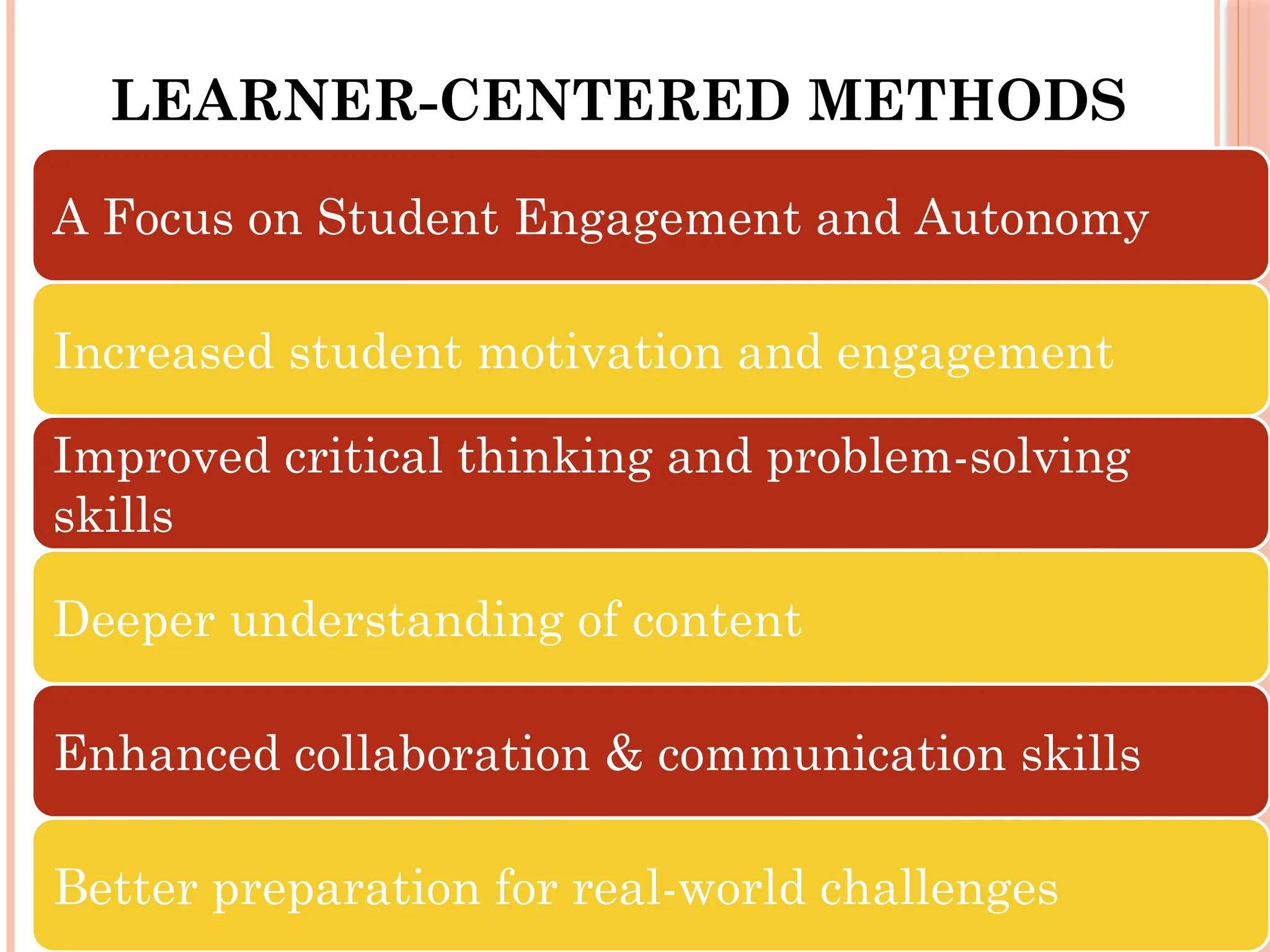
LEARNER-CENTERED METHODS
A Focus on Student Engagement and Autonomy
Increased student motivation and engagement
Improved critical thinking and problem-solving
skills
Deeper understanding of content
Enhanced collaboration & communication skills
Better preparation for real-world challenges
PRINCIPLES OF LEARNER-
CENTERED METHODS
 Student-centered learning: The focus is on the
student's needs, interests, and learning styles.
 Active learning: Students are actively engaged
in the learning process through activities,
discussions, and problem-solving.
 Collaborative learning: Students work
together to learn from each other and develop
teamwork skills.
 Authentic learning: Learning is connected to
real-world experiences and challenges.
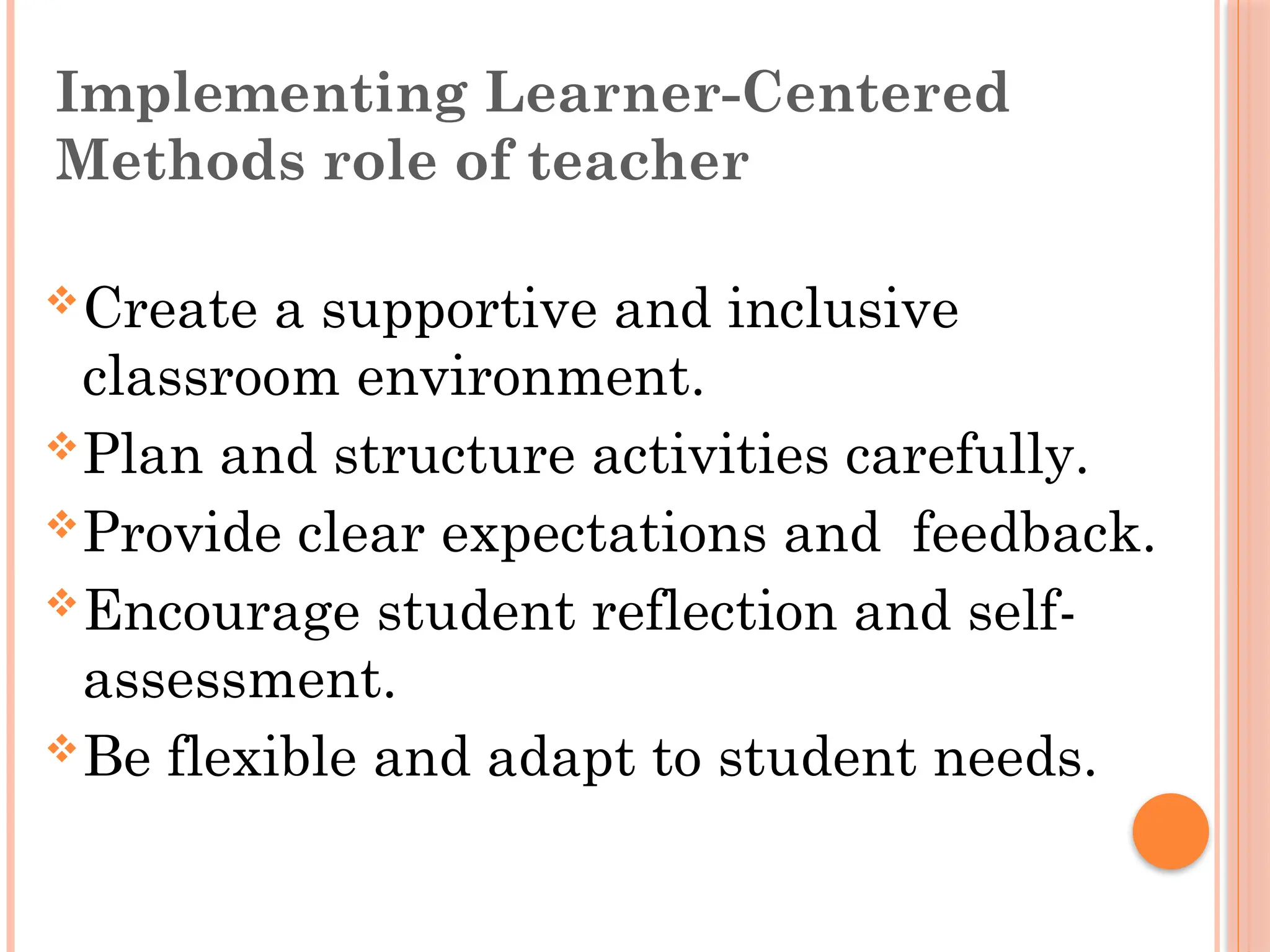
Implementing Learner-Centered
Methods role of teacher
Create a supportive and inclusive
classroom environment.
Plan and structure activities carefully.
Provide clear expectations and feedback.
Encourage student reflection and self-
assessment.
Be flexible and adapt to student needs.
Learner-Centered Methods -
COMPARISION
Criteria
Teacher-
Centric
Learner-
Centric
Teacher Role
Primary source of
knowledge
Facilitator and guide
Student Role
Passive recipient of
information
Active participant in
learning
Learning
Environment
Teacher-controlled Student-centered
Assessment
Methods
Focus on
memorization
Focus on application
and critical thinking
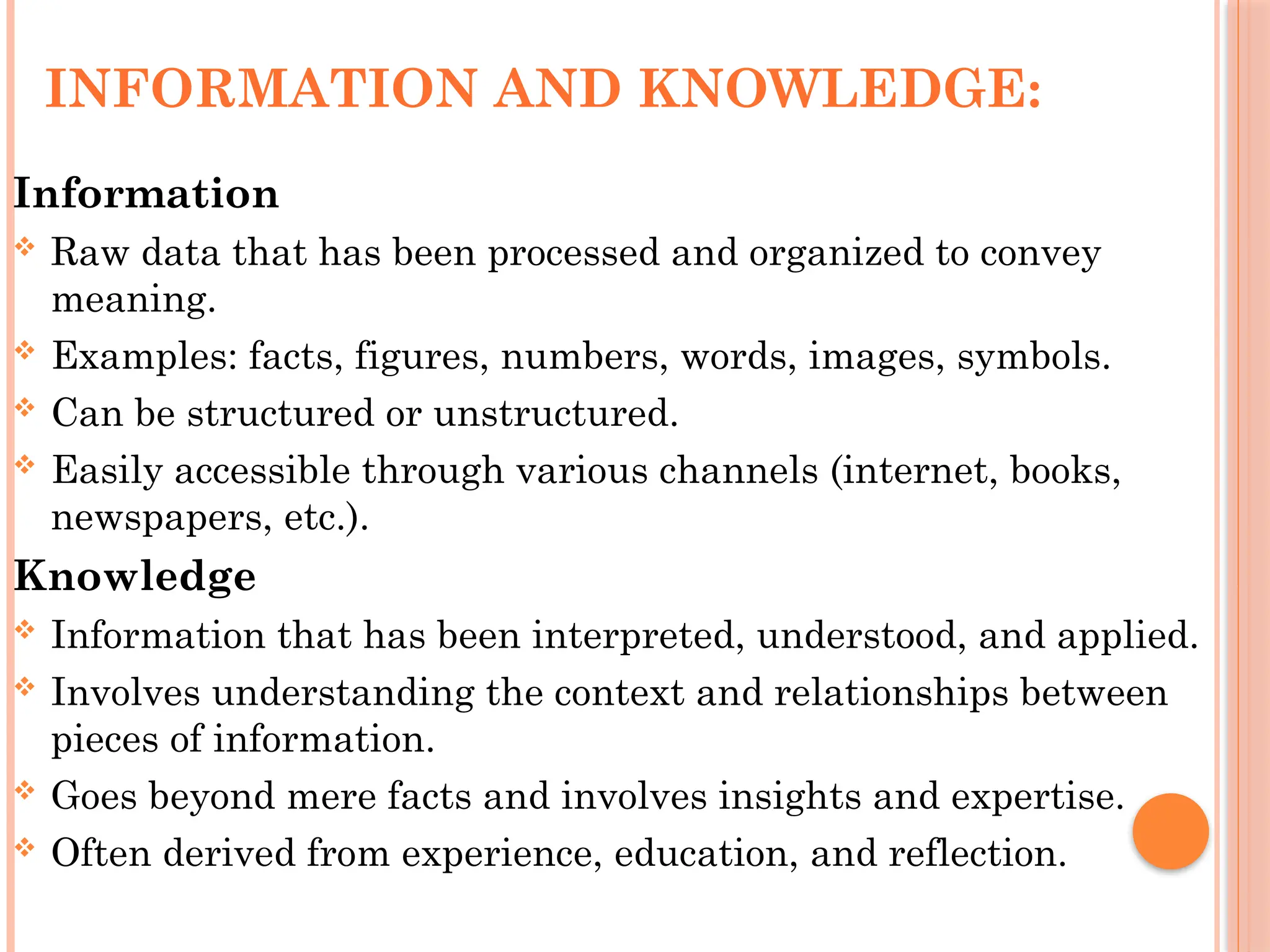
INFORMATION AND KNOWLEDGE:
Information
 Raw data that has been processed and organized to convey
meaning.
 Examples: facts, figures, numbers, words, images, symbols.
 Can be structured or unstructured.
 Easily accessible through various channels (internet, books,
newspapers, etc.).
Knowledge
 Information that has been interpreted, understood, and applied.
 Involves understanding the context and relationships between
pieces of information.
 Goes beyond mere facts and involves insights and expertise.
 Often derived from experience, education, and reflection.
THE
DIKW
HIERARCHY
The DIKW Hierarchy
This model illustrates the
progression from data to
knowledge:
Data: Raw, unorganized facts.
Information: Data that has
been processed and organized.
Knowledge: Information that
has been understood and
applied.
Wisdom: Knowledge applied
with judgment and
experience.
INFORMATION PROCESSING: TEACHER-CENTERED APPROACH
Information processing is the way humans perceive, store,
manipulate, and use information. It's essentially how we
learn and think.
Knowledge Transmission
 Teacher-centered approach
 Information is passed directly from teacher to student
 Students are passive recipients
 Focus on memorization and recall
 Examples: lectures, textbooks, rote learning
Think of it like filling a bucket. The teacher pours knowledge
into the student's mind.
KNOWLEDGE CONSTRUCTION: LEARNER-CENTERED APPROACH
 Students actively create knowledge through
exploration and inquiry
 Emphasizes understanding, application, and
problem-solving
 Students build on their existing knowledge
 Examples: group projects, experiments, real-
world problem-solving
Imagine it like building a house. Students use the
materials (information) to construct their own
understanding.
INCULCATING CRITICAL AND ANALYTICAL
THINKING SKILLS
Critical Thinking- This involves:
 Analyzing information objectively
 Evaluating evidence
 Considering different perspectives
 Making reasoned judgments
Analytical Thinking- This involves:
 Breaking down complex problems into smaller parts
 Identifying patterns and relationships
 Drawing logical conclusions
ANALYTICAL THINKING - CRITICAL
THINKING
Feature
Analytical
Thinking Critical Thinking
Focus Breaking down
information
Evaluating
information
Process Linear, step-by-
step
Holistic, multi-
faceted
Outcome Understanding
components
Making informed
judgments
Nature Primarily
objective
Subjective and
objective
RELATIONSHIP BETWEEN THE
TWO
-Analytical thinking is a foundational skill for
critical thinking. By breaking down information,
you can better evaluate its components and draw
informed conclusions.
However, critical thinking involves a higher level of
cognitive engagement as it requires judgment
and evaluation
CREATIVITY
 Creativity is the ability to generate new and original
ideas, or to find unique solutions to problems. (Process
0r Product)
 The Creative Process Creativity is often
viewed as a process, not just a product. This
process typically involves:
Preparation: Gathering information and knowledge related to
the problem or challenge.
Incubation: Allowing the mind to rest and process information
unconsciously.
Illumination: The "aha" moment when a new idea emerges.
Evaluation: Assessing the feasibility and value of the idea.
Elaboration: Developing the idea into a concrete product or
solution.
CORE COMPONENTS CREATIVITY
 Originality: The ability to produce new and unique ideas.
 Fluency: Generating a large quantity of ideas.
 Flexibility: The capacity to shift perspectives and explore
different approaches.
 Elaboration: Developing ideas into concrete and detailed
forms.
It's important to note that creativity is not solely
reserved for artists or geniuses. Everyone possesses
creative potential, and it can be nurtured and developed
through various techniques and practices.
DEVELOPMENT OF CREATIVITY
1. Encourage Exploration
and Curiosity
 Ask open-ended questions:
 Promote inquiry-based
learning:
 Expose students to diverse
perspectives:
2. Foster a Creative
Learning Environment
 Create a risk-free space:.
 Value imagination and
originality: Celebrate unique
ideas and approaches.
 Incorporate arts and
humanities
3. Develop Creative Thinking
Skills by using
 Brainstorming:
 Mind mapping:
 Role-playing:
 Project-based learning: Apply
knowledge creatively to solve
real-world problems.
Provide Opportunities for
Practice
 Creative writing and
storytelling:.
 Art and music:
 Drama and improvisation:
 Design and invention:
Student Diversity and Inclusive Education  1.pptx

Student Diversity and Inclusive Education 1.pptx

  • 1.
    STUDENT DIVERSITY AND INCLUSIVEEDUCATION Dr. Kiran Dammani Principal S.G.S.B.Ed. College Indore kiran_dammani@yahoo.co.in
  • 2.
    NEP2020 : STUDENTDIVERSITY IN INDIA  India's Higher education (HE) sector has experienced massive expansion to become the second-largest system in the world.  The growth is accompanied by increasing student diversity in the industry. Student diversity is reflected in terms of an increasing share of students from socially and economically disadvantaged groups.  According to MoE (2020), nearly 57% of students come from disadvantaged groups. https://mmc.ugc.ac.in/Home/ Student_Diversity_and_Inclusive_Education
  • 3.
    INCLUSIVE EDUCATION ANDDIVERSITY: LEGAL FRAMEWORK IN INDIA Constitution of India:  Article 14: Guarantees the right to equality, ensuring that no citizen shall be discriminated against on the grounds of religion, race, caste, sex, place of birth, or any of them..  Article 45: Directive Principle of State Policy, emphasizing the provision of free and compulsory education for all children until the age of 14. Right to Education (RTE) Act, 2009:  Mandates free and compulsory education for all children aged 6- 14.  Emphasizes inclusive education for children with disabilities.  Requires schools to provide necessary support services for children with special needs.
  • 4.
     Persons withDisabilities (Equal Opportunities, Protection of Rights, and Full Participation) Act, 1995:  Defines disabilities and provides for their identification, assessment, and rehabilitation.  Mandates inclusive education for children with disabilities.  Requires the provision of assistive devices and services.  Rights of Persons with Disabilities Act, 2016:  Replaced the 1995 Act with more comprehensive provisions.  Defines 21 types of disabilities.  Emphasizes inclusive education and provides for the establishment of inclusive schools.  National Policy on Education (NPE), 2020:  Reinforces the commitment to inclusive education.  Emphasizes early childhood care and education.  Focuses on the development of the whole child, including cognitive, social, and emotional development.
  • 5.
    WHAT IS DIVERSITY? Diversity is therange of human differences, including but not limited to race, ethnicity, gender, gender identity, sexual orientation, age, social class, physical ability or attributes, religious or ethical values system, national origin, and political beliefs. Understanding that individual is unique and recognizing individual differences LINGUISTIC SOCIO-CULTURAL, ECONOMIC, GENDER DISABILITY ABILITY
  • 6.
    DIVERSITY political beliefs national origin, religiousor ethical values system physical ability or attributes age sexual orientation Gender Ethnicity race
  • 8.
    INCLUSIVE EDUCATION The Rightsof Persons with Disabilities (RPWD) Act 2016 defines inclusive education as a ‘system of education wherein students with and without disabilities learn together and the system of teaching and learning is suitably adapted to meet the learning needs of different types of students with disabilities’. Inclusion in the classroom means that all children, no matter their racial, religious, or ethnic background, gender, learning style, or ability have equal access to educational opportunities in a learning environment where all students are equally safe, valued, and respected.
  • 9.
    INCLUSIVE EDUCATION It is an educational systemthat welcomes and supports all students, regardless of their abilities, backgrounds, or learning styles. It's about creating learning environments where everyone feels valued, respected, and has equal opportunities to succeed.
  • 10.
    WHO ALL ARECOMING TO HIGHER EDUCATION SCs Transgender STs Persons with Disabilities OBCs Women Low-income families Minorities Rural area residents International students SED First generation learners
  • 11.
    ADVANTAGE OF INCLUSION Enhances social development Promotes creative thinking Enhances self awareness Enrichesthe multiple perspectives Expands worldliness Increase our knowledge base Prepares students for future career success
  • 12.
  • 13.
    EQUITY IN EDUCATION Equityin education means that all children have a greater chance of success as all children receive what they need and not just simply giving every child the same regardless his or her circumstances There are several factors that contribute to inequity in education. Some of these factors include:------------- Equitable classrooms and curriculums are designed to serve students no matter their race, gender, income level, or ability by personalizing learning to their unique needs
  • 14.
    LINKING DIVERSITY TO INCLUSION Studentshaving different intellectual capabilities, Belonging to different states, regions, religions, communities, different social backgrounds, cultural backgrounds, differently abled students, and students with special needs, study together in the University or College
  • 15.
    CREATING EQUITY IN EDUCATION Effectiveteaching methods and curricula Mix up Learning Activities and Modes of Expression Encourage Peer to Peer Learning learning experiences according to the needs, interests and learning styles Team teaching, Project method etc.
  • 16.
    TEACHER COMPETENCIES TOWARDS DIVERSITYINCLUSION  Subject Knowledge(Mastery)  Pedagogy(Appropriate teaching methods)  Integrating ICT in Teaching Learning  Learner Centered pedagogical practices  it is becoming increasingly critical that children not only learn, but more importantly “learn how to learn”.  Education thus, must move towards less content, and more towards learning about “how to think critically” and “solve problems”.
  • 17.
    ROLE OF TEACHER Developing Positive Attitude among the children  Proper sitting Arrangement  Removing Architectural Barriers in the School Building  Involving children with disabilities, almost in all activities  Adaptation in Curriculum transaction  Adaptation in Evaluation  Remedial teaching, if needed  Parental Guidance
  • 18.
    WHAT IS PEDAGOGY? Pedagogy is another word for education, the profession and science of teaching.  The method and practice of teaching.  Pedagogy plays an important role to help teachers understand the best ways to conduct a classroom.  It gives them insights into how students learn differently in different topics so that they can conduct lessons to suit these needs.  It aims to improve the quality of education for students
  • 19.
    TEACHER-CENTRIC PEDAGOGY Focus on theteacher - Teacher as the primary source of knowledge. Lecture-based instruction Rote learning Passive student role Teacher-controlled pace Emphasis on content coverage
  • 20.
    CHARACTERISTICS OF ATEACHER- CENTRED CLASSROOM  the full control lies in the hand of the teacher, and the activities are completed in their presence.  Therefore, the classroom remains in order, and students stay quiet.  One benefit of a teacher-centred approach is that since the teacher is conducting all the activities, there is no chance of missing any important material or content.  But , It hinders the communication and collaborative skills of the students, and it creates monotony in the classroom, making the class boring .  The approach is less powerful in making students learn the concepts  Even the students start fearing the teacher and are hesitant to express themselves.  This approach discourages the children from asking logical questions.
  • 21.
    WHAT ARE LEARNER-CENTERED METHODS? Learner-centeredmethods are a variety of instructional approaches that shift the focus of the classroom from the teacher to the student. These methods empower students to take ownership of their learning, develop critical thinking skills, and apply knowledge in real-world contexts.
  • 22.
    LEARNER-CENTERED METHODS A Focuson Student Engagement and Autonomy Increased student motivation and engagement Improved critical thinking and problem-solving skills Deeper understanding of content Enhanced collaboration & communication skills Better preparation for real-world challenges
  • 23.
    PRINCIPLES OF LEARNER- CENTEREDMETHODS  Student-centered learning: The focus is on the student's needs, interests, and learning styles.  Active learning: Students are actively engaged in the learning process through activities, discussions, and problem-solving.  Collaborative learning: Students work together to learn from each other and develop teamwork skills.  Authentic learning: Learning is connected to real-world experiences and challenges.
  • 24.
    Implementing Learner-Centered Methods roleof teacher Create a supportive and inclusive classroom environment. Plan and structure activities carefully. Provide clear expectations and feedback. Encourage student reflection and self- assessment. Be flexible and adapt to student needs.
  • 25.
  • 26.
    COMPARISION Criteria Teacher- Centric Learner- Centric Teacher Role Primary sourceof knowledge Facilitator and guide Student Role Passive recipient of information Active participant in learning Learning Environment Teacher-controlled Student-centered Assessment Methods Focus on memorization Focus on application and critical thinking
  • 27.
    INFORMATION AND KNOWLEDGE: Information Raw data that has been processed and organized to convey meaning.  Examples: facts, figures, numbers, words, images, symbols.  Can be structured or unstructured.  Easily accessible through various channels (internet, books, newspapers, etc.). Knowledge  Information that has been interpreted, understood, and applied.  Involves understanding the context and relationships between pieces of information.  Goes beyond mere facts and involves insights and expertise.  Often derived from experience, education, and reflection.
  • 28.
    THE DIKW HIERARCHY The DIKW Hierarchy Thismodel illustrates the progression from data to knowledge: Data: Raw, unorganized facts. Information: Data that has been processed and organized. Knowledge: Information that has been understood and applied. Wisdom: Knowledge applied with judgment and experience.
  • 29.
    INFORMATION PROCESSING: TEACHER-CENTEREDAPPROACH Information processing is the way humans perceive, store, manipulate, and use information. It's essentially how we learn and think. Knowledge Transmission  Teacher-centered approach  Information is passed directly from teacher to student  Students are passive recipients  Focus on memorization and recall  Examples: lectures, textbooks, rote learning Think of it like filling a bucket. The teacher pours knowledge into the student's mind.
  • 30.
    KNOWLEDGE CONSTRUCTION: LEARNER-CENTEREDAPPROACH  Students actively create knowledge through exploration and inquiry  Emphasizes understanding, application, and problem-solving  Students build on their existing knowledge  Examples: group projects, experiments, real- world problem-solving Imagine it like building a house. Students use the materials (information) to construct their own understanding.
  • 31.
    INCULCATING CRITICAL ANDANALYTICAL THINKING SKILLS Critical Thinking- This involves:  Analyzing information objectively  Evaluating evidence  Considering different perspectives  Making reasoned judgments Analytical Thinking- This involves:  Breaking down complex problems into smaller parts  Identifying patterns and relationships  Drawing logical conclusions
  • 32.
    ANALYTICAL THINKING -CRITICAL THINKING Feature Analytical Thinking Critical Thinking Focus Breaking down information Evaluating information Process Linear, step-by- step Holistic, multi- faceted Outcome Understanding components Making informed judgments Nature Primarily objective Subjective and objective
  • 33.
    RELATIONSHIP BETWEEN THE TWO -Analyticalthinking is a foundational skill for critical thinking. By breaking down information, you can better evaluate its components and draw informed conclusions. However, critical thinking involves a higher level of cognitive engagement as it requires judgment and evaluation
  • 34.
    CREATIVITY  Creativity isthe ability to generate new and original ideas, or to find unique solutions to problems. (Process 0r Product)  The Creative Process Creativity is often viewed as a process, not just a product. This process typically involves: Preparation: Gathering information and knowledge related to the problem or challenge. Incubation: Allowing the mind to rest and process information unconsciously. Illumination: The "aha" moment when a new idea emerges. Evaluation: Assessing the feasibility and value of the idea. Elaboration: Developing the idea into a concrete product or solution.
  • 35.
    CORE COMPONENTS CREATIVITY Originality: The ability to produce new and unique ideas.  Fluency: Generating a large quantity of ideas.  Flexibility: The capacity to shift perspectives and explore different approaches.  Elaboration: Developing ideas into concrete and detailed forms. It's important to note that creativity is not solely reserved for artists or geniuses. Everyone possesses creative potential, and it can be nurtured and developed through various techniques and practices.
  • 36.
    DEVELOPMENT OF CREATIVITY 1.Encourage Exploration and Curiosity  Ask open-ended questions:  Promote inquiry-based learning:  Expose students to diverse perspectives: 2. Foster a Creative Learning Environment  Create a risk-free space:.  Value imagination and originality: Celebrate unique ideas and approaches.  Incorporate arts and humanities 3. Develop Creative Thinking Skills by using  Brainstorming:  Mind mapping:  Role-playing:  Project-based learning: Apply knowledge creatively to solve real-world problems. Provide Opportunities for Practice  Creative writing and storytelling:.  Art and music:  Drama and improvisation:  Design and invention: