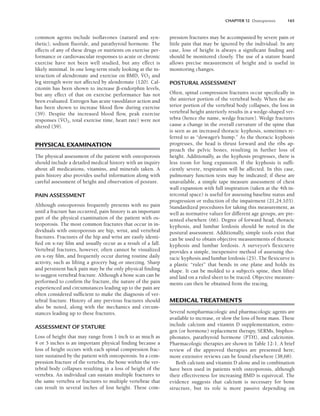
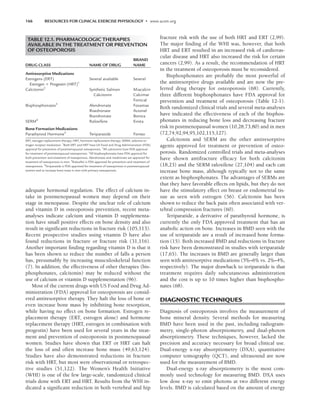
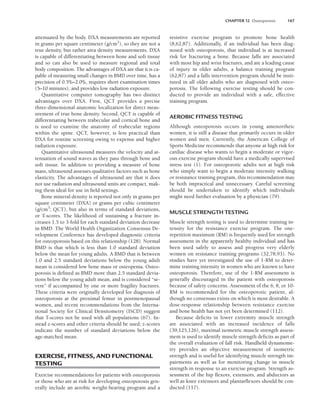
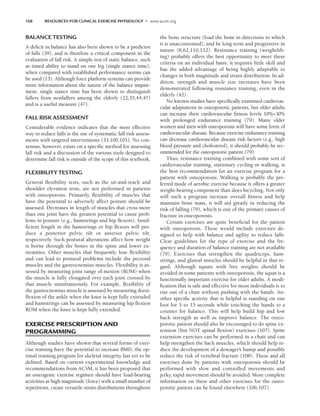
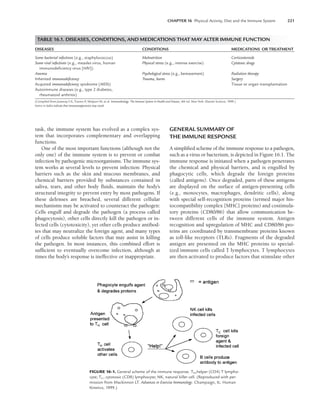
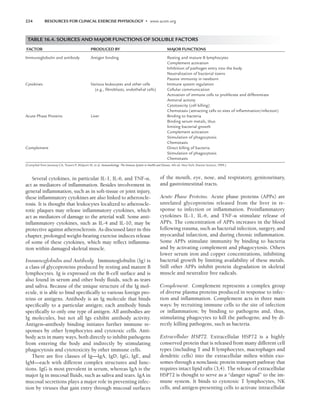
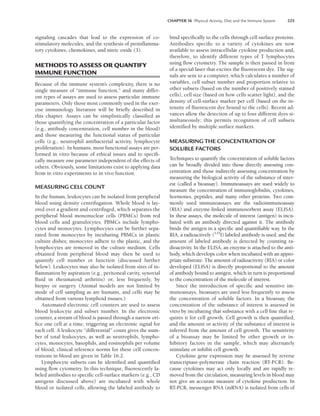
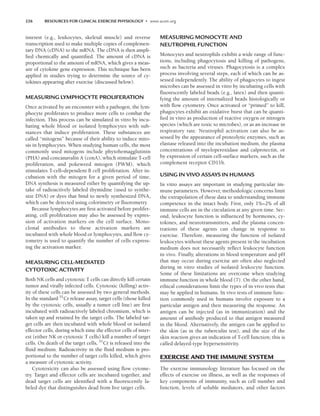
ACSM’s
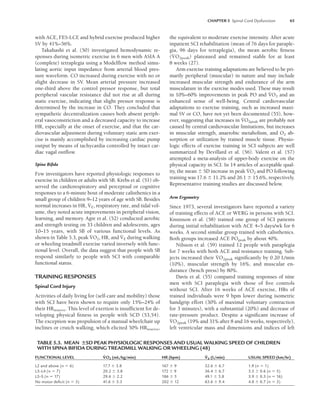
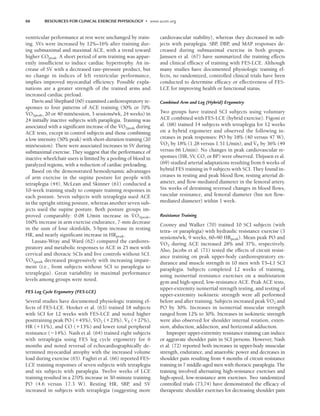
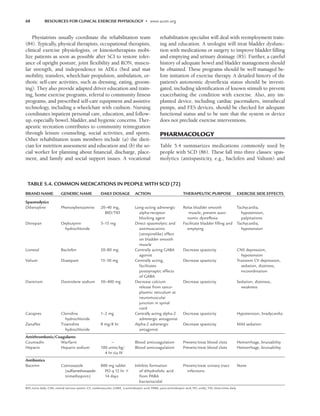
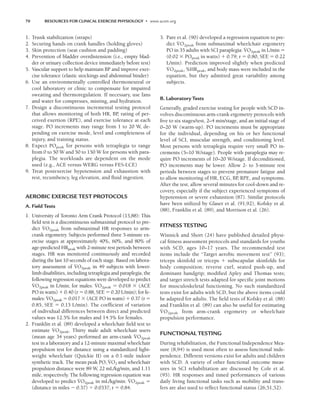
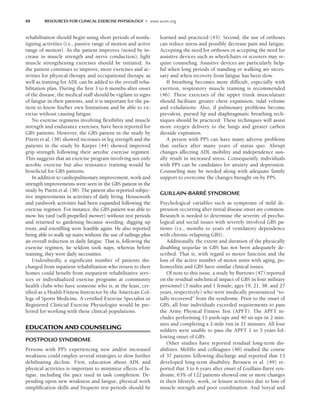
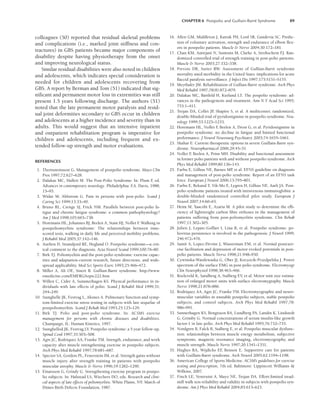
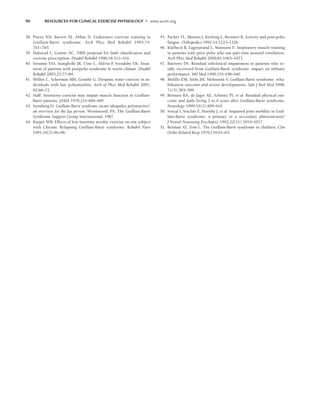
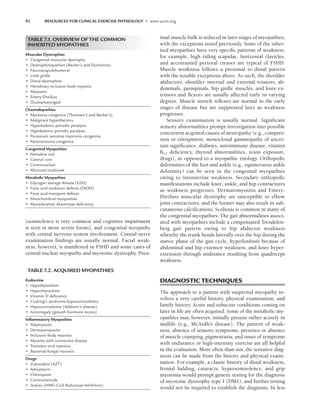
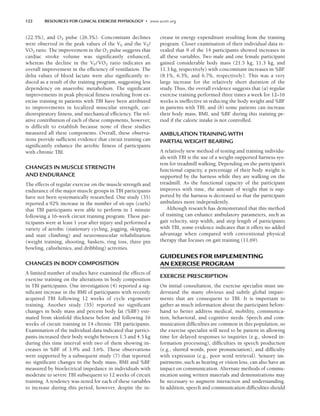
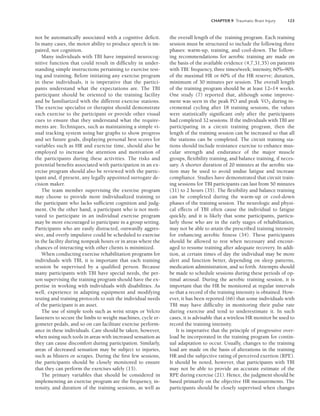
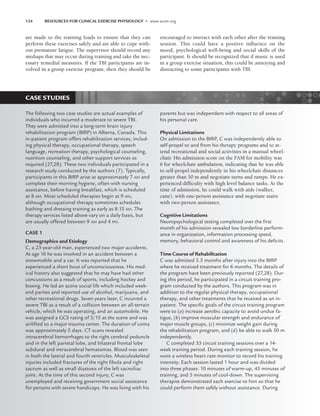
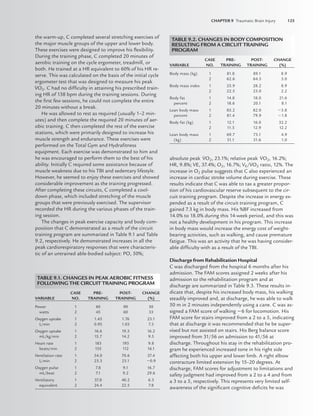
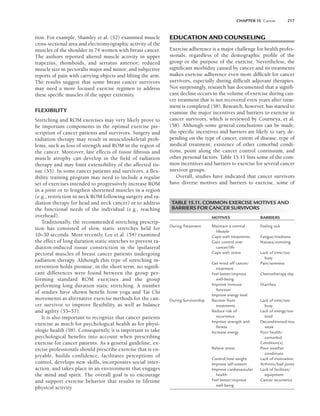
Resources for
Clinical Exercise Physiology
Musculoskeletal, Neuromuscular, Neoplastic,
Immunologic, and Hematologic Conditions
S E C O N D E D I T I O N
LWBK191-4034G-FM_i-xii.qxd 6/11/08 6:02 pm Page i Aptara (PPG-Quark)
> > > > > > > > > > > > > > > > > > > > > > > > > > > > > > > > > > > > > > > >
SENIOR EDITORS
Jonathan Myers, PhD, FACSM
Clinical Professor
Cardiology Division
Veterans Administration Palo Alto Health Care System
Stanford University
Palo Alto, California
David Nieman, PhD, FACSM
Professor
Department of Health, Leisure, and Exercise Science
Appalachian State University
Boone, North Carolina
SECTION EDITORS
Georgia Frey, PhD, FACSM
Associate Professor
Department of Kinesiology
Indiana University
Bloomington, Indiana
Kenneth Pitetti, PhD, FACSM
Professor
College of Health Professions
Wichita State University
Wichita, Kansas
David Nieman, PhD, FACSM
Professor
Department of Health, Leisure, and Exercise Science
Appalachian State University
Boone, North Carolina
William Herbert, PhD, FACSM
Professor
Department of Human Nutrition, Foods, and Exercise
Virginia Tech
Blacksburg, Virginia
Anthony S. Kaleth, PhD
Associate Professor
Department of Physical Education
Indiana University—Purdue University Indianapolis
Indianapolis, Indiana
LWBK191-4034G-FM_i-xii.qxd 6/11/08 6:02 pm Page ii Aptara (PPG-Quark)
> > > > > > > > > > > > > > > > ACSM’S
Resources for
Clinical Exercise Physiology
Musculoskeletal, Neuromuscular, Neoplastic,
Immunologic, and Hematologic Conditions
S E C O N D E D I T I O N
AMERICAN COLLEGE
OF SPORTS MEDICINE
LWBK191-4034G-FM_i-xii.qxd 6/11/08 6:02 pm Page iii Aptara (PPG-Quark)
Acquisitions Editor: Emily Lupash
Managing Editor: Andrea M. Klingler
Marketing Manager: Christen D. Murphy
Project Manager: Debra Schiff
Designer: Doug Smock
Production Services: Aptara, Inc.
ACSM Publication Committee Chair: Jeffrey L. Roitman, EdD, FACSM
ACSM Group Publisher: D. Mark Robertson
Copyright © 2010 and 2002 American College of Sports Medicine
351 West Camden Street 530 Walnut Street
Baltimore, MD 21201 Philadelphia, PA 19106
All rights reserved. This book is protected by copyright. No part of this book may be reproduced or transmitted in any form or by any means,
including as photocopies or scanned-in or other electronic copies, or utilized by any information storage and retrieval system without written
permission from the copyright owner, except for brief quotations embodied in critical articles and reviews.
The publisher is not responsible (as a matter of product liability, negligence, or otherwise) for any injury resulting from any material contained
herein. This publication contains information relating to general principles of medical care that should not be construed as specific instructions
for individual patients. Manufacturers’ product information and package inserts should be reviewed for current information, including
contraindications, dosages, and precautions.
Printed in China
Library of Congress Cataloging-in-Publication Data
ACSM's resources for clinical exercise physiology : musculoskeletal,
neuromuscular, neoplastic, immunologic, and hematologic conditions /
American College of Sports Medicine. – 2nd ed.
p. ; cm.
Includes bibliographical references and index.
ISBN 978-0-7817-6870-2 (alk. paper)
1. Exercise therapy. I. American College of Sports Medicine. II.
Title: Resources for clinical exercise physiology.
[DNLM: 1. Exercise Therapy–Practice Guideline. 2.
Exercise–physiology–Practice Guideline. WB 541 A1875 2010]
RM725.A34 2010
615.8'2--dc22
2008047172
The publishers have made every effort to trace the copyright holders for borrowed material. If they have inadvertently overlooked any, they will be pleased to make
the necessary arrangements at the first opportunity.
To purchase additional copies of this book, call our customer service department at (800) 638-3030 or fax orders to (301) 223-2320. International
customers should call (301) 223-2300.
Visit Lippincott Williams & Wilkins on the Internet: http://www.lww.com. Lippincott Williams & Wilkins customer service representatives are available from
8:30 am to 6:00 pm, EST.
For more information concerning American College of Sports Medicine Certification and suggested preparatory materials, call (800) 486-5643 or visit the
American College of Sports Medicine web site www.acsm.org.
9 8 7 6 5 4 3 2 1
LWBK191-4034G-FM_i-xii.qxd 6/11/08 6:02 pm Page iv Aptara (PPG-Quark)
v
Preface
> > > > > > > > > > > > > > > > > > > > >
The application of exercise as a preventive and therapeutic
medium was once largely limited to patients with pul-
monary or cardiovascular disease, mainly those who had
recently sustained a myocardial infarction. Over the last
three decades, many resources and guidelines have been
published that have been directed toward the application
of exercise evaluation and therapy in cardiovascular and
pulmonary disease. The range of individuals for whom ap-
propriately prescribed exercise has documented benefits
has broadened considerably in recent years. This text was
written in response to the need for guidance among exer-
cise clinicians working with patients with a broad range of
chronic diseases and disabilities beyond cardiovascular
and pulmonary disease, including orthopedic, neurologic,
metabolic, musculoskeletal, neoplastic, and immunodefi-
ciency conditions—populations that have been largely un-
derserved. It is intended to complement and extend exist-
ing ACSM publications, including ACSM’s Guidelines for
Exercise Testing and Prescription and ACSM’s Resource
Manual for Exercise Testing and Prescription.
The ACSM Registered Clinical Exercise Physiologist
(RCEP) pilot examination, initiated in 1999, was de-
signed to establish the existence of appropriate knowl-
edge, skills, and abilities for healthcare professionals
working with individuals with a broad range of chronic
diseases and disabilities. Ten years later, the RCEP has be-
come established as a standard certification for individu-
als working in clinical settings among patients with
chronic diseases and disabilities. The ACSM has defined
the RCEP as a “healthcare professional who works in the
application of exercise and physical activity for those clini-
cal and pathological situations where it has been shown to
provide therapeutic or functional benefit. Patients for whom
services are appropriate may include, but are not limited to,
those with cardiovascular, pulmonary, metabolic, muscu-
loskeletal, neuromuscular, neoplastic, immunologic, and
hematologic diseases and conditions. The RCEP applies ex-
ercise principles to groups such as geriatric, pediatric, or ob-
stetric populations, and to society as a whole in preventive
activities. The RCEP performs exercise evaluation, exercise
prescription, exercise supervision, exercise education, and
exercise outcome evaluation.” For each of the conditions
covered in this text, the chapters are therefore organized
by epidemiology, pathophysiology, diagnosis, medical
and surgical treatments, exercise/fitness/functional test-
ing, and exercise prescription and programming. Where
appropriate, case studies are included to underscore the
role of exercise in managing individuals with a particular
condition.
Although this text is intended to be a resource for in-
dividuals preparing for the RCEP examination, it is also
an appropriate resource for any individual trained in the
exercise sciences working in the clinical setting among
persons with chronic conditions and disabilities beyond
cardiovascular and pulmonary disease. It should serve as
a reference for physical therapists, nurses, physicians,
and other rehabilitation specialists who deal with the
conditions addressed in these chapters. These resources
generally apply to patients with chronic disease who, in
the opinion of their physician provider, are clinically sta-
ble and have sufficient functional capabilities to partici-
pate in individually prescribed exercise that is aimed at
improving fitness, function, physical work potential, and
quality of life, and which reduces exercise-related risk
factors that have an impact on progression of their dis-
ease. Much recent research has been performed related to
the benefits of exercise for patients with the wide variety
of conditions described in this text. Many physicians and
other health professionals have embraced the use of exer-
cise in the diagnosis, prevention, and treatment of vari-
ous chronic health problems. However, similar to cardio-
vascular disease, exercise as an intervention is greatly
underutilized for most of these conditions. The multi-
tude of disorders associated with a sedentary lifestyle ap-
plies to individuals with chronic disabilities just as it ap-
plies to those without such disabilities. An important
goal must be to better convey the value of appropriately
applied exercise therapy for these patients so that it is an
integrated part of the healthcare paradigm. This text rep-
resents another step, however small, in bringing this re-
search to the public and the medical community to foster
a greater appreciation of the value of the therapeutic ben-
efits of exercise across a broad spectrum of patients.
In this new edition of the RCEP resources, chapters
from the first edition have been updated and a section has
been added on Clinical Practice Issues for the RCEP. The
Clinical Practice Issues section includes chapters on the
evolution of the clinical exercise physiologist, demon-
strating functional outcomes for health and fitness, legal
and ethical considerations, and client referral and con-
sulting relations with allied professions. The latter sec-
tion was included to help provide the RCEP and other
healthcare professionals with a better the understanding
of their role and how they can have an important and
v
LWBK191-4034G-FM_i-xii.qxd 6/11/08 6:02 pm Page v Aptara (PPG-Quark)
vi PREFACE
integral place in today’s healthcare environment. In-
cluded in the Appendix are the updated knowledge,
skills, and abilities that have been developed to address
the role of the clinical exercise physiologist in the exercise
management of patients with chronic diseases and disabil-
ities. We hope that this text serves not only as resource for
credentialing by ACSM, but also to help further define the
important role of the exercise physiologist in the clinical
setting, as well as to extend the principles and recom-
mendations of exercise programming to a broader spec-
trum of the population.
Jonathan Myers, PhD
David Nieman, PhD
LWBK191-4034G-FM_i-xii.qxd 6/11/08 6:02 pm Page vi Aptara (PPG-Quark)
Contributors
vii
Contributors
> > > > > > > > > > > > > > > > > > > > >
Mark A. Anderson, PT, PhD, ATC
Department of Rehabilitation Sciences
University of Oklahoma Health Sciences Center
Oklahoma City, Oklahoma
Yagesh Bhambhani, PhD
Professor
Department of Occupational Therapy
University of Alberta
Edmonton, Alberta, Canada
Thomas J. Birk, PhD, MPT, FACSM
Associate Professor
Department of Physical Therapy, Physical Medicine
and Rehabilitation
Wayne State University
Detroit, Michigan
Louise Burke, MD
Head, Department of Sports Nutrition
Australian Institute of Sport
Belconnen, Canberra, Australia
Kerry S. Courneya, PhD
Professor
Department of Physical Education
University of Alberta
Edmonton, Alberta, Canada
Timothy J. Doherty, MD, PhD, FRCPc
Associate Professor
Departments of Clinical Neurological Sciences and
Rehabilitation Medicine Schulich School of Medicine
and Dentistry
The University of Western Ontario
London, Ontario
Kieran Fallon, PhD
Associate Professor
Head, Department of Sports Medicine
College of Medicine and Health Sciences
The Australian National University
Canberra, Australia
Stephen F. Figoni, PhD, RKT, FACSM
Research Health Scientist
Physical Medicine and Rehabilitation Service
Veterans Administration West Los Angeles
Los Angeles, California
Nadine M. Fisher, EdD
Assistant Professor
Department of Occupational Therapy
State University of New York at Buffalo
Buffalo, New York
Lisa Fleisher, MS, PT
School of Physical Therapy
Texas Women’s University
Dallas, Texas
Richard Glazier, MD, MPH
Associate Professor
Health Policy, Management and Evaluation
Faculty of Medicine
University of Toronto
Toronto, Ontario, Canada
D. Shaun Gray, MD, PhD, CCFP, FRCPC
Associate Professor
Division of Physical Medicine and Rehabilitation
University of Alberta
Edmonton, Alberta, Canada
Department Chief
Halvar Johnson Centre for Brain Injury
David Thompson Health Region
Ponoka, Alberta, Canada
David Herbert, JD
Senior Partner
David L. Herbert and Associates, LLD
Canton, Ohio
Kurt Jackson, PhD, PT, GCS
Neurology Coordinator
Doctor of Physical Therapy Program
Department of Health and Sports Science
University of Dayton
Dayton, Ohio
Anthony S. Kaleth, PhD
Associate Professor
Department of Physical Education
Indiana University—Purdue University Indianapolis
Indianapolis, Indiana
Jennifer Kaleth, PT
Department of Rehabilitation
The Shelbourne Knee Center at Methodist Hospital
Indianapolis, Indiana
LWBK191-4034G-FM_i-xii.qxd 6/11/08 6:02 pm Page vii Aptara (PPG-Quark)
viii CONTRIBUTORS
Steven J. Keteyian, PhD, FACSM
Division of Cardiovascular Medicine
The Henry Ford Heart and Vascular Institute
Henry Ford Hospital
Detroit, Michigan
Carl N. King, EdD
President and CEO
Cardiovascular Consultant
Hickory, North Carolina
B. Jenny Kiratli, PhD
Research Health Scientist
Spinal Cord Injury Center
Veterans Administration Palo Alto Health
Care System
Palo Alto, California
Cliff Klein, PhD, MA, BA
Assistant Professor
Department of Physical Therapy
University of Toronto
Toronto, Ontario, Canada
John J. LaManca, PhD
Research Coordinator/ Exercise Physiologist
Heart Failure and Cardiac Transplantation
New York Presbyterian Hospital
New York, New York
James J. Laskin, PT, PhD
Department of Physical Therapy
University of Montana
Missoula, Montana
Laurel T. MacKinnon, PhD, FACSM
Freelance Writer and Editor
Queensland, Australia
Robert C. Manske, MPT, CSCS
Associate Professor
Department of Physical Therapy
Wichita State University
Wichita, Kansas
Margaret L. McNeely, PT, MSc, PhD
Professor
Department of Physical Education and Recreation
University of Alberta
Edmonton, Alberta, Canada
Janet A. Mulcare, PhD, PT, FACSM
Professor of Physical Therapy
Department of Health Sciences
College of Mount St. Joseph
Cincinatti, Ohio
David L. Nichols, PhD
Assistant Research Professor
Institute for Women’s Health
Texas Women’s University
Denton, Texas
Terry Nicola, MD, FACSM
Director of Sports Medicine and Rehabilitation
Department of Orthopedics
University of Illinois Medical Center
Chicago, Illinois
David Nieman, PhD, FACSM, Section Editor
Professor
Department of Health, Leisure, and Exercise Science
Appalachian State University
Boone, North Carolina
Stephanie Nixon, PhD, MSc, BHSc(PT), BA
Assistant Professor
Department of Physical Therapy
University of Toronto
Toronto, Ontario, Canada
Kelly O’Brien, BSc, BScPT
Lecturer
Department of Physical Therapy
University of Toronto
Toronto, Ontario, Canada
Robin Parisotto, BAppSci
Laboratory Manager
Sports Haematology and Biochemistry Laboratory
Australian Institute of Sport
Leverrier Crescent
Bruce, Australian Capitol Territory, Australia
Jonathan Peake, PhD
School of Human Movement Studies
The University of Queensland
Queensland, Australia
Carolyn J. Peddle, MS
Department of Physical Education and Recreation
University of Alberta
Edmonton, Alberta, Canada
Mark T. Pfefer, RN, MS, DC
Cleveland Chiropractic College
Overland Park, Kansas
Kenneth Pitetti, PhD, FACSM, Section Editor
Professor
College of Health Professions
Wichita State University
Wichita, Kansas
LWBK191-4034G-FM_i-xii.qxd 6/11/08 6:02 pm Page viii Aptara (PPG-Quark)
CONTRIBUTORS ix
Elizabeth J. Protas, PT, PhD, FACSM, FAPTA
Interim Dean and Ruby Decker Endowed Professor
Senior Fellow, Sealy Center on Aging
School of Allied Health Sciences
University of Texas Medical Branch
Galveston, Texas
James H. Rimmer, PhD, Professor
Director, National Center on Physical Activity
and Disability and Rehabilitation Engineering
Research Center RecTech
Department of Disability and Human Development
University of Illinois at Chicago
Chicago, Illinois
Gary Rowland, MScOT, OT(c)
Faculty of Rehabilitative Medicine
University of Alberta
Edmonton, Alberta, Canada
Roy Sasaki, MD
Spinal Cord Injury Center
Veterans Administration Palo Alto Health Care System
Palo Alto, California
Christopher Sellar, MS
Department of Physical Education
and Recreation
University of Alberta
Edmonton, Alberta, Canada
Maureen J. Simmonds, PT, PhD
Professor and Director
School of Physical & Occupational Therapy
McGill University
Montreal, Quebec, Canada
Sue Ann Sisto, PT, MA, PhD
Professor, Physical Therapy
Research Director, Division of Rehabilitation Science
School of Health Technology and Management
Stony Brook University
Stony Brook, New York
Susan Smith, PT, PhD
Associate Professor and Director
Physical Therapy and Rehabilitation Services
Drexel University
Philadelphia, Pennsylvania
Rhonda K. Stanley, PT, PhD
Associate Professor, Physical Therapy
Arizona School of Health Sciences
A.T. Still University
Mesa, Arizona
Mark Tarnopolsky, MD, PhD, FRCPc
Professor of Pediatrics and Medicine
Hamilton Hospitals Assessment Center Endowed
Chair in Neuromuscular Disorders
Director of Neuromuscular and Neurometabolic
Clinic
McMaster University Medical Center
Hamilton, Ontario, Canada
Elaine Trudelle-Jackson, MS, PT
School of Physical Therapy
Texas Women’s University
Dallas, Texas
Anne-Marie Tynan, BA
Research Coordinator
St. Michael’s Hospital
Centre for Research on Inner City Health
Toronto, Ontario, Canada
David E. Verrill, MS, RCEP, FAACVPR
Program Coordinator
Presbyterian Hospital Pulmonary Rehabilitation
Program
Presbyterian Novant Heart and Wellness
Charlotte, North Carolina
LWBK191-4034G-FM_i-xii.qxd 8/11/08 12:30 am Page ix
> > > > > > > > > > > > > > > > > > > > >
x
Reviewers
Anthony A. Abbott, Ed.D., FACSM, FNSCA
President
Fitness Institute International, Inc.
Boca Raton, Florida
Susan A. Bloomfield, Ph.D., FACSM
Director, Bone Biology Laboratory
Member, Intercollegiate Faculty of Nutrition
Professor
Health & Kinesiology
Texas A&M University
College Station, Texas
Eileen Collins RN, PhD
Research Health Scientist
Edward Hines Jr., VA Hospital, Chicago
Associate Professor
UIC College of Nursing
Chicago, Illinois
Dino G. Costanzo, FACSM, RCEP
Administrative Director
Health Promotion, Bariatrics, and Cardiology
The Hospital of Central Connecticut
New Britain, Connecticut
Brian J. Coyne, M.Ed., RCEP
Instructor
Department of Kinesiology
University of Louisiana at Monroe
Monroe, Louisiana
Cathryn R. Dooly, FACSM
ACSM Exercise Specialist Certified
Chair and Associate Professor
Lander University,
Department of Physical Education & Exercise Studies
Greenwood, South Carolina
Julianne Frey, MS, RCEP
Senior Clinical Exercise Physiologist
Cardiovascular Testing Department
Internal Medicine Associates
Bloomington, Indiana
Dennis J. Guillot, MS, RRT, CSCS, RCEP
Assistant Professor
Human Performance Education Teacher Education
Nicholls State University
Thibodaux, Louisiana
Chris Kemnitz, PhD
Associate Professor
Department of Nursing
University of Wisconsin–Superior
Superior, Wisconsin
Tom LaFontaine, PhD, FACSM, FAACVPR, CSCS,
NSCA-CPT, RCEP
Owner, PREVENT Consulting Services, LLC
Clinical Exercise Physiologist
Co-Director, Optimus: The Center for Health
Columbia, Missouri
James J. Laskin, PT, PhD
Associate Professor
School of Physical Therapy and Rehabilitation Sciences
University of Montana
Missoula, Montana
Randi S. Lite, MA, RCEP
Senior Instructor of Biology
Simmons College
Boston, Massachusetts
Jacalyn J. McComb, PhD, FACSM
Professor in the Department of Health Exercise
and Sport Sciences
Texas Tech University
Lubbock, Texas
Peter M. Magyari, PhD
Assistant Professor of Exercise Physiology
Brooks College of Health
University of North Florida
Jacksonville, Florida
Jeanne F. Nichols, PhD, FACSM
School of Exercise & Nutritional Sciences
San Diego State University
San Diego, California
LWBK191-4034G-FM_i-xii.qxd 6/11/08 6:02 pm Page x Aptara (PPG-Quark)
REVIEWERS xi
Mark A. Patterson, MEd, RCEP
Clinical Exercise Physiologist
Cardiovascular Services/Vascular Surgery
Kaiser Permenante Colorado
Denver, Colorado
Elizabeth J. Protas, PT, PhD, FACSM
Interim Dean and Ruby Decker Endowed Professor
Senior Fellow, Sealy Center on Aging
School of Allied Health Sciences
University of Texas Medical Branch
Galveston, Texas
Jeffrey L. Roitman, EdD, FACSM
Associate Professor, Director Exercise Science Program
Rockhurst University
Exercise Science
Kansas City, Missouri
Peter Ronai, MS, NSCA CSCS-D, NSCA-CPT
Exercise Physiologist
Ahlbin Rehabilitation Centers
Bridgeport Hospital
Bridgeport, Connecticut
William F. Simpson, PhD, FACSM
Associate Professor/Director, Exercise Physiology
Laboratory
University of Wisconsin–Superior
Department of Health and Human Performance
Superior, Wisconsin
Paul Sorace, MS, RCEP
Clinical Exercise Physiologist
Hackensack University Medical Center
Hackensack, New Jersey
David E. Verrill, MS, RCEP, FAACVPR
Clinical Exercise Physiologist
Presbyterian Hospital Pulmonary Rehabilitation
Program
Presbyterian Novant Heart and Wellness
Charlotte, North Carolina
Karen Wallman (BEd, BSc (hons), PhD)
School of Sport Science Exercise and Health
Senior Lecturer
University of Western Australia
Perth, Western Australia
LWBK191-4034G-FM_i-xii.qxd 6/11/08 6:02 pm Page xi Aptara (PPG-Quark)
> > > > > > > > > > > > > > > > > > > > >
xii
Contents
Preface / v
Contributors / vii
Reviewers / x
SECTION I: NEUROMUSCULAR DISORDERS
Georgia Frey
1 Stroke / 2
Terry Nicola and James H. Rimmer
2 Cerebral Palsy / 19
Mark A. Anderson and James J. Laskin
3 Multiple Sclerosis / 34
Kurt Jackson and Janet A. Mulcare
4 Parkinson’s Disease / 44
Elizabeth J. Protas and Rhonda K. Stanley
5 Spinal Cord Dysfunction / 58
Stephen F. Figoni, B. Jenny Kiratli, and Roy Sasaki
6 Postpolio and Guillain-Barré Syndrome / 79
Thomas J. Birk and Kenneth Pitetti
7 Muscular Dystrophy and Other Myopathies / 91
Timothy J. Doherty and Mark Tarnopolsky
8 Peripheral Neuropathy and Neuropathic
Pain / 104
Mark T. Pfefer
9 Traumatic Brain Injury / 113
Yagesh Bhambhani and Gary Rowland
SECTION II: MUSCULOSKELETAL CONDITIONS
Kenneth Pitetti
10 Osteoarthritis, Rheumatoid Arthritis,
and Fibromyalgia / 132
Nadine M. Fisher
11 Exercise and Activity for Individuals with
Nonspecific Back Pain / 148
Maureen J. Simmonds
12 Osteoporosis / 162
David L. Nichols, Elaine Trudelle-Jackson,
and Lisa Fleisher
13 Vertebral Disorders / 175
Susan Smith
14 Amputation / 197
Kenneth Pitetti and Robert C. Manske
SECTION III: NEOPLASTIC, IMMUNOLOGIC,
AND HEMATOLOGIC CONDITIONS
David Nieman
15 Cancer / 206
Kerry S. Courneya, Margaret L. McNeely,
Carolyn J. Peddle, and Christopher Sellar
16 Physical Activity, Diet and the Immune
System / 220
Jonathan Peake and Laurel T. MacKinnon
17 Exercise Physiology and HIV/AIDS / 239
Cliff Klein, Kelly O’Brien, Stephanie Nixon, Anne-Marie
Tynan, and Richard Glazier
18 Chronic Fatigue Syndrome / 252
John J. LaManca and Sue Ann Sisto
19 Hematologic Disorders / 268
Louise Burke, Robin Parisotto, and Kieran Fallon
SECTION IV: CLINICAL PRACTICE ISSUES FOR
THE RCEP
William Herbert and Anthony S. Kaleth
20 Evolution of the Clinical Exercise
Physiologist / 280
David E. Verrill and Steven J. Keteyian
21 Client Referral and Consulting Relations with
Allied Professions / 288
Carl N. King
22 Demonstrating Functional Outcomes for Health
and Fitness / 292
Anthony S. Kaleth and Jennifer Kaleth
23 Legal and Ethical Considerations / 301
David Herbert
Appendix: ACSM Certifications / 307
Index / 317
LWBK191-4034G-FM_i-xii.qxd 7/11/08 11:47 pm Page xii
> > > > > > > > > > > > > > > > > > > > > > > > > > > > > > > > >
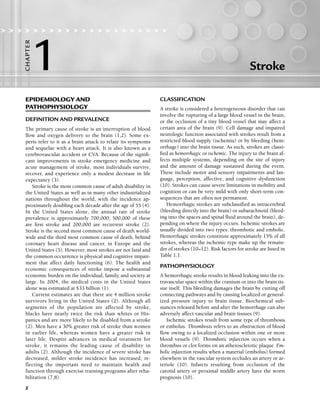
I
SECTI
ON
Neuromuscular Disorders
GEORGIA FREY, Section Editor
Chapter 1 Stroke
Chapter 2 Cerebral Palsy
Chapter 3 Multiple Sclerosis
Chapter 4 Parkinson’s Disease
Chapter 5 Spinal Cord Dysfunction
Chapter 6 Postpolio and Guillain-Barré Syndrome
Chapter 7 Muscular Dystrophy and Other Myopathies
Chapter 8 Peripheral Neuropathy and Neuropathic Pain
Chapter 9 Brain Injury
LWBK191-4034G-C01_01-18.qxd 6/11/08 5:50 pm Page 1 Aptara (PPG-Quark)
2
Stroke
> > > > > > > > > > > > > > > > > > > > >
1
C
HA
P
TER
EPIDEMIOLOGY AND
PATHOPHYSIOLOGY
DEFINITION AND PREVALENCE
The primary cause of stroke is an interruption of blood
flow and oxygen delivery to the brain (1,2). Some ex-
perts refer to it as a brain attack to relate its symptoms
and sequelae with a heart attack. It is also known as a
cerebrovascular accident or CVA. Because of the signifi-
cant improvements in stroke emergency medicine and
acute management of stroke, most individuals survive,
recover, and experience only a modest decrease in life
expectancy (3).
Stroke is the most common cause of adult disability in
the United States as well as in many other industrialized
nations throughout the world, with the incidence ap-
proximately doubling each decade after the age of 55 (4).
In the United States alone, the annual rate of stroke
prevalence is approximately 700,000; 500,000 of these
are first stroke and 200,000 are recurrent stroke (2).
Stroke is the second most common cause of death world-
wide and the third most common cause of death, behind
coronary heart disease and cancer, in Europe and the
United States (5). However, most strokes are not fatal and
the common occurrence is physical and cognitive impair-
ment that affect daily functioning (6). The health and
economic consequences of stroke impose a substantial
economic burden on the individual, family, and society at
large. In 2004, the medical costs in the United States
alone was estimated at $33 billion (1).
Current estimates are that there are 4 million stroke
survivors living in the United States (2). Although all
segments of the population are affected by stroke,
blacks have nearly twice the risk than whites or His-
panics and are more likely to be disabled from a stroke
(2). Men have a 30% greater risk of stroke than women
in earlier life, whereas women have a greater risk in
later life. Despite advances in medical treatment for
stroke, it remains the leading cause of disability in
adults (2). Although the incidence of severe stroke has
decreased, milder stroke incidence has increased, re-
flecting the important need to maintain health and
function through exercise training programs after reha-
bilitation (7,8).
CLASSIFICATION
A stroke is considered a heterogeneous disorder that can
involve the rupturing of a large blood vessel in the brain,
or the occlusion of a tiny blood vessel that may affect a
certain area of the brain (9). Cell damage and impaired
neurologic function associated with strokes result from a
restricted blood supply (ischemia) or by bleeding (hem-
orrhage) into the brain tissue. As such, strokes are classi-
fied as hemorrhagic or ischemic. The injury to the brain af-
fects multiple systems, depending on the site of injury
and the amount of damage sustained during the event.
These include motor and sensory impairments and lan-
guage, perception, affective, and cognitive dysfunction
(10). Strokes can cause severe limitations in mobility and
cognition or can be very mild with only short-term con-
sequences that are often not permanent.
Hemorrhagic strokes are subclassified as intracerebral
(bleeding directly into the brain) or subarachnoid (bleed-
ing into the spaces and spinal fluid around the brain), de-
pending on where the injury occurs. Ischemic strokes are
usually divided into two types: thrombotic and embolic.
Hemorrhagic strokes constitute approximately 15% of all
strokes, whereas the ischemic type make up the remain-
der of strokes (10–12). Risk factors for stroke are listed in
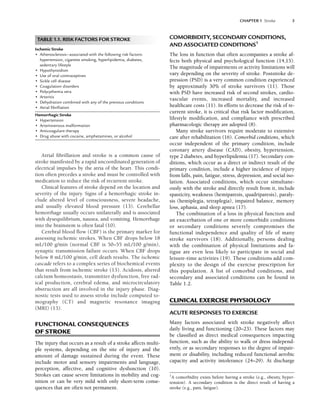
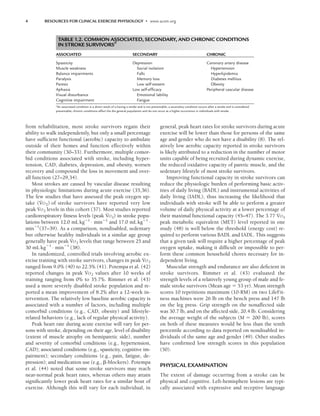
Table 1.1.
PATHOPHYSIOLOGY
A hemorrhagic stroke results in blood leaking into the ex-
travascular space within the cranium or into the brain tis-
sue itself. This bleeding damages the brain by cutting off
connecting pathways and by causing localized or general-
ized pressure injury to brain tissue. Biochemical sub-
stances released before and after the hemorrhage can also
adversely affect vascular and brain tissues (9).
Ischemic strokes result from some type of thrombosis
or embolus. Thrombosis refers to an obstruction of blood
flow owing to a localized occlusion within one or more
blood vessels (9). Thrombotic infarction occurs when a
thrombus or clot forms on an atherosclerotic plaque. Em-
bolic infarction results when a material (embolus) formed
elsewhere in the vascular system occludes an artery or ar-
teriole (10). Infarcts resulting from occlusion of the
carotid artery or proximal middle artery have the worst
prognosis (10).
LWBK191-4034G-C01_01-18.qxd 6/11/08 5:50 pm Page 2 Aptara (PPG-Quark)
CHAPTER 1 Stroke 3
Atrial fibrillation and stroke is a common cause of
stroke manifested by a rapid uncoordinated generation of
electrical impulses by the atria of the heart. This condi-
tion often precedes a stroke and must be controlled with
medication to reduce the risk of recurrent stroke.
Clinical features of stroke depend on the location and
severity of the injury. Signs of a hemorrhagic stroke in-
clude altered level of consciousness, severe headache,
and usually elevated blood pressure (13). Cerebellar
hemorrhage usually occurs unilaterally and is associated
with dysequilibrium, nausea, and vomiting. Hemorrhage
into the brainstem is often fatal (10).
Cerebral blood flow (CBF) is the primary marker for
assessing ischemic strokes. When CBF drops below 18
mL/100 g/min (normal CBF is 50–55 mL/100 g/min),
synaptic transmission failure occurs. When CBF drops
below 8 mL/100 g/min, cell death results. The ischemic
cascade refers to a complex series of biochemical events
that result from ischemic stroke (13). Acidosis, altered
calcium homeostasis, transmitter dysfunction, free rad-
ical production, cerebral edema, and microcirculatory
obstruction are all involved in the injury phase. Diag-
nostic tests used to assess stroke include computed to-
mography (CT) and magnetic resonance imaging
(MRI) (13).
FUNCTIONAL CONSEQUENCES
OF STROKE
The injury that occurs as a result of a stroke affects multi-
ple systems, depending on the site of injury and the
amount of damage sustained during the event. These
include motor and sensory impairments and language,
perception, affective, and cognitive dysfunction (10).
Strokes can cause severe limitations in mobility and cog-
nition or can be very mild with only short-term conse-
quences that are often not permanent.
COMORBIDITY, SECONDARY CONDITIONS,
AND ASSOCIATED CONDITIONS1
The loss in function that often accompanies a stroke af-
fects both physical and psychological function (14,15).
The magnitude of impairments or activity limitations will
vary depending on the severity of stroke. Poststroke de-
pression (PSD) is a very common condition experienced
by approximatly 30% of stroke survivors (11). Those
with PSD have increased risk of second strokes, cardio-
vascular events, increased mortality, and increased
healthcare costs (11). In efforts to decrease the risk of re-
current stroke, it is critical that risk factor modification,
lifestyle modification, and compliance with prescribed
pharmacologic therapy are adopted (8).
Many stroke survivors require moderate to extensive
care after rehabilitation (16). Comorbid conditions, which
occur independent of the primary condition, include
coronary artery disease (CAD), obesity, hypertension,
type 2 diabetes, and hyperlipidemia (17). Secondary con-
ditions, which occur as a direct or indirect result of the
primary condition, include a higher incidence of injury
from falls, pain, fatigue, stress, depression, and social iso-
lation. Associated conditions, which occur simultane-
ously with the stroke and directly result from it, include
spasticity, weakness (hemiparesis, quadriparesis), paraly-
sis (hemiplegia, tetraplegia), impaired balance, memory
loss, aphasia, and sleep apnea (17).
The combination of a loss in physical function and
an exacerbation of one or more comorbidit conditions
or secondary conditions severely compromises the
functional independence and quality of life of many
stroke survivors (18). Additionally, persons dealing
with the combination of physical limitations and fa-
tigue are even less likely to participate in social and
leisure-time activities (19). These conditions add com-
plexity to the design of the exercise prescription for
this population. A list of comorbid conditions, and
secondary and associated conditions can be found in
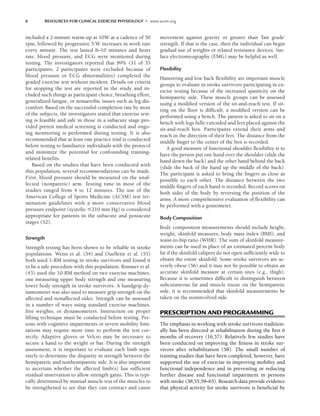
Table 1.2.
CLINICAL EXERCISE PHYSIOLOGY
ACUTE RESPONSES TO EXERCISE
Many factors associated with stroke negatively affect
daily living and functioning (20–23). These factors may
be classified as direct medical consequences impacting
function, such as the ability to walk or dress independ-
ently, or as secondary responses to the degree of impair-
ment or disability, including reduced functional aerobic
capacity and activity intolerance (24–29). At discharge
TABLE 1.1. RISK FACTORS FOR STROKE
Ischemic Stroke
• Atherosclerosis—associated with the following risk factors:
hypertension, cigarette smoking, hyperlipidemia, diabetes,
sedentary lifestyle
• Hypothyroidism
• Use of oral contraceptives
• Sickle cell disease
• Coagulation disorders
• Polycythemia vera
• Arteritis
• Dehydration combined with any of the previous conditions
• Atrial fibrillation
Hemorrhagic Stroke
• Hypertension
• Arteriovenous malformation
• Anticoagulant therapy
• Drug abuse with cocaine, amphetamines, or alcohol
1
A comorbidity exists before having a stroke (e.g., obesity, hyper-
tension). A secondary condition is the direct result of having a
stroke (e.g., pain, fatigue).
LWBK191-4034G-C01_01-18.qxd 6/11/08 5:50 pm Page 3 Aptara (PPG-Quark)
4 RESOURCES FOR CLINICAL EXERCISE PHYSIOLOGY • www.acsm.org
from rehabilitation, most stroke survivors regain their
ability to walk independently, but only a small percentage
have sufficient functional (aerobic) capacity to ambulate
outside of their homes and function effectively within
their community (30–33). Furthermore, multiple comor-
bid conditions associated with stroke, including hyper-
tension, CAD, diabetes, depression, and obesity, worsen
recovery and compound the loss in movement and over-
all function (27–29,34).
Most strokes are caused by vascular disease resulting
in physiologic limitations during acute exercise (35,36).
The few studies that have assessed the peak oxygen up-
take (V
.
O2) of stroke survivors have reported very low
peak V
.
O2 levels in this cohort (37). Most studies reported
cardiorespiratory fitness levels (peak V
.
O2) in stroke popu-
lations between 12.0 mLkg1 . min1
and 17.0 mLkg1 .
min1
(37–39). As a comparison, nondisabled, sedentary
but otherwise healthy individuals in a similar age group
generally have peak V
.
O2 levels that range between 25 and
30 mLkg1 . min1
(38).
In randomized, controlled trials involving aerobic ex-
ercise training with stroke survivors, changes in peak V
.
O2
ranged from 9.0% (40) to 22.5% (41). Potempa et al. (42)
reported changes in peak V
.
O2 values after 10 weeks of
training ranging from 0% to 35.7%. Rimmer et al. (43)
used a more severely disabled stroke population and re-
ported a mean improvement of 8.2% after a 12-week in-
tervention. The relatively low baseline aerobic capacity is
associated with a number of factors, including multiple
comorbid conditions (e.g., CAD, obesity) and lifestyle-
related behaviors (e.g., lack of regular physical activity).
Peak heart rate during acute exercise will vary for per-
sons with stroke, depending on their age, level of disability
(extent of muscle atrophy on hemiparetic side), number
and severity of comorbid conditions (e.g., hypertension,
CAD); associated conditions (e.g., spasticity, cognitive im-
pairment); secondary conditions (e.g., pain, fatigue, de-
pression); and medication use (e.g., -blockers). Potempa
et al. (44) noted that some stroke survivors may reach
near-normal peak heart rates, whereas others may attain
significantly lower peak heart rates for a similar bout of
exercise. Although this will vary for each individual, in
general, peak heart rates for stroke survivors during acute
exercise will be lower than those for persons of the same
age and gender who do not have a disability (8). The rel-
atively low aerobic capacity reported in stroke survivors
is likely attributed to a reduction in the number of motor
units capable of being recruited during dynamic exercise,
the reduced oxidative capacity of paretic muscle, and the
sedentary lifestyle of most stroke survivors.
Improving functional capacity in stroke survivors can
reduce the physiologic burden of performing basic activ-
ities of daily living (BADL) and instrumental activities of
daily living (IADL), thus increasing the likelihood that
individuals with stroke will be able to perform a greater
volume of daily physical activity at a lower percentage of
their maximal functional capacity (45–47). The 3.77 V
.
O2
peak metabolic equivalent (MET) level reported in one
study (48) is well below the threshold (energy cost) re-
quired to perform various BADL and IADL. This suggests
that a given task will require a higher percentage of peak
oxygen uptake, making it difficult or impossible to per-
form these common household chores necessary for in-
dependent living.
Muscular strength and endurance are also deficient in
stroke survivors. Rimmer et al. (43) evaluated the
strength levels of a relatively young group of male and fe-
male stroke survivors (Mean age  53 yr). Mean strength
scores 10 repetitions maximum (10-RM) on two LifeFit-
ness machines were 26 lb on the bench press and 147 lb
on the leg press. Grip strength on the nonaffected side
was 30.7 lb, and on the affected side, 20.4 lb. Considering
the average weight of the subjects (M  200 lb), scores
on both of these measures would be less than the tenth
percentile according to data reported on nondisabled in-
dividuals of the same age and gender (49). Other studies
have confirmed low strength scores in this population
(50).
PHYSICAL EXAMINATION
The extent of damage occurring from a stroke can be
physical and cognitive. Left-hemisphere lesions are typi-
cally associated with expressive and receptive language
TABLE 1.2. COMMON ASSOCIATED, SECONDARY, AND CHRONIC CONDITIONS
IN STROKE SURVIVORS
a
ASSOCIATED SECONDARY CHRONIC
Spasticity Depression Coronary artery disease
Muscle weakness Social isolation Hypertension
Balance impairments Falls Hyperlipidemia
Paralysis Memory loss Diabetes mellitus
Paresis Low self-esteem Obesity
Aphasia Low self-efficacy Peripheral vascular disease
Visual disturbance Emotional lability
Cognitive impairment Fatigue
a
An associated condition is a direct result of a having a stroke and is not preventable; a secondary condition occurs after a stroke and is considered
preventable; chronic conditions affect the the general population and do not occur at a higher occurrence in individuals with stroke.
LWBK191-4034G-C01_01-18.qxd 6/11/08 5:50 pm Page 4 Aptara (PPG-Quark)
deficits compared with right-hemisphere lesions. The
motor impairment from stroke usually results in hemiple-
gia (paralysis) or hemiparesis (weakness). When damage
occurs to the descending neural pathways, an abnormal
regulation of spinal motor neurons results in adverse
changes in postural and stretch reflexes and difficulty
with voluntary movement. Deficits in motor control can
involve muscle weakness, abnormal synergistic organiza-
tion of movements, impaired regulation of force, de-
creased reaction times, abnormal muscle tone, and loss of
active range of motion (ROM) (51).
EXERCISE TESTING AND
SCREENING CRITERIA
SCREENING PROTOCOL
Before conducting a graded exercise test, persons with
stroke should be screened by their primary care physi-
cian. Although no published guidelines exist on the type
of screening that should be conducted before a graded ex-
ercise test, taking the utmost precaution is critical be-
cause many stroke survivors are older and have cardio-
vascular disease. The screening should include a fasting
blood draw, resting electrocardiogram (ECG), resting
heart rate, resting blood pressure (standing, seated,
supine), and basal temperature. To be approved for peak
V
.
O2 testing, participants’ blood screening tests (i.e., com-
plete blood count [CBC], enzymes, protein levels) should
be within normal limits. If the preliminary blood work is
acceptable, the participant can be scheduled for testing.
Participants who successfully complete the graded exer-
cise test can be recommended for an exercise program.
Individuals who have adverse cardiovascular changes
during exercise testing should be advised for further
follow-up and may need to begin an exercise program in
a closely supervised setting, such as cardiac rehabilitation.
EXERCISE TESTING
Peak Oxygen Uptake (Cardiorespiratory Fitness)
Cycle ergometer testing with stroke survivors is consid-
ered safe and feasible when a medical prescreening is per-
formed and the participant’s exercise response is closely
monitored to minimize risk (52). Determination of aero-
bic exercise capacity is an important component for de-
veloping appropriate exercise programs and evaluating
the effectiveness of the programming (52). Because of a
significant loss of muscle function resulting from hemi-
paresis or hemiplegia, stroke survivors have a severely re-
duced maximal or peak oxygen uptake (37,52). Because
many stroke survivors also have cardiovascular comor-
bidity (e.g., hypertension, CAD), graded exercise tests
are often symptom-limited, thus not allowing the person
to achieve high peak capacities. Additionally, limited
data are available on the test-retest reliability of peak ex-
ercise testing among stroke survivors and it is recom-
mended that at least one preliminary testing trial be per-
formed to minimize the possible practice effect (53). In
the postacute stage, a symptom-limited graded exercise
test (peak V
.
O2) can be performed on a stationary bike or
treadmill, or in persons with severe hemiplegia, with an
arm ergometer. Although it may be necessary to perform
the exercise test with an arm ergometer, performance will
be limited because of the limited amount of muscle re-
cruitment and a greater strain on the cardiac system per
unit of peripheral muscle mass recruited (53). Typi-
cally, arm-cranking yields a peak V
.
O2 30%–35% less than
treadmill performance. The two most preferred exercise
modes are the stationary cycle and treadmill. For individ-
uals with balance difficulties or severe hemiplegia where
walking on a treadmill is difficult or not possible, the sta-
tionary cycle is preferred because it eliminates the risk of
falls.
Ramp Cycle Protocol
There are several different testing protocols that have
been used with persons with stroke. Rimmer et al. (43)
measured peak V
.
O2 in 35 stroke survivors using a ramp
cycle ergometer testing protocol. Participants began cy-
cling at a workload of 20 W at a target cadence of 60 rev-
olutions per minute (rpm) and increased by 10 W every
minute until maximal effort was achieved. Heart rate and
blood pressure were recorded every 2 minutes. Tests were
terminated if one of the following criteria was observed:
(a) respiratory exchange ratio (RER) 1.1, (b) peak heart
rate within 10 beat per min1
of age-predicted maximal
value, (c) abnormal blood pressure or ECG response, or
(d) unable to continue pedaling above 50 rpm. Potempa
et al. (22) used a similar ramp cycle ergometer protocol
with stroke survivors. Testing began at 10 W and in-
creased 10 W each minute until maximal effort was at-
tained.
Macko et al. (26) performed several exercise testing
and training studies with stroke survivors using a tread-
mill protocol. They recommended that a treadmill test at
0% incline be conducted before the maximal exercise test
to assess gait safety and walking velocity. As a safety
measure, individual wore a gait support belt. Participants
who successfully completed at least 3 consecutive min-
utes of treamill walking at .22 m/s or faster (0.5 mph)
were allowed to have a maximal exercise stress. After a
15-minute rest, the participants performed a constant ve-
locity, progressively graded treadmill test to volitional fa-
tigue or peak effort and were continuously monitored
(ECG and vital signs) during testing.
Tang et al. (52) conducted exercise testing on stroke
survivors who were in the subacute (3 months) stage of
recovery. They used a semirecumbent cycle ergometer
(Biodex) to perform the exercise test. The ramp protocol
CHAPTER 1 Stroke 5
LWBK191-4034G-C01_01-18.qxd 6/11/08 5:50 pm Page 5 Aptara (PPG-Quark)
6 RESOURCES FOR CLINICAL EXERCISE PHYSIOLOGY • www.acsm.org
included a 2-minute warm-up at 10W at a cadence of 50
rpm, followed by progressive 5 W increases in work rate
every minute. The test lasted 8–10 minutes and heart
rate, blood pressure, and ECG were monitored during
testing. The investigators reported that 89% (31 of 35
participants; 2 participants were excluded because of
blood pressure or ECG abnormalities) completed the
graded exercise test without incident. Details on criteria
for stopping the test are reported in the study and in-
cluded such things as participant choice, breathing effort,
generalized fatigue, or nonaerobic issues such as leg dis-
comfort. Based on the successful completion rate by most
of the subjects, the investigators stated that exercise test-
ing is feasible and safe in those in a subacute stage pro-
vided pretest medical screening is conducted and ongo-
ing monitoring is performed during testing. It is also
recommended that at least one practice trial is conducted
before testing to familiarize individuals with the protocol
and minimize the potential for confounding training-
related benefits.
Based on the studies that have been conducted with
this population, several recommendations can be made.
First, blood pressure should be measured on the unaf-
fected (nonparetic) arm. Testing time in most of the
studies ranged from 4 to 12 minutes. The use of the
American College of Sports Medicine (ACSM) test ter-
mination guidelines with a more conservative blood
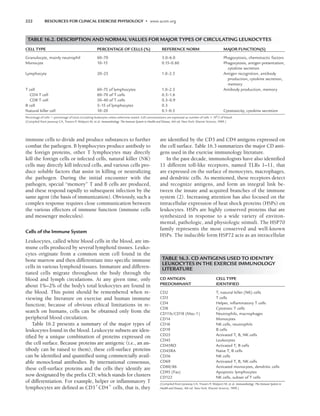
pressure endpoint (systolic 210 mm Hg) is considered
appropriate for patients in the subacute and postacute
stages (52).
Strength
Strength testing has been shown to be reliable in stroke
populations. Weiss et al. (54) and Ouellette et al. (55)
both used 1-RM testing in stroke survivors and found it
to be a safe procedure with this population. Rimmer et al.
(43) used the 10-RM method on two exercise machines,
one measuring upper body strength and one measuring
lower body strength in stroke survivors. A handgrip dy-
namometer was also used to measure grip strength on the
affected and nonaffected sides. Strength can be assessed
in a number of ways using standard exercise machines,
free weights, or dynamometers. Instruction on proper
lifting technique must be conducted before testing. Per-
sons with cognitive impairments or severe mobility limi-
tations may require more time to perform the test cor-
rectly. Adaptive gloves or Velcro may be necessary to
secure a hand to the weight or bar. During the strength
assessment, it is important to evaluate each limb sepa-
rately to determine the disparity in strength between the
hemiparetic and nonhemiparetic side. It is also important
to ascertain whether the affected limb(s) has sufficient
residual innervation to allow strength gains. This is typi-
cally determined by manual muscle test of the muscles to
be strengthened to see that they can contract and cause
movement against gravity or greater than ‘fair grade’
strength. If that is the case, then the individual can begin
gradual use of weights or related resistance devices. Sur-
face electromyography (EMG) may be helpful as well.
Flexibility
Hamstring and low back flexibility are important muscle
groups to evaluate in stroke survivors participating in ex-
ercise testing because of the increased spasticity on the
hemiparetic side. These muscle groups can be assessed
using a modified version of the sit-and-reach test. If sit-
ting on the floor is difficult, a modified version can be
performed using a bench. The patient is asked to sit on a
bench with legs fully extended and feet placed against the
sit-and-reach box. Participants extend their arms and
reach in the direction of their feet. The distance from the
middle finger to the center of the box is recorded.
A good measure of functional shoulder flexibility is to
have the person put one hand over the shoulder (slide the
hand down the back) and the other hand behind the back
(slide the back of the hand up the middle of the back).
The participant is asked to bring the fingers as close as
possible to each other. The distance between the two
middle fingers of each hand is recorded. Record scores on
both sides of the body by reversing the position of the
arms. A more comprehensive evaluation of flexibility can
be performed with a goniometer.
Body Composition
Body composition measurements should include height,
weight, skinfold measures, body mass index (BMI), and
waist-to-hip ratio (WHR). The sum of skinfold measure-
ments can be used in place of an estimated percent body
fat if the skinfold calipers do not open sufficiently wide to
obtain the entire skinfold. Some stroke survivors are se-
verely obese (56) and it may not be possible to obtain an
accurate skinfold measure at certain sites (e.g., thigh).
Because it is sometimes difficult to distinguish between
subcutaneous fat and muscle tissue on the hemiparetic
side, it is recommended that skinfold measurements be
taken on the noninvolved side.
PRESCRIPTION AND PROGRAMMING
The emphasis in working with stroke survivors tradition-
ally has been directed at rehabilitation during the first 6
months of recovery (16,57). Relatively few studies have
been conducted on improving the fitness in stroke sur-
vivors after rehabilitation (58). The small number of
training studies that have been completed, however, have
supported the use of exercise in improving mobility and
functional independence and in preventing or reducing
further disease and functional impairment in persons
with stroke (38,55,59–65). Research data provide evidence
that physical activity for stroke survivors is beneficial by
LWBK191-4034G-C01_01-18.qxd 6/11/08 5:50 pm Page 6 Aptara (PPG-Quark)
documenting reduced risk factors and reduced risk for
mortality from cardiovascular disease and stroke (8,66).
Most people with stroke go through a significant re-
covery period during the first 6 months after having had
a stroke, whereas others will see significant recovery for
up to a year or longer (8). The goal of resistance training
is to maximize recovery and sustain and improve fitness
throughout the lifespan (55). The clinical exercise physi-
ologist should work closely with the client’s physician or
therapist in developing a safe and effective program.
Stroke survivors who return home from a hospital or re-
habilitation facility shortly after their injury will need
greater attention to ensure that cardiovascular adapta-
tions are conducted in a safe environment with timely
and appropriate supervision.
CARDIORESPIRATORY ENDURANCE TRAINING
Cardiorespiratory fitness training is of critical importance
to stroke survivors. Cardiovascular-related morbidity and
mortality remains high after stroke and cardiovascular
deconditioning places added risk on the individual (38).
Stroke survivors often vary widely in age, severity of dis-
ability, motivational level, and number and severity of co-
morbid conditions, secondary conditions, and associated
conditions (Table 1.2). Although gait training and use of
the affected side (arm, leg) are major components of
stroke rehabilitation, several important studies have sug-
gested that aerobic exercise training should be a critical
part of the recovery process (26,38,44,63). Aerobic exer-
cise training can result in improved tolerance performing
ADL and allow more physical activity to be completed at
a lower submaximal threshold, thus reducing myocardial
oxygen demand (67).
FREQUENCY AND DURATION
The goal of the exercise program for stroke survivors
should be to have each participant engage in a tolerable
level of physical fitness depending on their overall health
and function. Thirty to 60 minutes a day most days of the
week is ideal, but if the individual has substantial barriers
to participating in physical activity (68,69), a lower
volume of exercise is also beneficial given their high rate
of deconditioning. If the individual is at a higher risk be-
cause of cardiovascular comorbidity or falls, suggestion is
that the person exercise under the supervision of a quali-
fied staff person, preferably trained in rehabilitation or
clinical exercise physiology. Hospital wellness centers
are excellent places for stroke survivors to exercise
because staff are usually trained in working with individ-
uals who have various types of disabilities. These pro-
grams, however, are usually located in only a few select
communities.
The cardiovascular exercise program should consist of
a warm-up and cool-down. Participants should have their
blood pressure checked at regular intervals before, dur-
ing, and after the training session. The cardiovascular
exercise can be continuous or accumulated over the day
to total 20–60 minutes (8). Obviously for individuals
who are older and more severely deconditioned, smaller
doses of physical activity may be necessary (i.e., 5–20
min/day). After the comprehensive screening has been
completed according to ACSM guidelines (49), the first
2–4 weeks of the program should be used to train partic-
ipants in using the equipment and becoming accus-
tomed to the program. Individual goals should be estab-
lished for each participant to ensure that he or she is
exercising within his or her comfort zone and achieving
the desired training effect.
INTENSITY LEVEL
When possible, the intensity level of the cardiovascular
exercise should be established for each participant from
the graded exercise test. The American Heart Association
scientific statement on physical activity and exercise rec-
ommendations for stroke survivors recommends training
at an intensity of 40%–70% of peak V
.
O2 or heart rate re-
serve (HRR) while also monitoring rating of perceived
exertion (RPE) (8). In the few studies that have been con-
ducted on stroke survivors, intensity was set at different
levels. Rimmer et al. (43) based the intensity level on the
participants’ peak V
.
O2 measure. The heart rate that the
participant reached at a respiratory quotient (RQ) of 1.00
was used to set the target heart rate range (THRR). Five
beats per minute was subtracted from this value, and the
THRR for the participant was then set from this heart rate
to 10 bpm below this heart rate. For example, if a partic-
ipant’s heart rate was 130 bpm at an RQ  1.00, subtract-
ing 5 bpm from this value would put the THRR at
115–125 bpm.
In the work by Potempa et al. (42), initial training for
stroke survivors was set at 40%–60% of measured peak
V
.
O2 for a duration of 30 minutes of continuous or dis-
continuous exercise. The emphasis during the early
stages of the program was on duration as opposed to in-
tensity. Once the person was able to exercise for 30 min-
utes, training intensity was progressively increased to the
highest workload tolerance without cardiac symptoms. It
is important to note that the investigators used telemetry
monitoring with their subjects and were thus able to be
more aggressive in their training intensity.
Macko et al. (26,36,63,67) have done a substantial
amount of treadmill training with stroke survivors. Their
training protocol started at low intensity (40%–50%
HRR) for 10–20 minutes and increased approximately 5
minutes every 2 weeks as tolerated until participants
were able to train at 60%–70% of HRR. Teixeira-Salmela
et al. (50) used an intensity of 70% of the maximal heart
rate attained from an exercise test with a higher function-
ing group of stroke survivors. Chu et al. (41) developed an
8-week, water-based program for 12 postroke survivors
CHAPTER 1 Stroke 7
LWBK191-4034G-C01_01-18.qxd 6/11/08 5:50 pm Page 7 Aptara (PPG-Quark)
8 RESOURCES FOR CLINICAL EXERCISE PHYSIOLOGY • www.acsm.org
using shallow water walking, mild running, and various
other activities and increased training intensity from
50%–70% HRR (weeks 1–2), to 75% (weeks 3–5), and
finally to 80% HRR (weeks 6–8). This is the only study in
the published literature that trained stroke survivors at
such a high intensity level (80%), although it was only
for a couple of weeks. Interestingly, they reported the
highest increases in peak V
.
O2 (22%) after an exercise in-
tervention with stroke subjects.
In the study by Rimmer et al. (43), participants who had
an abnormal blood pressure response during the exercise
test (systolic 220 mm Hg, diastolic 110 mm Hg) had a
modification to their exercise prescription. They were in-
structed not to exceed a rate pressure product (RPP) of 200.
The RPP was calculated by multiplying heart rate times sys-
tolic blood pressure, divided by 100. For example, if a par-
ticipant’s blood pressure response during an exercise ses-
sion was 180 mm Hg at a heart rate of 130 bpm, the RPP
would be 180 130/100 or 234. Because the value is more
than 200, the participant would not be allowed to exercise
on that day or had to wait until RPP dropped below 200.
Resting diastolic blood pressure (DBP) should be less
than 100 mm Hg to begin exercising. If resting DBP is
greater than 100 mm Hg, ROM exercises should be per-
formed until the DBP drops below 100. Exercise should
be terminated if blood pressure is elevated to 220/110
mm Hg or higher and should only be resumed when
blood pressure drops below this value.
Participants should begin with intermittent exercise
during the first 4 weeks of the program. At the end of 4
weeks, most participants should be able to complete 30
minutes of continuous or discontinuous exercise in their
THRR. However, it is important that participants have ap-
proval from their physician before participating in the
training program and that physicians are updated on
their patient’s performance at regular intervals.
TRAINING MODALITIES
Examples of cardiovascular training modalities for stroke
survivors include stationary cycling (recumbent and up-
right), over-ground walking, or walking on a treadmill
(provided the patients have adequate balance, are closely
supervised, and do not experience joint pain), elliptical
crosstraining, and recumbent stepping (especially useful
for those with severe hemiplegia). Participants should be
given the opportunity to select their own equipment as
long as it is considered safe and does not cause adverse
cardiovascular (i.e., excessive rise in blood pressure or
heart rate) or musculoskeletal complications (i.e., pain,
injury). Individuals with balance difficulties and a high
risk of falls should use a sitting modality such as the re-
cumbent stepper or stationary or recumbent cycle.
Several training advantages are seen to using a tread-
mill for improving cardiorespiratory fitness, gait, and
strength (70). Treadmill training allows the individual to
practice walking, which is critical to overall function;
handrails and body weight support (BWS) system (i.e.,
harness) allow professionals to load or unload some of
the body weight, depending on the patient’s strength and
balance; and grade can be used to adjust intensity, allow-
ing a comfortable speed to be maintained (63).
STRENGTH TRAINING
Muscle weakness has been recognized as a major symptom
following stroke (71). Research has also demonstrated that
the torque generated by the knee extensors, ankle plantar
flexors, and hip flexors is correlated to gait performance in
stroke survivors (72). Poor levels of strength can also be a
major factor contributing to significant functional limita-
tions, reduced walking speed and endurance, impaired sta-
bility, and increased postural sway (73–75). The primary
goal of strength training is to increase independence in
function, which can include walking, prevention of falls,
and performing BADL and IADL (76).
TRAINING INTENSITY
No published guidelines exist for developing resistance
training programs for persons with stroke. Based on the
research, several studies have demonstrated significant
improvements in strength using various levels of resis-
tance (73). Training intensity varied from 30%–50% of
maximal strength (77), to as high as 80% of 1-RM after a
2-week adjustment period (50,78). One study also found
significant improvements in strength using a circuit
training program that involved persons with stroke using
their body weight as the overload by performing sit-to-
stand from various chair heights; stepping forward, back-
ward, and sideways onto blocks of various heights; and
performing heel raises.
Rimmer et al. (43) initiated a strength training proto-
col for stroke survivors at 70% of each participant’s 10-
RM for one set of 15–20 repetitions. When participants
were able to complete 25 repetitions for 2 consecutive
sessions with proper lifting technique (i.e., proper bio-
mechanical motion, without Valsalva maneuver), the
weight was increased by 10% of their 10-RM. Participants
trained using a variety of exercises, including the bench
press, leg press, leg curl, triceps push-down, seated
shoulder press, seated row, lateral pull-down, and biceps
curl.
A general strength training prescription should use a
minimum of one set of 8–10 lifts using the large muscle
groups of the body, lighter weights, and higher repeti-
tions (e.g., 10–15 repetitions), and perform them 2–3
days a week. Blood pressure and RPE should be recorded
at the completion of each set until the person adjusts to
the program. Adaptive gloves and other types of assistive
aids may be necessary to ensure that the participant can
safely hold or grasp the weight.
LWBK191-4034G-C01_01-18.qxd 6/11/08 5:50 pm Page 8 Aptara (PPG-Quark)
TRAINING VOLUME
A major determinant of training volume is the amount of
muscle mass that is still functional. Persons with paralysis,
hemiplegia, impaired motor control, or limited joint mo-
bility have less functional muscle mass and, therefore, will
only tolerate a lower training volume. For individuals who
cannot lift the minimal weight on certain machines, resist-
ance bands or cuff weights are recommended. If bands and
cuff weights are too difficult, use the person’s own limb
weight as the initial resistance. For example, lifting an arm
or leg against gravity for 5–10 seconds may be the initial
starting point for those with very low strength levels.
Training volume will also depend on the patient’s
health status. Many individuals with stroke have been in-
active for much of their lives and will need only a small
amount of resistance exercise during the initial stage of
the program to obtain a training effect. How responsive
individuals with stroke will be to resistance exercise dur-
ing the conditioning stage depend on their current health
status and the severity of their stroke. For individuals
who start out at very low levels of strength, significant
improvements can be made with very light resistance.
TRAINING MODALITIES
Certain muscle groups need strengthening in persons
with physical disabilities (including stroke survivors) to
maintain the ability to perform BADL (e.g., dressing and
undressing) and IADL (e.g., lifting and carrying items,
walking up and down stairs). Lifting any type of resistance
requires good trunk stability and may be difficult to per-
form for individuals who have severe limitations in motor
control and coordination. Modes of resistance exercise fall
into four general categories: free weights, portable equip-
ment (i.e., elastic bands, tubing), machines, and person’s
own body weight. Any of these modalities is acceptable
for improving strength levels in stroke survivors, provided
the person is not at risk for injury. When an instructor
feels that the resistance mode presents a concern to the
person, the exercise routine should be either adapted
(e.g., securing the weight to the hand, changing the move-
ment) or substituted with a safer piece of equipment.
In persons with very low strength levels, gravity-
resistance exercise (lifting limbs against gravity) may be
all that the person is capable of performing. Abducting an
arm or extending a leg for several repetitions may be a
good entry point. These exercises can be used for persons
who are extremely weak after a stroke, whereas other
modes of resistance exercise can be used those who are
stronger. Once an individual is able to complete 8–12
repetitions of a gravity-resistance exercise, the person
could progress to free weight, bands, or machines. If an
individual is unable to move a limb against gravity be-
cause of extreme weakness, the instructor could place the
limb in a certain position (e.g., shoulder abduction) and
have that person hold the position isometrically for a few
seconds, gradually increasing the time. Horizontal move-
ments and aquatic exercises can be performed with grav-
ity eliminated, thus allowing the limb to move more
freely.
Rehabilitation professionals are also recommending
the use of treadmill training for improving functional
strength in stroke participants. A recent study found that
BWS treadmill training increased gait speed and strength
in individuals with stroke (70).
Active-assistive exercise may be required for certain in-
dividuals who do not have sufficient strength to over-
come the force of gravity. The instructor can assist that
person in performing the movement by providing as
much physical assistance as necessary. At various points
in the concentric phase, the instructor may have to assist
the person in overcoming the force of gravity. During the
eccentric phase, the instructor may need to control the
movement so that the weight or limb is not lowered too
quickly. In many instances, active-assistive exercise can
be used with severely weak musculature whereas active
exercise can be used with stronger muscle groups.
FLEXIBILITY TRAINING
Participants should be taught a variety of stretching exer-
cises targeting both upper and lower body muscle groups.
Participants should stretch at the beginning of each ex-
ercise session, at the end of the cardiovascular exercise
session, between strength exercises, and at the end of the
exercise session. Stretches should held with mild tension
for 15–30 seconds, being careful not to cause pain. A par-
ticular emphasis should be made to stretch the tight
(spastic) muscle groups on the hemiparetic side, which in-
clude the finger and wrist flexors, elbow flexors, shoulder
adductors, hip flexors, knee flexors, and ankle plantar flex-
ors. The primary goal of flexibility training for stroke sur-
vivors is to increase ROM and prevent joint contractures (8).
GENERAL PROGRAM GUIDELINES
STAFF SUPERVISION
Exercise sessions should be supervised by a clinical exer-
cise physiologist with guidance and support from the pa-
tient’s physician. It is helpful to have an assistant who can
be trained to monitor blood pressure, heart rate, and vital
signs, especially if several stroke survivors are exercising
in the facility at the same time. A recommended staff-to-
client ratio will depend on the functional level of the
client, number and type of comorbid conditions, associ-
ated or secondary conditions, and the expertise of the fit-
ness professional in working with stroke participants.
FACILITY PREPARATION
An emergency contact number should be posted in the ex-
ercise facility. If possible, physician pager numbers of stroke
CHAPTER 1 Stroke 9
LWBK191-4034G-C01_01-18.qxd 6/11/08 5:50 pm Page 9 Aptara (PPG-Quark)
10 RESOURCES FOR CLINICAL EXERCISE PHYSIOLOGY • www.acsm.org
survivors should be available. An automated external defib-
rillator is a good safety device to keep in the fitness center.
An infectious waste container for blood specimens should
be available for clients who must check their blood glucose
level. Blood specimens should be performed in a sterile set-
ting away from equipment and high-volume traffic areas.
CLIENT MONITORING
Given the higher level of comorbid and secondary condi-
tions associated with stroke, it is important for the clini-
cal exercise physiologist to monitor the exercise session
closely until the client adjusts to the exercise bout and
does not show signs of discomfort or exhibit any unusual
symptoms (e.g., fluctuations in blood pressure, dyspnea,
light-headedness). One way that many clinical exercise
physiologists monitor their client’s progress is with a
SOAP form. S stands for Subjective, which is a client self-
report of his or her current state (e.g., how much sleep
they had, do they feel well, did they eat breakfast, did they
take their medication(s), symptoms). O stands for Objec-
tive, which is the clinical staff’s evaluation of the partici-
pant’s current state and quantitative performance during
the exercise session (i.e., modality, workload, blood pres-
sure response, physiologic signs). A stands for Assess-
ment, which is how the clinician interprets S and O. P
stands for Plan, which refers to the prescribed or recom-
mended treatment plan, including modifications that
need to be made to the exercise prescription in the next
session (e.g., trying a new exercise, increasing resistance).
At the end of each session, blood pressure and heart rate
should be recorded to ensure that the participant returns
to resting values before departure from the fitness center.
The instructor should attempt to provide a program
that is appropriate in intensity, mode, duration, fre-
quency, and progression to minimize the likelihood of de-
veloping prolonged or unusual fatigue and delayed-onset
muscle soreness. Although this occasionally can be a com-
mon side effect of any new training regimen, it could
present a problem for persons with stroke if the soreness
prevents them from conducting their normal BADL or
IADL. Although a client with stroke may aspire to make
rapid gains in strength and can train at a moderate-to-
high intensity level, the clinical exercise physiologist
should be cautious not to overwork the muscle groups.
Use light resistance for at least the first 2 weeks of the
program (50% of 1-RM), and only proceed to higher train-
ing loads if muscle soreness and fatigue are not evident
and no other side effects are evident. A verbal evaluation
of the previous session should be conducted with the pa-
tient on return for the next session. If it is determined that
some soreness in certain muscle groups prevented the
person from performing routine daily activities, the exer-
cise should be discontinued until the soreness improves.
On continuation of the program, the clinical exercise
physiologist may need to reduce the training volume or
avoid certain exercises that result in pain or fatigue. If
prolonged bouts of pain or soreness occur 24–48 hours
after exercise, the client should consult with his or her
physician to determine the cause.
It is worth repeating that blood pressure must be mon-
itored closely in persons with stroke. Because hyperten-
sion is a common comorbidity, follow the guidelines in
ACSM’s Guidelines for Exercise Testing and Prescription for
working with persons with hypertension (49). It is espe-
cially important for the person’s blood pressure to be
under control before initiating the program. During the
first 4 weeks of the program, monitor blood pressure fre-
quently to ensure that complications or adverse changes
are not occurring. If blood pressure continually fluctu-
ates, contact the patient’s physician. Under no circum-
stances should a person who has had a stroke and con-
tinues to have difficulty maintaining a stable blood
pressure be allowed to exercise.
Persons with type 1 diabetes should bring their own
portable glucometer to the fitness center and take a blood
glucose measurement before and after each exercise ses-
sion. Orange juice and other high carbohydrate snacks
should be available for those who become hypoglycemic
(50 mg · dL1
). Participants should be encouraged to
drink adequate amounts of water during the exercise ses-
sion to avoid dehydration.
Many individuals with stroke will exhibit asymmetrica
weakness or will have a disproportionately greater degree
of weakness to the flexor or extensor muscle groups. It is
important to evaluate individual muscle groups on both
sides of the body, including both agonists and antago-
nists, to isolate the degree of weakness in key muscle
groups. Individuals with asymmetric weakness will often
“hike” their body toward the weaker side to compensate
for this weakness while performing resistance training.
Make sure that each person is performing the activity
with proper form. If there is a tendency to “hike” the
body, lower the resistance and emphasize good form.
An important goal of the clinical exercise physiologist
is to teach the client how to measure his or her own RPE,
how to use the equipment safely, and to understand the
warning signs when to stop exercising. A sample check-
list of safety guidelines for self-regulating exercise is
shown in Table 1.3. Stroke survivors should also be
taught the warning signs for when they should stop exer-
cising. Table 1.4 provides a list of items that should be re-
viewed with each person. Once the persons understands
these warning signs and can repeat them back to the in-
structor, both parties should sign the form. This assures
the instructor that the client has a basic understanding of
how to exercise safely.
EDUCATION AND COUNSELING
The clinical exercise physiologist has an important respon-
sibility to teach stroke survivors the importance of good
LWBK191-4034G-C01_01-18.qxd 6/11/08 5:50 pm Page 10 Aptara (PPG-Quark)
Structured lectures that address questions and miscon-
ceptions should be an integral part of the program. Partici-
pants must learn new ways to think about changes in their
lives following a stroke and thus facilitate healthier living.
Group discussions about stressful events related to stroke
(e.g., change in family roles) can be an important part of the
educational component and can be used to facilitate devel-
opment of peer support relationships. Through these peer
relationships, participants can help each other develop new
ways to think about coping and adapting following their
stroke and identify ways to incorporate exercise, healthier
TABLE 1.3. SAMPLE CHECKLIST FOR TEACHING CLIENTS TO PERFORM EXERCISE SAFELY
Client Name: ________________________________________ Staff Name: ____________________________________ Date:______________________
Before participation in an exercise program, you must be able to competently execute the tasks listed below. If you have difficulty performing any
of these tasks, you will receive additional training before participating in the program.
health promotion practices (mind–body relationship)
where clients and their caregiver can learn about various
strategies to enhance their health. Limited access to
healthcare and healthcare follow-up, combined with lack
of health education and health awareness, presents for-
midable barriers to effective health promotion in this
population. Subsequently, many stroke survivors do not
understand the importance of good health maintenance
(e.g., diet, exercise, health behavior) in preventing a re-
current stroke and the educational component is an ex-
tremely important part of the exercise plan.
Able to monitor target heart rate.
Able to use the rating of perceived exertion (RPE) scale.
Knows the warning signs to stop exercising.
Able to safely operate the treadmill.
Able to program the treadmill.
Able to safely operate the upright bike.
Able to program the upright bike.
Can record aerobic and strength activities on assigned log sheet.
Display knowledge of the goals of strength training.
Know what a set is.
Know what a repetition is.
Can adjust the bench press to fit him or her.
Can display proper form when using the bench press.
Can display proper breathing (lack of Valsalva maneuver) when using the bench press.
Can adjust the leg press to fit him or her.
Can display proper form when using the leg press.
Can display proper breathing (lack of Valsalva maneuver) when using the leg press.
Can adjust the shoulder press to fit him or her.
Can display proper form when using the shoulder press.
Can display proper breathing (lack of Valsalva maneuver) when using the shoulder press.
Can adjust the triceps push-down to fit him or her.
Can display proper form when using the triceps push-down.
Can display proper breathing (lack of Valsalva maneuver) when using the triceps push-down.
Can adjust the biceps curl to fit him or her.
Can display proper form when using the biceps curl.
Can display proper breathing (lack of Valsalva maneuver) when using the biceps curl.
Can adjust the front row to fit him or her.
Can display proper form when using the front row.
Can display proper breathing (lack of ValsaLva maneuver) when using the front row.
Can adjust the lat pull-down to fit him or her.
Can display proper form when using the lat pull-down.
Can display proper breathing (Lack of Valsalva maneuver) when using the lat pull-down.
Can adjust the hamstring curl to fit him or her.
Can display proper form when using the hamstring curl.
Can display proper breathing (lack of Valsalva maneuver) when using the hamstring curl.
CHAPTER 1 Stroke 11
LWBK191-4034G-C01_01-18.qxd 6/11/08 5:50 pm Page 11 Aptara (PPG-Quark)
12 RESOURCES FOR CLINICAL EXERCISE PHYSIOLOGY • www.acsm.org
cooking and eating habits, and new approaches to adjusting
to life changes living with a disability.
BARRIERS TO EXERCISE
Rimmer et al. (79) examined barriers to exercise in per-
sons with stroke and other physical disabilities. Data
were collected through an in-depth telephone interview
using an instrument that addressed issues related to
physical activity and the subjects’ disability (Barriers to
Physical Activity and Disability Survey–B-PADS). Sub-
jects were asked questions pertaining to their participa-
tion or interest level in structured exercise. The four
major barriers were cost of the exercise program (84.2%),
lack of energy (65.8%), transportation (60.5%), and did
not know where to exercise (57.9%). Barriers commonly
reported in nondisabled persons (e.g., lack of time, bore-
dom, too lazy) were not observed in this cohort. Interest-
ingly, only 11% of the subjects reported that they were
not interested in starting an exercise program. Most sub-
jects (81.5%) wanted to join an exercise program, but
were restricted by the number of barriers reported. The
investigators noted that black women with stroke and
other physical disabilities were interested in joining exer-
cise programs, but were limited in doing so because of
their inability to overcome several barriers to increased
physical activity participation.
In a more recent study (69), researchers reported that
the five most common barriers reported by a cohort of
stroke survivors in rank order were (1) cost of the pro-
gram (61%), (2) lack of awareness of fitness center in the
area (57%), (3) no means of transportation to get to a
facility (57%), (4) don’t know how to exercise (46%), (5)
don’t know where to exercise (44%). Least common barri-
ers were (1) lack of interest (16%), (2) lack of time (11%),
and (3) exercise will make my condition worse (1%).
To increase exercise adherence among stroke sur-
vivors, the clinical exercise physiologist must first assess
and subsequently work with the individual and other
support systems to problem-solve removing as many of
the actual (i.e., transportation) and perceived (i.e., exer-
cise will not improve condition) barriers as possible.
Available resources should be utilized, such as the Na-
tional Center on Physical Activity and Disability
(www.ncpad.org, 800/900-8086), which is a federally
funded information center that contains many useful
physical activities for people with stroke, including ways
to reduce or remove barriers to participation by providing
home exercise videos and a listing of organizations and
facilities that provide specialized programs for people
with disabilities. The website also provices access to the
aformentioned B-PADS instrument, which a useful way
to sytematically identifyand remove barriers to particip-
tion for stroke survivors.
TABLE 1.4. GUIDELINES FOR SELF-REGULATING
EXERCISE IN STROKE PARTICIPANTS
You understand that you are being asked to exercise within your own
comfort level. During exercise, your body may give you signs that you
should stop exercising.
These signs Include:
Lightheadedness or dizzyness
Chest heaviness, pain, or tightness; angina
Palpitations or irregular heart beat
Sudden shortness of breath not due to increased activity
Discomfort or stiffness in muscles and joints persisting for several
days after exercise
Call your doctor if you experience any of these sensations.
Please call your exercise instructor at (111-1111) if you experience
any of the following signs:
A change in your medication.
A change in your health, such as:
An increase or change in blood pressure, resting heart rate (just
sitting around), or other symptoms related to your heart
Hospitalization for any reason
Cold/flu
Emotional stress or upset at work or at home
Any other change that you feel is important
Your doctor advises you to stop exercising for any reason
I realize that it is my responsibility to report any of these
signs/symptoms to my DOCTOR. Once the situation is resolved, I
must contact MY INSTRUCTOR, Clinical Exercise Physiologist, at
111-1111.
Signature of Participant Date
Signature of Instructor Date
CST
CASE STUDIES
It should be noted that in all cases, physical, occupational,
and speech therapists had seen these patients and
completed programs in these allied healthcare disciplines.
Physician care included primary management by an
internist and a neurologist, with other specialty consults,
as needed. A psychiatrist, cognitive psychologist, or both
were also involved in patient care where needed for
depression and deficits in task processing were noted.
CASE 1
RM: 55-year-old married businessman, retired because
of a cerebrovascular accident, which left him with partial
left hemiplegia (hemiparesis). Chief complaint at the
time of visit was tightness of the left shoulder and
reduced grip strength, especially notable when golfing.
There was also a longstanding history of recurrent low
back pain with x-rays showing degenerative joint disease
LWBK191-4034G-C01_01-18.qxd 6/11/08 5:50 pm Page 12 Aptara (PPG-Quark)
CHAPTER 1 Stroke 13
in the spine. Medications: Plavix, Bayer ASA, Procardia,
Zocor, MVI, vitamins B6, B12, and folic acid. With
patient upright, his posture showed a left shoulder
droop relative to the right side. Rhomberg sign was neg-
ative. Gait up to 2 miles/hour was normal. He was
unable to walk on a narrow straight line for 10 feet with-
out making a side balance error. He was able to do a
partial squat. Spine ROM showed blocking of movement
with side tilt to the right side. The shoulder ROM was
limited to 90 degrees for abduction and 100 degrees for
forward flexion, 50 degrees of 90 degree abducted-exter-
nal rotation. There were no one-sided sensory, position
sense, or one-sided sensory neglect deficits detected.
Babinski sign was absent and muscle stretch reflexes
were normal. Cranial nerves showed a mild left facial
paresis. A program with the exercise physiologist was
conducted for 20 sessions over a 9-month period.
Initially, he was able to walk 2 mph for 10 minutes, and
reached a heart rate of 130 bpm. He could hold a 2 lb.
weight in the left hand, although was unable to use the
thumb. He could not control a coffee cup full of fluid
without spilling it. Exercises to establish a neutral spine
posture were initiated. Isometric program for the left
scapular muscles was initiated with feedback from a
take-home electrical muscle stimulation device. He was
able to progress to diagonal pattern upper extremity ex-
ercises and some grip movements of the left thumb. His
endurance improved to 4 mph for 20 minutes at a heart
rate of 140 bpm. The low back pain became more
evident as the patient became more active and played
golf 3 times per week, completing 18 holes, using a golf
cart for transportation. X-rays showed osteophytes and
degenerative joint changes in the facets, sacroiliac, sym-
physis pubis, and hip joints, no change since x-rays taken
5 months earlier. Fluoroscopically guided injection was
done to the left sacroiliac joint, which reduced pain and
interference from guarding of that area during sessions
with the exercise physiologist.
Problems to Consider
Left hemiparesis primarily involved the left upper extremity,
the most common form of hemiparesis. Usually some
muscles are spared, but it is rare to see complete sensori-
motor hemiplegia of every muscle group on the left side.
Deficits on the left side sometimes are more obvious
with fatigue after a period of ambulation at a given
speed, or after an increased challenge to coordination,
such a line-walking
Low back pain, which may lateralize to the side of poor-
est function, but the presence of pain alerts the
healthcare practitioner that the individual is aware of af-
fected side. The biomechanical deficits associated with
low back pain in this case are questionable. X-rays show
a long history of low back cumulative wear that probably
extends before the onset of the stroke. X-rays without
findings of unstable conditions, such as stress fracture
(spondylolysis), osteoporotic fracture, or tumors, will
not interfere with the exercise program. It is important
to address motor control of the oblique muscles of the
lumbopelvic girdle, emphasizing spine posture and
avoiding fatigue to those muscles. Isometric exercises,
while maintaining the neutral spine (the most relaxed
midposition between full spine flexion and full spine ex-
tension), will be beneficial. Weakness and increased tone
of the muscles on the hemiplegic side should be noted.
Golfer. The fact that the client is still able to golf
demonstrates an ability to swing right-handed. Assistive
devices, such as the tube device hooked to a glove for the
left hand, may minimize grip deficits and optimize the in-
dividual’s ability to coordinate the movements of the
upper extremity. He was also able to sometimes golf in
the 90s score range because of focus on ball direction in-
stead of distance. The emphasis in this program was first
normal trunk control, then head position and retraining
of the scapular movement with the golf swing.
The electromuscle stimulation machine was prescribed to
increase muscle contraction beyond the individual’s abil-
ity to do it simply by his own volition. Such devices are
used in disorders of the central nervous system to (a)
compensate for loss of maximal contraction owing to
loss of central nervous system input and (b) provide in-
creased feedback to the brain by the sensory input from
the electrical impulse to the muscle. It is important to
know the difference between this device and other
devices, such as a transcutaneous stimulation machine.
The latter only stimulates skin sensors to try to block
pain, but does not have the proper electrical settings to
reach muscle.
CASE 2
DK: 46-year-old woman with juvenile onset diabetes mel-
litus (type 1), smoker, suffered a cerebrovascular
accident at age 17 and has a history of seizures. This left
her with a spastic type of hemiparesis of the right upper
and lower extremities and aphasia (expressive type). Her
chief complaint is of difficulty with sustained daily activi-
ties and exercise because of the hemiplegia. In addition,
she complains of tender points in the left hand over the
thenar (thumb) muscle pad in the palm along with pain
and numbness into her fingers of that hand, the left ten-
sor fascia lata, and the left heel. Her lifestyle was
basically self-care, community errands, and a long-term
relationship with a boyfriend. She finished high school,
but never developed a career. She smoked one-half pack
per day. Medications: Tegretol, Dilantin, Provera,
Valium, metoprolol, gabapentin, cyclobenzaprine, alen-
dronate, and Insulin pump (implantable device for infu-
sion of insulin instead of injection needles). On physical
examination, she was an alert, oriented person who un-
derstood and obeyed either simple or multistep instruc-
tions. Her speech was markedly limited by nonfluent use
of single words and phrases and she often corrected
CHAPTER 1 Stroke 13
LWBK191-4034G-C01_01-18.qxd 6/11/08 5:50 pm Page 13 Aptara (PPG-Quark)
herself. Naming of simple objects, such as a pen or
watch, resulted in mispronunciations and nonwords.
She could communicate during most routine conversa-
tion if allowed to self-correct. Sensation was decreased,
but present for the right side, no neglect or sensory ex-
tinction was noted. The presence of the trigger points
in the areas of tenderness supported the absence of
neglect on the right side. Increased tone was noted in
the right lower extremity with a knee-extended gait.
Posturing of the foot was partially masked by previous
ankle/tendon surgery for equinovarus ankle posturing.
Increased tone was noted in the right hand in the form
of a grip posture. Range of motion was otherwise, nor-
mal. Pressure over any of the trigger points would cause
a sudden spastic response. Reflexes were increased for
the right upper and lower extremities, Babinski sign was
positive on the right, but negative on the left side.
Strength and motor control were evaluated. Volitional
movements tended to follow flexion or extension
synergy patterns on the right side. Movement could be
isolated for the scapulothoracic and hip muscles. The
individual could assume upright posture with cuing.
The individual entered a clinical exercise physiology
program for a period of 6 months. The first 3 months
involved every-other-week visits for endurance and a
home exercise program. She was independent and safe
in the community at the time of initial visit, however
her speed of gait was approximately 1.5 mph and very
labor intensive with aerobic level heart rates greater
than 130 bpm. She was unable to progress in the pro-
gram initially, owing to the painful trigger points
described. Phenol blocks were performed twice over the
treatment period, which provided marked relief of
symptoms and reduction in spasticity. The second 3
months of the program was done in an exercise class
setting. She made marked progress in the ability
control the right lower extremity during the swing
phase of gait. She also was prescribed a plastic ankle-
foot brace. The right upper extremity function
improved with the combined effect of improved scapu-
lar control with electrical muscle stimulation and the
use of a wrist-hand brace to help positioning for gross
grip of objects during daily activity and weight training.
She initially avoided use of the right upper extremity,
but by the end of the treatment session she was able to
use it as an assist in two-handed activities with the left
upper extremity. Throughout the program, blood
glucose levels were monitored and low blood sugars
less than 60 mg · dL1
were treated with a high glucose
content beverage. High blood sugars were addressed
with increased water ingestion. Dietary adjustments
and insulin pump (physician or nurse adjusted) dosage
changes were made in response to increased physical
activity, blood glucose and glucometer readings, and
physical symptoms. The program is now focusing on
help toward further education and career pursuits.
Problems to Consider
In insulin-dependent diabetes, even with an implantable
device, wide fluctuations of blood sugar can occur,
resulting in loss of consciousness or lethargy. Lethargic
mood can be misinterpreted as fatigue, lack of enthusi-
asm, or poor ability to follow instructions.
Aphasia is a broad family of classifications to describe
communication deficits in relationship to organic brain
disorders. They can be considered most simply as prima-
rily disorders of comprehension or disorders of
expression. Disorders of comprehension aphasias are the
most difficult to address during exercise programs. This
individual was primarily in the expressive disorders cate-
gory. Aphasia should not be confused with apraxia, in
which the individual can appropriately name objects and
converse, but has difficulty with the formation of words.
Also, paralysis of facial muscles or the tongue, such as an
injury to a nerve, is not aphasia. If a patient has an
aphasia, then communication through a very few written
words and pictures can improve exercise comprehension
and compliance.
Spasticity and increased tone in the spine and extremities
must be addressed by first working with muscles that do
have near normal function. Then, progression extends to
the next group of muscles, usually spine-related muscles
first, followed by more distal muscles, in the hope of se-
quential spread of motor control. Spasticity is usually
stimulated an undesirable increase in response to fast
movements or sudden large loads for resistance training.
Single sustained submaximal contractions, rather than
fast repetitions may be better. Proprioceptive neuromuscular
facilitation is used to describe various forms of feedback
through either tapping or light pressure during use of the
muscle desired. The individual should be positioned in a
lying or sitting position to avoid excessive spasticity
response. Electrical muscle stimulation may have a
biofeedback effect in combination with a voluntary con-
traction of a given muscle.
Contracture of the hemiplegic ankle received tendon
lengthening surgery to relieve the contracture. Contractures
can respond at least in part to single prolonged stretch-
ing, sometimes in excess of 2 minutes. If surgery is done,
then the contracture will be relieved, but anticipate
weakening of that muscle as a side effect of the surgery.
Tender points and trigger points are specific mapped out
areas where tenderness can be greatest in a muscle. The
tenderness can cause a noxious (pain) response that may
lead to muscle guarding and spasticity. Phenol blocks ei-
ther to a trigger point or to the actual nerve or its junction
in the muscle may reduce the spasticity and pain.
One-sided neglect was not present in this individual.
This is important in stroke because brain injury can
affect sensory processing areas. The patient can
sometimes feel the paralyzed side; however, neglect is
when both sides are stimulated at the same time with
the individual stating that she can only feel one side.
14 RESOURCES FOR CLINICAL EXERCISE PHYSIOLOGY • www.acsm.org
LWBK191-4034G-C01_01-18.qxd 06/11/2008 09:18 PM Page 14
CHAPTER 1 Stroke 15
Smoking history is part of the risk factor profile that
accompanies stroke. In this case, her pulmonary
function may be a limiting factor during exercise. An in-
quiry regarding her pulmonary function is important, es-
pecially if she is short of breath.
Pharmacologic issues: Be aware of reduced patient
arousal because of the somnolence side effects of her
medications (e.g., muscle relaxant [cyclobenzaprine],
antiseizure medications [carbamazepine]). Metoprolol is
a -blocker that reduces maximal heart rate and may
limit her exercise endurance.
Nerve conduction studies and needle electromyography test-
ing were used to discover the slowed median nerve con-
duction across the wrist called carpal tunnel syndrome,
explaining the numbness and pain in the nonhemiplegic
left hand. Electrical stimulation by a recording device
measures the speed and size (amplitude) of nerve
conduction to determine if the nerve is healthy or
injured. She has both a nerve pinch (i.e., carpal tunnel
syndrome) and diabetes, which will also show abnormal
results on nerve conduction study. The needle form of
electromyography is also used to assess for loss of motor
nerve function or muscle disease by observing the electri-
cal muscle membrane and muscle contraction potentials
heard and viewed on a screen.
CASE 3
JP: 72-year-old man suffered a cerebrovascular accident
2 years before his visit. He was a depressed gentleman, a
retired successful businessman, and he had a history of
participation in competitive sports. His chief complaint
was lack of improvement from a left hemiparesis after
the stroke and lack of energy. Extensive medical work-up
uncovered sleep apnea and a home airway (CPAP)
device was implemented through an affiliated sleep lab-
oratory. He needed help in bathing, dressing, and for
community walks greater than household distances (i.e.,
50 feet). He could eat, but not cut his own food. A
wheelchair was used for community mobility pushed
usually by his wife. His wife would state that he had sev-
eral falls at home while ambulating, none with any
injury. Medications: Dilantin, Coumadin, Synthroid,
Prozac, Zocor, MVI, Digoxin. The physical examination
noted a tall slender man with clear speech and commu-
nication, but with wandering of thoughts during his re-
sponses and slowed responses. He showed a left facial
hemiparesis. He could repeat five of seven numbers in
forward order, but was unable to repeat them in reverse
order. He also would tend to avoid looking over to his
left side and would not pay attention to his left arm
hanging off of the wheelchair. He displayed minimal
movement of the proximal scapula-related muscles and
no voluntary motor response in the more distal upper
extremity. The lower extremity strength was graded fair in
the proximal muscle of the hip and knee and poor in
more distal muscles of the ankle and foot. Sensation was
partially decreased on the left side, with sensory
extinction on simultaneous (left and right tested at the
same time) light touch. Grafesthesia was also impaired
but present on the left side. Reflexes were decreased on
the left side, with a positive Babinski sign on the left and
right sides. Cranial deficits were noted in facial muscles
on the left side. No aphasia was present. He needed sev-
eral attempts to arise from a sitting to a stand position.
However, with a quad cane he did ambulate at less than
1 mph with no deviations at that speed on noncarpeted
surface. He had a foot drop and would have difficulty
clearing his toe during swing phase of gait. He entered
the clinical exercise physiology program to improve both
safety in ambulation and focus on details as they related
to a home exercise program. The goal was also to facili-
tate maximal use of the left upper extremity and attention
to his left side. Throughout the program he displayed in-
terruption in ambulation, reaching tasks, and therapeutic
exercises, accompanied by random conversations about
issues that concerned him. He would also periodically
bump his left side in the doorway or other obstacles. The
program was adjusted to raise his awareness by having
him navigate various obstacle courses and objects to
reach another point. He was noted to not bump into
these obstacles when asked specifically to walk around
them. He also gradually responded to verbal cues to the
left side. Resistance exercise for the right side involved
lifting the left extremities. Electrical muscle stimulation
pulsed to turn on every 5 seconds for 5 seconds duration
was used to cue muscles of the left shoulder, and left hip-
and knee-related muscles. No gait training was done on
the treadmill, because his speed of ambulation was
initially 0.6 mph and never faster than 1.5 mph. He was
successful in the cessation of any falls at home. His speed
of ambulation increased, and he could discontinue his
left plastic ankle foot orthosis without a foot drop at the
end of 6 months of the program, on an every-other-week
basis. His left upper extremity became functional for arm
swing during ambulation. He was successfully connected
with psychological support care, as well as support coun-
seling for him and his wife.
Problems to Consider
One-sided neglect is a problem most common to individu-
als who have had a stroke to the right (or dominant side)
hemisphere with left hemiplegia. They will ignore the left
side of the body, often as if it did not exist. Setting up
safe challenges that requires the individual to become
aware of that side, such as an obstacle course, is one
form of cuing to that side. Other strategies are to use the
recognized extremities to find and use the neglected side
in bilateral two-extremity exercises. Biofeedback, such as
electrical stimulation with activities, can be useful.
Sensory extinction is the absence of recognition of a sen-
sory stimulus to one extremity when both are touched.
For example, if both extremities recognize a sensory
CHAPTER 1 Stroke 15
LWBK191-4034G-C01_01-18.qxd 6/11/08 5:50 pm Page 15 Aptara (PPG-Quark)
stimulus when touched or pin-pricked one at a time, one
side will not be recognized if both are simultaneously
touched. This sensory extinction is considered a sign of a
one-side brain injury or disease. Grafesthesia, or the
recognition of numeric signs gently traced (no marker or
inks), is another organic brain function test.
Depression and distractibility appear the same, but are
different in the underlying cause. Depression is a
disorder of the mind, with feelings of helplessness and
hopelessness. People with depression may not be very
arousable and will appear distractible. Organic brain
diseases will often have distractibility without depression
because of lack of arousal. In this case, depression
played a significant role in the individual’s distraction.
Flaccid hemiparesis is distinct from the spastic hemiparesis
in that the muscles show decreased activity, both with
voluntary and sudden involuntary movement. The hemi-
paresis described above was of the flaccid type. For
muscles that do function, repetitive movement exercises
are not a problem as they would be with the spastic
form.
Domestic falls are considered a functional concern,
even if the individual is noted to have strength and coor-
dination adequate for ambulation and arising from a sit-
ting position. The problem may be distractibility, fatigue,
or desire to move to another location faster than is safe
to move with a hemiparesis. Challenges in the clinic,
such as fast ambulation and obstacle courses, help to
deter further falls. Other causes, such as vertigo, heart
failure, medication side effects, and an unsafe household
with throw rugs, uneven surfaces, and slippery
bathrooms must be addressed as well.
REFERENCES
1. Mackay J, Mensah GA, Mendis S, Greenlund K. World Health Or-
ganization. The Atlas of Heart Disease and Stroke. Geneva: World
Health Organization; 2004.
2. Rosamond W, Flegal K, Friday, G, et al. Heart disease and stroke sta-
tistics—2007 update. A report from the American Heart Associa-
tion Statistics Committee and Stroke Statistics Subcommittee. Cir-
culation 2007;115:e69–e171.
3. Lopez-Yunez A. The management of stroke patients by neurolo-
gists: Common questions and new observations. Semin Neurol
2002,;22(1):53–61.
4. Feigin V, Lawes CM, Bennett DA, et al. Stroke epidemiology. A re-
view of population-based studies of incidence, prevalence, and
case-fatality in the late 20th century. Lancet Neurol 2003;2:43–53.
5. Pendlebury S. Worldwide under-funding of stroke research. Int J
Stroke 2007;2:80–84.
6. Wolfe C. The impact of stroke. Br Med Bull 2000;56:275–286.
7. Khadilkar A, Phillips K, Jean N, Lamothe C, Milne S, Sarnecka J.
Ottawa panel evidence-based clinical practice guidelines for post-
stroke rehabilitation. Top Stroke Rehabil 2006;13(2):1–269.
8. Gordon N, Gulanick M, Costa F
, et al. Physical activity and exercise
recommendations for stroke survivors: An American Heart Associ-
ation scientific statement from the Council on Clinical Cardiology,
Subcommittee on Exercise, Cardiac Rehabilitation, and Prevention;
the Council on Cardiovascular Nursing; the Council on Nutrition,
Physical Activity, and Metabolism; and the Stroke Council. Circula-
tion 2004;109(5):2031–2041.
9. Caplan L. Stroke. A Clinical Approach, 3rd ed. Boston: Butterworth-
Heinemann; 2000.
10. Collins C. Pathophysiology and classification of stroke. Nurs Stand
2007;21(28):35–39.
11. Williams LS, Kroenke K, Bakas T, et al. Care management of post-
stroke depression: A randomized, controlled trial. Stroke 2007;
38(3):998–1003.
12. Rich DQ, Gaziano JM, Kurth T. Geographic patterns in overall and
specific cardiovascular disease incidence in apparently healthy men
in the United States. Stroke 2007;38(8):2221–2227.
13. Stewart DG. Stroke rehabilitation. 1. Epidemiologic aspects and acute
management. Arch Phys Med Rehabil 1999;80(5 Suppl 1):S4–S7.
14. Kwok T, Lo RS, Wong E, Wai-Kwong T, Mok V, Kai-Sing W. Quality
of life of stroke survivors: A 1-year follow-up study. Arch Phys Med
Rehabil 2006;87(9):1177–1182; quiz 1287.
15. Lai SM, Studenski S, Richards L, et al. Therapeutic exercise and de-
pressive symptoms after stroke. J Am Geriatr Soc 2006;54(2):
240–247.
16. Teasell R, Foley N, Bhogal S, Bagg S, Jutai J. Evidence-based prac-
tice and setting basic standards for stroke rehabilitation in Canada.
Top Stroke Rehabil 2006;13(3):59–65.
17. Black-Schaffer RM, Kirsteins AE, Harvey RL. Stroke rehabilitation.
2. Co-morbidities and complications. Arch Phys Med Rehabil
1999;80(5 Suppl 1):S8–S16.
18. Rimmer JH, Shenoy SS. Impact of exercise on targeted secondary
conditions. In: Field MJ, Jette AM, Martin L, eds. Workshop on Dis-
ability in America. Washington, DC: National Academies Press;
2006.
19. Roth EJ, Lovell L. Community skill performance and its association
with the ability to perform everyday tasks by stroke survivors one
year following rehabilitation discharge. Top Stroke Rehabil 2007;
14(1):48–56.
20. Ebrahim S. Clinical Epidemiology of Stroke. New York: Oxford Uni-
versity Press; 1990.
21. Gordon NF
. Stroke. Your Complete Exercise Guide. The Cooper
Clinic and Research Institute fitness series. Champaign, IL: Human
Kinetics; 1993.
22. Kelly JF
. Stroke rehabilitation for elderly patients. In: Kemp B,
Brummel-Smith K, Ramsdell JW, eds. Geriatric Rehabilitation.
Boston: Little, Brown and Company; 1990: 61–89.
23. Pauls JA, Reed KL. Quick Reference to Physical Therapy. Gaithers-
burg, MD: Aspen; 1996.
24. Ramasubbu R, Robinson RG, Flint AJ, Kosier T, Price TR. Func-
tional impairment associated with acute poststroke depression: the
Stroke Data Bank Study. J Neuropsychiatry Clin Neurosci 1998;10(1):
26–33.
25. Alberts MJ, Easton JD. Stroke best practices: A team approach to
evidence-based care. JAMA 2004;96(4 Supplement):5S–20S.
26. Macko RF
, DeSouza CA, Tretter LD, et al. Treadmill aerobic exercise
training reduces the energy expenditure and cardiovascular de-
mands of hemiparetic gait in chronic stroke patients. A preliminary
report. Stroke 1997;28(2):326–330.
27. Wolf PA, Claggett GP, Easton JP, et al. Preventing Ischemic
Stroke in Patients With Prior Stroke and Transient Ischemic At-
tack: A Statement for Healthcare Professionals From the Stroke
Council of the American Heart Association. Stroke 1999, 30:
1991–1994.
16 RESOURCES FOR CLINICAL EXERCISE PHYSIOLOGY • www.acsm.org
LWBK191-4034G-C01_01-18.qxd 6/11/08 5:50 pm Page 16 Aptara (PPG-Quark)
CHAPTER 1 Stroke 17
28. Niemi ML, Laaksonen R, Kotila M, Waltimo O. Quality of life 4
years after stroke. Stroke 1988;19:1101–1107.
29. Black-Schaffer RM, Kirsteins AE, Harvey RL. Stroke rehabilitation:
Co-morbidities and complications. Arch Phys Med Rehabil 1999;
80:S8–S16.
30. Corr S, Bayer A. Poor functional status of stroke patients after hospital
discharge: Scope for intervention? Br J Occup Ther 1992;55:383–385.
31. Dean CM, Richards CL, Malouin F
. Task-related circuit training im-
proves performance of locomotor tasks in chronic stroke: A random-
ized controlled pilot trial. Arch Phys Med Rehabil 2000;81(4):
409–417.
32. Hill K, Ellis P
, Berhnardt J, Maggs P
, Hull S. Balance and mobility
outcomes for stroke patients: A comprehensive audit. Aust J Physio-
ther 1997;43:173–180.
33. Goldie PA, Matyas TA, Evans OM. Deficit and change in gait veloc-
ity during rehabilitation after stroke. Arch Phys Med Rehabil 1996;
77:1074–1082.
34. Duncan PW, Samsa GP
, Weinberger M, et al. Health status of indi-
viduals with mild stroke. Stroke 1997;28:740–745.
35. Mackay-Lyons MJ, Makrides L. Exercise capacity early after stroke.
Arch Phys Med Rehabil 2002;83:1697–1702.
36. Macko RF
, Katzel LI, Yataco A, et al. Low-velocity graded treadmill
stress testing in hemiparetic stroke patients. Stroke 1997;28(5):
988–992.
37. Rimmer JH, Wang E. Aerobic exercise training in stroke survivors.
Top Stroke Rehabil 2005;12(1):17–30.
38. Ivey F
, Macko RF
, Ryan AS, Hafer-Macko CE. Cardiovascular health
and fitness after stroke. Top Stroke Rehabil 2005, 12(1):1–16.
39. Pang M, Eng JJ, Gylfadottir S, et al. The use of aerobic exercise
training in improving aerobic capacity in individuals with stroke: A
meta-analysis. Clin Rehabil 2006;20:97–111.
40. Duncan P
, Studenski S, Richards L, et al. Randomized clinical trial
of therapeutic exercise in subacute stroke. Stroke 2003;34(9):
2173–2180.
41. Chu KS, Eng JJ, Dawson AS, Harris JE, Ozkaplan A, Gylfadottir S.
Water-based exercise for cardiovascular fitness in people with
chronic stroke: A randomized controlled trial. Arch Phys Med Reha-
bil 2004;85(6):870–874.
42. Potempa K, Braun LT, Szidon JP
, Fogg L, Tincknell T. Physiological
outcomes of aerobic exercise training in hemiparetic stroke pa-
tients. Stroke 1995;26:101–105.
43. Rimmer JH, Riley B, Creviston T, Nicola T. Exercise training in a
predominantly African-American group of stroke survivors. Med
Sci Sports Exerc 2000;32(12):1990–1996.
44. Potempa K, Braun LT, Tinknell T, Popovich J. Benefits of aerobic
exercise after stroke. Sports Med 1996;21:337–346.
45. Binder EF
, Burge SJ, Spina R. Peak aerobic power as an important
component of physical performance in older women. J Gerontol
Med Sci 1999;54A(M353–M356).
46. Malbut-Shennan K, Young A. The physiology of physical perform-
ance and training in old age. Coron Artery Dis 1999;10:37–42.
47. Rimmer JH, Nicola T. Stroke and exercise. In: ACSM’s Resources for
Clinical Exercise Physiology for Special Populations. Baltimore: Lip-
pincott Williams  Wilkins; 2002.
48. Rimmer JH, Riley B, Creviston C, Nicola T. Exercise training in a
predominantly African-American group of stroke survivors. Med
Sci Sports Exerc 2000;32:1990–1996.
49. American College of Sports Medicine. ACSM’s Guidelines for Exer-
cise Testing and Prescription, 7th ed. Baltimore: Lippincott Williams
 Wilkins; 2006.
50. Teixeira-Salmela LF
, Olney SJ, Nadeau S, Brouwer B. Muscle
strengthening and physical conditioning to reduce impairment and
disability in chronic stroke survivors. Arch Phys Med Rehabil 1999,
80(10):1211–1218.
51. Duncan PW. Synthesis of intervention trials to improve motor re-
covery following stroke. Top Stroke Rehabil 1997;3:1–20.
52. Tang A, Sibley KM, Thomas SG, McIlroy WE, Brooks D. Maximal
exercise test results in subacute stroke. Arch Phys Med Rehabil
2006;87(8):1100–1105.
53. McArdle W, Katch FI, Katch VL. Exercise Physiology: Energy, Nutri-
tion and Performance. Baltimore Lippincott Williams  Williams;
2006.
54. Weiss A, Suzuki T, Bean J, Fielding RA. High intensity strength
training improves strength and functional performance after stroke.
Am J Phys Med Rehabil 2000;79(4):369–376.
55. Ouellette M, LeBrasseur NK, Bean JF
, et al. High-intensity resistance
training improves muscle strength, self-reported function, and dis-
ability in long-term stroke survivors. Stroke 2004;35:1404–1409.
56. Rimmer JH, Wang E. Obesity prevalence among a group of Chicago
residents with disabilities. Arch Phys Med Rehabil 2005;86(7):
1461–1464.
57. Duncan PW, Lai SM, Keighley J. Defining post-stroke recovery: Im-
plications for design and interpretation of drug trials. Neurophar-
macology 2000;39(5):835–841.
58. Meek C, Pollock A, Potter J, et al. A systematic review of exercise
trials post stroke. Clin Rehabil 2003;17:6–13.
59. Ivey FM, Hafer-Macko CE, Macko RF
. Exercise rehabilitation after
stroke. NeuroRx 2006;3(4):439–450.
60. Pang MY, Eng JJ, Dawson AS, et al. A community-based fitness and
mobility exercise program for older adults with chronic stroke: A
randomized, controlled trial. J Am Geriatr Soc 2005;53(10):
1667–1674.
61. Patten C, Lexell J, Brown HE. Weakness and strength training in
persons with poststroke hemiplegia: rationale, method, and effi-
cacy. J Rehabil Res Dev 2004;41(3A):293–312.
62. Rimmer J. Exercise and physical activity in persons aging with a
physical disability. Phys Med Rehabil Clin N Am 2005;16(1):
41–56.
63. Macko RF
, Ivey FM, Forrester LW, et al. Treadmill exercise rehabili-
tation improves ambulatory function and cardiovascular fitness in
patients with chronic stroke. A randomized, controlled trial. Stroke
2005;26:2206–2211.
64. Macko RF
, Ivey FM, Forrester LW, et al. Treadmill exercise rehabili-
tation improves ambulatory function and cardiovascular fitness in
patients with chronic stroke: A randomized, controlled trial. Stroke
2005;36(10):2206–2211.
65. Ivey FM, Ryan AS, Hafer-Macko CE, Goldberg AP
, Macko RF
. Tread-
mill aerobic training improves glucose tolerance and indices of in-
sulin sensitivity in disabled stroke survivors: a preliminary report.
Stroke 2007;38(10):2752–2758.
66. Rimmer JH, Rauworth AE, Wang E, Nicola TL, Hill B. A prelimi-
nary study to examine the effects of aerobic and therapeutic
(non-aerobic) exercise on cardiorespiratory fitness and coronary
risk reduction in stroke survivors. Arch Phys Med Rehabil. In
press.
67. Macko RF
, Smith GV, Dobrovolny CL, Sorkin JD, Goldberg AP
, Sil-
ver KH. Treadmill training improves fitness reserve in chronic
stroke patients. Arch Phys Med Rehabil 2001;82(7):879–884.
68. Rimmer J. The conspicuous absence of people with disabilities in
public fitness and recreation facilities: Lack of interest or lack of ac-
cess? Am J Health Promot 2005;19:327–329.
69. Rimmer J, Wang E, Smith D. Barriers associated with exercise and
community access for individuals with stroke. J Rehab Res Develop
2008;45:315–322.
70. Sullivan K, Brown DA, Klassen T, Mulroy S, Winstein CJ. Effects of
task-specific locomotor and strength training in adults who were
ambulatory after stroke: Results of the STEPS randomized clinical
trial. Phys Ther. 87:1580–1602.
71. Yang Y, Wang R, Lin K, Chu M, Chan R, : Task-oriented progressive
resistance strength training improves muscle strength and func-
tional performance in individuals with stroke. Clin Rehab 2006;20:
860–870.
LWBK191-4034G-C01_01-18.qxd 6/11/08 5:50 pm Page 17 Aptara (PPG-Quark)
72. Sharp S, Brouwer BI. Isokinetic strength training at the hemiparetic
knee: effects on function and spasticity. Arch Phys Med Rehabil
1997;78:1231–1236.
73. Morris S, Dodd KJ, Morris ME. Outcomes of progressive resistance
strength training following stroke: A systematic review. Clin Rehabil
2004;18:27–39.
74. Kim C, Eng JJ. The relationship of lower-extremity muscle torque to
locomotor performance in people with stroke. Phys Ther 2003;83:
49–57.
75. Tihanyi T, Horvath M, Gazekas G, Hortobagyi T, Tihanyi J. One
session of whole body vibration increases voluntary muscle
strength transiently in patients with stroke. Clin Rehabil 2007;21:
782–793.
76. Patten C, Lexell UJ, Brown HE. Weakness and strength training in
persons with poststroke hemiplegia: Rationale, method, and effi-
cacy. J Rehabil Res Dev 2004;41(3A):293–312.
77. Badics E, Wittman A, Rupp M, Stabauer B, Zifko UA. Systematic
muscle building exercises in the rehabilitation of stroke patients.
J Neurorehabil 2002;17:211–214.
78. Texeira-Salmela L, Nadeau S, McBride I, Olney SJ. Effects of muscle
strengthening and physical conditioning training on temporal,
kinematic and kinetic variables during gait in chronic stroke sur-
vivors. J Rehabil Med 2001;33:53–60.
79. Rimmer JH, Rubin SS, Braddock D. Barriers to exercise in African
American women with physical disabilities. Arch Phys Med Rehabil
2000;81(2):182–188.
18 RESOURCES FOR CLINICAL EXERCISE PHYSIOLOGY • www.acsm.org
LWBK191-4034G-C01_01-18.qxd 6/11/08 5:50 pm Page 18 Aptara (PPG-Quark)
19
EPIDEMIOLOGY AND
PATHOPHYSIOLOGY
In 1959, cerebral palsy (CP) was viewed as an unchang-
ing disorder of movement and posture that appeared
early in life and was caused by a nonprogressive brain le-
sion (1). With advancements in the understanding of CP
,
the view has expanded and it is now considered an um-
brella term that encompasses a group of nonprogressive,
but changing motor impairments that affect muscle tone
and occur secondary to early development lesions or
anomalies in the motor control areas of the brain (2). It is
important to note that, although the brain lesion is static,
the resultant movement disorder many times is not, and
symptoms may improve or become worse (3). Nelson
and Ellenberg (4) found that half of all children diag-
nosed with CP and two-thirds of those diagnosed with
spastic diplegia by their first birthday had “outgrown” the
motor signs of the condition by age 7. Other studies have
shown that the motor skills of children diagnosed with
dystonic and athetoid CP can continue to worsen for
years (4,5).
The overall incidence of CP in the United States is
1.5–2.5 per 1,000 live births (3). The incidence is higher
among black children in the United States (7) and among
ethnic minority children in other parts of the world (8,9).
The Metropolitan Atlanta Developmental Disabilities
Surveillance Program reported in 2000 that the preva-
lence of CP in the five-county metropolitan area of At-
lanta was 3.1 per 1,000, with a higher prevalence among
males and blacks (10). Sinha et al. (11) reported inci-
dences of CP among Asian families in the Yorkshire re-
gion of Britain of between 5.48 and 6.42 per 1,000 live
births. The Surveillance of Cerebral Palsy in Europe re-
ported an increasing trend in the prevalence of CP in Eu-
rope from 1.7 per 1,000 live births in the 1970s to 2.4 per
1,000 live births in the 1990s. Also, a strong association
was noted between socioeconomic status and the occur-
rence of CP
. In the United Kingdom, the prevalence of CP
was 3.33 per 1,000 in the poorest socioeconomic quartile
compared with 2.08 per 1,000 in the most affluent quar-
tile. This was true for both children of normal birth
weight as well as low birth weight children (12).
The most readily identified cause of CP is the combi-
nation of prematurity and low birth weight (13). The di-
agnosis of CP has been associated with several prenatal
factors, including viral infections, maternal substance
abuse, multiple births, congenital brain malformations,
and certain genetic conditions. In addition, certain peri-
natal factors, such as anoxia from traumatic delivery,
hemorrhage with direct brain damage from birth trauma,
and kernicterus, may all cause CP
. Postnatal factors oc-
curring before the age of 2, such as viral and bacterial
meningitis, traumatic head injury, anoxia, and toxin-
induced encephalopathy, are also considered risk factors
for CP (13). According to Stanley et al. (14), CP is the re-
sult of a causal pathway rather than a single event. This
pathway identifies multiple causal factors that lead to the
child developing CP
. For example, multiple births may
lead to preterm delivery, and preterm delivery can lead to
neonatal cerebral damage and, ultimately, CP
. These fac-
tors increase the child’s vulnerability to other causal fac-
tors, such as intrauterine growth restriction, which may
decrease the child’s capacity to cope with intrapartum
stress.
Classification of CP may be done using physiologic
(Table 2.1) or anatomic (Table 2.2) categorization, or by
predominant movement disorder (Table 2.3). Classifica-
tion allows the categorization of CP into subtypes that
display certain specific characteristics. For each person
with CP
, the type and degree of motor impairment, com-
bined with other effects of diffuse brain damage, ulti-
mately determines functional level and the need for a va-
riety of intervention services, regardless of classification.
The prevalence of other conditions related to CP has
also been noted in the literature. Saito et al. (15) reported
a 68% incidence of scoliosis in those diagnosed with
spastic CP
. Scoliosis usually started before the age of 10
and progressed rapidly during the growth period. Risk
factors for progression of scoliosis in this population in-
cluded having a spinal curve of 40 degrees before the age
of 15 years, having spasticity which involved the total
body, being bedridden, and having a thoracolumbar
curve.
Odding et al. (12) also reported an increased incidence
of CP-related impairments. Motor impairment in some
form was found in 100% of children with CP
. The inci-
dence of musculoskeletal impairments increased in those
with spastic type of CP and included hip luxations
(75%), joint contractures (73%), and scoliosis (72%).
Cerebral Palsy
                    
2
CHA
P
TER
LWBK191-4034G-C02_19-33.qxd 06/11/2008 10:00 AM Page 19
20 RESOURCES FOR CLINICAL EXERCISE PHYSIOLOGY • www.acsm.org
They also reported cognitive impairments in 23%–44% of
cases. Sensory impairments included decreased stereog-
nosis and proprioception, speech impairments, and
dysarthria. Ophthalmic abnormalities were seen in 62%
of children with CP. Urogenital impairments were also
noted in 25% of children with CP having primary urinary
incontinence. Endocrine impairments noted in this pop-
ulation included feeding problems, silent aspiration,
growth disturbances, body mass issues, and reduced
bone mineral density. Del Giudice et al. (16) reported
that 92% of children with CP in their sample had clini-
cally significant gastrointestinal (GI) symptoms. These
included swallowing disorders, regurgitation and vomit-
ing, abdominal pain, chronic pulmonary aspiration, and
chronic constipation. They concluded that most of these
GI clinical manifestations were the result of motility dis-
orders and were not related to any specific brain damage.
CLINICAL EXERCISE PHYSIOLOGY
Limited research has been conducted on exercise re-
sponses in individuals with CP
. This may be related to the
fact that participation in exercise programs has been lim-
ited in this population. This lack of participation should
not be construed as a lack of desire to participate. In
many instances, lack of participation is related to a
paucity of programs designed for, or accessible to, per-
sons with disabilities.
In some individuals with CP
, impaired motor function
can cause a decrease in daily activity and diminished
function associated with physical activity (17–18). Per-
sons with CP have also been reported to have increased
adiposity (17), low muscle force (19), lower aerobic and
anaerobic power (18,20), decreased mechanical effi-
ciency (20), and decreased respiratory function (21). All
of these factors are signs of poor overall fitness. This may
be related to poor exercise habits, difficulty in performing
skilled movements, muscle imbalances, or overall poor
functional strength. It has also been reported that fatigue
and stress associated with a strenuous exercise program
can cause a transient increase in spasticity and discoordi-
nation in persons with CP (22).
Exercise testing of individuals with CP may be difficult
because of their spasticity and dyskinesia, and the ineffi-
cient nature of their mobility often leads to higher than
expected exercise response values. Studies examining
TABLE 2.1. PHYSIOLOGIC CLASSIFICATION OF
CEREBRAL PALSY (13,79)
TYPE SITE OF INJURY PRESENTATION
Pyramidal Cortical system Spastic, hyperreflexia,
“clasp-knife” hypertonia,
susceptible to contractures
Extrapyramidal Basal ganglia Athetosis, ataxia, “lead-pipe”
and cerebellum rigidity, chorea
Mixed Combination of Combination of above
above
TABLE 2.2. ANATOMIC CLASSIFICATION OF
CEREBRAL PALSY (13,79)
TYPE PRESENTATION
Hemiplegia Unilateral involvement; upper extremity
generally more involved than lower extremity
Diplegia Bilateral involvement; legs generally more
involved than arms
Tetraplegia Total body involvement, including cranial
nerves; frequently with mental retardation
Monoplegia Single limb involvement
Paraplegia Legs only involved; arms normal
Triplegia One limb unaffected
TABLE 2.3. CLASSIFICATION OF CEREBRAL PALSY BASED ON MOVEMENT DISORDER (3,47)
CLASSIFICATION PRESENTATION
Spastic cerebral palsy Present in 65 % of those with CP; diplegia most common; typically greater lower extremity involvement than
upper (diplegia, hemiplegia, extremity; involves flexors, adductors, and internal rotators greater than their
antagonists; hypotonia at birth progressing tetraplegia, paraplegia, to spasticity after infancy; increased DTR;
clonus; abnormal postural reflexes.monoplegia, triplegia)
Dyskinetic cebebral palsy Athetosis—slow, writhing motions of the appendicular musculature; present in 25% of those with CP;
impairment of dystonia, chorea, ataxia) postural reflexes; nonrhythmic involuntary movement; dysarthria;
dysphagia; signs increase with anxiety, absent during sleep.
Dystonia—sustained muscle contractions that result in twisting and repetitive movement or abnormal posture;
present in 15%–25% of those with CP; persists throughout life, but no joint contractures or deformities owing to
continuous movement.
Chorea—state of excessive, spontaneous movements, irregularly timed; nonrepetitive and abrupt; unable to
maintain voluntary muscle contraction; present in 25% of those with CP.
Ataxia—uncoordinated, voluntary movements; wide-based gait with genurecurvatum; mild intention tremors; in
the infant, generalized hypotonia; normal DTR; in its mildest form, called apraxia, which is an inability to
perform coordinated voluntary gross and fine motor skills.
Mixed cerebral palsy Present in 20% of those with CP; both spastic and dyskinetic components
CP, cerebral palsy; DTR, deep tendon reflex.
LWBK191-4034G-C02_19-33.qxd 06/11/2008 10:00 AM Page 20
CHAPTER 2 Cerebral Palsy 21
heart rate, blood pressure, expired air, and blood lactate
have shown that individuals with CP respond with
higher heart and respiratory rates, as well as elevated
blood pressures and blood lactate levels for a given sub-
maximal work rate than those without CP
. Peak physio-
logic responses are also lowered (10%–20%) in persons
with CP
. Physical work capacity has been shown to be
50% that of able-bodied subjects (22). Bowen et al. (23),
however, reported no statistically significant differences
in the percentage of variability of oxygen cost, oxygen
consumption, or physiologic cost index between subjects
with and without CP at free-walking velocity.
PHARMACOLOGY
Pharmacotherapy for the movement disorders of CP has
focused on the dyskinesia that most affects the person’s
functional level. Several main drugs are used to treat the
types of involuntary movements found in CP
, specifically
dystonia, myoclonus, chorea and athetosis, and spasticity
(24).
The main categories of drugs used to treat dystonia,
myoclonus, chorea, athetosis, and spasticity are listed in
Table 2.4. Up to 50% of patients with dystonia positively
respond to anti-Parkinsonian drugs and less than 25% re-
spond positively to antispasticity, dopaminergic, or anti-
convulsant drugs. Anticholinergic drugs may be helpful
in controlling the drooling in CP and may be delivered
via a transdermal patch. Drugs used for myoclonus typi-
cally are anticonvulsants which facilitate the action of -
aminobutyric acid (GABA), the principal inhibitory neu-
rotransmitter in mammalian brain. Benzodiazepines are
often used to treat chorea and athetosis, but are subject to
development of tolerance. Neuroleptics, which block
dopamine receptors, are effective drugs for chorea and
athetosis, but they are also associated with the most per-
manent side effects and are the most problematic with
chronic use. Spasticity may be of either cerebral or spinal
origin, and each requires a specific drug therapy. Ba-
clofen, however, has been shown to be effective in con-
trolling both cerebral and spinal spasticity (24).
Continuous intrathecal baclofen is perhaps the first
highly effective medical treatment of spasticity in persons
with CP (25) and it has been used for more than 15 years
(26). The first double-blind study on the use of intrathe-
cal baclofen for spinal spasticity reported that lower ex-
tremity spasticity was significantly reduced and that mus-
cle tone on the Ashworth scale was decreased from 4.0
(considerable increased tone–passive movement diffi-
cult) before treatment to 1.2 (slight increased tone) after
treatment (27). Baclofen has no direct effect on improv-
ing function, although it improves the effectiveness of
other treatments, such as physical therapy (28).
General indications for continuous intrathecal ba-
clofen infusion are to improve function, to facilitate care,
and to retard or prevent the development of contractures.
Another uncommon indication is to decrease pain associ-
ated with involuntary muscle spasms. According to Al-
bright (26) and Bodensteiner (29), continuous intrathecal
baclofen is indicated for treating spasticity in four distinct
groups: (a) those whose gait and lower extremity move-
ments are impeded by spasticity, but whose underlying
strength is poor; (b) individuals older than age 16 with
spasticity of the lower or both the upper and lower ex-
tremities that is interfering with gait or lower extremity
function; (c) nonambulatory persons with spastic quadri-
paresis whose spasticity interferes with their activities of
daily living (ADLs), comfort, and endurance; and (d) non-
functional persons in whom the goal is to enable their care.
Almeida et al. (30) described a case study in which the
reflex status, range of motion (ROM), strength, and
motor performance of an 11-year-old boy with spastic
diplegia were assessed before and following implantation
TABLE 2.4. PHARMACOLOGIC MANAGEMENT OF CEREBRAL PALSY (24,79)
DISORDER CATEGORY EXAMPLES SIDE EFFECTS
Dystonia Anti-Parkinsonian, anticholinergic, Baclofen, carbamazepine, Drowsiness, dizziness, weakness fatigue,
anticonvulsants, dopaminergic, clonazepam, levadopa/, skin rash, bone marrow suppression,
antispasmotics, antidopaminergic carbidopa lorazepam, ataxia, nausa, hepatotoxicity, depression,
and antidepressants reserbine tetrabenazine, psychosis, dry mouth, blurred vision,
trihexyphenidyl and nervousness
Myoclonus Anticonvulsants Clonazepam, valproate, Drowsiness, dizziness, weakness,
phenobarbital,baclofen, ataxia, fatigue, sedation, dry mouth,
piracetam, lorazepam and hyperactivity
Chorea/ Anticonvulsants, Baclofen, clonazepam, Drowsiness, dizziness, weakness,
Athetosis neuroleptics fluphenazine, haloperidol, dizziness, weakness, fatigue, skin rash,
pimozide, reserbine, bone marrow suppression,
tetrabenazine, valproate hepatotoxicity, ataxia, sedation,
extrapyramidal reactions, and
depression
Spasticity Muscle relaxants, Baclofen, dantrolene, Drowsiness, fatigue, hepatotoxicity,
antispasmotics diazepam ataxia, and diarrhea
LWBK191-4034G-C02_19-33.qxd 06/11/2008 10:00 AM Page 21
22 RESOURCES FOR CLINICAL EXERCISE PHYSIOLOGY • www.acsm.org
of an intrathecal baclofen pump. They showed that spas-
ticity, Babinski reflexes, clonus, strength, and coactiva-
tion of antagonist muscles during voluntary movement
were decreased following baclofen administration. They
also reported an increase in hip and ankle ROM and
upper extremity movement speed, as well as improved
independence in dressing and transfers and elimination
of orthoses. Gerszten et al. (31) reported that continuous
intrathecal baclofen for the treatment of spastic CP re-
duces the need for subsequent orthopedic surgery for the
effects of lower extremity spasticity. They further recom-
mended that in people with spastic CP
, spasticity should be
treated before orthopedic procedures are performed.
Continuous intrathecal baclofen has no affect on
athetosis, ataxia, and chorea, and is contraindicated for
choreathetoid CP
, ataxic CP
, and for individuals with se-
vere contractures. It may be effective in treating extensor
rigidity that occurs after anoxic episodes and appears to
improve generalized dystonia. Children receiving contin-
uous intrathecal baclofen have demonstrated insignifi-
cant increases in plasma baclofen (32). Excessive dosages
of baclofen result in patient listlessness, apathy, urinary
hesitancy, or leg weakness, but these symptoms respond
readily to lowering the dosage (25). Complications
owing to the intrathecal catheter occur in approximately
20% of patients, and infection requiring the removal of
the pump occurs in approximately 5% of patients (33).
Physicians have used neuromuscular blocking agents,
such as 45% ethyl alcohol, 4%–6% phenol, local anes-
thetics, or botulinum A toxin to treat the muscle imbal-
ance, spasticity, and joint deformities associated with CP
for over 30 years. The neuromuscular blockade may be
used to interrupt the function of the nerve, the neuro-
muscular junction, or the muscle. The blockade is used
to balance agonist–antagonist muscle forces by (a) di-
minishing stretch reflexes through neural destruction
and blocking of nerve transmission (phenol, alcohol,
local anesthetic); (b) preventing or decreasing muscle
fiber contraction by direct muscle fiber destruction (alco-
hol or phenol); or (c) blocking neuromuscular junction
activity (botulinum A toxin). The goal is complete or par-
tial paralysis of the agonist muscle while leaving antago-
nist muscles unaffected. All neuromuscular blockade
procedures are contraindicated in the presence of fixed
contractures (34).
Local anesthetics can be used diagnostically to differ-
entiate between dynamic deformity and fixed contracture
or to evaluate the performance of antagonist muscles and
to determine the potential functional effects of longer-
acting agents. Injection of the drugs within the target
muscle in the vicinity of the myoneural junction pro-
duces the maximum blockade effect. No well-controlled
studies have documented the effectiveness of alcohol in-
jection in modifying spasticity in those with CP
. Reports
in peer-reviewed literature indicate that the clinical ef-
fects of alcohol vary in duration and that there are occa-
sional complications, including the need for anesthetic
because of the pain. Phenol, which produces a functional
and clinical effect for 3–18 months, depending on the
concentration and duration of exposure, may also be ex-
tremely painful if injected in the vicinity of a sensory
nerve. However, phenol has been reported as safe, simple,
and economically advantageous in children with CP
(34).
The use of botulinum A toxin, although widely used
as a neuromuscular blockade, is a bit more controversial.
Botulinum A toxin was first introduced to treat strabis-
mus and blepherospasm and is now being used in an in-
creasing number of conditions, including involuntary
tremor, focal dystonias (e.g., spasmodic torticollis), and
autonomic disorders (e.g., focal hyperhydrosis of the
palms) (35). Botulinum A toxin has been used in persons
with CP to diminish paravertebral spasticity, to facilitate
positioning and hygiene, to improve ambulation, as an al-
ternative to serial casting, diagnostically to determine the
efficacy of surgery, as an adjunct to further therapy, to fa-
cilitate or replace bracing, to delay surgery, and to im-
prove upper extremity function (34–38). Following in-
jection, the onset of weakness is usually detectable in 2 or
3 days. Generally, weakness wears off by 3 months, but
functional improvement may last considerably longer
(37). Treatment may be given at periodic intervals, as
long as continued efficacy is documented. A positive re-
sponse rate of 70% has been reported in appropriately se-
lected ambulatory patients (34). Massin and Allington
(39) demonstrated that botulinum A toxin was effective
in reducing the energy cost of movement and in improv-
ing the endurance of spastic muscles in children with CP
.
Postoperative pain in children with CP is often a prob-
lem and may be difficult to manage with traditional anal-
gesics, such as opiates and benzodiazepines. Barwood
et al. (40) conducted a double-blind, randomized,
placebo-controlled clinical trial looking at the analgesic
affect of botulinum A toxin in children with CP following
surgery. They found that botulinum A toxin reduced
mean pain scores by 74%, reduced mean analgesic re-
quirements by 50%, and reduced mean length of hospital
stay by 33%. They concluded that an important part of
postoperative pain in this population was caused by mus-
cle spasm, which can be effectively managed by preoper-
ative injection of botulinum A toxin.
Few adverse effects from botulinum A toxin injection
have been reported, and when they have occurred, they
are generally mild. The most common complaints were
excessive weakness in the injected muscle or unwanted
weakness in adjacent muscles (37). Other side effects
may include pain around the injection site, frequent falls
from balance problems, and generalized fatigue (41).
Contraindications for the use of botulinum A toxin in-
clude fixed contracture, the presence of certain neuro-
muscular diseases (e.g., myasthenia gravis), treatment
with medications that may exaggerate the neuromuscular
LWBK191-4034G-C02_19-33.qxd 06/11/2008 10:00 AM Page 22
CHAPTER 2 Cerebral Palsy 23
blockade response, muscles that fail to respond to alcohol
or phenol injections, the absence of objective benefit, or
the presence of botulinum A toxin antibodies (34). The
presence of such antibodies may contribute to a phenom-
enon known as secondary unresponsiveness, where an in-
dividual fails to respond to botulinum A toxin on a sub-
sequent administration, after an earlier successful
treatment. The presence of these antibodies is reported to
be 3%–10% in adults, but thus far the incidence has not
been established in children (42). Disadvantages include
the requirement of repeated treatment at regular intervals
and cost (35).
The controversy that exists regarding the use of botu-
linum A toxin relates to a perceived lack of scientifically
rigorous studies on the efficacy of the treatment. Forss-
berg and Tedroff (43) reviewed the literature on botu-
linum A toxin and found scientific rigor lacking in the
published studies. Lannin et al. (44) conducted a system-
atic review of the effectiveness of therapy for children
with CP after botulinum A toxin injections and concluded
that insufficient evidence existed to either support or re-
fute the use of therapy interventions after this treatment.
Reeuwijk and Van Schie (45) also concluded that insuffi-
cient evidence existed to support the use of botulinum A
toxin injections to reduce spasticity or increase ROM and
upper limb function in people with CP. In addition, a
Cochrane review published in 2007 (46) reported that
there was not strong evidence to either support or refute
the use of botulinum A toxin injections for the treatment
of leg spasticity in children with CP
. However, consensus
is that more, well-designed and well-controlled studies
are needed to better evaluate the efficacy of botulinum A
toxin, inducing functional improvements in people with
CP
.
PHYSICAL EXAMINATION
In children with CP
, movement disorders become appar-
ent as the nervous system matures and new motor skills
are learned. This produces what appears to be a progres-
sive rather than a static disorder. The extent of the disor-
der may not be recognized until the child reaches age 2 or
3 years or even later. A definitive diagnosis of CP is rarely
made before age 6 months and many times much later,
but certain clinical findings should arouse suspicion of
the diagnosis (47).
Children with CP commonly exhibit tonal abnormali-
ties, such as hypotonia, hypertonia, or a combination of
both. Hypotonia may be identified by increased ROM of
the shoulders and hips. Hypertonicity of the lower ex-
tremities may be present if the infant displays a scissoring
posture of the legs. Asymmetry of movement or posture
between the right and left sides of the body should be
evaluated for possible dysfunction (47). Prechtl (48) re-
ported that even at very early infancy, distinct movement
patterns called general movements are predictive of neu-
rologic outcome over 2 years, in particular the presence
of CP
.
Persistence of primitive reflexes and the delayed ap-
pearance of postural reflexes are consistent with a diag-
nosis of CP
. Asymmetry of reflex response should also be
regarded as significant. Both hyperreflexia of the deep
tendon reflexes and ankle clonus should signal further
evaluation. Abnormal behavioral characteristics, such as
irritability, irregular sleep patterns, continuous gross
motor activity, delayed speech, and diminished attention
span, are more subtle, but may signify central nervous
system dysfunction. Additional behavioral signs include
delayed achievement of motor milestones, which is often
the first recognized sign and primary complaint (47).
MEDICAL AND SURGICAL TREATMENTS
Conservative treatment of people with CP is directed at
improving overall function and facilitating care. Besides
traditional physical and occupational therapy, a number
of different approaches have been used. Traditional ther-
apy has focused on improving strength and ROM to pro-
mote improved function through a combination of thera-
peutic exercise, neurodevelopmental treatment (NDT),
and motor learning approaches (49). The efficacy of such
treatments alone has been questioned. Law et al. (50)
found no significant differences in upper extremity func-
tion, quality of movement, or parents’ perception of func-
tional performance in children with CP between a group
receiving intensive NDT and casting, and a group receiv-
ing regular occupational therapy programs. Weindling
et al. (51) found no difference in functional outcomes be-
tween infants at high risk for CP receiving NDT and a
group whose therapy was delayed until abnormal signs
were present. Bower et al. (52) reported that, in children
with CP
, the use of specific measurable goals directed at
motor skill acquisition was more strongly associated with
the actual skill acquisition than either conventional
amounts or intensive amounts of physical therapy alone.
Several studies have demonstrated the positive effects
of various conservative interventions. Normal movement
with emphasis on weight bearing in children with spastic
CP has been shown to significantly increase femoral neck
bone mineral content and volumetric bone mineral den-
sity (53). Carlson et al. (54) showed that using an ankle-
foot orthosis during gait training provided biomechanical
benefits with more efficient gait in children with spastic
diplegia, whereas using supramalleolar orthoses ap-
peared to have little measurable effect. No differences in
walking speed, energy cost, and perceived exertion have
been shown when using anterior versus posterior walkers
among children with CP who were familiar with both
walkers, and most children preferred the posterior walker
(55).
Exercise can also be viewed as a treatment to improve
physical functioning in this population. Damiano and
LWBK191-4034G-C02_19-33.qxd 06/11/2008 10:00 AM Page 23
24 RESOURCES FOR CLINICAL EXERCISE PHYSIOLOGY • www.acsm.org
Abel (56) showed that children with spastic diplegia and
spastic hemiplegia could have significant strength gains
in targeted muscles following a 6-week strength training
program. In addition, they demonstrated that, with in-
creased strength, these children had higher gait velocities
with increased cadence, as well as an increase in the
Gross Motor Function Measure with no increase in en-
ergy expenditure. Swimming has been shown to im-
prove baseline vital capacity in children with CP (21).
Van den Berg-Emons et al. (18) looked at the effects of
two 9-month sports programs on level of daily physical
activity, fat mass, and physical fitness in children with
spastic CP
. They found that the children involved in the
training had no increase in fat mass compared with the
control group who showed an increase. Also noted, were
a favorable increase in muscle strength and peak aerobic
power in those involved in the training program.
Surgical intervention in persons with CP is designed
to improve function by relieving spasticity or by correct-
ing deformity. Selective dorsal (posterior) rhizotomy
(SDR) is the surgery used to treat spastic diplegia and
quadriplegia in children with spastic CP
. Numerous stud-
ies have demonstrated the effectiveness of this procedure
(57). Wright et al. (58), Steinbok et al. (59,60) found that
SDR in combination with physical, occupational therapy,
or both leads to significantly greater functional improve-
ment at 1 year following surgery than either physical
therapy or occupational therapy alone. The functional
improvement was achieved through reduced knee and
ankle tone, increased ankle dorsiflexion ROM, and more
normal foot-floor contact during gait. Buckon et al. (61)
compared SDR and orthopedic surgery outcomes using
the Gross Motor Performance Measure, the Gross Motor
Function Measure, and the Pediatric Evaluation and Dis-
ability Inventory. They found that both surgical interven-
tions demonstrated multidimensional benefits for ambu-
latory children with spastic diplegia. Subramanian et al.
(62) reported that SDR alleviated spasticity resulting in
lasting functional benefits as measured by improved gait
in children with spastic CP
.
Postoperative weakness following SDR has been re-
ported (63), but it is not consistently confirmed. For ex-
ample, Engsberg et al. (64,65) found no loss of hamstring
or ankle plantar flexor strength following SDR.
Abbott (63) reported various complications, either im-
mediately postoperative or at long term follow-up after
SDR. Besides postoperative hypotonia, other complica-
tions include persistent sensory loss, postoperative uro-
logic dysfunction, cerebrospinal fluid leakage around the
wound, subdural hematomas, and headache. Long-term
complications include changes in postural spinal align-
ment, low back pain, spondylolisthesis, soft tissue con-
tractures, hip dislocation, and persisting neurogenic
bladder. Buckon et al. (61) found no significant decrease
in upper extremity muscle tone at 1 year following SDR
in ambulatory children with spastic CP
.
Stereotactic surgery of the basal ganglia for the im-
provement of rigidity, choreoathetosis, and tremor in per-
sons with CP is another option (66). The surgery in-
volves placing a well-planned lesion either in the
ventrolateral nucleus of the thalamus or ventroposterior
pallidum and the site is chosen based on the predomi-
nance of individual symptoms. Speelman and van Manen
(67) conducted a 21-year follow-up on people who re-
ceived stereotactic surgery for CP and found subjective
improvement in function in 44% of the sample, with 64%
reporting side effects, such as hemiparesis and speech im-
pairments. In persons with unilateral dystonia, tremor,
and choreathetoid symptoms, it is the consensus that this
surgery is very successful (66).
Surgery to correct upper and lower extremity defor-
mity in persons with CP generally falls into one of three
categories: (a) soft tissue releases; (b) tendon transfers; or
(c) bone/joint stabilization. Table 2.5 describes these pro-
cedures with specific examples of how each is used in the
upper and lower extremity (68,69).
Hip problems, such as subluxation or dislocation, are
commonly seen in children with CP and they are usually
related to the severity of involvement. The incidence of
hip displacement ranges from 1% in those with spastic
hemiplegia to 75% in those with spastic quadriplegia
(70). These hip problems can lead to significant morbid-
ity in terms of pain, soft tissue contractures, and prob-
lems with sitting, standing, or walking; fractures, skin
ulceration, difficulty with perineal care, pelvic obliquity,
or scoliosis (71). Soft tissue release, such as adductor, il-
iopsoas tenotomy, or psoas release has been shown to be
effective in preventing hip dislocation, particularly in
those children who were ambulatory before surgery and
in those with spastic diplegia (72,73). Dobson et al. (74)
and Hagglund et al. (71) reported that early screening
through radiological hip examination of all children
with bilateral CP is an effective way to prevent future hip
problems in this population. Screening should begin at
18 months of age and be performed at 6- to 12-month in-
tervals thereafter, with appropriate surgical or pharma-
cologic management implemented to reduce the chance
of hip dislocation.
Van Heest et al. (68) observed significant improvement
with regard to upper limb function following surgical in-
tervention for upper extremity dysfunction in people with
CP over a 25-year period. Subjects were rated before and
after surgery on a Classification of Upper Extremity Func-
tional Use Scale from 0 (does not use) to 8 (spontaneous
use, complete) developed by House et al. (75). The aver-
age functional use score was 2.3 before surgery (range,
0–7) and 5.0 after surgery (range, 2–8). The average
change of 2.7 levels of improvement in functional use
scores was significant (68).
Davids et al. (76) suggest that orthopedic clinical
decision-making regarding surgery to optimize the
walking ability of children with CP should be based on
LWBK191-4034G-C02_19-33.qxd 06/11/2008 10:00 AM Page 24
CHAPTER 2 Cerebral Palsy 25
five sources of information, which are then plugged
into a diagnostic matrix. These include clinical history,
physical examination, diagnostic imaging, quantitative
gait analysis, and examination under anesthesia. Their
indications for common orthopedic surgical interven-
tions (iliopsoas recession, femoral rotational os-
teotomy, medial hamstring lengthening, rectus femoris
transfer, and gastrocnemius lengthening) are presented
in Table 2.6.
Persons with CP commonly develop deformities of the
spine, such as scoliosis, kyphosis, and lordosis. Kyphosis
and lordosis are usually treated conservatively unless ten-
don lengthening of the hip flexors or extensors is re-
quired to correct the deformity. Conservative manage-
ment of scoliosis in persons with CP is usually ineffective
in stopping the progression of the deformity. Surgical in-
tervention is indicated if the scoliosis curve exceeds
40%–50% and the spine will not be severely shortened by
arrest of its further growth. Spinal arthrodesis with inter-
nal fixation is the definitive treatment of progressive sco-
liosis in persons with CP
. This procedure should produce
a balanced spine over a level pelvis to facilitate sitting bal-
ance, improve sitting endurance, facilitate care and per-
sonal hygiene, and improve patient outlook (69). Both
Teli et al. (77) and Vialle et al. (78) report positive out-
comes following surgical stabilization for scoliosis in
those with CP
, including a reduction of the scoliosis with
correction of the pelvic obliquity, as well as an improve-
ment in quality of life.
DIAGNOSTIC TECHNIQUES
Along with the risk factors of prematurity, low birth
weight, and maternal history of smoking or drug abuse,
delayed motor milestones are often the first recognized
signs and primary complaint that eventually may lead to
the diagnosis of CP (79). The Early Motor Pattern Profile
is an effective instrument to identify children in their first
year of life who are at greatest risk for the development of
CP
. This profile, consisting of 15 items related to varia-
tions in muscle tone, reflexes, and movement and organ-
ized into a standardized format, may be incorporated into
a routine health screening. The format only adds minutes
to the routine screening and has high sensitivity and
specificity (80). A number of tests and measures are use-
ful in documenting and quantifying the outcomes of in-
tervention for children with CP
. These tests may be cate-
gorized in a variety of ways, including tests for assessing
ADLs (e.g., Canadian Occupational Performance Mea-
sure and Pediatric Evaluation of Disability Inventory);
tests of motor function (e.g., Pediatric Evaluation Dis-
ability Inventory, Gross Motor Function Measure, and
Peabody Developmental Motor Scales); and measures of
functional ability (Table 2.7) (81,82).
TABLE 2.5. COMMON SURGICAL PROCEDURES TO CORRECT DEFORMITIES ASSOCIATED WITH
CEREBRAL PALSY (68,69,79)
PROCEDURE TYPE UPPER EXTREMITY LOWER EXTREMITY
Soft-tissue releases Tendon lengthening; Biceps lengthening Achilles tendon
tendon release; for elbow flexion lengthening for equinus
aponeurosis release contracture; Biceps deformity; Fasciectomy
aponeurosis release for of medial and lateral
pronation contracture; hamstrings for knee
Adductor pollicis flexion contracture; Long
and first dorsal interosseous head of the rectus
release for thumb in palm femoris release for hip
flexion contracture
Tendon transfers Tendon rerouting; Pronator teres rerouting for Distal rectus femoris
tendon transfer for pronation contracture; tendon transfer to
muscle substitution Flexor carpi ulnaris sartorius to assist
transfer to extensor digitorum knee flexion during
communis for finger deformity gait; Posterior tibial
tendon rerouting
for supination/varus
deformity of forefoot
Bone/Joint stabilization Rotational osteotomies; Rotational osteotomy of the External rotation
arthrodesis; capsulodesis radius for pronation osteotomy of the
contracture; Wrist arthrodesis femur for femoral
with proximal row carpectomy anteversion;
for wrist flexion/ulnar deviation Extra-articular subtalar
deformity; Palmar plate arthrodesis for valgus
capsulodesis for finger deformity deformity of the foot;
Palmar plate capsulodesis
for hammer toe deformity
LWBK191-4034G-C02_19-33.qxd 06/11/2008 10:00 AM Page 25
26 RESOURCES FOR CLINICAL EXERCISE PHYSIOLOGY • www.acsm.org
EXERCISE/FITNESS/FUNCTIONAL
TESTING
Given the varied presentations of CP in terms of physical
attributes, cognitive abilities, communication abilities,
visual and hearing deficits, and chronological age, it not
possible to provide a simple recipe for exercise testing in
this population. In addition, limited research is available
to support the application of the able-bodied exercise
adaptation model, testing protocols, principles, and tech-
niques among people with CP (22,83–85). Therefore, it is
up to clinicians to use their experience, common sense,
the details provided in this chapter, and the basic princi-
ples of exercise testing as published by the American Col-
lege of Sports Medicine (86,87) to devise the most appro-
priate individualized exercise testing. To assist in the
assessment of needs, goals, and objectives, it is suggested
that the clinician utilize the Cerebral Palsy—Interna-
tional Sports and Recreation Association’s Functional
Classification System (see Table 2.8) (84,88). This classi-
fication system, although developed for sports, can be
used as a tool to help the clinician gain insight into a per-
son’s functional abilities. With this information, the clini-
cian will be better prepared to recommend specific exer-
cise test protocols and recognize the need for adaptations
that will help ensure the success of the testing session.
CARDIOVASCULAR
Cardiovascular fitness can be evaluated in wheelchair
uses with CP using a wheelchair or arm-crank ergome-
ter. In wheelchair ergometry, allowing persons to push
their own chair on a roller system provides the most
functional assessment. A disadvantage of the wheelchair
TABLE 2.6. INDICATIONS FOR THE SELECTION OF SPECIFIC ORTHOPEDIC SURGICAL INTERVENTIONS TO
OPTIMIZE THE GAIT OF CHILDREN WITH CEREBRAL PALSY (13,47,76)
CLINICAL HISTORY PHYSICAL EXAMINATION QUANTITATIVE GAIT ANALYSIS
Iliopsoas Recession Inability to stand and walk Hip flexion •Anterior pelvic tilt with
with upper body erect contracture 30° “double bump” waveform
during stance phase
•T Hip external in terminal stance with
T dynamic range throughout gait cycle
•c Internal or external moment in
midstance with delayed crossover to an
int. flexion moment in terminal stance
Femoral Rotational In-toeing, genu valgum, •c Femoral anteversion •c Hip internal rotation throughout
Osteotomy tripping •c Hip internal rotation gait cycle
•T Hip external rotation
Medial Hamstring Inability to stand up •Straight leg raise •c Knee flexion during loading response
Lengthening straight, walks with limited 60°
knees bent •T Popliteal V angle •Variable knee alignment
Anterior knee pain, 130° during mid- and terminal stance
fatigue with prolonged •Spastic response to •T Knee extension in terminal swing
walking fast stretch of •c Internal or external moment
hamstrings during stance
•Prolonged medial hamstring activity
into midstance
Rectus Femoris Stiff knees, toe () prone rectus •TDynamic ROM 80% normal
Transfer dragging, tripping test (Duncan-Ely) •Delayed and T peak flexion in
swing phase
•Activation of rectus femoris during
midswing
•() coactivation of vastus lateralis
during midswing
Gastrocnemius Walks on toes, •T Passive ankle •Excessive plantarflexion in stance and
Lengthening toe dragging, dorsiflexion swing phase
tripping, in-toeing •Clonus •Disruption of all 3 ankle rockers in
•c Achilles stance phase
DTR •Absence of internal dorsiflexion
moment in loading response
•c Internal plantarflexion moment in
midstance
•Premature activation of the gastrocnemius
in stance phase, beginning at initial
contact
DTR, deep tendon reflex; ROM, range of motion.
LWBK191-4034G-C02_19-33.qxd 06/11/2008 10:00 AM Page 26
CHAPTER 2 Cerebral Palsy 27
TABLE 2.7. MEASUREMENTS OF FUNCTIONAL ABILITY (81,82)
IMPAIRMENT MEASURMENT TOOL
Involuntary Movement Motion analysis
Position and orientation of multiple joints and body segments
Biofeedback training to reduce unwanted movements or to measure changes
following intervention
Speed/Progression of Movement Motion analysis
Position and orientation of multiple joints and body segments
Measure changes following intervention
Spasticity Ashworth scale
Measure resistance to passive movement following intervention
Postural Control/Alignment Gross motor performance measure
Quantifying impairment in postural alignment, weightshifting, coordination, and
select activation of specific joints or segments during gross motor skill performance
Assessment of behavioral components
Capture disordered postural alignment in children with cerebral palsy (CP) using
illustrated criterion referenced postures in children
Sitting assessment scale
Ratings of postural control of the head, trunk, and feet during performance of reaching and
various functional tasks in addition to functional performance measures of these skills
Melbourne assessment of unilateral upper limb function
Quality-of-movement scale addressing trunk control and alignment, fluence and range of
movement, and quality of grasp and release during 12 fine motor and reaching activities
Examination of a child with mild neurological dysfunction
Measures balance, coordination, posture, and motor function
Force Hand-held dynamometry or isokinetic dynamometry
Useful measures of outcomes of strength training programs for children with CP
Range of Motion Goniometry or electrogoniometry
Goniometry lacks satisfactory reliability in the presence of spasticity; electrogoniometry
shown to be more reliable than traditional approaches
Balance Functional reach test
Assess ability to reach forward in standing without losing one’s balance—simple, fast,
and reliable
Energy Cost Physiological cost index
Indicates biological cost of ambulation using heart rate during walking minus resting
heart rate divided by speed of walking; owing to inefficient gait of persons with CP,
this measure is only an estimate of energy cost
TABLE 2.8. OVERVIEW OF THE CEREBRAL PALSY—INTERNATIONAL SPORTS AND RECREATION
ASSOCIATION’S FUNCTIONAL PROFILES FOR ATHLETES WITH NONPROGRESSIVE BRAIN
INJURIES (22,84,88)
CLASS FUNCTIONAL PROFILE
1 Moderate to severe spasticity—severe involvement of all four limbs. Poor trunk control and functional strength in
upper extremities (UE).
2 (Lower) Moderate to severe spasticity—severe involvement of upper extremities and trunk. Poor functional strength and
control of UE. Propels wheelchair with legs.
2 (Upper) Moderate to severe spasticity—severe involvement of lower extremities and trunk. Poor functional strength and
control of lower extremities. Propels wheelchair poorly with arms.
3 Fair functional strength and moderate control in UE. Almost full functional strength in dominant UE. Propels
wheelchair slowly with one or both arms.
4 Moderate to severe involvement of lower limbs. Functional strength and minimal control problems in UE.
5 Good functional strength; minimal control problems in UE. Usually ambulates with an assistive device.
6 Moderate to minimal involvement of all four limbs and trunk (typically athetoid); competes without an assistive
device.
7 Moderate to minimal hemiplegia. Good functional ability on nonaffected side. Ambulates well.
8 Minimally affected or monoplegic. Good coordination and balance.
LWBK191-4034G-C02_19-33.qxd 06/11/2008 10:00 AM Page 27
28 RESOURCES FOR CLINICAL EXERCISE PHYSIOLOGY • www.acsm.org
roller ergometer is the difficulty in accurately calculating,
controlling, and progressing the rolling resistance. Often,
the persons are asked to wheel at progressively faster ca-
dences during each stage of the test protocol. Spasticity
and athetosis may be aggravated, however, by the in-
creased speed of movement. Ultimately, coordination
and, therefore, performance may be limited.
Various forms of arm-crank ergometers have been
used to assess cardiovascular function in this population
(83). Starting power outputs range from 0–15 W at
30–50 rpm and increasing in 5–10W increments every 2
minutes during typical arm-crank ergometry tests to voli-
tional exhaustion (83,89), but the specific resistance or
cadence will depend on the person’s functional abilities
and the presence of any concomitant secondary condi-
tions. Individual should be positioned so that during the
pedaling action their forearms do not rise above the hor-
izontal plane and their elbows do not fully extend. Their
stability in the seated position is critical. An axiom in re-
habilitation is that one cannot achieve distal mobility
without proximal stability. Participants with CP typically
present with increased muscle tone in the extremities and
decreased tone in the trunk. Using the patient’s own
wheelchair or some other stable seating system, with or
without strapping of the trunk, pelvis, and lower extrem-
ities may be necessary.
The clinician must also consider the handle position
of the ergometer. It is preferable to use handles that are in
the vertical versus the horizontal plane. If the handles are
grasped in the horizontal plane, the shoulder is forced
into marked internal rotation, thereby increasing the risk
for impingement and rotator cuff overuse syndromes
(22). Caution is warranted when considering strapping
the client’s hand to the handle. This type of strapping is
most commonly done for those with hemiplegia or
marked weakness of the hands. If the affected limb that is
strapped does not have sufficient ROM to complete the
same pedal stroke as the unaffected side, serious injury
could result to the wrist, elbow, or shoulder. A final con-
sideration is the distance between the individual and the
arm-crank ergometer. The typical setup described above
works primarily the upper-extremity musculature, with
the trunk muscles co-contracting for proximal stability.
The clinician may choose to increase the distance be-
tween the ergometer and the patient to force the trunk to
move through a greater ROM during the exercise (22).
Many wheelchair users, although not functional for
ambulation, will have some level of lower extremity use.
Exercise modalities, such as the Schwinn Air-Dyne and
the NuStep Recumbent Stepper, both allow for the use of
all four extremities. Utilization of all four limbs in a dy-
namic rhythmic movement pattern will help control the
spasticity or athetosis experienced by the patient. This
form of exercise will also maximize the number of mus-
cle groups involved in the exercise. The clinician may
choose to perform a graded exercise test on a Schwinn
Air-Dyne; however, the only way to increase the resist-
ance is to increase the cadence. Increasing the cadence
often increases the spasticity in the participant with mod-
erate to severe resting spasticity, thus significantly in-
creasing both the person’sr perceived effort and absolute
energy expenditure at any given workload. The NuStep
Recumbent Stepper allows the user to maintain a con-
stant cadence while resistance is increased, minimizing
the velocity of movement-related increases in spasticity
(22).
The treadmill will optimize the exercise test response
for those with CP who are ambulatory (22,88,90). The
clinician should note that, as the participant fatigues, the
spasticity of the hip adductors might increase (22,88),
leading to an increase in the genu valgus (knocked
knees). This may cause the individual to hit his or her
knees together and fall. Using a treadmill protocol that al-
lows the participant to choose a self-selected pace and in-
crease only the incline has been demonstrated to be the
most appropriate for those with mild to moderate spas-
ticity or athetosis. Because of the increased risk of falls in
this population (even those experienced with treadmill
use), a spotter should always be in place. For persons
with minimal motor deficits, any of the typical able-bod-
ied treadmill protocols would be appropriate (22,83,88).
Limitations in balance and coordination among ambu-
latory individuals with CP may dictate use of a cycle er-
gometer or some other form of ergometry (e.g., arm-
crank), or use of an unweighting system (90). Studies on
cycle ergometry in this population have employed power
outputs varying from an initial 25–50 W at 50–60 rpm
and increases in resistance from 15–25 W every 2 min-
utes until volitional fatigue (22,83). The clinician will
find that cage-type toe clips are invaluable for keeping
the participant’s feet on the pedals of a cycle ergometer,
especially with moderate to high resistances and ca-
dences. As previously mentioned, fatigue can lead to an
increase in the genu valgus (knocked knees) and cause
the individual’s knees to hit against the frame of the er-
gometer.
Research has documented high reliability coefficients
for testing maximal aerobic capacity using wheelchair,
arm-crank, and cycle ergometry in people with CP
(88,91–93). Determination of anaerobic threshold in
wheelchair athletes with CP using a discontinuous proto-
col has demonstrated poor reliability. Bhambhani et al.
(92) suggested that the poor reliability in this type of ex-
ercise may be owing to the protocol used or inconsisten-
cies related to the effect of spasticity and lactate diffusion
from the working muscles into the blood.
Clinicians who elect to collect metabolic data should
be aware that the mouth often develops abnormally in a
person with CP
. The long-term effects of increased tone of
the facial muscles and tongue result in a very acute
mandibular angle. This results in oral deformities that
may make the use of the typical mouthpiece difficult in
LWBK191-4034G-C02_19-33.qxd 06/11/2008 10:00 AM Page 28
CHAPTER 2 Cerebral Palsy 29
terms of fit, comfort, and the assurance of an airtight seal.
Also, a spastic tongue typically thrusts outward, thus
making it difficult for the cpatient to keep the mouth-
piece in place (22). Clinicians who resort to using a mask
must be careful to ensure that the seal remains unbroken
at rest and during exercise.
MUSCULAR STRENGTH AND ENDURANCE
Muscular strength and endurance testing in individuals
with spasticity or athetosis has often been considered in-
appropriate and invalid (94–96), but this is not well sub-
stantiated and several researchers have found these tests
to be appropriate in people with CP (95, 97–99). Strength
testing is a measurement of the capacity of the person to
activate a specific muscle or group while inhibiting the
antagonist. Bohannon et al. (95,97,100) present a body of
evidence that not only highlights the appropriateness of
muscular strength and endurance testing in this popula-
tion, but also demonstrates the predictive traits between
the initial and final clinical evaluations. Other research
has documented high test–retest reliability coefficients
for both upper and lower extremity one repetition maxi-
mal (1-RM) strength testing (83). The clinician must re-
member that, as a result of spasticity, the involuntary
contraction of the opposing muscle group during a man-
ual muscle test may result in a situation of co-contrac-
tion. The co-contracting muscle groups may both be
“strong,” but net little functional muscle strength during
the manual muscle testing procedure.
Before muscular strength and endurance testing, the
appropriate ROM measurements should be performed.
These measurements will help the clinician determine if
there are substantial side-to-side differences and if con-
tractures exist. With substantial side-to-side differences,
the case can be made to test muscle strength and en-
durance unilaterally versus bilaterally. Both active and
passive measurements should be made. If the passive
ROM is substantially greater than the active ROM, then
the difference is likely caused by increased tone or spas-
ticity of the antagonist or weakness of the agonist. If both
the passive and active ROM are equally clinically less
than the expected normal limits, then the loss is most
likely owing to a permanent contracture (79,82,101).
The main considerations for muscular strength and
endurance testing are stability, coordination, ROM, and
timing (75,96,101). The forms and protocols for testing
do not necessarily need to be modified from the able-bod-
ied model. Typically, an 8-RM muscular strength testing
protocol can be used. This protocol will adequately esti-
mate approximately 80%–85% of the individual’s 1-RM.
Using a protocol that utilizes moderate resistances will
help to minimize the risk of increased spasticity resulting
in decreased coordination and functional movement. The
goal for this protocol is to reach volitional fatigue (6–10
repetitions) in no more than three sets. When assessing
muscular endurance, a resistance in the order of
50%–60% of the predicted 1-RM should be used (83).
The clinician must pay particular attention to the partici-
pant’s technique. Any deviation from the prescribed tech-
nique or cadence would be reason to discontinue the test
even if the patient does not reach volitional fatigue.
Fatigue-related increases in spasticity and in coordina-
tion should be expected (22,79,101).
As mentioned previously, proximal (trunk) stability is
critical for the optimal performance of the extremity
movements. Wide benches, low seats (so the participant’s
feet can rest on the floor), and trunk and pelvic strapping
are potentially necessary adaptations for the person with
CP
. Given the potential for altered coordination and bal-
ance, it would be preferable to use selectorized weight
machines for this population. With the movements
guided, the participant can focus on muscular effort, the
learning curve of the task is diminished, and ultimately
the participant’s performance is optimized. Persons with
athetosis can especially benefit from the guided move-
ment that the weight machines offer. Free weights, al-
though more functional, may pose a safety threat to all
but the most experienced individual (79).
Using a metronome or other timing system to ensure
slow, controlled movements will help optimize the partic-
ipant’s performance. Slow, controlled movements will fa-
cilitate coordination of movement and lessen the impact
of spasticity. Another consideration when testing for
muscular strength and endurance is the use of large, non-
slip hand grips to help those individuals with weak or
dysfunctional handgrip. The clinician may also consider
the use of gloves, tension wraps, or other hand-strapping
systems to augment grip.
It is not uncommon for participants with CP to report
short-term increases in spasticity, athetosis, and incoordi-
nation during testing (79,82,101). After the testing ses-
sion, provide them with plenty of time to recover and be
prepared to assist those whose function has been signifi-
cantly impaired. Individuals often express that one of the
most profound changes that they observe when perform-
ing a regular exercise program is a decrease in their long-
term neurologic symptoms (83). When documenting the
testing session, be sure to record this and other behav-
ioral observations, such as changes in gait pattern and
function or independence.
Regardless of the exercise mode and test protocol
used, provide adequate practice and make the necessary
adaptations to the equipment to help ensure a successful
testing session. At the very least, the clinician must pro-
vide participants with adequate time to familiarize them-
selves with the equipment and testing protocol. This
learning period may be substantially longer than the time
needed for the able-bodied population because of differ-
ences in cognitive ability, previous experience, and the
amount of spasticity or athetosis and incoordination
(79,82,96).
LWBK191-4034G-C02_19-33.qxd 06/11/2008 10:00 AM Page 29
30 RESOURCES FOR CLINICAL EXERCISE PHYSIOLOGY • www.acsm.org
EXERCISE PRESCRIPTION AND
PROGRAMMING
People with CP typically have low levels of physical fit-
ness and are at extremely high risk for secondary condi-
tions (83,102–104). These low levels of physical fitness
relate to perceptions of poor quality of life, difficulties
with ADLs, and limited abilities to gain and retain em-
ployment. Although the research is limited, it has been
documented that people with CP incur positive adapta-
tions to both muscular strength and cardiovascular exer-
cise programs (22,83,85,88,102). There are resources to
help guide the clinician in developing exercise programs
for this population (86,87). Selection of the specific exer-
cise modes, frequency, intensity, duration, and progres-
sions will be individualized and will require the clinician
to be observant and request client feedback on a regular
basis. As discussed in the exercise testing section, a com-
prehensive initial evaluation will help identify the needs
or goals of clients, their activity preferences, specific pre-
cautions, potential barriers to the exercise program, as
well as considerations for equipment modification and
setup.
In general, the exercise program should be simple and
easy to follow. Initially, it is better to underestimate the
capabilities to the client. The clinician must remember
that the exercise program is just one component of the
person’s day and if unable to complete daily activities be-
cause of an exercise program that was too demanding,
that person might stop participating in the program
(83,85).
The detrained ambulatory client will be used as an ex-
ample of an initial exercise program. This initial exercise
program should start with a cardiovascular activity such
as 10–15 minutes on the treadmill or cycle ergometer at a
self-selected cadence. The activity should be at a conver-
sational pace (50%–65% of the maximal age-predicted
heart rate) and the desired health benefits may be gained
by continuous and discontinuous exercise (86). Because
many ambulatory persons with CP have limited dorsi-
flexion owing to spasticity of the plantar flexors, it is best
to keep the inclination of the treadmill relatively flat. A
few generalized stretches (3–5 repetitions for 15–20 sec-
onds each) for the upper and lower extremities should
be completed after the cardiovascular component of the
program. The clinician must be aware that spastic mus-
cles respond best to slow, controlled movements, there-
fore, stretching is best performed once the perspm has
completed a warm-up and is in a stable, safe seated or
supine position. After stretching, strength training can
be undertaken and typically 1–2 sets of 10–12 repeti-
tions per exercise are sufficient. To help the participant’s
technique and to maximize the functional nature of
strength exercises, an emphasis is placed on a slow, con-
trolled eccentric phase (count of two concentrically and
a count of four eccentrically) (22,83,85–86). Initial
strength exercises could include chest press, seated row,
lateral pull-down, seated leg press, seated leg curl, and
abdominal curls. Progression of these exercises and the
addition of new exercises would be at the discretion of
the clinician and the desire of the participant.
Another consideration when trying to determine the
appropriate resistance for a given strengthening exercise
is whether or not the antagonistic muscle presents with
increased muscle tone. If this is the case, then the work-
ing muscle must not only overcome the resistance pro-
vided by the exercise, but also the resistance to move-
ment being created by the spastic antagonist. To
minimize this effect, ensure that the participant is well
supported and the exercise is being performed in a rela-
tively slow, controlled manner. Many people with CP
present with altered or nonfunctional movement pat-
terns. These movement patterns have developed because
of the neurologic involvement of the condition or the
client has developed substitution strategies. When using
strapping, avoid direct contact with the skin and watch
for reddened areas.
Because CP is a condition that must be addressed
across the lifespan, the clinician must take into account
the client’s chronological age, and activities should be
age-appropriate and related to the individual’s interests,
needs, and goals. In addition, we have found that these
persons often have limited opportunities for social en-
gagement, therefore, group-oriented programs that facili-
tate social interaction are helpful in maintaining adher-
ence to the program. Frequent positive feedback and
routine supervision are also important to promote exer-
cise adherence (56,79,82–83,85).
EDUCATION AND COUNSELING
Clinicians can educate people with CP by developing a
rapport with each patient and facilitating adherence to a
program. The congenital nature of CP results in a popu-
lation that often has a long history of contact with the
medical and allied health professions. They may also
have lived very sheltered, protected lives. For many, in-
stead of a childhood of play-related recreation and sport,
their experience with exercise is one of regimented
stretching, positioning, and rehabilitation. This scenario
has dramatically changed with the advent of early inter-
vention programs and the Individuals with Disabilities
Education Act legislation (79,82,88). However, the adult
population may have a very jaded and negative opinion
of exercise and health professionals, hence the need for
patient education and participant-driven, goal-oriented
programming. The participant may need to be educated
in areas such as role of exercise in preventing secondary
chronic disease, the effects of exercise on depression, ex-
ercise as a component of weight management, and the
ways in which exercise may facilitate improvements in
LWBK191-4034G-C02_19-33.qxd 06/11/2008 10:00 AM Page 30
CHAPTER 2 Cerebral Palsy 31
ADLs and quality of life. Table 2.9 summarizes some of
the primary reasons why a person with CP might be mo-
tivated to exercise. Because of communication disorders,
this information may have to be provided in a variety of
formats and repeated numerous times. In addition, edu-
cation can be reinforced by introducing participants with
CP to an appropriate support network that includes other
involved healthcare professionals (79,82).
The primary educational objective of the clinician is to
inform the participant about the benefits of a lifelong
health-oriented exercise program. The clinician could
also present information regarding the recreational and
sporting opportunities that are available to those with
CP
. Besides the obvious easily integrated recreational ac-
tivities of walking, cycling, and swimming, numerous
sporting opportunities are available to people with CP.
Clinicians should familiarize themselves with the variety
of local, regional, statewide, national, and international
organizations that provide sporting opportunities for
these individuals (79,82). DePauw and Gavron (88) pub-
lished an excellent resource that provides an overview of
the variety of options and the appropriate contact organ-
izations. Rehabilitation centers, school districts, commu-
nity fitness facilities, and city parks and recreation de-
partments are also potential sources for information
regarding recreation and sporting opportunities for peo-
ple with disabilities (79).
A variety of barriers, including communication, phys-
ical limitations, medications, limited prior exposure to
participating in an exercise program, social and environ-
mental isolation, embarrassment to be in public, diffi-
culty with accessing and using public transportation, un-
supportive caregivers, and financial considerations are
potential barriers to exercise that must be taken into con-
sideration when working with participants with CP
. As
such, attendance at the initial evaluation may be a signif-
icant step for the participant (22,79,82) and this is an im-
portant opportunity for the clinician to use his or her
knowledge, experience, and creativity to encourage and
motivate the participant.
REFERENCES
1. Club L. Memorandum on terminology and classification of ‘cere-
bral palsy.’ Cerebral Palsy Bulletin 1959;1:27–35.
2. Mutch L, Alberman E, Hagberg B, et al. Cerebral palsy epidemiol-
ogy: Where are we now and where are we going? Dev Med Child
Neurol 1992;34:574–551.
3. Albright AL. Spasticity and movement disorders in cerebral palsy.
J Child Neurol 1996;11(Suppl 1):S1–S4.
4. Nelson KB, Ellenberg JH. Children who “outgrew” cerebral palsy.
Pediatrics 1982;69:529–536.
5. Arvidsson J, Hagberg B. Delayed onset dyskinetic ‘cerebral palsy’:
A late effect of perinatal asphyxia? Acta Pediatr Scand 1990;79:
1121–1123.
6. Lesny I. The development of athetosis. Dev Med Child Neurol
1968; 10:441–446.
7. Murphy CC, Yeargin-Allsopp M, Decoufle P
, et al. Prevalence of
cerebral palsy among ten year old children in metropolitan At-
lanta, 1985 through 1987. J Pediatr 1993;123:S13–S19.
8. Arens LJ, Molteno CD. A comparative study of postnatally-ac-
quired cerebral palsy in Cape Town. Dev Med Child Neurol
1989;31: 246–254.
9. Al-Rajah S, Bademosi O, Awada A, et al. Cerebral palsy in Saudi
Arabia: A case-control study of risk factors. Dev Med Child Neurol
1991;33:1048–1052.
10. Bhasin TK, Brocksen S, Avchen RN, Braun KVN. Prevalence of
four developmental disabilities among children aged 8 years—
Metropolitan Atlanta developmental disabilities surveillance pro-
gram, 1996–2000. MMWR 55(SS-1) 2006:1–9.
11. Sinha G, Corry P
, Subesinghe D, et al. Prevalence and type of cere-
bral palsy in a British ethnic community: the role of consanguin-
ity. Dev Med Child Neurol 1997;39:259–262.
12. Odding E, Roebroeck ME, Stam HJ. The epidemiology of cerebral
palsy: Incidence, impairments and risk factors. Disabil Rehabil
2006;28(4):183–191.
13. DeLuca PA. The musculoskeletal management of children with
cerebral palsy. Pediatr Clin North Am 1996;43(5): 1135–1150.
14. Stanley F
, Blair E, Alberman E. Cerebral Palsies: Epidemiology and
Causal Pathways. Clinics in Developmental Medicine. Number 87.
London: Mac Keith Press; 2000:1–51.
15. Saito N, Ebara S, Ohotsuka K, et al. Natural history of scoliosis in
spastic cerebral palsy. Lancet 1998;351:1687–1692.
16. Del Giudice E, Staiano A, Capano G, et al. Gastrointestinal mani-
festations in children with cerebral palsy. Brain Dev 1999;21:
307–311.
17. Bandini LG, Schoeller DA, Fukagawa NK, et al. Body composition
and energy expenditure in adolescents with cerebral palsy or
myelodysplasia. Pediatr Res 1991;29:70–77.
18. Van den Berg-Emons RJ, van Baak MA, Speth L, et al. Physical
training of school children with spastic cerebral palsy: Effects on
daily activity, fat mass and fitness. Int J Rehabil 1998;21:179–194.
19. Damiano DL, Kelly LE, Vaughn CL. Effects of quadriceps femoris
muscle strengthening on crouch gait in children with spastic cere-
bral palsy. Phys Ther 1995;75:658–671.
20. Bar-Or O, Inbar O, Spira R. Physiological effects of a sports reha-
bilitation program on cerebral palsied and post-poliomyelitic ado-
lescents. Med Sci Sports Exerc 1976;8:157–161.
21. Hutzler Y, Chacham A, Bergman U, et al. Effects of a movement
and swimming program on vital capacity and water orientation
skills of children with cerebral palsy. Dev Med Child Neurol 1998;
40: 176–181.
22. Laskin JJ. Cerebral palsy. In: ACSM’s Exercise Management for Per-
sons with Chronic Diseases and Disabilities, 2nd ed. Champaign, IL:
Human Kinetics; 2003.
23. Bowen TR, Lennon N, Castagno P, et al. Variability of energy-
consumption measures in children with cerebral palsy. J Pediatr
Orthop 1998;18:738–742.
TABLE 2.9. PRIMARY BENEFITS OF AN EXERCISE
PROGRAM FOR PEOPLE WITH CEREBRAL PALSY
(22,79,83,88)
1 Risk reduction for secondary chronic diseases
2 Maintain and improve bone health
3 Maintain and improve muscular strength
4 Maintain and improve cardiovascular fitness
5 Maintain and improve flexibility and mobility
6 Maintain and improve balance and coordination
7 May facilitate a decrease in spasticity or athetosis
8 Facilitate weight management
9 Reduce anxiety and stress
10 Provide a sense of well-being
11 Increased participation in individual pursuits and community
engagement
LWBK191-4034G-C02_19-33.qxd 06/11/2008 10:00 AM Page 31
32 RESOURCES FOR CLINICAL EXERCISE PHYSIOLOGY • www.acsm.org
24. Pranzatelli MR. Oral pharmacotherapy for the movement disor-
ders of cerebral palsy. J Child Neurol 1996;11(Suppl 1):S13–S22.
25. Albright AL. Intrathecal baclofen in cerebral palsy movement dis-
orders. J Child Neurol 1996;11(Suppl 1):S29–S35.
26. Penn RD, Kroin JS. Intrathecal baclofen alleviates spinal cord
spasticity. Lancet 1984;1:1078.
27. Penn RD, Savoy SM, Corcos D, et al. Intrathecal baclofen for se-
vere spinal spasticity. N Engl J Med 1989;320:1517–1521.
28. Goldstein M. The treatment of cerebral palsy: What we know,
what we don’t know. J Pediatr 2004;145:S45–S46.
29. Bodensteiner JB. The management of cerebral palsy: Subjectivity
and conundrum. J Child Neurol 1996;11(2):75–76.
30. Almeida GL, Campbell SK, Girolami GL, et al. Multidimensional
assessment of motor function in a child with cerebral palsy fol-
lowing intrathecal administration of baclofen. Phys Ther 1997;
77(7): 751–764.
31. Gerszten PC, Albright AL, Johnstone GF
. Intrathecal baclofen in-
fusion and subsequent orthopedic surgery in patients with spastic
cerebral palsy. J Neurosurg 1998;88:1009–1013.
32. Albright AL, Shultz BL. Plasma baclofen levels in children receiv-
ing continuous intrathecal baclofen infusion. J Child Neurol 1999;
14: 408–409.
33. Albright AL. Baclofen in the treatment of cerebral palsy. J Child
Neurol 1996;11:77–83.
34. Koman LA, Mooney JF
, Smith BP
. Neuromuscular blockade in the
management of cerebral palsy. J Child Neurol 1996;11(Suppl 1):
S23–S28.
35. Gordon N. The role of botulinus toxin type A in treatment—With
special reference to children. Brain Dev 1999;21:147–151.
36. Gouch JL, Sandell TV. Botulinum toxin for spasticity and athetosis
in children with cerebral palsy. Arch Phys Med Rehabil 1996;77:
508–511.
37. Carr LJ, Cosgrove AP
, Gringras P
, et al. Position paper on the use
of botulinum toxin in cerebral palsy. Arch Dis Child 1998;79:
271–73.
38. Hazneci GB, Vurucu, S, Örs, F
, Tan AF
, Gençdoğan, S, Alp, T. Fac-
tors affecting the functional level in children with cerebral palsy.
Turk J Phys Med Rehab 2006;52:105–109.
39. Massin M, Allington N. Role of exercise testing in the functional
assessment of cerebral palsy children after botulinum A toxin in-
jection. J Pediatr Orthop 1999;19:362–365.
40. Barwood S, Baillieu C, Boyd R, Brereton K, Low J, Nattrass G, Gra-
ham HK. Analgesic effects of botulinum toxin A: A randomized,
placebo-controlled clinical trial. Dev Med Child Neurol 2000;42:
116–121.
41. Jefferson RJ. Botulinum toxin in the management of cerebral
palsy. Dev Med Child Neurol 2004;46:491–499.
42. Ubhi T, Bhakta BB, Ives HL, Allgar V, Roussounis SH. Randomised
double blind placebo-controlled trial of the effect of botulinum
toxin on walking in cerebral palsy. Arch Dis Child 2000;83:
481–487.
43. Forssberg H, Tedroff KB. Botulinum toxin treatment in cerebral
palsy: Intervention with poor evaluation? Dev Med Child Neurol
1997;39:635–640.
44. Lannin N, Scheinberg A, Clark K. AACPDM systematic review of
the effectiveness of therapy for children with cerebral palsy after
botulinum toxin A injections. Dev Med Child Neurol 2006;48:
533–539.
45. Reeuwijk A, van Schie PEM. Effects of botulinum toxin type A on
upper limb function in children with cerebral palsy: A systematic
review. Clin Rehabil 2006;20:375–387.
46. Ade-Hall RA, Moore AP
. Botulinum toxin type A in the treatment
of lower limb spasticity in cerebral palsy. The Cochrane Database
of Systemic Reviews, The Cochran Library 2007;(2).
47. Davis DW. Review of cerebral palsy. Part II: Identification and in-
tervention. 1997;16(4):19–25.
48. Prechtl HFR. State of the art of a new functional assessment of the
young nervous system. An early predictor of cerebral palsy. Early
Hum Dev 1997;50:1–11.
49. Barry MJ. Physical therapy interventions for patients with move-
ment disorders from cerebral palsy. J Child Neurol 1996;11(Suppl 1):
S51–S60.
50. Law M, Pollock N, Rosenbaum P
, et al. A comparison of intensive
neurodevelopmental therapy plus casting and a regular occupa-
tional therapy program for children with cerebral palsy. Dev Med
Child Neurol 1997;39:664–670.
51. Weindling AM, Hallam P
, Gregg J, et al. A randomized controlled
trial of early physiotherapy for high-risk infants. Acta Paediatr
1996;85:1107–1111.
52. Bower E, McLellan DL, Arney J, et al. A randomised controlled
trial of different intensities of physiotherapy and different goal-
setting procedures in 44 children with cerebral palsy. Dev Med
Child Neurol 1996;38:226–237.
53. Chad KE, Bailey DA, McKay HA, et al. The effect of a weight-bear-
ing physical activity program on bone mineral content and esti-
mated volumetric density in children with spastic cerebral palsy.
J Pediatr 1999;135:115–117.
54. Carlson WE, Vaughan CL, Damiano DL, et al. Orthotic manage-
ment of gait in spastic diplegia. Am J Phys Med Rehabil 1997;76:
219–225.
55. Mattsson E, Andersson C. Oxygen cost, walking speed, and perceived
exertion in children with cerebral palsy when walking with anterior
and posterior walkers. Dev Med Child Neurol 1997;39:671–676.
56. Damiano DL, Abel MF
. Functional outcomes of strength training
in spastic cerebral palsy. Arch Phys Med Rehabil 1998;79:119–25.
57. Morton R. New surgical interventions for cerebral palsy and the
place of gait analysis. Dev Med Child Neurol 1999;41:424–428.
58. Wright FV
, Sheil EM, Drake JM, et al. Evaluation of selective dorsal
rhizotomy for the reduction of spasticity in cerebral palsy: A ran-
domized controlled trial. Dev Med Child Neurol 1998;40:239–247.
59. Steinbok P
, Reiner AM, Beauchamp R, et al. A randomized clinical
trial to compare selective posterior rhizotomy plus physiotherapy
with physiotherapy alone in children with spastic diplegic cere-
bral palsy. Dev Med Child Neurol 1997;39:178–184.
60. Steinbok P
, Reiner A, Kestle JRW. Therapeutic electrical stimula-
tion following selective posterior rhizotomy in children with spas-
tic diplegic cerebral palsy: A randomized clinical trial. Dev Med
Child Neurol 1997;39:515–520.
61. Buckon CE, Thomas SS, Aiona MD, et al. Assessment of upper ex-
tremity function in children with spastic diplegia before and after
selective dorsal rhizotomy. Dev Med Child Neurol 1995;38:
967–975.
62. Subramanian N, Vaughan CL, Peter JC, et al. Gait before and 10
years after rhizotomy in children with cerebral palsy spasticity.
J Neurosurg 1998;88:1014–1019.
63. Abbott R. Sensory rhizotomy for the treatment of childhood spas-
ticity. J Child Neurol 1996;11(Suppl 1):S36–S42.
64. Engsberg JR, Olree KS, Ross SA, et al. Spasticity and strength
changes as a function of selective dorsal rhizotomy. J Neurosurg
1998;88:1020–1026.
65. Engsberg JR, Ross SA, Park TS. Changes in ankle spasticity and
strength following selective dorsal rhizotomy and physical ther-
apy for spastic cerebral palsy. J Neurosurg 1999;91:727–732.
66. DeSalles AAF
. Role of stereotaxis in the treatment of cerebral palsy.
J Child Neurol 1996;11(Suppl 1):S43–S50.
67. Speelman JD, van Manen J. Cerebral palsy and stereotatic neuro-
surgery: Long term results. J Neurol Neurosurg Psychiatry 1989;52:
23–30.
68. Van Heest AE, House JH, Cariello C. Upper extremity surgical
treatment of cerebral palsy. J Hand Surg 1999;24A:323–330.
69. Renshaw TS, Green NE, Griffin PP, et al. Cerebral palsy: Or-
thopaedic management. Instr Course Lect 1996;45:475–490.
LWBK191-4034G-C02_19-33.qxd 06/11/2008 10:00 AM Page 32
CHAPTER 2 Cerebral Palsy 33
70. Lonstein JE, Beck K. Hip dislocation and subluxation in cerebral
palsy. J Pediatr Orthop 1986;6:521–526.
71. Hagglund G, Andersson S, Duppe H, Lauge-Pedersen H, Nord-
mark E, Westbom L. Prevention of dislocation of the hip in chil-
dren with cerebral palsy: The first ten years of a population based
prevention program. J Bone Joint Surg (Br) 2005;87-B:95–101.
72. Terjesen T, Lie GD, Hyldmo AA, Knaus A. Adductor tenotomy in
spastic cerebral palsy. Acta Orthop 2005;76(1):128–137.
73. Presedo A, Oh C, Dabney KW, Miller F
. Soft-tissue releases to treat
spastic hip subluxation in children with cerebral palsy. J Bone Joint
Surg 2005;87-A(4)832–841.
74. Dobson F
, Boyd RN, Parrot J, Nattrass GR, Graham HK. Hip sur-
veillance in children with cerebral palsy: Impact on the surgical
management of spastic hip disease. J Bone Joint Surg (Br) 2002;85-
B(5):720–726.
75. House JH, Gwaathmey FW, Fidler MO. A dynamic approach to the
thumb-in-palm deformity in cerebral palsy. J Bone Joint Surg
1981;63A:216–225.
76. Davids JR, Ounpuu S, DeLuca PA, Davis RB. Optimization of
walking ability of children with cerebral palsy. J Bone Joint Surg
2003;85-A(11):2224–2234.
77. Teli MG, Cinnella P
, Vincitorio F
, Lovi A, Grava G, Brayda-Bruno
M. Spinal fusion with Cotrel-Dubousset instrumentation for neu-
ropathic scoliosis in patients with cerebral palsy. Spine 2006;31(4):
E441–E447.
78. Vialle R, Delecourt C, Morin C. Surgical treatment of scoliosis with
pelvic obliquity in cerebral palsy. Spine 2006;31(13): 1461–1466.
79. Onley, SJ , Wright MJ. Cerebral palsy. In: Campbell SK, Vander
Linden DW, Palisano RJ, eds. Physical Therapy for Children.
Philadelphia: Saunders Elsevier; 2006:625–664.
80. Morgan AM, Aldag JC. Early identification of cerebral palsy using
a profile of abnormal motor patterns. Pediatrics 1996;98:692–697.
81. Campbell SK. Quantifying the effects of interventions for move-
ment disorders resulting from cerebral palsy. J Child Neurol 1996;
11(Suppl 1):S61–S70.
82. Tecklin JS. Pediatric Physical Therapy. 4th ed. Philadelphia: Lip-
pincott Williams  Wilkins; 2007.
83. Laskin JJ. Physiological adaptations to concurrent muscular
strength and aerobic endurance training in functionally active
people with a physical disability. Unpublished doctoral disserta-
tion, University of Alberta, 2001.
84. Carroll KL, Leiser J, Paisley TS. Cerebral palsy: Physical activity
and sport. Curr Sports Med Rep 2006;5(6):319–322.
85. Damiano DL. Activity, activity, activity: Rethinking our physical
therapy approach to cerebral palsy (III STEP Series). Phys Ther
2006;86(11):1534–1537.
86. American College of Sports Medicine. ACSM’s Guidelines for Exer-
cise Testing and Prescription, 7th ed. Baltimore: Lippincott Williams
 Wilkins; 2005.
87. American College of Sports Medicine. ACSM’s Resource Manual for
Guidelines for Exercise Testing and Prescription, 5th ed. Philadel-
phia: Lippincott Williams  Wilkins; 2005.
88. DePauw KP
, Gavron SJ. Disability Sport, 2nd ed. Champaign, IL:
Human Kinetics; 2005.
89. Shinohara T, Suzuki N, Oba M, Kawasumi M, Kimizuka M, Mita
K. Effect of exercise at the AT point for children with cerebral
palsy. Bull NYU Hosp Jt Dis 2002;61(1/2):63–67.
90. Unnithan VB, Kenne EM, Logan L, Collier S, Turk M. The effect of
partial body weight support on the oxygen cost of walking in chil-
dren and adolescents with spastic cerebral palsy. Pediatr Exerc Sci
2006;18(1):11–22.
91. Bhambhani YN, Holland LJ, Steaward RD. Maximal aerobic power
in cerebral palsied wheelchair athletes: Validity and reliability.
Arch Phys Med Rehabil 1992;73(3):246–252.
92. Bhambhani YN, Holland LJ, Steaward RD. Anaerobic threshold in
wheelchair athletes with cerebral palsy: Validity and reliability.
Arch Phys Med Rehabil 1993;74(3):305–311.
93. Suzuki N, Oshimi Y, Shinohara T, Kawasumi M, Mita M. Exercise
intensity based on heart rate while walking in spastic cerebral
palsy. Bull NYU Hosp Jt Dis 2001;60(1):18–22.
94. Bohannon RW. Is the measurement of muscle strength appropriate
in patients with brain lesions? A special communication. Phys
Ther 1989;69(3):225–229.
95. Bohannon RW, Walsh S. Nature, reliability, and predictive value of
muscle performance measures in patients with hemiparesis fol-
lowing stroke. Arch Phys Med Rehabil 1992;73:721–725.
96. Allen J, Dodd K, Taylor N, McBurney H, Larkin H. Strength train-
ing can be enjoyable and beneficial for adults with cerebral palsy.
Disabil Rehabil 2004;26(19):1121–1128.
97. Bohannon RW, Larkin PA, Smith MB, et al. Relationship between
static muscle strength deficits and spasticity in stroke patients
with hemiparesis. Phys Ther 1987;67(7):1068–1071.
98. Bohannon RW. Relative decreases in knee extension torque with
increased knee extension velocities in stroke patients with hemi-
paresis. Phys Ther 1987;67(7):1218–1220.
99. Bohannon RW, Smith MB. Assessment of strength deficits in eight
paretic upper extremity muscle groups of stroke patients with
hemiplegia. Phys Ther 1987;67(4):522–525.
100. Bohannon RW, Smith MB. Upper extremity strength deficits in
hemiplegic stroke patients: Relationship between admission and
discharge assessment and time since onset. Arch Phys Med Rehabil
1987;68:155–157.
101. Bennett SE, Karnes JL. Neurological Disabilities: Assessment and
Treatment. Philadelphia: Lippincott Williams  Wilkins; 1998.
102. Fernandez JE, Pitetti KH, Betzen MT. Physiological capacities of
individuals with cerebral palsy. Hum Factors 1990;32(4):
457–466.
103. Parker DF
, Carriere L, Hebestreit H, et al. Anaerobic endurance
and peak muscle power in children with spastic cerebral palsy. Am
J Dis Child 1992;146(9):1069–1073.
104. Parker DF
, Carriere L, Hebestreit H, et al. Muscle performance and
gross motor function of children with spastic cerebral palsy. Dev
Med Child Neurol 1993;35(1):17–23.
LWBK191-4034G-C02_19-33.qxd 06/11/2008 10:00 AM Page 33
34
Multiple Sclerosis
                    
3
C
HA
P
TER
EPIDEMIOLOGY/ETIOLOGY
Multiple sclerosis (MS) is a common neurologic disease
that affects women at a ratetwo to three times greater
than men (1). It is estimated that approximately
400,000 individuals in the United States have MS, with
a worldwide estimate of 2.5 million (1). Studies of mi-
grating populations have indicated that where a person
resides in relation to the equator before the age of 15 ap-
pears to determine the likelihood of developing MS (2).
The incidence of MS is nearly 3/100,000 in temperate
zones, and below 1/100,000 in tropical areas (3). The
initiation of MS, either propensity for the disease or the
disease itself, begins in childhood. A variety of mild
viral infections, such as measles and upper-respiratory
infections, are thought to be etiological (4). A threefold
increase in the incidence of exacerbations of MS is seen
following an upper-respiratory infection (5,6). Exacer-
bation rate is reduced during pregnancy and is increased
threefold in the postpartum period up to approximately
3 months (7). The onset of MS usually occurs between
the ages of 20 and 40; however, it is often possible to ob-
tain a history of transient neurologic deficits, such as
numbness of an extremity, weakness, blurring of vision,
and diplopia, in childhood or adolescence before the de-
velopment of more persistent neurologic deficits. The
latter often lead to a definitive diagnosis (8,9). It is pos-
sible that viruses causing upper-respiratory infections
may be responsible for sensitizing the brain to subse-
quent autoimmune insult, producing inflammatory de-
myelination.
Several distinct courses of the disease are now recog-
nized, as well as the prevalence rate associated with each
type: Relapsing-remitting MS (RRMS; 85%), primary pro-
gressive MS (PPMS; 10%), and progressive relapsing MS
(PRMS; 5%). After an initial period of RRMS, many de-
velop a secondary-progressive (SPMS) disease course,
characterized by a more steady decline in function with
or without flare-ups and remissions. Of the 85% of those
initially diagnosed with RRMS, more than 50% will go
onto to develop SPMS within 10 years. Furthermore, 90%
of patients with RRMS will develop SPMS within 25
years. These statistics, however, are based on data
collected before the widespread use of newer disease-
modifying agents that may delay or reduce the progression
of RRMS to SPMS. An overview of the course of each pat-
tern and related disability is presented in Figure 3.1 (10).
For decades scientists have speculated about a “ge-
netic predisposition” for MS; however, only recently has
the presence of two specific genes been identified that
could be related to the increased susceptability (11). Pa-
tients who have a definite diagnosis of MS are more
likely to have a variety of other illnesses of an autoim-
mune nature, such as systemic lupus erythematosus
(SLE), rheumatoid arthritis (RA), polymyositis, myas-
thenia gravis, and so forth (12). Studies have shown that
if a first-degree relative has MS, there is a 12- to 20-fold
increase in the likelihood of having MS (13). In monozy-
gotic twins there is a 33% increase in the incidence of
MS, whereas in dizygotic twins the incidence is about
8%, or that found in the normal population (14,15).
PATHOPHYSIOLOGY
Multiple sclerosis is a disease of the central nervous sys-
tem in which there are multiple areas of inflammatory de-
myelination with a predilection for distribution around
the ventricles and vascular spaces. Multiple mechanisms
are involved in producing damage to central nervous sys-
tem myelin, as well as axons (16,17). An immune reac-
tion to myelin (myelin basic protein [MBP]) and myelin
oligodendrocyte glycoprotein (MOG) occurs. Activated T
cells attach to the endothelium of capillaries within the
brain and migrate into the brain parenchyma, where acti-
vated macrophages attack and digest myelin. A number
of cytokines, including tumor necrosis factor (TNF), and
interferons, as well as IgG, are involved in the immune at-
tack. B cells produce IgG directed at MOG. There is in-
creased production of IgG and an increased prevalence of
specific IgG moieties, some of which represent antiviral
IgG. Recent studies of total brain N-acetylaspartate (NAA)-
to-creatine ratios have provided evidence for loss of axons,
as well as evidence for membrane damage (demyelination)
as an increase in choline-to-creatine ratio (18).
Lesions representing focal areas of inflammatory de-
myelination can be present in the cerebral hemispheres,
brainstem, and spinal cord. For a definite diagnosis to be
established, two or more areas of demyelination (white
matter lesions) must be established. Furthermore, there
must be two or more remissions of neurologic deficits.
LWBK191-4034G-C03_34-43.qxd 06/11/2008 10:00 AM Page 34
CHAPTER 3 Multiple Sclerosis 35
This must be accompanied by paraclinical evidence of
disease seen as the presence of magnetic resonance imag-
ing (MRI) T2-weighted lesions in white matter, as well as
evidence of increased IgG synthesis with positive oligo-
clonal bands (OCBs) in the spinal fluid (20). OCBs result
from a reduction in the number of different migrating
species of IgG obtained on electrophoresis. Other condi-
tions, such as bacterial or viral infection, autoimmune
diseases, such as SLE, and vasculitis, may also produce
increased IgG or oligoclonal bands.
CLINICAL FEATURES
Long-fiber pathways or tracts are more likely to be in-
volved in the process of demyelination. For example, it is
very common for patients to have posterior column signs,
such as loss of vibration sense, and pyramidal signs early in
the course of the disease when the disease is virtually
asymptomatic. A common feature of MS is profound fa-
tigue often with a diurnal pattern. This is characterized as
malaise or a lack of motivation for the performance of any
physical activity, as well as motor fatigue, which develops
with continued physical inactivity (19,20). Another ex-
tremely interesting phenomenon is a marked decrease in
heat tolerance (internal and external), which is sometimes
accompanied by the development of neurologic signs (21).
Blurring of vision in one or both eyes may occur with
physical exertion (Uhthoff’s phenomenon). Demyelina-
tion reduces the efficiency of axonal conduction so that
less current is available for depolarization at nodes of Ran-
vier. With demyelination and reduction of current density,
the safety factor for conduction can be exceeded
Common signs and symptoms of MS include painful
blurring or loss of vision in one eye with evidence of deaf-
ferentation (the Marcus-Gunn pupil) occurring as the re-
sult of optic neuritis. Eventually, there will be marked
loss of visual acuity. Most patients will begin to recover
vision within 6 weeks, with more rapid recovery and re-
duced pain when treated with methylprednisolone
(22,23). Various other visual complaints include blurring
of vision with rapid eye movements, difficulty with visual
fixation, diplopia (double vision), decreased night vision,
and an inability to ascertain contrast. The patient may
complain of facial numbness or pain typical of trigeminal
neuralgia. Numbness of the tongue and loss of taste may
occur. Patients rarely complain of difficulty swallowing,
although the prevalence of dysphagia is higher than com-
monly appreciated. Often, weakness and loss of coordi-
nation affect first the lower extremities and then the
upper extremities, sometimes in a typical hemiparetic
pattern. Spastic paraparesis along with ataxia is a com-
mon combination referred to as the “spastic ataxic syn-
drome.” Early in the illness, neurogenic bladder mani-
fests itself as an inability of the bladder to hold an
adequate volume of urine. Consequently, urinary fre-
quency and urgency exceeds six times per day, often with
incontinence. Nocturia is common. There is a high inci-
dence of urinary tract infections. Greater than 50% of
time
increasing
disability
time
increasing
disability
time
increasing
disability
time
increasing
disability
A B
C D
FIGURE 3.1. Graphic illustration of the four clinical subtypes of MS. A. Relapsing-remitting. B. Primary progressive. C. Secondary progressive.
D. Progressive relapsing (10).
LWBK191-4034G-C03_34-43.qxd 06/11/2008 10:00 AM Page 35
36 RESOURCES FOR CLINICAL EXERCISE PHYSIOLOGY • www.acsm.org
early diagnosed patients complain of urinary urgency and
frequency (24,25).
Sexual dysfunction is common, with loss of sensation,
lack of the ability to have an orgasm, and impotence
being very common (26). Adynamia (i.e., a loss of
strength or vigor) of the colon is also common with most
patients experiencing severe constipation (25). Some pa-
tients require partial colectomy secondary to obstipation
(intractable constipation).
A variety of skin sensations and loss of sensation
occur, most commonly vibration sense loss in both feet
with position sense preserved until vibration sense loss is
severe. Dysesthesias, characterized as abnormal sensa-
tions produced by touching or stroking the skin, are also
very common. These sensory disturbances do not occur
in a distribution characteristic of involvement of a pe-
ripheral nerve. Abnormal sensation over the trunk, par-
ticularly a bandlike sensation around the abdomen or
chest, is also characteristic. Most patients, however, do
not complain of severe pain in the extremities, but this
does sometimes occur (27,28).
Cognitive difficulties develop along with cranial,
motor, and sensory symptoms (29–31). The patient may
complain of an inability to function in the workplace
when he or she is required to monitor two or more activi-
ties at the same time. Attentiveness is decreased so that
the patient may be unable to register information accu-
rately in memory. Emotional lability is also common in as-
sociation with subfrontal demyelination, which produces
a pseudobulbar palsy. Studies have shown that cognitive
deficit is greater in individuals with prominent signs of
pseudobulbar palsy or excessive emotional lability (32).
MEDICAL AND SURGICAL TREATMENTS
Exacerbations of MS are usually treated with high-dose
adrenocortical steroids customarily administered intra-
venously at a dose of 1000 mg/day for 3 to 5 days, fol-
lowed by a prednisone taper over approximately 6 weeks
(22,23). It has been demonstrated that patients with
monosymptomatic MS initially treated with methylpred-
nisolone defer the development of more typical MS when
they are treated with methylprednisolone (22). Develop-
ment of two or more deficits, marked weakness and inco-
ordination, loss of sensation in both lower extremities, or
all of those are indication for treatment with adrenocorti-
cal steroids.
Prophylactic treatments include interferon beta-1a
(Rebif, Avonex) and -1b (Betaseron), which reduce lym-
phocytic invasion of the brain, induce a suppressor im-
mune reaction, provide an antiviral action, reduce the
number of exacerbations over time, and preserve brain
mass (32–34). Glatiramer (copolymer I or Copaxone), a
peptide consisting of four amino acids—glycine, alanine,
lycine, and tyrosine—act by inducing immune tolerance to
myelin basic protein (35). This is also effective in reducing
the number of exacerbations and preserving brain mass
over time. Chemotherapy, such as methotrexate and mi-
toxantrone (Novantrone), are also recommended for pa-
tients with chronic progressive disease (36,37).
Symptomatic management includes the treatment of
neurogenic bladder with anticholinergic medications,
such as oxybutynin, for urinary frequency and urgency.
Regimens for treating obstipation include psyllium
preparations, laxatives, suppositories, and physical activ-
ity. Spasticity, particularly flexor and extensor spasms, is
treated with either -aminobutyric acid (GABA-b-ergic)
compound (baclofen), which increases spinal inhibition,
or Tizanidine, which increases supraspinal inhibitors of
spinal reflex activities (38,39).
DIAGNOSTIC TECHNIQUES
If the patient’s history is highly suggestive of MS, then an
MRI of the brain, often combined with imaging of the
spinal cord are obtained. Sometimes, to establish the ex-
istence of another lesion characteristic of MS, evoked po-
tentials of the visual systems (visual evoked potential
[VEP]), the brainstem, or somatosensory (SSEP) systems
are obtained. In MS, there is a marked delay in conduc-
tion of the action potential. Evaluation of the spinal fluid
during an exacerbation early in the disease may reveal a
mild pleocytosis of usually less than 100 cells consisting
predominantly of lymphocytes and a mild elevation of
protein, usually less than 100 mg%. An increase in IgG
synthesis and decreased variability of the different moi-
eties of IgG are also characteristic. In the first few months
of the disease, spinal fluid findings may be normal, but
repeat examination a year or so later may reveal increased
IgG synthesis and OCBs. Early definitive diagnosis is im-
portant so that prophylactic treatment can be instituted
to prevent injury to the central nervous system (40).
CLINICAL EXERCISE PHYSIOLOGY
ACUTE EXERCISE RESPONSE
Studies have shown that persons with MS have a lower
maximal aerobic capacity than the average age- and gen-
der-matched, nondisabled adult without MS (38,39). Fur-
thermore, maximal aerobic capacity appears to be in-
versely related to level of disability (39) as measured on
the Kurtzke Expanded Disability Status Scale (EDSS)
(40). Individuals with a higher EDSS score, indicative of
more neurologic impairment as derived from a clinical ex-
amination, have a lower maximal and submaximal aerobic
exercise capacity. Despite the variability in peformance,
one common effect of acute exercise in individuals with
MS is an overwhelming sense of fatigue during postexer-
cise recovery. No scientific evidence, however, suggests
that the postexercise fatigue is reflective of an exacerba-
tion of existing or new MS symptom. Furthermore, recent
LWBK191-4034G-C03_34-43.qxd 06/11/2008 10:00 AM Page 36
CHAPTER 3 Multiple Sclerosis 37
evidence shows that the level of self-reported postexercise
fatigue as measured by the Modified Fatigue Impact Scale
(MFIS) can be reduced following training (40,41).
To understand basic physiologic responses to an acute
bout of exercise, it is helpful to use the two directions
commonly taken in the literature: (a) as it relates to mus-
cle performance (i.e., strength and endurance) and (b)
cardiovascular responses (i.e., heart rate, blood pressure,
oxygen utilization).
MUSCLE PERFORMANCE
In the absence of documented spasticity or use of anti-
spasmodic drugs, several studies have reported that mus-
cle endurance for persons with MS during a sustained
isometric contraction (e.g., 30% of maximal voluntary
contraction [MVC]) is similar to that of a nondisabled,
healthy adult (42). Although these findings are in direct
conflict with other studies of acute muscle response
(43–47), it is important to consider that in none of the
these other studies was the presence of spasticity or the
use of antispasmodic drugs controlled in the design. Both
Chen et al. (46) and Ponichtera et al. (44) hypothesized
that spasticity of antagonistic muscles may decrease con-
centric agonist force production. In contrast, antagonists
are not stretched during an eccentric contraction,
whereas the agonist receives additional stretch to facili-
tate its contraction. Ponichtera et al. (44) suggested that,
although spasticity in 44% of their sample may have con-
tributed to a significantly lower force production during
concentric knee extension, force production during ec-
centric knee extension for the MS patients was normal.
Thus, spasticity and or co-contraction of opposing mus-
cle groups may be one factor that can reduce concentric
muscle performance in this population.
To believe that spasticity is the sole contributor to dif-
ferences in muscle performance observed between MS
and non-MS persons would be naïve. Other contributors
to observed differences have been attributed to conduc-
tion block of demyelinated fibers (48), reduced muscle
metabolic responses during voluntary exercise (49),
muscle weakness owing to fiber atrophy (50,51), as well
as sensory deficits, which have been discussed previously.
Maximal muscle force during isokinetic exercise at var-
ious velocities has also been shown to be consistently
lower for persons with MS when matched to controls
(43–46). Furthermore, maximal aerobic power (POmax)
using leg cycling or combination leg–arm cycling proto-
cols have shown that most persons with MS are likely to
generate 20%–68% less power (38,39) than healthy indi-
viduals. More recently, similar findings have confirmed
that persons with MS have lower POmax than healthy,
sedentary adults. Performance during arm cranking and
combined arm–leg cycling shows similar findings: 31%
lower during arm cranking and 24% lower during com-
bined arm–leg cycling (39). However, when disability
level (i.e., EDSS) is taken into account and power output
is expressed in terms of body weight (watts/kilogram), it
appears that individuals with an EDSS of 4.0 or less (i.e.,
fully ambulatory) are not significantly weaker than able-
bodied, matched controls (52). Thus, documentation of
disability level in both research and clinical practice is im-
portant to understanding the potential work capacity in
this population and to setting realistic therapeutic goals.
ACUTE CARDIORESPIRATORY RESPONSES
Physiologic responses to an acute bout of submaximal aer-
obic exercise appear to be normal for many persons with
MS. Heart rate (HR), blood pressure (BP), and oxygen up-
take (V̇O2), and minute ventilation (VE) have been shown
to increase in a linear fashion to increments in workload
(38,39). Normal metabolic and cardiovascular responses
are consistent over a wide range of impairment levels (i.e.,
EDSS). In contrast, when HR response to incremental ex-
ercise is examined in the context of metabolic cost (i.e.,
oxygen pulse-V̇O2/HR), Tantucci et al. (53) reported a sig-
nificantly lower oxygen pulse for those with MS compared
with healthy controls. These findings are consistent during
both submaximal and maximal aerobic exercise. A higher
HR at a given V̇O2 might imply that stroke volume is in-
sufficient to support the metabolic demand. However, in a
case study by Vaz Fragoso and associates (54), right and
left ventricular ejection fraction were recorded at rest
and at anaerobic threshold showed normal cardiac output
and O2 saturation levels; implicating an abnormality in
peripheral O2 distribution or utilization. A reduction in O2
distribution could be related to a diminished sympathetic
outflow to arterial smooth muscle. Cardiovascular auto-
nomic dysfuction, both sympathetic and parasympathetic,
has been well-documented in the MS population (55–58).
A deficiency in O2 utilization is suggestive of peripheral
muscle pathology, which has already been supported in
earlier research findings (49–51). Future research should
focus on the question of peripheral issues, such as oxygen
extraction during exercise. Furthermore, whether oxygen
pulse (i.e, reduced HR) can be improved with increased
stroke volume following training is certainly an important
question to be answered.
From a clinical perspective, using HR as an index of ex-
ercise intensity presents a twofold problem. First, if oxygen
pulse is significantly lower in this population, then absolute
workloads will need to be lower during training. With ex-
ercise intensity being lower, smaller absolute gains in aero-
bic capacity are probable. Second, in the presence of dimin-
shed cardioacceleration, the application of either the
Karvonen method or the standard practice of calculating
HRmax as 220–age, from which a training HR is calculated,
should be done so with caution. Percieved exertion scales
would be better suited for this population with the use of
the Category-Ratio Rating of Perceived Exertion (59) possi-
bly being the best choice. This scales uses perceived stress
LWBK191-4034G-C03_34-43.qxd 06/11/2008 10:00 AM Page 37
38 RESOURCES FOR CLINICAL EXERCISE PHYSIOLOGY • www.acsm.org
level in three categories: peripheral, central, and integrated.
This alternative scale appears to represent a potentially use-
ful tool for obtaining information in lieu of a the presences
of unreliable input from “central” (e.g., HR) sources and
has been used successfully with the MS population (38).
Maximal aerobic power (V̇O2max), when measured
using indirect calorimetry, varies greatly based on the degree
of physical impairment and neurologic symptoms present
(38,39,52–55,60). When compared with that of healthy
adults, even minimally impaired MS clients will perform
more poorly (i.e., lower V̇O2max), regardless of whether the
test is performed using leg, arm, or combined arm–leg exer-
cise (39,53). Comparison of V̇O2max (mL/kg/min) of 20
minimally to moderately impaired sedentary persons with
MS against normative fitness standards showed that 75% fell
into the “low fitness” range, whereas 15% and 10% were
“fair” and “average,” respectively (61).
Aerobic exercise endurance (i.e., time to fatigue) has
been measured using various modes of ergometry, and
does not appear to be directly related to the level of phys-
ical impairment. At a moderate level of exercise (i.e.,
50% V̇O2max) patients have been able to exercise for as
little as 15 minutes to as long as 60 minutes (38). Correla-
tional analysis found no relationship between endurance
time and the level of physical impairment (EDSS).
CHRONIC EXERCISE RESPONSE
The body of research documenting the effects of training
on muscle performance in persons with MS has grown
over the past decade. Current literature confirms that MS
patients have the capacity to improve muscle strength fol-
lowing a supervised program of resistance (i.e., weights)
and aerobic training. Preliminary studies by Petajan et al.
(62) and Ponichtera-Mulcare et al. (63) reported modest
improvements (e.g., 11%–17%) following 15 weeks of
training and more substantial improvements (29%) after
24 weeks of training in muscle performance, respectively.
Resistance Training
Early resistance training research focused primarily on doc-
umenting absolute muscle performance in the MS popula-
tion. More recent data focus on gait kinematics (64) and
mobility (65,66). Training regimens have varied between 8
and 10 weeks in duration, most requiring a minimum of two
sessions per week, and have based resistance levels on
60%–80% of one repetition maximum (1-RM) (66,67). Im-
provements in walking distance, walking speed, endurance,
and perceived levels of fatigue have been reported. Common
among all these studies is the use of fairly mobile subjects
(EDSS 5.5). When a more severely-impaired sample has
been used (e.g., EDSS 5.5), the level of improvement has
been less dramatic (63). Thus, when developing realistic ex-
pectations based on the available literature two specific fac-
tors must be considered. First, subtle neurologic changes
that may not be observable to the clinician may affect
exercise training outcomes. Therefore, it is important to
carefully monitor neurologic changes by periodically inter-
viewing the client regarding subjective impressions of their
disease status. The Kurtzke Expanded Disability Status
Scale, which is most commonly used in qualifying disability
in research, requires physical examination by a trained cli-
nician, most often a neurologist. However, The Guy’s Neu-
rologic Disability Scale offers a valid means for document-
ing baseline disability and subsequent levels of disability
based on patient interview (69). Second, when applying
current research findings to patients it should be remem-
bered that training outcomes observed under strict supervi-
sion may not be similar to unsupervised, uncontrolled envi-
ronments, as would be the case of a home exercise program.
AEROBIC TRAINING
Similar to the new breed of resistance training studies,
aerobic training research is focusing more on indices of
endurance, such timed walking tests, walking speeds,
self-reports of fatigue, percieved vitality and activity
level, and even changes in anaerobic threshold. Most
studies have incorporated the use of cycle ergometry, for
as few as 4 weeks (68,70) and as long as 24 weeks (71).
Although direct comparison among studies is impossible
because of the numerous differences in protocols, there
appears to be a trend toward greater levels of improve-
ment in functional outcome measures as the length of the
training protocols increased (68,70–74).
EXERCISE/FITNESS/
FUNCTIONAL TESTING
General principles of fitness testing as outlined by the
American College of Sports Medicine (67) can be appro-
priately applied to many persons in this population.
When evaluating fitness in the person with MS, it is im-
portant, however, to consider special needs related to the
specific symptoms experienced by the client.
FLEXIBILITY
Because many MS patients experience lower-extremity
spasticity, flexibility may be restricted in the hip, knee,
and ankle joints. Hip flexor, hamstring, and gastrocsoleus
tightness is particularly problematic and should be evalu-
ated in the sitting position (e.g., Sit-and-Reach Test). Use
of this particular test will serve to eliminate any problem
with balance during testing. Lateral trunk flexibility
should also be evaluated from a sitting position or, if
standing, the clinician may place his or her hands on the
client’s waist to prevent loss of balance.
BALANCE
To truly appreciate how balance deficits might affect the
MS client’s ability to perform exercise safely, balance
should be evaluated under both static and dynamic condi-
tions. A fairly short and easy battery of tests can be found
LWBK191-4034G-C03_34-43.qxd 06/11/2008 10:00 AM Page 38
CHAPTER 3 Multiple Sclerosis 39
using the Berg Balance Scale (75). This test is valid for
neurologic conditions such as MS and takes approxi-
mately 15 minutes to administer. The results of this test
will provide a better understanding of the client’s ability to
exercise safely using standard equipment. A home-based
program of balance training that challenges sensory sys-
tems as well as dynamic and static postural control has
been shown to result in significant improvements (76).
AEROBIC FITNESS
Often persons with MS experience problems with balance
as well as foot drop. The latter is commonly associated
with weakness of the tibialis anterior, which can be im-
proved with appropriate resistance training (77,78). Foot
drop can appear during both weight-bearing and non-
weight-bearing exercise. For safety purposes, aerobic fit-
ness is best eevaluated using a bicycle ergometer. Even
so, this mode of exercise testing can also present chal-
lenges. Ankle clonus (i.e., spasmodic alternation of con-
traction and relaxation of muscles) and sensory abnor-
malities (e.g., numbness, tingling, deficits in joint
proprioception) can make it difficult for the client to
keep his or her feet on the pedals. The use of standard toe
clips and Velcro-secured heel straps can reduce or elimi-
nate this problem.
The general procedures for submaximal testing of
cardiorespiratory endurance using a cycle ergometer
published by the American College of Sports Medicine
can be applied to this population; however, workloads
suggested in standard tests, such as the YMCA Cycle Er-
gometry Protocol or the Astrand-Rhyming Test, may need
to be reduced. Modification of these protocols can be ac-
complished simply by beginning with a warm-up phase of
no-load pedaling, followed by fixed rate pedaling (deter-
mined by the patient’s ability level) at 50 W for 6 minutes
or by proceeding with increments of 0.25 kp at 50 rpm
until the appropriate HR response is achieved. Of these
two protocols, the latter may be more appropriate with ex-
tremely sedentary MS clients (male and female), who may
have maximal workload capacities less than 50 W. Tread-
mill testing and training has been used in fairly nondis-
abled MS clients (68,73), but harness support is recom-
mended with more severely disabled individuals (74).
MUSCULAR STRENGTH AND ENDURANCE
The general procedures for measuring muscle strength
and endurance suggested by the American College of
Sports Medicine can be applied to this population (67).
Again, to proceed safely, any reduction in joint range of
motion, sensory loss (upper and lower extremity), coordi-
nation deficits, ataxia, and spasticity needs to be consid-
ered before testing. Suggestions for activities and special
considerations during testing, training, and counseling
are summarized in Tables 3.1 and 3.2, respectively.
TABLE 3.1. GENERAL GUIDELINES FOR PRESCRIBING PHYSICAL ACTIVITY AND EXERCISE PROGRAMING
MODE OF EXERCISE/ INTENSITY/FREQUENCY/ SPECIAL
ACTIVITY GENERAL GOALS DURATION CONSIDERATIONS
Physical Activity
• Activities of daily living • Increase daily activity energy • 30 minutes of accumulated • Strategies for energy conservation
• Built-in inconveniences expenditure physical activity each day on may be necessary
• Leisure activities and hobbies most days
Aerobic and Endurance Exercise
• Stationary cycling • Increase cardiovascular • 60%–70% heart rate (HR) • Air temperature should be kept
• Walking function reduce risk for peak/50%–65% V̇O2peak cool; fans are helpful; therapeutic
• Water or chair aerobics coronary artery disease • 3 sessions/week swimming pool water is often too
• Weight supported treadmill (CAD) • 1, 30-min session or warm
3, 10-min sessions per day
Strength Training
• Resistance training • Increase general muscle • Perform on nonendurance • With upper-extremity sensory
• Therabands strength training days deficit, free weights should not be
• Free weights • Improve muscle tone • 2 sessions/week used.
• Weight machines • Equalize agonist/antagoist • 8–15 repetitions • Training should be performed in
• Pulley weights strength • 60%–80% 1-RM seated position if balance
• Pilates • Reduce spasticity • Minumum of 1 min rest impaired.
between sets/exercises
Flexibility (Stretching)
• Passive range of motion (ROM) • Increased joint ROM • Perform 1–2  daily • Should be performed from a
• Active ROM • Counteracts spasticity • Hold stretch 30–60 sec for seated or lying position.
• Yoga • Improved balance mild/mod tightness
• Tai Chi • Positional stretching with
assistance of gravity up to
20 min for contracture
LWBK191-4034G-C03_34-43.qxd 06/11/2008 10:00 AM Page 39
40 RESOURCES FOR CLINICAL EXERCISE PHYSIOLOGY • www.acsm.org
EDUCATION AND COUNSELING
Many people with disabilities (79), particularly those
with MS (80), believe that they do not possess the knowl-
edge and skills needed to exercise safely. Because of these
beliefs, it is not surprising to find that preliminary evi-
dence shows that persons with MS are less active than the
average, nondisabled American (81). However, before the
person with MS can be counseled regarding exercise and
physical activity, it is important to understand the per-
cived barriers that may be present.
In disabled populations, the major barriers to partici-
pation in an exercise program have been reported as fi-
nancial cost, lack of energy, transportation, and not
knowing where to exercise (82). Other barriers that have
been cited include not having someone to exercise with,
childcare responsibilities, lack of confidence, and lack of
encouragement from healthcare providers (81,82). These
factors, some more than others (e.g., lack of energy, lack
of confidence), are more than likely real issues for the
person with MS. Such barriers need to be overcome be-
fore successful participation in a program of regular exer-
cise can be facilitated.
At the foundation, counseling should focus on the
basic principles of training (i.e., frequency, intensity, du-
ration, and mode). Special emphasis on how to modify
each principle specific to the client’s lifestyle and physical
impairments is very important. Advice related to dealing
TABLE 3.2. SPECIAL CONSIDERATIONS WHEN PRESCRIBING PHYSICAL ACTIVITY EXERCISE
CONSIDERATION DESCRIPTION
Heat Sensitivity There is ample research documenting the presence of heat sensitivity in most persons with multiple
sclerosis (MS). The exact mechanism of how either external (e.g., environmental) or internal (e.g.,
metabolic) heat affects these individuals remains unknown. The resulting sequelae, however, can
include any one or all of the following: general or severe fatigue, loss of balance, foot drop, visual
changes (e.g., blurred vision), speech changes (e.g., slurred speech), and muscle weakness or
paralysis. Sweating has also been shown as being abnormal in as much as 50% of the population
(52). The absence of sweating may contribute to a perception of being overheated as capillary skin
blood flow increases in an effort to dissipate heat generated from exercising muscles. As such, the
perception of overheating coupled with heat-related fatigue may preempt the exercise session before
the desired time. Use of fans, wet neck wraps, and spray bottles may help reduce the perception of
overheating. Surface cooling has been shown to improve aerobic endurance slightly (84). Others
have shown that precooling before exercise also has a beneficial effect on performance (85).
Exercise is also recommended to occur early in the day. This is when circadian body temperature is
at its lowest. Subjective reports from most individuals with MS indicate a decline in energy level
occurs during the afternoon hours, with the occurrence of fatigue and other MS-related symptoms.
Bladder Dysfunction Bladder dysfunction is an MS symptom that can indirectly affect exercise performance. Because of
symptoms such as bladder urgency and exertional incontinence, clients with MS may limit their
daily intake of liquids. This is also a common practice observed during exercise. Recommendations
for proper hydration before exercise and rehydration following should be addressed when working
with this population.
Sensory Deficits Subtle losses in tactile and proprioceptive sensation may make using some equipment difficult and
even dangerous. Deficits may be reflected in an inability to grasp and control free weights, as well as
to perceive muscle and joint position. Visual feedback by training in front of a mirror or performing
rhythmic counting during repetitions can provide alternate forms of input to ensure proper
performance. When possible, the use of machines, such as the LifeCycle Series, is recommended
because it reduces the amount of control and coordination needed by the client and provides visual
feedback regarding range of motion and force produced for each repetition.
Incoordination Safety is also an issue for persons who have coordination deficits. The presence of spasticity, ataxia,
or tremor can result in uncoordinated movement patterns in the affected extremities. Therefore, use
of equipment that requires coordinated movement (i.e., free weights) is contraindicated. Use of
synchronized arm or leg ergometers may improve exercise performance by allowing the arms to
assist the less-coordinated legs.
Cognitive and Memory Deficits Subtle cognitive changes and memory deficits may require a modified approach to instructing the
client with MS. This might include providing information in both written and diagrammatic format,
and reminders of proper form, repetitions, and use of equipment. In addition, providing an easy
form of recording exercises will eliminate the need for accurate recall.
Neurologic Impairment Level Depending on the level of neurologic impairment, it may take longer for some persons with MS to
experience notable improvements in muscle strength, endurance, and aerobic fitness. In more
extensively impaired clients, this may be related to any or all of the following: the need to (a) begin
with very low levels of resistance, (b) reduce the number of weekly sessions because of a protracted
recovery time, and (c) disperse the daily exercise time into two to three smaller bouts.
LWBK191-4034G-C03_34-43.qxd 06/11/2008 10:00 AM Page 40
CHAPTER 3 Multiple Sclerosis 41
with spasticity, tremor, incoordination, balance deficits,
and general fatigue, when appropriate, will set a tone of
“understanding” that will help to promote a level of con-
fidence for these individuals. These issues have been out-
lined in the section “Special Considerations.”
Although evidence related to the efficacy of surface
cooling for improving exercise performance is equivocal,
previous research has shown that persons with MS per-
ceive exercise to be less stressful when surface cooling is
present (38,52). As such, strategies to promote surface
cooling may improve exercise tolerance and adherence.
These include (a) selecting water exercise instead of land,
(b) using a bicycle ergometer with a fan-style flywheel,
(c) wearing a presoaked neck scarf, (d) ingesting ice
chips before exercise, and (e) skin surface misting with
cool water. Prehydration and drinking during exercise
should also be discussed.
Providing information to the client regarding cost, ac-
cessibility, and scheduling of local exercise opportunities
sponsored by community recreational facilities, senior
citizen centers, universities, and hospital outreach pro-
grams can reduce or eliminate several other barriers.
However, if clients feel sufficiently confident in their gen-
eral knowledge base, they may prefer to exercise at home.
This will require the clinician to provide basic informa-
tion regarding appropriate choices of home equipment,
particularly as it relates to safety, cost, and ease of use.
Finally, an important key to successful counseling and
education for persons with MS, or any other disability, is
the building of confidence to practice self-advocacy. A
candid and comprehensive discussion of basic exercise
responses, training principles, modifications related to
symptomatology, safety issues, and programming can
provide a solid foundation for this to occur.
CASE STUDY
HISTORY
Patient is a 67-year-old woman with a 30-year history of
relapsing-remitting and secondary progressive MS. Her
current medications include Rebif and Baclofen. She is
retired, and uses a four-wheeled walker for mobility in
the home setting but has begun using an electric scooter
outdoors following a recent fall. This patient was
referred to a hospital-based wellness center after formal
physical therapy for instruction in a community-based
exercise program.
EVALUATION FINDINGS
Height: 54; Weight: 152 lb; BMI: 26; BP: 128/83;
RHR: 85 Muscle Performance: Manual muscle testing
reveals the following; both upper extremities and the
right lower extremity are grossly 4/5. Left ankle dorsi-
flexion and knee flexion are 2/5, left knee extension
and hip flexion 3/5. Endurance: 6-Minute Walk—90 m
(normal 512–640 m) with an ending HR of 124 bpm.
Functional Measures: 30-Second Sit to Stand Test—four
repetitions (normal 12–18). Timed Up-an-Go—47 sec
(normal 10 sec), Berg Balance Test—37 (normal
54–56). Range of Motion: Mild hip flexion contractures
of 10 bilaterally and a 5 plantarflexion contracture in
the left ankle. Tone: Moderately increased extensor
tone in left lower extremity with two to three beat
clonus in the left ankle. Sensation: Moderate loss of vi-
bration sense in the left LE distal to the knee, light
touch and sharp dull are mildly impaired. Gait: The pa-
tient ambulates with a four-wheel walker with excessive
trunk flexion with decreased step length and occasional
toe drag on the left. She also demonstrates knee hyper-
extension on the left during stance.
INTERPRETATION OF FINDINGS
This patient demonstrates deficits in muscle perform-
ance as evidenced by her manual muscle grades
and her 30-Second Sit to Stand Test. The results of
her 6-Minute Walk Test demonstrate a significant
impairment in walking endurance and speed. Her
Berg Balance and Timed Up-and-Go indicate a higher
risk for falls and her lack of sensation and increased
tone will have an impact on selection of appropriate
and safe exercises.
EXERCISE PRESCRIPTION
Cardiorespiratory Endurance
Use of NuStep recumbent stepper beginning with 5–10
minutes at 60%–75% of predicted max heart rate and
progressing to 30 minutes, 3–5 days a week.
Rationale: Provides reciprocal upper and lower extrem-
ity movement similar to walking while distributing work
to all four extremities to reduce chances of local muscle
fatigue limiting exercise time. Seated position is safe for
persons with balance deficits and large platform pedals
are easier to use for persons with coordination and sen-
sory deficits.
Strength and Muscular Endurance
Circuit training of leg press, seated knee flexion, standing
hip and knee flexion, latissimus pull-downs and seated
rows starting with 1 set of 12–15 repetitions at 60%–70%
1-RM progressing to 2 sets of 8–12 repetitions at
70%–80% 1-RM twice a week.
Rationale: Seated leg press will improve strength of
muscles used for activities such as sit to stand transfers.
Seated knee flexion to increase hamstring strength and
LWBK191-4034G-C03_34-43.qxd 06/11/2008 10:00 AM Page 41
REFERENCES
1. Web site home page-National Mulitple Sclerosis Society [Internet].
New York, NY. National MS Society; [cited 2007]. Avaiblable from:
http://www.nmms.org.
2. Rosati G. Descriptive epidemiology of MS in Europe in the 1980’s:
A critical overview. Ann Neurol 1994;36:5164–5174.
3. Weinshenker BG. Epidemiology of MS. Neurol Clin 1996;14:291–308.
4. Sibley WA, Bamford CR, Clark K. Clinical viral infections and MS.
Lancet 1985;1:1313–1315.
5. Panitch HS. Influence of infection on exacerbation of MS. Ann Neu-
rol 1994;36:525–528.
6. Korn-Labetzki I, Khana E, Cooper G, et al. Activity of MS during
pregnancy and puerperium. Ann Neurol 1984;16:229–231.
7. Carriere, W, Baskerville J, Ebers, GC. The natural history of MS: A ge-
ographically based study. Applications to planning and interpretation
of clinical and therapuetic trials. Brain 1991;114:1057–1067.
8. Wynn DR, Rodriguez M, O’Fallon M, Kurland LT. A reappraisal of
the epidemiology of MS in Olmstead County, Minnesota. Neurology
1990;40:780–786.
9. Lublin FD, Reingold SC. Defining the clinical course of multiple
sclerosis: Results of an international survey. National Multiple Scle-
rosis Society (USA) Advisory Committee on Clinical Trials of New
Agents in Multiple Sclerosis. Neurology 1996;46:907–911.
10. The International Multiple Sclerosis Genetics Consortium. Risk
alleles for multiple sclerosis identified by a genomewide study.
N Engl J Med [Internet]. 2007 [cited 2007, July 29. Available from:
http://www.nejm.com.
11. Haegert DG, Marrosu MG. Genetic susceptibility to MS. Ann Neurol
1994;36:2S04–S210.
12. Mumford CJ, Wood NW, Kellar-Wood H, Thorpe JW, Miller DH,
Compston, DA. The British Isles survey of MS in twins. Neurology
1994;44:11–15.
13. Sadovnick AD, Armstrong H, Rice GP
, et al. A population-based
study of MS in twins: Update. Ann Neurol 1993; 33:281–285.
14. Prineas JW. Pathology of MS. In: Cook SD, ed. Handbook of MS.
New York: Marcel Dekker. 1990:187–218.
15. Sobel RA. The pathology of MS. Neurol Clin 1995;13:1–21.
16. Waxman SG. Pathophysiology of MS. In: Coo DS, ed. Handbook of
MS. New York: Marcel Dekker. 1990:219–249.
17. Prineas JW, Barnanrd RD, Revesz T, Kwon EE, Sharer L, Cho E-S.
MS: Pathology of recurrent lesions. Brain 1993;116:681–693.
18. Gonen O, Patalace I, Babb JS, et al. Total brain N-acetylaspartate, a
new measure of disease load in MS. Neurology 2000;54:15–19.
19. Poser CM, Paty DW, Scheinberg L, et al. New diagnostic criteria for
MS: Guidelines for research protocols. Ann Neurol 1983;13:227–231.
20. Krupp LB, Alvarez LA, LaRocca NG, et al. Fatigue in MS. Arch Neu-
rol 1988;45:435–437.
21. Freal JE, Kraft GH, Coryell JK. Symptomatic fatigue in MS. Arch
Phys Med Rehabil 1984;65:165–168.
22. Thompson AJ, Kennard C, Swash M, et al. Relative efficacy of in-
travenous methylprednisolone and ACTH in the treatment of acute
relapse in MS. Neurology 1989;39:696–971.
23. Beck RW, Cleary PA, Anderson MM, et al. A randomized controlled
trial of corticosteroids in the treatment of acute optic neuritis. N
Engl J Med 1992;326:581–588.
24. Blaivas JG. Management of bladder dysfunction in MS. Neurology
1980;30:12–18.
25. Bradley WE, Logothetis JL, Timm GW. Cystometric and sphincter
abnormalities in MS. Neurology 1973;23:1131–1139.
26. Valleroy ML, Kraft G. Sexual dysfunction in MS. Arch Phys Med Re-
habil 1984;65:125–128.
27. Svendsen, KB, Jensen, TS, Hansen, HJ, Bach, FW. Sensory function
and quality of life in patients with multiple sclerosis and pain. Pain
2005;114:473–481.
28. Osterberg, A, Boivie, J, Thuomas, K-A. Central pain in multiple
sclerosis—prevelance and clinical characteristics. Eur J Pain 2005;
9:531–542.
29. Herholz, K. Cognitive dysfunction and emotional-behavioural
changes in MS: The potential of positron emission tomography.
J Neurol Sci 2006;245(1–2);9–12.
30. The IFNB MS study group and the University of British Columbia
MS/MRI analysis group. Interferon beta-1b in the treatment of MS:
Final outcome of the randomized controlled trial. Neurology
1995;45:1277–1285.
31. Gold R, Rieckmann P
, Chang P
, Abdalla J; the PRISMS Study Group.
The long-term safety and tolerability of high-dose interferon -1a
in relapsing-remitting multiple sclerosis: 4-year data from the
PRISMS study. Eur J Neurol 2005;12:649–656.
32. Johnson KP
, Brooks BR, Cohen JA, et al. Copolymer-1 reduces relapse
rate and improves disability in relapsing-remitting MS: Results of a
phase III multicenter double-blind placebo-controlled trial. Neurol-
ogy 1995;45:1268–1276.
33. Thompson AJ, Noseworthy JH. New treatments for MS: Clinical
perspective. Curr Opin Neurol 1996;9:187–198.
34. Fidler JM, DeJoy SQ, Smith FR 3rd, Gibbons JJ Jr. Selective im-
munomodulation by the antineoplastic agent mitoxantrone. Non-
specific adherent suppressor cells derived from mitoxantrone-
treated mice. J Immunol 1986;136:2747–2754.
35. Katz R. Management of spasticity. Am J Phys Med Rehabil 1988;
67:108–116.
36. Nance DW, Sheremata WA, Lynch SG, et al. Relationships of the an-
tispasticity effect of Tizanidine to plasma concentration in patients
with MS. Arch Neurol 1997;54:731–736.
37. Rudick RA, Goodman A, Herndon RM, Panitch HS. Selecting re-
lapsing-remitting MS patients for treatment: The care for early
treatment. J Neuroimmunol 1999;98:22–28.
38. Ponichtera-Mulcare JA, Glaser RM, Mathews T, Camaione, DN.
Maximal aerobic exercise in persons with MS. Clin Kinesiol 1983;
46(4):12–21.
39. Ponichtera-Mulcare JA, Mathews T, Glaser RM, Mathrews T Gupta
SC. Maximal aerobic exercise of individuals with MS using three
modes of ergometery. Clin Kinesiol 1995;49:4–13.
40. White LJ, McCoy SC, Castellano V, Guiterrez G, Stevens JE, Walter
GA, Vandenborne K. Resistance training improves strength and
functional capacity in persons with multiple sclerosis. Mult Scler
2004;10:668–674.
41. Surakka J, Romberg A, Ruutiainen J, Aunola S, Virtanen A, Karppi
SL, Maentaka K. Effects of aerobic and strength exercise on motor
fatigue in men and women with multiple sclerosis: A randomized
controlled trial. Clin Rehabil 2004;18(7):737–746.
counter extensor tone bias. Standing hip and knee
flexion to improve toe clearance during swing phase of
gait. Lateral pull-downs and seated rows to increase
strength of postural extensor muscles to reduce effects
of prolonged sitting and improve antigravity muscle con-
trol during functional activities.
Flexibility
• Stretching of pectoralis major or minor and illiopsoas
to improve trunk and hip extension.
• Stretching of gastocnemius or soleus to improve ankle
dorsiflexion. Perform two repetitions holding each
stretch for 60 seconds twice a day.
42 RESOURCES FOR CLINICAL EXERCISE PHYSIOLOGY • www.acsm.org
LWBK191-4034G-C03_34-43.qxd 06/11/2008 10:00 AM Page 42
CHAPTER 3 Multiple Sclerosis 43
42. Ng AV, Dao HT, Miller RG, Gelina DF
, Kent-Braun JA. Blunted pres-
sor and intramuscular metabolic responses to voluntary isometric
exercise in MS. J Appl Physiol 2000;88:871–880.
43. Lambert CP
, Archer RL, Evans WJ. Muscle strength and fatigue dur-
ing isokinetic exercise in individuals with multiple sclerosis. Med
Sci Sport Exerc 2001;33(10):1613–1619.
44. Ponichtera JA, Rodgers MM, Glaser RM, Mathews, T. Concentric
and eccentric isokinetic lower extremity strength in persons with
MS. J Orthop Sport Phys Ther 1988;16(3):114–122.
45. Armstrong LE, Winant DM, Swasey PR, Seidle ME, Carter AL,
Gehlsen GM. Using isokinetic dynamometry to test ambulatory pa-
tients with MS. Phys Ther 1983;63:1274–1279.
46. Chen W-Y, Peirson FM, Burnett CN. Force-time measurements of
knee muscle function in MS. Phys Ther 1987;67:934–940.
47. Rice CL, Volmer TL, Bigland-Ritchie B. Neuromuscular responses
of patients with MS. Muscle Nerve 1992;15:1123–1132.
48. McDonald WI, Sears TA. Effect of a demyelinating lesion on con-
duction in the central nervous system studied in single nerve fibers.
J Physiol (London) 1970;207:53–54P
.
49. Kent-Braun JA, Sharma KR, Miller RG, Weiner MW. Postexercise
phosphocreatine resysntheis is slowed in multiple sclerosis. Muscle
Nerve 1994;17(8):835–841.
50. Kent-Braun JA, Sharma KR, Weiner MW, Miller RG. Effects of exer-
cise on muscle activation and metabolism in MS. Muscle Nerve
1994;17(10):1162–1169.
51. Sharma KR, Kent-Braun J, Mynhier MA, Weiner MW, Miller RG.
Evidence of an abnormal intramuscular component of fatigue in
MS. Muscle Nerve 1995;18(12):1403–1411.
52. Mulcare JA, Webb P
, Mathews T, Gupta, SC. Sweat response in per-
sons with multiple sclerosis during submaximal aerobic exercise.
International Journal of MS Care 2001;3(4):26–33.
53. Tantucci, C Massucci M, Piperno R, Grassi V, Sorbini CA. Energy
cost of exercise in MS patients with low degree of disability. Mult
Scler 1996; 2(3):161–167.
54. Vaz Fragoso C, Wirz D, Mashman J. Establishing a physiological
basis to multiple sclerosis-related fatigue: A case report. Arch Phys
Med Rehabil 1995;76:583–586.
55. Linden D, Diehl RR, Kretzschmar A, Berlit P
. Autonomic evaluation
by means of standard tests and power spectral analysis in multiple
sclerosis. Muscle Nerve 1997;20(7):809–814.
56. Flachenecker P
, Wolf A, Krauser M, Hartung HP
, Reiners K. Cardio-
vascular autonomic dysfunction in multiple sclerosis: Correlation
with orthostatic intolerance. J Neurol 1999;246(7):578–586.
57. Bonnett M, Mulcare J, Mathews T, Gupta SA, Ahmed N, Yeragani V.
Heart rate and QT interval variability in multiple sclerosis: Evi-
dence for decreased sympathetic activity. J Neurol Sci [Turkish]
2006;23(4):248–256.
58. Pepin EB, Hicks RW, Spencer MK, Tan ZC, Jackson CGR. Pressor
response to isometric exercise in patients with multiple sclerosis.
Med Sci Sports Exerc 1996;23:656–660.
59. Noble BJ, Roberton RJ. Perceived Exertion. Champaign, IL: Human
Kinetics; 1996.
60. Pariser G, Madras D, Weiss E. J Outcomes of an aquatic exercise
program including aerobic capacity, lactate threshold, and fatigue
in two individuals with multiple sclerosis. Neur Phys Ther 2006;
30(2):82–90.
61. Nieman DC. Fitness and Sports Medicine: An Introduction. Palo Alto,
CA: Bull Publishing Company. 1990:500.
62. Petajan JH, Gappmaier E, White AT, Spencer JK, Mino L, Hicks RW.
Impact of aerobic training on fitness and quality of life in MS. Ann
Neurol 1996;34:432–441.
63. Ponichtera-Mulcare JA, Mathews T, Barrett PJ, Gupta SC. Change
in aerobic fitness of patients with MS during 6-month training pro-
gram. Sports Medicine, Training, and Rehabilitation 1997;7:265–272.
64. Gutierrez GM, Chow JW, Tillman MD, McCoy SC, Castellano V,
White J. Resistance training improves gait kinematics in persons
with multiple sclerosis. Arch Phys Med Rehabil 2005;86:1824–1929.
65. White LJ, McCoy SC, Castellano V
, Guiterrez G, Stevens JE, Walter GA,
Vandenborne K. Resistance training improves strength and functional
capacity in persons with multiple sclerosis. Mult Scler 2004;10:668–674
66. Taylor NF
, Dodd KJ, Prasad D, Denisenko S. Progressive resistance
exercise for people with multiple sclerosis. Disabil Rehabil 2006;
28(18):1119–1126.
67. American College of Sports Medicine. Progression models in resist-
ance training for healhty adults. Med Sci Sports Exerc 2002;34(2):
364–380.
68. van den Berg M, Dawes H, Wade DT, Newman M, Burridge J, Izadi
H, Sackley CM. Treadmill training for individuals with multiple
sclerosis: A pilot randomised trial. J Neurol Neurosurg Psychiatry
2006;77:531–533.
69. Hoogervorst ELJ, Eikelenboom MJ, Uitdehaag BMJ, Polman CH.
One year changes in disability in multiple sclerosis: Neurlogical ex-
amination compared with patient self report. J Neurol Neurosurg
Psych 2003;74(4):439–442.
70. Mostert S, Kesselring J. Effect of a short-term exercise training pro-
gram on aerobic fitness, fatigue, health perception and activity level
of subjects with multiple sclerosis. Mult Scler 2002;8:61–168.
71. Romberg A, Virtanen A, Ruutiainen J. Long-term exercise improves
functional impairment but not quality of life in multiple sclerosis.
J Neurol 2005;252:839–845.
72. Kileff J, Ashburn A. A pilot study of the effect of aerobic exercise on
people with moderate disabilty multiple sclerosis. Clin Rehabil
2005;19:165–169.
73. Newman MA, Dawes H, van den Berg M, Wade DT, Burridge J, Izadi
H. Can aerobic treadmill training reduce the effort of walking and
fatigue in people with multiple sclerosis: A pilot study. Mult Scler
2007;13:113–119.
74. Giesser B, Beres-Jones J, Budovitch A, Herlihy E, Harkema S. Loco-
motor training using body weight support on a treadmill improves
mobility in persons with multiple sclerosis: A pilot study. Mult Scler
2007;13:224–231.
75. Berg KO, Wood-Dauphine SL, Williams JI, Maki B. Measuring bal-
ance in the elderly: Validation of an instrument. Can J Public Health
1992;83[Suppl 2]:S7–S11.
76. Jackson KJ, Mulcare JA, Donahoe-Fillmore B, Fritz HI, Rodgers
MM. Home balance training intervention for people with multiple
sclerosis. Int J MS Care 2007;9:111–117.
77. Gutierrez GM, Chow JW, Tillman MD, McCoy SC, Castellano V,
White LJ. Resistance training improves gait kinematics in persons
with multiple sclerosis. Arch Phys Med Rehabil 2005;86:1824–1829.
78. White LJ, McCoy SC, Castellano V, Guiterrez G, Stevens JE, Walter
GA, Vandenborne K. Resistance training improves strength and
functional capacity in persons with multiple sclerosis. Mult Scler
2004;10:668–674.
79. Stuifbergen A. Health promoting behaviors and quality of life
among individuals with MS. Scholarly Inquiry for Nursing Practice
1995;9:31–50.
80. Stuifbergen A, Becker H. Predictors of health promoting lifestyles in
persons with disabilities. Res Nurs Health 1994;17:3–13.
81. Ng AV, Kent-Braun J. Quantification of lower physical activity in
persons with MS. Med Sci Sports Exerc 1997;29(4):517–523.
82. Rimmer JH, Rubin SS, Braddock D. Barriers to exercise in African
American women with physical disabilities. Arch Phys Med Rehabil
2000;81(2):182–188.
83. Abramson S, Stein J, Schaufele M, et al. Personal exercise habits and
counseling practices of primary care physicians: A national survey.
Clin J Sport Med 2000;10(1):40–48.
84. Mulcare JA, Webb P
, Mathew T, Gupta SC. The effect of body cool-
ing on the aerobic endurance of persons with MS following a
3-month aerobic training program. Med Sci Sports Exerc 1997;
29(5):S83.
85. White AT, Wilson TE, Petajan JH. Effect of pre-exercise cooling on
physical function and fatigue in MS patients. Med Sci Sports Exerc
1997;29(5):S83.
LWBK191-4034G-C03_34-43.qxd 06/11/2008 10:00 AM Page 43
44
Parkinson’s Disease
                    
4
CHA
P
TER
EPIDEMIOLOGY
Parkinsonism is a progressive, degenerative neurological
disorder. The pathology of Parkinson’s disease (PD) is asso-
ciated with the dysfunction of the central nervous system
resulting in the decrease, or abnormal activity, of neuro-
transmitter systems. The resulting neurotransmitter imbal-
ance is exhibited by abnormal movements of the body.
Parkinsonism is ranked as one of the most common
neurological syndromes affecting individuals older than
age 50 and includes a variety of disorders that consist of
varying degrees of resting tremor, bradykinesia (slowness
of movement), rigidity, and impaired postural reflexes
(15,64,146)(Marttila, 1983). Primary or idiopathic Parkin-
son’s disease (IPD) is the most common type of parkinson-
ism with the median age of onset being 56 years (119) and
most often presents itself between the ages of 50 and 79
years (75,104).
IPD is thought to occur worldwide, and to date, no
population has been found immune to the disease
(15,85). It is the most common neurodegenerative
movement disorder in the world and effects 1% of indi-
viduals older than age 60 and increases in prevalence
with increasing age (105,119). Races are affected differ-
ently by the disease; crude prevalence ratios in the Cau-
casian population vary from 84 to 270 per 100,000 peo-
ple (85), while African Americans and Asians appear to
have lower prevalence rates, ranging from 4 to 85.7 per
100,000 (Marttila, 1983). The ratio of African Americans
to Caucasians is reported to be 1:4 (85). In the United
States alone, based on a population of 250 million and
using an average prevalence ratio of 160 per 100,000, the
number of persons affected by IPD would be approxi-
mately 400,000 (104). In the United States, it is also es-
timated that 1 million Americans are impacted by PD
(119).
The incidence of PD has been studied less often than
prevalence, with rates varying from 5 to 24 per 100,000
(85). Because the incidence of PD increases with age,
after the age of 50, age-specific incidence is said to
sharply increase varying from 53 to 229 per 100,000
(Marttila, 1983; 82).
Because prevalence and incidence are closely related,
changes in one can affect the other. Prevalence is “the
proportion of individuals in a population who have the
disease at a specific instant” (45), whereas “incidence
quantifies the number of new events or cases of disease
that develop in a population of individuals at risk during
a specified time interval” (45). Since the advent of lev-
odopa (L-dopa) therapy in the late 1960s, the incidence
of PD has remained relatively constant, although the
prevalence has increased. This increase in prevalence has
been attributed to an increase in the age at time of
death—the result of the success of L-dopa therapy (Mart-
tilla, 1983; 75). Consequently, individuals with IPD are
living longer with the disease.
Prevalence and/or incidence rates between males and
females vary depending on whether crude or sex-specific
calculations are determined. In studies where sex-specific
prevalence and incidence calculations were used, no dif-
ferences between the sexes in PD affliction have been
shown (80,103). Other studies have found that the preva-
lence and incidence are lower in women versus men
(60–62,116).
As with prevalence and incidence, mortality rates as-
sociated with PD vary between studies. Prior to L-dopa
therapy, mortality related to PD was reported to be 2.9
times higher than in the general population (50). With
the advent of L-dopa therapy, this rate has decreased to
1.3 to 1.9 times higher than that in the general popula-
tion (Marttila, 1983; 21,81,129,145). Because coding and
reporting of diseases on death certificates can be incon-
sistent and often times inaccurate, the underlying cause
of death due to complications related to the PD is thought
to be underestimated (45). Respiratory and urinary infec-
tions are the leading causes of death in individuals having
PD (116,123).
CLASSIFICATION
Parkinsonism is a complex of neurological syndromes
characterized by clinical symptoms consisting of varying
degrees of tremor, bradykinesia, rigidity, and impaired
postural reflexes (64). Idiopathic Parkinson’s disease
(IPD) is classified as such because the damage to the
dopaminergic nigrostriatal pathway is unknown and be-
cause there is the distinct presence of Lewy body inclu-
sions found in the substantia nigra and locus ceruleus
(39,54,102). In contrast, secondary parkinsonism is a
LWBK191-4034G-C04_44-57.qxd 06/11/2008 10:00 AM Page 44
CHAPTER 4 Parkinson’s Disease 45
neurological syndrome displaying similar motor symp-
toms as IPD, but the cause of damage to the nigrostriatal
system has been identified (40). This secondary classifi-
cation includes postencephalitic, drug-induced, toxic,
traumatic, metabolic, and neoplastic causes (40,54). A
third classification includes parkinsonism due to multi-
ple system degenerations or atrophies and has also been
labeled parkinsonism-plus syndromes (40). This classifi-
cation includes striatonigral and pallidonigral degenera-
tions, olivopontocerebellar atrophy, progressive supranu-
clear palsy, and Shy-Drager syndrome (40,64). This
category also includes various degenerative diseases and
disorders of the nervous system that are inherited, all of
which can present with or cause parkinsonianlike symp-
toms (54). Approximately 10% of all patients with
parkinsonism have “secondary” parkinsonism, and 15%
of all patients seen in specialized clinics are diagnosed
with multiple system degenerations (54).
For purposes of this chapter, emphasis will be placed
on IPD. As much as 75% to 90% of parkinsonian syn-
dromes are thought to be IPD (54,116). Within this clas-
sification, distinct clinical pictures occur with the de-
scriptive subgroups labeled depending on which
authority one reads (40,54,64).
Clinical symptoms for IPD may be categorized within
three subgroups (64): (i) tremor predominant; (ii) pos-
tural instability-gait difficulty (PIGD), and (iii) akinetic-
rigidity predominant. In addition, there are differentiat-
ing features dependent upon age of onset, mental status,
and clinical course of the disease. The age of onset is typ-
ically broken down into juvenile, younger than 40 years,
between 40 and 75 years, or older than 75 years. Classifi-
cation of mental status is dependent upon dementia
being present or absent. The clinical course of the disease
can be classified as benign, progressive, or malignant.
As a means to classify the severity of the disease, one of
the historical scales, which continues to be used by neu-
rologists today, is the Hoehn and Yahr Staging Scale (50).
This original scale stages the progression or severity of the
disease from I to V. The scale is based upon symptoms
being unilateral or bilateral (I), one’s impairment of bal-
ance (II), one’s functional capability in relation to normal
activities (III), employment status (IV), and level of inde-
pendence (V). In the original version, the descriptives
under each stage lack congruity and allow for extreme sub-
jectivity when trying to rate an individual (Table 4.1). Al-
though modified scales have been developed that are more
congruent and less ambiguous (such as the United Parkin-
son’s Disease Rating Scale [32]), they still allow for subjec-
tivity when rating an individual. The latter scale is fre-
quently used clinically and in research as a means of
classifying patients according to the severity of their dis-
ease. Despite its measurement limitations, when reference
is made to a particular stage these scales, permit some con-
cept of where an individual is in the possible progression
of the disease.
PATHOPHYSIOLOGY
As stated previously, IPD is a neurodegenerative process
that can result in movement disorders. In addition, these
symptoms of dysfunctional movement are often accompa-
nied by nonmotor abnormalities, such as cognitive
changes and mood disturbances. The anatomical struc-
ture within the central nervous system known to be a pri-
mary area affected by the disease is the basal ganglia. Col-
lectively, the basal ganglia are thought to control the more
complex aspects of motor planning. In addition, parts of
the thalamus and reticular formation work in close associ-
ation with the above structures and are, therefore, consid-
ered to be part of the basal ganglia system for motor con-
trol. Furthermore, the basal ganglia is anatomically linked
to other parts of the brain that control not only motor and
sensory programs, but cognitive and motivational aspects
of the human body and psyche as well. Therefore, any dis-
ease of the basal ganglia can result in various movement
disorders as well as nonmotor abnormalities.
Although it is not the only area affected by the disease,
the structure within the basal ganglia most vulnerable to
the pathological process of IPD is the substantia nigra.
Widespread destruction of the pigmented neurons in the
substantia nigra pars compacta is associated with IPD,
and as a result of this destruction, the nigrostriatal tract
degenerates. The degeneration of the dopaminergic
TABLE 4.1. HOEHN AND YAHR STAGING OF
PARKINSON’S DISEASE
Stage 1
1. Signs and symptoms on one side only
2. Symptoms mild
3. Symptoms inconvenient but not disabling
4. Usually presents with tremor of one limb
5. Friends have noticed changes in posture, locomotion, and facial
expression
Stage 2
1. Symptoms are bilateral
2. Minimal disability
3. Posture and gait affected
Stage 3
1. Significant slowing of body movements
2. Early impairment of equilibrium on walking or standing
3. Generalized dysfunction that is moderately severe
Stage 4
1. Severe symptoms
2. Can still walk to a limited extent
3. Rigidity and bradykinesia
4. No longer able to live alone
5. Tremor may be less than earlier stages
Stage 5
1. Cachectic stage
2. Invalidism complete
3. Cannot stand or walk
4. Requires constant nursing care
LWBK191-4034G-C04_44-57.qxd 06/11/2008 10:00 AM Page 45
46 RESOURCES FOR CLINICAL EXERCISE PHYSIOLOGY • www.acsm.org
nigrostriatal pathway has been recognized as the primary
pathological event resulting in parkinsonian syndromes
(40,42,144). This degeneration results in the loss of
dopamine normally secreted in the caudate nucleus and
putamen, resulting in the classic motor symptoms. The
cause of the destruction within the substantia nigra in
IPD remains to be answered.
As mentioned previously, there are numerous nonmo-
tor difficulties that can be equally debilitating for those
with IPD. These include autonomic dysfunctions, neu-
ropsychiatric problems, sleep disorders, and sensory disor-
ders (119). Some of these problems are thought to be asso-
ciated with the length of time having had the disease, the
severity of the disease, and/or the use of antiparkinsonian
medications.
The presentation of autonomic dysfunction appears to
be associated with the duration and severity of the disease
or the use of antiparkinsonian medications. Structurally,
there have been lesions found within the hypothalamus
and the locus ceruleus that are both involved in the cen-
tral control of the autonomic nervous system (74). In ad-
dition, abnormalities within the dorsal nucleus of the
vagus nerve, a disturbed metabolism of catecholamines,
as well as Lewy bodies found within the enteric system
have been implicated in autonomic nervous system dys-
function (79,99,129,140–142).
ETIOLOGY
Although the cause of IPD is currently unknown, there
are two main theories that have been frequently studied
and debated. These involve genetic predisposition and of
environmental etiology.
Early twin studies lead researchers to believe that ge-
netics did not provide a significant contribution in the
cause of IPD (25,65,78,84,143). Even as recent as the
mid-1990s, it was thought that there was no genetic link
in the development of PD. Re-examinations of some of
the old studies as well as design of newer studies have
brought investigators back to reconsidering IPD as a ge-
netically inherited disease. The results of more recent re-
search indicate that genetics may indeed be a causative
factor in the development of PD (43). Although the links
between the genetic markers to sporadic cases of PD are
still unclear, it has generated a significant increase in re-
search examining a genetic cause to PD. The goals of this
research have been to determine whether there is indeed
a connection and then to determine whether early ge-
netic testing and counseling will impact the development
and prognosis of PD, if detected.
As support for an environmental cause, a bizarre out-
break of parkinsonism in northern California in 1983 led
to the theory that environmental factors play a role in the
etiology of IPD. The victims of this outbreak were drug
abusers and had been inadvertently exposed to 1-methyl-
4-phenyl-1,2,3,6-tetrahydropyridine (MPTP). MPTP can
result as a by-product during the synthesis of the nar-
cotic,1-methyl-r-phenyl-r-proprionorypiperidine (MPPP),
a synthetic form of heroine. The drug abusers were ex-
posed to the MPTP as a result of injecting contaminated
MPPP and later developed rapid and severe parkinsonian
symptoms that included bradykinesia, rigidity, weakness,
severe speech difficulties, tremor, masked faces, seborrhea,
festinating gait, drooling, flexed posture, as well as a fixed
stare and decreased blinking (121). L-dopa/carbidopa
treatment was initiated in all patients and improved symp-
toms, but within a few weeks drug-related side effects of
dyskinesias and clinical fluctuations ensued. Thus, an
earnest endeavor to search for an environmental cause of
IPD began.
Currently, there are no definitive data clearly support-
ing a genetic or environmental cause. Some believe that it
is likely a combination of both. Consequently, the search
goes on.
Two other theories that have been suggested as possible
mechanisms contributing to the pathogenesis of the disease
include mitochondrial dysfunction and free-radical toxicity.
Several studies currently suggest that nigral mitochondrial
Complex I is abnormal in those with IPD (11,12,108,130).
This abnormality appears to be specific to the brain because
other studies looking at tissues, such as platelets and mus-
cle (as well as other components of the electron transport
chain), have been less consistent in their results. Conse-
quently, more research is needed in this area.
Another body of evidence that is growing suggests that
free-radical toxicity causes nigral cell degeneration in
those with IPD (27,47,56). This theory suggests that free
radicals are produced in the basal ganglia and lead to the
progressive degeneration and eventual cell death of neu-
rons in the substantia nigra, although more research is
also needed in this area. Unfortunately, there are cur-
rently no definitive recognizable risk factors for the de-
velopment of IPD.
FUNCTIONAL IMPACT
The functional problems that a person with PD displays are
dependent upon the symptoms with which they present.
Some of the common motor problems related to function in
those with PD include gait and balance deficits and diffi-
culty getting out of bed, out of a car, or arising from a chair.
Other problems include difficulties with getting dressed
(especially fastening buttons), writing, and speech or swal-
lowing problems. Nonmotor problems that can result in
functional difficulty and decline include sleep disorders,
sensory disorders, and neuropsychiatric problems. In gen-
eral, the person with PD has trouble doing more than one
task at a time. As the disease progresses, these problems
usually become more pronounced and the person will
eventually lose their ability to perform activities of daily
living (ADL). In the last stage of the disease, the person is
usually wheelchair- and/or bed-bound.
LWBK191-4034G-C04_44-57.qxd 06/11/2008 10:00 AM Page 46
CHAPTER 4 Parkinson’s Disease 47
FUNCTIONAL DIFFICULTY RELATED
TO MOTOR SYMPTOMS
In general, problems associated with PD can be catego-
rized into either motor or nonmotor problems. The clas-
sic gait pattern displayed by the person with PD is a de-
crease in step length and foot clearance. The heel-toe
pattern is lost, and there is a tendency to shuffle the feet.
Posture is flexed forward out of the base of support,
which causes the person to take quicker and quicker
steps with an inability to stop. This propulsion forward
with quick steps is called festination. The person often
has difficulty stopping and may eventually fall. In addi-
tion, the natural arm swing with gait is greatly decreased
or absent.
Balance deficits are also common in those with PD. Be-
cause postural reflexes are absent (if the person is per-
turbed outside the base of support), he or she is often un-
able to recover and will fall. Falls are a major concern in
those with PD and should be kept in mind when pre-
scribing any kind of exercise program.
In addition to gait and balance deficits, segmental
movements in the joints (especially in the vertebrae) are
greatly decreased if rigidity is present. As a result, the
person will have difficulty isolating movements such as
rolling from side-to-side as is required when getting out
of bed, or being able to rotate the trunk when getting out
of a car. In general, movement can be very difficult due to
the rigidity and bradykinesia.
Another phenomenon that can greatly impact func-
tion is called “freezing.” This most typically occurs dur-
ing gait. The person will be unable to initiate gait or while
walking will suddenly become “frozen” in place, as if the
person’s feet have become glued to the floor. Various
techniques such as taking a step backward, marching in
place, or visualizing stepping over a line on the floor can
bring the person out of the “freeze.”
It is important to remember that the functional prob-
lems experienced by those with PD are extremely variable
from person to person. This requires that an individualized
approach be taken with each person afflicted with PD.
FUNCTIONAL DIFFICULTY RELATED
TO NONMOTOR SYMPTOMS
As mentioned previously, there are numerous nonmotor
problems associated with PD. These include autonomic
dysfunctions, neuropsychiatric problems, sleep disorders,
and sensory disorders (119). These problems are linked to
increased morbidity and mortality, decreased independ-
ence, and increased cost of care for those having PD (1,34).
Associated difficulties linked with autonomic nervous
system dysfunction include drooling, gastrointestinal prob-
lems (constipation, dysphagia), urinary problems (urinary
frequency), orthostatic hypotension, erectile dysfunction,
dysphagia, excessive sweating, and hypohydrosis (119).
The neuropsychiatric problems linked to PD include
mood disorders, anxiety disorders, psychotic hallucina-
tions or delusions, cognitive decline, and dementia. De-
pression is thought to be relatively common in those hav-
ing PD although the exact estimate varies widely (13).
The estimated range of those suffering from depression is
reported to be 7% to 76% (67,119). In addition to depres-
sion, mood fluctuations and anxiety are also common and
appear to be associated with motor fluctuations, most fre-
quently occurring in the “off” state (3). The presentation
of psychosis is most commonly in the form of hallucina-
tions or delusions. These disturbances are thought to be
due to secondary illness, medications, underlying demen-
tia, or all of these (119). Many individuals, especially the
elderly, experience visual hallucinations that are most
common during the evening hours. When asked about
these hallucinations, many individuals say they see people
or animals and recognize them for what they are and are
not usually threatened by them. The importance of recog-
nizing psychosis is that has been associated with nursing
home placement and increased mortality (31).
Sleep disorders are estimated to exist in 67% to 88% of
individuals having PD (19,92). The cause of these prob-
lems is not known, but seems to be linked to how long
one has had the disease. Sleep problems occur most fre-
quently in the later stages of the disease process (119).
These problems include difficulty falling asleep, difficulty
in maintaining sleep or sleep fragmentation, hypersom-
nolence (especially during the day), rapid eye movement
sleep disorders, restless leg syndrome, and obstructive
sleep–breathing disorders (76,120).
Sensory disorders experienced by those with PD in-
clude pain, akathisia, anosmia, and hyposmia. A com-
mon musculoskeletal disorder associated with PD is ad-
hesive capsulitis of the shoulder (“frozen shoulder”).
Frozen shoulder can cause extreme pain with or without
movement of the involved arm and most often occurs in
the upper extremity most affected by the associated
motor symptoms rigidity and bradykinesia. In addition,
pain is often associated with dystonia, which occurs most
frequently in the feet or toes during the “off” state. This
pain with dystonia can be so severe that the individual
may not be able to walk until it subsides.
FUNCTIONAL PROBLEMS ASSOCIATED WITH
COGNITIVE DECLINE AND DEMENTIA
Dementia is common in those with PD. Although the eti-
ology is unclear, dementia is associated with a more rapid
functional decline compared to those who do not experi-
ence dementia (77). In addition, dementia in those with
PD is associated with greater caregiver burden, increased
likelihood of nursing home placement and increased mor-
tality. Research has found that in those individuals having
even mild cognitive impairment of memory, language, or
executive function have a greater likelihood of developing
LWBK191-4034G-C04_44-57.qxd 06/11/2008 10:00 AM Page 47
48 RESOURCES FOR CLINICAL EXERCISE PHYSIOLOGY • www.acsm.org
dementia (49,55). In addition, individuals having more
severe motor symptoms, as seen in those having the PIGD
subtype, have been found to have a greater risk of a more
rapid cognitive decline and the eventual development of
dementia (4,14). Both have a significant impact on quality
of life for the PD patient, as well as for family and friends.
OTHER PROBLEMS THAT MAY
AFFECT FUNCTION
Other problems that are less well-studied in those with PD
are weight loss and subjective complaints of fatigue. It was
suggested by a series of studies spanning 5 years that one-
third or more of individuals participating in these studies
complained of fatigue (2,30,37,38,46,58,73,113,114). These
complaints were found to be more frequent than in age
matched healthy controls. The specific impact of this fatigue
factor on function for those with PD is not yet clear.
CLINICAL EXERCISE PHYSIOLOGY
Research on the effects of exercise for individuals with
PD has been directed toward interventions that would
most likely impact the motor control problems associated
with the disease. Typical treatment protocols that might
be used include range of motion (ROM) and flexibility
exercises, balance and gait training, mobility, and/or co-
ordination exercises (7,18,41,35,52,85,97,124). Little re-
search has been conducted assessing the aerobic capacity
of, or the impact that aerobic exercise might have on,
those with IPD. Likewise, there have been few studies as-
sessing strength or using strength training as the inter-
vention for IPD patients.
Most studies have found no difference in maximum or
peak oxygen consumption V̇O2peak in those with IPD
compared to healthy normals. Stanley et al. (122) had 20
men and women with IPD and 23 healthy men and
women perform a one-time exercise bout using a station-
ary bicycle. It was determined that there was no differ-
ence inV̇O2peak between those with IPD and the healthy
group. The only significant difference found was in time
to maximum exercise in the male subjects. Those with
IPD reached V̇O2peak sooner than the healthy group. An
additional notable finding between groups was a different
response to submaximal exercise. Men and women with
IPD appeared to have higher submaximalV̇O2 levels for
each stage of exercise. These authors concluded that
those with IPD might be less efficient during exercise.
Canning et al. (17) assessed exercise capacity in those
with IPD during cycle ergometry to determine if exercise
capacity was affected by abnormalities in respiratory func-
tion and gait. These researchers did not compare their sub-
jects to healthy individuals, but rather compared actual
values to predicted values. No differences were found in
peak work orV̇O2peak during exercise. However, they did
find certain respiratory abnormalities at rest and during
exercise. Koseoglu et al. (66) also found an impairment in
maximum voluntary ventilation and exercise tolerance in
those with IPD when compared to a healthy control group.
Following a 5-week exercise program involving unsup-
ported upper-extremity exercises (specifics not explained),
they found improvement in some respiratory measures as
well as an increase in exercise tolerance and a decrease in
rating of perceived exertion.
In a study by Reuter et al. (105), patients with PD and
age-matched healthy controls were tested using a ramped
cycle ergometer protocol. Heart rate variability and lactate
levels were measured during exercise with the assumption
that these would be impaired if a deficit in the respiratory
chain was present. Other variables measured included sys-
tolic and diastolic blood pressure and heart rate. They
found that heart rate variability was abnormal in those
with PD compared to the control group for all tests. The in-
crease in heart rate during exercise was not significantly
different between groups, nor was diastolic blood pressure.
Systolic blood pressure was lower in those with PD at sub-
maximal and maximal levels of exercise and lactate levels
tended to be lower at higher rates of exercise for those with
PD but were not statistically significant. These researchers
concluded that those with PD can be tested for aerobic ca-
pacity and would be expected to achieve changes in aero-
bic capacity with appropriate exercise intervention.
As with studies addressing aerobic capacity, the re-
search looking at strength issues in those with PD is also
limited. Kakinuma et al. (57) found that lower-extremity
strength in those with PD was lower on the affected side
compared to the unaffected side and that this difference
increased as the speed of movement increased. Nogaki
et al. (89) have also shown that muscle weakness in-
creases as performance velocity increases. Other studies
that have compared strength when the IPD patient has
been either on or off antiparkinsonian medications have
shown strength to be significantly less when the patient
was off their medications (20,69,96).
PHARMACOLOGY
Pharmacologic treatment is the primary therapeutic in-
tervention for the problems associated with IPD. This
treatment is based on what is currently known about the
neurochemical imbalances that exist in the neurotrans-
mitter concentrations within the basal ganglia of individ-
uals having IPD. Treatment modes have been classified
into two general categories by Berg et al. (9), which are:
(i) a reduction of the functional excess of acetylcholine
with anticholinergics, and (ii) an alleviation of the patho-
logical deficiency of dopamine with drugs that act on the
dopaminergic system. In more recent years, protective
therapy aimed at slowing the progression of this disease
has been introduced (86).
The most common drug classifications used for treat-
ment of IPD include dopaminergics, anticholinergics,
LWBK191-4034G-C04_44-57.qxd 06/11/2008 10:00 AM Page 48
CHAPTER 4 Parkinson’s Disease 49
monoamine oxidase type “B” (MAO-B) inhibitors, and
catechol-O-methyltransferase (COMT) inhibitors. In ad-
dition, there are various other drugs that are often pre-
scribed depending on signs and symptoms of the disease
(i.e., baclofen, clozapine). The most common medications
for each of the above classifications include the following:
1. Dopaminergics (levodopa, levodopa/carbidopa, aman-
tadine, pergolide, bromocriptine)
2. Anticholinergics (benztropine, trihexyphenidyl)
3. MAO-B inhibitors (selegiline)
4. COMT inhibitors (entacapone, tolcapone)
The acute and long-term side-effects can be considerable
for all medications taken for PD. Peripheral side effects
include gastrointestinal upset, orthostatic hypotension,
bradycardia, tachycardia, arrhythmia, dry mouth, blurred
vision, and headaches. Central side effects include motor
disturbances, insomnia, ataxia, vivid dreams, cognitive/
psychiatric disturbances, and edema.
Some of the most debilitating side-effects are those
that occur after long-term use of L-dopa. These side-ef-
fects are motor disturbances that include dyskinesias,
dystonias, and clinical fluctuation (end-of-dose wearing
off and predictable or unpredictable “off time”). These
frequently appear approximately 5 to 7 years after L-dopa
therapy was initiated, although more recent studies sug-
gest that these side-effects may occur as early as 1 to 2
years (94,95). Consequently, newer drugs have been in-
troduced in efforts to address some of the side-effects re-
lated to long-term use of levodopa. These include the
combination drug Stalevo (levodopa/carbidopa/enta-
capone) and drugs that utilize different delivery modes,
such as Rotigotine (transdermal patch) and Selegiline
orally disintegrating tablets. Clinical trials have shown
that all of these medications can potentially reduce end-
of-dose wearing off and/or “off time” (44,59,69,70,117).
Consideration should be taken when exercising an in-
dividual who exhibits any of the above mentioned side-
effects. The abnormal movements may interfere in any
physical activity that the person attempts to perform. For
considerations to be taken during exercise testing and
training, please refer to Protas (102).
PHYSICAL EXAMINATION
When examining an individual with PD, it is important
to take a thorough history, as well as perform a complete
neurological exam and an orthopedic screen. It is also im-
portant to determine how the individual is responding to
the antiparkinsonian medications, especially if they are
beginning to experience any of the long-term side effects.
During the neurological exam, rigidity, tremor, bradyki-
nesia, and postural reflexes must be examined. To illicit
rigidity, the examiner can grasp one or both wrists and
shake the hand(s) up and down. Looseness and ease of the
movement is normally observed. Flexing and extending
the forearm repetitively while feeling the ease of move-
ment can also be done to assess rigidity. The same can be
done with examination of the lower extremities at the hip,
knee, and ankle. The neck and trunk must also be exam-
ined by moving the body segment through all planes of
movement. Ease of movement and the degree of range will
determine the extent of the rigidity. When assessing for
rigidity, the movement should be passive, with the individ-
ual relaxed. Unlike spasticity, rigidity is not affected by
speed of movement (91).
To assess for resting tremor, one should have the pa-
tient sit with his/her hands resting in the lap. Then, have
the individual recite a specific sentence or count back-
wards by 2s or 7s. The stress of this activity will allow the
tremor to become obvious. The movement is often seen in
the hands and is similar to rolling a pill between the fin-
gers (referred to as “pill rolling”). Although resting tremor
is the most recognized type of tremor associated with IPD,
it is not uncommon that postural tremor and/or intention
tremor will present as the disease progresses. Postural
(static) tremor can be elicited by having the individual
hold a limb against gravity, such as holding one or both
arms out in front of the body parallel to the floor. Look for
slow up-and-down movement of the arm(s) as the indi-
vidual maintains this position. In addition, postural
tremor can be seen when the individual is asked to main-
tain a standing position. A slow oscillatory back-and-forth
movement will be seen (112). Intention tremor is elicited
by having the individual move a limb voluntarily, such as
reaching for a cup of water on a table, picking it up, bring-
ing it to the mouth to take a drink, and then returning the
cup to the table. An alternative action is to have the indi-
vidual repetitively bring the forefinger from resting in the
lap to his/her nose and then watching for tremor during
the course of the movement.
One can assess bradykinesia by having the individual
sit with both hands in his or her lap. Ask the patient to
supinate and pronate the forearm as fast as possible for at
least 30 seconds. If bradykinesia is present, the quality of
the movement will begin to break down after a few sec-
onds. There may be a slowing of the movement, a decrease
in range of motion, or decreased coordination of the
movement.
Postural reflexes can be examined by having the indi-
vidual stand with his/her back to the examiner. The in-
dividual is told to keep their eyes open while the exam-
iner reaches around to the front of the shoulders and
pulls quickly and firmly posteriorly. The examiner is ob-
serving for recovery from the pull test. Does the indi-
vidual: (i) stay in place, (ii) step or stagger backwards
but recover independently, (iii) step or stagger back-
wards requiring assistance from the examiner to recover,
or (iv) fall straight back without any attempt to recover?
It is important that the examiner be behind the individ-
ual during this test in order to prevent the individual
from falling.
LWBK191-4034G-C04_44-57.qxd 06/11/2008 10:00 AM Page 49
50 RESOURCES FOR CLINICAL EXERCISE PHYSIOLOGY • www.acsm.org
In addition to these tests, a general coordination, sen-
sory, and cognitive examination should also be per-
formed. The Unified Parkinson’s Disease Rating Scale
(UPDRS) is a comprehensive examination administered
by a health professional (32). The UPDRS examines cog-
nition, ADL, motor behaviors, complications of therapy,
and also provides a disability rating.
Because the person with IPD can have significant pos-
tural changes, a postural screen should be performed. This
should be done in both sitting and standing positions. The
examiner observes for a forward head, rounded shoulders,
kyphosis/scoliosis, decreased lordosis, and/or excessive
hip and knee flexion.
To determine responsiveness to the antiparkinsonian
medications, certain questions should be asked. To deter-
mine whether the individual is having dyskinesias or dys-
tonias, the examiner should ask whether the patient is
having any abnormal involuntary movements or pos-
tures. If the answer is yes, they should ask when these
movements occur in relation to taking his/her dose of
medication. The examiner should also ask if there are
times after taking his/her dose that the medication does
not seem to work and if their symptoms worsen. If this is
the case, the individual may be having clinical fluctua-
tions, also known as “on/off” phenomenon. All of this in-
formation can be important in determining the best time
for the person to exercise.
Numerous outcome measures have been developed
that can be used to evaluate the above mentioned prob-
lems associated with IPD and the impact that the disease
has on the individual’s quality of life. These tools can be
helpful in being able to objectively document the prob-
lems and how they impact one’s daily life. Some of the
tools that have been developed specifically for those with
IPD or have been psychometrically tested with those hav-
ing the disease include the UPDRS mentioned above, the
Parkinson’s Disease Questionnaire (PDQ-39), the Timed
Up and Go (TUG), Functional Reach, the Berg Balance
Scale, the Tinetti Gait and Balance (POMA), the Gait and
Balance Scale (GABS), the Functional Independence
Measure (FIM), and the 6 Minute Walk Test (6MWT)
(8,24,98,110,100,133,135,136).
MEDICAL AND SURGICAL TREATMENTS
As stated previously, drug therapy is the primary means
of medical management for IPD. Secondary lines of treat-
ment include sophisticated brain surgeries. Surgical pro-
cedures have historically included thalamotomy, pallido-
tomy, and deep brain stimulation (6,51). For the
thalamotomy and pallidotomy, neuroablation procedures
or lesions are made to specific areas in the thalamus or
globus pallidus. The procedure is an irreversible disrup-
tion of the abnormal functioning structure that elimi-
nates the undesired movement disorder such as tremor,
leaving other volitional movement intact. Thalamotomy
has been performed to correct drug-resistant tremor, and
pallidotomy to decrease rigidity, bradykinesia, tremor,
muscular spasms, and off-state dystonias.
Currently the most common surgical procedure used
for the treatment of symptoms related to IPD is deep
brain stimulation (DPS). In this procedure, a program-
mable pulse-generating device is implanted in the brain.
Like a heart pacemaker, the device can be adjusted tele-
metrically. The theory behind DPS is that by providing a
high-frequency electrical stimulation to specific regions
in the brain, it will mimic the effects of creating a lesion
as done in the above mentioned surgeries. The advan-
tages over creating permanent lesions are that it is safer,
reversible, adaptable, and can be performed bilaterally.
Because of these features, DPS has essentially replaced
the use of ablative stereotaxy except in special cases. The
most common areas within the brain that are targeted for
DPS are the subthalamic nucleus (STN) and the internal
segment of the globus pallidus (GPi). Studies that have
applied stimulation to the STN or the GPi areas have re-
sulted in a decrease of the cardinal motor symptoms re-
lated to IPD, improvements in ADL, a decrease in the
“off” time related to medication use, and improvements
in the “on” time without dyskinesias (106,139). Some
studies indicate that stimulation of STN is superior over
that of the GPi (132).
Those individuals considered to be candidates for DPS
may experience intractable tremor or long-term compli-
cations from L-dope therapy (139). These complications
include severe motor fluctuations and dyskinesias (138).
Considerable interest has been generated over the use
of stem cell transplants as a means of replacing the lost
dopaminergic cells in IPD. Three types of cells have been
studied for neural transplantation: neural stem cells, em-
bryonic stem cells, and other tissue-specific types of stem
cells (e.g., bone marrow stem cells) (87). The strategy is
to produce dopamine precursor cells for transplantation
that are functional in the host brain without increasing
the risk for tumor formation (87). The results so far have
been disappointing. Two double-blind clinical trials have
not demonstrated improvements. Some of the subjects
had problems with nausea and vomiting or developed
graft-related involuntary movements (87). Future work
may provide greater insight into this approach and offer
another treatment option for people with IPD.
DIAGNOSTIC TECHNIQUES
One important line of research related to IPD is the iden-
tification of a potential biomarker for early diagnosis of
the disease. Currently, the diagnosis is based on a number
of clinical symptoms. However, it is currently difficult to
differentiate between IPD, various parkinsonianlike syn-
dromes that are distinct from IPD, and other conditions,
such as dementia with Lewy-body disease. Patients with
IPD and their families often go years without a definitive
LWBK191-4034G-C04_44-57.qxd 06/11/2008 10:00 AM Page 50
CHAPTER 4 Parkinson’s Disease 51
diagnosis because of this problem. Clearly, early diagno-
sis would be helpful in terms of treatment alternatives
and in understanding the course of the disease.
Some research has led to the identification of my-
ocardial sympathetic denervation in individuals with
IPD. A technique using a radiolabeled tracer, I-123-
metaiodobenzlyguanidine–single photo emission to-
mography (MIBG SPECT), displays the myocardial den-
ervation through decreased uptake of the MIBG in
individuals with IPD and other Lewy-body diseases,
such as dementia with Lewy-body disease. Although
most people with IPD have this problem, it is not in-
digenous to IPD. In other words, the technique is sensi-
tive to the condition, but not exclusive to IPD (i.e.,
specificity) (88). Future work in this area may improve
the specificity of the test and provide an early diagnosis.
EXERCISE AND PHYSICAL
PERFORMANCE TESTING
Before exercise testing is performed, it is recommended
that balance, gait, general mobility, range of motion
(ROM), and manual muscle testing be performed. Results
of these tests will provide guidance on how to safely test
the individual for functional capacity and performance.
Both static and dynamic balance while in sitting and
standing positions should be performed. Clinical balance
tests that can be used with those having IPD include the
Functional Reach (24), the Berg Balance Scale (8), the
Gait and Balance Scale (133), or sensory organization
testing (72).
Gait can be observed while the individual walks a 20-
to 50-foot pathway. The examiner observes step length,
stride width, and heel strike. Because those with IPD
have trouble turning, the examiner should observe the
individual changing directions. Continuity of steps and
coordination during the transition phase are noted. It is
also important to observe the person coming to a sudden
stop while walking and looking for ease of stopping the
momentum. Does the individual stop easily, have to take
several steps, stagger or stutter step, or possibly fall?
Also, have the individual step over an object in the path.
The examiner should take note of any freezing episodes
that occur. If balance and gait are seriously compromised,
it is not recommended that the treadmill be used for ex-
ercise testing without some safety devices, such as safety
harnesses and support systems (101,126).
General mobility can be tested by using a tool like the
Duke Mobility test (125). Although the scoring of this
test uses an ordinal scale, it incorporates several of the
above tasks, such as walking, turning, and stepping over
an object, as well as reaching, bending down, chair trans-
fers, stairs, and static sitting and standing. It takes only
about 10 minutes to administer. Even though mobility
may appear to be greatly compromised, the person may
still be able to perform an exercise test using a stationary
bicycle or arm ergometry protocol. The activity should be
tried before assuming the individual cannot undergo ex-
ercise testing.
For the rehabilitation specialist, the standard way of
testing muscle strength is by manually testing specific
muscles or muscle groups. More objective measures in-
clude using devices such as hand-held dynamometers,
cable tensiometers, handgrip dynamometers, and isoki-
netic equipment. Because this area has not been well re-
searched, there are no recommendations as to which
strength testing protocols should be used. Therefore, rec-
ommendations as outlined by the ACSM should be fol-
lowed for testing muscle strength and endurance (5).
When deciding to test for aerobic endurance, the ab-
solute and relative contraindications for exercise testing
outlined by the ACSM should be followed (5). In addi-
tion, precautions should be taken if the individual is ex-
periencing severe dyskinesias or dystonias. The results of
the physical and functional exam should guide the exam-
iner in what exercise protocol is safe to use. Further re-
search is needed with regard to strength and aerobic test-
ing for those with IPD.
EXERCISE PRESCRIPTION
AND PROGRAMMING
When prescribing exercise for the person with IPD, an
overall, individualized program should be the goal. Be-
cause the disease is chronic and progressive, an exercise
program should begin early when the disease is first diag-
nosed and be maintained on a regular long-term basis.
The program should be updated and revised as the dis-
ease progresses and the needs of the individual change.
Each of the following areas should be addressed: flexibil-
ity, aerobic conditioning, strengthening, functional train-
ing, and motor control.
To address flexibility, slow static stretches should be
performed for all major muscle groups. In addition, ROM
exercises should be prescribed for all joints. The upper
quadrant and trunk should be emphasized early because
the disease affects these areas first and because frozen
shoulders and loss of segmental movements in the spine
are common as the disease progresses.
Although the optimal frequency for flexibility and
ROM exercises for IPD has not been established, sugges-
tions range from once a week to daily. Schenkman et al.
(111) conducted a randomized, clinical trial with 51 peo-
ple with IPD. Twenty-three people participated in a 10-
week, 3 times per week program focused on spinal flexi-
bility. This program resulted in improvement in trunk
flexibility and functional reach (a measure of balance)
but did not result in improvement in the time to move
from a supine to a standing position. Even though mov-
ing from supine to standing may be limited due to re-
duced trunk flexibility, increased trunk movement did
not result in improved function in this particular study.
LWBK191-4034G-C04_44-57.qxd 06/11/2008 10:00 AM Page 51
52 RESOURCES FOR CLINICAL EXERCISE PHYSIOLOGY • www.acsm.org
Because few studies conducted have used aerobic con-
ditioning or strength training for those with IPD, specifics
for prescribing exercise are lacking. Guidelines as out-
lined by the ACSM should be followed for frequency, in-
tensity, duration, and progression (5,101,102). The mode
of exercise should depend on the problems the individual
exhibits. As mentioned previously, caution should be
taken in placing someone on a treadmill if he/she has gait
or balance problems or a history of falls. A stationary bi-
cycle, recumbent bicycle, or arm ergometer may be safer.
If walking is used, a level surface with minimal obstacles,
such as a walking track, is recommended. Mall walking
may be feasible if the person walks when pedestrian traf-
fic is at a minimum. Anecdotal reports from those with
IPD indicate that swimming can be a good mode of exer-
cise. Some report that the water enables them to move
more easily. When prescribing a strength training pro-
gram, exercise machines may be safer than the use of free
weights because the movement can be better controlled. If
a person has severe intention tremor or dyskinesias, free
weights may not be as safe as resistive machines. Several
small studies suggest that high resistance strength train-
ing is safe and effective in individuals with IPD (22,47).
Functional training often includes gait and balance
training, as well as fall prevention and specific training in
ADL. Again, little research supports the efficacy of these
interventions. One small study suggested that gait and
step perturbation training on a treadmill can improve gait
and balance and reduce falls in individuals with IPD
(101). A more recent study supported the use of speed-de-
pendent treadmill training to improve gait speed in people
with IPD (16). Training the patient to use visual and audi-
tory cues demonstrates improvements in gait and a reduc-
tion in freezing (126,131). There is some evidence that
treadmill walking improves walking in people with IPD
because the treadmill acts as an externally cued pace-
maker (36). One synopsis of the literature related to ex-
ternal cueing and gait in patients with IPD concluded that
the best evidence showed strong support for improving
walking speed with the help of auditory cues. This study
also suggested that there is insufficient evidence for the ef-
fectiveness of visual and somatosensory cueing (71).
Motor control strategies emphasize slow, controlled
movement for specific tasks through various ranges of
motion while lying, sitting, standing, and walking. Dietz
 Colombo (23) reported that using a body-weight sup-
port system while those with IPD walked on a treadmill
improved some gait parameters. Another intriguing ap-
proach is training people with IPD to increase the ampli-
tude of movements. One small, nonrandomized study
demonstrated improvements in reaching and walking
with a 4-week amplitude training program (33).
In a study by Viliani et al. (137), physical training was
given to those with IPD that included active mobilization
for the lower and upper extremities, spinal mobility exer-
cises, limb coordination exercises, and postural and gait
exercises. Specific motor tasks were measured that in-
cluded supine to sitting, sitting to supine, rolling to
supine, and standing from a chair. All the variables
showed significant improvement following the interven-
tion. These researchers concluded that specific motor
task training can improve movements with which indi-
viduals with IPD have problems. Another study investi-
gated the outcomes of a physical therapy program with
multiple modes and also demonstrated the effectiveness
of this approach (29).
Because of the potential demands of an exercise pro-
gram, the participant needs to understand and follow in-
structions in order to safely complete the requirements of
the program. Cognitive changes for those with IPD can
range from mild to severe; consequently, it is important
that the instructor determine whether the person is able
to safely follow the program. Ways to ensure this include
providing both verbal and written instructions, giving
repetitive demonstrations, closely observing the individ-
ual while performing all tasks, and instructing the
spouse, friend, or other caregiver so that support and di-
rection can be given as needed when at home.
For the older person with IPD, comorbidity can be an
issue. Cardiopulmonary disease as well as coexisting
arthritis and related musculoskeletal abnormalities
should be considered and included in patient screening.
Some of the cardiac abnormalities that may be present on
the electrocardiogram include frequent premature ven-
tricular contractions, ST-segment depression, a blunted
heart rate response (similar to those on -blockade), and
sinus tachycardia during peak dose–related dyskinesias.
As mentioned previously, it is important to have a
clear understanding of how the individual responds to
his/her medications. Although timing the medication so
that the individual is at his/her best during the exercise
session is important, precautions should be taken if the
person is having dose-related dyskinesias during his/her
peak time. Depending on the severity of the dyskinesias,
exercise during this time may be contraindicated. For
those having “on/off” phenomenon, exercising during an
“off” time may be difficult or impossible.
Depending on the severity of the disease, supervision
during exercise may or may not be required. For those
more involved IPD patients or those with cognitive
deficits, group exercise may be more beneficial in order to
ensure safety, adherence, and socialization.
Recently published evidence-based practice guidelines
suggest that four intervention strategies are based on evi-
dence from two or more controlled trails (63). These
strategies include: (i) the application of cueing strategies
to improve gait, (ii) the application of cognitive move-
ment strategies to improve transfers, (iii) specific exer-
cises to improve balance, and (iv) training of joint mobil-
ity and muscle power to improve physical capacity.
Clearly, there is much more research needed on clinical
interventions for individuals with IPD.
LWBK191-4034G-C04_44-57.qxd 06/11/2008 10:00 AM Page 52
CHAPTER 4 Parkinson’s Disease 53
EDUCATION AND COUNSELING
Because the person with IPD may decrease his/her activ-
ity level as it becomes more difficult to move or the
tremor becomes an embarrassment, it is imperative that
the individual and his/her family be educated about the
importance of maintaining an active lifestyle. Parkinson’s
support groups are organized in larger cities. These
groups can be very important in educating the individual
and family about the disease, as well as encouraging con-
tinued socialization. Exercise groups are often available
through these organizations and often include educa-
tional presentations. In geographical areas where support
groups may not be available, the World Wide Web may be
of assistance for those with personal computers in find-
ing virtual support groups and/or information through
the various PD associations.
The barriers to exercise can be many for the person
with IPD, but the number one barrier may well be the in-
ability to do the activity because of the movement diffi-
culties. When prescribing exercise, careful consideration
should be given to the ability of the person and the com-
plexity of the program being prescribed. The more com-
plex the program, the less likely the individual will ad-
here and exercise compliance may become a problem.
THE FUTURE OF PARKINSON’S
DISEASE RESEARCH
GENETICS AND NEUROBIOLOGY
Rapid progress has recently occurred in our understanding
of the genetics and neurobiology of IPD. Research has
identified several genetic mutations, called PARK muta-
tions, that are related to genetic rather than sporadic or id-
iopathic forms of IPD. One mutation to the -syncline
gene may be related to neurotoxicity and is a major con-
stituent in Lewy bodies seen in IPD. Another mutation in
PARK 2 suggests that the ubiquitin-proteosome pathway
may be involved in IPD. Other mutations implicate oxida-
tive damage and mitochondria in the pathogenesis of IPD
(10). This research has led to agents that deal with oxida-
tive stress and the mitochondria, such as coenzyme Q10
(115). New insights provided by genetic forms of IPD and
the neurobiology of the disease promise to offer new direc-
tions and possible biological interventions in the future.
NEUROPROTECTION
Because IPD is a progressive neurodegenerative disease and
current treatment does not stop or delay the disease pro-
gression, an important question is whether interventions
can be found that will protect against the neural degenera-
tion seen in the disease. To date, no treatment that provides
neuroprotection has been found; however, research that ex-
amines the role of an intervention as a neuroprotective
agent is fraught with difficulties (10). One early issue in
this research is that loss of more than 80% of the dopamin-
ergic cells in the striatum occur before clinical symptoms
arise. Enrolling patients with even mild, early symptoms
may provide a population who still have significant loss of
neural cells. Another issue is that interventions that are cur-
rently available do offer symptomatic relief. Clinical trials
can imply neuroprotection when, in fact, only symptomatic
improvements occur. Improvements in clinical trail de-
signs, such as a delayed start, have addressed some of these
concerns. Other issues are the variability and the slow pro-
gression of the disease. There are insufficient methods to
categorize variations in the disease. For example, those
who develop IPD in their 80s often have mild symptoms
that progresses very slowly, while those who have a young
onset in their 30s often have more severe symptoms that
progress more rapidly.
With the above limitations in mind, the Committee
to Identify Neuroprotective Agents for Parkinson’s
(CINAPS) was established by the National Institute of
Neurological Disorders and Stroke. This evidence-
based assessment of various drugs and agents has iden-
tified a number of promising candidates (Ravina et al.,
2003). Drugs such as amantadine, cyclooxygenase I
and II inhibitors, and Ropinirole, as well as agents such
as ascorbic acid, caffeine, and nicotine were included.
Interestingly, epidemiologic studies have suggested that
both caffeine and nicotine use may have neuroprotec-
tive effects for developing IPD.
There is also evidence from animal studies of a num-
ber of mechanisms that may be neuroprotective (147).
An interesting line of this research is whether physical ac-
tivity can have a neuroprotective effect (118). In an ani-
mal model that uses neurotoxin exposure to produce
Parkinson-like symptoms, moderate treadmill exercise
attenuated the neurochemical loss and produced behav-
ioral sparing (134). Obviously, similar studies on the ef-
fects of moderate exercise in people with early IPD will
require large clinical trials and significant resources. In-
deed, we may see such a trial (or trials) in the near future.
NEURAL IMAGING
Recent advances in neural imaging techniques have al-
lowed studies that could provide images of the brain areas
affected by IPD. Clearly, these approaches are important to
examine not only responses to intervention but also possi-
ble neuroprotection of these interventions. With func-
tional magnetic resonance imaging, human locomotor
centers in the brainstem and cerebellum can be studied
during brain mental imagery of standing, walking, and
running in healthy individuals (53). Although this tech-
nique has not been used with people with IPD, the
methodology does have promise for future research.
Radiotracer-based imaging of nigrostriatal dopamine func-
tion may also be a method of monitoring the progression
LWBK191-4034G-C04_44-57.qxd 06/11/2008 10:00 AM Page 53
54 RESOURCES FOR CLINICAL EXERCISE PHYSIOLOGY • www.acsm.org
of the disease (28). Another method, spatial covariance
analysis with 18
F-fluorodeoxyglucose positron emission to-
mography, detects abnormal patterns of brain metabolism
in people with IPD (28). Another radiolabeled methodology,
18
F-fluoropropyl--CIT, quantifies the dopamine trans-
porter binding in the caudate and putamen—an index of
presynaptic nigrostriatal dopaminergic function (28). These
methodologies may provide a biomarker to diagnose IPD
and related disorders, determine sensitive measures of neu-
roprotection, and/or identify mechanisms underlying some
of the interventions such as exercise.
REFERENCES
1. Aarsland D, Larsen JP
, Tandberg E, Laake K. Predictors of nursing
home placement in Parkinson’s disease: A population-based,
prospective study. J Am Geriatr Soc 2000;48:938–942.
2. Abe K, Takanashi M, Yanagihara T. Fatigue in patients with
Parkinson’s disease. Behav Neurol 2000;12(3):103–106.
3. Adler CH. Nonmotor complications in Parkinson’s disease. Mov
Disord 2005;20(suppl 11):23–29.
4. Alves G, Larsen JP
, Emre M, et al. Changes in motor subtype and
risk for incident dementia in Parkinson’s disease. Mov Disord
2006;21(8):1123–1130.
5. American College of Sports Medicine. ACSM’s Guidelines For
Exercise Testing And Prescription. 8th ed. Baltimore: Lippincott
Williams  Wilkins; 2009.
6. Arle JE, Alterman RL. Surgical options in Parkinson’s disease. Med
Clin North Am. 1999;83(2):483–498.
7. Banks MA, Caird FI. Physiotherapy benefits patients with Parkin-
son’s disease. Clin Rehabil 1989;3:11–16.
8. Berg K, Wood-Dauphinee S, Williams JI, et al. Measuring balance
in the elderly: Preliminary development of an instrument. Physio-
ther Can 1989;41(6):304–311.
9. Berg MJ, Ebert B, Willis DK, et al. Parkinsonism—drug treatment:
Part I. Drug Intell Clin Pharm 1987;21(1):10–21.
10. Biglan KM, Ravina B. Neuroprotection in Parkinson’s disease: An
elusive goal. Semin Neurol 2007;27:106–112.
11. Bindoff LA, Birch-Machin MA, Cartlidge NEF
, et al. Mitochondrial
function in Parkinson’s disease. Lancet 1989:2:49.
12. Blin O, Desnuelle C, Rascol O, et al. Mitochondrial respiratory
failure in skeletal muscle from patients with Parkinson’s disease
and multiple system atrophy. J Neurol Sci 1994;125:95–101.
13. Bohnen NI, Kaufer DI, Hendrickson R, Constantine GM, Mathis
CA, Moore RY. Cortical cholinergic denervation is associated with
depressive symptoms in Parkinson’s disease and parkinsonian de-
mentia. J Neurol Neurosurg Psychiatry 2007;78:641–643.
14. Burn DJ, Rowan EN, Allan LM, Molloy S O’Brien JT, McKeith IG.
Motor subtype and cognitive decline in Parkinson’s disease,
Parkinson’s disease with dementia, and dementia with Lew bodies.
J Neurol Nurosurg Psychiatry 2006;77:585–589.
15. Caird FI. Parkinson’s disease and its natural history. In: Caird FI,
editor. Rehabilitation In Parkinson’s Disease. New York: Chapman
 Hall; 1991. p. 1–7.
16. Cakit BD, Saracoglu M, Genc H, Erdem HR. The effects of incremen-
tal speed-dependent treadmill training on postural instability and fear
of falling in Parkinson’s disease. Clin Rehabil 2007;21:698–705.
17. Canning CG, Alison JA, Allen NE, et al. Parkinson’s disease: An in-
vestigation of exercise capacity, respiratory function, and gait.
Arch Phys Med Rehabil 1997;78:199–207.
18. Comella CL, Stebbins GT, Brown-Toms N, et al. Physical therapy
and Parkinson’s disease: A controlled clinical trail. Neurology
1994;44:376–378.
19. Comella C. Sleep disturbances in Parkinson’s disease. Curr Neurol
Neurosci Rep 2003;3:173–180.
20. Corcos DM, Chen CM, Quinn NP
, et al. Strength in Parkinson’s
disease: Relationship to rate of force generation and clinical status.
Ann Neurol 1996;39:79–88.
21. Diamond SG, Markham ChC. Present mortality in Parkinson’s dis-
ease: The ratio observed to expected deaths with a method to cal-
culate expected deaths. J Neural Transm 1976;36:259–269.
22. Dibble LE, Hale T, Marcus RL, Gerber JP
, LaStayo PC. The safety and
feasibility of high-force eccentric resistance exercise in persons with
Parkinson’s disease. Arch Phys Med Rehabil 2006;87:1280–1282.
23. Dietz V, Colombo G. Influence of body load on the gait pattern in
Parkinson’s disease. Mov Disord 1998;13(2):255–261.
24. Duncan PW, Weiner DK, Chandler J, et al. Functional reach: A
new clinical measure of balance. J Gerontol 1990;45:M192–197.
25. Duvoisin RC, Eldridge R, Williams A, et al. Twin study of Parkin-
son’s disease. Neurology. 1981;31:77–80.
26. Duvoisin RC. Genetics of Parkinson’s disease. Adv Neurol 1986;
45:307–312.
27. Ebadi M, Srinivasan SK, Baxi MD. Oxidative stress and antioxi-
dant therapy in Parkinson’s disease. Prog Neurobiol 1996;48:1–19.
28. Eckert T, Tang C, Eidelberg D. Assessment of the progression of
Parkinson’s disease: A metabolic network approach. Lancet Neurol
2007;6:926–932.
29. Ellis T, de Goede CJ, Feldman RG, Wolters EC, Kwakkel G,
Wagenaar RC. Efficacy of a physical therapy program in patients
with Parkinson’s disease: A randomized controlled trial. Arch Phys
Med Rehabil 2005;86:626–632.
30. Erdal KJ. Depressive symptom patterns in patients with Parkin-
son’s disease and other older adults. J Clin Psychol 2001;57(12):
1559–1569.
31. Factor SA, Feustel PJ, Friedman JH, et al. Logitudinal outcome of
Parkinson’s disease patients with psychosis. Neurology 2003;60(11):
17546–1761.
32. Fahn S, Elton RL, Members of the UPDRS Development Commit-
tee. Unified Parkinson’s disease rating scale. In: Stanley F
, Marsden
CD, Goldstein M, et al., editors. Recent Developments In Parkinson’s
Disease, volume II. Florham Park (NJ): MacMillan Healthcare In-
formation; 1987. p. 153–303.
33. Farley B, Koshland GF
. Training BIG to move faster: The applica-
tion of the speed-amplitude relation as a rehabilitation strategy for
people with Parkinson’s disease. Exp Brain Res 2005;167:462–467.
34. Findley L, Aujla M, Bain PG, et al. Direct economic impact of
Parkinson’s disease: A research surve in the United Kingdom. Mov
Disord 2003;18(10):1139–1145.
35. Flewitt B, Capildeo R, Rose FC. Physiotherapy and assessment in
Parkinson’s disease using the polarised lightgoniometer. In: Rose
FC, Capildeo R, editors. Research Progress In Parkinson’s Disease.
Kent: Pitman Medical; 1981. p. 404–413.
36. Frenkel-Toledo S, Giladi N, Peretz C, Herman T, Gruendlinger L,
Hausdorff JM. Treadmill walking as an external pacemaker to im-
prove gait rhythm and stability in Parkinson’s disease. Mov Disord
2005;20:1109–1114.
37. Friedman J, Friedman H. Fatigue in Parkinson’s disease. Neurology
1993;43(10):2016–2018.
38. Friedman JH, Friedman H. Fatigue in Parkinson’s disease: A nine-
year follow-up. Mov Disord 2001;16(6):1120–1122.
39. Gershanik OS, Nygaard TG. Parkinson’s disease beginning before
age 40. In: Streifler MB, Korcqyn AD, Melamed E, et al., editors.
Advances In Neurology: Parkinson’s Disease: Anatomy, Pathology,
and Therapy. New York: Raven Press, Ltd.; 1990; p. 251–258.
40. Gerstenbrand F
, Poewe WH. The classification of Parkinson’s dis-
ease. In: Stern G, editor. Parkinson’s Disease. Baltimore: John Hop-
kins University Press; 1990. p. 315–331.
41. Gibberd FB, Page NGR, Spencer KM, et al. A controlled trial of phys-
iotherapy for Parkinson’s disease. In: Rose FC, Capildeo R, editors.
Research Progress in Parkinson’s Disease. Kent: Pitman Medical; 1981.
p. 401–403.
42. Gupta M. Parkinson’s disease pathology: Multineurotransmitter
systems defects. In: Schneider JS, Gupta M, editors. Current
LWBK191-4034G-C04_44-57.qxd 06/11/2008 10:00 AM Page 54
CHAPTER 4 Parkinson’s Disease 55
Concepts In Parkinson’s Disease Research. Seattle: Hogufe  Haber
Publishers; 1993. p. 21–40.
43. Hardy J, Cai H, Cookson MR, Gwing-Hardy K, Aingleton A. Ge-
netics of Parkinson’s disease and parkinsonism. Ann Neurol
2006;60:389–398.
44. Hauser RA. Levodopa/carbidopa/entacapone (stalevo). Neurology
2004;62(Suppl 1):S64–S71.
45. Hennekens CH, Buring JE. Epidemiology in Medicine. Boston: Lit-
tle, Brown and Co.; 1987. p. 57.
46. Herlofson K, Larsen JP
. Measuring fatigue in patients with Parkinson’s
disease—the Fatigue Severity Scale. Eur J Neurol 2002;9(6):595–600.
47. Hirsch EC. Does oxidative stress participate in nerve cell death in
Parkinson’s disease? Eur Neurol 1993;33(Suppl 1):52–59.
48. Hirsch MA, Toole T, Maitland CG, Rider RA. The effects of bal-
ance training and high-intensity resistance training on persons
with idiopathic Parkinson’s disease. Arch Phys Med Rehabil 2003;
84:1109–1117.
49. Hobson P
, Meara J. Risk and incidence of dementia in a cohort of
older subjects with Parkinson’s disease in the United Kingdom.
Mov Disord 2004;19(9):1043–1049.
50. Hoehn M, Yahr MD. Parkinsonism: Onset, progression, and mor-
tality. Neurology 1967;17(5):427–442.
51. Honey C, Gross RE, Lozano AM. New developments in the surgery
for Parkinson’s disease. Can J Neurol Sci 1999;26(Suppl 2):S45–S52.
52. Hurwitz LJ. Improving mobility in severely disabled parkinsonian
patients. Lancet 1964:953–955.
53. Jahn K, Deutschlander A, Stephan T, Kalla R, Wiesmann M,
Strupp M, Brandt T. Imaging human suprspinal locomotor centers
in brainstem and cerebellum. NeuroImage 2008;39:786–792.
54. Jankovic J. Parkinsonism—plus syndromes. Mov Disord 1989;
4(suppl 1):S95–S119.
55. Janvin CC, Larsen JP
, Aarsland D, et al. Subtypes of mild cognitive
imparment in Parkinson’s disease: Progression to dementia. Mov
Disord 2006;21(9):1343–1349.
56. Jenner P
, Olanow CW. Oxidative stress and the pathogenesis of
Parkinson’s disease. Neurology 1996;47(suppl 3):S161–S170.
57. Kakinuma S, Hiroshi N, Pramanik B, et al. Muscle weakness in
Parkinson’s disease: Isokenetic study of the lower limbs. Eur Neurol
1998;39:218–222.
58. Karlsen K, Larsen JP
, Tandberg E, Jorgensen K. Fatigue in patients
with Parkinson’s disease. Mov Disord 1999;14(2):237–241.
59. Kenney C, Jankovic J. Rotigotine transdermal patch in the treat-
ment of Parkinson’s disease and restless legss syndrom. Expert
Opin Pharmacother 2007;8(9):1329–1335.
60. Kessler II. Epidemiologic studies of Parkinson’s disease II. A hos-
pital-based survey. Am J Epidemiol 1972;95(4):308–318.
61. Kessler II. Epidemiologic studies of Parkinson’s disease III. A
community-based survey. Am J Epidemiol 1972;96(4):242–254.
62. Kessler II, Diamond EL. Epidemiologic studies of Parkinson’s dis-
ease I. Smoking and Parkinson’s disease: A survey and explanatory
hypothesis. Am J Epidemiol 1972;94(1):16–25.
63. Keus SHJ, Bloem BR, Hendriks EJM, Bredero-Cohen AB, Munneke
M. Evidence-based analysis of physical therapy in Parkinson’s dis-
ease with recommendation for practice and research. Mov Disord
2007;22:451–460.
64. Koller WC, Hubble JP
. Classification of parkinsonism. In: Koller
WC, editor. Handbook of Parkinson’s Disease. 2nd ed. New York:
Marcel Dekker, Inc.; 1992. p. 59–103.
65. Kondo K, Kurland LT, Schull WJ. Parkinson’s disease, genetic
analysis and evidence of a multifactorial etiology. Mayo Clin Proc
1973;48:465–475.
66. Koseoglu F
, Inan L, Ozel S, et al. The effects of a pulmonary reha-
bilitation program on pulmonary function tests and exercise toler-
ance in patients with Parkinson’s disease. Funct Neurol 1997;12:
319–325.
67. Leentjens AF
, Van den Akker M, Metsemakers JF
, Lousberg R, Ver-
hey FR. Higher incidence of depression preceding onset of Parkin-
son’s disease: A register study. Mov Disord 2003;18(4):414–418.
68. Lew MR, Pahwa R, Leehey M, Bertoni J, Kricorian G, the Sydis Se-
legiline Study Group. Safety and efficacy of newly formulated se-
legiline orally disintegrating tablets as an adjunct to levodopa in
the management of “off” episodes in patients with Parkinson’s dis-
ease. Curr Med Res Opin 2007;23(4):741–750.
69. LeWitt PA, Bharucha A, Chitrit I, et al. Perceived exertion and
muscle efficiency in Parkinson’s disease: L-dopa effects. Clin Neu-
ropharmacol 1994;17(5):454–459.
70. LeWitt PA, Lyons KE. Pahwa R, SP 650 Study Group. Advanced
Parkson disease treated with rotigotine transdermal system: PRE-
FER study. Neurology 2007;68:1262–1267.
71. Lim I, van Wegen E, de Goede C, et al. Effects of external rhyth-
mical cueing on gait in patients with Parkinson’s disease: A sys-
tematic review. Clin Rehabil 2005;19:695–713.
72. Liston RAL, Brouwer BJ. Reliability and validity of measures ob-
tained from stroke patient using the balance master. Arch Phys Med
Rehabil 1996;77:425–430.
73. Lou JS, Kearns G, Oken B, Sexton G, Nutt J. Exacerbated physical
fatigue and mental fatigue in Parkinson’s disease. Mov Disord
2001;16(2):190–196.
74. Ludin SM, Steiger MJ, Ludin. Autonomic disturbances and cardio-
vascular reflexes in idiopathic Parkinson’s disease. J Neurol 1987;
235:10–15.
75. Maguire GH. Occupational therapy. In: Abrams WB, Berkow R,
Fletcher AJ, et al., editors. The Merck Manual of Geriatrics. Rath-
way (NJ): Merck Sharp and Dohme Research Laboratories; 1990.
p. 274–278.
76. Maria B, Sophia S, Michalis M, et al. Sleep breathing disorders in pa-
tients with idopathic Parkinson’s disease. Respir Med 2003;97(10):
1151–1157.
77. Marras C, Rochon P
, Lang AE. Predicting motor decline and dis-
ability in Parkinson disease: A systematic review. Arch Neurol
2002;59:1724–1728.
78. Marsden CD. Parkinson’s disease in twins. J Neurol Neurosurg Psy-
chiatry 1987;50:105–106.
79. Martignoni E, Micieli G, Cavallini A, et al. Autonomic disorders in
idiopathic parkinsonism. J Neural Transm 1986;22(suppl):149–61.
80. Marttila RJ, Rinne UK. Epidemiology of Parkinson’s disease in Fin-
land. Acta Neurol Scand 1976;53:80–102.
81. Marttila RJ, Rinne UK, Siirtola T, et al. Mortality of patients with
Parkinson’s disease treated with levodopa. J Neurol 1977;216:
147–153.
82. Marttila RJ, Rinne UK. Epidemiology of Parkinson’s disease—an
overview. J Neural Trans 1981;51:135–148.
83. Marttila RJ. Hennekens CH, Buring JE. Epidemiology in Medicine.
Boston: Little, Brown and Co.; 1987. p. 57.
84. Martilla RJ, Kaprio J, Kistenvuo MD, et al. Parkinson’s disease in a
nationwide twin cohort. Neurology 1988;38:1217– 1219.
85. Marttila RJ. Epidemiology. In: Koller WC, editor. Handbook of
Parkinson’s Disease. 2nd ed. New York: Marcel Dekker, Inc.; 1992.
p. 35–57.
86. Montgomery EB, Lipsy RJ. Treatment of Parkinson’s disease. In:
Bressler R, Kane MD, editors. Geriatric Pharmacology. New York:
McGraw Hill, Inc.; 1993. p. 309–328.
87. Morizane A, Li JY, Brundin P
. From bench to bed: The potential of
stem cells for the treatment of Parkinson’s disease. Cell Tissue Res
2008;331:323–336.
88. Nagayama H, Hamamoto M, Ueda M, Nagashima J, Katayama Y.
Reliability of MIBG myocardial scintigraphy in the diagnosis of
Parkinson’s disease. J Neurol Neurosurg Psychiatry 2005;76:249–251.
89. Nogaki H, Kakinuma S, Morimatsu M. Movement velocity depend-
ent muscle strength in Parkinson’s disease. Acta Neurol Scand 1999;
99:152–157.
90. Olanow CW. An introduction to the free radical hypothesis in
Parkinson’s disease. Ann Neurol 1992;32(Suppl):S2–S9.
91. O’Sullivan SB. Parkinsons disease. In: O’Sullivan SB, Schmitz TJ,
editors. Physical Rehabilitation. 5th ed. Philadelphia: FA Davis
Company; 2007. p. 853–893.
LWBK191-4034G-C04_44-57.qxd 06/11/2008 10:00 AM Page 55
56 RESOURCES FOR CLINICAL EXERCISE PHYSIOLOGY • www.acsm.org
92. Pal PK, Thennarasu K, Fleming J, Schulzer M, Brown T, Calne SM.
Nocturnal sleep disturbances and daytime dysfunction in patients
with Parkinson’s disease and in their caregivers. Parkinsonism Re-
lat Disord 2004;10(3):157–168.
93. Palmer SS, Mortimer JA, Webster DD, et al. Exercise therapy for
Parkinson’s disease. Arch Phys Med Rehabil 1986;67:741–745.
94. Parkinson Study Group. Impact of deprenyl and tocopherol treat-
ment on Parkinson’s disease in DATATOP subjects not requiring
levodopa. Ann Neurol 1996;39:29–36.
95. Parkinson Study Group. Pramipexole versus levodeopa as initial
treatment for Parkinson’s disease: A randomized controlled trial.
Parkinson Study Group. JAMA 2000;284:1931–1938.
96. Pedersen SW, Oberg B, Insulander A, et al. Group training in
parkinsonism: Quantitative measurements of treatment. Scand J
Rehab Med 1990;22:207–211.
97. Pedersen SW, Oberg B. Dynamic strength in Parkinson’s disease.
Eur Neurol 1993;33:97–102.
98. Petro V et al. The development and validation of a short measure
of functioning and well being for individuals with Parkinson’s dis-
ease. Qual Life Res 1995;4:241.
99. Piha SJ, Rinne UK, Rinne RK, et al. Autonomic dysfunction in re-
cent onset and advanced Parkinson’s disease. Clin Neurol Neuro-
surg 1988;90(3):221–226.
100. Podsiadlo D, Richaardson S. The timed “Up and Go”: A test of ba-
sic functional mobility for frail elderly persons. J Am Geriatri Soc
1991;39:142–148.
101. Protas EJ, Williams A, Qureshy H, Caroline K, Lai E. Gait and step
training to reduce falls in Parkinson’s disease. Neurorehabilitation
2005;20(3):183–190.
102. Protas EJ, Stanley R, Jankovic J. Parkinson’s disease. In: Durstine
JL, Moore GE, editors. Exercise Management for Persons with
Chronic Disease and Disabilities. 3rd ed. Indianapolis: American
College of Sports Medicine. 2009; p. 295–302.
103. Rajput AH, Offord, Beard CM, et al. Epidemiology of parkinsonism:
Incidence classification and mortality. Ann Neurol 1984;16:278–282.
104. Rajput AH. Current concepts in the etiology of Parkinson’s dis-
ease. In: Schneider JS, Gupta M, editors. Current Concepts in
Parkinson’s Disease Research. Seattle: Hagrefe  Huber Publishers;
1993. p. 11–19.
105. Ravina BM, Fagan SC, Hart RG, et al. Neuroprotective agents for
clinical trials in Parkinson’s disease: a systematic assessment. Neu-
rology 2003;60(8):1234–1240.
106. Rodriguez-Oroz MC, Obeso JA, Lang AE, et al. Bilateral deep brain
stimulation in Parkinson’s disease: A multicentre study with 4
years follow-up. Brain 2005;128,2240–2249.
107. Samii A, Nutt JG, Ransom BR. Parkinson’s disease. Lancet 2004;
363(9423):1783–1793.
108. Schapira AHV, Cooper JM, Dexter DT, et al. Mitochondrial com-
plex I deficiency in Parkinson’s disease. Lancet 1989;1:1269.
109. Schenkman M, Butler RB. A model for multisystem evaluation
treatment of individuals with Parkinson’s disease. Phys Ther 1989;
69(11):932–943.
110. Schenkman M, Cutson TM, Kuchibhata M, Chandler J, Pieper C.
Reliability of impairment and physical performance measures for
persons with Parkinson’s disease. Phys Ther 1997;77(1):19–27.
111. Schenkman M, Cutson TM, Kuchihhatla M, et al. Exercise to im-
prove spinal flexibility and function for people with Parkinson’s
disease: A randomized, controlled trial. J Am Geriatr Soc
1998;46:1207–1216.
112. Schmitz TJ. Examination of coordination. In: O’Sullivan SB,
Schmitz TJ, editors. Physical Rehabilitation. 5th ed. Philadelphia:
FA Davis Company; 2007. p. 199.
113. Scott B, Borgman A, Engler H, Johnels B, Aquilonius SM. Gender
differences in Parkinson’s disease symptom profile. Acta Neurol
Scand 2000;102(1):37–43.
114. Shulman LM, Taback RL, Rabinstein AA, Weiner WJ. Non-
recognition of depression and other non-motor symptoms in
Parkinson’s disease. Parkinsonism Relat Disord 2002;8(3):
193–197.
115. Shults CW, Oakes D, Kieburtz K. Effects of coenzyme Q10 in early
Parkinson disease: Evidence of slowing of the functional decline.
Arch Neurol 2002;59:1541–1550.
116. Siderowf A, Stern M. Update on Parkinson’s disease. Ann Int Med
2003;138(8):651–658.
117. Silver DE. Clinical experience with the novel levodopa formula-
tion entacapone  levodopa  carbidop (stalevo®
). Expert Rev
Neurother 2004;4(4):589–599.
118. Smith AD, Zigmond MJ. Can the brain be protected through exer-
cise? Lessons from an animal model of parkinsonism. Exp Neurol
2003;184(1):31–39
119. Snyder CH, Adler CH. The patient with Parkinson’s disease: Part
Itreating the motor symptoms. J Am Acad Nurse Pract 2007;
179–197.
120. Snyder CH, Adler CH. The patient with Parkinson’s disease: Part
IItreating the nonmotor symptoms. J Am Acad Nurse Pract
2007;189–197.
121. Sonsalla PK, Nicklas WJ. MPTP and animal models of Parkinson’s
disease. In: Koller WC, editor. Handbook of Parkinson’s Disease.
2nd ed. New York: Marcel Dekker, Inc.; 1992. p. 319–340.
122. Stanley RK, Protas EJ, Jankovic J. Exercise performance in those
having Parkinson’s disease and healthy normals. Med Sci Sports
Exerc 1999;31(6):761–766.
123. Stefaniwsky L, Bilowit DS. Parkinsonism: Facilitation of motion
by sensory stimulation. Arch Phys Med Rehab 1973;54(2):75–77.
124. Stern PH, McDowell F
, Miller JM, et al. Levodopa and physical
therapy in treatment of patients with Parkinson’s disease. Arch
Phys Med Rehab 1970;(5):273–277.
125. Studenski S, Duncan PW, Hogue C, et al. Progressive mobility
skills: A mobility scale with hierarchical properties. In: American
Geriatrics Society Annual Meeting, Boston; 1989. p. 41.
126. Suteerawattananon M, MacNeill E, Protas EJ. Supported treadmill
training for gait and balance: A case report in progressive supranu-
clear palsy. Phys Ther 2002;82;485–495.
127. Suteerawattananon M, Morris GS, Etnyre BR, Jankovic J, Protas
EJ. Effect of visual and auditory cues on individuals with Parkin-
son’s disease. J Neuro Sci 2004;219(1-2):63–69.
128. Sweet RD, McDowell FH. Five years’ treatments of Parkinson’s dis-
ease with levodopa. Ann Intern Med 1975;83:456–463.
129. Tanner CM, Goetz CG, Klawans HL. Autonomic nervous system
disorders. In: Koller WC, editor. Handbook of Parkinson’s Disease.
New York: Marcel Dekker, Inc.; 1992. p. 185–215.
130. Taylor DJ, Krige D, Barnes PRJ, et al. A31
P magnetic resonance
spectroscopy study of mitochondrial function in skeletal muscle
of patients with Parkinson’s disease. J Neuro Sci 1994;125:
77–81.
131. Thaut MH, McIntosh GC, Rice RR, et al. Rhythmic auditory stim-
ulation in gait training for Parkinson’s disease patients. Mov Disord
1996;11(2):193–200.
132. The Deep Brain Stimulation for Parkinson’s Disease Study Group.
Deep-brain stimulation of the subthalamic nucleus or the pars in-
terna of the globus pallidus in Parkinson’s disease. New Engl J Med
2001;345:956–963.
133. Thomas M, Jankovic J, Suteerawattananon M, Wankadia S, Caro-
line K, Vuong KD, Protas E. Clinical gait and balance scale
(GABS). J Neuro Sci 2004;217:89–99.
134. Tillerson JL, Caudle WM, Reveron ME, Miller GW. Exercise in-
duces behavioral recovery and attenuates neruochemical deficits
in rodent models of Parkinson’s disease. Neuroscience 2003;119:
899–911.
135. Tinetti ME. Performance-oriented assessment of mobility prob-
lems in elderly patients. JAMA 1986;34:119–126.
136. Uniform Data System for Medical Rehabilitation. 1997. The Guide
for the Uniform Data Set for Medical Rehabilitation (Including the
FIM Instrument), Version 5.1, Buffalo:UDSMR.
LWBK191-4034G-C04_44-57.qxd 06/11/2008 10:00 AM Page 56
CHAPTER 4 Parkinson’s Disease 57
137. Viliani T, Pasquetti P
, Magnolfi S, et al. Effects of physical training
on straightening-up processes in patients with Parkinson’s disease.
Disabil Rehab 1999;21(2):68–73.
138. Volkmann, Alleret N, Voges J, Sturm V, Schnitzler A, Freund JH.
Long-term results of bilateral pallidal stimulation in Parkinson’s
disease. Ann Neurol 2004;55:871–875.
139. Volkmann J. Update on surgery for Parkinson’s disease. Curr Opin
Nuerol 2007;20:465–469.
140. Wakabayashi K, Takahashi H, Takeda S, et al. Parkinson’s disease:
The presence of Lewy bodies in Auerbach’s and Meissner’s plexuses.
Acta Neuropathol 1988;76:217–221.
141. Wakabayashi K, Takahashi H, Takeda S, et al. Louie bodies in the
enteric nervous system in Parkinson’s disease. Arch Histol Cytol
1989;52(Suppl 1):191–194.
142. Wakabayashi R, Takahashi H, Ohama E, et al. Parkinson’s disease:
An immunohistochemical study of Lewy body-containing neurons
in the enteric nervous system. Acta Neuropathol 1990;79:581–583.
143. Ward CD, Duvoisin RC, Ince SE, et al. Parkinson’s disease in 65 pairs
of twins and in a set of quadruplets. Neurology 1983;33:815–824.
144. Wichmann T, DeLong MR. Pathophysiology of parkinsonian mo-
tor abnormalities. In: Narabayashi H, Nagatau T, Yanagisawa N,
et al., editors. Advances in Neurology. New York: Raven Press, Ltd.;
1993:60. p. 53–61.
145. Yahr MD. Evaluation of long-term therapy in Parkinson’s disease.
Mortality and therapeutic efficacy. In: Birkmayer W, Hornykiewicz
O, editors. Advances in Parkinsonism. Basle: Editiones Roche; 1976.
p. 435–443.
146. Yahr MD, Pang SWH. Movement disorders. In: Abrams WB, Berkow
R, Fletcher AJ, et al., editors. The Merck Manual of Geriatrics. Rah-
way, NJ: Merck Sharp  Dohme Research Laboratories; 1990. p.
973–994.
147. Zigmond M. Triggering endogenous neuroprotective mechanisms
in Parkinson’s disease: studies with a cellular model. J Neural
Transm Suppl 2006;(70):439–442.
LWBK191-4034G-C04_44-57.qxd 06/11/2008 10:00 AM Page 57
58
Spinal Cord Dysfunction
                    
5
C
HA
P
TER
In this chapter, the term “spinal cord dysfunction” (SCD)
will represent either acquired spinal cord injury (SCI) or
spina bifida (SB), both of which involve lesions on the
spinal cord. It will not include poliomyelitis, postpolio,
or postpolio syndrome (see Chapter 6). Also, because of
the continuity of the spinal cord and cauda equina in the
spine, SCD will include both injury to the spinal cord
itself (part of the central nervous system) and to the
cauda equina (part of the peripheral nervous system).
The resulting damage to the neural elements within the
spinal canal results in impairment or loss of motor and/or
sensory function in the trunk and extremities. Depending
on the neurologic level and severity of the lesion, SCI
may result in (a) “tetraplegia or paresis” (formerly “quadri-
plegia or-paresis”—paralysis or weakness of upper and
lower extremities) or (b) “paraplegia or paresis” (paraly-
sis or weakness of the lower extremities).
Spinal cord injury is acquired after birth by trauma to,
or disease in, the spinal cord. The resulting compression,
contusion, or severance of the spinal cord or the associ-
ated spinal arteries cause spinal cord necrosis and dys-
function. This is in contrast to SB, which is a congenital
neural tube defect in which the posterior arch of the
spine fails to close during the first month of pregnancy.
The most severe type of SB with functional conse-
quences is “myelomeningocele,” (1) where the spinal
meninges and nerves herniate through an opening in the
lumbar or sacral vertebrae, damaging the spinal cord
(Fig. 5.1).
EPIDEMIOLOGY
SPINAL CORD INJURY
Most SCIs are acquired from trauma, with approxi-
mately 10,000 new SCIs each year in the United States.
The incidence of SCI is approximately 30–40/million
people in the population, with another 20/million
(5,000/yr) not surviving the initial injury. The highest
per capita rate of SCI occurs between ages 16 and 30.
An estimated 250,000–400,000 people with SCI live in
the United States, with about 80% being male. Mean
age at time of injury is 33 years (median 26, mode 19).
Causes of traumatic SCI in the United States include
motor vehicle accidents (44%), violence (24%), falls
(22%), and sports (8%). An undetermined number also
acquire SCI from diseases such as tumor, infection, and
thrombosis. Approximately 50% of SCIs involve the
cervical spine, 25% thoracic, 20% lumbar, and 5%
sacral. About 45% of SCIs are “complete” with total
loss of sensorimotor and autonomic function below the
injury level. The remaining 55% are “incomplete” with
partial loss. This proportion is increasing with im-
proved emergency medical treatment. Approximately
half of all SCIs result in tetraplegia, and this proportion
increases with the age at onset (2,3).
SPINA BIFIDA
In the United States, SB occurs in about 0.6 per 1,000 live
births and is steadily declining. At least 2,000 children
with SB are born annually in the United States. Incidence
is greatest among Hispanic Americans, lower among
white Americans, and lowest among African Americans.
About 80% of SB cases involve myelomeningocele (1).
PATHOPHYSIOLOGY
SPINAL CORD INJURY
Spinal cord injury results in impairment or loss of motor,
sensory function or both in the trunk or extremities
owing to damage to the neural elements within the spinal
canal. Injury to the cervical segments (C1–C8) or the
highest thoracic segment (T1) causes tetraplegia/-paresis,
with impairment of the arms, trunk, legs, and pelvic or-
gans (bladder, bowels, and sexual organs). Injury to the
thoracic segments T2–T12 causes paraplegia/-paresis,
with impairment to the trunk, legs, and/or pelvic organs.
Injury to the lumbar or sacral segments of the cauda
equina (L1–S4) impairs the legs and/or pelvic organs.
The neurologic level and completeness of injury deter-
mines the degree of impairment. See Figure 5.2 for an il-
lustration of spinal cord segmental innervation of mus-
cles and other organs (4,5). The American Spinal Injury
Association (ASIA) Impairment Scale in Table 5.1 is used
LWBK191-4034G-C05_58-78.qxd 06/11/2008 10:02 AM Page 58
CHAPTER 5 Spinal Cord Dysfunction 59
spinal cord
FIGURE 5.1. Lumbar myelomeingocele with spinal nerves and meninges
protruding from the newborn’s spine.
FIGURE 5.2. Segmental innervation of some key muscles and organs
in spinal cord dysfunction.
TABLE 5.1. AMERICAN SPINAL INJURY ASSOCIATION (ASIA) IMPAIRMENT SCALE FOR ASSESSING THE
SEVERITY OF SPINAL CORD INJURY (6,7)
CLASS DESCRIPTION
A Complete. No sensory or motor function is preserved in the sacral segments S4–S5.
B Incomplete. Sensory but no motor function is preserved below the neurologic level and extends through the sacral segments S4–S5.
C Incomplete. Motor function is preserved below the neurologic level, and most key muscles below the neurologic level have a manual
muscle test grade 3 out of 5.
D Incomplete. Motor function is preserved below the neurologic level, and most key muscles below the neurologic level have a manual
muscle test grade 3 out of 5.
E Normal. Sensory and motor function is normal.
ASIA. International Standards for Neurological Classification of SCI. Atlanta: American Spinal Injury Association; 2002.
ASIA. Standard neurological classification of spinal cord injury. Atlanta: American Spinal Injury Association; 2006. (accessed online, 2-17-08: http://www.asia-spinalinjury.org/publications/
2006_Classif_worksheet.pdf)
to grade the degree of impairment or completeness at a
given level (6,7).
Physiologic impairment from either acquired or con-
genital SCI can include sensory loss, muscular paralysis,
and sympathetic nervous system impairment. These fre-
quently have an impact on the magnitude and quality of
acute physiologic responses to exercise and the ultimate
trainability of the person with SCI. Basic anatomic and
physiologic impairments and residual functions are
often summarized by physicians on the form shown in
Figure 5.3 (6,7).
head, neck
Cervical
Thoracic
Lumbar
Sacral
diaphragm
deltoids, biceps brachii
wrist extensors
triceps brachii
hand
cardiac sympathetic
chest muscles
adrenal medullae
abdominal muscles
leg muscles
bowels, bladder
sexual function
C1
C2
C3
C4
C5
C6
C7
C8
T1
T2
T3
T4
T5
L1
L2
L3
L4
L5
S1
S2
S3
S4
S5
T6
T7
T8
T9
T10
T11
T12
LWBK191-4034G-C05_58-78.qxd 06/11/2008 10:02 AM Page 59
60 RESOURCES FOR CLINICAL EXERCISE PHYSIOLOGY • www.acsm.org
Clinical SCI Syndromes
Six major SCI syndromes are recognized (7), usually as-
sociated with incomplete SCI or low-level paraplegia.
• Brown-Sequard syndrome is an incomplete spinal
cord lesion resulting in relatively greater ipsilateral
proprioceptive and motor loss and contralateral loss of
sensitivity to pinprick and temperature.
• Central cord syndrome results from cervical cord le-
sion, spares sacral sensory function, and produces
greater weakness in the upper limbs than in the lower
limbs.
• Posterior cord syndrome is caused by a posterior le-
sion to the spinal cord and produces loss of pinprick
and temperature sensation, but largely preserves
motor function and proprioception.
• Anterior cord syndrome is a condition where blood
supply to the anterior spinal cord is reduced and re-
sults in profound motor loss, but may spare light
touch and pressure sensation.
• Conus medullaris syndrome is an injury to the sacral
cord (conus) and lumbar nerve roots within the spinal
canal, usually resulting in an areflexic bladder, bowel,
and lower limbs.
• Cauda equina syndrome is an injury to the lum-
bosacral nerve roots within the neural canal, resulting
in an areflexic bladder, bowel, and lower limbs.
Immediate Neurologic Consequences of SCI
1. Sensorimotor and autonomic function: (a) normal
function above neurologic level of lesion, (b) impaired
function (flaccid paralysis) at the level of lesion, (c) im-
paired function (spastic paralysis) below the level of
lesion (spasticity in skeletal and smooth muscles)—
according to myotome and dermatome diagrams
(Figs. 5.2 and 5.3).
2. Expected levels of functional independence varies by
level of lesion (8):
• Tetraplegia: impaired lower and upper body func-
tion, impaired cardiac and adrenal sympathetic
FIGURE 5.3. ASIA standard neurological classification of spinal cord injury (7).
LWBK191-4034G-C05_58-78.qxd 06/11/2008 10:02 AM Page 60
CHAPTER 5 Spinal Cord Dysfunction 61
innervation, vasomotor paralysis, susceptibility to
hypotension and autonomic dysreflexia, impaired
cough.
• Paraplegia: impaired lower body function.
3. Spastic or flaccid bladder requires catheterization or
urinary collection system for emptying and manage-
ment; risk of urinary incontinence.
4. Bowel constipation; risk of bowel incontinence.
5. Bone demineralization or osteopenia; risk of fracture.
Secondary Conditions and SCI
Secondary medical conditions may further compromise the
health and function of persons with SCI as they age. These
conditions generally increase with time since SCI. The most
prevalent secondary conditions are chronic pain, problem-
atic spasticity, depression, obesity, urinary tract infections,
and pressure sores (9–12). Many years of dependence on
the upper extremities for daily activities (wheelchair or
crutch use, and transfers) makes the shoulders, elbows, and
wrists susceptible to overuse injury, tendon inflammation,
joint degeneration, and pain. Severe spasticity can cause
joint contractures and loss of range of motion. Paralysis of
abdominal (expiratory) musculature impairs cough and in-
creases susceptibility to respiratory infections. Frequent
bladder infections and use of antibiotics can lead to kidney
damage and systemic infection. Inactivity, dyslipidemia,
insulin resistance, and hypertension put long-surviving
persons with SCD at risk for cardio- and cerebrovascular
disease and metabolic disease (13,14).
Exercise-related Consequences of SCI
Spinal cord injury can result in two major exercise-related
problems: (a) reduced ability to perform large-muscle-
group aerobic exercise voluntarily (i.e., without using
functional electrical stimulation leg cycle ergometry [FES-
LCE] with paralyzed leg muscles), and (b) the inability to
stimulate the autonomic and cardiovascular systems to
support higher rates of aerobic metabolism (15,16).
Therefore, catecholamine production by the adrenal
medullae, skeletal muscle venous pump, and thermoregu-
lation (17) may be impaired, which restricts exercise car-
diac output (CO) to subnormal levels. Hopman et al. (18)
examined the properties of the venous vasculature in the
lower extremities in persons with paraplegia. Compared
with non-SCI subjects, they noted lower venous distensi-
bility and capacity and higher venous flow resistance.
They attributed these to vascular adaptations to inactivity
and muscle atrophy rather than the effect of an inoperable
leg muscle pump and sympathetic denervation.
Common secondary complications during exercise,
especially in persons with tetraplegia, may include lim-
ited positive cardiac chronotropy and inotropy, excessive
venous pooling, venous atrophy, orthostatic and exercise
hypotension, exercise intolerance, and autonomic dysre-
flexia. This latter condition is a syndrome resulting from
mass activation of autonomic reflexes causing extreme
hypertension, headache, bradycardia, flushing, goose-
flesh, unusual sweating, shivering, or nasal congestion.
Tetraplegia usually results in a sedentary lifestyle with
profound deconditioning of many physiologic systems.
This exacerbates mobility impairment, bone demineral-
ization, myocardial and skeletal muscle atrophy, and
changes in body composition, such as decreased lean
body mass, body water content, blood volume, and in-
creased percentage of body fat (19).
SPINA BIFIDA
Immediate Neurologic Consequences of SB
Infants with SB generally have surgery within 24 hours of
birth to close the spinal malformation to minimize the risk
of infection and prevent further neurologic damage. About
80% of SB affects the lumbosacral nerve roots (1), resulting
in damage to the lumbar or sacral segments of the cauda
equina from L1 to S4. As with SCI at the same neurologic
level, SB usually results in sensorimotor and autonomic
impairment to the legs, pelvic organs (bladder, bowels, and
sexual organs), or both. The exact neurologic level and
completeness of injury determines the degree of impair-
ment (Figs. 5.2 and 5.3). Also as with SCI, the ASIA Im-
pairment Scale in Table 5.1 can be used to grade the degree
of impairment or completeness in SB at a given level (6,7).
A frequent complication of SB is “hydrocephalus” (an
abnormal accumulation of cerebrospinal fluid (CSF) in
the cavities of the brain, which can lead to increased in-
tracranial pressure and progressive enlargement of the
head, convulsion, and mental disability) occurring in
about 90% of individuals with SB (1). SB impairs proper
absorption and drainage of CSF and allows excessive
accumulation of CSF in the ventricles of the brain. If
ineffectively treated or left untreated, hydrocephalus
compresses the brain and causes brain damage and per-
manent cognitive impairment and learning disabilities.
Most people with SB have a plastic shunt implanted to
drain CSF from the ventricles of the brain under the skin
into the chest or abdomen. Shunts will fail if they become
obstructed; people with SB typically have their failed
shunt replaced twice in their lifetime.
Presence of the Arnold-Chiari malformation, a dis-
placement of the cerebellar tonsils and the medulla
through the foramen magnum, may result in compres-
sion of the brainstem and cerebellum (1). Symptoms in
children or adolescents may include neck pain, changes
in sensorimotor function, or problems with swallowing,
speech, or breathing. The only treatment is surgical de-
compression. Some may exhibit cerebellar dysfunction
with dysmetria, fine motor incoordination, tremors, nys-
tagmus, and ataxic gait. These individuals may experi-
ence difficulty with fine motor skills.
Spinal cord function must be closely monitored
in people with SB. Changes in muscle tone or strength,
LWBK191-4034G-C05_58-78.qxd 06/11/2008 10:02 AM Page 61
62 RESOURCES FOR CLINICAL EXERCISE PHYSIOLOGY • www.acsm.org
rapidly progressing scoliosis, or changes in bowel or
bladder function may indicate the presence of “hy-
dromyelia” or “tethered cord” (1). In hydromyelia (or sy-
ringomyelia), a fluid cavity develops in the central canal
of the spinal cord that further impairs neurologic func-
tion. It could develop at any time or level, requiring sur-
gical shunting of fluid. Spinal cord tethering is stretching
of the spinal cord with longitudinal growth of the spine
or with movement or exercise. When this occurs, surgical
correction of tethering is necessary to prevent further
spinal cord damage and loss of neurologic function.
Secondary Conditions and SB
Unlike most people with SCI, SB survivors endure their
condition over their entire life span. By the time children
with SB reach adulthood, they usually have had multiple
orthopedic and neurologic surgeries that can compro-
mise long-term functional status. If children with SB have
walked with assistive devices for years, stress and strain
on spinal and lower-extremity joints may require several
orthopedic surgeries to correct deformities, such as scol-
iosis, hip subluxation or dislocation, Achilles tendon
contracture, and muscle imbalance (1). Scoliosis is re-
ported to occur in 80% of people with SB and is treated
often with spinal fusion. Similarly, lifelong wheelchair
users may acquire upper-extremity overuse syndromes,
such as carpel tunnel syndrome, tendinitis, and arthritis,
further impairing their mobility. Osteoporosis is common
in children and adults with flaccid paralysis of the lower
extremities who use wheelchairs. Thus, they are vulnera-
ble to painless fractures with symptoms, such as local
redness, deformity, or fever.
As with those with SCI, many people with SB need to
pay close attention to skin care and hygiene. If the skin
over the ischial tuberosities, greater trochanters, or
sacrum is insensitive, then frequent weight shifts,
pushups, seat cushioning, pressure relief, and cleanliness
are necessary to prevent pressure sores on these areas.
Also, chronic urinary tract infections over a lifetime may
cause renal damage and failure, especially if bacteria be-
come antibiotic-resistant.
Obesity is particularly prevalent as children with SB
reach adolescence. Many children with SB are highly mo-
bile with weight-bearing ambulation using braces and
crutches. However, during adolescence, weight gain fre-
quently interferes with, and precludes, efficient upright
ambulation, forcing the person to use a manual wheel-
chair for mobility. This encourages further weight gain,
inactivity, and the vicious cycle of deconditioning and
declining health and functional independence. Wheel-
chair use also exposes the person to unusually high
upper-extremity stresses, increasing his or her suscepti-
bility to upper-extremity repetitive motion disorders.
Special attention should be paid to weight management
throughout adolescence and adulthood.
About 30% of persons with SB frequently have mild-to-
moderate cognitive and learning disabilities necessitating
special education (20). Many have low self-esteem, imma-
ture social skills, lack of initiative, and depression that
make independent living difficult. Lifelong guidance, sup-
port, and medical or therapeutic follow-up may be neces-
sary to maintain independence in the community.
Exercise-related Consequences of SB
If extensive lower-extremity paralysis is present, SB can
result in reduced ability to perform large-muscle-group
aerobic exercise voluntarily. Consequently, FES will not
reactivate flaccidly paralyzed gluteal, hamstring, and
quadriceps muscle groups; therefore, FES is not usually
an option unless the neurologic level of lesion is above
L1. During aerobic exercise testing and training, ambula-
tory people with SB can probably walk or jog on a tread-
mill. On the other hand, people with SB who primarily
use wheelchairs for mobility will require an exercise
mode involving wheelchair treadmill exercise, wheel-
chair ergometry (WERG), arm-crank ergometry (ACE),
upper body ergometry (UBE), or combined arm and leg
ergometry to elicit maximal physiologic responses.
Therapeutic exercises are recommended to maintain
balanced strength and flexibility in the upper extremities.
These are intended to help prevent upper-extremity over-
use syndromes, such as nerve entrapment syndromes and
degenerative joint disease, in lifelong wheelchair or
crutch users (21).
About 70% of people with SB have an allergic hyper-
sensitivity to latex (natural rubber) (1). Therefore, they
should not touch exercise, clinical, or research equip-
ment made of, or covered with, latex (e.g., elastic bands
or tubing, rubber-coated dumbbells, latex gloves, blood
pressure cuffs). If latex touches their skin or mucous
membranes or enters their circulation, they react with
watery eyes, wheezing, hives, rash, swelling, and, in se-
vere cases, life-threatening anaphylaxis.
Poor fitness and low physical activity have been docu-
mented among adults and youth with SCD (22,23). Com-
pared with peers with disability, adolescents with SCD
have 27% lower handgrip strength, 47% greater skinfold
thicknesses (i.e., higher body fatness), 65% lower V
.
O2
peak (16 versus 40 mL/kg/min), and very slow long-
distance mobility times (24,25).
CLINICAL EXERCISE PHYSIOLOGY
ACUTE RESPONSES TO EXERCISE
Spinal Cord Injury
Table 5.2 summarizes representative physiologic re-
sponses during rest and peak arm ergometry (ACE or
WERG) in two relatively large samples of adults with
SCI. The data from Morrison et al. (26) are from subjects
LWBK191-4034G-C05_58-78.qxd 06/11/2008 10:02 AM Page 62
CHAPTER 5 Spinal Cord Dysfunction 63
who were 6 months after discharge from SCI rehabilita-
tion. Notable differences among groups with different le-
sion levels are (a) blunted tachycardia in subjects with
tetraplegia, (b) lack of pressor response and very low
V
.
O2peak in subjects with tetraplegia and high-lesion para-
plegia, (c) inverse relationship between lesion level and
peak power output (PO), and (d) substantial variability
of most responses. Also in Table 5.2, the data of Hjeltnes
and Jansen (27) are from persons with long-standing SCI
(i.e., 4–16 years after SCI). Mean V
.
O2peak was substan-
tially higher than in the Morrison et al. study (26).
Higher V
.
O2peak was also strongly associated with higher
functional mobility and lower incidence of secondary
conditions, such as chronic pain, spasticity, urinary tract
infection, and osteoporosis.
Stewart et al. (28) completed a factor analysis of phys-
iologic and functional data on 102 subjects with SCI from
the study by Morrison et al. (26). They concluded that
the predominant fitness factor was “aerobic fitness and
muscle strength/endurance” as indicated by high load-
ings on several peak physiologic responses, followed by
“blood pressure” (maintenance) and “general health.”
Raymond et al. (29) compared cardiorespiratory re-
sponses during ACE to those during combined ACE and
FES-leg cycle ergometry (FEC-LCE) (“hybrid exercise”)
in seven subjects with T4–T12 paraplegia. FES-LCE in-
volved 18% (35 versus 30 W) higher PO than ACE alone.
Compared with ACE alone, submaximal steady-state
ACE  FES-LCE elicited 25% higher V
.
O2 (1.58 versus
1.26 L/min), 13% lower heart rate (HR) (132 versus 149
bpm), and 42% higher O2 pulse (V
.
O2/HR, 12.2 versus 8.6
L/b), with no differences in V
.
E expired ventilatory rate or
respiratory exchange ratio. These results demonstrate
that during submaximal or maximal exercise, a greater
metabolic stress is elicited during combined arm and leg
ergometry compared with arm ergometry. The higher car-
diac stroke volume (SV) observed during submaximal
combined arm and leg ergometry in the absence of any
difference in HR implies reduced venous pooling and
higher cardiac volume loading. These results suggest that
training incorporating both arm and leg muscles may be
more effective in improving aerobic fitness in people with
paraplegia than ACE alone.
Haisma et al. (30) critically reviewed the literature on
physical capacity in people with SCI who use wheelchairs.
Weighted means were calculated for various fitness param-
eters in subgroups. In tetraplegia the mean V
.
O2peak was
0.89 L/min for WERG and 0.87 for ACE or hand-cycling.
TABLE 5.2A. MEAN  SD PHYSIOLOGICAL RESPONSES OF 94 (ASIA CLASS A-B) ADULTS WITH SPINAL
CORD INJURY, 6 WEEKS AFTER DISCHARGE FROM REHABILITATION, DURING REST AND PEAK ARM
ERGOMETRY (25)
V
.
O2 (mL/ RPE PO
HR (bpm) SBP (mm Hg) DBP (mm Hg) kg/min) V
.
E (L/min) (6–20) (W)
Rest
Tetraplegia 83  16 98  16 66  13 — — — —
High Paraplegia 92  19 104  12 72  11 — — — —
Low Paraplegia 97  14 119  13 79  11 — — — —
Peak Arm Ergometry
Tetraplegia 117  16 95  22 65  14 8.3  2.9 30  12 17  2 34  11
High Paraplegia 152  29 107  30 67  13 8.9  2.6 36  11 17  2 51  15
Low Paraplegia 161  11 140  19 81  15 13.5  3.7 46  13 17  2 63  16
Mean age  30  10 yr (range  16–58): M, male; F, female.
Tetraplegia (C6–C8): n  24; 20 M, 4 F; mean  SD body mass  71  13 kg
High-lesion Paraplegia (T1–T5): n  15; 15 M, 13 F; mean  SD body mass  79  10 kg
Low-lesion Paraplegia (T6–L2): n  55; 42 M, 13 F; mean  SD body mass  71  18 kg
TABLE 5.2B. MEAN  SD V
.
O2peak (mL/kg/min) FOR 72 WOMEN AND MEN WITH LONG-STANDING SCI (26)
HIGH MID LOW VERY LOW INCOMPLETE INCOMPLETE
TETRAPLEGIA PARAPLEGIA PARAPLEGIA PARAPLEGIA PARAPLEGIA TETRAPLEGIA PARAPLEGIA
(C5–C8) (T1–T6) (T7–T11) (T12–L3) (L4–S2) (C5–C8) (T1–L3)
Females
n 0 0 2 2 1 3 1
V
.
O2peak — — 23  1 23  2 40 20  5 12
Males
n 10 6 14 8 11 10 4
V
.
O2peak 14  5 17  6 26  8 28  7 24  7 23  11 23  7
LWBK191-4034G-C05_58-78.qxd 06/11/2008 10:02 AM Page 63
64 RESOURCES FOR CLINICAL EXERCISE PHYSIOLOGY • www.acsm.org
The POpeak was 26 W for WERG and 40 W for ACE. In
paraplegia the mean V
.
O2peak was 2.10 L/min for WERG
and 1.51 for ACE, and the POpeak was 74 W for WERG and
85 W for ACE. In paraplegia, muscle strength of the upper
body and respiratory function were comparable to that in
the general population. In tetraplegia, muscle strength var-
ied greatly and respiratory function was reduced to
55%–59% of predicted values for the general population
matched for age, sex, and height. Physical capacity in SCI
is clearly reduced and varies greatly by population and
methodologic differences. Haisma et al. (30) contend that
standardized measurement of physical capacity is needed
to further develop comparative values for clinical practice
and rehabilitation research.
Paraplegia
In persons with paraplegia, the primary neuromuscular ef-
fect is paralysis of the lower body, precluding exercise
modes, such as walking, running, and voluntary leg cy-
cling. Therefore, the upper body must be used for all vol-
untary activities of daily living (ADLs) and exercise: arm
cranking, wheelchair propulsion, and ambulation with or-
thotic devices and crutches. The most common clinical
exercise modes for exercise testing of persons with para-
plegia are ACE and WERG. ACE is believed to be the more
general exercise stressor and less likely to be influenced by
the specific wheelchair skill of the user. It is the most avail-
able and standardized instrumentation for upper body ex-
ercise testing. WERG is specific to wheelchair propulsion,
and if the person’s own everyday or sports or racing wheel-
chair can be used for testing, it is also highly specific to the
wheelchair task. WERGs are constructed by research labo-
ratories and can take the form of a standardized wheelchair
linked with a flywheel or rollers (31–33), or a wheelchair
on a wide treadmill (34).
In paraplegia, the proportionally smaller active upper-
body muscle mass typically restricts peak values of PO,
V
.
O2, and CO to approximately one-half of those ex-
pected for maximal leg exercise in individuals without
SCI (16). Additionally, “circulatory hypokinesis,” a re-
duced CO for any given V
.
O2, has been reported by sev-
eral investigators. Presumably, this condition is caused by
a lack of the leg muscle pump to assist venous return dur-
ing exercise, excessive venous pooling owing to vasomo-
tor paralysis, excessive skin perfusion to aid thermoregu-
lation (35), or subnormal blood volume (36). The effect
of this condition would be to impair delivery of O2 and
nutrients to, and removal of, metabolites and CO2 from
working muscles, facilitating muscle fatigue.
The most active people with SCI can achieve high
upper body fitness levels. Veeger et al. (37) reported that
the average POpeak, HRpeak, and V
.
O2peak of 17 elite adult
wheelchair athletes (basketball and track and field) were
93 W, 184 bpm, and 2.8 L/min (40 mL/kg/min) during
maximal wheelchair treadmill exercise.
Tetraplegia
In persons with tetraplegia, the pathologic effects on neu-
romuscular and autonomic function are more extensive
than with paraplegia. The active upper body muscle mass
will be partially paralyzed, and the sympathetic nervous
system may be completely separated from control by the
brain. Upper body PO, V
.
O2, and CO are typically re-
duced to approximately one-half to one-third of those
levels seen in individuals with paraplegia (38–40). In the
upright sitting posture, peak HR, CO, SV, and arterial
blood pressure (BP) are often subnormal for given levels
of V
.
O2 (41–43). Furthermore, strenuous exercise may
not be tolerated because of orthostatic and exercise hy-
potension, which may produce overt symptoms of dizzi-
ness, nausea, and so on (44,45). Peak HRs for persons
with tetraplegia typically do not exceed approximately
125 bpm owing to small exercising muscle mass, im-
paired sympathetic adrenal and cardiac innervation, and
vagal cardiac dominance (16).
Posture of subjects with tetraplegia affects peak hemo-
dynamic and metabolic responses to ACE. Figoni et al.
(46) compared peak physiologic responses in supine ver-
sus upright sitting postures in 11 subjects with tetraple-
gia. Supine posture produced higher PO by 39%, V
.
O2 by
26%, CO by 20%, and SV by 14%, although mean arterial
pressure was lower (75 versus 83 mm Hg). Pitetti et al.
(34) observed higher peak V
.
O2, pulmonary minute ven-
tilation (V
.
E), and PO during ACE and higher V
.
O2peak
during treadmill wheelchair exercise in 10 men with
tetraplegia using an anti-G suit to compress the abdomen
and legs. Hopman et al. (47) also found 12% higher
V
.
O2peak during supine ACE in five men with tetraplegia.
These support the concept that excessive lower body ve-
nous pooling limits maximal arm exercise performance
in this population with severe autonomic impairment.
Ready (48) studied acute responses of athletes with
tetraplegia during prolonged ACE at 75% V
.
O2peak and
found no changes in HR or skin or rectal temperatures
across 10 exercise stages. They attributed the surprising
lack of “cardiovascular drift” to lack of adequate muscle
mass to increase body temperature and lack of skin va-
sodilation to compete with CO, thus maintaining a more
stable SV.
Hooker et al. (49) compared acute physiologic re-
sponses of eight subjects with tetraplegia performing
moderate-intensity voluntary ACE, FES-LCE, and hybrid
exercise. Although each mode elicited a V
.
O2 of 0.66
L/min separately, the POs used to elicit this metabolic re-
sponse were very different (arms 19 W versus legs 2 W).
This indicates markedly lower efficiency of FES-LCE
compared with voluntary ACE. Compared with ACE or
FES-LCE, hybrid exercise elicited higher levels of V
.
O2
(by 54%), V
.
E (by 33%–53%), HR (by 19%–33%), and CO
(by 33%–47%). Total peripheral vascular resistance during
hybrid exercise was also lower (by 21%–34%). Compared
LWBK191-4034G-C05_58-78.qxd 06/11/2008 10:02 AM Page 64
CHAPTER 5 Spinal Cord Dysfunction 65
with ACE, FES-LCE and hybrid exercise produced higher
SV by 41%–56%.
Takahashi et al. (50) investigated hemodynamic re-
sponses during isometric exercise in 6 men with ASIA A
(complete) tetraplegia using a Modelflow method simu-
lating aortic input impedance from arterial blood pres-
sure waveform. CO increased during exercise with no or
slight decrease in SV. Mean arterial pressure increased
one-third above the control pressor response, but total
peripheral vascular resistance did not rise at all during
static exercise, indicating that slight pressor response is
determined by the increase in CO. They concluded that
sympathetic decentralization causes both absent periph-
eral vasoconstriction and a decreased capacity to increase
HR, especially at the onset of exercise, and that the car-
diovascular adjustment during voluntary static arm exer-
cise is mainly accomplished by increasing cardiac pump
output by means of tachycardia controlled by intact car-
diac vagal outflow.
Spina Bifida
Few investigators have reported physiologic responses to
exercise in children or adults with SB. Krebs et al. (51) ob-
served the cardiorespiratory and perceptual or cognitive
responses to a 6-minute bout of moderate calisthenics in a
small group of children 9–12 years of age with SB. Besides
normal increases in HR, V
.
E, respiratory rate, and tidal vol-
ume, they noted acute improvements in peripheral vision,
learning, and memory. Agre et al. (52) conducted aerobic
and strength testing on 33 children and adolescents, ages
10–15 years, with SB of various functional levels. As
shown in Table 5.3, peak V
.
O2, HR, and V
.
E during walking
or wheeling treadmill exercise varied inversely with func-
tional level. Overall, the data suggest that people with SB
respond similarly to people with SCI with comparable
functional status.
TRAINING RESPONSES
Spinal Cord Injury
Activities of daily living for (self-care and mobility) those
with SCI have been shown to require only 15%–24% of
their HRreserve. This level of exertion is insufficient for de-
veloping physical fitness in people with SCD (53,54).
The exception was propulsion of a manual wheelchair up
inclines or crutch walking, which elicited 50% HRreserve,
the equivalent to moderate exercise intensity. After acute
inpatient SCI rehabilitation (mean of 76 days for paraple-
gia, 96 days for tetraplegia), the mean aerobic fitness
(V
.
O2peak) plateaued and remained stable for at least
8 weeks (27).
Arm exercise training adaptations are believed to be pri-
marily peripheral (muscular) in nature and may include
increased muscular strength and endurance of the arm
musculature in the exercise modes used. These may result
in 10%–60% improvements in peak PO and V
.
O2 and an
enhanced sense of well-being. Central cardiovascular
adaptations to exercise training, such as increased maxi-
mal SV or CO, have not yet been documented (55), how-
ever, suggesting that increases in V
.
O2peak are probably not
caused by central cardiovascular limitations, but increases
in muscular strength, anaerobic metabolism, and O2 ab-
sorption or utilization by trained muscle tissue. Physio-
logic effects of exercise training in SCI subjects are well
summarized by Devillard et al. (56). Valent et al. (57)
attempted a meta-analysis of upper-body exercise on the
physical capacity in SCI. In 14 articles of acceptable qual-
ity, the mean  SD increase in peak V
.
O2 and PO following
training was 17.6  11.2% and 26.1  15.6%, respectively.
Representative training studies are discussed below.
Arm Ergometry
Since 1973, several investigators have reported a variety
of training effects of ACE or WERG in persons with SCI.
Knutsson et al. (58) trained one group of SCI patients
during initial rehabilitation with ACE 4–5 days/wk for 6
weeks. A second similar group trained with calisthenics.
Both groups increased ACE POpeak by about 40%.
Nilsson et al. (59) trained 12 people with paraplegia
for 7 weeks with both ACE and resistance training. Sub-
jects increased their V
.
O2peak significantly by 0.20 L/min
(10%), muscular strength by 16%, and muscular en-
durance (bench press) by 80%.
Davis et al. (55) compared training responses of nine
men with SCI paraplegia with those of five controls
without SCI. After 16 weeks of ACE exercise, HRs of
trained individuals were 9 bpm lower during isometric
handgrip effort (30% of maximal voluntary contraction
for 3 minutes), with a substantial (20%) and decrease of
rate-pressure product. Despite a significant increase of
V
.
O2peak (19% and 31% after 8 and 16 weeks, respectively),
left ventricular mass and dimensions and indices of left
TABLE 5.3. MEAN SD PEAK PHYSIOLOGIC RESPONSES AND USUAL WALKING SPEED OF CHILDREN
WITH SPINA BIFIDA DURING TREADMILL WALKING OR WHEELING (48)
FUNCTIONAL LEVEL V
.
O2 (mL/kg/min) HR (bpm) V
.
E (L/min) USUAL SPEED (km/hr)
L2 and above (n  6) 17.7  3.8 167  9 32.6  6.7 1.9 (n  1)
L3–L4 (n  7) 20.2  3.8 172  9 36.4  6.7 3.5  0.6 (n  5)
L5–S (n  17) 29.6  2.2 186  5 49.1  3.8 3.9  0.3 (n  16)
No motor deficit (n  3) 41.6  5.3 202  12 63.6  9.4 4.8  0.7 (n  3)
LWBK191-4034G-C05_58-78.qxd 06/11/2008 10:02 AM Page 65
66 RESOURCES FOR CLINICAL EXERCISE PHYSIOLOGY • www.acsm.org
ventricular performance at rest were unchanged by train-
ing. SVs were increased by 12%–16% after training dur-
ing submaximal and maximal ACE, with a trend toward
higher COpeak. A short period of arm training was appar-
ently insufficient to induce cardiac hypertrophy. An in-
crease of SV with a decreased rate-pressure product, but
no change in indices of left ventricular performance,
implies improved myocardial efficiency. Possible expla-
nations are a greater strength of the trained arms and
increased cardiac preload.
Davis and Shephard (60) examined cardiorespiratory re-
sponses to four patterns of ACE training (50% or 70%
V
.
O2peak, 20 or 40-min/session, 3 sessions/wk, 24 weeks) in
24 initially inactive subjects with paraplegia. Training was
associated with a significant increase of the V
.
O2peak during
ACE tests, except in control subjects and those combining
a low intensity (50% peak) with short-duration training (20
min/session). There were associated increases in SV during
submaximal exercise. They suggest that the performance of
inactive wheelchair users is limited by a pooling of blood in
paralyzed regions, with a reduction of cardiac preloading.
Based on the demonstrated hemodynamic advantages
of arm exercise in the supine posture for people with
tetraplegia (44), McLean and Skinner (61) conducted a
10-week training study to compare training responses in
each posture. Seven subjects with tetraplegia used ACE
in the upright sitting posture, whereas another seven sub-
jects used the supine posture. Both posture groups im-
proved comparably: 0.08 L/min increase in V
.
O2peak,
160% increase in arm exercise endurance, 7-mm decrease
in the sum of four skinfolds, 5-bpm increase in resting
HR, and nearly significant increase in HRpeak.
Lassau-Wray and Ward (62) compared the cardiores-
piratory and metabolic responses to ACE in 25 men with
cervical and thoracic SCIs and five controls without SCI.
V
.
O2peak decreased progressively with increasing impair-
ment (i.e., from subjects without SCI to paraplegia to
tetraplegia). Great variability in maximal performance
levels among groups were noted.
FES Leg Cycle Ergometry (FES-LCE)
Several studies have documented physiologic training ef-
fects of FES-LCE. Hooker et al. (63) trained 18 subjects
with SCI for 12 weeks with FES-LCE and noted higher
posttraining peak PO (45%), V
.
O2 (23%), V
.
E (27%),
HR (11%), and CO (13%) and lower total peripheral
resistance (14%). Nash et al. (64) trained eight subjects
with tetraplegia using FES leg cycle ergometry for 6
months and noted reversal of echocardiographically de-
termined myocardial atrophy with the increased volume
load during exercise (65). Faghri et al. (66) reported FES-
LCE training responses of seven subjects with tetraplegia
and six subjects with paraplegia. Twelve weeks of LCE
training resulted in a 270% increase in 30-minute training
PO (4.6 versus 17.3 W). Resting HR, SBP, and SV
increased in subjects with tetraplegia (suggesting more
cardiovascular stability), whereas they decreased in sub-
jects with paraplegia. SBP
, DBP
, and MAP responses de-
creased during submaximal exercise in both groups.
Janssen et al. (67) have summarized the training effects
and clinical efficacy of training with FES-LCE. Although
many studies have documented physiologic training ef-
fects, no randomized, controlled clinical trials have been
conducted to determine efficacy or effectiveness of FES-
LCE for improving health or functional status.
Combined Arm and Leg (Hybrid) Ergometry
Two groups have trained SCI subjects using voluntary
ACE combined with FES-LCE (hybrid exercise). Figoni et
al. (68) trained 14 subjects with tetraplegia for 12 weeks
on a hybrid ergometer and observed the following in-
creases in peak responses: PO by 18% (40 versus 47 W),
V
.
O2 by 18% (1.28 versus 1.51 L/min), and V
.
E by 36% (49
versus 66 L/min). No changes in peak cardiovascular re-
sponses (HR, SV
, CO, or BP) were observed. Thijssen et al.
(69) studied arterial adaptations resulting from 6 weeks of
hybrid FES training in 9 subjects with SCI. They found in-
creases in resting and peak blood flow, resting arterial di-
ameter, and flow-mediated diameter in the femoral artery.
Six weeks of detraining reversed changes in blood flows,
vascular resistance, and femoral diameter (but not flow-
mediated diameter) within 1 week.
Resistance Training
Cooney and Walker (70) trained 10 SCI subjects (with
tetra- or paraplegia) with hydraulic resistance exercise (3
sessions/wk, 9 weeks, 60–90 HRpeak). Mean peak PO and
V
.
O2 during ACE increased 28% and 37%, respectively.
Also, Jacobs et al. (71) tested the effects of circuit resist-
ance training on peak upper-body cardiorespiratory en-
durance and muscle strength in 10 men with T5–L1 SCI
paraplegia. Subjects completed 12 weeks of training,
using isoinertial resistance exercises on a multistation
gym and high-speed, low-resistance ACE. Peak ACE tests,
upper-extremity isoinertial strength testing, and testing of
upper-extremity isokinetic strength were all performed
before and after training. Subjects increased peak V
.
O2 and
PO by 30%. Increases in isoinertial muscular strength
ranged from 12% to 30%. Increases in isokinetic strength
were also observed for shoulder internal rotation, exten-
sion, abduction, adduction, and horizontal adduction.
Improper upper-extremity resistance training can induce
or aggravate shoulder pain in SCI persons. However, Nash
et al. (72) reported both increases in upper-body muscular
strength, endurance, and anaerobic power and decreases in
shoulder pain resulting from 4 months of circuit resistance
training in 7 middle-aged men with thoracic paraplegia. The
training involved alternating high-resistance exercises and
high-speed, low-resistance arm exercises. Two randomized
controlled trials (73,74) have demonstrated the efficacy of
therapeutic shoulder exercises for decreasing shoulder pain
LWBK191-4034G-C05_58-78.qxd 06/11/2008 10:02 AM Page 66
CHAPTER 5 Spinal Cord Dysfunction 67
in adults with SCI and SB. Both programs involved home-
based exercises to stretch anterior shoulder musculature
and to strengthen posterior shoulder musculature.
Mixed Fitness Training
Hicks et al. (75) conducted a randomized controlled trial
of mixed fitness training (aerobic and resistance exercises
for 9 months, twice weekly) with a diverse group of 23
men and women (ages 19–65 years, SCI levels C4-L1,
ASIA A-D). The training intervention primarily used ACE,
pulley and free weights, and accessible Equalizer weight
machines. Compared with an educational intervention
control group (n  13), the exercise training group signif-
icantly increased submaximal ACE power output by 81%)
and 1-RM strength in upper body muscle groups (19%–
34%). The training group also reported less pain, stress,
and depression after training and scored higher than the
control group on indices of satisfaction with physical func-
tion, perceived health, and quality of life.
Body Weight Supported Treadmill Training (BWSTT)
Early animal studies examining recovery of hindlimb step-
ping after complete low thoracic SCI have evolved into
human trials. An experimental training method for persons
with SCI involves manual positioning of the legs by thera-
pists or robotic devices while subjects perform limb-loaded
stepping movements on a treadmill with their body weight
partially suspended by a harness, with or without electrical
stimulation of paralyzed muscles. Several reports describe
subjects with complete and incomplete SCI recovering ther-
apeutic or functional levels of ambulation (76,77). Nash
et al. (78) demonstrated in a case report that robotically as-
sisted BWSTT can induce slight acute increases in metabolic
rate (by 2.4 metabolic equivalents [METs]) and HR (by 17
bpm). The potential for BWSTT to improve fitness and
health in selected SCI individuals is largely undocumented.
Dobkin et al. (79) reported a recent clinical trial to compare
the functional outcomes of BWSTT with conventional am-
bulation training and concluded no differences between the
interventions in persons with incomplete SCI.
Spina Bifida
Arm Ergometry
Ekblom and Lundberg (80) trained 10 adolescents (7 SB
and 3 SCI, mean age 17 years, 6 female and 4 male) with
wheelchair exercise (30 min/session, 2–3 sessions/wk,
6 weeks). Although V
.
O2peak (1.1 L/min) did not change,
POpeak increased by 5.5 W (10%) to 60 W.
Resistance Training
Although no resistance exercise training studies are pub-
lished that utilized adults with only SB, a few small-scale
studies have documented training responses of children
or adolescents with SB. Andrade et al. (25) found that a
10-week exercise program significantly increased cardio-
vascular fitness, isometric muscle strength, and self-con-
cept in eight children with SB compared with control chil-
dren. Also, O’Connell and Barnhart (81) resistance-trained
three children (ages 4, 5, and 16) with thoracic SB. Train-
ing consisted of seven upper body exercises using free
weights: 30 min/session, 3 sets  6-repetition maximum
(RM), 3 sessions/wk for 9 weeks. All children improved 6-
RM muscular strength by 70%–300%, 50-m dash time by
20%, and 12-min wheelchair propulsion distance by 29%.
Thus, similar to youth without SCD, resistance training
improves strength and general fitness.
PHYSICAL EXAMINATION
To design a program for the participant with SCD ade-
quately, a systematic neurologic examination of the sen-
sory and motor function is required. A well-defined se-
quence is provided in the International Standards for
Neurological and Functional Classification of Spinal Cord
Injury (6). Beyond motor and sensory evaluation, atten-
tion must be paid to joint range of motion (ROM), spas-
ticity status, and skin integrity. Programs will need to be
tailored depending on contracture status, severe spasticity
or flaccidity, and the presence of open pressure sores in
weight-bearing areas. Some people with SCI require com-
prehensive pain management for chronic dysesthetic,
spinal, or upper-extremity overuse syndromes. These and
other functional tests (82,83) may include joint flexibility
or ROM; manual muscle testing to determine muscle im-
balance and risk of contracture; testing of reflexes, muscle
tone, and spasticity; equipment evaluation (wheelchair
and cushion, assistive and orthotic devices); home evalu-
ation for accessibility and modification; and psychological
evaluation to promote adjustment or coping and to assess
or control depression and substance abuse. Because of
susceptibility to pressure sores, people with SCD also
need to perform frequent inspections of insensitive
weight-bearing skin areas to assess skin integrity.
MEDICAL AND SURGICAL TREATMENTS
Multiple medical, nursing, and allied health professional
services are utilized during SCD rehabilitation (84).
Shortly after injury, neurosurgery, orthopedic surgery, or
both are usually necessary to stabilize spinal fractures
and dislocations. Internal fixation devices and fusion
(rodding, plating, screws, bone grafts) are often neces-
sary to accomplish this after traumatic SCI. The instru-
mentation and postsurgical healing must be adequate to
withstand exercise demands. External spinal orthoses,
such as halo, and other spinal orthoses are common for
several weeks after surgery to stabilize the healing spine.
Other orthopedic injuries often acquired during trau-
matic SCI include limb fracture and closed head injury.
LWBK191-4034G-C05_58-78.qxd 06/11/2008 10:02 AM Page 67
68 RESOURCES FOR CLINICAL EXERCISE PHYSIOLOGY • www.acsm.org
Physiatrists usually coordinate the rehabilitation team
(84). Typically, physical therapists, occupational therapists,
clinical exercise physiologists, or kinesiotherapists mobi-
lize patients as soon as possible after SCI to restore toler-
ance of upright posture, joint flexibility and RON, muscu-
lar strength, and independence in ADLs (bed and mat
mobility, transfers, wheelchair propulsion, ambulation, or-
thotic self-care activities, such as dressing, eating, groom-
ing). They also provide adapted driver education and train-
ing, home exercise programs, referral to community fitness
programs, and prescribed self-care equipment and assistive
technology, including a wheelchair with cushion. Nursing
coordinates inpatient personal care, education, and follow-
up, especially bowel, bladder, and hygienic concerns. Ther-
apeutic recreation contributes to community reintegration
through leisure counseling, social activities, and sports.
Other rehabilitation team members include (a) the dieti-
cian for nutrition assessment and education and (b) the so-
cial worker for planning about financial, discharge, place-
ment, and family and social support issues. A vocational
rehabilitation specialist will deal with reemployment train-
ing and education. A urologist will treat bladder dysfunc-
tion with medications or surgery to improve bladder filling
and emptying and urinary drainage (85). Further, a careful
history of adequate bowel and bladder management should
be obtained. These programs should be well managed be-
fore initiation of exercise therapy. A detailed history of the
patient’s autonomic dysreflexia status should be investi-
gated, including identification of known stimuli to prevent
exacerbating the condition with exercise. Also, any im-
planted device, including cardiac pacemakers, intrathecal
pumps, and FES devices, should be checked for adequate
functional status and to be sure that the system or device
does not preclude exercise interventions.
PHARMACOLOGY
Table 5.4 summarizes medications commonly used by
people with SCD (86). These fall into three classes: spas-
molytics (antispasticity, e.g., baclofen and Valium) and
TABLE 5.4. COMMON MEDICATIONS IN PEOPLE WITH SCD (72)
BRAND NAME GENERIC NAME DAILY DOSAGE ACTION THERAPEUTIC PURPOSE EXERCISE SIDE EFFECTS
Spasmolytics
Dibenzyline Phenoxybenzamine 20–40 mg, Long-acting adrenergic Relax bladder smooth Tachycardia,
BID/TID alpha-receptor muscle, prevent auto- hypotension,
blocking agent nomic dysreflexia palpitations
Ditropan Oxybutynin 5–15 mg Direct spasmolytic and Facilitate bladder filling and Tachycardia,
hydrochloride antimuscarinic emptying hypotension
(atropinelike) effect
on bladder smooth
muscle
Lioresal Baclofen 20–80 mg Centrally acting GABA Decrease spasticity CNS depression,
agonist hypotension
Valium Diazepam 15–30 mg Centrally acting, Decrease spasticity Transient CV depression,
facilitates sedation, dizziness,
postsynaptic effects incoordination
of GABA
Dantrium Dantrolene sodium 50–400 mg Decrease calcium Decrease spasticity Sedation, dizziness,
release from sarco- weakness
plasmic reticulum at
neuromuscular
junction in spinal
cord
Catapres Clonidine 1–2 mg Centrally acting alpha-2 Decrease spasticity Hypotension, bradycardia
hydrochloride adrenergic antagonist
Zanaflex Tizanidine 8 mg/8 hr Alpha-2 adrenergic Decrease spasticity Mild sedation
hydrochloride antagonist
Antithrombotic/Coagulants
Coumadin Warfarin — Blood anticoagulation Prevent/treat blood clots Hemorrhage, bruisability
Heparin Heparin sodium 100 units/kg/ Blood anticoagulation Prevent/treat blood clots Hemorrhage, bruisability
4 hr via IV
Antibiotics
Bactrim Cotrioxazole 800 mg tablet Inhibits formation Prevent/treat urinary tract None
(sulfamethoxazole- PO q 12 hr  of dihydrofolic acid infections
trimethoprim) 14 days from PABA
bacteriocidal
BID, twice daily; CNS, central nervous system; CV, cardiovascular; GABA, -aminobutyric acid; PABA, para-aminobutyric acid; PO, orally; TID, three times daily.
LWBK191-4034G-C05_58-78.qxd 06/11/2008 10:02 AM Page 68
CHAPTER 5 Spinal Cord Dysfunction 69
antithrombics (anticoagulation, e.g., warfarin), and an-
tibiotics (e.g., Bactrim). Neurogenic bladder treatment
may require alpha-blocking agents that induce hypoten-
sion, especially in persons with tetraplegia (86). Persons
with a history of deep venous thrombosis may be taking
warfarin, which leads to easy bruisability. Aging persons
with SCD are at risk for cardiovascular and metabolic dis-
ease and may take medications for hypertension, diabetes,
dyslipidemia, dysrhythmia, and congestive heart failure.
DIAGNOSTIC PROCEDURES
The physician will judge the necessity and extent of initial
diagnostic procedures that will depend on the prospective
participant’s documented medical history and physical ex-
amination. If FES-LCE exercise will be utilized in exercise
programming, the participant’s file should include baseline
radiographs (including plain x-rays, scans for osseous tis-
sue, and magnetic resonance imaging [MRI] for soft tis-
sues) showing adequacy of spinal alignment and integrity
of internal stabilization. Baseline pulmonary function tests
are desirable for those with tetraplegia or tetraparesis. The
nature and extent of the changes in ventilatory function
and cough depend to a great extent on level of neurological
injury or dysfunction. If the client is middle-aged or older
or if sufficient coronary risk factors exist, electrocardio-
grams (ECG) and myocardial perfusion tests should be ob-
tained as baseline evaluations of the participant’s cardiac
status. Also, laboratory analysis of baseline hematologic
and metabolic status would be useful, including a complete
blood count, electrolytes, renal indices, thyroid and liver
function, lipid panel, fasting blood sugar, and glucose toler-
ance. Urodynamic evaluation is necessary to assess bladder
responses to filling and emptying (e.g., voiding cys-
tourethrogram). Finally, because osteoporosis is common
below the level of injury in SCD and, with immobilization
in other conditions, consider evaluation of bone mineral
status (bone densitometry) as part of the initial workup.
EXERCISE/FITNESS/FUNCTIONAL
TESTING
GUIDELINES
During rehabilitation of persons with SCD, functional
testing takes priority over physiologic testing to promote
functional independence at the fastest rate possible. For
example, rehabilitation goals usually include independent
mobility via weight-bearing or wheelchair ambulation,
transfers, and self-care with or without assistive devices.
The fitness requirements of these tasks are specific to the
functional tasks themselves. The cardiovascular and
metabolic demands of walking and wheelchair ambula-
tion are the greatest of all functional tasks, hence, the im-
portance of exercise tolerance and capacity during reha-
bilitation. Aerobic fitness is necessary for long-distance
mobility, some recreational activities, competitive sports,
and long-term cardiovascular health. Neuromuscular co-
ordination and skill, balance and stability, and muscular
strength and endurance are necessary to various degrees
for safe standing, ambulation, transfers, driving, and other
self-care activities.
Table 5.5 lists relative and absolute contraindications
for cardiovascular exercise testing of persons with SCD.
These are the same as for people without disabilities and
include several disability-specific conditions.
Advice from the person with SCD concerning exercise
modes and proper positioning or strapping is often use-
ful. Adapt the exercise equipment, as needed, and pro-
vide for the following special needs (87):
TABLE 5.5. DISABILITY-SPECIFIC RELATIVE AND ABSOLUTE CONTRAINDICATIONS FOR EXERCISE
TESTING OF PERSONS WITH SPINAL CORD INJURY (SCI) AND SPINA BIFIDA (SB)
SCI
RELATIVE Tetraplegia Paraplegia SB
Asymptomatic hypotension X
Muscle and joint discomfort X X X
ABSOLUTE
Autonomic dysreflexia X
Severe or infected skin pressure sore on weight-bearing skin areas X X X
Symptomatic hypotension (dizziness, nausea, palor, extreme fatigue, X
visual disturbance, confusion)
Illness caused by acute urinary tract infection X X X
Uncontrolled spasticity or pain X X X
Unstable fracture X X X
Uncontrolled hot humid environments X
Inability to safely seat and stabilize the person on well-cushioned or padded X X X
ergometers or equipment
Insufficient range of motion to perform exercise task X X
X, special relevance to SCI or SB.
LWBK191-4034G-C05_58-78.qxd 06/11/2008 10:02 AM Page 69
70 RESOURCES FOR CLINICAL EXERCISE PHYSIOLOGY • www.acsm.org
1. Trunk stabilization (straps)
2. Securing hands on crank handles (holding gloves)
3. Skin protection (seat cushion and padding)
4. Prevention of bladder overdistension (i.e., empty blad-
der or urinary collection device immediately before test)
5. Vascular support to help maintain BP and improve exer-
cise tolerance (elastic stockings and abdominal binder)
6. Use an environmentally controlled thermoneutral or
cool laboratory or clinic to compensate for impaired
sweating and thermoregulation. If necessary, use fans
and water for compresses, misting, and hydration.
7. Design a discontinuous incremental testing protocol
that allows monitoring of both HR, BP
, rating of per-
ceived exertion (RPE), and exercise tolerance at each
stage. PO increments may range from 1 to 20 W, de-
pending on exercise mode, level and completeness of
injury, and training status.
8. Expect POpeak for persons with tetraplegia to range
from 0 to 50 W and 50 to 150 W for persons with para-
plegia. The workloads are dependent on the mode
used (e.g., ACE versus WERG versus FES-LCE)
9. Treat postexercise hypotension and exhaustion with
rest, recumbency, leg elevation, and fluid ingestion.
AEROBIC EXERCISE TEST PROTOCOLS
A. Field Tests
1. University of Toronto Arm Crank Protocol (15,88): This
field test is a discontinuous submaximal protocol to pre-
dict V
.
O2peak from submaximal HR responses to arm-
crank ergometry. Subjects performed three 5-minute ex-
ercise stages at approximately 40%, 60%, and 80% of
age-predicted HRpeak with 2-minute rest periods between
stages. HR was monitored continuously and recorded
during the last 10 seconds of each stage. Based on labora-
tory assessment of V
.
O2peak in 49 subjects with lower-
limb disabilities, including tetraplegia and paraplegia, the
following regression equations were developed to predict
V
.
O2peak in L/min; for males: V
.
O2peak  0.018  (ACE
PO in watts)  0.40 (r  0.88, SEE  0.20 L/min); for fe-
males: V
.
O2peak  0.017  (ACE PO in watts)  0.37 (r 
0.85, SEE  0.15 L/min). The coefficient of variation
of individual differences between direct and predicted
values was 12.5% for males and 14.5% for females.
2. Franklin et al. (89) developed a wheelchair field test to
estimate V
.
O2peak. Thirty male adult wheelchair users
(mean age 34 years) performed an arm-crank V
.
O2peak
test in a laboratory and a 12-minute maximal wheelchair
propulsion test for distance using a standardized light-
weight wheelchair (Quickie II) on a 0.1-mile indoor
synthetic track. The mean peak PO, V
.
O2 and wheelchair
propulsion distance were 89 W, 22 mL/kg/min, and 1.11
mile, respectively. The following regression equation was
developed to predict V
.
O2peak in mL/kg/min: V
.
O2peak 
(distance in miles  0.37) 0.0337; r  0.84.
3. Pare et al. (90) developed a regression equation to pre-
dict V
.
O2peak from submaximal wheelchair ergometry
PO in 35 adults with SCI paraplegia: V
.
O2peak in L/min 
(0.02  POpeak in watts)  0.79; r  0.80, SEE  0.22
L/min). Prediction improved slightly when predicted
V
.
O2peak, %HRpeak, and body mass were included in the
equation, but they admitted great variability among
subjects.
B. Laboratory Tests
Generally, graded exercise testing for people with SCD in-
volves discontinuous arm-crank ergometry protocols with
five to six stages/test, 2–4 min/stage, and an initial stage of
0–20 W (warm-up). PO increments must be appropriate
for the individual, depending on his or her functional
level of SCI, muscular strength, and conditioning level.
Most persons with tetraplegia require very small PO in-
crements (5–10 W/stage). People with paraplegia may re-
quire PO increments of 10–20 W/stage. If deconditioned,
PO increments may be lower. Allow 2- to 3-minute rest
periods between stages to prevent premature fatigue and
to allow monitoring of HR, ECG, BP
, RPE, and symptoms.
After the test, allow several minutes for cool-down and re-
covery, especially if the subject experienced symptoms of
hypotension or severe exhaustion (87). Similar protocols
have been utilized by Glaser et al. (91,92), Kofsky et al.
(88), Franklin et al. (89), and Morrison et al. (26).
FITNESS TESTING
Winnick and Short (24) have published detailed physi-
cal fitness assessment protocols and standards for youths
with SCD, ages 10–17 years. The recommended test
items include the “Target aerobic movement test” (93);
triceps skinfold or triceps  subscapular skinfolds for
body composition; reverse curl, seated push-up, and
dominant handgrip; modified Apley and Thomas tests;
and target stretch tests adapted for specific joint motions
for musculoskeletal functioning. No such standardized
tests exist for adults with SCD, but the above items could
be adapted for adults. The field tests of Kofsky et al. (88)
and Franklin et al. (89) can also be useful for estimating
V
.
O2peak from arm-crank ergometry or wheelchair
propulsion performance.
FUNCTIONAL TESTING
During rehabilitation, the Functional Independence Mea-
sure (8,94) is used most often to assess functional inde-
pendence. Different versions exist for adults and children
with SCD. A variety of other functional outcome meas-
ures in SCI rehabilitation are discussed by Cole et al.
(95). HR responses and timed performances of various
daily living functional tasks such as mobility and trans-
fers are also used to reflect functional status (26,51,52).
LWBK191-4034G-C05_58-78.qxd 06/11/2008 10:02 AM Page 70
CHAPTER 5 Spinal Cord Dysfunction 71
EXERCISE PRESCRIPTION AND
PROGRAMMING
GENERAL GUIDELINES
Rimaud et al. (96) reviewed 25 cardiorespiratory training
studies involving SCI subjects that varied greatly in pro-
gram parameters and outcomes. As a starting point and
on the basis of proven efficacy and specificity to daily ac-
tivity patterns, they recommended interval WERG train-
ing at 70% HRpeak for 30 minutes per session, three ses-
sions per week for 8 weeks. The following general
guidelines can contribute to the development of safe, ef-
fective, and standardized methods for rehabilitative exer-
cise evaluation and treatment and long-term fitness serv-
ices and sports programming for people with SCD:
1. Exercise modes: Aerobic cardiopulmonary training
modes may include ACE, WERG, wheelchair propul-
sion on extra-wide treadmill or rollers; free wheeling
over ground; swimming and other aquatic exercises;
vigorous sports, such as wheelchair basketball, quad
rugby, and wheelchair racing; arm-powered cycling;
seated aerobic exercises; FES-LCE with or without
combination with voluntary ACE; and vigorous ADLs,
such as ambulation with assistive devices.
2. Regulation of exercise: In general, using HR to gauge ex-
ercise intensity for the SCD population is problematic
because of the poor relationships between HR, V
.
O2,
and symptoms (98,99). Discrepancies are attributable
to varying amounts of active muscle mass, complete-
ness of spinal cord lesion, levels of spinal neurologic
function, and autonomic control of HR and hemody-
namics. However, within individuals, the relationship
between HR and V
.
O2 is likely to be more predictable
and may be useful to guide exercise training intensity.
Janssen et al. (53) and Dallmeijer et al. (54) have used
percentage of HRreserve successfully to gauge the relative
exercise intensity (physical strain) of various daily ac-
tivities and exercise performance relative to individu-
ally determined HRpeak values. With continuous HR
monitoring, %HRreserve can be calculated as follows: %
HRreserve  (HRpeak  HRobserved) (HRpeak  HRrest)
 100. Hayes et al. (100) used HR from a maximal ACE
test to predict energy expenditure (EE) during five
ADLs in a diverse group of 13 nonambulatory SCI per-
sons (ages 35–72, levels C5-L5, ASIA A-D, HRpeak
96–216 bpm). The ADLs included desk work, washing
dishes, transfer between wheelchair and beds, wheeling
on tile, and laundry tasks. In general, HRs derived from
individualized regression equations explained 55% of
the variance in measured EE. However, EE from cali-
brated HR consistently overestimated the actual EE by
about 25%. Therefore, HR can be used only as a gross
estimate of EE during higher-intensity ADLs.
If accurate HR monitoring is not possible, the Borg
CR-11 RPE scale (101) can be used to obtain a reliable
estimate of relative exercise intensity. Therefore,
“moderate”-intensity exercise would be perceived as
RPE  3, “strong” as RPE  5, “very strong” as RPE  7,
“extremely strong” as RPE  10, and “absolute maxi-
mum” as RPE  11. As exercise tolerance and fitness
improves through training, the exerciser performs at
higher POs while reporting the same RPE values.
3. Environment: For training, use an environmentally con-
trolled, thermoneutral or cool gym, laboratory, or clinic
for persons with tetraplegia. Individuals with impaired
thermoregulation can exercise outdoors if provisions
are made for extreme conditions. If necessary, drink flu-
ids before, during, and after exercise. Exercise only in
thermally neutral environments such as in a laboratory
or clinic with air-conditioning to control temperature
and humidity, especially for persons with tetraplegia.
4. Safety:
• Always supervise persons with SCD, especially
those with SCI tetraplegia.
• If they are not exercising in their wheelchairs, two
people may be necessary for manual transfer of large
individuals to and from exercise equipment.
• A person with tetraplegia may need assistance to
perform an exercise, to adjust machines and se-
lected weights, and to perform flexibility exercises.
• Follow all disability-specific precautions concern-
ing skin, bones, stabilization, handgrip, bladder,
bowels, illness, hypo- or hypertension, pain, or-
thopedic complications, and medications. For in-
dividuals with tetraplegia who are susceptible to
orthostatic and exercise hypotension, monitor BP
and symptoms regularly. Be prepared to reposition
a symptomatic hypotensive person with tetraplegia
to a more recumbent posture, and apply support
stockings and abdominal binder to help maintain
BP. The latter may influence exercise options.
• To prevent and treat upper-extremity overuse syn-
dromes, vary exercise modes from week to week,
strengthen muscles of the upper back and posterior
shoulder (especially shoulder external rotators),
and stretch muscles of anterior shoulder and chest.
• Emptying the bladder or urinary collection device
immediately beforehand may prevent dysreflexic
symptoms during exercise. People with tetraplegia
should not “boost” (i.e., self-induce “controlled” au-
tonomic dysreflexia) during exercise to improve ex-
ercise tolerance (i.e., prevent hypotension) because
of the danger of stroke and renal infection or damage.
5. Follow-up: Consult a physician and appropriate nurs-
ing or allied health personnel to answer specific ques-
tions concerning medical complications to which the
persons with SCD may be susceptible.
6. Training principles: Following the universal training
principles is necessary for achieving training outcomes.
• Specificity: Focus exercise training activities on
functional tasks to improve mobility and increase
LWBK191-4034G-C05_58-78.qxd 06/11/2008 10:02 AM Page 71
72 RESOURCES FOR CLINICAL EXERCISE PHYSIOLOGY • www.acsm.org
general lifestyle physical activity for health. Include
all components of fitness: flexibility, muscular
strength and endurance, aerobic fitness, and coordi-
nation for high-skill functional or recreational tasks.
For aerobic training, the greater the exercising mus-
cle mass, the greater the expected improvements in
all physiologic and performance parameters. Arm
training may prevent profound deconditioning, but
will probably only induce peripheral training effects
in the arm muscles. Combined arm and leg ergome-
try or exercise may induce both muscular and cen-
tral cardiopulmonary training effects.
• Overload: Perform exercise at a higher intensity, dura-
tion, or frequency than that to which the person is ac-
customed. Fine-tune these according to feedback
from the exerciser’s subsequent soreness, and so forth.
• Progression: Expect small absolute (peak PO or V
.
O2)
improvements. Health maintenance and prevention of
secondary conditions are essential for progressing to
high levels of fitness for sports and optimal functional
performance. Increases in exercise duration are more
likely to be seen in persons with SCD before absolute
improvements in peak PO or V
.
O2.
• Regularity: Exercise every week for at least three
sessions per week as per American College of Sports
Medicine/American Heart Association (ACSM-
AHA) recommendations (102). Plan to continue the
exercise training program indefinitely. Fulfill the
recommendation of at least 30 minutes of daily,
moderate, and varied physical activities.
EXERCISE PRESCRIPTION
Useful exercise prescriptions specify the modes, fre-
quency, intensity, and duration of exercises for an indi-
vidual with known abilities and needs. Because of the di-
verse functional presentations of SCD and varying fitness
goals, it is impossible to specify these parameters. How-
ever, approximations for beginners and advanced exercis-
ers with SCD are listed in Table 5.6.
TABLE 5.6. COMPONENTS OF THE BEGINNING AND ADVANCED EXERCISE PRESCRIPTION
FOR PERSONS WITH SPINAL CORD DYSFUNCTION
COMPONENT BEGINNING (MINIMUM) ADVANCED (MAXIMUM)
Flexibility
Modes Static or dynamic stretching, standing frame, Partner Joint motions Scapular adduction, shoulder hori-
stretching, PNF stretching (contract-relax, and so zontal abduction and extension, elbow extension,
forth), standing frame hip extension, knee extension, ankle dorsiflexion
Frequency Daily Twice daily
Intensity Moderate Moderate
Duration 30 s/stretch, 10 min/session 30 s/stretch, 30 min/session
Muscular Strength
Modes Active assistive, dumbbells, wrist weight, body weight Resistance machines, barbells, Smith
resistance, elastic bands or tubing machine, medicine ball, high-speed isokinetics,
Muscle groups Scapular depressors, elbow extensors, latissimus plyometrics
dorsi, and so on. (all innervated muscle groups
in balance, if possible)
Frequency 2 /wk Daily
Intensity 15-RM 1–10-RM
Duration 1 set  15 repetitions/exercise  5 exercises 2–3 sets  1–10 repetitions/exercise  15 exercises
Muscular Endurance
Modes Same as above for muscular strength, aquatics Same as above for muscular strength, circuit training,
medicine ball
Muscle groups Same as for muscular strength Same as above for muscular strength
Frequency 2 /wk Daily
Intensity Moderate (RPE  4/11) Maximal (RPE  10/11)
Duration 1 set  1 min/exercise 2–3 sets  2–5 min/exercise
Aerobic/Cardiopulmonary Fitness
Modes Walking, wheeling, seated or standing aerobics, Fast walking, jogging, wheeling, arm or leg cycling,
sports, interval training, fartlek swimming, racing, rowing, arm or leg cycling
Frequency 2–3  /wk 1–2 daily
Intensity Moderate (RPE  3/11) Moderate-extremely strong (RPE  3–10)
Duration 5 min/session 60 min/session
Coordination/Skill
Modes Skill-specific Skill-specific
Frequency Daily Twice daily
Intensity Low (avoid fatigue) Low (avoid fatigue)
Duration 20 min/session 60 min/session
PNF, proprioceptive neuromuscular facilitation; RM, repetition maximum; RPE, rating of perceived exertion.
LWBK191-4034G-C05_58-78.qxd 06/11/2008 10:02 AM Page 72
CHAPTER 5 Spinal Cord Dysfunction 73
EDUCATION AND COUNSELING
Coyle and Kinney (103) indicated that leisure satisfaction
was the most important and significant predictor of life sat-
isfaction among adults with disability. Edwards (104) noted
that the leading two services desired but not received by in-
dividuals following SCI were planning an exercise program
(43%) and providing a referral to a fitness center (26%).
Moreover, the ability to meet the physical and psychosocial
needs of the person affected by SCD is critical to the pursuit
of independent productivity (105). Figoni et al. (106) iden-
tified multiple physical barriers and inaccessibility of fit-
ness facilities and services. Scelza et al. (107) surveyed 72
people with SCI about perceived barriers to exercise. The
most frequently cited concerns fell into three areas: (a) in-
trapersonal or intrinsic (e.g., lack of motivation, lack of en-
ergy, lack of interest), (b) resources (e.g., cost of an exercise
program, not knowing where to exercise), and (c) structural
or architectural (e.g., accessibility of facilities and knowl-
edgeable instructors). More individuals with tetraplegia re-
ported concerns over exercise being too difficult and that
health concerns kept them from exercising. Greater num-
ber of concerns were significantly related to higher levels of
perceived stress. These findings underscore the need for re-
habilitation and exercise providers to promote lifelong fit-
ness, to provide instruction and guidelines, and to refer to
accessible fitness centers to assist in meeting the identified
needs of this population.
With the decline in the duration and reimbursement of
(re)habilitation services (108) and the scarcity of frequent
adapted physical education in schools, more and more peo-
ple with SCD are seeking community-based exercise and fit-
ness opportunities (109). Because many people with SCD
are marginally independent, deconditioning and activity-re-
lated secondary conditions will make independence more
difficult or impossible. Along with physical education and
fitness education that all students should receive, people
with SCD need physical activity and exercise counseling to
learn about benefits of activity, to identify and remove barri-
ers to exercise, and to solve problems related to accessibility
or availability of adapted fitness services (110). In particular,
the many barriers to physical activity and exercise for people
with SCD may not be readily apparent to professionals.
Adherence to physical activity and exercise programs is
as important as the programs themselves. People without
SCD report that their main barriers (111) are lack of social
support, unavailability of facilities, time constraints, and
cost. Persons with SCD may face additional barriers, such
as muscle paralysis, secondary medical conditions and
symptoms, need for physical assistance, inaccessibility of
facilities, and inappropriateness of equipment and serv-
ices (106,111). Table 5.7 summarizes many of these barri-
ers and some potential solutions. One recent publication
makes many suggestions for accessibility or universal de-
sign of fitness facilities and adaptation of exercise pro-
grams and equipment for people with SCD (112).
TABLE 5.7. FACILITATING FACTORS AND INTRINSIC/EXTRINSIC ALTERABLE/UNALTERABLE INHIBITING
FACTORS AFFECTING ADHERENCE OF PERSONS WITH SPINAL CORD DYSFUNCTION TO EXERCISE
PROGRAMS
FACILITATORS
Dedication to specific goals, intention to exercise Not currently ill
Belief that benefits will outweigh costs/risks Access to lots of exercise equipment at home or facility
(improved function, health, and so on)
Reliable transportation to facility Free accessible parking available
Good weather/driving conditions Accessible facility entrances and halls
Bowels/bladder managed OK today Accessible scale
Clean exercise clothes Appropriate accessible equipment
Enjoy fun physical activity/exercise Appropriate adaptations to equipment
Comfortable with (accepted by) other people at facility Assistance available
Attendance has priority over other competing activities Expert staff
Expectation of staff and peers to attend Social activity (meet friends at facility)
Clean, safe, air-conditioned facility Service charges covered by project (affordable)
Can participate year-round indoors Culturally sensitive environment
Competition, adherence Child care available
INHIBITORS OR BARRIERS STRATEGY TO REMOVE BARRIER
INTRINSIC (DISABILITY, PERSONALITY, BELIEFS, ATTITUDES, PREFERENCES, INTERESTS)
Alterable
Exercise is boring Listen to music, keep mind occupied, wheel/bike outdoors
Muscle or joint soreness Initial soreness will go away in a few days, build up gradually, stretch
after activity, analgesics
Fear of injury See staff/healthcare provider, education
Frequent temporary illness (cold, flu, allergy, UTI, sores) See healthcare provider, education
Lack of goal orientation See staff/healthcare provider, education
Belief that costs/risks will outweigh benefits See staff/healthcare provider, education
Cannot stick with it (low self-efficacy/will-power) Try it, improve confidence/success/discipline, social support, rewards,
benefits, record-keeping, adherence
(continued)
LWBK191-4034G-C05_58-78.qxd 06/11/2008 10:02 AM Page 73
74 RESOURCES FOR CLINICAL EXERCISE PHYSIOLOGY • www.acsm.org
TABLE 5.7. FACILITATING FACTORS AND INTRINSIC/EXTRINSIC ALTERABLE/UNALTERABLE INHIBITING
FACTORS AFFECTING ADHERENCE OF PERSONS WITH SPINAL CORD DYSFUNCTION TO EXERCISE
PROGRAMS (Continued)
INHIBITORS OR BARRIERS STRATEGY TO REMOVE BARRIER
INTRINSIC (DISABILITY, PERSONALITY, BELIEFS, ATTITUDES, PREFERENCES, INTERESTS)
Alterable
Prefer outdoors to indoors Do outdoor activities
Cultural insensitivity of staff/participants Staff training
Bowel/bladder accident before attendance See healthcare provider
No previous experience or sport history Start hobby or enjoyable activity that gets you moving
Does not enjoy exercise Do not “exercise,” try different activities, Do not focus on
discomfort
Uncomfortable with (not accepted by) other people See healthcare provider (psychology)
Dislike staff or participants Be tolerant of diversity (race, gender, level of SCI, athletes), change
location of exercise
Persistent hypotensive symptoms (dizzy, sick, weak), Supine posture, aquatics, support hose, binder, orthostatic training
poor orthostatic tolerance (tilt tolerance table, standing), see healthcare provider, meds
Too tired, not enough energy, too much effort Regular activity improves your energy level
Poor balance Use straps or partner/staff to stabilize
Poor hand grip Use holding gloves, wraps, or wrist cuffs
Cannot use equipment (transfer, change weight, grasp) Use adapted exercise equipment
Severe arthritis or joint pain See healthcare provider
Embarrassment (poor body image) See healthcare provider, psychology
Substance abuse See healthcare provider
Does not like to ask for help Assertiveness and social skills training
Likes to be alone Social skills training, use social support
Family does not encourage me to exercise Convince family of benefits of exercise
Exercise has low priority See staff/healthcare provider, prioritize and plan
Never see anyone else exercising Attend a fitness facility or our program
No friends or family who exercise Find a partner who will exercise, meet other participants
Do not know how to exercise or what to do See healthcare provider, education
Too old to exercise See healthcare provider, education
Healthcare provider said not to exercise See healthcare provider, education
Never had P.E., sport, or activities when I was younger Never too late to learn and benefit
Unalterable
Paralysis Exercise innervated muscles, FES for paralyzed muscles
Incoordination, spasticity Use simpler/slower exercises, practice skills
Low pain threshold Build up gradually, analgesics
Occasional illness Be patient
Cognitive impairment, ADD, mental illness See healthcare provider
Alterable
Medications make me drowsy See healthcare provider
No clean exercise clothes Do laundry more often; plan ahead
Neighborhood safety Bring friend, move
Child care unavailable Plan ahead, have alternatives, bring child
Family demands Plan ahead, bring family
No role models present Find one, Big Brothers, Big Sisters
Unreliable transportation to facility, can’t drive Plan ahead, learn to drive, hand controls, repair car, public transport,
alternative means of transport
Bad weather/driving conditions Exercise at home, have alternate plans
Lack of time, takes time from family/job responsibilities Time management, shorter exercise sessions, watch less TV, make
exercise a high priority, exercise improves function and job performance
Inconvenient facility times Expand facility hours, change facilities
Exercise is hard work and takes too much energy Build up gradually
Chronic pain See healthcare provider (education)
Exacerbates an existing medical condition See healthcare provider (education)
Hours conflict with work/school Plan accordingly
Music is too loud Lower the volume, change facilities
Facility is too far away Make time for commute, find closer facility
Exercise costs too much Benefits outweigh costs, find less expensive facility, exercise at home
Heavy work schedule Plan accordingly
Unalterable
Emergency, death in family, disaster (tornado, flood, fire) None
Facility closes down, research project ends Change facilities, have alternate facility and long-term plan
ADD, attention-deficit disorder; FES, functional electrical stimulation; P.E., physical education; SCI, spinal cord injury; UTI, urinary tract infection.
LWBK191-4034G-C05_58-78.qxd 06/11/2008 10:02 AM Page 74
CHAPTER 5 Spinal Cord Dysfunction 75
Less motivated people with or without SCD need
structured exercise plans that include behavioral sup-
ports to promote adherence. Frequently used supports
include self-monitoring (daily activity or exercise log to
which they are held accountable), frequent reassessment
and tracking of progress with reinforcement, social sup-
port (from staff, exercise partner, or fellow members of an
exercise group or wheelchair sports team), and provi-
sions for relapse prevention.
All exercise professionals need to be psychologically
supportive of efforts made by people with SCD to exer-
cise and remain physically active. They can help them as-
sess their need for specific exercises and activities, set re-
alistic goals, and use effective training methods.
Improvements in health, fitness, and function may have
profound effects on the lives of people with SCD that pro-
fessionals may not see in the clinical or fitness setting. If
the person with SCD does not seem to be coping with his
or her disability, the exercise professional should refer
that person to a clinical psychologist for evaluation. Anx-
iety, depression, and chronic pain are common in the
SCD population (113).
Recommended are several excellent practical guide-
lines on fitness and exercise education and training of
people with SCD (96,97,109–122). Additionally, exercise
professionals should be aware that competitive wheel-
chair sports opportunities are available for potential ath-
letes with SCD. They would fit best in events organized
by Wheelchair Sports USA with a classification system
based on neurologic level of spinal nerve function (123).
CASE STUDY
John sustained a complete spinal cord injury at C8 from a
gun shot wound 5 years ago at age 17. His trunk and leg
musculature are paralyzed, with marked spasticity in the
hip and knee flexors and ankle plantarflexors. The muscle
strength of his upper extremities is normal, but his finger
extensors and intrinsics, wrist flexors, pectorals, and latis-
simus dorsi muscles are weak. John is 180 cm tall and
weighs 110 kg (BMI  34 kg/m2
), with a triceps skinfold
of 25 mm. He has gained 50 pounds over the past 5 years
since his discharge from rehabilitation. He uses a manual
wheelchair and lives independently in the community and
drives an adapted van.
Subjective Data: John complains of arm muscle fatigue,
shoulder pain, dizziness, and shortness of breath when
propelling his manual lightweight everyday wheelchair
and especially up inclines. He considers himself
overweight and out of shape. His posture appears
kyphotic with rounded shoulders, forward head, and
protruding abdomen.
Objective Data: John’s resting HR and BP were 65 bpm
and 90/60 mm Hg, respectively. During a graded arm-
crank exercise test, his POpeak was 45 W. He became pro-
gressively more light-headed during the test as his systolic
blood pressure (SBPO decreased to 70 mm Hg and his
diastolic blood pressure (DBP) was inaudible. His HR
peaked at 125 bpm just before extreme arm muscle
fatigue or exhaustion (RPE  8 on the Borg CR-11 scale).
John takes 20 seconds to push his chair up a standard
(12:1) 4-meter ramp. During a 6-minute wheeling test, he
traveled a distance of 600 meter on a flat, smooth indoor
surface. In addition to his daily activities, the only formal
exercise that John performs on his own is daily stretching.
Assessment: John is physically deconditioned. He needs
improved physical fitness to accomplish his daily activities
without exhaustion or pain. Specifically, he needs decreased
body fat weight, increased triceps and shoulder depressor
strength and endurance, and balanced shoulder muscle
strength and flexibility. John needs lifestyle modification ed-
ucation, including exercise and nutrition behavior change to
manage his body weight over time. John needs medical eval-
uation to remediate his symptomatic hypotension.
He has substantial upper body muscle mass and strength,
but profoundly impaired autonomic vasomotor and
autonomic control over his cardiovascular system.
Plan: John will consult a registered dietician to implement
an appropriate diet to lose 20 kg of unnecessary fat
weight. John will consult his physician to rule out heart dis-
ease and a physical therapist concerning his shoulder pain.
He will try using an elastic abdominal binder, support
stockings, leg elevation, or supine posture to maintain his
BP during exercise. John will continue all normal daily ac-
tivities with his manual wheelchair. When tolerable, John
will increase his general physical activities to help with
weight management. John will exercise under the guidance
of a Clinical Exercise Physiologist at an accessible fitness
facility at least three sessions per week. Assistance will be
necessary for postural stability.
John’s beginning exercise prescription is as follows.
1. Warm-up (general upper body calisthenics and
seated aerobics, dynamic flexibility exercises for
upper extremities)
2. Shoulder Balance:
a. Therapeutic exercises to strengthen the external
shoulder rotators and scapular retractors, and
stretch the anterior chest and shoulder muscles
3. General Arm Strength, Endurance, and Anaerobic
Power Training:
a. Rickshaw exercise (similar to dips, but on a
wheelchair-accessible machine). Two exercises:
1) With bent elbows (for triceps)
2) With straight elbows (for shoulder depressors)
LWBK191-4034G-C05_58-78.qxd 06/11/2008 10:02 AM Page 75
76 RESOURCES FOR CLINICAL EXERCISE PHYSIOLOGY • www.acsm.org
REFERENCES
1. Nelson MR, Rott EJ. Spina bifida. In: Grabois M, Garrison SJ, Hart
KA, et al., eds. Physical Medicine and Rehabilitation: The Complete
Approach. Malden, MA: Blackwell Science; 2000:1414–1432.
2. Cardenas DD, Burns SP
, Chan L. Rehabilitation of spinal cord in-
jury. In: Grabois M, Garrison SJ, Hart KA, et al, eds. Physical Med-
icine and Rehabilitation: The Complete Approach. Malden, MA:
Blackwell Science; 2000:1305–1324.
3. Yarkony GM, Chen D. Rehabilitation of patients with spinal cord
injuries. In: Braddom RJ, ed. Physical Medicine and Rehabilitation.
Philadelphia: W.B. Saunders; 1996:1149–1179.
4. Mallory B. Autonomic dysfunction in spinal cord disease. In: Lin
VW, ed. Spinal Cord Medicine: Principles and Practice. New York:
Demos; 2003:477–500.
5. Goshgarian HG. Anatomy and function of the spinal cord. In: Lin
VW, ed. Spinal Cord Medicine: Principles and Practice. New York:
Demos; 2003:15–34.
6. ASIA. International Standards for Neurological Classification of
SCI. Atlanta: American Spinal Injury Association; 2002.
7. ASIA. Standard neurological classification of spinal cord injury.
Atlanta: American Spinal Injury Association; 2006. (accessed
online, 2-17-08: http://www.asia-spinalinjury.org/publications/
2006_Classif_worksheet.pdf)
8. Consortium for Spinal Cord Medicine. Outcomes following trau-
matic spinal cord injury: Clinical practice guidelines for healthcare
professions. Washington, DC: Paralyzed Veterans of America; 1999.
9. Furhrer MJ. Rehabilitation and research training center in com-
munity-oriented services for persons with spinal cord injury: A
progress report. Houston, TX: The Baylor College of Medicine and
The Institute for Rehabilitation Research; 1991.
10. Whiteneck GG. Learning from recent empirical investigations. In:
Whiteneck GG, Charlifue SW, Gerhart KS, et al., eds. Aging with
Spinal Cord Injury. New York: Demos Publications; 1993.
11. Anson CA, Shepherd C. Incidence of secondary complications in
spinal cord injury. Int J Rehabil Res 1996;19:55–66.
12. Johnson RL, Gerhart KA, McCray J, et al. Secondary conditions
following spinal cord injury in a population-based sample. Spinal
Cord 1998;36:45–50.
13. Bauman WA, Spungen AM. Metabolic changes in persons after
spinal cord injury. Phys Med Rehabil Clin N Am 2000;11:109–140.
14. Washburn RA, Figoni SF
. Physical activity and chronic cardiovas-
cular disease prevention: A comprehensive literature review. Top
Spinal Cord Injury Rehabil 1998;3:16–32.
15. Davis GM. Exercise capacity of individuals with paraplegia. Med
Sci Sports Exerc 1993;25:423–432.
16. Figoni SF
. Exercise responses and quadriplegia. Med Sci Sports
Exerc 1993;25:433–441.
17. Price MJ. Thermoregulation during exercise in individuals with
spinal cord injuries. Sports Med 2006;36:863–879.
18. Hopman MTE, Nommensen E, van Asten WNJC, et al. Properties
of the venous vascular system in the lower extremities on individ-
uals with parapelgia. Paraplegia 1994;32:810–816.
19. Bauman WA. Endocrinology and metabolism after spinal cord in-
jury. In: Kirshblum S, Campagnolo DI, DeLisa JA, eds. Spinal Cord
Medicine. Philadelphia, PA: Lippincott Williams  Wilkins; 2002:
164–180.
20. Kelly LE. Spinal cord disabilities. In: Winnick JP
, ed. Adapted Phys-
ical Education and Sport. 4th ed. Champaign, IL: Human Kinetics;
2005:275–306.
21. Hart AL, Malone TR, English T. Shoulder function and rehabilita-
tion implications for the wheelchair athlete. Top Spinal Cord Injury
Rehabil 1998;3:50–65.
22. Winnick JP
, Short FX. The physical fitness of youngsters with spinal
neuromuscular conditions. Adapted Phys Activ Q 1984;1:37–51.
23. Shephard RJ. Fitness in Special Populations. Champaign, IL: Hu-
man Kinetics, 1990.
24. Winnick JP
, Short FX. The Brockport Physical Fitness Test Manual.
Champaign, IL: Human Kinetics; 1999.
25. Andrade CK, Kramer J, Garber M, et al. Changes in self-concept, car-
diovascular endurance and muscular strength of children with spina
bifida aged 8 to 13 years in response to a 10-week physical-activity
programme: A pilot study. Child Care Health Dev 1991;17:183–196.
26. Morrison SA, Melton-Rogers SL, Hooker SP
. Changes in physical
capacity and physical strain in persons with acute spinal cord in-
jury. Top Spinal Cord Injury Rehabil 1997;3:1–15.
27. Hjeltnes N, Jansen T. Physical endurance capacity, functional sta-
tus and medical complications in spinal cord injured subjects with
long-standing lesions. Paraplegia 1990;428–432.
28. Stewart MW, Melton-Rogers SL, Morrison S, et al. The measure-
ment properties of fitness measures and health status for persons
with spinal cord injuries. Arch Phys Med Rehabil 2000;81:394–400.
29. Raymond J, Davis GM, Fahey A, et al. Oxygen uptake and heart rate
responses during arm vs combined arm/electrically stimulated leg
exercise in people with paraplegia. Spinal Cord 1997;35:680–685.
30. Haisma JA, van der Woude LH, Stam HJ, Bergen MP
, Sluis TA,
Bussmann JB. Physical capacity in wheelchair-dependent persons
with a spinal cord injury: A critical review of the literature. Spinal
Cord 2006;44(11):642–652.
31. Glaser RM. Exercise and locomotion for the spinal cord injured.
Exerc Sports Sci Rev 1985;13:263–303.
b. Lateral pull-downs (pulleys)
c. Rowing (pulleys)
d. Incline press (against light machine weights)
e. Bench press (weight machine)
Day 1: Assessments: Determine 10-RM for each
exercise, and perform Wingate anaerobic power test
(maximal work performed during maximal-effort, high-
intensity arm-cranking for 30 seconds).
Day 2: Training: 2 sets  10 repetitions at 90%
10-RM
Progress according to principles of progressive resis-
tive exercise and principles of overload, progression,
specificity, regularity, and so forth.
4. Aerobic Exercise: Choose two to three acceptable ac-
cessible available modes (e.g., arm-crank ergometry):
a. Find workload (20–30 W) that elicits RPE 
4/11 for at least 5 minutes or until arm muscle
fatigue or dizziness.
b. Perform at least two assessments on different days
to establish training baselines. Example:
1) Maximal work performed during 6-minute period
2) ACE field test
c. Progress over time to 30–60 minutes per workout.
d. Vary direction of cranking (forward versus backward).
e. Vary intensities and durations of workouts (i.e.,
shorter durations with higher intensity [intervals]
versus long, slow distance).
f. Watch videos or find partner to combat boredom
of arm ergometry.
g. Repeat assessments every 2 weeks.
LWBK191-4034G-C05_58-78.qxd 06/11/2008 10:02 AM Page 76
CHAPTER 5 Spinal Cord Dysfunction 77
32. Dreisinger TE, Londeree BR. Wheelchair exercise: A review. Para-
plegia 1982;20:20–34.
33. Fuhr L, Langbein E, Edwards LC, et al. Diagnostic wheelchair ex-
ercise testing. Top Spinal Cord Injury Rehabil 1997;3:34–48.
34. Pitetti KH, Barrett PJ, Campbell KD, et al. The effect of lower body
positive pressure on the exercise capacity of individuals with
spinal cord injury. Med Sci Sports Exerc 1994;26:463–468.
35. Sawka MN, Latzka WA, Pandolf KB. Temperature regulation dur-
ing upper body exercise: Able-bodied and spinal cord injured. Med
Sci Sports Exerc 1989;21:S132–S140.
36. Houtman S, Oeseburg B, Hopman MTE. Blood volume and hemo-
globin after spinal cord injury. Am J Phys Med Rehabil 2000;79:
260–265.
37. Veeger HEJ, Hajd Yahmed M, van der Woude LHV, et al. Peak oxy-
gen uptake and maximal power output of Olympic wheelchair-de-
pendent athletes. Med Sci Sports Exerc 1991;1201–1209.
38. Coutts KD, Rhodes EC, McKenzie DC. Maximal exercise responses
of tetraplegics and paraplegics. J Appl Physiol 1971;55:479–482.
39. Gass GC, Camp EM. Physiological characteristics of training Aus-
tralian paraplegic and tetraplegic subjects. Med Sci Sports Exerc
1979;11:256–265.
40. Van Loan MD, McCluer S, Loftin JM, et al. Comparison of physio-
logical responses to maximal arm exercise among able-bodied,
paraplegics, and quadriplegics. Paraplegia 1987;25:397–405.
41. Figoni SF
, Boileau RA, Massey BH, et al. Physiological responses of
quadriplegic and able-bodied men during exercise at the same
V
.
O2. Adapted Phys Activ Q 1988;5:130–139.
42. Hjeltnes N. Capacity for physical work and training after spinal
injuries and strokes. Scand J Rehabil Med 1982;29:245–251.
43. Hjeltnes N. Control of medical rehabilitation of para- and
tetraplegics by repeated evaluation of endurance capacity. Int
J Sports Med 1984;5:171–174.
44. Figoni SF
, Glaser RM. Arm and leg exercise stress testing in a per-
son with quadriparesis. Clin Kinesiol 1993;47:25–36.
45. Claydon VE, Hol AT, Eng JJ, Krassioukov AV. Cardiovascular re-
sponses and postexercise hypotension after arm cycling exercise
in subjects with spinal cord injury. Arch Phys Med Rehabil 2006;
87(8):1106–1114.
46. Figoni SF
, Gupta SC, Glaser RM. Effects of posture on arm exercise
performance of adults with tetrapelgia. Clin Exerc Physiol 1999;1:
74–85.
47. Hopman MTE, Dueck C, Monroe M, et al. Limits of maximal per-
formance in individuals with spinal cord injury. Int J Sports Med
1998;19:98–103.
48. Ready AE. Responses of quadriplegic athletes to maximal and
submaximal exercise. Physiother Can 1984;36:124–128.
49. Hooker SP
, Figoni SF
, Rodgers MM, et al. Metabolic and hemody-
namic responses to concurrent voluntary arm crank and electrical
stimulation leg cycle exercise in quadriplegics. J Rehabil Res Dev
1992;29:1–11.
50. Takahashi M, Sakaguchi A, Matsukawa K, Komine H, Kawaguchi
K, Onari K. Cardiovascular control during voluntary static exer-
cise in humans with tetraplegia. J Appl Physiol 2004;97:2077-82.
51. Krebs P
, Eickelberg W, Krobath H, et al. Effects of physical exercise
on peripheral vision and learning in children with spina bifida
manifestation. Perceptual and Motor Skills 1989;68:167–174.
52. Agre JC, Findley TW, McNally MC, et al. Physical activity capac-
ity in children with myelomeningocele. Arch Phys Med Rehabil
1987;68:372–377.
53. Janssen TWJ, van Oers CAJM, van der Woude LHV, et al. Physical
strain in daily life of wheelchair users with spinal cord injuries.
Med Sci Sports Exerc 1994;26:661–670.
54. Dallmeijer AJ, Hopman MTE, van As HHJ, et al. Physical capacity
and physical strain in persons with tetraplegia: The role of sport
activity. Spinal Cord 1996; 34:729–735.
55. Davis GM, Shephard RJ, Leenen FH. Cardiac effects of short term
arm crank training in paraplegics: Echocardiographic evidence.
Eur J Appl Physiol Occup Physiol 1987;56:90–96.
56. Devillard X, Rimaud D, Roche F
, Calmels P
. Effects of training pro-
grams for spinal cord injury. Ann Readapt Med Phys 2007;50(6):
490–498.
57. Valent L, Dallmeijer A, Houdijk H, Talsma E, van der Woude L.
The effects of upper body exercise on the physical capacity of peo-
ple with a spinal cord injury: A systematic review. Clin Rehabil
2007 Apr;21(4):315–330.
58. Knutsson E, Lewenhaupt-Olsson E, Thorsen M. Physical work ca-
pacity and physical conditioning in paraplegic patients. Paraplegia
1973;11:205–216.
59. Nilsson S, Staff PH, Pruett ED. Physical work capacity and the ef-
fect of training on subjects with long-standing paraplegia. Scand J
Rehabil Med 1975;7:51–56.
60. Davis GM, Shephard RJ. Strength training for wheelchair users. Br
J Sports Med 1990;24:25–30.
61. McLean KP
, Skinner JS. Effect of body training position on out-
comes of an aerobic training study on individuals with quadriple-
gia. Arch Phys Med Rehabil 1995;76:139–150.
62. Lassau-Wray ER, Ward GR. Varying physiological response to
arm-crank exercise in specific spinal injuries. J Physiol Anthropol
Appl Human Sci 2000;19:5–12.
63. Hooker SP
, Figoni SF
, Rodgers MM, et al. Physiologic effects of
electrical stimulation leg cycle exercise training in spinal cord in-
jured persons. Arch Phys Med Rehabil 1992;73:470–476.
64. Nash MS, Bilsker S, Marcillo AE, et al. Reversal of adaptive left
ventricular atrophy following electrically stimulated exercise
training in human tetraplegia. Paraplegia 1992;29:590–599.
65. Nash MS. Exercise reconditioning of the heart and peripheral cir-
culation after spinal cord injury. Top Spinal Cord Injury Rehabil
1998;4:1–15.
66. Faghri PD, Glaser RM, Figoni SF
. Functional electrical stimulation
leg cycle ergometer exercise: Training effect on cardiorespiratory
responses of spinal cord injured subjects at rest and during sub-
maximal exercise. Arch Phys Med Rehabil 1992;73:1085–1093.
67. Janssen TWJ, Glaser RM, Shuster DB. Clinical efficacy of electrical
stimulation exercise training: Effects on health, fitness, and func-
tion. Top Spinal Cord Injury Rehabil 1998;3:33–49.
68. Figoni SF
, Glaser RM, Collins SR. Training effects of hybrid exer-
cise on peak physiologic responses in quadriplegics. Proceedings
of the 12th International Congress of World Confederation for
Physical Therapy. Alexandria, VA: American Physical Therapy As-
sociation, 1995, Paper no. PO-SI-0028T on CD-ROM.
69. Thijssen DH, Ellenkamp R, Smits P
, Hopman MT. Rapid vascular
adaptations to training and detraining in persons with spinal cord
injury. Arch Phys Med Rehabil 2006;87(4):474–481.
70. Cooney MM, Walker JB. Hydraulic resistance exercise benefits
cardiovascular fitness of spinal cord injured. Med Sci Sports Exerc
1986;18:522–525.
71. Jacobs PL, Nash MS, Rusinkowski JW Jr. Circuit training provides
cardiorespiratory and strength benefits in persons with paraplegia.
Med Sci Sports Exerc 2001;33:711–717.
72. Nash MS, van de Ven I, van Elk N, Johnson BM. Effects of circuit
resistance training on fitness attributes and upper-extremity pain
in middle-aged men with paraplegia. Arch Phys Med Rehabil
2007;88(1):70–75.
73. Curtis KA, Tyner TM, Zachary L, et al. Effect of a standard exercise
protocol on shoulder pain in long-term wheelchair users. Spinal
Cord 1999;37(6):421–429.
74. Nawoczenski DA, Ritter-Soronen JM, Wilson CM, Howe BA,
Ludewig PM. Clinical trial of exercise for shoulder pain in chronic
spinal injury. Phys Ther 2006;86(12):1604–1618.
75. Hicks AL, Martin KA, Ditor DS, Latimer AE, Craven C, Bugaresti J,
McCartney N. Long-term exercise training in persons with spinal
cord injury: Effects on strength, arm ergometry performance and
psychological well-being. Spinal Cord 2003;41(1):34–43.
76. Barbeau H, Nadeau S, Garneau C. Physical determinants, emerg-
ing concepts, and training approaches in gait of individuals with
spinal cord injury. J Neurotrauma 2006;23(3–4):571–585.
LWBK191-4034G-C05_58-78.qxd 06/11/2008 10:02 AM Page 77
78 RESOURCES FOR CLINICAL EXERCISE PHYSIOLOGY • www.acsm.org
77. Field-Fote EC, Lindley SD, Sherman AL. Locomotor training ap-
proaches for individuals with spinal cord injury: A preliminary
report of walking-related outcomes. J Neurol Phys Ther 2005;29(3):
127–137.
78. Nash MS, Jacobs PL, Johnson BM, Field-Fote’ E. Metabolic
and cardiac responses to robotic-assisted locomotion in motor-
complete tetraplegia: A case report. J Spinal Cord Med 2004;
27(1):78–82.
79. Dobkin B, Barbeau H, Deforge D, et al; Spinal Cord Injury Loco-
motor Trial Group. The evolution of walking-related outcomes
over the first 12 wk of rehabilitation for incomplete traumatic
spinal cord injury: The multicenter randomized Spinal Cord Injury
Locomotor Trial. Neurorehabil Neural Repair 2007;21(1):25–35.
80. Ekblom B, Lundberg A. Effect of physical training on adolescents
with severe motor handicaps. Acta Paediatr Scand 1968;57:17–23.
81. O’Connell DG, Barnhart R. Improvement in wheelchair propul-
sion in pediatric wheelchair users through resistance training: A
pilot study. Arch Phys Med Rehabil 1995;76:368–372.
82. Yarkony GM, ed. Spinal Cord Injury: Medical Management and Re-
habilitation. Gaithersberg, MD: Aspen Publishers; 1994.
83. Nesathurai S. The Rehabilitation of People with Spinal Cord Iinjury,
2nd ed. Williston, VT: Blackwell Science; 2000.
84. Stass W, et al. Rehabilitation of the spinal cord injured patient. In:
Delisa JA, Gans BM, Bockenek WL, eds. Rehabilitation Medicine:
Principles and Practice. Baltimore: Lippincott William  Wilkins,
1993:891.
85. Bodner DR, Perkash I. Urological management in spinal cord in-
jury. In: Lin VW, ed. Spinal Cord Medicine: Principles and Practice.
New York: Demos; 2003:299–306.
86. Physicians’ Desk Reference (PDR). (accessed online, 2-17-08,
http://www.pdr.net)
87. Figoni SF
. Spinal cord injury. In: Durstine JL, ed. ACSM’s Exercise
Management for Persons with Chronic Diseases and Disabilities.
Champaign, IL: Human Kinetics; 1997:175–179.
88. Kofsky PR, Davis GM, Jackson RW, et al. Field testing—Assess-
ment of physical fitness of disabled adults. Eur J Appl Physiol
1983;51:109–120.
89. Franklin BA, Swantek KI, Grais SL, et al. Field test estimation of
maximal oxygen consumption in wheelchair users. Arch Phys Med
Rehabil 1990;71:574–578.
90. Pare G, Noreau L, Simard C. Prediction of maximal aerobic power
from a submaximal exercise test performed by paraplegics on a
wheelchair ergometer. Paraplegia 1993;31:584–592.
91. Glaser RM, Sawka MN, Brune MF
, et al. Physiological responses to
maximal effort wheelchair and arm crank ergometry. J Appl Physiol
1980;48:1060–1064.
92. Glaser RM. Arm exercise training for wheelchair users. Med Sci
Sports Exerc 1989;21(Suppl 5):S149–S157.
93. Rimmer JH, Connor-Kuntz F
, Winnick JP
, et al. Feasibility of the
target aerobic movement test in children and adolescents with
spina bifida. Adapted Phys Activ Q 1997;14:147–155.
94. UDS: Uniform Data System for Medical Rehabilitation. Accessed 2-
17-08 at http://www.fimsystem.com
95. Cole B, Finch, Gowland C, et al. Physical Rehabilitation Outcome
Measures. Baltimore: Williams  Wilkins; 1995.
96. Rimaud D, Calmels P
, Devillard X. Training programs in spinal
cord injury. Ann Readapt Med Phys 2005;48(5):259–269.
97. Jacobs PL, Nash MS. Exercise recommendations for individuals
with spinal cord injury. Sports Med 2004;34:727–751.
98. Hooker SP
, Greenwood JD, Hatae DT, et al. Oxygen uptake and
heart rate relationship in persons with spinal cord injury. Med Sci
Sport Exerc.1993;25:1115–1119.
99. Irizawa M, Yamasaki M, Muraki S, et al. Relationship between
heart rate and oxygen uptake during submaximal arm cranking in
paraplegics and quadriplegics. Ann Physiol Anthrop 1994;13(5):
275–280.
100. Hayes AM, Myers JN, Ho M, Lee MY, Perkash I, Kiratli BJ. Heart
rate as a predictor of energy expenditure in people with spinal
cord injury. J Rehabil Res Dev 2005;42(5):617–624.
101. Borg G. Borg’s Perceived Exertion and Pain Scales. Champaign, IL:
Human Kinetics; 1998.
102. Haskell WL, Lee I-M, Pate RR, et al. Physical activity and public
health: Updated recommendation for adults from the American
College of Sports Medicine and the American Heart Association.
Med Sci Sports Exerc 2007;39(8):1423–1434.
103. Coyle CP
, Santiago MC. Aerobic exercise training and depressive
symptomatology in adults with physical disabilities. Arch Phys
Med 1995;76:647–652.
104. Edwards PA. Health promotion through fitness for adolescents
and young adults following spinal cord injury. SCI Nurs 1996;
13:69–73.
105. Nichols S, Brasile FM. The role of recreational therapy in physical
medicine. Top Spinal Cord Injury Rehabil 1998;3:89–98.
106. Figoni SF
, McClain L, Bell AA, et al. Accessibility of physical fit-
ness facilities in the Kansas City metropolitan area. Top Spinal
Cord Injury Rehabil 1998;3:66–78.
107. Scelza WM, Kalpakjian CZ, Zemper ED, Tate DG. Perceived barri-
ers to exercise in people with spinal cord injury. Am J Phys Med
Rehabil. 2005 Aug;84(8):576–583.
108. Morrison SA, Stanwyck DJ. The effect of shorter lengths of stay on
functional outcomes of spinal cord injury rehabilitation. Top
Spinal Cord Injury Rehabil 1999;4:44–55.
109. Johnson KA, Klaas SJ. Recreation issues and trends in pediatric
spinal cord injury. Top Spinal Cord Injury Rehabil 1997;3:79–84.
110. Steadward R. Musculoskeletal and neurological disabilities: Impli-
cations for fitness appraisal, programming, and counseling. Can
J Appl Physiol 1998;23:131–165.
111. Sallis JF
, Hovell MF
, Hofstetter CR. Predictors of adoption and
maintenance of vigorous physical activity in men and women.
Prev Med 1992;21:237–251.
112. North Carolina Office on Disability and Health. Removing Barriers
to Health Clubs and Fitness Facilities. Chapel Hill, NC: Frank
Porter Graham Child Development Center, 2001. (accessed on-
line, 2-17-08, http://www.fpg.unc.edu/~ncodh/)
113. Elliott TR, Rank RG. Depression following spinal cord injury. Arch
Phys Med Rehabil 1996;77:816–823.
114. Lowe C. Basic training (fitness, exercise, and sports). In: Lutken-
hoff M, Oppenheimer SG, eds. Spinabilities: A Young Person’s Guide
to Spina Bifida. Bethesda, MD: Woodbine House; 1997:123–131.
115. Lockette KF
, Keyes AM. Conditioning with Physical Disabilities.
Champaign, IL: Human Kinetics; 1994.
116. Miller P
, ed. Fitness Programming and Physical Disability. Cham-
paign, IL: Human Kinetics, 1994.
117. Apple DF
, ed. Physical Fitness: A Guide for Individuals with Spinal
Cord Injury. Washington, DC: VA Rehabilitation Research and De-
velopment Service; 1996.
118. Youngbauer J, ed. Deconditioning and Eeight Gain. Secondary Conditions
Prevention  Treatment. B Series, No. 3. Lawrence, KS: Research and
Training Center on Independent Living, University of Kansas; 1996.
119. Chase TM. Physical fitness strategies. In: Lanig IS, ed. A Practical
Guide to Health Promotion After Spinal Cord Injury. Gaithersberg,
MD: Aspen Publishers; 1996.
120. Laskin JJ, James SA, Cantwell BM. A fitness and wellness program
for people with spinal cord injury. Top Spinal Cord Injury Rehabil
1997;3:16–33.
121. Virgilio SJ. Fitness education for children with disabilities. In: Virgilio
SJ. Fitness Education for Children. Champaign, IL: Human Kinetics;
1997:47–58.
122. Rimmer JH. Fitness and Rehabilitation Programs for Special Pop-
ulations. Madison, WI: Wm. C. Brown; 1994.
123. Wheelchair Sports USA website. (accessed online, 2-17-08,
http://www.wsusa.org)
LWBK191-4034G-C05_58-78.qxd 06/11/2008 10:02 AM Page 78
79
EPIDEMIOLOGY AND
PATHOPHYSIOLOGY
POSTPOLIO SYNDROME
Poliomyelitis is an acute viral disease that attacks the an-
terior horn cells of the lower motor neurons. This disease
reached a peak epidemic period in the United States dur-
ing the 1950s. Poliomyelitis results in flaccid paresis,
paralysis, and atrophy in affected muscle groups with ac-
companying symptoms of fatigue, weakness, and pain.
The acute 2-month phase of the disease is followed by a
functional recovery period. A greater degree of functional
recovery is expected when the percentage of motor neu-
rons damaged, either partially or completely, does not ex-
ceed 50% (1). The functional period phase is usually sta-
ble for 15 years or more after initial diagnosis. During the
stable recovery period, skeletal muscle fibers are reinner-
vated from the lower motor neurons spared by the polio
virus. At some point, however, the remaining motor neu-
rons are unable to generate new sprouts, and denervation
exceeds reinnervation (Figure 6.1). Unable to keep up
with reinnervation, symptoms such as fatigue, weakness,
pain, muscle atrophy, cold intolerance, muscle spasms,
and cramps and the difficulty of completing activities of
daily living (ADLs) can appear. These symptoms are sim-
ilar to the original ones and, therefore, this condition is
termed postpolio syndrome (PPS) (2).
Postpolio syndrome affects a varyingly large percentage
of the almost 1.8 million polio survivors (3–5). Approxi-
mately 40% of these survivors have indicated that fatigue,
associated with PPS, significantly interferes with occupa-
tional performance, and at least 25% of these survivors re-
ported that PPS-related symptoms also interfered with
performance of ADLs (4). Conservatively, PPS affects up
to one-half million polio survivors, 15–40 years after the
original diagnosis, with a peak incidence at 30–34 years.
Two subtypes of PPS are recognized: postpolio pro-
gressive muscular atrophy (PPMA) and musculoskeletal
postpoliomyelitis symptoms (MPPS). PPMA is equated to
neurologic symptoms (i.e., loss of residual motor units)
and, therefore, is regarded as PPS. MPPS, on the other
hand, is secondary to “wear and tear” on joints and not
caused by adverse neurologic changes, and its inclusion
may be why PPS has a varyingly large incidence.
Postpolio syndrome is more prevalent and more in-
tense in the muscules of the legs (5). It is also prevelant
in the back and arms, but to a lesser degree than the legs
(6). The increased stress on progressively weakening and
wasting muscles heightens joint instability. PPS is has-
tened when original paralysis affected all four limbs, a
ventilator was required, hospitalization was necessary
during acute stages, or the polio virus was contracted
after the age of 10 (7).
In addition to physical fatigue and weakness, difficulty
in concentration, memory, and attention span have been
reported (4). The brain fatigue generator (BFG) model
has been used to explain the cognitive and motor activity
problems. The BFG model suggests that viral damage to
the reticular formation, hypothalamus, thalamic nuclei,
and dopaminergic neurons diminishes cortical activity,
thereby reducing information processing as well as in-
hibiting motor processing. Lower levels of dopamine have
been found in individuals with PPS, suggesting that de-
pleted dopamine can contribute to cognitive and motor
activity problems in PPS. Credibility for this finding was
gained when fatigue, attention span, and memory were
improved in PPS patients when treated with dopamine re-
ceptor agonist medication.
GUILLAIN-BARRÉ SYNDROME
Guillain-Barré syndrome (GBS) is an autoimmune-medi-
ated process that can result in a self-limiting period (8–16
months) of motor, sensory, or autonomic dysfunction.
GBS is usually described as an acute inflammatory de-
myelinating polyneuropathy characterized by progressive
symmetric ascending muscle weakness, paralysis, and hy-
poreflexia, with or without sensory or autonomic symp-
toms (8). Peripheral nerves and spinal roots are the major
sites of demyelination, but cranial nerves also may be in-
volved. GBS is believed to result from an autoimmune re-
sponse, both humoral and cell mediated, to antecedent in-
fections (bacterial, viral) or immune challenges (rabies,
flu, tetanous vaccinations). The identification of various
antiganglioside antibodies that crossreact with the gan-
glioside surface molecules on the myelin sheath of
peripheral nerves suggest that molecular mimicry may
serve as a possible mechanism for the disease. Recovery is
usually associated with remyelination.
Postpolio and
Guillain-Barré Syndrome
                    
6
CHA
P
TER
LWBK191-4034G-C06_79-90.qxd 06/11/2008 10:02 AM Page 79
80 RESOURCES FOR CLINICAL EXERCISE PHYSIOLOGY • www.acsm.org
Several pathologic and etiologic subtypes exist:
• Acute inflammatory demyelinating polyneuropathy
(AIDP)
• Acute motor axonal neuropathy (AMAN)
• Miller-Fisher syndrome (MFS)
• Acute panautonomic neuropathy
Acute inflammatory demyelinating polyneuropathy
subtype of GBS is the most common form in the United
States. It is generally preceded by an antecedent bacterial
(40% of patients are seropositive for Campylobacter je-
juni) or viral infection (e.g., acute cytomegalovirus
mononucleosis syndrome, herpes simplex). Sensory
symptoms often precede motor weakness. About 20% of
patients develop respiratory failure. The hallmark of clas-
sic AIDP is progressive weakness that usually begins in
the feet before involving all four limbs. At presentation,
60% of patients have weakness in all four limbs. Weak-
ness plateaus at 2 weeks after onset in 50% of patients
and by 4 weeks in more than 90%. Improvement in
strength usually begins 1–4 weeks after the plateau. Mor-
tality rate ranges from 2%–6% with death usually caused
by complications of ventilation. More than 75% of pa-
tients have complete or near-complete recovery with no
deficit or only mild residual fatigue and distal weakness.
Almost all patients with GBS who required ventilation
report severe dysesthesias (unpleasant, abnormal sensa-
tions) or moderately severe distal weakness as residual
symptoms and about 15% of these patients end up with
significant neurological residuals. Treatment for AIDP
, as
well as the other subtypes, includes intravenous im-
munoglobulin or plasma exchange treatment.
Whereas most forms of GBS are AIDP in western
countries, an axonal form of GBS, termed acute motor
axonal neuropathy (AMAN), has been recognized in
northern China and in other Asian countries. It is sug-
gested that AMAN is associated with pure motor axonal
involvement.
Miller Fisher syndrome (MFS) is a variant of Guil-
lain-Barré syndrome characterized by the triad of oph-
thalmoplegia, ataxia and areflexia without significant
motor or sensory deficit in the limbs. MFS usually re-
sults in complete recovery without specific treatment.
Unlike GBS, MFS involves descending paralysis (i.e.,
paralysis that begins in the upper body and gradually
spreads downward). Specifically, in MFS, paralysis starts
in the head, affecting eye muscles and balance and
slowly descends to the neck, arms, and so on. MFS does
not generally have the life-threatening aspects of GBS,
but can be very difficult to live through with double vi-
sion, nausea, and weakness.
Acute panautonomic neuropathy is among the rarest
of all variants and involves both the sympathetic and
parasympathetic nervous systems. Cardiovascular in-
volvement is common, and dysrhythmias are a significant
source of mortality in this form of the disease. Recovery is
gradual and often incomplete. Cardiovascular signs may
include tachycardia, bradycardia, wide fluctuations in
blood pressure and postural hypotension.
CLINICAL EXERCISE PHYSIOLOGY
POSTPOLIO SYNDROME
Studies using a stationary bicycle protocol have reported
that aerobic capacity (V̇O2peak) was significantly related
to muscle strength in the lower extremities (LEs) for per-
sons with “late effects” of polio (9) or “late sequelae” of
PPS (10). This strongly suggests that poor exercise per-
formance on the stationary bicycle was limited by weak
muscle function and, therefore, low V̇O2peak was second-
ary to poor leg strength. In addition, a similar but weaker
relationship of leg muscle strength and maximal walking
speed has been reported (9). Consequently, the American
College of Sports Medicine (11) advocates the use of an
ergometer that involves both upper and lower extremities
(e.g., Schwinn Air-Dyne ergometer) when evaluating the
aerobic capacity of persons with PPS rather than a sta-
tionary bicycle or treadmill protocol. For persons with
PPS whose condition prevents the use of their legs, arm-
crank ergometry is recommended to evaluate exercise ca-
pacity (11).
FIGURE 6.1. Denervation and reinnervation of muscle fibers.
LWBK191-4034G-C06_79-90.qxd 06/11/2008 10:02 AM Page 80
CHAPTER 6 Postpolio and Guillain-Barré Syndrome 81
Aerobic capacity for persons with PPS was found to be
lower than their able-bodied peers or their peers with polio
but without PPS (12). Significant increases inV̇O2peak have
been observed following exercise programs of stationary
bicycling, walking, and arm cranking (6). These increases
occurred in aerobic exercise training programs that ranged
from 8 to 22 weeks. No adverse effects were reported from
participation in these training programs. A recent study
found that walking in daily life was more demanding than
being tested under standarized conditions and heart rate
was 11 bpm less at self-selected testing speed than com-
pared with daily activities (5). Thus, those with PPS tend
to have greater cardiovascular stress with everyday walk-
ing, do physically less than healthy adults and only some-
what more than those with congestive heart failure.
Concern exists that resistance training of the LEs for
persons with PPS could result in loss of strength owing to
overtaxed motor neurons. Studies that involved persons
with PPS in resistance training regimens of the LEs for a
period of 6–12 weeks, however, showed significant in-
creases in LE strength and some participants became less
asymptomatic (13–15). Neither muscle nor joint pain
was increased, and evidence of weakness was not seen al-
though exercise intensity was classified as “moderate to
hard.” Considering the results of these studies (13–15), it
is recommended that when initiating LE resistance train-
ing programs for persons with unstable PPS, a conserva-
tive approach should be taken. That is, the person with
PPS should begin at a low intensity and gradually (i.e.,
over 4–6 weeks) increase to a moderate intensity. It is not
recommended that high-intensity LE resistance training
be performed by persons with PPS (12).
Recent research has also identified impairments of
upper extremities secondary to PPS (16,17). In a study by
Allen et al. (16), 172 of 177 polio patients reported new
generalized PPS symptoms and 16 (9%) and 52 (30%) of
the 172 demonstrated reduced elbow fexor strength and
function, respectively. Whether these impairments in
upper extremity strenght can be improved was the focus
of a study by Chan et al. (17). This study (17) introduced
a moderate intensity isometric exercise program with PPS
patients who demonstrated reduced hand strength. Out-
comes were consistent with findings of LE studies in that
hand strength was improved with no adverse affect to the
remaining motor units. An important secondary finding
of this study (17) was that the strength increases were pri-
marily attributed to voluntary motor drive (central), sug-
gesting that PPS may involve central motor drive as well
as motor unit transmission defects (peripheral).
GUILLAIN-BARRÉ SYNDROME
Guillain-Barré syndrome is a significant cause of long-
term disability for at least 1,000 persons per year in the
United States. The age-specific incidence of GBS in-
creased with age from 1.5/100,000 in persons 15 years
of age to 8.6/100,000 in persons 70–79 years of age (18).
Given the young age at which GBS can occur and the rel-
atively long life expectancies following GBS, it is likely
that from 25,000 to 50,000 persons in the United States
are experiencing some residual effects of GBS. Approxi-
mately 40% of patients who are hospitalized with GBS
will require inpatient rehabilitation. Issues that affect re-
habilitation are dysautonomia (i.e., orthostatic hypoten-
sion, unstable blood pressure, abnormal heart rate, bowel
and bladder dysfunction), deafferent pain syndrome
(pain originating peripherally, not centrally), and multi-
ple medical complications related to length of immobi-
lization, which include deep venous thrombosis, joint
contracture, hypercalcemia owing to bone demineraliza-
tion, anemia, and decubitus ulcers.
Rehabilitation strategies are similar to those for other
neuromuscular illnesses and diseases. (See ref. 19 for a
summary of clinical treatment and inpatient rehabilitation
therapy for GBS.) Patients with GBS can display such di-
verse findings as significant involvement with tetrapare-
sis, or isolated weakness of the arm, leg, facial muscles, or
oropharynx. Extreme care should be taken not to over-
fatigue the affected motor units during therapy. In fact,
overworked muscle groups in patients with GBS have
been clinically associated with paradoxical weakening.
Motor weakness in GBS has been associated with mus-
cle shortening and resultant joint contractures and can be
prevented with daily range-of-motion exercises. Depend-
ing on the degree of weakness, exercise can be passive,
active-assistive, or active. Initial exercise should include a
program of low-intensity strengthening that involves iso-
metric, isotonic, isokinetic, manual-resistive, and pro-
gressive-resistive exercises carefully tailored to the sever-
ity of the condition. Orthotics should be incorporated to
properlyposition the limbs during exercise and optimize
residual function.
Proprioceptive losses (i.e., vibratory sensation and
joint position) expressed by patients with GBS can cause
ataxia (i.e, loss of ability to coordinate muscular move-
ments) and incoordination. Repetitive exercises that in-
volve whole body movements (i.e., picking up an object
on a table and placing it onto a shelf) will help improve
coordination.
Patients with GBS who enter inpatient rehabilitation
are not usually threatened by cardiac arrhythmias; how-
ever, 19%–50% will have evidence of postural hypoten-
sion. Prevention of hypotensive episodes involves physi-
cal modalities, such as compression hose, abdominal
binders, and proper hydration. Patients who experience
long periods of immobilization will find progressive mo-
bilization on a tilt table to be a useful therapeutic tool for
treating orthostatic hypotension.
A patient with GBS is still in the recovery phase during
inpatient rehabilitation. Changes in the patient’s condi-
tion should be monitored by nerve conduction velocity
and muscle strength testing.
LWBK191-4034G-C06_79-90.qxd 06/11/2008 10:02 AM Page 81
82 RESOURCES FOR CLINICAL EXERCISE PHYSIOLOGY • www.acsm.org
PHARMACOLOGY
POSTPOLIO SYNDROME
Medications, such as nonsteroidal anti-inflammatory
drugs (NSAIDs) and muscle relaxants, are prescribed for
persons with PPS to reduce symptoms and do not usually
restrict acute or chronic exercise performance. Medications
prescribed for reduction of pain and fatigue include tri-
cyclic antidepressants and serotonin blockers. These med-
ications are not only used to reduce pain but to facilitate
anxiety reduction, thus enhancing overall relaxation and
restful sleep. Selective serotonin reuptake inhibitors
(serotonin blockers) have little overall effect on exercise
performance, but tricyclic antidepressants have been
shown to increase heart rate and decrease blood pressure
during rest and exercise. Tricyclic antidepressants can
cause ECG abnormalities, resulting in either false-positive
or false-negative exercise test results, T-wave changes,
and dysrhythmias, particularly in persons with a cardiac
history.
Medications such as prednisone, amantadine, pyri-
dostigmine, and bromocriptine mesylate have also been
used to diminish fatigue and weakness and enhance phys-
ical performance. Prednisone, a corticosteroid, has not
significantly increased muscle strength in PPS, and aman-
tadine has not significantly decreased muscle fatigue (20).
Pyridostigmine, an anticholinesterase inhibitor that pro-
longs the effectiveness of acetycholine on neuromuscular
signal tranmission, has been investigated and showed
muscle fatigue was not significantly diminished in those
with PPS (21,22). However, there may be a limited but
beneficial effect on walking distance (22). That is, quadri-
ceps strength, walking duration and maximum voluntary
activation improved significantly after a dose of 60 mg of
pyridostigmine, four times/day for 14 weeks. However the
benefits were only found in normal-sized motor units
with transmission defects (i.e., subjects who did not show
“new weakness” symptoms). In those subjects (n  23)
who did display PPS symptoms (confirmed motor unit ab-
normalities/changes), pyridostigmine showed no benefit
to physical performance. Bromocriptine mesylate, a post-
synaptic dopamine receptor agonist, did not show effects
on diminishing fatigue, but was found to enhance atten-
tion, cognition, and memory (5).
These four drugs (prednisone, amantadine, pyri-
dostigmine, and bromocriptine mesylate) should not
negatively affect exercise performance. However, chronic
use of prednisone can weaken muscle tissue and cause
deposition of fat in the muscle cells, and lead to edema.
GUILLAIN-BARRÉ SYNDROME
Topical analgesics and/or nonsteroidal anti-inflammatory
drugs has not been shown to afford sufficient pain relief.
During the critical phase (i.e., intensive care) of GBS,
gabapentin (seizure medication) and carbamazepine
(anticonvulsant and mood stabilizer) are used for acute
treatment of pain and along with tramadol and mexiletine
may assist in the long-term management of neuropathic
pain. Side effects for gabapentin and carbamazepine in-
clude dizziness, drowsiness, and motor coordination im-
pairment (23).
PHYSICAL EXAMINATION
POSTPOLIO SYNDROME
An initial physical exam should include medical history
of the person with PPS and a description of both central
and peripheral complaints and symptoms, particularly
new and/or increased overall fatigue and specific mus-
cle(s) weakness or pain. It is important to understand ini-
tial polio problems and to determine whether the new
and/or increased fatigue, weakness, and pain are associ-
ated with areas of the body affected by the initial polio.
Symptoms should be analyzed with reference to type, in-
tensity, duration, and frequency of all physical activities
(leisure or recreational), including occupational tasks.
Daily body postures and positions should also be ana-
lyzed, with specific attention to spinal, pelvic, knee, and
ankle areas, to determine any abnormal joint mechanics.
Since atrophy will likely be presented as an end stage of
new neuromuscular deterioration, girth measurements
with a tape measure are suggested to determine the ex-
tent of tissue lose. Ideally, sequential or at least a baseline
girth measurement of a limb can be used for comparison.
The amount of rehabilitation after the initial polio
onset and whether assistive devices were used or are still
being used for balance and ambulation is important in-
formation to more accurately determine the extent of
muscle fatigue and weakness. Also, the length of the
functional stability period (see Epidemiology and Patho-
physiology section), the highest level of physical func-
tion achieved during the stability period, and any psy-
chosocial exacerbating factors are important to note.
An extensive neuromuscular exam should begin with
a structural/postural evaluation to determine any adverse
structural relationships caused by increased fatigue and
weakness. The exam should also evaluate muscle size to
indicate atrophy in symptomatic areas and test for light
touch, sharp/dull touch, vibration, and temperature. Sen-
sory testing of the symptomatic regions will facilitate
determination of possible peripheral nerve dysfunction.
Reflex testing should also be included in order to differ-
entiate the extent of lower motor neuron involvement,
since decreased responses are indicative of increased
flaccidity. However, a hyperactive reflex suggests muscle
spasm associated with early poliomyelitis.
The motor portion of the exam should include obser-
vation of gait and balance testing, including both static
and dynamic challenges. Rapid or alternate movement of
symptomatic and asymptomatic limbs should be tested
LWBK191-4034G-C06_79-90.qxd 06/11/2008 10:02 AM Page 82
CHAPTER 6 Postpolio and Guillain-Barré Syndrome 83
for coordination and timing with the evaluator looking
for tremors and/or unsteady movements and visual signs.
A goniometer is suggested to assess range of motion
(ROM) for all symptomatic limbs and joints, including
both active range of motion (AROM) and passive range of
motion (PROM). Strength can be measured subjectively
by manual muscle testing (MMT) to detect gross motor
weakness (24). MMT is isometric exercise with the sub-
ject required to exert fully to generate sufficient opposing
force and activation of muscle fibers to maintain no
movement. Isometric exercise more recently has been
more widely used for assessing muscle strength in PPS
since differentiation of new, weak joint angles are more
accurately determined (25). MMT has five grades corre-
sponding from 0, with no contraction, to 5, which is nor-
mal strength. MMT should not be used to differentiate
nonfunctional contractions, since this musculature has
most likely lost a critical number of motor neurons and
will not be involved in exercise programs. The MMT
should include either several repetitions and/or single
repetitions held for a longer period of time because
single-effort maximal contraction will not typically show
any strength loss, but repetitive contractions will show ad-
ditional weakness. Consequently, MMT should involve at
least 3, and up to 10, repetitions of near-maximal effort at
midrange for the symptomatic musculature. Residual
fatigue of the tested muscles should be checked within
30 minutes of the initial test and up to 48 hours posttest.
This subjective question assessment provides clinical
data relevant to the assessment of PPS for the sympto-
matic musculature. These physical portions of the exam
for symptomatic areas should be performed after the less
fatiguing portions of the overall exam to avoid possible
confounding effects of exertion.
GUILLAIN-BARRÉ SYNDROME
During inpatient rehabilitation, GBS patients can have a
relapse of the disease (10%), so close supervision dur-
ing inpatient rehabilitation is warranted. Detailed daily
physical exams should occur involving motor (i.e.,
strength), sensory, and autonomic tests to identify re-
lapses and/or complications.
MEDICAL AND SURGICAL TREATMENTS
POSTPOLIO SYNDROME
Medications, as described under Pharmacology. have not
been shown to significantly reduce fatigue or weakness as-
sociated with PPS; therefore, management of PPS is based
largely on treating symptoms. Soft tissue, joint pain, and
fatigue have been treated with various local medications
and systemic medications such as selective serotonin re-
uptake inhibitors and tricyclic antidepressants. Success of
these medications to modify pain and fatigue has varied.
Intravenous immunoglobulin (IvIg) has recently been
studied as a method to reduce inflammation in the spinal
cord, in a pilot study of 20 people with PPS (26). Tumor
necrosis factor- (TNF-) was increased in the cerebral
spinal fluid of the subjects with PPS. TNF- is a potent
pro-inflammatory cytokine. The level of TNF- is influ-
enced by the inflammation. TNF- was significantly re-
duced as was pain after the 3 months of treatment, but
whether IvIg was directly responsible for the TNF- re-
duction was difficult to ascertain due to differing baseline
values. Two other key outcomes, muscle strength and fa-
tigue, were not changed. It could be argued that since
muscle strength didn’t further diminish during the study
that there was a therapeutic effect from the IvIg especially
on weight-bearing musculature. But, these results al-
though provocative, can’t be termed conclusive second-
ary to the small number of subjects in this pilot study.
Orthotic devices have been successfully used to de-
crease abnormal, excessive force and motion on LE
joints. Certain neuromuscular and orthopedic deficien-
cies, such as dorsiflexor muscle weakness (i.e., drop-
foot), genu valgum (i.e., knock-knee), and genu recurva-
tum (i.e., hyper-extended knee) impose movements that
overstress both noncontractile and contractile tissue. For
example, ankle-foot orthoses (AFOs) have been fitted to
reduce drop-foot and avoid loss of balance and inefficient
walking. Gait can be improved with simple heel lifts or
shoe inserts, which decrease the amount of dorsiflexion.
Knee orthoses, knee-ankle-foot orthoses (KAFOs), and
bracing can facilitate balanced compressive forces on the
tibia while walking with genu valgum and recurvatum
conditions. Abnormal chronic forces on the knee second-
ary to chronic drop-foot can result in overstretched con-
nective tissue and cartilage shearing. These abnormal
changes result in decreased mobility and increased joint-
related pain. A KAFO can also spare the other leg from
becoming prematurely fatigued and overworked. Ortho-
sis should be made of carbon fiber which are lightweight.
The lightweight carbon fiber orthoses should increase
walking ability (27). There are also lightweight nylon
knee braces can be a benefit and less conspicuous. Or-
thotic devices use and compliance for persons with PPS
need a strong rationale due to early unpleasant memories
associated with braces during the acute polio stage.
GUILLAIN-BARRÉ SYNDROME
In terms of the progression of GBS, only plasma exchange
therapy (i.e., plasmapheresis) and intravenous immune
serum globulin (IVIG) has proven effective. Oral corti-
costeroids (e.g., methylprednisolone) alone do not pro-
duce significant benefit or harm (23). Side effects caused
by plasma exchange therapy include vagus nerve syn-
drome (low or high blood pressure) and impaired hemo-
stasis (i.e., hypocoaguable state). With IVIG, incidence of
generalized reactions occur during and/or immediately
LWBK191-4034G-C06_79-90.qxd 06/11/2008 10:02 AM Page 83
84 RESOURCES FOR CLINICAL EXERCISE PHYSIOLOGY • www.acsm.org
after (30–60 minutes) administration are mild and self
limiting and include: 1) pyrogenic reaction; 2) minor sys-
temic reactions such as headache, myalgia, chills, nausea
and/or vomiting; and 3) vasomotor and cardiovascular
manifestations are marked by changes in blood pressure
and tachycardia.
DIAGNOSTIC TECHNIQUES
POSTPOLIO SYNDROME
PPS is diagnosed by exclusion of multiple sclerosis, amy-
otrophic lateral sclerosis, myasthenia gravis, chronic in-
fection, hypothyroidism, collagen disorders, neuropathies,
and depression. Exclusion or differential diagnosis of
painful conditions such as bursitis, tendinitis, myalgias,
osteoarthritis, and poliomyositis must also be made be-
cause many of these conditions can occur at the same
age as late symptoms of polio. Therefore, aging and its
effects on the body must also be ruled out when diag-
nosing PPS. Significant muscle atrophy is a discerning
factor since it is not common in aging and is most sug-
gestive of PPS (1).
There are no laboratory procedures that significantly
identify PPS, but procedures can rule out other medical
conditions. Viral assays can identify the continuance of
the polio virus and have been positive in more than 50%
of individuals with PPS, but whether the long-term exis-
tence of the virus is linked to a progressive onset of PPS is
not clear (28). Further evidence has suggested that if the
virus remains active, it may not affect the cerebral cortex,
and this suggests that fatigue is not of central origin (29).
Electromyography (EMG) and nerve conduction ve-
locity (NVC) assessments have been used to rule out
neuropathies and myasthenia gravis and to identify dif-
ferent phases of PPS. EMGs can identify late changes,
such as fasciculations, fibrillations, and increased motor
unit amplitude and duration (Fig. 6.2) (1). Although
nonspecific, these motor unit alterations indicate overall
damage to the motor unit. EMG has differentiated new
and more severe pathology in PPS and subsequent com-
pensation of the motor unit (30). Even surface EMG has
shown good correlation with invasive EMG in identifying
enlarged, overburdened motor units (23). While EMG
may differentiate new motor unit pathology, it appears to
be a poor predictor of muscle strength loss and impaired
muscule endurance (31).
Maximal voluntary activation, another type of EMG
being used more recently, has been assessed by the twitch
interpolation technique, which is to have the limb (often
the arm) attached to a myograph at the wrist, and per-
forming three maximal isometric voluntary contractions
of 2–3 secs. duration (32). During each maximal effort, a
supramaximal electrical stimulus is delivered through
surface electrodes over the muscle which is the primary
mover of the joint, such as the biceps brachii of the
elbow, and the distal tendon. Increments of torque
evoked by the stimuli are measured by an amplifier and
computerized software.
Biochemical markers showing muscle function de-
cline have gained some attention in diagnosing PPS. Lev-
els of somatomedin C (IGF-1) and serum creatine kinase
have been utilized to determine muscle force and muscle
strength and endurance, respectively (33) Although de-
creased levels of IGF-1 may be consistent with a central
deficit which could reduce muscle force in PPS, two stud-
ies have found no correlation between muscle force and
IGF-1 (33). Creative kinase was related to declining
elbow flexor muscle endurance after 45 minutes of sub-
maximal exercise, and positively correlated with elbow
flexor strength (33). Yet neither IGF-1 or creatine kinase
markers were related to current symptoms, which were
negative. Increase use of IGF-1 and serum creatine kinase
with greater numbers of people with PPS, appears war-
ranted before either marker can be used as an adjunct in
the workup of diagnosing PPS.
A
B
Rest Voluntary contraction
FIGURE 6.2. EMG responses of: A, normal muscle fiber; B, motor neuron disease (PPS) muscle
fiber with chronic denervation.
LWBK191-4034G-C06_79-90.qxd 06/11/2008 10:02 AM Page 84
CHAPTER 6 Postpolio and Guillain-Barré Syndrome 85
Subjective complaints of pain, particularly in the
hip, are the best correlation to new muscle fatigue and
dysfunction (34). Since the hip and pelvis are major
weight-supporting structures, it follows that pain in
this region could present greater estimation of dys-
function than any other area. Diagnostic techniques
such as an EMG can be helpful in diagnosis of PPS, but
diagnosis is dependent, at least partially, on a good pa-
tient interview.
GUILLAIN-BARRÉ SYNDROME
Typical clinical findings such as rapidly evolving flaccid
paralysis, areflexia, absence of fever, and a likely inciting
event (e.g., bacterial or viral infection, vaccination) are
usually followed up by the following laboratory studies.
The following laboratory studies are useful in ruling out
other diagnoses and to better assess functional status and
prognosis. However, because of the acute nature of the
disease, they may not become abnormal until 1–2 weeks
after onset of weakness.
Typical findings for lumbar puncture and cerebral
spinal fluid (CSF) analysis include an elevated protein
level (400 mg/dl) without accompanying pleocytosis
(increased cell count). An elevation in CSR cell count
may indicate an alternative diagnosis such as infection.
Electromyography (EMG) and nerve conduction
study (NCS) may show prolonged distal latencies, con-
duction slowing, conduction block, and temporal dis-
persion of compound action potential in demyelinating
cases. In primary axonal damage, the findings included
reduced amplitude of the action potential without con-
duction slowing. Rarely EMG and NCS are normal in
patients with GBS. This is thought to be due to the loca-
tion of demyelinating lesions in proximal sites not eas-
ily accessible.
Forced vital capacity (FVC), measured by spirometry,
is useful in guiding therapy. Patients with an FVC less
than 15–20 mL/kg, maximum inspiratory pressure
less than 30 cm H2O, or a maximum expiratory pressure
less than 40 cm H2O generally progress to require pro-
phylactic intubation and mechanical ventilation (35).
EXERCISE/FITNESS/
FUNCTIONAL TESTING
The basic principles for exercise testing stated in ACSM’s
Guidelines for Exercise Testing and Prescription (36) pro-
vide the foundation for this section and the next section,
“Exercise Prescription and Programming.” When not
otherwise stated, these basic principles will apply. In ad-
dition, the basic principles for exercise testing and exer-
cise management outlined for polio and postpolio syn-
drome in ACSM’s Exercise Management for Persons with
Chronic Diseases and Disabilities (11) also provide a foun-
dation for this section and the next section. Special situa-
tions created by PPS and GBS will be addressed in these
sections.
POSTPOLIO SYNDROME
Evaluation of aerobic capacity for persons with PPS
should be performed with an ergometer that involves
both upper and lower extremities (e.g., Schwinn Air-
Dyne ergometer) (11). A discontinuous protocol should
be performed, with initial workloads of 10–25 W and in-
cremental increases of 10–25 W every 2 minutes. Rest pe-
riods of 2–4 minutes are recommended between each
stage. Persons with PPS whose condition prevents the use
of their legs should use an arm-crank ergometer, with an
initial workload of 5–10 W, incremental increases of 5–10
W every 2 minutes, and rest periods of 2–4 minutes be-
tween each stage. Validity and reliability of a functional
ability assessment of PPS, using an effort-limited tread-
mill walk test, has recently been established (37). Sub-
jects walked at their determined speed, on a treadmill, for
as long as it took until an rate of perceived exertion (RPE)
of “15” or “hard” or pain level of 7/10, was expressed.
The distance achieved was a reproducible measure over
the 3 trials on the treadmill and was significantly associ-
ated with the timed “get up and go” test. There was also a
good correlation between distance walked on the tread-
mill and pain with activities of daily living (ADL’s). That
is, the greater the pain the less the distance walked and
ADL’s performed.
The guidelines established for GBS (see below) are ap-
plicable to persons with PPS for muscle strength, en-
durance, and range-of-motion evaluations. Additionally,
and as mentioned earlier, isometric exercise whether for
evaluation or training has gained popularity (17). Iso-
metric exercise while taking longer to perform has ad-
vantages in that it facilitates greater control of intensity,
duration, rest periods and angle of work. These advan-
tages reduce the likelihood of overtraining, possibly spar-
ing some over extended neuromuscular units, but still fa-
cilitating training effects for the remainder of the muscle
groups.
Muscle strength measurements are used to assess mus-
cle dysfunction, but muscle strength has not been shown
to have a good correlation with functional performance
(i.e., ADL tasks) (19,27–29). Consequently, recommen-
dations for evaluating functional performance of such
ADL activities as walking, rising from a chair, and rising
from supine to standing include: (1) walking capacity—
timing a distance of 300 feet with at least three changes in
direction and two different grades; (2) stepping capac-
ity—timing the ascent and descent on a flight of 10 steps,
twice, using conventional 7–8 inch household steps; and
(3) orthostatic capacity—timing 10 repetitions of sit-
to-stand from a conventional chair (i.e., 52 cm in height).
These functional tests can be difficult for persons
with PPS who have MMT scores of less than 3/5 for knee
LWBK191-4034G-C06_79-90.qxd 06/11/2008 10:02 AM Page 85
86 RESOURCES FOR CLINICAL EXERCISE PHYSIOLOGY • www.acsm.org
extension and/or hip abduction for one leg, and ex-
tremely difficult for individuals with MMT scores of less
than 3/5 for both legs. When persons with PPS are using
orthosis or assistive devices, these devices should be
worn during functional evaluation.
GUILLAIN-BARRÉ SYNDROME
It is important to recognize two distinct phases of reha-
bilitation for persons with GBS. Testing procedures for
inpatient rehabilitation are covered in the sections on
clinical exercise physiology and diagnostic techniques.
This section and the next section, “Exercise Prescription
and Programming,” address the “outpatient” phase of re-
habilitation and recovery. The outpatient phase is when
the patient has been released from a rehabilitation center
and is no longer under direct medical care.
The study by Pitetti and colleagues (38) reported
methodologies for cardiovascular and strength testing of
a GBS patient. Pitetti et al. (38) evaluated the cardiovas-
cular fitness and muscle strength of a 58-year-old male
GBS patient, 3.5 years after being released from the hos-
pital. At the time of his discharge from the hospital, this
patient had severe muscle atrophy and was unable to am-
bulate without crutches and ankle orthoses. He also had
significant weakness, bilateral foot drop, and some sen-
sory loss in the hands. Three and one-half years later, at
the time of exercise evaluation, this patient was able to
ambulate with the assistance of one crutch and experi-
enced minimal weakness in the hands and feet.
This patient’s peak exercise capacity was evaluated
using three different modes of exercise: a Schwinn Air-
Dyne ergometer (SAE), an electrically braked bicycle er-
gometer (BE), and an arm-crank ergometer (ACE). The
testing protocol for the SAE and BE was similar, with each
exercise starting at an initial workload of 25 W for 2 min-
utes and increasing workload 25 W every 2 minutes until
volitional exhaustion. The protocol for the ACE started
the participant with arm cranking at 10 W (50 rpm) for 2
minutes, increasing workload by 10 W every 2 minutes
until volitional exhaustion. The peak physiological pa-
rameters measured were peak oxygen consumption
(V·O2peak, mL · min1
and mL · kg1
· min1
), heart rate
(HR, bpm), ventilation (V·E, l · min1
), and respiratory
exchange ratio (RER, V·CO2/V·O2). Peak work capacity
(in watts) and length of test time were also measured on
the BE. The highest peak physiological parameters were
seen using the SAE followed by the BE. The highest work
level reached (175 W) was also achieved on the SAE fol-
lowed by the BE (100 W). Arm-crank ergometry pro-
duced the lowest work level (75 W) of all parameters
measured. Blood pressure responses (taken 2 min before,
2 min after exercise, and the last minute of each work
level) throughout all three tests were normal.
Knee extension and flexion were evaluated using the
Cybex 340 dynamometer. It was the opinion of these
authors (30) that, given the physical capacities of this GBS
participant, he was capable of performing most any test of
flexibility, muscle strength and endurance, or cardiovas-
cular fitness that could be performed by able-bodied indi-
viduals, with the exception of a treadmill protocol.
Upper body measurement techniques used to assess
range of motion, as well as upper body strength and en-
durance test protocols used to evaluate able-bodied indi-
viduals, should be applicable to most GBS patients. Varia-
tions for lower-extremity testing protocols depend on the
residual weakness of the lower limbs. Knee flexion and
extension and hip measurements (e.g., flexion, extension,
adduction, abduction) used to evaluate able-bodied indi-
viduals are applicable to GBS patients. As with upper body
measurements, GBS patients should be sitting (as with
knee or hip flexion and extension measurements) or
prone (as in leg press) in order to maintain balance.
Standing test measurements, like a squat, should be per-
formed with caution and in the presence of an assistant.
EXERCISE PRESCRIPTION AND
PROGRAMMING
POSTPOLIO SYNDROME
Five classifications of PPS have been developed to facili-
tate safer and more effective exercise programs (39). If a
person is not correctly classified, the exercise program
could injure unstable motor units.
Classification I (no clinical polio) is the highest func-
tional and least symptomatic. Individuals with this classi-
fication have no history of recent muscle weakness. Their
physical exam shows good to normal strength, sensation,
and reflexes and no muscle atrophy. EMG and NCV re-
sults are normal. Persons in Classification I should be
able to exercise aerobically at intensities of 50%–70%
heart rate reserve (HRR), rating of perceived exertion
(RPE) of 12–14 (on the 6–20 scale), or MET levels in the
6–9 range; durations of up to 30 minutes; with frequen-
cies of 3–5 days/week. It is recommended that the mode
of exercise involve both upper and lower body muscula-
ture (i.e., Schwinn Air-Dyne, swimming).
Classification II (subclinical polio) shows no new
weakness but a history of weakness with full recovery.
EMG and NCV testing should exhibit chronic denerva-
tion or large polyphasic motor unit action potentials but
no acute denervation. Exercise for this classification in-
cludes similar MHRR and RPE intensities as Classification
I, but MET levels should be in the 5–8 range. However,
exercise duration should include intervals of 5 minutes,
with a “rest” period of 1 minute between intervals. Exer-
cise days should alternate with 1 day of rest, and the sug-
gested exercise mode is the same as Classification I.
Classification III (clinically stable polio) shows a his-
tory of weakness with variable recovery and no new
weakness. Physical exam results include poor to good
LWBK191-4034G-C06_79-90.qxd 06/11/2008 10:02 AM Page 86
CHAPTER 6 Postpolio and Guillain-Barré Syndrome 87
strength, normal sensation, normal to decreased reflexes,
and possible muscle atrophy. EMG and NCV results indi-
cate chronic denervation. Exercise intensity should in-
clude an MHRR of 40%–60%, RPE of 11–13, with MET
levels in the 4–5 range. Duration should be up to 20 min-
utes total, with intervals of no more than 3 minutes and
recovery time of 1 minute. Frequency and modalities are
similar to Classification II.
Classification IV (clinically unstable polio) shows a
history of weakness with variable recovery and a recent
history of new weakness. The physical exam and
EMG/NCV results are similar to Classification III. Exer-
cise activities should include durations of 2–3 minutes
followed by a 1–2 minute recovery for a total exercise time
of 15 minutes, 3 times per week. Intensity level should be
HRR of 40%–50%, RPE of 11–12, and MET levels at 3.
Nonfatiguing resistance exercise can be supplemented.
Classification V (severely atrophic polio) is the lowest
functional and most symptomatic, with new weakness
and little recovery from the acute stage. The physical
exam results show poor muscle strength, normal sensa-
tion, areflexic and severe limb atrophy. EMG and NCV
tests show decreased insertional activity with few to no
motor unit action potentials and acute denervation. Ex-
ercise is generally contraindicated. ADL should be the ex-
tent of exercise programming. Orthotic and bracing de-
vices are indicated, and often a wheelchair is required for
mobility.
Significant increases have been shown in muscle
strength of elbow and knee extensors in persons with PPS
using concentric contraction training, 3 nonconsecutive
times/week, with 3 sets of 20, 15, and 10 repetitions (14).
Resistance intensity was 75% of 3-RM with 90 seconds’
recovery between sets and 3 minutes’ rest between exer-
cises. Another study (13) reported strength gains using
isotonic training that consisted of 3 sets, 12 repetitions
each, twice a week on nonconsecutive days. Initial
weight or resistance was at a differentiated RPE of 13–14.
Recent studies have focused on the effects of climate
and water on training efficacy. Warm climate has been
shown to decrease pain, health related problems and de-
pression (40). However, differences in walking were not
reported between the warm and colder climate groups
(40). Warm water exercises were found to reduce pain
and improve cardiovascular conditioning (41). It should
be noted that both studies (40,41) used exercise regimens
of moderate intensity and duration.
GUILLAIN-BARRÉ SYNDROME
The course of illness can be more prolonged in adults,
particularly older adults, than in children. Improvement
can continue for up to 2 years after onset, with rate and
variability of neurological recovery related to age, require-
ment for respiratory support, and rate of progression. The
course of illness can also result in chronic-relapsing GBS.
Questions regarding the usefulness of exercise to help
maintain health for patients with GBS remains unan-
swered because of the dearth of research regarding the ef-
fects of exercise on GBS. The “Medical News” section of
the Journal of the American Medical Association (42) re-
ported a paper written by Dr. Bensman, who at that time
was an assistant professor at the University of Minnesota
Medical School. The paper discussed the clinical course
of eight GBS patients who were adversely affected by “ex-
cessive physical activity” that was part of their inpatient
rehabilitation. The phrase “excessive physical activity”
was never defined. Three of the eight patients were
placed on a nonfatiguing program including passive
range-of-motion exercises, which quickly resulted in an
increase in muscle strength and no more periods of func-
tional loss. Another three of the eight patients had al-
ready been discharged, but loss of function due to weak-
ness and/or paresis reappeared after “exercising too
strenuously.” These three GBS patients improved after
bedrest and limitation of activity, but relapses continued
“to be associated with fatigue.” The two remaining pa-
tients returned to the hospital because of a recurrence of
GBS 1 year after the onset of symptoms.
Steinberg (43) noted that excessive exercise, especially
fatiguing activity, often causes abnormal sensations for
various periods of time. Steinberg (43) suggested that
GBS patients be allowed to engage in physical activity up
to the point where muscle ache/fatigue begins. Fatigue
declined after their activity was “carefully controlled.”
The GBS participant in the study by Pitetti et al. (38)
performed 40 exercise sessions during a 16-week period
on an SAE following initial cardiovascular and strength
testing. The GBS participant exercised for 20–30 minutes
per session at 70% of peak heart rate as determined by a
pretraining exercise test on the SAE. The GBS participant
increased cardiopulmonary capacities, peak work level,
total work capacity, and isokinetic leg strength following
this supervised exercise regimen without any GBS-related
complications.
Karper (44) reported the effects of a low-intensity aer-
obic exercise regimen on a female (18 yr) with chronic-
relapsing GBS. The exercise regimen consisted of a 10-
week walking phase followed by a 15-week cycling
phase. The GBS patient exercised 3 days a week for 20 to
37 minutes as a walking phase and 15 to 32 minutes as a
cycling phase. The GBS patient was not allowed to exer-
cise over 45 percent of her HRR (220 – age) reserve. Dur-
ing cycling, the participant stopped every 5 minutes and
rested for 2 minutes. No rest periods were reported for
the walking phase. Following both exercise phases, the
GBS patient improved in walking distance, speed of walk-
ing, and riding time (cycle ergometer) without any GBS
relapse or side effects.
Given the above reports, a very conservative approach
should be taken for both inpatient and outpatient reha-
bilitation. Once the disease begins to stabilize, inpatient
LWBK191-4034G-C06_79-90.qxd 06/11/2008 10:02 AM Page 87
88 RESOURCES FOR CLINICAL EXERCISE PHYSIOLOGY • www.acsm.org
rehabilitation should begin using short periods of nonfa-
tiguing activities (i.e., passive range of motion and active
range of motion). As the patient improves (noted by in-
crease in muscle strength and nerve conduction), light
muscle strengthening exercises should be initiated. As
the patient continues to improve, more exercises and ac-
tivities for physical therapy and occupational therapy, as
well as training for ADL can be added to the overall reha-
bilitation plan. During the first 3 to 6 months after onset
of the disease, the medical staff should be vigilant to signs
of fatigue in their patients, and it is important for the pa-
tient to know his/her own limitations and be able to ex-
ercise without causing fatigue.
No exercise regimens involving flexibility and muscle
strength and endurance exercises, have been reported for
GBS patients. However, the GBS patient in the study by
Pitetti et al. (38) showed increases in leg strength and the
patients in the study by Karper (44) showed improved
grip strength following their aerobic exercise regimen.
This suggests that an exercise program involving not only
aerobic exercise but also resistance training would be
beneficial for GBS patients.
In addition to cardiopulmonary improvement, work and
strength improvements were seen in the GBS patient in the
study by Pitetti et al. (38). The patient also reported subjec-
tive improvements in activities of daily living. Housework
and yardwork activities had been expanded following the
exercise regimen. For instance, the GBS patient was able to
mow his yard (self-propelled mower) without rest periods
and returned to gardening because weeding, digging up
roots, and rototilling were feasible again. He also reported
being able to walk up stairs without the use of railings plus
an overall reduction in daily fatigue. That is, following the
exercise regimen, he seldom took naps, whereas before
training, they were daily necessities.
Undoubtedly, a significant number of patients dis-
charged from inpatient rehabilitation who return to their
homes could benefit from outpatient rehabilitative serv-
ices or individualized exercise programs at community
health clubs who have someone who is, at the least, cer-
tified as a Health Fitness Instructor by the American Col-
lege of Sports Medicine. A certified Exercise Specialist or
Registered Clinicial Exercise Physiologist would be pre-
ferred for working with these clinical populations.
EDUCATION AND COUNSELING
POSTPOLIO SYNDROME
Persons with PPS experiencing new and/or increased
weakness could employ several strategies to slow further
debilitating decline. First, education about ADL and
physical activities is important to minimize effects of fa-
tigue, including the pace used in task completion. De-
pending upon new weakness and fatigue, physical work
simplification skills and frequent rest periods should be
learned and practiced (45). Second, the use of orthoses
can reduce stress and possibly decrease pain and fatigue.
Accepting the need for orthoses or accepting the need for
assistive devices such as wheelchairs or scooters may re-
quire counseling. Assistive devices are particularly help-
ful when long periods of standing or walking are neces-
sary and when recovery from fatigue has been slow.
If breathing becomes more difficult, especially with
exertion, respiratory muscle training is recommended
(46). These exercises of the upper trunk musculature
should facilitate greater chest expansion, tidal volume
and exhalations. Also, if pulmonary problems become
prevalent, pursed lip and diaphragmatic breathing tech-
niques should be practiced. These techniques will assist
more oxygen delivery to the lungs and greater carbon
dioxide expiration.
A person with PPS can have many adverse problems
that surface after many years of status quo. Abrupt
changes affecting ADL mobility and independence usu-
ally result in increased stress. Consequently, individuals
with PPS can be candidates for anxiety and depression.
Counseling may be needed along with adequate family
support to overcome the changes brought on by PPS.
GUILLAIN-BARRÉ SYNDROME
Psychological variables such as symptoms of mild de-
pression occurring after initial disease onset are common.
Research is needed to determine the severity of psycho-
logical and social issues with severely involved GBS pa-
tients (i.e., months to years of ventilatory dependence
with chronic-relapsing GBS).
Additionally, the extent and duration of the physically
disabling sequelae in GBS has not been adequately de-
scribed. That is, with regard to motor function and the
loss of the active number of motor units with aging, po-
liomyelitis and GBS have similar clinical issues.
Of note to this issue, a study by Burrows (47) reported
on the residual subclinical impact of GBS in four military
personnel (3 males and 1 female; ages 19, 21, 58, and 27
years, respectively) who were medically pronounced “to-
tally recovered” from the syndrome. Prior to the onset of
GBS, all four individuals exceeded requirements to pass
the Army Physical Fitness Test (APFT). The APFT in-
cludes performing 15 push-ups and 40 sit-ups in 2 min-
utes and completing a 2-mile run in 21 minutes. All four
soldiers were unable to pass the APFT 1 to 3 years fol-
lowing onset of GBS.
Other studies have reported residual long-term dis-
abilities. Melillo and colleagues (48) studied the course
of 37 patients following discharge and reported that 13
developed long-term disability. Bernsen et al. (49) re-
ported that 3 to 6 years after onset of Guillain-Barré syn-
drome, 63% of 122 patients showed one or more changes
in their lifestyle, work, or leisure activities due to loss of
muscle strength and poor coordination. And Soryal and
LWBK191-4034G-C06_79-90.qxd 06/11/2008 10:02 AM Page 88
CHAPTER 6 Postpolio and Guillain-Barré Syndrome 89
colleagues (50) reported that residual skeletal problems
and complications (i.e., marked joint stiffness and con-
tractures) in GBS patients became major components of
disability despite having physiotherapy from the onset
and improving neurological status.
Similar residual disabilities were also noted in children
and adolescents, which indicates special consideration is
needed for children and adolescents recovering from
GBS. A report by Berman and Tom (51) indicated that sig-
nificant and permanent motor loss in extremities was still
present 1.5 years following discharge. The authors (51)
noted that the late permanent motor paralysis and resid-
ual joint deformities secondary to GBS occur in children
and adolescents at a higher incidence and severity than in
adults. This would suggest that an intensive inpatient
and outpatient rehabilitation program is imperative for
children and adolescents, including frequent and ex-
tended follow-up strength and motor evaluations.
REFERENCES
1. Thornsteinsson G. Management of postpolio syndrome. Mayo Clin
Pros 1997;72:627–628.
2. Dalakas MC, Hallett M. The Post-Polio Syndrome: In: Plum F
, ed.
Advances in contemporary neurology. Philadelphia: F
.A. Davis, 1988;
15–95.
3. Widar M, Ahlstrom G. Pain in persons with post-polio. Scand J
Caring Sci 1999;13:33–40.
4. Bruno RL, Crenge SJ, Frick NM. Parallels between post-polio fa-
tigue and chronic fatigue syndrome: a common pathophysiology?
Am J Med 1998;105:665–738.
5. Horemans HL, Johannes BJ, Beelen A, Stam HJ, Nollet F
. Walking in
postpoliomyelitis syndrome: The relationships between time-
scored tests, walking in daily life and perceived mobility problems.
J Rehabil Med 2005;37:142–146.
6. Aurlien D, Strandjord RE, Hegland O. Postpolio syndrome—a crit-
ical comment to the diagnosis. Acta Neurol Scand 1999;100:76–80.
7. Birk TJ. Poliomyelitis and the post-polio syndrome: exercise capac-
ities and adaptation-current research, future directions, and wide-
spread applicability. Med Sci Sports Exerc 1993;25:466–472.
8. Miller A, Ali OE, Sinert R. Gullian-Barré syndrome. http://www.
emedicine.com/EMERG/topic222.htm
9. Willen C, Cider A, Summerhagen KS. Physical performance in in-
dividuals with late effects of polio. Scand J Rehabil Med 1999;31:
244–249.
10. Stanghelle JK, Festvag L, Aksnes A. Pulmonary function and symp-
tom-limited exercise stress testing in subjects with late sequelae of
postpoliomyelitis. Scand J Rehab Med 1993;25:125–129.
11. Birk TJ. Polio and post-polio syndrome. In: ACSM’s exercise
management for persons with chronic diseases and disabilities.
Champaign, IL: Human Kinetics, 1997.
12. Stanghellod JK, Festvag LV. Postpolio syndrome: a 5 year follow-up.
Spinal Cord 1997;35:503–508.
13. Agre JC, Rodriquez AA, Franke TM. Strength, endurance, and work
capacity after muscle strengthening exercise in postpolio subjects.
Arch Phys Med Rehabil 1997;78:681–687.
14. Spector SA, Gordon PL, Feuerstein IM, et al. Strength gains without
muscle injury after strength training in patients with postpolio
muscular atrophy. Muscle  Nerve 1996;19:1282–1290.
15. Einarsson G, Grindy G. Strengthening exercise program in postpo-
lio subjects. In: Halstead LS, Wiechers DO, eds. Research and clini-
cal aspects of late effects of poliomyelitis. White Plains, NY: March of
Dimes Birth Defects Foundation, 1987.
16. Allen GM, Middleton J, Katrak PH, Lord SR, Gandevia SC. Predic-
tion of voluntary activation, strength and endurance of elbow flex-
ors in postpolio patients. Muscle  Nerve 2004;30:172–181.
17. Chan KM, Amirjani N, Sumrain M, Clarke A, Strohschein FJ. Ran-
domized controlled trial of strength training in post-polio parients.
Muscle  Nerve 2003;27:332–338.
18. Prevots DR, Sutter RW. Assessment of Gullian-Barré syndrome
mortality aned morbidity in the United Staes: implications for acute
flaccid paralysis surveillance. J Infect Dis 1997;175:S151–S155.
19. Meythaler JM. Rehabilitation of Gullian-Barré syndrome. Arch Phys
Med Rehabil 1997;78(8):872–879.
20. Dalakas MC, Bartfeld H, Kurland LT. The pospolio syndrome: ad-
vances in the pathogenesis and treatment. Ann N Y Acad Sci 1995;
753:1–411.
21. Trojan DA, Collet JP
, Shapiro S, et al. A multicenter, randomized,
double-blinded trial of pyridostigmine in postpolio syndrome. Neu-
rology 1999;53:1225–1233.
22. Horemans HL, Nollet F
, Beelen A, Drost G, et al. Pyridostigmine in
postpolio syndrome: no decline in fatigue and limited functional
performance. J Neurol Neurosurg Psychiatry 2003;74:1655–1661.
23. Shahar E: Current therapeutic options in severe Guillain-Barre syn-
drome. Neuropharmacol 2006;29:45–51
24. Nollet F
, Beelen A, Prins MH. Disability and functional assessment
in former polio patients with and without postpolio syndrome. Arch
Phys Med Rehabil 1999;80:136–143.
25. Farbu E, Gilhus NE, Barnes MP
, et al. EFNS guideline on diagnosis
and management of post-polio syndrome. Report of an EFNS task
force. European J Neurol 2006;13:795–801.
26. Farbu E, Rekand T, Vik-Mo E, Lygren H, Gilhus NE, Aarli JA. Post-
polio syndrome patients treated with intravenous immunoglobin: a
double-blinded randomized controlled pilot study. European J
Neurol 2007;14:60–65.
27. Heim M, Yaacobi E, Azaria M. A pilot study to determine the effi-
ciency of lightweight carbon fibre orthoses in the management of
patients suffering from post-poliomyelitis syndrome. Clin Rehab
1997;11:302–305.
28. Julien J, Leparc-Goffart I, Lina B, et al. Postpolio syndrome: po-
liovirus persistence is involved in the pathogenesis. J Neurol 1999;
246:472–476.
29. Samii A, Lopez-Devine J, Wasserman EM, et al. Normal postexer-
cise facilitation and depression of motor evoked potentials in post-
polio patients. Muscle Nerve 1998;21:948–950.
30. Cywinska-Wasilewaska G, Ober JJ, Koczocik-Przedpelska J. Power
spectrum of the surface EMG in post-polio syndrome. Electromyogr
Clin Neurophysiol 1998;38:463–466.
31. Roeleveld K, Sandberg A, Stalberg EV, et al. Motor unit size estima-
tion of enlarged motor units with surface electromygraphy. Muscle
Nerve 1998;21:878–886.
32. Rodriquez AA, Agre JC, Franke TM. Electromyographic and neuro-
muscular variables in unstable postpolio subjects, stable postpolio
subjects, and control subjects. Arch Phys Med Rehabil 1997;78:
986–991.
33. Sunnerhagen KS, Bengtsson BA, Lundberg PA, Landin K, Lindstedt
G, Grimby G. Normal concentrations of serum insulin-like growth
factor-1 in late polio. Arch Phys Med Rehabil 1995;76:732–735.
34. Nordgren B, Falck B, Stalberg E, et al. Postpolio muscular dysfunc-
tion: relationships between muscle energy metabolism, subjective
symptoms, magnetic resonance imaging, electromyography, and
muscle strength. Muscle Nerve 1997;20:1341–1351.
35. Hughes RA, Wijdicks EF
, Benson E. Supportive care for patients
with Guillain-Barré syndrome. Arch Neurol 2005;62:1194–1198.
36. American College of Sports Medicine. ACSM’s guidelines for exercise
testing and prescription, 7th ed. Baltimore: Lippincott Williams 
Wilkins, 2007.
37. Finch LE, Ventruini A, Mayo NE, Trojan DA. Effort-limited tread-
mill walk test-reliability and validity in subjects with postpolio syn-
drome. Am J Phys Med Rehabil 2004;83:613–623.
LWBK191-4034G-C06_79-90.qxd 06/11/2008 10:02 AM Page 89
90 RESOURCES FOR CLINICAL EXERCISE PHYSIOLOGY • www.acsm.org
38. Pitetti KH, Barrett PJ, Abbas D. Endurance exercise training in
Guillain-Barré syndrome. Arch Phys Med Rehabil 1993;74:
761–765.
39. Halstead L, Gawne AC. NRH proposal for limb classification and
exercise prescription. Disabil Rehabil 1996;18:311–316.
40. Strumse YAS, Stanghelle JK, Utne L, Ahlvin P
, Svendsby EK. Treat-
ment of patients with postpolio syndrome in warm climate. Disabil
Rehabil 2003;25:77–84.
41. Willen C, Scherman MH, Grimby G. Dynamic water exercise in in-
dividuals with late poliomyelitis. Arch of Phys Med Rehabil 2001;
82:66–72.
42. Staff. Strenuous exercise may impair muscle function in Guillain-
Barré patients. JAMA 1970;214:468–469.
43. Steinberg JS. Guillain-Barrè syndrome (acute idiopathic polyneuritis):
an overview for the lay person. Wynnwood, PA: The Guillian-Barrè
Syndrome Support Group International, 1987.
44. Karper WB. Effects of low-intensity aerobic exercise on one subject
with Chronic Relapsing Guillian-Barrè syndrome. Rehabil Nurs
1991;16(2):96–98.
45. Packer TL, Martins I, Krefting L, Brouwer B. Activity and post-polio
fatigue. Orthopedics 1991;14:1223–1226.
46. Klefbeck B, Lagerstrand L, Mattsson E. Inspiratory muscle training
in patients with prior polio who use part-time assisted ventilation.
Arch Phys Med Rehabil 2000;81:1065–1071.
47. Burrows DS. Residual subclinical impairment in patients who to-
tally recovered from Guillain-Barrè syndrome: impact on military
performance. Mil Med 1990;155:438–440.
48. Melillo EM, Sethi JM, Mohsenin V. Guillain-Barré syndrome: reha-
bilitation outcome and recent developments. Yale J Biol Med 1998;
71(5):383–389.
49. Bernsen RA, de Jager AE, Schmitz PI, et al. Residual physical out-
come and daily living 3 to 6 years after Guillain-Barré syndrome.
Neurology 1999;53(2):409–410.
50. Soryal I, Sinclair E, Hornby J, et al. Impaired joint mobility in Guil-
lain-Barré syndrome: a primary or a secondary phenomenon?
J Neurol Neurosurg Psychiatry 1992;22(11):1014–1017.
51. Berman AT, Tom L. The Guillain-Barrè syndrome in children. Clin
Ortho Related Resp 1976;116:61–65.
LWBK191-4034G-C06_79-90.qxd 06/11/2008 10:02 AM Page 90
91
EPIDEMIOLOGY AND
PATHOPHYSIOLOGY
Myopathies encompass a wide range of disorders that can
be broadly considered as either congenital, inherited, or
acquired. The congenital forms include the muscular dy-
strophies, congenital myopathies, channelopathies, and
metabolic myopathies (Table 7.1). The acquired my-
opathies include endocrine myopathies, inflammatory
myopathies, toxic myopathies (including drugs), and pri-
mary infectious myopathies (Table 7.2). The incidence
and prevalence of muscle disorders varies widely, with
myotonic dystrophy and Duchenne dystrophy (DMD)
ocurring in about 1 of 3,500 live births (DMD only in
men), whereas other disorders, such as MELAS 3271 (mi-
tochondrial myopathy), is present in only about 40 peo-
ple in the world (10,42).
Most of the genetically based myopathies are caused
by mutations in structural or metabolism linked proteins.
These can be categorized as autosomal dominant (AD),
autosomal recessive (AR), X-linked recessive (XR), ma-
ternally inherited (MI, mitochondrial disorders), or spo-
radic spontaneous mutations. In general, the dystrophies
often result from abnormalities in the cytoskeleton (e.g.,
dystrophin in DMD), whereas the metabolic myopathies
are caused by mutations in the energy transduction en-
zymes (e.g., carnitine palmitoyl transferase deficiency
[CPT-2]). Some exceptions to this general rule exist,
such as calpain-3 deficiency (a proteolytic enzyme) seen
in a form of AR limb girdle dystrophy. The inheritance
pattern and gene product of many of the inherited my-
opathies are presented in Table 7.3.
The acquired myopathies encountered in North Amer-
ica are usually inflammatory, endocrine, or toxic. Acute
viral myopathies, which are frequently encountered with
a wide spectrum of severity, are most commonly caused
by influenza or coxsackie viruses. The most common
toxic myopathies are those caused by lipid-lowering
agents, primarily the statins (hydroxymethylglutaryl-
coenzyme A [HMG-CoA]-reductase inhibitors) (36).
Fungal and bacterial myopathies rarely occur in first-
world countries, but should be considered in recent im-
migrants or those with travel histories to developing
countries (Table 7.2).
SYMPTOMS AND FUNCTIONAL
CONSEQUENCES
Progressive muscle weakness is the most common symp-
tom of structural myopathies, and episodic fatigability is
the most common symptom of the metabolic myopathies
and channelopathies. Most of the congenital myopathies
or dystrophies start with weakness in the proximal mus-
cles that eventually spreads more distally. Notable excep-
tions are fascioscapulohumeral dystrophy (FSHD), where
facial weakness may be a prominent and early sign, my-
opathies with distal weakness including the “distal my-
opathies,” and myotonic muscular dystrophy. In general,
the disorders of fat metabolism and mitochondrial cy-
topathies present with impairment in endurance-type ac-
tivities, whereas glycogen storage diseases present with
symptoms during higher-intensity muscle contractions.
A common outcome from prolonged weakness is joint
contracture and secondary bony abnormalities, including
osteoarthritis, osteoporosis, and scoliosis. Contractures
are most commonly seen at the shoulders, elbows, an-
kles, knees, and hips. Several of the myopathies can also
affect cardiac muscle with conduction block (e.g., myo-
tonic dystrophy) and cardiomyopathy (dystrophinopa-
thy, Emery-Dreifuss) (Table 7.4).
In general, because most myopathies initially affect
proximal limb muscles, early in the course of the disease
individuals with these conditions will often experience
difficultly arising from a low chair, climbing stairs, or ris-
ing from a kneeling position or from the ground (e.g.,
after a fall). As weakness progresses, gait disturbance and
limitations in functional mobility become more problem-
atic. Most children with DMD become wheelchair de-
pendent for mobility by 10 to 12 years of age. The re-
quirement for power mobility is extremely variable in
other forms of acquired and inherited myopathy.
PHYSICAL EXAMINATION
As stated above, most people with myopathy will have
significant proximal weakness without any sensory signs
or symptoms as primary manifestations of their disorder.
Mental status is usually unaffected, with the exception of
some children with DMD, myotonic muscular dystrophy
Muscular Dystrophy and
Other Myopathies
                    
7
CHA
P
TER
LWBK191-4034G-C07_91-103.qxd 06/11/2008 10:03 AM Page 91
92 RESOURCES FOR CLINICAL EXERCISE PHYSIOLOGY • www.acsm.org
(somnolence is very common and cognitive impairment
is seen in more severe forms), and congenital myopathy
with central nervous system involvement. Cranial nerve
examination findings are usually normal. Facial weak-
ness, however, is manifested in FSHD and some cases of
central nuclear myopathy and myotonic dystrophy. Prox-
imal muscle bulk is reduced in later stages of myopathies,
with the exceptions noted previously. Some of the inher-
ited myopathies have very specific patterns of weakness,
for example, high riding scapulae, horizontal clavicles,
and accentuated pectoral creases are typical of FSHD.
Muscle weakness follows a proximal to distal pattern
with the notable exceptions above. As such, the shoulder
abductors, shoulder internal and external rotators, ab-
dominals, paraspinals, hip girdle muscles, and knee ex-
tensors and flexors are usually affected early in varying
degrees. Muscle stretch reflexes are normal in the early
stages of disease but are suppressed later as weakness
progresses.
Sensory examination is usually normal. Significant
sensory abnormalities prompt investigation into possible
concurrent acquired causes of neuropathy (e.g., compres-
sion or entrapment, monoclonal gammopathy of uncer-
tain significance, diabetes, autoimmune disease, vitamin
B12 deficiency, thyroid abnormalities, toxin exposure,
drugs), as opposed to a myopathic etiology. Orthopedic
deformities of the foot and ankle (e.g., equinovarus ankle
deformity) can be seen in the congenital myopathies
owing to intrauterine weakness. Secondary orthopedic
manifestations include knee, ankle, and hip contractures
as weakness progresses. Dermatomyositis and Emery-
Dreifuss muscular dystrophy are susceptible to elbow
joint contractures, and the former may also result in sub-
cutaneous calcifications. Scoliosis is common in many of
the congential myopathies. The gait abnormalities associ-
ated with myopathies include a compensated Trendelen-
berg gait pattern owing to hip abductor weakness
whereby the trunk bends laterally over the hip during the
stance phase of the gait cycle, hyperlordosis because of
abdominal and hip extensor weakness, and knee hyper-
extension through midstance resulting from quadriceps
weakness.
DIAGNOSTIC TECHNIQUES
The approach to a patient with suspected myopathy in-
volves a very careful history, physical examination, and
family history. Acute and subacute conditions coming on
later in life are often acquired. Some of the metabolic my-
opathies may, however, initially present rather acutely in
midlife (e.g., McArdle’s disease). The pattern of weak-
ness, absence of sensory symptoms, presence or absence
of muscle cramping, pigmenturia, and onset of symptoms
with endurance or high-intensity exercise are all helpful
in the evaluation. More often than not, the tentative diag-
nosis can be made from the history and physical exami-
nation. For example, a classic history of distal weakness,
frontal balding, cataracts, hypersomnolence, and grip
myotonia would prompt genetic testing for the diagnosis
of myotonic dystrophy type 1 (DM1), and further testing
would not be required to establish the diagnosis. In less
TABLE 7.1. OVERVIEW OF THE COMMON
INHERITED MYOPATHIES
Muscular Dystrophies
• Congenital muscular dystrophy
• Dystrophinopathies (Becker’s and Duchenne)
• Fascioscapulohumeral
• Limb girdle
• Distal dystrophies
• Hereditary inclusion body myositis
• Myotonic
• Emery-Dreifuss
• Oculopharyngeal
Channelopathies
• Myotonia congenita (Thomsen’s and Becker’s)
• Malignant hyperthermia
• Hyperkalemic periodic paralysis
• Hypokalemic periodic paralysis
• Potassium sensitive myotonia congenita
• Paramyotonia congenita
Congenital Myopathies
• Nemaline rod
• Central core
• Centronuclear
• Minicore/multicore
Metabolic Myopathies
• Glycogen storage disease (GSD)
• Fatty acid oxidation defects (FAOD)
• Fatty acid transport defects
• Mitochondrial myopathies
• Myoadenylate deaminase deficiency
TABLE 7.2. ACQUIRED MYOPATHIES
Endocrine
• Hypothyroidism
• Hyperthyroidism
• Vitamin D deficiency
• Cushing’s syndrome-hypercortisolemia
• Hypocortisolemia (Addison’s disease)
• Acromegaly (growth hormone excess)
Inflammatory Myopathies
• Polymyositis
• Dermatomyositis
• Inclusion body myositis
• Myositis with connective disease
• Transient viral myositis
• Bacterial/fungal myositis
Drugs
• Zidovudine (AZT)
• Adriamycin
• Chloriquine
• Corticosteroids
• Statins (HMG-CoA Reductase Inhibitors)
LWBK191-4034G-C07_91-103.qxd 06/11/2008 10:03 AM Page 92
CHAPTER 7 Muscular Dystrophy and Other Myopathies 93
classic cases, further testing is required, including serum
chemistries for creatine kinase (CK) activity, electrolytes,
and thyroid function as an initial screen. The finding of
rash, joint involvement, or other autoimmune features
would prompt further investigation for underlying con-
nective tissue disease as part of the initial investigation of
a potential inflammatory myopathy. In suspected meta-
bolic myopathy, forearm ischemic testing may be helpful
in showing absence of lactate rise with normal ammonia
rise (a classic glycogen storage disease pattern), or normal
lactate rise with absent ammonia rise (myoadenylate
deaminase deficiency). Evaluation of suspected free fatty
acid (FFA) oxidation defects, FFA transport abnormalities,
and mitochondrial cytopathy requires referral to tertiary
and quaternary centers that are skilled in the assessment
of these disorders (e.g., Institute for Exercise and Envi-
ronmental Medicine, Southwestern Medical Center, Uni-
versity of Texas, Dallas, Texas; Neuromuscular and Neu-
rometabolic Clinic, McMaster University Medical Center,
Hamilton, Ontario).
Most people with a suspected acquired myopathy
should have a number of routine investigations, includ-
ing a complete blood count, CK, creatinine, liver en-
zymes, thyroid function (thyroid-stimulating hormone
[TSH]), antinuclear antibody (ANA), and an erythrocyte
sedimentation rate (ESR). With any suspicion of respira-
tory involvement, both sitting and supine pulmonary
function studies and oximetry are of value. People with
suspected cardiac involvement or with possible conduc-
TABLE 7.3. MUSCULAR DYSTROPHIES/CONGENITAL MYOPATHIES/CHANNELOPATHIES
INHERITANCE PATTERN GENE PRODUCT SYMBOL
Duchenne muscular dystrophy XR Dystrophin DYS-DMD
Becker’s muscular dystrophy XR Dystrophin DYS-BMD
Limb girdle muscular dystrophy AR Dysferlin LG-MD2B
AR -sarcoglycan LG-MD2D
AR -sarcoglycan LG-MD2E
AR -sarcoglycan LG-MD2C
AR Calpain-3 LG-MD2A
Limb girdle muscular dystrophy (dominant) AD Caveolin-3 LG-MD1C
AD Laminin A/C LG-MD1B
Distal Muscular Dystrophy
• Miyoshi AR Dysferlin MM
• Miscellaneous (Nonaka, Udd, and Bethlem)
Hereditary inclusion body myopathy AR ?
IBM2
Oculopharyngeal muscular dystrophy AD Poly(A) binding OPMD
Protein
Congenital Myopathy/Dystrophy
• Myotubular myopathy XR Myotubularin MTMX
• Central core AD Ryanodine receptor CCD
• Nemaline myopathy AD -tropomyosin NEM1
AR Nebulin NEM2
• Emery-Dreifuss XR Emerin EMD1
AD Laminin A/C EMD2
Fascioscapulohumeral AD ? FSHD
Myotonic muscular dystrophy–1 AD Myotonin DM
Proximal myotonic myopathy AD Zinc finger protein 9 DM2
Congenital muscular dystrophy AR -2 laminin LAMA2
AR Integrin  7 ITG7
Congenital muscular dystrophy AR Fukutin FCMD
Channelopathies
Malignant hyperthermia AD Ryanodine receptor MHS1
Myotonia congenita AD Chloride channel CLC-1
AR Chloride channel CLC-1
Hyperkalemic periodic paralysis AD Sodium channel SCN4A
 subunit
Hypokalemic periodic paralysis AD Dihydropyridine receptor CACNL1A3
TABLE 7.4. MYOPATHIES ASSOCIATED WITH
CARDIAC ABNORMALITIES
MYOPATHY CARDIAC DEFECT
Dystrophinopathies (Becker’s Cardiomyopathy
and Duchenne)
Myotonic dystrophy, types I  II Cardiac conduction block
Emery-Dreifuss muscular dystrophy Cardiac conduction block
Nemaline rod myopathy Cardiomyopathy
Centronuclear myopathy Cardiomyopathy
LWBK191-4034G-C07_91-103.qxd 06/11/2008 10:03 AM Page 93
94 RESOURCES FOR CLINICAL EXERCISE PHYSIOLOGY • www.acsm.org
tion defects (e.g., DM1 and myotonic dystrophy type 2)
require annual screening with electrocardiography (ECG),
echocardiography (e.g., DMD, Becker’s), or both.
Electrodiagnostic investigation or electromyography
(EMG) is often helpful in the initial investigation of a po-
tential myopathic disorder. EMG is perhaps most helpful
in cases where the clinical presentation is not clear cut
and when atempting to distinguish between disorders af-
fecting the motor neurons or axons versus muscle. The
classic findings on needle EMG studies of early recruit-
ment and brief- or low-amplitude polyphasic motor unit
action potentials would all point toward a potential my-
opathy (7). Spontaneous activity (fibrillation potentials
and positive sharp waves) are usually indicative of mus-
cle fiber necrosis and functional denervation. These find-
ings are typically present in inflammatory myopathies,
but can be seen in inherited forms as well (e.g., DMD).
The presence of myotonia on EMG testing can help to
confirm the suspicion of DM1 or DM2. It is imporant to
note that for many of the inheritied myopathies, espe-
cially in milder disease or early presentations, needle
EMG findings can be completely normal, even in clni-
cally weak muscles. Abnormalities on nerve conduction
testing indicating sensory involvement, presence of de-
myelinating features on motor nerve conduction testing,
and neuropathic motor unit action potentials on needle
EMG testing would all point toward a primary neuro-
pathic disorder or, in some cases, an associated focal neu-
ropathy (e.g., ulnar nerve entrapment related to pressure
from arm rest and prolonged seating).
The muscle biopsy is an essential part of the workup
in many myopathies. We routinely use a modified 5-mm
Bergstrom needle with a custom-made apparatus, such
that a 60-mL syringe can provide airtight suction via a
plastic hose inserted into the end using a pipette tip. We
routinely obtain sufficient muscle for histochemistry
(40 mg), electron microscopy (10 mg), and another
piece (60–100 mg) for enzyme and genetic testing.
Light microscopy allows for the assessment of morphom-
etry, accumulation of substrates (i.e., glycogen), fiber
type, and immunohistochemistry can be used to assess
proteins (Table 7.5). Electron microscopy can be useful
in the assessment of ultrastructural details, such as mito-
chondrial morphology, Z-disc streaming, and inclusions.
We have found cranial magnetic resonance imaging
(MRI) to be particularly helpful in assessment of mito-
chondrial cytopathies and also in the evaluation of the
hypotonic (floppy) infant, particularly if there are de-
velopmental delays in more than one sphere. 31
-phos-
phorous MR spectroscopy is also helpful, particularly
when combined with exercise, and it may show delayed
phosphocreatine resynthesis rates with fatty acid oxida-
tion defects and mitochondrial cytopathy (4). Near-
infrared spectroscopy can contribute significantly to a
diagnosis by showing characteristic patterns in meta-
bolic cytopathies (46).
Aerobic exercise testing can be helpful in determining
physical fitness of individuals for exercise prescription
and is also very useful in the evaluation of peoplewith
suspected metabolic disorders. A low V̇O2 peak is seen in
patients with mitochondrial cytopathies. For example, in
our recent study with predominantly MELAS partici-
pants, the meanV̇O2 peak was approximately 10 mL/kg/
min (39). The respiratory exchange ratio also increases
rapidly and to a very high level in participants with mito-
chondrial cytopathies (39). A recent review of exercise
testing for the mitochondrial cytopathies is found in ref-
erence (40).
EXERCISE, FITNESS, AND
FUNCTIONAL TESTING
Most physicians and physiotherapists use the Medical
Research Council scale to semiquantitatively categorize
muscle strength during manual muscle testing (Table
7.6). Manual muscle testing is relatively quickly and eas-
ily carried out in the clinic by a trained examiner and is
sensitive to major changes in strength (e.g., reduction
from the ability to apply resistance to the examiner, grade
4, to antigravity strength, grade 3). Although useful clin-
ically, this testing is often not helpful in evaluating an ex-
perimental therapeutic substance in a clinical trial (i.e.,
deflazacort or creatine monohydrate) owing to insensiv-
ity of the categorical scale and the wide range of strength
that accompanies grade 4.
More objective strength outcome measures include
isokinetic and isometric dynamometry (i.e., Cybex,
Biodex,) as well as hand-held dynamometry. In our expe-
rience, we have found these to be very helpful in making
treatment decisions, such as tapering corticosteroids in
inflammatory myopathies, and in following individuals
on a prescribed exercise regimen to ensure that they are
not overtraining and losing strength.
Forearm ischemic testing is helpful in the evaluation of
suspected myoadenylate deaminase deficiency or glycogen
TABLE 7.5. COMMON MICROSCOPY TECHNIQUES
HISTOCHEMICAL
ANALYSES UTILITY
Adenosine triphosphatase Fiber typing
(ATPase)
Hematoxylin and eosin Central nuclei, inflammatory cells
Modified gomori trichrome Mitochondria, nemaline rods
Periodic acid Schiff Glycogen
Oil red-O Lipid content
Myoadenylate deaminase AMPD1 deficiency
Cytochrome oxidase COX deficiency, ragged red fibers
NADH tetrazolium Reductase NADH deficiency, ragged
red fibers
Succinate dehydrogenase CMPLX II deficiency, ragged red fibers
Elastic Van Giesson Connective tissue
LWBK191-4034G-C07_91-103.qxd 06/11/2008 10:03 AM Page 94
CHAPTER 7 Muscular Dystrophy and Other Myopathies 95
storage disease (GSD). This test requires basal lactate and
ammonia determination (both immediately placed on ice
and transported to the laboratory). Following this, a
sphygmomanometer cuff is inflated to 20 mm Hg beyond
the arterial pressure, and the individual performs rhythmic
isometric exercise with a 9:1 exercise-to-rest duty cycle.
After 60 seconds of exercise, the manometer cuff is re-
leased and recovery samples are taken at 1, 3, and 5 min-
utes postexercise. Most texts suggest a 10- or even 20-
minute recovery. However, we have found that this does
not add to the sensitivity and specificity of the test. The re-
covery samples must be taken and placed immediately on
ice and analyzed rapidly to avoid false elevations in lactate
and ammonia from red blood cell metabolism. It is criti-
cally important when performing this test to terminate im-
mediately if the individual develops a painful muscle con-
tracture, and not to proceed with this type of testing if the
individual has had definite myoglobinuria with high-
intensity exercise in the past. Under these circumstances,
semi-ischemic protocols have been developed, although in
reality the muscle is highly ischemic because of the iso-
metric nature of the contractions and all precautions re-
garding a painful contracture and termination of the test
must be assessed and followed.
Submaximal aerobic activity on the cycle ergometer
(3) can be helpful to determine the efficacy of a given in-
tervention (i.e., frequent glucose meals for carnitine
palmitoyl transferase deficiency, type 2).
PHYSICAL INTERVENTIONS
Physical therapeutic interventions for most myopathies
consist minimally of moderate exercise, regular static
stretching, and range-of-motion exercise. Stretching and
range-of-motion exercises may be of benefit in preventing
contractures. When contractures are emerging, serial
casting, preventive bracing, and more intensive stretch-
ing with a physiotherapist are warranted. If this fails, a
surgical procedure, such as tendon lengthening, may be-
come necessary. People with myopathies are very sensi-
tive to the immobility associated with surgery or other
forced periods of immobility, which can cause a rapid
step-wise decline in motor function.
Gait aids, such as canes and walkers, can be of benefit
for those with myopathies by improving balance and
overall endurance. In many cases, however, it is difficult
for those with myopathic gait patterns to utilize these de-
vices, because their use often requires substantial upper
body strength and excessive trunk or hip flexion.
Bracing is a challenge for those with proximal weak-
ness because the weight and complexity of these devices
(e.g., knee-ankle-foot orthoses) often results in poor
compliance. Some patients with weakness in the knee ex-
tensors benefit from knee stabilizing ankle-foot orthoses,
but in our experience, simple knee orthoses are usually
poorly tolerated and not helpful functionally for those
with myopathies. Power mobility devices (wheelchairs
and scooters) require indivdualized consideration and
prescription. When functional mobility limits the indi-
vidual from taking part in activities of daily living (ADL)
or becomes a barrier to full partcicipation in vocational
or avocational pursuits, it is very reasonable to prescribe
a power mobility device. When possible, this is best done
through a specialized seating clinic with experience in
neuromuscular disorders or through referral to a commu-
nity-based occupational therapist with appropriate train-
ing and expertise. Regular standing or walking should be
encouraged for those still able to do so.
PHARMACOLOGIC INTERVENTIONS
Most children with DMD and Becker’s muscular dystro-
phy will be treated with corticosteroids (prednisone or
deflazacort), which have become an accepted mainstay of
treatment in patients with dystrophinopathies (32). Side
effects of long-term (weeks to months) corticosteroid use
are weight gain, elevated blood pressure, insulin resis-
tance and elevated blood glucose, elevated serum lipids,
cataract formation, and osteoporosis (1). Despite their
negative side effects, studies show that corticosteriods
lead to an overall improvement in muscle strength and
function in this population (1). Nevertheless, each child
must be treated on an individual basis, and we recom-
mend objective and subjective evaluation and follow-up
in a tertiary care center familiar with the use of cortico-
steroids in dystrophinopathy.
Although limited evidence of functional benefit exists,
some people with FSHD are prescribed -2 agonists,
which can produce side effects of tachycardia and possi-
bly cardiac dysrhythmia. Many people with myopathies
are also taking creatine monohydrate, which probably
has a positive effect on exercise capacity (25,43). A recent
Cochrane review has also concluded that creatine mono-
hydrate is of some clinical utility in the muscualr dystro-
phies (25). Another study found that creatine monohy-
drate supplementation enhanced function in people with
polymyositis and dermatomyositis. Alph-lipoic acid and
coenzyme Q10, in combination with creatine monohy-
TABLE 7.6. MEDICAL RESEARCH COUNCIL (MRC)
SCALE
0  No contraction
1  Flicker of contraction
2  Movement through a full range without gravity
3  Movement through a full range against gravity
4 Movement against minimal resistance
4  Movement against some resistance
4 Movement against moderate resistance
5  Full muscle power
LWBK191-4034G-C07_91-103.qxd 06/11/2008 10:03 AM Page 95
96 RESOURCES FOR CLINICAL EXERCISE PHYSIOLOGY • www.acsm.org
drate, appear to confer some efficacy on surrogate mark-
ers of disease severity, including lower serum lactate and
urineary oxidative stress markers. Currently, however,
few other pharmacologic treatment options have been
show to alter progression of the major manifestations of
inherited myopathies (muscle wasting and weakness).
Acetaminophen and nonsteroidal anti-inflammatories
are useful for musculoskeletal pain associated with im-
mobilty or secondary degenerative joint disease. Some
people with more severe joint pain require the use of nar-
cotic analgesics. Immunosupression is the mainstay of
treatment for the inflammatory myopathies (polymyosi-
tis, dermatomyositis). For these disorders, treament is
usually initiated with high-dose prednisone, which is ta-
pered following initial treatment reponse. Azathioprine
and methotrexate are commonly used as steroid-sparing
immunosuppresive agents for inflammatory myopathies.
Currently, no benefit is demonstrated of immunosupres-
sion for inclusion body myositis.
EXERCISE PRESCRIPTION AND
PROGRAMMING
The goal of any therapeutic intervention for patients with
progressive disorders involving the neuromuscular sys-
tem is the maintainance of independence and the ability
to perform typical ADL, including vocational and avoca-
tional pursuits, to as full an extent as possible (23,48).
The means of achieving these goals include (a) the main-
tenance of maximal muscle mass and strength within the
limitations imposed by the disease process, and (b) the
prevention or slowing of secondary complications, in-
cluding disuse weakness and atrophy as well as the de-
velopment of contractures that lead to the premature loss
of ambulation and functional independence. The extent
to which exercise therapy is able to improve skeletal mus-
cle strength and function will be reviewed in the follow-
ing sections.
The hallmark of any progressive myopathy is muscle
atrophy and associated weakness. In addition to strength
losses associated with the underlying disease, most indi-
viduals with neuromuscular disorders lead sedentary
lifestyles that likely contribute significantly to their de-
gree of impairment and disability (23). The reasons for
this are multifactorial and include (a) concern among
parents, educators, physicians, and therapists that exer-
cise may be detrimental to children with progressive my-
opathic disorders; (b) limited opportunities for children
and adults with progressive myopathies to take part in ac-
tivity owing to lack of available, accessible programming
in many communities; (c) lack of early development of
adequate motor skills in typical sports and games during
childhood that limits participation later in life; and (d)
minimal positive reinforcement associated with sport and
physical activity in these populations. As a result, lack of
physical activity likely contributes significantly to the
overall disability in patients with progressive neuromus-
cular disorders and, specifically, myopathies. Thus, there
has been interest in examining the extent to which exer-
cise therapy can reverse or delay some of the maladaptive
changes associated with inactivity.
GENERAL ISSUES IN EXERCISE PRESCRIPTION
IN MYOPATHIC DISORDERS
Muscular Dystrophy and Congenital/
Inflammatory Myopathies
Individuals should first be screened for evidence of cardiac
conduction defects (i.e., myotonic dystrophy) and car-
diomyopathy (i.e., DMD). We recommend stress testing
and echocardiography in all individuals in whom cardiac
pathology is known to exist (Table 7.5). It is very important
that individuals stretch and warm up before exercise. With
weight training, we encourage a higher number of repeti-
tions and low percentage (40%–50%) of one-repetition
maximum (1-RM) for the first few weeks, with individuals
gradually increasing their percentage (1-RM) as they adapt
to the activity (no more intense than 3 sets of 10 repeti-
tions) (24). It is very important that each person “listen to
his or her body” and report any abnormal muscle or joint
pain. We recommend that a muscle group be exercised
with resistance training no more frequently than every
48 hours. With endurance exercise, most structural my-
opathies, and well-treated inflammatory and recovering
endocrine myopathies, can follow a standard exercise pre-
scription similar to that for individuals without disabilities
starting an endurance exercise program.
A special concern for both endurance and strength
training is the individual with a recently diagnosed in-
flammatory myopathy whose condidtion is not yet well
controlled with corticosteroids or other therapies, or has
just undergone an exacerbation of his or her condition
with increased weakness and elevated CK. We usually
have these individuals reduce their training or delay the
initiation of onset, and perform gentle static stretching
until the CK values are returning toward normal, and the
individual feels subjective improvements in his or her
strength (Table 7.7). All individuals who are taking corti-
costeroids should be taking vitamin D and calcium and,
under some circumstances, bisphosphates.
Channelopathies
Many people with channelopathies, for example the peri-
odic paralyses, are at risk for malignant hyperthermia
(MH). Although the main trigger for malignant hyperther-
mia is exposure to anesthesia with succinyl choline, volatile
halogenated anesthetic agents, or both, individuals harbor-
ing malignant hyperthermia may also have episodes of po-
tentially fatal hypermetabolic crisis precipitated by pro-
longed or severe exercise in very hot and humid conditions
LWBK191-4034G-C07_91-103.qxd 06/11/2008 10:03 AM Page 96
CHAPTER 7 Muscular Dystrophy and Other Myopathies 97
(44). People with MH should follow the ACSM Guidelines
for exercise in the heat, and we would recommend avoid-
ance of prolonged or very high-intensity repeated activities
in hot or humid environments. The medication dantrolene
sodium has dramatically decreased the mortality from anes-
thesia-related MH deaths (44) and would certainly be indi-
cated in a rare case of MH crisis precipitated by exercise. All
patients with malignant hyperthermia should wear a
Medic-Alert bracelet and, if exercise must be performed in
hot or humid environments, prophylactic oral dantrolene
sodium may be of benefit, but it may reduce strength.
People with myotonia congenita develop extreme mus-
cle hypertrophy. Most of these individuals avoid resistance
training because of precipitation of extreme hypertrophy
that can be so extensive that it is disfiguring. Rapidly ini-
tiating exercise results in myotonia, and slowly warming
up helps to prevent the myotonia. These individuals toler-
ate endurance exercise quite well, which does not result in
muscle hypertrophy. In persons with paramyotonia con-
genita, the main issue with exercise is severe symptomatic
exacerbation when exposed to the cold. For this reason,
these individuals should not perform winter activities
when the potential for hypothermia or a severe cold expo-
sure exists. Under no circumstances should these individ-
uals participate in swimming sports in open water, where
cold-induced myotonia could be fatal. In paramyotonia
and hyperkalemic periodic paralysis, profound muscle
weakness can occur in the minutes to hours following ex-
ercise. This is exacerbated with complete inactivity (i.e.,
driving home in a car after activity). For this reason, we
recommend that these individuals try to perform a gentle
warm-down and keep their legs moving at low intensities
following exercise to avoid the paralysis.
Metabolic Myopathies
It is of primary importance for those with fatty acid oxi-
dation defects to avoid fasting and never exercise during a
period of concurrent illness. Most patients should start
the consumption of carbohydrates at approximately
1 g/kg/h in the hour before exercise and consume at least
0.25 g/kg at 15-minute intervals during endurance exer-
cise. Persons with CPT-2 deficiency and other fatty acid
oxidation defects should adopt a high carbohydrate diet
(27). If muscle cramping, shortness of breath, or tachy-
cardia occurs in patients with fatty acid oxidation defects,
they should stop their activity, continue to consume fluids
with high carbohydrate content, and if symptoms persist,
(44) the clinical exercise physiologist should implement
the facility’s emergency procedures protocol. In our expe-
rience, we have found that these exercise and dietary
strategies have allowed most of our patients with CPT-2 to
perform endurance-type activities, some even at rather
surprising intensity or duration.
For the person with GSD, it is imperative to perform a
long warm-up period to increase the delivery of blood-
borne substrates, such as glucose, FFA, and proteins, to
“bypass the defect” and get into the “second wind” (50).
Most people with this condition report a very idiosyn-
cratic feeling of “getting their second wind” when the
body can aerobically utilize lipids. Studies have shown
that persons with McArdle’s disease (GSD, type 5) may
also benefit from frequent sips of carbohydrate during ex-
ercise as the glucose bypasses the metabolic defect
(27,28). Carbohydrate intake before and during exercise
in patients with GSD type 7 (Tarui’s disease) inhibits fatty
acid mobilization and utilization, and significantly im-
pairs exercise performance (14). Avoidance of carbohy-
drates before and during exercise is also prudent for
those with other glycogenoses affecting glycolysis (i.e.,
phosphoglycerate mutase, phosphoglycerate kinase).
Several studies have demonstrated the benefits from
slowly progressive endurance exercise training programs
in people with McArdle’s disease (15).
SPECIFIC CONCERNS DURING
EXERCISE TRAINING
Overuse Weakness
Overuse or overwork weakness, a concern first identified
in those recovering from the effects of poliomyelitis, is a
major concern among patients, their parents, clinicians,
and therapists. There have been anecdotal case reports of
increased weakness following strengthening exercise in
people with amyotrophic lateral sclerosis, peripheral
nerve lesions, and DMD (6,16,26). Additionally, overuse
was suggested in several family members with FSHD
based on asymmetric weakness in the upper extremities
(21). The affected family members showed greater weak-
ness on the dominant side, with the exception of one in-
dividual, a heavy equipment operator, who used his non-
dominant left arm to operate the equipment and
exhibited greater weakness on that side. This description
TABLE 7.7. GENERAL RESISTANCE EXERCISE
PRESCRIPTION GUIDELINES FOR PATIENTS WITH
MYOPATHIES
WEAKNESS MRC GRADE EXERCISE PRESCRIPTION
None to mild 4, 4, 5 May perform moderate to high
intensity resistance exercise
with appropriate monitoring
(8–12 repetition maximum
sets)
Moderate 3, 4 May perform moderate intensity
exercise with appropriate
monitoring (15–20 repetition
maximum sets)
Severe 1, 2 Passive and active assisted
range-of-motion exercise to
maintain range and prevent
contractures
LWBK191-4034G-C07_91-103.qxd 06/11/2008 10:03 AM Page 97
98 RESOURCES FOR CLINICAL EXERCISE PHYSIOLOGY • www.acsm.org
is obviously anecdotal and uncontrolled. Additionally, it
fails to take into account the common observation of sig-
nificant asymmetry in the pattern of weakness typically
found in people with FSHD. In one controlled study, par-
ticipants with DMD performed submaximal knee exten-
sion exercise for 6 months and showed no evidence of
overuse weakness in comparison to the nonexercised
control leg (19). Thus, no definitive evidence currently
exists to support overuse weakness in persons with myo-
pathic disorders (see later). It is most prudent, however,
that exercise programs be appropriately adapted to indi-
vidual needs and that adequate supervision and monitor-
ing is in place.
Resistance Exercise in Rapidly Progressive Myopathies
In DMD, there is rapid and progressive loss of strength and
functional capacity. Boys are typically dependent on
wheelchairs for mobility between the ages of 8 and 12
years (48). Because of this rapid progression, these boys
are limited in the extent to which they can participate with
their peers in normal age-appropriate physical activity and
play. There is, therefore, considerable risk of isolation and
lack of social interaction, as well as the aforementioned ad-
ditive problems of disuse weakness and atrophy, as well as
obesity from inactivity, potentially complicated by corti-
costeroid use (23). Thus, considerable interest exists in the
potential benefits of strengthening exercise to slow the
progression of weakness, improve functional capacity, and
allow for more natural social development.
In general, resistance exercise in children with DMD
has been shown to either maintain strength or result in
mild improvement. Little consensus is found among ex-
perts, however, to the clinical utility of strength training
in this population (13,24,47). The few studies in the lit-
erature are limited by (a) frequent use of nonquantitative,
insensitive outcome measures; (b) often poorly defined
exercise programs; (c) lack of a control group in many
cases or use of the opposite limb as a control; (d) hetero-
geneity in the treatment groups regarding age, specific
type of disease, disease progression, functional level, and
degree of contracture present; and (e) small sample sizes
in the treatment and, when present, control groups. Ad-
ditionally, any intervention trial directed toward DMD
must take into account the rapidly progressive nature of
this disease (13,24).
Two pioneering studies that examined resistance exer-
cise in children with DMD were carried out by Abramson
and Rogoff (2) and Hoberman (19). Strength was as-
sessed by manual muscle testing in both studies. Abram-
son and Rogoff (2) reported slight improvement by about
one-half to one grade on the Medical Research Council
(MRC) scale in half of their subjects, with the other half
remaining unchanged in response to a 7-month program
consisting of active, active-assisted, and resistance exer-
cise performed three times per week. Although poorly
quantified, mention was also made of improved mobility
in 8 of 27 subjects.
Hoberman (19) examined 10 patients over a 4-month
daily program of resistance exercise, gait training, and
stretching. There were no reported improvements in
strength defined as a gain of one full MRC grade. The au-
thor noted, however, in some participants for whom
there were records, there was less decline in strength dur-
ing the program than in the previous year.
The lack of positive results in this study and the failure
of one-half of the patients to respond in the former study
may have been influenced by the high proportion of sub-
jects in each with severe disease progression. Two-thirds
of the patients in both studies were using wheelchairs for
mobility. It has been suggested that, by the time patients
with DMD are wheelchair dependent, they have lost half
of their muscle mass (48). Additionally, contractures
were present in most subjects, which further reduces the
ability of the muscle to respond optimally to resistance
exercise training.
Wratney (52) provided a home-based, unsupervised
exercise program for 75 people with muscular dystrophy
(most with DMD) between the ages of 12 and 16 years.
The program consisted of arm and leg exercises against
gravity for an unspecified length of time within a 3-year
period. No gains in strength were reported; however, it
was suggested that a program of this nature may prevent
disuse atrophy and maintain range of motion.
Vignos and Watkins (49) attempted to improve on
these earlier studies and examined the effects of a 1-year,
home-based, higher-intensity resistance-training program
in a group of still ambulatory persons with muscular dys-
trophy (14 DMD, 6 LGMD, 4 FSHD). The DMD partici-
pants were compared with a nonexercised control group
of age, strength, and functional ability matched people
with DMD. As determined by manual muscle testing,
measurable increases in strength were reported for all
three groups. In all three forms of dystrophy, the strength
gains occurred in the first 4 months; however, the gains
were maintained during the subsequent 8 months. In gen-
eral, participants with less severe disease improved more
so and greater gains were noted in muscles that were ini-
tially stronger. The muscle strength had declined in both
the exercised and nonexercised subjects with DMD in the
year before the study. The control subjects continued to
decline during the second year. The exercised group
showed no loss in strength and exhibited a minimal in-
crease, thus suggesting some longer term benefit.
Finally, DeLateur and Giaconi (8) isokinetically
(Cybex) trained the quadriceps of one leg in four partici-
pants with DMD four to five times per week for 6
months. The nonexercised leg served as a control. All five
subjects were ambulatory at the onset of the study and
had at least grade 3/5 strength in the knee extensors. One
subject, however, with rapidly progressive disease be-
came nonambulatory during the study. Strength was
LWBK191-4034G-C07_91-103.qxd 06/11/2008 10:03 AM Page 98
CHAPTER 7 Muscular Dystrophy and Other Myopathies 99
tested on the same device at monthly intervals during the
6-month training period and for the first 6 months after
training, and at 18 and 24 months after training. In-
creases in maximal strength in response to this program
were modest, and strength was greater in the exercised
leg at only the 5- and 9-month test periods. It should be
noted, however, that the maximal strength of the exer-
cised leg was equal to or stronger than the control leg for
all months of follow-up except at 2 years. Additionally,
one of the subjects appeared to have deteriorated rapidly
during the course of the study, which likely biased this
small data set. An important additional conclusion of this
study was the lack of any evidence for overuse weakness
in the trained legs as compared with the control legs.
In summary, it can be concluded that little evidence
supports overuse weakness in response to controlled re-
sistance training programs, at least in cases of DMD. For
the most part, studies have shown either maintenance of
strength and, in some cases, modest improvements. In
general, the most significant gains have been noted in
people with less disease progression and in their less se-
verely affected muscle groups. These latter points may in-
dicate the need to intervene as early as possible to obtain
maximal benefits. Further investigation into the potential
benefit of resistance exercise in DMD is required. These
studies will require adequate sample sizes, matched con-
trols, carefully designed and monitored programs, and
sensitive strength and functional outcome measures. In
addition, as noted earlier, most boys with DMD are now
treated with either oral prednisone or deflazacort. The
additive effect of well-controlled resistance training pro-
grams in conjunction with corticosteroids has not yet
been assessed.
Resistance Exercise in Slowly Progressive Myopathy
In more slowly progressive myopathies, such as myotonic
dystrophy (DM1), LGMD, FSHD, and most of the con-
genital myopathies, the goal of resistance exercise pro-
grams has been to improve strength and function rather
than simply slow the pace of disease progression. Most
studies in this regard have grouped people with different
disorders to achieve adequate sample sizes.
McCartney and coworkers (30) dynamically trained
the elbow flexors of one arm and the knee and hip exten-
sors bilaterally in five persons with slowly progressive
neuromuscular disorders (three with spinal muscular at-
rophy, one with LGMD, and one with FSHD) three times
per week for 9 weeks. Strength was objectively deter-
mined with isometric dynamomoetry before and after
training while the extent of motor unit activation was de-
termined with the twitch interpolation technique (5).
Force in the trained elbow flexors increased from 19% to
34% and from 14 to 25% in the control arm. Leg
strength improved on average by 11%. Three subjects
who were unable to activate their muscles completely
pretraining, as determined by twitch interpolation, were
able to do so after training, suggesting a significant cen-
tral neural component to their strength increases.
Milner-Brown and Miller (33) similarly trained a group
of people with slowly progressive neuromuscular disorders
(six with FSHD, four with DM, one with LGMD, three
with spinal muscular atrophy, and one with polyneuropa-
thy). The elbow flexors and knee extensors were trained
with a standard progressive-resistance exercise program,
and quantitative measures of strength and fatigue were
performed with isometric dynamometry. Significant in-
creases in strength and endurance were noted for mildly to
moderately weak muscles. Severely weak muscles (10%
normal), however, generally did not improve.
The impact of a moderate-resistance, home-based ex-
ercise program for patients with slowly progressive neu-
romuscular disease was reported by Aitkens et al. (3).
Subjects trained their knee extensors and elbow flexors
unilaterally with weights 3 days per week for 12 weeks. A
healthy control group was studied for comparison. Train-
ing loads were designed to be moderate in intensity and
ranged from 10%–40% of maximum (except handgrip at
100%). Both the experimental and control groups
demonstrated similar modest increases in strength, and
there were similar gains for both the exercised and
nonexercised limbs. This provides evidence that even a
very modest training program can result in improve-
ments in this population. This same group of researchers
examined the effects of a higher-resistance, home-based,
resistance training program (22). The training load for
the knee extensors and elbow flexors was based on a 10-
RM load (approximately 80% of maximum). The authors
expressed concern that a program of this nature may be
harmful to persons with neuromuscular diseases because
a number of the isokinetic indices for the elbow flexors
failed to show any statistical improvement. It should be
noted, however, that the healthy control subjects also
failed to show improvement in most of the isokinetic
elbow flexion variables, perhaps related to the lack of
similarity between the training regimen and testing con-
dition (isotonic versus isokinetic). Therefore, the ex-
pressed concern over higher-intensity training by the au-
thors in this study may not be valid. More recently,
Tollbäck et al. (45) reported the effects of a supervised
high-resistance training program in a small group of per-
sons with mytonic dystrophy type 1 (DM1). Subjects per-
formed supervised unilateral knee extension exercises
three sets of 10 repetitions at 80% of 1-RM three times
per week for 12 weeks. In the trained leg, the 1-RM load
increased significantly by 25%. No significant improve-
ments were noted in isokinetic concentric or eccentric
values. Muscle biopsy revealed no change in the degree of
histopathology, and a trend noted toward increased type I
fiber cross-sectional area. These authors stressed the im-
portance of supervision during programs of this nature to
ensure compliance.
LWBK191-4034G-C07_91-103.qxd 06/11/2008 10:03 AM Page 99
100 RESOURCES FOR CLINICAL EXERCISE PHYSIOLOGY • www.acsm.org
Finally, Lindeman and coworkers (29) reported the re-
sults of a study that examined the effects of a 24-week
strength training program in persons with DM1 and
hereditary motor sensory neuropathy. Matched subjects
were randomly assigned to either a training or control
group. The training group performed knee extension ex-
ercise three times per week with loads increasing gradu-
ally from 60% to 80%. Maximal isometric and isokinetic
strength, functional tasks, ADL questionnaires, and
serum myoglobin were measured before and after train-
ing. Subjects with DM1 showed no deleterious effects of
training, and all subjects progressed with regard to their
training loads. None of the less-specific strength or timed
functional tasks, however, exhibited any significant im-
provement. Myoglobin levels were not significantly
changed from pretraining levels.
In summary (Table 7.7), although not all studies have
shown consistent positive effects, moderate- to high-in-
tensity resistance training generally has been found to
maintain or improve strength in people with a variety of
myopathic disorders. As with DMD, strength gains tend
to be greatest for muscles with mild-to-moderate weak-
ness and are minimal in muscle groups with severe weak-
ness. Strength training programs for these populations
should be designed by experienced, trained personnel,
and the program must be specifically tailored to the needs
and limitations of the participants. Programs should be
supervised, at least during their initial stages, and objec-
tive monitoring should be in place. High-intensity resist-
ance training has no advantage over moderate-intensity
resistance programs and may lead to a greater liklihood of
joint pain, injury, and, possibly, overtraining. Training the
major muscle groups two to three times per week with in-
tensities allowing 12–15 repetitions maximum is appro-
priate. The required frequency and intensity for maintenance
of strength gains have not been adequately addressed in
these patient populations.
Future high-quality studies are required to better de-
fine minimal and optimal training intensities and vol-
umes (13,24). Ideally, these studies should include ran-
domized control groups, completely supervised training
programs, blinded assessors, and homogeneous training
groups. The latter may require a multicentered approach.
Functional, person-centered outcomes are crucial to ex-
amine the potential impact of these interventions on dis-
ability, participation, and quality of life.
Resistance Exercise in Inflammatory Myopathy
Exercise therapy in inflammatory myopathies has tradi-
tionally been confined to range-of-motion exercises and
stretching in an attempt to prevent contractures and re-
stricted joint motion. Traditional teaching has promoted
rest and energy conservation in these disorders, because
it was felt that exercise would potentially harm inflamed
muscles. Although this may still hold true for the initial
stages of treatment in inflammatory myopathies, evi-
dence now indicates that a more active approach is safe
and of potential benefit in the overall management of
these disorders (18).
A single case report was the first indication that resist-
ance exercise could be of potential benefit in the rehabil-
itation of polymyositis (17). In this case, a 42-year-old
man with a stable course of at least 4 months’ duration
performed isometric resistance exercise (6- 6-second
maximal isometric contractions) for the biceps and
quadriceps for 1 month. There was a gradual and signifi-
cant increase in peak isometric force over the course of
the study and, if anything, a slight decrease in the pos-
texercise CK activity. Thus, there was evidence to support
potential strength increase and no indication of increased
muscle damage.
Escalante et al. (11) similarly reported a small case se-
ries of five subjects with stable polymyositis or dermato-
myositis who underwent successive 2-week periods of
generalized rehabilitation and resistance exercise. Four of
the five subjects had significant increases in strength as-
sociated with the periods of resistance exercise. A small
and likely clinically insignificant 7.7% mean rise in CK
was seen postexercise.
Wiesinger et al. (53) reported the results of a random-
ized, controlled trial of progressive bicycle ergometer and
step aerobic exercise in a group of individuals with stable
inflammatory myopathy. As with the resistance training
programs described above, significant gains were
achieved in peak isometric strength, and additionally im-
provements in an ADL questionnaire and maximal oxy-
gen consumption in the trained group in comparison to
controls. No evidence was seen of any deleterious effects
with this type of program.
Finally, Spector et al. (37) examined the potential effi-
cacy and safety of resistance training in five people with
inclusion body myositis (a chronic inflammatory myopa-
thy that typically affects older adults with quadriceps
weakness as initial manifestation). Four men and one
woman trained 3 days per week for 12 weeks with a pro-
gram consisting of concentric exercises for the knee flex-
ors and extensors and the elbow flexors. Following the
12-week program, no significant increase was seen in
MRC scores or the Barthel Index. Three subjects, how-
ever, reported improved function as a result of the pro-
gram. Mean 3-RM values were significantly improved for
all muscle except the right knee extensors. Strength gains
were greatest for the initially stronger muscle groups.
Serum CK, B cells, T cells, and natural killer cells (all
markers of inflammation) remained unchanged. These re-
sults were interpreted as suggesting that resistance exer-
cise was safe and may be functionally beneficial for people
with this diagnosis. This is an important finding because,
as opposed to polymyositis and dermatomyositis, there is
no proved benefit of immunosuppression or other med-
ical therapy at this point for inclusion body myositis.
LWBK191-4034G-C07_91-103.qxd 06/11/2008 10:03 AM Page 100
CHAPTER 7 Muscular Dystrophy and Other Myopathies 101
In summary, reasonable evidence indicates that resist-
ance training and general conditioning are safe and po-
tentially beneficial in people with inflammatory myopa-
thy. As with the dystrophies, need exists for appropriate
monitoring and follow-up. Participants should be ex-
posed to active exercise programs only when they have
been stable for 3 or more months, and programs should
initially be supervised. In general, training should be ap-
proached very cautiously in muscle groups with less than
antigravity strength. If these muscle groups are trained, it
is best done with the supervison of a trained therapist.
There is a considerable need for future well-designed
studies.
Respiratory Muscle Training in Myopathies
Although limb and trunk muscle weakness is responsible
for much of the functional limitation in progressive my-
opathies, deterioration of respiratory muscle function is
primarily responsible for the high mortality rate among
these individuals (31). Respiratory insufficiency and as-
sociated hypercapnia, loss of lung volume, impaired
cough, and pneumonia are leading causes of morbidity
and mortality among people with DMD (31). Thus, along
with appropriate respiratory therapy and support, there
has been interest in the potential benefit of inspiratory
muscle training to improve respiratory muscle force and
endurance in this population. As with other muscle
groups, concern exists over the possibility of overuse
weakness with inspiratory muscle training and the extent
to which improvement on pulmonary function indices
may translate to decreased morbidity.
The results of studies that have assessed the effec-
tiveness of inspiratory muscle training are varied. Di-
Marco et al. (9) examined the effects of inspiratory mus-
cle resistance training on inspiratory muscle function in
11 patients with muscular dystrophies (DMD, LGMD,
FSHD). After 6 weeks of training with inspiratory resis-
tive load, improvements were noted in the maximal in-
spiratory resistance that could be tolerated for 5 min-
utes and maximal sustainable ventilation. The degree of
improvement with training, as noted previously for limb
muscles, was directly related to the person’s baseline
vital capacity. Wanke et al. (51) studied the effects of a
6-month inspiratory muscle training program on 15
subjects with DMD in comparison to a DMD control
group. The authors found that the 10 subjects who com-
pleted the training protocol had improvements in force
as measured by maximal transdiaphragmatic pressure
and maximal esophageal pressures. No changes were re-
ported, however, for vital capacity, forced expiratory
volume in 1 second, or maximal voluntary ventilation.
Again, persons with the most severely reduced function
responded less or not at all.
Gozal and Thiriet (12) examined the effects of a 6-
month respiratory muscle training program on respira-
tory muscle strength and respiratory load perception in
21 children with DMD and spinal muscular atrophy type
III. They were compared with 20 matched controls. Sub-
jects were randomized to undergo incremental respira-
tory muscle training against inspiratory and expiratory
loads, or against no load. In controls, no change in maxi-
mal static pressures or load perception was found. Respi-
ratory training in the neuromuscular patients, alterna-
tively, was associated with improvements in maximal
inspiratory and expiratory pressures. Additionally, respi-
ratory load perception improved in the group that trained
against higher inspiratory and expiratory loads. Static
pressures returned to baseline values within 3 months,
whereas respiratory load perception was still improved
after 3 months.
In general, as with the limb muscles, some evidence
indicates that respiratory muscle training can improve
some measures of maximal respiratory muscle function
and may decrease the perceived respiratory effort. Those
with high pretraining values tend to improve more so,
which as with limb muscle training may support the
role for early intervention. No definite evidence at this
time suggests that respiratory muscle training is able to
decrease incidence of chest infection and associated
morbidity.
Aerobic Training in Muscle Disease
Although most exercise studies for myopathies have ad-
dressed the cardinal features of weakness and muscle
wasting with resistance exercise, a few studies have also
addressed the potential benefit of aerobic or endurance
exercise (47). Olsen et al. (34) reported improved maxi-
mal oxygen uptake and training workloads in a group of
people with FSHD in response to a 12-week cycle training
program of moderate intensity (heart rate corresponding
to 65% of V̇O2max). Similar results were reported for
groups with LGMD, DM1, and mitochondrial myopathy
(20,35,38). In some cases, the improvements in en-
durance translated to improvement in performance of
ADL and quality of life. Based on these studies, it would
appear that endurance or aerobic exercise training is safe
and effective for patients with moderately severe my-
opathies. In general, the relative improvements in aerobic
capacity are similar to controls. Whether endurance train-
ing is safe and effective for those with severe weakness has
not been addressed in the literature.
EDUCATION AND COUNSELING
With careful monitoring and appropriate treatment, many
people with myopathies live a normal, or only a minimally
reduced, life span. For these reasons, a healthy lifestyle
with respect to nutrition and physical education is impor-
tant, and general guidelines are not much different than
for those without disabilities with the caveats described
LWBK191-4034G-C07_91-103.qxd 06/11/2008 10:03 AM Page 101
102 RESOURCES FOR CLINICAL EXERCISE PHYSIOLOGY • www.acsm.org
above. Barriers to participation are much higher for those
who require assistive devices, ranging from orthoses and
canes to scooters and wheelchairs. Many universities and
fitness facilities, however, are now wheelchair accessible.
Many of these individuals, however, still feel embarrassed
or different when going to a public gymnasium, although
these barriers are also falling. A major factor we have en-
countered, particularly in children with DMD and most
patients with myotonic dystrophy, is disinterest and poor
compliance with exercise programs. Therefore, to im-
prove compliance, it is important to make the activities
enjoyable and age-specific.
REFERENCES
1. Angelini C. The role of corticosteroids in muscular dystrophy: A
critical appraisal. Muscle Nerve 2007;May 31.
2. Abramson AS, Rogoff J. An approach to rehabilitation of children
with muscular dystrophy. Proceedings of the First and Second
Medical Conferences of the MDAA, Inc. New York, MDAA; 1953.
p. 123–124.
3. Aitkens SG, McCrory MA, Kilmer DD, et al. Moderate resistance ex-
ercise program: Its effect in slowly progressive neuromuscular dis-
ease. Arch Phys Med Rehabil 1993;74:711–715.
4. Argov Z, Arnold DL. MR Spectroscopy and imaging in metabolic
myopathies. Neurol Clin 2000;18:35–52.
5. Belanger AY, McComas AJ. Extent of motor unit activation during
effort. J Appl Physiol 1981;51:1131–1135.
6. Bonsett CA. Pseudohypertrophic muscular dystrophy: Distribution
of degenerative features as revealed by anatomical study. Neurology
1963;13:728–738.
7. Buchthal F
, Rosenfalck P
. Action potential parameters in different
human muscles. Acta Physiol Scand 1955;30:125–131.
8. DeLateur BJ, Giaconi RM. Effect on maximal strength of submaxi-
mal exercise in Duchenne muscular dystrophy. Am J Phys Med
1979;58:26–36.
9. DiMarco AF
, Kelling J, Sajovic M, et al. Respiratory muscle training
in muscular dystrophy. Clin Res 1982;30:427A.
10. Dubowitz V. Muscle Disorders in Childhood. 2nd ed. Philadelphia:
W.B. Saunders; 1995:1–133.
11. Escalante A, Miller L, Beardmore TD. Resistive exercise in the reha-
bilitation of polymyositis/dermatomyositis. J Rheumatol 1993;20:
1340–1344.
12. Gozal D, Thiriet P
. Respiratory muscle training in neuromuscular
disease: long-term effects on strength and load perception. Med Sci
Sports Exerc 1999;31:1522–1527.
13. Grange RW, Call JA. Recommendations to define exercise prescrip-
tion for Duchenne muscular dystrophy. Exerc Sport Sci Rev 2007;
35:12–17.
14. Haller RG, Lewis SF
. Glucose-induced exertional fatigue in muscle
phosphofructokinase deficiency. N Engl J Med 1991;324:364–369.
15. Haller RG, Wyrick P
, Taivassalo T, Vissing J. Aerobic conditioning:
An effective therapy in McArdle’s disease. Ann Neurol 2006;59(6):
922–928.
16. Hickok RJ. Physical therapy as related to peripheral nerve lesions.
Phys Ther Rev 1961;41:113–117.
17. Hicks JE, Miller F
, Plotz P, et al. Isometric exercise increases
strength and does not produce sustained creatinine phosphokinase
increases in a patient with polymyositis. J Rheumatol 1993;20:
1399–1401.
18. Hicks JE. Role of rehabilitation in the management of myopathies.
Curr Opin Rheumatol 1998;10:548–555.
19. Hoberman M. Physical medicine and rehabilitation: Its value and
limitations in progressive muscular dystrophy. Am J Phys Med
1955;34:109–115.
20. Jeppesen TD, Schwartz M, Olsen DB, et al. Aerobic training is safe
and improves exercise capacity in patients with mitochondrial my-
opathy. Brain 2006;129:3402–3412.
21. Johnson EW, Braddom R. Over-work weakness in facioscapulo-
humeral muscular dystrophy. Arch Phys Med Rehabil 1971;52:
333–336.
22. Kilmer DD, McCrory MA, Wright NC, et al. The effect of a high re-
sistance exercise program in slowly progressive neuromuscular dis-
ease. Arch Phys Med Rehabil 1994;75:560–563.
23. Kilmer DD. The role of exercise in neuromuscular disease. Phys
Med Rehabil Clin N Am 1998;9:115–125.
24. Kilmer DD. Response to resistive strengthening exercise training in
humans with neuromuscular disease. Am J Phys Med Rehabil 2002;
81(11 Suppl):S121–S126.
25. Kley RA, Vorgerd M, Tarnopolsky MA. Creatine for treating muscle
disorders. Cochrane Database Syst Rev 2007(1):CD004760.
26. Lenman JA. A clinical and experimental study of the effects of ex-
ercise on motor weakness in neurological disease. J Neurol Neuro-
surg Psychiatry 1959;22:182–194.
27. Lewis SF
, Haller RG. Skeletal muscle disorders and associated fac-
tors that limit exercise performance. Exerc Sport Sci Rev 1989;17:
67–113.
28. Lewis SF
, Haller RG, Cook JD, et al. Muscle fatigue in McArdle’s dis-
ease studied by 31P-NMR: Effect of glucose infusion. J Appl Physiol
1985;59:1991–1994.
29. Lindeman E, Leffers P
, Spaans F
, et al. Strength training in patients
with myotonic dystrophy and hereditary motor and sensory neu-
ropathy: A randomized clinical trial. Arch Phys Med Rehabil 1995;
76:612–620.
30. McCartney N, Moroz D, Garner SH, et al. The effects of strength
training in patients with selected neuromuscular disorders. Med Sci
Sports Exerc 1988;20:362–368.
31. McCool FD, Tzelepis GE. Inspiratory muscle training in the patient
with neuromuscular disease. Phys Ther 1995;75:1006–1014.
32. Mendell JR, Moxley RT, Griggs RC, et al. Randomized, double-blind
six-month trial of prednisone in Duchenne’s muscular dystrophy. N
Engl J Med 1989;320:1592–1597.
33. Milner-Brown HS, Miller RG. Muscle strengthening through high-
resistance weight training in patients with neuromuscular disor-
ders. Arch Phys Med Rehabil 1988;69:14–19.
34. Olsen DB, Orngreen MC, Vissing J. Aerobic training improves exer-
cise performance in facioscapulohumeral muscular dystrophy. Neu-
rology 2005 22;64(6):1064–1066.
35. Orngreen MC, Olsen DB, Vissing J. Aerobic training in patients
with myotonic dystrophy type 1. Ann Neurol 2005;57(5):754–757.
36. Radcliffe KA, Campbell WW. Statin myopathy. Curr Neurol Neurosci
Rep 2008;8(1):66–72.
37. Spector SA, Lemmer JT, Koffman BM, et al. Safety and efficacy of
strength training in patients with sporadic inclusion body myositis.
Muscle Nerve 1997;20:1242–1248.
38. Sveen ML, Jeppesen TD, Hauerslev S, Krag TO, Vissing J. En-
durance training: An effective and safe treatment for patients with
LGMD2I. Neurology 2007;68(1):59–61.
39. Tarnopolsky M. Exercise testing as a diagnostic entity in mitochon-
drial myopathies. Mitochondrion 2004;4(5-6):529–542.
40. Tarnopolsky MA, Raha S. Mitochondrial myopathies: Diagnosis,
exercise intolerance, and treatment options. Med Sci Sports Exerc
2005;37(12):2086–2093.
41. Tarnopolsky MA, Roy BD, MacDonald JR. A randomized, con-
trolled trial of creatine monohydrate in patients with mitochondrial
cytopathies. Muscle Nerve 1997;20:1502–1509.
42. Tarnopolsky MA, Maguire J, Myint T, et al. Clinical, physiological,
and histological features in a kindred with the T3271C melas mu-
tation. Muscle Nerve 1998;21:25–33.
43. Tarnopolsky M, Mahoney D, Vajsar J, et al. Creatine monohydrate
increases strength and body composition in boys with duchenne
muscular dystrophy. Neurology 2004;62(10):1771–1777.
LWBK191-4034G-C07_91-103.qxd 06/11/2008 10:03 AM Page 102
CHAPTER 7 Muscular Dystrophy and Other Myopathies 103
44. Tein I. Metabolic myopathies. Semin Pediatr Neurol 1996;3:59–98.
45. Tollbäck A, Eriksson S, Wredenberg A, et al. Effects of high resist-
ance training in patients with myotonic dystrophy. Scand J Rehabil
Med 1999;31:9–16.
46. van Beekvelt MC, van Engelen BG, Wevers RA, et al. Quantitative
near-infrared spectroscopy discriminates between mitochondrial
myopathies and normal muscle. Ann Neurol 1999;46:667–670.
47. van der Kooi EL, Lindeman E, Riphagen I. Strength training and
aerobic exercise training for muscle disease. Cochrane Database Syst
Rev 2005(1):CD003907
48. Vignos PJ Jr. Physical models of rehabilitation in neuromuscular
disease. Muscle Nerve 1983;6:323–338.
49. Vignos PJ, Watkins MP
. The effect of exercise in muscular dystro-
phy. JAMA 1966;197:89–96.
50. Vissing J, Haller RG. The effect of oral sucrose on exercise tolerance
in patients with McArdle’s disease. N Engl J Med 2003;349(26):
2503–2509.
51. Wanke T, Toifl K, Merkle M, et al. Inspiratory muscle training in pa-
tients with Duchenne muscular dystrophy. Chest 1994;105:475–482.
52. Wratney MJ. Physical therapy for muscular dystrophy children.
Phys Ther Rev 1958;38:26–32.
53. Wiesinger GF
, Quittan M, Aringer M, et al. Improvement of physical
fitness and muscle strength in polymyositis/dermatomyositis pa-
tients by a training programme. Br J Rheumatol 1998;37:196–200.
LWBK191-4034G-C07_91-103.qxd 06/11/2008 10:03 AM Page 103
104
Peripheral Neuropathy and
Neuropathic Pain
                    
8
C
HA
P
TER
PATHOPHYSIOLOGY
Pain is a common experience, and the capacity to sense
pain plays a protective role in warning of current or po-
tential tissue damage. Response to tissue injury (as well
as painful stimuli) includes adaptive changes that pro-
mote healing and avoid further irritation to the injured
tissue.
Peripheral neuropathy is defined as deranged function
and structure of peripheral motor, sensory, and auto-
nomic neurons (outside the central nervous system
[CNS]), involving either the entire neuron or selected
levels (1). Pain and other sensory changes can be pro-
duced in a variety of ways and, in peripheral nerves,
motor or sensory fibers may be preferentially affected,
but in most neuropathies both are involved, leading to
various patterns of sensorimotor deficit (2). Pain is not
always associated with peripheral neuropathy. Painful
neuropathies are usually a result of damage to the axon,
in contrast to demyelinating neuropathies that tend, with
some exceptions, to cause pronounced motor or sensory
loss without pain (3).
The two basic mechanisms by which the experience of
pain can be evoked are somatic tissue injury (nociceptive)
or nerve injury (4). In the typical process of nociceptive
pain, stimulation of tissue nociceptors (found through-
out the musculoskeletal system) causes action potentials
to be propagated along nociceptive axons that ultimately
enter the limbic sectors of the cerebral cortex where the
pain is perceived. Nociceptive pain is typically described
by patients as deep, tender, dull, aching, and diffuse (4).
Pain induced by nociceptive pain mechanisms is the most
common variety seen in clinical practice (5).
In contrast to nociceptive pain syndromes that are typi-
cally related to musculoskeletal damage or injury, damage
to the peripheral or CNS produces a different type of pain.
This type of pain is known as neuropathic pain. Often neu-
ropathic pain is chronic and persistent, and patients are
more likely to use adjectives such as shooting, stabbing,
lancinating, burning, and searing to describe it and often
complain of pain worsening at night (6). Patients with
neuropathic pain may appear to have continuous or parox-
ysmal pain without any detectable relationship to stimulus
(7). The symptoms can be divided into those that are un-
provoked and those that are provoked by maneuvers such
as skin stimulation, pressure over affected nerves, changes
in temperature, or emotional factors (2).
One key diagnostic feature of neuropathic pain is the
presence of pain within an area of sensory deficit (8). Al-
lodynia is also a commonly seen hyperpathic state in neu-
ropathic pain, in which a normally innocuous stimulus
produces a sensation of pain whose quality is inappropri-
ate for the stimulus. An example of this is the patient who
cannot tolerate a blanket resting on an affected extremity.
Another feature suggestive of neuropathic pain is summa-
tion, which is the progressive worsening of pain evoked by
slow, repetitive stimulation with mildly noxious stimuli, for
example, pinprick (8).
Neuropathic pain can be classified on the basis of the
cause of the insult to the nervous system, the disease or
event that precipitated the pain syndrome, or the distri-
bution of pain. Certain medical conditions are associated
with neuropathic pain, and these commonly include dia-
betes, human immunodeficiency virus (HIV) infection or
acquired immunodeficiency syndrome (AIDS), multiple
sclerosis, cancer chemotherapy, malignancy, spinal sur-
gery, alcoholism, herpes zoster, and amputation (6). Can-
cer patients can develop neuropathy from tumor invasion
and also are at higher risk for neuropathic pain following
chemotherapy or radiation therapy.
Diabetes is associated with peripheral neuropathy and
radiculopathy (9,10). HIV is associated with a variety of
neuropathies and myelopathies. Multiple sclerosis is asso-
ciated with neuralgia and neuropathy (11). Failed spine
surgery is associated with radiculopathy. Amputation is
associated with neuroma and phantom limb pain (6).
Trauma can lead to the development of entrapment neu-
ropathies, as well as partial or complete nerve transection,
plexopathies, and painful scars. Entrapment neuropathies,
such as carpal tunnel syndrome, are usually characterized
in the early stages by paresthesia and pain (2).
CLASSIFICATION
A variety of disease processes can cause, or contribute to,
peripheral neuropathy and the possible pain associated
with it (12). A working knowledge of these is needed to
help identify or establish a specific cause or underlying
process and develop a prognosis and treatment plan
LWBK191-4034G-C08_104-112.qxd 06/11/2008 10:03 AM Page 104
CHAPTER 8 Peripheral Neuropathy and Neuropathic Pain 105
accordingly. Despite a thorough investigation into the
cause of peripheral polyneuropathy, the cause often re-
mains unknown in 25%–50% of cases (13). It is then the
goal of treatment to lessen the patient’s symptoms or
dysfunction.
Based on anatomic distribution, there are four main
types of peripheral nervous system disease. It is useful to
know their clinical patterns for diagnosis and treatment
(14):
1. Symmetric polyneuropathy: affects mainly the distal
extremities, usually affects the feet with altered sensa-
tion. It is the most common chronic type of peripheral
polyneuropathy. Diabetes, metabolic causes, or toxin
exposures often cause this type of neuropathy.
2. Mononeuropathy: affects a single nerve and is also a
common cause of acute or chronic peripheral neu-
ropathy. This type is often from a focal compression of
the nerve, but is often found with chronic disease
states, such as diabetes, which make the nerve more
susceptible.
3. Plexopathy dysfunction in the nerve plexus): is often
the result of injury, but can result from an underlying
endogenous process, such as might develop after radi-
ation treatment for a tumor. It may affect several pe-
ripheral nerves in a nondermatomal pattern with
weakness or sensory changes.
4. Radiculopathies: result from involvement or injury to
a nerve more proximally (toward the spinal cord)
causing nerve root dysfunction, often with weakness,
pain, and peripheral sensory deficit in a specific der-
matomal pattern (15). Nerve encroachment from
spondylitic degenerative changes or disk herniation
can commonly cause this.
5. Facial neuralgias: although not classically considered
in a discussion of peripheral neuropathies, must also
be considered when discussing pain in the peripheral
nervous system.
CLINICAL EXERCISE PHYSIOLOGY
Basic information about nociception and pain has not
received systematic coverage in either exercise science
textbooks or the sports medicine literature (16). The
patient with a chronic pain problem typically has a
complicated medical and psychological history. An ad-
equate comprehensive treatment of the problem re-
quires a careful and multidisciplinary assessment. The
goal of the assessment is to identify nociceptive factors
that may be correctable, psychological factors that can
be addressed (pharmacologically or behaviorally), the
contribution of disuse to the pain problem, and the so-
cioenvironmental context in which the pain problem is
maintained (17).
Physical exercise is widely used in the treatment in pa-
tients with chronic pain. Patients with chronic pain have
demonstrated highly significant improvements in aerobic
fitness measures following a short (4-week) course of ex-
ercise intervention (18). Outcomes assessed have in-
cluded V̇O2 max and metabolic equivalents (METs), and
lower body power output. Possible mechanisms underly-
ing such dramatic improvement include improved phys-
ical fitness, learning, or desensitization to symptoms
associated with exertion, and improved effort. Patients
with chronic pain related to peripheral neuropathy have
displayed lower health-related quality of life, and patients
placed on a 6-week home exercise program demonstrated
slight improvements in this measure as well as increases
in muscle strength (19).
Patients with peripheral neuropathy involving the me-
dian nerve at the wrist (carpal tunnel syndrome) have
been treated with nerve and tendon-gliding exercises. A
significant number of patients reported excellent results
and were spared the morbidity of a carpal tunnel release
procedure (20). Other studies have shown that various
exercise interventions may prevent or decrease the inci-
dence of carpal tunnel syndrome and other painful cu-
mulative trauma disorders (21,22).
Physical activity, including appropriate endurance and
resistance training, is a major therapeutic modality for
type 2 diabetes. Too often, however, physical activity is an
underutilized therapy. Favorable changes in glucose tol-
erance and insulin sensitivity usually deteriorate within
72 hours of the last exercise session; consequently, regu-
lar physical activity is imperative to sustain glucose-
lowering effects and improved insulin sensitivity (23).
Modifications to exercise type and intensity may be nec-
essary for those who have complications of diabetes. Au-
tonomic neuropathy affects the heart rate response to
exercise. As a result, ratings of perceived exertion (RPE)
may need to be used instead of heart rate for moderating
intensity of physical activity. Patients with diabetic neu-
ropathy causing sensory loss in the lower extremity may
have to alter exercises to focus on the use of non–weight-
bearing forms of activity (23).
Exercise has been demonstrated to improve several
measures of balance in diabetic patients with peripheral
neuropathy (24). This study involved a short (3-week) in-
tervention designed to increase lower-extremity strength
and balance. Significant improvement was found in unipedal
stance time, tandem stance time, and functional reach.
Additional studies are needed to determine if this de-
creases fall frequency in this population.
Pain can be modulated at peripheral sites by opioids,
and peripheral blood concentrations of -endorphins
are increased during exercise (16). Therefore, exercise
may play a beneficial role in reducing pain in certain
cases, but further research is warranted to understand
the specific mechanisms. Also, additional research is
needed to understand the conditions (e.g., mode, du-
ration, and intensity of exercise, whether or not the ex-
ercise itself is painful, and the nature of the noxious
LWBK191-4034G-C08_104-112.qxd 06/11/2008 10:03 AM Page 105
106 RESOURCES FOR CLINICAL EXERCISE PHYSIOLOGY • www.acsm.org
stimulus) under which exercise-related analgesia is
produced (16).
PHARMACOLOGY
A variety of pharmacologic approaches to the manage-
ment of neuropathic pain are in use, although no current
consensus exists on optimal strategy. Pharmacologic
management is based on the response of the patient and
careful titration of dosage to achieve positive results
while minimizing side effects. Pharmacologic treatments
have generally been selected on the basis of evidence for
efficacy in randomized, placebo-controlled trials con-
ducted in disease-based groups of patients, notably in
postherpetic neuralgia and diabetic polyneuropathy (25).
These studies demonstrate efficacy of tricyclic antide-
pressants, standard and newer anticonvulsants, and opi-
oids. Evidence for efficacy is less for selective serotonin
reuptake inhibitors (SSRIs), antiarrhythmics (mexile-
tine), and capsaicin. Nonopioid analgesics (aspirin, acet-
aminophen, and other nonsteroidal anti-inflammatory
drugs [NSAIDs]) are often used by patients with neuro-
pathic pain, but they are typically more effective for mild
to moderate nociceptive pain. Emerging treatments in-
clude pharmocologic blockade of specific ion receptors,
ligand-gated channels, and nicotinic receptors, and in-
creasing spinal inhibition (26).
Many patients with mild to moderate pain are helped
by the use of aspirin, acetaminophen, and NSAIDs. Ac-
etaminophen is often used initially because of its lower
incidence of gastrointestinal toxicity when taken chroni-
cally. It has no anti-inflammatory effect and is not appro-
priate as a primary therapy for an inflammatory process.
A wide variety of NSAIDs are in use, and many patients
respond better to one over another, although this is un-
predictable in advance of starting on the drug. NSAID use
is associated with an increased incidence of gastrointesti-
nal toxicity and should be avoided in patients with peptic
ulcer disease or bleeding abnormalities (27). NSAIDs
should also be avoided in patients older than 70 years of
age and as unsupervised long-term treatment (28). Pa-
tients with neuropathic pain will typically be engaged in
low-level exercise programs, but it is important to ac-
knowledge a recent study that demonstrated that use of
NSAIDs was found to be a risk factor in exercise-associated
hyponatremia in high-level physical activity (29).
Many patients with neuropathic pain experience relief
with the use of antidepressants. Pain relief is often
achieved at doses that are subtherapeutic for the treat-
ment of depression. The analgesic effects of these agents
may result from their ability to block reuptake at presy-
naptic nerve endings of neurotransmitters, such as sero-
tonin and norepinephrine, which are involved in pain
and depression (30). Tricyclic antidepressants remain the
class most commonly used, and their use has been docu-
mented in a variety of pain-related conditions, including
postherpetic neuralgia, diabetic neuropathy, arthritis, low
back pain, myofascial pain, cancer pain, migraine and
tension-type headaches, central pain, and psychogenic
pain (30). Common side effects include sedation and dry
mouth. In light of recent reports of sudden death in chil-
dren being treated with desipramine (tricyclic antide-
pressant), three of which were associated with physical
exercise, the effects of this drug on exercise were evalu-
ated (31). Desipramine was found to have only minor ef-
fects on the cardiovascular response to exercise, and the
effects did not appear to be age related (31). The authors
stated that desipramine may increase the risk of exercise-
associated arrhythmias in some individuals.
When the previously described drugs are not sufficient,
the addition of an anticonvulsant drug to the antidepres-
sant may be useful (32). Anticonvulsants are generally
considered to be first-line agents for the treatment of neu-
ropathic pain with a predominantly paroxysmal or lanci-
nating quality, such as trigeminal neuralgia (30). The
mechanisms by which anticonvulsants relieve pain may
be related to stabilizing neuronal membranes (pheny-
toin), altering sodium channel activity (carbamazepine),
and modulating -aminobutyric acid activity (clon-
azepam and valproate) (30). Carbamazepine (anticonvul-
sant) produced a significant delay in pain increase in pa-
tients with peripheral neuropathy that was previously
mediated by spinal cord stimulation (33). In this study,
the pain-relieving spinal cord stimulation was inactivated
before introduction of medication. Anticonvulsant med-
ication demonstrated better delay in return of pain com-
pared with an opioid analgesic.
The role of opioid analgesics is controversial in the man-
agement of neuropathic pain. Most patients do not respond
to these drugs and should not receive them (32). Many pa-
tients need detoxification from opioids, sedative-hypnotics,
and muscle relaxants (32). Some evidence indicates that
some patients with neuropathic pain do function well while
taking low-dose, regularly scheduled opioids (32).
Neuropathic pain with a major cutaneous component
may respond well to topical therapy with the substance P
depletor, capsaicin, to reduce elevated prostaglandin
levels (32). Animal studies are demonstrating a rationale
for the selected use of topical capsaicin in the treatment
of pain (34).
Chronic pain and depression are often found to coex-
ist. The use of tricyclic antidepressants in higher thera-
peutic doses is indicated in these cases. SSRIs, such as
fluoxetine (Prozac), paroxetine (Paxil), and sertraline
(Zoloft), have generally replaced tricyclic antidepressants
for the treatment of depression (30). Although they are
typically well tolerated with fewer side effects, SSRIs have
not shown significant efficacy for treatment of pain.
Sometimes, patients with chronic pain and depression are
placed on bedtime dosing of tricyclics and concomitant
daytime dosing of SSRIs. Caution is required because
LWBK191-4034G-C08_104-112.qxd 07/11/2008 05:29 AM Page 106
CHAPTER 8 Peripheral Neuropathy and Neuropathic Pain 107
some SSRIs can significantly increase tricyclic antidepres-
sant serum levels (30).
HISTORY AND PHYSICAL EXAMINATION
The history the patient gives can be a very important
guide toward diagnosis. Specific attempts should be made
to determine the following:
1. The time course of the patient’s symptoms: When did
they start (acute, subacute, chronic, or relapsing)?
Was there a specific event associated with onset?
What age did symptoms first occur? How fast have
the symptoms progressed?
2. What type of distribution or pattern are the symp-
toms: symmetric or asymmetric, proximal or distal,
single nerve, multiple nerves, or diffuse?
3. What type of nerve fibers are affected more: motor
(weakness), sensory (pain or anesthesia), or auto-
nomic symptoms (blood pressure, pulse rate, and
rhythm changes)?
4. What is the quality and quantity associated with pain
or sensory change (dull ache, sharp, burning, numb)
and its effects on daily functions or activities.
5. Does it seem to start in a given area and then radiate?
6. Is there anything the patient can identify that causes
the symptom to be worse, or that helps alleviate it
(body positions, use, rest, movement)?
7. Is there a certain time of day or night when it worsens
or improves?
8. Family history: Attempt to search for possible genetic
patterns or links to other family members.
9. Social history: Illicit drug use, alcohol use, job history
(repetitive strain, toxic exposure, heavy lifting or
labor), travel history (exposures and subsequent ill-
nesses), diet changes or patterns (with exposure to
toxins or illnesses), and vitamin ingestion (deficiency
or toxicities).
10. Medical history: illnesses or conditions affecting
organ systems (infections, diabetes, thyroid or en-
docrine disease, tumors, kidney disease, connective
tissue diseases, metabolic diseases or defects, prior
disease treatments or prior medications).
11. Current medications
12. Allergies
Many other conditions can mimic the pain or dysfunc-
tion of neuropathy, such as myopathy, arthritides, muscu-
loskeletal pain, myofascial pain, visceral conditions, in-
fections, neoplasms, psychological causes, and pain or
weakness from CNS conditions.
Peripheral neuropathy affects lower motor neurons,
and the neurologic physical examination may uncover
any of the constellation of findings that typically result
from this. Neurologic findings may include weakness, at-
rophy, loss of sensation, hypersensation, paresthesia, and
decreased deep tendon reflexes in the distribution of the
affected nerve or nerves (14). In acute neuropathy, there
may be nerve tension signs (e.g., a positive straight leg
raise in lumbar radiculopathy) and splinting of muscles,
or antalgic body postures. There may be changes in gait
due to weakness, pain, or loss of distal sensation. Posi-
tion sense may be impaired in the extremities and mus-
cles may be atrophied in more chronic nerve disease. In
suspected peripheral neuropathy, each of the areas of the
neurologic physical examination should be evaluated.
It is important, especially with suspected mononeuropa-
thy or radiculopathy, to compare physical examination
findings from the affected side of the body with the unaf-
fected side, looking for objective differences or asymmetry
in sensation, reflexes, strength, size, and body position.
In peripheral polyneuropathy, usually a more symmet-
ric neurologic involvement is seen in the distal limbs.
The physical examination will often show decreased deep
tendon reflexes, decreased or increased sensation (in a
nondermatomal stocking-type distribution), and possible
weakness in the distal extremities (12). The lower ex-
tremities are usually most affected in earlier states of in-
volvement, but eventually all extremities may be affected.
Sensory testing for smaller fiber involvement can be
performed by pinprick and ice touching. Larger fibers can
be tested better with a tuning fork for vibration, two-point
discrimination at the fingertips, or by position sense (by
lifting a toe or fingertip slightly superiorly or inferiorly
with the patient’s eyes closed and then asking them to
identify what they felt) (35). Strength can be tested man-
ually with resisted joint range of motion (ROM) against
the examiner’s own resistance, and with maneuvers that
test strength in the lower extremities that the patient can
perform (e.g., heel-toe walking, squatting, step-ups, or toe
raises). Reflexes should be checked with a reflex hammer
with the patient’s joint in a neutral, relaxed position. To
help facilitate a reflex in an areflexic limb, the patient
should clasp his or her hands together in front of the torso
and attempt to pull them apart while the reflex is retested.
Nerve tension or compression signs may be checked by
applying traction to the nerve, by applying focal pressure,
or by mechanically tapping over the nerve. Examples
would be (a) the straight leg raise test to stretch the sciatic
nerve and lumbar nerve roots in evaluating for suspected
lumbar radiculopathy; (b) Spurling’s (maximal foraminal
compression) test in the cervical spine to check for nerve
encroachment in the intervertebral foramen; or (c) com-
pression or tapping over the median nerve at the wrist to
reproduce symptoms of carpal tunnel syndrome (median
neuropathy at the wrist).
MEDICAL AND SURGICAL TREATMENTS
Treatment of neuropathy of any etiology should be aimed
at treating or correcting any underlying identifiable
LWBK191-4034G-C08_104-112.qxd 06/11/2008 10:03 AM Page 107
108 RESOURCES FOR CLINICAL EXERCISE PHYSIOLOGY • www.acsm.org
cause, if possible (12,14,36). Because many etiologies
exist for peripheral neuropathies, numerous approaches
also exist to their treatment, whether acute or chronic.
Immediate goals of therapy are generally to achieve ac-
ceptable pain levels, minimize any functional deficits,
and protect from risk of ongoing damage or hypoesthesia.
Acute, painful neuropathies (e.g., acute radiculopathy
or acute peripheral nerve trauma) are often treated, de-
pending on severity and cause, with analgesic medica-
tions (narcotic and nonnarcotic); appropriate limitations
of activity, physical therapy and pain-modulating modal-
ities; appropriate assistive or supportive devices (e.g.,
upper-extremity sling support, cervical or lumbar sup-
port, or functional or static limb bracing); anesthetic
nerve blocks; or surgical correction (37,38). Conserva-
tive treatments should be implemented first when possi-
ble before attempting more invasive measures. Examples:
First, lancinating sharp pain of trigeminal neuralgia may
be treated conservatively with baclofen or anticonvulsant
medications (12,39,40) (starting at a low dose to mini-
mize more common side effects of drowsiness, dizziness,
or gastrointestinal problems), or by more invasive surgi-
cal or regional anesthetic techniques (including trigemi-
nal nerve anesthetic block, glycerol gangliolysis injections,
or surgical decompression of the trigeminal ganglion).
Second, acute lumbar radiculopathy may often be treated
conservatively with relative rest (up to 2–3 days); oral or
intramuscular narcotic and nonnarcotic medications
(which may include Tylenol, NSAIDs, antispasmodics or
muscle relaxants, tramadol, or antidepressants, which
may augment other medications effects); intermittent or-
thotic splinting with a lumbosacral corset; active and pas-
sive physical therapy techniques (often with modalities
to minimize pain, dysfunction, disuse, spasm, endocrine
dysfunction or irritation); transcutaneous electrical stim-
ulation; oral steroids; epidural injections with steroids,
opioids, anesthetics, or a combination of these drugs; or
surgical decompression of the nerve (in severe cases).
In more chronic causes of neuropathy or neuropathic
pain that may not be correctable, some of the same tech-
niques and medications may be used, but there is a shift
toward more chronic or long-term treatment approaches
to help manage the disorder. With a chronic underlying
disease state causing or contributing to the neuropathy,
the initial goal is medically manage that condition to the
best degree possible, because it may often have a positive
effect on the neuropathy process and the patient’s symp-
toms (14). Examples include: (a) improvement in pe-
ripheral polyneuropathy with tight control of blood
glucose levels in diabetes mellitus, or (b) appropriate
therapeutic control of hypothyroidism with replacement
hormone. If the chronic neuropathy has no known un-
derlying cause or cannot be improved by medical inter-
vention, the management of the symptoms or dysfunction
is the focus. Often, medications for chronic neuropathic
pain may be implemented to help control symptoms
(14,39,40). These often include sympatholytics; oral an-
ticonvulsants; tricyclic antidepressants or sometimes se-
lective serotonin reuptake inhibitors; baclofen; topical
medications (26,41) (anesthetics, nonsteroidal drugs,
capsaicin, or other neuromodulating medications that are
often used orally, alone, or in combinations with each
other), which are less proven, but may be tried alone or
with oral medications to lessen their side effects; corti-
costeroids; oral or intravenous anesthetics; and, less
often, narcotics (usually only used when other methods
to control pain have failed).
Anesthetic approaches may be used transiently or
more permanently to block sympathetic or somatic
nerve transmission. Techniques include infiltration of
involved nerves, perineurally, in the epidural space, or
intraspinally, with local anesthetics, corticosteroids,
sympatholytics, narcotics, or a combination of these
drugs, and sometimes neurolytic substances (42,43).
They may be given by single injections or by continu-
ous type of infusion by catheter in patients who fail to
obtain sufficient pain relief with less-invasive meas-
ures. Examples: (a) lumbar epidural steroid injection
for radiculopathy, (b) continual morphine intraspinal
infusion for failed low back syndrome. Radio-frequency
nerve ablation, cryolysis, or neurosurgical interruptive
procedures may also be used as neurodestructive proce-
dures of last resort (44).
Neurostimulatory techniques for neural afferent sen-
sory pathway modulation are other approaches to painful
neuropathy. Counter-irritation (rubbing) of the painful
area, transcutaneous electrical stimulation, spinal cord
stimulation (requires electrode implantation), and
acupuncture are examples. Many patients may achieve
analgesia soon after implementation of these techniques,
but often fewer obtain lasting relief (15).
Physical medicine and rehabilitation are often impor-
tant in patients with significant dysfunctions from neu-
ropathies for their overall outcome and management. Re-
habilitation techniques are used in both acute and
chronic neuropathies. They help the patient to accommo-
date or compensate for deficits; improve strength, coordi-
nation, and self-confidence; appropriately use assistive
devices (if needed); reduce pain; and help maximize
overall functional ability (45). A vast array of active and
passive therapy modalities and techniques may be imple-
mented, based on the state and severity of the patient’s
disease, the degree of dysfunction or pain, comorbid con-
ditions, and the goals for rehabilitation. Generally speak-
ing, passive therapies are used early in the course of
treatment, moving to greater use of active therapy as
treatment continues. Passive therapy may include various
cold or heat techniques, electrotherapies and stimulation,
traction, massage, mobilization, manipulation or manual
therapy, and compression. Active therapy may include
implementation and training with specific orthoses, ther-
apeutic exercise, gait training, adaptation or training for
LWBK191-4034G-C08_104-112.qxd 07/11/2008 05:29 AM Page 108
CHAPTER 8 Peripheral Neuropathy and Neuropathic Pain 109
activities of daily living, vocational adaptation or condi-
tioning, and ergonomic considerations (37). Multiple
disciplines may be needed to fully assess and implement
many of these strategies to best serve the patient’s needs
(depending on the disease process). These may include
the physician, physical therapist, chiropractor, occupa-
tional therapist, orthotist, clinical exercise physiologist,
kinesiotherapist, recreational therapist, social worker,
and psychologist.
DIAGNOSTIC TECHNIQUES
Diagnostic imaging studies, such as computed tomogra-
phy (CT) or magnetic resonance imaging (MRI) may
help detect abnormal causes contributing to an entrap-
ment neuropathy, such as bony encroachments, soft-tis-
sue masses, tumors, infections, vascular lesions, or cysts
(46–48). MRI is the study of choice for imaging most
soft-tissue types of suspected lesions, whereas scanning
visualizes many bony processes better (48). These tests
provide an anatomic “picture” of the tissues in question
and are best used as an extension to a good history and
physical examination to provide further information of
an already clinically suspected lesion or process. If not
used in this manner, their results are less meaningful to-
ward providing accurate diagnostic information and can
sometimes mislead the true diagnosis.
Electrodiagnostic studies are physiologic tests per-
formed on the specific nerves and muscle they innervate.
They are often very valuable in objectively confirming the
diagnosis of neuropathy and documenting the type of
nerve pathology involved (49–52). They can help classify
whether the neuropathy is focal or diffuse, sensory or
motor, or axonal or demyelinating types of processes.
This helps guide a more accurate diagnosis and treat-
ment. Electrodiagnostic nerve conduction studies do
have some limitations. These studies test the larger-
diameter nerve fiber conduction which may be completely
normal in patients with painful diffuse peripheral neu-
ropathy involving only the smaller nerve fibers. Elec-
tromyographic findings may also be complicated by the
process of reinnervation (53).
Laboratory studies are appropriate with undeter-
mined causes of peripheral neuropathy to help further
narrow the diagnosis and appropriate treatment (54).
Treatment of neuropathies is usually aimed at correct-
ing deficiencies, removing insultive agents, and treat-
ing contributing systemic illnesses. Studies of blood,
urine, spinal fluid, antibody assays, and sometimes
nerve biopsies are needed to help determine a cause
(54). Blood, urine, and cerebrospinal fluid (CSF) tests
may need to be done to assess for the following condi-
tions: diabetes, liver or thyroid disease, autoimmune
processes, collagen-vascular disease, vitamin deficiency
or toxicities, toxin exposures or ingestions, prescrip-
tion and nonprescription or illicit drug use, infections,
neoplasms, or hereditary causes.
Anesthetic approaches, such as regional analgesia,
may be implemented in neuropathy to help with diagno-
sis, prognosis, prophylaxis, or for therapeutic measures
(42). Neural blockade (anesthetic) injection procedures
may be used to block transiently the somatic or sympa-
thetic nerves for diagnostic analysis, or may be used to
block these nerves more permanently to abolish the pain
(42,43). Diagnostic (temporary) blocks are directed to
affect the afferent pathways involved with pain. They
may also be used to prognosticate the affect of a more
permanent neurolytic or ablative procedure. Nerve
blockade may be performed peripherally in direct prox-
imity of the affected nerve as used with the trigeminal or
intercostal neuralgia or sympathetic blocks of the lum-
bar plexus or stellate ganglion. Regional blockade may
be performed intraspinally in the epidural space for con-
ditions such as radiculopathy, or may be performed in-
trathecally. Repeated blocks may be used therapeutically
for patients who obtain relief from an initial trial
(42,43).
PAIN MEASUREMENT
Pain measurement is important to monitor effects of
treatment. Measurement of pain poses some difficulties
because of the subjectivity of the experience and varia-
tions in cognitive and emotional factors from person to
person. One of the most common ways to measure and
document pain is the use of the visual analog scale (VAS)
(55). The patient marks or points to a mark on a 10-cm
line that corresponds to his or her level of pain with one
end point corresponding to “no pain” and the other end
point corresponding to “worst pain.” The distance in cen-
timeters from the low end of the VAS to the patient’s re-
port is used as a numerical index of the severity of pain.
High reliability and validity have been reported with this
commonly used scaling device (55–59).
Another commonly used instrument is the McGill
Pain Questionnaire (60). This questionnaire is designed
to assess the multidimensional nature of pain experience
and has been demonstrated to be a reliable, valid, and
consistent measurement tool (60). A short-form McGill
Pain Questionnaire is also available when time limita-
tions are present and a need exists to obtain more than
just pain intensity. This questionnaire is widely used and
is available in many different languages.
Ongoing assessment of outcomes is vital when dealing
with a patient with chronic pain, and quantification of
pain is an important part of this process. Providers
should periodically assess patients relative to the begin-
ning of care, not just on a visit-by-visit basis. In this way,
the risk of losing sight of the overall progress goals in lieu
of palliative management can be avoided (61).
LWBK191-4034G-C08_104-112.qxd 07/11/2008 05:29 AM Page 109
110 RESOURCES FOR CLINICAL EXERCISE PHYSIOLOGY • www.acsm.org
EXERCISE/FITNESS/FUNCTIONAL
TESTING
Before starting on an exercise program, all patients with
peripheral neuropathy or neurogenic pain syndromes
should undergo a medical evaluation and graded exercise
test to determine their general state of health, the presence
and degree of long-term complications, and any limita-
tions or contraindications to exercise. The patient with a
chronic pain problem typically has a complicated medical
and psychological history. An adequate comprehensive
treatment of the problem requires a careful and multidis-
ciplinary assessment. The goal of the assessment is to
identify nociceptive factors that may be correctable, psy-
chological factors that can be addressed (pharmacologi-
cally or behaviorally), the contribution of disuse to the
pain problem, and the socioenvironmental context in
which the pain problem is maintained (62).
Exercise tolerance testing in patients with neuropathic
pain should be performed only after medical clearance is
obtained. Increased activity and exercise may aggravate
and increase pain in these patients, so it is important to
pay attention to patients having exercise testing and eval-
uation. Documentation of specific aggravating activities
or movement is important.
Muscle weakness, joint contractures, and muscle
shortening can occur in patients with peripheral neuropa-
thy. Active and passive ROM of the trunk and extremities
should be evaluated using goniometer or inclinometer as-
sessment. Strength of the trunk and extremities can be
evaluated manually or with the use of isokinetic testing
equipment. Documentation of pain provoked by active
and passive movement, as well as pain produced with re-
sisted ROM or strength testing, should be noted, includ-
ing a description of location and character of pain.
EXERCISE PRESCRIPTION
AND PROGRAMMING
Therapeutic exercises represent an important part of the
treatment program for most patients with pain, keeping
in mind that most patients will have varying degrees of
deconditioning that can range from mild to severe. Exer-
cises are utilized to increase flexibility, improve strength
and endurance, and stabilize weak or lax joints.
Patients with pain often decrease their level of physi-
cal activity because of concern that they may exacerbate
pain or produce tissue damage. The consequences may
include reduced flexibility, decreased muscle strength,
muscle wasting, and overall deconditioning (30). Inter-
vention should include exercises specific for the painful
area, in addition to general aerobic exercises. The exer-
cises should encourage flexibility and strength improve-
ment while demonstrating to the patient that no harm is
being produced.
As discussed above, muscle weakness, joint contrac-
tures, and muscle shortening commonly occur in patients
with peripheral neuropathy. This should be addressed
with ongoing range-of-motion exercises performed both
passively and actively. Graded mild resistance training is
added as tolerated, keeping in mind that stress on the af-
fected area can produce a hyperpathic pain response or
reports of exaggerated pain intensities following exercise
or activity.
Exercise guidelines for the patient with chronic pain
differ from those of the acutely injured. Often, medical
practitioners use pain as a guideline, telling the patient,
“If it hurts, don’t do it.” This may be appropriate with an
acute injury, but not with a chronic condition. As a gen-
eral rule, exercises that induce more peripheral pain
should be avoided, and exercises that centralize the pain
should be continued (63).
Prescribed exercises will depend on patient interest
and motivation and should minimize risk of exacerbating
pain. Examples of appropriate exercises include walking,
rapid walking, running, aerobic dance, bicycling, swim-
ming, rowing, and crosscountry skiing. The program
should be graduated, starting with exercise to tolerance
as determined by pain, weakness, or fatigue. Initially,
brief daily periods of exercise should be encouraged, with
a goal to exercise 15–30 minutes at least three times per
week. The following specific walking program has been
recommended as appropriate for patients with chronic
pain (30).
1. Achieve activity level of walking 2,000 feet (e.g., 10
laps of 200 feet each) without interruption. If neces-
sary, this goal may be attained by increasing the dis-
tance walked by 200–400 feet each day.
2. Increase the distance walked to 2,400 feet at previ-
ous pace, or decrease time to walk 2,000 feet by 30
seconds.
3. When this quota is reached, increase distance another
400 feet, or decrease time another 30 seconds.
4. Continue reduction in time quotas until upper speed
limit is reached, as determined by repeated time quota
failures.
5. Increase time quota to level previously achieved, and
expand distance walked on successive days.
6. Provide positive reinforcement for achieving these
goals by documenting increments in speed and dis-
tance on performance graphs.
Patients with chronic neuropathies (either focal or dif-
fuse) or with neurogenic pain syndromes may not re-
spond positively to increased exercise. With this group of
patients, it may be beneficial to prescribe physical activi-
ties not clearly defined as exercise (64). Increased walk-
ing may be a useful goal for these patients. Increase in
recreational activities, such as gardening, may also have
some beneficial effects in this group of patients. In addi-
tion, these patients will often require formal programs to
LWBK191-4034G-C08_104-112.qxd 06/11/2008 10:03 AM Page 110
CHAPTER 8 Peripheral Neuropathy and Neuropathic Pain 111
maintain ROM, improve aerobic conditioning, prevent
deconditioning, and enhance strength.
REFERENCES
1. Dyck PJ. Causes, classification and treatment of peripheral neu-
ropathy. N Eng J Med 1982;307:283–286.
2. Scadding JW. Peripheral neuropathies. In: Wall PD, Melzack R,
eds. Textbook of Pain. Edinburgh: Churchill Livingstone; 1999:
1815.
3. Vaillancourt PD, Langevin HM. Painful peripheral neuropathies.
Med Clin North Am 1999;83:627.
4. Perle SM, Schneider MJ, Seaman DR. Chiropractic management of
peripheral neuropathy: Pathophysiology, assessment, and treat-
ment. Top Clin Chiropr 1999;6:6–19.
5. Seaman DR, Cleveland C. Spinal pain syndromes: Nociceptive,
neuropathic, and psychologic mechanisms. J Manipulative Physiol
Ther 1998;22:458–472.
6. Belgrade MJ. Following the clues to neuropathic pain. Postgraduate
Med 1999;106:127–140.
7. Bennett GF
. Neuropathic pain. In: Wall PD, Melzack R, eds. Text-
book of Pain. Edinburgh: Churchill Livingstone; 1994:201–224.
8. Fields HL, Baron R, Rowbotham MC. Peripheral neuropathic pain:
An approach to management. In: Wall PD, Melzack R, eds. Textbook
of Pain. Edinburgh: Churchill Livingstone; 1999:1523–1533.
9. Boulton AJ. Diabetic neuropathy: Classification, measurement and
treatment. Curr Opin Endocrinol Diabetes 2007;14:141–145.
10. Tracy JA, Dyck PJ. The spectrum of diabetic neuropathies. Phys Med
Rehabil Clin N Am 2008;19:1–26.
11. Pollmann W, Feneberg W. Current management of pain associated
with multiple sclerosis. CNS Drugs 2008;22:291–324.
12. Loar, C. Peripheral nervous system pain. In: Raj P
. Pain Medicine: A
Comprehension Review. St. Louis: Mosby Year Book; 1996:453–459.
13. Oh SJ, ed. Clinical Electromyography: Nerve Conduction Studies. Bal-
timore: Williams  Wilkins; 1993.
14. Fisher MA. Peripheral neuropathy. In: Weiner WJ, Goetz CG, eds.
Neurology for the Non-neurologist, 3rd ed. Philadelphia: JB Lippincott;
1994:154–170.
15. Hogan QH. Back pain and radiculopathy. In: Abram S, Haddox J,
eds. The Pain Clinic Manual, 2nd ed. Philadelphia: Lippincott
Williams  Wilkins; 2000:157–166.
16. O’Connor PJ, Cook DB. Exercise and pain: The neurobiology, meas-
urement, and laboratory study of pain in relation to exercise in
humans. Exerc Sports Sci Rev 1999;27:119–166.
17. Cardenas DD, Egan KJ. Management of chronic pain. In: Kottke FJ,
Lehmann JF
, eds. Krusen’s Handbook of Physical Medicine and Reha-
bilitation. Philadelphia: WB Saunders; 1990:1162–1191.
18. Davis VP, Fillingim RB, Doleys DM, et al. Assessment of aerobic
power in chronic pain patients before and after a multi-
disciplinary treatment program. Arch Phys Med Rehabil 1992;73:
726–729.
19. Ruhland JL, Shields RK. The effects of a home exercise program on
impairment and health-related quality of life in persons with
chronic peripheral neuropathies. Phys Ther 1997;77:1026–1039.
20. Rozmaryn LM, Dovelle S, Rothman ER, et al. Nerve and tendon
gliding exercises and the conservative management of carpal tunnel
syndrome. J Hand Ther 1998;11:171–179.
21. Seradge H, Bear C, Bithell D. Preventing carpal tunnel syndrome
and cumulative trauma disorder: Effect of carpal tunnel decom-
pression exercises. An Oklahoma experience. J Okla State Med Assoc
2000;93:150–153.
22. Lincoln AE, Bernick JS, Ogaitis S, et al. Interventions for the pri-
mary prevention of work-related carpal tunnel syndrome. Am J Prev
Med 2000;18:37–50.
23. Albright A, Franz M, Hornsby G, et al. American College of Sports
Medicine Position Stand. Exercise and type 2 diabetes. Med Sci
Sports Exerc 2000;32:1324–1360.
24. Richardson JK, Sandman D, Vela S. A focused exercise regimen im-
proves clinical measures of balance in patients with peripheral neu-
ropathy. Arch Phys Med Rehabil 2001;82:205–209.
25. Attal N. Pharmacologic treatment of neuropathic pain. Acta Neurol
Belg 2001;101:53–64.
26. Dray A. Neuropathic pain: Emerging treatments. Br J Anaesth 2008;
101:48–58.
27. Julien RM. A Primer of Dug Action. A Concise, Nontechnical Guide to
the Actions, Uses, and Side Effects of Psychoactive Drugs, 8th ed. New
York: W. H. Freeman: 1998:181–222.
28. Pariente A, Danan G. Gastrointestinal disorders. In: Benichou C,
eds. Adverse Drug Reactions: A Practical Guide to Diagnosis and Man-
agement. New York: John Wiley  Sons; 1994:77–86.
29. Davis DP
, Videen JS, Marino A, et al. Exercise-associated hypona-
tremia in marathon runners: A two-year experience. J Emerg Med
2001;21:47–57.
30. Hamilton ME, Gershwin ME. Treatment of pain. In: Gershwin ME,
Hamilton ME, eds. The Pain Management Handbook. Totowa, NJ:
Humana Press; 1998:283–235.
31. Waslick BD, Walsh BT, Greenhill LL, et al. Cardiovascular effects of
desipramine in children and adults during exercise testing. J Am
Acad Child Adolesc Psychiatry 1999;38:179–186.
32. Lipman AG. Analgesic drugs for neuropathic and sympathetically
maintained pain. Clin Geriatr Med 1996;12:501–515.
33. Harke H, Gretenkort P
, Ladleif HU, et al. The response of neuro-
pathic pain and pain in complex regional pain syndrome I to carba-
mazepine and sustained-release morphine in patients pretreated
with spinal cord stimulation: A double-blinded randomized study.
Anesth Analg 2001;92:488–495.
34. Minami T, Bakoshi S, Nakano H, et al. The Effects of capsaicin
cream on prostaglandin-induced allodynia. Anesth Analg 2001;93:
419–423.
35. Ho J, DeLuca KG. Neurologic assessment of the pain patient. In:
Benzon H, Raja S, Borsook D, et al., eds. Essentials of Pain Medicine
and Regional Anesthesia. New York: Churchill Livingstone; 1999:
14–15.
36. Galluzzi KE. Managing neuropathic pain. J Am Osteopath Assoc
2007;107:ES39-ES48.
37. Tan JC. Practical Manual of Physical Medicine and Rehabilitation. St.
Louis: Mosby Yearbook; 1998:133–155, 607–644.
38. Williams V, Pappagallo M. Entrapment neuropathies. In: Benzon H,
Raja S, Borsook D, et al., eds. Essentials of Pain Medicine and Re-
gional Anesthesia. Philadelphia: Churchill Livingstone; 1999:298.
39. Rathmell J, Katz J. Diabetic and other peripheral neuropathies. In:
Benzon H, Raja S, Borsook D, et al., eds. Essentials of Pain Medicine
and Regional Anesthesia. Philadelphia: Churchill Livingstone; 1999:
288–294.
40. Backonia M. Anticonvulsants for neuropathic pain syndromes. Clin
J Pain 2000;16:S67–S72.
41. Tan JC. Practical Manual of Physical Medicine and Rehabilitation. St.
Louis: Mosby Yearbook; 1998:133–155, 607–644.
42. Abram SE. Neural blockade for neuropathic pain. Clin J Pain 2000;
16:S56–S61.
43. Raj P. Neural Blockade in Clinical Anesthesia and Management of
Pain. St. Louis: Mosby Year Book; 1996:899–934.
44. Levy R. Neuroablative procedures for treatment of intractable pain.
In: Benzon H, Raja S, Borsook D, et al., eds. Essentials of Pain Medi-
cine and Regional Anesthesia. Philadelphia: Churchill Livingstone;
1999:104–110.
45. Carter GT. Rehabilitation management of peripheral neuropathy.
Semin Neurol 2005;25:229-237.
46. Kemp SS, Rogg JM. In: Latchaw, ed. MR and Imaging of the Head,
Neck, and Spine. St. Louis: MosbyYear Book; 1991:1109–1157.
47. Deutsch AL, Mink JH. Magnetic resonance imaging of muscu-
loskeletal disorders. Radiol Clin North Am 1989;27:983–1002.
48. Daffner RH, Rothfus WB. In: Latchaw, ed. MR and Imagining of the
Head, Neck, and Spine. St. Louis: Mosby Year Book; 1999:1225–1255.
LWBK191-4034G-C08_104-112.qxd 06/11/2008 10:03 AM Page 111
112 RESOURCES FOR CLINICAL EXERCISE PHYSIOLOGY • www.acsm.org
49. Intracosa JH, Christopherson LA. Radiology of the spine. In: Ben-
zon H, Raja S, Borsook D, et al., eds. Essentials of Pain Medicine and
Regional Anesthesia. New York: Churchill Livingstone; 1999:
20–26.
50. Nishida T, Miniek M. Role of neurophysiologic testing for pain. In:
Benzon H, Raja S, Borsook D, et al., eds. Essentials of Pain Medicine and
Regional Anesthesia. New York: Churchill Livingstone; 1999:27–33.
51. Kimura J. Electrodiagnosis in Diseases of Nerve and Muscle: Principles
and Practice, 2nd ed. Philadelphia: FA Davis; 1989.
52. Wilborn AJ. The electrodiagnostic exam of patients with radicu-
lopathies. Muscle Nerve 1998;32:1612–1631.
53. Dumitru D. Electrodiagnostic Medicine. Philadelphia: Hanley and
Belfus; 1995.
54. Griffin JW, Hiesch ST, McArthur JC, et al. Laboratory testing in pe-
ripheral neuropathy. Neurol Clin 1996;14:119–133.
55. Huskisson EC. Measurement of pain. Lancet 1974;2:1127–1131.
56. Huskisson EC. Measurement of pain. J Rheumatol 1982;9:768–769.
57. Dixon JS. Reproducibility along a 10 cm vertical visual analogue
scale. Ann Rheumatol Dis 1981;40:87–89.
58. Scott J, Huskisson EC. Vertical or horizontal visual analogue scales.
Ann Rheumatol Dis 1979;38:560.
59. Maxwell C. Sensitivity and accuracy of the visual analogue scale. Br
J Clin Pharmacol 1978;6:15.
60. Melzack R, Katz J. Pain measurement in persons in pain. In: Wall
PD, Melzack R, eds. Textbook of Pain. Edinburgh: Churchill Living-
stone; 1999:409–426.
61. Skogsbergh DR, Chapman SA. Dealing with the chronic patient. In:
Mootz RD, Vernon HT, eds. Best Practices in Clinical Chiropractic.
Gaithersburg, MD: Aspen; 1999:120–129.
62. Cardenas DD, Egan KJ. Management of chronic pain. In: Kottke FJ,
Lehmann JF
, eds. Krusen’s Handbook of Physical Medicine and Reha-
bilitation. Philadelphia: WB Saunders; 1990:1162–1191.
63. Yeh C, Gonyea M, Lemke J, et al. Physical therapy. In: Aronoff GM,
ed. Evaluation and Treatment of Chronic Pain. Baltimore: Williams 
Wilkins. 1985:251–261.
64. Kilmer DD, Aitkens S. Neuromuscular disease. In: Frontera WR,
Dawson DM, Slovic DM, eds. Exercise in Rehabilitative Medicine.
Champaign, IL: Human Kinetics; 1999:253–266.
LWBK191-4034G-C08_104-112.qxd 06/11/2008 10:03 AM Page 112
113
EPIDEMIOLOGY
Traumatic brain injury (TBI) refers to the primary and
secondary neurologic consequences of an insult to the
brain resulting from the application of an external force.
These forces can result from various injury scenarios,
such as, falls, direct blows to the head, acceleration-de-
celeration injury, crush injuries, gunshot wounds, explo-
sive blast injuries, or motor vehicle collisions. TBI is a
significant public health issue in that it results in death or
long-term disability for many people. In the United
States, the incidence of TBI is approximately 100–300 per
100,000 people per year. This amounts to a total of 1.5
million people injured yearly (61). Approximately
50,000–75,000 of these will die from their injuries and
80,000 will acquire long-term disability in any or all of
the cognitive, behavioral, or physical function domains
(15). It is important to realize that the total number of
disabled is cumulative and currently up to 2% of the
United States population has disability resulting from TBI
(9). In adults, TBI typically has two main incidence
peaks: those aged 15–24 years and those more than 75
years of age. Most studies report the top three mecha-
nisms of injury as being motor vehicle collisions, falls,
and assaults (61). Transportation-related causes account
for most of injuries in the 15–24 year-old age group and
falls are the primary mechanism of injury in those more
than 75 year of age. In the younger group, males account
for about 2 of 3 TBI cases, whereas men and women tend
to be more equally represented in the older age group.
Overall, TBI is the leading cause of death and disability in
young adults, despite the primary causes of injury being
eminently preventable (38).
During the last decade, the incidence of TBI in mili-
tary personnel engaged in the war zones has increased
considerably owing to explosions, accidents, and other
causes (http://www.tbindc.org). Blast injuries as a result
of improvised explosive devices and military ordinance,
such as artillery, mortar shells, and aerial bombing, are an
increasingly significant cause of TBI in both military per-
sonnel and civilian populations. Explosions produce
three types of injuries. Injuries owing to the blast wave-
induced changes in atmospheric pressure primarily affect
areas of the body with air-fluid interfaces, such as the
lungs, bowels, and middle ear. It is still not clear whether
the brain is vulnerable to the blast wave. It is thought,
however, that concussion, hemorrhage, edema, axonal
injury, and infarctions caused by the formation of gas em-
boli are possible consequences of exposure to explosions
(58). The other two forms of blast injuries, being struck
by objects propelled by the blast and being thrown into a
stationary object by the shock wave, have similar conse-
quences as penetrating brain injuries, and automobile ac-
cidents, or falls, respectively.
PATHOPHYSIOLOGY
Traumatic damage to the brain can be thought of in terms
of both primary and secondary injuries. Primary injury
refers to the immediate damage to brain tissue caused by
the actual application of force. This may be a shearing,
tearing, or laceration wound caused by a knife, bullet, or
other object entering the brain; or it may refer to shearing
along tissue planes of differential density or fiber tracts
caused by rotational torque forces within the brain itself.
Widespread disruption of axonal fiber tracts and the
gray–white matter interface caused by these torque forces
is called diffuse axonal injury and can result in widespread
brain dysfunction. Injury to brain tissue can also result
from cavitational or pressure wave phenomena in situa-
tions, such as high-velocity gunshot injuries, or blast-
type injures, as in an explosion. These initial applications
of force can also disrupt blood vessels and result in con-
tusions (bruises), hematomas (large blood collections),
or ischemia (oxygen deficiency) to areas supplied by the
affected blood vessels. Besides direct trauma, the brain
can also be widely affected by reduced perfusion or oxy-
genation failure resulting from other concurrent injury,
such as shock, pneumothorax, and circulatory collapse.
This occurs particularly in cases of high-speed motor ve-
hicle collisions, industrial accidents, and other scenarios
that result in a high probability of thoracic injury.
After the initial trauma, secondary causes of injury to
the brain evolve over the minutes, hours, and days fol-
lowing the injury. These secondary injuries refer to
events such as, cerebral edema (brain swelling) or a cas-
cade of neurotoxic events at the cellular level triggered by
the initial injury. Edema is particularly worrisome as the
brain is encased in a rigid box (the skull) and there is
Traumatic Brain Injury
                    
9
CHA
P
TER
LWBK191-4034G-C09_113-130.qxd 06/11/2008 10:04 AM Page 113
114 RESOURCES FOR CLINICAL EXERCISE PHYSIOLOGY • www.acsm.org
usually equilibrium in pressure among tissue, blood, and
cerebrospinal fluid compartments. Should any one of
these compartments enlarge, the intracranial pressure will
increase and there is a risk of decreasing cerebral blood
flow, as well as tissue injury taking place as the swollen
brain attempts to squeeze across or through rigid tissues
or bony areas (herniation). The disruptive events at the
cellular level include the release of excitatory neurotrans-
mitters (so-called “excitotoxins”), free radicals, lipid per-
oxidases, and a variety of other proinflammatory media-
tors that can cause widespread, ongoing neuronal death
for a period of time after injury. Current acute treatment
for TBI is generally based on interventions directed to-
ward limiting these secondary consequences by control-
ling intracranial pressure, evacuating space-occupying
blood collections, or inhibiting the toxic cellular cascade
with treatments such as hypothermia (5,10). Despite
many promising animal laboratory findings, there are no
currently available, clinically effective, drug treatments
available to limit the secondary injury cascade.
SEVERITY OF INJURY
Traumatic brain injury severity is typically graded ac-
cording to the degree of compromise of neurologic func-
tion resulting from the injury. This grading can be done
in reference to the person’s degree of responsiveness and
ability to interact with the environment, or the duration
of the characteristic period of anterograde amnesia that
accompanies TBI. The most common way of grading re-
sponsiveness is the Glasgow Coma Scale (GCS). Initially
developed to allow accurate and reliable communication
of functional state (59), the GCS score ranges from 3 to
15 on three subscales based on eye-opening, best motor
response, and best verbal response. A GCS score of 8 or
less constitutes coma and represents severe brain injury, a
score of 9–12 constitutes moderate brain injury, and a
score of 13–15, mild brain injury. Some controversy re-
mains surrounding the accepted definition of mild TBI
(52), perhaps because disabilities associated with this
condition are often subtle and difficult to diagnose. It is
commonly accepted that injury to the brain may occur
without loss or significant alteration of consciousness.
About 80% of TBI falls into the mild category, with the re-
maining 20% representing moderate to severe injury.
Mild TBI frequently occurs in contact sports, such as ice
hockey, football, boxing, and soccer. These injuries have
been reported to alter the acute cardiovascular responses
(autonomic control) during exercise (5). Research has in-
dicated that even mild TBI can cause premature fatigue,
thereby affecting the person’s ability to perform routine
(43,73) activities of daily living (ADL).
The duration of posttraumatic amnesia (PTA) has also
been used to grade injury severity, with mild TBI defined
as PTA less than 1 hour and extremely severe TBI defined
as PTA lasting longer than 1 month (43). Both the initial
GCS score and the PTA duration are correlated (al-
though not perfectly) with functional outcome following
brain injury. In general, lower GCS scores and longer du-
rations of PTA are associated with poorer outcome and
increased disability. It should be noted that 10%–15% of
even mild TBI survivors have persisting symptoms and
impairments (52).
DIAGNOSTIC TECHNIQUES
AND NEUROIMAGING
A variety of techniques have been developed to assess
structure and function of the brain. Perhaps the most
widely available and useful neuroimaging technique is
computed tomography or CT scanning. CT is relatively
inexpensive and, because CT images clearly show bone,
acute blood collections, fluid-filled spaces, and brain tis-
sue, it is very useful in initial trauma evaluation and sur-
gical decision-making. Magnetic resonance imaging
(MRI) is a nonionizing radiation technique that has great
capacity to show structural details, but has two disadvan-
tages that limit its usefulness in the acute situation: it re-
quires longer scan acquisition times and more complex
technology. The greater spatial resolution and range of
image manipulation available with MRI does mean, how-
ever, that it is more effective than CT in situations where
structural injury may be more subtle, diffuse, or earlier in
evolution. Other techniques, such as CT angiography,
conventional angiography, magnetic resonance angiogra-
phy (MRA), or radionuclide scanning (single photo emis-
sion computed tomography [SPECT]) may be used in
some cases to evaluate the integrity of blood vessels and
cerebral perfusion (16). These imaging techniques are
limited, however, to assessing structure and give little in-
formation about function of the neural tissue. Functional
brain imaging may be done with positron emission to-
mography (PET) or functional MRI (fMRI), but these re-
main largely research techniques and are not presently in
widespread clinical use (39). The electrical activity of the
brain can also be used to assess brain function (71).
Recording of the minute electrical signals across the skull
(electroencephalography [EEG]), or recording stimulus-
locked brain electrical activity (evoked potentials [EP])
for different sensory systems (e.g., auditory evoked re-
sponses, visual-evoked responses, soma-to-sensory evoked
responses) can provide at least some crude assessment of
functional activity and the integrity of sensory pathways.
EEG also has a more specific application in the evaluation
of brain death.
Other diagnostic and evaluation techniques rely on be-
havioral responses to assess brain function. Some of these
techniques (e.g., the coma recovery scale-revised) (23) or
the Wessex head injury matrix (30) can be applied in the
case of the very low functioning patient. In the more alert
LWBK191-4034G-C09_113-130.qxd 06/11/2008 10:04 AM Page 114
CHAPTER 9 Traumatic Brain Injury 115
and higher functioning patient, a comprehensive neu-
ropsychological assessment may be used to obtain a profile
of perceptuomotor, cognitive, and behavioral strengths
and weaknesses (50). Recently, near infrared spectroscopy,
a noninvasive optical technique had been demonstrated to
be reliable and useful in evaluating neuronal activation
during maximal, rhythmic handgrip contractions in indi-
viduals with moderate to severe TBI (6).
MEDICAL CONSEQUENCES AND
TREATMENT RELATED TO BRAIN INJURY
SEIZURES
Seizure disorders may complicate long-term recovery in
up to 50% of penetrating brain injury survivors (53).
Risk factors for posttraumatic epilepsy include severe
brain injury, intracranial hemorrhage, the presence of
hematomas, and injury in which the dura mater is pene-
trated. Early seizures (within the first week) are consid-
ered minor risk factors for the development of later
seizures. Most of the later seizures (75%–80%) will occur
within the first 2 years after injury and may require long-
term treatment with anticonvulsant medications. Current
guidelines, however, suggest no role exists for prophylac-
tic anticonvulsant treatment in prevention of epilepsy
(60). The primary concern related to anticonvulsant drug
treatment of seizure disorders is the potential for side ef-
fects associated with the anticonvulsant drugs (40).
These may include cognitive impairment, sedation, bal-
ance dysfunction, impairment of liver function, and seri-
ous hematologic consequences. In general, if seizure
medication is needed, attempts should be made to choose
the least-impairing medication.
HYPERTONIA AND SPASTICITY
Excessive muscle tone and exaggerated muscle stretch re-
flexes may accompany injury in the brainstem, cerebel-
lum or midbrain to motor control pathways as part of the
upper motor neuron syndrome. This syndrome can result
in poor muscle coordination, flexor or extensor motor
patterns, co-contraction, spastic dystonia, or even joint
contracture (57). Spasticity, defined as a velocity depend-
ent increase in resistance when a joint is passively moved
through its available range of motion (ROM) typically is
more pronounced in the flexor muscles of the upper ex-
tremities and the extensor muscles of the lower extremi-
ties. Increases in tone not only affect the muscles of the
limbs but also those in the trunk, neck, and face and may
be sufficiently severe to interfere with, or prevent, day-to-
day motor activities, such as, speech, feeding, ambula-
tion, and dressing. In some instances, the increased mus-
cle tone can be of functional benefit in some ADL; for
example, increased extensor tone may assist in learning
to perform independent transfers and walk with an adap-
tive device. However, not all increased motor tone and
dyscoordination is spastic in nature. Motor dysfunction
may also result from drug side effects, injury to subcorti-
cal motor areas, or impairments in motor planning and
execution (dyspraxia). Treatment for excessive motor
tone is focused on a number of goals: improving specific
functions, such as, gait or transfers; relieving painful
spasm; facilitating self or assisted care, such as dressing;
improving seating; and preventing joint contracture. A
variety of treatments have been proposed (26), including
drugs, cryotherapy, hydrotherapy, stretching, exercise,
casting and splinting, and electrical stimulation. Drugs
can be delivered orally, intrathecally, or focally targeted to
specific muscle groups (e.g., botulinum toxin or phenol).
Concerns exist regarding the effectiveness and potential
for side effects of centrally acting drugs, such as baclofen,
diazepam, and tizanidine, and because of this some health
professionals prefer more peripherally acting agents, such
as dantrolene sodium, as first-line drug treatment. Typi-
cally, treatment modalities would be combined to enhance
effectiveness (54).
HYPOTONIA
Hypotonia is not as common as increased tone in the peo-
ple with TBI. When it occurs it is typically associated with
injury to the cerebellum. Often, when patients are admit-
ted to rehabilitation, they may exhibit low tone in one or
more limbs. In extreme cases, the muscles involved may
be described as flaccid. Over time, usually tone increases
and treatment is required to prevent the problems associ-
ated with high tone, such as the development of contrac-
tures. As seen with hypertonia, hypotonia can also affect
muscles in the trunk, neck, and face. This can impair
motor control of the extremities, balance, and gait, which
in turn affects functional activities such as ADL.
HETEROTOPIC OSSIFICATION
Heterotopic ossification (HO) refers to the poorly under-
stood phenomenon of ectopic growth of bony tissue in
tissue planes around major joints, such as the shoulders,
hips, and knees, following major insults, such as, brain
injury, spinal cord injury, burns, or joint replacement
(62). Not surprisingly, HO can severely limit joint range
and, in extreme cases, prevent joint movement, thus
making active or passive use of the joint difficult or im-
possible. In addition, the ectopic bone can compromise
neurovascular structure around joints, leading to such
problems as peripheral neuropathy, weakness, or paresis.
In the early stages, HO can present as a painful or in-
creasingly range limited joint with x-rays showing the os-
sified tissue only later in the course of the condition.
Early detection for treatment requires a reasonable index
of suspicion and the use of radionuclide scanning. Treat-
ment is generally with nonsteroidal anti-inflammatory
LWBK191-4034G-C09_113-130.qxd 06/11/2008 10:04 AM Page 115
116 RESOURCES FOR CLINICAL EXERCISE PHYSIOLOGY • www.acsm.org
drugs and sodium etidronate. Once ossification has oc-
curred, the only treatment is surgical resection of the
bony overgrowth.
BALANCE DISORDERS
Difficulty with balance is very common after TBI (18).
This may relate to motor problems, impaired postural con-
trol reflexes, or impaired central processing of balance and
stability cues, such as, proprioceptive, visual, and kines-
thetic feedback. Central or peripheral damage to the
vestibular apparatus may also occur and the patient should
be carefully evaluated for easily treatable causes of balance
dysfunction, such as benign positional vertigo (49).
MUSCULOSKELETAL INJURIES
Events such as motor vehicle accidents, falls, and artillery
blasts where the body is subjected to violence can result in
significant musculoskeletal injuries in addition to the
brain injury. Fractures, dislocations, tissue lacerations,
limb loss, and organ contusions are examples of the types
of injuries that can occur. Damage can occur to the me-
dian, ulnar, and radial nerves as well as the brachial plexus
when musculoskeletal damage involves the upper extrem-
ities and neck. The sciatic nerve or lumbosacral plexus
may also be damaged when injuries occur to the pelvis and
lower extremities. Damage to the spine can result in injury
to the spinal cord or the nerve roots innervating associated
organs and muscles. Damage to the central and peripheral
nervous systems can contribute to impairment in both the
motor and sensory systems and negatively affect involve-
ment in rehabilitation efforts. Poorly united fractures of
the pelvis and bones of the legs can result in leg length dis-
crepancies affecting gait and the sites of fractures may be
painful when stressed during activity.
NEUROCOGNITIVE FUNCTION, SENSORY
FUNCTION, SPEECH, AND COMMUNICATION
Behavioral psychiatric disturbance is common after TBI
(2). For example, some estimates have placed the inci-
dence of depression as high as 60% after brain injury (37)
and newly acquired psychiatric diagnoses, such as anxi-
ety and mood disorders, are common (2). Many individ-
uals experience personality changes, particularly those
with frontal lobe damage. Behavioral disturbance can also
take the form of agitated behavior, aggressive behavior, or
socially inappropriate behavior resulting from impair-
ments in judgment, temper control, planning and prob-
lem-solving, and self-awareness. Cognitive problems can
include deficits or delays in executive functioning, mem-
ory, attention, concentration, information processing,
and speech (e.g., word retrieval). Speech and communi-
cation disturbances can also occur because of damage to
the motor areas of the brain that control physical produc-
tion of speech. Sleep disturbances, chronic pain, and
headaches are commonly reported after TBI and can neg-
atively impact cognitive functioning. Individuals who be-
come neurocompromised as a result of TBI often experi-
ence changes in sensory systems that can range from
heightened sensitivity and difficulty filtering sensory
input, to sensory losses in vision, hearing, taste, and
smell (2). The importance of these behavioral, psychi-
atric, speech, and sensory consequences cannot be un-
derestimated because they may be the primary reason for
failure of successful community reintegration after brain
injury (41). In addition, many people with TBI have mul-
tiple symptoms, each of which can exacerbate the effects
of another. For example, someone with TBI from a bomb
blast may have chronic tinnitus, difficulty articulating,
poor concentration, depression, and difficulty self-
regulating. The individual gets frustrated because he or
she knows what to say during a conversation and under-
stands dialog, but his or her rate of speech is slow. As a
result, the person becomes frustrated, which causes trou-
ble with self-regulation and increases depression. Also,
the chronic tinnitus can lead to sleep problems, which in-
crease fatigue and have a negative impact on the ability to
concentrate, which can also increase depression.
Treatment may consist of psychotherapeutic interven-
tions, behavior modification techniques, speech therapy,
cognitive therapy, psychotropic pharmacotherapy, assis-
tive devices (e.g. hearing aids), or a combination of
methods. The use of psychopharmacologic agents is
somewhat controversial because some of the commonly
used drugs have been associated with side effects, such as
excessive sedation, cognitive impairment, or even the po-
tential for delaying or retarding functional recovery (24).
IATROGENIC AND
TREATMENT-RELATED ISSUES
A number of complications of severe TBI are related to non-
neurologic consequences. In cases of extended decreased
consciousness, some problems can simply be related to the
prolonged periods of bedrest and immobility (42). These
complications can include significant loss of lean muscle
mass (and associated strength loss) and overall body
weight, impaired skin integrity, joint contracture, periph-
eral neuropathy (intensive care unit [ICU] polyneuropathy
or focal pressure palsies), marked loss of cardiovascular
reflexes, and decreased general aerobic fitness. These con-
sequences may occur regardless of the extent and type of
neurologic injury, and may compound the functional im-
pairments resulting from the brain injury itself.
RISK OF SUBSEQUENT BRAIN INJURY AND
SECOND IMPACT SYNDROME
One concern with regard to return to activity after brain
injury is the risk associated with possible additional brain
LWBK191-4034G-C09_113-130.qxd 06/11/2008 10:04 AM Page 116
CHAPTER 9 Traumatic Brain Injury 117
injury (33). In general, the consequences of a second or
subsequent head injury are felt to be cumulative and
more severe than for first injuries of equivalent energy
transfer. Related to this is the so-called second impact
syndrome. Second impact syndrome refers to the poten-
tial for catastrophic injury and even death following a
second sequential brain trauma. Concern about second
impact syndrome is the main driving force behind guide-
lines for concussion management and return to play cri-
teria in sport (14).
ASSESSING THE FUNCTIONAL CAPACITY
IN TRAUMATIC BRAIN INJURY
Individuals with TBI present with a wide range of physi-
cal abilities, depending on the nature and location of
their injury. Often, a significant gap exists between what
the individual can do, and what he or she believes is pos-
sible to do or wants and needs to do. One of the aims of
rehabilitation services is to reduce this occupational gap,
which persists in those with TBI, even several years after
injury. The Functional Assessment Measure (FAM) is a
tool that is used by rehabilitation therapists to evaluate
the ability of individuals with TBI in the following six
areas: mobility, transfers, self-care, cognition, psychoso-
cial, and communication (56). The individual is evalu-
ated on specific skills pertaining to each of these areas
that are essential to performing routine ADL. Physical
therapy, occupational therapy, and other support services
are provided on the basis of their performance on the
FAM. The individual’s progress can be continually moni-
tored during the course of rehabilitation using this in-
strument. Examples of the utility of the FAM are pro-
vided in the case studies presented at the end of this
chapter.
FOCUS OF REHABILITATION:
IMPORTANCE OF EXERCISE
Although there is an element of spontaneous recovery
from even very severe TBI, this can be enhanced with
treatment in a coordinated comprehensive rehabilitation
program (32). Spontaneous recovery can take any number
of forms, ranging from rapid to slow insidious improve-
ments over multiple years. Emerging evidence suggests
that rehabilitation activities may take advantage of the in-
herent plasticity of the human brain to either restore neu-
rologic function, or facilitate the acquisition of compen-
satory strategies (12). Factors that influence rehabilitation
outcomes include type and severity of injury, age at time
of injury, time after injury at rehabilitation entry, duration
and intensity of rehabilitation, and support systems (e.g.
family, quality of care, community resources) (72). Even
those with very severe TBI may benefit from rehabilita-
tion, particularly if rehabilitation can be provided over an
extended period (28). Human cerebral tissue is highly
dependent on aerobic metabolism to maintain ionic bal-
ance and membrane stabilization, neuronal activation,
and synthesis of numerous structural components. It has
been reported that the mitochondrial oxidative capacity
in patients with TBI in the acute stages of recovery is
suppressed (64). Whether this is evident in the chronic
stage of rehabilitation is not known. Increasing cerebral
blood flow as a result of dynamic exercise may be one
way of restoring mitochondrial function in cerebral tis-
sue. Furthermore (63), regular exercise can positively
influence some aspects of recovery from TBI by elevating
the brain-derived neurotrophic factor, which is known
to stimulate the proliferation of cells in the central nerv-
ous system.
In one retrospective study (25), it was found that indi-
viduals with TBI who exercised regularly experienced
less depression than nonexercising individuals with TBI.
No differences were noted between the two groups of in-
dividuals with TBI on measures of disability. In patients
with severe head trauma who were in the chronic stages
of rehabilitation, it has been demonstrated (55) that a
comprehensive rehabilitation program that includes cog-
nitive and perceptual remediation, problem-solving
learning, personal counseling, physical exercise and re-
laxation, social skills, and prevocational training over a
30 week period induces significant improvements in the
psychomotor tests of attention, visual information pro-
cessing, memory, and complex reasoning. Changes in
manual dexterity, verbal IQ, and basic academic skills
were not, however, evident subsequent to the rehabilita-
tion program. Participants with damage to the motor sys-
tem gained cognitively as much as those whose motor
system was intact. More importantly, these improvements
were sustained 3–12 months after rehabilitation. A ran-
domized, controlled trial (3) that examined the effects of
12 weeks of aerobic training in patients with recent TBI
demonstrated significant improvements in exercise ca-
pacity in the training compared with the control group.
These changes, however, were not matched by greater
improvements in functional independence, mobility, or
psychological function, at either 12 weeks or follow-up.
Participation in group exercise programs and sports or
leisure activities also offers the added advantage of social
interaction with other participants, which could enhance
their chances of successful reintegration into society. Al-
though the importance of regular exercise cannot be
overemphasized in this population, it should be recog-
nized that individuals with disabilities face numerous
barriers for participation. In one survey conducted in the
United States (48), lack of transportation, financial cir-
cumstances, lack of energy, poor motivation, uncertainty
about suitable fitness facilities for individuals with dis-
abilities, what exercises to perform, fear of leaving home
and going into a new environment, and engaging with
strangers were reported as barriers to participation.
LWBK191-4034G-C09_113-130.qxd 06/11/2008 10:04 AM Page 117
118 RESOURCES FOR CLINICAL EXERCISE PHYSIOLOGY • www.acsm.org
MEASUREMENT OF PHYSICAL FITNESS
IN TRAUMATIC BRAIN INJURY
AEROBIC POWER AND CAPACITY
Selecting the Exercise Mode
The primary physical consideration for implementing an
exercise testing and training program for those with TBI
is establishing the functional capacity of the participant.
Individuals with TBI present with a wide range of func-
tional abilities, depending on the location, nature, and
magnitude of the injury. Preliminary screening using the
FAM with specific reference to the ambulatory score is a
useful starting point. Typically, the exercise mode for
measurement of aerobic fitness should incorporate as
large a muscle mass as possible so that the cardiorespira-
tory system can be maximally stressed. This, however, is
usually not possible in those with TBI because most of
these individuals experience premature fatigue well be-
fore their cardiorespiratory system is fully stressed
(4,7,31). Individuals with TBI can be tested for aerobic
fitness using the following exercise modes: treadmill
walking or running (31), upright and recumbent cycle
ergometry (4,7,31), arm-cranking (7), wheelchair ergom-
etry, a combination of arm and leg ergometry, and stair
climbing (31). Although treadmill walking or running is
the most logical choice for testing because it utilizes the
largest muscle mass and has the potential for transfer to
ambulation and other ADL, this mode may not be feasible
and safe for all individuals with TBI. For example, al-
though a participant with TBI may be able to walk inde-
pendently, he or she may experience balance problems
while exercising on the treadmill, which could compro-
mise safety. In such cases, cycle ergometry may be a more
appropriate mode for testing and training the individual.
Participants who are nonambulatory and are wheelchair
dependent can be tested on an arm-crank ergometer or a
specially designed wheelchair ergometer. Both these
types of ergometers can quantify the power output gener-
ated and can be used to monitor the progress of the par-
ticipant. Wheelchair ergometry is a more valid method of
evaluation, however, because it is specific to their mode
of ambulation.
Modifications to Exercise Testing Equipment
Many individuals with TBI have sensorimotor impair-
ments and experience a high degree of spasticity, which
could affect their ability to exercise on the different de-
vices. In such instances, it may be necessary to make
some modifications so that the participant can safely
complete the exercise (13). For example, a person who is
unable to apply consistent force with the hands or feet on
the pedals of the arm-cranking and cycle ergometers, re-
spectively, can be assisted by using Velcro straps to secure
the limbs to the pedals. Differences in muscle function
between the two limbs should also be considered when
selecting the suitability of exercise machines for enhanc-
ing muscle strength and endurance.
Modifications to Exercise Testing Protocols
Although the testing protocols for assessment of various
fitness parameters have been standardized for able-bod-
ied individuals, this not the case for individuals with dis-
abilities, including those with TBI (13). Therefore, it is
recommended that existing protocols for the able-bodied
population be modified when evaluating participants
with TBI. For example, if the goal of the test is to deter-
mine the peak oxygen uptake (peak V̇O2) during cy-
cling, then an incremental protocol with low power out-
put increments should be used when assessing the
participant. Most of the cycling protocols for able-
bodied individuals utilize power output (PO) incre-
ments of 25–30 Watts each minute at a pedaling cadence
of 60 revolutions/minute. This may not be suitable for
participants with TBI because of their low cardiorespira-
tory fitness and reduced muscular strength and en-
durance. Designing a protocol with lower PO increments
and pedaling cadence will delay premature fatigue and
increase the chances of obtaining a more valid measure
of the aerobic fitness of the individual. The same princi-
ple can be applied to arm-cranking or treadmill tests that
are designed to measure the peak V̇O2 of the participant.
MUSCLE STRENGTH AND ENDURANCE
Likely, the extended periods of bedrest, sedentary lifestyles,
and other barriers to physical activity in those with TBI
will result in muscle atrophy, thereby reducing muscle
strength and endurance (17). As well, muscle weakness,
hypertonicity, or the loss of ability to perform isolated
movement can occur as a result of the TBI. In the able-
bodied population, computerized dynamometers, such as
the Cybex and Biodex, have been used to quantify the peak
torque, total work done, and fatigue index of various mus-
cle groups under isokinetic, isotonic, and isometric condi-
tions at various limb velocities. Although no compelling
neurologic reason exists to why this method of testing
cannot be used on people with TBI, some important fac-
tors should be considered when using such instrumenta-
tion. The participant should: (a) have sufficient cognition
to fully understand the test requirements; (b) be com-
pletely familiarized with the exercise mode, especially if
isokinetic measurements are required because this is not a
natural movement; and (c) be tested at the slow to moder-
ate speeds to minimize the risk of injury.
Resistance training machines, free weights, and hand
grip dynamaometers can also be used to evaluate the
muscle strength and endurance of people with TBI. Cau-
tion should be used when using free weights because TBI
can often result in an imbalance in strength and ROM
LWBK191-4034G-C09_113-130.qxd 06/11/2008 10:04 AM Page 118
CHAPTER 9 Traumatic Brain Injury 119
between the left and right sides of the body. Evidence
from studies that have used circuit training (7,31,36) in-
dicates that individuals with TBI can safely participate in
such activities. Resistance training does not increase the
muscle tone in people with TBI and hypertonia. There-
fore, this method of training should be used to restore the
deficits in muscle strength and endurance that occur in
this population. Velcro straps should be used to secure
the limbs to the machines as required. Seat belts should
also be used to stabilize the torso, if necessary. When
using the hand grip dynamometer, a record should be
kept of the hand position and joint angle at which the
measurements are taken. Abdominal muscle strength and
endurance can be measured using the modified curl-up
test to the point of fatigue or over a fixed duration
(22,36). The latter study (36) reported that TBI partici-
pants scored in the eighth percentile on this particular
test. Because motivation plays a very important role in
strength measurement, it is important that the participant
is motivated to a similar degree when these assessments
are taken.
FLEXIBILITY
Flexibility is necessary to perform many of the ADL with-
out undue stress. Individuals with TBI could have limited
joint flexibility because of a variety of reasons including:
(a) trauma to one or more joints which could restrict the
range of motion, (b) muscle weakness, (c) hypertonia,
(d) heterotopic ossification in the joints, and (e) in-
creased incidence of arthritis. The ROM of various joints
can be reliably measured using a hand-held goniometer.
The sit-and-reach test can also be used to assess the flex-
ibility of the hamstrings and lower back in this popula-
tion (44). When assessing flexibility, the movement
should be performed in a slow and sustained manner to
minimize the effects of increasing muscle tone, which
could influence the measurement.
BODY COMPOSITION
Individuals with TBI who have been hospitalized for
extended periods undergo profound changes in body
composition owing to extended periods of bedrest. As
well, most of these individuals lead sedentary lifestyles
because they may be in-patients in a rehabilitation cen-
ter where the opportunities for physical activity, unless
specifically undertaken as part of their therapy, are
often limited by the time demands of therapies address-
ing other deficits. Those living in the community also
face several barriers to participation in physical activity
programs. It is likely, therefore, that these individuals
will demonstrate an increased proportion of body fat
with lower levels of lean body mass. In addition, some
people with TBI who have damage to the hypothalamus
may have problems in regulating food intake. This
could result in ingestion of excessive number of calo-
ries and significantly increase the proportion of body
fat. One study (29) demonstrated that people with TBI
who were in the chronic state of recovery tended to eat
larger meals and consume significantly more calories
per day than their able-bodied counterparts. The pres-
ence of other individuals during the meal influenced
the meal size of patients with TBI, but not that of the
controls. Whether this is due to alterations in hypo-
thalamic control of food intake in this population is
currently unclear. It is well documented that a seden-
tary lifestyle and excessive amount of body fat can in-
crease the overall risk of cardiovascular disease. It is
important, therefore, that the body composition of in-
dividuals with TBI be monitored at regular intervals
during the rehabilitation program.
The body composition of individuals with TBI has
been assessed using simple measurements, such as body
weight and the body mass index (BMI). The BMI values
calculated can be compared with expected values for
nondisabled adults so that an overall index of their health
risk is obtained. Conventional methods of measuring
body fat, such as densitometry and skinfold thickness,
have not been validated for the TBI population. The latter
can be influenced by both hypertonia and hypotonia over
the measurement sites in this population. Nevertheless,
despite these limitations, some researchers (22) have
used the sum of skinfolds at selected sites to examine the
changes in body composition as a result of exercise train-
ing programs in individuals with TBI. The reliability of
the bioelectrical impedance technique to measure total
body water and estimate body fat in the TBI population
has been documented (51). Another study (7) has uti-
lized this technique to examine the changes as a result of
a circuit training program in participants with moderate
to severe TBI.
VALIDITY OF INCREMENTAL
EXERCISE RESPONSES
Participants with TBI usually demonstrate the normal
cardiovascular and respiratory responses to exercise, un-
less specific damage has occurred to the medulla oblon-
gata, which alters their autonomic control. As observed
in the able-bodied population, the oxygen uptake (V̇O2)
and heart rate (HR) increase linearly during dynamic in-
cremental exercise until the point of fatigue on the tread-
mill or cycle ergometer (8,19). Alterations in blood pres-
sure during exercise have not been systematically
examined in this population. Because of their low levels
of aerobic fitness, participants with TBI usually do not
meet the American College of Sports Medicine (1) crite-
ria for attaining the maximal aerobic power (V̇O2max). In
other words, these participants demonstrate a peak V̇O2
and not a true V̇O2max. No published research exists per-
taining to the lactate (ventilatory) threshold in those
LWBK191-4034G-C09_113-130.qxd 06/11/2008 10:04 AM Page 119
120 RESOURCES FOR CLINICAL EXERCISE PHYSIOLOGY • www.acsm.org
with TBI. Testing conducted by the authors indicate that
TBI participants with sufficient exercise capacity demon-
strate the exponential changes in the ventilation rate
(VE), carbon dioxide (VCO2) production and respiratory
exchange ratio (RER) that occur at this intensity during
incremental cycling, similar to that observed in able-bod-
ied subjects.
RELIABILITY OF PEAK
CARDIORESPIRATORY RESPONSES
Laboratory Tests
Research (8) has demonstrated that the PO and the asso-
ciated physiologic responses during incremental cycling
to voluntary fatigue can be reliably determined in partic-
ipants with moderate to severe TBI. Significant test–retest
reliability coefficients of 0.96, 0.98, 0.97, 0.82, 0.96, and
0.81 were reported for the peak values of the PO, ab-
solute V̇O2, relative V̇O2, HR, VE and oxygen pulse (O2
pulse) respectively, during repeated tests conducted
within a 1-week period. The reliability of the submaximal
and maximal responses of HR, V̇O2, VE, and RER in par-
ticipants with TBI has also been demonstrated during
treadmill walking (47). The intraclass correlations for the
submaximal responses ranged between 0.80 and 93,
whereas those for the peak responses were between 0.77
and 0.92. The authors reported strongest correlations be-
tween the third and seventh minutes of exercise, with the
values during the early and later stages of the exercise test
being less than optimal for HR and VE. These observa-
tions have important implications for evaluating the
training responses of participants with TBI.
Field Tests
Direct measurement of V̇O2 requires specialized equip-
ment and technical expertise that may not be available at
all rehabilitation centers. Several researchers have there-
fore designed field tests to evaluate the V̇O2 of partici-
pants with TBI. One study (45) reported high test–retest
reliability of a 6-minute walking test in male and female
participants who were assessed 7–38 months after injury.
The participants, who were clients in a postacute reha-
bilitation facility, completed two 6-minute walks on a
rectangular track within a 10-day period. Significant intr-
aclass correlations of 0.94, 0.65, and 0.89 were reported
for the distance traveled, HR, and the physiologic cost
index (ratio between HR and distance traveled). Another
investigation (65) demonstrated the reliability of a 20-m
shuttle walk or run test in adults with TBI. The partici-
pants performed a progressive walking or running shuttle
course until the point of fatigue twice within a 1-week
period. The intraclass correlations for the number of
levels completed, total walk or run test time, and the
maximal HR were 0.97, 0.98, and 0.96, respectively.
These observations indicated that simple field tests can
be used with confidence to evaluate aerobic capacity in
those with TBI.
AEROBIC FITNESS AND ENERGY
EXPENDITURE IN TRAUMATIC
BRAIN INJURY
Several studies have indicated that the aerobic capacity of
participants with TBI is well below that of their age- and
gender-matched counterparts. According to the pub-
lished literature (4,7,31,35) the peak V̇O2 of individuals
with TBI before participation in a conditioning program
ranged from 67% to 74% of the value predicted for their
able-bodied counterparts. It has been reported that the
peak PO during incremental cycling is associated with
quadriceps muscle strength in participants with moder-
ate to severe TBI (20). This suggests that besides aerobic
capacity, the premature fatigue observed during cycling
in those with TBI may also be limited by localized muscle
strength of the quadriceps muscles. The low levels of aer-
obic fitness in persons with TBI are also evident during
submaximal exercise. In participants recovering from
TBI, the O2 pulse was significantly lower and the VE/V̇O2
ratio was significantly higher in the TBI participants
when compared with a convenience sample of age- and
gender-matched controls (46). The lower O2 pulse sug-
gests that cardiac stroke volume was also reduced in the
TBI subjects while the higher VE/V̇O2 ratio implies that
they had a greater energy cost of ventilation. Because
most of the ADL performed by these individuals are usu-
ally submaximal in nature, these observations have im-
portant implications for the rehabilitation of this segment
of the population.
The energy expenditure during walking, measured
by the amount of oxygen consumed, is significantly
higher in people with TBI when compared with that of
their able-bodied counterparts (31). Factors such as (al-
tered) muscle tone, spasticity, lack of coordination, re-
duced ROM, and poor postural control can account for
this increase. As well, patients with TBI who ambulate
in a wheelchair perform this task with a considerably
smaller muscle mass when compared with normal walk-
ing. Methods of propulsion include (a) use of both arms
or both legs, (b) one arm and one leg typically on the
same side of the body, (c) one leg or the use of special-
ized wheelchairs that enable the use of one arm where
the drive wheel on the individual’s affected side is
mounted inside of the handrim of the unaffected side,
or (d) a lever drive mechanism. Where funding is avail-
able (sources may include insurance, litigation or pri-
vate), power wheelchairs can be used and, although these
machines significantly improve mobility and community
LWBK191-4034G-C09_113-130.qxd 06/11/2008 10:04 AM Page 120
CHAPTER 9 Traumatic Brain Injury 121
access, users do not obtain the cardiorespiratory bene-
fits that self-propelling in a manual wheelchair pro-
vides. These factors, along with their low aerobic fitness
levels, impose a substantially greater stress on the car-
diorespiratory and metabolic systems in individuals
with TBI. Therefore, it is not surprising that fatigue is
one of the most commonly reported symptoms in this
population (73). Individuals with TBI have a low toler-
ance for physical activity, which can influence their abil-
ity to perform routine ADL. Furthermore, the onset of
fatigue could deteriorate the posture and biomechanical
aspects of simple tasks, thereby exacerbating this symp-
tom. From a vocational standpoint, it has been reported
that the ability to work continuously for 3 hours a day is
an important criterion that determines whether a per-
son with a TBI can obtain and keep a job (68). As such,
addressing fatigue by increasing physical fitness and
stamina is important to helping this population reinte-
grate into a work setting.
SCREENING FOR HEALTH RISK FACTORS
BEFORE INITIATING A PROGRAM
Before initiating an exercise rehabilitation program for an
individual with TBI, the person should be screened for
pertinent medical and psychological factors to determine
suitability for participation. With respect to the medical
factors, the attending physician should complete the
PARmedX (13) questionnaire to screen the individual for
possible medical conditions that could place the individ-
ual “at risk” for an active exercise program. Although this
is a generic questionnaire that is used for individuals who
respond positively to the Physical Activity Readiness
Questionnaire (PAR-Q) (13), it is routinely used to
screen individuals with a variety of disabilities for exer-
cise and physical activity programs. Besides this prelimi-
nary screening, the physician should specifically screen
for the following health risk factors that have been iden-
tified (67) as extremely important for individuals with
TBI: (a) angina pectoris, (b) aortic stenosis, (c) exertional
syncope, (d) musculoskeletal sequelae that are exacer-
bated by exercise, (e) pulmonary embolism, (f) uncon-
trolled epilepsy (seizures), and (g) ventricular arrhyth-
mias. The participant should be carefully evaluated for
sensory deficits (e.g., hearing or vision loss) that may re-
quire modification for participation in an exercise pro-
gram. As well, psychological factors such as cognition,
judgment, motivation, outward aggression, and impul-
siveness should be evaluated before initiating the training
program. This information should be communicated
with the members of the rehabilitation team responsible
for supervising the participant’s physical activity program
and should be placed in the participant’s file for follow-up
if necessary.
EXERCISE TRAINING IN PARTICIPANTS
WITH TRAUMATIC BRAIN INJURY
AEROBIC TRAINING
Research (34) has indicated that individuals who have re-
cently acquired a brain injury can participate in an exer-
cise training program during early in-patient rehabilita-
tion. Some of them, however, may take longer to attain
the prescribed training intensity corresponding to a HR
60% of the age predicted maximum and a duration of
30 minutes per session that is required to induce aerobic
fitness improvements. In participants who have recently
acquired a severe TBI (4), 24 sessions of cycle ergometer
training for 30 minutes per session at 60%–80% of the
age-predicted maximal HR has been reported to induce a
significant increase in the peak PO (34%) with a slight
decline in the peak HR (4.2%). Moreover, only a slight
decline occurred in the peak PO when the participants
were reevaluated 12 weeks after the cessation of training.
This study did not report the changes in the cardiorespi-
ratory responses of the participants. Another investiga-
tion (70) examining the effects of 12 weeks of cycle er-
gometer training at 60%–80% of the maximal HR for 30
minutes per session in participants with chronic TBI
demonstrated significant increases in exercise time to fa-
tigue (59.6%), peak PO (82.7%), and VE (12.3%). The
large increases were most likely due to the low levels of
initial fitness of the participants.
CIRCUIT TRAINING
Circuit training is a method of conditioning in which par-
ticipants exercise at various stations during the session.
This type of training is designed to improve the main fit-
ness parameters, such as aerobic capacity, anaerobic ca-
pacity, muscle strength and endurance, flexibility, and
body composition. In one investigation (35), 16 weeks of
circuit training during which the chronic TBI partici-
pants completed three 2-hour training sessions per week
induced 15.4% increase in the peak V̇O2. The aerobic
training component was performed at 70% of the age-
predicted maximal HR. These findings were corroborated
in another study (31) that demonstrated significant in-
creases of 21.2% and 14.1%, respectively, in the peak PO
and peak V̇O2 subsequent to a 12-week circuit training
program during which the participants trained five times
per week for 50 minutes per session. These investigators
also reported that the HR after 4 minutes of exercise was
significantly reduced subsequent to training, which is
similar to the bradycardia observed in able-bodied sub-
jects. A more recent study (7) examining the effects of
circuit training on patients with moderate to severe TBI
reported significant increases in the peak values of the PO
(41.3%), absolute peak V̇O2 (33.3%), relative peak V̇O2
LWBK191-4034G-C09_113-130.qxd 06/11/2008 10:04 AM Page 121
122 RESOURCES FOR CLINICAL EXERCISE PHYSIOLOGY • www.acsm.org
(22.5%), and O2 pulse (26.3%). Concomitant declines
were observed in the peak values of the VE and the VE/
V̇O2 ratio. The improvement in the O2 pulse suggests that
cardiac stroke volume was significantly enhanced,
whereas the decline in the VE/V̇O2 ratio indicates an
overall improvement in the efficiency of ventilation. The
delta values of blood lactate were also significantly re-
duced as a result of the training program, suggesting less
dependency on anaerobic metabolism. The significant
improvements in peak physical fitness resulting from ex-
ercise training in patients with TBI have been attributed
to improvements in localized muscular strength, car-
diorespiratory fitness, and mechanical efficiency. The rel-
ative contribution of each of these components, however,
is difficult to establish because none of these studies
measured all these components. Overall, these observa-
tions provide sufficient evidence that circuit training can
significantly enhance the aerobic fitness of participants
with chronic TBI.
CHANGES IN MUSCLE STRENGTH
AND ENDURANCE
The effects of regular exercise on the muscle strength and
endurance of the major muscle groups in TBI participants
have not been systematically researched. One study (35)
reported a 92% increase in the number of sit-ups (curls)
that TBI participants were able to perform in 1 minute
following a 16-week circuit training program. These par-
ticipants were at least 1 year after injury and performed a
variety of aerobic (stationary cycling, jogging, skipping,
and stair climbing) and neuromuscular rehabilitation
(weight training, shooting, baskets, ring toss, three pin
bowling, calisthenics, and dribbling) activities.
CHANGES IN BODY COMPOSITION
A limited number of studies have examined the effects of
exercise training on the alterations in body composition
in TBI participants. One investigation (4) reported a sig-
nificant increase in the BMI of participants with recently
acquired TBI following 12 weeks of cycle ergometer
training. Another study (35) reported no significant
changes in body mass and percent body fat (%BF) esti-
mated from skinfold thickness before and following 16
weeks of circuit training in 14 chronic TBI participants.
Examination of the individual data indicated that partici-
pants increased their body weight between 1.5 and 4.5 kg
during this time interval with two of them showing in-
creases in %BF of 3.9% and 3.6%. These observations
were supported by a subsequent study (7) that reported
no significant changes in the body mass, BMI and %BF
measured by bioelectrical impedance in individuals with
moderate to severe TBI subsequent to 12 weeks of circuit
training. A tendency was noted for each of these variables
to increase during this period, however, despite the in-
crease in energy expenditure resulting from the training
program. Closer examination of their individual data re-
vealed that 9 of the 14 participants showed increases in
all these variables. Two male and one female participant
gained considerable body mass (21.5 kg, 11.3 kg, and
11.3 kg, respectively) with concomitant increases in %BF
(8.1%, 6.3%, and 6.7%, respectively). This was a very
large increase for the relatively short duration of the
study. Thus, the overall evidence suggests that (a) regular
exercise training performed three times a week for 12–16
weeks is ineffective in reducing the body weight and %BF
in patients with TBI, and (b) some patients can increase
their body mass, BMI, and %BF during this training pe-
riod if the caloric intake is not controlled.
AMBULATION TRAINING WITH
PARTIAL WEIGHT BEARING
A relatively new method of testing and training individu-
als with TBI is the use of a weight-supported harness sys-
tem for treadmill walking. Depending on the participant’s
functional capacity, a percentage of their body weight is
supported by the harness while they are walking on the
treadmill. As the functional capacity of the participant
improves with time, the amount of weight that is sup-
ported by the harness is decreased so that the participant
ambulates more independently.
Although research has demonstrated that this method
of training can enhance ambulatory parameters, such as
gait velocity, step width, and step length of participants
with TBI, some evidence indicates that it offers no added
advantage when compared with conventional physical
therapy that focuses on gait training (11,69).
GUIDELINES FOR IMPLEMENTING
AN EXERCISE PROGRAM
EXERCISE PRESCRIPTION
On initial consultation, the exercise specialist must un-
derstand the many obvious and subtle global impair-
ments that are consequent to TBI. It is important to
gather as much information about the participant before-
hand to better address medical, mobility, communica-
tion, behavioral, and cognitive needs. Speech and com-
munication difficulties are common in this population, so
the exercise specialist will need to be patient in allowing
time for delayed responses to inquiries (e.g., slowed in-
formation processing), difficulties in speech production
(e.g., slurred words, poor pronunciation), and difficulty
with expression (e.g., poor word retrieval). Sensory im-
pairments, such as hearing or vision loss, can also have an
impact on communication. Alternate methods of commu-
nication using written materials and demonstrations may
be necessary to augment interaction and understanding.
In addition, speech and communication difficulties should
LWBK191-4034G-C09_113-130.qxd 06/11/2008 10:04 AM Page 122
CHAPTER 9 Traumatic Brain Injury 123
not be automatically associated with a cognitive deficit.
In many cases, the motor ability to produce speech is im-
paired, not cognition.
Many individuals with TBI have impaired neurocog-
nitive function that could result in difficulty in under-
standing simple instructions pertaining to exercise test-
ing and training. Before initiating any exercise program
in these individuals, it is imperative that the partici-
pants understand what the expectations are. The TBI
participant should be oriented to the training facility
and be familiarized with the different exercise stations.
The exercise specialist or therapist should demonstrate
each exercise to the participant or provide other visual
cues to ensure that they understand what the require-
ments are. Techniques, such as maintaining a simple vi-
sual tracking system using bar graphs to show progress
and set future goals, displaying personal best scores for
variables such as HR and exercise time, should also be
employed to increase the attention and motivation of
the participants during these activities. The risks and
potential benefits associated with participation in an ex-
ercise program should also be reviewed with the partic-
ipant and, if present, any legally appointed surrogate de-
cision maker.
The team member supervising the exercise program
may choose to provide more individualized training to
the participant who lacks sufficient cognition and judg-
ment. On the other hand, a participant who is not moti-
vated to participate in an individual exercise program
may be more encouraged to participate in a group setting.
Participants who are easily distracted, outwardly aggres-
sive, and overly impulsive could be scheduled to exercise
in the facility during nonpeak hours or in areas where the
chances of interacting with other clients is minimized.
When conducting exercise rehabilitation programs for
individuals with TBI, it is important that each training
session be supervised by a qualified person. Because
many participants with TBI have special needs, the per-
son supervising the training program should have the ex-
pertise in working with individuals with disabilities. As
well, experience in adapting equipment and modifying
testing and training protocols to suit the individual needs
of the participant is an asset.
The use of simple tools such as wrist straps or Velcro
fasteners to secure the limbs to weight machines, cycle er-
gometer pedals, and so on can facilitate exercise perform-
ance in these individuals. Care should be taken, however,
when using such tools in areas with increased sensation as
they can cause discomfort during participation. Similarly,
areas of decreased sensation may be subject to injuries,
such as blisters or scrapes. During the first few sessions,
the participants should be closely monitored to ensure
that they can perform the exercises safely (13).
The primary variables that should be considered in
implementing an exercise program are the frequency, in-
tensity, and duration of the training sessions, as well as
the overall length of the training program. Each training
session must be structured to include the following three
phases: warm-up, training, and cool-down. The follow-
ing recommendations for aerobic training are made on
the basis of the available evidence (4,7,31,35) on patients
with TBI: frequency, three times/week; intensity, 60%–90%
of the maximal HR or 60% of the HR reserve; duration,
minimum of 30 minutes per session. The overall length
of the training program should be at least 12–14 weeks.
One study (7) reported that, although some improve-
ment was seen in the peak PO and peak V̇O2 during in-
cremental cycling after 18 training sessions, the values
were statistically significant only after the participants
had completed 32 sessions. If the individuals with TBI are
participating in a circuit training program, then the
length of the training session can be increased so that all
the stations can be completed. The circuit training sta-
tions should include resistance exercise to enhance mus-
cular strength and endurance of the major muscle
groups, flexibility training, and balance training, if neces-
sary. A shorter duration of 20 minutes at the aerobic sta-
tion may be used to avoid undue fatigue and increase
compliance. Studies have demonstrated that circuit train-
ing sessions for TBI participants can last from 50 minutes
(31) to 2 hours (35). The flexibility and balance training
can be completed during the warm-up or cool-down
phases of the training session. The neurologic and physi-
cal effects of TBI often cause the individual to fatigue
quickly, and it is likely that some participants, particu-
larly those who are in the early stages of rehabilitation,
may not be able to attain the prescribed training intensity
for enhancing aerobic fitness (34). These participants
should be allowed to rest when necessary and encour-
aged to resume training after adequate recovery. In addi-
tion, at certain times of day the individual may be more
alert and function better, depending on sleep patterns,
medication administration, and so forth. Attempts should
be made to schedule sessions during these periods of op-
timal arousal. During the aerobic training session, it is
important that the HR be monitored at regular intervals
so that a record of the training intensity is obtained. How-
ever, it has been reported (66) that some individuals with
TBI may have difficulty in monitoring their pulse rate
during exercise and tend to underestimate it. In such
cases, it is advisable that a wireless HR monitor be used to
record the training intensity.
It is imperative that the principle of progressive over-
load be incorporated in the training program for contin-
ual adaptation to occur. Usually, changes to the training
load are made on the basis of alterations in the training
HR and the subjective rating of perceived exertion (RPE).
It should be noted, however, that participants with TBI
may not be able to provide an accurate estimate of the
RPE during exercise (21). Hence, the judgment should be
based primarily on the objective HR measurements. The
participants should be closely supervised when changes
LWBK191-4034G-C09_113-130.qxd 06/11/2008 10:04 AM Page 123
CASE STUDIES
124 RESOURCES FOR CLINICAL EXERCISE PHYSIOLOGY • www.acsm.org
are made to the training loads to ensure that they can
perform these exercises safely and are able to cope with-
out premature fatigue. The supervisor should record any
mishaps that may occur during training and take the nec-
essary remedial measures. If the TBI participants are in-
volved in a group exercise program, then they should be
encouraged to interact with each other after the training
session. This could have a positive influence on the
mood, psychological well-being and social skills of the
participant. It should be recognized that if music is used
in a group exercise situation, this could be annoying and
distracting to some participants with TBI.
The following two case studies are actual examples of
individuals who incurred a moderate to severe TBI.
They were admitted into a long-term brain injury
rehabilitation program (BIRP) in Alberta, Canada. This
in-patient program offers rehabilitation services, includ-
ing physical therapy, occupational therapy, speech
language, recreation therapy, psychological counseling,
nutrition counseling, and other support services as
required (27,28). These two individuals participated in a
research study conducted by the authors (7). Typically,
participants in this BIRP arise at approximately 7 AM and
complete their morning hygiene, often with nursing
assistance, before having breakfast, which is scheduled
at 8 AM. Most scheduled therapies begin at 9 AM,
although occupational therapy sometimes schedules
bathing and dressing training as early as 8:15 AM. The
therapy services listed above vary on a daily basis, but
are usually offered between 9 AM and 4 PM.
CASE 1
Demographics and Etiology
C, a 23-year-old man, experienced two major accidents.
At age 16 he was involved in an accident between a
snowmobile and a car. It was reported that he
experienced a short bout of unconsciousness. His med-
ical history also suggested that he may have had other
concussions as a result of sports, including hockey and
boxing. He led an active social life which included week-
end parties and reported use of alcohol, marijuana, and
other recreational drugs. Seven years later, C incurred a
severe TBI as a result of a collision between an all-terrain
vehicle, which he was operating, and an automobile. He
was assigned a GCS rating of 5/15 at the scene and was
airlifted to a major trauma center. The duration of coma
was approximately 5 days. CT scans revealed
intracerebral hemorrhages to the right cerebral peduncle
and in the left parietal lobe, and bilateral frontal lobe
subdural and intracerebral hematomas. Blood was seen
in both the lateral and fourth ventricles. Musculoskeletal
injuries included fractures of the right fibula and right
sacrum as well as small diastosis of the left sacroiliac
joint. At the time of this second injury, C was
unemployed and receiving government social assistance
for persons with severe handicaps. He was living with his
parents but was independent with respect to all areas of
his personal care.
Physical Limitations
On admission to the BIRP, C was independently able to
self-propel to and from his therapy programs and to at-
tend recreational and social activities in a manual wheel-
chair. His admission score on the FAM for mobility was
6 for wheelchair ambulation, indicating that he was able
to self-propel independently in his wheelchair distances
greater than 50 m and negotiate turns and ramps. He ex-
perienced difficulty with high level balance tasks. At the
time of admission, he could walk with aids (walker,
cane), with one-person assistance and negotiate stairs
with two-person assistance.
Cognitive Limitations
Neuropsychological testing completed over the first
month of his admission revealed low borderline perform-
ance in organization, information processing speed,
memory, behavioral control and awareness of his deficits.
Time Course of Rehabilitation
C was admitted 5.5 months after injury into the BIRP
where he received treatment for 6 months. The details of
the program have been previously reported (27,28). Dur-
ing this period, he participated in a circuit training pro-
gram conducted by the authors. This program was in
addition to the regular physical therapy, occupational
therapy, and other treatments that he received as an in-
patient. The specific goals of the circuit training program
were to (a) increase aerobic capacity to avoid undue fa-
tigue, (b) improve muscular strength and endurance of
major muscle groups, (c) minimize weight gain during
the rehabilitation program, and (d) be able to walk 50 m
independently.
C completed 33 circuit training sessions over a 14-
week training period. During each training session, he
wore a wireless heart rate monitor to record his training
intensity. Each session lasted 1 hour and was divided
into three phases: 10 minutes of warm-up, 45 minutes of
training, and 5 minutes of cool-down. The supervising
therapist demonstrated each exercise to him so that he
could perform them safely without assistance. During
LWBK191-4034G-C09_113-130.qxd 06/11/2008 10:04 AM Page 124
CHAPTER 9 Traumatic Brain Injury 125
the warm-up, C completed several stretching exercises of
the major muscle groups of the upper and lower body.
These exercises were designed to improve his flexibility.
During the training phase, C completed 20 minutes of
aerobic training on the cycle ergometer, treadmill, or
both. He trained at a HR equivalent to 60% of his HR re-
serve. This was calculated on the basis of the initial cycle
ergometer test that was designed to measure his peak
V̇O2. C had no difficulty in attaining his prescribed train-
ing HR of 138 bpm during the training sessions. During
the first few sessions, he could not complete the entire
20 minutes without a break.
He was allowed to rest as required (usually 1–2 min-
utes) and then complete the required 20 minutes of aer-
obic training. C then completed the rest of the exercise
stations, which were primarily designed to increase his
muscle strength and endurance. These exercises were
performed on the Total Gym and Hydrafitness
equipment. Each exercise was demonstrated to him and
he was encouraged to perform them to the best of his
ability. Initially C required some assistance because of
muscle weakness due to his TBI and sedentary lifestyle.
However, he seemed to enjoy these exercises and showed
considerable improvement as the training progressed.
After completing these circuits, C completed a cool-
down phase, which included stretching of the muscle
groups that were previously exercised. The supervisor
recorded the HR during the various phases of the train-
ing session.
The changes in peak exercise capacity and body com-
position that C demonstrated as a result of the circuit
training program are summarized in Table 9.1 and Table
9.2, respectively. He demonstrated increases in all the
peak cardiorespiratory responses that were characteris-
tic of an untrained able-bodied subject: PO, 50%;
absolute peak V̇O2, 23.1%; relative peak V̇O2, 16.2%;
HR, 9.8%; VE, 37.4%; O2, 16.7%; VE/V̇O2 ratio, 12%. The
increase in O2 pulse suggests that C also experienced an
increase in cardiac stroke volume during exercise. These
results indicate that C was able to tax a greater propor-
tion of his cardiovascular reserve subsequent to the cir-
cuit training program. Despite the increase in energy ex-
pended as a result of the circuit training program, C
gained 7.3 kg in body mass. His %BF increased from
14.0% to 18.0% during this 14-week period, and this was
not a healthy development in his program. This increase
in body mass would increase the energy cost of weight-
bearing activities, such as walking, and cause premature
fatigue. This was an activity that he was having consider-
able difficulty with as a result of the TBI.
Discharge from Rehabilitation Hospital
C was discharged from the hospital 6 months after his
admission. The FAM scores assigned 2 weeks after his
admission to the rehabilitation program and at
discharge are summarized in Table 9.3. These results in-
dicate that, despite his increased body mass, his walking
steadily improved and, at discharge, he was able to walk
50 m in 2 minutes independently using a cane. C was as-
signed a FAM score of walking 6 for locomotion. His
FAM score for stairs improved from a 2 to a 5, indicating
that at discharge it was recommended that he be super-
vised but not assisted on stairs. His Berg balance score
improved from 31/56 on admission to 41/56 at
discharge. Throughout his stay in the rehabilitation pro-
gram he experienced increased tone in his right side
affecting both his upper and lower limb. A right elbow
contracture limited extension by 15–20 degrees. At
discharge, FAM scores for adjustment to limitations and
safety judgment had improved from a 2 to a 4 and from
a 3 to a 5, respectively. This represents very limited self-
awareness of the significant cognitive deficits he was
TABLE 9.1. CHANGES IN PEAK AEROBIC FITNESS
FOLLOWING THE CIRCUIT TRAINING PROGRAM
CASE PRE- POST- CHANGE
VARIABLE NO. TRAINING TRAINING (%)
Power 1 60 90 50
watts 2 45 60 33
Oxygen uptake 1 1.43 1.76 23.1
L/min 2 0.95 1.03 7.3
Oxygen uptake 1 16.6 19.3 16.2
mL/kg/min 2 15.7 14.2 9.5
Heart rate 1 183 193 9.8
beats/min 2 135 112 16.1
Ventilation rate 1 54.0 70.6 37.4
L/min 2 23.3 23.1 0.9
Oxygen pulse 1 7.8 9.1 16.7
mL/beat 2 7.1 9.2 29.6
Ventilatory 1 37.8 40.2 6.3
equivalent 2 24.4 22.5 7.8
TABLE 9.2. CHANGES IN BODY COMPOSITION
RESULTING FROM A CIRCUIT TRAINING
PROGRAM
CASE PRE- POST- CHANGE
VARIABLE NO. TRAINING TRAINING (%)
Body mass (kg) 1 81.8 89.1 8.9
2 62.6 64.5 3.0
Body mass index 1 25.9 28.2 8.9
2 22.5 23.0 2.2
Body fat 1 14.8 18.0 21.6
percent 2 18.6 20.1 8.1
Lean body mass 1 85.2 82.0 3.8
percent 2 81.4 79.9 1.8
Body fat (kg) 1 12.1 16.0 32.2
2 11.5 12.9 12.2
Lean body mass 1 69.7 73.1 4.9
(kg) 2 51.1 51.6 1.0
LWBK191-4034G-C09_113-130.qxd 06/11/2008 10:04 AM Page 125
126 RESOURCES FOR CLINICAL EXERCISE PHYSIOLOGY • www.acsm.org
experiencing and their impact on his ability to live inde-
pendently. At discharge, C returned to live with his par-
ents. Referrals were made to the appropriate community
services to provide on-going support to C and his family.
This included recommendations for participation in ac-
tive living programs so that he could improve or
maintain his existing fitness levels.
CASE 2
Demographics and Etiology
M, a 34-year-old woman, incurred a TBI as a result of a
motor vehicle accident. At the time of her injury, she was
married to a farmer and had two school-aged children.
For the previous 9 years she worked primarily as a home-
maker and mother and assisted with farming activities.
Before that, she was employed as a designer for a mono-
gram company. Her GCS rating was 3/15 at the scene,
implying a very severe brain injury. Her GCS was between
5 and 7/15 in the emergency department and
subsequently dropped to 3 again. A CT scan the day after
her accident revealed petechial hemorrhages in the
frontal lobes bilaterally and in the left parietal lobe
extending into the left basal ganglia. A brainstem contu-
sion was also queried. A second CT scan, 4 days after the
injury indicated diffuse axonal shearing. The duration of
coma was approximately 5 days. She also sustained a de-
pressed fracture in the left parietal area and a fracture of
the zygomatic bone of the right orbit. She also incurred
fractures of the left ribs and scapula. A CT scan
performed approximately 6 months after injury was
indicative of minimal atrophy in the frontal lobes bilater-
ally and showed minimal attenuation peripherally in the
right occipital lobe consistent with traumatic atrophy. At
the time of admission, she presented with cognitive
deficits, visual disturbances thought to be related to cra-
nial nerve injuries, decreased balance, right foot drop,
poor balance, and dysmetria on reaching tasks. She was
occasionally incontinent of both bowel and bladder.
Physical Limitations
On admission to the rehabilitation program M used a
manual wheelchair for mobility and walked only when
supervised by staff. Her initial Berg balance score was
36/56. At discharge she was walking with a four-wheeled
walker with supervision and her Berg balance score had
increased to 39/56. Transfers to and from a bed, chair,
and toilet had improved from minimal one-person assist
to independent using grab bars and transfer poles. Tub
transfers improved from needing one-person physical as-
sistance to needing supervision and cuing only. Her
Clinical Outcome Variables Scale (COVs) scores improved
from 47/91 at admission to 72/91 at discharge. Her
average speed measured while completing a 2-minute
walk test improved from 0.3 m/sec to 0.46 m/sec.
Cognitive Limitations
Neuropsychology testing completed approximately 4.5
months after injury revealed moderate to severe impair-
ment in all aspects of cognitive functioning.
Time Course of Rehabilitation
M was admitted into the BIRP 89 days after injury. She
was enrolled in the program for a total of 410 days (13.5
months). During this period, she participated in the
TABLE 9.3. CASE STUDIES: FUNCTIONAL ASSESSMENT MEASUREMENT SCORES
CASE STUDY 1 CASE STUDY 2
FUNCTION ACTIVITY/PROCESS ADMISSION DISCHARGE ADMISSION DISCHARGE
Mobility Walking Walking, 6 Walking, 6 W/c, 5 Walking, 5
Transfers Bed, chair, wheelchair 2 5 4 6
Toilet 6 6 4 6
Tub or shower 6 6 4 5
Self-care Dressing upper body 6 5 5 5
Dressing lower body 5 6 5 5
Bathing 5 6 2 5
Cognitive Problem-solving 5 5 2 2
Memory 2 3 2 3
Orientation 2 5 3 4
Attention 3 7 2 3
Safety judgment 5 5 2 2
Psychosocial Adjustment to limitations 3 5 2 2
Employability 2 4 3 3
Communication Comprehension 2 3 4 4
Expression 5 6 4 4
Reading 4 6 2 5
Writing 5 6 3 5
Speech intelligibility 4 4 6 6
W/c, wheelchair dependent.
LWBK191-4034G-C09_113-130.qxd 06/11/2008 10:04 AM Page 126
CHAPTER 9 Traumatic Brain Injury 127
REFERENCES
1. American College of Sports Medicine. Guidelines for Exercise Testing
and Prescription. Philadelphia: Lippincott Williams  Wilkins;
2001.
2. Ashman TA, Gordon WA, Cantor JB, Hibbard MR. Neurobehavioral
consequences of traumatic brain injury. Mt. Sinai J Med 2006;
73(7):999–1005.
3. Barnard P
, Dill H, Eldredge P
, Held JM, Judd DL, Nalette E. Reduc-
tion of hypertonicity by early casting in a comatose head-injured in-
dividual. A case report. Phys Ther 1984;64(10)1540–1542.
4. Bateman A, Culpan FJ, Pickering AD, Powell JH, Scott OM, Green-
wood RJ. The effect of aerobic training on rehabilitation outcomes
after recent severe brain injury: A randomized controlled evalua-
tion. Arch Phys Med Rehabil 2001;82(2)174–182.
5. Bell SE, Hlatky R. Update in the treatment of traumatic brain injury.
Curr Treat Options Neurol 2006;8(2)167–175.
6. Bhambhani Y, Maikala R, Farag M, Rowland G. Reliability of near-
infrared spectroscopy measures of cerebral oxygenation and blood
volume during handgrip exercise in nondisabled and traumatic
brain-injured subjects. J Rehabil Res Dev 2006;43(7):845–856.
7. Bhambhani Y, Rowland G, Farag M. Effects of circuit training on
body composition and peak cardiorespiratory responses in patients
with moderate to severe traumatic brain injury. Arch Phys Med
Rehabil 2005;86(2)268–276.
8. Bhambhani Y, Rowland G, Farag M. Reliability of peak cardiorespi-
ratory responses in patients with moderate to severe traumatic
brain injury. Arch Phys Med Rehabil 2003;84(11):1629–1636.
9. Binder S, Corrigan JD, Langlois JA. The public health approach to
traumatic brain injury: An overview of CDC’s research and pro-
grams. J Head Trauma Rehabil 2005;20(3):189–195.
10. Brain Trauma Foundation, American Association of Neurological
Surgeons, Congress of Neurological Surgeons and Joint Section on
Neurotrauma and Critical Care, AANS/CNS. Guidelines for the
same circuit training program that C participated in, ap-
proximately 6 months after her accident. The overall
goals for her training were similar to those of C. M com-
pleted 28 training sessions over the 14-week training pe-
riod. During the aerobic training phase, the prescribed
target HR was 105 bpm based on her initial incremental
exercise test. However, M had considerable difficulty at-
taining this HR during training, which is consistent with
previous research (34) that has demonstrated this in pa-
tients with acute TBI. She was unable to complete the re-
quired 20 minutes continuously and had to take several
breaks. M had difficulty motivating herself to participate
in the circuit training program and completed an average
of only two training sessions per week.
The changes in peak aerobic fitness and body compo-
sition as a result of participating in the circuit raining
program for M are presented in Tables 9.1 and 9.2,
respectively. Although M did show some improvement in
peak V̇O2, the magnitude of the improvement was con-
siderably lower that that observed in C. This is most
likely because of the difficulty that M had in attaining
the aerobic training prescription based on her initial fit-
ness level. However, M demonstrated a large decrease in
her peak HR after the circuit training program, despite
the increase in the peak power output. It is likely that her
ability to attain a higher peak power output after train-
ing was owing to increased quadriceps muscle strength
and endurance rather than an increase in aerobic fitness.
Discharge from Rehabilitation Hospital
As can be seen in the chart of FAM scores in Table 9.3,
M demonstrated a great improvement in her ability to
ambulate. At admission, she was ambulating in a wheel-
chair, whereas at discharge she was able to walk a
distance of 50 m independently. She also demonstrated
good improvement in the ability to transfer from the
bed, chair, and wheelchair and in some other areas of
self-care. M demonstrated significant changes in her cog-
nitive skills, particularly in the area of reading and writ-
ing. At discharge, her FAM scores for adjustment to limi-
tations and safety judgment remained unchanged from
admission. This represents very limited self-awareness of
the significant cognitive deficits she was experiencing
and their impact on her ability to live independently. At
discharge, M returned to live with her family. Family
members, including her mother and mother-in-law, pro-
vided assistance and supervision with household and
child-rearing activities. Referrals were made to the
appropriate community services to provide on-going
support to M and her family.
Although these two individuals completed 33 and 28
circuit training sessions, respectively, over a period of 14
weeks, this moderately high level of participation was
owing to the structure and routines established within
the rehabilitation hospital. The circuit training sessions
were scheduled three times per week and copies of the
patient’s schedules were posted on their units, made
available to the patient, and were also accessible to ther-
apists on-line. As with the regularly scheduled therapy
programs, such as occupational and physical therapy,
staff sought out patients who did not keep their
appointments and encouraged them to participate in
treatment and exercise sessions. Even when a patient ini-
tially refused, efforts were made to verbally persuade
them to attend and often they would. People with TBI
who live in the community would not have the same de-
gree of external support and encouragement to attend
exercise programs. Members of the rehabilitation team
should include participation in regularly scheduled exer-
cise in their discharge planning and make special efforts
to facilitate access to fitness programs for individuals
with TBI. Caregivers should be educated about the
importance of exercise and the health implications in
the TBI population.
LWBK191-4034G-C09_113-130.qxd 06/11/2008 10:04 AM Page 127
128 RESOURCES FOR CLINICAL EXERCISE PHYSIOLOGY • www.acsm.org
management of severe traumatic brain injury. XIV. Hyperventila-
tion. J Neurotrauma 2007;24(Suppl 1):S87–S90.
11. Brown TH, Mount J, Rouland BL, Kautz KA, Barnes RM, Kim J.
Body weight-supported treadmill training versus conventional gait
training for people with chronic traumatic brain injury. J Head
Trauma Rehabil 2005;20:(5):402–415.
12. Butefisch CM. Neurobiological bases of rehabilitation. Neurol Sci
2006;27(Suppl 1):S18–S23.
13. Bhambhani Y, Coutts K, Gillespie M, et al. Inclusive Fitness and
Lifestyle Services of All Disabilities. Canadian Society for Exercise
Physiology; 2002.
14. Cantu RC. Posttraumatic retrograde and anterograde amnesia:
Pathophysiology and implications in grading and safe return to
play. Journal of Athletic Training 2001;36:244–248.
15. Centers for Disease Control and Prevention. Traumatic Brain Injury
in the United States: A Report to Congress. Atlanta, Georgia: Centers
for Disease Control and Prevention; 1999.
16. Coles JP
. Imaging after brain injury. Br J Anaesth 2997;99(1):49–60.
17. Convertino VA, Bloomfield SA, Greenleaf JE. An overview of the is-
sues: Physiological effects of bed rest and restricted physical activ-
ity. Med Sci Sports Exerc 1997;29(2):187–190.
18. Dault MC, Dugas C. Evaluation of a specific balance and coordina-
tion programme for individuals with a traumatic brain injury. Brain
Inj 2002;16(3):231–244.
19. Dawes H, Bateman A, Culpan J, Scott O, Wade DT, Roach N, Green-
wood R. The effect of increasing effort on movement economy dur-
ing incremental cycling exercise in individuals early after acquired
brain injury. Clin Rehabil 2003;17(5):528–534.
20. Dawes H, Scott OM, Roach NK, Wade DT. Exertional symptoms
and exercise capacity in individuals with brain injury. Disabil Reha-
bil 2006;28(20):1243–1250.
21. Dawes HN, Barker KL, Cockburn J, Roach N, Scott O, Wade D.
Borg’s rating of perceived exertion scales: Do the verbal anchors
mean the same for different clinical groups? Arch Phys Med Rehabil
2005;86(5):912–916.
22. Driver S, O’Connor J, Lox C, Rees K. Evaluation of an aquatics pro-
gramme on fitness parameters of individuals with a brain injury.
Brain Inj 2004;18(9):847–859.
23. Giacino JT, Kalmar K, Whyte J. The JFK Coma Recovery Scale-Re-
vised: Measurement characteristics and diagnostic utility. Arch Phys
Med Rehabil 2004;85(12):2020–2029.
24. Goldstein LB. Prescribing of potentially harmful drugs to patients
admitted to hospital after head injury. J Neurol Neurosurg Psychiatry
1995;58(6):753–755.
25. Gordon WA, Zafonte R, Cicerone K, et al. Traumatic brain injury reha-
bilitation: State of the science. Am J Med Rehabil 2006;85(4):343–382.
26. Gracies JM. Physical modalities other than stretch in spastic hyper-
tonia. Phys Med Rehabil Clin North Am 2001;12(4):769–792, vi.
27. Gray DS. Slow-to-recover severe traumatic brain injury: A review of
outcomes and rehabilitation effectiveness. Brain Inj 2000;14(11):
1003–1014.
28. Gray DS, Burnham RS. Preliminary outcome analysis of a long-term
rehabilitation program for severe acquired brain injury. Arch Phys
Med Rehabil 2000;81(11):1447–1456.
29. Henson MB, De Castro JM, Stringer AY, Johnson C. Food intake by
brain-injured humans who are in the chronic phase of recovery.
Brain Inj 1993;7(2):169–178.
30. Horn S, Watson M, Wilson BA, McLellan DL. The development of
new techniques in the assessment and monitoring of recovery from
severe head injury: A preliminary report and case history. Brain Inj
1992;6(4):321–325.
31. Hunter M, Tomberlin J, Kirkikis C, Kuna ST. Progressive exercise
testing in closed head-injured subjects: Comparison of exercise ap-
paratus in assessment of a physical conditioning program. Phys
Ther 1990;70(6):363–371.
32. Irdesel J, Aydiner SB, Akgoz S. Rehabilitation outcome after trau-
matic brain injury. Neurocirugia (Astur) 2007;18(1):5–15.
33. Iverson GL, Gaetz M, Lovell MR, Collins MW. Cumulative effects of
concussion in amateur athletes. Brain Inj 2004;18(5):433–443.
34. Jackson D, Turner-Stokes L, Culpan J, Bateman A, Scott O, Powell
J, Greenwood R. Can brain-injured patients participate in an aero-
bic exercise programme during early inpatient rehabilitation? Clin
Rehabil 2001;15(5):535–544.
35. Jankowski LW, Sullivan SJ. Aerobic and neuromuscular training: Ef-
fect on the capacity, efficiency, and fatigability of patients with trau-
matic brain injuries. Arch Phys Med Rehabil 1990;71(7):500–504.
36. Jankowski LW, Sullivan SJ. Aerobic and neuromuscular training: Ef-
fect on the capacity, efficiency, and fatigability of patients with trau-
matic brain injuries. Arch Phys Med Rehabil 1990;71(7):500–504.
37. Jorge RE, Robinson RG, Moser D, Tateno A, Crespo-Facorro B,
Arndt S. Major depression following traumatic brain injury. Arch
Gen Psychiatry 2004;61(1):42–50.
38. Kraus JF
, McArthur DL. Epidemiologic aspects of brain injury. Neu-
rol Clin 1996;14(2):435–450.
39. Laatsch L, Krisky C. Changes in fMRI activation following rehabil-
itation of reading and visual processing deficits in subjects with
traumatic brain injury. Brain Inj 2006;20(13–14):1367–1375.
40. LaRoche SM, Helmers SL. The new antiepileptic drugs: Clinical ap-
plications. JAMA 2004;291(5):615–620.
41. Lequerica AH, Rapport LJ, Loeher K, Axelrod BN, Vangel SJ, Jr,
Hanks RA. Agitation in acquired brain injury: Impact on acute
rehabilitation therapies. J Head Trauma Rehabil 2007;22(3):
177–183.
42. Lim HB, Smith M. Systemic complications after head injury: A clin-
ical review. Anaesthesia 2007;62(5):474–482.
43. McKinlay WW, Watkiss AJ. Cognitive and behavioral effects of
brain injury. In: Rosebthal M, Kreutzer J, Griffith E, Pentland B, eds.
Rehabilitation of the Adult and Child with Traumatic Brain Injury.
Philadelphia: FA Davis; 1999:74–86.
44. Mehrholz J, Major Y, Meissner D, Sandi-Gahun S, Koch R, Pohl M.
The influence of contractures and variation in measurement
stretching velocity on the reliability of the Modified Ashworth Scale
in patients with severe brain injury. Clin Rehabil 2005;19(1):63–72.
45. Mossberg KA. Reliability of a timed walk test in persons with ac-
quired brain injury. Am J Med Rehabil 2003;82(5):385–90; quiz
391–392.
46. Mossberg KA, Ayala D, Baker T, Heard J, Masel B. Aerobic capacity
after traumatic brain injury: Comparison with a nondisabled co-
hort. Arch Phys Med Rehabil 2007;88(3):315–320.
47. Mossberg KA, Greene BP
. Reliability of graded exercise testing after
traumatic brain injury: Submaximal and peak responses. Am J Med
Rehabil 2005;84(7):492–500.
48. Painter P
, Durstine JL, Rimmer J, Morgan D, Franklin B, Pitteti K.
Increasing physical activity in disabled populations. Medicine and
Science in Sports and Exercise 1998;30(5, Suppl):S86.
49. Parnes LS, Agrawal SK, Atlas J. Diagnosis and management of be-
nign paroxysmal positional vertigo (BPPV). CMAJ 2003;169(7):
681–693.
50. Putnam S, Fichtenberg N. Neuropsychological examination of the
patient with traumatic brain injury. In: Rosenthal M, Kreutzer J,
Griffith E, Pentland B, eds. Rehabilitation of the Adult and Child with
Traumatic Brain Injury. Philadelphia: FA Davis; 1999:147–166.
51. Raggueneau JL, Gambini D, Levante A, Riche F
, de Vernejoul P,
Echter E. [Monitoring of extra- and intra-cellular compartment
through total body impedance (author’s transl)]. Anesth Analg (Paris)
1979;36(9–10):439–443.
52. Ruff R. Two decades of advances in understanding of mild trau-
matic brain injury. J Head Trauma Rehabil 2005;20(1):5–18.
53. Salazar AM, Jabbari B, Vance SC, Grafman J, Amin D, Dillon JD.
Epilepsy after penetrating head injury. I. Clinical correlates: A re-
port of the Vietnam Head Injury Study. Neurology 1985;35(10):
1406–1414.
54. Satkunam LE. Rehabilitation medicine: 3. Management of adult
spasticity. CMAJ 2003;169(11):1173–1179.
LWBK191-4034G-C09_113-130.qxd 06/11/2008 10:04 AM Page 128
CHAPTER 9 Traumatic Brain Injury 129
55. Scherzer BP
. Rehabilitation following severe head trauma: Results of
a three-year program. Arch Phys Med Rehabil 1986;67(6):366–374.
56. Seel RT, Wright G, Wallace T, Newman S, Dennis L. The Utility of
the FIM  FAM for Assessing Traumatic Brain Injury Day Program
Outcomes. J Head Trauma Rehabil 2007;22(5):267–277.
57. Singer BJ, Jegasothy GM, Singer KP
, Allison GT, Dunne JW. Inci-
dence of ankle contracture after moderate to severe acquired brain
injury. Arch Phys Med Rehabil 2004;85(9):1465–1469.
58. Taber KH, Warden DL, Hurley RA. Blast-related traumatic brain in-
jury: What is known? J Neuropsychiatry Clin Neurosci 2006;18(2):
141–145.
59. Teasdale G, Jennett B. Assessment of coma and impaired conscious-
ness. Lancet 1974;2:81–84.
60. Temkin NR, Dikmen SS, Anderson GD, et al. Valproate therapy for
prevention of posttraumatic seizures: A randomized trial. J Neuro-
surg 1999;91(4):593–600.
61. Thurman DJ, Coronado V, Selassie A. The epidemiology of brain in-
jury: Implications for public health. In: Zasler ND, Katz DI, Zafonte
RD, eds. Brain Injury Medicine, Principles and Practice. New York:
Demos Medical Publishing; 2007;13:45–55.
62. Varghese G. Heterotopic ossification. Phys Med Rehabil Clin North
Am 1992:407–415.
63. Vaynman S, Gomez-Pinilla F
. License to run: Exercise impacts func-
tional plasticity in the intact and injured central nervous system by
using neurotrophins. Neurorehabil Neural Repair 2005;19(4):283–295.
64. Verweij BH, Amelink GJ, Muizelaar JP
. Current concepts of cerebral
oxygen transport and energy metabolism after severe traumatic
brain injury. Prog Brain Res 2007;161:111–124.
65. Vitale AE, Jankowski LW, Sullivan SJ. Reliability for a walk/run test
to estimate aerobic capacity in a brain-injured population. Brain Inj
1997;11(1):67–76.
66. Vitale AE, Sullivan SJ, Jankowski LW. Underestimation of subjects’
monitored radial pulse rates following traumatic brain injury. Per-
cept Mot Skills 1995;80(1):57–58.
67. Vitale AE, Sullivan SJ, Jankowski LW, Fleury J, Lefrancois C,
Lebouthillier E. Screening of health risk factors prior to exercise or
a fitness evaluation of adults with traumatic brain injury: A consen-
sus by rehabilitation professionals. Brain Inj 1996;10(5):367–375.
68. Wehman P
, Targett P
, West M, Kregel J. Productive work and em-
ployment for persons with traumatic brain injury: What have we
learned after 20 years? J Head Trauma Rehabil 2005;20(2):115–127.
69. Wilson DJ, Powell M, Gorham JL, Childers MK. Ambulation train-
ing with and without partial weightbearing after traumatic brain in-
jury: Results of a randomized, controlled trial. Am J Med Rehabil
2006;85(1):68–74.
70. Wolman RL, Cornall C. Aerobic training in brain-injured patients.
Clinical Rehabilitation 1994;8:253–257.
71. Yamada T, Yeh M, Kimura J. Fundamental principles of somatosensory
evoked potentials. Phys Med Rehabil Clin North Am. 2004;15:19–42.
72. Zhu XL, Poon WS, Chan CC, Chan SS. Does intensive rehabilita-
tion improve the functional outcome of patients with traumatic
brain injury (TBI)? A randomized controlled trial. Brain Inj 2007;
21(7):681–690.
73. Ziino C, Ponsford J. Measurement and prediction of subjective fa-
tigue following traumatic brain injury. J Int Neuropsychol Soc 2005;
11(4):416–425.
LWBK191-4034G-C09_113-130.qxd 06/11/2008 10:04 AM Page 129
LWBK191-4034G-C09_113-130.qxd 06/11/2008 10:04 AM Page 130
II
SECTI
ON
Musculoskeletal Conditions
KENNETH PITETTI, Section Editor
Chapter 10 Osteoarthritis, Rheumatoid Arthritis, and Fibromyalgia
Chapter 11 Exercise and Activity for Individuals with Nonspecific Back Pain
Chapter 12 Osteoporosis
Chapter 13 Vertebral Disorders
Chapter 14 Amputation
LWBK191-4034G-C10_131-147.qxd 06/11/2008 10:05 AM Page 131
132
More than 100 rheumatologic conditions are considered
forms of arthritis. Osteoarthritis (OA), rheumatoid arthri-
tis (RA) and fibromyalgia syndrome (FM) are three of the
most common forms. Each is a very distinct condition. Al-
though there is no cure for OA, RA, or FM, each condition
can be medically and pharmacologically managed with
some success. Surgical procedures have been successful,
especially for patients with OA and RA. Patient education
programs, including exercise, nutritional counseling, and
behavior modification techniques, have also had thera-
peutic benefits for certain patients. These types of arthritis
typically result in long-term disability to the patient. In
fact, arthritis is the leading cause of disability in the
United States (1). Additionally, arthritis-attributable work
limitations have been reported by approximately 30% of
people with arthritis (2). Therefore, many patients are in-
terested in therapeutic treatments, especially exercise, to
help them manage their disease and decrease their levels
of disabilities. In general, rehabilitative exercise has been
shown to have a significant impact on decreasing the im-
pairment and disability of arthritis.
EPIDEMIOLOGY AND
PATHOPHYSIOLOGY
OSTEOARTHRITIS
Osteoarthritis (OA), also known as degenerative joint dis-
ease or osteoarthrosis, is the most common type of arthri-
tis and one of the most common chronic diseases in the
United States (3), affecting approximately 27 million peo-
ple (4). It is the second most common cause of long-term
disability in the adult population (3,5). Contrary to popu-
lar myth, it is not a normal characteristic of aging, yet it is
strongly related to age. Clinical signs and symptoms of
OA are estimated to be present in 12% of people 25–75
years of age (3). OA is characterized by localized degener-
ation of the articular cartilage (the major pathology) and
synthesis of new bone at the joint surfaces or margins. It
typically affects the hips, knees, feet, spine, and hands.
Risk factors for OA are age, gender, race, occupation (i.e.,
repetitive trauma, overuse), obesity, history of joint
trauma, bone or joint disorders, genetic mutations of col-
lagen, and a history of inflammatory arthritis (3).
The prevalence of OA differs, depending on which
joints are considered and how the disease is assessed. The
prevalence of OA also differs among different popula-
tions. Many individuals may show OA on x-ray, but have
no symptoms. Therefore, the prevalence of OA when as-
sessed by x-ray is much higher than when determined by
the symptomatology. Of the population, 90% shows evi-
dence of degenerative changes in weight-bearing joints
(hips, knees, feet) by age 40; however, symptoms are gen-
erally not present (6). These x-ray changes and the inci-
dence of symptomatic OA continue to progress with in-
creasing age. OA occurs more frequently in women than
men after age 50, with evidence of an increase in disease
severity and the number of joints affected (7,8). This dis-
parity becomes larger with age. Under the age of 45, how-
ever, the prevalence of OA is about the same for men and
women. The incidence of OA is not well defined; how-
ever, for hip, knee, and hand OA, the incidence rises with
age and is greater in women than men (9). Older women
are more often diagnosed with OA of the hand and finger
joints and the knees. Knee OA is more prevalent in black
women than white women (10,11), as well as obese per-
sons, nonsmokers, and those who are physically active
(12). Women are more susceptible than men to the in-
flammatory type of OA.
Osterarthritis is classified into two major types, pri-
mary OA and secondary OA (6). Primary or idiopathic
OA, the most common type, is diagnosed when no cause
is known for the symptoms. Secondary OA is diagnosed
when there is an identifiable cause (e.g., trauma or un-
derlying joint disorders). Each type is further classified
into subtypes. For more information on the types and
subtypes of OA, see Chapter 105 by Moskowitz in Arthri-
tis and Allied Conditions: A Textbook of Rheumatology (6).
Specific classification criteria have also been developed
by the American College of Rheumatology for OA of the
hand (13), knee (14), and hip (15). The common major
criterion for each is the presence of pain. Because there
is no nerve supply to the articular cartilage, pain may
be caused by inflammation of the synovium, medullary
hypertension, microfractures in the subchondral bone,
stretching of periosteal nerve endings by the osteophytes
(spurs), or stretching of ligaments and spasming of mus-
cles around the inflamed joint capsule (16).
Osteoarthritis, Rheumatoid
Arthritis, and Fibromyalgia
                    
10
CHA
P
TER
LWBK191-4034G-C10_131-147.qxd 06/11/2008 10:05 AM Page 132
CHAPTER 10 Osteoarthritis, Rheumatoid Arthritis, and Fibromyalgia 133
Two hallmark symptoms of OA are pain during joint
use and short-term stiffness or gelling in inactive joints.
For the common signs and symptoms of OA, see Table
10.1. Inflammation is not a typical sign of OA, but mild
synovial inflammation may be present in some cases. Spe-
cific joint symptoms are instability and buckling of the
knees with knee OA, groin pain and radiating leg pain with
hip OA, decreased manual dexterity with hand OA, and
radiating pain, weakness, and numbness (nerve root com-
pression) in neck and low back OA (3). As pain increases
on joint loading or weight bearing, physical activity and
joint mobility decreases. It is not unusual for joint con-
tractures, especially of the weight-bearing joints, to occur
secondary to the decrease in joint mobility. This leads to an
increase in the energy expenditure needed to participate in
functional and physical activities. Inactivity because of OA
may consequently lead to an increased risk of other co-
morbid conditions, such as heart disease, hypertension, di-
abetes, depression, obesity, and some cancers.
RHEUMATOID ARTHRITIS
Rheumatoid arthritis (RA) is a chronic, systemic inflam-
matory disease affecting the synovium of diarthrodial
joints. Synovitis or inflammation of the synovial mem-
brane is the dominant pathology. The prevalence of RA is
approximately 1%–2% in the population, affecting women
two to three times more often than men (3,17,18). RA af-
fects all ethnic groups. RA is most often diagnosed be-
tween the ages of 30 and 60 years, although prevalence
increases with age (3). In addition, RA tends to shorten
life expectancy (19). The incidence of RA is 0.5 per 100
people per year (3). The etiology of RA is unknown; how-
ever, the progression and pattern of inflammation are
both related to genetic and environmental factors (3). For
example, first-degree relatives of patients with RA are at
1.5 times higher risk of developing RA than the general
population. Overall heritability of RA is estimated to be
50%–60% (3).
RA can be classified in terms of the functional status of
the patient. Functional status is divided into four classes
(20). Please refer to Table 10.2 for a description of the RA
functional status classes. When prescribing exercise for
an individual with RA, functional status must be consid-
ered.
With RA, it is typical to observe symmetric and bilat-
eral joint involvement, marked over time by structural
damage and deformities (3,21). Inflammatory synovitis
may result in reversible (morning stiffness, synovial in-
flammation) and irreversible (structural joint damage)
TABLE 10.1. COMMON SIGNS AND SYMPTOMS OF OSTEOARTHRITIS (OA), RHEUMATOID ARTHRITIS (RA),
AND FIBROMYALGIA (FM)
OA RA FM
Pain during joint use Joint pain Diffuse nonarticular pain
Short-term stiffness (30 min.) Joint swelling Multiple tender points
Gelling in inactive joints (stiffness Joint stiffness (60 min.) Fatigue
for several minutes) Contractures Morning stiffness
Osteophytes (bony hypertrophy) Muscle weakness Sleep disturbance
Cartilage destruction Fatigue Possibly:
Joint malalignment Systemic inflammation: Irritable bowel syndrome (50% of cases)
Ligament and tendon laxity Low grade fever Tension headaches
Movement or gait problems Malaise Cognitive dysfunction
Muscle weakness Myalgias Fine motor weakness
Activity limitation Loss of appetite Restless leg syndrome
Pain worse during activity; Weight loss Temperature and chemical sensitivities
better with rest Other organ systems affected Paresthesias
TABLE 10.2. RHEUMATOID ARTHRITIS (RA) FUNCTIONAL STATUS CLASSES
FUNCTIONAL PATIENT ABILITIES
CLASS CAN PERFORM INDEPENDENTLY LIMITATIONS IN PERFORMANCE
I Self-care activities (e.g., feeding, bathing, grooming) None
Recreational and leisure activities
Work, school, and home activities
II Self-care activities Recreational and leisure activities
Work, school, and home activities
III Self-care activities Work, school, and home activities
Recreational and leisure activities
IV None Self-care activities
Work, school, and home activities
Recreational and leisure activities
LWBK191-4034G-C10_131-147.qxd 06/11/2008 10:05 AM Page 133
134 RESOURCES FOR CLINICAL EXERCISE PHYSIOLOGY • www.acsm.org
signs and symptoms of RA. With synovial inflammation,
patients commonly experience prolonged morning stiff-
ness (1 hour). This is unlike the morning stiffness that
is experienced in OA, which typically lasts up to 30 min-
utes. With a remission of inflammation, the patient with
RA has a decrease in morning stiffness. During active in-
flammatory synovitis, the affected joints are usually
warm, red, and swollen. A linear relationship exists be-
tween the time of active, uncontrolled synovitis and the
progression of joint structural damage (3). Joint destruc-
tion usually begins within the first 1–2 years of the dis-
ease. Prognostic variables have been identified that pre-
dict a poor outcome for patients with RA. Some of these
are being female, having a strong family history of RA, a
large number of swollen and tender joints, a high
rheumatoid factor (RF) titer (in 75%–85% cases of RA),
high anticyclic citrullinated peptide (anti-CCP) titer, per-
sistent pain, increased erythrocyte sedimentation rate
(ESR) and C-reactive protein (CRP) levels, and low so-
cioeconomic status (3).
Common signs and symptoms of RA are joint pain,
swelling, stiffness, and contractures, with concomitant
muscle weakness and fatigue. The muscles and tendons
that surround the inflamed joints tend to spasm and
shorten, whereas the ligaments are weakened by the en-
zymatic breakdown of collagen. The most common joints
affected are the hands, wrists, elbows, shoulders, cervical
spine, hips, knees, ankles, and feet. Other nonarticular
symptoms that may occur include low grade fever,
malaise, myalgias, and decreased appetite and weight loss
because of the systemic inflammation (3). In approxi-
mately 40%–50% of patients with RA, inflammation of
other organ systems occurs. Some of these extra-articular
manifestations are skin (e.g., rheumatoid nodules), oph-
thalmologic (e.g., keratoconjunctivitis sicca), respiratory
(e.g., pleuritis), cardiac (e.g., pericarditis), gastrointesti-
nal (e.g., gastritis, peptic ulcer), renal (e.g., interstitial
renal disease), neurologic (e.g., cervical spine instability,
peripheral nerve entrapment), vascular (e.g., vasculitis),
and hematologic (e.g., normocytic normochromic ane-
mia) (3). The most common extra-articular condition is
Sjögren’s syndrome (dry eyes and mouth), which occurs
in approximately 35% of patients (3). Patients with RA
have a higher incidence of myocardial infarction and
stroke than the general population because of accelerated
atherosclerosis as a result of chronic inflammation (3).
For the common signs and symptoms of RA, see Table 10.1.
FIBROMYALGIA
Fibromyalgia (FM) is a rheumatic syndrome that pres-
ents as chronic diffuse nonarticular musculoskeletal
pain, yet it does not appear to be an inflammatory process
(3). It is not considered a true form of arthritis. FM is not
associated with the development of joint deformities or
joint disease (22–24). It is the most common rheumatic
cause of chronic widespread pain (3) and affects approx-
imately 5 million Americans (4). FM is predominantly di-
agnosed in women between 30 and 50 years of age (3,25).
The approximate prevalence of FM in population-based
studies indicates rates from 3% to 5% in women and 0.5%
in men (4,26). The prevalence of FM appears to increase
with age. It presents in approximately 15% of rheumatol-
ogy patients and 5% of general medical patients (3). Indi-
viduals with autoimmune disease are at a higher risk of
developing FM (26). The incidence of FM is unknown.
FM has previously been known as fibrositis, psychogenic
rheumatism, nonarticular rheumatism, primary
fibromyalgia (no underlying or concomitant condition),
and secondary fibromyalgia (other concomitant condi-
tions). In 1990, however, criteria for classifying patients
with FM were published by the Multicenter Committee
of the American College of Rheumatology (ACR) (27)
and the classifications were abandoned.
The etiology of FM is unknown. Studies have been
conducted that suggest possible factors for the develop-
ment of FM, however, none are conclusive. It has been
suggested that the pain of FM may be caused by (a) ge-
netic factors, including a genetic susceptibility to micro-
trauma of the musculature or neurohormonal dysfunc-
tion, and polymorphisms that affect the metabolism or
transport of monoamines, which are important for sen-
sory processing and responding to stress; (b) peripheral
mechanisms, such as muscle tissue abnormalities and mi-
crotrauma; and (c) central mechanisms, including elec-
troencephalographic (EEG) abnormalities during sleep,
neuroendocrine abnormalities (i.e., hypothalamic-
pituitary-adrenal axis, low blood serum levels of sero-
tonin, high cerebrospinal fluid (CSF) levels of substance
P and low levels of somatomedin C), immunologic fac-
tors (i.e., viral infection, Lyme disease), physical trauma,
psychological distress or psychiatric disorders, regional
pain conditions, and abnormalities in central nervous
center (CNS) structures (i.e., thalamus and caudate nu-
cleus) (3,25,28).
Common symptoms and features of FM are diffuse
nonarticular (soft tissue) pain, multiple tender points, fa-
tigue and morning stiffness, and sleep disturbance (3).
For the common signs and symptoms of FM, see Table
10.1. Fatigue, the most limiting feature, affects 75%–80%
of people with FM, and is often due to poor sleep (3). In
addition, patients with FM may have concomitant os-
teoarthritis, RA, Lyme disease, or sleep apnea. FM symp-
toms may be exacerbated by inactivity, emotional stress,
poor sleep, high humidity, and moderate physical activity
(3). Approximately 30% of patients with FM have a diag-
nosis of depression as well (29).
In general, risk factors associated with all types of
arthritis can be considered nonmodifiable and modifi-
able. The nonmodifiable risk factors are female gender
(60% of all cases), genetic predisposition, and age. Al-
though arthritis is not considered a normal part of the
LWBK191-4034G-C10_131-147.qxd 06/11/2008 10:05 AM Page 134
CHAPTER 10 Osteoarthritis, Rheumatoid Arthritis, and Fibromyalgia 135
aging process, the risk does increase with age. Modifiable
risk factors are obesity, joint injuries, infections, and cer-
tain physically demanding occupations (especially those
that require repetitive knee-bending) (30).
CLINICAL EXERCISE PHYSIOLOGY
Many studies have shown that patients with OA, RA, or
FM have lower neuromuscular and cardiorespiratory
function, as well as physical functioning (flexibility, func-
tional performance), than nondiseased individuals. In a
very general sense, this is due to the effect that pain has
on the ability of the patient to exercise and even perform
activities of daily living (ADLs). These patients are less
active because of the pain on movement. This leads to a
neuromuscular deconditioning, followed by a general-
ized cardiorespiratory deconditioning, and ultimately,
difficulty in performing their everyday activities. This
downward spiral (loss of physiologic reserve) will con-
tinue unless appropriate treatments are given.
Many studies have shown that significant declines
occur in joint range of motion (ROM) or flexibility
(31–33), neuromuscular function, including EMG activ-
ity, muscle strength, muscle endurance, and muscle con-
traction speed (31,33–49), cardiorespiratory function,
including V

O2, heart rate (HR), blood pressure (BP), and
exercise capacity (32,35,38,40,50–55), functional per-
formance, including walking, climbing stairs (31,32,42,
47,49,52–55,57–64), physical fitness (65), and physical
activity (47,66–69). In addition, increases in arthritis
symptoms, including pain, have been documented
(31,32,42,49,50,52,55–63). In general, they also show
that pain and inflammation limit physical activity and
performance on all physiologic and functional tests. This
is most likely because of motor unit or muscle inhibition
(70,71). For patients with OA, RA or FM, incorrectly pre-
scribed or performed exercises may exacerbate arthritis
symptoms, especially the pain associated with the micro-
trauma to the joints and/or musculature.
Many different exercise programs have been studied in
the OA, RA, and FM patient groups. Most have focused
on aerobic exercise, resistance exercise, or general condi-
tioning protocols (72–84). In general, they have been
successful in eliciting some level of improvement in
flexibility (33,54,77,85–93), neuromuscular function
(33,34,39,43–46,52,56–62,77,81,86–90,92,94–129), car-
diovascular function (39,52,54,77,81,86,89,92,94,99,
100,106,107,116,129–139), functional performance (34,
43,52,56–64,88,91–93,95–97,100,104,106,108,110,114,
116,118,121,124,126,129,131–134,137,139,140–159,16
1–163), pain (44,45,52–54,56–62,64,77,87,88,90–97,
105,106,108,109,113,114,116,121,122,124,125,127–132,
134,135,138–140,142–146,149–152,154,156,158,159,161–
173), disease symptomatology (33,34,43,44,53,54,64,77,
85,88,90,92,93,99,105,106,109,110,113,114,116,118,
121,127–131,135,139,144,146,147,150–156,162,163,
165–168,171–174), exercise self-efficacy (63,114,126,
128,141,145,149,153,155,158,170,175), psychological
function (i.e., depression, anxiety, quality of life) (54,63,
77,85,93,109,113,121,124,127,128,133,138,139,148–
155,162,165–167,171,174,176), and physical activity
(77,115).
It is important for the exercise technician to accurately
assess physiologic function and functional performance
in the arthritis patient to prescribe an exercise progres-
sion that would focus on improving the patient’s physio-
logic and functional limitations. When prescribing exer-
cise for patients with arthritis, it is critical to carefully
assess baseline exercise capacity (cardiorespiratory, neu-
romuscular, flexibility, and so forth) and functional per-
formance or status to prescribe individually the most
beneficial program for each patient. Individually pre-
scribed progressive programs, based on physiologic and
functional deficits, are necessary to ensure that the pa-
tients do not fail in the early stages of an exercise pro-
gram. For the arthritis patient, it is useful to begin the ex-
ercise progression slowly, to allow the patient to adapt
physiologically, prevent early exacerbation, and reduce
the potential for noncompliance.
PHARMACOLOGY
Pain reduction or relief is the primary reason for pharma-
cologic treatments in OA, RA, and FM. Usually the first
line of treatment for OA is simple analgesics, such as
acetaminophen. At times, topical analgesics, such as cap-
saicin cream, may provide pain relief as well. The second
line of medications for OA and the first line for RA are
nonsteroidal anti-inflammatory drugs (NSAIDs). NSAIDs
inhibit the synthesis of proinflammatory prostaglandins
(3). Examples of these are aspirin, celecoxib, ibuprofen,
naproxen, and indomethacin. Although they generally
provide good pain relief, this class of drugs also is known
for their increased risk of upper gastrointestinal, renal,
hepatic, and central nervous system toxicity (177). Not
much evidence exists that indicates that NSAIDs are
effective for FM (24).
Low dose oral corticosteroids, such as prednisone,
may be used. With local, severe inflammation or a joint
effusion, intra-articular corticosteroid injections may be
indicated for relief of the painful joint in OA and RA. Be-
cause of the high toxicity of corticosteroids, they are not
used as often, and should only be used as an adjunct to
other pharmacologic or nonpharmacologic therapies.
Adverse reactions to corticosteroids include osteoporosis,
myopathy, cataracts, hypertension, and diabetes mellitus
(3,177). Intra-articular injections of hyaluronan may re-
duce the symptoms of early OA (3).
Another class of medications is disease modifying
antirheumatic drugs (DMARDs). DMARDs are more often
indicated for patients with RA and are used aggressively
early in the disease process (usually within 3–6 months of
LWBK191-4034G-C10_131-147.qxd 06/11/2008 10:05 AM Page 135
136 RESOURCES FOR CLINICAL EXERCISE PHYSIOLOGY • www.acsm.org
disease onset) to prevent disability. Effectiveness of the
DMARDs for RA is determined by their ability to change
the course of RA by increasing physical function, decreas-
ing inflammatory synovitis, and slowing structural damage.
Examples of DMARDs are methotrexate, leflunomide,
sulfasalazine, hydroxychloroquine, and injectable gold.
Methotrexate, the most common DMARD, has been used
successfully in combination with other DMARDs and bio-
logics. As with the other arthritis medications, each
DMARD has its related toxic effects. For example, long-
term methotrexate use typically results in liver function
complications, whereas sulfasalazine can result in gas-
trointestinal and CNS toxicity. Biologics, which are also
considered DMARDs, specifically target the pathogenic
mediators of joint inflammation and damage (e.g., tumor
necrosis factor [TNF] antagonists, anti-IL-1 receptor an-
tagonists). Common biologic agents include the TNF in-
hibitors (i.e., etanercept, infliximab, and adalimumab),
which specifically inhibit the proinflammatory cytokine,
TNF-, and anti-IL-1 receptor antagonists (i.e.,
anakinra). For more severe RA, the biologics abatacept
and rituximab may be needed. Side effects of the TNF in-
hibitors may include an increased risk of lymphoma and
other malignancies, heart failure, and demyelinating dis-
orders (3). No evidence exists that suggests that any
DMARDs are effective or can modify OA.
Popular treatments for arthritis, especially OA, are
glucosamine, chondroitin sulfate, or the combination of
both. Their effectiveness for relieving pain is equivocal
(178). It appears that they are most effective for moderate
to severe knee pain (179). Currently, research is being
conducted to determine the use of vitamins C and D for
reducing the risk of progression of knee OA.
Specific to FM, medications are used to improve
restorative sleep and mood, and decrease pain to reduce
fatigue and decrease the symptomatology of FM. Some
of the pharmacologic agents used for sleep include
amitriptyline, cyclobenzaprine, zolpidem, and pramipex-
ole. Medications for pain include amitriptyline, tramadol,
duloxetine, and the anticonvulsants gabapentin and pre-
gabalin. Medications prescribed to improve mood in-
clude tricyclic antidepressants (amitriptyline and cy-
clobenzaprine), selective serotonin reuptake inhibitors
(SSRIs), such as fluoxetine and sertraline, and serotonin-
norepinephrine reuptake inhibitors (SNRIs) (venlafax-
ine and duloxetine) (3). Recently, pregabalin was the
first drug approved by the US Food and Drug Adminis-
tration (FDA) for treating FM after research showed that
it decreased pain and improved restorative sleep in pa-
tients with FM (180). As is typical with any medica-
tion, their effectiveness is not the same for all patients.
A meta-analysis of the efficacy of treatment outcomes
for FM indicates that nonpharmacologic treatments, es-
pecially exercise in combination with cognitive behav-
ioral therapy, give the best outcomes (181). However,
these can be supplemented by pharmacologic
treatments to reduce pain and sleep disturbances. See
Table 10.3 for the common pharmacologic treatments
for OA, RA, and FM.
Each pharmacologic agent for arthritis has side effects
and toxicity levels that can have an impact on different
physiologic systems. In general, there does not appear to be
TABLE 10.3. SOME COMMON PHARMACOLOGIC TREATMENTS FOR OSTEOARTHRITIS (OA),
RHEUMATOID ARTHRITIS (RA), AND FIBROMYALGIA (FM)
OA RA FM
Analgesics NSAIDs (see OA list) Pain
Acetaminophen (Tylenol) DMARDs Pregabalin (Lyrica)
Capsaicin (Capzasin-P) Methotrexate (Rheumatrex) Gabapentin (Neurontin)
NSAIDs Leflunomide (Arava) Duloxetine (Cymbalta)
Aspirin Sulfasalazine (Azulfidine) Tramadol (Ultram)
Celecoxib (Celebrex) Hydroxychloroquine (Plaquenil) Amitriptyline (Elavil)
Ibuprofen (Advil) Biologics Sleep
Naproxen (Aleve) Etanercept (Enbrel) Amitriptyline (Elavil)
Corticosteroids Infliximab (Remicade) Cyclobenzaprine (Flexeril)
Prednisone Adalimumab (Humira) Zolpidem (Ambien)
Viscosupplementation Abatacept (Orencia) Pramipexole (Mirapex)
Hyaluronan (Euflexxa) Rituximab (Rituxan) Pregabalin (Lyrica)
Hylan G-F 20 (Synvisc) Mood
SSRIs
Fluoxetine (Prozac)
Sertraline (Zoloft)
SNRIs
Venlafaxine (Effexor)
Duloxetine (Cymbalta)
Tricyclics
Amitriptyline (Elavil)
DMARDs, disease modifying antirheumatic drugs; NSAIDs, nonsteroidal anti-inflammatory drugs; SNRIs, serotonin-norepinephrine reuptake inhibitors; SSRIs, selective serotonin reuptake inhibitors.
LWBK191-4034G-C10_131-147.qxd 06/11/2008 10:05 AM Page 136
CHAPTER 10 Osteoarthritis, Rheumatoid Arthritis, and Fibromyalgia 137
any more risk of these medications having an impact on ex-
ercise testing and training than any other class of medica-
tions. To find out the specific impact of each drug and its in-
teractions, the reader is referred to the PDR (Physicians’
Desk Reference) (182). For OA, RA, and FM, it is always rec-
ommended that the pharmacologic management be used in
combination with nonpharmacologic treatments.
PHYSICAL EXAMINATION
Osteoarthritis is typically diagnosed by a history and
physical examination (3). Several characteristics that may
be present on physical examination (i.e., joint palpation)
in a patient with OA are localized symptomatic joints,
pain on motion (joint capsule irritation), tenderness at
the joint margins and capsules (bony enlargements), de-
creased range of joint motion (osteophyte formation, con-
tractures), joint instability, joint locking (loose bodies or
cartilage fragments in joint), crepitus (irregular joint sur-
faces), joint malalignment (varus or valgus deformity),
and local signs of inflammation (warmth, soft tissue
swelling). Blood tests and synovial fluid are typically nor-
mal. A diagnosis of OA is confirmed by radiographs of the
affected joints. Osteophyte formation (bony proliferation)
at the joint margins is a typical finding on x-ray of a pa-
tient with OA. Other findings that indicate OA on the x-
ray are asymmetric joint space narrowing, subchondral
bone sclerosis, and possibly subchondral cyst formation.
If bone demineralization (periarticular osteoporosis) and
erosion of bone at the joint margins is visible on x-ray, the
diagnosis is more likely RA than OA (3).
Rheumatoid arthritis is difficult to diagnose early on in
the disease process because of the lack of definitive char-
acteristics that are typically present. It generally takes sev-
eral weeks to several months for RA to be present before it
can be diagnosed. The onset is insidious. The American
College of Rheumatology has described the seven criteria
for classifying an individual with RA. To have a diagnosis
of RA, the patient needs to have at least four of the seven
criteria, and criteria one through four need to be present
for a minimum of 6 weeks. See Table 10.4 for the RA clas-
sification criteria (3,183). On palpation of surface joints
(fingers, elbows, knees), joint deformities may be evident.
Deformities of the deeper joints (shoulders, hips) may
only be evident by ROM limitations. Usually joint defor-
mities occur in the upper extremity, especially the fingers
and wrist, first, as the patient can still function adequately
even with a reduced ROM and less mobility.
For a diagnosis of FM to be made, certain criteria must
be met. See Table 10.5 for the FM diagnostic criteria (27).
MEDICAL AND SURGICAL TREATMENTS
Medical management of patients with OA, RA, or FM
must use a multidisciplinary approach. In general, the
major goals for treating patients with OA, RA, and FM are
fourfold. They are to relieve the arthritis symptoms (e.g.,
pain), maintain or increase physical functioning, limit
physical disability, and avoid drug toxicity (3,184). Be-
sides the prescription of medications, medical treatments
may include referring the arthritis patient to the appro-
priate healthcare professionals for different nonpharma-
cologic treatments, such as joint protection and energy
conservation techniques (including assistive devices),
weight loss and maintenance, use of heat and cold modal-
ities, patellar taping techniques (for knee OA), transcuta-
neous electrical nerve stimulation (TENS) for pain relief,
exercise, meditation, acupuncture, biofeedback, and
massage (3,16,80). In addition, for patients with RA,
short-term splinting of inflamed joints (hands) may be
indicated to decrease inflammation and joint trauma, as
well as increase joint alignment. For those with FM, the
interaction between pain, fatigue, sleep and mood distur-
bances, as well as general physical deconditioning, must
be taken into account. In addition to exercise, electrical
TABLE 10.4. RHEUMATOID ARTHRITIS (RA)
CLASSIFICATION CRITERIAa
1. Morning stiffness lasting a minimum of 1 hour in and around the
joints.
2. Soft tissue swelling or fluid in at least three joint areas (especially
hands, wrists, elbows, knees, ankles and feet) simultaneously.
3. At least one swollen hand or wrist joint.
4. Concurrent involvement of the same joint area bilaterally.
5. Rheumatoid nodules (subcutaneous nodules that typically are
located over bony prominences or extensor surfaces).
6. Abnormal amount of serum rheumatoid factor.
7. Radiographic evidence of structural changes typical of RA, such as
bone erosion or decalcification in or adjacent to the involved joints
(especially the hand and wrist).
a
For a diagnosis of RA, 4 of 7 criteria must be present. Criteria 1-4 need to be present for a
minimum of 6 weeks.
TABLE 10.5. FIBROMYALGIA (FM) DIAGNOSTIC
CRITERIA
1. Patient must have a history of widespread pain (i.e. pain on both
sides of the body and above and below the waist) for at least
3 months. Patient must have pain in the axial skeletal region
(i.e. cervical spine, anterior chest, thoracic spine, or low back).
2. Patient must have pain in 11 of 18 tender points (9 bilateral points)
on digital palpation of approximately 4 kg or by using a calibrated
dolorimeter. Tender point sites are:
a. Occiput, at the suboccipital muscle insertions
b. Low cervical, at the anterior aspects of the intertransverse spaces
of C5-C7
c. Trapezius, at the midpoint of the upper border
d. Supraspinatus, above the medial border of the scapular spine
e. Second rib, at the second costochondral junctions
f. Lateral epicondyle, 2 cm distal to the epicondyles
g. Gluteal, at the upper outer quadrants of the buttocks
h. Greater trochanter, posterior to the trochanteric prominence
i. Knee, at the medial fat pad proximal to the joint line
LWBK191-4034G-C10_131-147.qxd 06/11/2008 10:05 AM Page 137
138 RESOURCES FOR CLINICAL EXERCISE PHYSIOLOGY • www.acsm.org
stimulation of the tender areas, coupled with heat (ultra-
sound or whirlpool), may be therapeutic for patients with
FM. For patients with FM and RA, it is important to treat
their underlying depression. This can typically be treated
by tricyclic antidepressants, patient education, or both. It
has been shown that patients who are younger and have
less severe disease have better outcomes (3).
Cognitive behavioral therapies have been shown to re-
duce pain and disability in patients with OA, RA, and FM
(24,74,167,185–189). Some of these therapies include re-
laxation training, activity pacing, coping skills training,
reinforcement of healthy behaviors, and pain manage-
ment techniques.
Surgery for OA and RA is usually not considered a
treatment alternative until the patient cannot get pain re-
lief from other methods and has significant functional
impairments. Several surgical options are available for
different joints. For the knee, arthroscopic debridement,
lavage with meniscectomy, or both may be performed to
increase joint function and decrease pain by removing
loose fragments of cartilage, bone and menisci (3). Os-
teotomies for the knee (high tibial) and hip (femoral)
may be performed to realign the joints and redistribute
the loading on the joints (3). For very advanced disease,
arthrodesis or joint fusion may be performed to decrease
pain, and increase stability and joint alignment. This pro-
cedure is more frequently performed for the spine (cervi-
cal and lumbar), wrists, ankles, and hand and foot joints
(3). Joint fusion is not typically recommended because it
completely eliminates joint motion and may increase
loading on the unfused joints. A surgical treatment that is
successful in reducing or eliminating arthritis pain is
total joint arthroplasty. This procedure is performed rou-
tinely for knees and hips. Total joint replacements, al-
though usually successful, cannot exactly replicate natu-
ral articular cartilage and over time may need revision
(3). No surgical techniques have been recommended for
FM. The rate of recovery from surgery depends on the pa-
tient’s condition before surgery. Therefore, it is important
to try to optimize presurgical functional status (122).
DIAGNOSTIC TECHNIQUES
As mentioned in the Physical Examination section above,
a diagnosis of OA is made by a history and physical ex-
amination and confirmed by radiographs of the affected
joints. As a routine matter, standard laboratory tests are
conducted; results are typically normal. In addition, tests
for rheumatoid factor (RF) and erythrocyte sedimenta-
tion rate (ESR) are conducted to exclude other joint dis-
eases (3).
No one particular test confirms RA, although inflam-
matory synovitis must be present. This can be deter-
mined by leukocytes in the synovial fluid or evidence
of joint erosion on x-ray. As mentioned previously, the
history and physical examination are important proce-
dures to help in the diagnosis. The main factor that indi-
cates disease activity is the number of tender and swollen
joints. Other factors include degree of pain and disability,
radiographic progression, and serum levels of the inflam-
matory biomarkers (3). Laboratory tests to determine
serum RF
, anti-CCP antibodies, ESR, and C-reactive pro-
tein levels are typically ordered to assist with the diagno-
sis of RA. ESR and C-reactive protein are good indicators
of synovial inflammation. Contrary to popular myth, RF
is not a diagnostic test for RA (190). Some patients with
RA are not RF positive, although approximately 85% of
patients with RA have RF (3). For those patients who are
RF positive, their disease is usually severe and they ex-
hibit extra-articular manifestations of RA. Imaging tech-
niques, such as x-ray, magnetic resonance imaging
(MRI), and ultrasound, are common in RA to assess the
degree of joint destruction (including articular cartilage,
ligaments, tendons, and bones) and inflammation
(3,190). Typical changes seen with imaging are symmet-
rical joint space narrowing, bony erosions on the joint
margins, subluxation and joint malalignment, and laxity
or rupture of the ligaments or tendons. Some clinical as-
sessments include tender and swollen joint counts, ROM
measurements, walking time, duration of morning stiff-
ness, assessment of fatigue severity, and grip strength.
Other diseases or conditions that may be confused for RA
are psoriatic arthritis, lupus, systemic sclerosis, Sjögren’s
syndrome, and hepatitis C-associated polyarthritis (3).
In general, no standard diagnostic tests are available
for FM. In addition to the classification criteria for FM
outlined under Physical Examination (above), a sleep his-
tory is typically taken from the patient. The laboratory
tests that may be done include a blood chemistry panel,
complete blood count, liver and kidney function tests,
and tests to determine levels of inflammatory markers
(CRP and ESR), thyroid-stimulating hormone, and crea-
tine kinase (3). These tests are frequently conducted to
rule out other diseases, however. Several other conditions
that can mimic FM include depression, regional pain
syndrome, tapering of steroids, malignancy, drug-
induced myopathy (from statins), diabetes, human im-
munodeficiency virus (HIV), hepatitis C, metabolic my-
opathies, osteomalacia, lupus, RA, polymyalgia rheumatica,
hyper- or hypothyroidism, sleep apnea, and chronic
fatigue syndrome (3).
EXERCISE/FITNESS/
FUNCTIONAL TESTING
In general, it is important for the patient to perform the
exercise or functional test protocols in the most pain-free
manner possible. Therefore, the exercise technician must
consider the positioning of the patient during the testing,
as well as the order of the tests to ensure appropriate
LWBK191-4034G-C10_131-147.qxd 06/11/2008 10:05 AM Page 138
CHAPTER 10 Osteoarthritis, Rheumatoid Arthritis, and Fibromyalgia 139
recovery of the different systems (e.g., cardiorespiratory,
neuromuscular) and muscle groups. It is not unusual for
patients with OA and RA to have joint contractures and,
therefore, reduced flexibility or ROM. Care must be taken
with these patients to allow for recovery from fatigue be-
tween test protocols and to adjust testing equipment and
protocols in case of pain or symptom exacerbation. If it is
the judgment of the exercise technician that the risks of
the testing outweigh the benefits derived from the exer-
cise program, then the patient should not be tested.
Thoughtful planning of testing procedures is impor-
tant for the different types of arthritis. Usually, there is
some assessment of pain, physical limitations, physical
function, flexibility, muscle function, and cardiovascular
function. As mentioned earlier, taking into consideration
the patient’s symptoms and exercise goals will allow the
exercise scientist to measure the appropriate variables.
Pain and functional limitations are often measured by
self-report questionnaires, such as visual analog scales for
pain or marking painful areas on a diagram of the body.
Several specific assessments are valid and reliable for pa-
tients with arthritis. The two major assessment tools are
the Arthritis Impact Measurement Scales 2 (191) for all
types of arthritis and the Western Ontario and McMaster
Universities (WOMAC) Osteoarthritis Index for OA
(192). The assessment tool most often used for FM is the
Fibromyalgia Impact Questionnaire (FIQ) (193).
Physical function or performance can be measured in
many ways, including a 6-minute walk (distance) plus
pulse and rating of perceived exertion, low back flexibil-
ity (sit and reach), rising from a chair for 1 minute,
climbing stairs, and a measured walk for speed. Besides
the sit and reach test, flexibility can be measured with a
goniometer as the subject moves the desired joints
through their ranges of motion. For shoulder flexibility, a
forward reach test has been shown to be valid.
Muscle function (strength, endurance, contraction
speed, power) can be measured isometrically, isotoni-
cally, or isokinetically. When conducting these tests, it is
important to consider the effect that a painful joint will
have on the ability to produce a maximal muscle contrac-
tion. Pain will result in neural inhibition, thereby leading
to a much lower measure of muscle function. In some
cases, EMG activity (surface or invasive) may also be
measured.
Work capacity or aerobic function is measured in multi-
ple ways as well. In some cases, depending on the sever-
ity of the disease, it may be more practical to estimate aer-
obic power from a submaximal test (194). Generally,
most patients with OA, RA, or FM will be able to accom-
plish a symptom-limited graded exercise test, where the
major symptoms are pain and peripheral muscle fatigue.
It is important to consider the testing equipment that will
be used to conduct the test. Using a weight-bearing activ-
ity, such as walking on a treadmill, may result in an ab-
breviated test because of joint pain in any of the weight-
bearing joints. Performing a nonweight-bearing activity,
such as on a cycle ergometer, may allow a more accurate
measurement of cardiovascular function if patients can
perform to a higher level before they experience pain and
stop the test. Because of the possibility of comorbid con-
ditions, especially cardiovascular diseases, it is recom-
mended that all patients be continuously monitored
(ECG, heart rate, and BP) throughout the cardiovascular
testing (resting, work, and recovery). For patients with
FM, it is usually standard to assess their pain threshold
over their tender points using a dolorimeter.
EXERCISE PRESCRIPTION AND
PROGRAMMING
As has been shown throughout this chapter, OA, RA, and
FM are very different forms of arthritis. Therefore, it is
important to understand the type of arthritis, the charac-
teristic symptoms and limitations, prognosis of the dis-
ease, and other comorbid conditions that the patients
have when prescribing exercises. Because of the pain, in-
flammation, fatigue, and limitations in joint movement,
these patients are usually more deconditioned peripher-
ally than centrally. This means that the limitations to ex-
ercise are usually in the peripheral musculature. Many
arthritis patients will stop an exercise test protocol be-
cause of muscle fatigue or joint pain, not usually because
of dyspnea, angina, or other acute cardiorespiratory
events. Therefore, the type of exercise program should
focus initially on the primary limitation of each type of
arthritis and then progress to more general exercises. For
example, if a patient has OA of the knee joint, has pain on
weight bearing, and quadriceps muscle atrophy, non-
weight-bearing resistance exercises would be more ap-
propriate than aerobic exercises initially.
In general, patients with arthritis can participate in
many different types of exercises. With a properly de-
signed program, they will reap the same benefits as any-
one who exercises. When designing an exercise program
for individuals with arthritis, it is important to distin-
guish between exercising to improve functional capabili-
ties and exercising to achieve a level of physical fitness. It
is essential for the exercise specialist to provide exercises
to increase the patient’s functional capabilities first and
then, increase physical fitness. The goal of many patients
with arthritis is to engage in their normal everyday activ-
ities without undue fatigue or pain. In many cases, they
may be more focused on this outcome than achieving a
level of physical fitness.
Previous research has shown that patients with OA,
RA, and FM can benefit from aerobic exercises, including
walking, stationary cycling, and water exercise (53,
54,64,77,78,86,92,99,100,102,107,114–117,121,122,
129,131–141,143–146,149–151,153–158,165,166,168,
172,174,176,195), but the benefits over time may be
LWBK191-4034G-C10_131-147.qxd 06/11/2008 10:05 AM Page 139
140 RESOURCES FOR CLINICAL EXERCISE PHYSIOLOGY • www.acsm.org
relatively short-lived (86,131,196) or sustained above
baseline measures for several months (53,64,85,100,115,
116,123,125,134,139,142,151,153–155,159,171,174,175).
Although there may be aerobic benefits (e.g. increase in
peak oxygen consumption) and reduction in pain
(53,54,64,77,92,114,116,121,129–132,139,140,144,145,
149–151,154,156,158,165,166,168,172), generally there
is not as much improvement accrues in muscle strength
and muscle endurance or flexibility from aerobic programs
(139). Warm water exercises are recommended for pa-
tients with arthritis. Some scientific evidence has shown
that they improve the patients’ aerobic capacity, muscle
strength or endurance (89,115,126,150), joint flexibility
and overall physical function, pain, quality of life, disease
symptoms, self-efficacy, and mood (63,85,91,113,124,
139,141,150–154,157,159,161,165,166,171,174).
In patients with OA, RA, and FM, research focusing on
resistance exercises has shown that these patients have
dramatic improvements in muscle strength, muscle en-
durance, and contraction speed of the muscles that sup-
port the active joints (34,39,45,52,56–58,60–62,78,86,
88,94–101,103–106,108–113,117–120,122,123,125,
127–129,133,134,143,158). This type of exercise has also
been shown to provide pain relief (45,52,56–58,
60–62,88,92,93,95–97,105,106,108,109,113,122,125,
127–130,133,134,143,145,146,148,149,158,163,164,169,
174) and increases in muscular efficiency, exercise capac-
ity, and cardiovascular performance (39,52,86,88,99,
106,110,130,133–136,143), thereby allowing patients to
perform aerobic exercises at a level where they can
achieve a cardiovascular and aerobic benefit. In most
cases, evidence indicates that arthritis patients who par-
ticipate in resistance exercises can sustain their improve-
ments above baseline measures for several months or
more after the completion of the exercise programs
(34,57,100,113,120,123,125,134,149).
The best exercise prescription for individuals with
arthritis appears to be a progression from flexibility ex-
ercises, especially of affected joints (to prevent contrac-
tures), to muscle function exercises (focusing on mus-
cle strength, endurance, and contraction speed), to
aerobic exercises (including nonweight-bearing and
weight-bearing alternatives). Built into this prescrip-
tion may be functional activities (e.g., climbing stairs,
rising from a low chair, walking) and relaxation activi-
ties (e.g., Tai Chi, yoga). This same type of progression
would be useful for prescribing exercise for arthritis
patients to improve their everyday function, as well as
for improving fitness. Using this rehabilitative strategy,
the approach may be more conservative initially in
order to monitor any exacerbation of symptoms, deter-
mine the rate of physiologic adaptability to the exer-
cise, and to encourage exercise compliance and pro-
gram adherence.
Table 10.6 provides a general outline of progressive
exercise prescriptions for individuals with OA, RA, and
FM. The prescription is basically the same for OA and
RA. However, for RA, it is critical to build an appropriate
rest and recovery time into the protocol so as not to cause
a flare-up, exacerbation, or undo inflammation because
of an intense acute bout of exercise. Appropriate rest is
also critically important for FM patients.
TABLE 10.6. GENERAL AND PROGRESSIVE EXERCISE PRESCRIPTIONS FOR OSTEOARTHRITIS (OA),
RHEUMATOID ARTHRITIS (RA), AND FIBROMYALGIA (FM)a
TYPE OF
ARTHRITIS EXERCISE PROGRESSION FREQUENCY INTENSITY DURATION
OA Flexibility • ROM Daily Active/gentle 10–15 min
Resistance • Strength 2–3/wk 10%–80% max 5–10 reps
• Endurance 2–3/wk 10%–80% max 90–120 sec
• Speed 2–3/wk 10%–80% max 5–10 reps
Aerobic • Endurance 3–4/wk 60%–80% peak HR 30–60 min (cumulative)
Functional Activities Daily Moderate 1–5 reps
RA Flexibility • ROM Daily Active/gentle 10–15 min
Resistance • Strength 2–3/wk 10%–80% max 5–10 reps
• Endurance 2–3/wk 10%–80% max 90–120 sec
• Speed 2–3/wk 10%–80% max 5–10 reps
Aerobic • Endurance 3–4/wk 60%–80% peak HR 30–60 min (cumulative)
Functional Activities Daily Moderate 1–5 reps
FM Flexibility • ROM Daily Active/gentle 10–15 min
Resistance • Isotonic/isometric 2–3/wk 5%–80% of max 5–30 reps
• Endurance 2–3/wk 5%–80% of max 30–120 sec
• Speed 2–3/wk 5%–80% of max 5–30 reps
• Strength 2–3/wk 5%–80% of max 3–5 reps
Aerobic • Endurance 3–4/wk 40%–80% of peak HR 10–60 min (cumulative 30 min)
Functional Activities Daily Low–moderate 1–5 reps
Min, minutes; reps, repetitions;ROM, range of motion; sec, seconds.
a
See text for explanation of progression.
LWBK191-4034G-C10_131-147.qxd 06/11/2008 10:05 AM Page 140
CHAPTER 10 Osteoarthritis, Rheumatoid Arthritis, and Fibromyalgia 141
FLEXIBILITY EXERCISES
A general program of flexibility and stretching exercises
is important for individuals with OA, RA, and FM
(33,54,92,93,118,122,149,158,172,173). It is important
to gently and actively move all joints through the ROM to
prevent joint contractures and to stretch the surrounding
musculature. This may be performed three to five times a
day. To prevent injury, the joints should never be forced
through their ROM.
RESISTANCE ACTIVITIES
Resistance exercise programs have become very popular
for OA (34,52,56,57,60–62,88,92,93,95–97,122,123,
125,127–129,143,145,158,163,169,173,197), RA (39,78,
79,86,98–100,103–106,108,117–120), and FM (33,43–45,
94,109,110,112,113,130,149). When prescribing resist-
ance exercises for patients with arthritis, it is important
initially to assess each patient’s limitations. Whether
using a strain gauge, isokinetic device, or the one repeti-
tion maximum (1-RM) technique, it is important to have
a measurement of the patient’s maximal capability for any
given muscle or muscle group before prescribing resist-
ance exercise. Based on the symptomatology, the progres-
sion of resistance exercises may differ for patients with
FM than for patients with OA and RA. Several types of re-
sistance exercises can be prescribed for arthritis patients
(i.e. isometric, isotonic,or isokinetic), which can be used
in different ways to address deficits in muscle strength,
muscle endurance. or muscle contraction speed.
Strength
For OA and RA patients who have direct joint involve-
ment, it is important to begin the resistance training with
maximal voluntary isometric contractions of the muscles
that support the affected joints. An isometric contraction
will maximally contract the muscle without joint move-
ment. Ideally, there is no pain. To improve strength, three
to five maximal contractions of each muscle group
should be performed once a day. Each contraction should
be held for 5–10 seconds (progression). Patients can per-
form isometric exercises using a variety of methods (e.g.,
resistance bands, overloaded weight bench, bicycle tire or
surgical tubing, another person). Strength can also be im-
proved by progressing to higher resistance, low repetition
dynamic (formally known as isotonic contractions) mus-
cle contractions. It is recommended that the progression
for resistances begins very low (approximately 10% of the
patient’s maximum) and progresses at a maximal rate of
10% per week. Although this may appear conservative, it
allows the exercise technician to monitor the patient’s
progress and ability to adapt to the exercise without an
exacerbation of symptoms. Patients should perform the
dynamic contractions or exercises three times per week.
They do not need to do more than 5–10 repetitions with
any muscle group per day. For patients with FM, the ini-
tial resistances may be lower and the progression slower
than for the OA and RA patients because of the potential
for more widespread pain and fatigue. For these patients,
performing up to 30 repetitions would be advisable be-
fore increasing the resistance. If the patients have access
to a clinic with isokinetic equipment, they can perform
the isometric and isokinetic exercises with supervision.
In all cases, regardless of where the patients go to exer-
cise, they need to be taught the proper mechanics of per-
forming each exercise so as not to become injured or
progress at too rapid a rate.
Endurance
Several ways exist to improve muscle endurance. Tradi-
tionally, muscle endurance has been addressed using a
low resistance, high repetition model. Although this may
improve the endurance of the slow twitch or type I mus-
cle fibers, it does not train all muscle fiber types equally
within the muscle. To address multiple muscle fiber
types, it is important to sustain a muscle contraction over
time. One way to do this is by having the patient lift the
prescribed resistance (beginning at 10% of maximal and
increasing by 10% each week) and holding it for a period
of time. Depending on the type of arthritis, the patient
may progressively increase the amount of time the resist-
ance is held or always hold it for a predetermined amount
of time. For example, patients with OA and RA can sus-
tain the contraction for 90 seconds at each training ses-
sion, whereas the FM patients may initially hold the con-
traction for 30 seconds and eventually work up to 90
seconds using the same resistance before increasing to a
higher resistance.
Contraction Speed or Rate of Force Development
Another aspect of muscle physiology that is frequently
overlooked when exercising individuals with arthritis is
their ability to contract their muscles quickly. It is impor-
tant to improve their muscle contraction speed or rate of
force development to improve their ability to do certain
functional activities (e.g., cross the street before the traf-
fic light changes) and to help prevent falls. In many peo-
ple with arthritis, their gait becomes affected over time,
either because of joint deformities, pain, fatigue, and pos-
sible contralateral limb compensation strategies. Con-
traction speed can be improved by having the patient lift
the prescribed resistances as rapidly as possible in a con-
trolled manner through the range of joint motion. If dy-
namic exercises are performed without supervision, it is
extremely important to teach the patient how to lift the
resistances in a controlled manner to protect the arthritic
joint and to prevent muscle injury and undue pain. These
exercises can also be performed safely using isokinetic
equipment. Patients with FM will be able to add contrac-
tion speed exercises into their exercise progression earlier
LWBK191-4034G-C10_131-147.qxd 06/11/2008 10:05 AM Page 141
142 RESOURCES FOR CLINICAL EXERCISE PHYSIOLOGY • www.acsm.org
in their programs than patients with OA and RA because
with FM, there is not as much concern for joint effusions.
It is recommended that for patients with OA and RA, con-
traction speed exercises should be added to the progres-
sion last, after the muscles around the affected joints have
begun to adapt and help support the joint. It is recom-
mended that this higher impact activity be performed 3
days per week and using lower resistances initially.
Within 6–12 weeks, the musculature should be trained to
a level where the patient starts to notice significant im-
provements in function and, in many cases, a reduction
in pain and fatigue levels.
CARDIOVASCULAR ACTIVITIES
Once the musculature has been trained sufficiently and
the muscles can be used more efficiently, it is recom-
mended that aerobic exercises and functional activities be
added to the exercise progression. Again, if the potential
exists to measure the patients’ maximal or peak aerobic
power, this will provide the tools to prescribe the best
aerobic program. An important consideration when pre-
scribing an aerobic training program for persons with
arthritis is to consider the types of aerobic activity they
are comfortable doing. For instance, many individuals
with OA and RA are overweight and will not do water ex-
ercises because they are uncomfortable in public wearing
a bathing suit. It is also important to consider if a non-
weight-bearing or weight-bearing aerobic exercise would
be more appropriate. Generally, whatever exercise the pa-
tient is willing to perform regularly will suffice. It is rec-
ommended that the exercise progression begin conserva-
tively by allowing the patient to adapt to aerobic activity
by using lower target heart rate ranges and then progress
up to the cardiovascular training ranges.
FUNCTIONAL ACTIVITIES
Functional activities can be defined as basic physical ac-
tivities that an individual does to participate in personal
daily leisure, recreational, family, and work activities. Ex-
amples of these activities are walking, climbing stairs, ris-
ing from a chair, and bending. As part of an overall exer-
cise program, it is important to include functional activities.
It has been shown that, although there is physiologic
adaptation with the traditional types of exercise, it does
not translate into better functioning unless individuals
can use their improved physiology to increase the effi-
ciency of their actual functional activities.
EDUCATION AND COUNSELING
Other than the medical, pharmacologic, and surgical
management of the different types of arthritis, patient
self-management is critical. It has been shown that arthri-
tis patients with higher self-efficacy report less pain and
impairment during physical activities (114,126,141,145,
149,153,155,158,170,198). Group programs, combining
strategies to improve fitness and flexibility with stress re-
duction techniques and support groups, seem to hold
promise as community or outpatient programs for indi-
viduals with arthritis (114,149,150,155,167,174,199).
Generally, any programs to promote physical activity and
weight reduction with which the patient will comply are
recommended. The Arthritis Foundation offers several
community-based programs for individuals with arthri-
tis. These include the land-based Arthritis Foundation
Exercise Program (formerly known as the People with
Arthritis Can Exercise [PACE] Program) (114) and the
warm water-based Arthritis Foundation Aquatic pro-
gram. Both programs focus on low-level flexibility,
strength, and endurance activities. Other Arthritis Foun-
dation programs include Tai Chi (Sun style) and the
Walk with Ease Program, which are designed to increase
quality of life and encourage regular physical activity. An-
other educational intervention is the Arthritis Founda-
tion Self-Help Program. It gives the patients information
on their disease, medications, and side effects, dealing
with their physicians, pain management, energy conser-
vation techniques, nutrition, and weight management,
relaxation techniques, and exercise and physical activity
(3,30). This program has been shown to reduce the costs
associated with arthritis care as well as reduce the pa-
tients’ perceptions of pain by 20% (200,201). Infre-
quently, patients are referred to physical or occupational
therapy, unless they experience an acute disease flare.
REFERENCES
1. Centers for Disease Control and Prevention (CDC). Prevalence of
disabilities and associated health conditions among adults: United
States, 1999. MMWR 2001;50:120–5.
2. Theis KA, Murphy L, Hootman JM, Helmick CG, Yelin E. Preva-
lence and correlates of arthritis-attributable work limitation in the
US population among persons ages 18–64:2002 National Health
Interview Survey data. Arthritis Care Res 2007;57(3):355–63.
3. Klippel JH, Stone JH, Crofford LJ, White PH, eds. Primer on the
Rheumatic Diseases. 13th ed. New York: Springer; 2008.
4. Lawrence RC, Felson DT, Helmick CG, et al. Estimates of the
prevalence of arthritis and other rheumatic conditions in the
United States. Part II. Arthritis Rheum 2008;58:26–35.
5. Peyron JG, Altman RD. The epidemiology of osteoarthritis. In:
Moskowitz RW, Howell DS, Goldberg VM, Mankin HJ, eds. Os-
teoarthritis: Diagnosis and Medical/Surgical Management. 2nd ed.
Philadelphia: WB Saunders; 1992:15–37.
6. Moskowitz RW. Clinical and laboratory findings in osteoarthritis.
In: Koopman WJ, editor. Arthritis and Allied Conditions: A Textbook
of Rheumatology. 13th ed. Baltimore: Williams  Wilkins; 1997:
1985–2011.
7. Kellgren JH, Lawrence JS, Bier F
. Genetic factors in generalized
osteo-arthrosis. Ann Rheum Dis 1963;22:237–55.
8. Felson DT, Naimark A, Anderson JJ, Kazis L, Castelli W, Meenan
RF
. The prevalence of knee osteoarthritis in the elderly: The Fram-
ingham Osteoarthritis Study. Arthritis Rheum 1987;30:914–8.
9. Felson DT. Epidemiology of the rheumatic diseases. In: Koopman
WJ, editor. Arthritis and Allied Conditions: A Textbook of Rheuma-
tology. 13th ed. Baltimore: Williams  Wilkins; 1997:3–34.
LWBK191-4034G-C10_131-147.qxd 06/11/2008 10:05 AM Page 142
CHAPTER 10 Osteoarthritis, Rheumatoid Arthritis, and Fibromyalgia 143
10. Peyron JG. Epidemiologic and etiologic approach to osteoarthri-
tis. Semin Arthritis Rheum 1979;8:288–306.
11. Anderson J, Felson DT. Factors associated with knee osteoarthri-
tis (OA) in the HANES I survey: Evidence of an association with
overweight, race and physical demands of work. Am J Epidemiol
1988;128:179–89.
12. Felson DT, Zhang Y, Hannan MT, Naimark A, Weissman B, Ali-
abadi P
, Levy P
. Risk factors for incident radiographic knee os-
teoarthritis in the elderly: The Framingham study. Arthritis Rheum
1997;40:728–33.
13. Altman R, Alarcón G, Applerouth D, et al. The American College
of Rheumatology criteria for classification and reporting of os-
teoarthritis of the hand. Arthritis Rheum 1990;33:1601–10.
14. Altman R, Asch E, Bloch D, et al. Development of criteria for clas-
sification and reporting of osteoarthritis. Classification of os-
teoarthritis of the knee. Arthritis Rheum 1986;29:1039–49.
15. Altman R, Alarcón G, Applerouth D, et al. Criteria for classifica-
tion and reporting of osteoarthritis of the hip. Arthritis Rheum
1991;34:505–15.
16. Brandt KD. Nonsurgical management of osteoarthritis, with an
emphasis on nonpharmacologic measures. Arch Fam Med 1995;4:
1057–64.
17. Albani S, Carson DA. Etiology and pathogenesis of rheumatoid
arthritis. In: Koopman WJ, ed. Arthritis and Allied Conditions: A
Textbook of Rheumatology. 13th ed. Baltimore: Williams 
Wilkins; 1997:979–92.
18. Helmick CG, Felson DT, Lawrence RC, et al. Estimates of the
prevalence of arthritis and other rheumatic conditions in the
United States. Part I. Arthritis Rheum 2008;58:15–25.
19. Wolfe F
, Mitchell DM, Sibley JT, et al. The mortality of rheumatoid
arthritis. Arthritis Rheum 1994;37:481–94.
20. Hochberg MC, Chang RW, Dwosh I, Lindsey S, Pincus T, Wolfe F
.
The American College of Rheumatology 1991 revised criteria for
the classification of global functional status in rheumatoid arthri-
tis. Arthritis Rheum 1992;35:498–502.
21. Hale LP
, Haynes BF
. Pathology of rheumatoid arthritis and associ-
ated disorders. In: Koopman WJ, ed. Arthritis and Allied Condi-
tions: A Textbook of Rheumatology. 13th ed. Baltimore: Williams 
Wilkins; 1997:993–1016.
22. Goldenberg DL. Treatment of fibromyalgia syndrome. Rheum Dis
Clin North Am 1989;15:61–71.
23. Buckelew SP
. Fibromyalgia: A rehabilitation approach. Am J Phys
Med Rehabil 1989;68:37–42.
24. Goldenberg DL, Burckhardt C, Crofford L. Management of fi-
bromyalgia syndrome. JAMA 2004;92:2388–95.
25. Bradley LA, Alarcón GS. Fibromyalgia. In: Koopman WJ, ed.
Arthritis and Allied Conditions: A Textbook of Rheumatology. 13th
ed. Baltimore: Williams  Wilkins; 1997:1619–40.
26. Lawrence RC, Helmick CG, Arnett FC, et al. Estimates of the
prevalence of arthritis and selected musculoskeletal disorders in
the United States. Arthritis Rheum 1998;41:778–99.
27. Wolfe F
, Smythe HA, Yunus MB, et al. The American College of
Rheumatology 1990 Criteria for the Classification of Fibromyal-
gia: Report of the Multicenter Criteria Committee. Arthritis Rheum
1990;33:160–72.
28. Mease P
. Fibromyalgia syndrome. Review of clinical presentation,
pathogenesis, outcome measures and treatment. J Rheumatol
2005;32:6–21.
29. Burckhardt CS, O’Reilly CA, Wien AN. Assessing depression in fi-
bromyalgia patients. Arthritis Care Res 1994;1:35–9.
30. Arthritis Foundation, Association of State and Territorial Health
Officials, and Centers for Disease Control and Prevention. Na-
tional Arthritis Action Plan: A Public Health Strategy. Arthritis
Foundation National Office, Atlanta, GA; 1999.
31. Mannerkorpi K, Burckhardt CS, Bjelle A. Physical performance
characteristics of women with fibromyalgia. Arthritis Care Res
1994;7:123–9.
32. Minor MA, Hewett JE, Webel RR, Dreisinger TE, Kay DR. Exercise
tolerance and disease related measures in patients with rheuma-
toid arthritis and osteoarthritis. J Rheumatol 1988;15:905–11.
33. Jones KD, Burckhardt CS, Clark SR, Bennett RM, Potempa KM. A
randomized controlled trial of muscle strengthening versus flexi-
bility training in fibromyalgia. J. Rheumatol 2002;29(5):1041–8.
34. Hurley MV, Scott DL. Improvements in quadriceps sensorimotor
function and disability of patients with knee osteoarthritis follow-
ing a clinically practicable exercise regimen. Br J Rheumatol
1998;37:1181–7.
35. Ettinger WH Jr., Afable RF
. Physical disability from knee os-
teoarthritis: The role of exercise as an intervention. Med Sci Sports
Exerc 1994;26:1435–40.
36. Slemenda C, Brandt KD, Heilman DK, Mazzuca S, Braunstein EM,
Katz BP
, Wolinsky FD. Quadriceps weakness and osteoarthritis of
the knee. Ann Intern Med 1997;127:97–104.
37. Tan J, Balci N, Sepici V, Gener FA. Isokinetic and isometric
strength in osteoarthrosis of the knee. Am J Phys Med Rehabil
1995;74:364–9.
38. Beals CA, Lampman RM, Figley Banwell B, Braunstein EM, Albers
JW, Castor CW. Measurement of exercise tolerance in patients
with rheumatoid arthritis and osteoarthritis. J Rheumatol
1985;12:458–61.
39. Danneskiold-Samsøe B, Lyngberg K, Risum T, Telling M. The ef-
fect of water exercise given to patients with rheumatoid arthritis.
Scand J Rehab Med 1987;19:31–5.
40. Ekdahl C, Broman G. Muscle strength, endurance, and aerobic ca-
pacity in rheumatoid arthritis: A comparative study with healthy
subjects. Ann. Rheum Dis 1992;51:35–40.
41. Hsieh LF
, Didenko B, Schumacher HR Jr., Torg JS. Isokinetic and
isometric testing of knee musculature in patients with rheumatoid
arthritis with mild knee involvement. Arch Phys Med Rehabil
1987;68:294–7.
42. Fisher NM, Pendergast DR. Reduced muscle function in patients
with osteoarthritis. Scand J Rehab Med 1997;29:213–21.
43. Valkeinen H, Alen M, Hannonen P
, Häkkinen A, Airaksinen O,
Häkkinen K. Changes in knee extension and flexion force, EMG
and functional capacity during strength training in older females
with fibromyalgia and healthy controls. Rheumatology 2004;43:
225–8.
44. Häkkinen A, Häkkinen K, Hannonen P
, Alen M. Strength training
induced adaptations in neuromuscular function of premenopausal
women with fibromyalgia: A comparison with healthy women.
Ann Rheum Dis 2001;60(1):21–6.
45. Valkeinen H, Häkkinen A, Hannonen P, Häkkinen K, Alen M.
Acute heavy-resistance exercise-induced pain and neuromuscular
fatigue in elderly women with fibromyalgia and in healthy con-
trols: Effects of strength training. Arthritis Rheum 2006;54(4):
1334–9.
46. Häkkinen K, Pakarinen A, Hannonen P
, Häkkinen A, Airaksinen
O, Valkeinen H, Alen M. Effects of strength training on muscle
strength, cross-sectional area, maximal electromyographic activ-
ity, and serum hormones in premenopausal women with fi-
bromyalgia. J Rheumatol 2002;29(6):1287–95.
47. Thyberg I, Hass UAM, Nordenskiold U, Gerdle B, Skogh T. Activ-
ity limitation in rheumatoid arthritis correlates with reduced grip
force regardless of sex: The Swedish TIRA Project. Arthritis Care
Res 2005;53(6):886–96.
48. Hakkinen A, Hannonan P
, Nyman K, Hakkinen K. Aerobic and
neuromuscular performance capacity of physically active females
with early and long-term rheumatoid arthritis compared to
matched healthy women. Scand J Rheumatol 2002;31:345–50.
49. Ling SM, Xue QL, Simonsick EM, Tian J, Bandeen-Roche K, Fried
LP
, Bathon JM. Transitions to mobility difficulty associated with
lower extremity osteoarthritis in high functioning older women:
Longitudinal data from the Women’s Health and Aging Study II.
Arthritis Care Res 2006; 55:256–63.
LWBK191-4034G-C10_131-147.qxd 06/11/2008 10:05 AM Page 143
144 RESOURCES FOR CLINICAL EXERCISE PHYSIOLOGY • www.acsm.org
50. Mengshoel AM, Vollestad NK, Forre O. Pain and fatigue induced
by exercise in fibromyalgia patients and sedentary healthy sub-
jects. Clin Exp Rheumatol 1995;13:477–82.
51. Philbin EF
, Groff GD, Ries MD, Miller TE. Cardiovascular fitness
and health in patients with end-stage osteoarthritis. Arthritis
Rheum 1995;38:799–805.
52. Fisher NM, Pendergast DR. Effects of a muscle exercise program
on exercise capacity in subjects with osteoarthritis. Arch Phys Med
Rehabil 1994;75:792–7.
53. Richards SCM, Scott DL. Prescribed exercise in people with fi-
bromyalgia: Parallel group randomised controlled trial. BMJ
2002;325:185–9.
54. Valim V, Oliveira L, Suda A, et al. Aerobic fitness effects in fi-
bromyalgia. J Rheumatol 2003;30(5):1060–9.
55. Sutbeyaz ST, Sezer N, Koseoglu BF
, Ibrahimoglu F
, Tekin D. Influ-
ence of knee osteoarthritis on exercise capacity and quality of life
in obese adults. Obesity 2007;15:2071–6.
56. Fisher NM, Gresham GE, Pendergast DR. Quantitative progressive
exercise rehabilitation for osteoarthritis of the knee. Phys Med Re-
habil Clin North Am 1994;5:785–802.
57. Fisher NM, Pendergast DR, Gresham GE, Calkins E. Muscle rehabil-
itation: Its effects on muscular and functional performance of patients
with knee osteoarthritis. Arch Phys Med Rehabil 1991;72: 367–74.
58. Fisher DR, Pendergast DR. Application of quantitative and pro-
gressive exercise rehabilitation to patients with osteoarthritis of
the knee. Journal of Back and Musculoskeletal Rehabilitation
1995;5:33–53.
59. Fisher NM, Gresham GE, Abrams M, Hicks J, Horrigan D, Pen-
dergast DR. Quantitative effects of physical therapy on muscular
and functional performance in subjects with osteoarthritis of the
knees. Arch Phys Med Rehabil 1993;74:840–7.
60. Fisher NM, Gresham G, Pendergast DR. Effects of a quantitative
progressive rehabilitation program applied unilaterally to the os-
teoarthritic knee. Arch Phys Med Rehabil 1993;74:1319–26.
61. Fisher NM, Kame VD, Rouse L, Pendergast DR. Quantitative eval-
uation of a home exercise program on muscle and functional ca-
pacity of patients with osteoarthritis. Am J Phys Med Rehabil
1994;73:413–20.
62. Fisher NM, White SC, Yack HJ, Smolinski RJ, Pendergast DR. Mus-
cle function and gait in patients with knee osteoarthritis before and
after muscle rehabilitation. Disability Rehabil 1997;19:47–55.
63. Gowans SE, deHueck A, Voss S, Silaj A, Abbey SE, Reynolds WJ.
Effect of a randomized, controlled trial of exercise on mood and
physical function in individuals with fibromyalgia. Arthritis Care
Res 2001;45:519–29.
64. DaCosta D, Abrahamowicz M, Lowensteyn I, Bernatsky S, Dritsa
M, Fitzcharles MA, Dobkin PL. A randomized clinical trial of an
individualized home-based exercise programme for women with
fibromyalgia. Rheumatology 2005;44:1422–7.
65. Bennett RM, Clark SR, Goldberg L, Nelson D, Bonafede RP
, Porter J,
Specht D. Aerobic fitness in patients with fibrositis: A controlled
study of respiratory gas exchange and 133
xenon clearance from ex-
ercising muscle. Arthritis Rheum 1989;32:454–60.
66. Sokka T, Hakkinen A, Kautiainen H, et al. Physical inactivity in pa-
tients with rheumatoid arthritis: Data from twenty-one countries in a
cross-sectional, international study. Arthritis Care Res 2008;59:42–50.
67. Mancuso CA, Rincon M, Sayles W, Paget SA. Comparison of en-
ergy expenditure from lifestyle physical activities between pa-
tients with rheumatoid arthritis and healthy controls. Arthritis
Care Res 2007;57:672–8.
68. van den Berg MH, de Boer IG, le Cessie S, Breedveld FC, Vliet
Vlieland TPM. Are patients with rheumatoid arthritis less physi-
cally active than the general population? J. Clin Rheumatol 2007;
13:181–6.
69. Shih M, Hootman JM, Kruger J, Helmick CG. Physical activity in
men and women with arthritis. National Health Interview Survey,
2002. Am J Prev Med 2006;30(5):385–93.
70. McNair PJ, Marshall RN, Maguire K. Swelling of the knee joint:
Effects of exercise on quadriceps muscle strength. Arch Phys Med
Rehabil 1996;77:896–9.
71. Hurley MV. The role of muscle weakness in the pathogenesis of
osteoarthritis. Rheum Dis Clinics North Am 1999;25:283–98.
72. Jones KD, Adams D, Winters-Stone K, Burckhardt CS. A compre-
hensive review of 46 exercise treatment studies in fibromyalgia
(1988–2005). Health Qual Life Outcomes 2006;4:67.
73. Gowans SE, deHueck A. Effectiveness of exercise in management
of fibromyalgia. Curr Opin Rheumatol 2004;16:138–42.
74. Rooks DS. Fibromyalgia treatment update. Curr Opin Rheumatol
2007;19:111–7.
75. Busch AJ, Barber KAR, Overend TJ, Peloso PMJ, Schachter CL.
Exercise for treating fibromyalgia syndrome. Cochrane Database
Syst Rev 2008;3.
76. Mannerkorpi K. Exercise in fibromyalgia. Curr Opin Rheumatol
2005;17:190–4.
77. Westby MD. A health professional’s guide to exercise prescription
for people with arthritis: A review of aerobic fitness activities.
Arthritis Care Res 2001;45:501–511.
78. Stenstrom CH, Minor MA. Evidence for the benefit of aerobic and
strengthening exercise in rheumatoid arthritis. Arthritis Care Res
2003;49:428–34.
79. Mayoux Benhamou MA. Reconditioning in patients with rheuma-
toid arthritis. Ann Readapt Med Phys 2007;50(6):382–5.
80. Vliet Vlieland TPM. Non-drug care for RA—Is the era of evidence-
based practice approaching? Rheumatology 2007;46:1397–1404.
81. van den Ende CHM, Vliet Vlieland TPM, Munneke M, Hazes
JMW. Dynamic exercise therapy for treating rheumatoid arthritis.
Cochrane Database Syst Rev 2008;3.
82. Roddy E, Zhang W, Doherty M. Aerobic walking or strengthening
exercise for osteoarthritis of the knee? A systematic review. Ann
Rheum Dis 2005;64:544–8.
83. Bartels EM, Lund H, Hagen KB, Dagfinrud H, Christensen R,
Danneskiold-Samsoe B. Aquatic exercise for the treatment of knee
and hip osteoarthritis. Cochrane Database Syst Rev 2008;3.
84. Fransen M, McConnell S, Bell M. Exercise for osteoarthritis of the
hip or knee. Cochrane Database Syst Rev 2008;3.
85. Hall J, Skevington SM, Maddison PJ, Chapman K. A randomized
and controlled trial of hydrotherapy in rheumatoid arthritis.
Arthritis Care Res 1996;9:206–15.
86. van den Ende CH, Hazes JM, le Cessie S, Mulder WJ, Belfor DG,
Breedveld FC, Dijkmans BA. Comparison of high and low in-
tensity training in well controlled rheumatoid arthritis. Results
of a randomized clinical trial. Ann. Rheum Dis 1996;55:
798–805.
87. Dellhag B, Wollersjo I, Bjelle A. Effect of active hand exercise and
wax bath treatment in rheumatoid arthritis patients. Arthritis Care
Res 1992;5:87–92.
88. Huang M-H, Yang R-C, Lee C-L, Chen T-W, Wang M-C. Prelimi-
nary results of integrated therapy for patients with knee os-
teoarthritis. Arthritis Care Res 2005;53:812–20.
89. Wang TJ, Belza B, Thompson FE, Whitney JD, Bennett K. Effects
of aquatic exercise on flexibility, strength and aerobic fitness in
adults with osteoarthritis of the hip or knee. J Adv Nurs 2007;
57(2):141–52.
90. Messier SP
, Loeser RF
, Miller GD, et al. Exercise and dietary weight
loss in overweight and obese older adults with knee osteoarthritis:
The Arthritis, Diet, and Activity Promotion Trial. Arthritis Rheum
2004;50:1501–10.
91. Wyatt FB, Milam S, Manske RC, Deere R. The effects of aquatic
and traditional exercise programs on persons with knee os-
teoarthritis. J Strength Cond Res 2001;15:337–40.
92. Peloquin L, Bravo G, Gauthier P
, Lacombe G, Billiard J-S. Effects of
a cross-training exercise program in persons with osteoarthritis of
the knee. A randomized controlled trial. J Clin Rheumatol 1999;5:
126–36.
LWBK191-4034G-C10_131-147.qxd 06/11/2008 10:05 AM Page 144
CHAPTER 10 Osteoarthritis, Rheumatoid Arthritis, and Fibromyalgia 145
93. Petrella RJ, Bartha C. Home based exercise therapy for older pa-
tients with knee osteoarthritis: A randomized clinical trial. J
Rheumatol 2000;27:2215–21.
94. Mengshoel AM, Komnaes HB, Forre O. The effects of 20 weeks of
physical fitness training in female patients with fibromyalgia. Clin
Exp Rheumatol 1992;10:345–9.
95. O’Reilly SC, Muir KR, Doherty M. Effectiveness of home exercise
on pain and disability from osteoarthritis of the knee: A random-
ized controlled trial. Ann Rheum Dis 1999;58:15–19.
96. Røgind H, Bibow-Nielsen B, Jensen B, Møller HC, Frimodt-Møller
H, Bliddal H. The effects of a physical training program on pa-
tients with osteoarthritis of the knees. Arch Phys Med Rehabil
1998;79:1421–7.
97. Maurer BT, Stern AG, Kinossian B, Cook KD, Schumacher HR.
Osteoarthritis of the knee: Isokinetic quadriceps exercise versus
an educational intervention. Arch Phys Med Rehabil 1999;80:
1293–9.
98. Machover S, Sapecky AJ. Effect of isometric exercise on the
quadriceps muscle in patients with rheumatoid arthritis. Arch
Phys Med Rehabil 1966;47:737–41.
99. Lyngberg KB, Danneskiold-Samsøe B, Halskov O. The effect of
physical training on patients with rheumatoid arthritis: Changes
in disease activity, muscle strength and aerobic capacity. A clini-
cally controlled minimized cross-over study. Clin Exp Rheumatol
1988;6:253–60.
100. Ekdahl C, Andersson SI, Moritz U, Svensson B. Dynamic versus
static training in patients with rheumatoid arthritis. Scand J
Rheumatol 1990;19:17–26.
101. Brighton SW, Lubbe JE, van der Merwe CA. The effect of a long-
term exercise programme on the rheumatoid hand. Br J Rheumatol
1993;32:392–5.
102. Hansen TM, Hansen G, Langgaard AM, Rasmussen JO. Long-term
physical training in rheumatoid arthritis. A randomized trial with
different training programs and blinded observers. Scand J
Rheumatol 1993;22:107–12.
103. Lyngberg KB, Ramsing BU, Nawrocki A, Harreby M, Danneskiold-
Samsøe B. Safe and effective isokinetic knee extension training in
rheumatoid arthritis. Arthritis Rheum 1994;37:623–8.
104. Hakkinen A, Hakkinen K, Hannonen P
. Effects of strength training
on neuromuscular function and disease activity in patients with
recent-onset inflammatory arthritis. Scand J Rheumatol 1994;23:
237–42.
105. Rall LC, Meydani SN, Kehayias JJ, Dawson-Hughes B, Roubenoff R.
The effect of progressive resistance training in rheumatoid arthri-
tis. Increased strength without changes in energy balance or body
composition. Arthritis Rheum 1996;39:415–26.
106. Komatireddy GR, Leitch RW, Cella K, Browning G, Minor M. Effi-
cacy of low load resistive muscle training in patients with rheuma-
toid arthritis functional class II and III. J Rheumatol 1997;24:
1531–9.
107. Lyngberg KK, Harreby M, Bentzen H, Frost B, Danneskiold-
Samsøe B. Elderly rheumatoid arthritis patients on steroid treat-
ment tolerate physical training without an increase in disease ac-
tivity. Arch Phys Med Rehabil 1994;75:1189–95.
108. McMeeken J, Stillman B, Story I, Kent P
, Smith J. The effects of
knee extensor and flexor muscle training on the timed-up-and-go
test in individuals with rheumatoid arthritis. Physiother Res Int
1999;4:55–67.
109. Geel SE, Robergs RA. The effect of graded resistance exercise on fi-
bromyalgia symptoms and muscle bioenergetics: A pilot study.
Arthritis Care Res 2002;47:82–6.
110. Rooks DS, Silverman CB, Kantrowitz FG. The effects of progres-
sive strength training and aerobic exercise on muscle strength and
cardiovascular fitness in women with fibromyalgia: A pilot study.
Arthritis Rheum 2002;47(1):22–8.
111. Valkeinen H, Häkkinen K, Pakarinen A, et al. Muscle hypertrophy,
strength development, and serum hormones during strength
training in elderly women with fibromyalgia. Scand J Rheumatol
2005;34:309–14.
112. Kingsley JD, Panton LB, Toole T, Sirithienthad P
, Mathis R, McMil-
lan V. The effects of a 12-week strength-training program on
strength and functionality in women with fibromyalgia. Arch Phys
Med Rehabil 2005;86:1713–21.
113. Gusi N, Tomas-Carus P
, Häkkinen A, Häkkinen K, Ortega-Alonso
A. Exercise in waist-high warm water decreases pain and improves
health-related quality of life and strength in the lower extremities
in women with fibromyalgia. Arthritis Care Res 2006;55(1):66–73.
114. Callahan LF
, Mielenz T, Freburger J, et al. A randomized con-
trolled trial of the People with Arthritis Can Exercise Program:
Symptoms, function, physical activity, and psychosocial out-
comes. Arthritis Care Res 2008;59:92–101.
115. Stenstrom CH, Lindell B, Swanberg E, Swanberg P
, Harms-Ring-
dahl K, Nordemar R. Intensive dynamic training in water for
rheumatoid arthritis functional class II—A long-term study of ef-
fects. Scand J Rheumatol 1991;20:358–65.
116. Neuberger GB, Press AN, Lindsley HB, et al. Effects of exercise on
fatigue, aerobic fitness, and disease activity measures in persons
with rheumatoid arthritis. Res Nurs Health 1997;20:195–204.
117. van den Ende CHM, Breedveld FC, le Cessie S, Dijkmans BAC, de
Mug AW, Hazes JMW. Effect of intensive exercise on patients with
active rheumatoid arthritis: A randomised clinical trial. Ann
Rheum Dis 2000;59:615–21.
118. Hakkinen A, Sokka T, Kotaniemi A, Hannonen P
. A randomized
two-year study of the effects of dynamic strength training on mus-
cle strength, disease activity, functional capacity, and bone mineral
density in early rheumatoid arthritis. Arthritis Rheum 2001;44(3):
515–22.
119. Hakkinen A. Effectiveness and safety of strength training in
rheumatoid arthritis. Curr Opin Rheumatol 2004;16:132–7.
120. Hakkinen A, Sokka T, Kautiainen H, Kotaniemi A, Hannonen P
.
Sustained maintenance of exercise induced muscle strength gains
and normal bone mineral density in patients with early rheuma-
toid arthritis: A 5 year follow-up. Ann Rheum Dis 2004;63:910–6.
121. Neuberger GB, Aaronson LS, Gajewski B, Embretson SE, Cagle
PE, Loudon JK, Miller PA. Predictors of exercise and effects of ex-
ercise on symptoms, function, aerobic fitness, and disease out-
comes of rheumatoid arthritis. Arthritis Care Res 2007;57:943–52.
122. Rooks DS, Huang J, Bierbaum BE, et al. Effect of preoperative ex-
ercise on measures of functional status in men and women under-
going total hip and knee arthroplasty. Arthritis Care Res 2006;55:
700–8.
123. Iwamoto J, Takeda T, Sato Y. Effect of muscle strengthening exer-
cises on the muscle strength in patients with osteoarthritis of the
knee. Knee 2007;15:224–30.
124. Hinman RS, Heywood SE, Day AR. Aquatic physical therapy for
hip and knee osteoarthritis: Results of a single-blind randomized
controlled trial. Phys Ther 2007;87:32–43.
125. Rogers MW, Wilder FV. The effects of strength training among
persons with hand osteoarthritis: A two-year follow-up study. J
Hand Ther 2007;20:244–50.
126. Foley A, Halbert J, Hewitt T, Crotty M. Does hydrotherapy im-
prove strength and physical function in patients with osteoarthri-
tis—A randomised controlled trial comparing a gym based and a
hydrotherapy based strengthening programme. Ann. Rheum Dis
2003;62:1162–7.
127. Baker KR, Nelson ME, Felson DT, Layne JE, Sarno R, Roubenoff R.
The efficacy of home based progressive strength training in older
adults with knee osteoarthritis: A randomized controlled trial. J
Rheumatol 2001;28:1655–65.
128. Hopman-Rock M, Westhoff M. The effects of a health educational
and exercise program for older adults with osteoarthritis of the hip
or knee. J Rheumatol 2000;27:1947–54.
129. McCain GA, Bell DA, Mai FM, Halliday PD. A controlled study of
the effects of a supervised cardiovascular fitness training program
LWBK191-4034G-C10_131-147.qxd 06/11/2008 10:05 AM Page 145
146 RESOURCES FOR CLINICAL EXERCISE PHYSIOLOGY • www.acsm.org
on the manifestations of primary fibromyalgia. Arthritis Rheum
1988;31:1135–41.
130. Martin L, Nutting A, MacIntosh BR, Edworthy SM, Butterwick D,
Cook J. An exercise program in the treatment of fibromyalgia. J
Rheumatol 1996;23:1050–3.
131. Wigers SH, Stiles TC, Vogel PA. Effects of aerobic exercise versus
stress management treatment in fibromyalgia. A 4.5 year prospec-
tive study. Scand J Rheumatol 1996;25:77–86.
132. Mangione KK, McCully K, Gloviak A, Lefebvre I, Hofmann M,
Craik R. The effects of high-intensity and low-intensity cycle er-
gometry in older adults with knee osteoarthritis. J Gerontol Med
Sci 1999;54A:M184–90.
133. Minor MA, Hewett JE, Webel RR, Anderson SK, Kay DR. Efficacy
of physical conditioning exercise in patients with rheumatoid
arthritis and osteoarthritis. Arthritis Rheum 1989;32:1396–405.
134. Ekblom B, Lovgren O, Alderin M, Fridström M, Sätterström G. Ef-
fect of short-term physical training on patients with rheumatoid
arthritis I. Scand J Rheumatol 1975;4:80–6.
135. Harkcom TM, Lampman RM, Banwell BF
, Castor CW. Therapeutic
value of graded aerobic exercise training in rheumatoid arthritis.
Arthritis Rheum 1985;28:32–9.
136. Baslund BK, Lyngberg K, Andersen V, Halkjaer Kristensen J,
Hansen M, Klokker M, Pedersen BK. Effect of 8 weeks of bicycle
training on the immune system of patients with rheumatoid
arthritis. J Appl Physiol 1993;75:1691–5.
137. Minor MA, Hewett JE. Physical fitness and work capacity in women
with rheumatoid arthritis. Arthritis Care Res 1995;8:146–254.
138. Noreau L, Martineau H, Roy L, Belzile M. Effects of a modified
dance-based exercise on cardiorespiratory fitness, psychological
state and health status of persons with rheumatoid arthritis. Am J
Phys Med Rehabil 1995;74:19–27.
139. Jentoft ES, Kvalvik AG, Mengshoel AM. Effects of pool-based and
land-based aerobic exercise on women with fibromyalgia/chronic
widespread muscle pain. Arthritis Rheum 2001;45:42–7.
140. Burckhardt CS, Mannerkorpi K, Hedenberg L, Bjelle A. A random-
ized, controlled clinical trial of education and physical training for
women with fibromyalgia. J Rheumatol 1994;21:714–20.
141. Gowans SE, deHueck A, Voss S, Richardson M. A randomized,
controlled trial of exercise and education for individuals with fi-
bromyalgia. Arthritis Care Res 1999;12:120–8.
142. Deyle GD, Henderson NE, Matekel RL, Ryder MG, Garber MB, Al-
lison SC. Effectiveness of manual physical therapy and exercise in
osteoarthritis of the knee. A randomized, controlled trial. Ann In-
tern Med 2000;132:173–81.
143. Ettinger WH Jr., Burns R, Messier SP
, et al. A randomized trial
comparing aerobic exercise and resistance exercise with a health
education program in older adults with knee osteoarthritis. The
Fitness Arthritis and Seniors Trial (FAST). JAMA 1997;277:25–31.
144. Kovar PA, Allegrante JP
, MacKenzie CR, Peterson, MG, Gutin B,
Charlson ME. Supervised fitness walking in patients with os-
teoarthritis of the knee. A randomized, controlled trial. Ann Intern
Med 1992;116:529–34.
145. Rejeski WJ, Ettinger WH, Martin K, Morgan T. Treating disability
in knee osteoarthritis with exercise therapy: A central role for self-
efficacy and pain. Arthritis Care Res 1998;11:94–101.
146. Perlman SG, Connell KJ, Clark A, et al. Dance-based aerobic exer-
cise for rheumatoid arthritis. Arthritis Care Res. 1990;3:29–35.
147. Stenstrom CH, Arge B, Sundbom A. Dynamic training versus relax-
ation training as home exercise for patients with inflammatory rheu-
matic diseases. A randomized controlled study. Scand J Rheumatol
1996;25:28–33.
148. Stenstrom CH, Arge B, Sundbom A. Home exercise and compli-
ance in inflammatory rheumatic diseases—Prospective clinical
trial. J Rheumatol 1997;24:470–6.
149. Rooks DS, Gautam S, Romeling M, et al. Group exercise, educa-
tion, and combination self-management in women with fibromyal-
gia: A randomized trial. Arch Intern Med 2007;167(20):2192–200.
150. Mannerkorpi K, Nyberg B, Ahlman M, Ekdahl C. Pool exercise
combined with an education program for patients with fibromyal-
gia syndrome. A prospective, randomized study. J Rheumatol 2000;
27(10):2473–81.
151. Mannerkorpi K, Ahlmen M, Ekdahl C. Six- and 24-month follow-
up of pool exercise therapy and education for patients with fi-
bromyalgia. Scand J Rheumatol 2002;31(5):306–10.
152. Gowans SE, deHueck A. Pool exercise for individuals with fi-
bromyalgia. Curr Opin Rheumatol 2007;19:168–73.
153. Gowans SE, deHueck A, Voss S, Silaj A, Abbey SE. Six-month and
one-year follow-up of 23 weeks of aerobic exercise for individuals
with fibromyalgia. Arthritis Care Res 2004;51(6):890–8.
154. Tomas-Carus P
, Häkkinen A, Gusi N, Leal A, Häkkinen K, Ortega-
Alonso A. Aquatic training and detraining on fitness and quality of
life in fibromyalgia. Med Sci Sports Exerc 2007;39(7): 1044–50.
155. King SJ, Wessel J, Bhambhani Y, Sholter D, Maksymowych W. The
effects of exercise and education, individually or combined, in
women with fibromyalgia. J Rheumatol 2002;29(12):2620–7.
156. Schachter CL, Busch AJ, Peloso PM, Sheppard MS. Effects of short
versus long bouts of aerobic exercise in sedentary women with fi-
bromyalgia: A randomized controlled trial. Phys Ther 2003; 83:
340–58.
157. Eversden L, Maggs F
, Nightingale P
, Jobanputra P
. A pragmatic ran-
domised controlled trial of hydrotherapy and land exercises on
overall well being and quality of life in rheumatoid arthritis. BMC
Musculoskelet Disord 2007;8:23.
158. Hughes SL, Seymour RB, Campbell R, Pollak N, Huber G, Sharma
L. Impact of the fit and strong intervention on older adults with
osteoarthritis. Gerontologist 2004;44:217–28.
159. Fransen M, Nairn L, Winstanley J, Lam P
, Edmonds J. Physical ac-
tivity for osteoarthritis management: A randomized controlled
clinical trial evaluating hydrotherapy or tai chi classes. Arthritis
Care Res 2007;57:407–14.
160. Hurley MV, Walsh NE, Mitchell HL, et al. Clinical effectiveness of
a rehabilitation program integrating exercise, self-management,
and active coping strategies for chronic knee pain: A cluster ran-
domized trial. Arthritis Care Res 207;57:1211–9.
161. Cochrane T, Davey RC, Matthes Edwards SM. Randomised con-
trolled trial of the cost-effectiveness of water-based therapy for
lower limb osteoarthritis. Health Technol Assess 2005;9(31):iii–xi,1.
162. Fransen M, Crosbie J, Edmonds J. Physical therapy is effective for
patients with osteoarthritis of the knee: A randomized controlled
trial. J Rheumatol 2001;28:156–64.
163. Topp R, Woolley S, Horuyak J, Khuder S, Kahaleh B. The effect of
dynamic versus isometric resistance training on pain and func-
tioning among adults with osteoarthritis of the knee. Arch Phys
Med Rehabil 2002;83:1187–95.
164. van Baar ME, Dekker J, Oostendorp RA, Bijl D, Voorn TB, Lem-
mens JA, Bijlsma JW. The effectiveness of exercise therapy in pa-
tients with osteoarthritis of the hip or knee: A randomized clinical
trial. J Rheumatol 1998;25:2432–9.
165. Assis MR, Silva LE, Alves AMB, et al. A randomized controlled
trial of deep water running: Clinical effectiveness of aquatic ex-
ercise to treat fibromyalgia. Arthritis Care Res 2006;55(1):
57–65.
166. Altan L, Bingol U, Aykac M, Koc Z, Yurtkuran M. Investigation of
the effects of pool-based exercise on fibromyalgia syndrome.
Rheumatol Int 2004;24(5):272–7.
167. Lemstra M, Olszynski WP
. The effectiveness of multidisciplinary
rehabilitation in the treatment of fibromyalgia. A randomized con-
trolled trial. Clin J Pain 2005;21:166–74.
168. Talbot LA, Gaines JM, Huynh TN, Metter EJ. A home-based pe-
dometer-driven walking program to increase physical activity in
older adults with osteoarthritis of the knee: A preliminary study. J
Am Geriatr Soc 2003;51:387–92.
169. Quilty B, Tucker M, Campbell R, Dieppe P
. Physiotherapy, includ-
ing quadriceps exercises and patellar taping, for knee osteoarthritis
LWBK191-4034G-C10_131-147.qxd 06/11/2008 10:05 AM Page 146
CHAPTER 10 Osteoarthritis, Rheumatoid Arthritis, and Fibromyalgia 147
with predominant patello-femoral joint involvement: Randomized
controlled trial. J Rheumatol 2003;30:1311–7.
170. Yip YB, Sit JWH, Fung KKY, Wong DYS, Chong SYC, Chung LH,
Ng TP
. Effects of a self-management arthritis programme with an
added exercise component for osteoarthritic knee: Randomized
controlled trial. J Adv Nurs 2007;59:20–8.
171. Stener-Victorin E, Kruse-Smidje C, Jung K. Comparison between
electro-acupuncture and hydrotherapy, both in combination with
patient education and patient education alone, on the sympto-
matic treatment of osteoarthritis of the hip. Clin J Pain 2004;
20(3):179–85.
172. Bautch JC, Malone DG, Vailas AC. Effects of exercise on knee
joints with osteoarthritis: A pilot study of biologic markers.
Arthritis Care Res 1997;10:48–55.
173. Thomas KS, Muir KR, Doherty M, Jones AC, O’Reilly SC, Bassey
EJ. Home based exercise programme for knee pain and knee os-
teoarthritis: Randomised controlled trial. BMJ 2002;325:752–7.
174. Cedraschi C, Desmeules J, Rapiti E, et al. Fibromyalgia: A ran-
domised, controlled trial of a treatment programme based on self
management. Ann Rheum Dis 2004;63:290–6.
175. Buckelew SP
, Conway R, Parker J, et al. Biofeedback/relaxation
training and exercise interventions for fibromyalgia: A prospective
trial. Arthritis Care Res 1998;11:196–209.
176. Thorstensson CA, Roos EM, Petersson IF
, Ekdahl C. Six-week
high-intensity exercise program for middle-aged patients with
knee osteoarthritis: A randomized controlled trial. BMC Muscu-
loskel. Dis 2005;6:27.
177. Semble EL. Rheumatoid arthritis: New approaches for its evalua-
tion and management. Arch Phys Med Rehabil 1995;76: 190–201.
178. Messier SP
, Mihalko S, Loeser RF
, et al. Glucosamine/chondroitin
combined with exercise for the treatment of knee osteoarthritis: A
preliminary study. Osteoarthritis Cartilage 2007;15:1256–1266.
179. Clegg DO, Reda DJ, Harris CL, et al. Glucosamine, chondroitin
sulfate, and the two in combination for painful knee osteoarthri-
tis. N Engl J Med 2006;354(8):795–808.
180. Crofford LJ, Rowbotham MC, Mease PJ, et al.; Pregabalin
1008–105 Study Group. Pregabalin for the treatment of fi-
bromyalgia syndrome: Results of a randomized, double-blind,
placebo-controlled trial. Arthritis Rheum 2005;52:1264–73.
181. Rossy LA, Buckelew SP, Dorr N, et al. A meta-analysis of fi-
bromyalgia treatment interventions. Ann Behav Med 1999;21:
180–91.
182. Physicians’ Desk Reference (PDR). 62nd ed. Montvale, NJ: Thom-
son Healthcare; 2007.
183. Arnett FC, Edworthy SM, Bloch DA, et al. The American Rheuma-
tism Association 1987 revised criteria for the classification of
rheumatoid arthritis. Arthritis Rheum 1988;31:315–24.
184. American College of Rheumatology Subcommittee on Rheuma-
toid Arthritis Guidelines. Guidelines for the management of
rheumatoid arthritis. 2002 update. Arthritis Rheum 2002;46(2):
328–46.
185. Bradley LA, Young LD, Anderson KO, et al. Effects of psychologi-
cal therapy on pain behavior of rheumatoid arthritis patients.
Treatment outcome and six-month follow-up. Arthritis Rheum
1990;30:1105–14.
186. Keefe FJ, Caldwell DS, Williams DA, Gil KM, Mitchell D, Robertson
C. Pain coping skills training in the management of osteoarthritis
knee pain: A comparative study. Behav Ther 1990;21:49–62.
187. Nielson WR, Walker C, McCain GA. Cognitive behavioral treat-
ment of fibromyalgia syndrome: Preliminary findings. J Rheumatol
1992;19:98–103.
188. Goldenberg DL, Kaplan KH, Nadeau MG, Brodeur C, Smith J,
Schmid CH. A controlled study of a stress-reduction, cognitive-
behavioral treatment program in fibromyalgia. J Musculoskel Pain
1994;2:53–66.
189. White KP, Nielson WR. Cognitive-behavioral treatment of fi-
bromyalgia syndrome: A follow-up assessment. J Rheumatol 1995;
22:717–21.
190. Fuchs HA, Sergent JS. Rheumatoid arthritis: The clinical picture.
In: Koopman WJ, editor. Arthritis and Allied Conditions: A Textbook
of Rheumatology. 13th ed. Baltimore: Williams  Wilkins; 1997:
1041–70.
191. Meenan RF
, Mason JH, Anderson JJ, Guccione AA, Kazis LE.
AIMS2. The content and properties of a revised and expanded
Arthritis Impact Measurement Scales health status questionnaire.
Arthritis Rheum 1992;35:1–10.
192. Bellamy N, Campbell J, Stevens J, Pilch L, Stewart C, Mahmood Z.
Validation study of a computerized version of the Western Ontario
and McMaster Universities v3.0 Osteoarthritis Index. J Rheumatol
1997;24:2413–5.
193. Burckhardt CS, Clark CR, Bennett RM. The fibromyalgia impact
questionnaire: Development and validation. J Rheumatol 1991;18:
728–33.
194. King S, Wessel J, Bhambhani Y, Maikala R, Sholter D, Maksy-
mowych W. Validity and reliability of the 6 minute walk in per-
sons with fibromyalgia. J Rheumatol 1999;26:2233–7.
195. Chamberlain MA, Care G, Harfield B. Physiotherapy in os-
teoarthritis of the knees. A controlled trial of hospital versus home
exercises. International Rehabilitation Medicine 1982;4:101–6.
196. Sullivan T, Allegrante JP, Peterson MGE, Kovar PA, MacKenzie
CR. One-year follow-up of patients with osteoarthritis of the
knee who participated in a program of supervised fitness walking
and supportive patient education. Arthritis Care Res 1998;11:
228–33.
197. Mikesky AE, Mazzuca SA, Brandt KD, Perkins SM, Damush T,
Lane KA. Effects of strength training on the incidence and pro-
gression of knee osteoarthritis. Arthritis Care Res 2006;55:690–9.
198. Buckelew SP
, Murray SE, Hewett JE, Johnson J, Huyser B. Self-ef-
ficacy, pain, and physical activity among fibromyalgia patients.
Arthritis Care Res 1995;8:43–50.
199. Bennett RM, Burckhardt CS, Clark SR, O’Reilly CA, Wiens AN,
Campbell SM. Group treatment of fibromyalgia: A 6 month out-
patient program. J Rheumatol 1996;23:521–8.
200. Lorig K, Mazonson PD, Holman HR. Evidence suggesting that
health education for self-management in patients with chronic
arthritis has sustained health benefits while reducing health care
costs. Arthritis Rheum 1993;36:439–46.
201. Kruger JMS, Helmick CG, Callahan LF
, Haddix AC. Cost-effec-
tiveness of the Arthritis Self-Help Course. Arch Intern Med 1998;
158:1245–9.
LWBK191-4034G-C10_131-147.qxd 06/11/2008 10:05 AM Page 147
148
Exercise and Activity for Individuals
with Nonspecific Back Pain
                    
11
CHA
P
TER
Low back pain (LBP) is an enigma. It remains a com-
mon, complex, and controversial problem. It is one of
the most widely experienced health-related problems in
the world. It is incredibly costly in both human and eco-
nomic terms, and its presentation and consequences are
characterized by variability. LBP may be sudden or insid-
ious in onset; result from major trauma or multiple
episodes of microtrauma; have muscular, articular, noci-
ceptive, and neuropathic components; involve single or
multiple sites of pain; and persist for weeks, months, or
a lifetime.
Some individuals experience an acute episode of LBP
as a temporary, albeit uncomfortable, inconvenience that
has little if any effect on their regular activity. Others
with an apparently similar level of impairment enter a
downward spiral of distress, disability, and dependence
on the healthcare system (1). Most individuals with LBP
adapt to, and cope with, persistent and recurrent symp-
toms of pain and temporary activity limitation (2).
Clearly, LBP is a simple label for a complex multidimen-
sional (biopsychosocial) problem that is managed rather
than cured. Clinical guidelines now recommend that this
management should be based on education, and advice
to maintain or resume activity (3–8). This chapter re-
views the problem of LBP and its management using an
expanded conceptual framework and best available
evidence.
DEFINITIONS
Impairment and disability are key terms in any discus-
sion of LBP. In 1980, the World Health Organization
(WHO) defined the terms as follows. Impairment is any
loss or abnormality of psychological, physiological, or
anatomical structure or function (e.g., decreased range of
motion or strength). Disability is any restriction or lack
(resulting from an impairment) of the ability to perform
an activity in the manner or within the range considered
normal (e.g., the inability to work) (9). Wang et al. (10)
recognized the need for a concept that bridged impair-
ment and disability, and proposed the term functional lim-
itation. Functional limitation is defined as compromised
ability to perform tasks of daily life. The authors pro-
posed a model that illustrated the linkage from pathology,
through impairment and functional limitation to dis-
ability.
Pathology S Impairment S Functional Limitation S
Disability
A shortcoming of this model is the implied unidirec-
tional and linear progression from pathology through to
disability that is not entirely accurate. Rather, each of the
constructs is complex and is influenced by a myriad of fac-
tors. Depending on when and how the different constructs
are measured, and on the influence of mediating factors
(e.g., psychosocial factors), the relationships among the
constructs (pathology, impairment, functional limitation,
and disability) may be trivial. Nevertheless, the disable-
ment model provided an expanded conceptual framework
for understanding, assessing, and managing LBP
. This con-
ceptual change to an expanded model of health and dis-
ability is in line with the WHO International Classification
of Functioning, Disability and Health (ICF) (11).
The ICF “mainstreams” the experience of disability
and recognizes it as a universal human experience. By
shifting the focus from cause to impact, the ICF takes into
account the social aspects of disability and does not see
disability only as “medical” or “biological” dysfunction.
By including contextual factors, in which environmental
factors are listed, ICF allows to record the impact of the
environment on the person’s functioning (12). Thus, the
ICF is concerned with health and health-related domains
in terms of body functions and structures, activities, and
participation. Most evidence-based rehabilitation prac-
tices endorse the ICF and the application of the ICF
framework and its principles has helped consolidate the
expanded conceptual change in rehabilitation.
EPIDEMIOLOGY
The lifetime prevalence of LBP is between 58% to 70% in
industrial countries (13–16) and the yearly prevalence
rate is between 15% and 37% (15,17,18). Although inter-
esting, these data do not provide much information about
the nature or the effect of the problem. The data fre-
quently do not distinguish between a single episode of
mild backache that lasts less than a day and severe back
pain that is permanently incapacitating. And although an
LWBK191-4034G-C11_148-161.qxd 06/11/2008 10:05 AM Page 148
CHAPTER 11 Exercise and Activity for Individuals with Nonspecific Back Pain 149
episode of LBP may settle quickly, recurrence rates are
about 50% in the following 12 months. Andersson (14)
reported that about 2% of the population with LBP
, are
temporarily or chronically disabled by LBP
.
Von Korff et al. (20) reported that 41% of adults aged
between 26 and 44 years reported having back pain in the
previous 6 months. Most had occasional episodes of pain
that lasted a few days, was mild or moderate in intensity,
and did not limit activities. However, 25% of individuals
had back pain that limited their activity and was more
often present than not. Wahlgren et al. (2) showed, in a
cohort of 76 individuals with a first episode of LBP
, that
78% still experienced pain at 6 months and 72% still ex-
perienced pain at 12 months. Further, 26% and 14% of
individuals were disabled by LBP at 6 and 12 months, re-
spectively, after a first episode of LBP. These results show
that, although a high percentage of individuals have per-
sistent LBP
, most (75%) self-manage their problem and a
few become significantly disabled by LBP
. Indeed, self-
management is a consistent and strong recommendation
of evidence-based clinical practice guidelines.
The costs of care for the minority who enter the health-
care system are tremendous. Frymoyer and Durret (14a)
estimated the costs of LBP in the United States to range
between $38 and $50 billion a year. This includes the
costs for approximately 50 million chiropractic visits and
more than 5 million physical therapist visits each year
(14). There are also about 300,000 operations annually
(21), back and neck operations being the third most com-
mon form of surgery in the United States (22).
Despite the cost and extent of healthcare for those
with LBP who seek professional care, little consensus and
less evidence support the many specific treatment tech-
niques and regimens for most cases of LBP
. Indeed, treat-
ment regimens have been based on historical tradition,
practitioners’ knowledge, skills, and biases; available re-
sources; and payers’ regulations, rather than the needs of
the individual (21–26).
In recent years, clinical guidelines (see recommended
readings) have been published in the United States, the
United Kingdom, New Zealand, and the Netherlands
(3–5,7,8,27–29). The guidelines are based on systematic
reviews and consensus statements and focus on the as-
sessment and management of back pain in primary care.
Most guidelines promote the use of a screening assess-
ment “red flags” to identify serious physical pathology
(Table 11.1), promote the use of a psychosocial screen-
ing assessment “yellow flags” to identify those at risk of
chronic disability (Figure 11.1 and Table 11.2). All
guidelines promote the use of patient education and ex-
ercise in the management of LBP. The newer guidelines
(5,7,30) also emphasize and promote self-management,
whereas older guidelines reflect a balance between tradi-
tional healthcare and self-management. This difference
may reflect cultural differences, but essentially reflect the
evidence available when the guidelines were produced
and the contemporary conceptual maturity of the prob-
lem (i.e., a recognition of the problem of low back pain
as a biopsychosocial problem not just a biomedical or
impairment problem of the spine). Although, a gap re-
mains between this knowledge, clinical guidelines based
on this knowledge, and clinical practice (31–40). Out-
comes are better when activity-based guidelines are fol-
lowed (41).
RISK FACTORS
A myriad of personal, physical, and psychosocial factors
are associated with the presence, the report, and the im-
pact of LBP. This is evidence of the multidimensional na-
ture of the problem. Personal factors associated with LBP
include age and gender, some anthropometric character-
istics (e.g., height and body build), spinal abnormalities,
and previous history of low back problems. The latter re-
mains one of the most reliable predictors of subsequent
back problems. None of the foregoing factors are modifi-
able, whereas other personal risk factors (e.g., weight,
physical fitness, and smoking) are. In a 1-year longitudi-
nal survey of 2,715 adults, Croft et al. (42) reported that
poor general health was the strongest predictor of a new
episode of LBP. They also noted, however, that self-
reported low level of physical activity was not consis-
tently linked with subsequent LBP
.
A number of social or work-related factors are also as-
sociated with LBP
. These include physical factors such as
heavy physical work, lifting and forceful movements,
awkward postures, and whole body vibration. Work-
related risk factors account for 28%–50% of the low back
problem in an adult population.
Although no evidence suggests that psychological fac-
tors predict the initial occurrence of LBP
, these factors do
predict the impact of LBP and the response to treatment.
Therefore, practitioners need to understand and address
such treatment confounders. Overattention to the biolog-
ical domain at the expense of psychological and sociolog-
ical domains is destined to lead to treatment failure and
frustration for patient and practitioner. Factors predictive
TABLE 11.1. RED FLAGS FOR POTENTIALLY
SERIOUS CONDITIONS
• Features of cauda equine syndrome (especially urinary retention,
bilateral neurologic symptoms and signs, saddle anesthesia)—this
requires very urgent referral
• Significant trauma
• Weight loss
• History of cancer
• Fever
• Intravenous drug use
• Steroid use
• Patient over 50 years of age
• Sever, unremitting nighttime pain
• Pain that gets worse when patient is lying down
LWBK191-4034G-C11_148-161.qxd 06/11/2008 10:05 AM Page 149
150 RESOURCES FOR CLINICAL EXERCISE PHYSIOLOGY • www.acsm.org
of disability or poor outcome include depressed mood,
negative or passive coping strategies, catastrophic think-
ing (43), and fear of pain and reinjury (44). Social factors
predictive of negative outcome include dissatisfaction
with current work, low educational level, and solicitous
behavior of significant others (44).
TYPES
Diagnostic terms used in LBP are usually descriptive,
anatopathologic or physiologic, whereas classification
of LBP is usually based on duration of trouble, signs and
symptoms, treatment or consequences (45). A variety of
diagnostic labels are applied to LBP (e.g., facetogenic,
myofascial, discogenic, muscle strain, and sprain). The
labels are based on hypothesized injuries or pathologies
of specific structures. Most, however, are not verifiable
owing to problems with the sensitivity and specificity of
clinical assessment and imaging measures. Grazier et al.
(45) estimated that of the 11 million outpatient visits
made to physicians for LBP each year, 9 million were
soft tissue problems, “diagnosed” as strains and sprains.
However, Nachemson et al. (46) estimated that a spe-
cific verifiable diagnosis is possible in less than 5% of
History and examination
Assess for red flags
Note yellow flags
Full reassessment
History and examination
Screen for red and
yellow flags
Investigations as
appropriate
Consider ongoing
treatment requirements
Red flags?
Red flags?
Assurance and explanation
Advise to continue normal
activities, including work if
appropriate
Analgesics and/or
manipulation if required
Avoid bed rest
Review in 7 days if
necessary
Consider referral to health
professional with expertise
in acute LBP
Yellow flags?
Unsatisfactory return to
activities?
Failure to return to work?
Unsatisfactory response
to treatment?
Explain, reassure, encourage
continuation of usual
activities and return to work
Consider continuation of
effective treatments
Recovered?
Consider referral
to specialist
and/or
investigations
Consider referral
to specialist
Consider referral
to specialist for
multidisciplinary
assessment
Initial presentation
Review as required
Full reassessment
4 weeks
6 weeks
No
No
No
No
Yes
Yes
Yes
RECOVERY
Yes
FIGURE 11-1. Management of acute low back pain. (Reproduced with permission from the Accident
Rehabilitation and Compensation Insurance Corporation of New Zealand and the National Health Committee,
Wellington, New Zealand, 1997.)
LWBK191-4034G-C11_148-161.qxd 06/11/2008 10:05 AM Page 150
CHAPTER 11 Exercise and Activity for Individuals with Nonspecific Back Pain 151
acute cases. A newer approach to “diagnosis and man-
agement” or at least subgrouping of patients with LBP
has focused on pain experienced during specific move-
ments (47–49).
Regardless of such diagnostic or subgrouping issues, it
is unlikely that injuries are as tissue specific as many diag-
nostic labels imply. Tissue injury leads to an increased sen-
sitivity of both the injured and adjacent tissues, thereby
TABLE 11.2. YELLOW FLAGS FOR POTENTIAL RISK OF CHRONIC INCAPACITY, DISTRESS, AND WORK LOSS
Attitudes and Beliefs About Back Pain
• Belief that pain is harmful or disabling, resulting in fear and avoidance of movement
• Belief that all pain must be abolished before return to normal activity or work
• Expectation of increased pain with activity or work, lack of ability to predict capability
• Catastrophising, thinking the work, misinterpreting bodily symptoms
• Belief that pain is uncontrollable
• Passive attitude toward rehabilitation
Behaviors
• Use of extended rest
• Reduced activity level with significant withdrawal from activities of daily living
• Irregular participation with physical exercise, poor pacing
• Avoidance of normal activity and progressive substitution of lifestyle away from productive activity
• Report of extremely high intensity of pain
• Excessive use on the use of aids or appliances
• Sleep quality reduced since onset of back pain
• Smoking
Compensation/Litigation Issues
• Lack of financial incentive to return to work
• Delay in accessing income support and treatment costs, disputes over eligibility
• History of claims for other claims management
• Previous experience of ineffective claims management
Diagnostic and Treatment
• Health professional sanctioning disability, not providing interventions that will improve function
• Experience of conflicting diagnoses or explanations for back pain, leading to confusion
• Diagnostic language leading to catastrophising and fear
• Dramatization of back pain by health professional producing dependency on treatments, and continuation of passive treatment
• Number of visits to health professionals in the previous year
• Expectation of a quick fix
• Lack of satisfaction with previous treatment for back pain
• Advice to withdraw from job
Emotions
• Fear of increased pain with activity or work
• Depression, loss of sense of enjoyment
• More irritable than usual
• Anxiety about and heightened awareness of body sensations
• Feeling under stress and unable to maintain a sense of control
• Presence of social anxiety or disinterested in social activity
• Feeling useless and not needed
Family
• Overprotective partner or spouse, emphasizing fear of harm (usually well-intentioned)
• Solicitous behavior from spouse
• Socially punitive behavior from spouse
• Extent to which family members support return to work
• Lack of support person to talk about problems
Work
• History of manual work
• Work history, frequent job changes, dissatisfaction, poor relationships with peers, lack of vocational direction
• Belief that work is harmful
• Unsupported or unhappy work environment
• Low educational background, low socioeconomic status
• Job involves significant biomechanical demands, such as lifting and handling heavy items, extended sitting, extended standing, driving, vibration,
inflexible work schedule
• Shift work or unsociable hours
• Minimal availability or unsatisfactory implementation of selected duties and graduated return to work pathways
• Negative experience of workplace management of back pain
• Absence of interest from employer
LWBK191-4034G-C11_148-161.qxd 06/11/2008 10:05 AM Page 151
152 RESOURCES FOR CLINICAL EXERCISE PHYSIOLOGY • www.acsm.org
confounding a tissue specific “diagnosis.” If significant or
definitive spinal (e.g., fracture, spinal stenosis, nerve root
compression) or visceral pathologies (i.e., “red flags”) have
been ruled out, a generic term such as “nonspecific” LBP is
probably the most useful and accurate diagnostic term.
The term does not conjure worrisome images of spinal dis-
integration for patients, and does not provide a false sense
of diagnostic knowledge to practitioners.
The U.S. clinical practice guidelines recommended the
use of three categorizations based on medical history and
clinical findings (3). These are (a) potentially serious spinal
condition (e.g., spinal tumor, infection, fracture, or cauda
equina syndrome); (b) sciatica: back-related lower limb
symptoms suggesting nerve root compromise; and (c) non-
specific back symptoms, symptoms occurring primarily in
the back that suggests neither nerve root compromise, nor
a serious underlying condition. Nonspecific back pain in-
cludes, but is not limited to, pain of muscular origin.
Grouping individuals with LBP based on pain distri-
bution and duration is the simplest and the most reliable
classification method. Individuals are grouped according
to whether they have (a) back pain alone, (b) back pain
with radiating pain into the thigh, and (c) back pain with
pain radiating into the leg below the knee (50). Pain dis-
tribution has been shown to influence levels of pain, dis-
ability, and physical performance (51, 52). In regard to
duration of the problem, individuals are usually grouped
as follows: (a) acute, 6 weeks; (b) subacute, 6–12
weeks; and (c) chronic, 12 weeks of continuous symp-
toms (50). Duration of symptoms can be a problematic
basis for classification because of the recurrent, episodic
nature of LBP
. However, the problem can be ameliorated
by the inclusion of a “recurrent” category. Thus the New
Zealand LBP guidelines classify LBP as acute, chronic or
recurrent. Recurrent LBP is defined as episodes of acute
low back problems lasting less than 3 months but recur-
ring after a period of time without low back symptoms
sufficient to restrict activity or function (27). Bekkering
et al. (53) examined many different prognostic factors for
outcomes and used a variety of statistical modeling tech-
niques. The most stable predictor of prognosis in LBP
was the duration of the current episode (53).
PROBLEMS
The primary problems of individuals with LBP are pain,
physical dysfunction, and concerns about pain and phys-
ical dysfunction. Treatment interventions usually include
strategies to reduce pain, improve physical function, and
correct any catastrophic misconceptions about LBP
. It is
axiomatic that optimal management is predicated on an
adequate understanding of the fundamental problems.
PAIN
Pain is a multidimensional (biopsychosocial) experience
that is one of the most misunderstood and mismanaged
problems (1,21,25,44). A comprehensive review of the
complex physiologic mechanisms (e.g., transduction,
central processing, modulation, and neural plasticity),
psychological factors (e.g., personality characteristics,
emotional states, and cognitive processes), and social cir-
cumstances (e.g., family and work interactions) involved
in the pain experience is beyond the scope of this chap-
ter. This chapter focuses simply on some of the key
elements and common misconceptions about the pain of
LBP, especially as this relates to the relationship—or lack
thereof—between tissue injury, pain and physical dys-
function, and the ameliorating role of activity and
exercise.
NEUROBIOLOGICAL FACTORS AND PAIN
An extensive plexus of nerve fibers supplies the spine
(osseous and nonosseous tissues), the surrounding facet
joints, soft tissues (muscle and ligaments), and the neu-
rovascular tissues. The extensive plexus is one reason
why the source of pain is frequently enigmatic. Any in-
nervated structure can trigger a nociceptive signal, and
most structures in the back are well innervated, relatively
small, and in close proximity to each other. The sensory
system that transmits nociceptive signals includes sen-
sory receptors in the periphery, processing circuits in the
dorsal horn and ascending pathways in the spine to the
brain where the signal is interpreted.
Imaging studies implicate many brain regions in-
volved in nociception (54). However, a nociceptive signal
may or may not be interpreted as painful because a myr-
iad of factors, such as past experience, current mood, ex-
pectancy, and social context all influence interpretation.
Thus an important distinction exists between nocicep-
tion and pain.
Nociception refers to neural events and reflex re-
sponses evoked by noxious stimuli that are potentially
sufficient to cause tissue injury. Pain is more complex, it
is an unpleasant sensory and emotional experience, usu-
ally (but not always) associated with actual or potential
tissue injury (55). Tissue injury, nociception, and pain
are not synonymous. Indeed, the relationship among
them may be trivial, especially in chronic pain, because
nociceptive signals persist even after tissue has healed.
Moreover, the nociceptive signal is modified during
transmission and the interpretation of the signal is influ-
enced by a myriad of psychological and social factors,
further weakening the relationship.
Nociception is usually initially triggered by actual or
impending tissue injury. The noxious stimulus may be
mechanical, electrical, or chemical. Regardless of stimu-
lus type, acute tissue injury is followed by inflammation,
which essentially involves an endogenous biochemical
cascade. A variety of substances are released from the in-
jured tissue, from blood vessels, and from primary affer-
ent nerve fibers in the injured area (54). Many of these
LWBK191-4034G-C11_148-161.qxd 06/11/2008 10:05 AM Page 152
CHAPTER 11 Exercise and Activity for Individuals with Nonspecific Back Pain 153
substances (e.g., prostaglandins, leukotrienes, bradykinin,
histamine, sustance P calcitonin gene-related peptide)
either sensitize or directly stimulate receptors involved
in nociception, including “silent nociceptors.” Silent no-
ciceptors are normally unresponsive to mechanical stim-
uli, but following tissue injury, they respond to mechan-
ical stimuli (even very weak mechanical stimuli). Silent
nociceptor sensitization accounts for the increased sen-
sitivity (hyperalgesia) to noxious and non-noxious stim-
uli in the directly injured tissues and in adjacent tissues.
Hence accurate location of specifically injured tissue is
difficult and error prone. Although the area of injury can
be identified with confidence, this confidence is mis-
placed in regard to the accurate location of a specifically
injured tissue.
Persistent or intense noxious input also leads to sensi-
tization of cells in the central nervous system. Nocicep-
tive neurons in the dorsal horn are classified as nocicep-
tive specific (NS) and wide dynamic range (WDR)
neurons, based on their response characteristics. As their
name suggests, nociceptive neurones respond to noxious
input, whereas WDR neurons respond to both noxious
and non-noxious input. Persistent noxious input to WDR
neurons leads to a progressive increase in their response,
processes known as “wind-up” and central sensitization.
Wind-up is largely mediated through N-methyl-D-aspar-
tate (NMDA) glutamate receptors, whereas central sensi-
tization is largely mediated through excitatory amino
acids, and substance P and can last for hours (54).
Central sensitization also leads to enhanced responses
of spinothalmamic tract neurons. In essence, peripheral
nociceptive input results in a cascade of activity through-
out the neural system. The threshold for nociceptive sig-
nals is decreased and, once generated, nociceptive signals
can persist even after the initiating noxious stimulus is
removed (56). This aberrant nociceptive sensitivity and
enhanced nociceptive signaling make it difficult to ifen-
tify accurately the injured tissue based on location of pain
or on specific provocative movements that may be used
as part of a clinical assessment.
Finally, the neural system is plastic. Persistent noci-
ceptive input leads to neuroplastic changes throughout
the neural system and these changes help account for
persistent or chronic pain that is no longer associated
with ongoing tissue injury. Thus, chronic pain is not simply
acute pain that lasts a long time. Indeed, chronic pain is a
pathologic condition in and of itself (similar to epilepsy).
Acute pain should be managed appropriately in an effort
to inhibit neuroplastic changes that contribute to persist-
ent and disabling chronic pain.
Psychological Factors and Pain
Clearly, the nociceptive signal that arrives at the cortex is
distinctly different from that generated in the periphery.
Whether the signal is enhanced or inhibited depends on
the relative strength of the opposing neuromodulatory
processes. Whether the signal is interpreted as painful or
not, however, it is influenced by a myriad of psychologi-
cal and social factors. The individual’s expectancy, mood,
attention, sense of control, current activity, past experi-
ence, and the social and environmental context in which
the signal is received influence the interpretation of that
signal. Indeed, the meaning that the individual attaches
to the pain will influence his or her emotional response
and subsequent behavior and that behavior outlasts the
sensory signal and contributes to disability. (See the ex-
cellent review by Vlaeyen and Linton, on this topic [57]).
The beliefs that individuals has about their pain will
influence what they do about it. Some individuals will
consider the pain a minor inconvenience and attempt to
ignore it, whereas others will worry about its meaning
and even think the pain is catastropic and immediately
seek professional help. If pain is aggravated by activity,
they may avoid activities that are painful and even those
that they anticipate will be painful. Although this action
may be appropriate in the short term for acute pain it is
not appropriate for the long term and indeed will aggra-
vate the problem.
An important point to consider in this context is that
pain, mood, stress, and exercise or activity all have neu-
robiochemical bases. The interactions among these con-
structs are complex and not well understood, either at
the molecular or the person level. It is intriguing to con-
sider whether such central mechanisms account for the
reported nonspecific effects of specific exercise regimens
(58,59).
In summary, LBP is a multidimensional experience. It
has sensory, emotional, cognitive, and behavioral compo-
nents. The relative magnitude of each component helps
determine how an individual’s problem should be man-
aged (i.e., modify sensory input, address misunderstand-
ings about the meaning of the pain and the relationship
to injury, and address anxieties about pain and activity).
The simple adage “let pain be the guide” belies the com-
plexity of the construct.
For a significant acute back injury (where pain and in-
jury are related) it is reasonable to reduce activity for a
day or two, treat the pain (e.g., with analgesic medication
a physical modality, such as ice, or both) and be guided
by pain intensity and duration as normal activity is re-
sumed (1–2 days). The period of inactivity should be lim-
ited by time not pain, however. An early return to normal
activities should be encouraged and expected. Any advice
to rest must be accompanied by advice on activity resump-
tion.
For chronic or recurrent LBP
, this approach is inap-
propriate and even harmful. Pain is not indicative of on-
going tissue injury and it is likely to persist, therefore it
cannot be used to guide the amount of activity. Practi-
tioners must be sensitive to the degree of pain and to its
effect on an individual’s psychological and physical state.
LWBK191-4034G-C11_148-161.qxd 06/11/2008 10:05 AM Page 153
154 RESOURCES FOR CLINICAL EXERCISE PHYSIOLOGY • www.acsm.org
Measurement of pain and disability caused by LBP using
reliable and valid assessment tools is an essential compo-
nent of LBP management. You cannot manage what you do
not measure. This does not imply that practitioners
should focus on pain and pain behavior. It does mean
that practitioners should acknowledge the presence of
pain, and address misconceptions or fears about pain, tis-
sue injury, and activity. Most importantly, practitioners
should provide appropriate reassurance (19) and advise
patients on resumption of activity. The reassurance must
include recognition and acknowledgement of the pa-
tient’s problems. Patronizing reassurance without per-
ceived understanding or acknowledgement of the indi-
vidual’s problems is likely to aggravate rather than
alleviate the problem.
Pain Assessment
Pain is a subjective phenomenon, therefore self-report
should be the primary form of assessment. Pain assess-
ment should focus not only on pain intensity, but also on
pain affect and pain distribution.
Pain intensity and pain affect can easily be measured
using numeric rating scales (NRS) or visual analogue
scales (VAS). Numerous studies provide support for the
reliability, validity, and responsiveness of these measures
(60). For a measure of pain intensity using an NRS, the
individual is asked to select a number between 0 and 10
that best describes the intensity of the pain, 0  no pain
and 10  most severe pain imaginable. A VAS consists of
a 10-cm line with descriptors at the endpoints (e.g., 0 
no pain and 10  most severe pain imaginable). The in-
dividual places a mark on the line to indicate the inten-
sity of the pain. A pain intensity score is computed by
measuring the distance from the 0 point to the mark
made by the individual.
A second important dimension of the pain experience
is pain affect. Pain affect refers to the unpleasantness of
pain. It can be measured at the same time as pain inten-
sity using 0–10 NRS or 10-cm. VAS, with different end-
point words. Endpoints for pain affect are, 0  not at all
unpleasant and 10  most unpleasant pain imaginable.
Pain intensity and affect are related but certain treat-
ments, including some medications and physical thera-
pies, can have their effect through a reduction in pain af-
fect rather than pain intensity (61).
Pain location is most easily assessed using a body map,
which is an outline of a human figure, on which the indi-
vidual is asked to shade the painful area.
FUNCTIONAL ASSESSMENT
Low back pain can have a major impact on a person’s
functional ability. Standard clinical assessments of LBP
are traditionally limited to measures of impairment. Al-
though restoration of function is one of the most com-
mon aims of treatment (62), function is not always
directly assessed but is inferred from the level of impair-
ment. In the last two decades it has become increasingly
obvious that impairment does not have a strong or stable
relationship with functional limitation or disability. This
is partly because of the complexity of the constructs and
partly because of the difficulties in measuring them.
Functional measures assess at the level of the person,
whereas impairment measures (e.g. range of motion,
muscle strength) assess at the level of the “part.”
Traditional assessments based on impairment meas-
ures are now often complemented with functionally
based measures. They assess the impact of any impair-
ment and, in that respect, they are more meaningful to
the patient. The assessment methods include patient self-
report questionnaires and clinician measured tasks (63).
An advantage of questionnaires is that they sample a
range of different activities, including mobility and the
performance of household chores and other work-related
activity. They can be relatively quick, simple, and practi-
cal to administer and score. They are widely used, norms
are available, and clearly they have superior face validity
when compared with health professionals’ estimates of
function. The most commonly used self-report question-
naires for LBP are the Oswestry Disability Questionnaire
(64), Roland and Morris Questionnaire (65), and the SF-
36 (66). The SF-36 is a multidimensional measure of gen-
eral health status, whereas the Oswestry and Roland and
Morris Questionnaires are both LBP specific.
Simmonds et al. (67) developed, tested, and refined a
comprehensive, but simple battery of performance tests
to complement the functional assessment of individuals
with LBP. Performance on the task battery is generally
measured on the basis of how quickly a task can be per-
formed, or how far a subject can reach forward (an indi-
rect measure of spinal load) because individuals with LBP
have difficulty withstanding spinal loads (compressive
and shear), and velocity and acceleration of motion is
generally slower compared with pain-free individuals
(61,67,68). The timed tasks include repeated trunk bend-
ing, sit to stand, 50-foot speed walk; the distance tasks in-
clude a 5-minute walk and the distance reached forward
while holding a 4.6-kg weight.
All measures have excellent inter-rater reliability. Intr-
aclass correlation coefficients (ICC1,1) were all equal or
greater than 0.95. Face validity, convergent, discriminant,
and predictive validity have also been established (67).
Noteworthy is that in 66 patients with LBP
, physical per-
formance measures outperformed impairment factors as
predictors of disability (R2  0.61) compared with (R2 
0.47) (69).
EXERCISE AND ACTIVITY
A consequence of LBP
, regardless of its genesis, is a tem-
porary or permanent reduction in activity. Physical inac-
tivity can have a detrimental effect on the cardiovascular
LWBK191-4034G-C11_148-161.qxd 06/11/2008 10:05 AM Page 154
CHAPTER 11 Exercise and Activity for Individuals with Nonspecific Back Pain 155
and musculoskeletal systems. It can also have a detri-
mental effect on psychosocial well-being (70). It has now
been well established that deconditioning neither con-
tributes to back pain nor indeed is it a consequence of it
(71–74). It is also well established that physical activity is
beneficial for those with or without back pain. Therefore,
maintenance of, or early return to, normal activity is a
fundamental aim of management. What is less clear is
whether any particular exercise or activity regimen will
facilitate resumption of normal activity and, if so,
whether the specific mechanisms of effects are biological,
psychological, sociological, or all of those.
Physical activity is an umbrella term that includes
concepts such as fitness, exercise, training, and condi-
tioning (75). Essentially any bodily movement that in-
creases energy expenditure above the resting level is
physical activity (76). Exercise is frequently used inter-
changeably with physical activity. However, exercise and
exercise training is purposeful activity specifically de-
signed to improve or maintain a particular component of
physical fitness (e.g. flexibility, strength, or endurance—
cardiovascular or musculoskeletal).
In the case of LBP
, a variety of different treatment reg-
imens and specific types and intensity of exercise have
been used in clinical practice to prevent or treating LBP
and its consequences. Most regimens have been based on
a biomedical impairment model and have thus focused
on improving specific trunk strength, endurance, flexibil-
ity, and aerobic fitness (59,62,77). The implied rationale
of this assessment and management approach is that
trunk muscles are weak and the spine is stiff. Trunk
strength and mobility, however, neither predict LBP
(77–80) nor disability (69,80). Moreover, these measures
frequently do not discriminate between individuals with
and without LBP because of the large range of interindi-
vidual variability (81).
Other treatment regimens focus on general exercises
and aerobic conditioning. Jette et al. (62) reported that
endurance exercises were included in 52% of treatment
plans of 739 individuals with LBP
. Again, the implied and
the stated rationale (82) is that individuals with LBP are
deconditioned or become deconditioned because of LBP
.
The evidence supporting that notion is weak and contra-
dictory (76,83), however. In 1994, the Agency for Health
Care Policy and Research (AHCPR) recommended the
use of low-stress aerobic, endurance, and conditioning
exercises (3). The report acknowledged, however, that
the evidence supporting that recommendation was mod-
erate to weak.
Although the AHCPR guidelines were associated
with political and scientific controversy following their
release, the guidelines served to shake clinical compla-
cency regarding the evidence, or lack thereof, support-
ing common clinical practice for LBP. One result has
been systematic investigations into the mechanisms of
action, the efficacy, and the effectiveness of specific exer-
cise regimens in acute, subacute, and chronic nonspe-
cific LBP.
A serious review and critique of the literature on LBP
is a daunting task, but a number of scientific groups have
conducted systematically reviews of the literature
(5,28,84–98). The literature is voluminous and highly
variable in terms of scientific quality. Moreover, the natu-
ral history of the condition and the many methodologic
differences among studies make it difficult to compare
study outcomes.
For example, subjects are heterogeneous or are not
well described; exercise interventions are often inade-
quately described in terms of type, intensity, or duration;
and outcome measures vary from specific impairment
measures (e.g., pain reduction) to social measures, such
as return to work. Although the latter is a very important
outcome, it is influenced more strongly by the individu-
als’ beliefs about their back problem, their education, and
job skills, and by the unemployment rate than by the
severity of their LBP
. Finally, studies differ in their length
of follow-up that may vary between immediate postinter-
vention or up to 2 years postintervention. The length of
follow-up is an important consideration in LBP because
of its recurrent nature. Also, individuals seek healthcare
when symptoms are at their worst, therefore natural his-
tory and regression to the mean favor early resolution, or
at least reduction in symptoms, despite any treatment in-
tervention. Long-term follow-up is difficult, but essential
to establish the effectiveness of an exercise intervention.
Given the voluminous and variable nature of the liter-
ature, the lag between research and the clinical applica-
tion of research findings is understandable. This is why
government agencies, scientific societies, and research
groups have formed task forces (clinicians and re-
searchers) to appraise the evidence and publish treatment
guidelines (7). Dissemination of findings to key decision
makers, and consumers of healthcare services is expected
to assist healthcare professionals and managers to ensure
that their practice reflects best available evidence. Re-
search, however, has shown problems with the imple-
mentation of guidelines in clinical practice. For clinical
guidelines to be useful, they must be known by the target
group and used. Many guidelines are not used after de-
velopment and dissemination (32,40,98,99). Moreover,
standard implementation activities frequently produce
only moderate improvement (40) despite that adherent
care is related to better clinical outcomes and lower costs
(41, 101). Research on guideline adherence has shown
that for guidelines to be used, they must be meaningful to
clinicians and they must be simple and easy to use. Iron-
ically, it is also necessary that guidelines do not deviate
too much from current clinical practice.
The final section of this chapter reviews the evidence
and discusses the guidelines regarding exercise for non-
specific LBP
. Acute and chronic LBP will be discussed be-
cause chronic LBP cannot be optimally managed without
LWBK191-4034G-C11_148-161.qxd 06/11/2008 10:05 AM Page 155
156 RESOURCES FOR CLINICAL EXERCISE PHYSIOLOGY • www.acsm.org
a good understanding of (a) how the condition became
chronic and (b) whether the acute phase was managed
appropriately. Moreover, all patients with chronic LBP
will have recurrent episodes of acute LBP
. Indeed, that
may be the time at which they seek professional care.
Therefore, practitioners must understand the role of ex-
ercise in all phases of nonspecific LBP
.
EXERCISE FOR ACUTE LOW BACK PAIN
Acute nonspecific LBP is defined as symptoms 6 weeks
in duration, with no evidence of serious pathology or
nerve root irritation. The history rather than the physical
examination provides the most useful categorization in-
formation to the clinician (3,101). Several investigative
teams have examined the effects of rest, exercise, educa-
tion, and other interventions in individuals with acute
LBP (102–104). Others have conducted systematic or
critical reviews of the evidence (29,105,106).
The AHCPR guidelines were published in 1994. They
contained three recommendations against the use of
bedrest for acute LBP (two of which were supported by
moderate evidence), and six recommendations regarding
exercise for acute LBP (all of which were supported by
limited or no research evidence). The recommendations
and the evidence that supported them are as follows.
1. Low stress aerobic exercise can prevent debilitation
caused by inactivity and may help return patients to
the highest level of function appropriate to their cir-
cumstances. Strength of evidence: Limited (at least one
adequate scientific study).
2. Aerobic (endurance) exercise programs, which mini-
mally stress the back (walking, biking, or swimming)
can be started during the first 2 weeks for most pa-
tients with acute low back problems. Strength of evi-
dence: No research basis.
3. Conditioning exercises for trunk muscles (especially
back extensors), gradually increased, are helpful for
patients with acute back pain. Strength of evidence:
Limited (at least one adequate scientific study).
4. Back-specific exercises on machines provide no bene-
fit over traditional exercise. Strength of evidence: No re-
search basis.
5. Stretching exercises (of back muscles) are not recom-
mended. Strength of evidence: No research basis.
6. Exercises using quotas yield better outcomes than ex-
ercises using pain as a guide to progression. Strength of
evidence: Limited (at least one adequate scientific study).
Thus, consensus and evidence indicate that rest is
detrimental for LBP
. Based on that evidence, it seems rea-
sonable to believe that exercise is beneficial for LBP
. The
guideline recommendations regarding exercise are prima-
rily based on consensus rather than evidence. Subsequent
systematic reviews (29,105,106), a report from the Inter-
national Paris Task Force (107), and the European
Guidelines (8) do not support the use of specific exercise
regimens in acute LBP
. They promote reassurance and ad-
vice to remain active but no specific exercise regimens.
Faas et al. (106) identified four randomized, controlled
trials on acute LBP that met the criteria for inclusion in
their systematic review. They reported that the trials with
the highest method score reported no efficacy of flexion
or extension exercises. For example, Detorri et al. (59)
compared outcomes in 149 individuals with LBP as-
signed to a trunk flexion exercise group, a trunk exten-
sion exercise group, or a no exercise group. They re-
ported no differences in outcomes (impairment, pain and
disability) at 8 weeks between the exercise groups. More-
over, no differences were seen in recurrence rates be-
tween any of the groups at 6 and 12 months. A finding
that questions the value of exercise in preventing LBP
, al-
beit evidence suggests that physical activity mediates dis-
ability caused by LBP (108).
In contrast, Faas et al. (106) reported that the trials
with the lowest method score reported positive results
from McKenzie type exercise. In a later (2000) Cochrane
review, Van Tulder et al. (109) reported that for acute LBP
,
strong evidence indicates that exercise therapy was not
more effective than any inactive or other active treat-
ments it had been compared with. Effectiveness was
judged on the basis of reduction in pain intensity, in-
crease in self-report of functional status, overall improve-
ment, and return to work.
Although specific exercises are not useful, advice to
continue ordinary activity is (102). The United King-
dom guidelines assert that there are “generally consis-
tent findings in the majority of acceptable studies. . . .”
that “. . . .advice to continue ordinary activity can pro-
vide for a faster symptomatic recovery from an acute
episode. . . .”
Most people with nonspecific LBP are expected to re-
cover within days or weeks, regardless of management
strategy. Analgesics and anti-inflammatory medication
are appropriate to control symptoms and allow people to
remain reasonably active. An important component of
acute care is to provide reassurance, promote self-care,
and identify individuals at risk of disability (110). The
New Zealand guidelines suggest that a preliminary screen
for psychosocial yellow flags is appropriate at the time of
initial presentation. Others suggest the screen be used for
those individuals with LBP who still have significant pain
and disability after about 4 weeks. Finally, excess disabil-
ity can result from the attitude and beliefs of the treat-
ment provider as well as those of the patient. “Reliance
on a narrow medical model of pain; passive treatments,
discouragement of self care strategies and failure to in-
struct the patient in self management; sanctioning of dis-
ability and not providing interventions that will improve
function; and over-investigation and perpetuation of be-
lief in the ‘broken part hypothesis’” will contribute to
chronic disabling LBP (27).
LWBK191-4034G-C11_148-161.qxd 06/11/2008 10:05 AM Page 156
CHAPTER 11 Exercise and Activity for Individuals with Nonspecific Back Pain 157
EXERCISE FOR CHRONIC LOW
BACK PAIN
Chronic nonspecific LBP is characterized by the persist-
ence of symptoms beyond 12 weeks. However, with the
exception of sharing a minimal time of symptom dura-
tion, individuals with chronic LBP are characterized by
heterogeneity. Most individuals with chronic and persist-
ent symptoms of LBP do not seek healthcare, they have
little disability, continue to work, and are generally not
distressed about their back pain. Those who do seek pro-
fessional care vary widely in terms of the total duration of
symptoms, symptom severity, disability level, distress,
and overall physical condition resulting from those
symptoms. Clearly, the approach to management has to
be individualized, holistic, and rational, with considera-
tion given to biological, psychological, and sociological
factors.
Clinical guidelines now address the assessment and
management of chronic LBP (7). Also, in the United
Kingdom, the Clinical Standards Advisory Group (4) has
suggested that as LBP becomes chronic, psychological
factors become more important and purely physical man-
agement should be avoided in favor of active exercise and
multidisciplinary rehabilitation based on a biopsychoso-
cial model. These recommendations are essentially con-
cordant with the European Guidelines for the Manage-
ment of Chronic Nonspecific Low Back Pain (7):
education, cognitive behavioral therapy, supervised activ-
ity, and active multidisciplinary biopsychosocial treat-
ment. Although the Guidelines suggest that a short
course of mobilization can be considered, physical
modalities (i.e., heat, cold, laser, transcutaneous electri-
cal nerve stimulation [TENS], massage, corsets) are not
recommended. The 2000 report from the International
Paris Task Force on Back Pain (107) recommends the
prescription of physical, therapeutic, or recreational ex-
ercise in cases of chronic nonspecific back pain.
A number of randomized, controlled trials and sys-
tematic reviews have addressed exercise and activity in
individuals with chronic nonspecific LBP
. It seems clear
that exercise and activity are beneficial for individuals
with LBP because they can reduce the perception of pain
and enhance the sense of well-being. It is less clear
whether the type, intensity, frequency, or duration of ex-
ercise or activity is important. The Paris Task Force rec-
ommends that exercise programs should combine
strength training, stretching and fitness, whereas other
guidelines are less prescriptive. But perhaps the most ef-
fective exercise or activity regimen is that which is done.
In individuals with LBP
, barriers to, and motivators of,
physical activity are similar to those in the general popu-
lation (e.g., lack of time, inclement weather, and family
commitments) (111). However, it is interesting that back
problems are identified as both barriers to, and motiva-
tors of, activity. In a qualitative study Keen et al. (111) in-
terviewed 27 individuals who were participants in a ran-
domized, controlled trial of a progressive exercise pro-
gram. They reported that some individuals believed that
being more physically active helped ease their back pain
and made them feel better. They were worried about
stopping exercise for fear that their back pain would re-
turn. Others did not exercise on a regular basis but re-
sumed exercise when reminded to by their backache. Still
others avoided physical activity for fear of an aggravation
of their LBP
. Although all subjects identified the avoid-
ance of some physical activity (e.g., lifting and garden-
ing), not all were fearful or anxious about such activity. It
appears that those individuals in the latter category, re-
ported that their confidence was restored over time
through (a) reassurance and advice from health profes-
sionals, (b) modifying the way an activity was done (e.g.,
less vigorous), and (c) a progressive exercise program
(111). It appears that a change in behavior led to a
change in belief about the ability to be active.
Participation in exercise or activity is essential if bene-
fits are to accrue, whether those benefits are physical or
attitudinal. Friedrich et al. (112) conducted a double-
blind, randomized study and evaluated the effect of a mo-
tivation program on exercise compliance (adherence)
and disability. A total of 93 patients with LBP were ran-
domly assigned to either a standard exercise program
(n  49) group or a combined exercise and motivation
group (n  44). The exercise program consisted of an in-
dividual submaximal gradually increased training ses-
sion. Each patient was prescribed 10 sessions that each
lasted about 25 minutes. The specific exercises were
aimed at “improving spinal mobility, as well as trunk and
lower limb muscle length, force, endurance, and coordi-
nation, thereby restoring normal function.” Flexibility
exercises for the trunk and lower limbs preceded
strengthening exercises for the trunk. The motivation
program consisted of five sessions that included counsel-
ing, information about LBP and exercise, reinforcement,
forming a treatment contract between patient and thera-
pist, and keeping an exercise diary.
The combined exercise and motivation group in-
creased the rate of attendance and reduced disability and
pain in the short term (4 and 12 months). However, there
was no difference in exercise adherence in the long term.
Long-term adherence to exercise is an acknowledged
problem in the general population and is no different in
those with LBP
. In the case of LBP
, when exercise benefits
may not be immediate or even apparent, and when recur-
rence of LBP is inevitable anyway, it is hardly surprising
that adherence to exercise is problematic. For some indi-
viduals, encouraging and facilitating them to have a more
active lifestyle may be more beneficial for them than pre-
scribing a specific exercise regimen that they do not do.
That no evidence supports the notion that specific regi-
mens are differentially more effective for nonspecific
back pain supports this position. Some evidence,
LWBK191-4034G-C11_148-161.qxd 06/11/2008 10:05 AM Page 157
158 RESOURCES FOR CLINICAL EXERCISE PHYSIOLOGY • www.acsm.org
however, indicates that supervised activity is more effec-
tive than nonsupervised activity (103,104). The mecha-
nisms through which supervision is effective are not es-
tablished and may not be as obvious as they seem.
Supervision, however, ensures that the prescribed exer-
cises and activities are carried out. The nonspecific effects
(e.g., reduction of anxiety) have not been ruled out.
A number of studies have shown that individuals in
exercise programs do better than control subjects. No
clear indication exists of any superiority of any specific
exercise regimen. The Paris Task force reviewed 10 scien-
tifically rigorous randomized, controlled trials of exercise
for chronic LBP
. Patients did better than control subjects
in 7 of the 10 trials. However, the regimens were charac-
terized by variability of type, intensity and duration.
Moreover, some treatment programs included additional
components, such as education or behavior modification.
For example, Frost et al. (103) tested a supervised
general fitness program composed of 81 individuals with
chronic LBP
, who were randomized to a fitness program
or a control group. Both groups were taught exercises and
attended an educational program on LBP. The exercise
group also attended eight sessions of a supervised fitness
program that extended over 4 weeks. Cognitive behav-
ioral principles and a normal model of human behavior
rather than a disease model was followed. Participants
were encouraged to compare themselves with sports par-
ticipant who had been laid off from training and who
needed to get back to previous activity level. They were
also reminded that unaccustomed exercise might lead to
muscle aches, and that pain and injury (hurt and harm)
was not synonymous. Finally, participants were encour-
aged to improve their own performance record (not com-
pete with others) and to complete an activity diary. The
fitness program is included in Table 11.3. A mean reduction
of 7.7% (pain and disability) was obtained in the exercise
group compared with a 2.4% reduction in the control
group. This difference was statistically significant and
was maintained at the 2-year follow up. However, the au-
thors note that the confidence interval of the differences
between groups was large, indicating a wide variation in
treatment effect. Moreover and mathematically, the use of
percentage change always biases results in favor of indi-
viduals with an initial low level of pain and disability. It is
not possible to determine from the article whether those
who responded optimally were, in fact, those with a rela-
tively low level of pain and disability at baseline.
It is not surprising that in studies comparing relatively
active and relatively passive intervention, the active in-
tervention appears more effective. However, in a recent
Volvo Award Winning study, Mannion et al. (58) com-
pared three active therapies for chronic LBP
. In this study,
148 subjects were randomly assigned to (a) an active
physiotherapy program, (b) a muscle reconditioning pro-
gram using training devices, or (c) a low-impact aerobics
program. Subjects attended their program twice a week
for 3 months. All programs led to a reduction in pain and
disability that were maintained at 6 months. That no dif-
ferences were seen between groups suggested a lack of
treatment specificity.
In summary, it appears that the specific type of exer-
cise or exercise regimen is much less important than once
thought. Although the notion may be an anathema to tra-
ditional thinking clinicians with a more narrow struc-
turally focused biomedical (impairment) model, it is less
surprising to those who recognize the biopsychosocial
nature of chronic LBP
. Exercises targeted at a specific bio-
logical or structural impairment may effect changes in
impairment, but the actual impairment may contribute
relatively little to the individual’s LBP problem. Although
speculative at present, it is plausible to suggest that exer-
cise is beneficial for those with chronic LBP because it re-
duces psychosocial distress (70), leads to improvement
in mood, reduces anxieties about the LBP
, and changes
the perception of self as disabled. Thus, the primary ben-
efits of exercise or activity for individuals with chronic
LBP are central rather than peripheral or structural.
SUMMARY
The title of Waddell’s book, “The Back Pain Revolution,”
captured the profound change in the conceptualization
and, thus, assessment and management of LBP that began
in the last decade (25). Recognition of a broad psychoso-
cial model of health, the positive role of activity, the re-
liance on clinical evidence, and the application of clinical
guidelines has the potential to transform the assessment
and management of LBP into one that has a more rational
basis (113). Primary management of LBP must include
education and advice on staying active. The approach
should be individualized, holistic, and rational, with
TABLE 11.3. FITNESS PROGRAM CIRCUIT
OF EXERCISE
1. Static cycling; gradually increase resistance, not speed
2. Free arm weights while in lying down; increase and record weight
3. Alternate knee raise while in standing (right knee toward left hand
and vice versa. Progress by lifting legs higher toward the opposite
elbow).
4. Repeated sit-to-stand
5. Press-ups against wall, progressing through half press-ups to full
press-ups on a mat
6. Bridging
7. Setp-ups
8. Medicine ball lifts while in lying down
9. Jogging on a bouncer
10. Rounding and hollowing back in four-point kneeling
11. Walking—back and forth between two markers on the floor;
gradually increase speed
12. Arm raising while in standing; gradually increase speed
13. Straight leg lifting while in lying down
14. Abdominal crunch while in lying down
15. Skipping with a rope
LWBK191-4034G-C11_148-161.qxd 06/11/2008 10:05 AM Page 158
CHAPTER 11 Exercise and Activity for Individuals with Nonspecific Back Pain 159
consideration given to biological, psychological, and so-
ciological factors.
Clearly it is not possible to recommend evidence-
based specific exercise or activity regimens for individu-
als with nonspecific LBP
. The exercise and activity princi-
ples are essentially no different from those applied to
individuals without LBP
. Perhaps the enigma of LBP is the
no enigma exists after all.
REFERENCES
1. Pither C, Nicholas M, eds. The Identification of Iatrogenic Factors in
the Development of Chronic Pain Syndromes: Abnormal Treatment
Behaviour? Proceedings of the Vith World Congress on Pain. Bond
M, Charlton J, Woolf C, eds. Netherlands: Elsevier Science: 1991:
429–434.
2. Wahlgren D, Atkinson JH, Epping-Jordan JE, et al. One-year
follow-up of first onset low back pain. Pain 1997;73:213–221.
3. Bigos S, et al. Acute low back problems in adults. Clinical Practice
Guideline No. 14. Rockville, MD: 1994 Agency for Health Care Pol-
icy and Research, Public Health Service, U.S. Department of
Health and Human Services.
4. Clinical Standards Advisory Group C. Back Pain: Report of a CSAG
Committee on Back Pain. London: His Majesty’s Stationary Office;
1994.
5. Chou R, Huffman LH Nonpharmacologic therapies for acute and
chronic low back pain: A review of the evidence for an American
Pain Society/American College of Physicians clinical practice
guideline. Ann Intern Med 2007;147(7):492–504.
6. Philadelphia Panel evidence-based clinical practice guidelines on
selected rehabilitation interventions for low back pain. Phys Ther
2001;81(10):1641–1674.
7. Airaksinen O, et al. European guidelines for the management of
chronic nonspecific low back pain. Eur Spine J 2006;15(Suppl
2):S192–S300.
8. van Tulder M, et al. European guidelines for the management of
acute nonspecific low back pain in primary care. Eur Spine J
2006;15(Suppl 2):S169–S191.
9. O’Brien K, et al. Progressive resistive exercise interventions for
adults living with HIV/AIDS. Cochrane Database Syst Rev 2004(4):
CD004248.
10. Nagi SZ. Disability concepts revisited: implications for prevention.
In: AM Pope, AR Tarlov, eds. Disability in America: Towards a Na-
tional Agenda for Prevention. Washington, DC: Division of Health
Promotion and Disease Prevention. Institute of Medicine, Na-
tional Academy Press; 1991:309–327.
11. WHO. International Classification of Functioning, Disability and
Health (ICF) Online. 2006 (cited September 1, 2006); Available
from: www.who.int/classifications/icf/en. Accessed 10/27/2008.
12. WHO. International Classification of Functioning, Disability and
Health (ICF). 2006 (cited 2006; Available from: http://www3.who.
int/icf/onlinebrowser/icf.cfm. Accessed 10/27/2008.
13. Papergeorgiou A, et al. Estimating the prevalence of low back pain
in the general population. Evidence from the South Manchester
back pain Survey. Spine 1995;20:1889–1894.
14. Andersson G. The epidemiology of spinal disorders. In: Frymoyer
J, ed. The Adult Spine: Principles and Practice, 2nd ed. Philadelphia:
Lippincott-Raven: Philadelphia; 1997:93–142.
14a. Frymoyer JW, Durret CL. The economics of spinal disorders. In:
JW Frymoyer, ed. The Adult Spine: Principles and Practice, 2nd ed.
Philadelphia: Lippincott-Raven; 1997:143–150.
15. Walsh K, Cruddas M, Coggon D. Low back pain in eight areas of
Britain. J Epidemiol Community Health. 1992;46:227–230.
16. Skovron M, et al. Sociocultural factors in and back pain. A popu-
lation based study in Belgian adults. Spine 1994;19:129–137.
17. Mason V. The prevalence of back pain in Great Britain. In: Office
of Population Censuses and Surveys, 1994, Social Survey Divi-
sion. London: HMSO; 1994:1–24.
18. Anderson J, Felson D. Factors associated with osteoarthritis of the
knee in the first national Health and Nutrition Examination
Survey (HANES I). Evidence for an association with overweight,
race, and physical demands of work. Am J Epidemiol 1988;128:
179–189.
19. Croft P
, ed. Low Back Pain. Oxford: Radcliffe Medical Press, 1997.
20. Von Korff M, et al. An epidemiologic comparison of pain com-
plaints. Pain 1988;32:173–183.
21. Waddell G. Low back pain: A twentieth century health care
enigma. Spine 1996;21(24):2820–2825.
22. Cherkin D, et al. An international comparison of back surgery
rates. Spine 1994;19:1201–1206.
23. Jette AM, et al. Physical therapy episodes of care for patients with
low back pain. Phys Ther 1994;74(2):101–10; discussion 110–115.
24. Wennburg J. Practice variations and the challenge to leadership.
Spine 1996;21:910–916.
25. Waddell G. The Back Pain Revolution. Edinburgh: Churchill Liv-
ingstone; 1998.
26. Battie M. et al. Managing low back pain: Attitudes and treatment
preferences of physical therapists. Phys Ther 1994;74:219–226.
27. New Zealand acute low back pain guide, and Guide in assessing
psychosocial yellow flags in acute low back pain. Wellington,
NZ: Accident Rehabilitation and Compensation Insurance Cor-
poration of New Zealand and the National Health Committee;
1997.
28. Chou R. Evidence-based medicine and the challenge of low back
pain: Where are we now? Pain Pract 2005;5(3):153–178.
29. Van Tulder M. Evidence-based physical therapy for low back pain:
A promising future. Dutch Journal of Physical Therapy 1999;109:
29–32.
30. van Eijk FA, Chavannes AW, Gubbels JW. A randomized trial of
exercise therapy in patients with acute low back pain. Efficacy on
sickness absence. Spine 1995;15:941–947.
31. Dahan R, et al. The challenge of using the low back pain guide-
lines: A qualitative research. J Eval Clin Pract 2007;13(4): 616–620.
32. Fullen BM, et al. Adherence of Irish general practitioners to Euro-
pean guidelines for acute low back pain: A prospective pilot study.
Eur J Pain 2007;11(6):614–623.
33. Bekkering, G.E., et al. Implementation of clinical guidelines on
physical therapy for patients with low back pain: Randomized trial
comparing patient outcomes after a standard and active imple-
mentation strategy. Phys Ther 2005;85(6):544–555.
34. Espeland A, Baerheim A. Factors affecting general practitioners’
decisions about plain radiography for back pain: Implications for
classification of guideline barriers—A qualitative study. BMC
Health Serv Res 2003;3(1):8.
35. Armstrong MP
, McDonough S, Baxter GD. Clinical guidelines ver-
sus clinical practice in the management of low back pain. Int J Clin
Pract 2003;57(1):9–13.
36. Koes BW, et al. Clinical guidelines for the management of low
back pain in primary care: An international comparison. Spine
2001;26(22):2504–2513; discussion 2513–2514.
37. Foster NE, et al. Management of nonspecific low back pain by
physiotherapists in Britain and Ireland. A descriptive question-
naire of current clinical practice. Spine 1999;24(13):1332–1342.
38. Bekkering GE, et al. Effect on the process of care of an active strat-
egy to implement clinical guidelines on physiotherapy for low
back pain: A cluster randomised controlled trial. Qual Saf Health
Care 2005;14(2):107–112.
39. Burgers JS, et al. Characteristics of effective clinical guidelines for
general practice. Br J Gen Pract 2003;53:15–19.
40. Grol R. Successes and failures in the implementation of evidence-
based guidelines for clinical practice. Med Care 2001;39(8 Suppl
2):II-46–II-54.
LWBK191-4034G-C11_148-161.qxd 06/11/2008 09:23 PM Page 159
160 RESOURCES FOR CLINICAL EXERCISE PHYSIOLOGY • www.acsm.org
41. Fritz JM, Cleland JA, Brennan GP
. Does adherence to the guideline
recommendation for active tTreatments improve the quality of
care for patients with acute low back pain delivered by physical
therapists? Med Care 2007;45(10):973–980.
42. Croft P et al. Short-term physical risk indicators for new episodes
of low back pain. Spine 1999;24:1556–1561.
43. Sullivan MJ, Rodgers WM, Kirsch I. Catastrophizing, depression
and expectancies for pain and emotional distress. Pain 2001;
91(1–2):147–154.
44. Turk D. The role of demographic and psychosocial factors in tran-
sition from acute to chronic pain. In: Jensen T, Turner J, Wiesen-
feld-Hallin Z, eds. Proceedings of the 8th World Congress on Pain,
Progress in Pain Research and Management. Seattle: IASP Press;
1997:185–213.
45. Grazier KL, et al. The frequency of occurrence, impact, and cost of
musculoskeletal conditions in the United States. Chicago: Ameri-
can Academy of Orthopedic Surgeons; 1984.
46. Nachemson A, ed. Exercise, fitness and back pain. Scientific Pro-
ceedings of the International Conference on Exercise, Fitness and
Health. Champaign, IL: Human Kinetics; 1998.
47. Fritz JM, Cleland JA, Childs JD. Subgrouping patients with low
back pain: Evolution of a classification approach to physical ther-
apy. J Orthop Sports Phys Ther 2007;37(6):290–302.
48. Cleland JA, et al. Development of a clinical prediction rule for
guiding treatment of a subgroup of patients with neck pain: Use of
thoracic spine manipulation, exercise, and patient education. Phys
Ther 2007;87(1):9–23.
49. Fritz JM, et al. An examination of the reliability of a classification
algorithm for subgrouping patients with low back pain. Spine
2006;31(1):77–82.
50. Spitzer W, et al. Scientific approach to the assessment and man-
agement of activity-related spinal disorders. Spine 1987;7S:S1–S55.
51. Selim A, et al. The importance of radiating leg painin assessing
health outcomes among patients with low back pain: Results from
the Veterans Health Study. Spine 1998;23:470–474.
52. Simmonds M, Lee C, Jones S. Pain distribution and physical func-
tion in patients with low back pain. In: 13th International Congress
of World Confederation for Physical Therapy. Yokohama, Japan;
1999.
53. Bekkering GE, et al. Prognostic factors for low back pain in pa-
tients referred for physiotherapy: Comparing outcomes and vary-
ing modeling techniques. Spine 2005;30(16):1881–1886.
54. Willis W, ed. Introduction to the basic science of pain and
headache for the clinician: physiological concepts. In: Max M, ed.
Pain 1999—An Updated Review. Seattle; IASP Press; 1999: 561–572.
55. International Association for the Study of Pain: Subcommittee on
Taxonomy. Pain Terms: A list with definitions and notes on usage.
Pain 1980;8:249–252
56. Tillman D. Heat response properties of unmyelinated nociceptors.
Baltimore, MD: Johns Hopkins University; 1992.
57. Vlayen J,Linton S. Fear-avoidance and its consequences in chronic
musculoskeletal pain: A state of the art. Pain 2000;85:317–332.
58. Mannion AF
, et al. A randomized clinical trial of three active ther-
apies for chronic low back pain. Spine 1999;24(23):2435–2448.
59. Dettori J, et al. The effects of spinal flexion and extension exercises
and their associated postures in patients with acute low back pain.
Spine 1995;20:2303–2312.
60. Jensen M, Karoly P
. Self-report scales and procedures for assessing
pain in adults. In: Turk D, Mlezack R, eds. Handbook of Pain As-
sessment. D. Turk and R. Melzack. New York: Guilford Press;
1992:135–151.
61. Simmonds MJ, Claveau Y. Measures of pain and physical function
in patients with low back pain. Physiother Theory Pract 1997;13:
53–65.
62. Jette A, et al. Physical therapy episodes of care for patients with
low back pain. Phys Ther 1994;74:101–115.
63. Lee CE, et al. Self-reports and clinician-measured physical func-
tion among patients with low back pain: A comparison. Arch Phys
Med Rehabil 2001;82(2):227–231.
64. Fairbank J, et al. The Oswestry low back pain disability question-
naire. Physiotherapy 1980;66:271–273.
65. Roland M, Morris R. A study of the natural history of back pain.
Part I: Development of a reliable and sensitive measure of disabil-
ity in low-back pain. Spine 1983;8(2):141–144.
66. Ware J, Sherbourne C. The MOS 36-item short-form health survey
(SF-36). I. Conceptual framework and item selection. Med Care
1992;30:473–483.
67. Simmonds MJ, et al. Physical performance tests: are they psycho-
metrically sound and clinically useful for patients with low back
pain? Spine 1998;23(22):2412–2421.
68. Marras W, Wongsamm P
. Flexibility and velocity of normal and
impaired lumbar spine. Arch Phys Med Rehabil 1986;67:213–217.
69. Simmonds M, et al. Disability prediction in patients with back
pain using performance based models. In: Joint Meeting North
American Spine Society and American Pain Society, 1998;
Charleston, South Carolina.
70. Simmonds MJ, Kumar S, Lechelt E. Psychological factors in dis-
abling low back pain: causes or consequences? Disabil Rehabil
1996;18(4):161–168.
71. Smeets RJ, et al. The association of physical deconditioning and
chronic low back pain: A hypothesis-oriented systematic review.
Disabil Rehabil 2006;28(11):673–693.
72. Smeets RJ, et al. Do patients with chronic low back pain have a
lower level of aerobic fitness than healthy controls? Are pain, dis-
ability, fear of injury, working status, or level of leisure time activ-
ity associated with the difference in aerobic fitness level? Spine
2006;31(1):90–97; discussion 98.
73. Wittink H, et al. The association of pain with aerobic fitness in pa-
tients with chronic low back pain. Arch Phys Med Rehabil 2002;83:
1467–1471.
74. Wittink H, et al. Aerobic fitness testing in patients with chronic
low back pain: Which test is best? Spine 2000;25(13):1704–1710.
75. Protas E. Physical activity and low back pain. In: Max M, ed. Pain
1999—An updated review. Seattle: IASP Press 1999:145–152.
76. U.S. Department of Health and Human Services. Physical Activity
and Health: A report of the Surgeon General. Atlanta: U.S. Depart-
ment of Health and Human Services, Centers for Disease Control
and Prevention, National Center for Chronic Disease Prevention
and Health Promotion; 1996.
77. Helewa A, et al. Does strengthening the abdominal muscles pre-
vent low back pain—A randomized controlled trial. J Rheumatol
1999;26:1808–1815.
78. Battie M, et al. The role of spinal flexibility in back pain com-
plaints within industry. Spine 1990;15:768–773.
79. Nelson R. NIOSH Low back atlas of standardized tests and meas-
ures. Springfield, VA: National Technical Information Service;
1988.
80. Waddell G. A new clinical model for the treatment of low back
pain. Spine 1987;12:632–644.
81. Newton M, et al. Trunk strength testing with Iso-machines. Part 2:
Experimental evaluation of the Cybex II Back testing system in
normal subjects and patients with chronic low back pain. Spine
1993;18(7):812–824.
82. Mayer T, Gatchel R. Functional Restoration for Spinal Disorders:
The Sports Medicine Approach. Philadelphia: Lea and Febiger;
1988.
83. Protas E. Aerobic exercise in the rehabilitation of individuals with
chronic low back pain: a review. Critical Reviews in Physical and
Rehabilitation Medicine 1996;8:283–295.
84. Bronfort G, et al. Efficacy of spinal manipulation and mobilization
for low back pain and neck pain: A systematic review and best ev-
idence synthesis. The Spine Journal 2004;4:335–356.
LWBK191-4034G-C11_148-161.qxd 06/11/2008 10:05 AM Page 160
CHAPTER 11 Exercise and Activity for Individuals with Nonspecific Back Pain 161
85. Clare HA, Adams R Maher CG. A systematic review of efficacy of
McKenzie therapy for spinal pain. Aust J Physiother 2004;50:
209–216.
86. van der Roer N, et al. What is the most cost-effective treatment for
patients with low back pain? A systematic review. Best Pract Res
Clin Rheumatol 2005;19(4):671–684.
87. Ostelo RW, et al. Behavioural treatment for chronic low-back pain.
Cochrane Database Syst Rev 2005(1):CD002014.
88. Staal JB, et al. Return-to-work interventions for low back pain: A
descriptive review of contents and concepts of working mecha-
nisms. Sports Med 2002;32(4):251–267.
89. van Tulder MW, et al. Behavioral treatment for chronic low back
pain: A systematic review within the framework of the Cochrane
Back Review Group. Spine 2001;26(3):270–281.
90. van Tulder M, et al. Exercise therapy for low back pain: A system-
atic review within the framework of the cochrane collaboration
back review group. Spine 2000;25(21):2784–2796.
91. van Tulder MW, et al. (Chronic low back pain: Exercise therapy,
multidisciplinary programs, NSAID’s, back schools and behavioral
therapy effective; traction not effective; results of systematic re-
views). Ned Tijdschr Geneeskd 2000;144(31):1489–1494.
92. Hancock MJ, et al. Systematic review of tests to identify the disc,
SIJ or facet joint as the source of low back pain. Eur Spine J 2007.
93. Liddle SD, Gracey JH, Baxter GD. Advice for the management of
low back pain: A systematic review of randomised controlled tri-
als. Man Ther 2007;12(4):310–327.
94. Gulich M, et al. (Development of a guideline for rehabilitation of
patients with low back pain. Phase 2: Analysis of data of the clas-
sification of therapeutic procedures). Rehabilitation (Stuttg)
2003;42(2):109–117.
95. Pengel HM, Maher CG, Refshauge KM. Systematic review of con-
servative interventions for subacute low back pain. Clin Rehabil
2002;16(8):811–820.
96. Koes BW, et al. Spinal manipulation for low back pain. An updated
systematic review of randomized clinical trials. Spine 1996;21(24):
2860–2871; discussion 2872–2873.
97. Engers A, et al. Patient education for low-back pain. Cochrane
Database Syst Rev 2003(1).
98. Baker R, Lecouturier J, Bond S. Explaining variation in GP referral
rates for x-rays for back pain. Implementation Science 2006;1:15.
99. Negrini S, et al. General practitioners’ management of low back
pain: impact of clinical guidelines in a non-English-speaking
country. Spine 2001;26(24):2727–2733; discussion 2734.
100. Feuerstein M, et al. Evidence-based practice for acute low back
pain in primary care: Patient outcomes and cost of care. Pain 2006;
124(1–2):140–149.
101. Jackson D, Llewelyn-Philips H, Klaber-Moffett J. Categorization of
back pain patients using an evidence based approach. Muscu-
loskeletal Management 1996;2:39–46.
102. Malmivaara A, et al. The treatment of acute low back pain—Bed
rest, exercises, or ordinary activity? N Engl J Med 1995;332: 351–355.
103. Frost H, et al. A fitness programme for patients with chronic low
back pain: 2-year follow-up of a randomized controlled trial. Pain
1998;75:273–279.
104. Tortensen T, et al. Efficiency and costs of medical exercise therapy,
conventional physiotherapy, and self-exercise in patients with
chronic low back pain. Spine 1998;23:2616–2624.
105. Maher C, Latimer, J. Refshauge K. Prescription of activity for low
back pain: What works? Aust J Physiother 1999;45:121–132.
106. Faas A, Battie M, Malmivaara A. Exercises: Which ones are worth
trying for which patients and when? Spine 1996;21:2874–2879.
107. Abenhaim L, et al. The role of activity in the therapeutic manage-
ment of back pain. Report of the International Paris Task Force on
Back Pain. Spine, 2000;25(4 Suppl):1S–33S.
108. Videman T, et al. The long-term effects of physical loading and ex-
ercise lifestyles on back-related symptoms, disability, and spinal
pathology among men. Spine 1995;20:699–709.
109. van Tulder M, et al. Exercise therapy for low back pain (Cochrane
Review). The Cochrane Library. Oxford: Update Software, 2000(2).
110. van Tulder M, et al. European Guidelines for the management of
acute nonspecific low back pain in primary care. In COST B13
Working Group on Guidelines for the Management of Acute Low
Back Pain in Primary Care. European Commission, Research Di-
rectorate-General, Department of Policy, Co-ordination and Strat-
egy;2004. Available at www.backpaineurope.org.
111. Keen S, et al. Individuals with low back pain: How do they view
physical activity? Fam Pract 1999;16:39–45.
112. Friedrich M, et al. Combined exercise and motivation program:
Effect on the compliance and level of disability of patients with
chronic low back pain: A randomized controlled trial. Arch Phys
Med Rehabil 1998;79(5):475–487.
113. Simmonds MJ, et al. Physical therapy assessment: Expanding the
model. In: Proceedings of the 9th World Congress on Pain. Progress
on Pain. Progress in Pain Research and Management, vol 16.
Dever M, Rowbotham MC, Wiesenfield-Hallin. IASP Press, Seat-
tle: 2000; 1013–1030.
LWBK191-4034G-C11_148-161.qxd 06/11/2008 09:23 PM Page 161
162
Osteoporosis
                    
12
CHA
P
TER
EPIDEMIOLOGY AND
PATHOPHYSIOLOGY
Osteoporosis is the most common disease that affects the
skeleton. It is estimated that 10 million women in the
United States today have osteoporosis and approximately
34 million have low bone mass, placing them at increased
risk for osteoporosis (77). It is estimated that 2 million
osteoporotic fractures occurred in the United States in
2005. The distribution of fractures included 27% verte-
bral fractures, 19% wrist fractures, 14% hip fractures, 7%
pelvic fractures, and 33% “other” fractures (14). Frac-
tures of the hip and spine result in disability, decreased
independence and quality of life, and increased risk of
death (19). The incidence of osteoporotic fractures rises
sharply in the fourth decade of life. A 50-year-old woman
has a lifetime fracture risk of 54%. Her risk of sustaining
a spinal fracture is 32%–35%, 16%–18% for a hip frac-
ture, and 15%–17% for a wrist fracture. Most hip
fractures are a consequence of traumatic falls, making
falls the number 1 cause of accidental death in people
over the age of 75. Approximately 50,000 deaths result
from complications from hip fractures each year. Cur-
rently, osteoporosis-related fractures occurring in the
United States cause a direct medical cost of $17 billion
per year (14,20). Nonvertebral fractures account for 73%
of the fractures and 94% of the cost. Men comprise 30%
of osteoporosis-related fractures and 25% of the cost. By
the year 2025, it is projected that the annual number of
fractures will surpass 3 million and the direct cost will in-
crease to approximately $25 million (14). In addition, it
is predicted that the nonwhite (mainly Hispanic) popula-
tion will have a rapidly increasing share of the disease
burden over time.
DEFINITION, CLASSIFICATION
Osteoporosis is defined as a disease characterized by low
bone mineral density (BMD, also referred to as bone
mass), microarchitectural deterioration of bone tissue
with a consequent increase in bone fragility and suscepti-
bility to fracture (83). The two categories of osteoporosis
are primary osteoporosis and secondary osteoporosis.
Primary osteoporosis is caused by a disruption in the nor-
mal cycle of bone turnover. Postmenopausal osteoporosis
(type I) is categorized as primary osteoporosis. Other
types of primary osteoporosis are senile osteoporosis
(type II) and idiopathic osteoporosis. Secondary osteo-
porosis occurs when bone loss is a consequence of dis-
eases such as Cushing’s disease, hyperthyroidism, and
prolonged treatment with corticosteroids.
BONE PHYSIOLOGY
Bone tissue has three main functions. First, bones pro-
vide structural and mechanical support for soft tissues,
serving as attachment points for skeletal muscle and act-
ing as levers for locomotion. Second, the skeleton is re-
sponsible for maintaining calcium homeostasis, as well as
serving as a storage site for phosphate, magnesium,
potassium, and bicarbonate. Finally, the skeleton is the
primary site of blood cell formation (97).
The two types of bone tissue are cortical bone and tra-
becular bone. Cortical bone, also known as compact
bone, is found in the shafts of the long bones and it com-
prises approximately 80% of the skeleton. Trabecular, or
cancellous bone, constitutes the remaining 20% of the
skeleton. Trabecular bone, which is arranged in a honey-
comb pattern of trabeculae, is found in the flat bones,
such as the pelvis and vertebral bodies, and in the ends of
the long bones, such as the head and neck of the femur.
Trabecular bone is more metabolically active with an an-
nual bone turnover rate of 25% compared with cortical
bone with an annual bone turnover rate of 2%–3% (16).
Therefore, trabecular bone is more sensitive to changes in
biochemical, hormonal, and nutritional status and thus
more susceptible to being lost. For this reason, most os-
teoporotic fractures occur in areas with a large proportion
of trabecular bone: the spine, proximal hip (femoral neck
and greater trochanter), and distal radius and ulna.
The adult skeleton is a dynamic organ that undergoes
a constant process of resorption and deposition, referred
to as bone remodeling. Bone remodeling serves to main-
tain the architecture and strength of the bone, maintain
mineral homeostasis, and prevent fatigue damage. Re-
modeling is also important during periods of growth
when most of adult bone mass is laid down.
Bone resorption is carried out by osteoclasts, large
multinucleated cells originating from stem cells in the
bone marrow. Resorption involves the dissolving of a
LWBK191-4034G-C12_162-174.qxd 06/11/2008 10:06 AM Page 162
CHAPTER 12 Osteoporosis 163
predetermined volume of bone mineral over 1–2 weeks
by proteolytic enzymes and organic acids released from
the osteoclasts (16,45). The result is a cavity of approxi-
mately 60 m within the surface of the bone. Deposition
of new bone matrix in the cavity created by the osteo-
clasts is carried out by osteoblasts. Bone matrix is com-
posed of collagen fibers and calcium salts known as hy-
droxyapatite. The complete remodeling cycle takes
several months and leaves a new Haversian system in cor-
tical bone and a new “packet” of bone in cancellous bone
(16).
Osteoporosis results a disruption occurs at any point
during the remodeling cycle of resorption and deposi-
tion. During young adulthood, these two processes are
balanced and bone loss is minimal with peak bone mass
being attained by the end of the second decade (16). Dur-
ing perimenopause, women lose bone mass at a rate of
approximately 1% per year. At menopause, when ovarian
function ceases, estrogen deficiency ensues and results in
rapid bone loss for up to 5 years after menopause
(29,52,52). Some age-related bone loss (approximately
0.5%–1.0% per year) is experienced by both men and
women (36,37,37,52), although the exact age of onset of
this loss is not really known.
RISK FACTORS AND PATHOPHYSIOLOGY
Several risk factors are associated with osteoporosis,
some of which are immutable and others over which we
have some control. Immutable risk factors include family
history of osteoporosis, female sex, advanced age, race,
menstrual history, hysterectomy, and nulliparity (never
given birth). Risk factors that can be controlled to some
extent include dietary factors, inadequate physical activ-
ity, smoking, gonadal hormone insufficiency, and use of
certain medications.
As with many other diseases, including cancer and
cardiovascular disease, osteoporosis tends to run in fam-
ilies. Peak bone density and rate of bone loss are depend-
ent on genetic components as well as shared environ-
mental factors. Women are at greater risk than men for
developing osteoporosis. This is mostly because of the
postmenopausal loss of estrogen, but also partly because
women tend to be less physically active than men and
most women also have inadequate calcium intakes.
Women can lose up to 15% of bone mass within 5–10
years of menopause (40). Men do not experience the
same rapid drop in testosterone, which is responsible for
bone mass in males. In addition, it has also been shown
that bone density in the femur declines 0.95% per year in
women compared with only 0.5% per year in men (81).
The continual expected loss of bone further increases the
risk of osteoporosis as people age.
Currently, white, Asian, Native American, and His-
panic women are at risk for osteoporosis. The National
Health and Nutrition Examination Survey (NHANES) III
data indicate that the highest prevalence of osteoporosis
is in older white women, followed by Hispanic women,
then black women (70). However, the National Osteo-
porosis Risk Assessment (NORA) study found that Na-
tive Americans were similar to white women in terms of
osteoporosis risk. It was also demonstrated that Asian
and Hispanic women had increased risk of osteoporosis
and black women had a decreased risk for osteoporosis
compared with white women (109). Although the risk
for osteoporosis is much higher in women than in men,
the mortality rate after a fracture is higher in men, most
likely because osteoporosis develops later in life in men
(9).
A woman’s menstrual history can affect her risk of os-
teoporosis. A late onset of the menstrual cycle (119) or an
early onset of menopause can negatively affect the BMD
related to the decreased amount of time estrogen circu-
lates in the body. A woman who has a hysterectomy is
also at an increased risk for the same reasons. It has also
been found that women who are nulliparous have de-
creased BMD (111).
Dietary factors that can influence the risk of osteo-
porosis for an individual include inadequate calcium and
vitamin D intake, excessive consumption of alcohol and
caffeine, and consumption of colas. Adequate calcium in-
take is necessary for the attainment of peak bone mass as
well as being effective in reducing postmenopausal bone
loss. Vitamin D is required for calcium absorption from
the gut and for the maintenance of bone calcium. A re-
cent meta-analysis recommended minimum doses of
1,200 mg of calcium and 800 IU of vitamin D to aid in the
prevention of osteoporosis in people 50 years of age or
older (113). An early study determined that caffeine
causes a short-term increase in urinary calcium loss and
is associated with an increased risk of hip fracture in eld-
erly women (57). Further investigation revealed that caf-
feine had no harmful effect on bone provided that indi-
viduals took the recommended daily allowances of
calcium (46). A recent study concluded, however, that a
daily intake of 330 mg of caffeine (4 cups of coffee) or
more may be associated with a modest increase in risk of
fractures (41). In addition, the increased risk of fractures
was greater in women with lower intakes of calcium.
Similar to caffeine, alcohol is associated with increased
urinary loss of calcium and excessive alcohol intake may
reduce absorption of calcium from the intestine. Alcohol
is also known to be toxic to osteoblasts (45). Recent stud-
ies have found that a moderate intake of alcohol has a
positive effect on BMD in men and women (75,129). Ex-
cessive alcohol intake, however, continues to increase the
risk of fractures, especially in men (75), and is still con-
sidered to be a risk factor for osteoporosis and fractures
(53,75).
Intake of colas is also considered a risk factor for os-
teoporosis. A recent study determined that intake of cola
by women, but not other types of carbonated beverages,
LWBK191-4034G-C12_162-174.qxd 06/11/2008 10:06 AM Page 163
164 RESOURCES FOR CLINICAL EXERCISE PHYSIOLOGY • www.acsm.org
is associated with low BMD in the hip but not the spine
(118). The findings were similar for diet colas but were
weaker when the colas were decaffeinated.
Lower body weight is directly correlated to lower bone
density (3,98) and is a determinant of bone density in
adults (34). Smoking is associated with low BMD (91),
an increased risk of fracture (54), decreased levels of vi-
tamin D (121), and decreased calcium absorption (91). It
is thought that smoking also interferes with estrogen me-
tabolism (114). The gonadal hormones, particularly es-
trogen, are essential for maintaining bone mass. Estrogen
directly affects bone turnover by binding to estrogen re-
ceptors on the osteoblasts. Estrogen also enhances cal-
cium absorption from the intestines (16). Several med-
ications, in particular the glucocorticoids, have adverse
effects on the skeleton. These include increased urinary
excretion and decreased intestinal absorption of calcium,
reduced levels of gonadal hormones, inhibition of os-
teoblast function, and increased bone resorption (16).
Another risk factor for osteoporosis is decreased activ-
ity level. It is well known that increased activity level and
exercise will aid in maintaining or improving BMD. In a
recent study it was determined that among many lifestyle
risk factors, high school sports participation appeared to
have the greatest influence on BMD levels in the femoral
neck (3). This supports the need for physical activity, es-
pecially during adolescence, for accruing and improving
bone mass.
Several of these risk factors are interrelated. For exam-
ple, peak bone mass is largely determined by genetic fac-
tors; however, failure to reach one’s genetic potential is
often the result of inadequate calcium intake and exercise
(45). Also, risk of osteoporosis increases with advancing
age, particularly after menopause in women, with early
menopause, either natural or surgical, causing an even
greater risk. Postmenopausal bone loss is largely the re-
sult of estrogen deficiency, but pharmacologic therapy
can dramatically attenuate postmenopausal bone loss.
CLINICAL EXERCISE PHYSIOLOGY
Bone density does not respond to acute exercise bouts
and cardiovascular responses to acute exercise have not
been well studied in osteoporotic populations. Lombardi
et al. (69) examined physical capacity during exercise in
women with osteoporosis, with and without vertebral
fracture, and compared their responses with those of
women without osteoporosis. Very few differences were
found in measures of physical capacity during walking
exercise at 3 or 4 mph (V
.
O2, metabolic equivalents
[METs], heart rate) although energy expenditure was
positively associated with the degree of kyphosis (69).
The primary purposes of acute exercise testing are typi-
cally to aid in the diagnoses of coronary artery disease
(CAD) and to determine appropriate levels of exercise
training. Osteoporosis can sometimes mask the presence
of CAD if it prevents an individual from achieving the ad-
equate heart rate and blood pressure necessary for accu-
rate diagnoses. In addition, severe thoracic kyphosis can
impair respiration and limit the test (24). Nonetheless,
no specific recommendations from the American College
of Sports Medicine (ACSM) would suggest that osteo-
porosis is an absolute contraindication to exercise testing
(1). If an exercise stress test is to be used in patients with
osteoporosis, one utilizing a bicycle protocol would prob-
ably be the best choice, because that would involve the
least trauma and impact on the bones. Caution, however,
must still be taken when utilizing a bike protocol. An up-
right posture should be maintained by the patient at all
times because spinal flexion is contraindicated in people
with osteoporosis. Treadmill protocols can be utilized if
need be, but a walking protocol should be used and care
should be taken to ensure the patient does not trip or fall.
Bone mass responses to chronic exercise in the osteo-
porotic population and in postmenopausal women have
been well studied (11,26,43,64,78,89,120). The primary
purpose of prescribing exercise in these populations
would be to increase both BMD and overall fitness and
balance to aid in fall prevention (62). In this regard, most
studies have shown positive results. A number of studies
in postmenopausal women have shown that exercise can
increase BMD or prevent further bone loss when com-
pared with nonexercising controls (11,26,64,78).
Although bone mass responds positively to chronic
exercise in adults, the use of exercise as a treatment for
older adults with low bone mass is limited (61) because
increases in BMD with exercise are generally small (2% or
less). A better utilization of exercise may lie in prevention
of osteoporosis by improving peak bone mass. Recent re-
views of the literature highlight the importance of exer-
cise in establishing optimal levels of bone mineral during
the growing years when bone may respond better to
chronic exercise (4,6). Further, the timing of exercise in-
tervention in childhood has been demonstrated to affect
bone mineral status in adulthood. Female tennis and
squash players who started their playing careers before or
at menarche were found to have a two- to threefold
greater dominant arm bone mineral content than those
who had started playing more than 15 years after menar-
che (55). So, the chronic responses of bone to exercise
would appear to differ, depending at what point in life the
exercise is initiated.
PHARMACOLOGY
Most women diagnosed with osteoporosis, and post-
menopausal women in general, likely will be taking some
form of calcium and vitamin D supplements. Other com-
mon drugs available that may be used for treatment of os-
teoporosis include estrogen alone or in combination with
progesterone, bisphosphonates, calcitonin, and selective
estrogen receptor modulators (SERM). Other less
LWBK191-4034G-C12_162-174.qxd 06/11/2008 10:06 AM Page 164
CHAPTER 12 Osteoporosis 165
common agents include isoflavones (natural and syn-
thetic), sodium fluoride, and parathyroid hormone. The
effects of any of these drugs or nutrients on exercise per-
formance or cardiovascular responses to acute or chronic
exercise have not been well studied, but any effect is
likely minimal. In one long-term study looking at the in-
teraction of alendronate and exercise on BMD, V
.
O2 and
leg strength were not affected by alendronate (120). Cal-
citonin has been shown to increase -endorphin levels,
but any effect of that on exercise performance has not
been evaluated. Estrogen has acute vasodilator action and
has been shown to increase blood flow during exercise
(59). Despite the increased blood flow, peak exercise
responses (V
.
O2, total exercise time, heart rate) were not
altered (59).
PHYSICAL EXAMINATION
The physical assessment of the patient with osteoporosis
should include a detailed medical history with an inquiry
about all medications, vitamins, and minerals taken. A
pain history also provides useful information along with
careful assessment of height and observation of posture.
PAIN ASSESSMENT
Although osteoporosis frequently presents with no pain
until a fracture has occurred, pain history is an important
part of the physical examination of the patient with os-
teoporosis. The most common fractures that occur in in-
dividuals with osteoporosis are hip, wrist, and vertebral
fractures. Fractures of the hip and wrist are easily identi-
fied on x-ray film and usually occur as a result of a fall.
Vertebral fractures, however, often cannot be visualized
on x-ray film, and frequently occur during routine daily
activity, such as lifting a grocery bag or sneezing. Sharp
and persistent back pain may be the only physical finding
to suggest vertebral fracture. Although a bone scan can be
performed to confirm the fracture, the nature of the pain
experienced and circumstances leading up to the pain are
often considered sufficient to make the diagnosis of ver-
tebral fracture. History of any previous fractures should
also be noted, along with the mechanics and circum-
stances leading up to these fractures.
ASSESSMENT OF STATURE
Loss of height that may range from 1 inch to as much as
4 or 5 inches is an important physical finding because a
loss of height occurs with each spinal compression frac-
ture sustained by the patient with osteoporosis. In a com-
pression fracture of the vertebra, the bone within the ver-
tebral body collapses resulting in a loss of height of the
vertebra. An individual can sustain multiple fractures to
the same vertebra or fractures to multiple vertebrae that
can result in several inches of lost height. These com-
pression fractures may be accompanied by severe pain or
little pain that may be ignored by the individual. In any
case, loss of height is always a significant finding and
should be monitored closely. The use of a stature board
allows precise measurement of height and is useful in
monitoring changes.
POSTURAL ASSESSMENT
Often, spinal compression fractures occur specifically in
the anterior portion of the vertebral body. When the an-
terior portion of the vertebral body collapses, the loss in
vertebral height anteriorly results in a wedge-shaped ver-
tebra (hence the name, wedge fracture). Wedge fractures
cause a change in the overall curvature of the spine that
is seen as an increased thoracic kyphosis, sometimes re-
ferred to as “dowager’s hump.” As the thoracic kyphosis
progresses, the head is thrust forward and the ribs ap-
proach the pelvic bones, resulting in further loss of
height. Additionally, as the kyphosis progresses, there is
less room for lung expansion. If the kyphosis is suffi-
ciently severe, respiration will be affected. In this case,
pulmonary function tests may be indicated; if these are
unavailable, a simple tape measure assessment of chest
wall expansion with full inspiration (taken at the 4th in-
tercostal space) is useful for assessing baseline status and
progression or reduction of the impairment (21,24,103).
Standardized procedures for taking this measurement, as
well as normative values for different age groups, are pre-
sented elsewhere (66). Degree of forward head, thoracic
kyphosis, and lumbar lordosis should be noted in the
postural assessment. Additionally, simple tools exist that
can be used to obtain objective measurements of thoracic
kyphosis and lumbar lordosis. A surveyor’s flexicurve
provides a simple, inexpensive method of assessing tho-
racic kyphosis and lumbar lordosis (25). The flexicurve is
a plastic “ruler” that bends in one plane and holds its
shape. It can be molded to a subject’s spine, then lifted
and laid on a ruled sheet to be traced. Objective measure-
ments can then be obtained from the tracing.
MEDICAL TREATMENTS
Several nonpharmacologic and pharmacologic agents are
available to increase, or slow the loss of bone mass. These
include calcium and vitamin D supplementation, estro-
gen (or hormone) replacement therapy, SERMs, bisphos-
phonates, parathyroid hormone (PTH), and calcitonin.
Pharmacologic therapies are shown in Table 12-1. A brief
review of the approved therapies are presented here;
more extensive reviews can be found elsewhere (38,68).
Both calcium and vitamin D alone and in combination
have been used in patients with osteoporosis, although
their effectiveness for increasing BMD is equivocal. The
evidence suggests that calcium is necessary for bone
structure, but its role is more passive depending on
LWBK191-4034G-C12_162-174.qxd 06/11/2008 10:06 AM Page 165
166 RESOURCES FOR CLINICAL EXERCISE PHYSIOLOGY • www.acsm.org
adequate hormonal regulation. The effect of calcium in-
take in postmenopausal women may depend on their
stage in menopause. Despite the unclear role of calcium
and vitamin D in osteoporosis prevention, recent meta-
analyses indicate calcium and vitamin D supplementa-
tion have small positive effects on bone density and also
result in significant reductions in fracture risk (105,113).
Recent prospective studies using vitamin D have also
found reductions in fracture or fracture risk (31,116).
Another important finding regarding vitamin D is that it
has been shown to reduce the number of falls a person
has, presumably by increasing musculoskeletal function
(7). In addition, the effectiveness of other therapies (bis-
phosphonates, calcitonin) may be reduced without the
use of calcium or vitamin D supplementation (96).
Most of the current drugs with US Food and Drug Ad-
ministration (FDA) approval for osteoporosis are consid-
ered antiresorptive therapy. They halt the loss of bone or
even increase bone mass by inhibiting bone resorption,
while having no effect on bone formation. Estrogen re-
placement therapy (ERT, estrogen alone) and hormone
replacement therapy (HRT, estrogen in combination with
progestin) have been used for several years in the treat-
ment and prevention of osteoporosis in postmenopausal
women. Studies have shown that ERT or HRT can halt
the loss of and often increase bone mass (49,63,124).
Studies have also demonstrated reductions in fracture
risk with HRT, but most were observational or retrospec-
tive studies (51,122). The Women’s Health Initiative
(WHI) is one of the few large-scale, randomized clinical
trials done with ERT and HRT. Results from the WHI in-
dicated a significant reduction in both vertebral and hip
fracture risk with the use of both HRT and ERT (2,99).
The major finding of the WHI was, however, that both
HRT and ERT resulted in an increased risk of cardiovas-
cular disease and HRT also increased the risk for certain
cancers (2,99). As a result, the recommendation of HRT
in the treatment of osteoporosis must be reconsidered.
Bisphosphonates are probably the most powerful of
the antiresorptive drugs available and are now the pre-
ferred drug therapy for osteoporosis (68). Currently,
three different bisphosphonates have FDA approval for
prevention and treatment of osteoporosis (Table 12-1).
Both randomized clinical trials and several meta-analyses
have indicated the effectiveness of each of the bisphos-
phonates in reducing bone loss and decreasing fracture
risk in postmenopausal women (10,28,73,80) and in men
(72,74,92,94,95,102,115,127).
Calcitonin and SERM are the other antiresorptive
agents approved for treatment or prevention of osteo-
porosis. Randomized controlled trials and meta-analyses
have shown antifracture efficacy for both calcitonin
(18,23) and the SERM raloxifene (27,104) and each can
increase bone mass, although typically not to the same
extent as bisphosphonates. The advantages of SERMs are
that they have favorable effects on lipids, but they do not
have the stimulatory effect on breast or endometrial tis-
sue as seen with estrogen (56). Calcitonin has been
shown to reduce the back pain often associated with ver-
tebral compression fractures (60).
Teriparatide, a derivative of parathyroid hormone, is
currently the only FDA approved treatment that has an
anabolic action on bone. Increases in BMD seen with the
use of teriparatide are a result of increased bone forma-
tion (15). Both increased BMD and reductions in fracture
risk have been demonstrated in studies with teriparatide
(17,65). The increases in BMD are generally larger than
seen with antiresorptive medications (5%–6% vs. 2%–4%,
respectively). The major drawback to teriparatide is that
treatment requires daily subcutaneous administration
and the cost is up to 10 times higher than bisphospho-
nates (68).
DIAGNOSTIC TECHNIQUES
Diagnosis of osteoporosis involves the measurement of
bone mineral density. Several methods for measuring
BMD have been used in the past, including radiogram-
metry, single-photon absorptiometry, and dual-photon
absorptiometry. These techniques, however, lacked the
precision and accuracy necessary for broad clinical use.
Dual-energy x-ray absorptiometry (DXA), quantitative
computer tomography (QCT), and ultrasound are now
used for the measurement of BMD.
Dual-energy x-ray absorptiometry is the most com-
monly used technology for measuring BMD. DXA uses
low dose x-ray to emit photons at two different energy
levels. BMD is calculated based on the amount of energy
TABLE 12.1. PHARMACOLOGIC THERAPIES
AVAILABLE IN THE TREATMENT OR PREVENTION
OF OSTEOPOROSIS
BRAND
DRUG CLASS NAME OF DRUG NAME
Antiresorptive Medications
Estrogens (ERT) Several available Several
Estrogen  Progestin (HRT)1
Calcitonin2
Synthetic Salmon Miacalcin
Calcitonin Calcimar
Fortical
Bisphosphonates3
Alendronate Fosamax
Risedronate Actonel
Ibandronate Boniva
SERM4
Raloxifene Evista
Bone Formation Medications
Parathyroid Hormone5
Teriparatide Forteo
ERT, estrogen replacement therapy; HRT, hormone replacement therapy; SERM, selective es-
trogen receptor modulator. 1
Both ERT and HRT have US Food and Drug Administration (FDA)
approval for prevention of postmenopausal osteoporosis. 2
All calcitonins have FDA approval
for treatment of postmenopausal osteoporosis. 3
All bisphosphonates have FDA approval for
both prevention and treatment of osteoporosis. Alendronate and risedronate are approved for
treatment of osteoporosis in men. 4
Raloxifen is FDA approved for prevention and treatment of
osteoporosis. 5
Teriparatide is FDA approved for treatment of osteoporosis in postmenopausal
women and to increase bone mass in men with primary osteoporosis.
LWBK191-4034G-C12_162-174.qxd 06/11/2008 10:06 AM Page 166
CHAPTER 12 Osteoporosis 167
attenuated by the body. DXA measurements are reported
in grams per square centimeter (g/cm2
), so they are not a
true density, but rather area density measurements. DXA
is capable of differentiating between bone and soft tissue
and so can also be used to measure regional and total
body composition. The advantages of DXA are that it is ca-
pable of measuring small changes in BMD over time, has a
precision of 0.5%–2.0%, requires short examination times
(5–10 minutes), and provides low radiation exposure.
Quantitative computer tomography has two distinct
advantages over DXA. First, QCT provides a precise
three-dimensional anatomic localization for direct meas-
urement of true bone density. Second, QCT is capable of
differentiating between trabecular and cortical bone and
is used to examine the anatomy of trabecular regions
within the spine. QCT, however, is less practical than
DXA for routine screening owing to expense and higher
radiation exposure.
Quantitative ultrasound measures the velocity and at-
tenuation of sound waves as they pass through bone and
soft tissue. In addition to providing a measure of bone
mass, ultrasound assesses qualitative factors such as bone
elasticity. The advantages of ultrasound are that it does
not use radiation and ultrasound units are compact, mak-
ing them ideal for use in field settings.
Bone mineral density is reported not only in grams per
square centimeter (DXA) or grams per cubic centimeter
(g/cm3
; QCT), but also in terms of standard deviations,
or T-scores. The likelihood of sustaining a fracture in-
creases 1.5 to 3-fold for each standard deviation decrease
in BMD. The World Health Organization Consensus De-
velopment Conference has developed diagnostic criteria
for osteoporosis based on this relationship (128). Normal
BMD is that which is less than 1.0 standard deviation
below the mean for young adults. A BMD that is between
1.0 and 2.5 standard deviations below the young adult
mean is considered low bone mass or osteopenia. Osteo-
porosis is defined as BMD more than 2.5 standard devia-
tions below the young adult mean, and is considered “se-
vere” if accompanied by one or more fragility fractures.
These criteria were originally developed for diagnosis of
osteoporosis at the proximal femur in postmenopausal
women, and recent recommendations from the Interna-
tional Society for Clinical Densitometry (ISCD) suggest
that T-scores not be used with all populations (67). In-
stead z-scores and other criteria should be used; z-scores
indicate the number of standard deviations below the
age-matched mean.
EXERCISE, FITNESS, AND FUNCTIONAL
TESTING
Exercise recommendations for patients with osteoporosis
or those who are at risk for developing osteoporosis gen-
erally include an aerobic weight-bearing program and a
resistive exercise program to promote bone health
(8,62,87). Additionally, if an individual has been diag-
nosed with osteoporosis, that individual is at increased
risk for fracturing a bone. Because falls are associated
with most hip and wrist fractures, and are a leading cause
of injury in older adults, a balance training program
(62,87) and a falls intervention program should be insti-
tuted in all older adults who are diagnosed with osteo-
porosis. The following exercise testing should be con-
ducted to provide an individual with a safe, effective
training program.
AEROBIC FITNESS TESTING
Although osteoporosis occurs in young amenorrheic
women, it is still a disease that primarily occurs in older
women and men. Currently, the American College of
Sports Medicine recommends that anyone at high risk for
cardiac disease who wants to begin a moderate or vigor-
ous exercise program should have a medically supervised
stress test (1). For osteoporotic adults not at high risk
who simply want to begin a moderate intensity walking
or resistance training program, this recommendation may
be both impractical and unnecessary. Careful screening
should be undertaken to identify which individuals
might need further evaluation by a physician (79).
MUSCLE STRENGTH TESTING
Muscle strength testing is used to determine training in-
tensity for the resistance exercise program. The one-
repetition maximum (RM) is frequently used for strength
assessment in the apparently healthy individual and has
been used safely to assess and progress very elderly
women on resistance training programs (32,78,93). No
studies have yet investigated the use of 1-RM to deter-
mine training intensity in women who are known to have
osteoporosis. Therefore, use of the 1-RM assessment is
generally discouraged in the patient with osteoporosis
because of safety concerns. Assessment of the 6, 8, or 10-
RM is recommended for the osteoporotic patient, al-
though no consensus exists on which is most desirable. A
dose-response relationship between resistance exercise
and bone health has not yet been determined (112).
Because deficits in lower extremity muscle strength
are associated with an increased incidence of falls
(39,125,126), maximal isometric muscle strength assess-
ment is used to identify muscle strength deficits as part of
the overall evaluation of fall risk. Handheld dynamome-
try provides an objective measurement of isometric
strength and is useful for identifying muscle strength im-
pairments as well as for monitoring change in muscle
strength in response to an exercise program. Strength as-
sessment of the hip flexors, extensors, and abductors as
well as knee extensors and plantarflexors should be con-
ducted (117).
LWBK191-4034G-C12_162-174.qxd 06/11/2008 10:06 AM Page 167
168 RESOURCES FOR CLINICAL EXERCISE PHYSIOLOGY • www.acsm.org
BALANCE TESTING
A deficit in balance has also been shown to be a predictor
of falls (39), and is therefore a critical component in the
evaluation of fall risk. A simple test of static balance, such
as timed ability to stand on one leg (single stance time),
when compared with established performance norms can
be used (13). Although force platform systems can provide
more information about the nature of the balance impair-
ment, single stance time has been shown to distinguish
fallers from nonfallers among the elderly (22,35,44,47)
and is a useful measure (47).
FALL RISK ASSESSMENT
Considerable evidence indicates that the most effective
way to reduce falls is the use of systematic fall risk assess-
ments with targeted interventions (33,100,101). No con-
sensus, however, exists on a specific method for assessing
fall risk and a discussion of the various tools designed to
determine fall risk is outside of the scope of this textbook.
FLEXIBILITY TESTING
General flexibility tests, such as the sit-and-reach and
shoulder elevation tests, are not performed in patients
with osteoporosis. Primarily, flexibility of muscles that
have the potential to adversely affect posture should be
assessed. Decreases in length of muscles that cross more
than one joint have the greatest potential to cause prob-
lems in posture (e.g., hamstrings and hip flexors). Insuf-
ficient length in the hamstrings or hip flexors will pro-
duce a posterior pelvic tilt or anterior pelvic tilt,
respectively. Such postural alterations affect how weight
is borne through the bones in the spine and lower ex-
tremities. Other muscles that frequently lose flexibility
and can lead to postural problems include the pectoral
muscles and the gastrocnemius muscles. Flexibility is as-
sessed by measuring joint range of motion (ROM) when
the muscle is fully elongated over each joint crossed by
that muscle simultaneously. For example, flexibility of
the gastrocnemius muscle is assessed by measuring dorsi-
flexion of the ankle when the knee is kept fully extended
and hamstrings can be assessed by measuring hip flexion
ROM when the knee is kept fully extended.
EXERCISE PRESCRIPTION AND
PROGRAMMING
Although studies have shown that several forms of exer-
cise training have the potential to increase BMD, the op-
timal training program for skeletal integrity has yet to be
defined. Based on current experimental knowledge and
recommendations from ACSM, it has been proposed that
an osteogenic exercise regimen should have load-bearing
activities at high magnitude (force) with a small number of
repetitions, create versatile strain distributions throughout
the bone structure (load the bone in directions to which
it is unaccustomed), and be long term and progressive in
nature (8,62,110,112). Resistance training (weightlift-
ing) probably offers the best opportunity to meet these
criteria on an individual basis; it requires little skill and
has the added advantage of being highly adaptable to
changes in both magnitude and strain distribution. In ad-
dition, strength and muscle size increases have been
demonstrated following resistance training, even in the
elderly (42).
No known studies have specifically examined cardiovas-
cular adaptations in osteoporotic patients, but older adults
can increase their cardiovascular fitness levels 10%–30%
with prolonged endurance training (79). Many older
women and men with osteoporosis will have some form of
cardiovascular disease. Because exercise endurance training
can decrease cardiovascular disease risk factors (e.g., high
blood pressure and cholesterol), it should probably be rec-
ommended for the osteoporotic patient (79).
Thus, resistance training combined with some sort of
cardiovascular training, stationary cycling or walking, is
the best recommendation for an exercise program for a
patient with osteoporosis. Walking is probably the pre-
ferred mode of aerobic exercise because it offers a greater
weight-bearing component than does bicycling. Not only
will such a program increase overall fitness and help
maintain bone mass, it will aid greatly in reducing the
risk of falling (79), which is one of the primary causes of
fracture in osteoporosis.
Certain exercises are quite beneficial for the patient
with osteoporosis. These would include exercises de-
signed to help with balance and agility to reduce falls.
Clear guidelines for the type of exercise and the fre-
quency and duration of balance training are not available
(79). Exercises that strengthen the quadriceps, ham-
strings, and gluteal muscles should be helpful in that re-
gard. Although squats with free weights should be
avoided in some patients with osteoporosis, the squat is a
functionally important exercise for older adults. A modi-
fication that is safe and effective for most individuals is to
rise out of a chair without pushing with the hands. An-
other specific activity that is helpful is standing on one
foot for 5 to 15 seconds while touching the hands to a
counter for balance. This will help build hip and low
back strength as well as improve balance. The osteo-
porotic patient should also be encouraged to do spine ex-
tension (but NOT spinal flexion) exercises (107). Spine
extension exercises can be performed in a chair and can
help strengthen the back muscles, which should help re-
duce the development of a dowager’s hump and possibly
reduce the risk of vertebral fracture (108). These and all
exercises done by patients with osteoporosis should be
performed with slow and controlled movements and
jerky, rapid movement should be avoided. More complete
information on these and other exercises for the osteo-
porotic patient can be found elsewhere (106,107).
LWBK191-4034G-C12_162-174.qxd 06/11/2008 10:06 AM Page 168
CHAPTER 12 Osteoporosis 169
For patients with osteoporosis just beginning an exer-
cise program, goals should include an increase in cardio-
vascular fitness, increased muscular strength and balance,
and an increase (or at least no decrease) in BMD. Heart dis-
ease remains the number one killer of adults by a wide
margin. So, the goal of all adults should be to increase their
physical activity to reduce the risk of heart disease. The re-
cent position stand by ACSM and the American Heart As-
sociation recommends at least 30 minutes of moderate in-
tensity activity for a minimum of 5 days/week or 3
days/week if the activity is vigorous (79). This would be a
worthwhile goal for all adults, including those with osteo-
porosis. If the patient with osteoporosis is just beginning
an exercise program, however, multiple bouts of physical
activity (10 min) as opposed to a continuous bout might
be needed initially to allow time for adjustment to the ex-
ercise (79). As the person’s fitness level increases, the
amount of time exercising can be increased. For the patient
with osteoporosis, a walking program should provide the
needed benefits along with being a safe mode of exercise.
For increases in muscular strength and bone density,
weight training offers the most benefits in that regard. Cur-
rent recommendations for older adults suggest a single set
of 15 repetitions of 8–10 exercises performed at least 2
days/week (62,79) depending on the health of the individ-
ual. Again, this is a worthwhile goal for the person with os-
teoporosis, but a less strenuous program may be needed
initially. Care should be taken to avoid exercises that are
dangerous for individuals with osteoporosis. In addition,
some resistance training exercises have a tendency to cause
spinal flexion, especially those for the upper and lower ex-
tremities, so it is important that during resistance training
all exercise be done in an upright posture.
A program to increase flexibility can also be useful to
the osteoporotic patient because decreased flexibility can
cause problems with posture. Muscles, such as the ham-
string, that cross more than one joint are particularly im-
portant, although spinal flexion must be avoided when
doing hamstring exercises. Little consensus exists on the
optimal training program for increasing flexibility but
good suggestions are available from many sources (123).
Flexibility training has been shown to be beneficial (58)
and ACSM recommends at least 10 minutes of flexibility
training on most days of the week (79).
Participation in athletics also has the potential for in-
creasing BMD in both young and older populations. In-
deed, a number of studies, both cross-sectional and lon-
gitudinal, have found positive effects on bone health in
all age groups from the training associated with sports
participation (30,71,79,82,85,86). Sufficient evidence
does not yet exist that suggests one type of athletic activ-
ity is better than another in regard to their osteogenic ef-
fect. It does appear that those sports which involve a high
degree of impact (gymnastics or volleyball) are more ben-
eficial to bone than those sports without impact loading
(swimming or cycling) (30,84,110).
Thus, exercise may be useful both for increasing bone
density to help prevent osteoporosis and using as a ther-
apeutic modality for those patients in whom osteoporosis
is already present. The major benefit of exercise for those
with osteoporosis is probably more related to fall preven-
tion than any major effect on bone density. Caution must
be observed in the type of exercise program to be used
and the specific exercises done. Persons with severe os-
teoporosis who are just beginning an exercise program
should be supervised until it is determined that they can
properly perform the exercises without danger to them-
selves. A suggested exercise program is summarized in
Table 12.2, but keep in mind that no optimal training
program for the skeleton has been identified.
TABLE 12.2. SUGGESTED EXERCISE PROGRAM FOR CLIENTS WITH OSTEOPOROSIS
TRAINING FREQUENCY, INTENSITY, SPECIAL CONSIDERATIONS/
METHOD MODE AND TIME PROGRESSION GOALS COMMENTS
Aerobic Walking or 4–5 times per week Increase speed 30–45 min at No jogging, avoid
stationary at a moderate intensity; and distance 3.0 mph for activities that increase
cycling start at 20 min/session gradually after walking; 70 rpm risk of falling (e.g.,
if the patient has a initial 2 weeks for cycling step aerobics)
minimal history of
exercise
Strength Resistance Start at 1–2 days/week Add a set after 3–4 days/week Avoid spinal flexion during
training depending on the client; initial 2 weeks at 10–12 all exercises; use slow and
15 repetitions of 8–10 repetitions/set controlled movements;
exercise (may require target legs and back
less strenuous
program initially)
Range of Stretching 5–7 days/week for Increase or Stretching exercises involving
Motion 10–12 minutes; hold maintain range spinal flexion should
each stretch for of motion be avoided
approximately
15–20 seconds
LWBK191-4034G-C12_162-174.qxd 06/11/2008 10:06 AM Page 169
170 RESOURCES FOR CLINICAL EXERCISE PHYSIOLOGY • www.acsm.org
CONTRAINDICATIONS FOR EXERCISE
High-impact exercises, such as jumping, running, or jog-
ging, are contraindicated in people who have osteoporo-
sis (76). These exercises cause high compressive forces in
the spine and lower extremities, and can cause fractures
in weakened bones. High-impact exercises, such as two-
footed jumping, however, have been shown to be effec-
tive for maintaining BMD in nonosteoporotic women and
can be used to help prevent osteoporosis (5).
Another activity that absolutely should not be done by
persons with osteoporosis is spinal flexion, especially
when combined with a resistive or twisting movement
(107). Spinal flexion and twisting motions at the waist
drastically increase the forces on the spine, increasing the
likelihood of a fracture (12). For this reason, exercises
such as toe touches, sit-ups, or rowing machines, should
be avoided in people with osteoporosis (76). Other activ-
ities that should be avoided are those that may increase
the chance of falling, such as trampolines, step aerobics,
skating (ice or in-line), or exercising on slippery floors
(76). Resistive exercises are not contraindicated in people
with osteoporosis, but resistance should be used cau-
tiously when the osteoporosis is severe (79).
EDUCATION AND COUNSELING
ACTIVITY/EXERCISE
It is important to follow instructions in an appropriate
exercise program, emphasizing the following points to
encourage patient compliance with the recommended ex-
ercise program.
• Gains made in bone density will only be maintained as
long as the exercise is continued (62).
• Approximately 9 months to 1 year are required to de-
tect a significant change in bone mass (16,62).
• Whether or not significant gains in bone density are
achieved, participating in a regular exercise program is
still beneficial for reducing cardiovascular risk factors,
improving muscle strength and balance, reducing the
risk for falling, and improving posture.
SAFETY HAZARDS IN THE HOME
As mentioned, falls are a frequent cause of fracture and
thus it is important to prevent them in the person with
osteoporosis. The reasons falls occur are varied, but iden-
tified risk factors include environmental hazards, muscle
weakness, poor balance, and medication-related side ef-
fects (126). By eliminating as many of these risk factors
as possible, the danger of falling can be reduced. A dis-
cussion of safety hazards in the home and suggestions for
removal of these hazards is an integral part of any falls
prevention program. Filling out a fall risk assessment can
help identify hazards in the home. The examiner may
then make suggestions on how to remove the hazards or
how to modify the home to make it safer. These sugges-
tions may be as simple as moving a telephone to within
reach of the bed to avoid falls when getting up in the dark
to answer it. Other possible hazards, such as slippery
floors or bathtubs, can also be eliminated (50,90). Al-
though these efforts seem like common sense, many peo-
ple may not recognize a telephone out of reach as a haz-
ard until after an accident happens. Muscle weakness and
balance can be improved at any age with the use of a
properly structured exercise program. Educating persons
on the side effects of medications, such as those that
cause dizziness, is also an important step in fall preven-
tion. Although many fall risk assessment tools are avail-
able and have been shown to be useful for identifying fall
hazards (88), no consensus exists on which is most use-
ful. Selection of a fall risk assessment tool should be
based largely on the patient’s characteristics (e.g.,
whether the individual is an active older adult residing in
the community versus a frail adult residing in an institu-
tion) as well as prior determination that the assessment
tool possesses diagnostic accuracy and reliability.
ACTIVITY MODIFICATION
Although proper body mechanics during lifting should
be encouraged in all individuals, it is absolutely critical
for those who have osteoporosis. Attempting to lift an ob-
ject with the back flexed is a common mechanism of ver-
tebral fracture in people with osteoporosis. Instructions
must be provided on how to bend the knees and keep the
back straight while reaching an object to be picked up
from the floor.
Daily activities, such as sweeping, vacuuming, or
mopping, can also present problems for people with os-
teoporosis because these activities are typically per-
formed by using a lot of bending and twisting of the
spine. These activities, however, can be modified to avoid
spinal twisting and bending, and instead provide benefi-
cial loading to the spine and hips. People with osteoporo-
sis should be encouraged to mop, sweep, or vacuum by
placing one foot in front of the other, and shifting weight
from one foot to the other in a rocking motion (76). The
knees are bent and the back is kept straight during this
rocking motion. The rocking motion from one foot to the
other takes the place of bending and twisting of the spine
to reach forward when mopping, sweeping, or vacuum-
ing.
DIETARY MODIFICATIONS AND CALCIUM
SUPPLEMENTS
Individuals diagnosed with osteoporosis or osteopenia
should be educated regarding dietary modifications and
calcium supplementation. Education should begin with a
review of foods that are a good source of calcium along
LWBK191-4034G-C12_162-174.qxd 06/11/2008 10:06 AM Page 170
CHAPTER 12 Osteoporosis 171
with instructions on how to read food labels. Food labels
do not tell how much calcium is in a given food. Instead,
labels tell you what percentage of the recommended daily
requirement is provided by the food item. These percent-
ages, however, are based on the inaccurate assumption
that the recommended daily requirement is 1,000 mg for
everybody, regardless of age or gender. Patients can be
easily educated on how to convert the percentages to ac-
tual quantity of calcium in milligram by adding a zero to
the end of the percentage number. For example, if a con-
tainer of yogurt has 30% of the recommended calcium
per serving, then there are 300 mg of calcium per serving.
Patients should also be instructed about which types of
food provide the best source of calcium. Dairy products
are the best source of calcium; however, some individuals
cannot eat dairy products. Other types of food that are
rich in calcium are dark green leafy vegetables, such as
collard greens; almonds, and canned salmon with bones.
In addition, many foods (e.g., orange juice and cereal) are
now fortified with calcium. It has been shown that indi-
viduals can only absorb 500–600 mg of calcium at one
time. Therefore, it is beneficial to instruct patients to eat
calcium throughout the day rather than at just one meal.
Finally, a discussion of the different types of calcium
supplements is valuable because people often take their
supplements incorrectly and therefore reduce their effec-
tiveness. Calcium comes in many different forms, but the
two most common forms are calcium citrate (e.g., Citra-
cal), and calcium carbonate (e.g., Os-Cal, Caltrate, Viac-
tiv). Studies show that calcium citrate is more readily ab-
sorbed (48), but has less calcium per tablet than calcium
carbonate. That means more tablets of calcium citrate
must be taken per day to attain the recommended require-
ment of 1,200 or 1,500 mg. In any case, individuals who
choose calcium carbonate because of being able to take
fewer tablets per day, they should take part of their re-
quirement after each meal. Taking calcium carbonate after
a meal improves the absorption, but it still will not be ab-
sorbed as well as calcium citrate. Finally, it is important
that calcium supplementation is taken in smaller doses
(500–600 mg) throughout the day and not just once daily
to aid in the ability of the body to absorb more calcium.
CASE STUDY
Jane is a 53-year-old white woman diagnosed with osteo-
porosis at the femoral neck (t = 2.53) and osteopenia
at the lumbar spine (L2-4) (t = 1.48) in April, 1998.
Jane has no family history of osteoporosis or history of
amenorrhea; she has been physically active throughout
childhood and adulthood and never abused alcohol or
consumed excessive caffeine. She has never smoked, but
as a flight attendant for 32 years she was exposed to
secondhand smoke from 1967 to 1997. She has supple-
mented her diet with 1,000 mg of calcium for 20 years.
At age 43, Jane initiated HRT after having a hysterectomy.
Immediately following diagnosis, Jane increased her cal-
cium supplementation to 1,500 mg daily. She also
increased her walking program from 30 minutes, 3–4
days/week to 50 minutes, 7 days/week and began
performing isometric exercises for the abdominals and
upper back twice daily. Jane also began a resistance
training program consisting of 10 free weight and
machine exercises performed in two sets of 8–15 repeti-
tions, 2–3 days/week. Six months after diagnosis, Jane
began treatment with 10 mg alendronate daily. In 18
months of resistance training, Jane has experienced an
average increase in strength of 250%. Follow-up bone
density scans in October 1999, revealed an increase in
BMD of 9.28% at the femoral neck (t = 1.99) and
10.49% at the lumbar spine (t = 0.88). Based on Jane’s
outcome, it appears that the inclusion of an aggressive
resistive and weight-bearing exercise regimen in the treat-
ment of osteoporosis may be effective for increasing
BMD above that expected from calcium
supplementation and antiresorptive therapy.
REFERENCES
1. American College of Sports Medicine. American College of Sports
Medicine’s Guidelines for Exercise Testing and Prescription. 7th ed.
Baltimore (MD): Lippincott Williams  Wilkins; 2006. 366 p.
2. Anderson GL, Limacher M, Assaf AR, et al. Effects of conjugated
equine estrogen in postmenopausal women with hysterectomy:
the Women’s Health Initiative randomized controlled trial. JAMA.
2004;291:1701–12.
3. Bainbridge KE, Sowers M, Lin X, et al. Risk factors for low bone
mineral density and the 6-year rate of bone loss among pre-
menopausal and perimenopausal women. Osteoporos Int. 2004;15:
439–46.
4. Bass SL. The prepubertal years: a uniquely opportune stage of
growth when the skeleton is most responsive to exercise? Sports
Med. 2000;30:73–8.
5. Bassey EJ, Ramsdale SJ. Weight-bearing exercise and ground reac-
tion forces: a 12-month randomized controlled trial of effects on
bone mineral density in healthy postmenopausal women. Bone.
1995;16:469–76.
6. Beck BR, Snow CM. Bone health across the lifespan—exercising
our options. Exerc Sport Sci Rev. 2003;31:117–22.
7. Bischoff-Ferrari HA, Dawson-Hughes B, Willett WC, et al. Effect
of vitamin D on falls: a meta-analysis. JAMA. 2004;291:
1999–2006.
LWBK191-4034G-C12_162-174.qxd 06/11/2008 10:06 AM Page 171
172 RESOURCES FOR CLINICAL EXERCISE PHYSIOLOGY • www.acsm.org
8. Bonaiuti D, Shea B, Lovine R, et al. Exercise for preventing and
treating osteoporosis in postmenopausal women. Cochrane Data-
base Syst Rev. 2002(2), CD000333.
9. Bonnick SL. Osteoporosis in men and women. Clin Cornerstone.
2006;8:28–39.
10. Bonnick SL, Saag KG, Kiel DP
, et al. Comparison of weekly treat-
ment of postmenopausal osteoporosis with alendronate versus
risedronate over two years. J Clin Endocrinol Metab. 2006;91:
2631–7.
11. Borer KT, Fogleman K, Gross M, et al. Walking intensity for post-
menopausal bone mineral preservation and accrual. Bone.
2007;41:713–21.
12. Bouxsein ML, Myers ER, Hayes WC. Biomechanics of age-related
fractures. In: Marcus R, Feldman D, Kelsey JL, editors. Osteoporo-
sis. San Diego (CA): Academic Press, Inc; 1996. p. 373–93.
13. Briggs RC, Gossman MR, Birch R, et al. Balance performance
among noninstitutionalized elderly women. Phys Ther. 1989;69:
748–56.
14. Burge R, Dawson-Hughes B, Solomon DH, et al. Incidence and
economic burden of osteoporosis-related fractures in the United
States, 2005–2025. J Bone Miner Res. 2007;22:465–75.
15. Canalis E, Giustina A, Bilezikian JP
. Mechanisms of anabolic ther-
apies for osteoporosis. N Engl J Med. 2007;357:905–16.
16. Chavassieux P, Seeman E, Delmas PD. Insights into material
and structural basis of bone fragility from diseases associated
with fractures: how determinants of the biomechanical proper-
ties of bone are compromised by disease. Endocr Rev. 2007;28:
151–64.
17. Chen P
, Miller PD, Delmas PD, et al. Change in lumbar spine BMD
and vertebral fracture risk reduction in teriparatide-treated post-
menopausal women with osteoporosis. J Bone Miner Res. 2006;21:
1785–90.
18. Chesnut CH, Silverman S, Andriano K, et al. A randomized trial of
nasal spray salmon calcitonin in postmenopausal women with es-
tablished osteoporosis: the prevent recurrence of osteoporotic
fractures study. Am J Med. 2000;109:267–76.
19. Chrischilles EA, Butler CD, Davis CS, et al. A model of lifetime os-
teoporosis impact. Arch Intern Med. 1991;151:2026–32.
20. Chrischilles EA, Shireman T, Wallace R. Costs and health effects of
osteoporotic fractures. Bone. 1994;15:377–85.
21. Cimen OB, Ulubas B, Sahin G, et al. Pulmonary function tests,
respiratory muscle strength, and endurance of patients with os-
teoporosis. South Med J. 2003;96:423–6.
22. Cowley A, Kerr K. A review of clinical balance tools for use with
elderly populations. Crit Rev Phys Rehabil Med. 2003;15:
167–206.
23. Cranney A, Tugwell P
, Zytaruk N, et al. Meta-analyses of therapies
for postmenopausal osteoporosis. VI. Meta-analysis of calcitonin
for the treatment of postmenopausal osteoporosis. Endocr Rev.
2002;23:540–51.
24. Culham EG, Jimenez HA, King CE. Thoracic kyphosis, rib mobil-
ity, and lung volumes in normal women and women with osteo-
porosis. Spine. 1994;19:1250–5.
25. Cutler WB, Friedmann E, Genovese-Stone E. Prevalence of
kyphosis in a healthy sample of pre- and postmenopausal women.
Am J Phys Med Rehabil. 1993;72:219–25.
26. Dalsky GP
, Stocke KS, Ehsani AA, et al. Weight-bearing exercise
training and lumbar bone mineral content in postmenopausal
women. Ann Intern Med. 1988;108:824–8.
27. Delmas PD, Ensrud KE, Adachi JD, et al. Efficacy of raloxifene on
vertebral fracture risk reduction in postmenopausal women with
osteoporosis: four-year results from a randomized clinical trial.
J Clin Endocrinol Metab. 2002;87:3609–17.
28. Ensrud KE, Black DM, Palermo L, et al. Treatment with alen-
dronate prevents fractures in women at highest risk: results from
the Fracture Intervention Trial. Arch Intern Med. 1997;157:
2617–24.
29. Ensrud KE, Palermo L, Black DM, et al. Hip and calcaneal bone loss
increase with advancing age: longitudinal results from the study of
osteoporotic fractures. J Bone Miner Res. 1995;10:1778–87.
30. Fehling PC, Alekel L, Clasey J, et al. A comparison of bone min-
eral densities among female athletes in impact loading and active
loading sports. Bone. 1995;17:205–10.
31. Feskanich D, Willett WC, Colditz GA. Calcium, vitamin D, milk
consumption, and hip fractures: a prospective study among post-
menopausal women. Am J Clin Nutr. 2003;77:504–11.
32. Fiatarone MA, Marks EC, Ryan ND, et al. High-intensity strength
training in nonagenarians: effects on skeletal muscle. JAMA.
1990;263:3029–34.
33. Flemming PJ. Utilization of a screening tool to identify home-
bound older adults at risk for falls: validity and reliability. Home
Health Care Serv Q. 2006;25:1–26.
34. Forsmo S, Hvam HM, Rea ML, et al. Height loss, forearm bone
density and bone loss in menopausal women: a 15-year prospec-
tive study. The Nord-Trondelag Health Study, Norway. Osteoporos
Int. 2007;18:1261–9.
35. Gehlsen GM, Whaley MH. Falls in the elderly. Part II: Balance,
strength, and flexibility. Arch Phys Med Rehabil. 1990;71:
739–41.
36. Gennari L, Bilezikian JP
. Osteoporosis in men: pathophysiology
and treatment. Curr Rheumatol Rep. 2007;9:71–7.
37. Glynn NW, Meilahn EN, Charron M, et al. Determinants of bone
mineral density in older men. J Bone Miner Res. 1995;10:
1769–77.
38. Grey A. Emerging pharmacologic therapies for osteoporosis. Ex-
pert Opin Emerg Drugs. 2007;12:493–508.
39. Guralnik JM, Ferrucci L, Simonsick EM, et al. Lower-extremity
function in persons over the age of 70 years as a predictor of sub-
sequent disability. N Engl J Med. 1995;332:556–61.
40. Guthrie JR, Lehert P
, Dennerstein L, et al. The relative effect of en-
dogenous estradiol and androgens on menopausal bone loss: a
longitudinal study. Osteoporos Int. 2004;15:881–6.
41. Hallstrom H, Wolk A, Glynn A, et al. Coffee, tea and caffeine con-
sumption in relation to osteoporotic fracture risk in a cohort of
Swedish women. Osteoporos Int. 2006;17:1055–64.
42. Harridge SD, Kryger A, Stensgaard A. Knee extensor strength, ac-
tivation, and size in very elderly people following strength train-
ing. Muscle Nerve. 1999;22:831–9.
43. Hatori M, Hasegawa A, Adachi H, et al. The effects of walking at
the anaerobic threshold on vertebral bone loss in postmenopausal
women. Calcif Tissue Int. 1993;52:411–4.
44. Hawk C, Hyland J, Rupert R, et al. Assessment of balance and risk
for falls in a sample of community-dwelling adults aged 65 and
older. Chiropractic  Osteopathy. 2006;14:3.
45. Heaney RP
. Pathophysiology of osteoporosis. Am J Med Sci. 1996;
312:251–6.
46. Heaney RP
. Effects of caffeine on bone and the calcium economy.
Food Chem Toxicol. 2002;40:1263–70.
47. Heitmann DK, Gossman MR, Shaddeau SA, et al. Balance per-
formance and step width in noninstitutionalized, elderly, female
fallers and nonfallers. Phys Ther. 1989;69:923–31.
48. Heller HJ, Stewart A, Haynes S, et al. Pharmacokinetics of calcium
absorption from two commercial calcium supplements. J Clin
Pharmacol. 1999;39:1151–4.
49. Hillard TC, Whitcroft SJ, Marsh MS, et al. Long-term effects of
transdermal and oral hormone replacement therapy on post-
menopausal bone loss. Osteoporos Int. 1994;4:341–8.
50. Hornbrook MC, Stevens VJ, Wingfield DJ. Seniors’ program for
injury control and education. J Am Geriatr Soc. 1993;41:
309–14.
51. Hundrup YA, Ekholm O, Hoidrup S, et al. Risk factors for hip frac-
ture and a possible effect modification by hormone replacement
therapy. The Danish nurse cohort study. Eur J Epidemiol.
2005;20:871–7.
LWBK191-4034G-C12_162-174.qxd 06/11/2008 10:06 AM Page 172
CHAPTER 12 Osteoporosis 173
52. Jones G, Nguyen T, Sambrook P
, et al. Progressive loss of bone in
the femoral neck in elderly people: longitudinal findings from the
Dubbo osteoporosis epidemiology study. BMJ. 1994;309:691–5.
53. Kanis JA, Johansson H, Johnell O, et al. Alcohol intake as a risk
factor for fracture. Osteoporos Int. 2005;16:737–42.
54. Kanis JA, Johnell O, Oden A, et al. Smoking and fracture risk: a
meta-analysis. Osteoporos Int. 2005;16:155–62.
55. Kannus P
, Haapasalo H, Sankelo M, et al. Effect of starting age of
physical activity on bone mass in the dominant arm of tennis and
squash players. Ann Intern Med. 1995;123:27–31.
56. Khovidhunkit W, Shoback DM. Clinical effects of raloxifene hy-
drochloride in women. Ann Intern Med. 1999;130:431–9.
57. Kiel DP
, Felson DT, Hannan MT, et al. Caffeine and the risk of hip
fracture: the Framingham Study. Am J Epidemiol. 1990;132:
675–84.
58. King AC, Pruitt LA, Phillips W, et al. Comparative effects of two
physical activity programs on measured and perceived physical
functioning and other health-related quality of life outcomes in
older adults. J Gerontol A Biol Sci Med Sci. 2000;55:M74–M83.
59. Kirwan LD, MacLusky NJ, Shapiro HM, et al. Acute and chronic
effects of hormone replacement therapy on the cardiovascular sys-
tem in healthy postmenopausal women. J Clin Endocrinol Metab.
2004;89:1618–29.
60. Knopp JA, Diner BM, Blitz M, et al. Calcitonin for treating acute
pain of osteoporotic vertebral compression fractures: a systematic
review of randomized, controlled trials. Osteoporos Int. 2005;16:
1281–90.
61. Kohrt WM. Aging and the osteogenic response to mechanical
loading. Int J Sport Nutr Exerc Metab. 2001;11(Suppl):S137–S142.
62. Kohrt WM, Bloomfield SA, Little KD, et al. American College of
Sports Medicine Position Stand: physical activity and bone health.
Med Sci Sports Exerc. 2004;36:1985–96.
63. Kohrt WM, Snead DB, Slatopolsky E, et al. Additive effects of
weight-bearing exercise and estrogen on bone mineral density in
older women. J Bone Miner Res. 1995;10:1303–11.
64. Korpelainen R, Keinanen-Kiukaanniemi S, Heikkinen J, et al. Ef-
fect of impact exercise on bone mineral density in elderly women
with low BMD: a population-based randomized controlled 30-
month intervention. Osteoporos Int. 2006;17: 109–18.
65. Kung AW, Pasion EG, Sofiyan M, et al. A comparison of teriparatide
and calcitonin therapy in postmenopausal Asian women with os-
teoporosis: a 6-month study. Curr Med Res Opin. 2006;22:929–37.
66. LaPier TK. Chest wall expansion values in supine and standing
across the adult lifespan. Physical and Occupational Therapy in
Geriatrics. 2002;21:65–81.
67. Leslie WD, Adler RA, El Hajj FG, et al. Application of the 1994
WHO classification to populations other than postmenopausal
Caucasian women: the 2005 ISCD Official Positions. J Clin Den-
sitom. 2006;9:22–30.
68. Levine JP
. Pharmacologic and nonpharmacologic management of
osteoporosis. Clin Cornerstone. 2006;8:40–53.
69. Lombardi I, Oliveira LM, Monteiro CR, et al. Evaluation of physi-
cal capacity and quality of life in osteoporotic women. Osteoporos
Int. 2004;15:80–5.
70. Looker AC, Orwoll ES, Johnston CC, Jr., et al. Prevalence of low
femoral bone density in older U.S. adults from NHANES III. J Bone
Miner Res. 1997;12:1761–8.
71. Lynch NA, Ryan AS, Evans J, et al. Older elite football players have
reduced cardiac and osteoporosis risk factors. Med Sci Sports Ex-
erc. 2007;39:1124–30.
72. McClung M, Clemmesen B, Daifotis A, et al. Alendronate prevents
postmenopausal bone loss in women without osteoporosis. A
double-blind, randomized, controlled trial. Ann Intern Med.
1998;128:253–61.
73. McClung MR, Geusens P
, Miller PD, et al. Effect of risedronate on
the risk of hip fracture in elderly women. Hip Intervention Pro-
gram Study Group. N Engl J Med. 2001;344:333–40.
74. Mortensen L, Charles P, Bekker PJ, et al. Risedronate increases
bone mass in an early postmenopausal population: two years of
treatment plus one year of follow-up. J Clin Endocrinol Metab.
1998;83:396–402.
75. Mukamal KJ, Robbins JA, Cauley JA, et al. Alcohol consumption,
bone density, and hip fracture among older adults: the cardiovas-
cular health study. Osteoporos Int. 2007;18:593–602.
76. National Osteoporosis Foundation. Boning up on osteoporosis: A
guide to prevention and treatment. 2000. Washington, DC: Na-
tional Osteoporosis Foundation.
77. National Osteoporosis Foundation. America’s bone health: The
state of osteoporosis and low bone mass. 2002. Washington, DC:
National Osteoporosis Foundation.
78. Nelson ME, Fiatarone MA, Morganti CM, et al. Effects of high-in-
tensity strength training on multiple risk factors for osteoporotic
fractures. A randomized controlled trial. JAMA. 1994;272:
1909–14.
79. Nelson ME, Rejeski WJ, Blair SN, et al. Physical activity and pub-
lic health in older adults: recommendation from the American
College of Sports Medicine and the American Heart Association.
Med Sci Sports Exerc. 2007;39:1435–45.
80. Nguyen ND, Eisman JA, Nguyen TV. Anti-hip fracture efficacy of
biophosphonates: a Bayesian analysis of clinical trials. J Bone
Miner Res. 2006;21:340–9.
81. Nguyen TV, Kelly PJ, Sambrook PN, et al. Lifestyle factors and bone
density in the elderly: implications for osteoporosis prevention. J
Bone Miner Res. 1994;9:1339–46.
82. Nichols DL, Sanborn CF
, Bonnick SL, et al. The effects of gymnas-
tics training on bone mineral density. Med Sci Sports Exerc.
1994;26:1220–5.
83. NIH Consensus Development Panel on Osteoporosis Prevention
DaT. Osteoporosis Prevention, Diagnosis, and Therapy. JAMA.
2001;285:785–95.
84. Nikander R, Sievanen H, Heinonen A, et al. Femoral neck struc-
ture in adult female athletes subjected to different loading modal-
ities. J Bone Miner Res. 2005;20:520–8.
85. Nordstrom A, Karlsson C, Nyquist F
, et al. Bone loss and fracture
risk after reduced physical activity. J Bone Miner Res. 2005;20:
202–7.
86. Nordstrom A, Olsson T, Nordstrom P
. Sustained benefits from pre-
vious physical activity on bone mineral density in males. J Clin En-
docrinol Metab. 2006;91:2600–4.
87. Pedersen BK, Saltin B. Evidence for prescribing exercise as therapy
in chronic disease. Scand J Med Sci Sports. 2006;16(Suppl 1):3–63.
88. Perell KL, Nelson A, Goldman RL, et al. Fall risk assessment meas-
ures: an analytic review. J Gerontol A Biol Sci Med Sci. 2001;56:
M761–M766.
89. Prince RL, Smith M, Dick IM, et al. Prevention of postmenopausal
osteoporosis: a comparative study of exercise, calcium supple-
mentation, and hormone-replacement therapy. N Engl J Med.
1991;325:1189–95.
90. Province MA, Hadley EC, Hornbrook MC, et al. The effects of ex-
ercise on falls in elderly patients. A preplanned meta-analysis of
the FICSIT Trials. Frailty and Injuries: Cooperative Studies of In-
tervention Techniques. JAMA. 1995;273:1341–7.
91. Rapuri PB, Gallagher JC, Balhorn KE, et al. Smoking and bone me-
tabolism in elderly women. Bone. 2000;27:429–36.
92. Reid IR, Wattie DJ, Evans MC, et al. Continuous therapy with
pamidronate, a potent bisphosphonate, in postmenopausal osteo-
porosis. J Clin Endocrinol Metab. 1994;79:1595–9.
93. Rhodes EC, Martin AD, Taunton JE, et al. Effects of one year of
resistance training on the relation between muscular strength
and bone density in elderly women. Br J Sports Med. 2000;34:
18–22.
94. Ringe JD, Dorst A, Faber H, Ibach K. Alendronate treatment of es-
tablished primary osteoporosis in men: 3-year results of a prospec-
tive, comparative, two-arm study. Rheumatol Int. 2004;24:110–3.
LWBK191-4034G-C12_162-174.qxd 06/11/2008 10:06 AM Page 173
174 RESOURCES FOR CLINICAL EXERCISE PHYSIOLOGY • www.acsm.org
95. Ringe JD, Faber H, Farahmand P
, et al. Efficacy of risedronate in
men with primary and secondary osteoporosis: results of a 1-year
study. Rheumatol Int. 2006;26:427–31.
96. Ringe JD, van der Geest SA, Moller G. Importance of calcium co-
medication in bisphosphonate therapy of osteoporosis: an ap-
proach to improving correct intake and drug adherence. Drugs
Aging. 2006;23:569–78.
97. Rodan GA. Introduction to bone biology. Bone. 1992;13:S3–S6.
98. Rollins D, Imrhan V, Czajka-Narins DM, et al. Lower bone mass
detected at femoral neck and lumbar spine in lower-weight vs nor-
mal-weight small-boned women. J Am Diet Assoc. 2003;103:
742–4.
99. Rossouw JE, Anderson GL, Prentice RL, et al. Risks and benefits of
estrogen plus progestin in healthy postmenopausal women: prin-
cipal results From the Women’s Health Initiative randomized con-
trolled trial. JAMA. 2002;288:321–33.
100. Rubenstein LZ. Falls in older people: epidemiology, risk factors
and strategies for prevention. Age Ageing. 2006;35(Suppl 2):
ii37–ii41.
101. Rubenstein LZ, Josephson KR. Falls and their prevention in eld-
erly people: what does the evidence show? Med Clin North Am.
2006;90:807–24.
102. Sawka AM, Papaioannou A, Adachi JD, et al. Does alendronate re-
duce the risk of fracture in men? A meta-analysis incorporating
prior knowledge of anti-fracture efficacy in women. BMC Muscu-
loskelet Disord. 2005;6:39.
103. Schlaich C, Minne HW, Bruckner T, et al. Reduced pulmonary
function in patients with spinal osteoporotic fractures. Osteoporos
Int. 1998;8:261–7.
104. Seeman E, Crans GG, Diez-Perez A, et al. Anti-vertebral fracture
efficacy of raloxifene: a meta-analysis. Osteoporos Int. 2006;17:
313–6.
105. Shea B, Wells G, Cranney A, et al. Calcium supplementation on
bone loss in postmenopausal women. Cochrane Database Syst Rev.
2004CD004526.
106. Sinaki M. Postmenopausal spinal osteoporosis: physical therapy
and rehabilitation principles. Mayo Clin Proc. 1982;57:699–703.
107. Sinaki M, Mikkelsen BA. Postmenopausal spinal osteoporosis:
flexion versus extension exercises. Arch Phys Med Rehab. 1984;
65:593–6.
108. Sinaki M, Wollan PC, Scott RW, et al. Can strong back extensors
prevent vertebral fractures in women with osteoporosis? Mayo
Clin Proc. 1996;71:951–6.
109. Siris ES, Miller PD, Barrett-Connor E, et al. Identification and frac-
ture outcomes of undiagnosed low bone mineral density in post-
menopausal women: results from the National Osteoporosis Risk
Assessment. JAMA. 2001;286:2815–22.
110. Snow CM. Exercise and bone mass in young premenopausal
women. Bone. 1996;18:51S–5S.
111. Sowers M. Pregnancy and lactation as risk factors for subsequent
bone loss and osteoporosis. J Bone Miner Res. 1996;11: 1052–60.
112. Suominen H. Muscle training for bone strength. Aging Clin Exp
Res. 2006;18:85–93.
113. Tang BM, Eslick GD, Nowson C, et al. Use of calcium or calcium
in combination with vitamin D supplementation to prevent frac-
tures and bone loss in people aged 50 years and older: a meta-
analysis. Lancet. 2007;370:657–66.
114. Tansavatdi K, McClain B, Herrington DM. The effects of smoking
on estradiol metabolism. Minerva Ginecol. 2004;56: 105–14.
115. Thiebaud D, Burckhardt P
, Kriegbaum H, et al. Three monthly in-
travenous injections of ibandronate in the treatment of post-
menopausal osteoporosis. Am J Med. 1997;103:298–307.
116. Trivedi DP
, Doll R, Khaw KT. Effect of four monthly oral vitamin
D3 (cholecalciferol) supplementation on fractures and mortality
in men and women living in the community: randomised double-
blind controlled trial. BMJ. 2003;326:469.
117. Trudelle-Jackson EJ, Jackson AW, Morrow J. Muscle strength and
postural stability in healthy, older women: implications for fall
prevention. J Phys Act Health. 2006;3:
118. Tucker KL, Morita K, Qiao N, et al. Colas, but not other carbon-
ated beverages, are associated with low bone mineral density in
older women: The Framingham Osteoporosis Study. Am J Clin
Nutr. 2006;84:936–42.
119. Tudor-Locke C, McColl RS. Factors related to variation in pre-
menopausal bone mineral status: a health promotion approach.
Osteoporos Int. 2000;11:1–24.
120. Uusi-Rasi K, Kannus P
, Cheng S, et al. Effect of alendronate and
exercise on bone and physical performance of postmenopausal
women: a randomized controlled trial. Bone. 2003;33:132–43.
121. Valimaki MJ, Laitinen KA, Tahtela RK, et al. The effects of trans-
dermal estrogen therapy on bone mass and turnover in early post-
menopausal smokers: a prospective, controlled study. Am J Obstet
Gynecol. 2003;189:1213–20.
122. Vestergaard P
, Rejnmark L, Mosekilde L. Fracture reducing poten-
tial of hormone replacement therapy on a population level. Matu-
ritas. 2006;54:285–93.
123. Weir JP
, Cramer JT. Principles of musculoskeletal exercise program-
ming. In: American College of Sports Medicine, editors. ACSM’s Re-
source Manual for Guidelines for Exercise Testing and Prescription,
Baltimore (MD): Lippincott Williams  Wilkins; 2006. p. 350–365.
124. Wells G, Tugwell P
, Shea B, et al. Meta-analyses of therapies for
postmenopausal osteoporosis. V. Meta-analysis of the efficacy of
hormone replacement therapy in treating and preventing osteo-
porosis in postmenopausal women. Endocr Rev. 2002;23:529–39.
125. Whipple RH, Wolfson LI, Amerman PM. The relationship of knee
and ankle weakness to falls in nursing home residents: an isoki-
netic study. J Am Geriatr Soc. 1987;35:13–20.
126. Wickham C, Cooper C, Margetts BM, et al. Muscle strength, activ-
ity, housing and the risk of falls in elderly people. Age Ageing.
1989;18:47–51.
127. Wimalawansa SJ. A four-year randomized controlled trial of hor-
mone replacement and bisphosphonate, alone or in combination,
in women with postmenopausal osteoporosis. Am J Med. 1998;
104:219–26.
128. World Health Organization. Assessment of Fracture Risk and Its Ap-
plication to Screening for Postmenopausal Osteoporosis. Geneva:
World Health Organization; 1994.
129. Wosje KS, Kalkwarf HJ. Bone density in relation to alcohol intake
among men and women in the United States. Osteoporos Int.
2007;18:391–400.
LWBK191-4034G-C12_162-174.qxd 06/11/2008 10:06 AM Page 174
175
Clinical exercise practitioners may work with individuals
who experience acute, subacute, or chronic spinal pain.
Because the spine is critical in posture, movement, and
protection, pain and loss of function hinders an individ-
ual’s ability to perform routine activities. As with any
complex structure, the potential for problems is great. Al-
though “vertebral disorders” can occur in any part of the
spine (cervical, thoracic, lumbar, sacral, and coccygeal),
most vertebral disorders are lumbar. Lumbar disorders
result in the highest medical, financial, legal, and psy-
chosocial costs to society. Consequently, lumbar disor-
ders have attracted international medical, scientific, eco-
nomic, and popular attention. This chapter is not
necessarily intended to help readers diagnose or treat
back pain. Individuals experiencing new or worsening
low back pain should be referred back to the appropriate
clinician for diagnosis and treatment. This chapter, there-
fore, focuses on lumbar disorders, and specifically, on
what is termed nonspecific, mechanical low back pain.
EPIDEMIOLOGY AND IMPACT
Low back pain is defined as “pain, muscle tension, or stiff-
ness localized below the costal margin and above the infe-
rior gluteal folds, with or without leg pain (sciatica)” (1,
p. 134). Low back pain afflicts nearly everyone at some
stage in life. Reported prevalence rates vary according to
study methodology used, but a 60%–80% individual life-
time prevalence of low back pain is often reported (2–4).
The prevailing notion is that episodes of low back pain are
short-lived (1 month). Evidence suggests, however, that
42%–75% of people still have symptoms after 1 year (5),
although, these individuals are not necessarily seeking or
receiving treatment. A disturbing statistic is that the re-
currence rate after an episode of low back pain is esti-
mated at 60% within the first year (6) and the lifetime re-
currence rate may be as high as 85% (7). Consequently,
low back pain is one of the most prevalent and costly
health problems in industrialized countries. In 1990, di-
rect medical costs for low back pain exceeded $24 billion.
When disability costs are included, the total annual cost
for low back disorders is estimated at $50 billion (8,9).
Low back pain is among the leading reasons people seek
healthcare and, coupled with neck problems, is the sec-
ond leading cause of disability in the United States (10).
Despite that, by definition, nonspecific low back pain
does not involve perceptible structural changes, it can
cause limitations in function, activities, and participation
as defined within the “biopsychosocial” framework of the
World Health Organization’s (WHO) International Clas-
sification of Functioning, Disability and Health (ICF)
(11). The ICF model can be used to visualize the impact
of low back pain on both populations and individuals
(12). An example of the potential impact of nonspecific
low back pain on an individual using the integrated ICF
model is shown in Figure 13.1.
PATHOPHYSIOLOGY
Pain is considered “an unpleasant sensory and emotional
experience associated with actual or potential tissue
damage or described in terms of such damage” (13). No-
ciceptive nerve endings (pain fibers) are activated with
mechanical, thermal, or chemical stimuli. Mechanical
pain is caused by deformation of tissues and varies with
physical activity. That is, certain movements or positions
make mechanical pain worse and other movements or
positions relieve mechanical pain. Specific low back pain
has an identifiable cause, such as fractures, cancer, or in-
fection. Approximately 90% of back pain has no identifi-
able cause and is termed nonspecific (1).
In general, pain can be somatic (arising from stimula-
tion of nerve endings in a musculoskeletal site [joint, mus-
cle, ligament, bone]), visceral (arising from a body organ),
neurogenic (arising from irritation of the axons or cell bod-
ies of peripheral nerves, spinal nerves, or nerve roots), or
psychogenic. Pain resulting from irritation of spinal nerves
or roots is more specifically called radicular pain. Further-
more, pain can be referred to, and perceived in, an area re-
mote from the source of the pain. Pain referred elsewhere
from the viscera is called visceral referred pain, and pain
from somatic sources is described as somatic referred pain
(14). An example of a visceral referred pain is the arm pain
sometimes associated with a myocardial infarction. An ex-
ample of somatic referred pain is diffuse pain in the but-
tock or leg associated with low back pain.
Vertebral Disorders
                    
13
CHA
P
TER
LWBK191-4034G-C13_175-196.qxd 06/11/2008 11:10 AM Page 175
176 RESOURCES FOR CLINICAL EXERCISE PHYSIOLOGY • www.acsm.org
The etiology of spinal pain is frequently elusive. As
Bogduk (14) points out, any structure with nociceptors
is capable of producing irritation that manifests as the
perception of pain. These structures in the spine in-
clude, but are not limited to, the intervertebral discs,
zygapophysial joints, bone, muscles, ligaments, dura
mater, dorsal and ventral ramus, and mixed spinal
nerves. Of these anatomic sources of pain, the most
common are likely the intervertebral discs and the
zygapophysial joints (15,16).
Given the various anatomic sites that can be associ-
ated with spinal pain, a number of labels, or diagnoses,
for vertebral disorders have evolved. Some frequently
used diagnoses for specific and nonspecific vertebral dis-
orders are as follows: low back pain, fractures, ligamen-
tous sprains, spondylolysis, spinal stenosis, strain, zy-
gapophysial joint locking, sacroiliac dysfunction, trigger
points, zygapophysial osteoarthritis, disc degeneration,
spondylolisthesis, scoliosis, instability, and herniated
discs, or herniated nucleus pulposus. The latter, interver-
tebral disc lesions, have been further subclassified based
on the extent that the nuclear material has herniated, or
externalized. In one classification system, these disc
pathologies have been called disc protrusions (bulges with
no migration of nuclear material and no neural compro-
mise), prolapses (migration of the nucleus, with no exter-
nalization, that can manifest with neural and dural
signs), extrusions (externalized nuclear material with
neurologic deficit), and sequestrations (extruded nuclear
material fragmented into the spinal canal; the size and lo-
cation of the fragment determines the clinical findings).
Another classification system merely divides disc lesions
into those contained within the outer layer of the disc
(the annulus) and those not contained within the annu-
lus. Contained lesions usually cause minimal neurologic
deficits and uncontained disc lesions tend to demonstrate
greater neurologic deficits (17).
Spinal pain is rarely the result of a single event or em-
anates from a single tissue-type. As Sahrmann (18) points
out, the question is not the source of the pain, but what
caused the tissues to become painful. Frequently, the precip-
itating event was preceded by accumulated incidents of mi-
crotrauma from sustained or repetitive loading. As noted,
lumbar disorders are typically nonspecific and theoretically
result from a combination of events leading to dysfunction.
Degenerative changes have been associated with verte-
bral disorders. Biomechanical and biochemical changes
and genetics have been implicated in the degenerative
process, but the mechanisms are unclear. Kirkaldy-Willis
(19) proposed a three-stage degenerative cascading
process that begins with injury and cumulative trauma
and leads to changes in the intervertebral disc, zy-
gapophysial joints, supporting ligaments, joint capsules,
and vertebral end plates that ultimately results in the pain
and dysfunction. Stage 1 of this process (the stage of dys-
function) is characterized by joint synovitis, subluxation,
early cartilage degeneration, radial and linear annular
tears within the disc, local ischemia, sustained local mus-
cle hypertonicity, and ligamentous strain. Stage 2 (the
stage of instability) manifests in further cartilage degen-
eration and capsular laxity that permits increased rota-
tional movement and further annular disruption and
joint stress. Typical osteoarthritic changes, including
joint space narrowing, fibrosis, osteophyte (bone spur)
Health Condition
Low Back Pain
Body Structure
Lumbar spine
(nonspecific)
Body Function
Central low back pain
Stress
Participation
Inability to work
Missing work/leisure
social contacts
Inability to play club
tennis
Environmental
Factors
Job involves sitting
Lives alone
Personal Factors
Age
Body weight
Smoking
Coping style
Activity
Limited self care
Limited chores
involving lifting
Limited sitting/driving
Contextual Factors
FIGURE 13-1. Example of impact of low back pain on the individual illustrated within the biopsy-
chosocial model for health and disability of the World Health Organization (WHO) International
Classification of Functioning, Disability and Health (ICF).
LWBK191-4034G-C13_175-196.qxd 06/11/2008 11:10 AM Page 176
CHAPTER 13 Vertebral Disorders 177
formation, and loss of joint cartilage, characterize stage 3
(the stage of stabilization). These changes can contribute
to central and spinal stenosis. This degenerative cascade
model helps explain the age-related incidences of spinal
disorders. Discogenic sources of pain are more common
in the fourth and fifth decades (stages of dysfunction and
instability), and stenosis is more common in the sixth
and seventh decades (stage of stabilization).
Thus, a pathoanatomic diagnosis is often not possible.
Indeed, the symptoms are frequently caused by movement
disorders rather than structural, morphologic disorders.
Because back pain is difficult to diagnose, various classifi-
cation systems have evolved. Waddell (20) suggested a
three-category triage system consisting of “simple back-
ache,” “nerve root pain,” and “serious spinal pathology.”
Simple (i.e., nonspecific, low back pain) includes a variety
of disorders and is the most common type of back pain.
Nerve root pain could be attributable to disorders such as
disc prolapse or spinal stenosis and is present less than 5%
of the time. Serious spinal pathology (and red flags) in-
cludes diseases such as tumors, infections, and inflamma-
tory disorders, such as ankylosing spondylitis, and repre-
sents less than 1% of the persons presenting with low back
pain. The value of further subclassifying low back pain
will be discussed later in this chapter.
RISK FACTORS
Because low back pain is a multifactorial disorder with a
number of potential causes, determining risk factors is
difficult. Hence, a multitude of risk factors linked to non-
specific low back pain has been identified. None of these
factors is considered causal and the strength of the evi-
dence supporting each factor is variable, depending on
the sources of the data. Overall risk factors can be divided
into risk factors for primary occurrences and risk factors
associated with chronicity. Risk factors can be further
subcategorized generally into individual, psychosocial,
health behavior, and occupational risk factors. Table 13.1
lists commonly identified risk factors associated with low
back pain (1,5,21–23).
CLINICAL PICTURE
Typically, individuals with vertebral disorders present
with one or more of the following physical complaints:
back pain, leg pain, stiffness, muscle tension, neurologic
symptoms, and spinal deformity. Pain is usually the pri-
mary complaint.
According to Waddell (20) persons with “simple back-
ache” are usually healthy individuals, between 20 and 55
years of age, who present with pain in the lumbosacral re-
gion, buttocks, or thighs. Pain varies in intensity and may
be produced, aggravated, or relieved with general or spe-
cific spinal movements, activities, positions, and time.
Morning stiffness or pain is common, and pain may
worsen over the course of the day. A lateral spinal shift
can be present, where the spine is pulled to one side, and
the lordotic lumbar curve can be lost. Persons presenting
with specific spinal conditions, such as “nerve root pain,”
complain of unilateral leg pain that is worse than their
back pain, pain that radiates below the knee, numbness
or altered sensation in the same distribution, nerve root
signs (e.g., a positive straight leg raise [SLR] test), and
motor, sensory, or reflex changes in one nerve root. Frank
nerve root compression signs are reflex changes, muscle
weakness, muscle atrophy, and sensory loss over a de-
fined area. Spinal stenosis is a condition where the spinal
canal or nerve root formina becomes narrowed (usually
because of degenerative changes) and compresses the
spinal cord or nerve roots. This compression, depending
on location, can cause low back pain, leg pain in one or
both legs, and weakness and numbness of the legs. These
symptoms are characteristically aggravated by walking
and relieved by sitting, lying and bending forward. Red
TABLE 13.1. POTENTIAL RISK FACTORS
ASSOCIATED WITH THE OCCURRENCE OF
NONSPECIFIC LOW BACK PAIN AND WITH
CHRONICITY (1,12,23,74)
FACTORS OCCURRENCE CHRONICITY
Individual Heredity/genetica
Educational level
Agea
Unemployment
Prior back pain historya
High levels of
Sex pain/disability
Anatomic/biomechanical Socioeconomic
variations status
General health status
High birth weight (males)
Psychosocial Stress Distress
Depressiona
Depression
Pain behavior Fear-avoidance
behavior
Anxiety Somatization
Health Behaviors Smoking Obesity/Body Mass
Obesity/Body Mass Indexa
Indexa
Strength of trunk
musculature
Physical fitness level
Occupational Heavy physical work Unavailability of light
Lifting, bending and duty
twisting Daily repetitive lifting
Monotonous tasks Job dissatisfaction
Whole-body vibration
Static work postures
Job dissatisfaction
Night shifts
Control at work
Other Healthcare provider
attitudes
a
Predictors with stronger evidence.
LWBK191-4034G-C13_175-196.qxd 06/11/2008 11:10 AM Page 177
178 RESOURCES FOR CLINICAL EXERCISE PHYSIOLOGY • www.acsm.org
flags for “potential serious pathology” are presented in
Table 13.2.
Pain involves more than the transmission of sensory
input. In addition to one or more of the physical com-
plaints, people with low back pain can also present with
varying degrees of anxiety, fear, anger, frustration, preoc-
cupation with bodily sensations, irritability, decreased
concentration, fatigue, and depression secondary to the
physical disorder and pain. These emotions are common
and normal responses to pain. However, these same emo-
tions can become harmful and perpetuate symptoms if
they become prolonged or excessive. Pain, fear, anxiety,
and depression seem particularly interrelated. Response
to the stress of back pain often influences the response to
intervention. Therefore, these emotions need to be con-
sidered and dealt with appropriately in any care plan. The
Fear-Avoidance Beliefs Questionnaire (24) and the Beck
Depression Inventory (25) may help identify the severity
of the emotional response. Pain reinforced by secondary
gain, inappropriate treatment, job dissatisfaction, pend-
ing litigation, and workers’ compensation can manifest in
symptom-magnification behaviors and total disability.
Another important consideration is the stage of the dis-
order. Symptoms vary within the same low back pain
episode over the course of time. “Acute” to the patient
frequently means “intense.” To the healthcare provider,
acute is usually defined in terms of the duration of symp-
toms in months, weeks, days, and even hours. Most com-
monly, acute typically describes pain lasting less than
6 weeks. Presumably, the acute stage reflects the charac-
teristics of the inflammatory process accompanying the
disorder. Acute pain may be present at rest, aggravated by
most activities, and felt over a diffuse area.
The subacute stage is considered as the period of time
between 6 and 12 weeks after the event. Pain in the sub-
acute stage is more localized, associated with specific
movements, and not present at rest. Notably, some clini-
cians do not distinguish between acute and subacute
stages and consider the acute stage as lasting less than
3 months.
Chronic pain is defined as continuous pain lasting
longer than 3 months, or beyond the expected recovery
time. Some people have frequent recurrences, such that
the condition appears chronic, but might be better classi-
fied as recurrent (26) versus chronic. “True” chronic pain
is modulated differently within the nervous system and
becomes dissociated from the original physical disorder.
Chronic pain can be intractable and self-perpetuating.
Chronic pain is usually not amenable to the same kinds
of treatment interventions used in the acute, subacute, or
recurrent stages. Patients with chronic pain can become
depressed and manifest with symptom-magnification and
chronic pain-related disability.
Considering the stage of the disorder is important
when developing a treatment regimen. However, as
noted, intermittent exacerbations of symptoms and re-
current episodes cloud the distinction among stages. An
alternative approach may be to consider the irritability
(ease or difficulty of provoking symptoms) of the condi-
tion rather than the length of time that the condition has
persisted.
A distinction should also be made between pain with
temporary dysfunction and pain with permanent, total
disability. Disability is the inability or restricted capacity
to perform activities and participate in life situations
(11). Disability refers to patterns of behavior that have
emerged over time during which functional limitations
could not be overcome to maintain usual role perform-
ance (27). Persons seeking medical attention often pres-
ent with at least temporary limitations in activities (in-
cluding postures) or participation. Patients and some
healthcare providers assume that functional limitations
will be eliminated when the pain impairment is relieved.
Notably, pain does not always lead to disability, nor does
TABLE 13.2. RED FLAGS POTENTIALLY SUGGESTIVE
OF MORE SERIOUS PATHOLOGY AND NEED FOR
MEDICAL CONSULTATION OR REFERRAL
Saddle (anal, genital or perineum) anesthesiaa
Unsteadiness, gait disturbances, fainting spells, or fallinga
Urinary retention, bladder dysfunction, or fecal incontinencea
Progressive weakness or incoordination in arms or legsb
Poor general healthc
• Unexplained weight loss
• Loss of appetite
• Unusual fatigue or general malaise
• Chest pain or heaviness
• Frequent or severe abdominal pain
• Nausea and vomiting
• Fever
• Severe headaches or dizziness
• Shortness of breath
• Unusual lumps, growths, or unexplained swelling
• Changes in vision, hearing, swallowing, or speech
Onset before 20 or after 55 years of age
Severe trauma (e.g., falls, motor vehicle accidents)
Constant, progressive nonmechanical pain
Unrelenting night pain
Thoracic pain
History of cancer, systemic steroids, osteoporosis, recent infections,
rheumatologic disorders, human immunodeficiency virus (HIV),
intravenous drug use
Major persisting spinal deformity
Severe spasm
Severe lumbar flexion limitation
Psychologic overlay (yellow flags: prognostic of chronic disability)
Inflammatory disordersd
• Gradual onset before age 40
• Marked, prolonged morning stiffness
• Persisting limitations in spinal movement in all directions
• Peripheral joint involvement
• Iritis, skin rashes, colitis, urethral discharge
• Family history
a
Urgent referral: combination of signs suggests cauda equina lesion.
b
Urgent referral: suggests serious spinal pathology.
c
May require urgent referral depending on findings (e.g., cardiac).
d
Early diagnosis of some inflammatory disorders (e.g., rheumatoid arthritis) is essential for
effective treatment.
LWBK191-4034G-C13_175-196.qxd 06/11/2008 11:10 AM Page 178
CHAPTER 13 Vertebral Disorders 179
the reported intensity of pain reflect the amount of per-
ceived disability (28). Pain intensity does not necessarily
signal that tissue damage is occurring (i.e., pain can
occur in structurally normal tissues). Simply put, hurt
does not always mean harm. Stretching one’s hamstrings
can be uncomfortable, but is not typically harmful. Pa-
tients and clinicians need to make this distinction to help
prevent chronic pain behavior and permanent disability
by keeping patients generally active and functioning dur-
ing their recovery or rehabilitation.
DIAGNOSTIC TECHNIQUES
Accurate diagnosis is, of course, the cornerstone of effec-
tive intervention. But, as previously pointed out, in the
case of low back pain, diagnosis rarely identifies the
pathologic source of the pain (29,30). In addition, evi-
dence suggests that using specific anatomic diagnoses
does not improve outcomes for most patients (31). Wad-
dell’s (20) triage system gives a broad clinical picture of
low back pain and offers a screening system that can be
used to guide in further diagnostic testing. A similar
three-category initial triage was also recommended in a
recent clinical guideline jointly developed by the Ameri-
can College of Physicians/American Pain Society Low
Back Pain Guidelines Panel (31). In general the cate-
gories are “nonspecific low back pain,” “back pain poten-
tially associated with radiculopathy or spinal stenosis,”
or “back pain potentially associated with another specific
spinal cause.” The key points in diagnosing low back
pain are determining whether the pain is indeed coming
from the spine, ruling out specific disorders and poten-
tially serious disorders, and acquiring information neces-
sary to develop a care plan. Diagnostic procedures always
include a clinical examination and evaluation (31) and
may include movement system, diagnostic imaging, electro-
diagnostic, and laboratory testing when further informa-
tion is needed. Each of these diagnostic techniques is dis-
cussed briefly in the following paragraphs.
CLINICAL EXAMINATION AND EVALUATION
The primary diagnostic procedure in the case of low back
pain is the clinical examination and evaluation. The clin-
ical examination consists of two parts, the subjective ex-
amination, or history, and the objective examination, or
physical. Based on the results of the examination, the cli-
nician evaluates (or assesses) the findings of the exami-
nation and either makes a diagnosis or determines the
need for further testing. Typical components of a clinical
examination are outlined in Table 13.3.
HISTORY
The history, or subjective examination, consists of gath-
ering information from patient reports in five major
TABLE 13.3. OUTLINE OF TYPICAL COMPONENTS
OF A CLINICAL EXAMINATION OF A PATIENT
WITH LOW BACK PAINa
CLINICAL EXAMINATION
History
(Subjective Examination)
Present Condition
Mechanism and date of onset or duration
Location of symptoms
Nature, quality and intensity of pain (assessed using a pain scale)
Behavior of symptoms (better and worse)
Types of limitations/disabilities (including use of a standardized,
condition-specific outcome measure [e.g., Oswestry])
Previous Incidents
Including prior treatment and outcomes
Medical and Surgical History
Including medications
Personal Information
Demographic
Occupational
Social
Living environment
Patient Goals
Using the Patient Specific Functional Scale
Physical Examinationa
(Objective Examination)
PART 1: SYSTEMS REVIEW/MEDICAL SCREENING
Systems Review and Observations
General appearance
Communication ability, affect and behavior
Gross symmetry, structure, and skin integrity
Locomotion, balance, and transitional movements
Heart and respiratory rate and blood pressure
Height, weight, body mass index (BMI)
Other
PART 2: REGIONAL TESTS AND MEASURES TO VERIFY LUMBAR
SPINE INVOLVEMENT AND GENERAL NATURE OF INVOLVEMENT
Posture/Alignment
Movement Examination: Active, Passive, and Resistive Lumbar
Movements
Quantity (range) of movement
Quality and pattern of movement
Effect of movement on symptoms
Neurologic Screening Lower Quarter
Cutaneous sensation in dermatomes
Myotome (groups of muscles supplied by a single nerve root) testing
Deep tendon reflexes
Upper motor neuron screen (e.g., pathologica reflexes)
Neurodynamic tests (e.g., straight leg raising, dural mobility tests)
Vascular Screening of Lower Quadrant
Pulses, for example
Peripheral and Sacroiliac Joint Screening
Special Tests
As indicated, based on symptoms (e.g., prone instability test, active
straight raise leg test)
Palpation
Temperature
Tenderness
Tissue condition: tension, texture, thickness, and so forth
Intervertebral Joint Movement Testing
Movement and end feel
Functional Assessment Screening
Task performance ability
a
Content and extent of the physical examination varies with the practitioner’s discipline, back-
ground, and experience, the results of the subjective examination, and the purpose of the ex-
amination.
LWBK191-4034G-C13_175-196.qxd 06/11/2008 11:10 AM Page 179
180 RESOURCES FOR CLINICAL EXERCISE PHYSIOLOGY • www.acsm.org
areas: the present condition, previous incidents, medical
and surgical history, personal information, and patient
goals.
Information about the present condition can be fur-
ther subdivided into information about the mechanism
and date (or time period) of onset, location of symptoms,
nature and intensity of pain, behavior of the symptoms,
and types of functional limitations. Each of these sources
of information is discussed in the following paragraphs.
The onset of pain could be an injury or a gradual onset
with no discernable precipitating event. A gradual onset
might be triggered by predisposing activities, such as a
change in habits, work duties, work environment, new
chair, and so forth. The date or time frame suggests the
stage of the disorder. The location (or anatomic distribu-
tion) of symptoms directs the extent and type of exami-
nation. Particularly important is whether the pain is cen-
trally located (i.e., in the back), peripherally located (in
the extremities, especially if below the knee), or both.
The nature, or quality, of the symptoms is helpful in
determining the general source of the problem. Different
sources of pain give rise to different types of sensation.
For example, as noted previously, somatic referred pain is
typically deep, diffuse, achy, hard to localize, and varying
in intensity. Pain intensity, or severity, is typically assessed
either verbally or diagrammatically using a pain scale.
When using a numeric pain scale, the patient is asked to
express the intensity of the usual pain from 0 to 10 with
0 being no pain and a 10 suggesting that the pain is as bad
as it could possible be, or a need to go to an emergency
room. A visual analog scale (VAS) of pain intensity can
also be used. A VAS typically consists of a 100-mm line
with the extremes of pain denoted at each end of the line
(i.e., no pain to the worst possible pain). The patient is
then asked to mark the pain intensity on the line, which
can then be measured and “quantified” using a ruler. Al-
ternatively, the patient may be asked to circle adjectives
describing the nature of the pain.
The behavior of the symptoms is especially important in
helping to rule out more serious pathology, in gauging
the intensity of the physical examination, and in ulti-
mately developing an intervention strategy. Specifically,
the patient is asked to describe what eases the pain and
what worsens it. When evaluating mechanical pain, the
clinician is particularly interested in the postures, move-
ments, and activities that affect the nature, location, and
intensity of the pain.
Other information needed about the present condition
is knowledge of any functional limitation or disability the
patient is encountering because of the low back pain. The
patient can simply be asked about his or her activity re-
strictions or a functional status questionnaire can be used.
Typical assessment includes inquiry about bending, lifting,
standing, walking, sitting, sleeping, dressing, sexual activ-
ity, traveling, and performing household chores, childcare,
work, leisure, and social activities. Urinary incontinence
has also been reported in women with low back pain
(32). Two of the more widely used standardized, region-,
or condition-specific measures of low back disability are
the Oswestry (33) and the Roland-Morris (34) question-
naires.
The patient is also asked about the nature, duration,
and frequency of any previous episodes of low back pain.
Medical history questions are generally designed to iden-
tify red flags suggestive of more serious pathology and to
alert the clinician to factors that may confound the prob-
lem or that need to be considered in treatment (e.g., dia-
betes). Personal questions include questions about age,
occupation, leisure activities, and social history. Lastly,
the patient is asked about his or her goals and expected
outcome of care. The Patient Specific Functional Scale
(PSFS) (35) is designed to complement condition-
specific outcome measures. The scale is a useful and vali-
dated instrument to gather a patient’s current ability level
and goals in a structured way and then to monitor the re-
sults of treatment. The patient is asked to identify three
activities that he or she is having difficulty performing
because of pain and to rate the ability to perform these
tasks on a 0 to 10 scale (0 indicates an inability to per-
form the task and 10 indicates ability to perform the
activity as before the vertebral disorder). The minimal de-
tectable change (MDC) of the scale for use with a single
activity score is “3.” That is, a positive change of greater
than 3 units on the scale suggests improvement.
The examiner usually makes a preliminary diagnosis
based on the history. In addition, the examiner judges the
irritability of the disorder, that is, how easy or how diffi-
cult it is to provoke the symptoms (high, moderate, or
low). A highly irritable condition will be easy to repro-
duce and may require a gentle physical examination. A
less irritable condition can be difficult to evoke and may
require a more extensive, vigorous physical examination.
Physical Examination
The second part of the clinical examination is the physi-
cal, or objective examination. The physical examination
is used to confirm or refute the preliminary diagnosis by
reproducing the “comparable, or asterisk, sign.” The
comparable or asterisk sign is the collection of signs and
symptoms that reproduce the pain or dysfunction that
caused the patient to seek the services of a healthcare
provider. The content and extent of the physical exami-
nation varies with the practitioner’s discipline, back-
ground and experience, the results of the subjective ex-
amination, and the purpose of the examination. A
physician may need only to decide whether the patient
has nonspecific low back pain, a specific spinal disorder,
pain from a source other than the spine, or red flags sig-
naling potential serious pathology. This may be sufficient
information to decide on a course of action. However, a
diagnosis of nonspecific low back pain (or one of the
LWBK191-4034G-C13_175-196.qxd 06/11/2008 11:10 AM Page 180
CHAPTER 13 Vertebral Disorders 181
many diagnostic labels suggesting essentially the same
thing (e.g., sprain or strain, degenerative disc or joint dis-
ease) is insufficient for a physical therapist, for example,
to initiate intervention. A physical therapist needs de-
tailed information about the quality and quantity of ac-
tive and passive movements and the effect of movements
and positions on pain and function as well as the results
of several selected special tests. Assessment of the move-
ments and postures affecting the problem is used in con-
junction with other information to direct treatment.
Potential components of a physical examination are
outlined in Table 13.3. The examination consists of two
parts. The first part is the systems review (also called,
medical screening or scan examination), which is used
primarily to confirm or refute any red flags suggested by
the history. The second part of the examination is to de-
termine the presence of signs of nerve irritation, decide
whether the pain actually involves the lumbar spine, and
obtain further clarifying information to make a differen-
tial diagnosis and develop a care plan. The general intent
of the physical examination is to reproduce the compara-
ble (or asterisk) sign through selected tests, measures,
and patient responses, and to determine the nature and
extent of impairments, function, and disability (activity
limitations and participation restrictions).
Evaluation
Based on evaluation (interpretation) of the results of the
history and physical examinations, the clinician can usu-
ally decide on one of two courses of action:
• Diagnose the disorder (see section entitled, The Med-
ical  Clinical Diagnosis), make a prognosis, design
and implement the care plan, or
• Tentatively diagnose the disorder and determine the
need for further testing to confirm or refute this work-
ing diagnosis. Trial treatment, based on the tentative
diagnosis, may or may not be initiated at this time.
If further diagnostic procedures are indicated, this
testing might consist of more in-depth movement system
testing, diagnostic imaging, electrodiagnostic testing, or
laboratory testing to clarify the diagnosis. The tests de-
pend on the discipline and background of the practi-
tioner and on the needs of the patient.
MOVEMENT SYSTEM TESTING
Movement is a physiologic system with several contribut-
ing components. Movement system impairments are the-
orized to lead to pain, functional limitations, disability,
and to pathology (36). Thorough movement system test-
ing is performed when the systems review scan examina-
tion does not yield an adequate specific medical diagno-
sis or additional information on movement system
impairments is needed to make a clinical diagnosis and
develop a care plan. Impairments are defined as alter-
ations in anatomic, physiologic, or psychologic struc-
tures or functions (27). For the purposes of this discus-
sion, movement dysfunctions are as follows: reduced mo-
tion, excessive motion, aberrant motion, uncoordinated
movement, or atypical recruitment patterns or timing.
Movement dysfunctions can occur because of impair-
ments in elements of the movement system at the base
(musculoskeletal) level (e.g., extensibility, mobility,
strength, endurance), modulator (nervous system) level
(e.g., muscle recruitment, feedback, feed forward), bio-
mechanical level (e.g., statics, dynamics), support level
(e.g., cardiac, pulmonary, metabolic), or a combination
(36). The movement system evaluation is used to deter-
mine which elements or which combination of these ele-
ments is causing or perpetuating the pain and dysfunc-
tion. Examples follow.
The routine clinical examination may have included
screening of passive physiologic intervertebral mobility
as listed in Table 13.3. If indicated by the screen, more in-
depth and specialized testing of articular (joint) mobility
(termed a biomechanical examination by Meadows [37])
may be needed. When restricted physiologic interverte-
bral movements are found, specific passive arthrokine-
matic (movement at the level of the joint surface) inter-
vertebral movement tests are used to detect articular
dysfunctions potentially amenable to manipulation or
mobilization. When excessive or aberrant movement is
detected with physiologic intervertebral movement test-
ing, segmental stability is examined to test for articular
integrity using one or more specific stability tests, such as
a torsion test or the prone instability test. Clinical insta-
bility (38) is potentially amenable to stabilization exer-
cises, which are discussed later in this chapter. Clinical
instability can involve uncoordinated movement, aber-
rant movement, or movement with atypical recruitment
patterns or timing (dynamic instability).
Movement system impairments occurring primarily at
the musculoskeletal and neuromuscular levels (e.g., prob-
lems with muscle strength, muscle extensibility, muscle
length-tension properties, endurance, mobility, alignment,
stability, coordination, or muscle recruitment patterns) can
also cause movement-related disorders. More in-depth
movement system testing is likely to include examination
and evaluation of the impairments hypothesized to relate
to the patient’s functional limitations and disability. This
testing might consist of traditional testing of muscle force
or torque capacity, such as with a dynamometer, and mo-
bility testing using goniometry, and so on (see section on
Exercise, Fitness, and Functional Testing). Or, regional, inte-
grated, standardized movement impairment assessment
protocols, such as that developed by Sahrmann (39), can
be used to identify interrelationships among systems that
affect movement quality and to detect the offending “di-
rectional susceptibility to movement (DSM)”. Specific
movement system disorders are corrected with individual-
ized exercise and retraining programs.
LWBK191-4034G-C13_175-196.qxd 06/11/2008 11:10 AM Page 181
182 RESOURCES FOR CLINICAL EXERCISE PHYSIOLOGY • www.acsm.org
DIAGNOSTIC IMAGING
Diagnostic imaging may be indicated in certain circum-
stances (e.g., in the presence of progressive neurologic
deficit) and in recommended time frames. Imaging stud-
ies are not routinely, initially recommended in patients
with nonspecific low back pain (31). Because anatomic
anomalies and changes associated with aging will be
present on diagnostic images, the patient’s clinical find-
ings must be correlated with radiologic findings. Typical
imaging used to assist in diagnosis and treatment plan-
ning might include one or more of the following: plain
film radiography, myelography, computerized tomogra-
phy, bone scans, discography, fluoroscopy, magnetic reso-
nance imaging, and rehabilitation ultrasound imaging.
Each of these procedures is briefly discussed.
Plain film radiography (x-ray) is a primary means of
diagnostic imaging for musculoskeletal disorders. The
main purpose of plain film radiography is to rule out frac-
tures, infection, serious disease, and structural abnormal-
ities. Disc space narrowing of the lumbar vertebra ap-
pears more strongly associated with back pain than other
radiographic findings, such as degenerative disc disease
and facet joint arthritis (40). Radiographs poorly differ-
entiate most soft-tissue structures.
Computed tomography (CT) scans produce cross-
sectional images taken at specific levels and axial projec-
tions. Based on the amount of radiation absorbed by differ-
ent structures from multiple angles, 2- or 3-dimensional
images are reconstructed. CT is particularly useful for vi-
sualizing bone and has good resolution of soft tissue
structures, such as the paravertebral muscles. CT scans
can detect disc protrusions, spinal stenosis, joint disease,
tumors, epidural scarring after surgery, and fractures.
Bone scans (radionuclide imaging) consist of intra-
venous injections of radioactive tracers (isotopes) to lo-
calize specific areas of high level turnover of bone. These
areas of high turnover are then detected, usually with ra-
diographs, as “hot spots.” Bone scans are used to detect
bone loss, active bone disease, fracture, infection, arthri-
tis, and tumors. Bone scans are sensitive to bone abnor-
malities, but do not identify the specific abnormality.
Discography is an invasive and less common tech-
nique that involves injecting radiopaque dye into the nu-
cleus pulposus of an intervertebral disc under radi-
ographic guidance. Discography is used to determine
internal disc derangement, especially when magnetic res-
onance imaging and myelography findings are normal.
Discography is also used to determine whether the injec-
tion reproduces the patient’s symptoms.
Myelography is an invasive imaging procedure used to
visualize soft tissues within the spine. A radiopaque dye is
injected into the epidural space and allowed to flow to dif-
ferent levels of the spinal cord. A plain film or CT scan is
then taken. The procedure is used to detect such disorders
as disc herniation, spinal stenosis, osteophytes, tumor,
and nerve root entrapment. Magnetic resonance imaging
(MRI) has largely replaced myelography, which can have a
number of side effects. Myelography, however, is used as a
surgical screen when the MRI or CT is equivocal.
Fluoroscopy is an infrequently performed technique
used to show motion in joints using x-ray imaging. Fluo-
roscopy is frequently used, however, to direct the needle
in injection therapy.
Magnetic resonance imaging (MRI) is a noninvasive,
multiplanar imaging technique that uses exposure to
magnetic fields to image bone and soft tissue. MRI has
the advantage of no exposure to x-ray. Delineation of soft
tissues is greater with MRI than with CT. MRI is the pre-
ferred technique for imaging disc disease. MRI can be
used to detect tumors, disc pathology, infection, and soft
tissue lesions. MRI can also be used with contrasts, for
example, to enhance imaging of intrathecal nerve roots.
Emerging developments in MRI, including imaging in
weight-bearing positions, such as standing, and use of
cinematographic MRI, may yield even more sophisticated
diagnostic capabilities for low back disorders, especially
for identifying movement disorders.
Rehabilitation ultrasound imaging (RUSI), or real-
time or musculoskeletal, ultrasound imaging, is a radia-
tion-free imaging modality that uses sound-wave tech-
nology to reflect off soft tissues. RUSI can be used to
examine and measure selected structure and form prop-
erties of muscles. In patients with low back pain, RUSI
has emerged as a tool useful for determining altered mus-
cular control and function, particularly of the deep stabi-
lizing musculature. RUSI can also be used as biofeedback
in helping patients activate the stabilizing muscles.
ELECTRODIAGNOSTIC TESTING
Electrodiagnostic testing (e.g., electromyography [EMG]
and nerve conduction velocity [NCV] studies) is some-
times indicated to localize dysfunction along lower
motor neurons. Specifically, disease processes can be lo-
calized to the level of the anterior horn cell, nerve root,
plexus, or peripheral nerve, neuromuscular junction, or
muscle. Kinesiologic EMG can be used to determine the
function and coordination of muscles during activities.
LABORATORY TESTING
Sometimes laboratory-screening tests, such as erythro-
cyte sedimentation rate (ESR), blood count, or urinalysis,
are requested when there are clinical red flags suggesting
disease or infection. Otherwise, use of laboratory tests in
the case of low back pain is not common.
THE MEDICAL AND CLINICAL DIAGNOSIS
A diagnosis, even one made on interpretation of the most
reliable and valid tests and measures, is largely provisional
LWBK191-4034G-C13_175-196.qxd 06/11/2008 11:10 AM Page 182
CHAPTER 13 Vertebral Disorders 183
and subject to change. A diagnosis is both a process and a
product. A medical diagnosis is the identification of a pa-
tient’s pathology or disease from the symptoms, signs, and
test results. Physicians diagnose and treat diseases and
pathologies. Frequently, however, no significant underly-
ing disease or pathology can be identified, or the identi-
fied disease or pathology may be insufficient on which to
develop an intervention strategy. As noted, sometimes a
diagnosis is simply “low back pain.” In these cases, a clin-
ical diagnosis is made. A clinical diagnosis is a classifica-
tion, or a label, encompassing a cluster of signs and symp-
toms commonly associated with a disorder, syndrome, or
category of impairment, functional limitation, or disabil-
ity (27). Subclassifying patients with nonspecific low back
pain based on diagnostic classification paradigms is essen-
tial in determining appropriate interventions and out-
comes.
CLINICAL DIAGNOSIS OR CLASSIFICATION
OF LOW BACK DISORDERS
Because of the recognized need to develop classifications to
characterize low back pain, a number of these systems have
evolved. The Quebec classification system is one such di-
agnostic classification system (41). Sahrmann (39) pro-
posed a movement impairment-based classification system
for clinically diagnosing clusters of impairments in move-
ment quality. Other efforts have been aimed at developing
treatment-based, clinical diagnoses that direct interven-
tions, such as specific exercises, stabilization exercises, and
manipulation (42). Delitto et al. (43) published a treat-
ment-based classification system specifically for conserva-
tive management of persons with low back syndrome that
has been substantively revised and is being substantiated
with a series of clinical prediction rule (CPR) studies
(44–46). Results of these studies have produced prelimi-
nary evidence for clinicians to use in matching patient’s
signs and symptoms to interventions that optimize chances
for successful outcomes. Further information about the re-
sults of these clinical prediction rule studies is provided
later in this chapter. Such classification systems are based
on the concept that, although most patients with low back
pain are without a specific diagnosis, they are not a homo-
geneous population. Clinically differentiating patients gen-
erally categorized with nonspecific low back pain is prereq-
uisite to determining effective intervention and successful,
cost-controlled outcomes. Otherwise, decisions about con-
servative intervention for low back pain are largely “hit or
miss.” Despite the recent progress, much work remains in
refining and validating treatment-based classification sys-
tems for low back and other vertebral disorders.
PROGNOSIS AND PLAN OF CARE
Once a diagnosis is determined, the expected optimal level
of improvement in the desired outcomes is predicted, and
the amount of time required to reach these outcomes is es-
timated. Based on the diagnosis, stage and severity of the
disorder, prognosis, and patient goals, an individualized
care plan is developed specifying the goals, outcomes, spe-
cific interventions, and the proposed timing for managing
the disorder. The general anticipated goals and expected
outcomes may be one or more of the following: affect
pathology or pathophysiology, reduce function-related im-
pairments (including pain), restore function, prevent dis-
ability, reduce risk, prevent recurrences, promote health,
activity and participation, and satisfy patients, all accom-
plished in a measurable, timely, and cost-effective manner.
Interventions can be generally classified as medical, phar-
macologic, physical, educational and counseling, comple-
mentary and alternative, and surgical. Of course, several
intervention strategies can be used concurrently, or spe-
cific interventions may follow the successful or unsuccess-
ful outcome of previous interventions.
MEDICAL, PHARMACOLOGIC, PHYSICAL,
EDUCATIONAL AND COUNSELING,
COMPLEMENTARY AND ALTERNATIVE,
AND SURGICAL INTERVENTIONS
Management of spinal pain depends on the presumed cause
or clinical classification, severity, stage of the disorder, the
presence of comorbid conditions, practitioner experience
and judgment, and individual patient factors (e.g., age, val-
ues, motivation, activity level, goals). A discussion of the
management of nerve root disorders and serious spinal
pathology (e.g., inflammatory diseases, cauda equina syn-
drome, spinal tumors) is beyond the scope of this chapter.
The focus in this section is on intervention strategies for non-
specific, activity-related, or mechanical, back pain.
The strength of evidence for different intervention
strategies varies; however, none of the evidence is over-
whelmingly strong. Therefore, it should be noted that no
intervention has been shown unequivocally effective in the
treatment of nonspecific acute and chronic low back pain.
Some of the people are helped, some of the time. As noted,
part of the problem in determining effectiveness is lack of
adequate methodology for subclassifying this large hetero-
geneous population of persons with nonspecific low back
pain. To research the effectiveness of various interventions,
more homogeneous groupings are needed. To expand on
Kane (47), the ultimate key to successful intervention and
patient outcome at all levels is to do the right things, for
the right people, at the right time, and to do them well. We
just do not yet know with certainty the right things, the
right people, the right time, or perhaps, even the right way.
MEDICAL INTERVENTION
Medical intervention typically consists of dispensing in-
formation, advice, reassurance and psychological support,
LWBK191-4034G-C13_175-196.qxd 06/11/2008 11:10 AM Page 183
184 RESOURCES FOR CLINICAL EXERCISE PHYSIOLOGY • www.acsm.org
making referrals, and managing pharmacologic interven-
tion. Dispensing information, advice, reassurance, and
psychological support are discussed in the subsection on
educational and counseling interventions. Recognizing
the need for appropriate referrals is essential for each
practitioner dealing with persons with low back pain.
Pharmacologic intervention is discussed in the next sub-
section.
PHARMACOLOGIC INTERVENTION
Pharmacologic intervention is common for reducing the
symptoms of low back pain and for maintaining function.
Drugs may be nonprescription or prescription, oral, topi-
cal, or injected. Medication types used in the treatment of
low back pain are anti-inflammatories (nonsteroidal anti-
inflammatory drugs [NSAIDS], and steroids), muscle re-
laxants, analgesics (opioid and nonopioid), antidepres-
sants, anticonvulsants, and anesthetics. Patients need to
understand, however, that medications do not cure low
back pain, but medications may be useful in assisting
them in tolerating activity.
Commonly used nonprescription medications are
acetaminophen (Tylenol), aspirin, Aleve, and ibuprofen
(Motrin and Advil). Acetaminophen is a simple analgesic
with strong evidence for effectiveness in relieving the
symptoms of low back pain and promoting activity and
participation (12). The other medications mentioned are
anti-inflammatory analgesics (NSAIDS).
Widely prescribed for acute and chronic low back pain
(48), NSAIDs purportedly reduce swelling and inflamma-
tion and promote healing. Examples of prescription
NSAIDs are Dolobid, Naprosyn, Relafen, Ansaid,
Voltaren, and Celebrex (Cox-2 inhibitor). NSAIDs have a
number of potentially serious adverse drug reactions
(ADRs), especially gastrointestinal tract irritation and
renal effects. Cox-2 inhibitors have been associated with
risk of stroke and myocardial infarction. Both prescrip-
tion and nonprescription NSAIDs must be used with dis-
cretion. Even use of over-the-counter NSAIDs is not
recommended for more than 10 days. NSAIDs are some-
times augmented with acetaminophen and a muscle re-
laxant (49) (e.g., Flexeril, Soma, Valium) to relieve mus-
cle spasms in acute low back pain. Drowsiness is a
common side effect of muscle relaxants. Oral steroids
(e.g., Prednisone, Medrol) are strong anti-inflammatory
medications and are occasionally used short term (1–2
weeks) for more severe inflammation. Ultram (tramadol)
is a narcotic-like analgesic used to treat moderate to se-
vere pain. A short course of narcotic analgesics (e.g., Dar-
vocet, Tylenol with Codeine, Vicodin, OxyContin) is oc-
casionally prescribed for more severe pain, but less likely
with nonspecific low back pain. Narcotic analgesics are
addictive and usually avoided. Antiseizure medications,
such as Neurontin, and antidepressants are sometimes
used to help control symptoms of chronic low back pain.
In addition, injection therapy is sometimes used for
symptom control. Typical injections consist of myofas-
cial trigger point, intra-articular (facet), or epidural in-
jections and nerve blocks. Myofascial trigger points can
be injected with an anesthetic to relieve pain and spasm.
Intra-articular injections, epidural injections, and nerve
blocks consist of local injections of a mixture that typi-
cally includes steroids and anesthetics into a specific
area under x-ray (fluoroscopy) guidance. These injec-
tions are used both diagnostically and as therapy. That is,
if the symptoms are relieved, the injection was treat-
ment. If the symptoms were not affected, then presum-
ably the injection sites were not the sources of pain.
Intra-articular injections are made directly into the of-
fending lumbar joints relieve pain and inflammation.
Epidural injections consist of injecting into the epidural
space close to the affected area. Epidural injections are
used for patients with nerve root irritation, or compro-
mise, and presumably decrease inflammation of nerve
roots and relieve pain. A lumbar sympathetic nerve
block involves injecting around the sympathetic nerves
to “block” neuropathic pain. Blocks can also be selective
nerve root blocks for specific spinal roots. In severe
cases, injections are used to permanently destroy nerves
to relieve pain. The efficacy of injection therapy is in-
conclusive (13).
PHYSICAL INTERVENTION
Physical intervention consists of a broad range of treat-
ments that might be categorized as thermal modalities,
electrotherapeutic modalities, mechanical modalities, or-
thotics, protective and supportive devices, manual ther-
apy, and exercise. In general, the evidence supporting use
of various physical interventions is inconclusive or found
to be useful only during specific stages (i.e., acute or
chronic) and for patients who fit well into current treat-
ment-based classifications. The Philadelphia Panel Evi-
dence-Based Clinical Guideline on Selected Rehabilita-
tion Interventions for Low Back Pain (50) provided the
status of the information on the effectiveness of various
management strategies for use with adults with low back
pain, but did not include evidence for the effectiveness of
manipulation in their review.
Thermal modalities are physical agents that use heat,
cold, sound or light energy to decrease pain, increase tis-
sue extensibility, reduce soft inflammation, decrease
swelling, remodel scar tissue, and so forth. Ultrasound
(which has both thermal and mechanical effects), hy-
drotherapy, hot packs, and cold packs are examples of
thermal modalities used in treatment of low back pain.
Typically, thermal agents, if used, are used in the acute
stages of low back pain or as adjunctive interventions to
other physical interventions, such as using heat com-
bined with stretching. Generally, the effectiveness of ther-
mal therapy has not been substantiated.
LWBK191-4034G-C13_175-196.qxd 06/11/2008 11:10 AM Page 184
CHAPTER 13 Vertebral Disorders 185
Electrotherapeutic modalities consist of physical
agents that use electricity to decrease pain, reduce soft
tissue inflammation, decrease muscle spasm and guard-
ing, and assist in muscle re-education. Examples of elec-
trotherapeutic modalities include alternating direct and
pulsed current, transcutaneous electrical nerve stimula-
tion (TENS), low level laser, neuromuscular electrical
stimulation (NMES), and surface electromyography
(SEMG). Again, electrotherapeutic modalities, if used,
are typically used in conjunction with other physical in-
terventions. However, evidence is insufficient to make
recommendations for usage.
Mechanical modalities include traction, compression,
taping, and continuous passive motion. Mechanical
modalities are typically intended to decrease pain, stabi-
lize or mobilize an area, apply distraction or compres-
sion, or increase range of motion. The effectiveness of
mechanical modalities has not been adequately studied.
Orthotics, protective and supportive devices, used in
treating low back pain consist primarily of shoe inserts or
lifts and various back supports, corsets, and braces. Cor-
rective foot orthotics are sometimes prescribed for pa-
tients who have back pain in standing or walking and
who do so for long periods. Shoe lifts might be used to
correct a fairly large leg length discrepancy. Back sup-
ports, corsets, and braces can be used as adjunctive treat-
ment to restrict movement and provide support. The se-
lection of the type of brace depends on the degree of
immobilization required and the region of the spine re-
quiring stabilization. Evidence for use functional immo-
bilization has not been demonstrated (12).
Manual therapy consists of several techniques includ-
ing, but not limited to, spinal manipulation or mobiliza-
tion, muscle energy technique, myofascial release, exer-
cise, and soft tissue mobilization or massage. Manual
therapy is used by a number of different practitioners,
primarily osteopathic physicians, physical therapists, and
chiropractors. Massage therapists also may perform some
deep-tissue techniques. Manipulation, or mobilization,
is defined as a continuum of skilled passive movements
to joints and related soft tissues that are applied at vary-
ing speeds and amplitudes. Manipulation is typically
thought of as a localized thrust of high velocity, small am-
plitude therapeutic movement (27); whereas, mobiliza-
tion is usually considered a nonthrust technique. The
general objectives of manipulation and mobilization are
to regain pain-free movement and restore function. Evi-
dence suggests that manipulation is effective treatment
for selected patients with a recent onset (16 days) of
low back pain, especially patients who have no symptoms
distal to the knee, demonstrate hypomobilitiy with inter-
vertebral (spring) testing, and have low Fear Avoidance
Behavior Questionnaire scores (42,44,45). Use of manip-
ulation with patients with radiculopathy is controversial.
Muscle energy technique is an active procedure in which
the patient helps correct a movement by contracting
muscle in a controlled direction against a counterforce
supplied by a clinician. Muscle energy technique can
be used to mobilize joints, and relax, lengthen, or
strengthen muscle (51). Myofascial release and soft tis-
sue mobilization may serve as a prelude to other proce-
dures. These techniques are intended to mechanically
stretch skin, fascia, and muscle to improve extensibility,
increase circulation, and decrease muscle guarding and
spasm.
Exercise includes physical activities to increase mobil-
ity, stability, muscle performance, balance, coordination,
posture, neuromuscular control, cardiovascular and mus-
cular endurance, and movement patterns. Exercises are
used to relieve pain; to improve physical function, health
status, activity and participation; and to prevent compli-
cations and future impairments or functional loss. Exer-
cise is also believed to reduce fear-avoidance behavior
and facilitate function despite continued pain (1,52). Ex-
ercises will be considered in more detail in the section
about exercise prescription and programming, below.
In summary, in general, well-designed randomized,
controlled trials for whether to use, or not use, many
physical interventions are lacking. Clinically important
benefits have been demonstrated for continuing normal
activity and for therapeutic exercise for subacute, chronic
and postsurgical patients (50). In addition, evidence sup-
ports the use of manipulation for selected patients in the
acute stage of the disorder (45), and for stabilization ex-
ercises with selected findings (46).
EDUCATIONAL AND COUNSELING
INTERVENTION
Educational and counseling interventions can take many
forms: informal or formal, group or individual, verbal or
written, solicited or unsolicited, individualized or
generic, to name a few. Nonspecific low back pain may
seem common and routine for the clinician, but the pa-
tient can fear pain, damage, harm, and permanent func-
tional limitations and disability. Information is critical in
allaying these fears that naturally accompany low back
pain. Another key aspect of relieving fear is providing re-
assurance, comfort, and caring. Pain, after all, is a sen-
sory and emotional experience for people, not their
spines.
The Joint Clinical Practice Guideline from the American
College of Physicians and the American Pain Society (31)
recommended that patient education include evidence-
based explanations about the diagnosis, expected course
of the disorder, prognosis, safe and effective methods of
symptom control, use of diagnostic procedures, general
course of care, and recommendations to stay active (54).
Advice can also consist of the use, discontinued use, or
presumed effectiveness of various treatments or products
(e.g., supports, mattresses, herbals), and the Dos and
Don’ts of general, occupational, social, and leisure activity
LWBK191-4034G-C13_175-196.qxd 06/11/2008 11:10 AM Page 185
186 RESOURCES FOR CLINICAL EXERCISE PHYSIOLOGY • www.acsm.org
modifications. Bedrest is not recommended for most
cases of simple, nonspecific backache (55). If used, rest
should not exceed 2 days for persons without neuromo-
tor deficits (56).
To paraphrase a saying attributed to Hippocrates,
“healing is often a matter of time and opportunity.” Mod-
ifying various positions and activities is frequently rec-
ommended as a means of providing the opportunity for
healing. It is difficult to heal that which is constantly
being irritated. Patients may need individualized guidance
on the position and activity modifications appropriate to
their disorder, behavior and severity of symptoms, age,
general health, and typical physical demands. For exam-
ple, merely teaching a patient who experiences pain with
spinal extension when returning to upright from spinal
flexion to initiate movement from the hips versus the
spine, may relieve all symptoms associated with that ac-
tivity. Some positions and activities may be deemed irri-
tating and, therefore, temporary or permanent lifestyle
changes may be recommended.
Specific position and activity modifications are based
primarily on the patient’s report of the behavior of the
symptoms and on known mechanical spine stressors,
such as lifting. For example, if patients complain of pain
during sitting, they may be advised to temporarily limit or
interrupt periods of sitting. Likewise, if patients com-
plain of pain during running, they may be advised to limit
running. However, patients complaining of symptoms
after running, may be able to continue running, but may
need to modify the activity they do after running, that is,
when they feel the pain (frequently sitting). Patients are
generally encouraged to continue routine activities and
working and to gradually increase their physical activities
over a period of a few days or weeks (55).
Although evidence supporting effectiveness is limited,
another area of patient education focuses on ergonomic
and work and home site recommendations. Patients may
need information on types of chairs and adjustments, sit-
ting supports (e.g., lumbar rolls), pillows, shoes, stand-
ing surfaces, seating positions, desk arrangements, com-
puter heights, lifting, and so on. Providing patient-
specific information based on his or her report of “what
aggravates” and “what eases,” is presumably more effec-
tive than providing generic information.
Structured patient education through back schools has
been somewhat effective in the workplace (54) and may
include work site-specific education. Behavioral inter-
ventions, cognitive therapies, and pain management clin-
ics are more often recommended for patients dealing with
chronic pain syndrome.
In addition to individualized and group education,
various pamphlets, books, magazines, and information
from relatives, friends, strangers, and websites are readily
available. Frequently, patients need help in interpreting
this information relative to their situation and in judging
the quality of the information.
COMPLEMENTARY AND ALTERNATIVE
INTERVENTION
An ever-increasing number of complementary and alter-
native medical (CAM) interventions for treating low back
pain have evolved, largely based on anecdotal and extrap-
olated evidence, and on real or perceived failures of con-
ventional medical care. Some of the more common com-
plementary interventions (i.e., used with conventional
medical care) and alternative interventions (i.e., used in-
stead of conventional medical care) for low back pain at
this time are acupuncture, acupressure, biomagnets,
selected mind–body techniques, herbs (e.g., devil’s claw,
white willow bark), and supplements (e.g., glucosamine-
chrondroitin sulfates, omega-3 fatty acids). Increased
popular use of these complementary and alternative inter-
ventions has sparked interest in scientific circles. At this
time, most of these interventions have inadequate high-
quality evidence to warrant recommendation.
SURGICAL INTERVENTION
Surgical intervention is not typically indicated for non-
specific low back pain, but is indicated with progressive
neurologic deficit and with some serious disorders.
Surgery is also used in some cases of severe pain and in
cases with significant neurologic deficit. A number of dif-
ferent surgical approaches and techniques are available
and constantly evolving. Common types of surgeries are
fusions, artificial disc replacements, and decompressions.
A trend now exists to perform more minimally invasive
spine surgeries, which consist of performing selected sur-
geries through small incisions usually with endoscopic
visualization. The advantages are less muscle-related
damage and speedier recoveries.
Spinal fusion is performed to eliminate motion at one
or more vertebral segments. Spinal fusion involves
adding bone graft to an area of the spine that then grows
between the segments to eliminate motion. Fusions may
also be instrumented, that is augmented by implanting
fixation implements, such as screws and rods, to further
stabilize the area. Interbody fusions are common and
consist of a fusion through the disc spaces. This can be
accomplished by an anterior lumbar interbody fusion
(ALIF), laterally using an extreme lateral interbody fusion,
or posteriorly with a transforaminal interbody fusion
(TLIF) or posterior lumbar interbody fusion (PLIF).
Other techniques are posterior or posterolateral, anterior-
posterior, and lumbar cage fusions. Fusions can be per-
formed for conditions such as degenerative disc disease,
iatrogenic segmental instability, and spondylolisthesis.
Artificial disc replacement surgery (ADR) can be
used to replace degenerated discs while preserving spinal
motion. Currently, ADR surgery is used mostly for pa-
tients with one symptomatic disc without bone disease
(e.g., osteoporosis) or other selected disorders. An addi-
tional type of experimental spine surgery is the prosthetic
LWBK191-4034G-C13_175-196.qxd 06/11/2008 11:10 AM Page 186
CHAPTER 13 Vertebral Disorders 187
disc nucleus (PDN) that also restores disc height and per-
mits movement, but replaces only the nuclear material
and not the entire disc.
The general purpose of decompressive spinal surgery
is to relieve neural impingement by creating more space.
Foraminotomy is used to increase the size of the neural
foramen to relieve nerve compression. Decompressive
laminectomy is a common procedure to treat lumbar
spinal stenosis. Two examples of decompressive surgeries
for neural impingement caused by disc herniation are mi-
crodiscectomies and discectomy (removal of the herni-
ated disc material) via laminectomy. Percutaneous and
endoscopic disectomies and intradiscal electrothermal
therapy (IDET) are other less invasive surgical tech-
niques for lumbar disc herniation.
OUTCOMES OF INTERVENTION
Successful outcomes from management of an episode of
low back pain are typically measured using minimally
clinically important differences (MCID) on standardized
pain and disability scales, with patient-specific functional
scales and with patient satisfaction questionnaires. Scales
should be validated for individuals as well as groups. Given
the high rate of recurrence, patients should be provided
with knowledge of warning signs and self-management
strategies, or first aid (e.g., ice, specific movements), for
future episodes. In addition, patients should be taught in-
dividualized risk reduction (Table 13.1) and preventive
strategies (see section on Preventing Low Back Pain). Exer-
cise and cognitive interventions that boost confidence and
reduce fear avoidance behaviors may provide improved
outcomes for patients on the path toward chronic pain
syndrome. Ideal success would be happy, fully function-
ing and actively participating individuals without recur-
rence or future reliance on the healthcare system.
EXERCISE, FITNESS, AND
FUNCTIONAL TESTING
A variety of testing exists for measuring exercise, fitness,
and function for patients with low back pain. The relia-
bility, validity, specificity, sensitivity, likelihood ratios,
and responsiveness of these tests and measures vary and,
in all cases, are population-specific. As indicated, some
tests are valid for individuals and others are only valid for
groups. Therefore, the selection of tests should be based
on the purpose of the test and applicability to the patient.
Selected tests and measures associated with low back dis-
orders are presented in Table 13.4.
CLINICAL EXERCISE PHYSIOLOGY
To understand the exercise prescription and program-
ming, a brief description of trunk muscle function is
included, followed by a brief description of acute and
chronic responses to exercise.
Functionally, the lumbopelvic muscles can be divided
into local stabilizing (or deep) muscles and global stabi-
lizing muscles. Two of the primary, so-called, local stabi-
lizing muscles are the transversus abdominis and the mul-
tifidis. These muscles have been hypothesized to
contribute to lumbar spine stiffness and to control inter-
segmental motion. A contraction of the transversus abdo-
minis reportedly precedes movement of an extremity
(56,57). Onset of premovement activity in the transversus
abdominis has been shown to be delayed in patients with
low back pain. Evidence suggests that poor endurance of
the multifidus and segmental fibers of the erector spinae
may be a predictor for recurrent low back pain (59). Fur-
ther, and importantly, the multifidi apparently do not au-
tomatically recover full strength after the first episode of
low back pain without directed exercise (60).
In addition to the suspected key roles of the transver-
sus abdominis and the multifidis in trunk stability, the
pelvic floor muscles (PFM) may also be a critical compo-
nent. Neumann and Gill (60) confirmed a synergistic re-
lationship between th
ACSM_s Resources for Clinical Exercise Physiology.pdf

ACSM_s Resources for Clinical Exercise Physiology.pdf

  • 3.
    ACSM’s Resources for Clinical ExercisePhysiology Musculoskeletal, Neuromuscular, Neoplastic, Immunologic, and Hematologic Conditions S E C O N D E D I T I O N LWBK191-4034G-FM_i-xii.qxd 6/11/08 6:02 pm Page i Aptara (PPG-Quark)
  • 4.
    > > >> > > > > > > > > > > > > > > > > > > > > > > > > > > > > > > > > > > > > SENIOR EDITORS Jonathan Myers, PhD, FACSM Clinical Professor Cardiology Division Veterans Administration Palo Alto Health Care System Stanford University Palo Alto, California David Nieman, PhD, FACSM Professor Department of Health, Leisure, and Exercise Science Appalachian State University Boone, North Carolina SECTION EDITORS Georgia Frey, PhD, FACSM Associate Professor Department of Kinesiology Indiana University Bloomington, Indiana Kenneth Pitetti, PhD, FACSM Professor College of Health Professions Wichita State University Wichita, Kansas David Nieman, PhD, FACSM Professor Department of Health, Leisure, and Exercise Science Appalachian State University Boone, North Carolina William Herbert, PhD, FACSM Professor Department of Human Nutrition, Foods, and Exercise Virginia Tech Blacksburg, Virginia Anthony S. Kaleth, PhD Associate Professor Department of Physical Education Indiana University—Purdue University Indianapolis Indianapolis, Indiana LWBK191-4034G-FM_i-xii.qxd 6/11/08 6:02 pm Page ii Aptara (PPG-Quark)
  • 5.
    > > >> > > > > > > > > > > > > ACSM’S Resources for Clinical Exercise Physiology Musculoskeletal, Neuromuscular, Neoplastic, Immunologic, and Hematologic Conditions S E C O N D E D I T I O N AMERICAN COLLEGE OF SPORTS MEDICINE LWBK191-4034G-FM_i-xii.qxd 6/11/08 6:02 pm Page iii Aptara (PPG-Quark)
  • 6.
    Acquisitions Editor: EmilyLupash Managing Editor: Andrea M. Klingler Marketing Manager: Christen D. Murphy Project Manager: Debra Schiff Designer: Doug Smock Production Services: Aptara, Inc. ACSM Publication Committee Chair: Jeffrey L. Roitman, EdD, FACSM ACSM Group Publisher: D. Mark Robertson Copyright © 2010 and 2002 American College of Sports Medicine 351 West Camden Street 530 Walnut Street Baltimore, MD 21201 Philadelphia, PA 19106 All rights reserved. This book is protected by copyright. No part of this book may be reproduced or transmitted in any form or by any means, including as photocopies or scanned-in or other electronic copies, or utilized by any information storage and retrieval system without written permission from the copyright owner, except for brief quotations embodied in critical articles and reviews. The publisher is not responsible (as a matter of product liability, negligence, or otherwise) for any injury resulting from any material contained herein. This publication contains information relating to general principles of medical care that should not be construed as specific instructions for individual patients. Manufacturers’ product information and package inserts should be reviewed for current information, including contraindications, dosages, and precautions. Printed in China Library of Congress Cataloging-in-Publication Data ACSM's resources for clinical exercise physiology : musculoskeletal, neuromuscular, neoplastic, immunologic, and hematologic conditions / American College of Sports Medicine. – 2nd ed. p. ; cm. Includes bibliographical references and index. ISBN 978-0-7817-6870-2 (alk. paper) 1. Exercise therapy. I. American College of Sports Medicine. II. Title: Resources for clinical exercise physiology. [DNLM: 1. Exercise Therapy–Practice Guideline. 2. Exercise–physiology–Practice Guideline. WB 541 A1875 2010] RM725.A34 2010 615.8'2--dc22 2008047172 The publishers have made every effort to trace the copyright holders for borrowed material. If they have inadvertently overlooked any, they will be pleased to make the necessary arrangements at the first opportunity. To purchase additional copies of this book, call our customer service department at (800) 638-3030 or fax orders to (301) 223-2320. International customers should call (301) 223-2300. Visit Lippincott Williams & Wilkins on the Internet: http://www.lww.com. Lippincott Williams & Wilkins customer service representatives are available from 8:30 am to 6:00 pm, EST. For more information concerning American College of Sports Medicine Certification and suggested preparatory materials, call (800) 486-5643 or visit the American College of Sports Medicine web site www.acsm.org. 9 8 7 6 5 4 3 2 1 LWBK191-4034G-FM_i-xii.qxd 6/11/08 6:02 pm Page iv Aptara (PPG-Quark)
  • 7.
    v Preface > > >> > > > > > > > > > > > > > > > > > The application of exercise as a preventive and therapeutic medium was once largely limited to patients with pul- monary or cardiovascular disease, mainly those who had recently sustained a myocardial infarction. Over the last three decades, many resources and guidelines have been published that have been directed toward the application of exercise evaluation and therapy in cardiovascular and pulmonary disease. The range of individuals for whom ap- propriately prescribed exercise has documented benefits has broadened considerably in recent years. This text was written in response to the need for guidance among exer- cise clinicians working with patients with a broad range of chronic diseases and disabilities beyond cardiovascular and pulmonary disease, including orthopedic, neurologic, metabolic, musculoskeletal, neoplastic, and immunodefi- ciency conditions—populations that have been largely un- derserved. It is intended to complement and extend exist- ing ACSM publications, including ACSM’s Guidelines for Exercise Testing and Prescription and ACSM’s Resource Manual for Exercise Testing and Prescription. The ACSM Registered Clinical Exercise Physiologist (RCEP) pilot examination, initiated in 1999, was de- signed to establish the existence of appropriate knowl- edge, skills, and abilities for healthcare professionals working with individuals with a broad range of chronic diseases and disabilities. Ten years later, the RCEP has be- come established as a standard certification for individu- als working in clinical settings among patients with chronic diseases and disabilities. The ACSM has defined the RCEP as a “healthcare professional who works in the application of exercise and physical activity for those clini- cal and pathological situations where it has been shown to provide therapeutic or functional benefit. Patients for whom services are appropriate may include, but are not limited to, those with cardiovascular, pulmonary, metabolic, muscu- loskeletal, neuromuscular, neoplastic, immunologic, and hematologic diseases and conditions. The RCEP applies ex- ercise principles to groups such as geriatric, pediatric, or ob- stetric populations, and to society as a whole in preventive activities. The RCEP performs exercise evaluation, exercise prescription, exercise supervision, exercise education, and exercise outcome evaluation.” For each of the conditions covered in this text, the chapters are therefore organized by epidemiology, pathophysiology, diagnosis, medical and surgical treatments, exercise/fitness/functional test- ing, and exercise prescription and programming. Where appropriate, case studies are included to underscore the role of exercise in managing individuals with a particular condition. Although this text is intended to be a resource for in- dividuals preparing for the RCEP examination, it is also an appropriate resource for any individual trained in the exercise sciences working in the clinical setting among persons with chronic conditions and disabilities beyond cardiovascular and pulmonary disease. It should serve as a reference for physical therapists, nurses, physicians, and other rehabilitation specialists who deal with the conditions addressed in these chapters. These resources generally apply to patients with chronic disease who, in the opinion of their physician provider, are clinically sta- ble and have sufficient functional capabilities to partici- pate in individually prescribed exercise that is aimed at improving fitness, function, physical work potential, and quality of life, and which reduces exercise-related risk factors that have an impact on progression of their dis- ease. Much recent research has been performed related to the benefits of exercise for patients with the wide variety of conditions described in this text. Many physicians and other health professionals have embraced the use of exer- cise in the diagnosis, prevention, and treatment of vari- ous chronic health problems. However, similar to cardio- vascular disease, exercise as an intervention is greatly underutilized for most of these conditions. The multi- tude of disorders associated with a sedentary lifestyle ap- plies to individuals with chronic disabilities just as it ap- plies to those without such disabilities. An important goal must be to better convey the value of appropriately applied exercise therapy for these patients so that it is an integrated part of the healthcare paradigm. This text rep- resents another step, however small, in bringing this re- search to the public and the medical community to foster a greater appreciation of the value of the therapeutic ben- efits of exercise across a broad spectrum of patients. In this new edition of the RCEP resources, chapters from the first edition have been updated and a section has been added on Clinical Practice Issues for the RCEP. The Clinical Practice Issues section includes chapters on the evolution of the clinical exercise physiologist, demon- strating functional outcomes for health and fitness, legal and ethical considerations, and client referral and con- sulting relations with allied professions. The latter sec- tion was included to help provide the RCEP and other healthcare professionals with a better the understanding of their role and how they can have an important and v LWBK191-4034G-FM_i-xii.qxd 6/11/08 6:02 pm Page v Aptara (PPG-Quark)
  • 8.
    vi PREFACE integral placein today’s healthcare environment. In- cluded in the Appendix are the updated knowledge, skills, and abilities that have been developed to address the role of the clinical exercise physiologist in the exercise management of patients with chronic diseases and disabil- ities. We hope that this text serves not only as resource for credentialing by ACSM, but also to help further define the important role of the exercise physiologist in the clinical setting, as well as to extend the principles and recom- mendations of exercise programming to a broader spec- trum of the population. Jonathan Myers, PhD David Nieman, PhD LWBK191-4034G-FM_i-xii.qxd 6/11/08 6:02 pm Page vi Aptara (PPG-Quark)
  • 9.
    Contributors vii Contributors > > >> > > > > > > > > > > > > > > > > > Mark A. Anderson, PT, PhD, ATC Department of Rehabilitation Sciences University of Oklahoma Health Sciences Center Oklahoma City, Oklahoma Yagesh Bhambhani, PhD Professor Department of Occupational Therapy University of Alberta Edmonton, Alberta, Canada Thomas J. Birk, PhD, MPT, FACSM Associate Professor Department of Physical Therapy, Physical Medicine and Rehabilitation Wayne State University Detroit, Michigan Louise Burke, MD Head, Department of Sports Nutrition Australian Institute of Sport Belconnen, Canberra, Australia Kerry S. Courneya, PhD Professor Department of Physical Education University of Alberta Edmonton, Alberta, Canada Timothy J. Doherty, MD, PhD, FRCPc Associate Professor Departments of Clinical Neurological Sciences and Rehabilitation Medicine Schulich School of Medicine and Dentistry The University of Western Ontario London, Ontario Kieran Fallon, PhD Associate Professor Head, Department of Sports Medicine College of Medicine and Health Sciences The Australian National University Canberra, Australia Stephen F. Figoni, PhD, RKT, FACSM Research Health Scientist Physical Medicine and Rehabilitation Service Veterans Administration West Los Angeles Los Angeles, California Nadine M. Fisher, EdD Assistant Professor Department of Occupational Therapy State University of New York at Buffalo Buffalo, New York Lisa Fleisher, MS, PT School of Physical Therapy Texas Women’s University Dallas, Texas Richard Glazier, MD, MPH Associate Professor Health Policy, Management and Evaluation Faculty of Medicine University of Toronto Toronto, Ontario, Canada D. Shaun Gray, MD, PhD, CCFP, FRCPC Associate Professor Division of Physical Medicine and Rehabilitation University of Alberta Edmonton, Alberta, Canada Department Chief Halvar Johnson Centre for Brain Injury David Thompson Health Region Ponoka, Alberta, Canada David Herbert, JD Senior Partner David L. Herbert and Associates, LLD Canton, Ohio Kurt Jackson, PhD, PT, GCS Neurology Coordinator Doctor of Physical Therapy Program Department of Health and Sports Science University of Dayton Dayton, Ohio Anthony S. Kaleth, PhD Associate Professor Department of Physical Education Indiana University—Purdue University Indianapolis Indianapolis, Indiana Jennifer Kaleth, PT Department of Rehabilitation The Shelbourne Knee Center at Methodist Hospital Indianapolis, Indiana LWBK191-4034G-FM_i-xii.qxd 6/11/08 6:02 pm Page vii Aptara (PPG-Quark)
  • 10.
    viii CONTRIBUTORS Steven J.Keteyian, PhD, FACSM Division of Cardiovascular Medicine The Henry Ford Heart and Vascular Institute Henry Ford Hospital Detroit, Michigan Carl N. King, EdD President and CEO Cardiovascular Consultant Hickory, North Carolina B. Jenny Kiratli, PhD Research Health Scientist Spinal Cord Injury Center Veterans Administration Palo Alto Health Care System Palo Alto, California Cliff Klein, PhD, MA, BA Assistant Professor Department of Physical Therapy University of Toronto Toronto, Ontario, Canada John J. LaManca, PhD Research Coordinator/ Exercise Physiologist Heart Failure and Cardiac Transplantation New York Presbyterian Hospital New York, New York James J. Laskin, PT, PhD Department of Physical Therapy University of Montana Missoula, Montana Laurel T. MacKinnon, PhD, FACSM Freelance Writer and Editor Queensland, Australia Robert C. Manske, MPT, CSCS Associate Professor Department of Physical Therapy Wichita State University Wichita, Kansas Margaret L. McNeely, PT, MSc, PhD Professor Department of Physical Education and Recreation University of Alberta Edmonton, Alberta, Canada Janet A. Mulcare, PhD, PT, FACSM Professor of Physical Therapy Department of Health Sciences College of Mount St. Joseph Cincinatti, Ohio David L. Nichols, PhD Assistant Research Professor Institute for Women’s Health Texas Women’s University Denton, Texas Terry Nicola, MD, FACSM Director of Sports Medicine and Rehabilitation Department of Orthopedics University of Illinois Medical Center Chicago, Illinois David Nieman, PhD, FACSM, Section Editor Professor Department of Health, Leisure, and Exercise Science Appalachian State University Boone, North Carolina Stephanie Nixon, PhD, MSc, BHSc(PT), BA Assistant Professor Department of Physical Therapy University of Toronto Toronto, Ontario, Canada Kelly O’Brien, BSc, BScPT Lecturer Department of Physical Therapy University of Toronto Toronto, Ontario, Canada Robin Parisotto, BAppSci Laboratory Manager Sports Haematology and Biochemistry Laboratory Australian Institute of Sport Leverrier Crescent Bruce, Australian Capitol Territory, Australia Jonathan Peake, PhD School of Human Movement Studies The University of Queensland Queensland, Australia Carolyn J. Peddle, MS Department of Physical Education and Recreation University of Alberta Edmonton, Alberta, Canada Mark T. Pfefer, RN, MS, DC Cleveland Chiropractic College Overland Park, Kansas Kenneth Pitetti, PhD, FACSM, Section Editor Professor College of Health Professions Wichita State University Wichita, Kansas LWBK191-4034G-FM_i-xii.qxd 6/11/08 6:02 pm Page viii Aptara (PPG-Quark)
  • 11.
    CONTRIBUTORS ix Elizabeth J.Protas, PT, PhD, FACSM, FAPTA Interim Dean and Ruby Decker Endowed Professor Senior Fellow, Sealy Center on Aging School of Allied Health Sciences University of Texas Medical Branch Galveston, Texas James H. Rimmer, PhD, Professor Director, National Center on Physical Activity and Disability and Rehabilitation Engineering Research Center RecTech Department of Disability and Human Development University of Illinois at Chicago Chicago, Illinois Gary Rowland, MScOT, OT(c) Faculty of Rehabilitative Medicine University of Alberta Edmonton, Alberta, Canada Roy Sasaki, MD Spinal Cord Injury Center Veterans Administration Palo Alto Health Care System Palo Alto, California Christopher Sellar, MS Department of Physical Education and Recreation University of Alberta Edmonton, Alberta, Canada Maureen J. Simmonds, PT, PhD Professor and Director School of Physical & Occupational Therapy McGill University Montreal, Quebec, Canada Sue Ann Sisto, PT, MA, PhD Professor, Physical Therapy Research Director, Division of Rehabilitation Science School of Health Technology and Management Stony Brook University Stony Brook, New York Susan Smith, PT, PhD Associate Professor and Director Physical Therapy and Rehabilitation Services Drexel University Philadelphia, Pennsylvania Rhonda K. Stanley, PT, PhD Associate Professor, Physical Therapy Arizona School of Health Sciences A.T. Still University Mesa, Arizona Mark Tarnopolsky, MD, PhD, FRCPc Professor of Pediatrics and Medicine Hamilton Hospitals Assessment Center Endowed Chair in Neuromuscular Disorders Director of Neuromuscular and Neurometabolic Clinic McMaster University Medical Center Hamilton, Ontario, Canada Elaine Trudelle-Jackson, MS, PT School of Physical Therapy Texas Women’s University Dallas, Texas Anne-Marie Tynan, BA Research Coordinator St. Michael’s Hospital Centre for Research on Inner City Health Toronto, Ontario, Canada David E. Verrill, MS, RCEP, FAACVPR Program Coordinator Presbyterian Hospital Pulmonary Rehabilitation Program Presbyterian Novant Heart and Wellness Charlotte, North Carolina LWBK191-4034G-FM_i-xii.qxd 8/11/08 12:30 am Page ix
  • 12.
    > > >> > > > > > > > > > > > > > > > > > x Reviewers Anthony A. Abbott, Ed.D., FACSM, FNSCA President Fitness Institute International, Inc. Boca Raton, Florida Susan A. Bloomfield, Ph.D., FACSM Director, Bone Biology Laboratory Member, Intercollegiate Faculty of Nutrition Professor Health & Kinesiology Texas A&M University College Station, Texas Eileen Collins RN, PhD Research Health Scientist Edward Hines Jr., VA Hospital, Chicago Associate Professor UIC College of Nursing Chicago, Illinois Dino G. Costanzo, FACSM, RCEP Administrative Director Health Promotion, Bariatrics, and Cardiology The Hospital of Central Connecticut New Britain, Connecticut Brian J. Coyne, M.Ed., RCEP Instructor Department of Kinesiology University of Louisiana at Monroe Monroe, Louisiana Cathryn R. Dooly, FACSM ACSM Exercise Specialist Certified Chair and Associate Professor Lander University, Department of Physical Education & Exercise Studies Greenwood, South Carolina Julianne Frey, MS, RCEP Senior Clinical Exercise Physiologist Cardiovascular Testing Department Internal Medicine Associates Bloomington, Indiana Dennis J. Guillot, MS, RRT, CSCS, RCEP Assistant Professor Human Performance Education Teacher Education Nicholls State University Thibodaux, Louisiana Chris Kemnitz, PhD Associate Professor Department of Nursing University of Wisconsin–Superior Superior, Wisconsin Tom LaFontaine, PhD, FACSM, FAACVPR, CSCS, NSCA-CPT, RCEP Owner, PREVENT Consulting Services, LLC Clinical Exercise Physiologist Co-Director, Optimus: The Center for Health Columbia, Missouri James J. Laskin, PT, PhD Associate Professor School of Physical Therapy and Rehabilitation Sciences University of Montana Missoula, Montana Randi S. Lite, MA, RCEP Senior Instructor of Biology Simmons College Boston, Massachusetts Jacalyn J. McComb, PhD, FACSM Professor in the Department of Health Exercise and Sport Sciences Texas Tech University Lubbock, Texas Peter M. Magyari, PhD Assistant Professor of Exercise Physiology Brooks College of Health University of North Florida Jacksonville, Florida Jeanne F. Nichols, PhD, FACSM School of Exercise & Nutritional Sciences San Diego State University San Diego, California LWBK191-4034G-FM_i-xii.qxd 6/11/08 6:02 pm Page x Aptara (PPG-Quark)
  • 13.
    REVIEWERS xi Mark A.Patterson, MEd, RCEP Clinical Exercise Physiologist Cardiovascular Services/Vascular Surgery Kaiser Permenante Colorado Denver, Colorado Elizabeth J. Protas, PT, PhD, FACSM Interim Dean and Ruby Decker Endowed Professor Senior Fellow, Sealy Center on Aging School of Allied Health Sciences University of Texas Medical Branch Galveston, Texas Jeffrey L. Roitman, EdD, FACSM Associate Professor, Director Exercise Science Program Rockhurst University Exercise Science Kansas City, Missouri Peter Ronai, MS, NSCA CSCS-D, NSCA-CPT Exercise Physiologist Ahlbin Rehabilitation Centers Bridgeport Hospital Bridgeport, Connecticut William F. Simpson, PhD, FACSM Associate Professor/Director, Exercise Physiology Laboratory University of Wisconsin–Superior Department of Health and Human Performance Superior, Wisconsin Paul Sorace, MS, RCEP Clinical Exercise Physiologist Hackensack University Medical Center Hackensack, New Jersey David E. Verrill, MS, RCEP, FAACVPR Clinical Exercise Physiologist Presbyterian Hospital Pulmonary Rehabilitation Program Presbyterian Novant Heart and Wellness Charlotte, North Carolina Karen Wallman (BEd, BSc (hons), PhD) School of Sport Science Exercise and Health Senior Lecturer University of Western Australia Perth, Western Australia LWBK191-4034G-FM_i-xii.qxd 6/11/08 6:02 pm Page xi Aptara (PPG-Quark)
  • 14.
    > > >> > > > > > > > > > > > > > > > > > xii Contents Preface / v Contributors / vii Reviewers / x SECTION I: NEUROMUSCULAR DISORDERS Georgia Frey 1 Stroke / 2 Terry Nicola and James H. Rimmer 2 Cerebral Palsy / 19 Mark A. Anderson and James J. Laskin 3 Multiple Sclerosis / 34 Kurt Jackson and Janet A. Mulcare 4 Parkinson’s Disease / 44 Elizabeth J. Protas and Rhonda K. Stanley 5 Spinal Cord Dysfunction / 58 Stephen F. Figoni, B. Jenny Kiratli, and Roy Sasaki 6 Postpolio and Guillain-Barré Syndrome / 79 Thomas J. Birk and Kenneth Pitetti 7 Muscular Dystrophy and Other Myopathies / 91 Timothy J. Doherty and Mark Tarnopolsky 8 Peripheral Neuropathy and Neuropathic Pain / 104 Mark T. Pfefer 9 Traumatic Brain Injury / 113 Yagesh Bhambhani and Gary Rowland SECTION II: MUSCULOSKELETAL CONDITIONS Kenneth Pitetti 10 Osteoarthritis, Rheumatoid Arthritis, and Fibromyalgia / 132 Nadine M. Fisher 11 Exercise and Activity for Individuals with Nonspecific Back Pain / 148 Maureen J. Simmonds 12 Osteoporosis / 162 David L. Nichols, Elaine Trudelle-Jackson, and Lisa Fleisher 13 Vertebral Disorders / 175 Susan Smith 14 Amputation / 197 Kenneth Pitetti and Robert C. Manske SECTION III: NEOPLASTIC, IMMUNOLOGIC, AND HEMATOLOGIC CONDITIONS David Nieman 15 Cancer / 206 Kerry S. Courneya, Margaret L. McNeely, Carolyn J. Peddle, and Christopher Sellar 16 Physical Activity, Diet and the Immune System / 220 Jonathan Peake and Laurel T. MacKinnon 17 Exercise Physiology and HIV/AIDS / 239 Cliff Klein, Kelly O’Brien, Stephanie Nixon, Anne-Marie Tynan, and Richard Glazier 18 Chronic Fatigue Syndrome / 252 John J. LaManca and Sue Ann Sisto 19 Hematologic Disorders / 268 Louise Burke, Robin Parisotto, and Kieran Fallon SECTION IV: CLINICAL PRACTICE ISSUES FOR THE RCEP William Herbert and Anthony S. Kaleth 20 Evolution of the Clinical Exercise Physiologist / 280 David E. Verrill and Steven J. Keteyian 21 Client Referral and Consulting Relations with Allied Professions / 288 Carl N. King 22 Demonstrating Functional Outcomes for Health and Fitness / 292 Anthony S. Kaleth and Jennifer Kaleth 23 Legal and Ethical Considerations / 301 David Herbert Appendix: ACSM Certifications / 307 Index / 317 LWBK191-4034G-FM_i-xii.qxd 7/11/08 11:47 pm Page xii
  • 15.
    > > >> > > > > > > > > > > > > > > > > > > > > > > > > > > > > > I SECTI ON Neuromuscular Disorders GEORGIA FREY, Section Editor Chapter 1 Stroke Chapter 2 Cerebral Palsy Chapter 3 Multiple Sclerosis Chapter 4 Parkinson’s Disease Chapter 5 Spinal Cord Dysfunction Chapter 6 Postpolio and Guillain-Barré Syndrome Chapter 7 Muscular Dystrophy and Other Myopathies Chapter 8 Peripheral Neuropathy and Neuropathic Pain Chapter 9 Brain Injury LWBK191-4034G-C01_01-18.qxd 6/11/08 5:50 pm Page 1 Aptara (PPG-Quark)
  • 16.
    2 Stroke > > >> > > > > > > > > > > > > > > > > > 1 C HA P TER EPIDEMIOLOGY AND PATHOPHYSIOLOGY DEFINITION AND PREVALENCE The primary cause of stroke is an interruption of blood flow and oxygen delivery to the brain (1,2). Some ex- perts refer to it as a brain attack to relate its symptoms and sequelae with a heart attack. It is also known as a cerebrovascular accident or CVA. Because of the signifi- cant improvements in stroke emergency medicine and acute management of stroke, most individuals survive, recover, and experience only a modest decrease in life expectancy (3). Stroke is the most common cause of adult disability in the United States as well as in many other industrialized nations throughout the world, with the incidence ap- proximately doubling each decade after the age of 55 (4). In the United States alone, the annual rate of stroke prevalence is approximately 700,000; 500,000 of these are first stroke and 200,000 are recurrent stroke (2). Stroke is the second most common cause of death world- wide and the third most common cause of death, behind coronary heart disease and cancer, in Europe and the United States (5). However, most strokes are not fatal and the common occurrence is physical and cognitive impair- ment that affect daily functioning (6). The health and economic consequences of stroke impose a substantial economic burden on the individual, family, and society at large. In 2004, the medical costs in the United States alone was estimated at $33 billion (1). Current estimates are that there are 4 million stroke survivors living in the United States (2). Although all segments of the population are affected by stroke, blacks have nearly twice the risk than whites or His- panics and are more likely to be disabled from a stroke (2). Men have a 30% greater risk of stroke than women in earlier life, whereas women have a greater risk in later life. Despite advances in medical treatment for stroke, it remains the leading cause of disability in adults (2). Although the incidence of severe stroke has decreased, milder stroke incidence has increased, re- flecting the important need to maintain health and function through exercise training programs after reha- bilitation (7,8). CLASSIFICATION A stroke is considered a heterogeneous disorder that can involve the rupturing of a large blood vessel in the brain, or the occlusion of a tiny blood vessel that may affect a certain area of the brain (9). Cell damage and impaired neurologic function associated with strokes result from a restricted blood supply (ischemia) or by bleeding (hem- orrhage) into the brain tissue. As such, strokes are classi- fied as hemorrhagic or ischemic. The injury to the brain af- fects multiple systems, depending on the site of injury and the amount of damage sustained during the event. These include motor and sensory impairments and lan- guage, perception, affective, and cognitive dysfunction (10). Strokes can cause severe limitations in mobility and cognition or can be very mild with only short-term con- sequences that are often not permanent. Hemorrhagic strokes are subclassified as intracerebral (bleeding directly into the brain) or subarachnoid (bleed- ing into the spaces and spinal fluid around the brain), de- pending on where the injury occurs. Ischemic strokes are usually divided into two types: thrombotic and embolic. Hemorrhagic strokes constitute approximately 15% of all strokes, whereas the ischemic type make up the remain- der of strokes (10–12). Risk factors for stroke are listed in Table 1.1. PATHOPHYSIOLOGY A hemorrhagic stroke results in blood leaking into the ex- travascular space within the cranium or into the brain tis- sue itself. This bleeding damages the brain by cutting off connecting pathways and by causing localized or general- ized pressure injury to brain tissue. Biochemical sub- stances released before and after the hemorrhage can also adversely affect vascular and brain tissues (9). Ischemic strokes result from some type of thrombosis or embolus. Thrombosis refers to an obstruction of blood flow owing to a localized occlusion within one or more blood vessels (9). Thrombotic infarction occurs when a thrombus or clot forms on an atherosclerotic plaque. Em- bolic infarction results when a material (embolus) formed elsewhere in the vascular system occludes an artery or ar- teriole (10). Infarcts resulting from occlusion of the carotid artery or proximal middle artery have the worst prognosis (10). LWBK191-4034G-C01_01-18.qxd 6/11/08 5:50 pm Page 2 Aptara (PPG-Quark)
  • 17.
    CHAPTER 1 Stroke3 Atrial fibrillation and stroke is a common cause of stroke manifested by a rapid uncoordinated generation of electrical impulses by the atria of the heart. This condi- tion often precedes a stroke and must be controlled with medication to reduce the risk of recurrent stroke. Clinical features of stroke depend on the location and severity of the injury. Signs of a hemorrhagic stroke in- clude altered level of consciousness, severe headache, and usually elevated blood pressure (13). Cerebellar hemorrhage usually occurs unilaterally and is associated with dysequilibrium, nausea, and vomiting. Hemorrhage into the brainstem is often fatal (10). Cerebral blood flow (CBF) is the primary marker for assessing ischemic strokes. When CBF drops below 18 mL/100 g/min (normal CBF is 50–55 mL/100 g/min), synaptic transmission failure occurs. When CBF drops below 8 mL/100 g/min, cell death results. The ischemic cascade refers to a complex series of biochemical events that result from ischemic stroke (13). Acidosis, altered calcium homeostasis, transmitter dysfunction, free rad- ical production, cerebral edema, and microcirculatory obstruction are all involved in the injury phase. Diag- nostic tests used to assess stroke include computed to- mography (CT) and magnetic resonance imaging (MRI) (13). FUNCTIONAL CONSEQUENCES OF STROKE The injury that occurs as a result of a stroke affects multi- ple systems, depending on the site of injury and the amount of damage sustained during the event. These include motor and sensory impairments and language, perception, affective, and cognitive dysfunction (10). Strokes can cause severe limitations in mobility and cog- nition or can be very mild with only short-term conse- quences that are often not permanent. COMORBIDITY, SECONDARY CONDITIONS, AND ASSOCIATED CONDITIONS1 The loss in function that often accompanies a stroke af- fects both physical and psychological function (14,15). The magnitude of impairments or activity limitations will vary depending on the severity of stroke. Poststroke de- pression (PSD) is a very common condition experienced by approximatly 30% of stroke survivors (11). Those with PSD have increased risk of second strokes, cardio- vascular events, increased mortality, and increased healthcare costs (11). In efforts to decrease the risk of re- current stroke, it is critical that risk factor modification, lifestyle modification, and compliance with prescribed pharmacologic therapy are adopted (8). Many stroke survivors require moderate to extensive care after rehabilitation (16). Comorbid conditions, which occur independent of the primary condition, include coronary artery disease (CAD), obesity, hypertension, type 2 diabetes, and hyperlipidemia (17). Secondary con- ditions, which occur as a direct or indirect result of the primary condition, include a higher incidence of injury from falls, pain, fatigue, stress, depression, and social iso- lation. Associated conditions, which occur simultane- ously with the stroke and directly result from it, include spasticity, weakness (hemiparesis, quadriparesis), paraly- sis (hemiplegia, tetraplegia), impaired balance, memory loss, aphasia, and sleep apnea (17). The combination of a loss in physical function and an exacerbation of one or more comorbidit conditions or secondary conditions severely compromises the functional independence and quality of life of many stroke survivors (18). Additionally, persons dealing with the combination of physical limitations and fa- tigue are even less likely to participate in social and leisure-time activities (19). These conditions add com- plexity to the design of the exercise prescription for this population. A list of comorbid conditions, and secondary and associated conditions can be found in Table 1.2. CLINICAL EXERCISE PHYSIOLOGY ACUTE RESPONSES TO EXERCISE Many factors associated with stroke negatively affect daily living and functioning (20–23). These factors may be classified as direct medical consequences impacting function, such as the ability to walk or dress independ- ently, or as secondary responses to the degree of impair- ment or disability, including reduced functional aerobic capacity and activity intolerance (24–29). At discharge TABLE 1.1. RISK FACTORS FOR STROKE Ischemic Stroke • Atherosclerosis—associated with the following risk factors: hypertension, cigarette smoking, hyperlipidemia, diabetes, sedentary lifestyle • Hypothyroidism • Use of oral contraceptives • Sickle cell disease • Coagulation disorders • Polycythemia vera • Arteritis • Dehydration combined with any of the previous conditions • Atrial fibrillation Hemorrhagic Stroke • Hypertension • Arteriovenous malformation • Anticoagulant therapy • Drug abuse with cocaine, amphetamines, or alcohol 1 A comorbidity exists before having a stroke (e.g., obesity, hyper- tension). A secondary condition is the direct result of having a stroke (e.g., pain, fatigue). LWBK191-4034G-C01_01-18.qxd 6/11/08 5:50 pm Page 3 Aptara (PPG-Quark)
  • 18.
    4 RESOURCES FORCLINICAL EXERCISE PHYSIOLOGY • www.acsm.org from rehabilitation, most stroke survivors regain their ability to walk independently, but only a small percentage have sufficient functional (aerobic) capacity to ambulate outside of their homes and function effectively within their community (30–33). Furthermore, multiple comor- bid conditions associated with stroke, including hyper- tension, CAD, diabetes, depression, and obesity, worsen recovery and compound the loss in movement and over- all function (27–29,34). Most strokes are caused by vascular disease resulting in physiologic limitations during acute exercise (35,36). The few studies that have assessed the peak oxygen up- take (V . O2) of stroke survivors have reported very low peak V . O2 levels in this cohort (37). Most studies reported cardiorespiratory fitness levels (peak V . O2) in stroke popu- lations between 12.0 mLkg1 . min1 and 17.0 mLkg1 . min1 (37–39). As a comparison, nondisabled, sedentary but otherwise healthy individuals in a similar age group generally have peak V . O2 levels that range between 25 and 30 mLkg1 . min1 (38). In randomized, controlled trials involving aerobic ex- ercise training with stroke survivors, changes in peak V . O2 ranged from 9.0% (40) to 22.5% (41). Potempa et al. (42) reported changes in peak V . O2 values after 10 weeks of training ranging from 0% to 35.7%. Rimmer et al. (43) used a more severely disabled stroke population and re- ported a mean improvement of 8.2% after a 12-week in- tervention. The relatively low baseline aerobic capacity is associated with a number of factors, including multiple comorbid conditions (e.g., CAD, obesity) and lifestyle- related behaviors (e.g., lack of regular physical activity). Peak heart rate during acute exercise will vary for per- sons with stroke, depending on their age, level of disability (extent of muscle atrophy on hemiparetic side), number and severity of comorbid conditions (e.g., hypertension, CAD); associated conditions (e.g., spasticity, cognitive im- pairment); secondary conditions (e.g., pain, fatigue, de- pression); and medication use (e.g., -blockers). Potempa et al. (44) noted that some stroke survivors may reach near-normal peak heart rates, whereas others may attain significantly lower peak heart rates for a similar bout of exercise. Although this will vary for each individual, in general, peak heart rates for stroke survivors during acute exercise will be lower than those for persons of the same age and gender who do not have a disability (8). The rel- atively low aerobic capacity reported in stroke survivors is likely attributed to a reduction in the number of motor units capable of being recruited during dynamic exercise, the reduced oxidative capacity of paretic muscle, and the sedentary lifestyle of most stroke survivors. Improving functional capacity in stroke survivors can reduce the physiologic burden of performing basic activ- ities of daily living (BADL) and instrumental activities of daily living (IADL), thus increasing the likelihood that individuals with stroke will be able to perform a greater volume of daily physical activity at a lower percentage of their maximal functional capacity (45–47). The 3.77 V . O2 peak metabolic equivalent (MET) level reported in one study (48) is well below the threshold (energy cost) re- quired to perform various BADL and IADL. This suggests that a given task will require a higher percentage of peak oxygen uptake, making it difficult or impossible to per- form these common household chores necessary for in- dependent living. Muscular strength and endurance are also deficient in stroke survivors. Rimmer et al. (43) evaluated the strength levels of a relatively young group of male and fe- male stroke survivors (Mean age 53 yr). Mean strength scores 10 repetitions maximum (10-RM) on two LifeFit- ness machines were 26 lb on the bench press and 147 lb on the leg press. Grip strength on the nonaffected side was 30.7 lb, and on the affected side, 20.4 lb. Considering the average weight of the subjects (M 200 lb), scores on both of these measures would be less than the tenth percentile according to data reported on nondisabled in- dividuals of the same age and gender (49). Other studies have confirmed low strength scores in this population (50). PHYSICAL EXAMINATION The extent of damage occurring from a stroke can be physical and cognitive. Left-hemisphere lesions are typi- cally associated with expressive and receptive language TABLE 1.2. COMMON ASSOCIATED, SECONDARY, AND CHRONIC CONDITIONS IN STROKE SURVIVORS a ASSOCIATED SECONDARY CHRONIC Spasticity Depression Coronary artery disease Muscle weakness Social isolation Hypertension Balance impairments Falls Hyperlipidemia Paralysis Memory loss Diabetes mellitus Paresis Low self-esteem Obesity Aphasia Low self-efficacy Peripheral vascular disease Visual disturbance Emotional lability Cognitive impairment Fatigue a An associated condition is a direct result of a having a stroke and is not preventable; a secondary condition occurs after a stroke and is considered preventable; chronic conditions affect the the general population and do not occur at a higher occurrence in individuals with stroke. LWBK191-4034G-C01_01-18.qxd 6/11/08 5:50 pm Page 4 Aptara (PPG-Quark)
  • 19.
    deficits compared withright-hemisphere lesions. The motor impairment from stroke usually results in hemiple- gia (paralysis) or hemiparesis (weakness). When damage occurs to the descending neural pathways, an abnormal regulation of spinal motor neurons results in adverse changes in postural and stretch reflexes and difficulty with voluntary movement. Deficits in motor control can involve muscle weakness, abnormal synergistic organiza- tion of movements, impaired regulation of force, de- creased reaction times, abnormal muscle tone, and loss of active range of motion (ROM) (51). EXERCISE TESTING AND SCREENING CRITERIA SCREENING PROTOCOL Before conducting a graded exercise test, persons with stroke should be screened by their primary care physi- cian. Although no published guidelines exist on the type of screening that should be conducted before a graded ex- ercise test, taking the utmost precaution is critical be- cause many stroke survivors are older and have cardio- vascular disease. The screening should include a fasting blood draw, resting electrocardiogram (ECG), resting heart rate, resting blood pressure (standing, seated, supine), and basal temperature. To be approved for peak V . O2 testing, participants’ blood screening tests (i.e., com- plete blood count [CBC], enzymes, protein levels) should be within normal limits. If the preliminary blood work is acceptable, the participant can be scheduled for testing. Participants who successfully complete the graded exer- cise test can be recommended for an exercise program. Individuals who have adverse cardiovascular changes during exercise testing should be advised for further follow-up and may need to begin an exercise program in a closely supervised setting, such as cardiac rehabilitation. EXERCISE TESTING Peak Oxygen Uptake (Cardiorespiratory Fitness) Cycle ergometer testing with stroke survivors is consid- ered safe and feasible when a medical prescreening is per- formed and the participant’s exercise response is closely monitored to minimize risk (52). Determination of aero- bic exercise capacity is an important component for de- veloping appropriate exercise programs and evaluating the effectiveness of the programming (52). Because of a significant loss of muscle function resulting from hemi- paresis or hemiplegia, stroke survivors have a severely re- duced maximal or peak oxygen uptake (37,52). Because many stroke survivors also have cardiovascular comor- bidity (e.g., hypertension, CAD), graded exercise tests are often symptom-limited, thus not allowing the person to achieve high peak capacities. Additionally, limited data are available on the test-retest reliability of peak ex- ercise testing among stroke survivors and it is recom- mended that at least one preliminary testing trial be per- formed to minimize the possible practice effect (53). In the postacute stage, a symptom-limited graded exercise test (peak V . O2) can be performed on a stationary bike or treadmill, or in persons with severe hemiplegia, with an arm ergometer. Although it may be necessary to perform the exercise test with an arm ergometer, performance will be limited because of the limited amount of muscle re- cruitment and a greater strain on the cardiac system per unit of peripheral muscle mass recruited (53). Typi- cally, arm-cranking yields a peak V . O2 30%–35% less than treadmill performance. The two most preferred exercise modes are the stationary cycle and treadmill. For individ- uals with balance difficulties or severe hemiplegia where walking on a treadmill is difficult or not possible, the sta- tionary cycle is preferred because it eliminates the risk of falls. Ramp Cycle Protocol There are several different testing protocols that have been used with persons with stroke. Rimmer et al. (43) measured peak V . O2 in 35 stroke survivors using a ramp cycle ergometer testing protocol. Participants began cy- cling at a workload of 20 W at a target cadence of 60 rev- olutions per minute (rpm) and increased by 10 W every minute until maximal effort was achieved. Heart rate and blood pressure were recorded every 2 minutes. Tests were terminated if one of the following criteria was observed: (a) respiratory exchange ratio (RER) 1.1, (b) peak heart rate within 10 beat per min1 of age-predicted maximal value, (c) abnormal blood pressure or ECG response, or (d) unable to continue pedaling above 50 rpm. Potempa et al. (22) used a similar ramp cycle ergometer protocol with stroke survivors. Testing began at 10 W and in- creased 10 W each minute until maximal effort was at- tained. Macko et al. (26) performed several exercise testing and training studies with stroke survivors using a tread- mill protocol. They recommended that a treadmill test at 0% incline be conducted before the maximal exercise test to assess gait safety and walking velocity. As a safety measure, individual wore a gait support belt. Participants who successfully completed at least 3 consecutive min- utes of treamill walking at .22 m/s or faster (0.5 mph) were allowed to have a maximal exercise stress. After a 15-minute rest, the participants performed a constant ve- locity, progressively graded treadmill test to volitional fa- tigue or peak effort and were continuously monitored (ECG and vital signs) during testing. Tang et al. (52) conducted exercise testing on stroke survivors who were in the subacute (3 months) stage of recovery. They used a semirecumbent cycle ergometer (Biodex) to perform the exercise test. The ramp protocol CHAPTER 1 Stroke 5 LWBK191-4034G-C01_01-18.qxd 6/11/08 5:50 pm Page 5 Aptara (PPG-Quark)
  • 20.
    6 RESOURCES FORCLINICAL EXERCISE PHYSIOLOGY • www.acsm.org included a 2-minute warm-up at 10W at a cadence of 50 rpm, followed by progressive 5 W increases in work rate every minute. The test lasted 8–10 minutes and heart rate, blood pressure, and ECG were monitored during testing. The investigators reported that 89% (31 of 35 participants; 2 participants were excluded because of blood pressure or ECG abnormalities) completed the graded exercise test without incident. Details on criteria for stopping the test are reported in the study and in- cluded such things as participant choice, breathing effort, generalized fatigue, or nonaerobic issues such as leg dis- comfort. Based on the successful completion rate by most of the subjects, the investigators stated that exercise test- ing is feasible and safe in those in a subacute stage pro- vided pretest medical screening is conducted and ongo- ing monitoring is performed during testing. It is also recommended that at least one practice trial is conducted before testing to familiarize individuals with the protocol and minimize the potential for confounding training- related benefits. Based on the studies that have been conducted with this population, several recommendations can be made. First, blood pressure should be measured on the unaf- fected (nonparetic) arm. Testing time in most of the studies ranged from 4 to 12 minutes. The use of the American College of Sports Medicine (ACSM) test ter- mination guidelines with a more conservative blood pressure endpoint (systolic 210 mm Hg) is considered appropriate for patients in the subacute and postacute stages (52). Strength Strength testing has been shown to be reliable in stroke populations. Weiss et al. (54) and Ouellette et al. (55) both used 1-RM testing in stroke survivors and found it to be a safe procedure with this population. Rimmer et al. (43) used the 10-RM method on two exercise machines, one measuring upper body strength and one measuring lower body strength in stroke survivors. A handgrip dy- namometer was also used to measure grip strength on the affected and nonaffected sides. Strength can be assessed in a number of ways using standard exercise machines, free weights, or dynamometers. Instruction on proper lifting technique must be conducted before testing. Per- sons with cognitive impairments or severe mobility limi- tations may require more time to perform the test cor- rectly. Adaptive gloves or Velcro may be necessary to secure a hand to the weight or bar. During the strength assessment, it is important to evaluate each limb sepa- rately to determine the disparity in strength between the hemiparetic and nonhemiparetic side. It is also important to ascertain whether the affected limb(s) has sufficient residual innervation to allow strength gains. This is typi- cally determined by manual muscle test of the muscles to be strengthened to see that they can contract and cause movement against gravity or greater than ‘fair grade’ strength. If that is the case, then the individual can begin gradual use of weights or related resistance devices. Sur- face electromyography (EMG) may be helpful as well. Flexibility Hamstring and low back flexibility are important muscle groups to evaluate in stroke survivors participating in ex- ercise testing because of the increased spasticity on the hemiparetic side. These muscle groups can be assessed using a modified version of the sit-and-reach test. If sit- ting on the floor is difficult, a modified version can be performed using a bench. The patient is asked to sit on a bench with legs fully extended and feet placed against the sit-and-reach box. Participants extend their arms and reach in the direction of their feet. The distance from the middle finger to the center of the box is recorded. A good measure of functional shoulder flexibility is to have the person put one hand over the shoulder (slide the hand down the back) and the other hand behind the back (slide the back of the hand up the middle of the back). The participant is asked to bring the fingers as close as possible to each other. The distance between the two middle fingers of each hand is recorded. Record scores on both sides of the body by reversing the position of the arms. A more comprehensive evaluation of flexibility can be performed with a goniometer. Body Composition Body composition measurements should include height, weight, skinfold measures, body mass index (BMI), and waist-to-hip ratio (WHR). The sum of skinfold measure- ments can be used in place of an estimated percent body fat if the skinfold calipers do not open sufficiently wide to obtain the entire skinfold. Some stroke survivors are se- verely obese (56) and it may not be possible to obtain an accurate skinfold measure at certain sites (e.g., thigh). Because it is sometimes difficult to distinguish between subcutaneous fat and muscle tissue on the hemiparetic side, it is recommended that skinfold measurements be taken on the noninvolved side. PRESCRIPTION AND PROGRAMMING The emphasis in working with stroke survivors tradition- ally has been directed at rehabilitation during the first 6 months of recovery (16,57). Relatively few studies have been conducted on improving the fitness in stroke sur- vivors after rehabilitation (58). The small number of training studies that have been completed, however, have supported the use of exercise in improving mobility and functional independence and in preventing or reducing further disease and functional impairment in persons with stroke (38,55,59–65). Research data provide evidence that physical activity for stroke survivors is beneficial by LWBK191-4034G-C01_01-18.qxd 6/11/08 5:50 pm Page 6 Aptara (PPG-Quark)
  • 21.
    documenting reduced riskfactors and reduced risk for mortality from cardiovascular disease and stroke (8,66). Most people with stroke go through a significant re- covery period during the first 6 months after having had a stroke, whereas others will see significant recovery for up to a year or longer (8). The goal of resistance training is to maximize recovery and sustain and improve fitness throughout the lifespan (55). The clinical exercise physi- ologist should work closely with the client’s physician or therapist in developing a safe and effective program. Stroke survivors who return home from a hospital or re- habilitation facility shortly after their injury will need greater attention to ensure that cardiovascular adapta- tions are conducted in a safe environment with timely and appropriate supervision. CARDIORESPIRATORY ENDURANCE TRAINING Cardiorespiratory fitness training is of critical importance to stroke survivors. Cardiovascular-related morbidity and mortality remains high after stroke and cardiovascular deconditioning places added risk on the individual (38). Stroke survivors often vary widely in age, severity of dis- ability, motivational level, and number and severity of co- morbid conditions, secondary conditions, and associated conditions (Table 1.2). Although gait training and use of the affected side (arm, leg) are major components of stroke rehabilitation, several important studies have sug- gested that aerobic exercise training should be a critical part of the recovery process (26,38,44,63). Aerobic exer- cise training can result in improved tolerance performing ADL and allow more physical activity to be completed at a lower submaximal threshold, thus reducing myocardial oxygen demand (67). FREQUENCY AND DURATION The goal of the exercise program for stroke survivors should be to have each participant engage in a tolerable level of physical fitness depending on their overall health and function. Thirty to 60 minutes a day most days of the week is ideal, but if the individual has substantial barriers to participating in physical activity (68,69), a lower volume of exercise is also beneficial given their high rate of deconditioning. If the individual is at a higher risk be- cause of cardiovascular comorbidity or falls, suggestion is that the person exercise under the supervision of a quali- fied staff person, preferably trained in rehabilitation or clinical exercise physiology. Hospital wellness centers are excellent places for stroke survivors to exercise because staff are usually trained in working with individ- uals who have various types of disabilities. These pro- grams, however, are usually located in only a few select communities. The cardiovascular exercise program should consist of a warm-up and cool-down. Participants should have their blood pressure checked at regular intervals before, dur- ing, and after the training session. The cardiovascular exercise can be continuous or accumulated over the day to total 20–60 minutes (8). Obviously for individuals who are older and more severely deconditioned, smaller doses of physical activity may be necessary (i.e., 5–20 min/day). After the comprehensive screening has been completed according to ACSM guidelines (49), the first 2–4 weeks of the program should be used to train partic- ipants in using the equipment and becoming accus- tomed to the program. Individual goals should be estab- lished for each participant to ensure that he or she is exercising within his or her comfort zone and achieving the desired training effect. INTENSITY LEVEL When possible, the intensity level of the cardiovascular exercise should be established for each participant from the graded exercise test. The American Heart Association scientific statement on physical activity and exercise rec- ommendations for stroke survivors recommends training at an intensity of 40%–70% of peak V . O2 or heart rate re- serve (HRR) while also monitoring rating of perceived exertion (RPE) (8). In the few studies that have been con- ducted on stroke survivors, intensity was set at different levels. Rimmer et al. (43) based the intensity level on the participants’ peak V . O2 measure. The heart rate that the participant reached at a respiratory quotient (RQ) of 1.00 was used to set the target heart rate range (THRR). Five beats per minute was subtracted from this value, and the THRR for the participant was then set from this heart rate to 10 bpm below this heart rate. For example, if a partic- ipant’s heart rate was 130 bpm at an RQ 1.00, subtract- ing 5 bpm from this value would put the THRR at 115–125 bpm. In the work by Potempa et al. (42), initial training for stroke survivors was set at 40%–60% of measured peak V . O2 for a duration of 30 minutes of continuous or dis- continuous exercise. The emphasis during the early stages of the program was on duration as opposed to in- tensity. Once the person was able to exercise for 30 min- utes, training intensity was progressively increased to the highest workload tolerance without cardiac symptoms. It is important to note that the investigators used telemetry monitoring with their subjects and were thus able to be more aggressive in their training intensity. Macko et al. (26,36,63,67) have done a substantial amount of treadmill training with stroke survivors. Their training protocol started at low intensity (40%–50% HRR) for 10–20 minutes and increased approximately 5 minutes every 2 weeks as tolerated until participants were able to train at 60%–70% of HRR. Teixeira-Salmela et al. (50) used an intensity of 70% of the maximal heart rate attained from an exercise test with a higher function- ing group of stroke survivors. Chu et al. (41) developed an 8-week, water-based program for 12 postroke survivors CHAPTER 1 Stroke 7 LWBK191-4034G-C01_01-18.qxd 6/11/08 5:50 pm Page 7 Aptara (PPG-Quark)
  • 22.
    8 RESOURCES FORCLINICAL EXERCISE PHYSIOLOGY • www.acsm.org using shallow water walking, mild running, and various other activities and increased training intensity from 50%–70% HRR (weeks 1–2), to 75% (weeks 3–5), and finally to 80% HRR (weeks 6–8). This is the only study in the published literature that trained stroke survivors at such a high intensity level (80%), although it was only for a couple of weeks. Interestingly, they reported the highest increases in peak V . O2 (22%) after an exercise in- tervention with stroke subjects. In the study by Rimmer et al. (43), participants who had an abnormal blood pressure response during the exercise test (systolic 220 mm Hg, diastolic 110 mm Hg) had a modification to their exercise prescription. They were in- structed not to exceed a rate pressure product (RPP) of 200. The RPP was calculated by multiplying heart rate times sys- tolic blood pressure, divided by 100. For example, if a par- ticipant’s blood pressure response during an exercise ses- sion was 180 mm Hg at a heart rate of 130 bpm, the RPP would be 180 130/100 or 234. Because the value is more than 200, the participant would not be allowed to exercise on that day or had to wait until RPP dropped below 200. Resting diastolic blood pressure (DBP) should be less than 100 mm Hg to begin exercising. If resting DBP is greater than 100 mm Hg, ROM exercises should be per- formed until the DBP drops below 100. Exercise should be terminated if blood pressure is elevated to 220/110 mm Hg or higher and should only be resumed when blood pressure drops below this value. Participants should begin with intermittent exercise during the first 4 weeks of the program. At the end of 4 weeks, most participants should be able to complete 30 minutes of continuous or discontinuous exercise in their THRR. However, it is important that participants have ap- proval from their physician before participating in the training program and that physicians are updated on their patient’s performance at regular intervals. TRAINING MODALITIES Examples of cardiovascular training modalities for stroke survivors include stationary cycling (recumbent and up- right), over-ground walking, or walking on a treadmill (provided the patients have adequate balance, are closely supervised, and do not experience joint pain), elliptical crosstraining, and recumbent stepping (especially useful for those with severe hemiplegia). Participants should be given the opportunity to select their own equipment as long as it is considered safe and does not cause adverse cardiovascular (i.e., excessive rise in blood pressure or heart rate) or musculoskeletal complications (i.e., pain, injury). Individuals with balance difficulties and a high risk of falls should use a sitting modality such as the re- cumbent stepper or stationary or recumbent cycle. Several training advantages are seen to using a tread- mill for improving cardiorespiratory fitness, gait, and strength (70). Treadmill training allows the individual to practice walking, which is critical to overall function; handrails and body weight support (BWS) system (i.e., harness) allow professionals to load or unload some of the body weight, depending on the patient’s strength and balance; and grade can be used to adjust intensity, allow- ing a comfortable speed to be maintained (63). STRENGTH TRAINING Muscle weakness has been recognized as a major symptom following stroke (71). Research has also demonstrated that the torque generated by the knee extensors, ankle plantar flexors, and hip flexors is correlated to gait performance in stroke survivors (72). Poor levels of strength can also be a major factor contributing to significant functional limita- tions, reduced walking speed and endurance, impaired sta- bility, and increased postural sway (73–75). The primary goal of strength training is to increase independence in function, which can include walking, prevention of falls, and performing BADL and IADL (76). TRAINING INTENSITY No published guidelines exist for developing resistance training programs for persons with stroke. Based on the research, several studies have demonstrated significant improvements in strength using various levels of resis- tance (73). Training intensity varied from 30%–50% of maximal strength (77), to as high as 80% of 1-RM after a 2-week adjustment period (50,78). One study also found significant improvements in strength using a circuit training program that involved persons with stroke using their body weight as the overload by performing sit-to- stand from various chair heights; stepping forward, back- ward, and sideways onto blocks of various heights; and performing heel raises. Rimmer et al. (43) initiated a strength training proto- col for stroke survivors at 70% of each participant’s 10- RM for one set of 15–20 repetitions. When participants were able to complete 25 repetitions for 2 consecutive sessions with proper lifting technique (i.e., proper bio- mechanical motion, without Valsalva maneuver), the weight was increased by 10% of their 10-RM. Participants trained using a variety of exercises, including the bench press, leg press, leg curl, triceps push-down, seated shoulder press, seated row, lateral pull-down, and biceps curl. A general strength training prescription should use a minimum of one set of 8–10 lifts using the large muscle groups of the body, lighter weights, and higher repeti- tions (e.g., 10–15 repetitions), and perform them 2–3 days a week. Blood pressure and RPE should be recorded at the completion of each set until the person adjusts to the program. Adaptive gloves and other types of assistive aids may be necessary to ensure that the participant can safely hold or grasp the weight. LWBK191-4034G-C01_01-18.qxd 6/11/08 5:50 pm Page 8 Aptara (PPG-Quark)
  • 23.
    TRAINING VOLUME A majordeterminant of training volume is the amount of muscle mass that is still functional. Persons with paralysis, hemiplegia, impaired motor control, or limited joint mo- bility have less functional muscle mass and, therefore, will only tolerate a lower training volume. For individuals who cannot lift the minimal weight on certain machines, resist- ance bands or cuff weights are recommended. If bands and cuff weights are too difficult, use the person’s own limb weight as the initial resistance. For example, lifting an arm or leg against gravity for 5–10 seconds may be the initial starting point for those with very low strength levels. Training volume will also depend on the patient’s health status. Many individuals with stroke have been in- active for much of their lives and will need only a small amount of resistance exercise during the initial stage of the program to obtain a training effect. How responsive individuals with stroke will be to resistance exercise dur- ing the conditioning stage depend on their current health status and the severity of their stroke. For individuals who start out at very low levels of strength, significant improvements can be made with very light resistance. TRAINING MODALITIES Certain muscle groups need strengthening in persons with physical disabilities (including stroke survivors) to maintain the ability to perform BADL (e.g., dressing and undressing) and IADL (e.g., lifting and carrying items, walking up and down stairs). Lifting any type of resistance requires good trunk stability and may be difficult to per- form for individuals who have severe limitations in motor control and coordination. Modes of resistance exercise fall into four general categories: free weights, portable equip- ment (i.e., elastic bands, tubing), machines, and person’s own body weight. Any of these modalities is acceptable for improving strength levels in stroke survivors, provided the person is not at risk for injury. When an instructor feels that the resistance mode presents a concern to the person, the exercise routine should be either adapted (e.g., securing the weight to the hand, changing the move- ment) or substituted with a safer piece of equipment. In persons with very low strength levels, gravity- resistance exercise (lifting limbs against gravity) may be all that the person is capable of performing. Abducting an arm or extending a leg for several repetitions may be a good entry point. These exercises can be used for persons who are extremely weak after a stroke, whereas other modes of resistance exercise can be used those who are stronger. Once an individual is able to complete 8–12 repetitions of a gravity-resistance exercise, the person could progress to free weight, bands, or machines. If an individual is unable to move a limb against gravity be- cause of extreme weakness, the instructor could place the limb in a certain position (e.g., shoulder abduction) and have that person hold the position isometrically for a few seconds, gradually increasing the time. Horizontal move- ments and aquatic exercises can be performed with grav- ity eliminated, thus allowing the limb to move more freely. Rehabilitation professionals are also recommending the use of treadmill training for improving functional strength in stroke participants. A recent study found that BWS treadmill training increased gait speed and strength in individuals with stroke (70). Active-assistive exercise may be required for certain in- dividuals who do not have sufficient strength to over- come the force of gravity. The instructor can assist that person in performing the movement by providing as much physical assistance as necessary. At various points in the concentric phase, the instructor may have to assist the person in overcoming the force of gravity. During the eccentric phase, the instructor may need to control the movement so that the weight or limb is not lowered too quickly. In many instances, active-assistive exercise can be used with severely weak musculature whereas active exercise can be used with stronger muscle groups. FLEXIBILITY TRAINING Participants should be taught a variety of stretching exer- cises targeting both upper and lower body muscle groups. Participants should stretch at the beginning of each ex- ercise session, at the end of the cardiovascular exercise session, between strength exercises, and at the end of the exercise session. Stretches should held with mild tension for 15–30 seconds, being careful not to cause pain. A par- ticular emphasis should be made to stretch the tight (spastic) muscle groups on the hemiparetic side, which in- clude the finger and wrist flexors, elbow flexors, shoulder adductors, hip flexors, knee flexors, and ankle plantar flex- ors. The primary goal of flexibility training for stroke sur- vivors is to increase ROM and prevent joint contractures (8). GENERAL PROGRAM GUIDELINES STAFF SUPERVISION Exercise sessions should be supervised by a clinical exer- cise physiologist with guidance and support from the pa- tient’s physician. It is helpful to have an assistant who can be trained to monitor blood pressure, heart rate, and vital signs, especially if several stroke survivors are exercising in the facility at the same time. A recommended staff-to- client ratio will depend on the functional level of the client, number and type of comorbid conditions, associ- ated or secondary conditions, and the expertise of the fit- ness professional in working with stroke participants. FACILITY PREPARATION An emergency contact number should be posted in the ex- ercise facility. If possible, physician pager numbers of stroke CHAPTER 1 Stroke 9 LWBK191-4034G-C01_01-18.qxd 6/11/08 5:50 pm Page 9 Aptara (PPG-Quark)
  • 24.
    10 RESOURCES FORCLINICAL EXERCISE PHYSIOLOGY • www.acsm.org survivors should be available. An automated external defib- rillator is a good safety device to keep in the fitness center. An infectious waste container for blood specimens should be available for clients who must check their blood glucose level. Blood specimens should be performed in a sterile set- ting away from equipment and high-volume traffic areas. CLIENT MONITORING Given the higher level of comorbid and secondary condi- tions associated with stroke, it is important for the clini- cal exercise physiologist to monitor the exercise session closely until the client adjusts to the exercise bout and does not show signs of discomfort or exhibit any unusual symptoms (e.g., fluctuations in blood pressure, dyspnea, light-headedness). One way that many clinical exercise physiologists monitor their client’s progress is with a SOAP form. S stands for Subjective, which is a client self- report of his or her current state (e.g., how much sleep they had, do they feel well, did they eat breakfast, did they take their medication(s), symptoms). O stands for Objec- tive, which is the clinical staff’s evaluation of the partici- pant’s current state and quantitative performance during the exercise session (i.e., modality, workload, blood pres- sure response, physiologic signs). A stands for Assess- ment, which is how the clinician interprets S and O. P stands for Plan, which refers to the prescribed or recom- mended treatment plan, including modifications that need to be made to the exercise prescription in the next session (e.g., trying a new exercise, increasing resistance). At the end of each session, blood pressure and heart rate should be recorded to ensure that the participant returns to resting values before departure from the fitness center. The instructor should attempt to provide a program that is appropriate in intensity, mode, duration, fre- quency, and progression to minimize the likelihood of de- veloping prolonged or unusual fatigue and delayed-onset muscle soreness. Although this occasionally can be a com- mon side effect of any new training regimen, it could present a problem for persons with stroke if the soreness prevents them from conducting their normal BADL or IADL. Although a client with stroke may aspire to make rapid gains in strength and can train at a moderate-to- high intensity level, the clinical exercise physiologist should be cautious not to overwork the muscle groups. Use light resistance for at least the first 2 weeks of the program (50% of 1-RM), and only proceed to higher train- ing loads if muscle soreness and fatigue are not evident and no other side effects are evident. A verbal evaluation of the previous session should be conducted with the pa- tient on return for the next session. If it is determined that some soreness in certain muscle groups prevented the person from performing routine daily activities, the exer- cise should be discontinued until the soreness improves. On continuation of the program, the clinical exercise physiologist may need to reduce the training volume or avoid certain exercises that result in pain or fatigue. If prolonged bouts of pain or soreness occur 24–48 hours after exercise, the client should consult with his or her physician to determine the cause. It is worth repeating that blood pressure must be mon- itored closely in persons with stroke. Because hyperten- sion is a common comorbidity, follow the guidelines in ACSM’s Guidelines for Exercise Testing and Prescription for working with persons with hypertension (49). It is espe- cially important for the person’s blood pressure to be under control before initiating the program. During the first 4 weeks of the program, monitor blood pressure fre- quently to ensure that complications or adverse changes are not occurring. If blood pressure continually fluctu- ates, contact the patient’s physician. Under no circum- stances should a person who has had a stroke and con- tinues to have difficulty maintaining a stable blood pressure be allowed to exercise. Persons with type 1 diabetes should bring their own portable glucometer to the fitness center and take a blood glucose measurement before and after each exercise ses- sion. Orange juice and other high carbohydrate snacks should be available for those who become hypoglycemic (50 mg · dL1 ). Participants should be encouraged to drink adequate amounts of water during the exercise ses- sion to avoid dehydration. Many individuals with stroke will exhibit asymmetrica weakness or will have a disproportionately greater degree of weakness to the flexor or extensor muscle groups. It is important to evaluate individual muscle groups on both sides of the body, including both agonists and antago- nists, to isolate the degree of weakness in key muscle groups. Individuals with asymmetric weakness will often “hike” their body toward the weaker side to compensate for this weakness while performing resistance training. Make sure that each person is performing the activity with proper form. If there is a tendency to “hike” the body, lower the resistance and emphasize good form. An important goal of the clinical exercise physiologist is to teach the client how to measure his or her own RPE, how to use the equipment safely, and to understand the warning signs when to stop exercising. A sample check- list of safety guidelines for self-regulating exercise is shown in Table 1.3. Stroke survivors should also be taught the warning signs for when they should stop exer- cising. Table 1.4 provides a list of items that should be re- viewed with each person. Once the persons understands these warning signs and can repeat them back to the in- structor, both parties should sign the form. This assures the instructor that the client has a basic understanding of how to exercise safely. EDUCATION AND COUNSELING The clinical exercise physiologist has an important respon- sibility to teach stroke survivors the importance of good LWBK191-4034G-C01_01-18.qxd 6/11/08 5:50 pm Page 10 Aptara (PPG-Quark)
  • 25.
    Structured lectures thataddress questions and miscon- ceptions should be an integral part of the program. Partici- pants must learn new ways to think about changes in their lives following a stroke and thus facilitate healthier living. Group discussions about stressful events related to stroke (e.g., change in family roles) can be an important part of the educational component and can be used to facilitate devel- opment of peer support relationships. Through these peer relationships, participants can help each other develop new ways to think about coping and adapting following their stroke and identify ways to incorporate exercise, healthier TABLE 1.3. SAMPLE CHECKLIST FOR TEACHING CLIENTS TO PERFORM EXERCISE SAFELY Client Name: ________________________________________ Staff Name: ____________________________________ Date:______________________ Before participation in an exercise program, you must be able to competently execute the tasks listed below. If you have difficulty performing any of these tasks, you will receive additional training before participating in the program. health promotion practices (mind–body relationship) where clients and their caregiver can learn about various strategies to enhance their health. Limited access to healthcare and healthcare follow-up, combined with lack of health education and health awareness, presents for- midable barriers to effective health promotion in this population. Subsequently, many stroke survivors do not understand the importance of good health maintenance (e.g., diet, exercise, health behavior) in preventing a re- current stroke and the educational component is an ex- tremely important part of the exercise plan. Able to monitor target heart rate. Able to use the rating of perceived exertion (RPE) scale. Knows the warning signs to stop exercising. Able to safely operate the treadmill. Able to program the treadmill. Able to safely operate the upright bike. Able to program the upright bike. Can record aerobic and strength activities on assigned log sheet. Display knowledge of the goals of strength training. Know what a set is. Know what a repetition is. Can adjust the bench press to fit him or her. Can display proper form when using the bench press. Can display proper breathing (lack of Valsalva maneuver) when using the bench press. Can adjust the leg press to fit him or her. Can display proper form when using the leg press. Can display proper breathing (lack of Valsalva maneuver) when using the leg press. Can adjust the shoulder press to fit him or her. Can display proper form when using the shoulder press. Can display proper breathing (lack of Valsalva maneuver) when using the shoulder press. Can adjust the triceps push-down to fit him or her. Can display proper form when using the triceps push-down. Can display proper breathing (lack of Valsalva maneuver) when using the triceps push-down. Can adjust the biceps curl to fit him or her. Can display proper form when using the biceps curl. Can display proper breathing (lack of Valsalva maneuver) when using the biceps curl. Can adjust the front row to fit him or her. Can display proper form when using the front row. Can display proper breathing (lack of ValsaLva maneuver) when using the front row. Can adjust the lat pull-down to fit him or her. Can display proper form when using the lat pull-down. Can display proper breathing (Lack of Valsalva maneuver) when using the lat pull-down. Can adjust the hamstring curl to fit him or her. Can display proper form when using the hamstring curl. Can display proper breathing (lack of Valsalva maneuver) when using the hamstring curl. CHAPTER 1 Stroke 11 LWBK191-4034G-C01_01-18.qxd 6/11/08 5:50 pm Page 11 Aptara (PPG-Quark)
  • 26.
    12 RESOURCES FORCLINICAL EXERCISE PHYSIOLOGY • www.acsm.org cooking and eating habits, and new approaches to adjusting to life changes living with a disability. BARRIERS TO EXERCISE Rimmer et al. (79) examined barriers to exercise in per- sons with stroke and other physical disabilities. Data were collected through an in-depth telephone interview using an instrument that addressed issues related to physical activity and the subjects’ disability (Barriers to Physical Activity and Disability Survey–B-PADS). Sub- jects were asked questions pertaining to their participa- tion or interest level in structured exercise. The four major barriers were cost of the exercise program (84.2%), lack of energy (65.8%), transportation (60.5%), and did not know where to exercise (57.9%). Barriers commonly reported in nondisabled persons (e.g., lack of time, bore- dom, too lazy) were not observed in this cohort. Interest- ingly, only 11% of the subjects reported that they were not interested in starting an exercise program. Most sub- jects (81.5%) wanted to join an exercise program, but were restricted by the number of barriers reported. The investigators noted that black women with stroke and other physical disabilities were interested in joining exer- cise programs, but were limited in doing so because of their inability to overcome several barriers to increased physical activity participation. In a more recent study (69), researchers reported that the five most common barriers reported by a cohort of stroke survivors in rank order were (1) cost of the pro- gram (61%), (2) lack of awareness of fitness center in the area (57%), (3) no means of transportation to get to a facility (57%), (4) don’t know how to exercise (46%), (5) don’t know where to exercise (44%). Least common barri- ers were (1) lack of interest (16%), (2) lack of time (11%), and (3) exercise will make my condition worse (1%). To increase exercise adherence among stroke sur- vivors, the clinical exercise physiologist must first assess and subsequently work with the individual and other support systems to problem-solve removing as many of the actual (i.e., transportation) and perceived (i.e., exer- cise will not improve condition) barriers as possible. Available resources should be utilized, such as the Na- tional Center on Physical Activity and Disability (www.ncpad.org, 800/900-8086), which is a federally funded information center that contains many useful physical activities for people with stroke, including ways to reduce or remove barriers to participation by providing home exercise videos and a listing of organizations and facilities that provide specialized programs for people with disabilities. The website also provices access to the aformentioned B-PADS instrument, which a useful way to sytematically identifyand remove barriers to particip- tion for stroke survivors. TABLE 1.4. GUIDELINES FOR SELF-REGULATING EXERCISE IN STROKE PARTICIPANTS You understand that you are being asked to exercise within your own comfort level. During exercise, your body may give you signs that you should stop exercising. These signs Include: Lightheadedness or dizzyness Chest heaviness, pain, or tightness; angina Palpitations or irregular heart beat Sudden shortness of breath not due to increased activity Discomfort or stiffness in muscles and joints persisting for several days after exercise Call your doctor if you experience any of these sensations. Please call your exercise instructor at (111-1111) if you experience any of the following signs: A change in your medication. A change in your health, such as: An increase or change in blood pressure, resting heart rate (just sitting around), or other symptoms related to your heart Hospitalization for any reason Cold/flu Emotional stress or upset at work or at home Any other change that you feel is important Your doctor advises you to stop exercising for any reason I realize that it is my responsibility to report any of these signs/symptoms to my DOCTOR. Once the situation is resolved, I must contact MY INSTRUCTOR, Clinical Exercise Physiologist, at 111-1111. Signature of Participant Date Signature of Instructor Date CST CASE STUDIES It should be noted that in all cases, physical, occupational, and speech therapists had seen these patients and completed programs in these allied healthcare disciplines. Physician care included primary management by an internist and a neurologist, with other specialty consults, as needed. A psychiatrist, cognitive psychologist, or both were also involved in patient care where needed for depression and deficits in task processing were noted. CASE 1 RM: 55-year-old married businessman, retired because of a cerebrovascular accident, which left him with partial left hemiplegia (hemiparesis). Chief complaint at the time of visit was tightness of the left shoulder and reduced grip strength, especially notable when golfing. There was also a longstanding history of recurrent low back pain with x-rays showing degenerative joint disease LWBK191-4034G-C01_01-18.qxd 6/11/08 5:50 pm Page 12 Aptara (PPG-Quark)
  • 27.
    CHAPTER 1 Stroke13 in the spine. Medications: Plavix, Bayer ASA, Procardia, Zocor, MVI, vitamins B6, B12, and folic acid. With patient upright, his posture showed a left shoulder droop relative to the right side. Rhomberg sign was neg- ative. Gait up to 2 miles/hour was normal. He was unable to walk on a narrow straight line for 10 feet with- out making a side balance error. He was able to do a partial squat. Spine ROM showed blocking of movement with side tilt to the right side. The shoulder ROM was limited to 90 degrees for abduction and 100 degrees for forward flexion, 50 degrees of 90 degree abducted-exter- nal rotation. There were no one-sided sensory, position sense, or one-sided sensory neglect deficits detected. Babinski sign was absent and muscle stretch reflexes were normal. Cranial nerves showed a mild left facial paresis. A program with the exercise physiologist was conducted for 20 sessions over a 9-month period. Initially, he was able to walk 2 mph for 10 minutes, and reached a heart rate of 130 bpm. He could hold a 2 lb. weight in the left hand, although was unable to use the thumb. He could not control a coffee cup full of fluid without spilling it. Exercises to establish a neutral spine posture were initiated. Isometric program for the left scapular muscles was initiated with feedback from a take-home electrical muscle stimulation device. He was able to progress to diagonal pattern upper extremity ex- ercises and some grip movements of the left thumb. His endurance improved to 4 mph for 20 minutes at a heart rate of 140 bpm. The low back pain became more evident as the patient became more active and played golf 3 times per week, completing 18 holes, using a golf cart for transportation. X-rays showed osteophytes and degenerative joint changes in the facets, sacroiliac, sym- physis pubis, and hip joints, no change since x-rays taken 5 months earlier. Fluoroscopically guided injection was done to the left sacroiliac joint, which reduced pain and interference from guarding of that area during sessions with the exercise physiologist. Problems to Consider Left hemiparesis primarily involved the left upper extremity, the most common form of hemiparesis. Usually some muscles are spared, but it is rare to see complete sensori- motor hemiplegia of every muscle group on the left side. Deficits on the left side sometimes are more obvious with fatigue after a period of ambulation at a given speed, or after an increased challenge to coordination, such a line-walking Low back pain, which may lateralize to the side of poor- est function, but the presence of pain alerts the healthcare practitioner that the individual is aware of af- fected side. The biomechanical deficits associated with low back pain in this case are questionable. X-rays show a long history of low back cumulative wear that probably extends before the onset of the stroke. X-rays without findings of unstable conditions, such as stress fracture (spondylolysis), osteoporotic fracture, or tumors, will not interfere with the exercise program. It is important to address motor control of the oblique muscles of the lumbopelvic girdle, emphasizing spine posture and avoiding fatigue to those muscles. Isometric exercises, while maintaining the neutral spine (the most relaxed midposition between full spine flexion and full spine ex- tension), will be beneficial. Weakness and increased tone of the muscles on the hemiplegic side should be noted. Golfer. The fact that the client is still able to golf demonstrates an ability to swing right-handed. Assistive devices, such as the tube device hooked to a glove for the left hand, may minimize grip deficits and optimize the in- dividual’s ability to coordinate the movements of the upper extremity. He was also able to sometimes golf in the 90s score range because of focus on ball direction in- stead of distance. The emphasis in this program was first normal trunk control, then head position and retraining of the scapular movement with the golf swing. The electromuscle stimulation machine was prescribed to increase muscle contraction beyond the individual’s abil- ity to do it simply by his own volition. Such devices are used in disorders of the central nervous system to (a) compensate for loss of maximal contraction owing to loss of central nervous system input and (b) provide in- creased feedback to the brain by the sensory input from the electrical impulse to the muscle. It is important to know the difference between this device and other devices, such as a transcutaneous stimulation machine. The latter only stimulates skin sensors to try to block pain, but does not have the proper electrical settings to reach muscle. CASE 2 DK: 46-year-old woman with juvenile onset diabetes mel- litus (type 1), smoker, suffered a cerebrovascular accident at age 17 and has a history of seizures. This left her with a spastic type of hemiparesis of the right upper and lower extremities and aphasia (expressive type). Her chief complaint is of difficulty with sustained daily activi- ties and exercise because of the hemiplegia. In addition, she complains of tender points in the left hand over the thenar (thumb) muscle pad in the palm along with pain and numbness into her fingers of that hand, the left ten- sor fascia lata, and the left heel. Her lifestyle was basically self-care, community errands, and a long-term relationship with a boyfriend. She finished high school, but never developed a career. She smoked one-half pack per day. Medications: Tegretol, Dilantin, Provera, Valium, metoprolol, gabapentin, cyclobenzaprine, alen- dronate, and Insulin pump (implantable device for infu- sion of insulin instead of injection needles). On physical examination, she was an alert, oriented person who un- derstood and obeyed either simple or multistep instruc- tions. Her speech was markedly limited by nonfluent use of single words and phrases and she often corrected CHAPTER 1 Stroke 13 LWBK191-4034G-C01_01-18.qxd 6/11/08 5:50 pm Page 13 Aptara (PPG-Quark)
  • 28.
    herself. Naming ofsimple objects, such as a pen or watch, resulted in mispronunciations and nonwords. She could communicate during most routine conversa- tion if allowed to self-correct. Sensation was decreased, but present for the right side, no neglect or sensory ex- tinction was noted. The presence of the trigger points in the areas of tenderness supported the absence of neglect on the right side. Increased tone was noted in the right lower extremity with a knee-extended gait. Posturing of the foot was partially masked by previous ankle/tendon surgery for equinovarus ankle posturing. Increased tone was noted in the right hand in the form of a grip posture. Range of motion was otherwise, nor- mal. Pressure over any of the trigger points would cause a sudden spastic response. Reflexes were increased for the right upper and lower extremities, Babinski sign was positive on the right, but negative on the left side. Strength and motor control were evaluated. Volitional movements tended to follow flexion or extension synergy patterns on the right side. Movement could be isolated for the scapulothoracic and hip muscles. The individual could assume upright posture with cuing. The individual entered a clinical exercise physiology program for a period of 6 months. The first 3 months involved every-other-week visits for endurance and a home exercise program. She was independent and safe in the community at the time of initial visit, however her speed of gait was approximately 1.5 mph and very labor intensive with aerobic level heart rates greater than 130 bpm. She was unable to progress in the pro- gram initially, owing to the painful trigger points described. Phenol blocks were performed twice over the treatment period, which provided marked relief of symptoms and reduction in spasticity. The second 3 months of the program was done in an exercise class setting. She made marked progress in the ability control the right lower extremity during the swing phase of gait. She also was prescribed a plastic ankle- foot brace. The right upper extremity function improved with the combined effect of improved scapu- lar control with electrical muscle stimulation and the use of a wrist-hand brace to help positioning for gross grip of objects during daily activity and weight training. She initially avoided use of the right upper extremity, but by the end of the treatment session she was able to use it as an assist in two-handed activities with the left upper extremity. Throughout the program, blood glucose levels were monitored and low blood sugars less than 60 mg · dL1 were treated with a high glucose content beverage. High blood sugars were addressed with increased water ingestion. Dietary adjustments and insulin pump (physician or nurse adjusted) dosage changes were made in response to increased physical activity, blood glucose and glucometer readings, and physical symptoms. The program is now focusing on help toward further education and career pursuits. Problems to Consider In insulin-dependent diabetes, even with an implantable device, wide fluctuations of blood sugar can occur, resulting in loss of consciousness or lethargy. Lethargic mood can be misinterpreted as fatigue, lack of enthusi- asm, or poor ability to follow instructions. Aphasia is a broad family of classifications to describe communication deficits in relationship to organic brain disorders. They can be considered most simply as prima- rily disorders of comprehension or disorders of expression. Disorders of comprehension aphasias are the most difficult to address during exercise programs. This individual was primarily in the expressive disorders cate- gory. Aphasia should not be confused with apraxia, in which the individual can appropriately name objects and converse, but has difficulty with the formation of words. Also, paralysis of facial muscles or the tongue, such as an injury to a nerve, is not aphasia. If a patient has an aphasia, then communication through a very few written words and pictures can improve exercise comprehension and compliance. Spasticity and increased tone in the spine and extremities must be addressed by first working with muscles that do have near normal function. Then, progression extends to the next group of muscles, usually spine-related muscles first, followed by more distal muscles, in the hope of se- quential spread of motor control. Spasticity is usually stimulated an undesirable increase in response to fast movements or sudden large loads for resistance training. Single sustained submaximal contractions, rather than fast repetitions may be better. Proprioceptive neuromuscular facilitation is used to describe various forms of feedback through either tapping or light pressure during use of the muscle desired. The individual should be positioned in a lying or sitting position to avoid excessive spasticity response. Electrical muscle stimulation may have a biofeedback effect in combination with a voluntary con- traction of a given muscle. Contracture of the hemiplegic ankle received tendon lengthening surgery to relieve the contracture. Contractures can respond at least in part to single prolonged stretch- ing, sometimes in excess of 2 minutes. If surgery is done, then the contracture will be relieved, but anticipate weakening of that muscle as a side effect of the surgery. Tender points and trigger points are specific mapped out areas where tenderness can be greatest in a muscle. The tenderness can cause a noxious (pain) response that may lead to muscle guarding and spasticity. Phenol blocks ei- ther to a trigger point or to the actual nerve or its junction in the muscle may reduce the spasticity and pain. One-sided neglect was not present in this individual. This is important in stroke because brain injury can affect sensory processing areas. The patient can sometimes feel the paralyzed side; however, neglect is when both sides are stimulated at the same time with the individual stating that she can only feel one side. 14 RESOURCES FOR CLINICAL EXERCISE PHYSIOLOGY • www.acsm.org LWBK191-4034G-C01_01-18.qxd 06/11/2008 09:18 PM Page 14
  • 29.
    CHAPTER 1 Stroke15 Smoking history is part of the risk factor profile that accompanies stroke. In this case, her pulmonary function may be a limiting factor during exercise. An in- quiry regarding her pulmonary function is important, es- pecially if she is short of breath. Pharmacologic issues: Be aware of reduced patient arousal because of the somnolence side effects of her medications (e.g., muscle relaxant [cyclobenzaprine], antiseizure medications [carbamazepine]). Metoprolol is a -blocker that reduces maximal heart rate and may limit her exercise endurance. Nerve conduction studies and needle electromyography test- ing were used to discover the slowed median nerve con- duction across the wrist called carpal tunnel syndrome, explaining the numbness and pain in the nonhemiplegic left hand. Electrical stimulation by a recording device measures the speed and size (amplitude) of nerve conduction to determine if the nerve is healthy or injured. She has both a nerve pinch (i.e., carpal tunnel syndrome) and diabetes, which will also show abnormal results on nerve conduction study. The needle form of electromyography is also used to assess for loss of motor nerve function or muscle disease by observing the electri- cal muscle membrane and muscle contraction potentials heard and viewed on a screen. CASE 3 JP: 72-year-old man suffered a cerebrovascular accident 2 years before his visit. He was a depressed gentleman, a retired successful businessman, and he had a history of participation in competitive sports. His chief complaint was lack of improvement from a left hemiparesis after the stroke and lack of energy. Extensive medical work-up uncovered sleep apnea and a home airway (CPAP) device was implemented through an affiliated sleep lab- oratory. He needed help in bathing, dressing, and for community walks greater than household distances (i.e., 50 feet). He could eat, but not cut his own food. A wheelchair was used for community mobility pushed usually by his wife. His wife would state that he had sev- eral falls at home while ambulating, none with any injury. Medications: Dilantin, Coumadin, Synthroid, Prozac, Zocor, MVI, Digoxin. The physical examination noted a tall slender man with clear speech and commu- nication, but with wandering of thoughts during his re- sponses and slowed responses. He showed a left facial hemiparesis. He could repeat five of seven numbers in forward order, but was unable to repeat them in reverse order. He also would tend to avoid looking over to his left side and would not pay attention to his left arm hanging off of the wheelchair. He displayed minimal movement of the proximal scapula-related muscles and no voluntary motor response in the more distal upper extremity. The lower extremity strength was graded fair in the proximal muscle of the hip and knee and poor in more distal muscles of the ankle and foot. Sensation was partially decreased on the left side, with sensory extinction on simultaneous (left and right tested at the same time) light touch. Grafesthesia was also impaired but present on the left side. Reflexes were decreased on the left side, with a positive Babinski sign on the left and right sides. Cranial deficits were noted in facial muscles on the left side. No aphasia was present. He needed sev- eral attempts to arise from a sitting to a stand position. However, with a quad cane he did ambulate at less than 1 mph with no deviations at that speed on noncarpeted surface. He had a foot drop and would have difficulty clearing his toe during swing phase of gait. He entered the clinical exercise physiology program to improve both safety in ambulation and focus on details as they related to a home exercise program. The goal was also to facili- tate maximal use of the left upper extremity and attention to his left side. Throughout the program he displayed in- terruption in ambulation, reaching tasks, and therapeutic exercises, accompanied by random conversations about issues that concerned him. He would also periodically bump his left side in the doorway or other obstacles. The program was adjusted to raise his awareness by having him navigate various obstacle courses and objects to reach another point. He was noted to not bump into these obstacles when asked specifically to walk around them. He also gradually responded to verbal cues to the left side. Resistance exercise for the right side involved lifting the left extremities. Electrical muscle stimulation pulsed to turn on every 5 seconds for 5 seconds duration was used to cue muscles of the left shoulder, and left hip- and knee-related muscles. No gait training was done on the treadmill, because his speed of ambulation was initially 0.6 mph and never faster than 1.5 mph. He was successful in the cessation of any falls at home. His speed of ambulation increased, and he could discontinue his left plastic ankle foot orthosis without a foot drop at the end of 6 months of the program, on an every-other-week basis. His left upper extremity became functional for arm swing during ambulation. He was successfully connected with psychological support care, as well as support coun- seling for him and his wife. Problems to Consider One-sided neglect is a problem most common to individu- als who have had a stroke to the right (or dominant side) hemisphere with left hemiplegia. They will ignore the left side of the body, often as if it did not exist. Setting up safe challenges that requires the individual to become aware of that side, such as an obstacle course, is one form of cuing to that side. Other strategies are to use the recognized extremities to find and use the neglected side in bilateral two-extremity exercises. Biofeedback, such as electrical stimulation with activities, can be useful. Sensory extinction is the absence of recognition of a sen- sory stimulus to one extremity when both are touched. For example, if both extremities recognize a sensory CHAPTER 1 Stroke 15 LWBK191-4034G-C01_01-18.qxd 6/11/08 5:50 pm Page 15 Aptara (PPG-Quark)
  • 30.
    stimulus when touchedor pin-pricked one at a time, one side will not be recognized if both are simultaneously touched. This sensory extinction is considered a sign of a one-side brain injury or disease. Grafesthesia, or the recognition of numeric signs gently traced (no marker or inks), is another organic brain function test. Depression and distractibility appear the same, but are different in the underlying cause. Depression is a disorder of the mind, with feelings of helplessness and hopelessness. People with depression may not be very arousable and will appear distractible. Organic brain diseases will often have distractibility without depression because of lack of arousal. In this case, depression played a significant role in the individual’s distraction. Flaccid hemiparesis is distinct from the spastic hemiparesis in that the muscles show decreased activity, both with voluntary and sudden involuntary movement. The hemi- paresis described above was of the flaccid type. For muscles that do function, repetitive movement exercises are not a problem as they would be with the spastic form. Domestic falls are considered a functional concern, even if the individual is noted to have strength and coor- dination adequate for ambulation and arising from a sit- ting position. The problem may be distractibility, fatigue, or desire to move to another location faster than is safe to move with a hemiparesis. Challenges in the clinic, such as fast ambulation and obstacle courses, help to deter further falls. Other causes, such as vertigo, heart failure, medication side effects, and an unsafe household with throw rugs, uneven surfaces, and slippery bathrooms must be addressed as well. REFERENCES 1. Mackay J, Mensah GA, Mendis S, Greenlund K. World Health Or- ganization. The Atlas of Heart Disease and Stroke. Geneva: World Health Organization; 2004. 2. Rosamond W, Flegal K, Friday, G, et al. Heart disease and stroke sta- tistics—2007 update. A report from the American Heart Associa- tion Statistics Committee and Stroke Statistics Subcommittee. Cir- culation 2007;115:e69–e171. 3. Lopez-Yunez A. The management of stroke patients by neurolo- gists: Common questions and new observations. Semin Neurol 2002,;22(1):53–61. 4. Feigin V, Lawes CM, Bennett DA, et al. Stroke epidemiology. A re- view of population-based studies of incidence, prevalence, and case-fatality in the late 20th century. Lancet Neurol 2003;2:43–53. 5. Pendlebury S. Worldwide under-funding of stroke research. Int J Stroke 2007;2:80–84. 6. Wolfe C. The impact of stroke. Br Med Bull 2000;56:275–286. 7. Khadilkar A, Phillips K, Jean N, Lamothe C, Milne S, Sarnecka J. Ottawa panel evidence-based clinical practice guidelines for post- stroke rehabilitation. Top Stroke Rehabil 2006;13(2):1–269. 8. Gordon N, Gulanick M, Costa F , et al. Physical activity and exercise recommendations for stroke survivors: An American Heart Associ- ation scientific statement from the Council on Clinical Cardiology, Subcommittee on Exercise, Cardiac Rehabilitation, and Prevention; the Council on Cardiovascular Nursing; the Council on Nutrition, Physical Activity, and Metabolism; and the Stroke Council. Circula- tion 2004;109(5):2031–2041. 9. Caplan L. Stroke. A Clinical Approach, 3rd ed. Boston: Butterworth- Heinemann; 2000. 10. Collins C. Pathophysiology and classification of stroke. Nurs Stand 2007;21(28):35–39. 11. Williams LS, Kroenke K, Bakas T, et al. Care management of post- stroke depression: A randomized, controlled trial. Stroke 2007; 38(3):998–1003. 12. Rich DQ, Gaziano JM, Kurth T. Geographic patterns in overall and specific cardiovascular disease incidence in apparently healthy men in the United States. Stroke 2007;38(8):2221–2227. 13. Stewart DG. Stroke rehabilitation. 1. Epidemiologic aspects and acute management. Arch Phys Med Rehabil 1999;80(5 Suppl 1):S4–S7. 14. Kwok T, Lo RS, Wong E, Wai-Kwong T, Mok V, Kai-Sing W. Quality of life of stroke survivors: A 1-year follow-up study. Arch Phys Med Rehabil 2006;87(9):1177–1182; quiz 1287. 15. Lai SM, Studenski S, Richards L, et al. Therapeutic exercise and de- pressive symptoms after stroke. J Am Geriatr Soc 2006;54(2): 240–247. 16. Teasell R, Foley N, Bhogal S, Bagg S, Jutai J. Evidence-based prac- tice and setting basic standards for stroke rehabilitation in Canada. Top Stroke Rehabil 2006;13(3):59–65. 17. Black-Schaffer RM, Kirsteins AE, Harvey RL. Stroke rehabilitation. 2. Co-morbidities and complications. Arch Phys Med Rehabil 1999;80(5 Suppl 1):S8–S16. 18. Rimmer JH, Shenoy SS. Impact of exercise on targeted secondary conditions. In: Field MJ, Jette AM, Martin L, eds. Workshop on Dis- ability in America. Washington, DC: National Academies Press; 2006. 19. Roth EJ, Lovell L. Community skill performance and its association with the ability to perform everyday tasks by stroke survivors one year following rehabilitation discharge. Top Stroke Rehabil 2007; 14(1):48–56. 20. Ebrahim S. Clinical Epidemiology of Stroke. New York: Oxford Uni- versity Press; 1990. 21. Gordon NF . Stroke. Your Complete Exercise Guide. The Cooper Clinic and Research Institute fitness series. Champaign, IL: Human Kinetics; 1993. 22. Kelly JF . Stroke rehabilitation for elderly patients. In: Kemp B, Brummel-Smith K, Ramsdell JW, eds. Geriatric Rehabilitation. Boston: Little, Brown and Company; 1990: 61–89. 23. Pauls JA, Reed KL. Quick Reference to Physical Therapy. Gaithers- burg, MD: Aspen; 1996. 24. Ramasubbu R, Robinson RG, Flint AJ, Kosier T, Price TR. Func- tional impairment associated with acute poststroke depression: the Stroke Data Bank Study. J Neuropsychiatry Clin Neurosci 1998;10(1): 26–33. 25. Alberts MJ, Easton JD. Stroke best practices: A team approach to evidence-based care. JAMA 2004;96(4 Supplement):5S–20S. 26. Macko RF , DeSouza CA, Tretter LD, et al. Treadmill aerobic exercise training reduces the energy expenditure and cardiovascular de- mands of hemiparetic gait in chronic stroke patients. A preliminary report. Stroke 1997;28(2):326–330. 27. Wolf PA, Claggett GP, Easton JP, et al. Preventing Ischemic Stroke in Patients With Prior Stroke and Transient Ischemic At- tack: A Statement for Healthcare Professionals From the Stroke Council of the American Heart Association. Stroke 1999, 30: 1991–1994. 16 RESOURCES FOR CLINICAL EXERCISE PHYSIOLOGY • www.acsm.org LWBK191-4034G-C01_01-18.qxd 6/11/08 5:50 pm Page 16 Aptara (PPG-Quark)
  • 31.
    CHAPTER 1 Stroke17 28. Niemi ML, Laaksonen R, Kotila M, Waltimo O. Quality of life 4 years after stroke. Stroke 1988;19:1101–1107. 29. Black-Schaffer RM, Kirsteins AE, Harvey RL. Stroke rehabilitation: Co-morbidities and complications. Arch Phys Med Rehabil 1999; 80:S8–S16. 30. Corr S, Bayer A. Poor functional status of stroke patients after hospital discharge: Scope for intervention? Br J Occup Ther 1992;55:383–385. 31. Dean CM, Richards CL, Malouin F . Task-related circuit training im- proves performance of locomotor tasks in chronic stroke: A random- ized controlled pilot trial. Arch Phys Med Rehabil 2000;81(4): 409–417. 32. Hill K, Ellis P , Berhnardt J, Maggs P , Hull S. Balance and mobility outcomes for stroke patients: A comprehensive audit. Aust J Physio- ther 1997;43:173–180. 33. Goldie PA, Matyas TA, Evans OM. Deficit and change in gait veloc- ity during rehabilitation after stroke. Arch Phys Med Rehabil 1996; 77:1074–1082. 34. Duncan PW, Samsa GP , Weinberger M, et al. Health status of indi- viduals with mild stroke. Stroke 1997;28:740–745. 35. Mackay-Lyons MJ, Makrides L. Exercise capacity early after stroke. Arch Phys Med Rehabil 2002;83:1697–1702. 36. Macko RF , Katzel LI, Yataco A, et al. Low-velocity graded treadmill stress testing in hemiparetic stroke patients. Stroke 1997;28(5): 988–992. 37. Rimmer JH, Wang E. Aerobic exercise training in stroke survivors. Top Stroke Rehabil 2005;12(1):17–30. 38. Ivey F , Macko RF , Ryan AS, Hafer-Macko CE. Cardiovascular health and fitness after stroke. Top Stroke Rehabil 2005, 12(1):1–16. 39. Pang M, Eng JJ, Gylfadottir S, et al. The use of aerobic exercise training in improving aerobic capacity in individuals with stroke: A meta-analysis. Clin Rehabil 2006;20:97–111. 40. Duncan P , Studenski S, Richards L, et al. Randomized clinical trial of therapeutic exercise in subacute stroke. Stroke 2003;34(9): 2173–2180. 41. Chu KS, Eng JJ, Dawson AS, Harris JE, Ozkaplan A, Gylfadottir S. Water-based exercise for cardiovascular fitness in people with chronic stroke: A randomized controlled trial. Arch Phys Med Reha- bil 2004;85(6):870–874. 42. Potempa K, Braun LT, Szidon JP , Fogg L, Tincknell T. Physiological outcomes of aerobic exercise training in hemiparetic stroke pa- tients. Stroke 1995;26:101–105. 43. Rimmer JH, Riley B, Creviston T, Nicola T. Exercise training in a predominantly African-American group of stroke survivors. Med Sci Sports Exerc 2000;32(12):1990–1996. 44. Potempa K, Braun LT, Tinknell T, Popovich J. Benefits of aerobic exercise after stroke. Sports Med 1996;21:337–346. 45. Binder EF , Burge SJ, Spina R. Peak aerobic power as an important component of physical performance in older women. J Gerontol Med Sci 1999;54A(M353–M356). 46. Malbut-Shennan K, Young A. The physiology of physical perform- ance and training in old age. Coron Artery Dis 1999;10:37–42. 47. Rimmer JH, Nicola T. Stroke and exercise. In: ACSM’s Resources for Clinical Exercise Physiology for Special Populations. Baltimore: Lip- pincott Williams Wilkins; 2002. 48. Rimmer JH, Riley B, Creviston C, Nicola T. Exercise training in a predominantly African-American group of stroke survivors. Med Sci Sports Exerc 2000;32:1990–1996. 49. American College of Sports Medicine. ACSM’s Guidelines for Exer- cise Testing and Prescription, 7th ed. Baltimore: Lippincott Williams Wilkins; 2006. 50. Teixeira-Salmela LF , Olney SJ, Nadeau S, Brouwer B. Muscle strengthening and physical conditioning to reduce impairment and disability in chronic stroke survivors. Arch Phys Med Rehabil 1999, 80(10):1211–1218. 51. Duncan PW. Synthesis of intervention trials to improve motor re- covery following stroke. Top Stroke Rehabil 1997;3:1–20. 52. Tang A, Sibley KM, Thomas SG, McIlroy WE, Brooks D. Maximal exercise test results in subacute stroke. Arch Phys Med Rehabil 2006;87(8):1100–1105. 53. McArdle W, Katch FI, Katch VL. Exercise Physiology: Energy, Nutri- tion and Performance. Baltimore Lippincott Williams Williams; 2006. 54. Weiss A, Suzuki T, Bean J, Fielding RA. High intensity strength training improves strength and functional performance after stroke. Am J Phys Med Rehabil 2000;79(4):369–376. 55. Ouellette M, LeBrasseur NK, Bean JF , et al. High-intensity resistance training improves muscle strength, self-reported function, and dis- ability in long-term stroke survivors. Stroke 2004;35:1404–1409. 56. Rimmer JH, Wang E. Obesity prevalence among a group of Chicago residents with disabilities. Arch Phys Med Rehabil 2005;86(7): 1461–1464. 57. Duncan PW, Lai SM, Keighley J. Defining post-stroke recovery: Im- plications for design and interpretation of drug trials. Neurophar- macology 2000;39(5):835–841. 58. Meek C, Pollock A, Potter J, et al. A systematic review of exercise trials post stroke. Clin Rehabil 2003;17:6–13. 59. Ivey FM, Hafer-Macko CE, Macko RF . Exercise rehabilitation after stroke. NeuroRx 2006;3(4):439–450. 60. Pang MY, Eng JJ, Dawson AS, et al. A community-based fitness and mobility exercise program for older adults with chronic stroke: A randomized, controlled trial. J Am Geriatr Soc 2005;53(10): 1667–1674. 61. Patten C, Lexell J, Brown HE. Weakness and strength training in persons with poststroke hemiplegia: rationale, method, and effi- cacy. J Rehabil Res Dev 2004;41(3A):293–312. 62. Rimmer J. Exercise and physical activity in persons aging with a physical disability. Phys Med Rehabil Clin N Am 2005;16(1): 41–56. 63. Macko RF , Ivey FM, Forrester LW, et al. Treadmill exercise rehabili- tation improves ambulatory function and cardiovascular fitness in patients with chronic stroke. A randomized, controlled trial. Stroke 2005;26:2206–2211. 64. Macko RF , Ivey FM, Forrester LW, et al. Treadmill exercise rehabili- tation improves ambulatory function and cardiovascular fitness in patients with chronic stroke: A randomized, controlled trial. Stroke 2005;36(10):2206–2211. 65. Ivey FM, Ryan AS, Hafer-Macko CE, Goldberg AP , Macko RF . Tread- mill aerobic training improves glucose tolerance and indices of in- sulin sensitivity in disabled stroke survivors: a preliminary report. Stroke 2007;38(10):2752–2758. 66. Rimmer JH, Rauworth AE, Wang E, Nicola TL, Hill B. A prelimi- nary study to examine the effects of aerobic and therapeutic (non-aerobic) exercise on cardiorespiratory fitness and coronary risk reduction in stroke survivors. Arch Phys Med Rehabil. In press. 67. Macko RF , Smith GV, Dobrovolny CL, Sorkin JD, Goldberg AP , Sil- ver KH. Treadmill training improves fitness reserve in chronic stroke patients. Arch Phys Med Rehabil 2001;82(7):879–884. 68. Rimmer J. The conspicuous absence of people with disabilities in public fitness and recreation facilities: Lack of interest or lack of ac- cess? Am J Health Promot 2005;19:327–329. 69. Rimmer J, Wang E, Smith D. Barriers associated with exercise and community access for individuals with stroke. J Rehab Res Develop 2008;45:315–322. 70. Sullivan K, Brown DA, Klassen T, Mulroy S, Winstein CJ. Effects of task-specific locomotor and strength training in adults who were ambulatory after stroke: Results of the STEPS randomized clinical trial. Phys Ther. 87:1580–1602. 71. Yang Y, Wang R, Lin K, Chu M, Chan R, : Task-oriented progressive resistance strength training improves muscle strength and func- tional performance in individuals with stroke. Clin Rehab 2006;20: 860–870. LWBK191-4034G-C01_01-18.qxd 6/11/08 5:50 pm Page 17 Aptara (PPG-Quark)
  • 32.
    72. Sharp S,Brouwer BI. Isokinetic strength training at the hemiparetic knee: effects on function and spasticity. Arch Phys Med Rehabil 1997;78:1231–1236. 73. Morris S, Dodd KJ, Morris ME. Outcomes of progressive resistance strength training following stroke: A systematic review. Clin Rehabil 2004;18:27–39. 74. Kim C, Eng JJ. The relationship of lower-extremity muscle torque to locomotor performance in people with stroke. Phys Ther 2003;83: 49–57. 75. Tihanyi T, Horvath M, Gazekas G, Hortobagyi T, Tihanyi J. One session of whole body vibration increases voluntary muscle strength transiently in patients with stroke. Clin Rehabil 2007;21: 782–793. 76. Patten C, Lexell UJ, Brown HE. Weakness and strength training in persons with poststroke hemiplegia: Rationale, method, and effi- cacy. J Rehabil Res Dev 2004;41(3A):293–312. 77. Badics E, Wittman A, Rupp M, Stabauer B, Zifko UA. Systematic muscle building exercises in the rehabilitation of stroke patients. J Neurorehabil 2002;17:211–214. 78. Texeira-Salmela L, Nadeau S, McBride I, Olney SJ. Effects of muscle strengthening and physical conditioning training on temporal, kinematic and kinetic variables during gait in chronic stroke sur- vivors. J Rehabil Med 2001;33:53–60. 79. Rimmer JH, Rubin SS, Braddock D. Barriers to exercise in African American women with physical disabilities. Arch Phys Med Rehabil 2000;81(2):182–188. 18 RESOURCES FOR CLINICAL EXERCISE PHYSIOLOGY • www.acsm.org LWBK191-4034G-C01_01-18.qxd 6/11/08 5:50 pm Page 18 Aptara (PPG-Quark)
  • 33.
    19 EPIDEMIOLOGY AND PATHOPHYSIOLOGY In 1959,cerebral palsy (CP) was viewed as an unchang- ing disorder of movement and posture that appeared early in life and was caused by a nonprogressive brain le- sion (1). With advancements in the understanding of CP , the view has expanded and it is now considered an um- brella term that encompasses a group of nonprogressive, but changing motor impairments that affect muscle tone and occur secondary to early development lesions or anomalies in the motor control areas of the brain (2). It is important to note that, although the brain lesion is static, the resultant movement disorder many times is not, and symptoms may improve or become worse (3). Nelson and Ellenberg (4) found that half of all children diag- nosed with CP and two-thirds of those diagnosed with spastic diplegia by their first birthday had “outgrown” the motor signs of the condition by age 7. Other studies have shown that the motor skills of children diagnosed with dystonic and athetoid CP can continue to worsen for years (4,5). The overall incidence of CP in the United States is 1.5–2.5 per 1,000 live births (3). The incidence is higher among black children in the United States (7) and among ethnic minority children in other parts of the world (8,9). The Metropolitan Atlanta Developmental Disabilities Surveillance Program reported in 2000 that the preva- lence of CP in the five-county metropolitan area of At- lanta was 3.1 per 1,000, with a higher prevalence among males and blacks (10). Sinha et al. (11) reported inci- dences of CP among Asian families in the Yorkshire re- gion of Britain of between 5.48 and 6.42 per 1,000 live births. The Surveillance of Cerebral Palsy in Europe re- ported an increasing trend in the prevalence of CP in Eu- rope from 1.7 per 1,000 live births in the 1970s to 2.4 per 1,000 live births in the 1990s. Also, a strong association was noted between socioeconomic status and the occur- rence of CP . In the United Kingdom, the prevalence of CP was 3.33 per 1,000 in the poorest socioeconomic quartile compared with 2.08 per 1,000 in the most affluent quar- tile. This was true for both children of normal birth weight as well as low birth weight children (12). The most readily identified cause of CP is the combi- nation of prematurity and low birth weight (13). The di- agnosis of CP has been associated with several prenatal factors, including viral infections, maternal substance abuse, multiple births, congenital brain malformations, and certain genetic conditions. In addition, certain peri- natal factors, such as anoxia from traumatic delivery, hemorrhage with direct brain damage from birth trauma, and kernicterus, may all cause CP . Postnatal factors oc- curring before the age of 2, such as viral and bacterial meningitis, traumatic head injury, anoxia, and toxin- induced encephalopathy, are also considered risk factors for CP (13). According to Stanley et al. (14), CP is the re- sult of a causal pathway rather than a single event. This pathway identifies multiple causal factors that lead to the child developing CP . For example, multiple births may lead to preterm delivery, and preterm delivery can lead to neonatal cerebral damage and, ultimately, CP . These fac- tors increase the child’s vulnerability to other causal fac- tors, such as intrauterine growth restriction, which may decrease the child’s capacity to cope with intrapartum stress. Classification of CP may be done using physiologic (Table 2.1) or anatomic (Table 2.2) categorization, or by predominant movement disorder (Table 2.3). Classifica- tion allows the categorization of CP into subtypes that display certain specific characteristics. For each person with CP , the type and degree of motor impairment, com- bined with other effects of diffuse brain damage, ulti- mately determines functional level and the need for a va- riety of intervention services, regardless of classification. The prevalence of other conditions related to CP has also been noted in the literature. Saito et al. (15) reported a 68% incidence of scoliosis in those diagnosed with spastic CP . Scoliosis usually started before the age of 10 and progressed rapidly during the growth period. Risk factors for progression of scoliosis in this population in- cluded having a spinal curve of 40 degrees before the age of 15 years, having spasticity which involved the total body, being bedridden, and having a thoracolumbar curve. Odding et al. (12) also reported an increased incidence of CP-related impairments. Motor impairment in some form was found in 100% of children with CP . The inci- dence of musculoskeletal impairments increased in those with spastic type of CP and included hip luxations (75%), joint contractures (73%), and scoliosis (72%). Cerebral Palsy 2 CHA P TER LWBK191-4034G-C02_19-33.qxd 06/11/2008 10:00 AM Page 19
  • 34.
    20 RESOURCES FORCLINICAL EXERCISE PHYSIOLOGY • www.acsm.org They also reported cognitive impairments in 23%–44% of cases. Sensory impairments included decreased stereog- nosis and proprioception, speech impairments, and dysarthria. Ophthalmic abnormalities were seen in 62% of children with CP. Urogenital impairments were also noted in 25% of children with CP having primary urinary incontinence. Endocrine impairments noted in this pop- ulation included feeding problems, silent aspiration, growth disturbances, body mass issues, and reduced bone mineral density. Del Giudice et al. (16) reported that 92% of children with CP in their sample had clini- cally significant gastrointestinal (GI) symptoms. These included swallowing disorders, regurgitation and vomit- ing, abdominal pain, chronic pulmonary aspiration, and chronic constipation. They concluded that most of these GI clinical manifestations were the result of motility dis- orders and were not related to any specific brain damage. CLINICAL EXERCISE PHYSIOLOGY Limited research has been conducted on exercise re- sponses in individuals with CP . This may be related to the fact that participation in exercise programs has been lim- ited in this population. This lack of participation should not be construed as a lack of desire to participate. In many instances, lack of participation is related to a paucity of programs designed for, or accessible to, per- sons with disabilities. In some individuals with CP , impaired motor function can cause a decrease in daily activity and diminished function associated with physical activity (17–18). Per- sons with CP have also been reported to have increased adiposity (17), low muscle force (19), lower aerobic and anaerobic power (18,20), decreased mechanical effi- ciency (20), and decreased respiratory function (21). All of these factors are signs of poor overall fitness. This may be related to poor exercise habits, difficulty in performing skilled movements, muscle imbalances, or overall poor functional strength. It has also been reported that fatigue and stress associated with a strenuous exercise program can cause a transient increase in spasticity and discoordi- nation in persons with CP (22). Exercise testing of individuals with CP may be difficult because of their spasticity and dyskinesia, and the ineffi- cient nature of their mobility often leads to higher than expected exercise response values. Studies examining TABLE 2.1. PHYSIOLOGIC CLASSIFICATION OF CEREBRAL PALSY (13,79) TYPE SITE OF INJURY PRESENTATION Pyramidal Cortical system Spastic, hyperreflexia, “clasp-knife” hypertonia, susceptible to contractures Extrapyramidal Basal ganglia Athetosis, ataxia, “lead-pipe” and cerebellum rigidity, chorea Mixed Combination of Combination of above above TABLE 2.2. ANATOMIC CLASSIFICATION OF CEREBRAL PALSY (13,79) TYPE PRESENTATION Hemiplegia Unilateral involvement; upper extremity generally more involved than lower extremity Diplegia Bilateral involvement; legs generally more involved than arms Tetraplegia Total body involvement, including cranial nerves; frequently with mental retardation Monoplegia Single limb involvement Paraplegia Legs only involved; arms normal Triplegia One limb unaffected TABLE 2.3. CLASSIFICATION OF CEREBRAL PALSY BASED ON MOVEMENT DISORDER (3,47) CLASSIFICATION PRESENTATION Spastic cerebral palsy Present in 65 % of those with CP; diplegia most common; typically greater lower extremity involvement than upper (diplegia, hemiplegia, extremity; involves flexors, adductors, and internal rotators greater than their antagonists; hypotonia at birth progressing tetraplegia, paraplegia, to spasticity after infancy; increased DTR; clonus; abnormal postural reflexes.monoplegia, triplegia) Dyskinetic cebebral palsy Athetosis—slow, writhing motions of the appendicular musculature; present in 25% of those with CP; impairment of dystonia, chorea, ataxia) postural reflexes; nonrhythmic involuntary movement; dysarthria; dysphagia; signs increase with anxiety, absent during sleep. Dystonia—sustained muscle contractions that result in twisting and repetitive movement or abnormal posture; present in 15%–25% of those with CP; persists throughout life, but no joint contractures or deformities owing to continuous movement. Chorea—state of excessive, spontaneous movements, irregularly timed; nonrepetitive and abrupt; unable to maintain voluntary muscle contraction; present in 25% of those with CP. Ataxia—uncoordinated, voluntary movements; wide-based gait with genurecurvatum; mild intention tremors; in the infant, generalized hypotonia; normal DTR; in its mildest form, called apraxia, which is an inability to perform coordinated voluntary gross and fine motor skills. Mixed cerebral palsy Present in 20% of those with CP; both spastic and dyskinetic components CP, cerebral palsy; DTR, deep tendon reflex. LWBK191-4034G-C02_19-33.qxd 06/11/2008 10:00 AM Page 20
  • 35.
    CHAPTER 2 CerebralPalsy 21 heart rate, blood pressure, expired air, and blood lactate have shown that individuals with CP respond with higher heart and respiratory rates, as well as elevated blood pressures and blood lactate levels for a given sub- maximal work rate than those without CP . Peak physio- logic responses are also lowered (10%–20%) in persons with CP . Physical work capacity has been shown to be 50% that of able-bodied subjects (22). Bowen et al. (23), however, reported no statistically significant differences in the percentage of variability of oxygen cost, oxygen consumption, or physiologic cost index between subjects with and without CP at free-walking velocity. PHARMACOLOGY Pharmacotherapy for the movement disorders of CP has focused on the dyskinesia that most affects the person’s functional level. Several main drugs are used to treat the types of involuntary movements found in CP , specifically dystonia, myoclonus, chorea and athetosis, and spasticity (24). The main categories of drugs used to treat dystonia, myoclonus, chorea, athetosis, and spasticity are listed in Table 2.4. Up to 50% of patients with dystonia positively respond to anti-Parkinsonian drugs and less than 25% re- spond positively to antispasticity, dopaminergic, or anti- convulsant drugs. Anticholinergic drugs may be helpful in controlling the drooling in CP and may be delivered via a transdermal patch. Drugs used for myoclonus typi- cally are anticonvulsants which facilitate the action of - aminobutyric acid (GABA), the principal inhibitory neu- rotransmitter in mammalian brain. Benzodiazepines are often used to treat chorea and athetosis, but are subject to development of tolerance. Neuroleptics, which block dopamine receptors, are effective drugs for chorea and athetosis, but they are also associated with the most per- manent side effects and are the most problematic with chronic use. Spasticity may be of either cerebral or spinal origin, and each requires a specific drug therapy. Ba- clofen, however, has been shown to be effective in con- trolling both cerebral and spinal spasticity (24). Continuous intrathecal baclofen is perhaps the first highly effective medical treatment of spasticity in persons with CP (25) and it has been used for more than 15 years (26). The first double-blind study on the use of intrathe- cal baclofen for spinal spasticity reported that lower ex- tremity spasticity was significantly reduced and that mus- cle tone on the Ashworth scale was decreased from 4.0 (considerable increased tone–passive movement diffi- cult) before treatment to 1.2 (slight increased tone) after treatment (27). Baclofen has no direct effect on improv- ing function, although it improves the effectiveness of other treatments, such as physical therapy (28). General indications for continuous intrathecal ba- clofen infusion are to improve function, to facilitate care, and to retard or prevent the development of contractures. Another uncommon indication is to decrease pain associ- ated with involuntary muscle spasms. According to Al- bright (26) and Bodensteiner (29), continuous intrathecal baclofen is indicated for treating spasticity in four distinct groups: (a) those whose gait and lower extremity move- ments are impeded by spasticity, but whose underlying strength is poor; (b) individuals older than age 16 with spasticity of the lower or both the upper and lower ex- tremities that is interfering with gait or lower extremity function; (c) nonambulatory persons with spastic quadri- paresis whose spasticity interferes with their activities of daily living (ADLs), comfort, and endurance; and (d) non- functional persons in whom the goal is to enable their care. Almeida et al. (30) described a case study in which the reflex status, range of motion (ROM), strength, and motor performance of an 11-year-old boy with spastic diplegia were assessed before and following implantation TABLE 2.4. PHARMACOLOGIC MANAGEMENT OF CEREBRAL PALSY (24,79) DISORDER CATEGORY EXAMPLES SIDE EFFECTS Dystonia Anti-Parkinsonian, anticholinergic, Baclofen, carbamazepine, Drowsiness, dizziness, weakness fatigue, anticonvulsants, dopaminergic, clonazepam, levadopa/, skin rash, bone marrow suppression, antispasmotics, antidopaminergic carbidopa lorazepam, ataxia, nausa, hepatotoxicity, depression, and antidepressants reserbine tetrabenazine, psychosis, dry mouth, blurred vision, trihexyphenidyl and nervousness Myoclonus Anticonvulsants Clonazepam, valproate, Drowsiness, dizziness, weakness, phenobarbital,baclofen, ataxia, fatigue, sedation, dry mouth, piracetam, lorazepam and hyperactivity Chorea/ Anticonvulsants, Baclofen, clonazepam, Drowsiness, dizziness, weakness, Athetosis neuroleptics fluphenazine, haloperidol, dizziness, weakness, fatigue, skin rash, pimozide, reserbine, bone marrow suppression, tetrabenazine, valproate hepatotoxicity, ataxia, sedation, extrapyramidal reactions, and depression Spasticity Muscle relaxants, Baclofen, dantrolene, Drowsiness, fatigue, hepatotoxicity, antispasmotics diazepam ataxia, and diarrhea LWBK191-4034G-C02_19-33.qxd 06/11/2008 10:00 AM Page 21
  • 36.
    22 RESOURCES FORCLINICAL EXERCISE PHYSIOLOGY • www.acsm.org of an intrathecal baclofen pump. They showed that spas- ticity, Babinski reflexes, clonus, strength, and coactiva- tion of antagonist muscles during voluntary movement were decreased following baclofen administration. They also reported an increase in hip and ankle ROM and upper extremity movement speed, as well as improved independence in dressing and transfers and elimination of orthoses. Gerszten et al. (31) reported that continuous intrathecal baclofen for the treatment of spastic CP re- duces the need for subsequent orthopedic surgery for the effects of lower extremity spasticity. They further recom- mended that in people with spastic CP , spasticity should be treated before orthopedic procedures are performed. Continuous intrathecal baclofen has no affect on athetosis, ataxia, and chorea, and is contraindicated for choreathetoid CP , ataxic CP , and for individuals with se- vere contractures. It may be effective in treating extensor rigidity that occurs after anoxic episodes and appears to improve generalized dystonia. Children receiving contin- uous intrathecal baclofen have demonstrated insignifi- cant increases in plasma baclofen (32). Excessive dosages of baclofen result in patient listlessness, apathy, urinary hesitancy, or leg weakness, but these symptoms respond readily to lowering the dosage (25). Complications owing to the intrathecal catheter occur in approximately 20% of patients, and infection requiring the removal of the pump occurs in approximately 5% of patients (33). Physicians have used neuromuscular blocking agents, such as 45% ethyl alcohol, 4%–6% phenol, local anes- thetics, or botulinum A toxin to treat the muscle imbal- ance, spasticity, and joint deformities associated with CP for over 30 years. The neuromuscular blockade may be used to interrupt the function of the nerve, the neuro- muscular junction, or the muscle. The blockade is used to balance agonist–antagonist muscle forces by (a) di- minishing stretch reflexes through neural destruction and blocking of nerve transmission (phenol, alcohol, local anesthetic); (b) preventing or decreasing muscle fiber contraction by direct muscle fiber destruction (alco- hol or phenol); or (c) blocking neuromuscular junction activity (botulinum A toxin). The goal is complete or par- tial paralysis of the agonist muscle while leaving antago- nist muscles unaffected. All neuromuscular blockade procedures are contraindicated in the presence of fixed contractures (34). Local anesthetics can be used diagnostically to differ- entiate between dynamic deformity and fixed contracture or to evaluate the performance of antagonist muscles and to determine the potential functional effects of longer- acting agents. Injection of the drugs within the target muscle in the vicinity of the myoneural junction pro- duces the maximum blockade effect. No well-controlled studies have documented the effectiveness of alcohol in- jection in modifying spasticity in those with CP . Reports in peer-reviewed literature indicate that the clinical ef- fects of alcohol vary in duration and that there are occa- sional complications, including the need for anesthetic because of the pain. Phenol, which produces a functional and clinical effect for 3–18 months, depending on the concentration and duration of exposure, may also be ex- tremely painful if injected in the vicinity of a sensory nerve. However, phenol has been reported as safe, simple, and economically advantageous in children with CP (34). The use of botulinum A toxin, although widely used as a neuromuscular blockade, is a bit more controversial. Botulinum A toxin was first introduced to treat strabis- mus and blepherospasm and is now being used in an in- creasing number of conditions, including involuntary tremor, focal dystonias (e.g., spasmodic torticollis), and autonomic disorders (e.g., focal hyperhydrosis of the palms) (35). Botulinum A toxin has been used in persons with CP to diminish paravertebral spasticity, to facilitate positioning and hygiene, to improve ambulation, as an al- ternative to serial casting, diagnostically to determine the efficacy of surgery, as an adjunct to further therapy, to fa- cilitate or replace bracing, to delay surgery, and to im- prove upper extremity function (34–38). Following in- jection, the onset of weakness is usually detectable in 2 or 3 days. Generally, weakness wears off by 3 months, but functional improvement may last considerably longer (37). Treatment may be given at periodic intervals, as long as continued efficacy is documented. A positive re- sponse rate of 70% has been reported in appropriately se- lected ambulatory patients (34). Massin and Allington (39) demonstrated that botulinum A toxin was effective in reducing the energy cost of movement and in improv- ing the endurance of spastic muscles in children with CP . Postoperative pain in children with CP is often a prob- lem and may be difficult to manage with traditional anal- gesics, such as opiates and benzodiazepines. Barwood et al. (40) conducted a double-blind, randomized, placebo-controlled clinical trial looking at the analgesic affect of botulinum A toxin in children with CP following surgery. They found that botulinum A toxin reduced mean pain scores by 74%, reduced mean analgesic re- quirements by 50%, and reduced mean length of hospital stay by 33%. They concluded that an important part of postoperative pain in this population was caused by mus- cle spasm, which can be effectively managed by preoper- ative injection of botulinum A toxin. Few adverse effects from botulinum A toxin injection have been reported, and when they have occurred, they are generally mild. The most common complaints were excessive weakness in the injected muscle or unwanted weakness in adjacent muscles (37). Other side effects may include pain around the injection site, frequent falls from balance problems, and generalized fatigue (41). Contraindications for the use of botulinum A toxin in- clude fixed contracture, the presence of certain neuro- muscular diseases (e.g., myasthenia gravis), treatment with medications that may exaggerate the neuromuscular LWBK191-4034G-C02_19-33.qxd 06/11/2008 10:00 AM Page 22
  • 37.
    CHAPTER 2 CerebralPalsy 23 blockade response, muscles that fail to respond to alcohol or phenol injections, the absence of objective benefit, or the presence of botulinum A toxin antibodies (34). The presence of such antibodies may contribute to a phenom- enon known as secondary unresponsiveness, where an in- dividual fails to respond to botulinum A toxin on a sub- sequent administration, after an earlier successful treatment. The presence of these antibodies is reported to be 3%–10% in adults, but thus far the incidence has not been established in children (42). Disadvantages include the requirement of repeated treatment at regular intervals and cost (35). The controversy that exists regarding the use of botu- linum A toxin relates to a perceived lack of scientifically rigorous studies on the efficacy of the treatment. Forss- berg and Tedroff (43) reviewed the literature on botu- linum A toxin and found scientific rigor lacking in the published studies. Lannin et al. (44) conducted a system- atic review of the effectiveness of therapy for children with CP after botulinum A toxin injections and concluded that insufficient evidence existed to either support or re- fute the use of therapy interventions after this treatment. Reeuwijk and Van Schie (45) also concluded that insuffi- cient evidence existed to support the use of botulinum A toxin injections to reduce spasticity or increase ROM and upper limb function in people with CP. In addition, a Cochrane review published in 2007 (46) reported that there was not strong evidence to either support or refute the use of botulinum A toxin injections for the treatment of leg spasticity in children with CP . However, consensus is that more, well-designed and well-controlled studies are needed to better evaluate the efficacy of botulinum A toxin, inducing functional improvements in people with CP . PHYSICAL EXAMINATION In children with CP , movement disorders become appar- ent as the nervous system matures and new motor skills are learned. This produces what appears to be a progres- sive rather than a static disorder. The extent of the disor- der may not be recognized until the child reaches age 2 or 3 years or even later. A definitive diagnosis of CP is rarely made before age 6 months and many times much later, but certain clinical findings should arouse suspicion of the diagnosis (47). Children with CP commonly exhibit tonal abnormali- ties, such as hypotonia, hypertonia, or a combination of both. Hypotonia may be identified by increased ROM of the shoulders and hips. Hypertonicity of the lower ex- tremities may be present if the infant displays a scissoring posture of the legs. Asymmetry of movement or posture between the right and left sides of the body should be evaluated for possible dysfunction (47). Prechtl (48) re- ported that even at very early infancy, distinct movement patterns called general movements are predictive of neu- rologic outcome over 2 years, in particular the presence of CP . Persistence of primitive reflexes and the delayed ap- pearance of postural reflexes are consistent with a diag- nosis of CP . Asymmetry of reflex response should also be regarded as significant. Both hyperreflexia of the deep tendon reflexes and ankle clonus should signal further evaluation. Abnormal behavioral characteristics, such as irritability, irregular sleep patterns, continuous gross motor activity, delayed speech, and diminished attention span, are more subtle, but may signify central nervous system dysfunction. Additional behavioral signs include delayed achievement of motor milestones, which is often the first recognized sign and primary complaint (47). MEDICAL AND SURGICAL TREATMENTS Conservative treatment of people with CP is directed at improving overall function and facilitating care. Besides traditional physical and occupational therapy, a number of different approaches have been used. Traditional ther- apy has focused on improving strength and ROM to pro- mote improved function through a combination of thera- peutic exercise, neurodevelopmental treatment (NDT), and motor learning approaches (49). The efficacy of such treatments alone has been questioned. Law et al. (50) found no significant differences in upper extremity func- tion, quality of movement, or parents’ perception of func- tional performance in children with CP between a group receiving intensive NDT and casting, and a group receiv- ing regular occupational therapy programs. Weindling et al. (51) found no difference in functional outcomes be- tween infants at high risk for CP receiving NDT and a group whose therapy was delayed until abnormal signs were present. Bower et al. (52) reported that, in children with CP , the use of specific measurable goals directed at motor skill acquisition was more strongly associated with the actual skill acquisition than either conventional amounts or intensive amounts of physical therapy alone. Several studies have demonstrated the positive effects of various conservative interventions. Normal movement with emphasis on weight bearing in children with spastic CP has been shown to significantly increase femoral neck bone mineral content and volumetric bone mineral den- sity (53). Carlson et al. (54) showed that using an ankle- foot orthosis during gait training provided biomechanical benefits with more efficient gait in children with spastic diplegia, whereas using supramalleolar orthoses ap- peared to have little measurable effect. No differences in walking speed, energy cost, and perceived exertion have been shown when using anterior versus posterior walkers among children with CP who were familiar with both walkers, and most children preferred the posterior walker (55). Exercise can also be viewed as a treatment to improve physical functioning in this population. Damiano and LWBK191-4034G-C02_19-33.qxd 06/11/2008 10:00 AM Page 23
  • 38.
    24 RESOURCES FORCLINICAL EXERCISE PHYSIOLOGY • www.acsm.org Abel (56) showed that children with spastic diplegia and spastic hemiplegia could have significant strength gains in targeted muscles following a 6-week strength training program. In addition, they demonstrated that, with in- creased strength, these children had higher gait velocities with increased cadence, as well as an increase in the Gross Motor Function Measure with no increase in en- ergy expenditure. Swimming has been shown to im- prove baseline vital capacity in children with CP (21). Van den Berg-Emons et al. (18) looked at the effects of two 9-month sports programs on level of daily physical activity, fat mass, and physical fitness in children with spastic CP . They found that the children involved in the training had no increase in fat mass compared with the control group who showed an increase. Also noted, were a favorable increase in muscle strength and peak aerobic power in those involved in the training program. Surgical intervention in persons with CP is designed to improve function by relieving spasticity or by correct- ing deformity. Selective dorsal (posterior) rhizotomy (SDR) is the surgery used to treat spastic diplegia and quadriplegia in children with spastic CP . Numerous stud- ies have demonstrated the effectiveness of this procedure (57). Wright et al. (58), Steinbok et al. (59,60) found that SDR in combination with physical, occupational therapy, or both leads to significantly greater functional improve- ment at 1 year following surgery than either physical therapy or occupational therapy alone. The functional improvement was achieved through reduced knee and ankle tone, increased ankle dorsiflexion ROM, and more normal foot-floor contact during gait. Buckon et al. (61) compared SDR and orthopedic surgery outcomes using the Gross Motor Performance Measure, the Gross Motor Function Measure, and the Pediatric Evaluation and Dis- ability Inventory. They found that both surgical interven- tions demonstrated multidimensional benefits for ambu- latory children with spastic diplegia. Subramanian et al. (62) reported that SDR alleviated spasticity resulting in lasting functional benefits as measured by improved gait in children with spastic CP . Postoperative weakness following SDR has been re- ported (63), but it is not consistently confirmed. For ex- ample, Engsberg et al. (64,65) found no loss of hamstring or ankle plantar flexor strength following SDR. Abbott (63) reported various complications, either im- mediately postoperative or at long term follow-up after SDR. Besides postoperative hypotonia, other complica- tions include persistent sensory loss, postoperative uro- logic dysfunction, cerebrospinal fluid leakage around the wound, subdural hematomas, and headache. Long-term complications include changes in postural spinal align- ment, low back pain, spondylolisthesis, soft tissue con- tractures, hip dislocation, and persisting neurogenic bladder. Buckon et al. (61) found no significant decrease in upper extremity muscle tone at 1 year following SDR in ambulatory children with spastic CP . Stereotactic surgery of the basal ganglia for the im- provement of rigidity, choreoathetosis, and tremor in per- sons with CP is another option (66). The surgery in- volves placing a well-planned lesion either in the ventrolateral nucleus of the thalamus or ventroposterior pallidum and the site is chosen based on the predomi- nance of individual symptoms. Speelman and van Manen (67) conducted a 21-year follow-up on people who re- ceived stereotactic surgery for CP and found subjective improvement in function in 44% of the sample, with 64% reporting side effects, such as hemiparesis and speech im- pairments. In persons with unilateral dystonia, tremor, and choreathetoid symptoms, it is the consensus that this surgery is very successful (66). Surgery to correct upper and lower extremity defor- mity in persons with CP generally falls into one of three categories: (a) soft tissue releases; (b) tendon transfers; or (c) bone/joint stabilization. Table 2.5 describes these pro- cedures with specific examples of how each is used in the upper and lower extremity (68,69). Hip problems, such as subluxation or dislocation, are commonly seen in children with CP and they are usually related to the severity of involvement. The incidence of hip displacement ranges from 1% in those with spastic hemiplegia to 75% in those with spastic quadriplegia (70). These hip problems can lead to significant morbid- ity in terms of pain, soft tissue contractures, and prob- lems with sitting, standing, or walking; fractures, skin ulceration, difficulty with perineal care, pelvic obliquity, or scoliosis (71). Soft tissue release, such as adductor, il- iopsoas tenotomy, or psoas release has been shown to be effective in preventing hip dislocation, particularly in those children who were ambulatory before surgery and in those with spastic diplegia (72,73). Dobson et al. (74) and Hagglund et al. (71) reported that early screening through radiological hip examination of all children with bilateral CP is an effective way to prevent future hip problems in this population. Screening should begin at 18 months of age and be performed at 6- to 12-month in- tervals thereafter, with appropriate surgical or pharma- cologic management implemented to reduce the chance of hip dislocation. Van Heest et al. (68) observed significant improvement with regard to upper limb function following surgical in- tervention for upper extremity dysfunction in people with CP over a 25-year period. Subjects were rated before and after surgery on a Classification of Upper Extremity Func- tional Use Scale from 0 (does not use) to 8 (spontaneous use, complete) developed by House et al. (75). The aver- age functional use score was 2.3 before surgery (range, 0–7) and 5.0 after surgery (range, 2–8). The average change of 2.7 levels of improvement in functional use scores was significant (68). Davids et al. (76) suggest that orthopedic clinical decision-making regarding surgery to optimize the walking ability of children with CP should be based on LWBK191-4034G-C02_19-33.qxd 06/11/2008 10:00 AM Page 24
  • 39.
    CHAPTER 2 CerebralPalsy 25 five sources of information, which are then plugged into a diagnostic matrix. These include clinical history, physical examination, diagnostic imaging, quantitative gait analysis, and examination under anesthesia. Their indications for common orthopedic surgical interven- tions (iliopsoas recession, femoral rotational os- teotomy, medial hamstring lengthening, rectus femoris transfer, and gastrocnemius lengthening) are presented in Table 2.6. Persons with CP commonly develop deformities of the spine, such as scoliosis, kyphosis, and lordosis. Kyphosis and lordosis are usually treated conservatively unless ten- don lengthening of the hip flexors or extensors is re- quired to correct the deformity. Conservative manage- ment of scoliosis in persons with CP is usually ineffective in stopping the progression of the deformity. Surgical in- tervention is indicated if the scoliosis curve exceeds 40%–50% and the spine will not be severely shortened by arrest of its further growth. Spinal arthrodesis with inter- nal fixation is the definitive treatment of progressive sco- liosis in persons with CP . This procedure should produce a balanced spine over a level pelvis to facilitate sitting bal- ance, improve sitting endurance, facilitate care and per- sonal hygiene, and improve patient outlook (69). Both Teli et al. (77) and Vialle et al. (78) report positive out- comes following surgical stabilization for scoliosis in those with CP , including a reduction of the scoliosis with correction of the pelvic obliquity, as well as an improve- ment in quality of life. DIAGNOSTIC TECHNIQUES Along with the risk factors of prematurity, low birth weight, and maternal history of smoking or drug abuse, delayed motor milestones are often the first recognized signs and primary complaint that eventually may lead to the diagnosis of CP (79). The Early Motor Pattern Profile is an effective instrument to identify children in their first year of life who are at greatest risk for the development of CP . This profile, consisting of 15 items related to varia- tions in muscle tone, reflexes, and movement and organ- ized into a standardized format, may be incorporated into a routine health screening. The format only adds minutes to the routine screening and has high sensitivity and specificity (80). A number of tests and measures are use- ful in documenting and quantifying the outcomes of in- tervention for children with CP . These tests may be cate- gorized in a variety of ways, including tests for assessing ADLs (e.g., Canadian Occupational Performance Mea- sure and Pediatric Evaluation of Disability Inventory); tests of motor function (e.g., Pediatric Evaluation Dis- ability Inventory, Gross Motor Function Measure, and Peabody Developmental Motor Scales); and measures of functional ability (Table 2.7) (81,82). TABLE 2.5. COMMON SURGICAL PROCEDURES TO CORRECT DEFORMITIES ASSOCIATED WITH CEREBRAL PALSY (68,69,79) PROCEDURE TYPE UPPER EXTREMITY LOWER EXTREMITY Soft-tissue releases Tendon lengthening; Biceps lengthening Achilles tendon tendon release; for elbow flexion lengthening for equinus aponeurosis release contracture; Biceps deformity; Fasciectomy aponeurosis release for of medial and lateral pronation contracture; hamstrings for knee Adductor pollicis flexion contracture; Long and first dorsal interosseous head of the rectus release for thumb in palm femoris release for hip flexion contracture Tendon transfers Tendon rerouting; Pronator teres rerouting for Distal rectus femoris tendon transfer for pronation contracture; tendon transfer to muscle substitution Flexor carpi ulnaris sartorius to assist transfer to extensor digitorum knee flexion during communis for finger deformity gait; Posterior tibial tendon rerouting for supination/varus deformity of forefoot Bone/Joint stabilization Rotational osteotomies; Rotational osteotomy of the External rotation arthrodesis; capsulodesis radius for pronation osteotomy of the contracture; Wrist arthrodesis femur for femoral with proximal row carpectomy anteversion; for wrist flexion/ulnar deviation Extra-articular subtalar deformity; Palmar plate arthrodesis for valgus capsulodesis for finger deformity deformity of the foot; Palmar plate capsulodesis for hammer toe deformity LWBK191-4034G-C02_19-33.qxd 06/11/2008 10:00 AM Page 25
  • 40.
    26 RESOURCES FORCLINICAL EXERCISE PHYSIOLOGY • www.acsm.org EXERCISE/FITNESS/FUNCTIONAL TESTING Given the varied presentations of CP in terms of physical attributes, cognitive abilities, communication abilities, visual and hearing deficits, and chronological age, it not possible to provide a simple recipe for exercise testing in this population. In addition, limited research is available to support the application of the able-bodied exercise adaptation model, testing protocols, principles, and tech- niques among people with CP (22,83–85). Therefore, it is up to clinicians to use their experience, common sense, the details provided in this chapter, and the basic princi- ples of exercise testing as published by the American Col- lege of Sports Medicine (86,87) to devise the most appro- priate individualized exercise testing. To assist in the assessment of needs, goals, and objectives, it is suggested that the clinician utilize the Cerebral Palsy—Interna- tional Sports and Recreation Association’s Functional Classification System (see Table 2.8) (84,88). This classi- fication system, although developed for sports, can be used as a tool to help the clinician gain insight into a per- son’s functional abilities. With this information, the clini- cian will be better prepared to recommend specific exer- cise test protocols and recognize the need for adaptations that will help ensure the success of the testing session. CARDIOVASCULAR Cardiovascular fitness can be evaluated in wheelchair uses with CP using a wheelchair or arm-crank ergome- ter. In wheelchair ergometry, allowing persons to push their own chair on a roller system provides the most functional assessment. A disadvantage of the wheelchair TABLE 2.6. INDICATIONS FOR THE SELECTION OF SPECIFIC ORTHOPEDIC SURGICAL INTERVENTIONS TO OPTIMIZE THE GAIT OF CHILDREN WITH CEREBRAL PALSY (13,47,76) CLINICAL HISTORY PHYSICAL EXAMINATION QUANTITATIVE GAIT ANALYSIS Iliopsoas Recession Inability to stand and walk Hip flexion •Anterior pelvic tilt with with upper body erect contracture 30° “double bump” waveform during stance phase •T Hip external in terminal stance with T dynamic range throughout gait cycle •c Internal or external moment in midstance with delayed crossover to an int. flexion moment in terminal stance Femoral Rotational In-toeing, genu valgum, •c Femoral anteversion •c Hip internal rotation throughout Osteotomy tripping •c Hip internal rotation gait cycle •T Hip external rotation Medial Hamstring Inability to stand up •Straight leg raise •c Knee flexion during loading response Lengthening straight, walks with limited 60° knees bent •T Popliteal V angle •Variable knee alignment Anterior knee pain, 130° during mid- and terminal stance fatigue with prolonged •Spastic response to •T Knee extension in terminal swing walking fast stretch of •c Internal or external moment hamstrings during stance •Prolonged medial hamstring activity into midstance Rectus Femoris Stiff knees, toe () prone rectus •TDynamic ROM 80% normal Transfer dragging, tripping test (Duncan-Ely) •Delayed and T peak flexion in swing phase •Activation of rectus femoris during midswing •() coactivation of vastus lateralis during midswing Gastrocnemius Walks on toes, •T Passive ankle •Excessive plantarflexion in stance and Lengthening toe dragging, dorsiflexion swing phase tripping, in-toeing •Clonus •Disruption of all 3 ankle rockers in •c Achilles stance phase DTR •Absence of internal dorsiflexion moment in loading response •c Internal plantarflexion moment in midstance •Premature activation of the gastrocnemius in stance phase, beginning at initial contact DTR, deep tendon reflex; ROM, range of motion. LWBK191-4034G-C02_19-33.qxd 06/11/2008 10:00 AM Page 26
  • 41.
    CHAPTER 2 CerebralPalsy 27 TABLE 2.7. MEASUREMENTS OF FUNCTIONAL ABILITY (81,82) IMPAIRMENT MEASURMENT TOOL Involuntary Movement Motion analysis Position and orientation of multiple joints and body segments Biofeedback training to reduce unwanted movements or to measure changes following intervention Speed/Progression of Movement Motion analysis Position and orientation of multiple joints and body segments Measure changes following intervention Spasticity Ashworth scale Measure resistance to passive movement following intervention Postural Control/Alignment Gross motor performance measure Quantifying impairment in postural alignment, weightshifting, coordination, and select activation of specific joints or segments during gross motor skill performance Assessment of behavioral components Capture disordered postural alignment in children with cerebral palsy (CP) using illustrated criterion referenced postures in children Sitting assessment scale Ratings of postural control of the head, trunk, and feet during performance of reaching and various functional tasks in addition to functional performance measures of these skills Melbourne assessment of unilateral upper limb function Quality-of-movement scale addressing trunk control and alignment, fluence and range of movement, and quality of grasp and release during 12 fine motor and reaching activities Examination of a child with mild neurological dysfunction Measures balance, coordination, posture, and motor function Force Hand-held dynamometry or isokinetic dynamometry Useful measures of outcomes of strength training programs for children with CP Range of Motion Goniometry or electrogoniometry Goniometry lacks satisfactory reliability in the presence of spasticity; electrogoniometry shown to be more reliable than traditional approaches Balance Functional reach test Assess ability to reach forward in standing without losing one’s balance—simple, fast, and reliable Energy Cost Physiological cost index Indicates biological cost of ambulation using heart rate during walking minus resting heart rate divided by speed of walking; owing to inefficient gait of persons with CP, this measure is only an estimate of energy cost TABLE 2.8. OVERVIEW OF THE CEREBRAL PALSY—INTERNATIONAL SPORTS AND RECREATION ASSOCIATION’S FUNCTIONAL PROFILES FOR ATHLETES WITH NONPROGRESSIVE BRAIN INJURIES (22,84,88) CLASS FUNCTIONAL PROFILE 1 Moderate to severe spasticity—severe involvement of all four limbs. Poor trunk control and functional strength in upper extremities (UE). 2 (Lower) Moderate to severe spasticity—severe involvement of upper extremities and trunk. Poor functional strength and control of UE. Propels wheelchair with legs. 2 (Upper) Moderate to severe spasticity—severe involvement of lower extremities and trunk. Poor functional strength and control of lower extremities. Propels wheelchair poorly with arms. 3 Fair functional strength and moderate control in UE. Almost full functional strength in dominant UE. Propels wheelchair slowly with one or both arms. 4 Moderate to severe involvement of lower limbs. Functional strength and minimal control problems in UE. 5 Good functional strength; minimal control problems in UE. Usually ambulates with an assistive device. 6 Moderate to minimal involvement of all four limbs and trunk (typically athetoid); competes without an assistive device. 7 Moderate to minimal hemiplegia. Good functional ability on nonaffected side. Ambulates well. 8 Minimally affected or monoplegic. Good coordination and balance. LWBK191-4034G-C02_19-33.qxd 06/11/2008 10:00 AM Page 27
  • 42.
    28 RESOURCES FORCLINICAL EXERCISE PHYSIOLOGY • www.acsm.org roller ergometer is the difficulty in accurately calculating, controlling, and progressing the rolling resistance. Often, the persons are asked to wheel at progressively faster ca- dences during each stage of the test protocol. Spasticity and athetosis may be aggravated, however, by the in- creased speed of movement. Ultimately, coordination and, therefore, performance may be limited. Various forms of arm-crank ergometers have been used to assess cardiovascular function in this population (83). Starting power outputs range from 0–15 W at 30–50 rpm and increasing in 5–10W increments every 2 minutes during typical arm-crank ergometry tests to voli- tional exhaustion (83,89), but the specific resistance or cadence will depend on the person’s functional abilities and the presence of any concomitant secondary condi- tions. Individual should be positioned so that during the pedaling action their forearms do not rise above the hor- izontal plane and their elbows do not fully extend. Their stability in the seated position is critical. An axiom in re- habilitation is that one cannot achieve distal mobility without proximal stability. Participants with CP typically present with increased muscle tone in the extremities and decreased tone in the trunk. Using the patient’s own wheelchair or some other stable seating system, with or without strapping of the trunk, pelvis, and lower extrem- ities may be necessary. The clinician must also consider the handle position of the ergometer. It is preferable to use handles that are in the vertical versus the horizontal plane. If the handles are grasped in the horizontal plane, the shoulder is forced into marked internal rotation, thereby increasing the risk for impingement and rotator cuff overuse syndromes (22). Caution is warranted when considering strapping the client’s hand to the handle. This type of strapping is most commonly done for those with hemiplegia or marked weakness of the hands. If the affected limb that is strapped does not have sufficient ROM to complete the same pedal stroke as the unaffected side, serious injury could result to the wrist, elbow, or shoulder. A final con- sideration is the distance between the individual and the arm-crank ergometer. The typical setup described above works primarily the upper-extremity musculature, with the trunk muscles co-contracting for proximal stability. The clinician may choose to increase the distance be- tween the ergometer and the patient to force the trunk to move through a greater ROM during the exercise (22). Many wheelchair users, although not functional for ambulation, will have some level of lower extremity use. Exercise modalities, such as the Schwinn Air-Dyne and the NuStep Recumbent Stepper, both allow for the use of all four extremities. Utilization of all four limbs in a dy- namic rhythmic movement pattern will help control the spasticity or athetosis experienced by the patient. This form of exercise will also maximize the number of mus- cle groups involved in the exercise. The clinician may choose to perform a graded exercise test on a Schwinn Air-Dyne; however, the only way to increase the resist- ance is to increase the cadence. Increasing the cadence often increases the spasticity in the participant with mod- erate to severe resting spasticity, thus significantly in- creasing both the person’sr perceived effort and absolute energy expenditure at any given workload. The NuStep Recumbent Stepper allows the user to maintain a con- stant cadence while resistance is increased, minimizing the velocity of movement-related increases in spasticity (22). The treadmill will optimize the exercise test response for those with CP who are ambulatory (22,88,90). The clinician should note that, as the participant fatigues, the spasticity of the hip adductors might increase (22,88), leading to an increase in the genu valgus (knocked knees). This may cause the individual to hit his or her knees together and fall. Using a treadmill protocol that al- lows the participant to choose a self-selected pace and in- crease only the incline has been demonstrated to be the most appropriate for those with mild to moderate spas- ticity or athetosis. Because of the increased risk of falls in this population (even those experienced with treadmill use), a spotter should always be in place. For persons with minimal motor deficits, any of the typical able-bod- ied treadmill protocols would be appropriate (22,83,88). Limitations in balance and coordination among ambu- latory individuals with CP may dictate use of a cycle er- gometer or some other form of ergometry (e.g., arm- crank), or use of an unweighting system (90). Studies on cycle ergometry in this population have employed power outputs varying from an initial 25–50 W at 50–60 rpm and increases in resistance from 15–25 W every 2 min- utes until volitional fatigue (22,83). The clinician will find that cage-type toe clips are invaluable for keeping the participant’s feet on the pedals of a cycle ergometer, especially with moderate to high resistances and ca- dences. As previously mentioned, fatigue can lead to an increase in the genu valgus (knocked knees) and cause the individual’s knees to hit against the frame of the er- gometer. Research has documented high reliability coefficients for testing maximal aerobic capacity using wheelchair, arm-crank, and cycle ergometry in people with CP (88,91–93). Determination of anaerobic threshold in wheelchair athletes with CP using a discontinuous proto- col has demonstrated poor reliability. Bhambhani et al. (92) suggested that the poor reliability in this type of ex- ercise may be owing to the protocol used or inconsisten- cies related to the effect of spasticity and lactate diffusion from the working muscles into the blood. Clinicians who elect to collect metabolic data should be aware that the mouth often develops abnormally in a person with CP . The long-term effects of increased tone of the facial muscles and tongue result in a very acute mandibular angle. This results in oral deformities that may make the use of the typical mouthpiece difficult in LWBK191-4034G-C02_19-33.qxd 06/11/2008 10:00 AM Page 28
  • 43.
    CHAPTER 2 CerebralPalsy 29 terms of fit, comfort, and the assurance of an airtight seal. Also, a spastic tongue typically thrusts outward, thus making it difficult for the cpatient to keep the mouth- piece in place (22). Clinicians who resort to using a mask must be careful to ensure that the seal remains unbroken at rest and during exercise. MUSCULAR STRENGTH AND ENDURANCE Muscular strength and endurance testing in individuals with spasticity or athetosis has often been considered in- appropriate and invalid (94–96), but this is not well sub- stantiated and several researchers have found these tests to be appropriate in people with CP (95, 97–99). Strength testing is a measurement of the capacity of the person to activate a specific muscle or group while inhibiting the antagonist. Bohannon et al. (95,97,100) present a body of evidence that not only highlights the appropriateness of muscular strength and endurance testing in this popula- tion, but also demonstrates the predictive traits between the initial and final clinical evaluations. Other research has documented high test–retest reliability coefficients for both upper and lower extremity one repetition maxi- mal (1-RM) strength testing (83). The clinician must re- member that, as a result of spasticity, the involuntary contraction of the opposing muscle group during a man- ual muscle test may result in a situation of co-contrac- tion. The co-contracting muscle groups may both be “strong,” but net little functional muscle strength during the manual muscle testing procedure. Before muscular strength and endurance testing, the appropriate ROM measurements should be performed. These measurements will help the clinician determine if there are substantial side-to-side differences and if con- tractures exist. With substantial side-to-side differences, the case can be made to test muscle strength and en- durance unilaterally versus bilaterally. Both active and passive measurements should be made. If the passive ROM is substantially greater than the active ROM, then the difference is likely caused by increased tone or spas- ticity of the antagonist or weakness of the agonist. If both the passive and active ROM are equally clinically less than the expected normal limits, then the loss is most likely owing to a permanent contracture (79,82,101). The main considerations for muscular strength and endurance testing are stability, coordination, ROM, and timing (75,96,101). The forms and protocols for testing do not necessarily need to be modified from the able-bod- ied model. Typically, an 8-RM muscular strength testing protocol can be used. This protocol will adequately esti- mate approximately 80%–85% of the individual’s 1-RM. Using a protocol that utilizes moderate resistances will help to minimize the risk of increased spasticity resulting in decreased coordination and functional movement. The goal for this protocol is to reach volitional fatigue (6–10 repetitions) in no more than three sets. When assessing muscular endurance, a resistance in the order of 50%–60% of the predicted 1-RM should be used (83). The clinician must pay particular attention to the partici- pant’s technique. Any deviation from the prescribed tech- nique or cadence would be reason to discontinue the test even if the patient does not reach volitional fatigue. Fatigue-related increases in spasticity and in coordina- tion should be expected (22,79,101). As mentioned previously, proximal (trunk) stability is critical for the optimal performance of the extremity movements. Wide benches, low seats (so the participant’s feet can rest on the floor), and trunk and pelvic strapping are potentially necessary adaptations for the person with CP . Given the potential for altered coordination and bal- ance, it would be preferable to use selectorized weight machines for this population. With the movements guided, the participant can focus on muscular effort, the learning curve of the task is diminished, and ultimately the participant’s performance is optimized. Persons with athetosis can especially benefit from the guided move- ment that the weight machines offer. Free weights, al- though more functional, may pose a safety threat to all but the most experienced individual (79). Using a metronome or other timing system to ensure slow, controlled movements will help optimize the partic- ipant’s performance. Slow, controlled movements will fa- cilitate coordination of movement and lessen the impact of spasticity. Another consideration when testing for muscular strength and endurance is the use of large, non- slip hand grips to help those individuals with weak or dysfunctional handgrip. The clinician may also consider the use of gloves, tension wraps, or other hand-strapping systems to augment grip. It is not uncommon for participants with CP to report short-term increases in spasticity, athetosis, and incoordi- nation during testing (79,82,101). After the testing ses- sion, provide them with plenty of time to recover and be prepared to assist those whose function has been signifi- cantly impaired. Individuals often express that one of the most profound changes that they observe when perform- ing a regular exercise program is a decrease in their long- term neurologic symptoms (83). When documenting the testing session, be sure to record this and other behav- ioral observations, such as changes in gait pattern and function or independence. Regardless of the exercise mode and test protocol used, provide adequate practice and make the necessary adaptations to the equipment to help ensure a successful testing session. At the very least, the clinician must pro- vide participants with adequate time to familiarize them- selves with the equipment and testing protocol. This learning period may be substantially longer than the time needed for the able-bodied population because of differ- ences in cognitive ability, previous experience, and the amount of spasticity or athetosis and incoordination (79,82,96). LWBK191-4034G-C02_19-33.qxd 06/11/2008 10:00 AM Page 29
  • 44.
    30 RESOURCES FORCLINICAL EXERCISE PHYSIOLOGY • www.acsm.org EXERCISE PRESCRIPTION AND PROGRAMMING People with CP typically have low levels of physical fit- ness and are at extremely high risk for secondary condi- tions (83,102–104). These low levels of physical fitness relate to perceptions of poor quality of life, difficulties with ADLs, and limited abilities to gain and retain em- ployment. Although the research is limited, it has been documented that people with CP incur positive adapta- tions to both muscular strength and cardiovascular exer- cise programs (22,83,85,88,102). There are resources to help guide the clinician in developing exercise programs for this population (86,87). Selection of the specific exer- cise modes, frequency, intensity, duration, and progres- sions will be individualized and will require the clinician to be observant and request client feedback on a regular basis. As discussed in the exercise testing section, a com- prehensive initial evaluation will help identify the needs or goals of clients, their activity preferences, specific pre- cautions, potential barriers to the exercise program, as well as considerations for equipment modification and setup. In general, the exercise program should be simple and easy to follow. Initially, it is better to underestimate the capabilities to the client. The clinician must remember that the exercise program is just one component of the person’s day and if unable to complete daily activities be- cause of an exercise program that was too demanding, that person might stop participating in the program (83,85). The detrained ambulatory client will be used as an ex- ample of an initial exercise program. This initial exercise program should start with a cardiovascular activity such as 10–15 minutes on the treadmill or cycle ergometer at a self-selected cadence. The activity should be at a conver- sational pace (50%–65% of the maximal age-predicted heart rate) and the desired health benefits may be gained by continuous and discontinuous exercise (86). Because many ambulatory persons with CP have limited dorsi- flexion owing to spasticity of the plantar flexors, it is best to keep the inclination of the treadmill relatively flat. A few generalized stretches (3–5 repetitions for 15–20 sec- onds each) for the upper and lower extremities should be completed after the cardiovascular component of the program. The clinician must be aware that spastic mus- cles respond best to slow, controlled movements, there- fore, stretching is best performed once the perspm has completed a warm-up and is in a stable, safe seated or supine position. After stretching, strength training can be undertaken and typically 1–2 sets of 10–12 repeti- tions per exercise are sufficient. To help the participant’s technique and to maximize the functional nature of strength exercises, an emphasis is placed on a slow, con- trolled eccentric phase (count of two concentrically and a count of four eccentrically) (22,83,85–86). Initial strength exercises could include chest press, seated row, lateral pull-down, seated leg press, seated leg curl, and abdominal curls. Progression of these exercises and the addition of new exercises would be at the discretion of the clinician and the desire of the participant. Another consideration when trying to determine the appropriate resistance for a given strengthening exercise is whether or not the antagonistic muscle presents with increased muscle tone. If this is the case, then the work- ing muscle must not only overcome the resistance pro- vided by the exercise, but also the resistance to move- ment being created by the spastic antagonist. To minimize this effect, ensure that the participant is well supported and the exercise is being performed in a rela- tively slow, controlled manner. Many people with CP present with altered or nonfunctional movement pat- terns. These movement patterns have developed because of the neurologic involvement of the condition or the client has developed substitution strategies. When using strapping, avoid direct contact with the skin and watch for reddened areas. Because CP is a condition that must be addressed across the lifespan, the clinician must take into account the client’s chronological age, and activities should be age-appropriate and related to the individual’s interests, needs, and goals. In addition, we have found that these persons often have limited opportunities for social en- gagement, therefore, group-oriented programs that facili- tate social interaction are helpful in maintaining adher- ence to the program. Frequent positive feedback and routine supervision are also important to promote exer- cise adherence (56,79,82–83,85). EDUCATION AND COUNSELING Clinicians can educate people with CP by developing a rapport with each patient and facilitating adherence to a program. The congenital nature of CP results in a popu- lation that often has a long history of contact with the medical and allied health professions. They may also have lived very sheltered, protected lives. For many, in- stead of a childhood of play-related recreation and sport, their experience with exercise is one of regimented stretching, positioning, and rehabilitation. This scenario has dramatically changed with the advent of early inter- vention programs and the Individuals with Disabilities Education Act legislation (79,82,88). However, the adult population may have a very jaded and negative opinion of exercise and health professionals, hence the need for patient education and participant-driven, goal-oriented programming. The participant may need to be educated in areas such as role of exercise in preventing secondary chronic disease, the effects of exercise on depression, ex- ercise as a component of weight management, and the ways in which exercise may facilitate improvements in LWBK191-4034G-C02_19-33.qxd 06/11/2008 10:00 AM Page 30
  • 45.
    CHAPTER 2 CerebralPalsy 31 ADLs and quality of life. Table 2.9 summarizes some of the primary reasons why a person with CP might be mo- tivated to exercise. Because of communication disorders, this information may have to be provided in a variety of formats and repeated numerous times. In addition, edu- cation can be reinforced by introducing participants with CP to an appropriate support network that includes other involved healthcare professionals (79,82). The primary educational objective of the clinician is to inform the participant about the benefits of a lifelong health-oriented exercise program. The clinician could also present information regarding the recreational and sporting opportunities that are available to those with CP . Besides the obvious easily integrated recreational ac- tivities of walking, cycling, and swimming, numerous sporting opportunities are available to people with CP. Clinicians should familiarize themselves with the variety of local, regional, statewide, national, and international organizations that provide sporting opportunities for these individuals (79,82). DePauw and Gavron (88) pub- lished an excellent resource that provides an overview of the variety of options and the appropriate contact organ- izations. Rehabilitation centers, school districts, commu- nity fitness facilities, and city parks and recreation de- partments are also potential sources for information regarding recreation and sporting opportunities for peo- ple with disabilities (79). A variety of barriers, including communication, phys- ical limitations, medications, limited prior exposure to participating in an exercise program, social and environ- mental isolation, embarrassment to be in public, diffi- culty with accessing and using public transportation, un- supportive caregivers, and financial considerations are potential barriers to exercise that must be taken into con- sideration when working with participants with CP . As such, attendance at the initial evaluation may be a signif- icant step for the participant (22,79,82) and this is an im- portant opportunity for the clinician to use his or her knowledge, experience, and creativity to encourage and motivate the participant. REFERENCES 1. Club L. Memorandum on terminology and classification of ‘cere- bral palsy.’ Cerebral Palsy Bulletin 1959;1:27–35. 2. Mutch L, Alberman E, Hagberg B, et al. Cerebral palsy epidemiol- ogy: Where are we now and where are we going? Dev Med Child Neurol 1992;34:574–551. 3. Albright AL. Spasticity and movement disorders in cerebral palsy. J Child Neurol 1996;11(Suppl 1):S1–S4. 4. Nelson KB, Ellenberg JH. Children who “outgrew” cerebral palsy. Pediatrics 1982;69:529–536. 5. Arvidsson J, Hagberg B. Delayed onset dyskinetic ‘cerebral palsy’: A late effect of perinatal asphyxia? Acta Pediatr Scand 1990;79: 1121–1123. 6. Lesny I. The development of athetosis. Dev Med Child Neurol 1968; 10:441–446. 7. Murphy CC, Yeargin-Allsopp M, Decoufle P , et al. Prevalence of cerebral palsy among ten year old children in metropolitan At- lanta, 1985 through 1987. J Pediatr 1993;123:S13–S19. 8. Arens LJ, Molteno CD. A comparative study of postnatally-ac- quired cerebral palsy in Cape Town. Dev Med Child Neurol 1989;31: 246–254. 9. Al-Rajah S, Bademosi O, Awada A, et al. Cerebral palsy in Saudi Arabia: A case-control study of risk factors. Dev Med Child Neurol 1991;33:1048–1052. 10. Bhasin TK, Brocksen S, Avchen RN, Braun KVN. Prevalence of four developmental disabilities among children aged 8 years— Metropolitan Atlanta developmental disabilities surveillance pro- gram, 1996–2000. MMWR 55(SS-1) 2006:1–9. 11. Sinha G, Corry P , Subesinghe D, et al. Prevalence and type of cere- bral palsy in a British ethnic community: the role of consanguin- ity. Dev Med Child Neurol 1997;39:259–262. 12. Odding E, Roebroeck ME, Stam HJ. The epidemiology of cerebral palsy: Incidence, impairments and risk factors. Disabil Rehabil 2006;28(4):183–191. 13. DeLuca PA. The musculoskeletal management of children with cerebral palsy. Pediatr Clin North Am 1996;43(5): 1135–1150. 14. Stanley F , Blair E, Alberman E. Cerebral Palsies: Epidemiology and Causal Pathways. Clinics in Developmental Medicine. Number 87. London: Mac Keith Press; 2000:1–51. 15. Saito N, Ebara S, Ohotsuka K, et al. Natural history of scoliosis in spastic cerebral palsy. Lancet 1998;351:1687–1692. 16. Del Giudice E, Staiano A, Capano G, et al. Gastrointestinal mani- festations in children with cerebral palsy. Brain Dev 1999;21: 307–311. 17. Bandini LG, Schoeller DA, Fukagawa NK, et al. Body composition and energy expenditure in adolescents with cerebral palsy or myelodysplasia. Pediatr Res 1991;29:70–77. 18. Van den Berg-Emons RJ, van Baak MA, Speth L, et al. Physical training of school children with spastic cerebral palsy: Effects on daily activity, fat mass and fitness. Int J Rehabil 1998;21:179–194. 19. Damiano DL, Kelly LE, Vaughn CL. Effects of quadriceps femoris muscle strengthening on crouch gait in children with spastic cere- bral palsy. Phys Ther 1995;75:658–671. 20. Bar-Or O, Inbar O, Spira R. Physiological effects of a sports reha- bilitation program on cerebral palsied and post-poliomyelitic ado- lescents. Med Sci Sports Exerc 1976;8:157–161. 21. Hutzler Y, Chacham A, Bergman U, et al. Effects of a movement and swimming program on vital capacity and water orientation skills of children with cerebral palsy. Dev Med Child Neurol 1998; 40: 176–181. 22. Laskin JJ. Cerebral palsy. In: ACSM’s Exercise Management for Per- sons with Chronic Diseases and Disabilities, 2nd ed. Champaign, IL: Human Kinetics; 2003. 23. Bowen TR, Lennon N, Castagno P, et al. Variability of energy- consumption measures in children with cerebral palsy. J Pediatr Orthop 1998;18:738–742. TABLE 2.9. PRIMARY BENEFITS OF AN EXERCISE PROGRAM FOR PEOPLE WITH CEREBRAL PALSY (22,79,83,88) 1 Risk reduction for secondary chronic diseases 2 Maintain and improve bone health 3 Maintain and improve muscular strength 4 Maintain and improve cardiovascular fitness 5 Maintain and improve flexibility and mobility 6 Maintain and improve balance and coordination 7 May facilitate a decrease in spasticity or athetosis 8 Facilitate weight management 9 Reduce anxiety and stress 10 Provide a sense of well-being 11 Increased participation in individual pursuits and community engagement LWBK191-4034G-C02_19-33.qxd 06/11/2008 10:00 AM Page 31
  • 46.
    32 RESOURCES FORCLINICAL EXERCISE PHYSIOLOGY • www.acsm.org 24. Pranzatelli MR. Oral pharmacotherapy for the movement disor- ders of cerebral palsy. J Child Neurol 1996;11(Suppl 1):S13–S22. 25. Albright AL. Intrathecal baclofen in cerebral palsy movement dis- orders. J Child Neurol 1996;11(Suppl 1):S29–S35. 26. Penn RD, Kroin JS. Intrathecal baclofen alleviates spinal cord spasticity. Lancet 1984;1:1078. 27. Penn RD, Savoy SM, Corcos D, et al. Intrathecal baclofen for se- vere spinal spasticity. N Engl J Med 1989;320:1517–1521. 28. Goldstein M. The treatment of cerebral palsy: What we know, what we don’t know. J Pediatr 2004;145:S45–S46. 29. Bodensteiner JB. The management of cerebral palsy: Subjectivity and conundrum. J Child Neurol 1996;11(2):75–76. 30. Almeida GL, Campbell SK, Girolami GL, et al. Multidimensional assessment of motor function in a child with cerebral palsy fol- lowing intrathecal administration of baclofen. Phys Ther 1997; 77(7): 751–764. 31. Gerszten PC, Albright AL, Johnstone GF . Intrathecal baclofen in- fusion and subsequent orthopedic surgery in patients with spastic cerebral palsy. J Neurosurg 1998;88:1009–1013. 32. Albright AL, Shultz BL. Plasma baclofen levels in children receiv- ing continuous intrathecal baclofen infusion. J Child Neurol 1999; 14: 408–409. 33. Albright AL. Baclofen in the treatment of cerebral palsy. J Child Neurol 1996;11:77–83. 34. Koman LA, Mooney JF , Smith BP . Neuromuscular blockade in the management of cerebral palsy. J Child Neurol 1996;11(Suppl 1): S23–S28. 35. Gordon N. The role of botulinus toxin type A in treatment—With special reference to children. Brain Dev 1999;21:147–151. 36. Gouch JL, Sandell TV. Botulinum toxin for spasticity and athetosis in children with cerebral palsy. Arch Phys Med Rehabil 1996;77: 508–511. 37. Carr LJ, Cosgrove AP , Gringras P , et al. Position paper on the use of botulinum toxin in cerebral palsy. Arch Dis Child 1998;79: 271–73. 38. Hazneci GB, Vurucu, S, Örs, F , Tan AF , Gençdoğan, S, Alp, T. Fac- tors affecting the functional level in children with cerebral palsy. Turk J Phys Med Rehab 2006;52:105–109. 39. Massin M, Allington N. Role of exercise testing in the functional assessment of cerebral palsy children after botulinum A toxin in- jection. J Pediatr Orthop 1999;19:362–365. 40. Barwood S, Baillieu C, Boyd R, Brereton K, Low J, Nattrass G, Gra- ham HK. Analgesic effects of botulinum toxin A: A randomized, placebo-controlled clinical trial. Dev Med Child Neurol 2000;42: 116–121. 41. Jefferson RJ. Botulinum toxin in the management of cerebral palsy. Dev Med Child Neurol 2004;46:491–499. 42. Ubhi T, Bhakta BB, Ives HL, Allgar V, Roussounis SH. Randomised double blind placebo-controlled trial of the effect of botulinum toxin on walking in cerebral palsy. Arch Dis Child 2000;83: 481–487. 43. Forssberg H, Tedroff KB. Botulinum toxin treatment in cerebral palsy: Intervention with poor evaluation? Dev Med Child Neurol 1997;39:635–640. 44. Lannin N, Scheinberg A, Clark K. AACPDM systematic review of the effectiveness of therapy for children with cerebral palsy after botulinum toxin A injections. Dev Med Child Neurol 2006;48: 533–539. 45. Reeuwijk A, van Schie PEM. Effects of botulinum toxin type A on upper limb function in children with cerebral palsy: A systematic review. Clin Rehabil 2006;20:375–387. 46. Ade-Hall RA, Moore AP . Botulinum toxin type A in the treatment of lower limb spasticity in cerebral palsy. The Cochrane Database of Systemic Reviews, The Cochran Library 2007;(2). 47. Davis DW. Review of cerebral palsy. Part II: Identification and in- tervention. 1997;16(4):19–25. 48. Prechtl HFR. State of the art of a new functional assessment of the young nervous system. An early predictor of cerebral palsy. Early Hum Dev 1997;50:1–11. 49. Barry MJ. Physical therapy interventions for patients with move- ment disorders from cerebral palsy. J Child Neurol 1996;11(Suppl 1): S51–S60. 50. Law M, Pollock N, Rosenbaum P , et al. A comparison of intensive neurodevelopmental therapy plus casting and a regular occupa- tional therapy program for children with cerebral palsy. Dev Med Child Neurol 1997;39:664–670. 51. Weindling AM, Hallam P , Gregg J, et al. A randomized controlled trial of early physiotherapy for high-risk infants. Acta Paediatr 1996;85:1107–1111. 52. Bower E, McLellan DL, Arney J, et al. A randomised controlled trial of different intensities of physiotherapy and different goal- setting procedures in 44 children with cerebral palsy. Dev Med Child Neurol 1996;38:226–237. 53. Chad KE, Bailey DA, McKay HA, et al. The effect of a weight-bear- ing physical activity program on bone mineral content and esti- mated volumetric density in children with spastic cerebral palsy. J Pediatr 1999;135:115–117. 54. Carlson WE, Vaughan CL, Damiano DL, et al. Orthotic manage- ment of gait in spastic diplegia. Am J Phys Med Rehabil 1997;76: 219–225. 55. Mattsson E, Andersson C. Oxygen cost, walking speed, and perceived exertion in children with cerebral palsy when walking with anterior and posterior walkers. Dev Med Child Neurol 1997;39:671–676. 56. Damiano DL, Abel MF . Functional outcomes of strength training in spastic cerebral palsy. Arch Phys Med Rehabil 1998;79:119–25. 57. Morton R. New surgical interventions for cerebral palsy and the place of gait analysis. Dev Med Child Neurol 1999;41:424–428. 58. Wright FV , Sheil EM, Drake JM, et al. Evaluation of selective dorsal rhizotomy for the reduction of spasticity in cerebral palsy: A ran- domized controlled trial. Dev Med Child Neurol 1998;40:239–247. 59. Steinbok P , Reiner AM, Beauchamp R, et al. A randomized clinical trial to compare selective posterior rhizotomy plus physiotherapy with physiotherapy alone in children with spastic diplegic cere- bral palsy. Dev Med Child Neurol 1997;39:178–184. 60. Steinbok P , Reiner A, Kestle JRW. Therapeutic electrical stimula- tion following selective posterior rhizotomy in children with spas- tic diplegic cerebral palsy: A randomized clinical trial. Dev Med Child Neurol 1997;39:515–520. 61. Buckon CE, Thomas SS, Aiona MD, et al. Assessment of upper ex- tremity function in children with spastic diplegia before and after selective dorsal rhizotomy. Dev Med Child Neurol 1995;38: 967–975. 62. Subramanian N, Vaughan CL, Peter JC, et al. Gait before and 10 years after rhizotomy in children with cerebral palsy spasticity. J Neurosurg 1998;88:1014–1019. 63. Abbott R. Sensory rhizotomy for the treatment of childhood spas- ticity. J Child Neurol 1996;11(Suppl 1):S36–S42. 64. Engsberg JR, Olree KS, Ross SA, et al. Spasticity and strength changes as a function of selective dorsal rhizotomy. J Neurosurg 1998;88:1020–1026. 65. Engsberg JR, Ross SA, Park TS. Changes in ankle spasticity and strength following selective dorsal rhizotomy and physical ther- apy for spastic cerebral palsy. J Neurosurg 1999;91:727–732. 66. DeSalles AAF . Role of stereotaxis in the treatment of cerebral palsy. J Child Neurol 1996;11(Suppl 1):S43–S50. 67. Speelman JD, van Manen J. Cerebral palsy and stereotatic neuro- surgery: Long term results. J Neurol Neurosurg Psychiatry 1989;52: 23–30. 68. Van Heest AE, House JH, Cariello C. Upper extremity surgical treatment of cerebral palsy. J Hand Surg 1999;24A:323–330. 69. Renshaw TS, Green NE, Griffin PP, et al. Cerebral palsy: Or- thopaedic management. Instr Course Lect 1996;45:475–490. LWBK191-4034G-C02_19-33.qxd 06/11/2008 10:00 AM Page 32
  • 47.
    CHAPTER 2 CerebralPalsy 33 70. Lonstein JE, Beck K. Hip dislocation and subluxation in cerebral palsy. J Pediatr Orthop 1986;6:521–526. 71. Hagglund G, Andersson S, Duppe H, Lauge-Pedersen H, Nord- mark E, Westbom L. Prevention of dislocation of the hip in chil- dren with cerebral palsy: The first ten years of a population based prevention program. J Bone Joint Surg (Br) 2005;87-B:95–101. 72. Terjesen T, Lie GD, Hyldmo AA, Knaus A. Adductor tenotomy in spastic cerebral palsy. Acta Orthop 2005;76(1):128–137. 73. Presedo A, Oh C, Dabney KW, Miller F . Soft-tissue releases to treat spastic hip subluxation in children with cerebral palsy. J Bone Joint Surg 2005;87-A(4)832–841. 74. Dobson F , Boyd RN, Parrot J, Nattrass GR, Graham HK. Hip sur- veillance in children with cerebral palsy: Impact on the surgical management of spastic hip disease. J Bone Joint Surg (Br) 2002;85- B(5):720–726. 75. House JH, Gwaathmey FW, Fidler MO. A dynamic approach to the thumb-in-palm deformity in cerebral palsy. J Bone Joint Surg 1981;63A:216–225. 76. Davids JR, Ounpuu S, DeLuca PA, Davis RB. Optimization of walking ability of children with cerebral palsy. J Bone Joint Surg 2003;85-A(11):2224–2234. 77. Teli MG, Cinnella P , Vincitorio F , Lovi A, Grava G, Brayda-Bruno M. Spinal fusion with Cotrel-Dubousset instrumentation for neu- ropathic scoliosis in patients with cerebral palsy. Spine 2006;31(4): E441–E447. 78. Vialle R, Delecourt C, Morin C. Surgical treatment of scoliosis with pelvic obliquity in cerebral palsy. Spine 2006;31(13): 1461–1466. 79. Onley, SJ , Wright MJ. Cerebral palsy. In: Campbell SK, Vander Linden DW, Palisano RJ, eds. Physical Therapy for Children. Philadelphia: Saunders Elsevier; 2006:625–664. 80. Morgan AM, Aldag JC. Early identification of cerebral palsy using a profile of abnormal motor patterns. Pediatrics 1996;98:692–697. 81. Campbell SK. Quantifying the effects of interventions for move- ment disorders resulting from cerebral palsy. J Child Neurol 1996; 11(Suppl 1):S61–S70. 82. Tecklin JS. Pediatric Physical Therapy. 4th ed. Philadelphia: Lip- pincott Williams Wilkins; 2007. 83. Laskin JJ. Physiological adaptations to concurrent muscular strength and aerobic endurance training in functionally active people with a physical disability. Unpublished doctoral disserta- tion, University of Alberta, 2001. 84. Carroll KL, Leiser J, Paisley TS. Cerebral palsy: Physical activity and sport. Curr Sports Med Rep 2006;5(6):319–322. 85. Damiano DL. Activity, activity, activity: Rethinking our physical therapy approach to cerebral palsy (III STEP Series). Phys Ther 2006;86(11):1534–1537. 86. American College of Sports Medicine. ACSM’s Guidelines for Exer- cise Testing and Prescription, 7th ed. Baltimore: Lippincott Williams Wilkins; 2005. 87. American College of Sports Medicine. ACSM’s Resource Manual for Guidelines for Exercise Testing and Prescription, 5th ed. Philadel- phia: Lippincott Williams Wilkins; 2005. 88. DePauw KP , Gavron SJ. Disability Sport, 2nd ed. Champaign, IL: Human Kinetics; 2005. 89. Shinohara T, Suzuki N, Oba M, Kawasumi M, Kimizuka M, Mita K. Effect of exercise at the AT point for children with cerebral palsy. Bull NYU Hosp Jt Dis 2002;61(1/2):63–67. 90. Unnithan VB, Kenne EM, Logan L, Collier S, Turk M. The effect of partial body weight support on the oxygen cost of walking in chil- dren and adolescents with spastic cerebral palsy. Pediatr Exerc Sci 2006;18(1):11–22. 91. Bhambhani YN, Holland LJ, Steaward RD. Maximal aerobic power in cerebral palsied wheelchair athletes: Validity and reliability. Arch Phys Med Rehabil 1992;73(3):246–252. 92. Bhambhani YN, Holland LJ, Steaward RD. Anaerobic threshold in wheelchair athletes with cerebral palsy: Validity and reliability. Arch Phys Med Rehabil 1993;74(3):305–311. 93. Suzuki N, Oshimi Y, Shinohara T, Kawasumi M, Mita M. Exercise intensity based on heart rate while walking in spastic cerebral palsy. Bull NYU Hosp Jt Dis 2001;60(1):18–22. 94. Bohannon RW. Is the measurement of muscle strength appropriate in patients with brain lesions? A special communication. Phys Ther 1989;69(3):225–229. 95. Bohannon RW, Walsh S. Nature, reliability, and predictive value of muscle performance measures in patients with hemiparesis fol- lowing stroke. Arch Phys Med Rehabil 1992;73:721–725. 96. Allen J, Dodd K, Taylor N, McBurney H, Larkin H. Strength train- ing can be enjoyable and beneficial for adults with cerebral palsy. Disabil Rehabil 2004;26(19):1121–1128. 97. Bohannon RW, Larkin PA, Smith MB, et al. Relationship between static muscle strength deficits and spasticity in stroke patients with hemiparesis. Phys Ther 1987;67(7):1068–1071. 98. Bohannon RW. Relative decreases in knee extension torque with increased knee extension velocities in stroke patients with hemi- paresis. Phys Ther 1987;67(7):1218–1220. 99. Bohannon RW, Smith MB. Assessment of strength deficits in eight paretic upper extremity muscle groups of stroke patients with hemiplegia. Phys Ther 1987;67(4):522–525. 100. Bohannon RW, Smith MB. Upper extremity strength deficits in hemiplegic stroke patients: Relationship between admission and discharge assessment and time since onset. Arch Phys Med Rehabil 1987;68:155–157. 101. Bennett SE, Karnes JL. Neurological Disabilities: Assessment and Treatment. Philadelphia: Lippincott Williams Wilkins; 1998. 102. Fernandez JE, Pitetti KH, Betzen MT. Physiological capacities of individuals with cerebral palsy. Hum Factors 1990;32(4): 457–466. 103. Parker DF , Carriere L, Hebestreit H, et al. Anaerobic endurance and peak muscle power in children with spastic cerebral palsy. Am J Dis Child 1992;146(9):1069–1073. 104. Parker DF , Carriere L, Hebestreit H, et al. Muscle performance and gross motor function of children with spastic cerebral palsy. Dev Med Child Neurol 1993;35(1):17–23. LWBK191-4034G-C02_19-33.qxd 06/11/2008 10:00 AM Page 33
  • 48.
    34 Multiple Sclerosis 3 C HA P TER EPIDEMIOLOGY/ETIOLOGY Multiple sclerosis (MS) is a common neurologic disease that affects women at a ratetwo to three times greater than men (1). It is estimated that approximately 400,000 individuals in the United States have MS, with a worldwide estimate of 2.5 million (1). Studies of mi- grating populations have indicated that where a person resides in relation to the equator before the age of 15 ap- pears to determine the likelihood of developing MS (2). The incidence of MS is nearly 3/100,000 in temperate zones, and below 1/100,000 in tropical areas (3). The initiation of MS, either propensity for the disease or the disease itself, begins in childhood. A variety of mild viral infections, such as measles and upper-respiratory infections, are thought to be etiological (4). A threefold increase in the incidence of exacerbations of MS is seen following an upper-respiratory infection (5,6). Exacer- bation rate is reduced during pregnancy and is increased threefold in the postpartum period up to approximately 3 months (7). The onset of MS usually occurs between the ages of 20 and 40; however, it is often possible to ob- tain a history of transient neurologic deficits, such as numbness of an extremity, weakness, blurring of vision, and diplopia, in childhood or adolescence before the de- velopment of more persistent neurologic deficits. The latter often lead to a definitive diagnosis (8,9). It is pos- sible that viruses causing upper-respiratory infections may be responsible for sensitizing the brain to subse- quent autoimmune insult, producing inflammatory de- myelination. Several distinct courses of the disease are now recog- nized, as well as the prevalence rate associated with each type: Relapsing-remitting MS (RRMS; 85%), primary pro- gressive MS (PPMS; 10%), and progressive relapsing MS (PRMS; 5%). After an initial period of RRMS, many de- velop a secondary-progressive (SPMS) disease course, characterized by a more steady decline in function with or without flare-ups and remissions. Of the 85% of those initially diagnosed with RRMS, more than 50% will go onto to develop SPMS within 10 years. Furthermore, 90% of patients with RRMS will develop SPMS within 25 years. These statistics, however, are based on data collected before the widespread use of newer disease- modifying agents that may delay or reduce the progression of RRMS to SPMS. An overview of the course of each pat- tern and related disability is presented in Figure 3.1 (10). For decades scientists have speculated about a “ge- netic predisposition” for MS; however, only recently has the presence of two specific genes been identified that could be related to the increased susceptability (11). Pa- tients who have a definite diagnosis of MS are more likely to have a variety of other illnesses of an autoim- mune nature, such as systemic lupus erythematosus (SLE), rheumatoid arthritis (RA), polymyositis, myas- thenia gravis, and so forth (12). Studies have shown that if a first-degree relative has MS, there is a 12- to 20-fold increase in the likelihood of having MS (13). In monozy- gotic twins there is a 33% increase in the incidence of MS, whereas in dizygotic twins the incidence is about 8%, or that found in the normal population (14,15). PATHOPHYSIOLOGY Multiple sclerosis is a disease of the central nervous sys- tem in which there are multiple areas of inflammatory de- myelination with a predilection for distribution around the ventricles and vascular spaces. Multiple mechanisms are involved in producing damage to central nervous sys- tem myelin, as well as axons (16,17). An immune reac- tion to myelin (myelin basic protein [MBP]) and myelin oligodendrocyte glycoprotein (MOG) occurs. Activated T cells attach to the endothelium of capillaries within the brain and migrate into the brain parenchyma, where acti- vated macrophages attack and digest myelin. A number of cytokines, including tumor necrosis factor (TNF), and interferons, as well as IgG, are involved in the immune at- tack. B cells produce IgG directed at MOG. There is in- creased production of IgG and an increased prevalence of specific IgG moieties, some of which represent antiviral IgG. Recent studies of total brain N-acetylaspartate (NAA)- to-creatine ratios have provided evidence for loss of axons, as well as evidence for membrane damage (demyelination) as an increase in choline-to-creatine ratio (18). Lesions representing focal areas of inflammatory de- myelination can be present in the cerebral hemispheres, brainstem, and spinal cord. For a definite diagnosis to be established, two or more areas of demyelination (white matter lesions) must be established. Furthermore, there must be two or more remissions of neurologic deficits. LWBK191-4034G-C03_34-43.qxd 06/11/2008 10:00 AM Page 34
  • 49.
    CHAPTER 3 MultipleSclerosis 35 This must be accompanied by paraclinical evidence of disease seen as the presence of magnetic resonance imag- ing (MRI) T2-weighted lesions in white matter, as well as evidence of increased IgG synthesis with positive oligo- clonal bands (OCBs) in the spinal fluid (20). OCBs result from a reduction in the number of different migrating species of IgG obtained on electrophoresis. Other condi- tions, such as bacterial or viral infection, autoimmune diseases, such as SLE, and vasculitis, may also produce increased IgG or oligoclonal bands. CLINICAL FEATURES Long-fiber pathways or tracts are more likely to be in- volved in the process of demyelination. For example, it is very common for patients to have posterior column signs, such as loss of vibration sense, and pyramidal signs early in the course of the disease when the disease is virtually asymptomatic. A common feature of MS is profound fa- tigue often with a diurnal pattern. This is characterized as malaise or a lack of motivation for the performance of any physical activity, as well as motor fatigue, which develops with continued physical inactivity (19,20). Another ex- tremely interesting phenomenon is a marked decrease in heat tolerance (internal and external), which is sometimes accompanied by the development of neurologic signs (21). Blurring of vision in one or both eyes may occur with physical exertion (Uhthoff’s phenomenon). Demyelina- tion reduces the efficiency of axonal conduction so that less current is available for depolarization at nodes of Ran- vier. With demyelination and reduction of current density, the safety factor for conduction can be exceeded Common signs and symptoms of MS include painful blurring or loss of vision in one eye with evidence of deaf- ferentation (the Marcus-Gunn pupil) occurring as the re- sult of optic neuritis. Eventually, there will be marked loss of visual acuity. Most patients will begin to recover vision within 6 weeks, with more rapid recovery and re- duced pain when treated with methylprednisolone (22,23). Various other visual complaints include blurring of vision with rapid eye movements, difficulty with visual fixation, diplopia (double vision), decreased night vision, and an inability to ascertain contrast. The patient may complain of facial numbness or pain typical of trigeminal neuralgia. Numbness of the tongue and loss of taste may occur. Patients rarely complain of difficulty swallowing, although the prevalence of dysphagia is higher than com- monly appreciated. Often, weakness and loss of coordi- nation affect first the lower extremities and then the upper extremities, sometimes in a typical hemiparetic pattern. Spastic paraparesis along with ataxia is a com- mon combination referred to as the “spastic ataxic syn- drome.” Early in the illness, neurogenic bladder mani- fests itself as an inability of the bladder to hold an adequate volume of urine. Consequently, urinary fre- quency and urgency exceeds six times per day, often with incontinence. Nocturia is common. There is a high inci- dence of urinary tract infections. Greater than 50% of time increasing disability time increasing disability time increasing disability time increasing disability A B C D FIGURE 3.1. Graphic illustration of the four clinical subtypes of MS. A. Relapsing-remitting. B. Primary progressive. C. Secondary progressive. D. Progressive relapsing (10). LWBK191-4034G-C03_34-43.qxd 06/11/2008 10:00 AM Page 35
  • 50.
    36 RESOURCES FORCLINICAL EXERCISE PHYSIOLOGY • www.acsm.org early diagnosed patients complain of urinary urgency and frequency (24,25). Sexual dysfunction is common, with loss of sensation, lack of the ability to have an orgasm, and impotence being very common (26). Adynamia (i.e., a loss of strength or vigor) of the colon is also common with most patients experiencing severe constipation (25). Some pa- tients require partial colectomy secondary to obstipation (intractable constipation). A variety of skin sensations and loss of sensation occur, most commonly vibration sense loss in both feet with position sense preserved until vibration sense loss is severe. Dysesthesias, characterized as abnormal sensa- tions produced by touching or stroking the skin, are also very common. These sensory disturbances do not occur in a distribution characteristic of involvement of a pe- ripheral nerve. Abnormal sensation over the trunk, par- ticularly a bandlike sensation around the abdomen or chest, is also characteristic. Most patients, however, do not complain of severe pain in the extremities, but this does sometimes occur (27,28). Cognitive difficulties develop along with cranial, motor, and sensory symptoms (29–31). The patient may complain of an inability to function in the workplace when he or she is required to monitor two or more activi- ties at the same time. Attentiveness is decreased so that the patient may be unable to register information accu- rately in memory. Emotional lability is also common in as- sociation with subfrontal demyelination, which produces a pseudobulbar palsy. Studies have shown that cognitive deficit is greater in individuals with prominent signs of pseudobulbar palsy or excessive emotional lability (32). MEDICAL AND SURGICAL TREATMENTS Exacerbations of MS are usually treated with high-dose adrenocortical steroids customarily administered intra- venously at a dose of 1000 mg/day for 3 to 5 days, fol- lowed by a prednisone taper over approximately 6 weeks (22,23). It has been demonstrated that patients with monosymptomatic MS initially treated with methylpred- nisolone defer the development of more typical MS when they are treated with methylprednisolone (22). Develop- ment of two or more deficits, marked weakness and inco- ordination, loss of sensation in both lower extremities, or all of those are indication for treatment with adrenocorti- cal steroids. Prophylactic treatments include interferon beta-1a (Rebif, Avonex) and -1b (Betaseron), which reduce lym- phocytic invasion of the brain, induce a suppressor im- mune reaction, provide an antiviral action, reduce the number of exacerbations over time, and preserve brain mass (32–34). Glatiramer (copolymer I or Copaxone), a peptide consisting of four amino acids—glycine, alanine, lycine, and tyrosine—act by inducing immune tolerance to myelin basic protein (35). This is also effective in reducing the number of exacerbations and preserving brain mass over time. Chemotherapy, such as methotrexate and mi- toxantrone (Novantrone), are also recommended for pa- tients with chronic progressive disease (36,37). Symptomatic management includes the treatment of neurogenic bladder with anticholinergic medications, such as oxybutynin, for urinary frequency and urgency. Regimens for treating obstipation include psyllium preparations, laxatives, suppositories, and physical activ- ity. Spasticity, particularly flexor and extensor spasms, is treated with either -aminobutyric acid (GABA-b-ergic) compound (baclofen), which increases spinal inhibition, or Tizanidine, which increases supraspinal inhibitors of spinal reflex activities (38,39). DIAGNOSTIC TECHNIQUES If the patient’s history is highly suggestive of MS, then an MRI of the brain, often combined with imaging of the spinal cord are obtained. Sometimes, to establish the ex- istence of another lesion characteristic of MS, evoked po- tentials of the visual systems (visual evoked potential [VEP]), the brainstem, or somatosensory (SSEP) systems are obtained. In MS, there is a marked delay in conduc- tion of the action potential. Evaluation of the spinal fluid during an exacerbation early in the disease may reveal a mild pleocytosis of usually less than 100 cells consisting predominantly of lymphocytes and a mild elevation of protein, usually less than 100 mg%. An increase in IgG synthesis and decreased variability of the different moi- eties of IgG are also characteristic. In the first few months of the disease, spinal fluid findings may be normal, but repeat examination a year or so later may reveal increased IgG synthesis and OCBs. Early definitive diagnosis is im- portant so that prophylactic treatment can be instituted to prevent injury to the central nervous system (40). CLINICAL EXERCISE PHYSIOLOGY ACUTE EXERCISE RESPONSE Studies have shown that persons with MS have a lower maximal aerobic capacity than the average age- and gen- der-matched, nondisabled adult without MS (38,39). Fur- thermore, maximal aerobic capacity appears to be in- versely related to level of disability (39) as measured on the Kurtzke Expanded Disability Status Scale (EDSS) (40). Individuals with a higher EDSS score, indicative of more neurologic impairment as derived from a clinical ex- amination, have a lower maximal and submaximal aerobic exercise capacity. Despite the variability in peformance, one common effect of acute exercise in individuals with MS is an overwhelming sense of fatigue during postexer- cise recovery. No scientific evidence, however, suggests that the postexercise fatigue is reflective of an exacerba- tion of existing or new MS symptom. Furthermore, recent LWBK191-4034G-C03_34-43.qxd 06/11/2008 10:00 AM Page 36
  • 51.
    CHAPTER 3 MultipleSclerosis 37 evidence shows that the level of self-reported postexercise fatigue as measured by the Modified Fatigue Impact Scale (MFIS) can be reduced following training (40,41). To understand basic physiologic responses to an acute bout of exercise, it is helpful to use the two directions commonly taken in the literature: (a) as it relates to mus- cle performance (i.e., strength and endurance) and (b) cardiovascular responses (i.e., heart rate, blood pressure, oxygen utilization). MUSCLE PERFORMANCE In the absence of documented spasticity or use of anti- spasmodic drugs, several studies have reported that mus- cle endurance for persons with MS during a sustained isometric contraction (e.g., 30% of maximal voluntary contraction [MVC]) is similar to that of a nondisabled, healthy adult (42). Although these findings are in direct conflict with other studies of acute muscle response (43–47), it is important to consider that in none of the these other studies was the presence of spasticity or the use of antispasmodic drugs controlled in the design. Both Chen et al. (46) and Ponichtera et al. (44) hypothesized that spasticity of antagonistic muscles may decrease con- centric agonist force production. In contrast, antagonists are not stretched during an eccentric contraction, whereas the agonist receives additional stretch to facili- tate its contraction. Ponichtera et al. (44) suggested that, although spasticity in 44% of their sample may have con- tributed to a significantly lower force production during concentric knee extension, force production during ec- centric knee extension for the MS patients was normal. Thus, spasticity and or co-contraction of opposing mus- cle groups may be one factor that can reduce concentric muscle performance in this population. To believe that spasticity is the sole contributor to dif- ferences in muscle performance observed between MS and non-MS persons would be naïve. Other contributors to observed differences have been attributed to conduc- tion block of demyelinated fibers (48), reduced muscle metabolic responses during voluntary exercise (49), muscle weakness owing to fiber atrophy (50,51), as well as sensory deficits, which have been discussed previously. Maximal muscle force during isokinetic exercise at var- ious velocities has also been shown to be consistently lower for persons with MS when matched to controls (43–46). Furthermore, maximal aerobic power (POmax) using leg cycling or combination leg–arm cycling proto- cols have shown that most persons with MS are likely to generate 20%–68% less power (38,39) than healthy indi- viduals. More recently, similar findings have confirmed that persons with MS have lower POmax than healthy, sedentary adults. Performance during arm cranking and combined arm–leg cycling shows similar findings: 31% lower during arm cranking and 24% lower during com- bined arm–leg cycling (39). However, when disability level (i.e., EDSS) is taken into account and power output is expressed in terms of body weight (watts/kilogram), it appears that individuals with an EDSS of 4.0 or less (i.e., fully ambulatory) are not significantly weaker than able- bodied, matched controls (52). Thus, documentation of disability level in both research and clinical practice is im- portant to understanding the potential work capacity in this population and to setting realistic therapeutic goals. ACUTE CARDIORESPIRATORY RESPONSES Physiologic responses to an acute bout of submaximal aer- obic exercise appear to be normal for many persons with MS. Heart rate (HR), blood pressure (BP), and oxygen up- take (V̇O2), and minute ventilation (VE) have been shown to increase in a linear fashion to increments in workload (38,39). Normal metabolic and cardiovascular responses are consistent over a wide range of impairment levels (i.e., EDSS). In contrast, when HR response to incremental ex- ercise is examined in the context of metabolic cost (i.e., oxygen pulse-V̇O2/HR), Tantucci et al. (53) reported a sig- nificantly lower oxygen pulse for those with MS compared with healthy controls. These findings are consistent during both submaximal and maximal aerobic exercise. A higher HR at a given V̇O2 might imply that stroke volume is in- sufficient to support the metabolic demand. However, in a case study by Vaz Fragoso and associates (54), right and left ventricular ejection fraction were recorded at rest and at anaerobic threshold showed normal cardiac output and O2 saturation levels; implicating an abnormality in peripheral O2 distribution or utilization. A reduction in O2 distribution could be related to a diminished sympathetic outflow to arterial smooth muscle. Cardiovascular auto- nomic dysfuction, both sympathetic and parasympathetic, has been well-documented in the MS population (55–58). A deficiency in O2 utilization is suggestive of peripheral muscle pathology, which has already been supported in earlier research findings (49–51). Future research should focus on the question of peripheral issues, such as oxygen extraction during exercise. Furthermore, whether oxygen pulse (i.e, reduced HR) can be improved with increased stroke volume following training is certainly an important question to be answered. From a clinical perspective, using HR as an index of ex- ercise intensity presents a twofold problem. First, if oxygen pulse is significantly lower in this population, then absolute workloads will need to be lower during training. With ex- ercise intensity being lower, smaller absolute gains in aero- bic capacity are probable. Second, in the presence of dimin- shed cardioacceleration, the application of either the Karvonen method or the standard practice of calculating HRmax as 220–age, from which a training HR is calculated, should be done so with caution. Percieved exertion scales would be better suited for this population with the use of the Category-Ratio Rating of Perceived Exertion (59) possi- bly being the best choice. This scales uses perceived stress LWBK191-4034G-C03_34-43.qxd 06/11/2008 10:00 AM Page 37
  • 52.
    38 RESOURCES FORCLINICAL EXERCISE PHYSIOLOGY • www.acsm.org level in three categories: peripheral, central, and integrated. This alternative scale appears to represent a potentially use- ful tool for obtaining information in lieu of a the presences of unreliable input from “central” (e.g., HR) sources and has been used successfully with the MS population (38). Maximal aerobic power (V̇O2max), when measured using indirect calorimetry, varies greatly based on the degree of physical impairment and neurologic symptoms present (38,39,52–55,60). When compared with that of healthy adults, even minimally impaired MS clients will perform more poorly (i.e., lower V̇O2max), regardless of whether the test is performed using leg, arm, or combined arm–leg exer- cise (39,53). Comparison of V̇O2max (mL/kg/min) of 20 minimally to moderately impaired sedentary persons with MS against normative fitness standards showed that 75% fell into the “low fitness” range, whereas 15% and 10% were “fair” and “average,” respectively (61). Aerobic exercise endurance (i.e., time to fatigue) has been measured using various modes of ergometry, and does not appear to be directly related to the level of phys- ical impairment. At a moderate level of exercise (i.e., 50% V̇O2max) patients have been able to exercise for as little as 15 minutes to as long as 60 minutes (38). Correla- tional analysis found no relationship between endurance time and the level of physical impairment (EDSS). CHRONIC EXERCISE RESPONSE The body of research documenting the effects of training on muscle performance in persons with MS has grown over the past decade. Current literature confirms that MS patients have the capacity to improve muscle strength fol- lowing a supervised program of resistance (i.e., weights) and aerobic training. Preliminary studies by Petajan et al. (62) and Ponichtera-Mulcare et al. (63) reported modest improvements (e.g., 11%–17%) following 15 weeks of training and more substantial improvements (29%) after 24 weeks of training in muscle performance, respectively. Resistance Training Early resistance training research focused primarily on doc- umenting absolute muscle performance in the MS popula- tion. More recent data focus on gait kinematics (64) and mobility (65,66). Training regimens have varied between 8 and 10 weeks in duration, most requiring a minimum of two sessions per week, and have based resistance levels on 60%–80% of one repetition maximum (1-RM) (66,67). Im- provements in walking distance, walking speed, endurance, and perceived levels of fatigue have been reported. Common among all these studies is the use of fairly mobile subjects (EDSS 5.5). When a more severely-impaired sample has been used (e.g., EDSS 5.5), the level of improvement has been less dramatic (63). Thus, when developing realistic ex- pectations based on the available literature two specific fac- tors must be considered. First, subtle neurologic changes that may not be observable to the clinician may affect exercise training outcomes. Therefore, it is important to carefully monitor neurologic changes by periodically inter- viewing the client regarding subjective impressions of their disease status. The Kurtzke Expanded Disability Status Scale, which is most commonly used in qualifying disability in research, requires physical examination by a trained cli- nician, most often a neurologist. However, The Guy’s Neu- rologic Disability Scale offers a valid means for document- ing baseline disability and subsequent levels of disability based on patient interview (69). Second, when applying current research findings to patients it should be remem- bered that training outcomes observed under strict supervi- sion may not be similar to unsupervised, uncontrolled envi- ronments, as would be the case of a home exercise program. AEROBIC TRAINING Similar to the new breed of resistance training studies, aerobic training research is focusing more on indices of endurance, such timed walking tests, walking speeds, self-reports of fatigue, percieved vitality and activity level, and even changes in anaerobic threshold. Most studies have incorporated the use of cycle ergometry, for as few as 4 weeks (68,70) and as long as 24 weeks (71). Although direct comparison among studies is impossible because of the numerous differences in protocols, there appears to be a trend toward greater levels of improve- ment in functional outcome measures as the length of the training protocols increased (68,70–74). EXERCISE/FITNESS/ FUNCTIONAL TESTING General principles of fitness testing as outlined by the American College of Sports Medicine (67) can be appro- priately applied to many persons in this population. When evaluating fitness in the person with MS, it is im- portant, however, to consider special needs related to the specific symptoms experienced by the client. FLEXIBILITY Because many MS patients experience lower-extremity spasticity, flexibility may be restricted in the hip, knee, and ankle joints. Hip flexor, hamstring, and gastrocsoleus tightness is particularly problematic and should be evalu- ated in the sitting position (e.g., Sit-and-Reach Test). Use of this particular test will serve to eliminate any problem with balance during testing. Lateral trunk flexibility should also be evaluated from a sitting position or, if standing, the clinician may place his or her hands on the client’s waist to prevent loss of balance. BALANCE To truly appreciate how balance deficits might affect the MS client’s ability to perform exercise safely, balance should be evaluated under both static and dynamic condi- tions. A fairly short and easy battery of tests can be found LWBK191-4034G-C03_34-43.qxd 06/11/2008 10:00 AM Page 38
  • 53.
    CHAPTER 3 MultipleSclerosis 39 using the Berg Balance Scale (75). This test is valid for neurologic conditions such as MS and takes approxi- mately 15 minutes to administer. The results of this test will provide a better understanding of the client’s ability to exercise safely using standard equipment. A home-based program of balance training that challenges sensory sys- tems as well as dynamic and static postural control has been shown to result in significant improvements (76). AEROBIC FITNESS Often persons with MS experience problems with balance as well as foot drop. The latter is commonly associated with weakness of the tibialis anterior, which can be im- proved with appropriate resistance training (77,78). Foot drop can appear during both weight-bearing and non- weight-bearing exercise. For safety purposes, aerobic fit- ness is best eevaluated using a bicycle ergometer. Even so, this mode of exercise testing can also present chal- lenges. Ankle clonus (i.e., spasmodic alternation of con- traction and relaxation of muscles) and sensory abnor- malities (e.g., numbness, tingling, deficits in joint proprioception) can make it difficult for the client to keep his or her feet on the pedals. The use of standard toe clips and Velcro-secured heel straps can reduce or elimi- nate this problem. The general procedures for submaximal testing of cardiorespiratory endurance using a cycle ergometer published by the American College of Sports Medicine can be applied to this population; however, workloads suggested in standard tests, such as the YMCA Cycle Er- gometry Protocol or the Astrand-Rhyming Test, may need to be reduced. Modification of these protocols can be ac- complished simply by beginning with a warm-up phase of no-load pedaling, followed by fixed rate pedaling (deter- mined by the patient’s ability level) at 50 W for 6 minutes or by proceeding with increments of 0.25 kp at 50 rpm until the appropriate HR response is achieved. Of these two protocols, the latter may be more appropriate with ex- tremely sedentary MS clients (male and female), who may have maximal workload capacities less than 50 W. Tread- mill testing and training has been used in fairly nondis- abled MS clients (68,73), but harness support is recom- mended with more severely disabled individuals (74). MUSCULAR STRENGTH AND ENDURANCE The general procedures for measuring muscle strength and endurance suggested by the American College of Sports Medicine can be applied to this population (67). Again, to proceed safely, any reduction in joint range of motion, sensory loss (upper and lower extremity), coordi- nation deficits, ataxia, and spasticity needs to be consid- ered before testing. Suggestions for activities and special considerations during testing, training, and counseling are summarized in Tables 3.1 and 3.2, respectively. TABLE 3.1. GENERAL GUIDELINES FOR PRESCRIBING PHYSICAL ACTIVITY AND EXERCISE PROGRAMING MODE OF EXERCISE/ INTENSITY/FREQUENCY/ SPECIAL ACTIVITY GENERAL GOALS DURATION CONSIDERATIONS Physical Activity • Activities of daily living • Increase daily activity energy • 30 minutes of accumulated • Strategies for energy conservation • Built-in inconveniences expenditure physical activity each day on may be necessary • Leisure activities and hobbies most days Aerobic and Endurance Exercise • Stationary cycling • Increase cardiovascular • 60%–70% heart rate (HR) • Air temperature should be kept • Walking function reduce risk for peak/50%–65% V̇O2peak cool; fans are helpful; therapeutic • Water or chair aerobics coronary artery disease • 3 sessions/week swimming pool water is often too • Weight supported treadmill (CAD) • 1, 30-min session or warm 3, 10-min sessions per day Strength Training • Resistance training • Increase general muscle • Perform on nonendurance • With upper-extremity sensory • Therabands strength training days deficit, free weights should not be • Free weights • Improve muscle tone • 2 sessions/week used. • Weight machines • Equalize agonist/antagoist • 8–15 repetitions • Training should be performed in • Pulley weights strength • 60%–80% 1-RM seated position if balance • Pilates • Reduce spasticity • Minumum of 1 min rest impaired. between sets/exercises Flexibility (Stretching) • Passive range of motion (ROM) • Increased joint ROM • Perform 1–2 daily • Should be performed from a • Active ROM • Counteracts spasticity • Hold stretch 30–60 sec for seated or lying position. • Yoga • Improved balance mild/mod tightness • Tai Chi • Positional stretching with assistance of gravity up to 20 min for contracture LWBK191-4034G-C03_34-43.qxd 06/11/2008 10:00 AM Page 39
  • 54.
    40 RESOURCES FORCLINICAL EXERCISE PHYSIOLOGY • www.acsm.org EDUCATION AND COUNSELING Many people with disabilities (79), particularly those with MS (80), believe that they do not possess the knowl- edge and skills needed to exercise safely. Because of these beliefs, it is not surprising to find that preliminary evi- dence shows that persons with MS are less active than the average, nondisabled American (81). However, before the person with MS can be counseled regarding exercise and physical activity, it is important to understand the per- cived barriers that may be present. In disabled populations, the major barriers to partici- pation in an exercise program have been reported as fi- nancial cost, lack of energy, transportation, and not knowing where to exercise (82). Other barriers that have been cited include not having someone to exercise with, childcare responsibilities, lack of confidence, and lack of encouragement from healthcare providers (81,82). These factors, some more than others (e.g., lack of energy, lack of confidence), are more than likely real issues for the person with MS. Such barriers need to be overcome be- fore successful participation in a program of regular exer- cise can be facilitated. At the foundation, counseling should focus on the basic principles of training (i.e., frequency, intensity, du- ration, and mode). Special emphasis on how to modify each principle specific to the client’s lifestyle and physical impairments is very important. Advice related to dealing TABLE 3.2. SPECIAL CONSIDERATIONS WHEN PRESCRIBING PHYSICAL ACTIVITY EXERCISE CONSIDERATION DESCRIPTION Heat Sensitivity There is ample research documenting the presence of heat sensitivity in most persons with multiple sclerosis (MS). The exact mechanism of how either external (e.g., environmental) or internal (e.g., metabolic) heat affects these individuals remains unknown. The resulting sequelae, however, can include any one or all of the following: general or severe fatigue, loss of balance, foot drop, visual changes (e.g., blurred vision), speech changes (e.g., slurred speech), and muscle weakness or paralysis. Sweating has also been shown as being abnormal in as much as 50% of the population (52). The absence of sweating may contribute to a perception of being overheated as capillary skin blood flow increases in an effort to dissipate heat generated from exercising muscles. As such, the perception of overheating coupled with heat-related fatigue may preempt the exercise session before the desired time. Use of fans, wet neck wraps, and spray bottles may help reduce the perception of overheating. Surface cooling has been shown to improve aerobic endurance slightly (84). Others have shown that precooling before exercise also has a beneficial effect on performance (85). Exercise is also recommended to occur early in the day. This is when circadian body temperature is at its lowest. Subjective reports from most individuals with MS indicate a decline in energy level occurs during the afternoon hours, with the occurrence of fatigue and other MS-related symptoms. Bladder Dysfunction Bladder dysfunction is an MS symptom that can indirectly affect exercise performance. Because of symptoms such as bladder urgency and exertional incontinence, clients with MS may limit their daily intake of liquids. This is also a common practice observed during exercise. Recommendations for proper hydration before exercise and rehydration following should be addressed when working with this population. Sensory Deficits Subtle losses in tactile and proprioceptive sensation may make using some equipment difficult and even dangerous. Deficits may be reflected in an inability to grasp and control free weights, as well as to perceive muscle and joint position. Visual feedback by training in front of a mirror or performing rhythmic counting during repetitions can provide alternate forms of input to ensure proper performance. When possible, the use of machines, such as the LifeCycle Series, is recommended because it reduces the amount of control and coordination needed by the client and provides visual feedback regarding range of motion and force produced for each repetition. Incoordination Safety is also an issue for persons who have coordination deficits. The presence of spasticity, ataxia, or tremor can result in uncoordinated movement patterns in the affected extremities. Therefore, use of equipment that requires coordinated movement (i.e., free weights) is contraindicated. Use of synchronized arm or leg ergometers may improve exercise performance by allowing the arms to assist the less-coordinated legs. Cognitive and Memory Deficits Subtle cognitive changes and memory deficits may require a modified approach to instructing the client with MS. This might include providing information in both written and diagrammatic format, and reminders of proper form, repetitions, and use of equipment. In addition, providing an easy form of recording exercises will eliminate the need for accurate recall. Neurologic Impairment Level Depending on the level of neurologic impairment, it may take longer for some persons with MS to experience notable improvements in muscle strength, endurance, and aerobic fitness. In more extensively impaired clients, this may be related to any or all of the following: the need to (a) begin with very low levels of resistance, (b) reduce the number of weekly sessions because of a protracted recovery time, and (c) disperse the daily exercise time into two to three smaller bouts. LWBK191-4034G-C03_34-43.qxd 06/11/2008 10:00 AM Page 40
  • 55.
    CHAPTER 3 MultipleSclerosis 41 with spasticity, tremor, incoordination, balance deficits, and general fatigue, when appropriate, will set a tone of “understanding” that will help to promote a level of con- fidence for these individuals. These issues have been out- lined in the section “Special Considerations.” Although evidence related to the efficacy of surface cooling for improving exercise performance is equivocal, previous research has shown that persons with MS per- ceive exercise to be less stressful when surface cooling is present (38,52). As such, strategies to promote surface cooling may improve exercise tolerance and adherence. These include (a) selecting water exercise instead of land, (b) using a bicycle ergometer with a fan-style flywheel, (c) wearing a presoaked neck scarf, (d) ingesting ice chips before exercise, and (e) skin surface misting with cool water. Prehydration and drinking during exercise should also be discussed. Providing information to the client regarding cost, ac- cessibility, and scheduling of local exercise opportunities sponsored by community recreational facilities, senior citizen centers, universities, and hospital outreach pro- grams can reduce or eliminate several other barriers. However, if clients feel sufficiently confident in their gen- eral knowledge base, they may prefer to exercise at home. This will require the clinician to provide basic informa- tion regarding appropriate choices of home equipment, particularly as it relates to safety, cost, and ease of use. Finally, an important key to successful counseling and education for persons with MS, or any other disability, is the building of confidence to practice self-advocacy. A candid and comprehensive discussion of basic exercise responses, training principles, modifications related to symptomatology, safety issues, and programming can provide a solid foundation for this to occur. CASE STUDY HISTORY Patient is a 67-year-old woman with a 30-year history of relapsing-remitting and secondary progressive MS. Her current medications include Rebif and Baclofen. She is retired, and uses a four-wheeled walker for mobility in the home setting but has begun using an electric scooter outdoors following a recent fall. This patient was referred to a hospital-based wellness center after formal physical therapy for instruction in a community-based exercise program. EVALUATION FINDINGS Height: 54; Weight: 152 lb; BMI: 26; BP: 128/83; RHR: 85 Muscle Performance: Manual muscle testing reveals the following; both upper extremities and the right lower extremity are grossly 4/5. Left ankle dorsi- flexion and knee flexion are 2/5, left knee extension and hip flexion 3/5. Endurance: 6-Minute Walk—90 m (normal 512–640 m) with an ending HR of 124 bpm. Functional Measures: 30-Second Sit to Stand Test—four repetitions (normal 12–18). Timed Up-an-Go—47 sec (normal 10 sec), Berg Balance Test—37 (normal 54–56). Range of Motion: Mild hip flexion contractures of 10 bilaterally and a 5 plantarflexion contracture in the left ankle. Tone: Moderately increased extensor tone in left lower extremity with two to three beat clonus in the left ankle. Sensation: Moderate loss of vi- bration sense in the left LE distal to the knee, light touch and sharp dull are mildly impaired. Gait: The pa- tient ambulates with a four-wheel walker with excessive trunk flexion with decreased step length and occasional toe drag on the left. She also demonstrates knee hyper- extension on the left during stance. INTERPRETATION OF FINDINGS This patient demonstrates deficits in muscle perform- ance as evidenced by her manual muscle grades and her 30-Second Sit to Stand Test. The results of her 6-Minute Walk Test demonstrate a significant impairment in walking endurance and speed. Her Berg Balance and Timed Up-and-Go indicate a higher risk for falls and her lack of sensation and increased tone will have an impact on selection of appropriate and safe exercises. EXERCISE PRESCRIPTION Cardiorespiratory Endurance Use of NuStep recumbent stepper beginning with 5–10 minutes at 60%–75% of predicted max heart rate and progressing to 30 minutes, 3–5 days a week. Rationale: Provides reciprocal upper and lower extrem- ity movement similar to walking while distributing work to all four extremities to reduce chances of local muscle fatigue limiting exercise time. Seated position is safe for persons with balance deficits and large platform pedals are easier to use for persons with coordination and sen- sory deficits. Strength and Muscular Endurance Circuit training of leg press, seated knee flexion, standing hip and knee flexion, latissimus pull-downs and seated rows starting with 1 set of 12–15 repetitions at 60%–70% 1-RM progressing to 2 sets of 8–12 repetitions at 70%–80% 1-RM twice a week. Rationale: Seated leg press will improve strength of muscles used for activities such as sit to stand transfers. Seated knee flexion to increase hamstring strength and LWBK191-4034G-C03_34-43.qxd 06/11/2008 10:00 AM Page 41
  • 56.
    REFERENCES 1. Web sitehome page-National Mulitple Sclerosis Society [Internet]. New York, NY. National MS Society; [cited 2007]. Avaiblable from: http://www.nmms.org. 2. Rosati G. Descriptive epidemiology of MS in Europe in the 1980’s: A critical overview. Ann Neurol 1994;36:5164–5174. 3. Weinshenker BG. Epidemiology of MS. Neurol Clin 1996;14:291–308. 4. Sibley WA, Bamford CR, Clark K. Clinical viral infections and MS. Lancet 1985;1:1313–1315. 5. Panitch HS. Influence of infection on exacerbation of MS. Ann Neu- rol 1994;36:525–528. 6. Korn-Labetzki I, Khana E, Cooper G, et al. Activity of MS during pregnancy and puerperium. Ann Neurol 1984;16:229–231. 7. Carriere, W, Baskerville J, Ebers, GC. The natural history of MS: A ge- ographically based study. Applications to planning and interpretation of clinical and therapuetic trials. Brain 1991;114:1057–1067. 8. Wynn DR, Rodriguez M, O’Fallon M, Kurland LT. A reappraisal of the epidemiology of MS in Olmstead County, Minnesota. Neurology 1990;40:780–786. 9. Lublin FD, Reingold SC. Defining the clinical course of multiple sclerosis: Results of an international survey. National Multiple Scle- rosis Society (USA) Advisory Committee on Clinical Trials of New Agents in Multiple Sclerosis. Neurology 1996;46:907–911. 10. The International Multiple Sclerosis Genetics Consortium. Risk alleles for multiple sclerosis identified by a genomewide study. N Engl J Med [Internet]. 2007 [cited 2007, July 29. Available from: http://www.nejm.com. 11. Haegert DG, Marrosu MG. Genetic susceptibility to MS. Ann Neurol 1994;36:2S04–S210. 12. Mumford CJ, Wood NW, Kellar-Wood H, Thorpe JW, Miller DH, Compston, DA. The British Isles survey of MS in twins. Neurology 1994;44:11–15. 13. Sadovnick AD, Armstrong H, Rice GP , et al. A population-based study of MS in twins: Update. Ann Neurol 1993; 33:281–285. 14. Prineas JW. Pathology of MS. In: Cook SD, ed. Handbook of MS. New York: Marcel Dekker. 1990:187–218. 15. Sobel RA. The pathology of MS. Neurol Clin 1995;13:1–21. 16. Waxman SG. Pathophysiology of MS. In: Coo DS, ed. Handbook of MS. New York: Marcel Dekker. 1990:219–249. 17. Prineas JW, Barnanrd RD, Revesz T, Kwon EE, Sharer L, Cho E-S. MS: Pathology of recurrent lesions. Brain 1993;116:681–693. 18. Gonen O, Patalace I, Babb JS, et al. Total brain N-acetylaspartate, a new measure of disease load in MS. Neurology 2000;54:15–19. 19. Poser CM, Paty DW, Scheinberg L, et al. New diagnostic criteria for MS: Guidelines for research protocols. Ann Neurol 1983;13:227–231. 20. Krupp LB, Alvarez LA, LaRocca NG, et al. Fatigue in MS. Arch Neu- rol 1988;45:435–437. 21. Freal JE, Kraft GH, Coryell JK. Symptomatic fatigue in MS. Arch Phys Med Rehabil 1984;65:165–168. 22. Thompson AJ, Kennard C, Swash M, et al. Relative efficacy of in- travenous methylprednisolone and ACTH in the treatment of acute relapse in MS. Neurology 1989;39:696–971. 23. Beck RW, Cleary PA, Anderson MM, et al. A randomized controlled trial of corticosteroids in the treatment of acute optic neuritis. N Engl J Med 1992;326:581–588. 24. Blaivas JG. Management of bladder dysfunction in MS. Neurology 1980;30:12–18. 25. Bradley WE, Logothetis JL, Timm GW. Cystometric and sphincter abnormalities in MS. Neurology 1973;23:1131–1139. 26. Valleroy ML, Kraft G. Sexual dysfunction in MS. Arch Phys Med Re- habil 1984;65:125–128. 27. Svendsen, KB, Jensen, TS, Hansen, HJ, Bach, FW. Sensory function and quality of life in patients with multiple sclerosis and pain. Pain 2005;114:473–481. 28. Osterberg, A, Boivie, J, Thuomas, K-A. Central pain in multiple sclerosis—prevelance and clinical characteristics. Eur J Pain 2005; 9:531–542. 29. Herholz, K. Cognitive dysfunction and emotional-behavioural changes in MS: The potential of positron emission tomography. J Neurol Sci 2006;245(1–2);9–12. 30. The IFNB MS study group and the University of British Columbia MS/MRI analysis group. Interferon beta-1b in the treatment of MS: Final outcome of the randomized controlled trial. Neurology 1995;45:1277–1285. 31. Gold R, Rieckmann P , Chang P , Abdalla J; the PRISMS Study Group. The long-term safety and tolerability of high-dose interferon -1a in relapsing-remitting multiple sclerosis: 4-year data from the PRISMS study. Eur J Neurol 2005;12:649–656. 32. Johnson KP , Brooks BR, Cohen JA, et al. Copolymer-1 reduces relapse rate and improves disability in relapsing-remitting MS: Results of a phase III multicenter double-blind placebo-controlled trial. Neurol- ogy 1995;45:1268–1276. 33. Thompson AJ, Noseworthy JH. New treatments for MS: Clinical perspective. Curr Opin Neurol 1996;9:187–198. 34. Fidler JM, DeJoy SQ, Smith FR 3rd, Gibbons JJ Jr. Selective im- munomodulation by the antineoplastic agent mitoxantrone. Non- specific adherent suppressor cells derived from mitoxantrone- treated mice. J Immunol 1986;136:2747–2754. 35. Katz R. Management of spasticity. Am J Phys Med Rehabil 1988; 67:108–116. 36. Nance DW, Sheremata WA, Lynch SG, et al. Relationships of the an- tispasticity effect of Tizanidine to plasma concentration in patients with MS. Arch Neurol 1997;54:731–736. 37. Rudick RA, Goodman A, Herndon RM, Panitch HS. Selecting re- lapsing-remitting MS patients for treatment: The care for early treatment. J Neuroimmunol 1999;98:22–28. 38. Ponichtera-Mulcare JA, Glaser RM, Mathews T, Camaione, DN. Maximal aerobic exercise in persons with MS. Clin Kinesiol 1983; 46(4):12–21. 39. Ponichtera-Mulcare JA, Mathews T, Glaser RM, Mathrews T Gupta SC. Maximal aerobic exercise of individuals with MS using three modes of ergometery. Clin Kinesiol 1995;49:4–13. 40. White LJ, McCoy SC, Castellano V, Guiterrez G, Stevens JE, Walter GA, Vandenborne K. Resistance training improves strength and functional capacity in persons with multiple sclerosis. Mult Scler 2004;10:668–674. 41. Surakka J, Romberg A, Ruutiainen J, Aunola S, Virtanen A, Karppi SL, Maentaka K. Effects of aerobic and strength exercise on motor fatigue in men and women with multiple sclerosis: A randomized controlled trial. Clin Rehabil 2004;18(7):737–746. counter extensor tone bias. Standing hip and knee flexion to improve toe clearance during swing phase of gait. Lateral pull-downs and seated rows to increase strength of postural extensor muscles to reduce effects of prolonged sitting and improve antigravity muscle con- trol during functional activities. Flexibility • Stretching of pectoralis major or minor and illiopsoas to improve trunk and hip extension. • Stretching of gastocnemius or soleus to improve ankle dorsiflexion. Perform two repetitions holding each stretch for 60 seconds twice a day. 42 RESOURCES FOR CLINICAL EXERCISE PHYSIOLOGY • www.acsm.org LWBK191-4034G-C03_34-43.qxd 06/11/2008 10:00 AM Page 42
  • 57.
    CHAPTER 3 MultipleSclerosis 43 42. Ng AV, Dao HT, Miller RG, Gelina DF , Kent-Braun JA. Blunted pres- sor and intramuscular metabolic responses to voluntary isometric exercise in MS. J Appl Physiol 2000;88:871–880. 43. Lambert CP , Archer RL, Evans WJ. Muscle strength and fatigue dur- ing isokinetic exercise in individuals with multiple sclerosis. Med Sci Sport Exerc 2001;33(10):1613–1619. 44. Ponichtera JA, Rodgers MM, Glaser RM, Mathews, T. Concentric and eccentric isokinetic lower extremity strength in persons with MS. J Orthop Sport Phys Ther 1988;16(3):114–122. 45. Armstrong LE, Winant DM, Swasey PR, Seidle ME, Carter AL, Gehlsen GM. Using isokinetic dynamometry to test ambulatory pa- tients with MS. Phys Ther 1983;63:1274–1279. 46. Chen W-Y, Peirson FM, Burnett CN. Force-time measurements of knee muscle function in MS. Phys Ther 1987;67:934–940. 47. Rice CL, Volmer TL, Bigland-Ritchie B. Neuromuscular responses of patients with MS. Muscle Nerve 1992;15:1123–1132. 48. McDonald WI, Sears TA. Effect of a demyelinating lesion on con- duction in the central nervous system studied in single nerve fibers. J Physiol (London) 1970;207:53–54P . 49. Kent-Braun JA, Sharma KR, Miller RG, Weiner MW. Postexercise phosphocreatine resysntheis is slowed in multiple sclerosis. Muscle Nerve 1994;17(8):835–841. 50. Kent-Braun JA, Sharma KR, Weiner MW, Miller RG. Effects of exer- cise on muscle activation and metabolism in MS. Muscle Nerve 1994;17(10):1162–1169. 51. Sharma KR, Kent-Braun J, Mynhier MA, Weiner MW, Miller RG. Evidence of an abnormal intramuscular component of fatigue in MS. Muscle Nerve 1995;18(12):1403–1411. 52. Mulcare JA, Webb P , Mathews T, Gupta, SC. Sweat response in per- sons with multiple sclerosis during submaximal aerobic exercise. International Journal of MS Care 2001;3(4):26–33. 53. Tantucci, C Massucci M, Piperno R, Grassi V, Sorbini CA. Energy cost of exercise in MS patients with low degree of disability. Mult Scler 1996; 2(3):161–167. 54. Vaz Fragoso C, Wirz D, Mashman J. Establishing a physiological basis to multiple sclerosis-related fatigue: A case report. Arch Phys Med Rehabil 1995;76:583–586. 55. Linden D, Diehl RR, Kretzschmar A, Berlit P . Autonomic evaluation by means of standard tests and power spectral analysis in multiple sclerosis. Muscle Nerve 1997;20(7):809–814. 56. Flachenecker P , Wolf A, Krauser M, Hartung HP , Reiners K. Cardio- vascular autonomic dysfunction in multiple sclerosis: Correlation with orthostatic intolerance. J Neurol 1999;246(7):578–586. 57. Bonnett M, Mulcare J, Mathews T, Gupta SA, Ahmed N, Yeragani V. Heart rate and QT interval variability in multiple sclerosis: Evi- dence for decreased sympathetic activity. J Neurol Sci [Turkish] 2006;23(4):248–256. 58. Pepin EB, Hicks RW, Spencer MK, Tan ZC, Jackson CGR. Pressor response to isometric exercise in patients with multiple sclerosis. Med Sci Sports Exerc 1996;23:656–660. 59. Noble BJ, Roberton RJ. Perceived Exertion. Champaign, IL: Human Kinetics; 1996. 60. Pariser G, Madras D, Weiss E. J Outcomes of an aquatic exercise program including aerobic capacity, lactate threshold, and fatigue in two individuals with multiple sclerosis. Neur Phys Ther 2006; 30(2):82–90. 61. Nieman DC. Fitness and Sports Medicine: An Introduction. Palo Alto, CA: Bull Publishing Company. 1990:500. 62. Petajan JH, Gappmaier E, White AT, Spencer JK, Mino L, Hicks RW. Impact of aerobic training on fitness and quality of life in MS. Ann Neurol 1996;34:432–441. 63. Ponichtera-Mulcare JA, Mathews T, Barrett PJ, Gupta SC. Change in aerobic fitness of patients with MS during 6-month training pro- gram. Sports Medicine, Training, and Rehabilitation 1997;7:265–272. 64. Gutierrez GM, Chow JW, Tillman MD, McCoy SC, Castellano V, White J. Resistance training improves gait kinematics in persons with multiple sclerosis. Arch Phys Med Rehabil 2005;86:1824–1929. 65. White LJ, McCoy SC, Castellano V , Guiterrez G, Stevens JE, Walter GA, Vandenborne K. Resistance training improves strength and functional capacity in persons with multiple sclerosis. Mult Scler 2004;10:668–674 66. Taylor NF , Dodd KJ, Prasad D, Denisenko S. Progressive resistance exercise for people with multiple sclerosis. Disabil Rehabil 2006; 28(18):1119–1126. 67. American College of Sports Medicine. Progression models in resist- ance training for healhty adults. Med Sci Sports Exerc 2002;34(2): 364–380. 68. van den Berg M, Dawes H, Wade DT, Newman M, Burridge J, Izadi H, Sackley CM. Treadmill training for individuals with multiple sclerosis: A pilot randomised trial. J Neurol Neurosurg Psychiatry 2006;77:531–533. 69. Hoogervorst ELJ, Eikelenboom MJ, Uitdehaag BMJ, Polman CH. One year changes in disability in multiple sclerosis: Neurlogical ex- amination compared with patient self report. J Neurol Neurosurg Psych 2003;74(4):439–442. 70. Mostert S, Kesselring J. Effect of a short-term exercise training pro- gram on aerobic fitness, fatigue, health perception and activity level of subjects with multiple sclerosis. Mult Scler 2002;8:61–168. 71. Romberg A, Virtanen A, Ruutiainen J. Long-term exercise improves functional impairment but not quality of life in multiple sclerosis. J Neurol 2005;252:839–845. 72. Kileff J, Ashburn A. A pilot study of the effect of aerobic exercise on people with moderate disabilty multiple sclerosis. Clin Rehabil 2005;19:165–169. 73. Newman MA, Dawes H, van den Berg M, Wade DT, Burridge J, Izadi H. Can aerobic treadmill training reduce the effort of walking and fatigue in people with multiple sclerosis: A pilot study. Mult Scler 2007;13:113–119. 74. Giesser B, Beres-Jones J, Budovitch A, Herlihy E, Harkema S. Loco- motor training using body weight support on a treadmill improves mobility in persons with multiple sclerosis: A pilot study. Mult Scler 2007;13:224–231. 75. Berg KO, Wood-Dauphine SL, Williams JI, Maki B. Measuring bal- ance in the elderly: Validation of an instrument. Can J Public Health 1992;83[Suppl 2]:S7–S11. 76. Jackson KJ, Mulcare JA, Donahoe-Fillmore B, Fritz HI, Rodgers MM. Home balance training intervention for people with multiple sclerosis. Int J MS Care 2007;9:111–117. 77. Gutierrez GM, Chow JW, Tillman MD, McCoy SC, Castellano V, White LJ. Resistance training improves gait kinematics in persons with multiple sclerosis. Arch Phys Med Rehabil 2005;86:1824–1829. 78. White LJ, McCoy SC, Castellano V, Guiterrez G, Stevens JE, Walter GA, Vandenborne K. Resistance training improves strength and functional capacity in persons with multiple sclerosis. Mult Scler 2004;10:668–674. 79. Stuifbergen A. Health promoting behaviors and quality of life among individuals with MS. Scholarly Inquiry for Nursing Practice 1995;9:31–50. 80. Stuifbergen A, Becker H. Predictors of health promoting lifestyles in persons with disabilities. Res Nurs Health 1994;17:3–13. 81. Ng AV, Kent-Braun J. Quantification of lower physical activity in persons with MS. Med Sci Sports Exerc 1997;29(4):517–523. 82. Rimmer JH, Rubin SS, Braddock D. Barriers to exercise in African American women with physical disabilities. Arch Phys Med Rehabil 2000;81(2):182–188. 83. Abramson S, Stein J, Schaufele M, et al. Personal exercise habits and counseling practices of primary care physicians: A national survey. Clin J Sport Med 2000;10(1):40–48. 84. Mulcare JA, Webb P , Mathew T, Gupta SC. The effect of body cool- ing on the aerobic endurance of persons with MS following a 3-month aerobic training program. Med Sci Sports Exerc 1997; 29(5):S83. 85. White AT, Wilson TE, Petajan JH. Effect of pre-exercise cooling on physical function and fatigue in MS patients. Med Sci Sports Exerc 1997;29(5):S83. LWBK191-4034G-C03_34-43.qxd 06/11/2008 10:00 AM Page 43
  • 58.
    44 Parkinson’s Disease 4 CHA P TER EPIDEMIOLOGY Parkinsonism is a progressive, degenerative neurological disorder. The pathology of Parkinson’s disease (PD) is asso- ciated with the dysfunction of the central nervous system resulting in the decrease, or abnormal activity, of neuro- transmitter systems. The resulting neurotransmitter imbal- ance is exhibited by abnormal movements of the body. Parkinsonism is ranked as one of the most common neurological syndromes affecting individuals older than age 50 and includes a variety of disorders that consist of varying degrees of resting tremor, bradykinesia (slowness of movement), rigidity, and impaired postural reflexes (15,64,146)(Marttila, 1983). Primary or idiopathic Parkin- son’s disease (IPD) is the most common type of parkinson- ism with the median age of onset being 56 years (119) and most often presents itself between the ages of 50 and 79 years (75,104). IPD is thought to occur worldwide, and to date, no population has been found immune to the disease (15,85). It is the most common neurodegenerative movement disorder in the world and effects 1% of indi- viduals older than age 60 and increases in prevalence with increasing age (105,119). Races are affected differ- ently by the disease; crude prevalence ratios in the Cau- casian population vary from 84 to 270 per 100,000 peo- ple (85), while African Americans and Asians appear to have lower prevalence rates, ranging from 4 to 85.7 per 100,000 (Marttila, 1983). The ratio of African Americans to Caucasians is reported to be 1:4 (85). In the United States alone, based on a population of 250 million and using an average prevalence ratio of 160 per 100,000, the number of persons affected by IPD would be approxi- mately 400,000 (104). In the United States, it is also es- timated that 1 million Americans are impacted by PD (119). The incidence of PD has been studied less often than prevalence, with rates varying from 5 to 24 per 100,000 (85). Because the incidence of PD increases with age, after the age of 50, age-specific incidence is said to sharply increase varying from 53 to 229 per 100,000 (Marttila, 1983; 82). Because prevalence and incidence are closely related, changes in one can affect the other. Prevalence is “the proportion of individuals in a population who have the disease at a specific instant” (45), whereas “incidence quantifies the number of new events or cases of disease that develop in a population of individuals at risk during a specified time interval” (45). Since the advent of lev- odopa (L-dopa) therapy in the late 1960s, the incidence of PD has remained relatively constant, although the prevalence has increased. This increase in prevalence has been attributed to an increase in the age at time of death—the result of the success of L-dopa therapy (Mart- tilla, 1983; 75). Consequently, individuals with IPD are living longer with the disease. Prevalence and/or incidence rates between males and females vary depending on whether crude or sex-specific calculations are determined. In studies where sex-specific prevalence and incidence calculations were used, no dif- ferences between the sexes in PD affliction have been shown (80,103). Other studies have found that the preva- lence and incidence are lower in women versus men (60–62,116). As with prevalence and incidence, mortality rates as- sociated with PD vary between studies. Prior to L-dopa therapy, mortality related to PD was reported to be 2.9 times higher than in the general population (50). With the advent of L-dopa therapy, this rate has decreased to 1.3 to 1.9 times higher than that in the general popula- tion (Marttila, 1983; 21,81,129,145). Because coding and reporting of diseases on death certificates can be incon- sistent and often times inaccurate, the underlying cause of death due to complications related to the PD is thought to be underestimated (45). Respiratory and urinary infec- tions are the leading causes of death in individuals having PD (116,123). CLASSIFICATION Parkinsonism is a complex of neurological syndromes characterized by clinical symptoms consisting of varying degrees of tremor, bradykinesia, rigidity, and impaired postural reflexes (64). Idiopathic Parkinson’s disease (IPD) is classified as such because the damage to the dopaminergic nigrostriatal pathway is unknown and be- cause there is the distinct presence of Lewy body inclu- sions found in the substantia nigra and locus ceruleus (39,54,102). In contrast, secondary parkinsonism is a LWBK191-4034G-C04_44-57.qxd 06/11/2008 10:00 AM Page 44
  • 59.
    CHAPTER 4 Parkinson’sDisease 45 neurological syndrome displaying similar motor symp- toms as IPD, but the cause of damage to the nigrostriatal system has been identified (40). This secondary classifi- cation includes postencephalitic, drug-induced, toxic, traumatic, metabolic, and neoplastic causes (40,54). A third classification includes parkinsonism due to multi- ple system degenerations or atrophies and has also been labeled parkinsonism-plus syndromes (40). This classifi- cation includes striatonigral and pallidonigral degenera- tions, olivopontocerebellar atrophy, progressive supranu- clear palsy, and Shy-Drager syndrome (40,64). This category also includes various degenerative diseases and disorders of the nervous system that are inherited, all of which can present with or cause parkinsonianlike symp- toms (54). Approximately 10% of all patients with parkinsonism have “secondary” parkinsonism, and 15% of all patients seen in specialized clinics are diagnosed with multiple system degenerations (54). For purposes of this chapter, emphasis will be placed on IPD. As much as 75% to 90% of parkinsonian syn- dromes are thought to be IPD (54,116). Within this clas- sification, distinct clinical pictures occur with the de- scriptive subgroups labeled depending on which authority one reads (40,54,64). Clinical symptoms for IPD may be categorized within three subgroups (64): (i) tremor predominant; (ii) pos- tural instability-gait difficulty (PIGD), and (iii) akinetic- rigidity predominant. In addition, there are differentiat- ing features dependent upon age of onset, mental status, and clinical course of the disease. The age of onset is typ- ically broken down into juvenile, younger than 40 years, between 40 and 75 years, or older than 75 years. Classifi- cation of mental status is dependent upon dementia being present or absent. The clinical course of the disease can be classified as benign, progressive, or malignant. As a means to classify the severity of the disease, one of the historical scales, which continues to be used by neu- rologists today, is the Hoehn and Yahr Staging Scale (50). This original scale stages the progression or severity of the disease from I to V. The scale is based upon symptoms being unilateral or bilateral (I), one’s impairment of bal- ance (II), one’s functional capability in relation to normal activities (III), employment status (IV), and level of inde- pendence (V). In the original version, the descriptives under each stage lack congruity and allow for extreme sub- jectivity when trying to rate an individual (Table 4.1). Al- though modified scales have been developed that are more congruent and less ambiguous (such as the United Parkin- son’s Disease Rating Scale [32]), they still allow for subjec- tivity when rating an individual. The latter scale is fre- quently used clinically and in research as a means of classifying patients according to the severity of their dis- ease. Despite its measurement limitations, when reference is made to a particular stage these scales, permit some con- cept of where an individual is in the possible progression of the disease. PATHOPHYSIOLOGY As stated previously, IPD is a neurodegenerative process that can result in movement disorders. In addition, these symptoms of dysfunctional movement are often accompa- nied by nonmotor abnormalities, such as cognitive changes and mood disturbances. The anatomical struc- ture within the central nervous system known to be a pri- mary area affected by the disease is the basal ganglia. Col- lectively, the basal ganglia are thought to control the more complex aspects of motor planning. In addition, parts of the thalamus and reticular formation work in close associ- ation with the above structures and are, therefore, consid- ered to be part of the basal ganglia system for motor con- trol. Furthermore, the basal ganglia is anatomically linked to other parts of the brain that control not only motor and sensory programs, but cognitive and motivational aspects of the human body and psyche as well. Therefore, any dis- ease of the basal ganglia can result in various movement disorders as well as nonmotor abnormalities. Although it is not the only area affected by the disease, the structure within the basal ganglia most vulnerable to the pathological process of IPD is the substantia nigra. Widespread destruction of the pigmented neurons in the substantia nigra pars compacta is associated with IPD, and as a result of this destruction, the nigrostriatal tract degenerates. The degeneration of the dopaminergic TABLE 4.1. HOEHN AND YAHR STAGING OF PARKINSON’S DISEASE Stage 1 1. Signs and symptoms on one side only 2. Symptoms mild 3. Symptoms inconvenient but not disabling 4. Usually presents with tremor of one limb 5. Friends have noticed changes in posture, locomotion, and facial expression Stage 2 1. Symptoms are bilateral 2. Minimal disability 3. Posture and gait affected Stage 3 1. Significant slowing of body movements 2. Early impairment of equilibrium on walking or standing 3. Generalized dysfunction that is moderately severe Stage 4 1. Severe symptoms 2. Can still walk to a limited extent 3. Rigidity and bradykinesia 4. No longer able to live alone 5. Tremor may be less than earlier stages Stage 5 1. Cachectic stage 2. Invalidism complete 3. Cannot stand or walk 4. Requires constant nursing care LWBK191-4034G-C04_44-57.qxd 06/11/2008 10:00 AM Page 45
  • 60.
    46 RESOURCES FORCLINICAL EXERCISE PHYSIOLOGY • www.acsm.org nigrostriatal pathway has been recognized as the primary pathological event resulting in parkinsonian syndromes (40,42,144). This degeneration results in the loss of dopamine normally secreted in the caudate nucleus and putamen, resulting in the classic motor symptoms. The cause of the destruction within the substantia nigra in IPD remains to be answered. As mentioned previously, there are numerous nonmo- tor difficulties that can be equally debilitating for those with IPD. These include autonomic dysfunctions, neu- ropsychiatric problems, sleep disorders, and sensory disor- ders (119). Some of these problems are thought to be asso- ciated with the length of time having had the disease, the severity of the disease, and/or the use of antiparkinsonian medications. The presentation of autonomic dysfunction appears to be associated with the duration and severity of the disease or the use of antiparkinsonian medications. Structurally, there have been lesions found within the hypothalamus and the locus ceruleus that are both involved in the cen- tral control of the autonomic nervous system (74). In ad- dition, abnormalities within the dorsal nucleus of the vagus nerve, a disturbed metabolism of catecholamines, as well as Lewy bodies found within the enteric system have been implicated in autonomic nervous system dys- function (79,99,129,140–142). ETIOLOGY Although the cause of IPD is currently unknown, there are two main theories that have been frequently studied and debated. These involve genetic predisposition and of environmental etiology. Early twin studies lead researchers to believe that ge- netics did not provide a significant contribution in the cause of IPD (25,65,78,84,143). Even as recent as the mid-1990s, it was thought that there was no genetic link in the development of PD. Re-examinations of some of the old studies as well as design of newer studies have brought investigators back to reconsidering IPD as a ge- netically inherited disease. The results of more recent re- search indicate that genetics may indeed be a causative factor in the development of PD (43). Although the links between the genetic markers to sporadic cases of PD are still unclear, it has generated a significant increase in re- search examining a genetic cause to PD. The goals of this research have been to determine whether there is indeed a connection and then to determine whether early ge- netic testing and counseling will impact the development and prognosis of PD, if detected. As support for an environmental cause, a bizarre out- break of parkinsonism in northern California in 1983 led to the theory that environmental factors play a role in the etiology of IPD. The victims of this outbreak were drug abusers and had been inadvertently exposed to 1-methyl- 4-phenyl-1,2,3,6-tetrahydropyridine (MPTP). MPTP can result as a by-product during the synthesis of the nar- cotic,1-methyl-r-phenyl-r-proprionorypiperidine (MPPP), a synthetic form of heroine. The drug abusers were ex- posed to the MPTP as a result of injecting contaminated MPPP and later developed rapid and severe parkinsonian symptoms that included bradykinesia, rigidity, weakness, severe speech difficulties, tremor, masked faces, seborrhea, festinating gait, drooling, flexed posture, as well as a fixed stare and decreased blinking (121). L-dopa/carbidopa treatment was initiated in all patients and improved symp- toms, but within a few weeks drug-related side effects of dyskinesias and clinical fluctuations ensued. Thus, an earnest endeavor to search for an environmental cause of IPD began. Currently, there are no definitive data clearly support- ing a genetic or environmental cause. Some believe that it is likely a combination of both. Consequently, the search goes on. Two other theories that have been suggested as possible mechanisms contributing to the pathogenesis of the disease include mitochondrial dysfunction and free-radical toxicity. Several studies currently suggest that nigral mitochondrial Complex I is abnormal in those with IPD (11,12,108,130). This abnormality appears to be specific to the brain because other studies looking at tissues, such as platelets and mus- cle (as well as other components of the electron transport chain), have been less consistent in their results. Conse- quently, more research is needed in this area. Another body of evidence that is growing suggests that free-radical toxicity causes nigral cell degeneration in those with IPD (27,47,56). This theory suggests that free radicals are produced in the basal ganglia and lead to the progressive degeneration and eventual cell death of neu- rons in the substantia nigra, although more research is also needed in this area. Unfortunately, there are cur- rently no definitive recognizable risk factors for the de- velopment of IPD. FUNCTIONAL IMPACT The functional problems that a person with PD displays are dependent upon the symptoms with which they present. Some of the common motor problems related to function in those with PD include gait and balance deficits and diffi- culty getting out of bed, out of a car, or arising from a chair. Other problems include difficulties with getting dressed (especially fastening buttons), writing, and speech or swal- lowing problems. Nonmotor problems that can result in functional difficulty and decline include sleep disorders, sensory disorders, and neuropsychiatric problems. In gen- eral, the person with PD has trouble doing more than one task at a time. As the disease progresses, these problems usually become more pronounced and the person will eventually lose their ability to perform activities of daily living (ADL). In the last stage of the disease, the person is usually wheelchair- and/or bed-bound. LWBK191-4034G-C04_44-57.qxd 06/11/2008 10:00 AM Page 46
  • 61.
    CHAPTER 4 Parkinson’sDisease 47 FUNCTIONAL DIFFICULTY RELATED TO MOTOR SYMPTOMS In general, problems associated with PD can be catego- rized into either motor or nonmotor problems. The clas- sic gait pattern displayed by the person with PD is a de- crease in step length and foot clearance. The heel-toe pattern is lost, and there is a tendency to shuffle the feet. Posture is flexed forward out of the base of support, which causes the person to take quicker and quicker steps with an inability to stop. This propulsion forward with quick steps is called festination. The person often has difficulty stopping and may eventually fall. In addi- tion, the natural arm swing with gait is greatly decreased or absent. Balance deficits are also common in those with PD. Be- cause postural reflexes are absent (if the person is per- turbed outside the base of support), he or she is often un- able to recover and will fall. Falls are a major concern in those with PD and should be kept in mind when pre- scribing any kind of exercise program. In addition to gait and balance deficits, segmental movements in the joints (especially in the vertebrae) are greatly decreased if rigidity is present. As a result, the person will have difficulty isolating movements such as rolling from side-to-side as is required when getting out of bed, or being able to rotate the trunk when getting out of a car. In general, movement can be very difficult due to the rigidity and bradykinesia. Another phenomenon that can greatly impact func- tion is called “freezing.” This most typically occurs dur- ing gait. The person will be unable to initiate gait or while walking will suddenly become “frozen” in place, as if the person’s feet have become glued to the floor. Various techniques such as taking a step backward, marching in place, or visualizing stepping over a line on the floor can bring the person out of the “freeze.” It is important to remember that the functional prob- lems experienced by those with PD are extremely variable from person to person. This requires that an individualized approach be taken with each person afflicted with PD. FUNCTIONAL DIFFICULTY RELATED TO NONMOTOR SYMPTOMS As mentioned previously, there are numerous nonmotor problems associated with PD. These include autonomic dysfunctions, neuropsychiatric problems, sleep disorders, and sensory disorders (119). These problems are linked to increased morbidity and mortality, decreased independ- ence, and increased cost of care for those having PD (1,34). Associated difficulties linked with autonomic nervous system dysfunction include drooling, gastrointestinal prob- lems (constipation, dysphagia), urinary problems (urinary frequency), orthostatic hypotension, erectile dysfunction, dysphagia, excessive sweating, and hypohydrosis (119). The neuropsychiatric problems linked to PD include mood disorders, anxiety disorders, psychotic hallucina- tions or delusions, cognitive decline, and dementia. De- pression is thought to be relatively common in those hav- ing PD although the exact estimate varies widely (13). The estimated range of those suffering from depression is reported to be 7% to 76% (67,119). In addition to depres- sion, mood fluctuations and anxiety are also common and appear to be associated with motor fluctuations, most fre- quently occurring in the “off” state (3). The presentation of psychosis is most commonly in the form of hallucina- tions or delusions. These disturbances are thought to be due to secondary illness, medications, underlying demen- tia, or all of these (119). Many individuals, especially the elderly, experience visual hallucinations that are most common during the evening hours. When asked about these hallucinations, many individuals say they see people or animals and recognize them for what they are and are not usually threatened by them. The importance of recog- nizing psychosis is that has been associated with nursing home placement and increased mortality (31). Sleep disorders are estimated to exist in 67% to 88% of individuals having PD (19,92). The cause of these prob- lems is not known, but seems to be linked to how long one has had the disease. Sleep problems occur most fre- quently in the later stages of the disease process (119). These problems include difficulty falling asleep, difficulty in maintaining sleep or sleep fragmentation, hypersom- nolence (especially during the day), rapid eye movement sleep disorders, restless leg syndrome, and obstructive sleep–breathing disorders (76,120). Sensory disorders experienced by those with PD in- clude pain, akathisia, anosmia, and hyposmia. A com- mon musculoskeletal disorder associated with PD is ad- hesive capsulitis of the shoulder (“frozen shoulder”). Frozen shoulder can cause extreme pain with or without movement of the involved arm and most often occurs in the upper extremity most affected by the associated motor symptoms rigidity and bradykinesia. In addition, pain is often associated with dystonia, which occurs most frequently in the feet or toes during the “off” state. This pain with dystonia can be so severe that the individual may not be able to walk until it subsides. FUNCTIONAL PROBLEMS ASSOCIATED WITH COGNITIVE DECLINE AND DEMENTIA Dementia is common in those with PD. Although the eti- ology is unclear, dementia is associated with a more rapid functional decline compared to those who do not experi- ence dementia (77). In addition, dementia in those with PD is associated with greater caregiver burden, increased likelihood of nursing home placement and increased mor- tality. Research has found that in those individuals having even mild cognitive impairment of memory, language, or executive function have a greater likelihood of developing LWBK191-4034G-C04_44-57.qxd 06/11/2008 10:00 AM Page 47
  • 62.
    48 RESOURCES FORCLINICAL EXERCISE PHYSIOLOGY • www.acsm.org dementia (49,55). In addition, individuals having more severe motor symptoms, as seen in those having the PIGD subtype, have been found to have a greater risk of a more rapid cognitive decline and the eventual development of dementia (4,14). Both have a significant impact on quality of life for the PD patient, as well as for family and friends. OTHER PROBLEMS THAT MAY AFFECT FUNCTION Other problems that are less well-studied in those with PD are weight loss and subjective complaints of fatigue. It was suggested by a series of studies spanning 5 years that one- third or more of individuals participating in these studies complained of fatigue (2,30,37,38,46,58,73,113,114). These complaints were found to be more frequent than in age matched healthy controls. The specific impact of this fatigue factor on function for those with PD is not yet clear. CLINICAL EXERCISE PHYSIOLOGY Research on the effects of exercise for individuals with PD has been directed toward interventions that would most likely impact the motor control problems associated with the disease. Typical treatment protocols that might be used include range of motion (ROM) and flexibility exercises, balance and gait training, mobility, and/or co- ordination exercises (7,18,41,35,52,85,97,124). Little re- search has been conducted assessing the aerobic capacity of, or the impact that aerobic exercise might have on, those with IPD. Likewise, there have been few studies as- sessing strength or using strength training as the inter- vention for IPD patients. Most studies have found no difference in maximum or peak oxygen consumption V̇O2peak in those with IPD compared to healthy normals. Stanley et al. (122) had 20 men and women with IPD and 23 healthy men and women perform a one-time exercise bout using a station- ary bicycle. It was determined that there was no differ- ence inV̇O2peak between those with IPD and the healthy group. The only significant difference found was in time to maximum exercise in the male subjects. Those with IPD reached V̇O2peak sooner than the healthy group. An additional notable finding between groups was a different response to submaximal exercise. Men and women with IPD appeared to have higher submaximalV̇O2 levels for each stage of exercise. These authors concluded that those with IPD might be less efficient during exercise. Canning et al. (17) assessed exercise capacity in those with IPD during cycle ergometry to determine if exercise capacity was affected by abnormalities in respiratory func- tion and gait. These researchers did not compare their sub- jects to healthy individuals, but rather compared actual values to predicted values. No differences were found in peak work orV̇O2peak during exercise. However, they did find certain respiratory abnormalities at rest and during exercise. Koseoglu et al. (66) also found an impairment in maximum voluntary ventilation and exercise tolerance in those with IPD when compared to a healthy control group. Following a 5-week exercise program involving unsup- ported upper-extremity exercises (specifics not explained), they found improvement in some respiratory measures as well as an increase in exercise tolerance and a decrease in rating of perceived exertion. In a study by Reuter et al. (105), patients with PD and age-matched healthy controls were tested using a ramped cycle ergometer protocol. Heart rate variability and lactate levels were measured during exercise with the assumption that these would be impaired if a deficit in the respiratory chain was present. Other variables measured included sys- tolic and diastolic blood pressure and heart rate. They found that heart rate variability was abnormal in those with PD compared to the control group for all tests. The in- crease in heart rate during exercise was not significantly different between groups, nor was diastolic blood pressure. Systolic blood pressure was lower in those with PD at sub- maximal and maximal levels of exercise and lactate levels tended to be lower at higher rates of exercise for those with PD but were not statistically significant. These researchers concluded that those with PD can be tested for aerobic ca- pacity and would be expected to achieve changes in aero- bic capacity with appropriate exercise intervention. As with studies addressing aerobic capacity, the re- search looking at strength issues in those with PD is also limited. Kakinuma et al. (57) found that lower-extremity strength in those with PD was lower on the affected side compared to the unaffected side and that this difference increased as the speed of movement increased. Nogaki et al. (89) have also shown that muscle weakness in- creases as performance velocity increases. Other studies that have compared strength when the IPD patient has been either on or off antiparkinsonian medications have shown strength to be significantly less when the patient was off their medications (20,69,96). PHARMACOLOGY Pharmacologic treatment is the primary therapeutic in- tervention for the problems associated with IPD. This treatment is based on what is currently known about the neurochemical imbalances that exist in the neurotrans- mitter concentrations within the basal ganglia of individ- uals having IPD. Treatment modes have been classified into two general categories by Berg et al. (9), which are: (i) a reduction of the functional excess of acetylcholine with anticholinergics, and (ii) an alleviation of the patho- logical deficiency of dopamine with drugs that act on the dopaminergic system. In more recent years, protective therapy aimed at slowing the progression of this disease has been introduced (86). The most common drug classifications used for treat- ment of IPD include dopaminergics, anticholinergics, LWBK191-4034G-C04_44-57.qxd 06/11/2008 10:00 AM Page 48
  • 63.
    CHAPTER 4 Parkinson’sDisease 49 monoamine oxidase type “B” (MAO-B) inhibitors, and catechol-O-methyltransferase (COMT) inhibitors. In ad- dition, there are various other drugs that are often pre- scribed depending on signs and symptoms of the disease (i.e., baclofen, clozapine). The most common medications for each of the above classifications include the following: 1. Dopaminergics (levodopa, levodopa/carbidopa, aman- tadine, pergolide, bromocriptine) 2. Anticholinergics (benztropine, trihexyphenidyl) 3. MAO-B inhibitors (selegiline) 4. COMT inhibitors (entacapone, tolcapone) The acute and long-term side-effects can be considerable for all medications taken for PD. Peripheral side effects include gastrointestinal upset, orthostatic hypotension, bradycardia, tachycardia, arrhythmia, dry mouth, blurred vision, and headaches. Central side effects include motor disturbances, insomnia, ataxia, vivid dreams, cognitive/ psychiatric disturbances, and edema. Some of the most debilitating side-effects are those that occur after long-term use of L-dopa. These side-ef- fects are motor disturbances that include dyskinesias, dystonias, and clinical fluctuation (end-of-dose wearing off and predictable or unpredictable “off time”). These frequently appear approximately 5 to 7 years after L-dopa therapy was initiated, although more recent studies sug- gest that these side-effects may occur as early as 1 to 2 years (94,95). Consequently, newer drugs have been in- troduced in efforts to address some of the side-effects re- lated to long-term use of levodopa. These include the combination drug Stalevo (levodopa/carbidopa/enta- capone) and drugs that utilize different delivery modes, such as Rotigotine (transdermal patch) and Selegiline orally disintegrating tablets. Clinical trials have shown that all of these medications can potentially reduce end- of-dose wearing off and/or “off time” (44,59,69,70,117). Consideration should be taken when exercising an in- dividual who exhibits any of the above mentioned side- effects. The abnormal movements may interfere in any physical activity that the person attempts to perform. For considerations to be taken during exercise testing and training, please refer to Protas (102). PHYSICAL EXAMINATION When examining an individual with PD, it is important to take a thorough history, as well as perform a complete neurological exam and an orthopedic screen. It is also im- portant to determine how the individual is responding to the antiparkinsonian medications, especially if they are beginning to experience any of the long-term side effects. During the neurological exam, rigidity, tremor, bradyki- nesia, and postural reflexes must be examined. To illicit rigidity, the examiner can grasp one or both wrists and shake the hand(s) up and down. Looseness and ease of the movement is normally observed. Flexing and extending the forearm repetitively while feeling the ease of move- ment can also be done to assess rigidity. The same can be done with examination of the lower extremities at the hip, knee, and ankle. The neck and trunk must also be exam- ined by moving the body segment through all planes of movement. Ease of movement and the degree of range will determine the extent of the rigidity. When assessing for rigidity, the movement should be passive, with the individ- ual relaxed. Unlike spasticity, rigidity is not affected by speed of movement (91). To assess for resting tremor, one should have the pa- tient sit with his/her hands resting in the lap. Then, have the individual recite a specific sentence or count back- wards by 2s or 7s. The stress of this activity will allow the tremor to become obvious. The movement is often seen in the hands and is similar to rolling a pill between the fin- gers (referred to as “pill rolling”). Although resting tremor is the most recognized type of tremor associated with IPD, it is not uncommon that postural tremor and/or intention tremor will present as the disease progresses. Postural (static) tremor can be elicited by having the individual hold a limb against gravity, such as holding one or both arms out in front of the body parallel to the floor. Look for slow up-and-down movement of the arm(s) as the indi- vidual maintains this position. In addition, postural tremor can be seen when the individual is asked to main- tain a standing position. A slow oscillatory back-and-forth movement will be seen (112). Intention tremor is elicited by having the individual move a limb voluntarily, such as reaching for a cup of water on a table, picking it up, bring- ing it to the mouth to take a drink, and then returning the cup to the table. An alternative action is to have the indi- vidual repetitively bring the forefinger from resting in the lap to his/her nose and then watching for tremor during the course of the movement. One can assess bradykinesia by having the individual sit with both hands in his or her lap. Ask the patient to supinate and pronate the forearm as fast as possible for at least 30 seconds. If bradykinesia is present, the quality of the movement will begin to break down after a few sec- onds. There may be a slowing of the movement, a decrease in range of motion, or decreased coordination of the movement. Postural reflexes can be examined by having the indi- vidual stand with his/her back to the examiner. The in- dividual is told to keep their eyes open while the exam- iner reaches around to the front of the shoulders and pulls quickly and firmly posteriorly. The examiner is ob- serving for recovery from the pull test. Does the indi- vidual: (i) stay in place, (ii) step or stagger backwards but recover independently, (iii) step or stagger back- wards requiring assistance from the examiner to recover, or (iv) fall straight back without any attempt to recover? It is important that the examiner be behind the individ- ual during this test in order to prevent the individual from falling. LWBK191-4034G-C04_44-57.qxd 06/11/2008 10:00 AM Page 49
  • 64.
    50 RESOURCES FORCLINICAL EXERCISE PHYSIOLOGY • www.acsm.org In addition to these tests, a general coordination, sen- sory, and cognitive examination should also be per- formed. The Unified Parkinson’s Disease Rating Scale (UPDRS) is a comprehensive examination administered by a health professional (32). The UPDRS examines cog- nition, ADL, motor behaviors, complications of therapy, and also provides a disability rating. Because the person with IPD can have significant pos- tural changes, a postural screen should be performed. This should be done in both sitting and standing positions. The examiner observes for a forward head, rounded shoulders, kyphosis/scoliosis, decreased lordosis, and/or excessive hip and knee flexion. To determine responsiveness to the antiparkinsonian medications, certain questions should be asked. To deter- mine whether the individual is having dyskinesias or dys- tonias, the examiner should ask whether the patient is having any abnormal involuntary movements or pos- tures. If the answer is yes, they should ask when these movements occur in relation to taking his/her dose of medication. The examiner should also ask if there are times after taking his/her dose that the medication does not seem to work and if their symptoms worsen. If this is the case, the individual may be having clinical fluctua- tions, also known as “on/off” phenomenon. All of this in- formation can be important in determining the best time for the person to exercise. Numerous outcome measures have been developed that can be used to evaluate the above mentioned prob- lems associated with IPD and the impact that the disease has on the individual’s quality of life. These tools can be helpful in being able to objectively document the prob- lems and how they impact one’s daily life. Some of the tools that have been developed specifically for those with IPD or have been psychometrically tested with those hav- ing the disease include the UPDRS mentioned above, the Parkinson’s Disease Questionnaire (PDQ-39), the Timed Up and Go (TUG), Functional Reach, the Berg Balance Scale, the Tinetti Gait and Balance (POMA), the Gait and Balance Scale (GABS), the Functional Independence Measure (FIM), and the 6 Minute Walk Test (6MWT) (8,24,98,110,100,133,135,136). MEDICAL AND SURGICAL TREATMENTS As stated previously, drug therapy is the primary means of medical management for IPD. Secondary lines of treat- ment include sophisticated brain surgeries. Surgical pro- cedures have historically included thalamotomy, pallido- tomy, and deep brain stimulation (6,51). For the thalamotomy and pallidotomy, neuroablation procedures or lesions are made to specific areas in the thalamus or globus pallidus. The procedure is an irreversible disrup- tion of the abnormal functioning structure that elimi- nates the undesired movement disorder such as tremor, leaving other volitional movement intact. Thalamotomy has been performed to correct drug-resistant tremor, and pallidotomy to decrease rigidity, bradykinesia, tremor, muscular spasms, and off-state dystonias. Currently the most common surgical procedure used for the treatment of symptoms related to IPD is deep brain stimulation (DPS). In this procedure, a program- mable pulse-generating device is implanted in the brain. Like a heart pacemaker, the device can be adjusted tele- metrically. The theory behind DPS is that by providing a high-frequency electrical stimulation to specific regions in the brain, it will mimic the effects of creating a lesion as done in the above mentioned surgeries. The advan- tages over creating permanent lesions are that it is safer, reversible, adaptable, and can be performed bilaterally. Because of these features, DPS has essentially replaced the use of ablative stereotaxy except in special cases. The most common areas within the brain that are targeted for DPS are the subthalamic nucleus (STN) and the internal segment of the globus pallidus (GPi). Studies that have applied stimulation to the STN or the GPi areas have re- sulted in a decrease of the cardinal motor symptoms re- lated to IPD, improvements in ADL, a decrease in the “off” time related to medication use, and improvements in the “on” time without dyskinesias (106,139). Some studies indicate that stimulation of STN is superior over that of the GPi (132). Those individuals considered to be candidates for DPS may experience intractable tremor or long-term compli- cations from L-dope therapy (139). These complications include severe motor fluctuations and dyskinesias (138). Considerable interest has been generated over the use of stem cell transplants as a means of replacing the lost dopaminergic cells in IPD. Three types of cells have been studied for neural transplantation: neural stem cells, em- bryonic stem cells, and other tissue-specific types of stem cells (e.g., bone marrow stem cells) (87). The strategy is to produce dopamine precursor cells for transplantation that are functional in the host brain without increasing the risk for tumor formation (87). The results so far have been disappointing. Two double-blind clinical trials have not demonstrated improvements. Some of the subjects had problems with nausea and vomiting or developed graft-related involuntary movements (87). Future work may provide greater insight into this approach and offer another treatment option for people with IPD. DIAGNOSTIC TECHNIQUES One important line of research related to IPD is the iden- tification of a potential biomarker for early diagnosis of the disease. Currently, the diagnosis is based on a number of clinical symptoms. However, it is currently difficult to differentiate between IPD, various parkinsonianlike syn- dromes that are distinct from IPD, and other conditions, such as dementia with Lewy-body disease. Patients with IPD and their families often go years without a definitive LWBK191-4034G-C04_44-57.qxd 06/11/2008 10:00 AM Page 50
  • 65.
    CHAPTER 4 Parkinson’sDisease 51 diagnosis because of this problem. Clearly, early diagno- sis would be helpful in terms of treatment alternatives and in understanding the course of the disease. Some research has led to the identification of my- ocardial sympathetic denervation in individuals with IPD. A technique using a radiolabeled tracer, I-123- metaiodobenzlyguanidine–single photo emission to- mography (MIBG SPECT), displays the myocardial den- ervation through decreased uptake of the MIBG in individuals with IPD and other Lewy-body diseases, such as dementia with Lewy-body disease. Although most people with IPD have this problem, it is not in- digenous to IPD. In other words, the technique is sensi- tive to the condition, but not exclusive to IPD (i.e., specificity) (88). Future work in this area may improve the specificity of the test and provide an early diagnosis. EXERCISE AND PHYSICAL PERFORMANCE TESTING Before exercise testing is performed, it is recommended that balance, gait, general mobility, range of motion (ROM), and manual muscle testing be performed. Results of these tests will provide guidance on how to safely test the individual for functional capacity and performance. Both static and dynamic balance while in sitting and standing positions should be performed. Clinical balance tests that can be used with those having IPD include the Functional Reach (24), the Berg Balance Scale (8), the Gait and Balance Scale (133), or sensory organization testing (72). Gait can be observed while the individual walks a 20- to 50-foot pathway. The examiner observes step length, stride width, and heel strike. Because those with IPD have trouble turning, the examiner should observe the individual changing directions. Continuity of steps and coordination during the transition phase are noted. It is also important to observe the person coming to a sudden stop while walking and looking for ease of stopping the momentum. Does the individual stop easily, have to take several steps, stagger or stutter step, or possibly fall? Also, have the individual step over an object in the path. The examiner should take note of any freezing episodes that occur. If balance and gait are seriously compromised, it is not recommended that the treadmill be used for ex- ercise testing without some safety devices, such as safety harnesses and support systems (101,126). General mobility can be tested by using a tool like the Duke Mobility test (125). Although the scoring of this test uses an ordinal scale, it incorporates several of the above tasks, such as walking, turning, and stepping over an object, as well as reaching, bending down, chair trans- fers, stairs, and static sitting and standing. It takes only about 10 minutes to administer. Even though mobility may appear to be greatly compromised, the person may still be able to perform an exercise test using a stationary bicycle or arm ergometry protocol. The activity should be tried before assuming the individual cannot undergo ex- ercise testing. For the rehabilitation specialist, the standard way of testing muscle strength is by manually testing specific muscles or muscle groups. More objective measures in- clude using devices such as hand-held dynamometers, cable tensiometers, handgrip dynamometers, and isoki- netic equipment. Because this area has not been well re- searched, there are no recommendations as to which strength testing protocols should be used. Therefore, rec- ommendations as outlined by the ACSM should be fol- lowed for testing muscle strength and endurance (5). When deciding to test for aerobic endurance, the ab- solute and relative contraindications for exercise testing outlined by the ACSM should be followed (5). In addi- tion, precautions should be taken if the individual is ex- periencing severe dyskinesias or dystonias. The results of the physical and functional exam should guide the exam- iner in what exercise protocol is safe to use. Further re- search is needed with regard to strength and aerobic test- ing for those with IPD. EXERCISE PRESCRIPTION AND PROGRAMMING When prescribing exercise for the person with IPD, an overall, individualized program should be the goal. Be- cause the disease is chronic and progressive, an exercise program should begin early when the disease is first diag- nosed and be maintained on a regular long-term basis. The program should be updated and revised as the dis- ease progresses and the needs of the individual change. Each of the following areas should be addressed: flexibil- ity, aerobic conditioning, strengthening, functional train- ing, and motor control. To address flexibility, slow static stretches should be performed for all major muscle groups. In addition, ROM exercises should be prescribed for all joints. The upper quadrant and trunk should be emphasized early because the disease affects these areas first and because frozen shoulders and loss of segmental movements in the spine are common as the disease progresses. Although the optimal frequency for flexibility and ROM exercises for IPD has not been established, sugges- tions range from once a week to daily. Schenkman et al. (111) conducted a randomized, clinical trial with 51 peo- ple with IPD. Twenty-three people participated in a 10- week, 3 times per week program focused on spinal flexi- bility. This program resulted in improvement in trunk flexibility and functional reach (a measure of balance) but did not result in improvement in the time to move from a supine to a standing position. Even though mov- ing from supine to standing may be limited due to re- duced trunk flexibility, increased trunk movement did not result in improved function in this particular study. LWBK191-4034G-C04_44-57.qxd 06/11/2008 10:00 AM Page 51
  • 66.
    52 RESOURCES FORCLINICAL EXERCISE PHYSIOLOGY • www.acsm.org Because few studies conducted have used aerobic con- ditioning or strength training for those with IPD, specifics for prescribing exercise are lacking. Guidelines as out- lined by the ACSM should be followed for frequency, in- tensity, duration, and progression (5,101,102). The mode of exercise should depend on the problems the individual exhibits. As mentioned previously, caution should be taken in placing someone on a treadmill if he/she has gait or balance problems or a history of falls. A stationary bi- cycle, recumbent bicycle, or arm ergometer may be safer. If walking is used, a level surface with minimal obstacles, such as a walking track, is recommended. Mall walking may be feasible if the person walks when pedestrian traf- fic is at a minimum. Anecdotal reports from those with IPD indicate that swimming can be a good mode of exer- cise. Some report that the water enables them to move more easily. When prescribing a strength training pro- gram, exercise machines may be safer than the use of free weights because the movement can be better controlled. If a person has severe intention tremor or dyskinesias, free weights may not be as safe as resistive machines. Several small studies suggest that high resistance strength train- ing is safe and effective in individuals with IPD (22,47). Functional training often includes gait and balance training, as well as fall prevention and specific training in ADL. Again, little research supports the efficacy of these interventions. One small study suggested that gait and step perturbation training on a treadmill can improve gait and balance and reduce falls in individuals with IPD (101). A more recent study supported the use of speed-de- pendent treadmill training to improve gait speed in people with IPD (16). Training the patient to use visual and audi- tory cues demonstrates improvements in gait and a reduc- tion in freezing (126,131). There is some evidence that treadmill walking improves walking in people with IPD because the treadmill acts as an externally cued pace- maker (36). One synopsis of the literature related to ex- ternal cueing and gait in patients with IPD concluded that the best evidence showed strong support for improving walking speed with the help of auditory cues. This study also suggested that there is insufficient evidence for the ef- fectiveness of visual and somatosensory cueing (71). Motor control strategies emphasize slow, controlled movement for specific tasks through various ranges of motion while lying, sitting, standing, and walking. Dietz Colombo (23) reported that using a body-weight sup- port system while those with IPD walked on a treadmill improved some gait parameters. Another intriguing ap- proach is training people with IPD to increase the ampli- tude of movements. One small, nonrandomized study demonstrated improvements in reaching and walking with a 4-week amplitude training program (33). In a study by Viliani et al. (137), physical training was given to those with IPD that included active mobilization for the lower and upper extremities, spinal mobility exer- cises, limb coordination exercises, and postural and gait exercises. Specific motor tasks were measured that in- cluded supine to sitting, sitting to supine, rolling to supine, and standing from a chair. All the variables showed significant improvement following the interven- tion. These researchers concluded that specific motor task training can improve movements with which indi- viduals with IPD have problems. Another study investi- gated the outcomes of a physical therapy program with multiple modes and also demonstrated the effectiveness of this approach (29). Because of the potential demands of an exercise pro- gram, the participant needs to understand and follow in- structions in order to safely complete the requirements of the program. Cognitive changes for those with IPD can range from mild to severe; consequently, it is important that the instructor determine whether the person is able to safely follow the program. Ways to ensure this include providing both verbal and written instructions, giving repetitive demonstrations, closely observing the individ- ual while performing all tasks, and instructing the spouse, friend, or other caregiver so that support and di- rection can be given as needed when at home. For the older person with IPD, comorbidity can be an issue. Cardiopulmonary disease as well as coexisting arthritis and related musculoskeletal abnormalities should be considered and included in patient screening. Some of the cardiac abnormalities that may be present on the electrocardiogram include frequent premature ven- tricular contractions, ST-segment depression, a blunted heart rate response (similar to those on -blockade), and sinus tachycardia during peak dose–related dyskinesias. As mentioned previously, it is important to have a clear understanding of how the individual responds to his/her medications. Although timing the medication so that the individual is at his/her best during the exercise session is important, precautions should be taken if the person is having dose-related dyskinesias during his/her peak time. Depending on the severity of the dyskinesias, exercise during this time may be contraindicated. For those having “on/off” phenomenon, exercising during an “off” time may be difficult or impossible. Depending on the severity of the disease, supervision during exercise may or may not be required. For those more involved IPD patients or those with cognitive deficits, group exercise may be more beneficial in order to ensure safety, adherence, and socialization. Recently published evidence-based practice guidelines suggest that four intervention strategies are based on evi- dence from two or more controlled trails (63). These strategies include: (i) the application of cueing strategies to improve gait, (ii) the application of cognitive move- ment strategies to improve transfers, (iii) specific exer- cises to improve balance, and (iv) training of joint mobil- ity and muscle power to improve physical capacity. Clearly, there is much more research needed on clinical interventions for individuals with IPD. LWBK191-4034G-C04_44-57.qxd 06/11/2008 10:00 AM Page 52
  • 67.
    CHAPTER 4 Parkinson’sDisease 53 EDUCATION AND COUNSELING Because the person with IPD may decrease his/her activ- ity level as it becomes more difficult to move or the tremor becomes an embarrassment, it is imperative that the individual and his/her family be educated about the importance of maintaining an active lifestyle. Parkinson’s support groups are organized in larger cities. These groups can be very important in educating the individual and family about the disease, as well as encouraging con- tinued socialization. Exercise groups are often available through these organizations and often include educa- tional presentations. In geographical areas where support groups may not be available, the World Wide Web may be of assistance for those with personal computers in find- ing virtual support groups and/or information through the various PD associations. The barriers to exercise can be many for the person with IPD, but the number one barrier may well be the in- ability to do the activity because of the movement diffi- culties. When prescribing exercise, careful consideration should be given to the ability of the person and the com- plexity of the program being prescribed. The more com- plex the program, the less likely the individual will ad- here and exercise compliance may become a problem. THE FUTURE OF PARKINSON’S DISEASE RESEARCH GENETICS AND NEUROBIOLOGY Rapid progress has recently occurred in our understanding of the genetics and neurobiology of IPD. Research has identified several genetic mutations, called PARK muta- tions, that are related to genetic rather than sporadic or id- iopathic forms of IPD. One mutation to the -syncline gene may be related to neurotoxicity and is a major con- stituent in Lewy bodies seen in IPD. Another mutation in PARK 2 suggests that the ubiquitin-proteosome pathway may be involved in IPD. Other mutations implicate oxida- tive damage and mitochondria in the pathogenesis of IPD (10). This research has led to agents that deal with oxida- tive stress and the mitochondria, such as coenzyme Q10 (115). New insights provided by genetic forms of IPD and the neurobiology of the disease promise to offer new direc- tions and possible biological interventions in the future. NEUROPROTECTION Because IPD is a progressive neurodegenerative disease and current treatment does not stop or delay the disease pro- gression, an important question is whether interventions can be found that will protect against the neural degenera- tion seen in the disease. To date, no treatment that provides neuroprotection has been found; however, research that ex- amines the role of an intervention as a neuroprotective agent is fraught with difficulties (10). One early issue in this research is that loss of more than 80% of the dopamin- ergic cells in the striatum occur before clinical symptoms arise. Enrolling patients with even mild, early symptoms may provide a population who still have significant loss of neural cells. Another issue is that interventions that are cur- rently available do offer symptomatic relief. Clinical trials can imply neuroprotection when, in fact, only symptomatic improvements occur. Improvements in clinical trail de- signs, such as a delayed start, have addressed some of these concerns. Other issues are the variability and the slow pro- gression of the disease. There are insufficient methods to categorize variations in the disease. For example, those who develop IPD in their 80s often have mild symptoms that progresses very slowly, while those who have a young onset in their 30s often have more severe symptoms that progress more rapidly. With the above limitations in mind, the Committee to Identify Neuroprotective Agents for Parkinson’s (CINAPS) was established by the National Institute of Neurological Disorders and Stroke. This evidence- based assessment of various drugs and agents has iden- tified a number of promising candidates (Ravina et al., 2003). Drugs such as amantadine, cyclooxygenase I and II inhibitors, and Ropinirole, as well as agents such as ascorbic acid, caffeine, and nicotine were included. Interestingly, epidemiologic studies have suggested that both caffeine and nicotine use may have neuroprotec- tive effects for developing IPD. There is also evidence from animal studies of a num- ber of mechanisms that may be neuroprotective (147). An interesting line of this research is whether physical ac- tivity can have a neuroprotective effect (118). In an ani- mal model that uses neurotoxin exposure to produce Parkinson-like symptoms, moderate treadmill exercise attenuated the neurochemical loss and produced behav- ioral sparing (134). Obviously, similar studies on the ef- fects of moderate exercise in people with early IPD will require large clinical trials and significant resources. In- deed, we may see such a trial (or trials) in the near future. NEURAL IMAGING Recent advances in neural imaging techniques have al- lowed studies that could provide images of the brain areas affected by IPD. Clearly, these approaches are important to examine not only responses to intervention but also possi- ble neuroprotection of these interventions. With func- tional magnetic resonance imaging, human locomotor centers in the brainstem and cerebellum can be studied during brain mental imagery of standing, walking, and running in healthy individuals (53). Although this tech- nique has not been used with people with IPD, the methodology does have promise for future research. Radiotracer-based imaging of nigrostriatal dopamine func- tion may also be a method of monitoring the progression LWBK191-4034G-C04_44-57.qxd 06/11/2008 10:00 AM Page 53
  • 68.
    54 RESOURCES FORCLINICAL EXERCISE PHYSIOLOGY • www.acsm.org of the disease (28). Another method, spatial covariance analysis with 18 F-fluorodeoxyglucose positron emission to- mography, detects abnormal patterns of brain metabolism in people with IPD (28). Another radiolabeled methodology, 18 F-fluoropropyl--CIT, quantifies the dopamine trans- porter binding in the caudate and putamen—an index of presynaptic nigrostriatal dopaminergic function (28). These methodologies may provide a biomarker to diagnose IPD and related disorders, determine sensitive measures of neu- roprotection, and/or identify mechanisms underlying some of the interventions such as exercise. REFERENCES 1. Aarsland D, Larsen JP , Tandberg E, Laake K. Predictors of nursing home placement in Parkinson’s disease: A population-based, prospective study. J Am Geriatr Soc 2000;48:938–942. 2. Abe K, Takanashi M, Yanagihara T. Fatigue in patients with Parkinson’s disease. Behav Neurol 2000;12(3):103–106. 3. Adler CH. Nonmotor complications in Parkinson’s disease. Mov Disord 2005;20(suppl 11):23–29. 4. Alves G, Larsen JP , Emre M, et al. Changes in motor subtype and risk for incident dementia in Parkinson’s disease. Mov Disord 2006;21(8):1123–1130. 5. American College of Sports Medicine. ACSM’s Guidelines For Exercise Testing And Prescription. 8th ed. Baltimore: Lippincott Williams Wilkins; 2009. 6. Arle JE, Alterman RL. Surgical options in Parkinson’s disease. Med Clin North Am. 1999;83(2):483–498. 7. Banks MA, Caird FI. Physiotherapy benefits patients with Parkin- son’s disease. Clin Rehabil 1989;3:11–16. 8. Berg K, Wood-Dauphinee S, Williams JI, et al. Measuring balance in the elderly: Preliminary development of an instrument. Physio- ther Can 1989;41(6):304–311. 9. Berg MJ, Ebert B, Willis DK, et al. Parkinsonism—drug treatment: Part I. Drug Intell Clin Pharm 1987;21(1):10–21. 10. Biglan KM, Ravina B. Neuroprotection in Parkinson’s disease: An elusive goal. Semin Neurol 2007;27:106–112. 11. Bindoff LA, Birch-Machin MA, Cartlidge NEF , et al. Mitochondrial function in Parkinson’s disease. Lancet 1989:2:49. 12. Blin O, Desnuelle C, Rascol O, et al. Mitochondrial respiratory failure in skeletal muscle from patients with Parkinson’s disease and multiple system atrophy. J Neurol Sci 1994;125:95–101. 13. Bohnen NI, Kaufer DI, Hendrickson R, Constantine GM, Mathis CA, Moore RY. Cortical cholinergic denervation is associated with depressive symptoms in Parkinson’s disease and parkinsonian de- mentia. J Neurol Neurosurg Psychiatry 2007;78:641–643. 14. Burn DJ, Rowan EN, Allan LM, Molloy S O’Brien JT, McKeith IG. Motor subtype and cognitive decline in Parkinson’s disease, Parkinson’s disease with dementia, and dementia with Lew bodies. J Neurol Nurosurg Psychiatry 2006;77:585–589. 15. Caird FI. Parkinson’s disease and its natural history. In: Caird FI, editor. Rehabilitation In Parkinson’s Disease. New York: Chapman Hall; 1991. p. 1–7. 16. Cakit BD, Saracoglu M, Genc H, Erdem HR. The effects of incremen- tal speed-dependent treadmill training on postural instability and fear of falling in Parkinson’s disease. Clin Rehabil 2007;21:698–705. 17. Canning CG, Alison JA, Allen NE, et al. Parkinson’s disease: An in- vestigation of exercise capacity, respiratory function, and gait. Arch Phys Med Rehabil 1997;78:199–207. 18. Comella CL, Stebbins GT, Brown-Toms N, et al. Physical therapy and Parkinson’s disease: A controlled clinical trail. Neurology 1994;44:376–378. 19. Comella C. Sleep disturbances in Parkinson’s disease. Curr Neurol Neurosci Rep 2003;3:173–180. 20. Corcos DM, Chen CM, Quinn NP , et al. Strength in Parkinson’s disease: Relationship to rate of force generation and clinical status. Ann Neurol 1996;39:79–88. 21. Diamond SG, Markham ChC. Present mortality in Parkinson’s dis- ease: The ratio observed to expected deaths with a method to cal- culate expected deaths. J Neural Transm 1976;36:259–269. 22. Dibble LE, Hale T, Marcus RL, Gerber JP , LaStayo PC. The safety and feasibility of high-force eccentric resistance exercise in persons with Parkinson’s disease. Arch Phys Med Rehabil 2006;87:1280–1282. 23. Dietz V, Colombo G. Influence of body load on the gait pattern in Parkinson’s disease. Mov Disord 1998;13(2):255–261. 24. Duncan PW, Weiner DK, Chandler J, et al. Functional reach: A new clinical measure of balance. J Gerontol 1990;45:M192–197. 25. Duvoisin RC, Eldridge R, Williams A, et al. Twin study of Parkin- son’s disease. Neurology. 1981;31:77–80. 26. Duvoisin RC. Genetics of Parkinson’s disease. Adv Neurol 1986; 45:307–312. 27. Ebadi M, Srinivasan SK, Baxi MD. Oxidative stress and antioxi- dant therapy in Parkinson’s disease. Prog Neurobiol 1996;48:1–19. 28. Eckert T, Tang C, Eidelberg D. Assessment of the progression of Parkinson’s disease: A metabolic network approach. Lancet Neurol 2007;6:926–932. 29. Ellis T, de Goede CJ, Feldman RG, Wolters EC, Kwakkel G, Wagenaar RC. Efficacy of a physical therapy program in patients with Parkinson’s disease: A randomized controlled trial. Arch Phys Med Rehabil 2005;86:626–632. 30. Erdal KJ. Depressive symptom patterns in patients with Parkin- son’s disease and other older adults. J Clin Psychol 2001;57(12): 1559–1569. 31. Factor SA, Feustel PJ, Friedman JH, et al. Logitudinal outcome of Parkinson’s disease patients with psychosis. Neurology 2003;60(11): 17546–1761. 32. Fahn S, Elton RL, Members of the UPDRS Development Commit- tee. Unified Parkinson’s disease rating scale. In: Stanley F , Marsden CD, Goldstein M, et al., editors. Recent Developments In Parkinson’s Disease, volume II. Florham Park (NJ): MacMillan Healthcare In- formation; 1987. p. 153–303. 33. Farley B, Koshland GF . Training BIG to move faster: The applica- tion of the speed-amplitude relation as a rehabilitation strategy for people with Parkinson’s disease. Exp Brain Res 2005;167:462–467. 34. Findley L, Aujla M, Bain PG, et al. Direct economic impact of Parkinson’s disease: A research surve in the United Kingdom. Mov Disord 2003;18(10):1139–1145. 35. Flewitt B, Capildeo R, Rose FC. Physiotherapy and assessment in Parkinson’s disease using the polarised lightgoniometer. In: Rose FC, Capildeo R, editors. Research Progress In Parkinson’s Disease. Kent: Pitman Medical; 1981. p. 404–413. 36. Frenkel-Toledo S, Giladi N, Peretz C, Herman T, Gruendlinger L, Hausdorff JM. Treadmill walking as an external pacemaker to im- prove gait rhythm and stability in Parkinson’s disease. Mov Disord 2005;20:1109–1114. 37. Friedman J, Friedman H. Fatigue in Parkinson’s disease. Neurology 1993;43(10):2016–2018. 38. Friedman JH, Friedman H. Fatigue in Parkinson’s disease: A nine- year follow-up. Mov Disord 2001;16(6):1120–1122. 39. Gershanik OS, Nygaard TG. Parkinson’s disease beginning before age 40. In: Streifler MB, Korcqyn AD, Melamed E, et al., editors. Advances In Neurology: Parkinson’s Disease: Anatomy, Pathology, and Therapy. New York: Raven Press, Ltd.; 1990; p. 251–258. 40. Gerstenbrand F , Poewe WH. The classification of Parkinson’s dis- ease. In: Stern G, editor. Parkinson’s Disease. Baltimore: John Hop- kins University Press; 1990. p. 315–331. 41. Gibberd FB, Page NGR, Spencer KM, et al. A controlled trial of phys- iotherapy for Parkinson’s disease. In: Rose FC, Capildeo R, editors. Research Progress in Parkinson’s Disease. Kent: Pitman Medical; 1981. p. 401–403. 42. Gupta M. Parkinson’s disease pathology: Multineurotransmitter systems defects. In: Schneider JS, Gupta M, editors. Current LWBK191-4034G-C04_44-57.qxd 06/11/2008 10:00 AM Page 54
  • 69.
    CHAPTER 4 Parkinson’sDisease 55 Concepts In Parkinson’s Disease Research. Seattle: Hogufe Haber Publishers; 1993. p. 21–40. 43. Hardy J, Cai H, Cookson MR, Gwing-Hardy K, Aingleton A. Ge- netics of Parkinson’s disease and parkinsonism. Ann Neurol 2006;60:389–398. 44. Hauser RA. Levodopa/carbidopa/entacapone (stalevo). Neurology 2004;62(Suppl 1):S64–S71. 45. Hennekens CH, Buring JE. Epidemiology in Medicine. Boston: Lit- tle, Brown and Co.; 1987. p. 57. 46. Herlofson K, Larsen JP . Measuring fatigue in patients with Parkinson’s disease—the Fatigue Severity Scale. Eur J Neurol 2002;9(6):595–600. 47. Hirsch EC. Does oxidative stress participate in nerve cell death in Parkinson’s disease? Eur Neurol 1993;33(Suppl 1):52–59. 48. Hirsch MA, Toole T, Maitland CG, Rider RA. The effects of bal- ance training and high-intensity resistance training on persons with idiopathic Parkinson’s disease. Arch Phys Med Rehabil 2003; 84:1109–1117. 49. Hobson P , Meara J. Risk and incidence of dementia in a cohort of older subjects with Parkinson’s disease in the United Kingdom. Mov Disord 2004;19(9):1043–1049. 50. Hoehn M, Yahr MD. Parkinsonism: Onset, progression, and mor- tality. Neurology 1967;17(5):427–442. 51. Honey C, Gross RE, Lozano AM. New developments in the surgery for Parkinson’s disease. Can J Neurol Sci 1999;26(Suppl 2):S45–S52. 52. Hurwitz LJ. Improving mobility in severely disabled parkinsonian patients. Lancet 1964:953–955. 53. Jahn K, Deutschlander A, Stephan T, Kalla R, Wiesmann M, Strupp M, Brandt T. Imaging human suprspinal locomotor centers in brainstem and cerebellum. NeuroImage 2008;39:786–792. 54. Jankovic J. Parkinsonism—plus syndromes. Mov Disord 1989; 4(suppl 1):S95–S119. 55. Janvin CC, Larsen JP , Aarsland D, et al. Subtypes of mild cognitive imparment in Parkinson’s disease: Progression to dementia. Mov Disord 2006;21(9):1343–1349. 56. Jenner P , Olanow CW. Oxidative stress and the pathogenesis of Parkinson’s disease. Neurology 1996;47(suppl 3):S161–S170. 57. Kakinuma S, Hiroshi N, Pramanik B, et al. Muscle weakness in Parkinson’s disease: Isokenetic study of the lower limbs. Eur Neurol 1998;39:218–222. 58. Karlsen K, Larsen JP , Tandberg E, Jorgensen K. Fatigue in patients with Parkinson’s disease. Mov Disord 1999;14(2):237–241. 59. Kenney C, Jankovic J. Rotigotine transdermal patch in the treat- ment of Parkinson’s disease and restless legss syndrom. Expert Opin Pharmacother 2007;8(9):1329–1335. 60. Kessler II. Epidemiologic studies of Parkinson’s disease II. A hos- pital-based survey. Am J Epidemiol 1972;95(4):308–318. 61. Kessler II. Epidemiologic studies of Parkinson’s disease III. A community-based survey. Am J Epidemiol 1972;96(4):242–254. 62. Kessler II, Diamond EL. Epidemiologic studies of Parkinson’s dis- ease I. Smoking and Parkinson’s disease: A survey and explanatory hypothesis. Am J Epidemiol 1972;94(1):16–25. 63. Keus SHJ, Bloem BR, Hendriks EJM, Bredero-Cohen AB, Munneke M. Evidence-based analysis of physical therapy in Parkinson’s dis- ease with recommendation for practice and research. Mov Disord 2007;22:451–460. 64. Koller WC, Hubble JP . Classification of parkinsonism. In: Koller WC, editor. Handbook of Parkinson’s Disease. 2nd ed. New York: Marcel Dekker, Inc.; 1992. p. 59–103. 65. Kondo K, Kurland LT, Schull WJ. Parkinson’s disease, genetic analysis and evidence of a multifactorial etiology. Mayo Clin Proc 1973;48:465–475. 66. Koseoglu F , Inan L, Ozel S, et al. The effects of a pulmonary reha- bilitation program on pulmonary function tests and exercise toler- ance in patients with Parkinson’s disease. Funct Neurol 1997;12: 319–325. 67. Leentjens AF , Van den Akker M, Metsemakers JF , Lousberg R, Ver- hey FR. Higher incidence of depression preceding onset of Parkin- son’s disease: A register study. Mov Disord 2003;18(4):414–418. 68. Lew MR, Pahwa R, Leehey M, Bertoni J, Kricorian G, the Sydis Se- legiline Study Group. Safety and efficacy of newly formulated se- legiline orally disintegrating tablets as an adjunct to levodopa in the management of “off” episodes in patients with Parkinson’s dis- ease. Curr Med Res Opin 2007;23(4):741–750. 69. LeWitt PA, Bharucha A, Chitrit I, et al. Perceived exertion and muscle efficiency in Parkinson’s disease: L-dopa effects. Clin Neu- ropharmacol 1994;17(5):454–459. 70. LeWitt PA, Lyons KE. Pahwa R, SP 650 Study Group. Advanced Parkson disease treated with rotigotine transdermal system: PRE- FER study. Neurology 2007;68:1262–1267. 71. Lim I, van Wegen E, de Goede C, et al. Effects of external rhyth- mical cueing on gait in patients with Parkinson’s disease: A sys- tematic review. Clin Rehabil 2005;19:695–713. 72. Liston RAL, Brouwer BJ. Reliability and validity of measures ob- tained from stroke patient using the balance master. Arch Phys Med Rehabil 1996;77:425–430. 73. Lou JS, Kearns G, Oken B, Sexton G, Nutt J. Exacerbated physical fatigue and mental fatigue in Parkinson’s disease. Mov Disord 2001;16(2):190–196. 74. Ludin SM, Steiger MJ, Ludin. Autonomic disturbances and cardio- vascular reflexes in idiopathic Parkinson’s disease. J Neurol 1987; 235:10–15. 75. Maguire GH. Occupational therapy. In: Abrams WB, Berkow R, Fletcher AJ, et al., editors. The Merck Manual of Geriatrics. Rath- way (NJ): Merck Sharp and Dohme Research Laboratories; 1990. p. 274–278. 76. Maria B, Sophia S, Michalis M, et al. Sleep breathing disorders in pa- tients with idopathic Parkinson’s disease. Respir Med 2003;97(10): 1151–1157. 77. Marras C, Rochon P , Lang AE. Predicting motor decline and dis- ability in Parkinson disease: A systematic review. Arch Neurol 2002;59:1724–1728. 78. Marsden CD. Parkinson’s disease in twins. J Neurol Neurosurg Psy- chiatry 1987;50:105–106. 79. Martignoni E, Micieli G, Cavallini A, et al. Autonomic disorders in idiopathic parkinsonism. J Neural Transm 1986;22(suppl):149–61. 80. Marttila RJ, Rinne UK. Epidemiology of Parkinson’s disease in Fin- land. Acta Neurol Scand 1976;53:80–102. 81. Marttila RJ, Rinne UK, Siirtola T, et al. Mortality of patients with Parkinson’s disease treated with levodopa. J Neurol 1977;216: 147–153. 82. Marttila RJ, Rinne UK. Epidemiology of Parkinson’s disease—an overview. J Neural Trans 1981;51:135–148. 83. Marttila RJ. Hennekens CH, Buring JE. Epidemiology in Medicine. Boston: Little, Brown and Co.; 1987. p. 57. 84. Martilla RJ, Kaprio J, Kistenvuo MD, et al. Parkinson’s disease in a nationwide twin cohort. Neurology 1988;38:1217– 1219. 85. Marttila RJ. Epidemiology. In: Koller WC, editor. Handbook of Parkinson’s Disease. 2nd ed. New York: Marcel Dekker, Inc.; 1992. p. 35–57. 86. Montgomery EB, Lipsy RJ. Treatment of Parkinson’s disease. In: Bressler R, Kane MD, editors. Geriatric Pharmacology. New York: McGraw Hill, Inc.; 1993. p. 309–328. 87. Morizane A, Li JY, Brundin P . From bench to bed: The potential of stem cells for the treatment of Parkinson’s disease. Cell Tissue Res 2008;331:323–336. 88. Nagayama H, Hamamoto M, Ueda M, Nagashima J, Katayama Y. Reliability of MIBG myocardial scintigraphy in the diagnosis of Parkinson’s disease. J Neurol Neurosurg Psychiatry 2005;76:249–251. 89. Nogaki H, Kakinuma S, Morimatsu M. Movement velocity depend- ent muscle strength in Parkinson’s disease. Acta Neurol Scand 1999; 99:152–157. 90. Olanow CW. An introduction to the free radical hypothesis in Parkinson’s disease. Ann Neurol 1992;32(Suppl):S2–S9. 91. O’Sullivan SB. Parkinsons disease. In: O’Sullivan SB, Schmitz TJ, editors. Physical Rehabilitation. 5th ed. Philadelphia: FA Davis Company; 2007. p. 853–893. LWBK191-4034G-C04_44-57.qxd 06/11/2008 10:00 AM Page 55
  • 70.
    56 RESOURCES FORCLINICAL EXERCISE PHYSIOLOGY • www.acsm.org 92. Pal PK, Thennarasu K, Fleming J, Schulzer M, Brown T, Calne SM. Nocturnal sleep disturbances and daytime dysfunction in patients with Parkinson’s disease and in their caregivers. Parkinsonism Re- lat Disord 2004;10(3):157–168. 93. Palmer SS, Mortimer JA, Webster DD, et al. Exercise therapy for Parkinson’s disease. Arch Phys Med Rehabil 1986;67:741–745. 94. Parkinson Study Group. Impact of deprenyl and tocopherol treat- ment on Parkinson’s disease in DATATOP subjects not requiring levodopa. Ann Neurol 1996;39:29–36. 95. Parkinson Study Group. Pramipexole versus levodeopa as initial treatment for Parkinson’s disease: A randomized controlled trial. Parkinson Study Group. JAMA 2000;284:1931–1938. 96. Pedersen SW, Oberg B, Insulander A, et al. Group training in parkinsonism: Quantitative measurements of treatment. Scand J Rehab Med 1990;22:207–211. 97. Pedersen SW, Oberg B. Dynamic strength in Parkinson’s disease. Eur Neurol 1993;33:97–102. 98. Petro V et al. The development and validation of a short measure of functioning and well being for individuals with Parkinson’s dis- ease. Qual Life Res 1995;4:241. 99. Piha SJ, Rinne UK, Rinne RK, et al. Autonomic dysfunction in re- cent onset and advanced Parkinson’s disease. Clin Neurol Neuro- surg 1988;90(3):221–226. 100. Podsiadlo D, Richaardson S. The timed “Up and Go”: A test of ba- sic functional mobility for frail elderly persons. J Am Geriatri Soc 1991;39:142–148. 101. Protas EJ, Williams A, Qureshy H, Caroline K, Lai E. Gait and step training to reduce falls in Parkinson’s disease. Neurorehabilitation 2005;20(3):183–190. 102. Protas EJ, Stanley R, Jankovic J. Parkinson’s disease. In: Durstine JL, Moore GE, editors. Exercise Management for Persons with Chronic Disease and Disabilities. 3rd ed. Indianapolis: American College of Sports Medicine. 2009; p. 295–302. 103. Rajput AH, Offord, Beard CM, et al. Epidemiology of parkinsonism: Incidence classification and mortality. Ann Neurol 1984;16:278–282. 104. Rajput AH. Current concepts in the etiology of Parkinson’s dis- ease. In: Schneider JS, Gupta M, editors. Current Concepts in Parkinson’s Disease Research. Seattle: Hagrefe Huber Publishers; 1993. p. 11–19. 105. Ravina BM, Fagan SC, Hart RG, et al. Neuroprotective agents for clinical trials in Parkinson’s disease: a systematic assessment. Neu- rology 2003;60(8):1234–1240. 106. Rodriguez-Oroz MC, Obeso JA, Lang AE, et al. Bilateral deep brain stimulation in Parkinson’s disease: A multicentre study with 4 years follow-up. Brain 2005;128,2240–2249. 107. Samii A, Nutt JG, Ransom BR. Parkinson’s disease. Lancet 2004; 363(9423):1783–1793. 108. Schapira AHV, Cooper JM, Dexter DT, et al. Mitochondrial com- plex I deficiency in Parkinson’s disease. Lancet 1989;1:1269. 109. Schenkman M, Butler RB. A model for multisystem evaluation treatment of individuals with Parkinson’s disease. Phys Ther 1989; 69(11):932–943. 110. Schenkman M, Cutson TM, Kuchibhata M, Chandler J, Pieper C. Reliability of impairment and physical performance measures for persons with Parkinson’s disease. Phys Ther 1997;77(1):19–27. 111. Schenkman M, Cutson TM, Kuchihhatla M, et al. Exercise to im- prove spinal flexibility and function for people with Parkinson’s disease: A randomized, controlled trial. J Am Geriatr Soc 1998;46:1207–1216. 112. Schmitz TJ. Examination of coordination. In: O’Sullivan SB, Schmitz TJ, editors. Physical Rehabilitation. 5th ed. Philadelphia: FA Davis Company; 2007. p. 199. 113. Scott B, Borgman A, Engler H, Johnels B, Aquilonius SM. Gender differences in Parkinson’s disease symptom profile. Acta Neurol Scand 2000;102(1):37–43. 114. Shulman LM, Taback RL, Rabinstein AA, Weiner WJ. Non- recognition of depression and other non-motor symptoms in Parkinson’s disease. Parkinsonism Relat Disord 2002;8(3): 193–197. 115. Shults CW, Oakes D, Kieburtz K. Effects of coenzyme Q10 in early Parkinson disease: Evidence of slowing of the functional decline. Arch Neurol 2002;59:1541–1550. 116. Siderowf A, Stern M. Update on Parkinson’s disease. Ann Int Med 2003;138(8):651–658. 117. Silver DE. Clinical experience with the novel levodopa formula- tion entacapone levodopa carbidop (stalevo® ). Expert Rev Neurother 2004;4(4):589–599. 118. Smith AD, Zigmond MJ. Can the brain be protected through exer- cise? Lessons from an animal model of parkinsonism. Exp Neurol 2003;184(1):31–39 119. Snyder CH, Adler CH. The patient with Parkinson’s disease: Part Itreating the motor symptoms. J Am Acad Nurse Pract 2007; 179–197. 120. Snyder CH, Adler CH. The patient with Parkinson’s disease: Part IItreating the nonmotor symptoms. J Am Acad Nurse Pract 2007;189–197. 121. Sonsalla PK, Nicklas WJ. MPTP and animal models of Parkinson’s disease. In: Koller WC, editor. Handbook of Parkinson’s Disease. 2nd ed. New York: Marcel Dekker, Inc.; 1992. p. 319–340. 122. Stanley RK, Protas EJ, Jankovic J. Exercise performance in those having Parkinson’s disease and healthy normals. Med Sci Sports Exerc 1999;31(6):761–766. 123. Stefaniwsky L, Bilowit DS. Parkinsonism: Facilitation of motion by sensory stimulation. Arch Phys Med Rehab 1973;54(2):75–77. 124. Stern PH, McDowell F , Miller JM, et al. Levodopa and physical therapy in treatment of patients with Parkinson’s disease. Arch Phys Med Rehab 1970;(5):273–277. 125. Studenski S, Duncan PW, Hogue C, et al. Progressive mobility skills: A mobility scale with hierarchical properties. In: American Geriatrics Society Annual Meeting, Boston; 1989. p. 41. 126. Suteerawattananon M, MacNeill E, Protas EJ. Supported treadmill training for gait and balance: A case report in progressive supranu- clear palsy. Phys Ther 2002;82;485–495. 127. Suteerawattananon M, Morris GS, Etnyre BR, Jankovic J, Protas EJ. Effect of visual and auditory cues on individuals with Parkin- son’s disease. J Neuro Sci 2004;219(1-2):63–69. 128. Sweet RD, McDowell FH. Five years’ treatments of Parkinson’s dis- ease with levodopa. Ann Intern Med 1975;83:456–463. 129. Tanner CM, Goetz CG, Klawans HL. Autonomic nervous system disorders. In: Koller WC, editor. Handbook of Parkinson’s Disease. New York: Marcel Dekker, Inc.; 1992. p. 185–215. 130. Taylor DJ, Krige D, Barnes PRJ, et al. A31 P magnetic resonance spectroscopy study of mitochondrial function in skeletal muscle of patients with Parkinson’s disease. J Neuro Sci 1994;125: 77–81. 131. Thaut MH, McIntosh GC, Rice RR, et al. Rhythmic auditory stim- ulation in gait training for Parkinson’s disease patients. Mov Disord 1996;11(2):193–200. 132. The Deep Brain Stimulation for Parkinson’s Disease Study Group. Deep-brain stimulation of the subthalamic nucleus or the pars in- terna of the globus pallidus in Parkinson’s disease. New Engl J Med 2001;345:956–963. 133. Thomas M, Jankovic J, Suteerawattananon M, Wankadia S, Caro- line K, Vuong KD, Protas E. Clinical gait and balance scale (GABS). J Neuro Sci 2004;217:89–99. 134. Tillerson JL, Caudle WM, Reveron ME, Miller GW. Exercise in- duces behavioral recovery and attenuates neruochemical deficits in rodent models of Parkinson’s disease. Neuroscience 2003;119: 899–911. 135. Tinetti ME. Performance-oriented assessment of mobility prob- lems in elderly patients. JAMA 1986;34:119–126. 136. Uniform Data System for Medical Rehabilitation. 1997. The Guide for the Uniform Data Set for Medical Rehabilitation (Including the FIM Instrument), Version 5.1, Buffalo:UDSMR. LWBK191-4034G-C04_44-57.qxd 06/11/2008 10:00 AM Page 56
  • 71.
    CHAPTER 4 Parkinson’sDisease 57 137. Viliani T, Pasquetti P , Magnolfi S, et al. Effects of physical training on straightening-up processes in patients with Parkinson’s disease. Disabil Rehab 1999;21(2):68–73. 138. Volkmann, Alleret N, Voges J, Sturm V, Schnitzler A, Freund JH. Long-term results of bilateral pallidal stimulation in Parkinson’s disease. Ann Neurol 2004;55:871–875. 139. Volkmann J. Update on surgery for Parkinson’s disease. Curr Opin Nuerol 2007;20:465–469. 140. Wakabayashi K, Takahashi H, Takeda S, et al. Parkinson’s disease: The presence of Lewy bodies in Auerbach’s and Meissner’s plexuses. Acta Neuropathol 1988;76:217–221. 141. Wakabayashi K, Takahashi H, Takeda S, et al. Louie bodies in the enteric nervous system in Parkinson’s disease. Arch Histol Cytol 1989;52(Suppl 1):191–194. 142. Wakabayashi R, Takahashi H, Ohama E, et al. Parkinson’s disease: An immunohistochemical study of Lewy body-containing neurons in the enteric nervous system. Acta Neuropathol 1990;79:581–583. 143. Ward CD, Duvoisin RC, Ince SE, et al. Parkinson’s disease in 65 pairs of twins and in a set of quadruplets. Neurology 1983;33:815–824. 144. Wichmann T, DeLong MR. Pathophysiology of parkinsonian mo- tor abnormalities. In: Narabayashi H, Nagatau T, Yanagisawa N, et al., editors. Advances in Neurology. New York: Raven Press, Ltd.; 1993:60. p. 53–61. 145. Yahr MD. Evaluation of long-term therapy in Parkinson’s disease. Mortality and therapeutic efficacy. In: Birkmayer W, Hornykiewicz O, editors. Advances in Parkinsonism. Basle: Editiones Roche; 1976. p. 435–443. 146. Yahr MD, Pang SWH. Movement disorders. In: Abrams WB, Berkow R, Fletcher AJ, et al., editors. The Merck Manual of Geriatrics. Rah- way, NJ: Merck Sharp Dohme Research Laboratories; 1990. p. 973–994. 147. Zigmond M. Triggering endogenous neuroprotective mechanisms in Parkinson’s disease: studies with a cellular model. J Neural Transm Suppl 2006;(70):439–442. LWBK191-4034G-C04_44-57.qxd 06/11/2008 10:00 AM Page 57
  • 72.
    58 Spinal Cord Dysfunction 5 C HA P TER In this chapter, the term “spinal cord dysfunction” (SCD) will represent either acquired spinal cord injury (SCI) or spina bifida (SB), both of which involve lesions on the spinal cord. It will not include poliomyelitis, postpolio, or postpolio syndrome (see Chapter 6). Also, because of the continuity of the spinal cord and cauda equina in the spine, SCD will include both injury to the spinal cord itself (part of the central nervous system) and to the cauda equina (part of the peripheral nervous system). The resulting damage to the neural elements within the spinal canal results in impairment or loss of motor and/or sensory function in the trunk and extremities. Depending on the neurologic level and severity of the lesion, SCI may result in (a) “tetraplegia or paresis” (formerly “quadri- plegia or-paresis”—paralysis or weakness of upper and lower extremities) or (b) “paraplegia or paresis” (paraly- sis or weakness of the lower extremities). Spinal cord injury is acquired after birth by trauma to, or disease in, the spinal cord. The resulting compression, contusion, or severance of the spinal cord or the associ- ated spinal arteries cause spinal cord necrosis and dys- function. This is in contrast to SB, which is a congenital neural tube defect in which the posterior arch of the spine fails to close during the first month of pregnancy. The most severe type of SB with functional conse- quences is “myelomeningocele,” (1) where the spinal meninges and nerves herniate through an opening in the lumbar or sacral vertebrae, damaging the spinal cord (Fig. 5.1). EPIDEMIOLOGY SPINAL CORD INJURY Most SCIs are acquired from trauma, with approxi- mately 10,000 new SCIs each year in the United States. The incidence of SCI is approximately 30–40/million people in the population, with another 20/million (5,000/yr) not surviving the initial injury. The highest per capita rate of SCI occurs between ages 16 and 30. An estimated 250,000–400,000 people with SCI live in the United States, with about 80% being male. Mean age at time of injury is 33 years (median 26, mode 19). Causes of traumatic SCI in the United States include motor vehicle accidents (44%), violence (24%), falls (22%), and sports (8%). An undetermined number also acquire SCI from diseases such as tumor, infection, and thrombosis. Approximately 50% of SCIs involve the cervical spine, 25% thoracic, 20% lumbar, and 5% sacral. About 45% of SCIs are “complete” with total loss of sensorimotor and autonomic function below the injury level. The remaining 55% are “incomplete” with partial loss. This proportion is increasing with im- proved emergency medical treatment. Approximately half of all SCIs result in tetraplegia, and this proportion increases with the age at onset (2,3). SPINA BIFIDA In the United States, SB occurs in about 0.6 per 1,000 live births and is steadily declining. At least 2,000 children with SB are born annually in the United States. Incidence is greatest among Hispanic Americans, lower among white Americans, and lowest among African Americans. About 80% of SB cases involve myelomeningocele (1). PATHOPHYSIOLOGY SPINAL CORD INJURY Spinal cord injury results in impairment or loss of motor, sensory function or both in the trunk or extremities owing to damage to the neural elements within the spinal canal. Injury to the cervical segments (C1–C8) or the highest thoracic segment (T1) causes tetraplegia/-paresis, with impairment of the arms, trunk, legs, and pelvic or- gans (bladder, bowels, and sexual organs). Injury to the thoracic segments T2–T12 causes paraplegia/-paresis, with impairment to the trunk, legs, and/or pelvic organs. Injury to the lumbar or sacral segments of the cauda equina (L1–S4) impairs the legs and/or pelvic organs. The neurologic level and completeness of injury deter- mines the degree of impairment. See Figure 5.2 for an il- lustration of spinal cord segmental innervation of mus- cles and other organs (4,5). The American Spinal Injury Association (ASIA) Impairment Scale in Table 5.1 is used LWBK191-4034G-C05_58-78.qxd 06/11/2008 10:02 AM Page 58
  • 73.
    CHAPTER 5 SpinalCord Dysfunction 59 spinal cord FIGURE 5.1. Lumbar myelomeingocele with spinal nerves and meninges protruding from the newborn’s spine. FIGURE 5.2. Segmental innervation of some key muscles and organs in spinal cord dysfunction. TABLE 5.1. AMERICAN SPINAL INJURY ASSOCIATION (ASIA) IMPAIRMENT SCALE FOR ASSESSING THE SEVERITY OF SPINAL CORD INJURY (6,7) CLASS DESCRIPTION A Complete. No sensory or motor function is preserved in the sacral segments S4–S5. B Incomplete. Sensory but no motor function is preserved below the neurologic level and extends through the sacral segments S4–S5. C Incomplete. Motor function is preserved below the neurologic level, and most key muscles below the neurologic level have a manual muscle test grade 3 out of 5. D Incomplete. Motor function is preserved below the neurologic level, and most key muscles below the neurologic level have a manual muscle test grade 3 out of 5. E Normal. Sensory and motor function is normal. ASIA. International Standards for Neurological Classification of SCI. Atlanta: American Spinal Injury Association; 2002. ASIA. Standard neurological classification of spinal cord injury. Atlanta: American Spinal Injury Association; 2006. (accessed online, 2-17-08: http://www.asia-spinalinjury.org/publications/ 2006_Classif_worksheet.pdf) to grade the degree of impairment or completeness at a given level (6,7). Physiologic impairment from either acquired or con- genital SCI can include sensory loss, muscular paralysis, and sympathetic nervous system impairment. These fre- quently have an impact on the magnitude and quality of acute physiologic responses to exercise and the ultimate trainability of the person with SCI. Basic anatomic and physiologic impairments and residual functions are often summarized by physicians on the form shown in Figure 5.3 (6,7). head, neck Cervical Thoracic Lumbar Sacral diaphragm deltoids, biceps brachii wrist extensors triceps brachii hand cardiac sympathetic chest muscles adrenal medullae abdominal muscles leg muscles bowels, bladder sexual function C1 C2 C3 C4 C5 C6 C7 C8 T1 T2 T3 T4 T5 L1 L2 L3 L4 L5 S1 S2 S3 S4 S5 T6 T7 T8 T9 T10 T11 T12 LWBK191-4034G-C05_58-78.qxd 06/11/2008 10:02 AM Page 59
  • 74.
    60 RESOURCES FORCLINICAL EXERCISE PHYSIOLOGY • www.acsm.org Clinical SCI Syndromes Six major SCI syndromes are recognized (7), usually as- sociated with incomplete SCI or low-level paraplegia. • Brown-Sequard syndrome is an incomplete spinal cord lesion resulting in relatively greater ipsilateral proprioceptive and motor loss and contralateral loss of sensitivity to pinprick and temperature. • Central cord syndrome results from cervical cord le- sion, spares sacral sensory function, and produces greater weakness in the upper limbs than in the lower limbs. • Posterior cord syndrome is caused by a posterior le- sion to the spinal cord and produces loss of pinprick and temperature sensation, but largely preserves motor function and proprioception. • Anterior cord syndrome is a condition where blood supply to the anterior spinal cord is reduced and re- sults in profound motor loss, but may spare light touch and pressure sensation. • Conus medullaris syndrome is an injury to the sacral cord (conus) and lumbar nerve roots within the spinal canal, usually resulting in an areflexic bladder, bowel, and lower limbs. • Cauda equina syndrome is an injury to the lum- bosacral nerve roots within the neural canal, resulting in an areflexic bladder, bowel, and lower limbs. Immediate Neurologic Consequences of SCI 1. Sensorimotor and autonomic function: (a) normal function above neurologic level of lesion, (b) impaired function (flaccid paralysis) at the level of lesion, (c) im- paired function (spastic paralysis) below the level of lesion (spasticity in skeletal and smooth muscles)— according to myotome and dermatome diagrams (Figs. 5.2 and 5.3). 2. Expected levels of functional independence varies by level of lesion (8): • Tetraplegia: impaired lower and upper body func- tion, impaired cardiac and adrenal sympathetic FIGURE 5.3. ASIA standard neurological classification of spinal cord injury (7). LWBK191-4034G-C05_58-78.qxd 06/11/2008 10:02 AM Page 60
  • 75.
    CHAPTER 5 SpinalCord Dysfunction 61 innervation, vasomotor paralysis, susceptibility to hypotension and autonomic dysreflexia, impaired cough. • Paraplegia: impaired lower body function. 3. Spastic or flaccid bladder requires catheterization or urinary collection system for emptying and manage- ment; risk of urinary incontinence. 4. Bowel constipation; risk of bowel incontinence. 5. Bone demineralization or osteopenia; risk of fracture. Secondary Conditions and SCI Secondary medical conditions may further compromise the health and function of persons with SCI as they age. These conditions generally increase with time since SCI. The most prevalent secondary conditions are chronic pain, problem- atic spasticity, depression, obesity, urinary tract infections, and pressure sores (9–12). Many years of dependence on the upper extremities for daily activities (wheelchair or crutch use, and transfers) makes the shoulders, elbows, and wrists susceptible to overuse injury, tendon inflammation, joint degeneration, and pain. Severe spasticity can cause joint contractures and loss of range of motion. Paralysis of abdominal (expiratory) musculature impairs cough and in- creases susceptibility to respiratory infections. Frequent bladder infections and use of antibiotics can lead to kidney damage and systemic infection. Inactivity, dyslipidemia, insulin resistance, and hypertension put long-surviving persons with SCD at risk for cardio- and cerebrovascular disease and metabolic disease (13,14). Exercise-related Consequences of SCI Spinal cord injury can result in two major exercise-related problems: (a) reduced ability to perform large-muscle- group aerobic exercise voluntarily (i.e., without using functional electrical stimulation leg cycle ergometry [FES- LCE] with paralyzed leg muscles), and (b) the inability to stimulate the autonomic and cardiovascular systems to support higher rates of aerobic metabolism (15,16). Therefore, catecholamine production by the adrenal medullae, skeletal muscle venous pump, and thermoregu- lation (17) may be impaired, which restricts exercise car- diac output (CO) to subnormal levels. Hopman et al. (18) examined the properties of the venous vasculature in the lower extremities in persons with paraplegia. Compared with non-SCI subjects, they noted lower venous distensi- bility and capacity and higher venous flow resistance. They attributed these to vascular adaptations to inactivity and muscle atrophy rather than the effect of an inoperable leg muscle pump and sympathetic denervation. Common secondary complications during exercise, especially in persons with tetraplegia, may include lim- ited positive cardiac chronotropy and inotropy, excessive venous pooling, venous atrophy, orthostatic and exercise hypotension, exercise intolerance, and autonomic dysre- flexia. This latter condition is a syndrome resulting from mass activation of autonomic reflexes causing extreme hypertension, headache, bradycardia, flushing, goose- flesh, unusual sweating, shivering, or nasal congestion. Tetraplegia usually results in a sedentary lifestyle with profound deconditioning of many physiologic systems. This exacerbates mobility impairment, bone demineral- ization, myocardial and skeletal muscle atrophy, and changes in body composition, such as decreased lean body mass, body water content, blood volume, and in- creased percentage of body fat (19). SPINA BIFIDA Immediate Neurologic Consequences of SB Infants with SB generally have surgery within 24 hours of birth to close the spinal malformation to minimize the risk of infection and prevent further neurologic damage. About 80% of SB affects the lumbosacral nerve roots (1), resulting in damage to the lumbar or sacral segments of the cauda equina from L1 to S4. As with SCI at the same neurologic level, SB usually results in sensorimotor and autonomic impairment to the legs, pelvic organs (bladder, bowels, and sexual organs), or both. The exact neurologic level and completeness of injury determines the degree of impair- ment (Figs. 5.2 and 5.3). Also as with SCI, the ASIA Im- pairment Scale in Table 5.1 can be used to grade the degree of impairment or completeness in SB at a given level (6,7). A frequent complication of SB is “hydrocephalus” (an abnormal accumulation of cerebrospinal fluid (CSF) in the cavities of the brain, which can lead to increased in- tracranial pressure and progressive enlargement of the head, convulsion, and mental disability) occurring in about 90% of individuals with SB (1). SB impairs proper absorption and drainage of CSF and allows excessive accumulation of CSF in the ventricles of the brain. If ineffectively treated or left untreated, hydrocephalus compresses the brain and causes brain damage and per- manent cognitive impairment and learning disabilities. Most people with SB have a plastic shunt implanted to drain CSF from the ventricles of the brain under the skin into the chest or abdomen. Shunts will fail if they become obstructed; people with SB typically have their failed shunt replaced twice in their lifetime. Presence of the Arnold-Chiari malformation, a dis- placement of the cerebellar tonsils and the medulla through the foramen magnum, may result in compres- sion of the brainstem and cerebellum (1). Symptoms in children or adolescents may include neck pain, changes in sensorimotor function, or problems with swallowing, speech, or breathing. The only treatment is surgical de- compression. Some may exhibit cerebellar dysfunction with dysmetria, fine motor incoordination, tremors, nys- tagmus, and ataxic gait. These individuals may experi- ence difficulty with fine motor skills. Spinal cord function must be closely monitored in people with SB. Changes in muscle tone or strength, LWBK191-4034G-C05_58-78.qxd 06/11/2008 10:02 AM Page 61
  • 76.
    62 RESOURCES FORCLINICAL EXERCISE PHYSIOLOGY • www.acsm.org rapidly progressing scoliosis, or changes in bowel or bladder function may indicate the presence of “hy- dromyelia” or “tethered cord” (1). In hydromyelia (or sy- ringomyelia), a fluid cavity develops in the central canal of the spinal cord that further impairs neurologic func- tion. It could develop at any time or level, requiring sur- gical shunting of fluid. Spinal cord tethering is stretching of the spinal cord with longitudinal growth of the spine or with movement or exercise. When this occurs, surgical correction of tethering is necessary to prevent further spinal cord damage and loss of neurologic function. Secondary Conditions and SB Unlike most people with SCI, SB survivors endure their condition over their entire life span. By the time children with SB reach adulthood, they usually have had multiple orthopedic and neurologic surgeries that can compro- mise long-term functional status. If children with SB have walked with assistive devices for years, stress and strain on spinal and lower-extremity joints may require several orthopedic surgeries to correct deformities, such as scol- iosis, hip subluxation or dislocation, Achilles tendon contracture, and muscle imbalance (1). Scoliosis is re- ported to occur in 80% of people with SB and is treated often with spinal fusion. Similarly, lifelong wheelchair users may acquire upper-extremity overuse syndromes, such as carpel tunnel syndrome, tendinitis, and arthritis, further impairing their mobility. Osteoporosis is common in children and adults with flaccid paralysis of the lower extremities who use wheelchairs. Thus, they are vulnera- ble to painless fractures with symptoms, such as local redness, deformity, or fever. As with those with SCI, many people with SB need to pay close attention to skin care and hygiene. If the skin over the ischial tuberosities, greater trochanters, or sacrum is insensitive, then frequent weight shifts, pushups, seat cushioning, pressure relief, and cleanliness are necessary to prevent pressure sores on these areas. Also, chronic urinary tract infections over a lifetime may cause renal damage and failure, especially if bacteria be- come antibiotic-resistant. Obesity is particularly prevalent as children with SB reach adolescence. Many children with SB are highly mo- bile with weight-bearing ambulation using braces and crutches. However, during adolescence, weight gain fre- quently interferes with, and precludes, efficient upright ambulation, forcing the person to use a manual wheel- chair for mobility. This encourages further weight gain, inactivity, and the vicious cycle of deconditioning and declining health and functional independence. Wheel- chair use also exposes the person to unusually high upper-extremity stresses, increasing his or her suscepti- bility to upper-extremity repetitive motion disorders. Special attention should be paid to weight management throughout adolescence and adulthood. About 30% of persons with SB frequently have mild-to- moderate cognitive and learning disabilities necessitating special education (20). Many have low self-esteem, imma- ture social skills, lack of initiative, and depression that make independent living difficult. Lifelong guidance, sup- port, and medical or therapeutic follow-up may be neces- sary to maintain independence in the community. Exercise-related Consequences of SB If extensive lower-extremity paralysis is present, SB can result in reduced ability to perform large-muscle-group aerobic exercise voluntarily. Consequently, FES will not reactivate flaccidly paralyzed gluteal, hamstring, and quadriceps muscle groups; therefore, FES is not usually an option unless the neurologic level of lesion is above L1. During aerobic exercise testing and training, ambula- tory people with SB can probably walk or jog on a tread- mill. On the other hand, people with SB who primarily use wheelchairs for mobility will require an exercise mode involving wheelchair treadmill exercise, wheel- chair ergometry (WERG), arm-crank ergometry (ACE), upper body ergometry (UBE), or combined arm and leg ergometry to elicit maximal physiologic responses. Therapeutic exercises are recommended to maintain balanced strength and flexibility in the upper extremities. These are intended to help prevent upper-extremity over- use syndromes, such as nerve entrapment syndromes and degenerative joint disease, in lifelong wheelchair or crutch users (21). About 70% of people with SB have an allergic hyper- sensitivity to latex (natural rubber) (1). Therefore, they should not touch exercise, clinical, or research equip- ment made of, or covered with, latex (e.g., elastic bands or tubing, rubber-coated dumbbells, latex gloves, blood pressure cuffs). If latex touches their skin or mucous membranes or enters their circulation, they react with watery eyes, wheezing, hives, rash, swelling, and, in se- vere cases, life-threatening anaphylaxis. Poor fitness and low physical activity have been docu- mented among adults and youth with SCD (22,23). Com- pared with peers with disability, adolescents with SCD have 27% lower handgrip strength, 47% greater skinfold thicknesses (i.e., higher body fatness), 65% lower V . O2 peak (16 versus 40 mL/kg/min), and very slow long- distance mobility times (24,25). CLINICAL EXERCISE PHYSIOLOGY ACUTE RESPONSES TO EXERCISE Spinal Cord Injury Table 5.2 summarizes representative physiologic re- sponses during rest and peak arm ergometry (ACE or WERG) in two relatively large samples of adults with SCI. The data from Morrison et al. (26) are from subjects LWBK191-4034G-C05_58-78.qxd 06/11/2008 10:02 AM Page 62
  • 77.
    CHAPTER 5 SpinalCord Dysfunction 63 who were 6 months after discharge from SCI rehabilita- tion. Notable differences among groups with different le- sion levels are (a) blunted tachycardia in subjects with tetraplegia, (b) lack of pressor response and very low V . O2peak in subjects with tetraplegia and high-lesion para- plegia, (c) inverse relationship between lesion level and peak power output (PO), and (d) substantial variability of most responses. Also in Table 5.2, the data of Hjeltnes and Jansen (27) are from persons with long-standing SCI (i.e., 4–16 years after SCI). Mean V . O2peak was substan- tially higher than in the Morrison et al. study (26). Higher V . O2peak was also strongly associated with higher functional mobility and lower incidence of secondary conditions, such as chronic pain, spasticity, urinary tract infection, and osteoporosis. Stewart et al. (28) completed a factor analysis of phys- iologic and functional data on 102 subjects with SCI from the study by Morrison et al. (26). They concluded that the predominant fitness factor was “aerobic fitness and muscle strength/endurance” as indicated by high load- ings on several peak physiologic responses, followed by “blood pressure” (maintenance) and “general health.” Raymond et al. (29) compared cardiorespiratory re- sponses during ACE to those during combined ACE and FES-leg cycle ergometry (FEC-LCE) (“hybrid exercise”) in seven subjects with T4–T12 paraplegia. FES-LCE in- volved 18% (35 versus 30 W) higher PO than ACE alone. Compared with ACE alone, submaximal steady-state ACE FES-LCE elicited 25% higher V . O2 (1.58 versus 1.26 L/min), 13% lower heart rate (HR) (132 versus 149 bpm), and 42% higher O2 pulse (V . O2/HR, 12.2 versus 8.6 L/b), with no differences in V . E expired ventilatory rate or respiratory exchange ratio. These results demonstrate that during submaximal or maximal exercise, a greater metabolic stress is elicited during combined arm and leg ergometry compared with arm ergometry. The higher car- diac stroke volume (SV) observed during submaximal combined arm and leg ergometry in the absence of any difference in HR implies reduced venous pooling and higher cardiac volume loading. These results suggest that training incorporating both arm and leg muscles may be more effective in improving aerobic fitness in people with paraplegia than ACE alone. Haisma et al. (30) critically reviewed the literature on physical capacity in people with SCI who use wheelchairs. Weighted means were calculated for various fitness param- eters in subgroups. In tetraplegia the mean V . O2peak was 0.89 L/min for WERG and 0.87 for ACE or hand-cycling. TABLE 5.2A. MEAN SD PHYSIOLOGICAL RESPONSES OF 94 (ASIA CLASS A-B) ADULTS WITH SPINAL CORD INJURY, 6 WEEKS AFTER DISCHARGE FROM REHABILITATION, DURING REST AND PEAK ARM ERGOMETRY (25) V . O2 (mL/ RPE PO HR (bpm) SBP (mm Hg) DBP (mm Hg) kg/min) V . E (L/min) (6–20) (W) Rest Tetraplegia 83 16 98 16 66 13 — — — — High Paraplegia 92 19 104 12 72 11 — — — — Low Paraplegia 97 14 119 13 79 11 — — — — Peak Arm Ergometry Tetraplegia 117 16 95 22 65 14 8.3 2.9 30 12 17 2 34 11 High Paraplegia 152 29 107 30 67 13 8.9 2.6 36 11 17 2 51 15 Low Paraplegia 161 11 140 19 81 15 13.5 3.7 46 13 17 2 63 16 Mean age 30 10 yr (range 16–58): M, male; F, female. Tetraplegia (C6–C8): n 24; 20 M, 4 F; mean SD body mass 71 13 kg High-lesion Paraplegia (T1–T5): n 15; 15 M, 13 F; mean SD body mass 79 10 kg Low-lesion Paraplegia (T6–L2): n 55; 42 M, 13 F; mean SD body mass 71 18 kg TABLE 5.2B. MEAN SD V . O2peak (mL/kg/min) FOR 72 WOMEN AND MEN WITH LONG-STANDING SCI (26) HIGH MID LOW VERY LOW INCOMPLETE INCOMPLETE TETRAPLEGIA PARAPLEGIA PARAPLEGIA PARAPLEGIA PARAPLEGIA TETRAPLEGIA PARAPLEGIA (C5–C8) (T1–T6) (T7–T11) (T12–L3) (L4–S2) (C5–C8) (T1–L3) Females n 0 0 2 2 1 3 1 V . O2peak — — 23 1 23 2 40 20 5 12 Males n 10 6 14 8 11 10 4 V . O2peak 14 5 17 6 26 8 28 7 24 7 23 11 23 7 LWBK191-4034G-C05_58-78.qxd 06/11/2008 10:02 AM Page 63
  • 78.
    64 RESOURCES FORCLINICAL EXERCISE PHYSIOLOGY • www.acsm.org The POpeak was 26 W for WERG and 40 W for ACE. In paraplegia the mean V . O2peak was 2.10 L/min for WERG and 1.51 for ACE, and the POpeak was 74 W for WERG and 85 W for ACE. In paraplegia, muscle strength of the upper body and respiratory function were comparable to that in the general population. In tetraplegia, muscle strength var- ied greatly and respiratory function was reduced to 55%–59% of predicted values for the general population matched for age, sex, and height. Physical capacity in SCI is clearly reduced and varies greatly by population and methodologic differences. Haisma et al. (30) contend that standardized measurement of physical capacity is needed to further develop comparative values for clinical practice and rehabilitation research. Paraplegia In persons with paraplegia, the primary neuromuscular ef- fect is paralysis of the lower body, precluding exercise modes, such as walking, running, and voluntary leg cy- cling. Therefore, the upper body must be used for all vol- untary activities of daily living (ADLs) and exercise: arm cranking, wheelchair propulsion, and ambulation with or- thotic devices and crutches. The most common clinical exercise modes for exercise testing of persons with para- plegia are ACE and WERG. ACE is believed to be the more general exercise stressor and less likely to be influenced by the specific wheelchair skill of the user. It is the most avail- able and standardized instrumentation for upper body ex- ercise testing. WERG is specific to wheelchair propulsion, and if the person’s own everyday or sports or racing wheel- chair can be used for testing, it is also highly specific to the wheelchair task. WERGs are constructed by research labo- ratories and can take the form of a standardized wheelchair linked with a flywheel or rollers (31–33), or a wheelchair on a wide treadmill (34). In paraplegia, the proportionally smaller active upper- body muscle mass typically restricts peak values of PO, V . O2, and CO to approximately one-half of those ex- pected for maximal leg exercise in individuals without SCI (16). Additionally, “circulatory hypokinesis,” a re- duced CO for any given V . O2, has been reported by sev- eral investigators. Presumably, this condition is caused by a lack of the leg muscle pump to assist venous return dur- ing exercise, excessive venous pooling owing to vasomo- tor paralysis, excessive skin perfusion to aid thermoregu- lation (35), or subnormal blood volume (36). The effect of this condition would be to impair delivery of O2 and nutrients to, and removal of, metabolites and CO2 from working muscles, facilitating muscle fatigue. The most active people with SCI can achieve high upper body fitness levels. Veeger et al. (37) reported that the average POpeak, HRpeak, and V . O2peak of 17 elite adult wheelchair athletes (basketball and track and field) were 93 W, 184 bpm, and 2.8 L/min (40 mL/kg/min) during maximal wheelchair treadmill exercise. Tetraplegia In persons with tetraplegia, the pathologic effects on neu- romuscular and autonomic function are more extensive than with paraplegia. The active upper body muscle mass will be partially paralyzed, and the sympathetic nervous system may be completely separated from control by the brain. Upper body PO, V . O2, and CO are typically re- duced to approximately one-half to one-third of those levels seen in individuals with paraplegia (38–40). In the upright sitting posture, peak HR, CO, SV, and arterial blood pressure (BP) are often subnormal for given levels of V . O2 (41–43). Furthermore, strenuous exercise may not be tolerated because of orthostatic and exercise hy- potension, which may produce overt symptoms of dizzi- ness, nausea, and so on (44,45). Peak HRs for persons with tetraplegia typically do not exceed approximately 125 bpm owing to small exercising muscle mass, im- paired sympathetic adrenal and cardiac innervation, and vagal cardiac dominance (16). Posture of subjects with tetraplegia affects peak hemo- dynamic and metabolic responses to ACE. Figoni et al. (46) compared peak physiologic responses in supine ver- sus upright sitting postures in 11 subjects with tetraple- gia. Supine posture produced higher PO by 39%, V . O2 by 26%, CO by 20%, and SV by 14%, although mean arterial pressure was lower (75 versus 83 mm Hg). Pitetti et al. (34) observed higher peak V . O2, pulmonary minute ven- tilation (V . E), and PO during ACE and higher V . O2peak during treadmill wheelchair exercise in 10 men with tetraplegia using an anti-G suit to compress the abdomen and legs. Hopman et al. (47) also found 12% higher V . O2peak during supine ACE in five men with tetraplegia. These support the concept that excessive lower body ve- nous pooling limits maximal arm exercise performance in this population with severe autonomic impairment. Ready (48) studied acute responses of athletes with tetraplegia during prolonged ACE at 75% V . O2peak and found no changes in HR or skin or rectal temperatures across 10 exercise stages. They attributed the surprising lack of “cardiovascular drift” to lack of adequate muscle mass to increase body temperature and lack of skin va- sodilation to compete with CO, thus maintaining a more stable SV. Hooker et al. (49) compared acute physiologic re- sponses of eight subjects with tetraplegia performing moderate-intensity voluntary ACE, FES-LCE, and hybrid exercise. Although each mode elicited a V . O2 of 0.66 L/min separately, the POs used to elicit this metabolic re- sponse were very different (arms 19 W versus legs 2 W). This indicates markedly lower efficiency of FES-LCE compared with voluntary ACE. Compared with ACE or FES-LCE, hybrid exercise elicited higher levels of V . O2 (by 54%), V . E (by 33%–53%), HR (by 19%–33%), and CO (by 33%–47%). Total peripheral vascular resistance during hybrid exercise was also lower (by 21%–34%). Compared LWBK191-4034G-C05_58-78.qxd 06/11/2008 10:02 AM Page 64
  • 79.
    CHAPTER 5 SpinalCord Dysfunction 65 with ACE, FES-LCE and hybrid exercise produced higher SV by 41%–56%. Takahashi et al. (50) investigated hemodynamic re- sponses during isometric exercise in 6 men with ASIA A (complete) tetraplegia using a Modelflow method simu- lating aortic input impedance from arterial blood pres- sure waveform. CO increased during exercise with no or slight decrease in SV. Mean arterial pressure increased one-third above the control pressor response, but total peripheral vascular resistance did not rise at all during static exercise, indicating that slight pressor response is determined by the increase in CO. They concluded that sympathetic decentralization causes both absent periph- eral vasoconstriction and a decreased capacity to increase HR, especially at the onset of exercise, and that the car- diovascular adjustment during voluntary static arm exer- cise is mainly accomplished by increasing cardiac pump output by means of tachycardia controlled by intact car- diac vagal outflow. Spina Bifida Few investigators have reported physiologic responses to exercise in children or adults with SB. Krebs et al. (51) ob- served the cardiorespiratory and perceptual or cognitive responses to a 6-minute bout of moderate calisthenics in a small group of children 9–12 years of age with SB. Besides normal increases in HR, V . E, respiratory rate, and tidal vol- ume, they noted acute improvements in peripheral vision, learning, and memory. Agre et al. (52) conducted aerobic and strength testing on 33 children and adolescents, ages 10–15 years, with SB of various functional levels. As shown in Table 5.3, peak V . O2, HR, and V . E during walking or wheeling treadmill exercise varied inversely with func- tional level. Overall, the data suggest that people with SB respond similarly to people with SCI with comparable functional status. TRAINING RESPONSES Spinal Cord Injury Activities of daily living for (self-care and mobility) those with SCI have been shown to require only 15%–24% of their HRreserve. This level of exertion is insufficient for de- veloping physical fitness in people with SCD (53,54). The exception was propulsion of a manual wheelchair up inclines or crutch walking, which elicited 50% HRreserve, the equivalent to moderate exercise intensity. After acute inpatient SCI rehabilitation (mean of 76 days for paraple- gia, 96 days for tetraplegia), the mean aerobic fitness (V . O2peak) plateaued and remained stable for at least 8 weeks (27). Arm exercise training adaptations are believed to be pri- marily peripheral (muscular) in nature and may include increased muscular strength and endurance of the arm musculature in the exercise modes used. These may result in 10%–60% improvements in peak PO and V . O2 and an enhanced sense of well-being. Central cardiovascular adaptations to exercise training, such as increased maxi- mal SV or CO, have not yet been documented (55), how- ever, suggesting that increases in V . O2peak are probably not caused by central cardiovascular limitations, but increases in muscular strength, anaerobic metabolism, and O2 ab- sorption or utilization by trained muscle tissue. Physio- logic effects of exercise training in SCI subjects are well summarized by Devillard et al. (56). Valent et al. (57) attempted a meta-analysis of upper-body exercise on the physical capacity in SCI. In 14 articles of acceptable qual- ity, the mean SD increase in peak V . O2 and PO following training was 17.6 11.2% and 26.1 15.6%, respectively. Representative training studies are discussed below. Arm Ergometry Since 1973, several investigators have reported a variety of training effects of ACE or WERG in persons with SCI. Knutsson et al. (58) trained one group of SCI patients during initial rehabilitation with ACE 4–5 days/wk for 6 weeks. A second similar group trained with calisthenics. Both groups increased ACE POpeak by about 40%. Nilsson et al. (59) trained 12 people with paraplegia for 7 weeks with both ACE and resistance training. Sub- jects increased their V . O2peak significantly by 0.20 L/min (10%), muscular strength by 16%, and muscular en- durance (bench press) by 80%. Davis et al. (55) compared training responses of nine men with SCI paraplegia with those of five controls without SCI. After 16 weeks of ACE exercise, HRs of trained individuals were 9 bpm lower during isometric handgrip effort (30% of maximal voluntary contraction for 3 minutes), with a substantial (20%) and decrease of rate-pressure product. Despite a significant increase of V . O2peak (19% and 31% after 8 and 16 weeks, respectively), left ventricular mass and dimensions and indices of left TABLE 5.3. MEAN SD PEAK PHYSIOLOGIC RESPONSES AND USUAL WALKING SPEED OF CHILDREN WITH SPINA BIFIDA DURING TREADMILL WALKING OR WHEELING (48) FUNCTIONAL LEVEL V . O2 (mL/kg/min) HR (bpm) V . E (L/min) USUAL SPEED (km/hr) L2 and above (n 6) 17.7 3.8 167 9 32.6 6.7 1.9 (n 1) L3–L4 (n 7) 20.2 3.8 172 9 36.4 6.7 3.5 0.6 (n 5) L5–S (n 17) 29.6 2.2 186 5 49.1 3.8 3.9 0.3 (n 16) No motor deficit (n 3) 41.6 5.3 202 12 63.6 9.4 4.8 0.7 (n 3) LWBK191-4034G-C05_58-78.qxd 06/11/2008 10:02 AM Page 65
  • 80.
    66 RESOURCES FORCLINICAL EXERCISE PHYSIOLOGY • www.acsm.org ventricular performance at rest were unchanged by train- ing. SVs were increased by 12%–16% after training dur- ing submaximal and maximal ACE, with a trend toward higher COpeak. A short period of arm training was appar- ently insufficient to induce cardiac hypertrophy. An in- crease of SV with a decreased rate-pressure product, but no change in indices of left ventricular performance, implies improved myocardial efficiency. Possible expla- nations are a greater strength of the trained arms and increased cardiac preload. Davis and Shephard (60) examined cardiorespiratory re- sponses to four patterns of ACE training (50% or 70% V . O2peak, 20 or 40-min/session, 3 sessions/wk, 24 weeks) in 24 initially inactive subjects with paraplegia. Training was associated with a significant increase of the V . O2peak during ACE tests, except in control subjects and those combining a low intensity (50% peak) with short-duration training (20 min/session). There were associated increases in SV during submaximal exercise. They suggest that the performance of inactive wheelchair users is limited by a pooling of blood in paralyzed regions, with a reduction of cardiac preloading. Based on the demonstrated hemodynamic advantages of arm exercise in the supine posture for people with tetraplegia (44), McLean and Skinner (61) conducted a 10-week training study to compare training responses in each posture. Seven subjects with tetraplegia used ACE in the upright sitting posture, whereas another seven sub- jects used the supine posture. Both posture groups im- proved comparably: 0.08 L/min increase in V . O2peak, 160% increase in arm exercise endurance, 7-mm decrease in the sum of four skinfolds, 5-bpm increase in resting HR, and nearly significant increase in HRpeak. Lassau-Wray and Ward (62) compared the cardiores- piratory and metabolic responses to ACE in 25 men with cervical and thoracic SCIs and five controls without SCI. V . O2peak decreased progressively with increasing impair- ment (i.e., from subjects without SCI to paraplegia to tetraplegia). Great variability in maximal performance levels among groups were noted. FES Leg Cycle Ergometry (FES-LCE) Several studies have documented physiologic training ef- fects of FES-LCE. Hooker et al. (63) trained 18 subjects with SCI for 12 weeks with FES-LCE and noted higher posttraining peak PO (45%), V . O2 (23%), V . E (27%), HR (11%), and CO (13%) and lower total peripheral resistance (14%). Nash et al. (64) trained eight subjects with tetraplegia using FES leg cycle ergometry for 6 months and noted reversal of echocardiographically de- termined myocardial atrophy with the increased volume load during exercise (65). Faghri et al. (66) reported FES- LCE training responses of seven subjects with tetraplegia and six subjects with paraplegia. Twelve weeks of LCE training resulted in a 270% increase in 30-minute training PO (4.6 versus 17.3 W). Resting HR, SBP, and SV increased in subjects with tetraplegia (suggesting more cardiovascular stability), whereas they decreased in sub- jects with paraplegia. SBP , DBP , and MAP responses de- creased during submaximal exercise in both groups. Janssen et al. (67) have summarized the training effects and clinical efficacy of training with FES-LCE. Although many studies have documented physiologic training ef- fects, no randomized, controlled clinical trials have been conducted to determine efficacy or effectiveness of FES- LCE for improving health or functional status. Combined Arm and Leg (Hybrid) Ergometry Two groups have trained SCI subjects using voluntary ACE combined with FES-LCE (hybrid exercise). Figoni et al. (68) trained 14 subjects with tetraplegia for 12 weeks on a hybrid ergometer and observed the following in- creases in peak responses: PO by 18% (40 versus 47 W), V . O2 by 18% (1.28 versus 1.51 L/min), and V . E by 36% (49 versus 66 L/min). No changes in peak cardiovascular re- sponses (HR, SV , CO, or BP) were observed. Thijssen et al. (69) studied arterial adaptations resulting from 6 weeks of hybrid FES training in 9 subjects with SCI. They found in- creases in resting and peak blood flow, resting arterial di- ameter, and flow-mediated diameter in the femoral artery. Six weeks of detraining reversed changes in blood flows, vascular resistance, and femoral diameter (but not flow- mediated diameter) within 1 week. Resistance Training Cooney and Walker (70) trained 10 SCI subjects (with tetra- or paraplegia) with hydraulic resistance exercise (3 sessions/wk, 9 weeks, 60–90 HRpeak). Mean peak PO and V . O2 during ACE increased 28% and 37%, respectively. Also, Jacobs et al. (71) tested the effects of circuit resist- ance training on peak upper-body cardiorespiratory en- durance and muscle strength in 10 men with T5–L1 SCI paraplegia. Subjects completed 12 weeks of training, using isoinertial resistance exercises on a multistation gym and high-speed, low-resistance ACE. Peak ACE tests, upper-extremity isoinertial strength testing, and testing of upper-extremity isokinetic strength were all performed before and after training. Subjects increased peak V . O2 and PO by 30%. Increases in isoinertial muscular strength ranged from 12% to 30%. Increases in isokinetic strength were also observed for shoulder internal rotation, exten- sion, abduction, adduction, and horizontal adduction. Improper upper-extremity resistance training can induce or aggravate shoulder pain in SCI persons. However, Nash et al. (72) reported both increases in upper-body muscular strength, endurance, and anaerobic power and decreases in shoulder pain resulting from 4 months of circuit resistance training in 7 middle-aged men with thoracic paraplegia. The training involved alternating high-resistance exercises and high-speed, low-resistance arm exercises. Two randomized controlled trials (73,74) have demonstrated the efficacy of therapeutic shoulder exercises for decreasing shoulder pain LWBK191-4034G-C05_58-78.qxd 06/11/2008 10:02 AM Page 66
  • 81.
    CHAPTER 5 SpinalCord Dysfunction 67 in adults with SCI and SB. Both programs involved home- based exercises to stretch anterior shoulder musculature and to strengthen posterior shoulder musculature. Mixed Fitness Training Hicks et al. (75) conducted a randomized controlled trial of mixed fitness training (aerobic and resistance exercises for 9 months, twice weekly) with a diverse group of 23 men and women (ages 19–65 years, SCI levels C4-L1, ASIA A-D). The training intervention primarily used ACE, pulley and free weights, and accessible Equalizer weight machines. Compared with an educational intervention control group (n 13), the exercise training group signif- icantly increased submaximal ACE power output by 81%) and 1-RM strength in upper body muscle groups (19%– 34%). The training group also reported less pain, stress, and depression after training and scored higher than the control group on indices of satisfaction with physical func- tion, perceived health, and quality of life. Body Weight Supported Treadmill Training (BWSTT) Early animal studies examining recovery of hindlimb step- ping after complete low thoracic SCI have evolved into human trials. An experimental training method for persons with SCI involves manual positioning of the legs by thera- pists or robotic devices while subjects perform limb-loaded stepping movements on a treadmill with their body weight partially suspended by a harness, with or without electrical stimulation of paralyzed muscles. Several reports describe subjects with complete and incomplete SCI recovering ther- apeutic or functional levels of ambulation (76,77). Nash et al. (78) demonstrated in a case report that robotically as- sisted BWSTT can induce slight acute increases in metabolic rate (by 2.4 metabolic equivalents [METs]) and HR (by 17 bpm). The potential for BWSTT to improve fitness and health in selected SCI individuals is largely undocumented. Dobkin et al. (79) reported a recent clinical trial to compare the functional outcomes of BWSTT with conventional am- bulation training and concluded no differences between the interventions in persons with incomplete SCI. Spina Bifida Arm Ergometry Ekblom and Lundberg (80) trained 10 adolescents (7 SB and 3 SCI, mean age 17 years, 6 female and 4 male) with wheelchair exercise (30 min/session, 2–3 sessions/wk, 6 weeks). Although V . O2peak (1.1 L/min) did not change, POpeak increased by 5.5 W (10%) to 60 W. Resistance Training Although no resistance exercise training studies are pub- lished that utilized adults with only SB, a few small-scale studies have documented training responses of children or adolescents with SB. Andrade et al. (25) found that a 10-week exercise program significantly increased cardio- vascular fitness, isometric muscle strength, and self-con- cept in eight children with SB compared with control chil- dren. Also, O’Connell and Barnhart (81) resistance-trained three children (ages 4, 5, and 16) with thoracic SB. Train- ing consisted of seven upper body exercises using free weights: 30 min/session, 3 sets 6-repetition maximum (RM), 3 sessions/wk for 9 weeks. All children improved 6- RM muscular strength by 70%–300%, 50-m dash time by 20%, and 12-min wheelchair propulsion distance by 29%. Thus, similar to youth without SCD, resistance training improves strength and general fitness. PHYSICAL EXAMINATION To design a program for the participant with SCD ade- quately, a systematic neurologic examination of the sen- sory and motor function is required. A well-defined se- quence is provided in the International Standards for Neurological and Functional Classification of Spinal Cord Injury (6). Beyond motor and sensory evaluation, atten- tion must be paid to joint range of motion (ROM), spas- ticity status, and skin integrity. Programs will need to be tailored depending on contracture status, severe spasticity or flaccidity, and the presence of open pressure sores in weight-bearing areas. Some people with SCI require com- prehensive pain management for chronic dysesthetic, spinal, or upper-extremity overuse syndromes. These and other functional tests (82,83) may include joint flexibility or ROM; manual muscle testing to determine muscle im- balance and risk of contracture; testing of reflexes, muscle tone, and spasticity; equipment evaluation (wheelchair and cushion, assistive and orthotic devices); home evalu- ation for accessibility and modification; and psychological evaluation to promote adjustment or coping and to assess or control depression and substance abuse. Because of susceptibility to pressure sores, people with SCD also need to perform frequent inspections of insensitive weight-bearing skin areas to assess skin integrity. MEDICAL AND SURGICAL TREATMENTS Multiple medical, nursing, and allied health professional services are utilized during SCD rehabilitation (84). Shortly after injury, neurosurgery, orthopedic surgery, or both are usually necessary to stabilize spinal fractures and dislocations. Internal fixation devices and fusion (rodding, plating, screws, bone grafts) are often neces- sary to accomplish this after traumatic SCI. The instru- mentation and postsurgical healing must be adequate to withstand exercise demands. External spinal orthoses, such as halo, and other spinal orthoses are common for several weeks after surgery to stabilize the healing spine. Other orthopedic injuries often acquired during trau- matic SCI include limb fracture and closed head injury. LWBK191-4034G-C05_58-78.qxd 06/11/2008 10:02 AM Page 67
  • 82.
    68 RESOURCES FORCLINICAL EXERCISE PHYSIOLOGY • www.acsm.org Physiatrists usually coordinate the rehabilitation team (84). Typically, physical therapists, occupational therapists, clinical exercise physiologists, or kinesiotherapists mobi- lize patients as soon as possible after SCI to restore toler- ance of upright posture, joint flexibility and RON, muscu- lar strength, and independence in ADLs (bed and mat mobility, transfers, wheelchair propulsion, ambulation, or- thotic self-care activities, such as dressing, eating, groom- ing). They also provide adapted driver education and train- ing, home exercise programs, referral to community fitness programs, and prescribed self-care equipment and assistive technology, including a wheelchair with cushion. Nursing coordinates inpatient personal care, education, and follow- up, especially bowel, bladder, and hygienic concerns. Ther- apeutic recreation contributes to community reintegration through leisure counseling, social activities, and sports. Other rehabilitation team members include (a) the dieti- cian for nutrition assessment and education and (b) the so- cial worker for planning about financial, discharge, place- ment, and family and social support issues. A vocational rehabilitation specialist will deal with reemployment train- ing and education. A urologist will treat bladder dysfunc- tion with medications or surgery to improve bladder filling and emptying and urinary drainage (85). Further, a careful history of adequate bowel and bladder management should be obtained. These programs should be well managed be- fore initiation of exercise therapy. A detailed history of the patient’s autonomic dysreflexia status should be investi- gated, including identification of known stimuli to prevent exacerbating the condition with exercise. Also, any im- planted device, including cardiac pacemakers, intrathecal pumps, and FES devices, should be checked for adequate functional status and to be sure that the system or device does not preclude exercise interventions. PHARMACOLOGY Table 5.4 summarizes medications commonly used by people with SCD (86). These fall into three classes: spas- molytics (antispasticity, e.g., baclofen and Valium) and TABLE 5.4. COMMON MEDICATIONS IN PEOPLE WITH SCD (72) BRAND NAME GENERIC NAME DAILY DOSAGE ACTION THERAPEUTIC PURPOSE EXERCISE SIDE EFFECTS Spasmolytics Dibenzyline Phenoxybenzamine 20–40 mg, Long-acting adrenergic Relax bladder smooth Tachycardia, BID/TID alpha-receptor muscle, prevent auto- hypotension, blocking agent nomic dysreflexia palpitations Ditropan Oxybutynin 5–15 mg Direct spasmolytic and Facilitate bladder filling and Tachycardia, hydrochloride antimuscarinic emptying hypotension (atropinelike) effect on bladder smooth muscle Lioresal Baclofen 20–80 mg Centrally acting GABA Decrease spasticity CNS depression, agonist hypotension Valium Diazepam 15–30 mg Centrally acting, Decrease spasticity Transient CV depression, facilitates sedation, dizziness, postsynaptic effects incoordination of GABA Dantrium Dantrolene sodium 50–400 mg Decrease calcium Decrease spasticity Sedation, dizziness, release from sarco- weakness plasmic reticulum at neuromuscular junction in spinal cord Catapres Clonidine 1–2 mg Centrally acting alpha-2 Decrease spasticity Hypotension, bradycardia hydrochloride adrenergic antagonist Zanaflex Tizanidine 8 mg/8 hr Alpha-2 adrenergic Decrease spasticity Mild sedation hydrochloride antagonist Antithrombotic/Coagulants Coumadin Warfarin — Blood anticoagulation Prevent/treat blood clots Hemorrhage, bruisability Heparin Heparin sodium 100 units/kg/ Blood anticoagulation Prevent/treat blood clots Hemorrhage, bruisability 4 hr via IV Antibiotics Bactrim Cotrioxazole 800 mg tablet Inhibits formation Prevent/treat urinary tract None (sulfamethoxazole- PO q 12 hr of dihydrofolic acid infections trimethoprim) 14 days from PABA bacteriocidal BID, twice daily; CNS, central nervous system; CV, cardiovascular; GABA, -aminobutyric acid; PABA, para-aminobutyric acid; PO, orally; TID, three times daily. LWBK191-4034G-C05_58-78.qxd 06/11/2008 10:02 AM Page 68
  • 83.
    CHAPTER 5 SpinalCord Dysfunction 69 antithrombics (anticoagulation, e.g., warfarin), and an- tibiotics (e.g., Bactrim). Neurogenic bladder treatment may require alpha-blocking agents that induce hypoten- sion, especially in persons with tetraplegia (86). Persons with a history of deep venous thrombosis may be taking warfarin, which leads to easy bruisability. Aging persons with SCD are at risk for cardiovascular and metabolic dis- ease and may take medications for hypertension, diabetes, dyslipidemia, dysrhythmia, and congestive heart failure. DIAGNOSTIC PROCEDURES The physician will judge the necessity and extent of initial diagnostic procedures that will depend on the prospective participant’s documented medical history and physical ex- amination. If FES-LCE exercise will be utilized in exercise programming, the participant’s file should include baseline radiographs (including plain x-rays, scans for osseous tis- sue, and magnetic resonance imaging [MRI] for soft tis- sues) showing adequacy of spinal alignment and integrity of internal stabilization. Baseline pulmonary function tests are desirable for those with tetraplegia or tetraparesis. The nature and extent of the changes in ventilatory function and cough depend to a great extent on level of neurological injury or dysfunction. If the client is middle-aged or older or if sufficient coronary risk factors exist, electrocardio- grams (ECG) and myocardial perfusion tests should be ob- tained as baseline evaluations of the participant’s cardiac status. Also, laboratory analysis of baseline hematologic and metabolic status would be useful, including a complete blood count, electrolytes, renal indices, thyroid and liver function, lipid panel, fasting blood sugar, and glucose toler- ance. Urodynamic evaluation is necessary to assess bladder responses to filling and emptying (e.g., voiding cys- tourethrogram). Finally, because osteoporosis is common below the level of injury in SCD and, with immobilization in other conditions, consider evaluation of bone mineral status (bone densitometry) as part of the initial workup. EXERCISE/FITNESS/FUNCTIONAL TESTING GUIDELINES During rehabilitation of persons with SCD, functional testing takes priority over physiologic testing to promote functional independence at the fastest rate possible. For example, rehabilitation goals usually include independent mobility via weight-bearing or wheelchair ambulation, transfers, and self-care with or without assistive devices. The fitness requirements of these tasks are specific to the functional tasks themselves. The cardiovascular and metabolic demands of walking and wheelchair ambula- tion are the greatest of all functional tasks, hence, the im- portance of exercise tolerance and capacity during reha- bilitation. Aerobic fitness is necessary for long-distance mobility, some recreational activities, competitive sports, and long-term cardiovascular health. Neuromuscular co- ordination and skill, balance and stability, and muscular strength and endurance are necessary to various degrees for safe standing, ambulation, transfers, driving, and other self-care activities. Table 5.5 lists relative and absolute contraindications for cardiovascular exercise testing of persons with SCD. These are the same as for people without disabilities and include several disability-specific conditions. Advice from the person with SCD concerning exercise modes and proper positioning or strapping is often use- ful. Adapt the exercise equipment, as needed, and pro- vide for the following special needs (87): TABLE 5.5. DISABILITY-SPECIFIC RELATIVE AND ABSOLUTE CONTRAINDICATIONS FOR EXERCISE TESTING OF PERSONS WITH SPINAL CORD INJURY (SCI) AND SPINA BIFIDA (SB) SCI RELATIVE Tetraplegia Paraplegia SB Asymptomatic hypotension X Muscle and joint discomfort X X X ABSOLUTE Autonomic dysreflexia X Severe or infected skin pressure sore on weight-bearing skin areas X X X Symptomatic hypotension (dizziness, nausea, palor, extreme fatigue, X visual disturbance, confusion) Illness caused by acute urinary tract infection X X X Uncontrolled spasticity or pain X X X Unstable fracture X X X Uncontrolled hot humid environments X Inability to safely seat and stabilize the person on well-cushioned or padded X X X ergometers or equipment Insufficient range of motion to perform exercise task X X X, special relevance to SCI or SB. LWBK191-4034G-C05_58-78.qxd 06/11/2008 10:02 AM Page 69
  • 84.
    70 RESOURCES FORCLINICAL EXERCISE PHYSIOLOGY • www.acsm.org 1. Trunk stabilization (straps) 2. Securing hands on crank handles (holding gloves) 3. Skin protection (seat cushion and padding) 4. Prevention of bladder overdistension (i.e., empty blad- der or urinary collection device immediately before test) 5. Vascular support to help maintain BP and improve exer- cise tolerance (elastic stockings and abdominal binder) 6. Use an environmentally controlled thermoneutral or cool laboratory or clinic to compensate for impaired sweating and thermoregulation. If necessary, use fans and water for compresses, misting, and hydration. 7. Design a discontinuous incremental testing protocol that allows monitoring of both HR, BP , rating of per- ceived exertion (RPE), and exercise tolerance at each stage. PO increments may range from 1 to 20 W, de- pending on exercise mode, level and completeness of injury, and training status. 8. Expect POpeak for persons with tetraplegia to range from 0 to 50 W and 50 to 150 W for persons with para- plegia. The workloads are dependent on the mode used (e.g., ACE versus WERG versus FES-LCE) 9. Treat postexercise hypotension and exhaustion with rest, recumbency, leg elevation, and fluid ingestion. AEROBIC EXERCISE TEST PROTOCOLS A. Field Tests 1. University of Toronto Arm Crank Protocol (15,88): This field test is a discontinuous submaximal protocol to pre- dict V . O2peak from submaximal HR responses to arm- crank ergometry. Subjects performed three 5-minute ex- ercise stages at approximately 40%, 60%, and 80% of age-predicted HRpeak with 2-minute rest periods between stages. HR was monitored continuously and recorded during the last 10 seconds of each stage. Based on labora- tory assessment of V . O2peak in 49 subjects with lower- limb disabilities, including tetraplegia and paraplegia, the following regression equations were developed to predict V . O2peak in L/min; for males: V . O2peak 0.018 (ACE PO in watts) 0.40 (r 0.88, SEE 0.20 L/min); for fe- males: V . O2peak 0.017 (ACE PO in watts) 0.37 (r 0.85, SEE 0.15 L/min). The coefficient of variation of individual differences between direct and predicted values was 12.5% for males and 14.5% for females. 2. Franklin et al. (89) developed a wheelchair field test to estimate V . O2peak. Thirty male adult wheelchair users (mean age 34 years) performed an arm-crank V . O2peak test in a laboratory and a 12-minute maximal wheelchair propulsion test for distance using a standardized light- weight wheelchair (Quickie II) on a 0.1-mile indoor synthetic track. The mean peak PO, V . O2 and wheelchair propulsion distance were 89 W, 22 mL/kg/min, and 1.11 mile, respectively. The following regression equation was developed to predict V . O2peak in mL/kg/min: V . O2peak (distance in miles 0.37) 0.0337; r 0.84. 3. Pare et al. (90) developed a regression equation to pre- dict V . O2peak from submaximal wheelchair ergometry PO in 35 adults with SCI paraplegia: V . O2peak in L/min (0.02 POpeak in watts) 0.79; r 0.80, SEE 0.22 L/min). Prediction improved slightly when predicted V . O2peak, %HRpeak, and body mass were included in the equation, but they admitted great variability among subjects. B. Laboratory Tests Generally, graded exercise testing for people with SCD in- volves discontinuous arm-crank ergometry protocols with five to six stages/test, 2–4 min/stage, and an initial stage of 0–20 W (warm-up). PO increments must be appropriate for the individual, depending on his or her functional level of SCI, muscular strength, and conditioning level. Most persons with tetraplegia require very small PO in- crements (5–10 W/stage). People with paraplegia may re- quire PO increments of 10–20 W/stage. If deconditioned, PO increments may be lower. Allow 2- to 3-minute rest periods between stages to prevent premature fatigue and to allow monitoring of HR, ECG, BP , RPE, and symptoms. After the test, allow several minutes for cool-down and re- covery, especially if the subject experienced symptoms of hypotension or severe exhaustion (87). Similar protocols have been utilized by Glaser et al. (91,92), Kofsky et al. (88), Franklin et al. (89), and Morrison et al. (26). FITNESS TESTING Winnick and Short (24) have published detailed physi- cal fitness assessment protocols and standards for youths with SCD, ages 10–17 years. The recommended test items include the “Target aerobic movement test” (93); triceps skinfold or triceps subscapular skinfolds for body composition; reverse curl, seated push-up, and dominant handgrip; modified Apley and Thomas tests; and target stretch tests adapted for specific joint motions for musculoskeletal functioning. No such standardized tests exist for adults with SCD, but the above items could be adapted for adults. The field tests of Kofsky et al. (88) and Franklin et al. (89) can also be useful for estimating V . O2peak from arm-crank ergometry or wheelchair propulsion performance. FUNCTIONAL TESTING During rehabilitation, the Functional Independence Mea- sure (8,94) is used most often to assess functional inde- pendence. Different versions exist for adults and children with SCD. A variety of other functional outcome meas- ures in SCI rehabilitation are discussed by Cole et al. (95). HR responses and timed performances of various daily living functional tasks such as mobility and trans- fers are also used to reflect functional status (26,51,52). LWBK191-4034G-C05_58-78.qxd 06/11/2008 10:02 AM Page 70
  • 85.
    CHAPTER 5 SpinalCord Dysfunction 71 EXERCISE PRESCRIPTION AND PROGRAMMING GENERAL GUIDELINES Rimaud et al. (96) reviewed 25 cardiorespiratory training studies involving SCI subjects that varied greatly in pro- gram parameters and outcomes. As a starting point and on the basis of proven efficacy and specificity to daily ac- tivity patterns, they recommended interval WERG train- ing at 70% HRpeak for 30 minutes per session, three ses- sions per week for 8 weeks. The following general guidelines can contribute to the development of safe, ef- fective, and standardized methods for rehabilitative exer- cise evaluation and treatment and long-term fitness serv- ices and sports programming for people with SCD: 1. Exercise modes: Aerobic cardiopulmonary training modes may include ACE, WERG, wheelchair propul- sion on extra-wide treadmill or rollers; free wheeling over ground; swimming and other aquatic exercises; vigorous sports, such as wheelchair basketball, quad rugby, and wheelchair racing; arm-powered cycling; seated aerobic exercises; FES-LCE with or without combination with voluntary ACE; and vigorous ADLs, such as ambulation with assistive devices. 2. Regulation of exercise: In general, using HR to gauge ex- ercise intensity for the SCD population is problematic because of the poor relationships between HR, V . O2, and symptoms (98,99). Discrepancies are attributable to varying amounts of active muscle mass, complete- ness of spinal cord lesion, levels of spinal neurologic function, and autonomic control of HR and hemody- namics. However, within individuals, the relationship between HR and V . O2 is likely to be more predictable and may be useful to guide exercise training intensity. Janssen et al. (53) and Dallmeijer et al. (54) have used percentage of HRreserve successfully to gauge the relative exercise intensity (physical strain) of various daily ac- tivities and exercise performance relative to individu- ally determined HRpeak values. With continuous HR monitoring, %HRreserve can be calculated as follows: % HRreserve (HRpeak HRobserved) (HRpeak HRrest) 100. Hayes et al. (100) used HR from a maximal ACE test to predict energy expenditure (EE) during five ADLs in a diverse group of 13 nonambulatory SCI per- sons (ages 35–72, levels C5-L5, ASIA A-D, HRpeak 96–216 bpm). The ADLs included desk work, washing dishes, transfer between wheelchair and beds, wheeling on tile, and laundry tasks. In general, HRs derived from individualized regression equations explained 55% of the variance in measured EE. However, EE from cali- brated HR consistently overestimated the actual EE by about 25%. Therefore, HR can be used only as a gross estimate of EE during higher-intensity ADLs. If accurate HR monitoring is not possible, the Borg CR-11 RPE scale (101) can be used to obtain a reliable estimate of relative exercise intensity. Therefore, “moderate”-intensity exercise would be perceived as RPE 3, “strong” as RPE 5, “very strong” as RPE 7, “extremely strong” as RPE 10, and “absolute maxi- mum” as RPE 11. As exercise tolerance and fitness improves through training, the exerciser performs at higher POs while reporting the same RPE values. 3. Environment: For training, use an environmentally con- trolled, thermoneutral or cool gym, laboratory, or clinic for persons with tetraplegia. Individuals with impaired thermoregulation can exercise outdoors if provisions are made for extreme conditions. If necessary, drink flu- ids before, during, and after exercise. Exercise only in thermally neutral environments such as in a laboratory or clinic with air-conditioning to control temperature and humidity, especially for persons with tetraplegia. 4. Safety: • Always supervise persons with SCD, especially those with SCI tetraplegia. • If they are not exercising in their wheelchairs, two people may be necessary for manual transfer of large individuals to and from exercise equipment. • A person with tetraplegia may need assistance to perform an exercise, to adjust machines and se- lected weights, and to perform flexibility exercises. • Follow all disability-specific precautions concern- ing skin, bones, stabilization, handgrip, bladder, bowels, illness, hypo- or hypertension, pain, or- thopedic complications, and medications. For in- dividuals with tetraplegia who are susceptible to orthostatic and exercise hypotension, monitor BP and symptoms regularly. Be prepared to reposition a symptomatic hypotensive person with tetraplegia to a more recumbent posture, and apply support stockings and abdominal binder to help maintain BP. The latter may influence exercise options. • To prevent and treat upper-extremity overuse syn- dromes, vary exercise modes from week to week, strengthen muscles of the upper back and posterior shoulder (especially shoulder external rotators), and stretch muscles of anterior shoulder and chest. • Emptying the bladder or urinary collection device immediately beforehand may prevent dysreflexic symptoms during exercise. People with tetraplegia should not “boost” (i.e., self-induce “controlled” au- tonomic dysreflexia) during exercise to improve ex- ercise tolerance (i.e., prevent hypotension) because of the danger of stroke and renal infection or damage. 5. Follow-up: Consult a physician and appropriate nurs- ing or allied health personnel to answer specific ques- tions concerning medical complications to which the persons with SCD may be susceptible. 6. Training principles: Following the universal training principles is necessary for achieving training outcomes. • Specificity: Focus exercise training activities on functional tasks to improve mobility and increase LWBK191-4034G-C05_58-78.qxd 06/11/2008 10:02 AM Page 71
  • 86.
    72 RESOURCES FORCLINICAL EXERCISE PHYSIOLOGY • www.acsm.org general lifestyle physical activity for health. Include all components of fitness: flexibility, muscular strength and endurance, aerobic fitness, and coordi- nation for high-skill functional or recreational tasks. For aerobic training, the greater the exercising mus- cle mass, the greater the expected improvements in all physiologic and performance parameters. Arm training may prevent profound deconditioning, but will probably only induce peripheral training effects in the arm muscles. Combined arm and leg ergome- try or exercise may induce both muscular and cen- tral cardiopulmonary training effects. • Overload: Perform exercise at a higher intensity, dura- tion, or frequency than that to which the person is ac- customed. Fine-tune these according to feedback from the exerciser’s subsequent soreness, and so forth. • Progression: Expect small absolute (peak PO or V . O2) improvements. Health maintenance and prevention of secondary conditions are essential for progressing to high levels of fitness for sports and optimal functional performance. Increases in exercise duration are more likely to be seen in persons with SCD before absolute improvements in peak PO or V . O2. • Regularity: Exercise every week for at least three sessions per week as per American College of Sports Medicine/American Heart Association (ACSM- AHA) recommendations (102). Plan to continue the exercise training program indefinitely. Fulfill the recommendation of at least 30 minutes of daily, moderate, and varied physical activities. EXERCISE PRESCRIPTION Useful exercise prescriptions specify the modes, fre- quency, intensity, and duration of exercises for an indi- vidual with known abilities and needs. Because of the di- verse functional presentations of SCD and varying fitness goals, it is impossible to specify these parameters. How- ever, approximations for beginners and advanced exercis- ers with SCD are listed in Table 5.6. TABLE 5.6. COMPONENTS OF THE BEGINNING AND ADVANCED EXERCISE PRESCRIPTION FOR PERSONS WITH SPINAL CORD DYSFUNCTION COMPONENT BEGINNING (MINIMUM) ADVANCED (MAXIMUM) Flexibility Modes Static or dynamic stretching, standing frame, Partner Joint motions Scapular adduction, shoulder hori- stretching, PNF stretching (contract-relax, and so zontal abduction and extension, elbow extension, forth), standing frame hip extension, knee extension, ankle dorsiflexion Frequency Daily Twice daily Intensity Moderate Moderate Duration 30 s/stretch, 10 min/session 30 s/stretch, 30 min/session Muscular Strength Modes Active assistive, dumbbells, wrist weight, body weight Resistance machines, barbells, Smith resistance, elastic bands or tubing machine, medicine ball, high-speed isokinetics, Muscle groups Scapular depressors, elbow extensors, latissimus plyometrics dorsi, and so on. (all innervated muscle groups in balance, if possible) Frequency 2 /wk Daily Intensity 15-RM 1–10-RM Duration 1 set 15 repetitions/exercise 5 exercises 2–3 sets 1–10 repetitions/exercise 15 exercises Muscular Endurance Modes Same as above for muscular strength, aquatics Same as above for muscular strength, circuit training, medicine ball Muscle groups Same as for muscular strength Same as above for muscular strength Frequency 2 /wk Daily Intensity Moderate (RPE 4/11) Maximal (RPE 10/11) Duration 1 set 1 min/exercise 2–3 sets 2–5 min/exercise Aerobic/Cardiopulmonary Fitness Modes Walking, wheeling, seated or standing aerobics, Fast walking, jogging, wheeling, arm or leg cycling, sports, interval training, fartlek swimming, racing, rowing, arm or leg cycling Frequency 2–3 /wk 1–2 daily Intensity Moderate (RPE 3/11) Moderate-extremely strong (RPE 3–10) Duration 5 min/session 60 min/session Coordination/Skill Modes Skill-specific Skill-specific Frequency Daily Twice daily Intensity Low (avoid fatigue) Low (avoid fatigue) Duration 20 min/session 60 min/session PNF, proprioceptive neuromuscular facilitation; RM, repetition maximum; RPE, rating of perceived exertion. LWBK191-4034G-C05_58-78.qxd 06/11/2008 10:02 AM Page 72
  • 87.
    CHAPTER 5 SpinalCord Dysfunction 73 EDUCATION AND COUNSELING Coyle and Kinney (103) indicated that leisure satisfaction was the most important and significant predictor of life sat- isfaction among adults with disability. Edwards (104) noted that the leading two services desired but not received by in- dividuals following SCI were planning an exercise program (43%) and providing a referral to a fitness center (26%). Moreover, the ability to meet the physical and psychosocial needs of the person affected by SCD is critical to the pursuit of independent productivity (105). Figoni et al. (106) iden- tified multiple physical barriers and inaccessibility of fit- ness facilities and services. Scelza et al. (107) surveyed 72 people with SCI about perceived barriers to exercise. The most frequently cited concerns fell into three areas: (a) in- trapersonal or intrinsic (e.g., lack of motivation, lack of en- ergy, lack of interest), (b) resources (e.g., cost of an exercise program, not knowing where to exercise), and (c) structural or architectural (e.g., accessibility of facilities and knowl- edgeable instructors). More individuals with tetraplegia re- ported concerns over exercise being too difficult and that health concerns kept them from exercising. Greater num- ber of concerns were significantly related to higher levels of perceived stress. These findings underscore the need for re- habilitation and exercise providers to promote lifelong fit- ness, to provide instruction and guidelines, and to refer to accessible fitness centers to assist in meeting the identified needs of this population. With the decline in the duration and reimbursement of (re)habilitation services (108) and the scarcity of frequent adapted physical education in schools, more and more peo- ple with SCD are seeking community-based exercise and fit- ness opportunities (109). Because many people with SCD are marginally independent, deconditioning and activity-re- lated secondary conditions will make independence more difficult or impossible. Along with physical education and fitness education that all students should receive, people with SCD need physical activity and exercise counseling to learn about benefits of activity, to identify and remove barri- ers to exercise, and to solve problems related to accessibility or availability of adapted fitness services (110). In particular, the many barriers to physical activity and exercise for people with SCD may not be readily apparent to professionals. Adherence to physical activity and exercise programs is as important as the programs themselves. People without SCD report that their main barriers (111) are lack of social support, unavailability of facilities, time constraints, and cost. Persons with SCD may face additional barriers, such as muscle paralysis, secondary medical conditions and symptoms, need for physical assistance, inaccessibility of facilities, and inappropriateness of equipment and serv- ices (106,111). Table 5.7 summarizes many of these barri- ers and some potential solutions. One recent publication makes many suggestions for accessibility or universal de- sign of fitness facilities and adaptation of exercise pro- grams and equipment for people with SCD (112). TABLE 5.7. FACILITATING FACTORS AND INTRINSIC/EXTRINSIC ALTERABLE/UNALTERABLE INHIBITING FACTORS AFFECTING ADHERENCE OF PERSONS WITH SPINAL CORD DYSFUNCTION TO EXERCISE PROGRAMS FACILITATORS Dedication to specific goals, intention to exercise Not currently ill Belief that benefits will outweigh costs/risks Access to lots of exercise equipment at home or facility (improved function, health, and so on) Reliable transportation to facility Free accessible parking available Good weather/driving conditions Accessible facility entrances and halls Bowels/bladder managed OK today Accessible scale Clean exercise clothes Appropriate accessible equipment Enjoy fun physical activity/exercise Appropriate adaptations to equipment Comfortable with (accepted by) other people at facility Assistance available Attendance has priority over other competing activities Expert staff Expectation of staff and peers to attend Social activity (meet friends at facility) Clean, safe, air-conditioned facility Service charges covered by project (affordable) Can participate year-round indoors Culturally sensitive environment Competition, adherence Child care available INHIBITORS OR BARRIERS STRATEGY TO REMOVE BARRIER INTRINSIC (DISABILITY, PERSONALITY, BELIEFS, ATTITUDES, PREFERENCES, INTERESTS) Alterable Exercise is boring Listen to music, keep mind occupied, wheel/bike outdoors Muscle or joint soreness Initial soreness will go away in a few days, build up gradually, stretch after activity, analgesics Fear of injury See staff/healthcare provider, education Frequent temporary illness (cold, flu, allergy, UTI, sores) See healthcare provider, education Lack of goal orientation See staff/healthcare provider, education Belief that costs/risks will outweigh benefits See staff/healthcare provider, education Cannot stick with it (low self-efficacy/will-power) Try it, improve confidence/success/discipline, social support, rewards, benefits, record-keeping, adherence (continued) LWBK191-4034G-C05_58-78.qxd 06/11/2008 10:02 AM Page 73
  • 88.
    74 RESOURCES FORCLINICAL EXERCISE PHYSIOLOGY • www.acsm.org TABLE 5.7. FACILITATING FACTORS AND INTRINSIC/EXTRINSIC ALTERABLE/UNALTERABLE INHIBITING FACTORS AFFECTING ADHERENCE OF PERSONS WITH SPINAL CORD DYSFUNCTION TO EXERCISE PROGRAMS (Continued) INHIBITORS OR BARRIERS STRATEGY TO REMOVE BARRIER INTRINSIC (DISABILITY, PERSONALITY, BELIEFS, ATTITUDES, PREFERENCES, INTERESTS) Alterable Prefer outdoors to indoors Do outdoor activities Cultural insensitivity of staff/participants Staff training Bowel/bladder accident before attendance See healthcare provider No previous experience or sport history Start hobby or enjoyable activity that gets you moving Does not enjoy exercise Do not “exercise,” try different activities, Do not focus on discomfort Uncomfortable with (not accepted by) other people See healthcare provider (psychology) Dislike staff or participants Be tolerant of diversity (race, gender, level of SCI, athletes), change location of exercise Persistent hypotensive symptoms (dizzy, sick, weak), Supine posture, aquatics, support hose, binder, orthostatic training poor orthostatic tolerance (tilt tolerance table, standing), see healthcare provider, meds Too tired, not enough energy, too much effort Regular activity improves your energy level Poor balance Use straps or partner/staff to stabilize Poor hand grip Use holding gloves, wraps, or wrist cuffs Cannot use equipment (transfer, change weight, grasp) Use adapted exercise equipment Severe arthritis or joint pain See healthcare provider Embarrassment (poor body image) See healthcare provider, psychology Substance abuse See healthcare provider Does not like to ask for help Assertiveness and social skills training Likes to be alone Social skills training, use social support Family does not encourage me to exercise Convince family of benefits of exercise Exercise has low priority See staff/healthcare provider, prioritize and plan Never see anyone else exercising Attend a fitness facility or our program No friends or family who exercise Find a partner who will exercise, meet other participants Do not know how to exercise or what to do See healthcare provider, education Too old to exercise See healthcare provider, education Healthcare provider said not to exercise See healthcare provider, education Never had P.E., sport, or activities when I was younger Never too late to learn and benefit Unalterable Paralysis Exercise innervated muscles, FES for paralyzed muscles Incoordination, spasticity Use simpler/slower exercises, practice skills Low pain threshold Build up gradually, analgesics Occasional illness Be patient Cognitive impairment, ADD, mental illness See healthcare provider Alterable Medications make me drowsy See healthcare provider No clean exercise clothes Do laundry more often; plan ahead Neighborhood safety Bring friend, move Child care unavailable Plan ahead, have alternatives, bring child Family demands Plan ahead, bring family No role models present Find one, Big Brothers, Big Sisters Unreliable transportation to facility, can’t drive Plan ahead, learn to drive, hand controls, repair car, public transport, alternative means of transport Bad weather/driving conditions Exercise at home, have alternate plans Lack of time, takes time from family/job responsibilities Time management, shorter exercise sessions, watch less TV, make exercise a high priority, exercise improves function and job performance Inconvenient facility times Expand facility hours, change facilities Exercise is hard work and takes too much energy Build up gradually Chronic pain See healthcare provider (education) Exacerbates an existing medical condition See healthcare provider (education) Hours conflict with work/school Plan accordingly Music is too loud Lower the volume, change facilities Facility is too far away Make time for commute, find closer facility Exercise costs too much Benefits outweigh costs, find less expensive facility, exercise at home Heavy work schedule Plan accordingly Unalterable Emergency, death in family, disaster (tornado, flood, fire) None Facility closes down, research project ends Change facilities, have alternate facility and long-term plan ADD, attention-deficit disorder; FES, functional electrical stimulation; P.E., physical education; SCI, spinal cord injury; UTI, urinary tract infection. LWBK191-4034G-C05_58-78.qxd 06/11/2008 10:02 AM Page 74
  • 89.
    CHAPTER 5 SpinalCord Dysfunction 75 Less motivated people with or without SCD need structured exercise plans that include behavioral sup- ports to promote adherence. Frequently used supports include self-monitoring (daily activity or exercise log to which they are held accountable), frequent reassessment and tracking of progress with reinforcement, social sup- port (from staff, exercise partner, or fellow members of an exercise group or wheelchair sports team), and provi- sions for relapse prevention. All exercise professionals need to be psychologically supportive of efforts made by people with SCD to exer- cise and remain physically active. They can help them as- sess their need for specific exercises and activities, set re- alistic goals, and use effective training methods. Improvements in health, fitness, and function may have profound effects on the lives of people with SCD that pro- fessionals may not see in the clinical or fitness setting. If the person with SCD does not seem to be coping with his or her disability, the exercise professional should refer that person to a clinical psychologist for evaluation. Anx- iety, depression, and chronic pain are common in the SCD population (113). Recommended are several excellent practical guide- lines on fitness and exercise education and training of people with SCD (96,97,109–122). Additionally, exercise professionals should be aware that competitive wheel- chair sports opportunities are available for potential ath- letes with SCD. They would fit best in events organized by Wheelchair Sports USA with a classification system based on neurologic level of spinal nerve function (123). CASE STUDY John sustained a complete spinal cord injury at C8 from a gun shot wound 5 years ago at age 17. His trunk and leg musculature are paralyzed, with marked spasticity in the hip and knee flexors and ankle plantarflexors. The muscle strength of his upper extremities is normal, but his finger extensors and intrinsics, wrist flexors, pectorals, and latis- simus dorsi muscles are weak. John is 180 cm tall and weighs 110 kg (BMI 34 kg/m2 ), with a triceps skinfold of 25 mm. He has gained 50 pounds over the past 5 years since his discharge from rehabilitation. He uses a manual wheelchair and lives independently in the community and drives an adapted van. Subjective Data: John complains of arm muscle fatigue, shoulder pain, dizziness, and shortness of breath when propelling his manual lightweight everyday wheelchair and especially up inclines. He considers himself overweight and out of shape. His posture appears kyphotic with rounded shoulders, forward head, and protruding abdomen. Objective Data: John’s resting HR and BP were 65 bpm and 90/60 mm Hg, respectively. During a graded arm- crank exercise test, his POpeak was 45 W. He became pro- gressively more light-headed during the test as his systolic blood pressure (SBPO decreased to 70 mm Hg and his diastolic blood pressure (DBP) was inaudible. His HR peaked at 125 bpm just before extreme arm muscle fatigue or exhaustion (RPE 8 on the Borg CR-11 scale). John takes 20 seconds to push his chair up a standard (12:1) 4-meter ramp. During a 6-minute wheeling test, he traveled a distance of 600 meter on a flat, smooth indoor surface. In addition to his daily activities, the only formal exercise that John performs on his own is daily stretching. Assessment: John is physically deconditioned. He needs improved physical fitness to accomplish his daily activities without exhaustion or pain. Specifically, he needs decreased body fat weight, increased triceps and shoulder depressor strength and endurance, and balanced shoulder muscle strength and flexibility. John needs lifestyle modification ed- ucation, including exercise and nutrition behavior change to manage his body weight over time. John needs medical eval- uation to remediate his symptomatic hypotension. He has substantial upper body muscle mass and strength, but profoundly impaired autonomic vasomotor and autonomic control over his cardiovascular system. Plan: John will consult a registered dietician to implement an appropriate diet to lose 20 kg of unnecessary fat weight. John will consult his physician to rule out heart dis- ease and a physical therapist concerning his shoulder pain. He will try using an elastic abdominal binder, support stockings, leg elevation, or supine posture to maintain his BP during exercise. John will continue all normal daily ac- tivities with his manual wheelchair. When tolerable, John will increase his general physical activities to help with weight management. John will exercise under the guidance of a Clinical Exercise Physiologist at an accessible fitness facility at least three sessions per week. Assistance will be necessary for postural stability. John’s beginning exercise prescription is as follows. 1. Warm-up (general upper body calisthenics and seated aerobics, dynamic flexibility exercises for upper extremities) 2. Shoulder Balance: a. Therapeutic exercises to strengthen the external shoulder rotators and scapular retractors, and stretch the anterior chest and shoulder muscles 3. General Arm Strength, Endurance, and Anaerobic Power Training: a. Rickshaw exercise (similar to dips, but on a wheelchair-accessible machine). Two exercises: 1) With bent elbows (for triceps) 2) With straight elbows (for shoulder depressors) LWBK191-4034G-C05_58-78.qxd 06/11/2008 10:02 AM Page 75
  • 90.
    76 RESOURCES FORCLINICAL EXERCISE PHYSIOLOGY • www.acsm.org REFERENCES 1. Nelson MR, Rott EJ. Spina bifida. In: Grabois M, Garrison SJ, Hart KA, et al., eds. Physical Medicine and Rehabilitation: The Complete Approach. Malden, MA: Blackwell Science; 2000:1414–1432. 2. Cardenas DD, Burns SP , Chan L. Rehabilitation of spinal cord in- jury. In: Grabois M, Garrison SJ, Hart KA, et al, eds. Physical Med- icine and Rehabilitation: The Complete Approach. Malden, MA: Blackwell Science; 2000:1305–1324. 3. Yarkony GM, Chen D. Rehabilitation of patients with spinal cord injuries. In: Braddom RJ, ed. Physical Medicine and Rehabilitation. Philadelphia: W.B. Saunders; 1996:1149–1179. 4. Mallory B. Autonomic dysfunction in spinal cord disease. In: Lin VW, ed. Spinal Cord Medicine: Principles and Practice. New York: Demos; 2003:477–500. 5. Goshgarian HG. Anatomy and function of the spinal cord. In: Lin VW, ed. Spinal Cord Medicine: Principles and Practice. New York: Demos; 2003:15–34. 6. ASIA. International Standards for Neurological Classification of SCI. Atlanta: American Spinal Injury Association; 2002. 7. ASIA. Standard neurological classification of spinal cord injury. Atlanta: American Spinal Injury Association; 2006. (accessed online, 2-17-08: http://www.asia-spinalinjury.org/publications/ 2006_Classif_worksheet.pdf) 8. Consortium for Spinal Cord Medicine. Outcomes following trau- matic spinal cord injury: Clinical practice guidelines for healthcare professions. Washington, DC: Paralyzed Veterans of America; 1999. 9. Furhrer MJ. Rehabilitation and research training center in com- munity-oriented services for persons with spinal cord injury: A progress report. Houston, TX: The Baylor College of Medicine and The Institute for Rehabilitation Research; 1991. 10. Whiteneck GG. Learning from recent empirical investigations. In: Whiteneck GG, Charlifue SW, Gerhart KS, et al., eds. Aging with Spinal Cord Injury. New York: Demos Publications; 1993. 11. Anson CA, Shepherd C. Incidence of secondary complications in spinal cord injury. Int J Rehabil Res 1996;19:55–66. 12. Johnson RL, Gerhart KA, McCray J, et al. Secondary conditions following spinal cord injury in a population-based sample. Spinal Cord 1998;36:45–50. 13. Bauman WA, Spungen AM. Metabolic changes in persons after spinal cord injury. Phys Med Rehabil Clin N Am 2000;11:109–140. 14. Washburn RA, Figoni SF . Physical activity and chronic cardiovas- cular disease prevention: A comprehensive literature review. Top Spinal Cord Injury Rehabil 1998;3:16–32. 15. Davis GM. Exercise capacity of individuals with paraplegia. Med Sci Sports Exerc 1993;25:423–432. 16. Figoni SF . Exercise responses and quadriplegia. Med Sci Sports Exerc 1993;25:433–441. 17. Price MJ. Thermoregulation during exercise in individuals with spinal cord injuries. Sports Med 2006;36:863–879. 18. Hopman MTE, Nommensen E, van Asten WNJC, et al. Properties of the venous vascular system in the lower extremities on individ- uals with parapelgia. Paraplegia 1994;32:810–816. 19. Bauman WA. Endocrinology and metabolism after spinal cord in- jury. In: Kirshblum S, Campagnolo DI, DeLisa JA, eds. Spinal Cord Medicine. Philadelphia, PA: Lippincott Williams Wilkins; 2002: 164–180. 20. Kelly LE. Spinal cord disabilities. In: Winnick JP , ed. Adapted Phys- ical Education and Sport. 4th ed. Champaign, IL: Human Kinetics; 2005:275–306. 21. Hart AL, Malone TR, English T. Shoulder function and rehabilita- tion implications for the wheelchair athlete. Top Spinal Cord Injury Rehabil 1998;3:50–65. 22. Winnick JP , Short FX. The physical fitness of youngsters with spinal neuromuscular conditions. Adapted Phys Activ Q 1984;1:37–51. 23. Shephard RJ. Fitness in Special Populations. Champaign, IL: Hu- man Kinetics, 1990. 24. Winnick JP , Short FX. The Brockport Physical Fitness Test Manual. Champaign, IL: Human Kinetics; 1999. 25. Andrade CK, Kramer J, Garber M, et al. Changes in self-concept, car- diovascular endurance and muscular strength of children with spina bifida aged 8 to 13 years in response to a 10-week physical-activity programme: A pilot study. Child Care Health Dev 1991;17:183–196. 26. Morrison SA, Melton-Rogers SL, Hooker SP . Changes in physical capacity and physical strain in persons with acute spinal cord in- jury. Top Spinal Cord Injury Rehabil 1997;3:1–15. 27. Hjeltnes N, Jansen T. Physical endurance capacity, functional sta- tus and medical complications in spinal cord injured subjects with long-standing lesions. Paraplegia 1990;428–432. 28. Stewart MW, Melton-Rogers SL, Morrison S, et al. The measure- ment properties of fitness measures and health status for persons with spinal cord injuries. Arch Phys Med Rehabil 2000;81:394–400. 29. Raymond J, Davis GM, Fahey A, et al. Oxygen uptake and heart rate responses during arm vs combined arm/electrically stimulated leg exercise in people with paraplegia. Spinal Cord 1997;35:680–685. 30. Haisma JA, van der Woude LH, Stam HJ, Bergen MP , Sluis TA, Bussmann JB. Physical capacity in wheelchair-dependent persons with a spinal cord injury: A critical review of the literature. Spinal Cord 2006;44(11):642–652. 31. Glaser RM. Exercise and locomotion for the spinal cord injured. Exerc Sports Sci Rev 1985;13:263–303. b. Lateral pull-downs (pulleys) c. Rowing (pulleys) d. Incline press (against light machine weights) e. Bench press (weight machine) Day 1: Assessments: Determine 10-RM for each exercise, and perform Wingate anaerobic power test (maximal work performed during maximal-effort, high- intensity arm-cranking for 30 seconds). Day 2: Training: 2 sets 10 repetitions at 90% 10-RM Progress according to principles of progressive resis- tive exercise and principles of overload, progression, specificity, regularity, and so forth. 4. Aerobic Exercise: Choose two to three acceptable ac- cessible available modes (e.g., arm-crank ergometry): a. Find workload (20–30 W) that elicits RPE 4/11 for at least 5 minutes or until arm muscle fatigue or dizziness. b. Perform at least two assessments on different days to establish training baselines. Example: 1) Maximal work performed during 6-minute period 2) ACE field test c. Progress over time to 30–60 minutes per workout. d. Vary direction of cranking (forward versus backward). e. Vary intensities and durations of workouts (i.e., shorter durations with higher intensity [intervals] versus long, slow distance). f. Watch videos or find partner to combat boredom of arm ergometry. g. Repeat assessments every 2 weeks. LWBK191-4034G-C05_58-78.qxd 06/11/2008 10:02 AM Page 76
  • 91.
    CHAPTER 5 SpinalCord Dysfunction 77 32. Dreisinger TE, Londeree BR. Wheelchair exercise: A review. Para- plegia 1982;20:20–34. 33. Fuhr L, Langbein E, Edwards LC, et al. Diagnostic wheelchair ex- ercise testing. Top Spinal Cord Injury Rehabil 1997;3:34–48. 34. Pitetti KH, Barrett PJ, Campbell KD, et al. The effect of lower body positive pressure on the exercise capacity of individuals with spinal cord injury. Med Sci Sports Exerc 1994;26:463–468. 35. Sawka MN, Latzka WA, Pandolf KB. Temperature regulation dur- ing upper body exercise: Able-bodied and spinal cord injured. Med Sci Sports Exerc 1989;21:S132–S140. 36. Houtman S, Oeseburg B, Hopman MTE. Blood volume and hemo- globin after spinal cord injury. Am J Phys Med Rehabil 2000;79: 260–265. 37. Veeger HEJ, Hajd Yahmed M, van der Woude LHV, et al. Peak oxy- gen uptake and maximal power output of Olympic wheelchair-de- pendent athletes. Med Sci Sports Exerc 1991;1201–1209. 38. Coutts KD, Rhodes EC, McKenzie DC. Maximal exercise responses of tetraplegics and paraplegics. J Appl Physiol 1971;55:479–482. 39. Gass GC, Camp EM. Physiological characteristics of training Aus- tralian paraplegic and tetraplegic subjects. Med Sci Sports Exerc 1979;11:256–265. 40. Van Loan MD, McCluer S, Loftin JM, et al. Comparison of physio- logical responses to maximal arm exercise among able-bodied, paraplegics, and quadriplegics. Paraplegia 1987;25:397–405. 41. Figoni SF , Boileau RA, Massey BH, et al. Physiological responses of quadriplegic and able-bodied men during exercise at the same V . O2. Adapted Phys Activ Q 1988;5:130–139. 42. Hjeltnes N. Capacity for physical work and training after spinal injuries and strokes. Scand J Rehabil Med 1982;29:245–251. 43. Hjeltnes N. Control of medical rehabilitation of para- and tetraplegics by repeated evaluation of endurance capacity. Int J Sports Med 1984;5:171–174. 44. Figoni SF , Glaser RM. Arm and leg exercise stress testing in a per- son with quadriparesis. Clin Kinesiol 1993;47:25–36. 45. Claydon VE, Hol AT, Eng JJ, Krassioukov AV. Cardiovascular re- sponses and postexercise hypotension after arm cycling exercise in subjects with spinal cord injury. Arch Phys Med Rehabil 2006; 87(8):1106–1114. 46. Figoni SF , Gupta SC, Glaser RM. Effects of posture on arm exercise performance of adults with tetrapelgia. Clin Exerc Physiol 1999;1: 74–85. 47. Hopman MTE, Dueck C, Monroe M, et al. Limits of maximal per- formance in individuals with spinal cord injury. Int J Sports Med 1998;19:98–103. 48. Ready AE. Responses of quadriplegic athletes to maximal and submaximal exercise. Physiother Can 1984;36:124–128. 49. Hooker SP , Figoni SF , Rodgers MM, et al. Metabolic and hemody- namic responses to concurrent voluntary arm crank and electrical stimulation leg cycle exercise in quadriplegics. J Rehabil Res Dev 1992;29:1–11. 50. Takahashi M, Sakaguchi A, Matsukawa K, Komine H, Kawaguchi K, Onari K. Cardiovascular control during voluntary static exer- cise in humans with tetraplegia. J Appl Physiol 2004;97:2077-82. 51. Krebs P , Eickelberg W, Krobath H, et al. Effects of physical exercise on peripheral vision and learning in children with spina bifida manifestation. Perceptual and Motor Skills 1989;68:167–174. 52. Agre JC, Findley TW, McNally MC, et al. Physical activity capac- ity in children with myelomeningocele. Arch Phys Med Rehabil 1987;68:372–377. 53. Janssen TWJ, van Oers CAJM, van der Woude LHV, et al. Physical strain in daily life of wheelchair users with spinal cord injuries. Med Sci Sports Exerc 1994;26:661–670. 54. Dallmeijer AJ, Hopman MTE, van As HHJ, et al. Physical capacity and physical strain in persons with tetraplegia: The role of sport activity. Spinal Cord 1996; 34:729–735. 55. Davis GM, Shephard RJ, Leenen FH. Cardiac effects of short term arm crank training in paraplegics: Echocardiographic evidence. Eur J Appl Physiol Occup Physiol 1987;56:90–96. 56. Devillard X, Rimaud D, Roche F , Calmels P . Effects of training pro- grams for spinal cord injury. Ann Readapt Med Phys 2007;50(6): 490–498. 57. Valent L, Dallmeijer A, Houdijk H, Talsma E, van der Woude L. The effects of upper body exercise on the physical capacity of peo- ple with a spinal cord injury: A systematic review. Clin Rehabil 2007 Apr;21(4):315–330. 58. Knutsson E, Lewenhaupt-Olsson E, Thorsen M. Physical work ca- pacity and physical conditioning in paraplegic patients. Paraplegia 1973;11:205–216. 59. Nilsson S, Staff PH, Pruett ED. Physical work capacity and the ef- fect of training on subjects with long-standing paraplegia. Scand J Rehabil Med 1975;7:51–56. 60. Davis GM, Shephard RJ. Strength training for wheelchair users. Br J Sports Med 1990;24:25–30. 61. McLean KP , Skinner JS. Effect of body training position on out- comes of an aerobic training study on individuals with quadriple- gia. Arch Phys Med Rehabil 1995;76:139–150. 62. Lassau-Wray ER, Ward GR. Varying physiological response to arm-crank exercise in specific spinal injuries. J Physiol Anthropol Appl Human Sci 2000;19:5–12. 63. Hooker SP , Figoni SF , Rodgers MM, et al. Physiologic effects of electrical stimulation leg cycle exercise training in spinal cord in- jured persons. Arch Phys Med Rehabil 1992;73:470–476. 64. Nash MS, Bilsker S, Marcillo AE, et al. Reversal of adaptive left ventricular atrophy following electrically stimulated exercise training in human tetraplegia. Paraplegia 1992;29:590–599. 65. Nash MS. Exercise reconditioning of the heart and peripheral cir- culation after spinal cord injury. Top Spinal Cord Injury Rehabil 1998;4:1–15. 66. Faghri PD, Glaser RM, Figoni SF . Functional electrical stimulation leg cycle ergometer exercise: Training effect on cardiorespiratory responses of spinal cord injured subjects at rest and during sub- maximal exercise. Arch Phys Med Rehabil 1992;73:1085–1093. 67. Janssen TWJ, Glaser RM, Shuster DB. Clinical efficacy of electrical stimulation exercise training: Effects on health, fitness, and func- tion. Top Spinal Cord Injury Rehabil 1998;3:33–49. 68. Figoni SF , Glaser RM, Collins SR. Training effects of hybrid exer- cise on peak physiologic responses in quadriplegics. Proceedings of the 12th International Congress of World Confederation for Physical Therapy. Alexandria, VA: American Physical Therapy As- sociation, 1995, Paper no. PO-SI-0028T on CD-ROM. 69. Thijssen DH, Ellenkamp R, Smits P , Hopman MT. Rapid vascular adaptations to training and detraining in persons with spinal cord injury. Arch Phys Med Rehabil 2006;87(4):474–481. 70. Cooney MM, Walker JB. Hydraulic resistance exercise benefits cardiovascular fitness of spinal cord injured. Med Sci Sports Exerc 1986;18:522–525. 71. Jacobs PL, Nash MS, Rusinkowski JW Jr. Circuit training provides cardiorespiratory and strength benefits in persons with paraplegia. Med Sci Sports Exerc 2001;33:711–717. 72. Nash MS, van de Ven I, van Elk N, Johnson BM. Effects of circuit resistance training on fitness attributes and upper-extremity pain in middle-aged men with paraplegia. Arch Phys Med Rehabil 2007;88(1):70–75. 73. Curtis KA, Tyner TM, Zachary L, et al. Effect of a standard exercise protocol on shoulder pain in long-term wheelchair users. Spinal Cord 1999;37(6):421–429. 74. Nawoczenski DA, Ritter-Soronen JM, Wilson CM, Howe BA, Ludewig PM. Clinical trial of exercise for shoulder pain in chronic spinal injury. Phys Ther 2006;86(12):1604–1618. 75. Hicks AL, Martin KA, Ditor DS, Latimer AE, Craven C, Bugaresti J, McCartney N. Long-term exercise training in persons with spinal cord injury: Effects on strength, arm ergometry performance and psychological well-being. Spinal Cord 2003;41(1):34–43. 76. Barbeau H, Nadeau S, Garneau C. Physical determinants, emerg- ing concepts, and training approaches in gait of individuals with spinal cord injury. J Neurotrauma 2006;23(3–4):571–585. LWBK191-4034G-C05_58-78.qxd 06/11/2008 10:02 AM Page 77
  • 92.
    78 RESOURCES FORCLINICAL EXERCISE PHYSIOLOGY • www.acsm.org 77. Field-Fote EC, Lindley SD, Sherman AL. Locomotor training ap- proaches for individuals with spinal cord injury: A preliminary report of walking-related outcomes. J Neurol Phys Ther 2005;29(3): 127–137. 78. Nash MS, Jacobs PL, Johnson BM, Field-Fote’ E. Metabolic and cardiac responses to robotic-assisted locomotion in motor- complete tetraplegia: A case report. J Spinal Cord Med 2004; 27(1):78–82. 79. Dobkin B, Barbeau H, Deforge D, et al; Spinal Cord Injury Loco- motor Trial Group. The evolution of walking-related outcomes over the first 12 wk of rehabilitation for incomplete traumatic spinal cord injury: The multicenter randomized Spinal Cord Injury Locomotor Trial. Neurorehabil Neural Repair 2007;21(1):25–35. 80. Ekblom B, Lundberg A. Effect of physical training on adolescents with severe motor handicaps. Acta Paediatr Scand 1968;57:17–23. 81. O’Connell DG, Barnhart R. Improvement in wheelchair propul- sion in pediatric wheelchair users through resistance training: A pilot study. Arch Phys Med Rehabil 1995;76:368–372. 82. Yarkony GM, ed. Spinal Cord Injury: Medical Management and Re- habilitation. Gaithersberg, MD: Aspen Publishers; 1994. 83. Nesathurai S. The Rehabilitation of People with Spinal Cord Iinjury, 2nd ed. Williston, VT: Blackwell Science; 2000. 84. Stass W, et al. Rehabilitation of the spinal cord injured patient. In: Delisa JA, Gans BM, Bockenek WL, eds. Rehabilitation Medicine: Principles and Practice. Baltimore: Lippincott William Wilkins, 1993:891. 85. Bodner DR, Perkash I. Urological management in spinal cord in- jury. In: Lin VW, ed. Spinal Cord Medicine: Principles and Practice. New York: Demos; 2003:299–306. 86. Physicians’ Desk Reference (PDR). (accessed online, 2-17-08, http://www.pdr.net) 87. Figoni SF . Spinal cord injury. In: Durstine JL, ed. ACSM’s Exercise Management for Persons with Chronic Diseases and Disabilities. Champaign, IL: Human Kinetics; 1997:175–179. 88. Kofsky PR, Davis GM, Jackson RW, et al. Field testing—Assess- ment of physical fitness of disabled adults. Eur J Appl Physiol 1983;51:109–120. 89. Franklin BA, Swantek KI, Grais SL, et al. Field test estimation of maximal oxygen consumption in wheelchair users. Arch Phys Med Rehabil 1990;71:574–578. 90. Pare G, Noreau L, Simard C. Prediction of maximal aerobic power from a submaximal exercise test performed by paraplegics on a wheelchair ergometer. Paraplegia 1993;31:584–592. 91. Glaser RM, Sawka MN, Brune MF , et al. Physiological responses to maximal effort wheelchair and arm crank ergometry. J Appl Physiol 1980;48:1060–1064. 92. Glaser RM. Arm exercise training for wheelchair users. Med Sci Sports Exerc 1989;21(Suppl 5):S149–S157. 93. Rimmer JH, Connor-Kuntz F , Winnick JP , et al. Feasibility of the target aerobic movement test in children and adolescents with spina bifida. Adapted Phys Activ Q 1997;14:147–155. 94. UDS: Uniform Data System for Medical Rehabilitation. Accessed 2- 17-08 at http://www.fimsystem.com 95. Cole B, Finch, Gowland C, et al. Physical Rehabilitation Outcome Measures. Baltimore: Williams Wilkins; 1995. 96. Rimaud D, Calmels P , Devillard X. Training programs in spinal cord injury. Ann Readapt Med Phys 2005;48(5):259–269. 97. Jacobs PL, Nash MS. Exercise recommendations for individuals with spinal cord injury. Sports Med 2004;34:727–751. 98. Hooker SP , Greenwood JD, Hatae DT, et al. Oxygen uptake and heart rate relationship in persons with spinal cord injury. Med Sci Sport Exerc.1993;25:1115–1119. 99. Irizawa M, Yamasaki M, Muraki S, et al. Relationship between heart rate and oxygen uptake during submaximal arm cranking in paraplegics and quadriplegics. Ann Physiol Anthrop 1994;13(5): 275–280. 100. Hayes AM, Myers JN, Ho M, Lee MY, Perkash I, Kiratli BJ. Heart rate as a predictor of energy expenditure in people with spinal cord injury. J Rehabil Res Dev 2005;42(5):617–624. 101. Borg G. Borg’s Perceived Exertion and Pain Scales. Champaign, IL: Human Kinetics; 1998. 102. Haskell WL, Lee I-M, Pate RR, et al. Physical activity and public health: Updated recommendation for adults from the American College of Sports Medicine and the American Heart Association. Med Sci Sports Exerc 2007;39(8):1423–1434. 103. Coyle CP , Santiago MC. Aerobic exercise training and depressive symptomatology in adults with physical disabilities. Arch Phys Med 1995;76:647–652. 104. Edwards PA. Health promotion through fitness for adolescents and young adults following spinal cord injury. SCI Nurs 1996; 13:69–73. 105. Nichols S, Brasile FM. The role of recreational therapy in physical medicine. Top Spinal Cord Injury Rehabil 1998;3:89–98. 106. Figoni SF , McClain L, Bell AA, et al. Accessibility of physical fit- ness facilities in the Kansas City metropolitan area. Top Spinal Cord Injury Rehabil 1998;3:66–78. 107. Scelza WM, Kalpakjian CZ, Zemper ED, Tate DG. Perceived barri- ers to exercise in people with spinal cord injury. Am J Phys Med Rehabil. 2005 Aug;84(8):576–583. 108. Morrison SA, Stanwyck DJ. The effect of shorter lengths of stay on functional outcomes of spinal cord injury rehabilitation. Top Spinal Cord Injury Rehabil 1999;4:44–55. 109. Johnson KA, Klaas SJ. Recreation issues and trends in pediatric spinal cord injury. Top Spinal Cord Injury Rehabil 1997;3:79–84. 110. Steadward R. Musculoskeletal and neurological disabilities: Impli- cations for fitness appraisal, programming, and counseling. Can J Appl Physiol 1998;23:131–165. 111. Sallis JF , Hovell MF , Hofstetter CR. Predictors of adoption and maintenance of vigorous physical activity in men and women. Prev Med 1992;21:237–251. 112. North Carolina Office on Disability and Health. Removing Barriers to Health Clubs and Fitness Facilities. Chapel Hill, NC: Frank Porter Graham Child Development Center, 2001. (accessed on- line, 2-17-08, http://www.fpg.unc.edu/~ncodh/) 113. Elliott TR, Rank RG. Depression following spinal cord injury. Arch Phys Med Rehabil 1996;77:816–823. 114. Lowe C. Basic training (fitness, exercise, and sports). In: Lutken- hoff M, Oppenheimer SG, eds. Spinabilities: A Young Person’s Guide to Spina Bifida. Bethesda, MD: Woodbine House; 1997:123–131. 115. Lockette KF , Keyes AM. Conditioning with Physical Disabilities. Champaign, IL: Human Kinetics; 1994. 116. Miller P , ed. Fitness Programming and Physical Disability. Cham- paign, IL: Human Kinetics, 1994. 117. Apple DF , ed. Physical Fitness: A Guide for Individuals with Spinal Cord Injury. Washington, DC: VA Rehabilitation Research and De- velopment Service; 1996. 118. Youngbauer J, ed. Deconditioning and Eeight Gain. Secondary Conditions Prevention Treatment. B Series, No. 3. Lawrence, KS: Research and Training Center on Independent Living, University of Kansas; 1996. 119. Chase TM. Physical fitness strategies. In: Lanig IS, ed. A Practical Guide to Health Promotion After Spinal Cord Injury. Gaithersberg, MD: Aspen Publishers; 1996. 120. Laskin JJ, James SA, Cantwell BM. A fitness and wellness program for people with spinal cord injury. Top Spinal Cord Injury Rehabil 1997;3:16–33. 121. Virgilio SJ. Fitness education for children with disabilities. In: Virgilio SJ. Fitness Education for Children. Champaign, IL: Human Kinetics; 1997:47–58. 122. Rimmer JH. Fitness and Rehabilitation Programs for Special Pop- ulations. Madison, WI: Wm. C. Brown; 1994. 123. Wheelchair Sports USA website. (accessed online, 2-17-08, http://www.wsusa.org) LWBK191-4034G-C05_58-78.qxd 06/11/2008 10:02 AM Page 78
  • 93.
    79 EPIDEMIOLOGY AND PATHOPHYSIOLOGY POSTPOLIO SYNDROME Poliomyelitisis an acute viral disease that attacks the an- terior horn cells of the lower motor neurons. This disease reached a peak epidemic period in the United States dur- ing the 1950s. Poliomyelitis results in flaccid paresis, paralysis, and atrophy in affected muscle groups with ac- companying symptoms of fatigue, weakness, and pain. The acute 2-month phase of the disease is followed by a functional recovery period. A greater degree of functional recovery is expected when the percentage of motor neu- rons damaged, either partially or completely, does not ex- ceed 50% (1). The functional period phase is usually sta- ble for 15 years or more after initial diagnosis. During the stable recovery period, skeletal muscle fibers are reinner- vated from the lower motor neurons spared by the polio virus. At some point, however, the remaining motor neu- rons are unable to generate new sprouts, and denervation exceeds reinnervation (Figure 6.1). Unable to keep up with reinnervation, symptoms such as fatigue, weakness, pain, muscle atrophy, cold intolerance, muscle spasms, and cramps and the difficulty of completing activities of daily living (ADLs) can appear. These symptoms are sim- ilar to the original ones and, therefore, this condition is termed postpolio syndrome (PPS) (2). Postpolio syndrome affects a varyingly large percentage of the almost 1.8 million polio survivors (3–5). Approxi- mately 40% of these survivors have indicated that fatigue, associated with PPS, significantly interferes with occupa- tional performance, and at least 25% of these survivors re- ported that PPS-related symptoms also interfered with performance of ADLs (4). Conservatively, PPS affects up to one-half million polio survivors, 15–40 years after the original diagnosis, with a peak incidence at 30–34 years. Two subtypes of PPS are recognized: postpolio pro- gressive muscular atrophy (PPMA) and musculoskeletal postpoliomyelitis symptoms (MPPS). PPMA is equated to neurologic symptoms (i.e., loss of residual motor units) and, therefore, is regarded as PPS. MPPS, on the other hand, is secondary to “wear and tear” on joints and not caused by adverse neurologic changes, and its inclusion may be why PPS has a varyingly large incidence. Postpolio syndrome is more prevalent and more in- tense in the muscules of the legs (5). It is also prevelant in the back and arms, but to a lesser degree than the legs (6). The increased stress on progressively weakening and wasting muscles heightens joint instability. PPS is has- tened when original paralysis affected all four limbs, a ventilator was required, hospitalization was necessary during acute stages, or the polio virus was contracted after the age of 10 (7). In addition to physical fatigue and weakness, difficulty in concentration, memory, and attention span have been reported (4). The brain fatigue generator (BFG) model has been used to explain the cognitive and motor activity problems. The BFG model suggests that viral damage to the reticular formation, hypothalamus, thalamic nuclei, and dopaminergic neurons diminishes cortical activity, thereby reducing information processing as well as in- hibiting motor processing. Lower levels of dopamine have been found in individuals with PPS, suggesting that de- pleted dopamine can contribute to cognitive and motor activity problems in PPS. Credibility for this finding was gained when fatigue, attention span, and memory were improved in PPS patients when treated with dopamine re- ceptor agonist medication. GUILLAIN-BARRÉ SYNDROME Guillain-Barré syndrome (GBS) is an autoimmune-medi- ated process that can result in a self-limiting period (8–16 months) of motor, sensory, or autonomic dysfunction. GBS is usually described as an acute inflammatory de- myelinating polyneuropathy characterized by progressive symmetric ascending muscle weakness, paralysis, and hy- poreflexia, with or without sensory or autonomic symp- toms (8). Peripheral nerves and spinal roots are the major sites of demyelination, but cranial nerves also may be in- volved. GBS is believed to result from an autoimmune re- sponse, both humoral and cell mediated, to antecedent in- fections (bacterial, viral) or immune challenges (rabies, flu, tetanous vaccinations). The identification of various antiganglioside antibodies that crossreact with the gan- glioside surface molecules on the myelin sheath of peripheral nerves suggest that molecular mimicry may serve as a possible mechanism for the disease. Recovery is usually associated with remyelination. Postpolio and Guillain-Barré Syndrome 6 CHA P TER LWBK191-4034G-C06_79-90.qxd 06/11/2008 10:02 AM Page 79
  • 94.
    80 RESOURCES FORCLINICAL EXERCISE PHYSIOLOGY • www.acsm.org Several pathologic and etiologic subtypes exist: • Acute inflammatory demyelinating polyneuropathy (AIDP) • Acute motor axonal neuropathy (AMAN) • Miller-Fisher syndrome (MFS) • Acute panautonomic neuropathy Acute inflammatory demyelinating polyneuropathy subtype of GBS is the most common form in the United States. It is generally preceded by an antecedent bacterial (40% of patients are seropositive for Campylobacter je- juni) or viral infection (e.g., acute cytomegalovirus mononucleosis syndrome, herpes simplex). Sensory symptoms often precede motor weakness. About 20% of patients develop respiratory failure. The hallmark of clas- sic AIDP is progressive weakness that usually begins in the feet before involving all four limbs. At presentation, 60% of patients have weakness in all four limbs. Weak- ness plateaus at 2 weeks after onset in 50% of patients and by 4 weeks in more than 90%. Improvement in strength usually begins 1–4 weeks after the plateau. Mor- tality rate ranges from 2%–6% with death usually caused by complications of ventilation. More than 75% of pa- tients have complete or near-complete recovery with no deficit or only mild residual fatigue and distal weakness. Almost all patients with GBS who required ventilation report severe dysesthesias (unpleasant, abnormal sensa- tions) or moderately severe distal weakness as residual symptoms and about 15% of these patients end up with significant neurological residuals. Treatment for AIDP , as well as the other subtypes, includes intravenous im- munoglobulin or plasma exchange treatment. Whereas most forms of GBS are AIDP in western countries, an axonal form of GBS, termed acute motor axonal neuropathy (AMAN), has been recognized in northern China and in other Asian countries. It is sug- gested that AMAN is associated with pure motor axonal involvement. Miller Fisher syndrome (MFS) is a variant of Guil- lain-Barré syndrome characterized by the triad of oph- thalmoplegia, ataxia and areflexia without significant motor or sensory deficit in the limbs. MFS usually re- sults in complete recovery without specific treatment. Unlike GBS, MFS involves descending paralysis (i.e., paralysis that begins in the upper body and gradually spreads downward). Specifically, in MFS, paralysis starts in the head, affecting eye muscles and balance and slowly descends to the neck, arms, and so on. MFS does not generally have the life-threatening aspects of GBS, but can be very difficult to live through with double vi- sion, nausea, and weakness. Acute panautonomic neuropathy is among the rarest of all variants and involves both the sympathetic and parasympathetic nervous systems. Cardiovascular in- volvement is common, and dysrhythmias are a significant source of mortality in this form of the disease. Recovery is gradual and often incomplete. Cardiovascular signs may include tachycardia, bradycardia, wide fluctuations in blood pressure and postural hypotension. CLINICAL EXERCISE PHYSIOLOGY POSTPOLIO SYNDROME Studies using a stationary bicycle protocol have reported that aerobic capacity (V̇O2peak) was significantly related to muscle strength in the lower extremities (LEs) for per- sons with “late effects” of polio (9) or “late sequelae” of PPS (10). This strongly suggests that poor exercise per- formance on the stationary bicycle was limited by weak muscle function and, therefore, low V̇O2peak was second- ary to poor leg strength. In addition, a similar but weaker relationship of leg muscle strength and maximal walking speed has been reported (9). Consequently, the American College of Sports Medicine (11) advocates the use of an ergometer that involves both upper and lower extremities (e.g., Schwinn Air-Dyne ergometer) when evaluating the aerobic capacity of persons with PPS rather than a sta- tionary bicycle or treadmill protocol. For persons with PPS whose condition prevents the use of their legs, arm- crank ergometry is recommended to evaluate exercise ca- pacity (11). FIGURE 6.1. Denervation and reinnervation of muscle fibers. LWBK191-4034G-C06_79-90.qxd 06/11/2008 10:02 AM Page 80
  • 95.
    CHAPTER 6 Postpolioand Guillain-Barré Syndrome 81 Aerobic capacity for persons with PPS was found to be lower than their able-bodied peers or their peers with polio but without PPS (12). Significant increases inV̇O2peak have been observed following exercise programs of stationary bicycling, walking, and arm cranking (6). These increases occurred in aerobic exercise training programs that ranged from 8 to 22 weeks. No adverse effects were reported from participation in these training programs. A recent study found that walking in daily life was more demanding than being tested under standarized conditions and heart rate was 11 bpm less at self-selected testing speed than com- pared with daily activities (5). Thus, those with PPS tend to have greater cardiovascular stress with everyday walk- ing, do physically less than healthy adults and only some- what more than those with congestive heart failure. Concern exists that resistance training of the LEs for persons with PPS could result in loss of strength owing to overtaxed motor neurons. Studies that involved persons with PPS in resistance training regimens of the LEs for a period of 6–12 weeks, however, showed significant in- creases in LE strength and some participants became less asymptomatic (13–15). Neither muscle nor joint pain was increased, and evidence of weakness was not seen al- though exercise intensity was classified as “moderate to hard.” Considering the results of these studies (13–15), it is recommended that when initiating LE resistance train- ing programs for persons with unstable PPS, a conserva- tive approach should be taken. That is, the person with PPS should begin at a low intensity and gradually (i.e., over 4–6 weeks) increase to a moderate intensity. It is not recommended that high-intensity LE resistance training be performed by persons with PPS (12). Recent research has also identified impairments of upper extremities secondary to PPS (16,17). In a study by Allen et al. (16), 172 of 177 polio patients reported new generalized PPS symptoms and 16 (9%) and 52 (30%) of the 172 demonstrated reduced elbow fexor strength and function, respectively. Whether these impairments in upper extremity strenght can be improved was the focus of a study by Chan et al. (17). This study (17) introduced a moderate intensity isometric exercise program with PPS patients who demonstrated reduced hand strength. Out- comes were consistent with findings of LE studies in that hand strength was improved with no adverse affect to the remaining motor units. An important secondary finding of this study (17) was that the strength increases were pri- marily attributed to voluntary motor drive (central), sug- gesting that PPS may involve central motor drive as well as motor unit transmission defects (peripheral). GUILLAIN-BARRÉ SYNDROME Guillain-Barré syndrome is a significant cause of long- term disability for at least 1,000 persons per year in the United States. The age-specific incidence of GBS in- creased with age from 1.5/100,000 in persons 15 years of age to 8.6/100,000 in persons 70–79 years of age (18). Given the young age at which GBS can occur and the rel- atively long life expectancies following GBS, it is likely that from 25,000 to 50,000 persons in the United States are experiencing some residual effects of GBS. Approxi- mately 40% of patients who are hospitalized with GBS will require inpatient rehabilitation. Issues that affect re- habilitation are dysautonomia (i.e., orthostatic hypoten- sion, unstable blood pressure, abnormal heart rate, bowel and bladder dysfunction), deafferent pain syndrome (pain originating peripherally, not centrally), and multi- ple medical complications related to length of immobi- lization, which include deep venous thrombosis, joint contracture, hypercalcemia owing to bone demineraliza- tion, anemia, and decubitus ulcers. Rehabilitation strategies are similar to those for other neuromuscular illnesses and diseases. (See ref. 19 for a summary of clinical treatment and inpatient rehabilitation therapy for GBS.) Patients with GBS can display such di- verse findings as significant involvement with tetrapare- sis, or isolated weakness of the arm, leg, facial muscles, or oropharynx. Extreme care should be taken not to over- fatigue the affected motor units during therapy. In fact, overworked muscle groups in patients with GBS have been clinically associated with paradoxical weakening. Motor weakness in GBS has been associated with mus- cle shortening and resultant joint contractures and can be prevented with daily range-of-motion exercises. Depend- ing on the degree of weakness, exercise can be passive, active-assistive, or active. Initial exercise should include a program of low-intensity strengthening that involves iso- metric, isotonic, isokinetic, manual-resistive, and pro- gressive-resistive exercises carefully tailored to the sever- ity of the condition. Orthotics should be incorporated to properlyposition the limbs during exercise and optimize residual function. Proprioceptive losses (i.e., vibratory sensation and joint position) expressed by patients with GBS can cause ataxia (i.e, loss of ability to coordinate muscular move- ments) and incoordination. Repetitive exercises that in- volve whole body movements (i.e., picking up an object on a table and placing it onto a shelf) will help improve coordination. Patients with GBS who enter inpatient rehabilitation are not usually threatened by cardiac arrhythmias; how- ever, 19%–50% will have evidence of postural hypoten- sion. Prevention of hypotensive episodes involves physi- cal modalities, such as compression hose, abdominal binders, and proper hydration. Patients who experience long periods of immobilization will find progressive mo- bilization on a tilt table to be a useful therapeutic tool for treating orthostatic hypotension. A patient with GBS is still in the recovery phase during inpatient rehabilitation. Changes in the patient’s condi- tion should be monitored by nerve conduction velocity and muscle strength testing. LWBK191-4034G-C06_79-90.qxd 06/11/2008 10:02 AM Page 81
  • 96.
    82 RESOURCES FORCLINICAL EXERCISE PHYSIOLOGY • www.acsm.org PHARMACOLOGY POSTPOLIO SYNDROME Medications, such as nonsteroidal anti-inflammatory drugs (NSAIDs) and muscle relaxants, are prescribed for persons with PPS to reduce symptoms and do not usually restrict acute or chronic exercise performance. Medications prescribed for reduction of pain and fatigue include tri- cyclic antidepressants and serotonin blockers. These med- ications are not only used to reduce pain but to facilitate anxiety reduction, thus enhancing overall relaxation and restful sleep. Selective serotonin reuptake inhibitors (serotonin blockers) have little overall effect on exercise performance, but tricyclic antidepressants have been shown to increase heart rate and decrease blood pressure during rest and exercise. Tricyclic antidepressants can cause ECG abnormalities, resulting in either false-positive or false-negative exercise test results, T-wave changes, and dysrhythmias, particularly in persons with a cardiac history. Medications such as prednisone, amantadine, pyri- dostigmine, and bromocriptine mesylate have also been used to diminish fatigue and weakness and enhance phys- ical performance. Prednisone, a corticosteroid, has not significantly increased muscle strength in PPS, and aman- tadine has not significantly decreased muscle fatigue (20). Pyridostigmine, an anticholinesterase inhibitor that pro- longs the effectiveness of acetycholine on neuromuscular signal tranmission, has been investigated and showed muscle fatigue was not significantly diminished in those with PPS (21,22). However, there may be a limited but beneficial effect on walking distance (22). That is, quadri- ceps strength, walking duration and maximum voluntary activation improved significantly after a dose of 60 mg of pyridostigmine, four times/day for 14 weeks. However the benefits were only found in normal-sized motor units with transmission defects (i.e., subjects who did not show “new weakness” symptoms). In those subjects (n 23) who did display PPS symptoms (confirmed motor unit ab- normalities/changes), pyridostigmine showed no benefit to physical performance. Bromocriptine mesylate, a post- synaptic dopamine receptor agonist, did not show effects on diminishing fatigue, but was found to enhance atten- tion, cognition, and memory (5). These four drugs (prednisone, amantadine, pyri- dostigmine, and bromocriptine mesylate) should not negatively affect exercise performance. However, chronic use of prednisone can weaken muscle tissue and cause deposition of fat in the muscle cells, and lead to edema. GUILLAIN-BARRÉ SYNDROME Topical analgesics and/or nonsteroidal anti-inflammatory drugs has not been shown to afford sufficient pain relief. During the critical phase (i.e., intensive care) of GBS, gabapentin (seizure medication) and carbamazepine (anticonvulsant and mood stabilizer) are used for acute treatment of pain and along with tramadol and mexiletine may assist in the long-term management of neuropathic pain. Side effects for gabapentin and carbamazepine in- clude dizziness, drowsiness, and motor coordination im- pairment (23). PHYSICAL EXAMINATION POSTPOLIO SYNDROME An initial physical exam should include medical history of the person with PPS and a description of both central and peripheral complaints and symptoms, particularly new and/or increased overall fatigue and specific mus- cle(s) weakness or pain. It is important to understand ini- tial polio problems and to determine whether the new and/or increased fatigue, weakness, and pain are associ- ated with areas of the body affected by the initial polio. Symptoms should be analyzed with reference to type, in- tensity, duration, and frequency of all physical activities (leisure or recreational), including occupational tasks. Daily body postures and positions should also be ana- lyzed, with specific attention to spinal, pelvic, knee, and ankle areas, to determine any abnormal joint mechanics. Since atrophy will likely be presented as an end stage of new neuromuscular deterioration, girth measurements with a tape measure are suggested to determine the ex- tent of tissue lose. Ideally, sequential or at least a baseline girth measurement of a limb can be used for comparison. The amount of rehabilitation after the initial polio onset and whether assistive devices were used or are still being used for balance and ambulation is important in- formation to more accurately determine the extent of muscle fatigue and weakness. Also, the length of the functional stability period (see Epidemiology and Patho- physiology section), the highest level of physical func- tion achieved during the stability period, and any psy- chosocial exacerbating factors are important to note. An extensive neuromuscular exam should begin with a structural/postural evaluation to determine any adverse structural relationships caused by increased fatigue and weakness. The exam should also evaluate muscle size to indicate atrophy in symptomatic areas and test for light touch, sharp/dull touch, vibration, and temperature. Sen- sory testing of the symptomatic regions will facilitate determination of possible peripheral nerve dysfunction. Reflex testing should also be included in order to differ- entiate the extent of lower motor neuron involvement, since decreased responses are indicative of increased flaccidity. However, a hyperactive reflex suggests muscle spasm associated with early poliomyelitis. The motor portion of the exam should include obser- vation of gait and balance testing, including both static and dynamic challenges. Rapid or alternate movement of symptomatic and asymptomatic limbs should be tested LWBK191-4034G-C06_79-90.qxd 06/11/2008 10:02 AM Page 82
  • 97.
    CHAPTER 6 Postpolioand Guillain-Barré Syndrome 83 for coordination and timing with the evaluator looking for tremors and/or unsteady movements and visual signs. A goniometer is suggested to assess range of motion (ROM) for all symptomatic limbs and joints, including both active range of motion (AROM) and passive range of motion (PROM). Strength can be measured subjectively by manual muscle testing (MMT) to detect gross motor weakness (24). MMT is isometric exercise with the sub- ject required to exert fully to generate sufficient opposing force and activation of muscle fibers to maintain no movement. Isometric exercise more recently has been more widely used for assessing muscle strength in PPS since differentiation of new, weak joint angles are more accurately determined (25). MMT has five grades corre- sponding from 0, with no contraction, to 5, which is nor- mal strength. MMT should not be used to differentiate nonfunctional contractions, since this musculature has most likely lost a critical number of motor neurons and will not be involved in exercise programs. The MMT should include either several repetitions and/or single repetitions held for a longer period of time because single-effort maximal contraction will not typically show any strength loss, but repetitive contractions will show ad- ditional weakness. Consequently, MMT should involve at least 3, and up to 10, repetitions of near-maximal effort at midrange for the symptomatic musculature. Residual fatigue of the tested muscles should be checked within 30 minutes of the initial test and up to 48 hours posttest. This subjective question assessment provides clinical data relevant to the assessment of PPS for the sympto- matic musculature. These physical portions of the exam for symptomatic areas should be performed after the less fatiguing portions of the overall exam to avoid possible confounding effects of exertion. GUILLAIN-BARRÉ SYNDROME During inpatient rehabilitation, GBS patients can have a relapse of the disease (10%), so close supervision dur- ing inpatient rehabilitation is warranted. Detailed daily physical exams should occur involving motor (i.e., strength), sensory, and autonomic tests to identify re- lapses and/or complications. MEDICAL AND SURGICAL TREATMENTS POSTPOLIO SYNDROME Medications, as described under Pharmacology. have not been shown to significantly reduce fatigue or weakness as- sociated with PPS; therefore, management of PPS is based largely on treating symptoms. Soft tissue, joint pain, and fatigue have been treated with various local medications and systemic medications such as selective serotonin re- uptake inhibitors and tricyclic antidepressants. Success of these medications to modify pain and fatigue has varied. Intravenous immunoglobulin (IvIg) has recently been studied as a method to reduce inflammation in the spinal cord, in a pilot study of 20 people with PPS (26). Tumor necrosis factor- (TNF-) was increased in the cerebral spinal fluid of the subjects with PPS. TNF- is a potent pro-inflammatory cytokine. The level of TNF- is influ- enced by the inflammation. TNF- was significantly re- duced as was pain after the 3 months of treatment, but whether IvIg was directly responsible for the TNF- re- duction was difficult to ascertain due to differing baseline values. Two other key outcomes, muscle strength and fa- tigue, were not changed. It could be argued that since muscle strength didn’t further diminish during the study that there was a therapeutic effect from the IvIg especially on weight-bearing musculature. But, these results al- though provocative, can’t be termed conclusive second- ary to the small number of subjects in this pilot study. Orthotic devices have been successfully used to de- crease abnormal, excessive force and motion on LE joints. Certain neuromuscular and orthopedic deficien- cies, such as dorsiflexor muscle weakness (i.e., drop- foot), genu valgum (i.e., knock-knee), and genu recurva- tum (i.e., hyper-extended knee) impose movements that overstress both noncontractile and contractile tissue. For example, ankle-foot orthoses (AFOs) have been fitted to reduce drop-foot and avoid loss of balance and inefficient walking. Gait can be improved with simple heel lifts or shoe inserts, which decrease the amount of dorsiflexion. Knee orthoses, knee-ankle-foot orthoses (KAFOs), and bracing can facilitate balanced compressive forces on the tibia while walking with genu valgum and recurvatum conditions. Abnormal chronic forces on the knee second- ary to chronic drop-foot can result in overstretched con- nective tissue and cartilage shearing. These abnormal changes result in decreased mobility and increased joint- related pain. A KAFO can also spare the other leg from becoming prematurely fatigued and overworked. Ortho- sis should be made of carbon fiber which are lightweight. The lightweight carbon fiber orthoses should increase walking ability (27). There are also lightweight nylon knee braces can be a benefit and less conspicuous. Or- thotic devices use and compliance for persons with PPS need a strong rationale due to early unpleasant memories associated with braces during the acute polio stage. GUILLAIN-BARRÉ SYNDROME In terms of the progression of GBS, only plasma exchange therapy (i.e., plasmapheresis) and intravenous immune serum globulin (IVIG) has proven effective. Oral corti- costeroids (e.g., methylprednisolone) alone do not pro- duce significant benefit or harm (23). Side effects caused by plasma exchange therapy include vagus nerve syn- drome (low or high blood pressure) and impaired hemo- stasis (i.e., hypocoaguable state). With IVIG, incidence of generalized reactions occur during and/or immediately LWBK191-4034G-C06_79-90.qxd 06/11/2008 10:02 AM Page 83
  • 98.
    84 RESOURCES FORCLINICAL EXERCISE PHYSIOLOGY • www.acsm.org after (30–60 minutes) administration are mild and self limiting and include: 1) pyrogenic reaction; 2) minor sys- temic reactions such as headache, myalgia, chills, nausea and/or vomiting; and 3) vasomotor and cardiovascular manifestations are marked by changes in blood pressure and tachycardia. DIAGNOSTIC TECHNIQUES POSTPOLIO SYNDROME PPS is diagnosed by exclusion of multiple sclerosis, amy- otrophic lateral sclerosis, myasthenia gravis, chronic in- fection, hypothyroidism, collagen disorders, neuropathies, and depression. Exclusion or differential diagnosis of painful conditions such as bursitis, tendinitis, myalgias, osteoarthritis, and poliomyositis must also be made be- cause many of these conditions can occur at the same age as late symptoms of polio. Therefore, aging and its effects on the body must also be ruled out when diag- nosing PPS. Significant muscle atrophy is a discerning factor since it is not common in aging and is most sug- gestive of PPS (1). There are no laboratory procedures that significantly identify PPS, but procedures can rule out other medical conditions. Viral assays can identify the continuance of the polio virus and have been positive in more than 50% of individuals with PPS, but whether the long-term exis- tence of the virus is linked to a progressive onset of PPS is not clear (28). Further evidence has suggested that if the virus remains active, it may not affect the cerebral cortex, and this suggests that fatigue is not of central origin (29). Electromyography (EMG) and nerve conduction ve- locity (NVC) assessments have been used to rule out neuropathies and myasthenia gravis and to identify dif- ferent phases of PPS. EMGs can identify late changes, such as fasciculations, fibrillations, and increased motor unit amplitude and duration (Fig. 6.2) (1). Although nonspecific, these motor unit alterations indicate overall damage to the motor unit. EMG has differentiated new and more severe pathology in PPS and subsequent com- pensation of the motor unit (30). Even surface EMG has shown good correlation with invasive EMG in identifying enlarged, overburdened motor units (23). While EMG may differentiate new motor unit pathology, it appears to be a poor predictor of muscle strength loss and impaired muscule endurance (31). Maximal voluntary activation, another type of EMG being used more recently, has been assessed by the twitch interpolation technique, which is to have the limb (often the arm) attached to a myograph at the wrist, and per- forming three maximal isometric voluntary contractions of 2–3 secs. duration (32). During each maximal effort, a supramaximal electrical stimulus is delivered through surface electrodes over the muscle which is the primary mover of the joint, such as the biceps brachii of the elbow, and the distal tendon. Increments of torque evoked by the stimuli are measured by an amplifier and computerized software. Biochemical markers showing muscle function de- cline have gained some attention in diagnosing PPS. Lev- els of somatomedin C (IGF-1) and serum creatine kinase have been utilized to determine muscle force and muscle strength and endurance, respectively (33) Although de- creased levels of IGF-1 may be consistent with a central deficit which could reduce muscle force in PPS, two stud- ies have found no correlation between muscle force and IGF-1 (33). Creative kinase was related to declining elbow flexor muscle endurance after 45 minutes of sub- maximal exercise, and positively correlated with elbow flexor strength (33). Yet neither IGF-1 or creatine kinase markers were related to current symptoms, which were negative. Increase use of IGF-1 and serum creatine kinase with greater numbers of people with PPS, appears war- ranted before either marker can be used as an adjunct in the workup of diagnosing PPS. A B Rest Voluntary contraction FIGURE 6.2. EMG responses of: A, normal muscle fiber; B, motor neuron disease (PPS) muscle fiber with chronic denervation. LWBK191-4034G-C06_79-90.qxd 06/11/2008 10:02 AM Page 84
  • 99.
    CHAPTER 6 Postpolioand Guillain-Barré Syndrome 85 Subjective complaints of pain, particularly in the hip, are the best correlation to new muscle fatigue and dysfunction (34). Since the hip and pelvis are major weight-supporting structures, it follows that pain in this region could present greater estimation of dys- function than any other area. Diagnostic techniques such as an EMG can be helpful in diagnosis of PPS, but diagnosis is dependent, at least partially, on a good pa- tient interview. GUILLAIN-BARRÉ SYNDROME Typical clinical findings such as rapidly evolving flaccid paralysis, areflexia, absence of fever, and a likely inciting event (e.g., bacterial or viral infection, vaccination) are usually followed up by the following laboratory studies. The following laboratory studies are useful in ruling out other diagnoses and to better assess functional status and prognosis. However, because of the acute nature of the disease, they may not become abnormal until 1–2 weeks after onset of weakness. Typical findings for lumbar puncture and cerebral spinal fluid (CSF) analysis include an elevated protein level (400 mg/dl) without accompanying pleocytosis (increased cell count). An elevation in CSR cell count may indicate an alternative diagnosis such as infection. Electromyography (EMG) and nerve conduction study (NCS) may show prolonged distal latencies, con- duction slowing, conduction block, and temporal dis- persion of compound action potential in demyelinating cases. In primary axonal damage, the findings included reduced amplitude of the action potential without con- duction slowing. Rarely EMG and NCS are normal in patients with GBS. This is thought to be due to the loca- tion of demyelinating lesions in proximal sites not eas- ily accessible. Forced vital capacity (FVC), measured by spirometry, is useful in guiding therapy. Patients with an FVC less than 15–20 mL/kg, maximum inspiratory pressure less than 30 cm H2O, or a maximum expiratory pressure less than 40 cm H2O generally progress to require pro- phylactic intubation and mechanical ventilation (35). EXERCISE/FITNESS/ FUNCTIONAL TESTING The basic principles for exercise testing stated in ACSM’s Guidelines for Exercise Testing and Prescription (36) pro- vide the foundation for this section and the next section, “Exercise Prescription and Programming.” When not otherwise stated, these basic principles will apply. In ad- dition, the basic principles for exercise testing and exer- cise management outlined for polio and postpolio syn- drome in ACSM’s Exercise Management for Persons with Chronic Diseases and Disabilities (11) also provide a foun- dation for this section and the next section. Special situa- tions created by PPS and GBS will be addressed in these sections. POSTPOLIO SYNDROME Evaluation of aerobic capacity for persons with PPS should be performed with an ergometer that involves both upper and lower extremities (e.g., Schwinn Air- Dyne ergometer) (11). A discontinuous protocol should be performed, with initial workloads of 10–25 W and in- cremental increases of 10–25 W every 2 minutes. Rest pe- riods of 2–4 minutes are recommended between each stage. Persons with PPS whose condition prevents the use of their legs should use an arm-crank ergometer, with an initial workload of 5–10 W, incremental increases of 5–10 W every 2 minutes, and rest periods of 2–4 minutes be- tween each stage. Validity and reliability of a functional ability assessment of PPS, using an effort-limited tread- mill walk test, has recently been established (37). Sub- jects walked at their determined speed, on a treadmill, for as long as it took until an rate of perceived exertion (RPE) of “15” or “hard” or pain level of 7/10, was expressed. The distance achieved was a reproducible measure over the 3 trials on the treadmill and was significantly associ- ated with the timed “get up and go” test. There was also a good correlation between distance walked on the tread- mill and pain with activities of daily living (ADL’s). That is, the greater the pain the less the distance walked and ADL’s performed. The guidelines established for GBS (see below) are ap- plicable to persons with PPS for muscle strength, en- durance, and range-of-motion evaluations. Additionally, and as mentioned earlier, isometric exercise whether for evaluation or training has gained popularity (17). Iso- metric exercise while taking longer to perform has ad- vantages in that it facilitates greater control of intensity, duration, rest periods and angle of work. These advan- tages reduce the likelihood of overtraining, possibly spar- ing some over extended neuromuscular units, but still fa- cilitating training effects for the remainder of the muscle groups. Muscle strength measurements are used to assess mus- cle dysfunction, but muscle strength has not been shown to have a good correlation with functional performance (i.e., ADL tasks) (19,27–29). Consequently, recommen- dations for evaluating functional performance of such ADL activities as walking, rising from a chair, and rising from supine to standing include: (1) walking capacity— timing a distance of 300 feet with at least three changes in direction and two different grades; (2) stepping capac- ity—timing the ascent and descent on a flight of 10 steps, twice, using conventional 7–8 inch household steps; and (3) orthostatic capacity—timing 10 repetitions of sit- to-stand from a conventional chair (i.e., 52 cm in height). These functional tests can be difficult for persons with PPS who have MMT scores of less than 3/5 for knee LWBK191-4034G-C06_79-90.qxd 06/11/2008 10:02 AM Page 85
  • 100.
    86 RESOURCES FORCLINICAL EXERCISE PHYSIOLOGY • www.acsm.org extension and/or hip abduction for one leg, and ex- tremely difficult for individuals with MMT scores of less than 3/5 for both legs. When persons with PPS are using orthosis or assistive devices, these devices should be worn during functional evaluation. GUILLAIN-BARRÉ SYNDROME It is important to recognize two distinct phases of reha- bilitation for persons with GBS. Testing procedures for inpatient rehabilitation are covered in the sections on clinical exercise physiology and diagnostic techniques. This section and the next section, “Exercise Prescription and Programming,” address the “outpatient” phase of re- habilitation and recovery. The outpatient phase is when the patient has been released from a rehabilitation center and is no longer under direct medical care. The study by Pitetti and colleagues (38) reported methodologies for cardiovascular and strength testing of a GBS patient. Pitetti et al. (38) evaluated the cardiovas- cular fitness and muscle strength of a 58-year-old male GBS patient, 3.5 years after being released from the hos- pital. At the time of his discharge from the hospital, this patient had severe muscle atrophy and was unable to am- bulate without crutches and ankle orthoses. He also had significant weakness, bilateral foot drop, and some sen- sory loss in the hands. Three and one-half years later, at the time of exercise evaluation, this patient was able to ambulate with the assistance of one crutch and experi- enced minimal weakness in the hands and feet. This patient’s peak exercise capacity was evaluated using three different modes of exercise: a Schwinn Air- Dyne ergometer (SAE), an electrically braked bicycle er- gometer (BE), and an arm-crank ergometer (ACE). The testing protocol for the SAE and BE was similar, with each exercise starting at an initial workload of 25 W for 2 min- utes and increasing workload 25 W every 2 minutes until volitional exhaustion. The protocol for the ACE started the participant with arm cranking at 10 W (50 rpm) for 2 minutes, increasing workload by 10 W every 2 minutes until volitional exhaustion. The peak physiological pa- rameters measured were peak oxygen consumption (V·O2peak, mL · min1 and mL · kg1 · min1 ), heart rate (HR, bpm), ventilation (V·E, l · min1 ), and respiratory exchange ratio (RER, V·CO2/V·O2). Peak work capacity (in watts) and length of test time were also measured on the BE. The highest peak physiological parameters were seen using the SAE followed by the BE. The highest work level reached (175 W) was also achieved on the SAE fol- lowed by the BE (100 W). Arm-crank ergometry pro- duced the lowest work level (75 W) of all parameters measured. Blood pressure responses (taken 2 min before, 2 min after exercise, and the last minute of each work level) throughout all three tests were normal. Knee extension and flexion were evaluated using the Cybex 340 dynamometer. It was the opinion of these authors (30) that, given the physical capacities of this GBS participant, he was capable of performing most any test of flexibility, muscle strength and endurance, or cardiovas- cular fitness that could be performed by able-bodied indi- viduals, with the exception of a treadmill protocol. Upper body measurement techniques used to assess range of motion, as well as upper body strength and en- durance test protocols used to evaluate able-bodied indi- viduals, should be applicable to most GBS patients. Varia- tions for lower-extremity testing protocols depend on the residual weakness of the lower limbs. Knee flexion and extension and hip measurements (e.g., flexion, extension, adduction, abduction) used to evaluate able-bodied indi- viduals are applicable to GBS patients. As with upper body measurements, GBS patients should be sitting (as with knee or hip flexion and extension measurements) or prone (as in leg press) in order to maintain balance. Standing test measurements, like a squat, should be per- formed with caution and in the presence of an assistant. EXERCISE PRESCRIPTION AND PROGRAMMING POSTPOLIO SYNDROME Five classifications of PPS have been developed to facili- tate safer and more effective exercise programs (39). If a person is not correctly classified, the exercise program could injure unstable motor units. Classification I (no clinical polio) is the highest func- tional and least symptomatic. Individuals with this classi- fication have no history of recent muscle weakness. Their physical exam shows good to normal strength, sensation, and reflexes and no muscle atrophy. EMG and NCV re- sults are normal. Persons in Classification I should be able to exercise aerobically at intensities of 50%–70% heart rate reserve (HRR), rating of perceived exertion (RPE) of 12–14 (on the 6–20 scale), or MET levels in the 6–9 range; durations of up to 30 minutes; with frequen- cies of 3–5 days/week. It is recommended that the mode of exercise involve both upper and lower body muscula- ture (i.e., Schwinn Air-Dyne, swimming). Classification II (subclinical polio) shows no new weakness but a history of weakness with full recovery. EMG and NCV testing should exhibit chronic denerva- tion or large polyphasic motor unit action potentials but no acute denervation. Exercise for this classification in- cludes similar MHRR and RPE intensities as Classification I, but MET levels should be in the 5–8 range. However, exercise duration should include intervals of 5 minutes, with a “rest” period of 1 minute between intervals. Exer- cise days should alternate with 1 day of rest, and the sug- gested exercise mode is the same as Classification I. Classification III (clinically stable polio) shows a his- tory of weakness with variable recovery and no new weakness. Physical exam results include poor to good LWBK191-4034G-C06_79-90.qxd 06/11/2008 10:02 AM Page 86
  • 101.
    CHAPTER 6 Postpolioand Guillain-Barré Syndrome 87 strength, normal sensation, normal to decreased reflexes, and possible muscle atrophy. EMG and NCV results indi- cate chronic denervation. Exercise intensity should in- clude an MHRR of 40%–60%, RPE of 11–13, with MET levels in the 4–5 range. Duration should be up to 20 min- utes total, with intervals of no more than 3 minutes and recovery time of 1 minute. Frequency and modalities are similar to Classification II. Classification IV (clinically unstable polio) shows a history of weakness with variable recovery and a recent history of new weakness. The physical exam and EMG/NCV results are similar to Classification III. Exer- cise activities should include durations of 2–3 minutes followed by a 1–2 minute recovery for a total exercise time of 15 minutes, 3 times per week. Intensity level should be HRR of 40%–50%, RPE of 11–12, and MET levels at 3. Nonfatiguing resistance exercise can be supplemented. Classification V (severely atrophic polio) is the lowest functional and most symptomatic, with new weakness and little recovery from the acute stage. The physical exam results show poor muscle strength, normal sensa- tion, areflexic and severe limb atrophy. EMG and NCV tests show decreased insertional activity with few to no motor unit action potentials and acute denervation. Ex- ercise is generally contraindicated. ADL should be the ex- tent of exercise programming. Orthotic and bracing de- vices are indicated, and often a wheelchair is required for mobility. Significant increases have been shown in muscle strength of elbow and knee extensors in persons with PPS using concentric contraction training, 3 nonconsecutive times/week, with 3 sets of 20, 15, and 10 repetitions (14). Resistance intensity was 75% of 3-RM with 90 seconds’ recovery between sets and 3 minutes’ rest between exer- cises. Another study (13) reported strength gains using isotonic training that consisted of 3 sets, 12 repetitions each, twice a week on nonconsecutive days. Initial weight or resistance was at a differentiated RPE of 13–14. Recent studies have focused on the effects of climate and water on training efficacy. Warm climate has been shown to decrease pain, health related problems and de- pression (40). However, differences in walking were not reported between the warm and colder climate groups (40). Warm water exercises were found to reduce pain and improve cardiovascular conditioning (41). It should be noted that both studies (40,41) used exercise regimens of moderate intensity and duration. GUILLAIN-BARRÉ SYNDROME The course of illness can be more prolonged in adults, particularly older adults, than in children. Improvement can continue for up to 2 years after onset, with rate and variability of neurological recovery related to age, require- ment for respiratory support, and rate of progression. The course of illness can also result in chronic-relapsing GBS. Questions regarding the usefulness of exercise to help maintain health for patients with GBS remains unan- swered because of the dearth of research regarding the ef- fects of exercise on GBS. The “Medical News” section of the Journal of the American Medical Association (42) re- ported a paper written by Dr. Bensman, who at that time was an assistant professor at the University of Minnesota Medical School. The paper discussed the clinical course of eight GBS patients who were adversely affected by “ex- cessive physical activity” that was part of their inpatient rehabilitation. The phrase “excessive physical activity” was never defined. Three of the eight patients were placed on a nonfatiguing program including passive range-of-motion exercises, which quickly resulted in an increase in muscle strength and no more periods of func- tional loss. Another three of the eight patients had al- ready been discharged, but loss of function due to weak- ness and/or paresis reappeared after “exercising too strenuously.” These three GBS patients improved after bedrest and limitation of activity, but relapses continued “to be associated with fatigue.” The two remaining pa- tients returned to the hospital because of a recurrence of GBS 1 year after the onset of symptoms. Steinberg (43) noted that excessive exercise, especially fatiguing activity, often causes abnormal sensations for various periods of time. Steinberg (43) suggested that GBS patients be allowed to engage in physical activity up to the point where muscle ache/fatigue begins. Fatigue declined after their activity was “carefully controlled.” The GBS participant in the study by Pitetti et al. (38) performed 40 exercise sessions during a 16-week period on an SAE following initial cardiovascular and strength testing. The GBS participant exercised for 20–30 minutes per session at 70% of peak heart rate as determined by a pretraining exercise test on the SAE. The GBS participant increased cardiopulmonary capacities, peak work level, total work capacity, and isokinetic leg strength following this supervised exercise regimen without any GBS-related complications. Karper (44) reported the effects of a low-intensity aer- obic exercise regimen on a female (18 yr) with chronic- relapsing GBS. The exercise regimen consisted of a 10- week walking phase followed by a 15-week cycling phase. The GBS patient exercised 3 days a week for 20 to 37 minutes as a walking phase and 15 to 32 minutes as a cycling phase. The GBS patient was not allowed to exer- cise over 45 percent of her HRR (220 – age) reserve. Dur- ing cycling, the participant stopped every 5 minutes and rested for 2 minutes. No rest periods were reported for the walking phase. Following both exercise phases, the GBS patient improved in walking distance, speed of walk- ing, and riding time (cycle ergometer) without any GBS relapse or side effects. Given the above reports, a very conservative approach should be taken for both inpatient and outpatient reha- bilitation. Once the disease begins to stabilize, inpatient LWBK191-4034G-C06_79-90.qxd 06/11/2008 10:02 AM Page 87
  • 102.
    88 RESOURCES FORCLINICAL EXERCISE PHYSIOLOGY • www.acsm.org rehabilitation should begin using short periods of nonfa- tiguing activities (i.e., passive range of motion and active range of motion). As the patient improves (noted by in- crease in muscle strength and nerve conduction), light muscle strengthening exercises should be initiated. As the patient continues to improve, more exercises and ac- tivities for physical therapy and occupational therapy, as well as training for ADL can be added to the overall reha- bilitation plan. During the first 3 to 6 months after onset of the disease, the medical staff should be vigilant to signs of fatigue in their patients, and it is important for the pa- tient to know his/her own limitations and be able to ex- ercise without causing fatigue. No exercise regimens involving flexibility and muscle strength and endurance exercises, have been reported for GBS patients. However, the GBS patient in the study by Pitetti et al. (38) showed increases in leg strength and the patients in the study by Karper (44) showed improved grip strength following their aerobic exercise regimen. This suggests that an exercise program involving not only aerobic exercise but also resistance training would be beneficial for GBS patients. In addition to cardiopulmonary improvement, work and strength improvements were seen in the GBS patient in the study by Pitetti et al. (38). The patient also reported subjec- tive improvements in activities of daily living. Housework and yardwork activities had been expanded following the exercise regimen. For instance, the GBS patient was able to mow his yard (self-propelled mower) without rest periods and returned to gardening because weeding, digging up roots, and rototilling were feasible again. He also reported being able to walk up stairs without the use of railings plus an overall reduction in daily fatigue. That is, following the exercise regimen, he seldom took naps, whereas before training, they were daily necessities. Undoubtedly, a significant number of patients dis- charged from inpatient rehabilitation who return to their homes could benefit from outpatient rehabilitative serv- ices or individualized exercise programs at community health clubs who have someone who is, at the least, cer- tified as a Health Fitness Instructor by the American Col- lege of Sports Medicine. A certified Exercise Specialist or Registered Clinicial Exercise Physiologist would be pre- ferred for working with these clinical populations. EDUCATION AND COUNSELING POSTPOLIO SYNDROME Persons with PPS experiencing new and/or increased weakness could employ several strategies to slow further debilitating decline. First, education about ADL and physical activities is important to minimize effects of fa- tigue, including the pace used in task completion. De- pending upon new weakness and fatigue, physical work simplification skills and frequent rest periods should be learned and practiced (45). Second, the use of orthoses can reduce stress and possibly decrease pain and fatigue. Accepting the need for orthoses or accepting the need for assistive devices such as wheelchairs or scooters may re- quire counseling. Assistive devices are particularly help- ful when long periods of standing or walking are neces- sary and when recovery from fatigue has been slow. If breathing becomes more difficult, especially with exertion, respiratory muscle training is recommended (46). These exercises of the upper trunk musculature should facilitate greater chest expansion, tidal volume and exhalations. Also, if pulmonary problems become prevalent, pursed lip and diaphragmatic breathing tech- niques should be practiced. These techniques will assist more oxygen delivery to the lungs and greater carbon dioxide expiration. A person with PPS can have many adverse problems that surface after many years of status quo. Abrupt changes affecting ADL mobility and independence usu- ally result in increased stress. Consequently, individuals with PPS can be candidates for anxiety and depression. Counseling may be needed along with adequate family support to overcome the changes brought on by PPS. GUILLAIN-BARRÉ SYNDROME Psychological variables such as symptoms of mild de- pression occurring after initial disease onset are common. Research is needed to determine the severity of psycho- logical and social issues with severely involved GBS pa- tients (i.e., months to years of ventilatory dependence with chronic-relapsing GBS). Additionally, the extent and duration of the physically disabling sequelae in GBS has not been adequately de- scribed. That is, with regard to motor function and the loss of the active number of motor units with aging, po- liomyelitis and GBS have similar clinical issues. Of note to this issue, a study by Burrows (47) reported on the residual subclinical impact of GBS in four military personnel (3 males and 1 female; ages 19, 21, 58, and 27 years, respectively) who were medically pronounced “to- tally recovered” from the syndrome. Prior to the onset of GBS, all four individuals exceeded requirements to pass the Army Physical Fitness Test (APFT). The APFT in- cludes performing 15 push-ups and 40 sit-ups in 2 min- utes and completing a 2-mile run in 21 minutes. All four soldiers were unable to pass the APFT 1 to 3 years fol- lowing onset of GBS. Other studies have reported residual long-term dis- abilities. Melillo and colleagues (48) studied the course of 37 patients following discharge and reported that 13 developed long-term disability. Bernsen et al. (49) re- ported that 3 to 6 years after onset of Guillain-Barré syn- drome, 63% of 122 patients showed one or more changes in their lifestyle, work, or leisure activities due to loss of muscle strength and poor coordination. And Soryal and LWBK191-4034G-C06_79-90.qxd 06/11/2008 10:02 AM Page 88
  • 103.
    CHAPTER 6 Postpolioand Guillain-Barré Syndrome 89 colleagues (50) reported that residual skeletal problems and complications (i.e., marked joint stiffness and con- tractures) in GBS patients became major components of disability despite having physiotherapy from the onset and improving neurological status. Similar residual disabilities were also noted in children and adolescents, which indicates special consideration is needed for children and adolescents recovering from GBS. A report by Berman and Tom (51) indicated that sig- nificant and permanent motor loss in extremities was still present 1.5 years following discharge. The authors (51) noted that the late permanent motor paralysis and resid- ual joint deformities secondary to GBS occur in children and adolescents at a higher incidence and severity than in adults. This would suggest that an intensive inpatient and outpatient rehabilitation program is imperative for children and adolescents, including frequent and ex- tended follow-up strength and motor evaluations. REFERENCES 1. Thornsteinsson G. Management of postpolio syndrome. Mayo Clin Pros 1997;72:627–628. 2. Dalakas MC, Hallett M. The Post-Polio Syndrome: In: Plum F , ed. Advances in contemporary neurology. Philadelphia: F .A. Davis, 1988; 15–95. 3. Widar M, Ahlstrom G. Pain in persons with post-polio. Scand J Caring Sci 1999;13:33–40. 4. Bruno RL, Crenge SJ, Frick NM. Parallels between post-polio fa- tigue and chronic fatigue syndrome: a common pathophysiology? Am J Med 1998;105:665–738. 5. Horemans HL, Johannes BJ, Beelen A, Stam HJ, Nollet F . Walking in postpoliomyelitis syndrome: The relationships between time- scored tests, walking in daily life and perceived mobility problems. J Rehabil Med 2005;37:142–146. 6. Aurlien D, Strandjord RE, Hegland O. Postpolio syndrome—a crit- ical comment to the diagnosis. Acta Neurol Scand 1999;100:76–80. 7. Birk TJ. Poliomyelitis and the post-polio syndrome: exercise capac- ities and adaptation-current research, future directions, and wide- spread applicability. Med Sci Sports Exerc 1993;25:466–472. 8. Miller A, Ali OE, Sinert R. Gullian-Barré syndrome. http://www. emedicine.com/EMERG/topic222.htm 9. Willen C, Cider A, Summerhagen KS. Physical performance in in- dividuals with late effects of polio. Scand J Rehabil Med 1999;31: 244–249. 10. Stanghelle JK, Festvag L, Aksnes A. Pulmonary function and symp- tom-limited exercise stress testing in subjects with late sequelae of postpoliomyelitis. Scand J Rehab Med 1993;25:125–129. 11. Birk TJ. Polio and post-polio syndrome. In: ACSM’s exercise management for persons with chronic diseases and disabilities. Champaign, IL: Human Kinetics, 1997. 12. Stanghellod JK, Festvag LV. Postpolio syndrome: a 5 year follow-up. Spinal Cord 1997;35:503–508. 13. Agre JC, Rodriquez AA, Franke TM. Strength, endurance, and work capacity after muscle strengthening exercise in postpolio subjects. Arch Phys Med Rehabil 1997;78:681–687. 14. Spector SA, Gordon PL, Feuerstein IM, et al. Strength gains without muscle injury after strength training in patients with postpolio muscular atrophy. Muscle Nerve 1996;19:1282–1290. 15. Einarsson G, Grindy G. Strengthening exercise program in postpo- lio subjects. In: Halstead LS, Wiechers DO, eds. Research and clini- cal aspects of late effects of poliomyelitis. White Plains, NY: March of Dimes Birth Defects Foundation, 1987. 16. Allen GM, Middleton J, Katrak PH, Lord SR, Gandevia SC. Predic- tion of voluntary activation, strength and endurance of elbow flex- ors in postpolio patients. Muscle Nerve 2004;30:172–181. 17. Chan KM, Amirjani N, Sumrain M, Clarke A, Strohschein FJ. Ran- domized controlled trial of strength training in post-polio parients. Muscle Nerve 2003;27:332–338. 18. Prevots DR, Sutter RW. Assessment of Gullian-Barré syndrome mortality aned morbidity in the United Staes: implications for acute flaccid paralysis surveillance. J Infect Dis 1997;175:S151–S155. 19. Meythaler JM. Rehabilitation of Gullian-Barré syndrome. Arch Phys Med Rehabil 1997;78(8):872–879. 20. Dalakas MC, Bartfeld H, Kurland LT. The pospolio syndrome: ad- vances in the pathogenesis and treatment. Ann N Y Acad Sci 1995; 753:1–411. 21. Trojan DA, Collet JP , Shapiro S, et al. A multicenter, randomized, double-blinded trial of pyridostigmine in postpolio syndrome. Neu- rology 1999;53:1225–1233. 22. Horemans HL, Nollet F , Beelen A, Drost G, et al. Pyridostigmine in postpolio syndrome: no decline in fatigue and limited functional performance. J Neurol Neurosurg Psychiatry 2003;74:1655–1661. 23. Shahar E: Current therapeutic options in severe Guillain-Barre syn- drome. Neuropharmacol 2006;29:45–51 24. Nollet F , Beelen A, Prins MH. Disability and functional assessment in former polio patients with and without postpolio syndrome. Arch Phys Med Rehabil 1999;80:136–143. 25. Farbu E, Gilhus NE, Barnes MP , et al. EFNS guideline on diagnosis and management of post-polio syndrome. Report of an EFNS task force. European J Neurol 2006;13:795–801. 26. Farbu E, Rekand T, Vik-Mo E, Lygren H, Gilhus NE, Aarli JA. Post- polio syndrome patients treated with intravenous immunoglobin: a double-blinded randomized controlled pilot study. European J Neurol 2007;14:60–65. 27. Heim M, Yaacobi E, Azaria M. A pilot study to determine the effi- ciency of lightweight carbon fibre orthoses in the management of patients suffering from post-poliomyelitis syndrome. Clin Rehab 1997;11:302–305. 28. Julien J, Leparc-Goffart I, Lina B, et al. Postpolio syndrome: po- liovirus persistence is involved in the pathogenesis. J Neurol 1999; 246:472–476. 29. Samii A, Lopez-Devine J, Wasserman EM, et al. Normal postexer- cise facilitation and depression of motor evoked potentials in post- polio patients. Muscle Nerve 1998;21:948–950. 30. Cywinska-Wasilewaska G, Ober JJ, Koczocik-Przedpelska J. Power spectrum of the surface EMG in post-polio syndrome. Electromyogr Clin Neurophysiol 1998;38:463–466. 31. Roeleveld K, Sandberg A, Stalberg EV, et al. Motor unit size estima- tion of enlarged motor units with surface electromygraphy. Muscle Nerve 1998;21:878–886. 32. Rodriquez AA, Agre JC, Franke TM. Electromyographic and neuro- muscular variables in unstable postpolio subjects, stable postpolio subjects, and control subjects. Arch Phys Med Rehabil 1997;78: 986–991. 33. Sunnerhagen KS, Bengtsson BA, Lundberg PA, Landin K, Lindstedt G, Grimby G. Normal concentrations of serum insulin-like growth factor-1 in late polio. Arch Phys Med Rehabil 1995;76:732–735. 34. Nordgren B, Falck B, Stalberg E, et al. Postpolio muscular dysfunc- tion: relationships between muscle energy metabolism, subjective symptoms, magnetic resonance imaging, electromyography, and muscle strength. Muscle Nerve 1997;20:1341–1351. 35. Hughes RA, Wijdicks EF , Benson E. Supportive care for patients with Guillain-Barré syndrome. Arch Neurol 2005;62:1194–1198. 36. American College of Sports Medicine. ACSM’s guidelines for exercise testing and prescription, 7th ed. Baltimore: Lippincott Williams Wilkins, 2007. 37. Finch LE, Ventruini A, Mayo NE, Trojan DA. Effort-limited tread- mill walk test-reliability and validity in subjects with postpolio syn- drome. Am J Phys Med Rehabil 2004;83:613–623. LWBK191-4034G-C06_79-90.qxd 06/11/2008 10:02 AM Page 89
  • 104.
    90 RESOURCES FORCLINICAL EXERCISE PHYSIOLOGY • www.acsm.org 38. Pitetti KH, Barrett PJ, Abbas D. Endurance exercise training in Guillain-Barré syndrome. Arch Phys Med Rehabil 1993;74: 761–765. 39. Halstead L, Gawne AC. NRH proposal for limb classification and exercise prescription. Disabil Rehabil 1996;18:311–316. 40. Strumse YAS, Stanghelle JK, Utne L, Ahlvin P , Svendsby EK. Treat- ment of patients with postpolio syndrome in warm climate. Disabil Rehabil 2003;25:77–84. 41. Willen C, Scherman MH, Grimby G. Dynamic water exercise in in- dividuals with late poliomyelitis. Arch of Phys Med Rehabil 2001; 82:66–72. 42. Staff. Strenuous exercise may impair muscle function in Guillain- Barré patients. JAMA 1970;214:468–469. 43. Steinberg JS. Guillain-Barrè syndrome (acute idiopathic polyneuritis): an overview for the lay person. Wynnwood, PA: The Guillian-Barrè Syndrome Support Group International, 1987. 44. Karper WB. Effects of low-intensity aerobic exercise on one subject with Chronic Relapsing Guillian-Barrè syndrome. Rehabil Nurs 1991;16(2):96–98. 45. Packer TL, Martins I, Krefting L, Brouwer B. Activity and post-polio fatigue. Orthopedics 1991;14:1223–1226. 46. Klefbeck B, Lagerstrand L, Mattsson E. Inspiratory muscle training in patients with prior polio who use part-time assisted ventilation. Arch Phys Med Rehabil 2000;81:1065–1071. 47. Burrows DS. Residual subclinical impairment in patients who to- tally recovered from Guillain-Barrè syndrome: impact on military performance. Mil Med 1990;155:438–440. 48. Melillo EM, Sethi JM, Mohsenin V. Guillain-Barré syndrome: reha- bilitation outcome and recent developments. Yale J Biol Med 1998; 71(5):383–389. 49. Bernsen RA, de Jager AE, Schmitz PI, et al. Residual physical out- come and daily living 3 to 6 years after Guillain-Barré syndrome. Neurology 1999;53(2):409–410. 50. Soryal I, Sinclair E, Hornby J, et al. Impaired joint mobility in Guil- lain-Barré syndrome: a primary or a secondary phenomenon? J Neurol Neurosurg Psychiatry 1992;22(11):1014–1017. 51. Berman AT, Tom L. The Guillain-Barrè syndrome in children. Clin Ortho Related Resp 1976;116:61–65. LWBK191-4034G-C06_79-90.qxd 06/11/2008 10:02 AM Page 90
  • 105.
    91 EPIDEMIOLOGY AND PATHOPHYSIOLOGY Myopathies encompassa wide range of disorders that can be broadly considered as either congenital, inherited, or acquired. The congenital forms include the muscular dy- strophies, congenital myopathies, channelopathies, and metabolic myopathies (Table 7.1). The acquired my- opathies include endocrine myopathies, inflammatory myopathies, toxic myopathies (including drugs), and pri- mary infectious myopathies (Table 7.2). The incidence and prevalence of muscle disorders varies widely, with myotonic dystrophy and Duchenne dystrophy (DMD) ocurring in about 1 of 3,500 live births (DMD only in men), whereas other disorders, such as MELAS 3271 (mi- tochondrial myopathy), is present in only about 40 peo- ple in the world (10,42). Most of the genetically based myopathies are caused by mutations in structural or metabolism linked proteins. These can be categorized as autosomal dominant (AD), autosomal recessive (AR), X-linked recessive (XR), ma- ternally inherited (MI, mitochondrial disorders), or spo- radic spontaneous mutations. In general, the dystrophies often result from abnormalities in the cytoskeleton (e.g., dystrophin in DMD), whereas the metabolic myopathies are caused by mutations in the energy transduction en- zymes (e.g., carnitine palmitoyl transferase deficiency [CPT-2]). Some exceptions to this general rule exist, such as calpain-3 deficiency (a proteolytic enzyme) seen in a form of AR limb girdle dystrophy. The inheritance pattern and gene product of many of the inherited my- opathies are presented in Table 7.3. The acquired myopathies encountered in North Amer- ica are usually inflammatory, endocrine, or toxic. Acute viral myopathies, which are frequently encountered with a wide spectrum of severity, are most commonly caused by influenza or coxsackie viruses. The most common toxic myopathies are those caused by lipid-lowering agents, primarily the statins (hydroxymethylglutaryl- coenzyme A [HMG-CoA]-reductase inhibitors) (36). Fungal and bacterial myopathies rarely occur in first- world countries, but should be considered in recent im- migrants or those with travel histories to developing countries (Table 7.2). SYMPTOMS AND FUNCTIONAL CONSEQUENCES Progressive muscle weakness is the most common symp- tom of structural myopathies, and episodic fatigability is the most common symptom of the metabolic myopathies and channelopathies. Most of the congenital myopathies or dystrophies start with weakness in the proximal mus- cles that eventually spreads more distally. Notable excep- tions are fascioscapulohumeral dystrophy (FSHD), where facial weakness may be a prominent and early sign, my- opathies with distal weakness including the “distal my- opathies,” and myotonic muscular dystrophy. In general, the disorders of fat metabolism and mitochondrial cy- topathies present with impairment in endurance-type ac- tivities, whereas glycogen storage diseases present with symptoms during higher-intensity muscle contractions. A common outcome from prolonged weakness is joint contracture and secondary bony abnormalities, including osteoarthritis, osteoporosis, and scoliosis. Contractures are most commonly seen at the shoulders, elbows, an- kles, knees, and hips. Several of the myopathies can also affect cardiac muscle with conduction block (e.g., myo- tonic dystrophy) and cardiomyopathy (dystrophinopa- thy, Emery-Dreifuss) (Table 7.4). In general, because most myopathies initially affect proximal limb muscles, early in the course of the disease individuals with these conditions will often experience difficultly arising from a low chair, climbing stairs, or ris- ing from a kneeling position or from the ground (e.g., after a fall). As weakness progresses, gait disturbance and limitations in functional mobility become more problem- atic. Most children with DMD become wheelchair de- pendent for mobility by 10 to 12 years of age. The re- quirement for power mobility is extremely variable in other forms of acquired and inherited myopathy. PHYSICAL EXAMINATION As stated above, most people with myopathy will have significant proximal weakness without any sensory signs or symptoms as primary manifestations of their disorder. Mental status is usually unaffected, with the exception of some children with DMD, myotonic muscular dystrophy Muscular Dystrophy and Other Myopathies 7 CHA P TER LWBK191-4034G-C07_91-103.qxd 06/11/2008 10:03 AM Page 91
  • 106.
    92 RESOURCES FORCLINICAL EXERCISE PHYSIOLOGY • www.acsm.org (somnolence is very common and cognitive impairment is seen in more severe forms), and congenital myopathy with central nervous system involvement. Cranial nerve examination findings are usually normal. Facial weak- ness, however, is manifested in FSHD and some cases of central nuclear myopathy and myotonic dystrophy. Prox- imal muscle bulk is reduced in later stages of myopathies, with the exceptions noted previously. Some of the inher- ited myopathies have very specific patterns of weakness, for example, high riding scapulae, horizontal clavicles, and accentuated pectoral creases are typical of FSHD. Muscle weakness follows a proximal to distal pattern with the notable exceptions above. As such, the shoulder abductors, shoulder internal and external rotators, ab- dominals, paraspinals, hip girdle muscles, and knee ex- tensors and flexors are usually affected early in varying degrees. Muscle stretch reflexes are normal in the early stages of disease but are suppressed later as weakness progresses. Sensory examination is usually normal. Significant sensory abnormalities prompt investigation into possible concurrent acquired causes of neuropathy (e.g., compres- sion or entrapment, monoclonal gammopathy of uncer- tain significance, diabetes, autoimmune disease, vitamin B12 deficiency, thyroid abnormalities, toxin exposure, drugs), as opposed to a myopathic etiology. Orthopedic deformities of the foot and ankle (e.g., equinovarus ankle deformity) can be seen in the congenital myopathies owing to intrauterine weakness. Secondary orthopedic manifestations include knee, ankle, and hip contractures as weakness progresses. Dermatomyositis and Emery- Dreifuss muscular dystrophy are susceptible to elbow joint contractures, and the former may also result in sub- cutaneous calcifications. Scoliosis is common in many of the congential myopathies. The gait abnormalities associ- ated with myopathies include a compensated Trendelen- berg gait pattern owing to hip abductor weakness whereby the trunk bends laterally over the hip during the stance phase of the gait cycle, hyperlordosis because of abdominal and hip extensor weakness, and knee hyper- extension through midstance resulting from quadriceps weakness. DIAGNOSTIC TECHNIQUES The approach to a patient with suspected myopathy in- volves a very careful history, physical examination, and family history. Acute and subacute conditions coming on later in life are often acquired. Some of the metabolic my- opathies may, however, initially present rather acutely in midlife (e.g., McArdle’s disease). The pattern of weak- ness, absence of sensory symptoms, presence or absence of muscle cramping, pigmenturia, and onset of symptoms with endurance or high-intensity exercise are all helpful in the evaluation. More often than not, the tentative diag- nosis can be made from the history and physical exami- nation. For example, a classic history of distal weakness, frontal balding, cataracts, hypersomnolence, and grip myotonia would prompt genetic testing for the diagnosis of myotonic dystrophy type 1 (DM1), and further testing would not be required to establish the diagnosis. In less TABLE 7.1. OVERVIEW OF THE COMMON INHERITED MYOPATHIES Muscular Dystrophies • Congenital muscular dystrophy • Dystrophinopathies (Becker’s and Duchenne) • Fascioscapulohumeral • Limb girdle • Distal dystrophies • Hereditary inclusion body myositis • Myotonic • Emery-Dreifuss • Oculopharyngeal Channelopathies • Myotonia congenita (Thomsen’s and Becker’s) • Malignant hyperthermia • Hyperkalemic periodic paralysis • Hypokalemic periodic paralysis • Potassium sensitive myotonia congenita • Paramyotonia congenita Congenital Myopathies • Nemaline rod • Central core • Centronuclear • Minicore/multicore Metabolic Myopathies • Glycogen storage disease (GSD) • Fatty acid oxidation defects (FAOD) • Fatty acid transport defects • Mitochondrial myopathies • Myoadenylate deaminase deficiency TABLE 7.2. ACQUIRED MYOPATHIES Endocrine • Hypothyroidism • Hyperthyroidism • Vitamin D deficiency • Cushing’s syndrome-hypercortisolemia • Hypocortisolemia (Addison’s disease) • Acromegaly (growth hormone excess) Inflammatory Myopathies • Polymyositis • Dermatomyositis • Inclusion body myositis • Myositis with connective disease • Transient viral myositis • Bacterial/fungal myositis Drugs • Zidovudine (AZT) • Adriamycin • Chloriquine • Corticosteroids • Statins (HMG-CoA Reductase Inhibitors) LWBK191-4034G-C07_91-103.qxd 06/11/2008 10:03 AM Page 92
  • 107.
    CHAPTER 7 MuscularDystrophy and Other Myopathies 93 classic cases, further testing is required, including serum chemistries for creatine kinase (CK) activity, electrolytes, and thyroid function as an initial screen. The finding of rash, joint involvement, or other autoimmune features would prompt further investigation for underlying con- nective tissue disease as part of the initial investigation of a potential inflammatory myopathy. In suspected meta- bolic myopathy, forearm ischemic testing may be helpful in showing absence of lactate rise with normal ammonia rise (a classic glycogen storage disease pattern), or normal lactate rise with absent ammonia rise (myoadenylate deaminase deficiency). Evaluation of suspected free fatty acid (FFA) oxidation defects, FFA transport abnormalities, and mitochondrial cytopathy requires referral to tertiary and quaternary centers that are skilled in the assessment of these disorders (e.g., Institute for Exercise and Envi- ronmental Medicine, Southwestern Medical Center, Uni- versity of Texas, Dallas, Texas; Neuromuscular and Neu- rometabolic Clinic, McMaster University Medical Center, Hamilton, Ontario). Most people with a suspected acquired myopathy should have a number of routine investigations, includ- ing a complete blood count, CK, creatinine, liver en- zymes, thyroid function (thyroid-stimulating hormone [TSH]), antinuclear antibody (ANA), and an erythrocyte sedimentation rate (ESR). With any suspicion of respira- tory involvement, both sitting and supine pulmonary function studies and oximetry are of value. People with suspected cardiac involvement or with possible conduc- TABLE 7.3. MUSCULAR DYSTROPHIES/CONGENITAL MYOPATHIES/CHANNELOPATHIES INHERITANCE PATTERN GENE PRODUCT SYMBOL Duchenne muscular dystrophy XR Dystrophin DYS-DMD Becker’s muscular dystrophy XR Dystrophin DYS-BMD Limb girdle muscular dystrophy AR Dysferlin LG-MD2B AR -sarcoglycan LG-MD2D AR -sarcoglycan LG-MD2E AR -sarcoglycan LG-MD2C AR Calpain-3 LG-MD2A Limb girdle muscular dystrophy (dominant) AD Caveolin-3 LG-MD1C AD Laminin A/C LG-MD1B Distal Muscular Dystrophy • Miyoshi AR Dysferlin MM • Miscellaneous (Nonaka, Udd, and Bethlem) Hereditary inclusion body myopathy AR ? IBM2 Oculopharyngeal muscular dystrophy AD Poly(A) binding OPMD Protein Congenital Myopathy/Dystrophy • Myotubular myopathy XR Myotubularin MTMX • Central core AD Ryanodine receptor CCD • Nemaline myopathy AD -tropomyosin NEM1 AR Nebulin NEM2 • Emery-Dreifuss XR Emerin EMD1 AD Laminin A/C EMD2 Fascioscapulohumeral AD ? FSHD Myotonic muscular dystrophy–1 AD Myotonin DM Proximal myotonic myopathy AD Zinc finger protein 9 DM2 Congenital muscular dystrophy AR -2 laminin LAMA2 AR Integrin 7 ITG7 Congenital muscular dystrophy AR Fukutin FCMD Channelopathies Malignant hyperthermia AD Ryanodine receptor MHS1 Myotonia congenita AD Chloride channel CLC-1 AR Chloride channel CLC-1 Hyperkalemic periodic paralysis AD Sodium channel SCN4A subunit Hypokalemic periodic paralysis AD Dihydropyridine receptor CACNL1A3 TABLE 7.4. MYOPATHIES ASSOCIATED WITH CARDIAC ABNORMALITIES MYOPATHY CARDIAC DEFECT Dystrophinopathies (Becker’s Cardiomyopathy and Duchenne) Myotonic dystrophy, types I II Cardiac conduction block Emery-Dreifuss muscular dystrophy Cardiac conduction block Nemaline rod myopathy Cardiomyopathy Centronuclear myopathy Cardiomyopathy LWBK191-4034G-C07_91-103.qxd 06/11/2008 10:03 AM Page 93
  • 108.
    94 RESOURCES FORCLINICAL EXERCISE PHYSIOLOGY • www.acsm.org tion defects (e.g., DM1 and myotonic dystrophy type 2) require annual screening with electrocardiography (ECG), echocardiography (e.g., DMD, Becker’s), or both. Electrodiagnostic investigation or electromyography (EMG) is often helpful in the initial investigation of a po- tential myopathic disorder. EMG is perhaps most helpful in cases where the clinical presentation is not clear cut and when atempting to distinguish between disorders af- fecting the motor neurons or axons versus muscle. The classic findings on needle EMG studies of early recruit- ment and brief- or low-amplitude polyphasic motor unit action potentials would all point toward a potential my- opathy (7). Spontaneous activity (fibrillation potentials and positive sharp waves) are usually indicative of mus- cle fiber necrosis and functional denervation. These find- ings are typically present in inflammatory myopathies, but can be seen in inherited forms as well (e.g., DMD). The presence of myotonia on EMG testing can help to confirm the suspicion of DM1 or DM2. It is imporant to note that for many of the inheritied myopathies, espe- cially in milder disease or early presentations, needle EMG findings can be completely normal, even in clni- cally weak muscles. Abnormalities on nerve conduction testing indicating sensory involvement, presence of de- myelinating features on motor nerve conduction testing, and neuropathic motor unit action potentials on needle EMG testing would all point toward a primary neuro- pathic disorder or, in some cases, an associated focal neu- ropathy (e.g., ulnar nerve entrapment related to pressure from arm rest and prolonged seating). The muscle biopsy is an essential part of the workup in many myopathies. We routinely use a modified 5-mm Bergstrom needle with a custom-made apparatus, such that a 60-mL syringe can provide airtight suction via a plastic hose inserted into the end using a pipette tip. We routinely obtain sufficient muscle for histochemistry (40 mg), electron microscopy (10 mg), and another piece (60–100 mg) for enzyme and genetic testing. Light microscopy allows for the assessment of morphom- etry, accumulation of substrates (i.e., glycogen), fiber type, and immunohistochemistry can be used to assess proteins (Table 7.5). Electron microscopy can be useful in the assessment of ultrastructural details, such as mito- chondrial morphology, Z-disc streaming, and inclusions. We have found cranial magnetic resonance imaging (MRI) to be particularly helpful in assessment of mito- chondrial cytopathies and also in the evaluation of the hypotonic (floppy) infant, particularly if there are de- velopmental delays in more than one sphere. 31 -phos- phorous MR spectroscopy is also helpful, particularly when combined with exercise, and it may show delayed phosphocreatine resynthesis rates with fatty acid oxida- tion defects and mitochondrial cytopathy (4). Near- infrared spectroscopy can contribute significantly to a diagnosis by showing characteristic patterns in meta- bolic cytopathies (46). Aerobic exercise testing can be helpful in determining physical fitness of individuals for exercise prescription and is also very useful in the evaluation of peoplewith suspected metabolic disorders. A low V̇O2 peak is seen in patients with mitochondrial cytopathies. For example, in our recent study with predominantly MELAS partici- pants, the meanV̇O2 peak was approximately 10 mL/kg/ min (39). The respiratory exchange ratio also increases rapidly and to a very high level in participants with mito- chondrial cytopathies (39). A recent review of exercise testing for the mitochondrial cytopathies is found in ref- erence (40). EXERCISE, FITNESS, AND FUNCTIONAL TESTING Most physicians and physiotherapists use the Medical Research Council scale to semiquantitatively categorize muscle strength during manual muscle testing (Table 7.6). Manual muscle testing is relatively quickly and eas- ily carried out in the clinic by a trained examiner and is sensitive to major changes in strength (e.g., reduction from the ability to apply resistance to the examiner, grade 4, to antigravity strength, grade 3). Although useful clin- ically, this testing is often not helpful in evaluating an ex- perimental therapeutic substance in a clinical trial (i.e., deflazacort or creatine monohydrate) owing to insensiv- ity of the categorical scale and the wide range of strength that accompanies grade 4. More objective strength outcome measures include isokinetic and isometric dynamometry (i.e., Cybex, Biodex,) as well as hand-held dynamometry. In our expe- rience, we have found these to be very helpful in making treatment decisions, such as tapering corticosteroids in inflammatory myopathies, and in following individuals on a prescribed exercise regimen to ensure that they are not overtraining and losing strength. Forearm ischemic testing is helpful in the evaluation of suspected myoadenylate deaminase deficiency or glycogen TABLE 7.5. COMMON MICROSCOPY TECHNIQUES HISTOCHEMICAL ANALYSES UTILITY Adenosine triphosphatase Fiber typing (ATPase) Hematoxylin and eosin Central nuclei, inflammatory cells Modified gomori trichrome Mitochondria, nemaline rods Periodic acid Schiff Glycogen Oil red-O Lipid content Myoadenylate deaminase AMPD1 deficiency Cytochrome oxidase COX deficiency, ragged red fibers NADH tetrazolium Reductase NADH deficiency, ragged red fibers Succinate dehydrogenase CMPLX II deficiency, ragged red fibers Elastic Van Giesson Connective tissue LWBK191-4034G-C07_91-103.qxd 06/11/2008 10:03 AM Page 94
  • 109.
    CHAPTER 7 MuscularDystrophy and Other Myopathies 95 storage disease (GSD). This test requires basal lactate and ammonia determination (both immediately placed on ice and transported to the laboratory). Following this, a sphygmomanometer cuff is inflated to 20 mm Hg beyond the arterial pressure, and the individual performs rhythmic isometric exercise with a 9:1 exercise-to-rest duty cycle. After 60 seconds of exercise, the manometer cuff is re- leased and recovery samples are taken at 1, 3, and 5 min- utes postexercise. Most texts suggest a 10- or even 20- minute recovery. However, we have found that this does not add to the sensitivity and specificity of the test. The re- covery samples must be taken and placed immediately on ice and analyzed rapidly to avoid false elevations in lactate and ammonia from red blood cell metabolism. It is criti- cally important when performing this test to terminate im- mediately if the individual develops a painful muscle con- tracture, and not to proceed with this type of testing if the individual has had definite myoglobinuria with high- intensity exercise in the past. Under these circumstances, semi-ischemic protocols have been developed, although in reality the muscle is highly ischemic because of the iso- metric nature of the contractions and all precautions re- garding a painful contracture and termination of the test must be assessed and followed. Submaximal aerobic activity on the cycle ergometer (3) can be helpful to determine the efficacy of a given in- tervention (i.e., frequent glucose meals for carnitine palmitoyl transferase deficiency, type 2). PHYSICAL INTERVENTIONS Physical therapeutic interventions for most myopathies consist minimally of moderate exercise, regular static stretching, and range-of-motion exercise. Stretching and range-of-motion exercises may be of benefit in preventing contractures. When contractures are emerging, serial casting, preventive bracing, and more intensive stretch- ing with a physiotherapist are warranted. If this fails, a surgical procedure, such as tendon lengthening, may be- come necessary. People with myopathies are very sensi- tive to the immobility associated with surgery or other forced periods of immobility, which can cause a rapid step-wise decline in motor function. Gait aids, such as canes and walkers, can be of benefit for those with myopathies by improving balance and overall endurance. In many cases, however, it is difficult for those with myopathic gait patterns to utilize these de- vices, because their use often requires substantial upper body strength and excessive trunk or hip flexion. Bracing is a challenge for those with proximal weak- ness because the weight and complexity of these devices (e.g., knee-ankle-foot orthoses) often results in poor compliance. Some patients with weakness in the knee ex- tensors benefit from knee stabilizing ankle-foot orthoses, but in our experience, simple knee orthoses are usually poorly tolerated and not helpful functionally for those with myopathies. Power mobility devices (wheelchairs and scooters) require indivdualized consideration and prescription. When functional mobility limits the indi- vidual from taking part in activities of daily living (ADL) or becomes a barrier to full partcicipation in vocational or avocational pursuits, it is very reasonable to prescribe a power mobility device. When possible, this is best done through a specialized seating clinic with experience in neuromuscular disorders or through referral to a commu- nity-based occupational therapist with appropriate train- ing and expertise. Regular standing or walking should be encouraged for those still able to do so. PHARMACOLOGIC INTERVENTIONS Most children with DMD and Becker’s muscular dystro- phy will be treated with corticosteroids (prednisone or deflazacort), which have become an accepted mainstay of treatment in patients with dystrophinopathies (32). Side effects of long-term (weeks to months) corticosteroid use are weight gain, elevated blood pressure, insulin resis- tance and elevated blood glucose, elevated serum lipids, cataract formation, and osteoporosis (1). Despite their negative side effects, studies show that corticosteriods lead to an overall improvement in muscle strength and function in this population (1). Nevertheless, each child must be treated on an individual basis, and we recom- mend objective and subjective evaluation and follow-up in a tertiary care center familiar with the use of cortico- steroids in dystrophinopathy. Although limited evidence of functional benefit exists, some people with FSHD are prescribed -2 agonists, which can produce side effects of tachycardia and possi- bly cardiac dysrhythmia. Many people with myopathies are also taking creatine monohydrate, which probably has a positive effect on exercise capacity (25,43). A recent Cochrane review has also concluded that creatine mono- hydrate is of some clinical utility in the muscualr dystro- phies (25). Another study found that creatine monohy- drate supplementation enhanced function in people with polymyositis and dermatomyositis. Alph-lipoic acid and coenzyme Q10, in combination with creatine monohy- TABLE 7.6. MEDICAL RESEARCH COUNCIL (MRC) SCALE 0 No contraction 1 Flicker of contraction 2 Movement through a full range without gravity 3 Movement through a full range against gravity 4 Movement against minimal resistance 4 Movement against some resistance 4 Movement against moderate resistance 5 Full muscle power LWBK191-4034G-C07_91-103.qxd 06/11/2008 10:03 AM Page 95
  • 110.
    96 RESOURCES FORCLINICAL EXERCISE PHYSIOLOGY • www.acsm.org drate, appear to confer some efficacy on surrogate mark- ers of disease severity, including lower serum lactate and urineary oxidative stress markers. Currently, however, few other pharmacologic treatment options have been show to alter progression of the major manifestations of inherited myopathies (muscle wasting and weakness). Acetaminophen and nonsteroidal anti-inflammatories are useful for musculoskeletal pain associated with im- mobilty or secondary degenerative joint disease. Some people with more severe joint pain require the use of nar- cotic analgesics. Immunosupression is the mainstay of treatment for the inflammatory myopathies (polymyosi- tis, dermatomyositis). For these disorders, treament is usually initiated with high-dose prednisone, which is ta- pered following initial treatment reponse. Azathioprine and methotrexate are commonly used as steroid-sparing immunosuppresive agents for inflammatory myopathies. Currently, no benefit is demonstrated of immunosupres- sion for inclusion body myositis. EXERCISE PRESCRIPTION AND PROGRAMMING The goal of any therapeutic intervention for patients with progressive disorders involving the neuromuscular sys- tem is the maintainance of independence and the ability to perform typical ADL, including vocational and avoca- tional pursuits, to as full an extent as possible (23,48). The means of achieving these goals include (a) the main- tenance of maximal muscle mass and strength within the limitations imposed by the disease process, and (b) the prevention or slowing of secondary complications, in- cluding disuse weakness and atrophy as well as the de- velopment of contractures that lead to the premature loss of ambulation and functional independence. The extent to which exercise therapy is able to improve skeletal mus- cle strength and function will be reviewed in the follow- ing sections. The hallmark of any progressive myopathy is muscle atrophy and associated weakness. In addition to strength losses associated with the underlying disease, most indi- viduals with neuromuscular disorders lead sedentary lifestyles that likely contribute significantly to their de- gree of impairment and disability (23). The reasons for this are multifactorial and include (a) concern among parents, educators, physicians, and therapists that exer- cise may be detrimental to children with progressive my- opathic disorders; (b) limited opportunities for children and adults with progressive myopathies to take part in ac- tivity owing to lack of available, accessible programming in many communities; (c) lack of early development of adequate motor skills in typical sports and games during childhood that limits participation later in life; and (d) minimal positive reinforcement associated with sport and physical activity in these populations. As a result, lack of physical activity likely contributes significantly to the overall disability in patients with progressive neuromus- cular disorders and, specifically, myopathies. Thus, there has been interest in examining the extent to which exer- cise therapy can reverse or delay some of the maladaptive changes associated with inactivity. GENERAL ISSUES IN EXERCISE PRESCRIPTION IN MYOPATHIC DISORDERS Muscular Dystrophy and Congenital/ Inflammatory Myopathies Individuals should first be screened for evidence of cardiac conduction defects (i.e., myotonic dystrophy) and car- diomyopathy (i.e., DMD). We recommend stress testing and echocardiography in all individuals in whom cardiac pathology is known to exist (Table 7.5). It is very important that individuals stretch and warm up before exercise. With weight training, we encourage a higher number of repeti- tions and low percentage (40%–50%) of one-repetition maximum (1-RM) for the first few weeks, with individuals gradually increasing their percentage (1-RM) as they adapt to the activity (no more intense than 3 sets of 10 repeti- tions) (24). It is very important that each person “listen to his or her body” and report any abnormal muscle or joint pain. We recommend that a muscle group be exercised with resistance training no more frequently than every 48 hours. With endurance exercise, most structural my- opathies, and well-treated inflammatory and recovering endocrine myopathies, can follow a standard exercise pre- scription similar to that for individuals without disabilities starting an endurance exercise program. A special concern for both endurance and strength training is the individual with a recently diagnosed in- flammatory myopathy whose condidtion is not yet well controlled with corticosteroids or other therapies, or has just undergone an exacerbation of his or her condition with increased weakness and elevated CK. We usually have these individuals reduce their training or delay the initiation of onset, and perform gentle static stretching until the CK values are returning toward normal, and the individual feels subjective improvements in his or her strength (Table 7.7). All individuals who are taking corti- costeroids should be taking vitamin D and calcium and, under some circumstances, bisphosphates. Channelopathies Many people with channelopathies, for example the peri- odic paralyses, are at risk for malignant hyperthermia (MH). Although the main trigger for malignant hyperther- mia is exposure to anesthesia with succinyl choline, volatile halogenated anesthetic agents, or both, individuals harbor- ing malignant hyperthermia may also have episodes of po- tentially fatal hypermetabolic crisis precipitated by pro- longed or severe exercise in very hot and humid conditions LWBK191-4034G-C07_91-103.qxd 06/11/2008 10:03 AM Page 96
  • 111.
    CHAPTER 7 MuscularDystrophy and Other Myopathies 97 (44). People with MH should follow the ACSM Guidelines for exercise in the heat, and we would recommend avoid- ance of prolonged or very high-intensity repeated activities in hot or humid environments. The medication dantrolene sodium has dramatically decreased the mortality from anes- thesia-related MH deaths (44) and would certainly be indi- cated in a rare case of MH crisis precipitated by exercise. All patients with malignant hyperthermia should wear a Medic-Alert bracelet and, if exercise must be performed in hot or humid environments, prophylactic oral dantrolene sodium may be of benefit, but it may reduce strength. People with myotonia congenita develop extreme mus- cle hypertrophy. Most of these individuals avoid resistance training because of precipitation of extreme hypertrophy that can be so extensive that it is disfiguring. Rapidly ini- tiating exercise results in myotonia, and slowly warming up helps to prevent the myotonia. These individuals toler- ate endurance exercise quite well, which does not result in muscle hypertrophy. In persons with paramyotonia con- genita, the main issue with exercise is severe symptomatic exacerbation when exposed to the cold. For this reason, these individuals should not perform winter activities when the potential for hypothermia or a severe cold expo- sure exists. Under no circumstances should these individ- uals participate in swimming sports in open water, where cold-induced myotonia could be fatal. In paramyotonia and hyperkalemic periodic paralysis, profound muscle weakness can occur in the minutes to hours following ex- ercise. This is exacerbated with complete inactivity (i.e., driving home in a car after activity). For this reason, we recommend that these individuals try to perform a gentle warm-down and keep their legs moving at low intensities following exercise to avoid the paralysis. Metabolic Myopathies It is of primary importance for those with fatty acid oxi- dation defects to avoid fasting and never exercise during a period of concurrent illness. Most patients should start the consumption of carbohydrates at approximately 1 g/kg/h in the hour before exercise and consume at least 0.25 g/kg at 15-minute intervals during endurance exer- cise. Persons with CPT-2 deficiency and other fatty acid oxidation defects should adopt a high carbohydrate diet (27). If muscle cramping, shortness of breath, or tachy- cardia occurs in patients with fatty acid oxidation defects, they should stop their activity, continue to consume fluids with high carbohydrate content, and if symptoms persist, (44) the clinical exercise physiologist should implement the facility’s emergency procedures protocol. In our expe- rience, we have found that these exercise and dietary strategies have allowed most of our patients with CPT-2 to perform endurance-type activities, some even at rather surprising intensity or duration. For the person with GSD, it is imperative to perform a long warm-up period to increase the delivery of blood- borne substrates, such as glucose, FFA, and proteins, to “bypass the defect” and get into the “second wind” (50). Most people with this condition report a very idiosyn- cratic feeling of “getting their second wind” when the body can aerobically utilize lipids. Studies have shown that persons with McArdle’s disease (GSD, type 5) may also benefit from frequent sips of carbohydrate during ex- ercise as the glucose bypasses the metabolic defect (27,28). Carbohydrate intake before and during exercise in patients with GSD type 7 (Tarui’s disease) inhibits fatty acid mobilization and utilization, and significantly im- pairs exercise performance (14). Avoidance of carbohy- drates before and during exercise is also prudent for those with other glycogenoses affecting glycolysis (i.e., phosphoglycerate mutase, phosphoglycerate kinase). Several studies have demonstrated the benefits from slowly progressive endurance exercise training programs in people with McArdle’s disease (15). SPECIFIC CONCERNS DURING EXERCISE TRAINING Overuse Weakness Overuse or overwork weakness, a concern first identified in those recovering from the effects of poliomyelitis, is a major concern among patients, their parents, clinicians, and therapists. There have been anecdotal case reports of increased weakness following strengthening exercise in people with amyotrophic lateral sclerosis, peripheral nerve lesions, and DMD (6,16,26). Additionally, overuse was suggested in several family members with FSHD based on asymmetric weakness in the upper extremities (21). The affected family members showed greater weak- ness on the dominant side, with the exception of one in- dividual, a heavy equipment operator, who used his non- dominant left arm to operate the equipment and exhibited greater weakness on that side. This description TABLE 7.7. GENERAL RESISTANCE EXERCISE PRESCRIPTION GUIDELINES FOR PATIENTS WITH MYOPATHIES WEAKNESS MRC GRADE EXERCISE PRESCRIPTION None to mild 4, 4, 5 May perform moderate to high intensity resistance exercise with appropriate monitoring (8–12 repetition maximum sets) Moderate 3, 4 May perform moderate intensity exercise with appropriate monitoring (15–20 repetition maximum sets) Severe 1, 2 Passive and active assisted range-of-motion exercise to maintain range and prevent contractures LWBK191-4034G-C07_91-103.qxd 06/11/2008 10:03 AM Page 97
  • 112.
    98 RESOURCES FORCLINICAL EXERCISE PHYSIOLOGY • www.acsm.org is obviously anecdotal and uncontrolled. Additionally, it fails to take into account the common observation of sig- nificant asymmetry in the pattern of weakness typically found in people with FSHD. In one controlled study, par- ticipants with DMD performed submaximal knee exten- sion exercise for 6 months and showed no evidence of overuse weakness in comparison to the nonexercised control leg (19). Thus, no definitive evidence currently exists to support overuse weakness in persons with myo- pathic disorders (see later). It is most prudent, however, that exercise programs be appropriately adapted to indi- vidual needs and that adequate supervision and monitor- ing is in place. Resistance Exercise in Rapidly Progressive Myopathies In DMD, there is rapid and progressive loss of strength and functional capacity. Boys are typically dependent on wheelchairs for mobility between the ages of 8 and 12 years (48). Because of this rapid progression, these boys are limited in the extent to which they can participate with their peers in normal age-appropriate physical activity and play. There is, therefore, considerable risk of isolation and lack of social interaction, as well as the aforementioned ad- ditive problems of disuse weakness and atrophy, as well as obesity from inactivity, potentially complicated by corti- costeroid use (23). Thus, considerable interest exists in the potential benefits of strengthening exercise to slow the progression of weakness, improve functional capacity, and allow for more natural social development. In general, resistance exercise in children with DMD has been shown to either maintain strength or result in mild improvement. Little consensus is found among ex- perts, however, to the clinical utility of strength training in this population (13,24,47). The few studies in the lit- erature are limited by (a) frequent use of nonquantitative, insensitive outcome measures; (b) often poorly defined exercise programs; (c) lack of a control group in many cases or use of the opposite limb as a control; (d) hetero- geneity in the treatment groups regarding age, specific type of disease, disease progression, functional level, and degree of contracture present; and (e) small sample sizes in the treatment and, when present, control groups. Ad- ditionally, any intervention trial directed toward DMD must take into account the rapidly progressive nature of this disease (13,24). Two pioneering studies that examined resistance exer- cise in children with DMD were carried out by Abramson and Rogoff (2) and Hoberman (19). Strength was as- sessed by manual muscle testing in both studies. Abram- son and Rogoff (2) reported slight improvement by about one-half to one grade on the Medical Research Council (MRC) scale in half of their subjects, with the other half remaining unchanged in response to a 7-month program consisting of active, active-assisted, and resistance exer- cise performed three times per week. Although poorly quantified, mention was also made of improved mobility in 8 of 27 subjects. Hoberman (19) examined 10 patients over a 4-month daily program of resistance exercise, gait training, and stretching. There were no reported improvements in strength defined as a gain of one full MRC grade. The au- thor noted, however, in some participants for whom there were records, there was less decline in strength dur- ing the program than in the previous year. The lack of positive results in this study and the failure of one-half of the patients to respond in the former study may have been influenced by the high proportion of sub- jects in each with severe disease progression. Two-thirds of the patients in both studies were using wheelchairs for mobility. It has been suggested that, by the time patients with DMD are wheelchair dependent, they have lost half of their muscle mass (48). Additionally, contractures were present in most subjects, which further reduces the ability of the muscle to respond optimally to resistance exercise training. Wratney (52) provided a home-based, unsupervised exercise program for 75 people with muscular dystrophy (most with DMD) between the ages of 12 and 16 years. The program consisted of arm and leg exercises against gravity for an unspecified length of time within a 3-year period. No gains in strength were reported; however, it was suggested that a program of this nature may prevent disuse atrophy and maintain range of motion. Vignos and Watkins (49) attempted to improve on these earlier studies and examined the effects of a 1-year, home-based, higher-intensity resistance-training program in a group of still ambulatory persons with muscular dys- trophy (14 DMD, 6 LGMD, 4 FSHD). The DMD partici- pants were compared with a nonexercised control group of age, strength, and functional ability matched people with DMD. As determined by manual muscle testing, measurable increases in strength were reported for all three groups. In all three forms of dystrophy, the strength gains occurred in the first 4 months; however, the gains were maintained during the subsequent 8 months. In gen- eral, participants with less severe disease improved more so and greater gains were noted in muscles that were ini- tially stronger. The muscle strength had declined in both the exercised and nonexercised subjects with DMD in the year before the study. The control subjects continued to decline during the second year. The exercised group showed no loss in strength and exhibited a minimal in- crease, thus suggesting some longer term benefit. Finally, DeLateur and Giaconi (8) isokinetically (Cybex) trained the quadriceps of one leg in four partici- pants with DMD four to five times per week for 6 months. The nonexercised leg served as a control. All five subjects were ambulatory at the onset of the study and had at least grade 3/5 strength in the knee extensors. One subject, however, with rapidly progressive disease be- came nonambulatory during the study. Strength was LWBK191-4034G-C07_91-103.qxd 06/11/2008 10:03 AM Page 98
  • 113.
    CHAPTER 7 MuscularDystrophy and Other Myopathies 99 tested on the same device at monthly intervals during the 6-month training period and for the first 6 months after training, and at 18 and 24 months after training. In- creases in maximal strength in response to this program were modest, and strength was greater in the exercised leg at only the 5- and 9-month test periods. It should be noted, however, that the maximal strength of the exer- cised leg was equal to or stronger than the control leg for all months of follow-up except at 2 years. Additionally, one of the subjects appeared to have deteriorated rapidly during the course of the study, which likely biased this small data set. An important additional conclusion of this study was the lack of any evidence for overuse weakness in the trained legs as compared with the control legs. In summary, it can be concluded that little evidence supports overuse weakness in response to controlled re- sistance training programs, at least in cases of DMD. For the most part, studies have shown either maintenance of strength and, in some cases, modest improvements. In general, the most significant gains have been noted in people with less disease progression and in their less se- verely affected muscle groups. These latter points may in- dicate the need to intervene as early as possible to obtain maximal benefits. Further investigation into the potential benefit of resistance exercise in DMD is required. These studies will require adequate sample sizes, matched con- trols, carefully designed and monitored programs, and sensitive strength and functional outcome measures. In addition, as noted earlier, most boys with DMD are now treated with either oral prednisone or deflazacort. The additive effect of well-controlled resistance training pro- grams in conjunction with corticosteroids has not yet been assessed. Resistance Exercise in Slowly Progressive Myopathy In more slowly progressive myopathies, such as myotonic dystrophy (DM1), LGMD, FSHD, and most of the con- genital myopathies, the goal of resistance exercise pro- grams has been to improve strength and function rather than simply slow the pace of disease progression. Most studies in this regard have grouped people with different disorders to achieve adequate sample sizes. McCartney and coworkers (30) dynamically trained the elbow flexors of one arm and the knee and hip exten- sors bilaterally in five persons with slowly progressive neuromuscular disorders (three with spinal muscular at- rophy, one with LGMD, and one with FSHD) three times per week for 9 weeks. Strength was objectively deter- mined with isometric dynamomoetry before and after training while the extent of motor unit activation was de- termined with the twitch interpolation technique (5). Force in the trained elbow flexors increased from 19% to 34% and from 14 to 25% in the control arm. Leg strength improved on average by 11%. Three subjects who were unable to activate their muscles completely pretraining, as determined by twitch interpolation, were able to do so after training, suggesting a significant cen- tral neural component to their strength increases. Milner-Brown and Miller (33) similarly trained a group of people with slowly progressive neuromuscular disorders (six with FSHD, four with DM, one with LGMD, three with spinal muscular atrophy, and one with polyneuropa- thy). The elbow flexors and knee extensors were trained with a standard progressive-resistance exercise program, and quantitative measures of strength and fatigue were performed with isometric dynamometry. Significant in- creases in strength and endurance were noted for mildly to moderately weak muscles. Severely weak muscles (10% normal), however, generally did not improve. The impact of a moderate-resistance, home-based ex- ercise program for patients with slowly progressive neu- romuscular disease was reported by Aitkens et al. (3). Subjects trained their knee extensors and elbow flexors unilaterally with weights 3 days per week for 12 weeks. A healthy control group was studied for comparison. Train- ing loads were designed to be moderate in intensity and ranged from 10%–40% of maximum (except handgrip at 100%). Both the experimental and control groups demonstrated similar modest increases in strength, and there were similar gains for both the exercised and nonexercised limbs. This provides evidence that even a very modest training program can result in improve- ments in this population. This same group of researchers examined the effects of a higher-resistance, home-based, resistance training program (22). The training load for the knee extensors and elbow flexors was based on a 10- RM load (approximately 80% of maximum). The authors expressed concern that a program of this nature may be harmful to persons with neuromuscular diseases because a number of the isokinetic indices for the elbow flexors failed to show any statistical improvement. It should be noted, however, that the healthy control subjects also failed to show improvement in most of the isokinetic elbow flexion variables, perhaps related to the lack of similarity between the training regimen and testing con- dition (isotonic versus isokinetic). Therefore, the ex- pressed concern over higher-intensity training by the au- thors in this study may not be valid. More recently, Tollbäck et al. (45) reported the effects of a supervised high-resistance training program in a small group of per- sons with mytonic dystrophy type 1 (DM1). Subjects per- formed supervised unilateral knee extension exercises three sets of 10 repetitions at 80% of 1-RM three times per week for 12 weeks. In the trained leg, the 1-RM load increased significantly by 25%. No significant improve- ments were noted in isokinetic concentric or eccentric values. Muscle biopsy revealed no change in the degree of histopathology, and a trend noted toward increased type I fiber cross-sectional area. These authors stressed the im- portance of supervision during programs of this nature to ensure compliance. LWBK191-4034G-C07_91-103.qxd 06/11/2008 10:03 AM Page 99
  • 114.
    100 RESOURCES FORCLINICAL EXERCISE PHYSIOLOGY • www.acsm.org Finally, Lindeman and coworkers (29) reported the re- sults of a study that examined the effects of a 24-week strength training program in persons with DM1 and hereditary motor sensory neuropathy. Matched subjects were randomly assigned to either a training or control group. The training group performed knee extension ex- ercise three times per week with loads increasing gradu- ally from 60% to 80%. Maximal isometric and isokinetic strength, functional tasks, ADL questionnaires, and serum myoglobin were measured before and after train- ing. Subjects with DM1 showed no deleterious effects of training, and all subjects progressed with regard to their training loads. None of the less-specific strength or timed functional tasks, however, exhibited any significant im- provement. Myoglobin levels were not significantly changed from pretraining levels. In summary (Table 7.7), although not all studies have shown consistent positive effects, moderate- to high-in- tensity resistance training generally has been found to maintain or improve strength in people with a variety of myopathic disorders. As with DMD, strength gains tend to be greatest for muscles with mild-to-moderate weak- ness and are minimal in muscle groups with severe weak- ness. Strength training programs for these populations should be designed by experienced, trained personnel, and the program must be specifically tailored to the needs and limitations of the participants. Programs should be supervised, at least during their initial stages, and objec- tive monitoring should be in place. High-intensity resist- ance training has no advantage over moderate-intensity resistance programs and may lead to a greater liklihood of joint pain, injury, and, possibly, overtraining. Training the major muscle groups two to three times per week with in- tensities allowing 12–15 repetitions maximum is appro- priate. The required frequency and intensity for maintenance of strength gains have not been adequately addressed in these patient populations. Future high-quality studies are required to better de- fine minimal and optimal training intensities and vol- umes (13,24). Ideally, these studies should include ran- domized control groups, completely supervised training programs, blinded assessors, and homogeneous training groups. The latter may require a multicentered approach. Functional, person-centered outcomes are crucial to ex- amine the potential impact of these interventions on dis- ability, participation, and quality of life. Resistance Exercise in Inflammatory Myopathy Exercise therapy in inflammatory myopathies has tradi- tionally been confined to range-of-motion exercises and stretching in an attempt to prevent contractures and re- stricted joint motion. Traditional teaching has promoted rest and energy conservation in these disorders, because it was felt that exercise would potentially harm inflamed muscles. Although this may still hold true for the initial stages of treatment in inflammatory myopathies, evi- dence now indicates that a more active approach is safe and of potential benefit in the overall management of these disorders (18). A single case report was the first indication that resist- ance exercise could be of potential benefit in the rehabil- itation of polymyositis (17). In this case, a 42-year-old man with a stable course of at least 4 months’ duration performed isometric resistance exercise (6- 6-second maximal isometric contractions) for the biceps and quadriceps for 1 month. There was a gradual and signifi- cant increase in peak isometric force over the course of the study and, if anything, a slight decrease in the pos- texercise CK activity. Thus, there was evidence to support potential strength increase and no indication of increased muscle damage. Escalante et al. (11) similarly reported a small case se- ries of five subjects with stable polymyositis or dermato- myositis who underwent successive 2-week periods of generalized rehabilitation and resistance exercise. Four of the five subjects had significant increases in strength as- sociated with the periods of resistance exercise. A small and likely clinically insignificant 7.7% mean rise in CK was seen postexercise. Wiesinger et al. (53) reported the results of a random- ized, controlled trial of progressive bicycle ergometer and step aerobic exercise in a group of individuals with stable inflammatory myopathy. As with the resistance training programs described above, significant gains were achieved in peak isometric strength, and additionally im- provements in an ADL questionnaire and maximal oxy- gen consumption in the trained group in comparison to controls. No evidence was seen of any deleterious effects with this type of program. Finally, Spector et al. (37) examined the potential effi- cacy and safety of resistance training in five people with inclusion body myositis (a chronic inflammatory myopa- thy that typically affects older adults with quadriceps weakness as initial manifestation). Four men and one woman trained 3 days per week for 12 weeks with a pro- gram consisting of concentric exercises for the knee flex- ors and extensors and the elbow flexors. Following the 12-week program, no significant increase was seen in MRC scores or the Barthel Index. Three subjects, how- ever, reported improved function as a result of the pro- gram. Mean 3-RM values were significantly improved for all muscle except the right knee extensors. Strength gains were greatest for the initially stronger muscle groups. Serum CK, B cells, T cells, and natural killer cells (all markers of inflammation) remained unchanged. These re- sults were interpreted as suggesting that resistance exer- cise was safe and may be functionally beneficial for people with this diagnosis. This is an important finding because, as opposed to polymyositis and dermatomyositis, there is no proved benefit of immunosuppression or other med- ical therapy at this point for inclusion body myositis. LWBK191-4034G-C07_91-103.qxd 06/11/2008 10:03 AM Page 100
  • 115.
    CHAPTER 7 MuscularDystrophy and Other Myopathies 101 In summary, reasonable evidence indicates that resist- ance training and general conditioning are safe and po- tentially beneficial in people with inflammatory myopa- thy. As with the dystrophies, need exists for appropriate monitoring and follow-up. Participants should be ex- posed to active exercise programs only when they have been stable for 3 or more months, and programs should initially be supervised. In general, training should be ap- proached very cautiously in muscle groups with less than antigravity strength. If these muscle groups are trained, it is best done with the supervison of a trained therapist. There is a considerable need for future well-designed studies. Respiratory Muscle Training in Myopathies Although limb and trunk muscle weakness is responsible for much of the functional limitation in progressive my- opathies, deterioration of respiratory muscle function is primarily responsible for the high mortality rate among these individuals (31). Respiratory insufficiency and as- sociated hypercapnia, loss of lung volume, impaired cough, and pneumonia are leading causes of morbidity and mortality among people with DMD (31). Thus, along with appropriate respiratory therapy and support, there has been interest in the potential benefit of inspiratory muscle training to improve respiratory muscle force and endurance in this population. As with other muscle groups, concern exists over the possibility of overuse weakness with inspiratory muscle training and the extent to which improvement on pulmonary function indices may translate to decreased morbidity. The results of studies that have assessed the effec- tiveness of inspiratory muscle training are varied. Di- Marco et al. (9) examined the effects of inspiratory mus- cle resistance training on inspiratory muscle function in 11 patients with muscular dystrophies (DMD, LGMD, FSHD). After 6 weeks of training with inspiratory resis- tive load, improvements were noted in the maximal in- spiratory resistance that could be tolerated for 5 min- utes and maximal sustainable ventilation. The degree of improvement with training, as noted previously for limb muscles, was directly related to the person’s baseline vital capacity. Wanke et al. (51) studied the effects of a 6-month inspiratory muscle training program on 15 subjects with DMD in comparison to a DMD control group. The authors found that the 10 subjects who com- pleted the training protocol had improvements in force as measured by maximal transdiaphragmatic pressure and maximal esophageal pressures. No changes were re- ported, however, for vital capacity, forced expiratory volume in 1 second, or maximal voluntary ventilation. Again, persons with the most severely reduced function responded less or not at all. Gozal and Thiriet (12) examined the effects of a 6- month respiratory muscle training program on respira- tory muscle strength and respiratory load perception in 21 children with DMD and spinal muscular atrophy type III. They were compared with 20 matched controls. Sub- jects were randomized to undergo incremental respira- tory muscle training against inspiratory and expiratory loads, or against no load. In controls, no change in maxi- mal static pressures or load perception was found. Respi- ratory training in the neuromuscular patients, alterna- tively, was associated with improvements in maximal inspiratory and expiratory pressures. Additionally, respi- ratory load perception improved in the group that trained against higher inspiratory and expiratory loads. Static pressures returned to baseline values within 3 months, whereas respiratory load perception was still improved after 3 months. In general, as with the limb muscles, some evidence indicates that respiratory muscle training can improve some measures of maximal respiratory muscle function and may decrease the perceived respiratory effort. Those with high pretraining values tend to improve more so, which as with limb muscle training may support the role for early intervention. No definite evidence at this time suggests that respiratory muscle training is able to decrease incidence of chest infection and associated morbidity. Aerobic Training in Muscle Disease Although most exercise studies for myopathies have ad- dressed the cardinal features of weakness and muscle wasting with resistance exercise, a few studies have also addressed the potential benefit of aerobic or endurance exercise (47). Olsen et al. (34) reported improved maxi- mal oxygen uptake and training workloads in a group of people with FSHD in response to a 12-week cycle training program of moderate intensity (heart rate corresponding to 65% of V̇O2max). Similar results were reported for groups with LGMD, DM1, and mitochondrial myopathy (20,35,38). In some cases, the improvements in en- durance translated to improvement in performance of ADL and quality of life. Based on these studies, it would appear that endurance or aerobic exercise training is safe and effective for patients with moderately severe my- opathies. In general, the relative improvements in aerobic capacity are similar to controls. Whether endurance train- ing is safe and effective for those with severe weakness has not been addressed in the literature. EDUCATION AND COUNSELING With careful monitoring and appropriate treatment, many people with myopathies live a normal, or only a minimally reduced, life span. For these reasons, a healthy lifestyle with respect to nutrition and physical education is impor- tant, and general guidelines are not much different than for those without disabilities with the caveats described LWBK191-4034G-C07_91-103.qxd 06/11/2008 10:03 AM Page 101
  • 116.
    102 RESOURCES FORCLINICAL EXERCISE PHYSIOLOGY • www.acsm.org above. Barriers to participation are much higher for those who require assistive devices, ranging from orthoses and canes to scooters and wheelchairs. Many universities and fitness facilities, however, are now wheelchair accessible. Many of these individuals, however, still feel embarrassed or different when going to a public gymnasium, although these barriers are also falling. A major factor we have en- countered, particularly in children with DMD and most patients with myotonic dystrophy, is disinterest and poor compliance with exercise programs. Therefore, to im- prove compliance, it is important to make the activities enjoyable and age-specific. REFERENCES 1. Angelini C. The role of corticosteroids in muscular dystrophy: A critical appraisal. Muscle Nerve 2007;May 31. 2. Abramson AS, Rogoff J. An approach to rehabilitation of children with muscular dystrophy. Proceedings of the First and Second Medical Conferences of the MDAA, Inc. New York, MDAA; 1953. p. 123–124. 3. Aitkens SG, McCrory MA, Kilmer DD, et al. Moderate resistance ex- ercise program: Its effect in slowly progressive neuromuscular dis- ease. Arch Phys Med Rehabil 1993;74:711–715. 4. Argov Z, Arnold DL. MR Spectroscopy and imaging in metabolic myopathies. Neurol Clin 2000;18:35–52. 5. Belanger AY, McComas AJ. Extent of motor unit activation during effort. J Appl Physiol 1981;51:1131–1135. 6. Bonsett CA. Pseudohypertrophic muscular dystrophy: Distribution of degenerative features as revealed by anatomical study. Neurology 1963;13:728–738. 7. Buchthal F , Rosenfalck P . Action potential parameters in different human muscles. Acta Physiol Scand 1955;30:125–131. 8. DeLateur BJ, Giaconi RM. Effect on maximal strength of submaxi- mal exercise in Duchenne muscular dystrophy. Am J Phys Med 1979;58:26–36. 9. DiMarco AF , Kelling J, Sajovic M, et al. Respiratory muscle training in muscular dystrophy. Clin Res 1982;30:427A. 10. Dubowitz V. Muscle Disorders in Childhood. 2nd ed. Philadelphia: W.B. Saunders; 1995:1–133. 11. Escalante A, Miller L, Beardmore TD. Resistive exercise in the reha- bilitation of polymyositis/dermatomyositis. J Rheumatol 1993;20: 1340–1344. 12. Gozal D, Thiriet P . Respiratory muscle training in neuromuscular disease: long-term effects on strength and load perception. Med Sci Sports Exerc 1999;31:1522–1527. 13. Grange RW, Call JA. Recommendations to define exercise prescrip- tion for Duchenne muscular dystrophy. Exerc Sport Sci Rev 2007; 35:12–17. 14. Haller RG, Lewis SF . Glucose-induced exertional fatigue in muscle phosphofructokinase deficiency. N Engl J Med 1991;324:364–369. 15. Haller RG, Wyrick P , Taivassalo T, Vissing J. Aerobic conditioning: An effective therapy in McArdle’s disease. Ann Neurol 2006;59(6): 922–928. 16. Hickok RJ. Physical therapy as related to peripheral nerve lesions. Phys Ther Rev 1961;41:113–117. 17. Hicks JE, Miller F , Plotz P, et al. Isometric exercise increases strength and does not produce sustained creatinine phosphokinase increases in a patient with polymyositis. J Rheumatol 1993;20: 1399–1401. 18. Hicks JE. Role of rehabilitation in the management of myopathies. Curr Opin Rheumatol 1998;10:548–555. 19. Hoberman M. Physical medicine and rehabilitation: Its value and limitations in progressive muscular dystrophy. Am J Phys Med 1955;34:109–115. 20. Jeppesen TD, Schwartz M, Olsen DB, et al. Aerobic training is safe and improves exercise capacity in patients with mitochondrial my- opathy. Brain 2006;129:3402–3412. 21. Johnson EW, Braddom R. Over-work weakness in facioscapulo- humeral muscular dystrophy. Arch Phys Med Rehabil 1971;52: 333–336. 22. Kilmer DD, McCrory MA, Wright NC, et al. The effect of a high re- sistance exercise program in slowly progressive neuromuscular dis- ease. Arch Phys Med Rehabil 1994;75:560–563. 23. Kilmer DD. The role of exercise in neuromuscular disease. Phys Med Rehabil Clin N Am 1998;9:115–125. 24. Kilmer DD. Response to resistive strengthening exercise training in humans with neuromuscular disease. Am J Phys Med Rehabil 2002; 81(11 Suppl):S121–S126. 25. Kley RA, Vorgerd M, Tarnopolsky MA. Creatine for treating muscle disorders. Cochrane Database Syst Rev 2007(1):CD004760. 26. Lenman JA. A clinical and experimental study of the effects of ex- ercise on motor weakness in neurological disease. J Neurol Neuro- surg Psychiatry 1959;22:182–194. 27. Lewis SF , Haller RG. Skeletal muscle disorders and associated fac- tors that limit exercise performance. Exerc Sport Sci Rev 1989;17: 67–113. 28. Lewis SF , Haller RG, Cook JD, et al. Muscle fatigue in McArdle’s dis- ease studied by 31P-NMR: Effect of glucose infusion. J Appl Physiol 1985;59:1991–1994. 29. Lindeman E, Leffers P , Spaans F , et al. Strength training in patients with myotonic dystrophy and hereditary motor and sensory neu- ropathy: A randomized clinical trial. Arch Phys Med Rehabil 1995; 76:612–620. 30. McCartney N, Moroz D, Garner SH, et al. The effects of strength training in patients with selected neuromuscular disorders. Med Sci Sports Exerc 1988;20:362–368. 31. McCool FD, Tzelepis GE. Inspiratory muscle training in the patient with neuromuscular disease. Phys Ther 1995;75:1006–1014. 32. Mendell JR, Moxley RT, Griggs RC, et al. Randomized, double-blind six-month trial of prednisone in Duchenne’s muscular dystrophy. N Engl J Med 1989;320:1592–1597. 33. Milner-Brown HS, Miller RG. Muscle strengthening through high- resistance weight training in patients with neuromuscular disor- ders. Arch Phys Med Rehabil 1988;69:14–19. 34. Olsen DB, Orngreen MC, Vissing J. Aerobic training improves exer- cise performance in facioscapulohumeral muscular dystrophy. Neu- rology 2005 22;64(6):1064–1066. 35. Orngreen MC, Olsen DB, Vissing J. Aerobic training in patients with myotonic dystrophy type 1. Ann Neurol 2005;57(5):754–757. 36. Radcliffe KA, Campbell WW. Statin myopathy. Curr Neurol Neurosci Rep 2008;8(1):66–72. 37. Spector SA, Lemmer JT, Koffman BM, et al. Safety and efficacy of strength training in patients with sporadic inclusion body myositis. Muscle Nerve 1997;20:1242–1248. 38. Sveen ML, Jeppesen TD, Hauerslev S, Krag TO, Vissing J. En- durance training: An effective and safe treatment for patients with LGMD2I. Neurology 2007;68(1):59–61. 39. Tarnopolsky M. Exercise testing as a diagnostic entity in mitochon- drial myopathies. Mitochondrion 2004;4(5-6):529–542. 40. Tarnopolsky MA, Raha S. Mitochondrial myopathies: Diagnosis, exercise intolerance, and treatment options. Med Sci Sports Exerc 2005;37(12):2086–2093. 41. Tarnopolsky MA, Roy BD, MacDonald JR. A randomized, con- trolled trial of creatine monohydrate in patients with mitochondrial cytopathies. Muscle Nerve 1997;20:1502–1509. 42. Tarnopolsky MA, Maguire J, Myint T, et al. Clinical, physiological, and histological features in a kindred with the T3271C melas mu- tation. Muscle Nerve 1998;21:25–33. 43. Tarnopolsky M, Mahoney D, Vajsar J, et al. Creatine monohydrate increases strength and body composition in boys with duchenne muscular dystrophy. Neurology 2004;62(10):1771–1777. LWBK191-4034G-C07_91-103.qxd 06/11/2008 10:03 AM Page 102
  • 117.
    CHAPTER 7 MuscularDystrophy and Other Myopathies 103 44. Tein I. Metabolic myopathies. Semin Pediatr Neurol 1996;3:59–98. 45. Tollbäck A, Eriksson S, Wredenberg A, et al. Effects of high resist- ance training in patients with myotonic dystrophy. Scand J Rehabil Med 1999;31:9–16. 46. van Beekvelt MC, van Engelen BG, Wevers RA, et al. Quantitative near-infrared spectroscopy discriminates between mitochondrial myopathies and normal muscle. Ann Neurol 1999;46:667–670. 47. van der Kooi EL, Lindeman E, Riphagen I. Strength training and aerobic exercise training for muscle disease. Cochrane Database Syst Rev 2005(1):CD003907 48. Vignos PJ Jr. Physical models of rehabilitation in neuromuscular disease. Muscle Nerve 1983;6:323–338. 49. Vignos PJ, Watkins MP . The effect of exercise in muscular dystro- phy. JAMA 1966;197:89–96. 50. Vissing J, Haller RG. The effect of oral sucrose on exercise tolerance in patients with McArdle’s disease. N Engl J Med 2003;349(26): 2503–2509. 51. Wanke T, Toifl K, Merkle M, et al. Inspiratory muscle training in pa- tients with Duchenne muscular dystrophy. Chest 1994;105:475–482. 52. Wratney MJ. Physical therapy for muscular dystrophy children. Phys Ther Rev 1958;38:26–32. 53. Wiesinger GF , Quittan M, Aringer M, et al. Improvement of physical fitness and muscle strength in polymyositis/dermatomyositis pa- tients by a training programme. Br J Rheumatol 1998;37:196–200. LWBK191-4034G-C07_91-103.qxd 06/11/2008 10:03 AM Page 103
  • 118.
    104 Peripheral Neuropathy and NeuropathicPain 8 C HA P TER PATHOPHYSIOLOGY Pain is a common experience, and the capacity to sense pain plays a protective role in warning of current or po- tential tissue damage. Response to tissue injury (as well as painful stimuli) includes adaptive changes that pro- mote healing and avoid further irritation to the injured tissue. Peripheral neuropathy is defined as deranged function and structure of peripheral motor, sensory, and auto- nomic neurons (outside the central nervous system [CNS]), involving either the entire neuron or selected levels (1). Pain and other sensory changes can be pro- duced in a variety of ways and, in peripheral nerves, motor or sensory fibers may be preferentially affected, but in most neuropathies both are involved, leading to various patterns of sensorimotor deficit (2). Pain is not always associated with peripheral neuropathy. Painful neuropathies are usually a result of damage to the axon, in contrast to demyelinating neuropathies that tend, with some exceptions, to cause pronounced motor or sensory loss without pain (3). The two basic mechanisms by which the experience of pain can be evoked are somatic tissue injury (nociceptive) or nerve injury (4). In the typical process of nociceptive pain, stimulation of tissue nociceptors (found through- out the musculoskeletal system) causes action potentials to be propagated along nociceptive axons that ultimately enter the limbic sectors of the cerebral cortex where the pain is perceived. Nociceptive pain is typically described by patients as deep, tender, dull, aching, and diffuse (4). Pain induced by nociceptive pain mechanisms is the most common variety seen in clinical practice (5). In contrast to nociceptive pain syndromes that are typi- cally related to musculoskeletal damage or injury, damage to the peripheral or CNS produces a different type of pain. This type of pain is known as neuropathic pain. Often neu- ropathic pain is chronic and persistent, and patients are more likely to use adjectives such as shooting, stabbing, lancinating, burning, and searing to describe it and often complain of pain worsening at night (6). Patients with neuropathic pain may appear to have continuous or parox- ysmal pain without any detectable relationship to stimulus (7). The symptoms can be divided into those that are un- provoked and those that are provoked by maneuvers such as skin stimulation, pressure over affected nerves, changes in temperature, or emotional factors (2). One key diagnostic feature of neuropathic pain is the presence of pain within an area of sensory deficit (8). Al- lodynia is also a commonly seen hyperpathic state in neu- ropathic pain, in which a normally innocuous stimulus produces a sensation of pain whose quality is inappropri- ate for the stimulus. An example of this is the patient who cannot tolerate a blanket resting on an affected extremity. Another feature suggestive of neuropathic pain is summa- tion, which is the progressive worsening of pain evoked by slow, repetitive stimulation with mildly noxious stimuli, for example, pinprick (8). Neuropathic pain can be classified on the basis of the cause of the insult to the nervous system, the disease or event that precipitated the pain syndrome, or the distri- bution of pain. Certain medical conditions are associated with neuropathic pain, and these commonly include dia- betes, human immunodeficiency virus (HIV) infection or acquired immunodeficiency syndrome (AIDS), multiple sclerosis, cancer chemotherapy, malignancy, spinal sur- gery, alcoholism, herpes zoster, and amputation (6). Can- cer patients can develop neuropathy from tumor invasion and also are at higher risk for neuropathic pain following chemotherapy or radiation therapy. Diabetes is associated with peripheral neuropathy and radiculopathy (9,10). HIV is associated with a variety of neuropathies and myelopathies. Multiple sclerosis is asso- ciated with neuralgia and neuropathy (11). Failed spine surgery is associated with radiculopathy. Amputation is associated with neuroma and phantom limb pain (6). Trauma can lead to the development of entrapment neu- ropathies, as well as partial or complete nerve transection, plexopathies, and painful scars. Entrapment neuropathies, such as carpal tunnel syndrome, are usually characterized in the early stages by paresthesia and pain (2). CLASSIFICATION A variety of disease processes can cause, or contribute to, peripheral neuropathy and the possible pain associated with it (12). A working knowledge of these is needed to help identify or establish a specific cause or underlying process and develop a prognosis and treatment plan LWBK191-4034G-C08_104-112.qxd 06/11/2008 10:03 AM Page 104
  • 119.
    CHAPTER 8 PeripheralNeuropathy and Neuropathic Pain 105 accordingly. Despite a thorough investigation into the cause of peripheral polyneuropathy, the cause often re- mains unknown in 25%–50% of cases (13). It is then the goal of treatment to lessen the patient’s symptoms or dysfunction. Based on anatomic distribution, there are four main types of peripheral nervous system disease. It is useful to know their clinical patterns for diagnosis and treatment (14): 1. Symmetric polyneuropathy: affects mainly the distal extremities, usually affects the feet with altered sensa- tion. It is the most common chronic type of peripheral polyneuropathy. Diabetes, metabolic causes, or toxin exposures often cause this type of neuropathy. 2. Mononeuropathy: affects a single nerve and is also a common cause of acute or chronic peripheral neu- ropathy. This type is often from a focal compression of the nerve, but is often found with chronic disease states, such as diabetes, which make the nerve more susceptible. 3. Plexopathy dysfunction in the nerve plexus): is often the result of injury, but can result from an underlying endogenous process, such as might develop after radi- ation treatment for a tumor. It may affect several pe- ripheral nerves in a nondermatomal pattern with weakness or sensory changes. 4. Radiculopathies: result from involvement or injury to a nerve more proximally (toward the spinal cord) causing nerve root dysfunction, often with weakness, pain, and peripheral sensory deficit in a specific der- matomal pattern (15). Nerve encroachment from spondylitic degenerative changes or disk herniation can commonly cause this. 5. Facial neuralgias: although not classically considered in a discussion of peripheral neuropathies, must also be considered when discussing pain in the peripheral nervous system. CLINICAL EXERCISE PHYSIOLOGY Basic information about nociception and pain has not received systematic coverage in either exercise science textbooks or the sports medicine literature (16). The patient with a chronic pain problem typically has a complicated medical and psychological history. An ad- equate comprehensive treatment of the problem re- quires a careful and multidisciplinary assessment. The goal of the assessment is to identify nociceptive factors that may be correctable, psychological factors that can be addressed (pharmacologically or behaviorally), the contribution of disuse to the pain problem, and the so- cioenvironmental context in which the pain problem is maintained (17). Physical exercise is widely used in the treatment in pa- tients with chronic pain. Patients with chronic pain have demonstrated highly significant improvements in aerobic fitness measures following a short (4-week) course of ex- ercise intervention (18). Outcomes assessed have in- cluded V̇O2 max and metabolic equivalents (METs), and lower body power output. Possible mechanisms underly- ing such dramatic improvement include improved phys- ical fitness, learning, or desensitization to symptoms associated with exertion, and improved effort. Patients with chronic pain related to peripheral neuropathy have displayed lower health-related quality of life, and patients placed on a 6-week home exercise program demonstrated slight improvements in this measure as well as increases in muscle strength (19). Patients with peripheral neuropathy involving the me- dian nerve at the wrist (carpal tunnel syndrome) have been treated with nerve and tendon-gliding exercises. A significant number of patients reported excellent results and were spared the morbidity of a carpal tunnel release procedure (20). Other studies have shown that various exercise interventions may prevent or decrease the inci- dence of carpal tunnel syndrome and other painful cu- mulative trauma disorders (21,22). Physical activity, including appropriate endurance and resistance training, is a major therapeutic modality for type 2 diabetes. Too often, however, physical activity is an underutilized therapy. Favorable changes in glucose tol- erance and insulin sensitivity usually deteriorate within 72 hours of the last exercise session; consequently, regu- lar physical activity is imperative to sustain glucose- lowering effects and improved insulin sensitivity (23). Modifications to exercise type and intensity may be nec- essary for those who have complications of diabetes. Au- tonomic neuropathy affects the heart rate response to exercise. As a result, ratings of perceived exertion (RPE) may need to be used instead of heart rate for moderating intensity of physical activity. Patients with diabetic neu- ropathy causing sensory loss in the lower extremity may have to alter exercises to focus on the use of non–weight- bearing forms of activity (23). Exercise has been demonstrated to improve several measures of balance in diabetic patients with peripheral neuropathy (24). This study involved a short (3-week) in- tervention designed to increase lower-extremity strength and balance. Significant improvement was found in unipedal stance time, tandem stance time, and functional reach. Additional studies are needed to determine if this de- creases fall frequency in this population. Pain can be modulated at peripheral sites by opioids, and peripheral blood concentrations of -endorphins are increased during exercise (16). Therefore, exercise may play a beneficial role in reducing pain in certain cases, but further research is warranted to understand the specific mechanisms. Also, additional research is needed to understand the conditions (e.g., mode, du- ration, and intensity of exercise, whether or not the ex- ercise itself is painful, and the nature of the noxious LWBK191-4034G-C08_104-112.qxd 06/11/2008 10:03 AM Page 105
  • 120.
    106 RESOURCES FORCLINICAL EXERCISE PHYSIOLOGY • www.acsm.org stimulus) under which exercise-related analgesia is produced (16). PHARMACOLOGY A variety of pharmacologic approaches to the manage- ment of neuropathic pain are in use, although no current consensus exists on optimal strategy. Pharmacologic management is based on the response of the patient and careful titration of dosage to achieve positive results while minimizing side effects. Pharmacologic treatments have generally been selected on the basis of evidence for efficacy in randomized, placebo-controlled trials con- ducted in disease-based groups of patients, notably in postherpetic neuralgia and diabetic polyneuropathy (25). These studies demonstrate efficacy of tricyclic antide- pressants, standard and newer anticonvulsants, and opi- oids. Evidence for efficacy is less for selective serotonin reuptake inhibitors (SSRIs), antiarrhythmics (mexile- tine), and capsaicin. Nonopioid analgesics (aspirin, acet- aminophen, and other nonsteroidal anti-inflammatory drugs [NSAIDs]) are often used by patients with neuro- pathic pain, but they are typically more effective for mild to moderate nociceptive pain. Emerging treatments in- clude pharmocologic blockade of specific ion receptors, ligand-gated channels, and nicotinic receptors, and in- creasing spinal inhibition (26). Many patients with mild to moderate pain are helped by the use of aspirin, acetaminophen, and NSAIDs. Ac- etaminophen is often used initially because of its lower incidence of gastrointestinal toxicity when taken chroni- cally. It has no anti-inflammatory effect and is not appro- priate as a primary therapy for an inflammatory process. A wide variety of NSAIDs are in use, and many patients respond better to one over another, although this is un- predictable in advance of starting on the drug. NSAID use is associated with an increased incidence of gastrointesti- nal toxicity and should be avoided in patients with peptic ulcer disease or bleeding abnormalities (27). NSAIDs should also be avoided in patients older than 70 years of age and as unsupervised long-term treatment (28). Pa- tients with neuropathic pain will typically be engaged in low-level exercise programs, but it is important to ac- knowledge a recent study that demonstrated that use of NSAIDs was found to be a risk factor in exercise-associated hyponatremia in high-level physical activity (29). Many patients with neuropathic pain experience relief with the use of antidepressants. Pain relief is often achieved at doses that are subtherapeutic for the treat- ment of depression. The analgesic effects of these agents may result from their ability to block reuptake at presy- naptic nerve endings of neurotransmitters, such as sero- tonin and norepinephrine, which are involved in pain and depression (30). Tricyclic antidepressants remain the class most commonly used, and their use has been docu- mented in a variety of pain-related conditions, including postherpetic neuralgia, diabetic neuropathy, arthritis, low back pain, myofascial pain, cancer pain, migraine and tension-type headaches, central pain, and psychogenic pain (30). Common side effects include sedation and dry mouth. In light of recent reports of sudden death in chil- dren being treated with desipramine (tricyclic antide- pressant), three of which were associated with physical exercise, the effects of this drug on exercise were evalu- ated (31). Desipramine was found to have only minor ef- fects on the cardiovascular response to exercise, and the effects did not appear to be age related (31). The authors stated that desipramine may increase the risk of exercise- associated arrhythmias in some individuals. When the previously described drugs are not sufficient, the addition of an anticonvulsant drug to the antidepres- sant may be useful (32). Anticonvulsants are generally considered to be first-line agents for the treatment of neu- ropathic pain with a predominantly paroxysmal or lanci- nating quality, such as trigeminal neuralgia (30). The mechanisms by which anticonvulsants relieve pain may be related to stabilizing neuronal membranes (pheny- toin), altering sodium channel activity (carbamazepine), and modulating -aminobutyric acid activity (clon- azepam and valproate) (30). Carbamazepine (anticonvul- sant) produced a significant delay in pain increase in pa- tients with peripheral neuropathy that was previously mediated by spinal cord stimulation (33). In this study, the pain-relieving spinal cord stimulation was inactivated before introduction of medication. Anticonvulsant med- ication demonstrated better delay in return of pain com- pared with an opioid analgesic. The role of opioid analgesics is controversial in the man- agement of neuropathic pain. Most patients do not respond to these drugs and should not receive them (32). Many pa- tients need detoxification from opioids, sedative-hypnotics, and muscle relaxants (32). Some evidence indicates that some patients with neuropathic pain do function well while taking low-dose, regularly scheduled opioids (32). Neuropathic pain with a major cutaneous component may respond well to topical therapy with the substance P depletor, capsaicin, to reduce elevated prostaglandin levels (32). Animal studies are demonstrating a rationale for the selected use of topical capsaicin in the treatment of pain (34). Chronic pain and depression are often found to coex- ist. The use of tricyclic antidepressants in higher thera- peutic doses is indicated in these cases. SSRIs, such as fluoxetine (Prozac), paroxetine (Paxil), and sertraline (Zoloft), have generally replaced tricyclic antidepressants for the treatment of depression (30). Although they are typically well tolerated with fewer side effects, SSRIs have not shown significant efficacy for treatment of pain. Sometimes, patients with chronic pain and depression are placed on bedtime dosing of tricyclics and concomitant daytime dosing of SSRIs. Caution is required because LWBK191-4034G-C08_104-112.qxd 07/11/2008 05:29 AM Page 106
  • 121.
    CHAPTER 8 PeripheralNeuropathy and Neuropathic Pain 107 some SSRIs can significantly increase tricyclic antidepres- sant serum levels (30). HISTORY AND PHYSICAL EXAMINATION The history the patient gives can be a very important guide toward diagnosis. Specific attempts should be made to determine the following: 1. The time course of the patient’s symptoms: When did they start (acute, subacute, chronic, or relapsing)? Was there a specific event associated with onset? What age did symptoms first occur? How fast have the symptoms progressed? 2. What type of distribution or pattern are the symp- toms: symmetric or asymmetric, proximal or distal, single nerve, multiple nerves, or diffuse? 3. What type of nerve fibers are affected more: motor (weakness), sensory (pain or anesthesia), or auto- nomic symptoms (blood pressure, pulse rate, and rhythm changes)? 4. What is the quality and quantity associated with pain or sensory change (dull ache, sharp, burning, numb) and its effects on daily functions or activities. 5. Does it seem to start in a given area and then radiate? 6. Is there anything the patient can identify that causes the symptom to be worse, or that helps alleviate it (body positions, use, rest, movement)? 7. Is there a certain time of day or night when it worsens or improves? 8. Family history: Attempt to search for possible genetic patterns or links to other family members. 9. Social history: Illicit drug use, alcohol use, job history (repetitive strain, toxic exposure, heavy lifting or labor), travel history (exposures and subsequent ill- nesses), diet changes or patterns (with exposure to toxins or illnesses), and vitamin ingestion (deficiency or toxicities). 10. Medical history: illnesses or conditions affecting organ systems (infections, diabetes, thyroid or en- docrine disease, tumors, kidney disease, connective tissue diseases, metabolic diseases or defects, prior disease treatments or prior medications). 11. Current medications 12. Allergies Many other conditions can mimic the pain or dysfunc- tion of neuropathy, such as myopathy, arthritides, muscu- loskeletal pain, myofascial pain, visceral conditions, in- fections, neoplasms, psychological causes, and pain or weakness from CNS conditions. Peripheral neuropathy affects lower motor neurons, and the neurologic physical examination may uncover any of the constellation of findings that typically result from this. Neurologic findings may include weakness, at- rophy, loss of sensation, hypersensation, paresthesia, and decreased deep tendon reflexes in the distribution of the affected nerve or nerves (14). In acute neuropathy, there may be nerve tension signs (e.g., a positive straight leg raise in lumbar radiculopathy) and splinting of muscles, or antalgic body postures. There may be changes in gait due to weakness, pain, or loss of distal sensation. Posi- tion sense may be impaired in the extremities and mus- cles may be atrophied in more chronic nerve disease. In suspected peripheral neuropathy, each of the areas of the neurologic physical examination should be evaluated. It is important, especially with suspected mononeuropa- thy or radiculopathy, to compare physical examination findings from the affected side of the body with the unaf- fected side, looking for objective differences or asymmetry in sensation, reflexes, strength, size, and body position. In peripheral polyneuropathy, usually a more symmet- ric neurologic involvement is seen in the distal limbs. The physical examination will often show decreased deep tendon reflexes, decreased or increased sensation (in a nondermatomal stocking-type distribution), and possible weakness in the distal extremities (12). The lower ex- tremities are usually most affected in earlier states of in- volvement, but eventually all extremities may be affected. Sensory testing for smaller fiber involvement can be performed by pinprick and ice touching. Larger fibers can be tested better with a tuning fork for vibration, two-point discrimination at the fingertips, or by position sense (by lifting a toe or fingertip slightly superiorly or inferiorly with the patient’s eyes closed and then asking them to identify what they felt) (35). Strength can be tested man- ually with resisted joint range of motion (ROM) against the examiner’s own resistance, and with maneuvers that test strength in the lower extremities that the patient can perform (e.g., heel-toe walking, squatting, step-ups, or toe raises). Reflexes should be checked with a reflex hammer with the patient’s joint in a neutral, relaxed position. To help facilitate a reflex in an areflexic limb, the patient should clasp his or her hands together in front of the torso and attempt to pull them apart while the reflex is retested. Nerve tension or compression signs may be checked by applying traction to the nerve, by applying focal pressure, or by mechanically tapping over the nerve. Examples would be (a) the straight leg raise test to stretch the sciatic nerve and lumbar nerve roots in evaluating for suspected lumbar radiculopathy; (b) Spurling’s (maximal foraminal compression) test in the cervical spine to check for nerve encroachment in the intervertebral foramen; or (c) com- pression or tapping over the median nerve at the wrist to reproduce symptoms of carpal tunnel syndrome (median neuropathy at the wrist). MEDICAL AND SURGICAL TREATMENTS Treatment of neuropathy of any etiology should be aimed at treating or correcting any underlying identifiable LWBK191-4034G-C08_104-112.qxd 06/11/2008 10:03 AM Page 107
  • 122.
    108 RESOURCES FORCLINICAL EXERCISE PHYSIOLOGY • www.acsm.org cause, if possible (12,14,36). Because many etiologies exist for peripheral neuropathies, numerous approaches also exist to their treatment, whether acute or chronic. Immediate goals of therapy are generally to achieve ac- ceptable pain levels, minimize any functional deficits, and protect from risk of ongoing damage or hypoesthesia. Acute, painful neuropathies (e.g., acute radiculopathy or acute peripheral nerve trauma) are often treated, de- pending on severity and cause, with analgesic medica- tions (narcotic and nonnarcotic); appropriate limitations of activity, physical therapy and pain-modulating modal- ities; appropriate assistive or supportive devices (e.g., upper-extremity sling support, cervical or lumbar sup- port, or functional or static limb bracing); anesthetic nerve blocks; or surgical correction (37,38). Conserva- tive treatments should be implemented first when possi- ble before attempting more invasive measures. Examples: First, lancinating sharp pain of trigeminal neuralgia may be treated conservatively with baclofen or anticonvulsant medications (12,39,40) (starting at a low dose to mini- mize more common side effects of drowsiness, dizziness, or gastrointestinal problems), or by more invasive surgi- cal or regional anesthetic techniques (including trigemi- nal nerve anesthetic block, glycerol gangliolysis injections, or surgical decompression of the trigeminal ganglion). Second, acute lumbar radiculopathy may often be treated conservatively with relative rest (up to 2–3 days); oral or intramuscular narcotic and nonnarcotic medications (which may include Tylenol, NSAIDs, antispasmodics or muscle relaxants, tramadol, or antidepressants, which may augment other medications effects); intermittent or- thotic splinting with a lumbosacral corset; active and pas- sive physical therapy techniques (often with modalities to minimize pain, dysfunction, disuse, spasm, endocrine dysfunction or irritation); transcutaneous electrical stim- ulation; oral steroids; epidural injections with steroids, opioids, anesthetics, or a combination of these drugs; or surgical decompression of the nerve (in severe cases). In more chronic causes of neuropathy or neuropathic pain that may not be correctable, some of the same tech- niques and medications may be used, but there is a shift toward more chronic or long-term treatment approaches to help manage the disorder. With a chronic underlying disease state causing or contributing to the neuropathy, the initial goal is medically manage that condition to the best degree possible, because it may often have a positive effect on the neuropathy process and the patient’s symp- toms (14). Examples include: (a) improvement in pe- ripheral polyneuropathy with tight control of blood glucose levels in diabetes mellitus, or (b) appropriate therapeutic control of hypothyroidism with replacement hormone. If the chronic neuropathy has no known un- derlying cause or cannot be improved by medical inter- vention, the management of the symptoms or dysfunction is the focus. Often, medications for chronic neuropathic pain may be implemented to help control symptoms (14,39,40). These often include sympatholytics; oral an- ticonvulsants; tricyclic antidepressants or sometimes se- lective serotonin reuptake inhibitors; baclofen; topical medications (26,41) (anesthetics, nonsteroidal drugs, capsaicin, or other neuromodulating medications that are often used orally, alone, or in combinations with each other), which are less proven, but may be tried alone or with oral medications to lessen their side effects; corti- costeroids; oral or intravenous anesthetics; and, less often, narcotics (usually only used when other methods to control pain have failed). Anesthetic approaches may be used transiently or more permanently to block sympathetic or somatic nerve transmission. Techniques include infiltration of involved nerves, perineurally, in the epidural space, or intraspinally, with local anesthetics, corticosteroids, sympatholytics, narcotics, or a combination of these drugs, and sometimes neurolytic substances (42,43). They may be given by single injections or by continu- ous type of infusion by catheter in patients who fail to obtain sufficient pain relief with less-invasive meas- ures. Examples: (a) lumbar epidural steroid injection for radiculopathy, (b) continual morphine intraspinal infusion for failed low back syndrome. Radio-frequency nerve ablation, cryolysis, or neurosurgical interruptive procedures may also be used as neurodestructive proce- dures of last resort (44). Neurostimulatory techniques for neural afferent sen- sory pathway modulation are other approaches to painful neuropathy. Counter-irritation (rubbing) of the painful area, transcutaneous electrical stimulation, spinal cord stimulation (requires electrode implantation), and acupuncture are examples. Many patients may achieve analgesia soon after implementation of these techniques, but often fewer obtain lasting relief (15). Physical medicine and rehabilitation are often impor- tant in patients with significant dysfunctions from neu- ropathies for their overall outcome and management. Re- habilitation techniques are used in both acute and chronic neuropathies. They help the patient to accommo- date or compensate for deficits; improve strength, coordi- nation, and self-confidence; appropriately use assistive devices (if needed); reduce pain; and help maximize overall functional ability (45). A vast array of active and passive therapy modalities and techniques may be imple- mented, based on the state and severity of the patient’s disease, the degree of dysfunction or pain, comorbid con- ditions, and the goals for rehabilitation. Generally speak- ing, passive therapies are used early in the course of treatment, moving to greater use of active therapy as treatment continues. Passive therapy may include various cold or heat techniques, electrotherapies and stimulation, traction, massage, mobilization, manipulation or manual therapy, and compression. Active therapy may include implementation and training with specific orthoses, ther- apeutic exercise, gait training, adaptation or training for LWBK191-4034G-C08_104-112.qxd 07/11/2008 05:29 AM Page 108
  • 123.
    CHAPTER 8 PeripheralNeuropathy and Neuropathic Pain 109 activities of daily living, vocational adaptation or condi- tioning, and ergonomic considerations (37). Multiple disciplines may be needed to fully assess and implement many of these strategies to best serve the patient’s needs (depending on the disease process). These may include the physician, physical therapist, chiropractor, occupa- tional therapist, orthotist, clinical exercise physiologist, kinesiotherapist, recreational therapist, social worker, and psychologist. DIAGNOSTIC TECHNIQUES Diagnostic imaging studies, such as computed tomogra- phy (CT) or magnetic resonance imaging (MRI) may help detect abnormal causes contributing to an entrap- ment neuropathy, such as bony encroachments, soft-tis- sue masses, tumors, infections, vascular lesions, or cysts (46–48). MRI is the study of choice for imaging most soft-tissue types of suspected lesions, whereas scanning visualizes many bony processes better (48). These tests provide an anatomic “picture” of the tissues in question and are best used as an extension to a good history and physical examination to provide further information of an already clinically suspected lesion or process. If not used in this manner, their results are less meaningful to- ward providing accurate diagnostic information and can sometimes mislead the true diagnosis. Electrodiagnostic studies are physiologic tests per- formed on the specific nerves and muscle they innervate. They are often very valuable in objectively confirming the diagnosis of neuropathy and documenting the type of nerve pathology involved (49–52). They can help classify whether the neuropathy is focal or diffuse, sensory or motor, or axonal or demyelinating types of processes. This helps guide a more accurate diagnosis and treat- ment. Electrodiagnostic nerve conduction studies do have some limitations. These studies test the larger- diameter nerve fiber conduction which may be completely normal in patients with painful diffuse peripheral neu- ropathy involving only the smaller nerve fibers. Elec- tromyographic findings may also be complicated by the process of reinnervation (53). Laboratory studies are appropriate with undeter- mined causes of peripheral neuropathy to help further narrow the diagnosis and appropriate treatment (54). Treatment of neuropathies is usually aimed at correct- ing deficiencies, removing insultive agents, and treat- ing contributing systemic illnesses. Studies of blood, urine, spinal fluid, antibody assays, and sometimes nerve biopsies are needed to help determine a cause (54). Blood, urine, and cerebrospinal fluid (CSF) tests may need to be done to assess for the following condi- tions: diabetes, liver or thyroid disease, autoimmune processes, collagen-vascular disease, vitamin deficiency or toxicities, toxin exposures or ingestions, prescrip- tion and nonprescription or illicit drug use, infections, neoplasms, or hereditary causes. Anesthetic approaches, such as regional analgesia, may be implemented in neuropathy to help with diagno- sis, prognosis, prophylaxis, or for therapeutic measures (42). Neural blockade (anesthetic) injection procedures may be used to block transiently the somatic or sympa- thetic nerves for diagnostic analysis, or may be used to block these nerves more permanently to abolish the pain (42,43). Diagnostic (temporary) blocks are directed to affect the afferent pathways involved with pain. They may also be used to prognosticate the affect of a more permanent neurolytic or ablative procedure. Nerve blockade may be performed peripherally in direct prox- imity of the affected nerve as used with the trigeminal or intercostal neuralgia or sympathetic blocks of the lum- bar plexus or stellate ganglion. Regional blockade may be performed intraspinally in the epidural space for con- ditions such as radiculopathy, or may be performed in- trathecally. Repeated blocks may be used therapeutically for patients who obtain relief from an initial trial (42,43). PAIN MEASUREMENT Pain measurement is important to monitor effects of treatment. Measurement of pain poses some difficulties because of the subjectivity of the experience and varia- tions in cognitive and emotional factors from person to person. One of the most common ways to measure and document pain is the use of the visual analog scale (VAS) (55). The patient marks or points to a mark on a 10-cm line that corresponds to his or her level of pain with one end point corresponding to “no pain” and the other end point corresponding to “worst pain.” The distance in cen- timeters from the low end of the VAS to the patient’s re- port is used as a numerical index of the severity of pain. High reliability and validity have been reported with this commonly used scaling device (55–59). Another commonly used instrument is the McGill Pain Questionnaire (60). This questionnaire is designed to assess the multidimensional nature of pain experience and has been demonstrated to be a reliable, valid, and consistent measurement tool (60). A short-form McGill Pain Questionnaire is also available when time limita- tions are present and a need exists to obtain more than just pain intensity. This questionnaire is widely used and is available in many different languages. Ongoing assessment of outcomes is vital when dealing with a patient with chronic pain, and quantification of pain is an important part of this process. Providers should periodically assess patients relative to the begin- ning of care, not just on a visit-by-visit basis. In this way, the risk of losing sight of the overall progress goals in lieu of palliative management can be avoided (61). LWBK191-4034G-C08_104-112.qxd 07/11/2008 05:29 AM Page 109
  • 124.
    110 RESOURCES FORCLINICAL EXERCISE PHYSIOLOGY • www.acsm.org EXERCISE/FITNESS/FUNCTIONAL TESTING Before starting on an exercise program, all patients with peripheral neuropathy or neurogenic pain syndromes should undergo a medical evaluation and graded exercise test to determine their general state of health, the presence and degree of long-term complications, and any limita- tions or contraindications to exercise. The patient with a chronic pain problem typically has a complicated medical and psychological history. An adequate comprehensive treatment of the problem requires a careful and multidis- ciplinary assessment. The goal of the assessment is to identify nociceptive factors that may be correctable, psy- chological factors that can be addressed (pharmacologi- cally or behaviorally), the contribution of disuse to the pain problem, and the socioenvironmental context in which the pain problem is maintained (62). Exercise tolerance testing in patients with neuropathic pain should be performed only after medical clearance is obtained. Increased activity and exercise may aggravate and increase pain in these patients, so it is important to pay attention to patients having exercise testing and eval- uation. Documentation of specific aggravating activities or movement is important. Muscle weakness, joint contractures, and muscle shortening can occur in patients with peripheral neuropa- thy. Active and passive ROM of the trunk and extremities should be evaluated using goniometer or inclinometer as- sessment. Strength of the trunk and extremities can be evaluated manually or with the use of isokinetic testing equipment. Documentation of pain provoked by active and passive movement, as well as pain produced with re- sisted ROM or strength testing, should be noted, includ- ing a description of location and character of pain. EXERCISE PRESCRIPTION AND PROGRAMMING Therapeutic exercises represent an important part of the treatment program for most patients with pain, keeping in mind that most patients will have varying degrees of deconditioning that can range from mild to severe. Exer- cises are utilized to increase flexibility, improve strength and endurance, and stabilize weak or lax joints. Patients with pain often decrease their level of physi- cal activity because of concern that they may exacerbate pain or produce tissue damage. The consequences may include reduced flexibility, decreased muscle strength, muscle wasting, and overall deconditioning (30). Inter- vention should include exercises specific for the painful area, in addition to general aerobic exercises. The exer- cises should encourage flexibility and strength improve- ment while demonstrating to the patient that no harm is being produced. As discussed above, muscle weakness, joint contrac- tures, and muscle shortening commonly occur in patients with peripheral neuropathy. This should be addressed with ongoing range-of-motion exercises performed both passively and actively. Graded mild resistance training is added as tolerated, keeping in mind that stress on the af- fected area can produce a hyperpathic pain response or reports of exaggerated pain intensities following exercise or activity. Exercise guidelines for the patient with chronic pain differ from those of the acutely injured. Often, medical practitioners use pain as a guideline, telling the patient, “If it hurts, don’t do it.” This may be appropriate with an acute injury, but not with a chronic condition. As a gen- eral rule, exercises that induce more peripheral pain should be avoided, and exercises that centralize the pain should be continued (63). Prescribed exercises will depend on patient interest and motivation and should minimize risk of exacerbating pain. Examples of appropriate exercises include walking, rapid walking, running, aerobic dance, bicycling, swim- ming, rowing, and crosscountry skiing. The program should be graduated, starting with exercise to tolerance as determined by pain, weakness, or fatigue. Initially, brief daily periods of exercise should be encouraged, with a goal to exercise 15–30 minutes at least three times per week. The following specific walking program has been recommended as appropriate for patients with chronic pain (30). 1. Achieve activity level of walking 2,000 feet (e.g., 10 laps of 200 feet each) without interruption. If neces- sary, this goal may be attained by increasing the dis- tance walked by 200–400 feet each day. 2. Increase the distance walked to 2,400 feet at previ- ous pace, or decrease time to walk 2,000 feet by 30 seconds. 3. When this quota is reached, increase distance another 400 feet, or decrease time another 30 seconds. 4. Continue reduction in time quotas until upper speed limit is reached, as determined by repeated time quota failures. 5. Increase time quota to level previously achieved, and expand distance walked on successive days. 6. Provide positive reinforcement for achieving these goals by documenting increments in speed and dis- tance on performance graphs. Patients with chronic neuropathies (either focal or dif- fuse) or with neurogenic pain syndromes may not re- spond positively to increased exercise. With this group of patients, it may be beneficial to prescribe physical activi- ties not clearly defined as exercise (64). Increased walk- ing may be a useful goal for these patients. Increase in recreational activities, such as gardening, may also have some beneficial effects in this group of patients. In addi- tion, these patients will often require formal programs to LWBK191-4034G-C08_104-112.qxd 06/11/2008 10:03 AM Page 110
  • 125.
    CHAPTER 8 PeripheralNeuropathy and Neuropathic Pain 111 maintain ROM, improve aerobic conditioning, prevent deconditioning, and enhance strength. REFERENCES 1. Dyck PJ. Causes, classification and treatment of peripheral neu- ropathy. N Eng J Med 1982;307:283–286. 2. Scadding JW. Peripheral neuropathies. In: Wall PD, Melzack R, eds. Textbook of Pain. Edinburgh: Churchill Livingstone; 1999: 1815. 3. Vaillancourt PD, Langevin HM. Painful peripheral neuropathies. Med Clin North Am 1999;83:627. 4. Perle SM, Schneider MJ, Seaman DR. Chiropractic management of peripheral neuropathy: Pathophysiology, assessment, and treat- ment. Top Clin Chiropr 1999;6:6–19. 5. Seaman DR, Cleveland C. Spinal pain syndromes: Nociceptive, neuropathic, and psychologic mechanisms. J Manipulative Physiol Ther 1998;22:458–472. 6. Belgrade MJ. Following the clues to neuropathic pain. Postgraduate Med 1999;106:127–140. 7. Bennett GF . Neuropathic pain. In: Wall PD, Melzack R, eds. Text- book of Pain. Edinburgh: Churchill Livingstone; 1994:201–224. 8. Fields HL, Baron R, Rowbotham MC. Peripheral neuropathic pain: An approach to management. In: Wall PD, Melzack R, eds. Textbook of Pain. Edinburgh: Churchill Livingstone; 1999:1523–1533. 9. Boulton AJ. Diabetic neuropathy: Classification, measurement and treatment. Curr Opin Endocrinol Diabetes 2007;14:141–145. 10. Tracy JA, Dyck PJ. The spectrum of diabetic neuropathies. Phys Med Rehabil Clin N Am 2008;19:1–26. 11. Pollmann W, Feneberg W. Current management of pain associated with multiple sclerosis. CNS Drugs 2008;22:291–324. 12. Loar, C. Peripheral nervous system pain. In: Raj P . Pain Medicine: A Comprehension Review. St. Louis: Mosby Year Book; 1996:453–459. 13. Oh SJ, ed. Clinical Electromyography: Nerve Conduction Studies. Bal- timore: Williams Wilkins; 1993. 14. Fisher MA. Peripheral neuropathy. In: Weiner WJ, Goetz CG, eds. Neurology for the Non-neurologist, 3rd ed. Philadelphia: JB Lippincott; 1994:154–170. 15. Hogan QH. Back pain and radiculopathy. In: Abram S, Haddox J, eds. The Pain Clinic Manual, 2nd ed. Philadelphia: Lippincott Williams Wilkins; 2000:157–166. 16. O’Connor PJ, Cook DB. Exercise and pain: The neurobiology, meas- urement, and laboratory study of pain in relation to exercise in humans. Exerc Sports Sci Rev 1999;27:119–166. 17. Cardenas DD, Egan KJ. Management of chronic pain. In: Kottke FJ, Lehmann JF , eds. Krusen’s Handbook of Physical Medicine and Reha- bilitation. Philadelphia: WB Saunders; 1990:1162–1191. 18. Davis VP, Fillingim RB, Doleys DM, et al. Assessment of aerobic power in chronic pain patients before and after a multi- disciplinary treatment program. Arch Phys Med Rehabil 1992;73: 726–729. 19. Ruhland JL, Shields RK. The effects of a home exercise program on impairment and health-related quality of life in persons with chronic peripheral neuropathies. Phys Ther 1997;77:1026–1039. 20. Rozmaryn LM, Dovelle S, Rothman ER, et al. Nerve and tendon gliding exercises and the conservative management of carpal tunnel syndrome. J Hand Ther 1998;11:171–179. 21. Seradge H, Bear C, Bithell D. Preventing carpal tunnel syndrome and cumulative trauma disorder: Effect of carpal tunnel decom- pression exercises. An Oklahoma experience. J Okla State Med Assoc 2000;93:150–153. 22. Lincoln AE, Bernick JS, Ogaitis S, et al. Interventions for the pri- mary prevention of work-related carpal tunnel syndrome. Am J Prev Med 2000;18:37–50. 23. Albright A, Franz M, Hornsby G, et al. American College of Sports Medicine Position Stand. Exercise and type 2 diabetes. Med Sci Sports Exerc 2000;32:1324–1360. 24. Richardson JK, Sandman D, Vela S. A focused exercise regimen im- proves clinical measures of balance in patients with peripheral neu- ropathy. Arch Phys Med Rehabil 2001;82:205–209. 25. Attal N. Pharmacologic treatment of neuropathic pain. Acta Neurol Belg 2001;101:53–64. 26. Dray A. Neuropathic pain: Emerging treatments. Br J Anaesth 2008; 101:48–58. 27. Julien RM. A Primer of Dug Action. A Concise, Nontechnical Guide to the Actions, Uses, and Side Effects of Psychoactive Drugs, 8th ed. New York: W. H. Freeman: 1998:181–222. 28. Pariente A, Danan G. Gastrointestinal disorders. In: Benichou C, eds. Adverse Drug Reactions: A Practical Guide to Diagnosis and Man- agement. New York: John Wiley Sons; 1994:77–86. 29. Davis DP , Videen JS, Marino A, et al. Exercise-associated hypona- tremia in marathon runners: A two-year experience. J Emerg Med 2001;21:47–57. 30. Hamilton ME, Gershwin ME. Treatment of pain. In: Gershwin ME, Hamilton ME, eds. The Pain Management Handbook. Totowa, NJ: Humana Press; 1998:283–235. 31. Waslick BD, Walsh BT, Greenhill LL, et al. Cardiovascular effects of desipramine in children and adults during exercise testing. J Am Acad Child Adolesc Psychiatry 1999;38:179–186. 32. Lipman AG. Analgesic drugs for neuropathic and sympathetically maintained pain. Clin Geriatr Med 1996;12:501–515. 33. Harke H, Gretenkort P , Ladleif HU, et al. The response of neuro- pathic pain and pain in complex regional pain syndrome I to carba- mazepine and sustained-release morphine in patients pretreated with spinal cord stimulation: A double-blinded randomized study. Anesth Analg 2001;92:488–495. 34. Minami T, Bakoshi S, Nakano H, et al. The Effects of capsaicin cream on prostaglandin-induced allodynia. Anesth Analg 2001;93: 419–423. 35. Ho J, DeLuca KG. Neurologic assessment of the pain patient. In: Benzon H, Raja S, Borsook D, et al., eds. Essentials of Pain Medicine and Regional Anesthesia. New York: Churchill Livingstone; 1999: 14–15. 36. Galluzzi KE. Managing neuropathic pain. J Am Osteopath Assoc 2007;107:ES39-ES48. 37. Tan JC. Practical Manual of Physical Medicine and Rehabilitation. St. Louis: Mosby Yearbook; 1998:133–155, 607–644. 38. Williams V, Pappagallo M. Entrapment neuropathies. In: Benzon H, Raja S, Borsook D, et al., eds. Essentials of Pain Medicine and Re- gional Anesthesia. Philadelphia: Churchill Livingstone; 1999:298. 39. Rathmell J, Katz J. Diabetic and other peripheral neuropathies. In: Benzon H, Raja S, Borsook D, et al., eds. Essentials of Pain Medicine and Regional Anesthesia. Philadelphia: Churchill Livingstone; 1999: 288–294. 40. Backonia M. Anticonvulsants for neuropathic pain syndromes. Clin J Pain 2000;16:S67–S72. 41. Tan JC. Practical Manual of Physical Medicine and Rehabilitation. St. Louis: Mosby Yearbook; 1998:133–155, 607–644. 42. Abram SE. Neural blockade for neuropathic pain. Clin J Pain 2000; 16:S56–S61. 43. Raj P. Neural Blockade in Clinical Anesthesia and Management of Pain. St. Louis: Mosby Year Book; 1996:899–934. 44. Levy R. Neuroablative procedures for treatment of intractable pain. In: Benzon H, Raja S, Borsook D, et al., eds. Essentials of Pain Medi- cine and Regional Anesthesia. Philadelphia: Churchill Livingstone; 1999:104–110. 45. Carter GT. Rehabilitation management of peripheral neuropathy. Semin Neurol 2005;25:229-237. 46. Kemp SS, Rogg JM. In: Latchaw, ed. MR and Imaging of the Head, Neck, and Spine. St. Louis: MosbyYear Book; 1991:1109–1157. 47. Deutsch AL, Mink JH. Magnetic resonance imaging of muscu- loskeletal disorders. Radiol Clin North Am 1989;27:983–1002. 48. Daffner RH, Rothfus WB. In: Latchaw, ed. MR and Imagining of the Head, Neck, and Spine. St. Louis: Mosby Year Book; 1999:1225–1255. LWBK191-4034G-C08_104-112.qxd 06/11/2008 10:03 AM Page 111
  • 126.
    112 RESOURCES FORCLINICAL EXERCISE PHYSIOLOGY • www.acsm.org 49. Intracosa JH, Christopherson LA. Radiology of the spine. In: Ben- zon H, Raja S, Borsook D, et al., eds. Essentials of Pain Medicine and Regional Anesthesia. New York: Churchill Livingstone; 1999: 20–26. 50. Nishida T, Miniek M. Role of neurophysiologic testing for pain. In: Benzon H, Raja S, Borsook D, et al., eds. Essentials of Pain Medicine and Regional Anesthesia. New York: Churchill Livingstone; 1999:27–33. 51. Kimura J. Electrodiagnosis in Diseases of Nerve and Muscle: Principles and Practice, 2nd ed. Philadelphia: FA Davis; 1989. 52. Wilborn AJ. The electrodiagnostic exam of patients with radicu- lopathies. Muscle Nerve 1998;32:1612–1631. 53. Dumitru D. Electrodiagnostic Medicine. Philadelphia: Hanley and Belfus; 1995. 54. Griffin JW, Hiesch ST, McArthur JC, et al. Laboratory testing in pe- ripheral neuropathy. Neurol Clin 1996;14:119–133. 55. Huskisson EC. Measurement of pain. Lancet 1974;2:1127–1131. 56. Huskisson EC. Measurement of pain. J Rheumatol 1982;9:768–769. 57. Dixon JS. Reproducibility along a 10 cm vertical visual analogue scale. Ann Rheumatol Dis 1981;40:87–89. 58. Scott J, Huskisson EC. Vertical or horizontal visual analogue scales. Ann Rheumatol Dis 1979;38:560. 59. Maxwell C. Sensitivity and accuracy of the visual analogue scale. Br J Clin Pharmacol 1978;6:15. 60. Melzack R, Katz J. Pain measurement in persons in pain. In: Wall PD, Melzack R, eds. Textbook of Pain. Edinburgh: Churchill Living- stone; 1999:409–426. 61. Skogsbergh DR, Chapman SA. Dealing with the chronic patient. In: Mootz RD, Vernon HT, eds. Best Practices in Clinical Chiropractic. Gaithersburg, MD: Aspen; 1999:120–129. 62. Cardenas DD, Egan KJ. Management of chronic pain. In: Kottke FJ, Lehmann JF , eds. Krusen’s Handbook of Physical Medicine and Reha- bilitation. Philadelphia: WB Saunders; 1990:1162–1191. 63. Yeh C, Gonyea M, Lemke J, et al. Physical therapy. In: Aronoff GM, ed. Evaluation and Treatment of Chronic Pain. Baltimore: Williams Wilkins. 1985:251–261. 64. Kilmer DD, Aitkens S. Neuromuscular disease. In: Frontera WR, Dawson DM, Slovic DM, eds. Exercise in Rehabilitative Medicine. Champaign, IL: Human Kinetics; 1999:253–266. LWBK191-4034G-C08_104-112.qxd 06/11/2008 10:03 AM Page 112
  • 127.
    113 EPIDEMIOLOGY Traumatic brain injury(TBI) refers to the primary and secondary neurologic consequences of an insult to the brain resulting from the application of an external force. These forces can result from various injury scenarios, such as, falls, direct blows to the head, acceleration-de- celeration injury, crush injuries, gunshot wounds, explo- sive blast injuries, or motor vehicle collisions. TBI is a significant public health issue in that it results in death or long-term disability for many people. In the United States, the incidence of TBI is approximately 100–300 per 100,000 people per year. This amounts to a total of 1.5 million people injured yearly (61). Approximately 50,000–75,000 of these will die from their injuries and 80,000 will acquire long-term disability in any or all of the cognitive, behavioral, or physical function domains (15). It is important to realize that the total number of disabled is cumulative and currently up to 2% of the United States population has disability resulting from TBI (9). In adults, TBI typically has two main incidence peaks: those aged 15–24 years and those more than 75 years of age. Most studies report the top three mecha- nisms of injury as being motor vehicle collisions, falls, and assaults (61). Transportation-related causes account for most of injuries in the 15–24 year-old age group and falls are the primary mechanism of injury in those more than 75 year of age. In the younger group, males account for about 2 of 3 TBI cases, whereas men and women tend to be more equally represented in the older age group. Overall, TBI is the leading cause of death and disability in young adults, despite the primary causes of injury being eminently preventable (38). During the last decade, the incidence of TBI in mili- tary personnel engaged in the war zones has increased considerably owing to explosions, accidents, and other causes (http://www.tbindc.org). Blast injuries as a result of improvised explosive devices and military ordinance, such as artillery, mortar shells, and aerial bombing, are an increasingly significant cause of TBI in both military per- sonnel and civilian populations. Explosions produce three types of injuries. Injuries owing to the blast wave- induced changes in atmospheric pressure primarily affect areas of the body with air-fluid interfaces, such as the lungs, bowels, and middle ear. It is still not clear whether the brain is vulnerable to the blast wave. It is thought, however, that concussion, hemorrhage, edema, axonal injury, and infarctions caused by the formation of gas em- boli are possible consequences of exposure to explosions (58). The other two forms of blast injuries, being struck by objects propelled by the blast and being thrown into a stationary object by the shock wave, have similar conse- quences as penetrating brain injuries, and automobile ac- cidents, or falls, respectively. PATHOPHYSIOLOGY Traumatic damage to the brain can be thought of in terms of both primary and secondary injuries. Primary injury refers to the immediate damage to brain tissue caused by the actual application of force. This may be a shearing, tearing, or laceration wound caused by a knife, bullet, or other object entering the brain; or it may refer to shearing along tissue planes of differential density or fiber tracts caused by rotational torque forces within the brain itself. Widespread disruption of axonal fiber tracts and the gray–white matter interface caused by these torque forces is called diffuse axonal injury and can result in widespread brain dysfunction. Injury to brain tissue can also result from cavitational or pressure wave phenomena in situa- tions, such as high-velocity gunshot injuries, or blast- type injures, as in an explosion. These initial applications of force can also disrupt blood vessels and result in con- tusions (bruises), hematomas (large blood collections), or ischemia (oxygen deficiency) to areas supplied by the affected blood vessels. Besides direct trauma, the brain can also be widely affected by reduced perfusion or oxy- genation failure resulting from other concurrent injury, such as shock, pneumothorax, and circulatory collapse. This occurs particularly in cases of high-speed motor ve- hicle collisions, industrial accidents, and other scenarios that result in a high probability of thoracic injury. After the initial trauma, secondary causes of injury to the brain evolve over the minutes, hours, and days fol- lowing the injury. These secondary injuries refer to events such as, cerebral edema (brain swelling) or a cas- cade of neurotoxic events at the cellular level triggered by the initial injury. Edema is particularly worrisome as the brain is encased in a rigid box (the skull) and there is Traumatic Brain Injury 9 CHA P TER LWBK191-4034G-C09_113-130.qxd 06/11/2008 10:04 AM Page 113
  • 128.
    114 RESOURCES FORCLINICAL EXERCISE PHYSIOLOGY • www.acsm.org usually equilibrium in pressure among tissue, blood, and cerebrospinal fluid compartments. Should any one of these compartments enlarge, the intracranial pressure will increase and there is a risk of decreasing cerebral blood flow, as well as tissue injury taking place as the swollen brain attempts to squeeze across or through rigid tissues or bony areas (herniation). The disruptive events at the cellular level include the release of excitatory neurotrans- mitters (so-called “excitotoxins”), free radicals, lipid per- oxidases, and a variety of other proinflammatory media- tors that can cause widespread, ongoing neuronal death for a period of time after injury. Current acute treatment for TBI is generally based on interventions directed to- ward limiting these secondary consequences by control- ling intracranial pressure, evacuating space-occupying blood collections, or inhibiting the toxic cellular cascade with treatments such as hypothermia (5,10). Despite many promising animal laboratory findings, there are no currently available, clinically effective, drug treatments available to limit the secondary injury cascade. SEVERITY OF INJURY Traumatic brain injury severity is typically graded ac- cording to the degree of compromise of neurologic func- tion resulting from the injury. This grading can be done in reference to the person’s degree of responsiveness and ability to interact with the environment, or the duration of the characteristic period of anterograde amnesia that accompanies TBI. The most common way of grading re- sponsiveness is the Glasgow Coma Scale (GCS). Initially developed to allow accurate and reliable communication of functional state (59), the GCS score ranges from 3 to 15 on three subscales based on eye-opening, best motor response, and best verbal response. A GCS score of 8 or less constitutes coma and represents severe brain injury, a score of 9–12 constitutes moderate brain injury, and a score of 13–15, mild brain injury. Some controversy re- mains surrounding the accepted definition of mild TBI (52), perhaps because disabilities associated with this condition are often subtle and difficult to diagnose. It is commonly accepted that injury to the brain may occur without loss or significant alteration of consciousness. About 80% of TBI falls into the mild category, with the re- maining 20% representing moderate to severe injury. Mild TBI frequently occurs in contact sports, such as ice hockey, football, boxing, and soccer. These injuries have been reported to alter the acute cardiovascular responses (autonomic control) during exercise (5). Research has in- dicated that even mild TBI can cause premature fatigue, thereby affecting the person’s ability to perform routine (43,73) activities of daily living (ADL). The duration of posttraumatic amnesia (PTA) has also been used to grade injury severity, with mild TBI defined as PTA less than 1 hour and extremely severe TBI defined as PTA lasting longer than 1 month (43). Both the initial GCS score and the PTA duration are correlated (al- though not perfectly) with functional outcome following brain injury. In general, lower GCS scores and longer du- rations of PTA are associated with poorer outcome and increased disability. It should be noted that 10%–15% of even mild TBI survivors have persisting symptoms and impairments (52). DIAGNOSTIC TECHNIQUES AND NEUROIMAGING A variety of techniques have been developed to assess structure and function of the brain. Perhaps the most widely available and useful neuroimaging technique is computed tomography or CT scanning. CT is relatively inexpensive and, because CT images clearly show bone, acute blood collections, fluid-filled spaces, and brain tis- sue, it is very useful in initial trauma evaluation and sur- gical decision-making. Magnetic resonance imaging (MRI) is a nonionizing radiation technique that has great capacity to show structural details, but has two disadvan- tages that limit its usefulness in the acute situation: it re- quires longer scan acquisition times and more complex technology. The greater spatial resolution and range of image manipulation available with MRI does mean, how- ever, that it is more effective than CT in situations where structural injury may be more subtle, diffuse, or earlier in evolution. Other techniques, such as CT angiography, conventional angiography, magnetic resonance angiogra- phy (MRA), or radionuclide scanning (single photo emis- sion computed tomography [SPECT]) may be used in some cases to evaluate the integrity of blood vessels and cerebral perfusion (16). These imaging techniques are limited, however, to assessing structure and give little in- formation about function of the neural tissue. Functional brain imaging may be done with positron emission to- mography (PET) or functional MRI (fMRI), but these re- main largely research techniques and are not presently in widespread clinical use (39). The electrical activity of the brain can also be used to assess brain function (71). Recording of the minute electrical signals across the skull (electroencephalography [EEG]), or recording stimulus- locked brain electrical activity (evoked potentials [EP]) for different sensory systems (e.g., auditory evoked re- sponses, visual-evoked responses, soma-to-sensory evoked responses) can provide at least some crude assessment of functional activity and the integrity of sensory pathways. EEG also has a more specific application in the evaluation of brain death. Other diagnostic and evaluation techniques rely on be- havioral responses to assess brain function. Some of these techniques (e.g., the coma recovery scale-revised) (23) or the Wessex head injury matrix (30) can be applied in the case of the very low functioning patient. In the more alert LWBK191-4034G-C09_113-130.qxd 06/11/2008 10:04 AM Page 114
  • 129.
    CHAPTER 9 TraumaticBrain Injury 115 and higher functioning patient, a comprehensive neu- ropsychological assessment may be used to obtain a profile of perceptuomotor, cognitive, and behavioral strengths and weaknesses (50). Recently, near infrared spectroscopy, a noninvasive optical technique had been demonstrated to be reliable and useful in evaluating neuronal activation during maximal, rhythmic handgrip contractions in indi- viduals with moderate to severe TBI (6). MEDICAL CONSEQUENCES AND TREATMENT RELATED TO BRAIN INJURY SEIZURES Seizure disorders may complicate long-term recovery in up to 50% of penetrating brain injury survivors (53). Risk factors for posttraumatic epilepsy include severe brain injury, intracranial hemorrhage, the presence of hematomas, and injury in which the dura mater is pene- trated. Early seizures (within the first week) are consid- ered minor risk factors for the development of later seizures. Most of the later seizures (75%–80%) will occur within the first 2 years after injury and may require long- term treatment with anticonvulsant medications. Current guidelines, however, suggest no role exists for prophylac- tic anticonvulsant treatment in prevention of epilepsy (60). The primary concern related to anticonvulsant drug treatment of seizure disorders is the potential for side ef- fects associated with the anticonvulsant drugs (40). These may include cognitive impairment, sedation, bal- ance dysfunction, impairment of liver function, and seri- ous hematologic consequences. In general, if seizure medication is needed, attempts should be made to choose the least-impairing medication. HYPERTONIA AND SPASTICITY Excessive muscle tone and exaggerated muscle stretch re- flexes may accompany injury in the brainstem, cerebel- lum or midbrain to motor control pathways as part of the upper motor neuron syndrome. This syndrome can result in poor muscle coordination, flexor or extensor motor patterns, co-contraction, spastic dystonia, or even joint contracture (57). Spasticity, defined as a velocity depend- ent increase in resistance when a joint is passively moved through its available range of motion (ROM) typically is more pronounced in the flexor muscles of the upper ex- tremities and the extensor muscles of the lower extremi- ties. Increases in tone not only affect the muscles of the limbs but also those in the trunk, neck, and face and may be sufficiently severe to interfere with, or prevent, day-to- day motor activities, such as, speech, feeding, ambula- tion, and dressing. In some instances, the increased mus- cle tone can be of functional benefit in some ADL; for example, increased extensor tone may assist in learning to perform independent transfers and walk with an adap- tive device. However, not all increased motor tone and dyscoordination is spastic in nature. Motor dysfunction may also result from drug side effects, injury to subcorti- cal motor areas, or impairments in motor planning and execution (dyspraxia). Treatment for excessive motor tone is focused on a number of goals: improving specific functions, such as, gait or transfers; relieving painful spasm; facilitating self or assisted care, such as dressing; improving seating; and preventing joint contracture. A variety of treatments have been proposed (26), including drugs, cryotherapy, hydrotherapy, stretching, exercise, casting and splinting, and electrical stimulation. Drugs can be delivered orally, intrathecally, or focally targeted to specific muscle groups (e.g., botulinum toxin or phenol). Concerns exist regarding the effectiveness and potential for side effects of centrally acting drugs, such as baclofen, diazepam, and tizanidine, and because of this some health professionals prefer more peripherally acting agents, such as dantrolene sodium, as first-line drug treatment. Typi- cally, treatment modalities would be combined to enhance effectiveness (54). HYPOTONIA Hypotonia is not as common as increased tone in the peo- ple with TBI. When it occurs it is typically associated with injury to the cerebellum. Often, when patients are admit- ted to rehabilitation, they may exhibit low tone in one or more limbs. In extreme cases, the muscles involved may be described as flaccid. Over time, usually tone increases and treatment is required to prevent the problems associ- ated with high tone, such as the development of contrac- tures. As seen with hypertonia, hypotonia can also affect muscles in the trunk, neck, and face. This can impair motor control of the extremities, balance, and gait, which in turn affects functional activities such as ADL. HETEROTOPIC OSSIFICATION Heterotopic ossification (HO) refers to the poorly under- stood phenomenon of ectopic growth of bony tissue in tissue planes around major joints, such as the shoulders, hips, and knees, following major insults, such as, brain injury, spinal cord injury, burns, or joint replacement (62). Not surprisingly, HO can severely limit joint range and, in extreme cases, prevent joint movement, thus making active or passive use of the joint difficult or im- possible. In addition, the ectopic bone can compromise neurovascular structure around joints, leading to such problems as peripheral neuropathy, weakness, or paresis. In the early stages, HO can present as a painful or in- creasingly range limited joint with x-rays showing the os- sified tissue only later in the course of the condition. Early detection for treatment requires a reasonable index of suspicion and the use of radionuclide scanning. Treat- ment is generally with nonsteroidal anti-inflammatory LWBK191-4034G-C09_113-130.qxd 06/11/2008 10:04 AM Page 115
  • 130.
    116 RESOURCES FORCLINICAL EXERCISE PHYSIOLOGY • www.acsm.org drugs and sodium etidronate. Once ossification has oc- curred, the only treatment is surgical resection of the bony overgrowth. BALANCE DISORDERS Difficulty with balance is very common after TBI (18). This may relate to motor problems, impaired postural con- trol reflexes, or impaired central processing of balance and stability cues, such as, proprioceptive, visual, and kines- thetic feedback. Central or peripheral damage to the vestibular apparatus may also occur and the patient should be carefully evaluated for easily treatable causes of balance dysfunction, such as benign positional vertigo (49). MUSCULOSKELETAL INJURIES Events such as motor vehicle accidents, falls, and artillery blasts where the body is subjected to violence can result in significant musculoskeletal injuries in addition to the brain injury. Fractures, dislocations, tissue lacerations, limb loss, and organ contusions are examples of the types of injuries that can occur. Damage can occur to the me- dian, ulnar, and radial nerves as well as the brachial plexus when musculoskeletal damage involves the upper extrem- ities and neck. The sciatic nerve or lumbosacral plexus may also be damaged when injuries occur to the pelvis and lower extremities. Damage to the spine can result in injury to the spinal cord or the nerve roots innervating associated organs and muscles. Damage to the central and peripheral nervous systems can contribute to impairment in both the motor and sensory systems and negatively affect involve- ment in rehabilitation efforts. Poorly united fractures of the pelvis and bones of the legs can result in leg length dis- crepancies affecting gait and the sites of fractures may be painful when stressed during activity. NEUROCOGNITIVE FUNCTION, SENSORY FUNCTION, SPEECH, AND COMMUNICATION Behavioral psychiatric disturbance is common after TBI (2). For example, some estimates have placed the inci- dence of depression as high as 60% after brain injury (37) and newly acquired psychiatric diagnoses, such as anxi- ety and mood disorders, are common (2). Many individ- uals experience personality changes, particularly those with frontal lobe damage. Behavioral disturbance can also take the form of agitated behavior, aggressive behavior, or socially inappropriate behavior resulting from impair- ments in judgment, temper control, planning and prob- lem-solving, and self-awareness. Cognitive problems can include deficits or delays in executive functioning, mem- ory, attention, concentration, information processing, and speech (e.g., word retrieval). Speech and communi- cation disturbances can also occur because of damage to the motor areas of the brain that control physical produc- tion of speech. Sleep disturbances, chronic pain, and headaches are commonly reported after TBI and can neg- atively impact cognitive functioning. Individuals who be- come neurocompromised as a result of TBI often experi- ence changes in sensory systems that can range from heightened sensitivity and difficulty filtering sensory input, to sensory losses in vision, hearing, taste, and smell (2). The importance of these behavioral, psychi- atric, speech, and sensory consequences cannot be un- derestimated because they may be the primary reason for failure of successful community reintegration after brain injury (41). In addition, many people with TBI have mul- tiple symptoms, each of which can exacerbate the effects of another. For example, someone with TBI from a bomb blast may have chronic tinnitus, difficulty articulating, poor concentration, depression, and difficulty self- regulating. The individual gets frustrated because he or she knows what to say during a conversation and under- stands dialog, but his or her rate of speech is slow. As a result, the person becomes frustrated, which causes trou- ble with self-regulation and increases depression. Also, the chronic tinnitus can lead to sleep problems, which in- crease fatigue and have a negative impact on the ability to concentrate, which can also increase depression. Treatment may consist of psychotherapeutic interven- tions, behavior modification techniques, speech therapy, cognitive therapy, psychotropic pharmacotherapy, assis- tive devices (e.g. hearing aids), or a combination of methods. The use of psychopharmacologic agents is somewhat controversial because some of the commonly used drugs have been associated with side effects, such as excessive sedation, cognitive impairment, or even the po- tential for delaying or retarding functional recovery (24). IATROGENIC AND TREATMENT-RELATED ISSUES A number of complications of severe TBI are related to non- neurologic consequences. In cases of extended decreased consciousness, some problems can simply be related to the prolonged periods of bedrest and immobility (42). These complications can include significant loss of lean muscle mass (and associated strength loss) and overall body weight, impaired skin integrity, joint contracture, periph- eral neuropathy (intensive care unit [ICU] polyneuropathy or focal pressure palsies), marked loss of cardiovascular reflexes, and decreased general aerobic fitness. These con- sequences may occur regardless of the extent and type of neurologic injury, and may compound the functional im- pairments resulting from the brain injury itself. RISK OF SUBSEQUENT BRAIN INJURY AND SECOND IMPACT SYNDROME One concern with regard to return to activity after brain injury is the risk associated with possible additional brain LWBK191-4034G-C09_113-130.qxd 06/11/2008 10:04 AM Page 116
  • 131.
    CHAPTER 9 TraumaticBrain Injury 117 injury (33). In general, the consequences of a second or subsequent head injury are felt to be cumulative and more severe than for first injuries of equivalent energy transfer. Related to this is the so-called second impact syndrome. Second impact syndrome refers to the poten- tial for catastrophic injury and even death following a second sequential brain trauma. Concern about second impact syndrome is the main driving force behind guide- lines for concussion management and return to play cri- teria in sport (14). ASSESSING THE FUNCTIONAL CAPACITY IN TRAUMATIC BRAIN INJURY Individuals with TBI present with a wide range of physi- cal abilities, depending on the nature and location of their injury. Often, a significant gap exists between what the individual can do, and what he or she believes is pos- sible to do or wants and needs to do. One of the aims of rehabilitation services is to reduce this occupational gap, which persists in those with TBI, even several years after injury. The Functional Assessment Measure (FAM) is a tool that is used by rehabilitation therapists to evaluate the ability of individuals with TBI in the following six areas: mobility, transfers, self-care, cognition, psychoso- cial, and communication (56). The individual is evalu- ated on specific skills pertaining to each of these areas that are essential to performing routine ADL. Physical therapy, occupational therapy, and other support services are provided on the basis of their performance on the FAM. The individual’s progress can be continually moni- tored during the course of rehabilitation using this in- strument. Examples of the utility of the FAM are pro- vided in the case studies presented at the end of this chapter. FOCUS OF REHABILITATION: IMPORTANCE OF EXERCISE Although there is an element of spontaneous recovery from even very severe TBI, this can be enhanced with treatment in a coordinated comprehensive rehabilitation program (32). Spontaneous recovery can take any number of forms, ranging from rapid to slow insidious improve- ments over multiple years. Emerging evidence suggests that rehabilitation activities may take advantage of the in- herent plasticity of the human brain to either restore neu- rologic function, or facilitate the acquisition of compen- satory strategies (12). Factors that influence rehabilitation outcomes include type and severity of injury, age at time of injury, time after injury at rehabilitation entry, duration and intensity of rehabilitation, and support systems (e.g. family, quality of care, community resources) (72). Even those with very severe TBI may benefit from rehabilita- tion, particularly if rehabilitation can be provided over an extended period (28). Human cerebral tissue is highly dependent on aerobic metabolism to maintain ionic bal- ance and membrane stabilization, neuronal activation, and synthesis of numerous structural components. It has been reported that the mitochondrial oxidative capacity in patients with TBI in the acute stages of recovery is suppressed (64). Whether this is evident in the chronic stage of rehabilitation is not known. Increasing cerebral blood flow as a result of dynamic exercise may be one way of restoring mitochondrial function in cerebral tis- sue. Furthermore (63), regular exercise can positively influence some aspects of recovery from TBI by elevating the brain-derived neurotrophic factor, which is known to stimulate the proliferation of cells in the central nerv- ous system. In one retrospective study (25), it was found that indi- viduals with TBI who exercised regularly experienced less depression than nonexercising individuals with TBI. No differences were noted between the two groups of in- dividuals with TBI on measures of disability. In patients with severe head trauma who were in the chronic stages of rehabilitation, it has been demonstrated (55) that a comprehensive rehabilitation program that includes cog- nitive and perceptual remediation, problem-solving learning, personal counseling, physical exercise and re- laxation, social skills, and prevocational training over a 30 week period induces significant improvements in the psychomotor tests of attention, visual information pro- cessing, memory, and complex reasoning. Changes in manual dexterity, verbal IQ, and basic academic skills were not, however, evident subsequent to the rehabilita- tion program. Participants with damage to the motor sys- tem gained cognitively as much as those whose motor system was intact. More importantly, these improvements were sustained 3–12 months after rehabilitation. A ran- domized, controlled trial (3) that examined the effects of 12 weeks of aerobic training in patients with recent TBI demonstrated significant improvements in exercise ca- pacity in the training compared with the control group. These changes, however, were not matched by greater improvements in functional independence, mobility, or psychological function, at either 12 weeks or follow-up. Participation in group exercise programs and sports or leisure activities also offers the added advantage of social interaction with other participants, which could enhance their chances of successful reintegration into society. Al- though the importance of regular exercise cannot be overemphasized in this population, it should be recog- nized that individuals with disabilities face numerous barriers for participation. In one survey conducted in the United States (48), lack of transportation, financial cir- cumstances, lack of energy, poor motivation, uncertainty about suitable fitness facilities for individuals with dis- abilities, what exercises to perform, fear of leaving home and going into a new environment, and engaging with strangers were reported as barriers to participation. LWBK191-4034G-C09_113-130.qxd 06/11/2008 10:04 AM Page 117
  • 132.
    118 RESOURCES FORCLINICAL EXERCISE PHYSIOLOGY • www.acsm.org MEASUREMENT OF PHYSICAL FITNESS IN TRAUMATIC BRAIN INJURY AEROBIC POWER AND CAPACITY Selecting the Exercise Mode The primary physical consideration for implementing an exercise testing and training program for those with TBI is establishing the functional capacity of the participant. Individuals with TBI present with a wide range of func- tional abilities, depending on the location, nature, and magnitude of the injury. Preliminary screening using the FAM with specific reference to the ambulatory score is a useful starting point. Typically, the exercise mode for measurement of aerobic fitness should incorporate as large a muscle mass as possible so that the cardiorespira- tory system can be maximally stressed. This, however, is usually not possible in those with TBI because most of these individuals experience premature fatigue well be- fore their cardiorespiratory system is fully stressed (4,7,31). Individuals with TBI can be tested for aerobic fitness using the following exercise modes: treadmill walking or running (31), upright and recumbent cycle ergometry (4,7,31), arm-cranking (7), wheelchair ergom- etry, a combination of arm and leg ergometry, and stair climbing (31). Although treadmill walking or running is the most logical choice for testing because it utilizes the largest muscle mass and has the potential for transfer to ambulation and other ADL, this mode may not be feasible and safe for all individuals with TBI. For example, al- though a participant with TBI may be able to walk inde- pendently, he or she may experience balance problems while exercising on the treadmill, which could compro- mise safety. In such cases, cycle ergometry may be a more appropriate mode for testing and training the individual. Participants who are nonambulatory and are wheelchair dependent can be tested on an arm-crank ergometer or a specially designed wheelchair ergometer. Both these types of ergometers can quantify the power output gener- ated and can be used to monitor the progress of the par- ticipant. Wheelchair ergometry is a more valid method of evaluation, however, because it is specific to their mode of ambulation. Modifications to Exercise Testing Equipment Many individuals with TBI have sensorimotor impair- ments and experience a high degree of spasticity, which could affect their ability to exercise on the different de- vices. In such instances, it may be necessary to make some modifications so that the participant can safely complete the exercise (13). For example, a person who is unable to apply consistent force with the hands or feet on the pedals of the arm-cranking and cycle ergometers, re- spectively, can be assisted by using Velcro straps to secure the limbs to the pedals. Differences in muscle function between the two limbs should also be considered when selecting the suitability of exercise machines for enhanc- ing muscle strength and endurance. Modifications to Exercise Testing Protocols Although the testing protocols for assessment of various fitness parameters have been standardized for able-bod- ied individuals, this not the case for individuals with dis- abilities, including those with TBI (13). Therefore, it is recommended that existing protocols for the able-bodied population be modified when evaluating participants with TBI. For example, if the goal of the test is to deter- mine the peak oxygen uptake (peak V̇O2) during cy- cling, then an incremental protocol with low power out- put increments should be used when assessing the participant. Most of the cycling protocols for able- bodied individuals utilize power output (PO) incre- ments of 25–30 Watts each minute at a pedaling cadence of 60 revolutions/minute. This may not be suitable for participants with TBI because of their low cardiorespira- tory fitness and reduced muscular strength and en- durance. Designing a protocol with lower PO increments and pedaling cadence will delay premature fatigue and increase the chances of obtaining a more valid measure of the aerobic fitness of the individual. The same princi- ple can be applied to arm-cranking or treadmill tests that are designed to measure the peak V̇O2 of the participant. MUSCLE STRENGTH AND ENDURANCE Likely, the extended periods of bedrest, sedentary lifestyles, and other barriers to physical activity in those with TBI will result in muscle atrophy, thereby reducing muscle strength and endurance (17). As well, muscle weakness, hypertonicity, or the loss of ability to perform isolated movement can occur as a result of the TBI. In the able- bodied population, computerized dynamometers, such as the Cybex and Biodex, have been used to quantify the peak torque, total work done, and fatigue index of various mus- cle groups under isokinetic, isotonic, and isometric condi- tions at various limb velocities. Although no compelling neurologic reason exists to why this method of testing cannot be used on people with TBI, some important fac- tors should be considered when using such instrumenta- tion. The participant should: (a) have sufficient cognition to fully understand the test requirements; (b) be com- pletely familiarized with the exercise mode, especially if isokinetic measurements are required because this is not a natural movement; and (c) be tested at the slow to moder- ate speeds to minimize the risk of injury. Resistance training machines, free weights, and hand grip dynamaometers can also be used to evaluate the muscle strength and endurance of people with TBI. Cau- tion should be used when using free weights because TBI can often result in an imbalance in strength and ROM LWBK191-4034G-C09_113-130.qxd 06/11/2008 10:04 AM Page 118
  • 133.
    CHAPTER 9 TraumaticBrain Injury 119 between the left and right sides of the body. Evidence from studies that have used circuit training (7,31,36) in- dicates that individuals with TBI can safely participate in such activities. Resistance training does not increase the muscle tone in people with TBI and hypertonia. There- fore, this method of training should be used to restore the deficits in muscle strength and endurance that occur in this population. Velcro straps should be used to secure the limbs to the machines as required. Seat belts should also be used to stabilize the torso, if necessary. When using the hand grip dynamometer, a record should be kept of the hand position and joint angle at which the measurements are taken. Abdominal muscle strength and endurance can be measured using the modified curl-up test to the point of fatigue or over a fixed duration (22,36). The latter study (36) reported that TBI partici- pants scored in the eighth percentile on this particular test. Because motivation plays a very important role in strength measurement, it is important that the participant is motivated to a similar degree when these assessments are taken. FLEXIBILITY Flexibility is necessary to perform many of the ADL with- out undue stress. Individuals with TBI could have limited joint flexibility because of a variety of reasons including: (a) trauma to one or more joints which could restrict the range of motion, (b) muscle weakness, (c) hypertonia, (d) heterotopic ossification in the joints, and (e) in- creased incidence of arthritis. The ROM of various joints can be reliably measured using a hand-held goniometer. The sit-and-reach test can also be used to assess the flex- ibility of the hamstrings and lower back in this popula- tion (44). When assessing flexibility, the movement should be performed in a slow and sustained manner to minimize the effects of increasing muscle tone, which could influence the measurement. BODY COMPOSITION Individuals with TBI who have been hospitalized for extended periods undergo profound changes in body composition owing to extended periods of bedrest. As well, most of these individuals lead sedentary lifestyles because they may be in-patients in a rehabilitation cen- ter where the opportunities for physical activity, unless specifically undertaken as part of their therapy, are often limited by the time demands of therapies address- ing other deficits. Those living in the community also face several barriers to participation in physical activity programs. It is likely, therefore, that these individuals will demonstrate an increased proportion of body fat with lower levels of lean body mass. In addition, some people with TBI who have damage to the hypothalamus may have problems in regulating food intake. This could result in ingestion of excessive number of calo- ries and significantly increase the proportion of body fat. One study (29) demonstrated that people with TBI who were in the chronic state of recovery tended to eat larger meals and consume significantly more calories per day than their able-bodied counterparts. The pres- ence of other individuals during the meal influenced the meal size of patients with TBI, but not that of the controls. Whether this is due to alterations in hypo- thalamic control of food intake in this population is currently unclear. It is well documented that a seden- tary lifestyle and excessive amount of body fat can in- crease the overall risk of cardiovascular disease. It is important, therefore, that the body composition of in- dividuals with TBI be monitored at regular intervals during the rehabilitation program. The body composition of individuals with TBI has been assessed using simple measurements, such as body weight and the body mass index (BMI). The BMI values calculated can be compared with expected values for nondisabled adults so that an overall index of their health risk is obtained. Conventional methods of measuring body fat, such as densitometry and skinfold thickness, have not been validated for the TBI population. The latter can be influenced by both hypertonia and hypotonia over the measurement sites in this population. Nevertheless, despite these limitations, some researchers (22) have used the sum of skinfolds at selected sites to examine the changes in body composition as a result of exercise train- ing programs in individuals with TBI. The reliability of the bioelectrical impedance technique to measure total body water and estimate body fat in the TBI population has been documented (51). Another study (7) has uti- lized this technique to examine the changes as a result of a circuit training program in participants with moderate to severe TBI. VALIDITY OF INCREMENTAL EXERCISE RESPONSES Participants with TBI usually demonstrate the normal cardiovascular and respiratory responses to exercise, un- less specific damage has occurred to the medulla oblon- gata, which alters their autonomic control. As observed in the able-bodied population, the oxygen uptake (V̇O2) and heart rate (HR) increase linearly during dynamic in- cremental exercise until the point of fatigue on the tread- mill or cycle ergometer (8,19). Alterations in blood pres- sure during exercise have not been systematically examined in this population. Because of their low levels of aerobic fitness, participants with TBI usually do not meet the American College of Sports Medicine (1) crite- ria for attaining the maximal aerobic power (V̇O2max). In other words, these participants demonstrate a peak V̇O2 and not a true V̇O2max. No published research exists per- taining to the lactate (ventilatory) threshold in those LWBK191-4034G-C09_113-130.qxd 06/11/2008 10:04 AM Page 119
  • 134.
    120 RESOURCES FORCLINICAL EXERCISE PHYSIOLOGY • www.acsm.org with TBI. Testing conducted by the authors indicate that TBI participants with sufficient exercise capacity demon- strate the exponential changes in the ventilation rate (VE), carbon dioxide (VCO2) production and respiratory exchange ratio (RER) that occur at this intensity during incremental cycling, similar to that observed in able-bod- ied subjects. RELIABILITY OF PEAK CARDIORESPIRATORY RESPONSES Laboratory Tests Research (8) has demonstrated that the PO and the asso- ciated physiologic responses during incremental cycling to voluntary fatigue can be reliably determined in partic- ipants with moderate to severe TBI. Significant test–retest reliability coefficients of 0.96, 0.98, 0.97, 0.82, 0.96, and 0.81 were reported for the peak values of the PO, ab- solute V̇O2, relative V̇O2, HR, VE and oxygen pulse (O2 pulse) respectively, during repeated tests conducted within a 1-week period. The reliability of the submaximal and maximal responses of HR, V̇O2, VE, and RER in par- ticipants with TBI has also been demonstrated during treadmill walking (47). The intraclass correlations for the submaximal responses ranged between 0.80 and 93, whereas those for the peak responses were between 0.77 and 0.92. The authors reported strongest correlations be- tween the third and seventh minutes of exercise, with the values during the early and later stages of the exercise test being less than optimal for HR and VE. These observa- tions have important implications for evaluating the training responses of participants with TBI. Field Tests Direct measurement of V̇O2 requires specialized equip- ment and technical expertise that may not be available at all rehabilitation centers. Several researchers have there- fore designed field tests to evaluate the V̇O2 of partici- pants with TBI. One study (45) reported high test–retest reliability of a 6-minute walking test in male and female participants who were assessed 7–38 months after injury. The participants, who were clients in a postacute reha- bilitation facility, completed two 6-minute walks on a rectangular track within a 10-day period. Significant intr- aclass correlations of 0.94, 0.65, and 0.89 were reported for the distance traveled, HR, and the physiologic cost index (ratio between HR and distance traveled). Another investigation (65) demonstrated the reliability of a 20-m shuttle walk or run test in adults with TBI. The partici- pants performed a progressive walking or running shuttle course until the point of fatigue twice within a 1-week period. The intraclass correlations for the number of levels completed, total walk or run test time, and the maximal HR were 0.97, 0.98, and 0.96, respectively. These observations indicated that simple field tests can be used with confidence to evaluate aerobic capacity in those with TBI. AEROBIC FITNESS AND ENERGY EXPENDITURE IN TRAUMATIC BRAIN INJURY Several studies have indicated that the aerobic capacity of participants with TBI is well below that of their age- and gender-matched counterparts. According to the pub- lished literature (4,7,31,35) the peak V̇O2 of individuals with TBI before participation in a conditioning program ranged from 67% to 74% of the value predicted for their able-bodied counterparts. It has been reported that the peak PO during incremental cycling is associated with quadriceps muscle strength in participants with moder- ate to severe TBI (20). This suggests that besides aerobic capacity, the premature fatigue observed during cycling in those with TBI may also be limited by localized muscle strength of the quadriceps muscles. The low levels of aer- obic fitness in persons with TBI are also evident during submaximal exercise. In participants recovering from TBI, the O2 pulse was significantly lower and the VE/V̇O2 ratio was significantly higher in the TBI participants when compared with a convenience sample of age- and gender-matched controls (46). The lower O2 pulse sug- gests that cardiac stroke volume was also reduced in the TBI subjects while the higher VE/V̇O2 ratio implies that they had a greater energy cost of ventilation. Because most of the ADL performed by these individuals are usu- ally submaximal in nature, these observations have im- portant implications for the rehabilitation of this segment of the population. The energy expenditure during walking, measured by the amount of oxygen consumed, is significantly higher in people with TBI when compared with that of their able-bodied counterparts (31). Factors such as (al- tered) muscle tone, spasticity, lack of coordination, re- duced ROM, and poor postural control can account for this increase. As well, patients with TBI who ambulate in a wheelchair perform this task with a considerably smaller muscle mass when compared with normal walk- ing. Methods of propulsion include (a) use of both arms or both legs, (b) one arm and one leg typically on the same side of the body, (c) one leg or the use of special- ized wheelchairs that enable the use of one arm where the drive wheel on the individual’s affected side is mounted inside of the handrim of the unaffected side, or (d) a lever drive mechanism. Where funding is avail- able (sources may include insurance, litigation or pri- vate), power wheelchairs can be used and, although these machines significantly improve mobility and community LWBK191-4034G-C09_113-130.qxd 06/11/2008 10:04 AM Page 120
  • 135.
    CHAPTER 9 TraumaticBrain Injury 121 access, users do not obtain the cardiorespiratory bene- fits that self-propelling in a manual wheelchair pro- vides. These factors, along with their low aerobic fitness levels, impose a substantially greater stress on the car- diorespiratory and metabolic systems in individuals with TBI. Therefore, it is not surprising that fatigue is one of the most commonly reported symptoms in this population (73). Individuals with TBI have a low toler- ance for physical activity, which can influence their abil- ity to perform routine ADL. Furthermore, the onset of fatigue could deteriorate the posture and biomechanical aspects of simple tasks, thereby exacerbating this symp- tom. From a vocational standpoint, it has been reported that the ability to work continuously for 3 hours a day is an important criterion that determines whether a per- son with a TBI can obtain and keep a job (68). As such, addressing fatigue by increasing physical fitness and stamina is important to helping this population reinte- grate into a work setting. SCREENING FOR HEALTH RISK FACTORS BEFORE INITIATING A PROGRAM Before initiating an exercise rehabilitation program for an individual with TBI, the person should be screened for pertinent medical and psychological factors to determine suitability for participation. With respect to the medical factors, the attending physician should complete the PARmedX (13) questionnaire to screen the individual for possible medical conditions that could place the individ- ual “at risk” for an active exercise program. Although this is a generic questionnaire that is used for individuals who respond positively to the Physical Activity Readiness Questionnaire (PAR-Q) (13), it is routinely used to screen individuals with a variety of disabilities for exer- cise and physical activity programs. Besides this prelimi- nary screening, the physician should specifically screen for the following health risk factors that have been iden- tified (67) as extremely important for individuals with TBI: (a) angina pectoris, (b) aortic stenosis, (c) exertional syncope, (d) musculoskeletal sequelae that are exacer- bated by exercise, (e) pulmonary embolism, (f) uncon- trolled epilepsy (seizures), and (g) ventricular arrhyth- mias. The participant should be carefully evaluated for sensory deficits (e.g., hearing or vision loss) that may re- quire modification for participation in an exercise pro- gram. As well, psychological factors such as cognition, judgment, motivation, outward aggression, and impul- siveness should be evaluated before initiating the training program. This information should be communicated with the members of the rehabilitation team responsible for supervising the participant’s physical activity program and should be placed in the participant’s file for follow-up if necessary. EXERCISE TRAINING IN PARTICIPANTS WITH TRAUMATIC BRAIN INJURY AEROBIC TRAINING Research (34) has indicated that individuals who have re- cently acquired a brain injury can participate in an exer- cise training program during early in-patient rehabilita- tion. Some of them, however, may take longer to attain the prescribed training intensity corresponding to a HR 60% of the age predicted maximum and a duration of 30 minutes per session that is required to induce aerobic fitness improvements. In participants who have recently acquired a severe TBI (4), 24 sessions of cycle ergometer training for 30 minutes per session at 60%–80% of the age-predicted maximal HR has been reported to induce a significant increase in the peak PO (34%) with a slight decline in the peak HR (4.2%). Moreover, only a slight decline occurred in the peak PO when the participants were reevaluated 12 weeks after the cessation of training. This study did not report the changes in the cardiorespi- ratory responses of the participants. Another investiga- tion (70) examining the effects of 12 weeks of cycle er- gometer training at 60%–80% of the maximal HR for 30 minutes per session in participants with chronic TBI demonstrated significant increases in exercise time to fa- tigue (59.6%), peak PO (82.7%), and VE (12.3%). The large increases were most likely due to the low levels of initial fitness of the participants. CIRCUIT TRAINING Circuit training is a method of conditioning in which par- ticipants exercise at various stations during the session. This type of training is designed to improve the main fit- ness parameters, such as aerobic capacity, anaerobic ca- pacity, muscle strength and endurance, flexibility, and body composition. In one investigation (35), 16 weeks of circuit training during which the chronic TBI partici- pants completed three 2-hour training sessions per week induced 15.4% increase in the peak V̇O2. The aerobic training component was performed at 70% of the age- predicted maximal HR. These findings were corroborated in another study (31) that demonstrated significant in- creases of 21.2% and 14.1%, respectively, in the peak PO and peak V̇O2 subsequent to a 12-week circuit training program during which the participants trained five times per week for 50 minutes per session. These investigators also reported that the HR after 4 minutes of exercise was significantly reduced subsequent to training, which is similar to the bradycardia observed in able-bodied sub- jects. A more recent study (7) examining the effects of circuit training on patients with moderate to severe TBI reported significant increases in the peak values of the PO (41.3%), absolute peak V̇O2 (33.3%), relative peak V̇O2 LWBK191-4034G-C09_113-130.qxd 06/11/2008 10:04 AM Page 121
  • 136.
    122 RESOURCES FORCLINICAL EXERCISE PHYSIOLOGY • www.acsm.org (22.5%), and O2 pulse (26.3%). Concomitant declines were observed in the peak values of the VE and the VE/ V̇O2 ratio. The improvement in the O2 pulse suggests that cardiac stroke volume was significantly enhanced, whereas the decline in the VE/V̇O2 ratio indicates an overall improvement in the efficiency of ventilation. The delta values of blood lactate were also significantly re- duced as a result of the training program, suggesting less dependency on anaerobic metabolism. The significant improvements in peak physical fitness resulting from ex- ercise training in patients with TBI have been attributed to improvements in localized muscular strength, car- diorespiratory fitness, and mechanical efficiency. The rel- ative contribution of each of these components, however, is difficult to establish because none of these studies measured all these components. Overall, these observa- tions provide sufficient evidence that circuit training can significantly enhance the aerobic fitness of participants with chronic TBI. CHANGES IN MUSCLE STRENGTH AND ENDURANCE The effects of regular exercise on the muscle strength and endurance of the major muscle groups in TBI participants have not been systematically researched. One study (35) reported a 92% increase in the number of sit-ups (curls) that TBI participants were able to perform in 1 minute following a 16-week circuit training program. These par- ticipants were at least 1 year after injury and performed a variety of aerobic (stationary cycling, jogging, skipping, and stair climbing) and neuromuscular rehabilitation (weight training, shooting, baskets, ring toss, three pin bowling, calisthenics, and dribbling) activities. CHANGES IN BODY COMPOSITION A limited number of studies have examined the effects of exercise training on the alterations in body composition in TBI participants. One investigation (4) reported a sig- nificant increase in the BMI of participants with recently acquired TBI following 12 weeks of cycle ergometer training. Another study (35) reported no significant changes in body mass and percent body fat (%BF) esti- mated from skinfold thickness before and following 16 weeks of circuit training in 14 chronic TBI participants. Examination of the individual data indicated that partici- pants increased their body weight between 1.5 and 4.5 kg during this time interval with two of them showing in- creases in %BF of 3.9% and 3.6%. These observations were supported by a subsequent study (7) that reported no significant changes in the body mass, BMI and %BF measured by bioelectrical impedance in individuals with moderate to severe TBI subsequent to 12 weeks of circuit training. A tendency was noted for each of these variables to increase during this period, however, despite the in- crease in energy expenditure resulting from the training program. Closer examination of their individual data re- vealed that 9 of the 14 participants showed increases in all these variables. Two male and one female participant gained considerable body mass (21.5 kg, 11.3 kg, and 11.3 kg, respectively) with concomitant increases in %BF (8.1%, 6.3%, and 6.7%, respectively). This was a very large increase for the relatively short duration of the study. Thus, the overall evidence suggests that (a) regular exercise training performed three times a week for 12–16 weeks is ineffective in reducing the body weight and %BF in patients with TBI, and (b) some patients can increase their body mass, BMI, and %BF during this training pe- riod if the caloric intake is not controlled. AMBULATION TRAINING WITH PARTIAL WEIGHT BEARING A relatively new method of testing and training individu- als with TBI is the use of a weight-supported harness sys- tem for treadmill walking. Depending on the participant’s functional capacity, a percentage of their body weight is supported by the harness while they are walking on the treadmill. As the functional capacity of the participant improves with time, the amount of weight that is sup- ported by the harness is decreased so that the participant ambulates more independently. Although research has demonstrated that this method of training can enhance ambulatory parameters, such as gait velocity, step width, and step length of participants with TBI, some evidence indicates that it offers no added advantage when compared with conventional physical therapy that focuses on gait training (11,69). GUIDELINES FOR IMPLEMENTING AN EXERCISE PROGRAM EXERCISE PRESCRIPTION On initial consultation, the exercise specialist must un- derstand the many obvious and subtle global impair- ments that are consequent to TBI. It is important to gather as much information about the participant before- hand to better address medical, mobility, communica- tion, behavioral, and cognitive needs. Speech and com- munication difficulties are common in this population, so the exercise specialist will need to be patient in allowing time for delayed responses to inquiries (e.g., slowed in- formation processing), difficulties in speech production (e.g., slurred words, poor pronunciation), and difficulty with expression (e.g., poor word retrieval). Sensory im- pairments, such as hearing or vision loss, can also have an impact on communication. Alternate methods of commu- nication using written materials and demonstrations may be necessary to augment interaction and understanding. In addition, speech and communication difficulties should LWBK191-4034G-C09_113-130.qxd 06/11/2008 10:04 AM Page 122
  • 137.
    CHAPTER 9 TraumaticBrain Injury 123 not be automatically associated with a cognitive deficit. In many cases, the motor ability to produce speech is im- paired, not cognition. Many individuals with TBI have impaired neurocog- nitive function that could result in difficulty in under- standing simple instructions pertaining to exercise test- ing and training. Before initiating any exercise program in these individuals, it is imperative that the partici- pants understand what the expectations are. The TBI participant should be oriented to the training facility and be familiarized with the different exercise stations. The exercise specialist or therapist should demonstrate each exercise to the participant or provide other visual cues to ensure that they understand what the require- ments are. Techniques, such as maintaining a simple vi- sual tracking system using bar graphs to show progress and set future goals, displaying personal best scores for variables such as HR and exercise time, should also be employed to increase the attention and motivation of the participants during these activities. The risks and potential benefits associated with participation in an ex- ercise program should also be reviewed with the partic- ipant and, if present, any legally appointed surrogate de- cision maker. The team member supervising the exercise program may choose to provide more individualized training to the participant who lacks sufficient cognition and judg- ment. On the other hand, a participant who is not moti- vated to participate in an individual exercise program may be more encouraged to participate in a group setting. Participants who are easily distracted, outwardly aggres- sive, and overly impulsive could be scheduled to exercise in the facility during nonpeak hours or in areas where the chances of interacting with other clients is minimized. When conducting exercise rehabilitation programs for individuals with TBI, it is important that each training session be supervised by a qualified person. Because many participants with TBI have special needs, the per- son supervising the training program should have the ex- pertise in working with individuals with disabilities. As well, experience in adapting equipment and modifying testing and training protocols to suit the individual needs of the participant is an asset. The use of simple tools such as wrist straps or Velcro fasteners to secure the limbs to weight machines, cycle er- gometer pedals, and so on can facilitate exercise perform- ance in these individuals. Care should be taken, however, when using such tools in areas with increased sensation as they can cause discomfort during participation. Similarly, areas of decreased sensation may be subject to injuries, such as blisters or scrapes. During the first few sessions, the participants should be closely monitored to ensure that they can perform the exercises safely (13). The primary variables that should be considered in implementing an exercise program are the frequency, in- tensity, and duration of the training sessions, as well as the overall length of the training program. Each training session must be structured to include the following three phases: warm-up, training, and cool-down. The follow- ing recommendations for aerobic training are made on the basis of the available evidence (4,7,31,35) on patients with TBI: frequency, three times/week; intensity, 60%–90% of the maximal HR or 60% of the HR reserve; duration, minimum of 30 minutes per session. The overall length of the training program should be at least 12–14 weeks. One study (7) reported that, although some improve- ment was seen in the peak PO and peak V̇O2 during in- cremental cycling after 18 training sessions, the values were statistically significant only after the participants had completed 32 sessions. If the individuals with TBI are participating in a circuit training program, then the length of the training session can be increased so that all the stations can be completed. The circuit training sta- tions should include resistance exercise to enhance mus- cular strength and endurance of the major muscle groups, flexibility training, and balance training, if neces- sary. A shorter duration of 20 minutes at the aerobic sta- tion may be used to avoid undue fatigue and increase compliance. Studies have demonstrated that circuit train- ing sessions for TBI participants can last from 50 minutes (31) to 2 hours (35). The flexibility and balance training can be completed during the warm-up or cool-down phases of the training session. The neurologic and physi- cal effects of TBI often cause the individual to fatigue quickly, and it is likely that some participants, particu- larly those who are in the early stages of rehabilitation, may not be able to attain the prescribed training intensity for enhancing aerobic fitness (34). These participants should be allowed to rest when necessary and encour- aged to resume training after adequate recovery. In addi- tion, at certain times of day the individual may be more alert and function better, depending on sleep patterns, medication administration, and so forth. Attempts should be made to schedule sessions during these periods of op- timal arousal. During the aerobic training session, it is important that the HR be monitored at regular intervals so that a record of the training intensity is obtained. How- ever, it has been reported (66) that some individuals with TBI may have difficulty in monitoring their pulse rate during exercise and tend to underestimate it. In such cases, it is advisable that a wireless HR monitor be used to record the training intensity. It is imperative that the principle of progressive over- load be incorporated in the training program for contin- ual adaptation to occur. Usually, changes to the training load are made on the basis of alterations in the training HR and the subjective rating of perceived exertion (RPE). It should be noted, however, that participants with TBI may not be able to provide an accurate estimate of the RPE during exercise (21). Hence, the judgment should be based primarily on the objective HR measurements. The participants should be closely supervised when changes LWBK191-4034G-C09_113-130.qxd 06/11/2008 10:04 AM Page 123
  • 138.
    CASE STUDIES 124 RESOURCESFOR CLINICAL EXERCISE PHYSIOLOGY • www.acsm.org are made to the training loads to ensure that they can perform these exercises safely and are able to cope with- out premature fatigue. The supervisor should record any mishaps that may occur during training and take the nec- essary remedial measures. If the TBI participants are in- volved in a group exercise program, then they should be encouraged to interact with each other after the training session. This could have a positive influence on the mood, psychological well-being and social skills of the participant. It should be recognized that if music is used in a group exercise situation, this could be annoying and distracting to some participants with TBI. The following two case studies are actual examples of individuals who incurred a moderate to severe TBI. They were admitted into a long-term brain injury rehabilitation program (BIRP) in Alberta, Canada. This in-patient program offers rehabilitation services, includ- ing physical therapy, occupational therapy, speech language, recreation therapy, psychological counseling, nutrition counseling, and other support services as required (27,28). These two individuals participated in a research study conducted by the authors (7). Typically, participants in this BIRP arise at approximately 7 AM and complete their morning hygiene, often with nursing assistance, before having breakfast, which is scheduled at 8 AM. Most scheduled therapies begin at 9 AM, although occupational therapy sometimes schedules bathing and dressing training as early as 8:15 AM. The therapy services listed above vary on a daily basis, but are usually offered between 9 AM and 4 PM. CASE 1 Demographics and Etiology C, a 23-year-old man, experienced two major accidents. At age 16 he was involved in an accident between a snowmobile and a car. It was reported that he experienced a short bout of unconsciousness. His med- ical history also suggested that he may have had other concussions as a result of sports, including hockey and boxing. He led an active social life which included week- end parties and reported use of alcohol, marijuana, and other recreational drugs. Seven years later, C incurred a severe TBI as a result of a collision between an all-terrain vehicle, which he was operating, and an automobile. He was assigned a GCS rating of 5/15 at the scene and was airlifted to a major trauma center. The duration of coma was approximately 5 days. CT scans revealed intracerebral hemorrhages to the right cerebral peduncle and in the left parietal lobe, and bilateral frontal lobe subdural and intracerebral hematomas. Blood was seen in both the lateral and fourth ventricles. Musculoskeletal injuries included fractures of the right fibula and right sacrum as well as small diastosis of the left sacroiliac joint. At the time of this second injury, C was unemployed and receiving government social assistance for persons with severe handicaps. He was living with his parents but was independent with respect to all areas of his personal care. Physical Limitations On admission to the BIRP, C was independently able to self-propel to and from his therapy programs and to at- tend recreational and social activities in a manual wheel- chair. His admission score on the FAM for mobility was 6 for wheelchair ambulation, indicating that he was able to self-propel independently in his wheelchair distances greater than 50 m and negotiate turns and ramps. He ex- perienced difficulty with high level balance tasks. At the time of admission, he could walk with aids (walker, cane), with one-person assistance and negotiate stairs with two-person assistance. Cognitive Limitations Neuropsychological testing completed over the first month of his admission revealed low borderline perform- ance in organization, information processing speed, memory, behavioral control and awareness of his deficits. Time Course of Rehabilitation C was admitted 5.5 months after injury into the BIRP where he received treatment for 6 months. The details of the program have been previously reported (27,28). Dur- ing this period, he participated in a circuit training pro- gram conducted by the authors. This program was in addition to the regular physical therapy, occupational therapy, and other treatments that he received as an in- patient. The specific goals of the circuit training program were to (a) increase aerobic capacity to avoid undue fa- tigue, (b) improve muscular strength and endurance of major muscle groups, (c) minimize weight gain during the rehabilitation program, and (d) be able to walk 50 m independently. C completed 33 circuit training sessions over a 14- week training period. During each training session, he wore a wireless heart rate monitor to record his training intensity. Each session lasted 1 hour and was divided into three phases: 10 minutes of warm-up, 45 minutes of training, and 5 minutes of cool-down. The supervising therapist demonstrated each exercise to him so that he could perform them safely without assistance. During LWBK191-4034G-C09_113-130.qxd 06/11/2008 10:04 AM Page 124
  • 139.
    CHAPTER 9 TraumaticBrain Injury 125 the warm-up, C completed several stretching exercises of the major muscle groups of the upper and lower body. These exercises were designed to improve his flexibility. During the training phase, C completed 20 minutes of aerobic training on the cycle ergometer, treadmill, or both. He trained at a HR equivalent to 60% of his HR re- serve. This was calculated on the basis of the initial cycle ergometer test that was designed to measure his peak V̇O2. C had no difficulty in attaining his prescribed train- ing HR of 138 bpm during the training sessions. During the first few sessions, he could not complete the entire 20 minutes without a break. He was allowed to rest as required (usually 1–2 min- utes) and then complete the required 20 minutes of aer- obic training. C then completed the rest of the exercise stations, which were primarily designed to increase his muscle strength and endurance. These exercises were performed on the Total Gym and Hydrafitness equipment. Each exercise was demonstrated to him and he was encouraged to perform them to the best of his ability. Initially C required some assistance because of muscle weakness due to his TBI and sedentary lifestyle. However, he seemed to enjoy these exercises and showed considerable improvement as the training progressed. After completing these circuits, C completed a cool- down phase, which included stretching of the muscle groups that were previously exercised. The supervisor recorded the HR during the various phases of the train- ing session. The changes in peak exercise capacity and body com- position that C demonstrated as a result of the circuit training program are summarized in Table 9.1 and Table 9.2, respectively. He demonstrated increases in all the peak cardiorespiratory responses that were characteris- tic of an untrained able-bodied subject: PO, 50%; absolute peak V̇O2, 23.1%; relative peak V̇O2, 16.2%; HR, 9.8%; VE, 37.4%; O2, 16.7%; VE/V̇O2 ratio, 12%. The increase in O2 pulse suggests that C also experienced an increase in cardiac stroke volume during exercise. These results indicate that C was able to tax a greater propor- tion of his cardiovascular reserve subsequent to the cir- cuit training program. Despite the increase in energy ex- pended as a result of the circuit training program, C gained 7.3 kg in body mass. His %BF increased from 14.0% to 18.0% during this 14-week period, and this was not a healthy development in his program. This increase in body mass would increase the energy cost of weight- bearing activities, such as walking, and cause premature fatigue. This was an activity that he was having consider- able difficulty with as a result of the TBI. Discharge from Rehabilitation Hospital C was discharged from the hospital 6 months after his admission. The FAM scores assigned 2 weeks after his admission to the rehabilitation program and at discharge are summarized in Table 9.3. These results in- dicate that, despite his increased body mass, his walking steadily improved and, at discharge, he was able to walk 50 m in 2 minutes independently using a cane. C was as- signed a FAM score of walking 6 for locomotion. His FAM score for stairs improved from a 2 to a 5, indicating that at discharge it was recommended that he be super- vised but not assisted on stairs. His Berg balance score improved from 31/56 on admission to 41/56 at discharge. Throughout his stay in the rehabilitation pro- gram he experienced increased tone in his right side affecting both his upper and lower limb. A right elbow contracture limited extension by 15–20 degrees. At discharge, FAM scores for adjustment to limitations and safety judgment had improved from a 2 to a 4 and from a 3 to a 5, respectively. This represents very limited self- awareness of the significant cognitive deficits he was TABLE 9.1. CHANGES IN PEAK AEROBIC FITNESS FOLLOWING THE CIRCUIT TRAINING PROGRAM CASE PRE- POST- CHANGE VARIABLE NO. TRAINING TRAINING (%) Power 1 60 90 50 watts 2 45 60 33 Oxygen uptake 1 1.43 1.76 23.1 L/min 2 0.95 1.03 7.3 Oxygen uptake 1 16.6 19.3 16.2 mL/kg/min 2 15.7 14.2 9.5 Heart rate 1 183 193 9.8 beats/min 2 135 112 16.1 Ventilation rate 1 54.0 70.6 37.4 L/min 2 23.3 23.1 0.9 Oxygen pulse 1 7.8 9.1 16.7 mL/beat 2 7.1 9.2 29.6 Ventilatory 1 37.8 40.2 6.3 equivalent 2 24.4 22.5 7.8 TABLE 9.2. CHANGES IN BODY COMPOSITION RESULTING FROM A CIRCUIT TRAINING PROGRAM CASE PRE- POST- CHANGE VARIABLE NO. TRAINING TRAINING (%) Body mass (kg) 1 81.8 89.1 8.9 2 62.6 64.5 3.0 Body mass index 1 25.9 28.2 8.9 2 22.5 23.0 2.2 Body fat 1 14.8 18.0 21.6 percent 2 18.6 20.1 8.1 Lean body mass 1 85.2 82.0 3.8 percent 2 81.4 79.9 1.8 Body fat (kg) 1 12.1 16.0 32.2 2 11.5 12.9 12.2 Lean body mass 1 69.7 73.1 4.9 (kg) 2 51.1 51.6 1.0 LWBK191-4034G-C09_113-130.qxd 06/11/2008 10:04 AM Page 125
  • 140.
    126 RESOURCES FORCLINICAL EXERCISE PHYSIOLOGY • www.acsm.org experiencing and their impact on his ability to live inde- pendently. At discharge, C returned to live with his par- ents. Referrals were made to the appropriate community services to provide on-going support to C and his family. This included recommendations for participation in ac- tive living programs so that he could improve or maintain his existing fitness levels. CASE 2 Demographics and Etiology M, a 34-year-old woman, incurred a TBI as a result of a motor vehicle accident. At the time of her injury, she was married to a farmer and had two school-aged children. For the previous 9 years she worked primarily as a home- maker and mother and assisted with farming activities. Before that, she was employed as a designer for a mono- gram company. Her GCS rating was 3/15 at the scene, implying a very severe brain injury. Her GCS was between 5 and 7/15 in the emergency department and subsequently dropped to 3 again. A CT scan the day after her accident revealed petechial hemorrhages in the frontal lobes bilaterally and in the left parietal lobe extending into the left basal ganglia. A brainstem contu- sion was also queried. A second CT scan, 4 days after the injury indicated diffuse axonal shearing. The duration of coma was approximately 5 days. She also sustained a de- pressed fracture in the left parietal area and a fracture of the zygomatic bone of the right orbit. She also incurred fractures of the left ribs and scapula. A CT scan performed approximately 6 months after injury was indicative of minimal atrophy in the frontal lobes bilater- ally and showed minimal attenuation peripherally in the right occipital lobe consistent with traumatic atrophy. At the time of admission, she presented with cognitive deficits, visual disturbances thought to be related to cra- nial nerve injuries, decreased balance, right foot drop, poor balance, and dysmetria on reaching tasks. She was occasionally incontinent of both bowel and bladder. Physical Limitations On admission to the rehabilitation program M used a manual wheelchair for mobility and walked only when supervised by staff. Her initial Berg balance score was 36/56. At discharge she was walking with a four-wheeled walker with supervision and her Berg balance score had increased to 39/56. Transfers to and from a bed, chair, and toilet had improved from minimal one-person assist to independent using grab bars and transfer poles. Tub transfers improved from needing one-person physical as- sistance to needing supervision and cuing only. Her Clinical Outcome Variables Scale (COVs) scores improved from 47/91 at admission to 72/91 at discharge. Her average speed measured while completing a 2-minute walk test improved from 0.3 m/sec to 0.46 m/sec. Cognitive Limitations Neuropsychology testing completed approximately 4.5 months after injury revealed moderate to severe impair- ment in all aspects of cognitive functioning. Time Course of Rehabilitation M was admitted into the BIRP 89 days after injury. She was enrolled in the program for a total of 410 days (13.5 months). During this period, she participated in the TABLE 9.3. CASE STUDIES: FUNCTIONAL ASSESSMENT MEASUREMENT SCORES CASE STUDY 1 CASE STUDY 2 FUNCTION ACTIVITY/PROCESS ADMISSION DISCHARGE ADMISSION DISCHARGE Mobility Walking Walking, 6 Walking, 6 W/c, 5 Walking, 5 Transfers Bed, chair, wheelchair 2 5 4 6 Toilet 6 6 4 6 Tub or shower 6 6 4 5 Self-care Dressing upper body 6 5 5 5 Dressing lower body 5 6 5 5 Bathing 5 6 2 5 Cognitive Problem-solving 5 5 2 2 Memory 2 3 2 3 Orientation 2 5 3 4 Attention 3 7 2 3 Safety judgment 5 5 2 2 Psychosocial Adjustment to limitations 3 5 2 2 Employability 2 4 3 3 Communication Comprehension 2 3 4 4 Expression 5 6 4 4 Reading 4 6 2 5 Writing 5 6 3 5 Speech intelligibility 4 4 6 6 W/c, wheelchair dependent. LWBK191-4034G-C09_113-130.qxd 06/11/2008 10:04 AM Page 126
  • 141.
    CHAPTER 9 TraumaticBrain Injury 127 REFERENCES 1. American College of Sports Medicine. Guidelines for Exercise Testing and Prescription. Philadelphia: Lippincott Williams Wilkins; 2001. 2. Ashman TA, Gordon WA, Cantor JB, Hibbard MR. Neurobehavioral consequences of traumatic brain injury. Mt. Sinai J Med 2006; 73(7):999–1005. 3. Barnard P , Dill H, Eldredge P , Held JM, Judd DL, Nalette E. Reduc- tion of hypertonicity by early casting in a comatose head-injured in- dividual. A case report. Phys Ther 1984;64(10)1540–1542. 4. Bateman A, Culpan FJ, Pickering AD, Powell JH, Scott OM, Green- wood RJ. The effect of aerobic training on rehabilitation outcomes after recent severe brain injury: A randomized controlled evalua- tion. Arch Phys Med Rehabil 2001;82(2)174–182. 5. Bell SE, Hlatky R. Update in the treatment of traumatic brain injury. Curr Treat Options Neurol 2006;8(2)167–175. 6. Bhambhani Y, Maikala R, Farag M, Rowland G. Reliability of near- infrared spectroscopy measures of cerebral oxygenation and blood volume during handgrip exercise in nondisabled and traumatic brain-injured subjects. J Rehabil Res Dev 2006;43(7):845–856. 7. Bhambhani Y, Rowland G, Farag M. Effects of circuit training on body composition and peak cardiorespiratory responses in patients with moderate to severe traumatic brain injury. Arch Phys Med Rehabil 2005;86(2)268–276. 8. Bhambhani Y, Rowland G, Farag M. Reliability of peak cardiorespi- ratory responses in patients with moderate to severe traumatic brain injury. Arch Phys Med Rehabil 2003;84(11):1629–1636. 9. Binder S, Corrigan JD, Langlois JA. The public health approach to traumatic brain injury: An overview of CDC’s research and pro- grams. J Head Trauma Rehabil 2005;20(3):189–195. 10. Brain Trauma Foundation, American Association of Neurological Surgeons, Congress of Neurological Surgeons and Joint Section on Neurotrauma and Critical Care, AANS/CNS. Guidelines for the same circuit training program that C participated in, ap- proximately 6 months after her accident. The overall goals for her training were similar to those of C. M com- pleted 28 training sessions over the 14-week training pe- riod. During the aerobic training phase, the prescribed target HR was 105 bpm based on her initial incremental exercise test. However, M had considerable difficulty at- taining this HR during training, which is consistent with previous research (34) that has demonstrated this in pa- tients with acute TBI. She was unable to complete the re- quired 20 minutes continuously and had to take several breaks. M had difficulty motivating herself to participate in the circuit training program and completed an average of only two training sessions per week. The changes in peak aerobic fitness and body compo- sition as a result of participating in the circuit raining program for M are presented in Tables 9.1 and 9.2, respectively. Although M did show some improvement in peak V̇O2, the magnitude of the improvement was con- siderably lower that that observed in C. This is most likely because of the difficulty that M had in attaining the aerobic training prescription based on her initial fit- ness level. However, M demonstrated a large decrease in her peak HR after the circuit training program, despite the increase in the peak power output. It is likely that her ability to attain a higher peak power output after train- ing was owing to increased quadriceps muscle strength and endurance rather than an increase in aerobic fitness. Discharge from Rehabilitation Hospital As can be seen in the chart of FAM scores in Table 9.3, M demonstrated a great improvement in her ability to ambulate. At admission, she was ambulating in a wheel- chair, whereas at discharge she was able to walk a distance of 50 m independently. She also demonstrated good improvement in the ability to transfer from the bed, chair, and wheelchair and in some other areas of self-care. M demonstrated significant changes in her cog- nitive skills, particularly in the area of reading and writ- ing. At discharge, her FAM scores for adjustment to limi- tations and safety judgment remained unchanged from admission. This represents very limited self-awareness of the significant cognitive deficits she was experiencing and their impact on her ability to live independently. At discharge, M returned to live with her family. Family members, including her mother and mother-in-law, pro- vided assistance and supervision with household and child-rearing activities. Referrals were made to the appropriate community services to provide on-going support to M and her family. Although these two individuals completed 33 and 28 circuit training sessions, respectively, over a period of 14 weeks, this moderately high level of participation was owing to the structure and routines established within the rehabilitation hospital. The circuit training sessions were scheduled three times per week and copies of the patient’s schedules were posted on their units, made available to the patient, and were also accessible to ther- apists on-line. As with the regularly scheduled therapy programs, such as occupational and physical therapy, staff sought out patients who did not keep their appointments and encouraged them to participate in treatment and exercise sessions. Even when a patient ini- tially refused, efforts were made to verbally persuade them to attend and often they would. People with TBI who live in the community would not have the same de- gree of external support and encouragement to attend exercise programs. Members of the rehabilitation team should include participation in regularly scheduled exer- cise in their discharge planning and make special efforts to facilitate access to fitness programs for individuals with TBI. Caregivers should be educated about the importance of exercise and the health implications in the TBI population. LWBK191-4034G-C09_113-130.qxd 06/11/2008 10:04 AM Page 127
  • 142.
    128 RESOURCES FORCLINICAL EXERCISE PHYSIOLOGY • www.acsm.org management of severe traumatic brain injury. XIV. Hyperventila- tion. J Neurotrauma 2007;24(Suppl 1):S87–S90. 11. Brown TH, Mount J, Rouland BL, Kautz KA, Barnes RM, Kim J. Body weight-supported treadmill training versus conventional gait training for people with chronic traumatic brain injury. J Head Trauma Rehabil 2005;20:(5):402–415. 12. Butefisch CM. Neurobiological bases of rehabilitation. Neurol Sci 2006;27(Suppl 1):S18–S23. 13. Bhambhani Y, Coutts K, Gillespie M, et al. Inclusive Fitness and Lifestyle Services of All Disabilities. Canadian Society for Exercise Physiology; 2002. 14. Cantu RC. Posttraumatic retrograde and anterograde amnesia: Pathophysiology and implications in grading and safe return to play. Journal of Athletic Training 2001;36:244–248. 15. Centers for Disease Control and Prevention. Traumatic Brain Injury in the United States: A Report to Congress. Atlanta, Georgia: Centers for Disease Control and Prevention; 1999. 16. Coles JP . Imaging after brain injury. Br J Anaesth 2997;99(1):49–60. 17. Convertino VA, Bloomfield SA, Greenleaf JE. An overview of the is- sues: Physiological effects of bed rest and restricted physical activ- ity. Med Sci Sports Exerc 1997;29(2):187–190. 18. Dault MC, Dugas C. Evaluation of a specific balance and coordina- tion programme for individuals with a traumatic brain injury. Brain Inj 2002;16(3):231–244. 19. Dawes H, Bateman A, Culpan J, Scott O, Wade DT, Roach N, Green- wood R. The effect of increasing effort on movement economy dur- ing incremental cycling exercise in individuals early after acquired brain injury. Clin Rehabil 2003;17(5):528–534. 20. Dawes H, Scott OM, Roach NK, Wade DT. Exertional symptoms and exercise capacity in individuals with brain injury. Disabil Reha- bil 2006;28(20):1243–1250. 21. Dawes HN, Barker KL, Cockburn J, Roach N, Scott O, Wade D. Borg’s rating of perceived exertion scales: Do the verbal anchors mean the same for different clinical groups? Arch Phys Med Rehabil 2005;86(5):912–916. 22. Driver S, O’Connor J, Lox C, Rees K. Evaluation of an aquatics pro- gramme on fitness parameters of individuals with a brain injury. Brain Inj 2004;18(9):847–859. 23. Giacino JT, Kalmar K, Whyte J. The JFK Coma Recovery Scale-Re- vised: Measurement characteristics and diagnostic utility. Arch Phys Med Rehabil 2004;85(12):2020–2029. 24. Goldstein LB. Prescribing of potentially harmful drugs to patients admitted to hospital after head injury. J Neurol Neurosurg Psychiatry 1995;58(6):753–755. 25. Gordon WA, Zafonte R, Cicerone K, et al. Traumatic brain injury reha- bilitation: State of the science. Am J Med Rehabil 2006;85(4):343–382. 26. Gracies JM. Physical modalities other than stretch in spastic hyper- tonia. Phys Med Rehabil Clin North Am 2001;12(4):769–792, vi. 27. Gray DS. Slow-to-recover severe traumatic brain injury: A review of outcomes and rehabilitation effectiveness. Brain Inj 2000;14(11): 1003–1014. 28. Gray DS, Burnham RS. Preliminary outcome analysis of a long-term rehabilitation program for severe acquired brain injury. Arch Phys Med Rehabil 2000;81(11):1447–1456. 29. Henson MB, De Castro JM, Stringer AY, Johnson C. Food intake by brain-injured humans who are in the chronic phase of recovery. Brain Inj 1993;7(2):169–178. 30. Horn S, Watson M, Wilson BA, McLellan DL. The development of new techniques in the assessment and monitoring of recovery from severe head injury: A preliminary report and case history. Brain Inj 1992;6(4):321–325. 31. Hunter M, Tomberlin J, Kirkikis C, Kuna ST. Progressive exercise testing in closed head-injured subjects: Comparison of exercise ap- paratus in assessment of a physical conditioning program. Phys Ther 1990;70(6):363–371. 32. Irdesel J, Aydiner SB, Akgoz S. Rehabilitation outcome after trau- matic brain injury. Neurocirugia (Astur) 2007;18(1):5–15. 33. Iverson GL, Gaetz M, Lovell MR, Collins MW. Cumulative effects of concussion in amateur athletes. Brain Inj 2004;18(5):433–443. 34. Jackson D, Turner-Stokes L, Culpan J, Bateman A, Scott O, Powell J, Greenwood R. Can brain-injured patients participate in an aero- bic exercise programme during early inpatient rehabilitation? Clin Rehabil 2001;15(5):535–544. 35. Jankowski LW, Sullivan SJ. Aerobic and neuromuscular training: Ef- fect on the capacity, efficiency, and fatigability of patients with trau- matic brain injuries. Arch Phys Med Rehabil 1990;71(7):500–504. 36. Jankowski LW, Sullivan SJ. Aerobic and neuromuscular training: Ef- fect on the capacity, efficiency, and fatigability of patients with trau- matic brain injuries. Arch Phys Med Rehabil 1990;71(7):500–504. 37. Jorge RE, Robinson RG, Moser D, Tateno A, Crespo-Facorro B, Arndt S. Major depression following traumatic brain injury. Arch Gen Psychiatry 2004;61(1):42–50. 38. Kraus JF , McArthur DL. Epidemiologic aspects of brain injury. Neu- rol Clin 1996;14(2):435–450. 39. Laatsch L, Krisky C. Changes in fMRI activation following rehabil- itation of reading and visual processing deficits in subjects with traumatic brain injury. Brain Inj 2006;20(13–14):1367–1375. 40. LaRoche SM, Helmers SL. The new antiepileptic drugs: Clinical ap- plications. JAMA 2004;291(5):615–620. 41. Lequerica AH, Rapport LJ, Loeher K, Axelrod BN, Vangel SJ, Jr, Hanks RA. Agitation in acquired brain injury: Impact on acute rehabilitation therapies. J Head Trauma Rehabil 2007;22(3): 177–183. 42. Lim HB, Smith M. Systemic complications after head injury: A clin- ical review. Anaesthesia 2007;62(5):474–482. 43. McKinlay WW, Watkiss AJ. Cognitive and behavioral effects of brain injury. In: Rosebthal M, Kreutzer J, Griffith E, Pentland B, eds. Rehabilitation of the Adult and Child with Traumatic Brain Injury. Philadelphia: FA Davis; 1999:74–86. 44. Mehrholz J, Major Y, Meissner D, Sandi-Gahun S, Koch R, Pohl M. The influence of contractures and variation in measurement stretching velocity on the reliability of the Modified Ashworth Scale in patients with severe brain injury. Clin Rehabil 2005;19(1):63–72. 45. Mossberg KA. Reliability of a timed walk test in persons with ac- quired brain injury. Am J Med Rehabil 2003;82(5):385–90; quiz 391–392. 46. Mossberg KA, Ayala D, Baker T, Heard J, Masel B. Aerobic capacity after traumatic brain injury: Comparison with a nondisabled co- hort. Arch Phys Med Rehabil 2007;88(3):315–320. 47. Mossberg KA, Greene BP . Reliability of graded exercise testing after traumatic brain injury: Submaximal and peak responses. Am J Med Rehabil 2005;84(7):492–500. 48. Painter P , Durstine JL, Rimmer J, Morgan D, Franklin B, Pitteti K. Increasing physical activity in disabled populations. Medicine and Science in Sports and Exercise 1998;30(5, Suppl):S86. 49. Parnes LS, Agrawal SK, Atlas J. Diagnosis and management of be- nign paroxysmal positional vertigo (BPPV). CMAJ 2003;169(7): 681–693. 50. Putnam S, Fichtenberg N. Neuropsychological examination of the patient with traumatic brain injury. In: Rosenthal M, Kreutzer J, Griffith E, Pentland B, eds. Rehabilitation of the Adult and Child with Traumatic Brain Injury. Philadelphia: FA Davis; 1999:147–166. 51. Raggueneau JL, Gambini D, Levante A, Riche F , de Vernejoul P, Echter E. [Monitoring of extra- and intra-cellular compartment through total body impedance (author’s transl)]. Anesth Analg (Paris) 1979;36(9–10):439–443. 52. Ruff R. Two decades of advances in understanding of mild trau- matic brain injury. J Head Trauma Rehabil 2005;20(1):5–18. 53. Salazar AM, Jabbari B, Vance SC, Grafman J, Amin D, Dillon JD. Epilepsy after penetrating head injury. I. Clinical correlates: A re- port of the Vietnam Head Injury Study. Neurology 1985;35(10): 1406–1414. 54. Satkunam LE. Rehabilitation medicine: 3. Management of adult spasticity. CMAJ 2003;169(11):1173–1179. LWBK191-4034G-C09_113-130.qxd 06/11/2008 10:04 AM Page 128
  • 143.
    CHAPTER 9 TraumaticBrain Injury 129 55. Scherzer BP . Rehabilitation following severe head trauma: Results of a three-year program. Arch Phys Med Rehabil 1986;67(6):366–374. 56. Seel RT, Wright G, Wallace T, Newman S, Dennis L. The Utility of the FIM FAM for Assessing Traumatic Brain Injury Day Program Outcomes. J Head Trauma Rehabil 2007;22(5):267–277. 57. Singer BJ, Jegasothy GM, Singer KP , Allison GT, Dunne JW. Inci- dence of ankle contracture after moderate to severe acquired brain injury. Arch Phys Med Rehabil 2004;85(9):1465–1469. 58. Taber KH, Warden DL, Hurley RA. Blast-related traumatic brain in- jury: What is known? J Neuropsychiatry Clin Neurosci 2006;18(2): 141–145. 59. Teasdale G, Jennett B. Assessment of coma and impaired conscious- ness. Lancet 1974;2:81–84. 60. Temkin NR, Dikmen SS, Anderson GD, et al. Valproate therapy for prevention of posttraumatic seizures: A randomized trial. J Neuro- surg 1999;91(4):593–600. 61. Thurman DJ, Coronado V, Selassie A. The epidemiology of brain in- jury: Implications for public health. In: Zasler ND, Katz DI, Zafonte RD, eds. Brain Injury Medicine, Principles and Practice. New York: Demos Medical Publishing; 2007;13:45–55. 62. Varghese G. Heterotopic ossification. Phys Med Rehabil Clin North Am 1992:407–415. 63. Vaynman S, Gomez-Pinilla F . License to run: Exercise impacts func- tional plasticity in the intact and injured central nervous system by using neurotrophins. Neurorehabil Neural Repair 2005;19(4):283–295. 64. Verweij BH, Amelink GJ, Muizelaar JP . Current concepts of cerebral oxygen transport and energy metabolism after severe traumatic brain injury. Prog Brain Res 2007;161:111–124. 65. Vitale AE, Jankowski LW, Sullivan SJ. Reliability for a walk/run test to estimate aerobic capacity in a brain-injured population. Brain Inj 1997;11(1):67–76. 66. Vitale AE, Sullivan SJ, Jankowski LW. Underestimation of subjects’ monitored radial pulse rates following traumatic brain injury. Per- cept Mot Skills 1995;80(1):57–58. 67. Vitale AE, Sullivan SJ, Jankowski LW, Fleury J, Lefrancois C, Lebouthillier E. Screening of health risk factors prior to exercise or a fitness evaluation of adults with traumatic brain injury: A consen- sus by rehabilitation professionals. Brain Inj 1996;10(5):367–375. 68. Wehman P , Targett P , West M, Kregel J. Productive work and em- ployment for persons with traumatic brain injury: What have we learned after 20 years? J Head Trauma Rehabil 2005;20(2):115–127. 69. Wilson DJ, Powell M, Gorham JL, Childers MK. Ambulation train- ing with and without partial weightbearing after traumatic brain in- jury: Results of a randomized, controlled trial. Am J Med Rehabil 2006;85(1):68–74. 70. Wolman RL, Cornall C. Aerobic training in brain-injured patients. Clinical Rehabilitation 1994;8:253–257. 71. Yamada T, Yeh M, Kimura J. Fundamental principles of somatosensory evoked potentials. Phys Med Rehabil Clin North Am. 2004;15:19–42. 72. Zhu XL, Poon WS, Chan CC, Chan SS. Does intensive rehabilita- tion improve the functional outcome of patients with traumatic brain injury (TBI)? A randomized controlled trial. Brain Inj 2007; 21(7):681–690. 73. Ziino C, Ponsford J. Measurement and prediction of subjective fa- tigue following traumatic brain injury. J Int Neuropsychol Soc 2005; 11(4):416–425. LWBK191-4034G-C09_113-130.qxd 06/11/2008 10:04 AM Page 129
  • 144.
  • 145.
    II SECTI ON Musculoskeletal Conditions KENNETH PITETTI,Section Editor Chapter 10 Osteoarthritis, Rheumatoid Arthritis, and Fibromyalgia Chapter 11 Exercise and Activity for Individuals with Nonspecific Back Pain Chapter 12 Osteoporosis Chapter 13 Vertebral Disorders Chapter 14 Amputation LWBK191-4034G-C10_131-147.qxd 06/11/2008 10:05 AM Page 131
  • 146.
    132 More than 100rheumatologic conditions are considered forms of arthritis. Osteoarthritis (OA), rheumatoid arthri- tis (RA) and fibromyalgia syndrome (FM) are three of the most common forms. Each is a very distinct condition. Al- though there is no cure for OA, RA, or FM, each condition can be medically and pharmacologically managed with some success. Surgical procedures have been successful, especially for patients with OA and RA. Patient education programs, including exercise, nutritional counseling, and behavior modification techniques, have also had thera- peutic benefits for certain patients. These types of arthritis typically result in long-term disability to the patient. In fact, arthritis is the leading cause of disability in the United States (1). Additionally, arthritis-attributable work limitations have been reported by approximately 30% of people with arthritis (2). Therefore, many patients are in- terested in therapeutic treatments, especially exercise, to help them manage their disease and decrease their levels of disabilities. In general, rehabilitative exercise has been shown to have a significant impact on decreasing the im- pairment and disability of arthritis. EPIDEMIOLOGY AND PATHOPHYSIOLOGY OSTEOARTHRITIS Osteoarthritis (OA), also known as degenerative joint dis- ease or osteoarthrosis, is the most common type of arthri- tis and one of the most common chronic diseases in the United States (3), affecting approximately 27 million peo- ple (4). It is the second most common cause of long-term disability in the adult population (3,5). Contrary to popu- lar myth, it is not a normal characteristic of aging, yet it is strongly related to age. Clinical signs and symptoms of OA are estimated to be present in 12% of people 25–75 years of age (3). OA is characterized by localized degener- ation of the articular cartilage (the major pathology) and synthesis of new bone at the joint surfaces or margins. It typically affects the hips, knees, feet, spine, and hands. Risk factors for OA are age, gender, race, occupation (i.e., repetitive trauma, overuse), obesity, history of joint trauma, bone or joint disorders, genetic mutations of col- lagen, and a history of inflammatory arthritis (3). The prevalence of OA differs, depending on which joints are considered and how the disease is assessed. The prevalence of OA also differs among different popula- tions. Many individuals may show OA on x-ray, but have no symptoms. Therefore, the prevalence of OA when as- sessed by x-ray is much higher than when determined by the symptomatology. Of the population, 90% shows evi- dence of degenerative changes in weight-bearing joints (hips, knees, feet) by age 40; however, symptoms are gen- erally not present (6). These x-ray changes and the inci- dence of symptomatic OA continue to progress with in- creasing age. OA occurs more frequently in women than men after age 50, with evidence of an increase in disease severity and the number of joints affected (7,8). This dis- parity becomes larger with age. Under the age of 45, how- ever, the prevalence of OA is about the same for men and women. The incidence of OA is not well defined; how- ever, for hip, knee, and hand OA, the incidence rises with age and is greater in women than men (9). Older women are more often diagnosed with OA of the hand and finger joints and the knees. Knee OA is more prevalent in black women than white women (10,11), as well as obese per- sons, nonsmokers, and those who are physically active (12). Women are more susceptible than men to the in- flammatory type of OA. Osterarthritis is classified into two major types, pri- mary OA and secondary OA (6). Primary or idiopathic OA, the most common type, is diagnosed when no cause is known for the symptoms. Secondary OA is diagnosed when there is an identifiable cause (e.g., trauma or un- derlying joint disorders). Each type is further classified into subtypes. For more information on the types and subtypes of OA, see Chapter 105 by Moskowitz in Arthri- tis and Allied Conditions: A Textbook of Rheumatology (6). Specific classification criteria have also been developed by the American College of Rheumatology for OA of the hand (13), knee (14), and hip (15). The common major criterion for each is the presence of pain. Because there is no nerve supply to the articular cartilage, pain may be caused by inflammation of the synovium, medullary hypertension, microfractures in the subchondral bone, stretching of periosteal nerve endings by the osteophytes (spurs), or stretching of ligaments and spasming of mus- cles around the inflamed joint capsule (16). Osteoarthritis, Rheumatoid Arthritis, and Fibromyalgia 10 CHA P TER LWBK191-4034G-C10_131-147.qxd 06/11/2008 10:05 AM Page 132
  • 147.
    CHAPTER 10 Osteoarthritis,Rheumatoid Arthritis, and Fibromyalgia 133 Two hallmark symptoms of OA are pain during joint use and short-term stiffness or gelling in inactive joints. For the common signs and symptoms of OA, see Table 10.1. Inflammation is not a typical sign of OA, but mild synovial inflammation may be present in some cases. Spe- cific joint symptoms are instability and buckling of the knees with knee OA, groin pain and radiating leg pain with hip OA, decreased manual dexterity with hand OA, and radiating pain, weakness, and numbness (nerve root com- pression) in neck and low back OA (3). As pain increases on joint loading or weight bearing, physical activity and joint mobility decreases. It is not unusual for joint con- tractures, especially of the weight-bearing joints, to occur secondary to the decrease in joint mobility. This leads to an increase in the energy expenditure needed to participate in functional and physical activities. Inactivity because of OA may consequently lead to an increased risk of other co- morbid conditions, such as heart disease, hypertension, di- abetes, depression, obesity, and some cancers. RHEUMATOID ARTHRITIS Rheumatoid arthritis (RA) is a chronic, systemic inflam- matory disease affecting the synovium of diarthrodial joints. Synovitis or inflammation of the synovial mem- brane is the dominant pathology. The prevalence of RA is approximately 1%–2% in the population, affecting women two to three times more often than men (3,17,18). RA af- fects all ethnic groups. RA is most often diagnosed be- tween the ages of 30 and 60 years, although prevalence increases with age (3). In addition, RA tends to shorten life expectancy (19). The incidence of RA is 0.5 per 100 people per year (3). The etiology of RA is unknown; how- ever, the progression and pattern of inflammation are both related to genetic and environmental factors (3). For example, first-degree relatives of patients with RA are at 1.5 times higher risk of developing RA than the general population. Overall heritability of RA is estimated to be 50%–60% (3). RA can be classified in terms of the functional status of the patient. Functional status is divided into four classes (20). Please refer to Table 10.2 for a description of the RA functional status classes. When prescribing exercise for an individual with RA, functional status must be consid- ered. With RA, it is typical to observe symmetric and bilat- eral joint involvement, marked over time by structural damage and deformities (3,21). Inflammatory synovitis may result in reversible (morning stiffness, synovial in- flammation) and irreversible (structural joint damage) TABLE 10.1. COMMON SIGNS AND SYMPTOMS OF OSTEOARTHRITIS (OA), RHEUMATOID ARTHRITIS (RA), AND FIBROMYALGIA (FM) OA RA FM Pain during joint use Joint pain Diffuse nonarticular pain Short-term stiffness (30 min.) Joint swelling Multiple tender points Gelling in inactive joints (stiffness Joint stiffness (60 min.) Fatigue for several minutes) Contractures Morning stiffness Osteophytes (bony hypertrophy) Muscle weakness Sleep disturbance Cartilage destruction Fatigue Possibly: Joint malalignment Systemic inflammation: Irritable bowel syndrome (50% of cases) Ligament and tendon laxity Low grade fever Tension headaches Movement or gait problems Malaise Cognitive dysfunction Muscle weakness Myalgias Fine motor weakness Activity limitation Loss of appetite Restless leg syndrome Pain worse during activity; Weight loss Temperature and chemical sensitivities better with rest Other organ systems affected Paresthesias TABLE 10.2. RHEUMATOID ARTHRITIS (RA) FUNCTIONAL STATUS CLASSES FUNCTIONAL PATIENT ABILITIES CLASS CAN PERFORM INDEPENDENTLY LIMITATIONS IN PERFORMANCE I Self-care activities (e.g., feeding, bathing, grooming) None Recreational and leisure activities Work, school, and home activities II Self-care activities Recreational and leisure activities Work, school, and home activities III Self-care activities Work, school, and home activities Recreational and leisure activities IV None Self-care activities Work, school, and home activities Recreational and leisure activities LWBK191-4034G-C10_131-147.qxd 06/11/2008 10:05 AM Page 133
  • 148.
    134 RESOURCES FORCLINICAL EXERCISE PHYSIOLOGY • www.acsm.org signs and symptoms of RA. With synovial inflammation, patients commonly experience prolonged morning stiff- ness (1 hour). This is unlike the morning stiffness that is experienced in OA, which typically lasts up to 30 min- utes. With a remission of inflammation, the patient with RA has a decrease in morning stiffness. During active in- flammatory synovitis, the affected joints are usually warm, red, and swollen. A linear relationship exists be- tween the time of active, uncontrolled synovitis and the progression of joint structural damage (3). Joint destruc- tion usually begins within the first 1–2 years of the dis- ease. Prognostic variables have been identified that pre- dict a poor outcome for patients with RA. Some of these are being female, having a strong family history of RA, a large number of swollen and tender joints, a high rheumatoid factor (RF) titer (in 75%–85% cases of RA), high anticyclic citrullinated peptide (anti-CCP) titer, per- sistent pain, increased erythrocyte sedimentation rate (ESR) and C-reactive protein (CRP) levels, and low so- cioeconomic status (3). Common signs and symptoms of RA are joint pain, swelling, stiffness, and contractures, with concomitant muscle weakness and fatigue. The muscles and tendons that surround the inflamed joints tend to spasm and shorten, whereas the ligaments are weakened by the en- zymatic breakdown of collagen. The most common joints affected are the hands, wrists, elbows, shoulders, cervical spine, hips, knees, ankles, and feet. Other nonarticular symptoms that may occur include low grade fever, malaise, myalgias, and decreased appetite and weight loss because of the systemic inflammation (3). In approxi- mately 40%–50% of patients with RA, inflammation of other organ systems occurs. Some of these extra-articular manifestations are skin (e.g., rheumatoid nodules), oph- thalmologic (e.g., keratoconjunctivitis sicca), respiratory (e.g., pleuritis), cardiac (e.g., pericarditis), gastrointesti- nal (e.g., gastritis, peptic ulcer), renal (e.g., interstitial renal disease), neurologic (e.g., cervical spine instability, peripheral nerve entrapment), vascular (e.g., vasculitis), and hematologic (e.g., normocytic normochromic ane- mia) (3). The most common extra-articular condition is Sjögren’s syndrome (dry eyes and mouth), which occurs in approximately 35% of patients (3). Patients with RA have a higher incidence of myocardial infarction and stroke than the general population because of accelerated atherosclerosis as a result of chronic inflammation (3). For the common signs and symptoms of RA, see Table 10.1. FIBROMYALGIA Fibromyalgia (FM) is a rheumatic syndrome that pres- ents as chronic diffuse nonarticular musculoskeletal pain, yet it does not appear to be an inflammatory process (3). It is not considered a true form of arthritis. FM is not associated with the development of joint deformities or joint disease (22–24). It is the most common rheumatic cause of chronic widespread pain (3) and affects approx- imately 5 million Americans (4). FM is predominantly di- agnosed in women between 30 and 50 years of age (3,25). The approximate prevalence of FM in population-based studies indicates rates from 3% to 5% in women and 0.5% in men (4,26). The prevalence of FM appears to increase with age. It presents in approximately 15% of rheumatol- ogy patients and 5% of general medical patients (3). Indi- viduals with autoimmune disease are at a higher risk of developing FM (26). The incidence of FM is unknown. FM has previously been known as fibrositis, psychogenic rheumatism, nonarticular rheumatism, primary fibromyalgia (no underlying or concomitant condition), and secondary fibromyalgia (other concomitant condi- tions). In 1990, however, criteria for classifying patients with FM were published by the Multicenter Committee of the American College of Rheumatology (ACR) (27) and the classifications were abandoned. The etiology of FM is unknown. Studies have been conducted that suggest possible factors for the develop- ment of FM, however, none are conclusive. It has been suggested that the pain of FM may be caused by (a) ge- netic factors, including a genetic susceptibility to micro- trauma of the musculature or neurohormonal dysfunc- tion, and polymorphisms that affect the metabolism or transport of monoamines, which are important for sen- sory processing and responding to stress; (b) peripheral mechanisms, such as muscle tissue abnormalities and mi- crotrauma; and (c) central mechanisms, including elec- troencephalographic (EEG) abnormalities during sleep, neuroendocrine abnormalities (i.e., hypothalamic- pituitary-adrenal axis, low blood serum levels of sero- tonin, high cerebrospinal fluid (CSF) levels of substance P and low levels of somatomedin C), immunologic fac- tors (i.e., viral infection, Lyme disease), physical trauma, psychological distress or psychiatric disorders, regional pain conditions, and abnormalities in central nervous center (CNS) structures (i.e., thalamus and caudate nu- cleus) (3,25,28). Common symptoms and features of FM are diffuse nonarticular (soft tissue) pain, multiple tender points, fa- tigue and morning stiffness, and sleep disturbance (3). For the common signs and symptoms of FM, see Table 10.1. Fatigue, the most limiting feature, affects 75%–80% of people with FM, and is often due to poor sleep (3). In addition, patients with FM may have concomitant os- teoarthritis, RA, Lyme disease, or sleep apnea. FM symp- toms may be exacerbated by inactivity, emotional stress, poor sleep, high humidity, and moderate physical activity (3). Approximately 30% of patients with FM have a diag- nosis of depression as well (29). In general, risk factors associated with all types of arthritis can be considered nonmodifiable and modifi- able. The nonmodifiable risk factors are female gender (60% of all cases), genetic predisposition, and age. Al- though arthritis is not considered a normal part of the LWBK191-4034G-C10_131-147.qxd 06/11/2008 10:05 AM Page 134
  • 149.
    CHAPTER 10 Osteoarthritis,Rheumatoid Arthritis, and Fibromyalgia 135 aging process, the risk does increase with age. Modifiable risk factors are obesity, joint injuries, infections, and cer- tain physically demanding occupations (especially those that require repetitive knee-bending) (30). CLINICAL EXERCISE PHYSIOLOGY Many studies have shown that patients with OA, RA, or FM have lower neuromuscular and cardiorespiratory function, as well as physical functioning (flexibility, func- tional performance), than nondiseased individuals. In a very general sense, this is due to the effect that pain has on the ability of the patient to exercise and even perform activities of daily living (ADLs). These patients are less active because of the pain on movement. This leads to a neuromuscular deconditioning, followed by a general- ized cardiorespiratory deconditioning, and ultimately, difficulty in performing their everyday activities. This downward spiral (loss of physiologic reserve) will con- tinue unless appropriate treatments are given. Many studies have shown that significant declines occur in joint range of motion (ROM) or flexibility (31–33), neuromuscular function, including EMG activ- ity, muscle strength, muscle endurance, and muscle con- traction speed (31,33–49), cardiorespiratory function, including V O2, heart rate (HR), blood pressure (BP), and exercise capacity (32,35,38,40,50–55), functional per- formance, including walking, climbing stairs (31,32,42, 47,49,52–55,57–64), physical fitness (65), and physical activity (47,66–69). In addition, increases in arthritis symptoms, including pain, have been documented (31,32,42,49,50,52,55–63). In general, they also show that pain and inflammation limit physical activity and performance on all physiologic and functional tests. This is most likely because of motor unit or muscle inhibition (70,71). For patients with OA, RA or FM, incorrectly pre- scribed or performed exercises may exacerbate arthritis symptoms, especially the pain associated with the micro- trauma to the joints and/or musculature. Many different exercise programs have been studied in the OA, RA, and FM patient groups. Most have focused on aerobic exercise, resistance exercise, or general condi- tioning protocols (72–84). In general, they have been successful in eliciting some level of improvement in flexibility (33,54,77,85–93), neuromuscular function (33,34,39,43–46,52,56–62,77,81,86–90,92,94–129), car- diovascular function (39,52,54,77,81,86,89,92,94,99, 100,106,107,116,129–139), functional performance (34, 43,52,56–64,88,91–93,95–97,100,104,106,108,110,114, 116,118,121,124,126,129,131–134,137,139,140–159,16 1–163), pain (44,45,52–54,56–62,64,77,87,88,90–97, 105,106,108,109,113,114,116,121,122,124,125,127–132, 134,135,138–140,142–146,149–152,154,156,158,159,161– 173), disease symptomatology (33,34,43,44,53,54,64,77, 85,88,90,92,93,99,105,106,109,110,113,114,116,118, 121,127–131,135,139,144,146,147,150–156,162,163, 165–168,171–174), exercise self-efficacy (63,114,126, 128,141,145,149,153,155,158,170,175), psychological function (i.e., depression, anxiety, quality of life) (54,63, 77,85,93,109,113,121,124,127,128,133,138,139,148– 155,162,165–167,171,174,176), and physical activity (77,115). It is important for the exercise technician to accurately assess physiologic function and functional performance in the arthritis patient to prescribe an exercise progres- sion that would focus on improving the patient’s physio- logic and functional limitations. When prescribing exer- cise for patients with arthritis, it is critical to carefully assess baseline exercise capacity (cardiorespiratory, neu- romuscular, flexibility, and so forth) and functional per- formance or status to prescribe individually the most beneficial program for each patient. Individually pre- scribed progressive programs, based on physiologic and functional deficits, are necessary to ensure that the pa- tients do not fail in the early stages of an exercise pro- gram. For the arthritis patient, it is useful to begin the ex- ercise progression slowly, to allow the patient to adapt physiologically, prevent early exacerbation, and reduce the potential for noncompliance. PHARMACOLOGY Pain reduction or relief is the primary reason for pharma- cologic treatments in OA, RA, and FM. Usually the first line of treatment for OA is simple analgesics, such as acetaminophen. At times, topical analgesics, such as cap- saicin cream, may provide pain relief as well. The second line of medications for OA and the first line for RA are nonsteroidal anti-inflammatory drugs (NSAIDs). NSAIDs inhibit the synthesis of proinflammatory prostaglandins (3). Examples of these are aspirin, celecoxib, ibuprofen, naproxen, and indomethacin. Although they generally provide good pain relief, this class of drugs also is known for their increased risk of upper gastrointestinal, renal, hepatic, and central nervous system toxicity (177). Not much evidence exists that indicates that NSAIDs are effective for FM (24). Low dose oral corticosteroids, such as prednisone, may be used. With local, severe inflammation or a joint effusion, intra-articular corticosteroid injections may be indicated for relief of the painful joint in OA and RA. Be- cause of the high toxicity of corticosteroids, they are not used as often, and should only be used as an adjunct to other pharmacologic or nonpharmacologic therapies. Adverse reactions to corticosteroids include osteoporosis, myopathy, cataracts, hypertension, and diabetes mellitus (3,177). Intra-articular injections of hyaluronan may re- duce the symptoms of early OA (3). Another class of medications is disease modifying antirheumatic drugs (DMARDs). DMARDs are more often indicated for patients with RA and are used aggressively early in the disease process (usually within 3–6 months of LWBK191-4034G-C10_131-147.qxd 06/11/2008 10:05 AM Page 135
  • 150.
    136 RESOURCES FORCLINICAL EXERCISE PHYSIOLOGY • www.acsm.org disease onset) to prevent disability. Effectiveness of the DMARDs for RA is determined by their ability to change the course of RA by increasing physical function, decreas- ing inflammatory synovitis, and slowing structural damage. Examples of DMARDs are methotrexate, leflunomide, sulfasalazine, hydroxychloroquine, and injectable gold. Methotrexate, the most common DMARD, has been used successfully in combination with other DMARDs and bio- logics. As with the other arthritis medications, each DMARD has its related toxic effects. For example, long- term methotrexate use typically results in liver function complications, whereas sulfasalazine can result in gas- trointestinal and CNS toxicity. Biologics, which are also considered DMARDs, specifically target the pathogenic mediators of joint inflammation and damage (e.g., tumor necrosis factor [TNF] antagonists, anti-IL-1 receptor an- tagonists). Common biologic agents include the TNF in- hibitors (i.e., etanercept, infliximab, and adalimumab), which specifically inhibit the proinflammatory cytokine, TNF-, and anti-IL-1 receptor antagonists (i.e., anakinra). For more severe RA, the biologics abatacept and rituximab may be needed. Side effects of the TNF in- hibitors may include an increased risk of lymphoma and other malignancies, heart failure, and demyelinating dis- orders (3). No evidence exists that suggests that any DMARDs are effective or can modify OA. Popular treatments for arthritis, especially OA, are glucosamine, chondroitin sulfate, or the combination of both. Their effectiveness for relieving pain is equivocal (178). It appears that they are most effective for moderate to severe knee pain (179). Currently, research is being conducted to determine the use of vitamins C and D for reducing the risk of progression of knee OA. Specific to FM, medications are used to improve restorative sleep and mood, and decrease pain to reduce fatigue and decrease the symptomatology of FM. Some of the pharmacologic agents used for sleep include amitriptyline, cyclobenzaprine, zolpidem, and pramipex- ole. Medications for pain include amitriptyline, tramadol, duloxetine, and the anticonvulsants gabapentin and pre- gabalin. Medications prescribed to improve mood in- clude tricyclic antidepressants (amitriptyline and cy- clobenzaprine), selective serotonin reuptake inhibitors (SSRIs), such as fluoxetine and sertraline, and serotonin- norepinephrine reuptake inhibitors (SNRIs) (venlafax- ine and duloxetine) (3). Recently, pregabalin was the first drug approved by the US Food and Drug Adminis- tration (FDA) for treating FM after research showed that it decreased pain and improved restorative sleep in pa- tients with FM (180). As is typical with any medica- tion, their effectiveness is not the same for all patients. A meta-analysis of the efficacy of treatment outcomes for FM indicates that nonpharmacologic treatments, es- pecially exercise in combination with cognitive behav- ioral therapy, give the best outcomes (181). However, these can be supplemented by pharmacologic treatments to reduce pain and sleep disturbances. See Table 10.3 for the common pharmacologic treatments for OA, RA, and FM. Each pharmacologic agent for arthritis has side effects and toxicity levels that can have an impact on different physiologic systems. In general, there does not appear to be TABLE 10.3. SOME COMMON PHARMACOLOGIC TREATMENTS FOR OSTEOARTHRITIS (OA), RHEUMATOID ARTHRITIS (RA), AND FIBROMYALGIA (FM) OA RA FM Analgesics NSAIDs (see OA list) Pain Acetaminophen (Tylenol) DMARDs Pregabalin (Lyrica) Capsaicin (Capzasin-P) Methotrexate (Rheumatrex) Gabapentin (Neurontin) NSAIDs Leflunomide (Arava) Duloxetine (Cymbalta) Aspirin Sulfasalazine (Azulfidine) Tramadol (Ultram) Celecoxib (Celebrex) Hydroxychloroquine (Plaquenil) Amitriptyline (Elavil) Ibuprofen (Advil) Biologics Sleep Naproxen (Aleve) Etanercept (Enbrel) Amitriptyline (Elavil) Corticosteroids Infliximab (Remicade) Cyclobenzaprine (Flexeril) Prednisone Adalimumab (Humira) Zolpidem (Ambien) Viscosupplementation Abatacept (Orencia) Pramipexole (Mirapex) Hyaluronan (Euflexxa) Rituximab (Rituxan) Pregabalin (Lyrica) Hylan G-F 20 (Synvisc) Mood SSRIs Fluoxetine (Prozac) Sertraline (Zoloft) SNRIs Venlafaxine (Effexor) Duloxetine (Cymbalta) Tricyclics Amitriptyline (Elavil) DMARDs, disease modifying antirheumatic drugs; NSAIDs, nonsteroidal anti-inflammatory drugs; SNRIs, serotonin-norepinephrine reuptake inhibitors; SSRIs, selective serotonin reuptake inhibitors. LWBK191-4034G-C10_131-147.qxd 06/11/2008 10:05 AM Page 136
  • 151.
    CHAPTER 10 Osteoarthritis,Rheumatoid Arthritis, and Fibromyalgia 137 any more risk of these medications having an impact on ex- ercise testing and training than any other class of medica- tions. To find out the specific impact of each drug and its in- teractions, the reader is referred to the PDR (Physicians’ Desk Reference) (182). For OA, RA, and FM, it is always rec- ommended that the pharmacologic management be used in combination with nonpharmacologic treatments. PHYSICAL EXAMINATION Osteoarthritis is typically diagnosed by a history and physical examination (3). Several characteristics that may be present on physical examination (i.e., joint palpation) in a patient with OA are localized symptomatic joints, pain on motion (joint capsule irritation), tenderness at the joint margins and capsules (bony enlargements), de- creased range of joint motion (osteophyte formation, con- tractures), joint instability, joint locking (loose bodies or cartilage fragments in joint), crepitus (irregular joint sur- faces), joint malalignment (varus or valgus deformity), and local signs of inflammation (warmth, soft tissue swelling). Blood tests and synovial fluid are typically nor- mal. A diagnosis of OA is confirmed by radiographs of the affected joints. Osteophyte formation (bony proliferation) at the joint margins is a typical finding on x-ray of a pa- tient with OA. Other findings that indicate OA on the x- ray are asymmetric joint space narrowing, subchondral bone sclerosis, and possibly subchondral cyst formation. If bone demineralization (periarticular osteoporosis) and erosion of bone at the joint margins is visible on x-ray, the diagnosis is more likely RA than OA (3). Rheumatoid arthritis is difficult to diagnose early on in the disease process because of the lack of definitive char- acteristics that are typically present. It generally takes sev- eral weeks to several months for RA to be present before it can be diagnosed. The onset is insidious. The American College of Rheumatology has described the seven criteria for classifying an individual with RA. To have a diagnosis of RA, the patient needs to have at least four of the seven criteria, and criteria one through four need to be present for a minimum of 6 weeks. See Table 10.4 for the RA clas- sification criteria (3,183). On palpation of surface joints (fingers, elbows, knees), joint deformities may be evident. Deformities of the deeper joints (shoulders, hips) may only be evident by ROM limitations. Usually joint defor- mities occur in the upper extremity, especially the fingers and wrist, first, as the patient can still function adequately even with a reduced ROM and less mobility. For a diagnosis of FM to be made, certain criteria must be met. See Table 10.5 for the FM diagnostic criteria (27). MEDICAL AND SURGICAL TREATMENTS Medical management of patients with OA, RA, or FM must use a multidisciplinary approach. In general, the major goals for treating patients with OA, RA, and FM are fourfold. They are to relieve the arthritis symptoms (e.g., pain), maintain or increase physical functioning, limit physical disability, and avoid drug toxicity (3,184). Be- sides the prescription of medications, medical treatments may include referring the arthritis patient to the appro- priate healthcare professionals for different nonpharma- cologic treatments, such as joint protection and energy conservation techniques (including assistive devices), weight loss and maintenance, use of heat and cold modal- ities, patellar taping techniques (for knee OA), transcuta- neous electrical nerve stimulation (TENS) for pain relief, exercise, meditation, acupuncture, biofeedback, and massage (3,16,80). In addition, for patients with RA, short-term splinting of inflamed joints (hands) may be indicated to decrease inflammation and joint trauma, as well as increase joint alignment. For those with FM, the interaction between pain, fatigue, sleep and mood distur- bances, as well as general physical deconditioning, must be taken into account. In addition to exercise, electrical TABLE 10.4. RHEUMATOID ARTHRITIS (RA) CLASSIFICATION CRITERIAa 1. Morning stiffness lasting a minimum of 1 hour in and around the joints. 2. Soft tissue swelling or fluid in at least three joint areas (especially hands, wrists, elbows, knees, ankles and feet) simultaneously. 3. At least one swollen hand or wrist joint. 4. Concurrent involvement of the same joint area bilaterally. 5. Rheumatoid nodules (subcutaneous nodules that typically are located over bony prominences or extensor surfaces). 6. Abnormal amount of serum rheumatoid factor. 7. Radiographic evidence of structural changes typical of RA, such as bone erosion or decalcification in or adjacent to the involved joints (especially the hand and wrist). a For a diagnosis of RA, 4 of 7 criteria must be present. Criteria 1-4 need to be present for a minimum of 6 weeks. TABLE 10.5. FIBROMYALGIA (FM) DIAGNOSTIC CRITERIA 1. Patient must have a history of widespread pain (i.e. pain on both sides of the body and above and below the waist) for at least 3 months. Patient must have pain in the axial skeletal region (i.e. cervical spine, anterior chest, thoracic spine, or low back). 2. Patient must have pain in 11 of 18 tender points (9 bilateral points) on digital palpation of approximately 4 kg or by using a calibrated dolorimeter. Tender point sites are: a. Occiput, at the suboccipital muscle insertions b. Low cervical, at the anterior aspects of the intertransverse spaces of C5-C7 c. Trapezius, at the midpoint of the upper border d. Supraspinatus, above the medial border of the scapular spine e. Second rib, at the second costochondral junctions f. Lateral epicondyle, 2 cm distal to the epicondyles g. Gluteal, at the upper outer quadrants of the buttocks h. Greater trochanter, posterior to the trochanteric prominence i. Knee, at the medial fat pad proximal to the joint line LWBK191-4034G-C10_131-147.qxd 06/11/2008 10:05 AM Page 137
  • 152.
    138 RESOURCES FORCLINICAL EXERCISE PHYSIOLOGY • www.acsm.org stimulation of the tender areas, coupled with heat (ultra- sound or whirlpool), may be therapeutic for patients with FM. For patients with FM and RA, it is important to treat their underlying depression. This can typically be treated by tricyclic antidepressants, patient education, or both. It has been shown that patients who are younger and have less severe disease have better outcomes (3). Cognitive behavioral therapies have been shown to re- duce pain and disability in patients with OA, RA, and FM (24,74,167,185–189). Some of these therapies include re- laxation training, activity pacing, coping skills training, reinforcement of healthy behaviors, and pain manage- ment techniques. Surgery for OA and RA is usually not considered a treatment alternative until the patient cannot get pain re- lief from other methods and has significant functional impairments. Several surgical options are available for different joints. For the knee, arthroscopic debridement, lavage with meniscectomy, or both may be performed to increase joint function and decrease pain by removing loose fragments of cartilage, bone and menisci (3). Os- teotomies for the knee (high tibial) and hip (femoral) may be performed to realign the joints and redistribute the loading on the joints (3). For very advanced disease, arthrodesis or joint fusion may be performed to decrease pain, and increase stability and joint alignment. This pro- cedure is more frequently performed for the spine (cervi- cal and lumbar), wrists, ankles, and hand and foot joints (3). Joint fusion is not typically recommended because it completely eliminates joint motion and may increase loading on the unfused joints. A surgical treatment that is successful in reducing or eliminating arthritis pain is total joint arthroplasty. This procedure is performed rou- tinely for knees and hips. Total joint replacements, al- though usually successful, cannot exactly replicate natu- ral articular cartilage and over time may need revision (3). No surgical techniques have been recommended for FM. The rate of recovery from surgery depends on the pa- tient’s condition before surgery. Therefore, it is important to try to optimize presurgical functional status (122). DIAGNOSTIC TECHNIQUES As mentioned in the Physical Examination section above, a diagnosis of OA is made by a history and physical ex- amination and confirmed by radiographs of the affected joints. As a routine matter, standard laboratory tests are conducted; results are typically normal. In addition, tests for rheumatoid factor (RF) and erythrocyte sedimenta- tion rate (ESR) are conducted to exclude other joint dis- eases (3). No one particular test confirms RA, although inflam- matory synovitis must be present. This can be deter- mined by leukocytes in the synovial fluid or evidence of joint erosion on x-ray. As mentioned previously, the history and physical examination are important proce- dures to help in the diagnosis. The main factor that indi- cates disease activity is the number of tender and swollen joints. Other factors include degree of pain and disability, radiographic progression, and serum levels of the inflam- matory biomarkers (3). Laboratory tests to determine serum RF , anti-CCP antibodies, ESR, and C-reactive pro- tein levels are typically ordered to assist with the diagno- sis of RA. ESR and C-reactive protein are good indicators of synovial inflammation. Contrary to popular myth, RF is not a diagnostic test for RA (190). Some patients with RA are not RF positive, although approximately 85% of patients with RA have RF (3). For those patients who are RF positive, their disease is usually severe and they ex- hibit extra-articular manifestations of RA. Imaging tech- niques, such as x-ray, magnetic resonance imaging (MRI), and ultrasound, are common in RA to assess the degree of joint destruction (including articular cartilage, ligaments, tendons, and bones) and inflammation (3,190). Typical changes seen with imaging are symmet- rical joint space narrowing, bony erosions on the joint margins, subluxation and joint malalignment, and laxity or rupture of the ligaments or tendons. Some clinical as- sessments include tender and swollen joint counts, ROM measurements, walking time, duration of morning stiff- ness, assessment of fatigue severity, and grip strength. Other diseases or conditions that may be confused for RA are psoriatic arthritis, lupus, systemic sclerosis, Sjögren’s syndrome, and hepatitis C-associated polyarthritis (3). In general, no standard diagnostic tests are available for FM. In addition to the classification criteria for FM outlined under Physical Examination (above), a sleep his- tory is typically taken from the patient. The laboratory tests that may be done include a blood chemistry panel, complete blood count, liver and kidney function tests, and tests to determine levels of inflammatory markers (CRP and ESR), thyroid-stimulating hormone, and crea- tine kinase (3). These tests are frequently conducted to rule out other diseases, however. Several other conditions that can mimic FM include depression, regional pain syndrome, tapering of steroids, malignancy, drug- induced myopathy (from statins), diabetes, human im- munodeficiency virus (HIV), hepatitis C, metabolic my- opathies, osteomalacia, lupus, RA, polymyalgia rheumatica, hyper- or hypothyroidism, sleep apnea, and chronic fatigue syndrome (3). EXERCISE/FITNESS/ FUNCTIONAL TESTING In general, it is important for the patient to perform the exercise or functional test protocols in the most pain-free manner possible. Therefore, the exercise technician must consider the positioning of the patient during the testing, as well as the order of the tests to ensure appropriate LWBK191-4034G-C10_131-147.qxd 06/11/2008 10:05 AM Page 138
  • 153.
    CHAPTER 10 Osteoarthritis,Rheumatoid Arthritis, and Fibromyalgia 139 recovery of the different systems (e.g., cardiorespiratory, neuromuscular) and muscle groups. It is not unusual for patients with OA and RA to have joint contractures and, therefore, reduced flexibility or ROM. Care must be taken with these patients to allow for recovery from fatigue be- tween test protocols and to adjust testing equipment and protocols in case of pain or symptom exacerbation. If it is the judgment of the exercise technician that the risks of the testing outweigh the benefits derived from the exer- cise program, then the patient should not be tested. Thoughtful planning of testing procedures is impor- tant for the different types of arthritis. Usually, there is some assessment of pain, physical limitations, physical function, flexibility, muscle function, and cardiovascular function. As mentioned earlier, taking into consideration the patient’s symptoms and exercise goals will allow the exercise scientist to measure the appropriate variables. Pain and functional limitations are often measured by self-report questionnaires, such as visual analog scales for pain or marking painful areas on a diagram of the body. Several specific assessments are valid and reliable for pa- tients with arthritis. The two major assessment tools are the Arthritis Impact Measurement Scales 2 (191) for all types of arthritis and the Western Ontario and McMaster Universities (WOMAC) Osteoarthritis Index for OA (192). The assessment tool most often used for FM is the Fibromyalgia Impact Questionnaire (FIQ) (193). Physical function or performance can be measured in many ways, including a 6-minute walk (distance) plus pulse and rating of perceived exertion, low back flexibil- ity (sit and reach), rising from a chair for 1 minute, climbing stairs, and a measured walk for speed. Besides the sit and reach test, flexibility can be measured with a goniometer as the subject moves the desired joints through their ranges of motion. For shoulder flexibility, a forward reach test has been shown to be valid. Muscle function (strength, endurance, contraction speed, power) can be measured isometrically, isotoni- cally, or isokinetically. When conducting these tests, it is important to consider the effect that a painful joint will have on the ability to produce a maximal muscle contrac- tion. Pain will result in neural inhibition, thereby leading to a much lower measure of muscle function. In some cases, EMG activity (surface or invasive) may also be measured. Work capacity or aerobic function is measured in multi- ple ways as well. In some cases, depending on the sever- ity of the disease, it may be more practical to estimate aer- obic power from a submaximal test (194). Generally, most patients with OA, RA, or FM will be able to accom- plish a symptom-limited graded exercise test, where the major symptoms are pain and peripheral muscle fatigue. It is important to consider the testing equipment that will be used to conduct the test. Using a weight-bearing activ- ity, such as walking on a treadmill, may result in an ab- breviated test because of joint pain in any of the weight- bearing joints. Performing a nonweight-bearing activity, such as on a cycle ergometer, may allow a more accurate measurement of cardiovascular function if patients can perform to a higher level before they experience pain and stop the test. Because of the possibility of comorbid con- ditions, especially cardiovascular diseases, it is recom- mended that all patients be continuously monitored (ECG, heart rate, and BP) throughout the cardiovascular testing (resting, work, and recovery). For patients with FM, it is usually standard to assess their pain threshold over their tender points using a dolorimeter. EXERCISE PRESCRIPTION AND PROGRAMMING As has been shown throughout this chapter, OA, RA, and FM are very different forms of arthritis. Therefore, it is important to understand the type of arthritis, the charac- teristic symptoms and limitations, prognosis of the dis- ease, and other comorbid conditions that the patients have when prescribing exercises. Because of the pain, in- flammation, fatigue, and limitations in joint movement, these patients are usually more deconditioned peripher- ally than centrally. This means that the limitations to ex- ercise are usually in the peripheral musculature. Many arthritis patients will stop an exercise test protocol be- cause of muscle fatigue or joint pain, not usually because of dyspnea, angina, or other acute cardiorespiratory events. Therefore, the type of exercise program should focus initially on the primary limitation of each type of arthritis and then progress to more general exercises. For example, if a patient has OA of the knee joint, has pain on weight bearing, and quadriceps muscle atrophy, non- weight-bearing resistance exercises would be more ap- propriate than aerobic exercises initially. In general, patients with arthritis can participate in many different types of exercises. With a properly de- signed program, they will reap the same benefits as any- one who exercises. When designing an exercise program for individuals with arthritis, it is important to distin- guish between exercising to improve functional capabili- ties and exercising to achieve a level of physical fitness. It is essential for the exercise specialist to provide exercises to increase the patient’s functional capabilities first and then, increase physical fitness. The goal of many patients with arthritis is to engage in their normal everyday activ- ities without undue fatigue or pain. In many cases, they may be more focused on this outcome than achieving a level of physical fitness. Previous research has shown that patients with OA, RA, and FM can benefit from aerobic exercises, including walking, stationary cycling, and water exercise (53, 54,64,77,78,86,92,99,100,102,107,114–117,121,122, 129,131–141,143–146,149–151,153–158,165,166,168, 172,174,176,195), but the benefits over time may be LWBK191-4034G-C10_131-147.qxd 06/11/2008 10:05 AM Page 139
  • 154.
    140 RESOURCES FORCLINICAL EXERCISE PHYSIOLOGY • www.acsm.org relatively short-lived (86,131,196) or sustained above baseline measures for several months (53,64,85,100,115, 116,123,125,134,139,142,151,153–155,159,171,174,175). Although there may be aerobic benefits (e.g. increase in peak oxygen consumption) and reduction in pain (53,54,64,77,92,114,116,121,129–132,139,140,144,145, 149–151,154,156,158,165,166,168,172), generally there is not as much improvement accrues in muscle strength and muscle endurance or flexibility from aerobic programs (139). Warm water exercises are recommended for pa- tients with arthritis. Some scientific evidence has shown that they improve the patients’ aerobic capacity, muscle strength or endurance (89,115,126,150), joint flexibility and overall physical function, pain, quality of life, disease symptoms, self-efficacy, and mood (63,85,91,113,124, 139,141,150–154,157,159,161,165,166,171,174). In patients with OA, RA, and FM, research focusing on resistance exercises has shown that these patients have dramatic improvements in muscle strength, muscle en- durance, and contraction speed of the muscles that sup- port the active joints (34,39,45,52,56–58,60–62,78,86, 88,94–101,103–106,108–113,117–120,122,123,125, 127–129,133,134,143,158). This type of exercise has also been shown to provide pain relief (45,52,56–58, 60–62,88,92,93,95–97,105,106,108,109,113,122,125, 127–130,133,134,143,145,146,148,149,158,163,164,169, 174) and increases in muscular efficiency, exercise capac- ity, and cardiovascular performance (39,52,86,88,99, 106,110,130,133–136,143), thereby allowing patients to perform aerobic exercises at a level where they can achieve a cardiovascular and aerobic benefit. In most cases, evidence indicates that arthritis patients who par- ticipate in resistance exercises can sustain their improve- ments above baseline measures for several months or more after the completion of the exercise programs (34,57,100,113,120,123,125,134,149). The best exercise prescription for individuals with arthritis appears to be a progression from flexibility ex- ercises, especially of affected joints (to prevent contrac- tures), to muscle function exercises (focusing on mus- cle strength, endurance, and contraction speed), to aerobic exercises (including nonweight-bearing and weight-bearing alternatives). Built into this prescrip- tion may be functional activities (e.g., climbing stairs, rising from a low chair, walking) and relaxation activi- ties (e.g., Tai Chi, yoga). This same type of progression would be useful for prescribing exercise for arthritis patients to improve their everyday function, as well as for improving fitness. Using this rehabilitative strategy, the approach may be more conservative initially in order to monitor any exacerbation of symptoms, deter- mine the rate of physiologic adaptability to the exer- cise, and to encourage exercise compliance and pro- gram adherence. Table 10.6 provides a general outline of progressive exercise prescriptions for individuals with OA, RA, and FM. The prescription is basically the same for OA and RA. However, for RA, it is critical to build an appropriate rest and recovery time into the protocol so as not to cause a flare-up, exacerbation, or undo inflammation because of an intense acute bout of exercise. Appropriate rest is also critically important for FM patients. TABLE 10.6. GENERAL AND PROGRESSIVE EXERCISE PRESCRIPTIONS FOR OSTEOARTHRITIS (OA), RHEUMATOID ARTHRITIS (RA), AND FIBROMYALGIA (FM)a TYPE OF ARTHRITIS EXERCISE PROGRESSION FREQUENCY INTENSITY DURATION OA Flexibility • ROM Daily Active/gentle 10–15 min Resistance • Strength 2–3/wk 10%–80% max 5–10 reps • Endurance 2–3/wk 10%–80% max 90–120 sec • Speed 2–3/wk 10%–80% max 5–10 reps Aerobic • Endurance 3–4/wk 60%–80% peak HR 30–60 min (cumulative) Functional Activities Daily Moderate 1–5 reps RA Flexibility • ROM Daily Active/gentle 10–15 min Resistance • Strength 2–3/wk 10%–80% max 5–10 reps • Endurance 2–3/wk 10%–80% max 90–120 sec • Speed 2–3/wk 10%–80% max 5–10 reps Aerobic • Endurance 3–4/wk 60%–80% peak HR 30–60 min (cumulative) Functional Activities Daily Moderate 1–5 reps FM Flexibility • ROM Daily Active/gentle 10–15 min Resistance • Isotonic/isometric 2–3/wk 5%–80% of max 5–30 reps • Endurance 2–3/wk 5%–80% of max 30–120 sec • Speed 2–3/wk 5%–80% of max 5–30 reps • Strength 2–3/wk 5%–80% of max 3–5 reps Aerobic • Endurance 3–4/wk 40%–80% of peak HR 10–60 min (cumulative 30 min) Functional Activities Daily Low–moderate 1–5 reps Min, minutes; reps, repetitions;ROM, range of motion; sec, seconds. a See text for explanation of progression. LWBK191-4034G-C10_131-147.qxd 06/11/2008 10:05 AM Page 140
  • 155.
    CHAPTER 10 Osteoarthritis,Rheumatoid Arthritis, and Fibromyalgia 141 FLEXIBILITY EXERCISES A general program of flexibility and stretching exercises is important for individuals with OA, RA, and FM (33,54,92,93,118,122,149,158,172,173). It is important to gently and actively move all joints through the ROM to prevent joint contractures and to stretch the surrounding musculature. This may be performed three to five times a day. To prevent injury, the joints should never be forced through their ROM. RESISTANCE ACTIVITIES Resistance exercise programs have become very popular for OA (34,52,56,57,60–62,88,92,93,95–97,122,123, 125,127–129,143,145,158,163,169,173,197), RA (39,78, 79,86,98–100,103–106,108,117–120), and FM (33,43–45, 94,109,110,112,113,130,149). When prescribing resist- ance exercises for patients with arthritis, it is important initially to assess each patient’s limitations. Whether using a strain gauge, isokinetic device, or the one repeti- tion maximum (1-RM) technique, it is important to have a measurement of the patient’s maximal capability for any given muscle or muscle group before prescribing resist- ance exercise. Based on the symptomatology, the progres- sion of resistance exercises may differ for patients with FM than for patients with OA and RA. Several types of re- sistance exercises can be prescribed for arthritis patients (i.e. isometric, isotonic,or isokinetic), which can be used in different ways to address deficits in muscle strength, muscle endurance. or muscle contraction speed. Strength For OA and RA patients who have direct joint involve- ment, it is important to begin the resistance training with maximal voluntary isometric contractions of the muscles that support the affected joints. An isometric contraction will maximally contract the muscle without joint move- ment. Ideally, there is no pain. To improve strength, three to five maximal contractions of each muscle group should be performed once a day. Each contraction should be held for 5–10 seconds (progression). Patients can per- form isometric exercises using a variety of methods (e.g., resistance bands, overloaded weight bench, bicycle tire or surgical tubing, another person). Strength can also be im- proved by progressing to higher resistance, low repetition dynamic (formally known as isotonic contractions) mus- cle contractions. It is recommended that the progression for resistances begins very low (approximately 10% of the patient’s maximum) and progresses at a maximal rate of 10% per week. Although this may appear conservative, it allows the exercise technician to monitor the patient’s progress and ability to adapt to the exercise without an exacerbation of symptoms. Patients should perform the dynamic contractions or exercises three times per week. They do not need to do more than 5–10 repetitions with any muscle group per day. For patients with FM, the ini- tial resistances may be lower and the progression slower than for the OA and RA patients because of the potential for more widespread pain and fatigue. For these patients, performing up to 30 repetitions would be advisable be- fore increasing the resistance. If the patients have access to a clinic with isokinetic equipment, they can perform the isometric and isokinetic exercises with supervision. In all cases, regardless of where the patients go to exer- cise, they need to be taught the proper mechanics of per- forming each exercise so as not to become injured or progress at too rapid a rate. Endurance Several ways exist to improve muscle endurance. Tradi- tionally, muscle endurance has been addressed using a low resistance, high repetition model. Although this may improve the endurance of the slow twitch or type I mus- cle fibers, it does not train all muscle fiber types equally within the muscle. To address multiple muscle fiber types, it is important to sustain a muscle contraction over time. One way to do this is by having the patient lift the prescribed resistance (beginning at 10% of maximal and increasing by 10% each week) and holding it for a period of time. Depending on the type of arthritis, the patient may progressively increase the amount of time the resist- ance is held or always hold it for a predetermined amount of time. For example, patients with OA and RA can sus- tain the contraction for 90 seconds at each training ses- sion, whereas the FM patients may initially hold the con- traction for 30 seconds and eventually work up to 90 seconds using the same resistance before increasing to a higher resistance. Contraction Speed or Rate of Force Development Another aspect of muscle physiology that is frequently overlooked when exercising individuals with arthritis is their ability to contract their muscles quickly. It is impor- tant to improve their muscle contraction speed or rate of force development to improve their ability to do certain functional activities (e.g., cross the street before the traf- fic light changes) and to help prevent falls. In many peo- ple with arthritis, their gait becomes affected over time, either because of joint deformities, pain, fatigue, and pos- sible contralateral limb compensation strategies. Con- traction speed can be improved by having the patient lift the prescribed resistances as rapidly as possible in a con- trolled manner through the range of joint motion. If dy- namic exercises are performed without supervision, it is extremely important to teach the patient how to lift the resistances in a controlled manner to protect the arthritic joint and to prevent muscle injury and undue pain. These exercises can also be performed safely using isokinetic equipment. Patients with FM will be able to add contrac- tion speed exercises into their exercise progression earlier LWBK191-4034G-C10_131-147.qxd 06/11/2008 10:05 AM Page 141
  • 156.
    142 RESOURCES FORCLINICAL EXERCISE PHYSIOLOGY • www.acsm.org in their programs than patients with OA and RA because with FM, there is not as much concern for joint effusions. It is recommended that for patients with OA and RA, con- traction speed exercises should be added to the progres- sion last, after the muscles around the affected joints have begun to adapt and help support the joint. It is recom- mended that this higher impact activity be performed 3 days per week and using lower resistances initially. Within 6–12 weeks, the musculature should be trained to a level where the patient starts to notice significant im- provements in function and, in many cases, a reduction in pain and fatigue levels. CARDIOVASCULAR ACTIVITIES Once the musculature has been trained sufficiently and the muscles can be used more efficiently, it is recom- mended that aerobic exercises and functional activities be added to the exercise progression. Again, if the potential exists to measure the patients’ maximal or peak aerobic power, this will provide the tools to prescribe the best aerobic program. An important consideration when pre- scribing an aerobic training program for persons with arthritis is to consider the types of aerobic activity they are comfortable doing. For instance, many individuals with OA and RA are overweight and will not do water ex- ercises because they are uncomfortable in public wearing a bathing suit. It is also important to consider if a non- weight-bearing or weight-bearing aerobic exercise would be more appropriate. Generally, whatever exercise the pa- tient is willing to perform regularly will suffice. It is rec- ommended that the exercise progression begin conserva- tively by allowing the patient to adapt to aerobic activity by using lower target heart rate ranges and then progress up to the cardiovascular training ranges. FUNCTIONAL ACTIVITIES Functional activities can be defined as basic physical ac- tivities that an individual does to participate in personal daily leisure, recreational, family, and work activities. Ex- amples of these activities are walking, climbing stairs, ris- ing from a chair, and bending. As part of an overall exer- cise program, it is important to include functional activities. It has been shown that, although there is physiologic adaptation with the traditional types of exercise, it does not translate into better functioning unless individuals can use their improved physiology to increase the effi- ciency of their actual functional activities. EDUCATION AND COUNSELING Other than the medical, pharmacologic, and surgical management of the different types of arthritis, patient self-management is critical. It has been shown that arthri- tis patients with higher self-efficacy report less pain and impairment during physical activities (114,126,141,145, 149,153,155,158,170,198). Group programs, combining strategies to improve fitness and flexibility with stress re- duction techniques and support groups, seem to hold promise as community or outpatient programs for indi- viduals with arthritis (114,149,150,155,167,174,199). Generally, any programs to promote physical activity and weight reduction with which the patient will comply are recommended. The Arthritis Foundation offers several community-based programs for individuals with arthri- tis. These include the land-based Arthritis Foundation Exercise Program (formerly known as the People with Arthritis Can Exercise [PACE] Program) (114) and the warm water-based Arthritis Foundation Aquatic pro- gram. Both programs focus on low-level flexibility, strength, and endurance activities. Other Arthritis Foun- dation programs include Tai Chi (Sun style) and the Walk with Ease Program, which are designed to increase quality of life and encourage regular physical activity. An- other educational intervention is the Arthritis Founda- tion Self-Help Program. It gives the patients information on their disease, medications, and side effects, dealing with their physicians, pain management, energy conser- vation techniques, nutrition, and weight management, relaxation techniques, and exercise and physical activity (3,30). This program has been shown to reduce the costs associated with arthritis care as well as reduce the pa- tients’ perceptions of pain by 20% (200,201). Infre- quently, patients are referred to physical or occupational therapy, unless they experience an acute disease flare. REFERENCES 1. Centers for Disease Control and Prevention (CDC). Prevalence of disabilities and associated health conditions among adults: United States, 1999. MMWR 2001;50:120–5. 2. Theis KA, Murphy L, Hootman JM, Helmick CG, Yelin E. Preva- lence and correlates of arthritis-attributable work limitation in the US population among persons ages 18–64:2002 National Health Interview Survey data. Arthritis Care Res 2007;57(3):355–63. 3. Klippel JH, Stone JH, Crofford LJ, White PH, eds. Primer on the Rheumatic Diseases. 13th ed. New York: Springer; 2008. 4. Lawrence RC, Felson DT, Helmick CG, et al. Estimates of the prevalence of arthritis and other rheumatic conditions in the United States. Part II. Arthritis Rheum 2008;58:26–35. 5. Peyron JG, Altman RD. The epidemiology of osteoarthritis. In: Moskowitz RW, Howell DS, Goldberg VM, Mankin HJ, eds. Os- teoarthritis: Diagnosis and Medical/Surgical Management. 2nd ed. Philadelphia: WB Saunders; 1992:15–37. 6. Moskowitz RW. Clinical and laboratory findings in osteoarthritis. In: Koopman WJ, editor. Arthritis and Allied Conditions: A Textbook of Rheumatology. 13th ed. Baltimore: Williams Wilkins; 1997: 1985–2011. 7. Kellgren JH, Lawrence JS, Bier F . Genetic factors in generalized osteo-arthrosis. Ann Rheum Dis 1963;22:237–55. 8. Felson DT, Naimark A, Anderson JJ, Kazis L, Castelli W, Meenan RF . The prevalence of knee osteoarthritis in the elderly: The Fram- ingham Osteoarthritis Study. Arthritis Rheum 1987;30:914–8. 9. Felson DT. Epidemiology of the rheumatic diseases. In: Koopman WJ, editor. Arthritis and Allied Conditions: A Textbook of Rheuma- tology. 13th ed. Baltimore: Williams Wilkins; 1997:3–34. LWBK191-4034G-C10_131-147.qxd 06/11/2008 10:05 AM Page 142
  • 157.
    CHAPTER 10 Osteoarthritis,Rheumatoid Arthritis, and Fibromyalgia 143 10. Peyron JG. Epidemiologic and etiologic approach to osteoarthri- tis. Semin Arthritis Rheum 1979;8:288–306. 11. Anderson J, Felson DT. Factors associated with knee osteoarthri- tis (OA) in the HANES I survey: Evidence of an association with overweight, race and physical demands of work. Am J Epidemiol 1988;128:179–89. 12. Felson DT, Zhang Y, Hannan MT, Naimark A, Weissman B, Ali- abadi P , Levy P . Risk factors for incident radiographic knee os- teoarthritis in the elderly: The Framingham study. Arthritis Rheum 1997;40:728–33. 13. Altman R, Alarcón G, Applerouth D, et al. The American College of Rheumatology criteria for classification and reporting of os- teoarthritis of the hand. Arthritis Rheum 1990;33:1601–10. 14. Altman R, Asch E, Bloch D, et al. Development of criteria for clas- sification and reporting of osteoarthritis. Classification of os- teoarthritis of the knee. Arthritis Rheum 1986;29:1039–49. 15. Altman R, Alarcón G, Applerouth D, et al. Criteria for classifica- tion and reporting of osteoarthritis of the hip. Arthritis Rheum 1991;34:505–15. 16. Brandt KD. Nonsurgical management of osteoarthritis, with an emphasis on nonpharmacologic measures. Arch Fam Med 1995;4: 1057–64. 17. Albani S, Carson DA. Etiology and pathogenesis of rheumatoid arthritis. In: Koopman WJ, ed. Arthritis and Allied Conditions: A Textbook of Rheumatology. 13th ed. Baltimore: Williams Wilkins; 1997:979–92. 18. Helmick CG, Felson DT, Lawrence RC, et al. Estimates of the prevalence of arthritis and other rheumatic conditions in the United States. Part I. Arthritis Rheum 2008;58:15–25. 19. Wolfe F , Mitchell DM, Sibley JT, et al. The mortality of rheumatoid arthritis. Arthritis Rheum 1994;37:481–94. 20. Hochberg MC, Chang RW, Dwosh I, Lindsey S, Pincus T, Wolfe F . The American College of Rheumatology 1991 revised criteria for the classification of global functional status in rheumatoid arthri- tis. Arthritis Rheum 1992;35:498–502. 21. Hale LP , Haynes BF . Pathology of rheumatoid arthritis and associ- ated disorders. In: Koopman WJ, ed. Arthritis and Allied Condi- tions: A Textbook of Rheumatology. 13th ed. Baltimore: Williams Wilkins; 1997:993–1016. 22. Goldenberg DL. Treatment of fibromyalgia syndrome. Rheum Dis Clin North Am 1989;15:61–71. 23. Buckelew SP . Fibromyalgia: A rehabilitation approach. Am J Phys Med Rehabil 1989;68:37–42. 24. Goldenberg DL, Burckhardt C, Crofford L. Management of fi- bromyalgia syndrome. JAMA 2004;92:2388–95. 25. Bradley LA, Alarcón GS. Fibromyalgia. In: Koopman WJ, ed. Arthritis and Allied Conditions: A Textbook of Rheumatology. 13th ed. Baltimore: Williams Wilkins; 1997:1619–40. 26. Lawrence RC, Helmick CG, Arnett FC, et al. Estimates of the prevalence of arthritis and selected musculoskeletal disorders in the United States. Arthritis Rheum 1998;41:778–99. 27. Wolfe F , Smythe HA, Yunus MB, et al. The American College of Rheumatology 1990 Criteria for the Classification of Fibromyal- gia: Report of the Multicenter Criteria Committee. Arthritis Rheum 1990;33:160–72. 28. Mease P . Fibromyalgia syndrome. Review of clinical presentation, pathogenesis, outcome measures and treatment. J Rheumatol 2005;32:6–21. 29. Burckhardt CS, O’Reilly CA, Wien AN. Assessing depression in fi- bromyalgia patients. Arthritis Care Res 1994;1:35–9. 30. Arthritis Foundation, Association of State and Territorial Health Officials, and Centers for Disease Control and Prevention. Na- tional Arthritis Action Plan: A Public Health Strategy. Arthritis Foundation National Office, Atlanta, GA; 1999. 31. Mannerkorpi K, Burckhardt CS, Bjelle A. Physical performance characteristics of women with fibromyalgia. Arthritis Care Res 1994;7:123–9. 32. Minor MA, Hewett JE, Webel RR, Dreisinger TE, Kay DR. Exercise tolerance and disease related measures in patients with rheuma- toid arthritis and osteoarthritis. J Rheumatol 1988;15:905–11. 33. Jones KD, Burckhardt CS, Clark SR, Bennett RM, Potempa KM. A randomized controlled trial of muscle strengthening versus flexi- bility training in fibromyalgia. J. Rheumatol 2002;29(5):1041–8. 34. Hurley MV, Scott DL. Improvements in quadriceps sensorimotor function and disability of patients with knee osteoarthritis follow- ing a clinically practicable exercise regimen. Br J Rheumatol 1998;37:1181–7. 35. Ettinger WH Jr., Afable RF . Physical disability from knee os- teoarthritis: The role of exercise as an intervention. Med Sci Sports Exerc 1994;26:1435–40. 36. Slemenda C, Brandt KD, Heilman DK, Mazzuca S, Braunstein EM, Katz BP , Wolinsky FD. Quadriceps weakness and osteoarthritis of the knee. Ann Intern Med 1997;127:97–104. 37. Tan J, Balci N, Sepici V, Gener FA. Isokinetic and isometric strength in osteoarthrosis of the knee. Am J Phys Med Rehabil 1995;74:364–9. 38. Beals CA, Lampman RM, Figley Banwell B, Braunstein EM, Albers JW, Castor CW. Measurement of exercise tolerance in patients with rheumatoid arthritis and osteoarthritis. J Rheumatol 1985;12:458–61. 39. Danneskiold-Samsøe B, Lyngberg K, Risum T, Telling M. The ef- fect of water exercise given to patients with rheumatoid arthritis. Scand J Rehab Med 1987;19:31–5. 40. Ekdahl C, Broman G. Muscle strength, endurance, and aerobic ca- pacity in rheumatoid arthritis: A comparative study with healthy subjects. Ann. Rheum Dis 1992;51:35–40. 41. Hsieh LF , Didenko B, Schumacher HR Jr., Torg JS. Isokinetic and isometric testing of knee musculature in patients with rheumatoid arthritis with mild knee involvement. Arch Phys Med Rehabil 1987;68:294–7. 42. Fisher NM, Pendergast DR. Reduced muscle function in patients with osteoarthritis. Scand J Rehab Med 1997;29:213–21. 43. Valkeinen H, Alen M, Hannonen P , Häkkinen A, Airaksinen O, Häkkinen K. Changes in knee extension and flexion force, EMG and functional capacity during strength training in older females with fibromyalgia and healthy controls. Rheumatology 2004;43: 225–8. 44. Häkkinen A, Häkkinen K, Hannonen P , Alen M. Strength training induced adaptations in neuromuscular function of premenopausal women with fibromyalgia: A comparison with healthy women. Ann Rheum Dis 2001;60(1):21–6. 45. Valkeinen H, Häkkinen A, Hannonen P, Häkkinen K, Alen M. Acute heavy-resistance exercise-induced pain and neuromuscular fatigue in elderly women with fibromyalgia and in healthy con- trols: Effects of strength training. Arthritis Rheum 2006;54(4): 1334–9. 46. Häkkinen K, Pakarinen A, Hannonen P , Häkkinen A, Airaksinen O, Valkeinen H, Alen M. Effects of strength training on muscle strength, cross-sectional area, maximal electromyographic activ- ity, and serum hormones in premenopausal women with fi- bromyalgia. J Rheumatol 2002;29(6):1287–95. 47. Thyberg I, Hass UAM, Nordenskiold U, Gerdle B, Skogh T. Activ- ity limitation in rheumatoid arthritis correlates with reduced grip force regardless of sex: The Swedish TIRA Project. Arthritis Care Res 2005;53(6):886–96. 48. Hakkinen A, Hannonan P , Nyman K, Hakkinen K. Aerobic and neuromuscular performance capacity of physically active females with early and long-term rheumatoid arthritis compared to matched healthy women. Scand J Rheumatol 2002;31:345–50. 49. Ling SM, Xue QL, Simonsick EM, Tian J, Bandeen-Roche K, Fried LP , Bathon JM. Transitions to mobility difficulty associated with lower extremity osteoarthritis in high functioning older women: Longitudinal data from the Women’s Health and Aging Study II. Arthritis Care Res 2006; 55:256–63. LWBK191-4034G-C10_131-147.qxd 06/11/2008 10:05 AM Page 143
  • 158.
    144 RESOURCES FORCLINICAL EXERCISE PHYSIOLOGY • www.acsm.org 50. Mengshoel AM, Vollestad NK, Forre O. Pain and fatigue induced by exercise in fibromyalgia patients and sedentary healthy sub- jects. Clin Exp Rheumatol 1995;13:477–82. 51. Philbin EF , Groff GD, Ries MD, Miller TE. Cardiovascular fitness and health in patients with end-stage osteoarthritis. Arthritis Rheum 1995;38:799–805. 52. Fisher NM, Pendergast DR. Effects of a muscle exercise program on exercise capacity in subjects with osteoarthritis. Arch Phys Med Rehabil 1994;75:792–7. 53. Richards SCM, Scott DL. Prescribed exercise in people with fi- bromyalgia: Parallel group randomised controlled trial. BMJ 2002;325:185–9. 54. Valim V, Oliveira L, Suda A, et al. Aerobic fitness effects in fi- bromyalgia. J Rheumatol 2003;30(5):1060–9. 55. Sutbeyaz ST, Sezer N, Koseoglu BF , Ibrahimoglu F , Tekin D. Influ- ence of knee osteoarthritis on exercise capacity and quality of life in obese adults. Obesity 2007;15:2071–6. 56. Fisher NM, Gresham GE, Pendergast DR. Quantitative progressive exercise rehabilitation for osteoarthritis of the knee. Phys Med Re- habil Clin North Am 1994;5:785–802. 57. Fisher NM, Pendergast DR, Gresham GE, Calkins E. Muscle rehabil- itation: Its effects on muscular and functional performance of patients with knee osteoarthritis. Arch Phys Med Rehabil 1991;72: 367–74. 58. Fisher DR, Pendergast DR. Application of quantitative and pro- gressive exercise rehabilitation to patients with osteoarthritis of the knee. Journal of Back and Musculoskeletal Rehabilitation 1995;5:33–53. 59. Fisher NM, Gresham GE, Abrams M, Hicks J, Horrigan D, Pen- dergast DR. Quantitative effects of physical therapy on muscular and functional performance in subjects with osteoarthritis of the knees. Arch Phys Med Rehabil 1993;74:840–7. 60. Fisher NM, Gresham G, Pendergast DR. Effects of a quantitative progressive rehabilitation program applied unilaterally to the os- teoarthritic knee. Arch Phys Med Rehabil 1993;74:1319–26. 61. Fisher NM, Kame VD, Rouse L, Pendergast DR. Quantitative eval- uation of a home exercise program on muscle and functional ca- pacity of patients with osteoarthritis. Am J Phys Med Rehabil 1994;73:413–20. 62. Fisher NM, White SC, Yack HJ, Smolinski RJ, Pendergast DR. Mus- cle function and gait in patients with knee osteoarthritis before and after muscle rehabilitation. Disability Rehabil 1997;19:47–55. 63. Gowans SE, deHueck A, Voss S, Silaj A, Abbey SE, Reynolds WJ. Effect of a randomized, controlled trial of exercise on mood and physical function in individuals with fibromyalgia. Arthritis Care Res 2001;45:519–29. 64. DaCosta D, Abrahamowicz M, Lowensteyn I, Bernatsky S, Dritsa M, Fitzcharles MA, Dobkin PL. A randomized clinical trial of an individualized home-based exercise programme for women with fibromyalgia. Rheumatology 2005;44:1422–7. 65. Bennett RM, Clark SR, Goldberg L, Nelson D, Bonafede RP , Porter J, Specht D. Aerobic fitness in patients with fibrositis: A controlled study of respiratory gas exchange and 133 xenon clearance from ex- ercising muscle. Arthritis Rheum 1989;32:454–60. 66. Sokka T, Hakkinen A, Kautiainen H, et al. Physical inactivity in pa- tients with rheumatoid arthritis: Data from twenty-one countries in a cross-sectional, international study. Arthritis Care Res 2008;59:42–50. 67. Mancuso CA, Rincon M, Sayles W, Paget SA. Comparison of en- ergy expenditure from lifestyle physical activities between pa- tients with rheumatoid arthritis and healthy controls. Arthritis Care Res 2007;57:672–8. 68. van den Berg MH, de Boer IG, le Cessie S, Breedveld FC, Vliet Vlieland TPM. Are patients with rheumatoid arthritis less physi- cally active than the general population? J. Clin Rheumatol 2007; 13:181–6. 69. Shih M, Hootman JM, Kruger J, Helmick CG. Physical activity in men and women with arthritis. National Health Interview Survey, 2002. Am J Prev Med 2006;30(5):385–93. 70. McNair PJ, Marshall RN, Maguire K. Swelling of the knee joint: Effects of exercise on quadriceps muscle strength. Arch Phys Med Rehabil 1996;77:896–9. 71. Hurley MV. The role of muscle weakness in the pathogenesis of osteoarthritis. Rheum Dis Clinics North Am 1999;25:283–98. 72. Jones KD, Adams D, Winters-Stone K, Burckhardt CS. A compre- hensive review of 46 exercise treatment studies in fibromyalgia (1988–2005). Health Qual Life Outcomes 2006;4:67. 73. Gowans SE, deHueck A. Effectiveness of exercise in management of fibromyalgia. Curr Opin Rheumatol 2004;16:138–42. 74. Rooks DS. Fibromyalgia treatment update. Curr Opin Rheumatol 2007;19:111–7. 75. Busch AJ, Barber KAR, Overend TJ, Peloso PMJ, Schachter CL. Exercise for treating fibromyalgia syndrome. Cochrane Database Syst Rev 2008;3. 76. Mannerkorpi K. Exercise in fibromyalgia. Curr Opin Rheumatol 2005;17:190–4. 77. Westby MD. A health professional’s guide to exercise prescription for people with arthritis: A review of aerobic fitness activities. Arthritis Care Res 2001;45:501–511. 78. Stenstrom CH, Minor MA. Evidence for the benefit of aerobic and strengthening exercise in rheumatoid arthritis. Arthritis Care Res 2003;49:428–34. 79. Mayoux Benhamou MA. Reconditioning in patients with rheuma- toid arthritis. Ann Readapt Med Phys 2007;50(6):382–5. 80. Vliet Vlieland TPM. Non-drug care for RA—Is the era of evidence- based practice approaching? Rheumatology 2007;46:1397–1404. 81. van den Ende CHM, Vliet Vlieland TPM, Munneke M, Hazes JMW. Dynamic exercise therapy for treating rheumatoid arthritis. Cochrane Database Syst Rev 2008;3. 82. Roddy E, Zhang W, Doherty M. Aerobic walking or strengthening exercise for osteoarthritis of the knee? A systematic review. Ann Rheum Dis 2005;64:544–8. 83. Bartels EM, Lund H, Hagen KB, Dagfinrud H, Christensen R, Danneskiold-Samsoe B. Aquatic exercise for the treatment of knee and hip osteoarthritis. Cochrane Database Syst Rev 2008;3. 84. Fransen M, McConnell S, Bell M. Exercise for osteoarthritis of the hip or knee. Cochrane Database Syst Rev 2008;3. 85. Hall J, Skevington SM, Maddison PJ, Chapman K. A randomized and controlled trial of hydrotherapy in rheumatoid arthritis. Arthritis Care Res 1996;9:206–15. 86. van den Ende CH, Hazes JM, le Cessie S, Mulder WJ, Belfor DG, Breedveld FC, Dijkmans BA. Comparison of high and low in- tensity training in well controlled rheumatoid arthritis. Results of a randomized clinical trial. Ann. Rheum Dis 1996;55: 798–805. 87. Dellhag B, Wollersjo I, Bjelle A. Effect of active hand exercise and wax bath treatment in rheumatoid arthritis patients. Arthritis Care Res 1992;5:87–92. 88. Huang M-H, Yang R-C, Lee C-L, Chen T-W, Wang M-C. Prelimi- nary results of integrated therapy for patients with knee os- teoarthritis. Arthritis Care Res 2005;53:812–20. 89. Wang TJ, Belza B, Thompson FE, Whitney JD, Bennett K. Effects of aquatic exercise on flexibility, strength and aerobic fitness in adults with osteoarthritis of the hip or knee. J Adv Nurs 2007; 57(2):141–52. 90. Messier SP , Loeser RF , Miller GD, et al. Exercise and dietary weight loss in overweight and obese older adults with knee osteoarthritis: The Arthritis, Diet, and Activity Promotion Trial. Arthritis Rheum 2004;50:1501–10. 91. Wyatt FB, Milam S, Manske RC, Deere R. The effects of aquatic and traditional exercise programs on persons with knee os- teoarthritis. J Strength Cond Res 2001;15:337–40. 92. Peloquin L, Bravo G, Gauthier P , Lacombe G, Billiard J-S. Effects of a cross-training exercise program in persons with osteoarthritis of the knee. A randomized controlled trial. J Clin Rheumatol 1999;5: 126–36. LWBK191-4034G-C10_131-147.qxd 06/11/2008 10:05 AM Page 144
  • 159.
    CHAPTER 10 Osteoarthritis,Rheumatoid Arthritis, and Fibromyalgia 145 93. Petrella RJ, Bartha C. Home based exercise therapy for older pa- tients with knee osteoarthritis: A randomized clinical trial. J Rheumatol 2000;27:2215–21. 94. Mengshoel AM, Komnaes HB, Forre O. The effects of 20 weeks of physical fitness training in female patients with fibromyalgia. Clin Exp Rheumatol 1992;10:345–9. 95. O’Reilly SC, Muir KR, Doherty M. Effectiveness of home exercise on pain and disability from osteoarthritis of the knee: A random- ized controlled trial. Ann Rheum Dis 1999;58:15–19. 96. Røgind H, Bibow-Nielsen B, Jensen B, Møller HC, Frimodt-Møller H, Bliddal H. The effects of a physical training program on pa- tients with osteoarthritis of the knees. Arch Phys Med Rehabil 1998;79:1421–7. 97. Maurer BT, Stern AG, Kinossian B, Cook KD, Schumacher HR. Osteoarthritis of the knee: Isokinetic quadriceps exercise versus an educational intervention. Arch Phys Med Rehabil 1999;80: 1293–9. 98. Machover S, Sapecky AJ. Effect of isometric exercise on the quadriceps muscle in patients with rheumatoid arthritis. Arch Phys Med Rehabil 1966;47:737–41. 99. Lyngberg KB, Danneskiold-Samsøe B, Halskov O. The effect of physical training on patients with rheumatoid arthritis: Changes in disease activity, muscle strength and aerobic capacity. A clini- cally controlled minimized cross-over study. Clin Exp Rheumatol 1988;6:253–60. 100. Ekdahl C, Andersson SI, Moritz U, Svensson B. Dynamic versus static training in patients with rheumatoid arthritis. Scand J Rheumatol 1990;19:17–26. 101. Brighton SW, Lubbe JE, van der Merwe CA. The effect of a long- term exercise programme on the rheumatoid hand. Br J Rheumatol 1993;32:392–5. 102. Hansen TM, Hansen G, Langgaard AM, Rasmussen JO. Long-term physical training in rheumatoid arthritis. A randomized trial with different training programs and blinded observers. Scand J Rheumatol 1993;22:107–12. 103. Lyngberg KB, Ramsing BU, Nawrocki A, Harreby M, Danneskiold- Samsøe B. Safe and effective isokinetic knee extension training in rheumatoid arthritis. Arthritis Rheum 1994;37:623–8. 104. Hakkinen A, Hakkinen K, Hannonen P . Effects of strength training on neuromuscular function and disease activity in patients with recent-onset inflammatory arthritis. Scand J Rheumatol 1994;23: 237–42. 105. Rall LC, Meydani SN, Kehayias JJ, Dawson-Hughes B, Roubenoff R. The effect of progressive resistance training in rheumatoid arthri- tis. Increased strength without changes in energy balance or body composition. Arthritis Rheum 1996;39:415–26. 106. Komatireddy GR, Leitch RW, Cella K, Browning G, Minor M. Effi- cacy of low load resistive muscle training in patients with rheuma- toid arthritis functional class II and III. J Rheumatol 1997;24: 1531–9. 107. Lyngberg KK, Harreby M, Bentzen H, Frost B, Danneskiold- Samsøe B. Elderly rheumatoid arthritis patients on steroid treat- ment tolerate physical training without an increase in disease ac- tivity. Arch Phys Med Rehabil 1994;75:1189–95. 108. McMeeken J, Stillman B, Story I, Kent P , Smith J. The effects of knee extensor and flexor muscle training on the timed-up-and-go test in individuals with rheumatoid arthritis. Physiother Res Int 1999;4:55–67. 109. Geel SE, Robergs RA. The effect of graded resistance exercise on fi- bromyalgia symptoms and muscle bioenergetics: A pilot study. Arthritis Care Res 2002;47:82–6. 110. Rooks DS, Silverman CB, Kantrowitz FG. The effects of progres- sive strength training and aerobic exercise on muscle strength and cardiovascular fitness in women with fibromyalgia: A pilot study. Arthritis Rheum 2002;47(1):22–8. 111. Valkeinen H, Häkkinen K, Pakarinen A, et al. Muscle hypertrophy, strength development, and serum hormones during strength training in elderly women with fibromyalgia. Scand J Rheumatol 2005;34:309–14. 112. Kingsley JD, Panton LB, Toole T, Sirithienthad P , Mathis R, McMil- lan V. The effects of a 12-week strength-training program on strength and functionality in women with fibromyalgia. Arch Phys Med Rehabil 2005;86:1713–21. 113. Gusi N, Tomas-Carus P , Häkkinen A, Häkkinen K, Ortega-Alonso A. Exercise in waist-high warm water decreases pain and improves health-related quality of life and strength in the lower extremities in women with fibromyalgia. Arthritis Care Res 2006;55(1):66–73. 114. Callahan LF , Mielenz T, Freburger J, et al. A randomized con- trolled trial of the People with Arthritis Can Exercise Program: Symptoms, function, physical activity, and psychosocial out- comes. Arthritis Care Res 2008;59:92–101. 115. Stenstrom CH, Lindell B, Swanberg E, Swanberg P , Harms-Ring- dahl K, Nordemar R. Intensive dynamic training in water for rheumatoid arthritis functional class II—A long-term study of ef- fects. Scand J Rheumatol 1991;20:358–65. 116. Neuberger GB, Press AN, Lindsley HB, et al. Effects of exercise on fatigue, aerobic fitness, and disease activity measures in persons with rheumatoid arthritis. Res Nurs Health 1997;20:195–204. 117. van den Ende CHM, Breedveld FC, le Cessie S, Dijkmans BAC, de Mug AW, Hazes JMW. Effect of intensive exercise on patients with active rheumatoid arthritis: A randomised clinical trial. Ann Rheum Dis 2000;59:615–21. 118. Hakkinen A, Sokka T, Kotaniemi A, Hannonen P . A randomized two-year study of the effects of dynamic strength training on mus- cle strength, disease activity, functional capacity, and bone mineral density in early rheumatoid arthritis. Arthritis Rheum 2001;44(3): 515–22. 119. Hakkinen A. Effectiveness and safety of strength training in rheumatoid arthritis. Curr Opin Rheumatol 2004;16:132–7. 120. Hakkinen A, Sokka T, Kautiainen H, Kotaniemi A, Hannonen P . Sustained maintenance of exercise induced muscle strength gains and normal bone mineral density in patients with early rheuma- toid arthritis: A 5 year follow-up. Ann Rheum Dis 2004;63:910–6. 121. Neuberger GB, Aaronson LS, Gajewski B, Embretson SE, Cagle PE, Loudon JK, Miller PA. Predictors of exercise and effects of ex- ercise on symptoms, function, aerobic fitness, and disease out- comes of rheumatoid arthritis. Arthritis Care Res 2007;57:943–52. 122. Rooks DS, Huang J, Bierbaum BE, et al. Effect of preoperative ex- ercise on measures of functional status in men and women under- going total hip and knee arthroplasty. Arthritis Care Res 2006;55: 700–8. 123. Iwamoto J, Takeda T, Sato Y. Effect of muscle strengthening exer- cises on the muscle strength in patients with osteoarthritis of the knee. Knee 2007;15:224–30. 124. Hinman RS, Heywood SE, Day AR. Aquatic physical therapy for hip and knee osteoarthritis: Results of a single-blind randomized controlled trial. Phys Ther 2007;87:32–43. 125. Rogers MW, Wilder FV. The effects of strength training among persons with hand osteoarthritis: A two-year follow-up study. J Hand Ther 2007;20:244–50. 126. Foley A, Halbert J, Hewitt T, Crotty M. Does hydrotherapy im- prove strength and physical function in patients with osteoarthri- tis—A randomised controlled trial comparing a gym based and a hydrotherapy based strengthening programme. Ann. Rheum Dis 2003;62:1162–7. 127. Baker KR, Nelson ME, Felson DT, Layne JE, Sarno R, Roubenoff R. The efficacy of home based progressive strength training in older adults with knee osteoarthritis: A randomized controlled trial. J Rheumatol 2001;28:1655–65. 128. Hopman-Rock M, Westhoff M. The effects of a health educational and exercise program for older adults with osteoarthritis of the hip or knee. J Rheumatol 2000;27:1947–54. 129. McCain GA, Bell DA, Mai FM, Halliday PD. A controlled study of the effects of a supervised cardiovascular fitness training program LWBK191-4034G-C10_131-147.qxd 06/11/2008 10:05 AM Page 145
  • 160.
    146 RESOURCES FORCLINICAL EXERCISE PHYSIOLOGY • www.acsm.org on the manifestations of primary fibromyalgia. Arthritis Rheum 1988;31:1135–41. 130. Martin L, Nutting A, MacIntosh BR, Edworthy SM, Butterwick D, Cook J. An exercise program in the treatment of fibromyalgia. J Rheumatol 1996;23:1050–3. 131. Wigers SH, Stiles TC, Vogel PA. Effects of aerobic exercise versus stress management treatment in fibromyalgia. A 4.5 year prospec- tive study. Scand J Rheumatol 1996;25:77–86. 132. Mangione KK, McCully K, Gloviak A, Lefebvre I, Hofmann M, Craik R. The effects of high-intensity and low-intensity cycle er- gometry in older adults with knee osteoarthritis. J Gerontol Med Sci 1999;54A:M184–90. 133. Minor MA, Hewett JE, Webel RR, Anderson SK, Kay DR. Efficacy of physical conditioning exercise in patients with rheumatoid arthritis and osteoarthritis. Arthritis Rheum 1989;32:1396–405. 134. Ekblom B, Lovgren O, Alderin M, Fridström M, Sätterström G. Ef- fect of short-term physical training on patients with rheumatoid arthritis I. Scand J Rheumatol 1975;4:80–6. 135. Harkcom TM, Lampman RM, Banwell BF , Castor CW. Therapeutic value of graded aerobic exercise training in rheumatoid arthritis. Arthritis Rheum 1985;28:32–9. 136. Baslund BK, Lyngberg K, Andersen V, Halkjaer Kristensen J, Hansen M, Klokker M, Pedersen BK. Effect of 8 weeks of bicycle training on the immune system of patients with rheumatoid arthritis. J Appl Physiol 1993;75:1691–5. 137. Minor MA, Hewett JE. Physical fitness and work capacity in women with rheumatoid arthritis. Arthritis Care Res 1995;8:146–254. 138. Noreau L, Martineau H, Roy L, Belzile M. Effects of a modified dance-based exercise on cardiorespiratory fitness, psychological state and health status of persons with rheumatoid arthritis. Am J Phys Med Rehabil 1995;74:19–27. 139. Jentoft ES, Kvalvik AG, Mengshoel AM. Effects of pool-based and land-based aerobic exercise on women with fibromyalgia/chronic widespread muscle pain. Arthritis Rheum 2001;45:42–7. 140. Burckhardt CS, Mannerkorpi K, Hedenberg L, Bjelle A. A random- ized, controlled clinical trial of education and physical training for women with fibromyalgia. J Rheumatol 1994;21:714–20. 141. Gowans SE, deHueck A, Voss S, Richardson M. A randomized, controlled trial of exercise and education for individuals with fi- bromyalgia. Arthritis Care Res 1999;12:120–8. 142. Deyle GD, Henderson NE, Matekel RL, Ryder MG, Garber MB, Al- lison SC. Effectiveness of manual physical therapy and exercise in osteoarthritis of the knee. A randomized, controlled trial. Ann In- tern Med 2000;132:173–81. 143. Ettinger WH Jr., Burns R, Messier SP , et al. A randomized trial comparing aerobic exercise and resistance exercise with a health education program in older adults with knee osteoarthritis. The Fitness Arthritis and Seniors Trial (FAST). JAMA 1997;277:25–31. 144. Kovar PA, Allegrante JP , MacKenzie CR, Peterson, MG, Gutin B, Charlson ME. Supervised fitness walking in patients with os- teoarthritis of the knee. A randomized, controlled trial. Ann Intern Med 1992;116:529–34. 145. Rejeski WJ, Ettinger WH, Martin K, Morgan T. Treating disability in knee osteoarthritis with exercise therapy: A central role for self- efficacy and pain. Arthritis Care Res 1998;11:94–101. 146. Perlman SG, Connell KJ, Clark A, et al. Dance-based aerobic exer- cise for rheumatoid arthritis. Arthritis Care Res. 1990;3:29–35. 147. Stenstrom CH, Arge B, Sundbom A. Dynamic training versus relax- ation training as home exercise for patients with inflammatory rheu- matic diseases. A randomized controlled study. Scand J Rheumatol 1996;25:28–33. 148. Stenstrom CH, Arge B, Sundbom A. Home exercise and compli- ance in inflammatory rheumatic diseases—Prospective clinical trial. J Rheumatol 1997;24:470–6. 149. Rooks DS, Gautam S, Romeling M, et al. Group exercise, educa- tion, and combination self-management in women with fibromyal- gia: A randomized trial. Arch Intern Med 2007;167(20):2192–200. 150. Mannerkorpi K, Nyberg B, Ahlman M, Ekdahl C. Pool exercise combined with an education program for patients with fibromyal- gia syndrome. A prospective, randomized study. J Rheumatol 2000; 27(10):2473–81. 151. Mannerkorpi K, Ahlmen M, Ekdahl C. Six- and 24-month follow- up of pool exercise therapy and education for patients with fi- bromyalgia. Scand J Rheumatol 2002;31(5):306–10. 152. Gowans SE, deHueck A. Pool exercise for individuals with fi- bromyalgia. Curr Opin Rheumatol 2007;19:168–73. 153. Gowans SE, deHueck A, Voss S, Silaj A, Abbey SE. Six-month and one-year follow-up of 23 weeks of aerobic exercise for individuals with fibromyalgia. Arthritis Care Res 2004;51(6):890–8. 154. Tomas-Carus P , Häkkinen A, Gusi N, Leal A, Häkkinen K, Ortega- Alonso A. Aquatic training and detraining on fitness and quality of life in fibromyalgia. Med Sci Sports Exerc 2007;39(7): 1044–50. 155. King SJ, Wessel J, Bhambhani Y, Sholter D, Maksymowych W. The effects of exercise and education, individually or combined, in women with fibromyalgia. J Rheumatol 2002;29(12):2620–7. 156. Schachter CL, Busch AJ, Peloso PM, Sheppard MS. Effects of short versus long bouts of aerobic exercise in sedentary women with fi- bromyalgia: A randomized controlled trial. Phys Ther 2003; 83: 340–58. 157. Eversden L, Maggs F , Nightingale P , Jobanputra P . A pragmatic ran- domised controlled trial of hydrotherapy and land exercises on overall well being and quality of life in rheumatoid arthritis. BMC Musculoskelet Disord 2007;8:23. 158. Hughes SL, Seymour RB, Campbell R, Pollak N, Huber G, Sharma L. Impact of the fit and strong intervention on older adults with osteoarthritis. Gerontologist 2004;44:217–28. 159. Fransen M, Nairn L, Winstanley J, Lam P , Edmonds J. Physical ac- tivity for osteoarthritis management: A randomized controlled clinical trial evaluating hydrotherapy or tai chi classes. Arthritis Care Res 2007;57:407–14. 160. Hurley MV, Walsh NE, Mitchell HL, et al. Clinical effectiveness of a rehabilitation program integrating exercise, self-management, and active coping strategies for chronic knee pain: A cluster ran- domized trial. Arthritis Care Res 207;57:1211–9. 161. Cochrane T, Davey RC, Matthes Edwards SM. Randomised con- trolled trial of the cost-effectiveness of water-based therapy for lower limb osteoarthritis. Health Technol Assess 2005;9(31):iii–xi,1. 162. Fransen M, Crosbie J, Edmonds J. Physical therapy is effective for patients with osteoarthritis of the knee: A randomized controlled trial. J Rheumatol 2001;28:156–64. 163. Topp R, Woolley S, Horuyak J, Khuder S, Kahaleh B. The effect of dynamic versus isometric resistance training on pain and func- tioning among adults with osteoarthritis of the knee. Arch Phys Med Rehabil 2002;83:1187–95. 164. van Baar ME, Dekker J, Oostendorp RA, Bijl D, Voorn TB, Lem- mens JA, Bijlsma JW. The effectiveness of exercise therapy in pa- tients with osteoarthritis of the hip or knee: A randomized clinical trial. J Rheumatol 1998;25:2432–9. 165. Assis MR, Silva LE, Alves AMB, et al. A randomized controlled trial of deep water running: Clinical effectiveness of aquatic ex- ercise to treat fibromyalgia. Arthritis Care Res 2006;55(1): 57–65. 166. Altan L, Bingol U, Aykac M, Koc Z, Yurtkuran M. Investigation of the effects of pool-based exercise on fibromyalgia syndrome. Rheumatol Int 2004;24(5):272–7. 167. Lemstra M, Olszynski WP . The effectiveness of multidisciplinary rehabilitation in the treatment of fibromyalgia. A randomized con- trolled trial. Clin J Pain 2005;21:166–74. 168. Talbot LA, Gaines JM, Huynh TN, Metter EJ. A home-based pe- dometer-driven walking program to increase physical activity in older adults with osteoarthritis of the knee: A preliminary study. J Am Geriatr Soc 2003;51:387–92. 169. Quilty B, Tucker M, Campbell R, Dieppe P . Physiotherapy, includ- ing quadriceps exercises and patellar taping, for knee osteoarthritis LWBK191-4034G-C10_131-147.qxd 06/11/2008 10:05 AM Page 146
  • 161.
    CHAPTER 10 Osteoarthritis,Rheumatoid Arthritis, and Fibromyalgia 147 with predominant patello-femoral joint involvement: Randomized controlled trial. J Rheumatol 2003;30:1311–7. 170. Yip YB, Sit JWH, Fung KKY, Wong DYS, Chong SYC, Chung LH, Ng TP . Effects of a self-management arthritis programme with an added exercise component for osteoarthritic knee: Randomized controlled trial. J Adv Nurs 2007;59:20–8. 171. Stener-Victorin E, Kruse-Smidje C, Jung K. Comparison between electro-acupuncture and hydrotherapy, both in combination with patient education and patient education alone, on the sympto- matic treatment of osteoarthritis of the hip. Clin J Pain 2004; 20(3):179–85. 172. Bautch JC, Malone DG, Vailas AC. Effects of exercise on knee joints with osteoarthritis: A pilot study of biologic markers. Arthritis Care Res 1997;10:48–55. 173. Thomas KS, Muir KR, Doherty M, Jones AC, O’Reilly SC, Bassey EJ. Home based exercise programme for knee pain and knee os- teoarthritis: Randomised controlled trial. BMJ 2002;325:752–7. 174. Cedraschi C, Desmeules J, Rapiti E, et al. Fibromyalgia: A ran- domised, controlled trial of a treatment programme based on self management. Ann Rheum Dis 2004;63:290–6. 175. Buckelew SP , Conway R, Parker J, et al. Biofeedback/relaxation training and exercise interventions for fibromyalgia: A prospective trial. Arthritis Care Res 1998;11:196–209. 176. Thorstensson CA, Roos EM, Petersson IF , Ekdahl C. Six-week high-intensity exercise program for middle-aged patients with knee osteoarthritis: A randomized controlled trial. BMC Muscu- loskel. Dis 2005;6:27. 177. Semble EL. Rheumatoid arthritis: New approaches for its evalua- tion and management. Arch Phys Med Rehabil 1995;76: 190–201. 178. Messier SP , Mihalko S, Loeser RF , et al. Glucosamine/chondroitin combined with exercise for the treatment of knee osteoarthritis: A preliminary study. Osteoarthritis Cartilage 2007;15:1256–1266. 179. Clegg DO, Reda DJ, Harris CL, et al. Glucosamine, chondroitin sulfate, and the two in combination for painful knee osteoarthri- tis. N Engl J Med 2006;354(8):795–808. 180. Crofford LJ, Rowbotham MC, Mease PJ, et al.; Pregabalin 1008–105 Study Group. Pregabalin for the treatment of fi- bromyalgia syndrome: Results of a randomized, double-blind, placebo-controlled trial. Arthritis Rheum 2005;52:1264–73. 181. Rossy LA, Buckelew SP, Dorr N, et al. A meta-analysis of fi- bromyalgia treatment interventions. Ann Behav Med 1999;21: 180–91. 182. Physicians’ Desk Reference (PDR). 62nd ed. Montvale, NJ: Thom- son Healthcare; 2007. 183. Arnett FC, Edworthy SM, Bloch DA, et al. The American Rheuma- tism Association 1987 revised criteria for the classification of rheumatoid arthritis. Arthritis Rheum 1988;31:315–24. 184. American College of Rheumatology Subcommittee on Rheuma- toid Arthritis Guidelines. Guidelines for the management of rheumatoid arthritis. 2002 update. Arthritis Rheum 2002;46(2): 328–46. 185. Bradley LA, Young LD, Anderson KO, et al. Effects of psychologi- cal therapy on pain behavior of rheumatoid arthritis patients. Treatment outcome and six-month follow-up. Arthritis Rheum 1990;30:1105–14. 186. Keefe FJ, Caldwell DS, Williams DA, Gil KM, Mitchell D, Robertson C. Pain coping skills training in the management of osteoarthritis knee pain: A comparative study. Behav Ther 1990;21:49–62. 187. Nielson WR, Walker C, McCain GA. Cognitive behavioral treat- ment of fibromyalgia syndrome: Preliminary findings. J Rheumatol 1992;19:98–103. 188. Goldenberg DL, Kaplan KH, Nadeau MG, Brodeur C, Smith J, Schmid CH. A controlled study of a stress-reduction, cognitive- behavioral treatment program in fibromyalgia. J Musculoskel Pain 1994;2:53–66. 189. White KP, Nielson WR. Cognitive-behavioral treatment of fi- bromyalgia syndrome: A follow-up assessment. J Rheumatol 1995; 22:717–21. 190. Fuchs HA, Sergent JS. Rheumatoid arthritis: The clinical picture. In: Koopman WJ, editor. Arthritis and Allied Conditions: A Textbook of Rheumatology. 13th ed. Baltimore: Williams Wilkins; 1997: 1041–70. 191. Meenan RF , Mason JH, Anderson JJ, Guccione AA, Kazis LE. AIMS2. The content and properties of a revised and expanded Arthritis Impact Measurement Scales health status questionnaire. Arthritis Rheum 1992;35:1–10. 192. Bellamy N, Campbell J, Stevens J, Pilch L, Stewart C, Mahmood Z. Validation study of a computerized version of the Western Ontario and McMaster Universities v3.0 Osteoarthritis Index. J Rheumatol 1997;24:2413–5. 193. Burckhardt CS, Clark CR, Bennett RM. The fibromyalgia impact questionnaire: Development and validation. J Rheumatol 1991;18: 728–33. 194. King S, Wessel J, Bhambhani Y, Maikala R, Sholter D, Maksy- mowych W. Validity and reliability of the 6 minute walk in per- sons with fibromyalgia. J Rheumatol 1999;26:2233–7. 195. Chamberlain MA, Care G, Harfield B. Physiotherapy in os- teoarthritis of the knees. A controlled trial of hospital versus home exercises. International Rehabilitation Medicine 1982;4:101–6. 196. Sullivan T, Allegrante JP, Peterson MGE, Kovar PA, MacKenzie CR. One-year follow-up of patients with osteoarthritis of the knee who participated in a program of supervised fitness walking and supportive patient education. Arthritis Care Res 1998;11: 228–33. 197. Mikesky AE, Mazzuca SA, Brandt KD, Perkins SM, Damush T, Lane KA. Effects of strength training on the incidence and pro- gression of knee osteoarthritis. Arthritis Care Res 2006;55:690–9. 198. Buckelew SP , Murray SE, Hewett JE, Johnson J, Huyser B. Self-ef- ficacy, pain, and physical activity among fibromyalgia patients. Arthritis Care Res 1995;8:43–50. 199. Bennett RM, Burckhardt CS, Clark SR, O’Reilly CA, Wiens AN, Campbell SM. Group treatment of fibromyalgia: A 6 month out- patient program. J Rheumatol 1996;23:521–8. 200. Lorig K, Mazonson PD, Holman HR. Evidence suggesting that health education for self-management in patients with chronic arthritis has sustained health benefits while reducing health care costs. Arthritis Rheum 1993;36:439–46. 201. Kruger JMS, Helmick CG, Callahan LF , Haddix AC. Cost-effec- tiveness of the Arthritis Self-Help Course. Arch Intern Med 1998; 158:1245–9. LWBK191-4034G-C10_131-147.qxd 06/11/2008 10:05 AM Page 147
  • 162.
    148 Exercise and Activityfor Individuals with Nonspecific Back Pain 11 CHA P TER Low back pain (LBP) is an enigma. It remains a com- mon, complex, and controversial problem. It is one of the most widely experienced health-related problems in the world. It is incredibly costly in both human and eco- nomic terms, and its presentation and consequences are characterized by variability. LBP may be sudden or insid- ious in onset; result from major trauma or multiple episodes of microtrauma; have muscular, articular, noci- ceptive, and neuropathic components; involve single or multiple sites of pain; and persist for weeks, months, or a lifetime. Some individuals experience an acute episode of LBP as a temporary, albeit uncomfortable, inconvenience that has little if any effect on their regular activity. Others with an apparently similar level of impairment enter a downward spiral of distress, disability, and dependence on the healthcare system (1). Most individuals with LBP adapt to, and cope with, persistent and recurrent symp- toms of pain and temporary activity limitation (2). Clearly, LBP is a simple label for a complex multidimen- sional (biopsychosocial) problem that is managed rather than cured. Clinical guidelines now recommend that this management should be based on education, and advice to maintain or resume activity (3–8). This chapter re- views the problem of LBP and its management using an expanded conceptual framework and best available evidence. DEFINITIONS Impairment and disability are key terms in any discus- sion of LBP. In 1980, the World Health Organization (WHO) defined the terms as follows. Impairment is any loss or abnormality of psychological, physiological, or anatomical structure or function (e.g., decreased range of motion or strength). Disability is any restriction or lack (resulting from an impairment) of the ability to perform an activity in the manner or within the range considered normal (e.g., the inability to work) (9). Wang et al. (10) recognized the need for a concept that bridged impair- ment and disability, and proposed the term functional lim- itation. Functional limitation is defined as compromised ability to perform tasks of daily life. The authors pro- posed a model that illustrated the linkage from pathology, through impairment and functional limitation to dis- ability. Pathology S Impairment S Functional Limitation S Disability A shortcoming of this model is the implied unidirec- tional and linear progression from pathology through to disability that is not entirely accurate. Rather, each of the constructs is complex and is influenced by a myriad of fac- tors. Depending on when and how the different constructs are measured, and on the influence of mediating factors (e.g., psychosocial factors), the relationships among the constructs (pathology, impairment, functional limitation, and disability) may be trivial. Nevertheless, the disable- ment model provided an expanded conceptual framework for understanding, assessing, and managing LBP . This con- ceptual change to an expanded model of health and dis- ability is in line with the WHO International Classification of Functioning, Disability and Health (ICF) (11). The ICF “mainstreams” the experience of disability and recognizes it as a universal human experience. By shifting the focus from cause to impact, the ICF takes into account the social aspects of disability and does not see disability only as “medical” or “biological” dysfunction. By including contextual factors, in which environmental factors are listed, ICF allows to record the impact of the environment on the person’s functioning (12). Thus, the ICF is concerned with health and health-related domains in terms of body functions and structures, activities, and participation. Most evidence-based rehabilitation prac- tices endorse the ICF and the application of the ICF framework and its principles has helped consolidate the expanded conceptual change in rehabilitation. EPIDEMIOLOGY The lifetime prevalence of LBP is between 58% to 70% in industrial countries (13–16) and the yearly prevalence rate is between 15% and 37% (15,17,18). Although inter- esting, these data do not provide much information about the nature or the effect of the problem. The data fre- quently do not distinguish between a single episode of mild backache that lasts less than a day and severe back pain that is permanently incapacitating. And although an LWBK191-4034G-C11_148-161.qxd 06/11/2008 10:05 AM Page 148
  • 163.
    CHAPTER 11 Exerciseand Activity for Individuals with Nonspecific Back Pain 149 episode of LBP may settle quickly, recurrence rates are about 50% in the following 12 months. Andersson (14) reported that about 2% of the population with LBP , are temporarily or chronically disabled by LBP . Von Korff et al. (20) reported that 41% of adults aged between 26 and 44 years reported having back pain in the previous 6 months. Most had occasional episodes of pain that lasted a few days, was mild or moderate in intensity, and did not limit activities. However, 25% of individuals had back pain that limited their activity and was more often present than not. Wahlgren et al. (2) showed, in a cohort of 76 individuals with a first episode of LBP , that 78% still experienced pain at 6 months and 72% still ex- perienced pain at 12 months. Further, 26% and 14% of individuals were disabled by LBP at 6 and 12 months, re- spectively, after a first episode of LBP. These results show that, although a high percentage of individuals have per- sistent LBP , most (75%) self-manage their problem and a few become significantly disabled by LBP . Indeed, self- management is a consistent and strong recommendation of evidence-based clinical practice guidelines. The costs of care for the minority who enter the health- care system are tremendous. Frymoyer and Durret (14a) estimated the costs of LBP in the United States to range between $38 and $50 billion a year. This includes the costs for approximately 50 million chiropractic visits and more than 5 million physical therapist visits each year (14). There are also about 300,000 operations annually (21), back and neck operations being the third most com- mon form of surgery in the United States (22). Despite the cost and extent of healthcare for those with LBP who seek professional care, little consensus and less evidence support the many specific treatment tech- niques and regimens for most cases of LBP . Indeed, treat- ment regimens have been based on historical tradition, practitioners’ knowledge, skills, and biases; available re- sources; and payers’ regulations, rather than the needs of the individual (21–26). In recent years, clinical guidelines (see recommended readings) have been published in the United States, the United Kingdom, New Zealand, and the Netherlands (3–5,7,8,27–29). The guidelines are based on systematic reviews and consensus statements and focus on the as- sessment and management of back pain in primary care. Most guidelines promote the use of a screening assess- ment “red flags” to identify serious physical pathology (Table 11.1), promote the use of a psychosocial screen- ing assessment “yellow flags” to identify those at risk of chronic disability (Figure 11.1 and Table 11.2). All guidelines promote the use of patient education and ex- ercise in the management of LBP. The newer guidelines (5,7,30) also emphasize and promote self-management, whereas older guidelines reflect a balance between tradi- tional healthcare and self-management. This difference may reflect cultural differences, but essentially reflect the evidence available when the guidelines were produced and the contemporary conceptual maturity of the prob- lem (i.e., a recognition of the problem of low back pain as a biopsychosocial problem not just a biomedical or impairment problem of the spine). Although, a gap re- mains between this knowledge, clinical guidelines based on this knowledge, and clinical practice (31–40). Out- comes are better when activity-based guidelines are fol- lowed (41). RISK FACTORS A myriad of personal, physical, and psychosocial factors are associated with the presence, the report, and the im- pact of LBP. This is evidence of the multidimensional na- ture of the problem. Personal factors associated with LBP include age and gender, some anthropometric character- istics (e.g., height and body build), spinal abnormalities, and previous history of low back problems. The latter re- mains one of the most reliable predictors of subsequent back problems. None of the foregoing factors are modifi- able, whereas other personal risk factors (e.g., weight, physical fitness, and smoking) are. In a 1-year longitudi- nal survey of 2,715 adults, Croft et al. (42) reported that poor general health was the strongest predictor of a new episode of LBP. They also noted, however, that self- reported low level of physical activity was not consis- tently linked with subsequent LBP . A number of social or work-related factors are also as- sociated with LBP . These include physical factors such as heavy physical work, lifting and forceful movements, awkward postures, and whole body vibration. Work- related risk factors account for 28%–50% of the low back problem in an adult population. Although no evidence suggests that psychological fac- tors predict the initial occurrence of LBP , these factors do predict the impact of LBP and the response to treatment. Therefore, practitioners need to understand and address such treatment confounders. Overattention to the biolog- ical domain at the expense of psychological and sociolog- ical domains is destined to lead to treatment failure and frustration for patient and practitioner. Factors predictive TABLE 11.1. RED FLAGS FOR POTENTIALLY SERIOUS CONDITIONS • Features of cauda equine syndrome (especially urinary retention, bilateral neurologic symptoms and signs, saddle anesthesia)—this requires very urgent referral • Significant trauma • Weight loss • History of cancer • Fever • Intravenous drug use • Steroid use • Patient over 50 years of age • Sever, unremitting nighttime pain • Pain that gets worse when patient is lying down LWBK191-4034G-C11_148-161.qxd 06/11/2008 10:05 AM Page 149
  • 164.
    150 RESOURCES FORCLINICAL EXERCISE PHYSIOLOGY • www.acsm.org of disability or poor outcome include depressed mood, negative or passive coping strategies, catastrophic think- ing (43), and fear of pain and reinjury (44). Social factors predictive of negative outcome include dissatisfaction with current work, low educational level, and solicitous behavior of significant others (44). TYPES Diagnostic terms used in LBP are usually descriptive, anatopathologic or physiologic, whereas classification of LBP is usually based on duration of trouble, signs and symptoms, treatment or consequences (45). A variety of diagnostic labels are applied to LBP (e.g., facetogenic, myofascial, discogenic, muscle strain, and sprain). The labels are based on hypothesized injuries or pathologies of specific structures. Most, however, are not verifiable owing to problems with the sensitivity and specificity of clinical assessment and imaging measures. Grazier et al. (45) estimated that of the 11 million outpatient visits made to physicians for LBP each year, 9 million were soft tissue problems, “diagnosed” as strains and sprains. However, Nachemson et al. (46) estimated that a spe- cific verifiable diagnosis is possible in less than 5% of History and examination Assess for red flags Note yellow flags Full reassessment History and examination Screen for red and yellow flags Investigations as appropriate Consider ongoing treatment requirements Red flags? Red flags? Assurance and explanation Advise to continue normal activities, including work if appropriate Analgesics and/or manipulation if required Avoid bed rest Review in 7 days if necessary Consider referral to health professional with expertise in acute LBP Yellow flags? Unsatisfactory return to activities? Failure to return to work? Unsatisfactory response to treatment? Explain, reassure, encourage continuation of usual activities and return to work Consider continuation of effective treatments Recovered? Consider referral to specialist and/or investigations Consider referral to specialist Consider referral to specialist for multidisciplinary assessment Initial presentation Review as required Full reassessment 4 weeks 6 weeks No No No No Yes Yes Yes RECOVERY Yes FIGURE 11-1. Management of acute low back pain. (Reproduced with permission from the Accident Rehabilitation and Compensation Insurance Corporation of New Zealand and the National Health Committee, Wellington, New Zealand, 1997.) LWBK191-4034G-C11_148-161.qxd 06/11/2008 10:05 AM Page 150
  • 165.
    CHAPTER 11 Exerciseand Activity for Individuals with Nonspecific Back Pain 151 acute cases. A newer approach to “diagnosis and man- agement” or at least subgrouping of patients with LBP has focused on pain experienced during specific move- ments (47–49). Regardless of such diagnostic or subgrouping issues, it is unlikely that injuries are as tissue specific as many diag- nostic labels imply. Tissue injury leads to an increased sen- sitivity of both the injured and adjacent tissues, thereby TABLE 11.2. YELLOW FLAGS FOR POTENTIAL RISK OF CHRONIC INCAPACITY, DISTRESS, AND WORK LOSS Attitudes and Beliefs About Back Pain • Belief that pain is harmful or disabling, resulting in fear and avoidance of movement • Belief that all pain must be abolished before return to normal activity or work • Expectation of increased pain with activity or work, lack of ability to predict capability • Catastrophising, thinking the work, misinterpreting bodily symptoms • Belief that pain is uncontrollable • Passive attitude toward rehabilitation Behaviors • Use of extended rest • Reduced activity level with significant withdrawal from activities of daily living • Irregular participation with physical exercise, poor pacing • Avoidance of normal activity and progressive substitution of lifestyle away from productive activity • Report of extremely high intensity of pain • Excessive use on the use of aids or appliances • Sleep quality reduced since onset of back pain • Smoking Compensation/Litigation Issues • Lack of financial incentive to return to work • Delay in accessing income support and treatment costs, disputes over eligibility • History of claims for other claims management • Previous experience of ineffective claims management Diagnostic and Treatment • Health professional sanctioning disability, not providing interventions that will improve function • Experience of conflicting diagnoses or explanations for back pain, leading to confusion • Diagnostic language leading to catastrophising and fear • Dramatization of back pain by health professional producing dependency on treatments, and continuation of passive treatment • Number of visits to health professionals in the previous year • Expectation of a quick fix • Lack of satisfaction with previous treatment for back pain • Advice to withdraw from job Emotions • Fear of increased pain with activity or work • Depression, loss of sense of enjoyment • More irritable than usual • Anxiety about and heightened awareness of body sensations • Feeling under stress and unable to maintain a sense of control • Presence of social anxiety or disinterested in social activity • Feeling useless and not needed Family • Overprotective partner or spouse, emphasizing fear of harm (usually well-intentioned) • Solicitous behavior from spouse • Socially punitive behavior from spouse • Extent to which family members support return to work • Lack of support person to talk about problems Work • History of manual work • Work history, frequent job changes, dissatisfaction, poor relationships with peers, lack of vocational direction • Belief that work is harmful • Unsupported or unhappy work environment • Low educational background, low socioeconomic status • Job involves significant biomechanical demands, such as lifting and handling heavy items, extended sitting, extended standing, driving, vibration, inflexible work schedule • Shift work or unsociable hours • Minimal availability or unsatisfactory implementation of selected duties and graduated return to work pathways • Negative experience of workplace management of back pain • Absence of interest from employer LWBK191-4034G-C11_148-161.qxd 06/11/2008 10:05 AM Page 151
  • 166.
    152 RESOURCES FORCLINICAL EXERCISE PHYSIOLOGY • www.acsm.org confounding a tissue specific “diagnosis.” If significant or definitive spinal (e.g., fracture, spinal stenosis, nerve root compression) or visceral pathologies (i.e., “red flags”) have been ruled out, a generic term such as “nonspecific” LBP is probably the most useful and accurate diagnostic term. The term does not conjure worrisome images of spinal dis- integration for patients, and does not provide a false sense of diagnostic knowledge to practitioners. The U.S. clinical practice guidelines recommended the use of three categorizations based on medical history and clinical findings (3). These are (a) potentially serious spinal condition (e.g., spinal tumor, infection, fracture, or cauda equina syndrome); (b) sciatica: back-related lower limb symptoms suggesting nerve root compromise; and (c) non- specific back symptoms, symptoms occurring primarily in the back that suggests neither nerve root compromise, nor a serious underlying condition. Nonspecific back pain in- cludes, but is not limited to, pain of muscular origin. Grouping individuals with LBP based on pain distri- bution and duration is the simplest and the most reliable classification method. Individuals are grouped according to whether they have (a) back pain alone, (b) back pain with radiating pain into the thigh, and (c) back pain with pain radiating into the leg below the knee (50). Pain dis- tribution has been shown to influence levels of pain, dis- ability, and physical performance (51, 52). In regard to duration of the problem, individuals are usually grouped as follows: (a) acute, 6 weeks; (b) subacute, 6–12 weeks; and (c) chronic, 12 weeks of continuous symp- toms (50). Duration of symptoms can be a problematic basis for classification because of the recurrent, episodic nature of LBP . However, the problem can be ameliorated by the inclusion of a “recurrent” category. Thus the New Zealand LBP guidelines classify LBP as acute, chronic or recurrent. Recurrent LBP is defined as episodes of acute low back problems lasting less than 3 months but recur- ring after a period of time without low back symptoms sufficient to restrict activity or function (27). Bekkering et al. (53) examined many different prognostic factors for outcomes and used a variety of statistical modeling tech- niques. The most stable predictor of prognosis in LBP was the duration of the current episode (53). PROBLEMS The primary problems of individuals with LBP are pain, physical dysfunction, and concerns about pain and phys- ical dysfunction. Treatment interventions usually include strategies to reduce pain, improve physical function, and correct any catastrophic misconceptions about LBP . It is axiomatic that optimal management is predicated on an adequate understanding of the fundamental problems. PAIN Pain is a multidimensional (biopsychosocial) experience that is one of the most misunderstood and mismanaged problems (1,21,25,44). A comprehensive review of the complex physiologic mechanisms (e.g., transduction, central processing, modulation, and neural plasticity), psychological factors (e.g., personality characteristics, emotional states, and cognitive processes), and social cir- cumstances (e.g., family and work interactions) involved in the pain experience is beyond the scope of this chap- ter. This chapter focuses simply on some of the key elements and common misconceptions about the pain of LBP, especially as this relates to the relationship—or lack thereof—between tissue injury, pain and physical dys- function, and the ameliorating role of activity and exercise. NEUROBIOLOGICAL FACTORS AND PAIN An extensive plexus of nerve fibers supplies the spine (osseous and nonosseous tissues), the surrounding facet joints, soft tissues (muscle and ligaments), and the neu- rovascular tissues. The extensive plexus is one reason why the source of pain is frequently enigmatic. Any in- nervated structure can trigger a nociceptive signal, and most structures in the back are well innervated, relatively small, and in close proximity to each other. The sensory system that transmits nociceptive signals includes sen- sory receptors in the periphery, processing circuits in the dorsal horn and ascending pathways in the spine to the brain where the signal is interpreted. Imaging studies implicate many brain regions in- volved in nociception (54). However, a nociceptive signal may or may not be interpreted as painful because a myr- iad of factors, such as past experience, current mood, ex- pectancy, and social context all influence interpretation. Thus an important distinction exists between nocicep- tion and pain. Nociception refers to neural events and reflex re- sponses evoked by noxious stimuli that are potentially sufficient to cause tissue injury. Pain is more complex, it is an unpleasant sensory and emotional experience, usu- ally (but not always) associated with actual or potential tissue injury (55). Tissue injury, nociception, and pain are not synonymous. Indeed, the relationship among them may be trivial, especially in chronic pain, because nociceptive signals persist even after tissue has healed. Moreover, the nociceptive signal is modified during transmission and the interpretation of the signal is influ- enced by a myriad of psychological and social factors, further weakening the relationship. Nociception is usually initially triggered by actual or impending tissue injury. The noxious stimulus may be mechanical, electrical, or chemical. Regardless of stimu- lus type, acute tissue injury is followed by inflammation, which essentially involves an endogenous biochemical cascade. A variety of substances are released from the in- jured tissue, from blood vessels, and from primary affer- ent nerve fibers in the injured area (54). Many of these LWBK191-4034G-C11_148-161.qxd 06/11/2008 10:05 AM Page 152
  • 167.
    CHAPTER 11 Exerciseand Activity for Individuals with Nonspecific Back Pain 153 substances (e.g., prostaglandins, leukotrienes, bradykinin, histamine, sustance P calcitonin gene-related peptide) either sensitize or directly stimulate receptors involved in nociception, including “silent nociceptors.” Silent no- ciceptors are normally unresponsive to mechanical stim- uli, but following tissue injury, they respond to mechan- ical stimuli (even very weak mechanical stimuli). Silent nociceptor sensitization accounts for the increased sen- sitivity (hyperalgesia) to noxious and non-noxious stim- uli in the directly injured tissues and in adjacent tissues. Hence accurate location of specifically injured tissue is difficult and error prone. Although the area of injury can be identified with confidence, this confidence is mis- placed in regard to the accurate location of a specifically injured tissue. Persistent or intense noxious input also leads to sensi- tization of cells in the central nervous system. Nocicep- tive neurons in the dorsal horn are classified as nocicep- tive specific (NS) and wide dynamic range (WDR) neurons, based on their response characteristics. As their name suggests, nociceptive neurones respond to noxious input, whereas WDR neurons respond to both noxious and non-noxious input. Persistent noxious input to WDR neurons leads to a progressive increase in their response, processes known as “wind-up” and central sensitization. Wind-up is largely mediated through N-methyl-D-aspar- tate (NMDA) glutamate receptors, whereas central sensi- tization is largely mediated through excitatory amino acids, and substance P and can last for hours (54). Central sensitization also leads to enhanced responses of spinothalmamic tract neurons. In essence, peripheral nociceptive input results in a cascade of activity through- out the neural system. The threshold for nociceptive sig- nals is decreased and, once generated, nociceptive signals can persist even after the initiating noxious stimulus is removed (56). This aberrant nociceptive sensitivity and enhanced nociceptive signaling make it difficult to ifen- tify accurately the injured tissue based on location of pain or on specific provocative movements that may be used as part of a clinical assessment. Finally, the neural system is plastic. Persistent noci- ceptive input leads to neuroplastic changes throughout the neural system and these changes help account for persistent or chronic pain that is no longer associated with ongoing tissue injury. Thus, chronic pain is not simply acute pain that lasts a long time. Indeed, chronic pain is a pathologic condition in and of itself (similar to epilepsy). Acute pain should be managed appropriately in an effort to inhibit neuroplastic changes that contribute to persist- ent and disabling chronic pain. Psychological Factors and Pain Clearly, the nociceptive signal that arrives at the cortex is distinctly different from that generated in the periphery. Whether the signal is enhanced or inhibited depends on the relative strength of the opposing neuromodulatory processes. Whether the signal is interpreted as painful or not, however, it is influenced by a myriad of psychologi- cal and social factors. The individual’s expectancy, mood, attention, sense of control, current activity, past experi- ence, and the social and environmental context in which the signal is received influence the interpretation of that signal. Indeed, the meaning that the individual attaches to the pain will influence his or her emotional response and subsequent behavior and that behavior outlasts the sensory signal and contributes to disability. (See the ex- cellent review by Vlaeyen and Linton, on this topic [57]). The beliefs that individuals has about their pain will influence what they do about it. Some individuals will consider the pain a minor inconvenience and attempt to ignore it, whereas others will worry about its meaning and even think the pain is catastropic and immediately seek professional help. If pain is aggravated by activity, they may avoid activities that are painful and even those that they anticipate will be painful. Although this action may be appropriate in the short term for acute pain it is not appropriate for the long term and indeed will aggra- vate the problem. An important point to consider in this context is that pain, mood, stress, and exercise or activity all have neu- robiochemical bases. The interactions among these con- structs are complex and not well understood, either at the molecular or the person level. It is intriguing to con- sider whether such central mechanisms account for the reported nonspecific effects of specific exercise regimens (58,59). In summary, LBP is a multidimensional experience. It has sensory, emotional, cognitive, and behavioral compo- nents. The relative magnitude of each component helps determine how an individual’s problem should be man- aged (i.e., modify sensory input, address misunderstand- ings about the meaning of the pain and the relationship to injury, and address anxieties about pain and activity). The simple adage “let pain be the guide” belies the com- plexity of the construct. For a significant acute back injury (where pain and in- jury are related) it is reasonable to reduce activity for a day or two, treat the pain (e.g., with analgesic medication a physical modality, such as ice, or both) and be guided by pain intensity and duration as normal activity is re- sumed (1–2 days). The period of inactivity should be lim- ited by time not pain, however. An early return to normal activities should be encouraged and expected. Any advice to rest must be accompanied by advice on activity resump- tion. For chronic or recurrent LBP , this approach is inap- propriate and even harmful. Pain is not indicative of on- going tissue injury and it is likely to persist, therefore it cannot be used to guide the amount of activity. Practi- tioners must be sensitive to the degree of pain and to its effect on an individual’s psychological and physical state. LWBK191-4034G-C11_148-161.qxd 06/11/2008 10:05 AM Page 153
  • 168.
    154 RESOURCES FORCLINICAL EXERCISE PHYSIOLOGY • www.acsm.org Measurement of pain and disability caused by LBP using reliable and valid assessment tools is an essential compo- nent of LBP management. You cannot manage what you do not measure. This does not imply that practitioners should focus on pain and pain behavior. It does mean that practitioners should acknowledge the presence of pain, and address misconceptions or fears about pain, tis- sue injury, and activity. Most importantly, practitioners should provide appropriate reassurance (19) and advise patients on resumption of activity. The reassurance must include recognition and acknowledgement of the pa- tient’s problems. Patronizing reassurance without per- ceived understanding or acknowledgement of the indi- vidual’s problems is likely to aggravate rather than alleviate the problem. Pain Assessment Pain is a subjective phenomenon, therefore self-report should be the primary form of assessment. Pain assess- ment should focus not only on pain intensity, but also on pain affect and pain distribution. Pain intensity and pain affect can easily be measured using numeric rating scales (NRS) or visual analogue scales (VAS). Numerous studies provide support for the reliability, validity, and responsiveness of these measures (60). For a measure of pain intensity using an NRS, the individual is asked to select a number between 0 and 10 that best describes the intensity of the pain, 0 no pain and 10 most severe pain imaginable. A VAS consists of a 10-cm line with descriptors at the endpoints (e.g., 0 no pain and 10 most severe pain imaginable). The in- dividual places a mark on the line to indicate the inten- sity of the pain. A pain intensity score is computed by measuring the distance from the 0 point to the mark made by the individual. A second important dimension of the pain experience is pain affect. Pain affect refers to the unpleasantness of pain. It can be measured at the same time as pain inten- sity using 0–10 NRS or 10-cm. VAS, with different end- point words. Endpoints for pain affect are, 0 not at all unpleasant and 10 most unpleasant pain imaginable. Pain intensity and affect are related but certain treat- ments, including some medications and physical thera- pies, can have their effect through a reduction in pain af- fect rather than pain intensity (61). Pain location is most easily assessed using a body map, which is an outline of a human figure, on which the indi- vidual is asked to shade the painful area. FUNCTIONAL ASSESSMENT Low back pain can have a major impact on a person’s functional ability. Standard clinical assessments of LBP are traditionally limited to measures of impairment. Al- though restoration of function is one of the most com- mon aims of treatment (62), function is not always directly assessed but is inferred from the level of impair- ment. In the last two decades it has become increasingly obvious that impairment does not have a strong or stable relationship with functional limitation or disability. This is partly because of the complexity of the constructs and partly because of the difficulties in measuring them. Functional measures assess at the level of the person, whereas impairment measures (e.g. range of motion, muscle strength) assess at the level of the “part.” Traditional assessments based on impairment meas- ures are now often complemented with functionally based measures. They assess the impact of any impair- ment and, in that respect, they are more meaningful to the patient. The assessment methods include patient self- report questionnaires and clinician measured tasks (63). An advantage of questionnaires is that they sample a range of different activities, including mobility and the performance of household chores and other work-related activity. They can be relatively quick, simple, and practi- cal to administer and score. They are widely used, norms are available, and clearly they have superior face validity when compared with health professionals’ estimates of function. The most commonly used self-report question- naires for LBP are the Oswestry Disability Questionnaire (64), Roland and Morris Questionnaire (65), and the SF- 36 (66). The SF-36 is a multidimensional measure of gen- eral health status, whereas the Oswestry and Roland and Morris Questionnaires are both LBP specific. Simmonds et al. (67) developed, tested, and refined a comprehensive, but simple battery of performance tests to complement the functional assessment of individuals with LBP. Performance on the task battery is generally measured on the basis of how quickly a task can be per- formed, or how far a subject can reach forward (an indi- rect measure of spinal load) because individuals with LBP have difficulty withstanding spinal loads (compressive and shear), and velocity and acceleration of motion is generally slower compared with pain-free individuals (61,67,68). The timed tasks include repeated trunk bend- ing, sit to stand, 50-foot speed walk; the distance tasks in- clude a 5-minute walk and the distance reached forward while holding a 4.6-kg weight. All measures have excellent inter-rater reliability. Intr- aclass correlation coefficients (ICC1,1) were all equal or greater than 0.95. Face validity, convergent, discriminant, and predictive validity have also been established (67). Noteworthy is that in 66 patients with LBP , physical per- formance measures outperformed impairment factors as predictors of disability (R2 0.61) compared with (R2 0.47) (69). EXERCISE AND ACTIVITY A consequence of LBP , regardless of its genesis, is a tem- porary or permanent reduction in activity. Physical inac- tivity can have a detrimental effect on the cardiovascular LWBK191-4034G-C11_148-161.qxd 06/11/2008 10:05 AM Page 154
  • 169.
    CHAPTER 11 Exerciseand Activity for Individuals with Nonspecific Back Pain 155 and musculoskeletal systems. It can also have a detri- mental effect on psychosocial well-being (70). It has now been well established that deconditioning neither con- tributes to back pain nor indeed is it a consequence of it (71–74). It is also well established that physical activity is beneficial for those with or without back pain. Therefore, maintenance of, or early return to, normal activity is a fundamental aim of management. What is less clear is whether any particular exercise or activity regimen will facilitate resumption of normal activity and, if so, whether the specific mechanisms of effects are biological, psychological, sociological, or all of those. Physical activity is an umbrella term that includes concepts such as fitness, exercise, training, and condi- tioning (75). Essentially any bodily movement that in- creases energy expenditure above the resting level is physical activity (76). Exercise is frequently used inter- changeably with physical activity. However, exercise and exercise training is purposeful activity specifically de- signed to improve or maintain a particular component of physical fitness (e.g. flexibility, strength, or endurance— cardiovascular or musculoskeletal). In the case of LBP , a variety of different treatment reg- imens and specific types and intensity of exercise have been used in clinical practice to prevent or treating LBP and its consequences. Most regimens have been based on a biomedical impairment model and have thus focused on improving specific trunk strength, endurance, flexibil- ity, and aerobic fitness (59,62,77). The implied rationale of this assessment and management approach is that trunk muscles are weak and the spine is stiff. Trunk strength and mobility, however, neither predict LBP (77–80) nor disability (69,80). Moreover, these measures frequently do not discriminate between individuals with and without LBP because of the large range of interindi- vidual variability (81). Other treatment regimens focus on general exercises and aerobic conditioning. Jette et al. (62) reported that endurance exercises were included in 52% of treatment plans of 739 individuals with LBP . Again, the implied and the stated rationale (82) is that individuals with LBP are deconditioned or become deconditioned because of LBP . The evidence supporting that notion is weak and contra- dictory (76,83), however. In 1994, the Agency for Health Care Policy and Research (AHCPR) recommended the use of low-stress aerobic, endurance, and conditioning exercises (3). The report acknowledged, however, that the evidence supporting that recommendation was mod- erate to weak. Although the AHCPR guidelines were associated with political and scientific controversy following their release, the guidelines served to shake clinical compla- cency regarding the evidence, or lack thereof, support- ing common clinical practice for LBP. One result has been systematic investigations into the mechanisms of action, the efficacy, and the effectiveness of specific exer- cise regimens in acute, subacute, and chronic nonspe- cific LBP. A serious review and critique of the literature on LBP is a daunting task, but a number of scientific groups have conducted systematically reviews of the literature (5,28,84–98). The literature is voluminous and highly variable in terms of scientific quality. Moreover, the natu- ral history of the condition and the many methodologic differences among studies make it difficult to compare study outcomes. For example, subjects are heterogeneous or are not well described; exercise interventions are often inade- quately described in terms of type, intensity, or duration; and outcome measures vary from specific impairment measures (e.g., pain reduction) to social measures, such as return to work. Although the latter is a very important outcome, it is influenced more strongly by the individu- als’ beliefs about their back problem, their education, and job skills, and by the unemployment rate than by the severity of their LBP . Finally, studies differ in their length of follow-up that may vary between immediate postinter- vention or up to 2 years postintervention. The length of follow-up is an important consideration in LBP because of its recurrent nature. Also, individuals seek healthcare when symptoms are at their worst, therefore natural his- tory and regression to the mean favor early resolution, or at least reduction in symptoms, despite any treatment in- tervention. Long-term follow-up is difficult, but essential to establish the effectiveness of an exercise intervention. Given the voluminous and variable nature of the liter- ature, the lag between research and the clinical applica- tion of research findings is understandable. This is why government agencies, scientific societies, and research groups have formed task forces (clinicians and re- searchers) to appraise the evidence and publish treatment guidelines (7). Dissemination of findings to key decision makers, and consumers of healthcare services is expected to assist healthcare professionals and managers to ensure that their practice reflects best available evidence. Re- search, however, has shown problems with the imple- mentation of guidelines in clinical practice. For clinical guidelines to be useful, they must be known by the target group and used. Many guidelines are not used after de- velopment and dissemination (32,40,98,99). Moreover, standard implementation activities frequently produce only moderate improvement (40) despite that adherent care is related to better clinical outcomes and lower costs (41, 101). Research on guideline adherence has shown that for guidelines to be used, they must be meaningful to clinicians and they must be simple and easy to use. Iron- ically, it is also necessary that guidelines do not deviate too much from current clinical practice. The final section of this chapter reviews the evidence and discusses the guidelines regarding exercise for non- specific LBP . Acute and chronic LBP will be discussed be- cause chronic LBP cannot be optimally managed without LWBK191-4034G-C11_148-161.qxd 06/11/2008 10:05 AM Page 155
  • 170.
    156 RESOURCES FORCLINICAL EXERCISE PHYSIOLOGY • www.acsm.org a good understanding of (a) how the condition became chronic and (b) whether the acute phase was managed appropriately. Moreover, all patients with chronic LBP will have recurrent episodes of acute LBP . Indeed, that may be the time at which they seek professional care. Therefore, practitioners must understand the role of ex- ercise in all phases of nonspecific LBP . EXERCISE FOR ACUTE LOW BACK PAIN Acute nonspecific LBP is defined as symptoms 6 weeks in duration, with no evidence of serious pathology or nerve root irritation. The history rather than the physical examination provides the most useful categorization in- formation to the clinician (3,101). Several investigative teams have examined the effects of rest, exercise, educa- tion, and other interventions in individuals with acute LBP (102–104). Others have conducted systematic or critical reviews of the evidence (29,105,106). The AHCPR guidelines were published in 1994. They contained three recommendations against the use of bedrest for acute LBP (two of which were supported by moderate evidence), and six recommendations regarding exercise for acute LBP (all of which were supported by limited or no research evidence). The recommendations and the evidence that supported them are as follows. 1. Low stress aerobic exercise can prevent debilitation caused by inactivity and may help return patients to the highest level of function appropriate to their cir- cumstances. Strength of evidence: Limited (at least one adequate scientific study). 2. Aerobic (endurance) exercise programs, which mini- mally stress the back (walking, biking, or swimming) can be started during the first 2 weeks for most pa- tients with acute low back problems. Strength of evi- dence: No research basis. 3. Conditioning exercises for trunk muscles (especially back extensors), gradually increased, are helpful for patients with acute back pain. Strength of evidence: Limited (at least one adequate scientific study). 4. Back-specific exercises on machines provide no bene- fit over traditional exercise. Strength of evidence: No re- search basis. 5. Stretching exercises (of back muscles) are not recom- mended. Strength of evidence: No research basis. 6. Exercises using quotas yield better outcomes than ex- ercises using pain as a guide to progression. Strength of evidence: Limited (at least one adequate scientific study). Thus, consensus and evidence indicate that rest is detrimental for LBP . Based on that evidence, it seems rea- sonable to believe that exercise is beneficial for LBP . The guideline recommendations regarding exercise are prima- rily based on consensus rather than evidence. Subsequent systematic reviews (29,105,106), a report from the Inter- national Paris Task Force (107), and the European Guidelines (8) do not support the use of specific exercise regimens in acute LBP . They promote reassurance and ad- vice to remain active but no specific exercise regimens. Faas et al. (106) identified four randomized, controlled trials on acute LBP that met the criteria for inclusion in their systematic review. They reported that the trials with the highest method score reported no efficacy of flexion or extension exercises. For example, Detorri et al. (59) compared outcomes in 149 individuals with LBP as- signed to a trunk flexion exercise group, a trunk exten- sion exercise group, or a no exercise group. They re- ported no differences in outcomes (impairment, pain and disability) at 8 weeks between the exercise groups. More- over, no differences were seen in recurrence rates be- tween any of the groups at 6 and 12 months. A finding that questions the value of exercise in preventing LBP , al- beit evidence suggests that physical activity mediates dis- ability caused by LBP (108). In contrast, Faas et al. (106) reported that the trials with the lowest method score reported positive results from McKenzie type exercise. In a later (2000) Cochrane review, Van Tulder et al. (109) reported that for acute LBP , strong evidence indicates that exercise therapy was not more effective than any inactive or other active treat- ments it had been compared with. Effectiveness was judged on the basis of reduction in pain intensity, in- crease in self-report of functional status, overall improve- ment, and return to work. Although specific exercises are not useful, advice to continue ordinary activity is (102). The United King- dom guidelines assert that there are “generally consis- tent findings in the majority of acceptable studies. . . .” that “. . . .advice to continue ordinary activity can pro- vide for a faster symptomatic recovery from an acute episode. . . .” Most people with nonspecific LBP are expected to re- cover within days or weeks, regardless of management strategy. Analgesics and anti-inflammatory medication are appropriate to control symptoms and allow people to remain reasonably active. An important component of acute care is to provide reassurance, promote self-care, and identify individuals at risk of disability (110). The New Zealand guidelines suggest that a preliminary screen for psychosocial yellow flags is appropriate at the time of initial presentation. Others suggest the screen be used for those individuals with LBP who still have significant pain and disability after about 4 weeks. Finally, excess disabil- ity can result from the attitude and beliefs of the treat- ment provider as well as those of the patient. “Reliance on a narrow medical model of pain; passive treatments, discouragement of self care strategies and failure to in- struct the patient in self management; sanctioning of dis- ability and not providing interventions that will improve function; and over-investigation and perpetuation of be- lief in the ‘broken part hypothesis’” will contribute to chronic disabling LBP (27). LWBK191-4034G-C11_148-161.qxd 06/11/2008 10:05 AM Page 156
  • 171.
    CHAPTER 11 Exerciseand Activity for Individuals with Nonspecific Back Pain 157 EXERCISE FOR CHRONIC LOW BACK PAIN Chronic nonspecific LBP is characterized by the persist- ence of symptoms beyond 12 weeks. However, with the exception of sharing a minimal time of symptom dura- tion, individuals with chronic LBP are characterized by heterogeneity. Most individuals with chronic and persist- ent symptoms of LBP do not seek healthcare, they have little disability, continue to work, and are generally not distressed about their back pain. Those who do seek pro- fessional care vary widely in terms of the total duration of symptoms, symptom severity, disability level, distress, and overall physical condition resulting from those symptoms. Clearly, the approach to management has to be individualized, holistic, and rational, with considera- tion given to biological, psychological, and sociological factors. Clinical guidelines now address the assessment and management of chronic LBP (7). Also, in the United Kingdom, the Clinical Standards Advisory Group (4) has suggested that as LBP becomes chronic, psychological factors become more important and purely physical man- agement should be avoided in favor of active exercise and multidisciplinary rehabilitation based on a biopsychoso- cial model. These recommendations are essentially con- cordant with the European Guidelines for the Manage- ment of Chronic Nonspecific Low Back Pain (7): education, cognitive behavioral therapy, supervised activ- ity, and active multidisciplinary biopsychosocial treat- ment. Although the Guidelines suggest that a short course of mobilization can be considered, physical modalities (i.e., heat, cold, laser, transcutaneous electri- cal nerve stimulation [TENS], massage, corsets) are not recommended. The 2000 report from the International Paris Task Force on Back Pain (107) recommends the prescription of physical, therapeutic, or recreational ex- ercise in cases of chronic nonspecific back pain. A number of randomized, controlled trials and sys- tematic reviews have addressed exercise and activity in individuals with chronic nonspecific LBP . It seems clear that exercise and activity are beneficial for individuals with LBP because they can reduce the perception of pain and enhance the sense of well-being. It is less clear whether the type, intensity, frequency, or duration of ex- ercise or activity is important. The Paris Task Force rec- ommends that exercise programs should combine strength training, stretching and fitness, whereas other guidelines are less prescriptive. But perhaps the most ef- fective exercise or activity regimen is that which is done. In individuals with LBP , barriers to, and motivators of, physical activity are similar to those in the general popu- lation (e.g., lack of time, inclement weather, and family commitments) (111). However, it is interesting that back problems are identified as both barriers to, and motiva- tors of, activity. In a qualitative study Keen et al. (111) in- terviewed 27 individuals who were participants in a ran- domized, controlled trial of a progressive exercise pro- gram. They reported that some individuals believed that being more physically active helped ease their back pain and made them feel better. They were worried about stopping exercise for fear that their back pain would re- turn. Others did not exercise on a regular basis but re- sumed exercise when reminded to by their backache. Still others avoided physical activity for fear of an aggravation of their LBP . Although all subjects identified the avoid- ance of some physical activity (e.g., lifting and garden- ing), not all were fearful or anxious about such activity. It appears that those individuals in the latter category, re- ported that their confidence was restored over time through (a) reassurance and advice from health profes- sionals, (b) modifying the way an activity was done (e.g., less vigorous), and (c) a progressive exercise program (111). It appears that a change in behavior led to a change in belief about the ability to be active. Participation in exercise or activity is essential if bene- fits are to accrue, whether those benefits are physical or attitudinal. Friedrich et al. (112) conducted a double- blind, randomized study and evaluated the effect of a mo- tivation program on exercise compliance (adherence) and disability. A total of 93 patients with LBP were ran- domly assigned to either a standard exercise program (n 49) group or a combined exercise and motivation group (n 44). The exercise program consisted of an in- dividual submaximal gradually increased training ses- sion. Each patient was prescribed 10 sessions that each lasted about 25 minutes. The specific exercises were aimed at “improving spinal mobility, as well as trunk and lower limb muscle length, force, endurance, and coordi- nation, thereby restoring normal function.” Flexibility exercises for the trunk and lower limbs preceded strengthening exercises for the trunk. The motivation program consisted of five sessions that included counsel- ing, information about LBP and exercise, reinforcement, forming a treatment contract between patient and thera- pist, and keeping an exercise diary. The combined exercise and motivation group in- creased the rate of attendance and reduced disability and pain in the short term (4 and 12 months). However, there was no difference in exercise adherence in the long term. Long-term adherence to exercise is an acknowledged problem in the general population and is no different in those with LBP . In the case of LBP , when exercise benefits may not be immediate or even apparent, and when recur- rence of LBP is inevitable anyway, it is hardly surprising that adherence to exercise is problematic. For some indi- viduals, encouraging and facilitating them to have a more active lifestyle may be more beneficial for them than pre- scribing a specific exercise regimen that they do not do. That no evidence supports the notion that specific regi- mens are differentially more effective for nonspecific back pain supports this position. Some evidence, LWBK191-4034G-C11_148-161.qxd 06/11/2008 10:05 AM Page 157
  • 172.
    158 RESOURCES FORCLINICAL EXERCISE PHYSIOLOGY • www.acsm.org however, indicates that supervised activity is more effec- tive than nonsupervised activity (103,104). The mecha- nisms through which supervision is effective are not es- tablished and may not be as obvious as they seem. Supervision, however, ensures that the prescribed exer- cises and activities are carried out. The nonspecific effects (e.g., reduction of anxiety) have not been ruled out. A number of studies have shown that individuals in exercise programs do better than control subjects. No clear indication exists of any superiority of any specific exercise regimen. The Paris Task force reviewed 10 scien- tifically rigorous randomized, controlled trials of exercise for chronic LBP . Patients did better than control subjects in 7 of the 10 trials. However, the regimens were charac- terized by variability of type, intensity and duration. Moreover, some treatment programs included additional components, such as education or behavior modification. For example, Frost et al. (103) tested a supervised general fitness program composed of 81 individuals with chronic LBP , who were randomized to a fitness program or a control group. Both groups were taught exercises and attended an educational program on LBP. The exercise group also attended eight sessions of a supervised fitness program that extended over 4 weeks. Cognitive behav- ioral principles and a normal model of human behavior rather than a disease model was followed. Participants were encouraged to compare themselves with sports par- ticipant who had been laid off from training and who needed to get back to previous activity level. They were also reminded that unaccustomed exercise might lead to muscle aches, and that pain and injury (hurt and harm) was not synonymous. Finally, participants were encour- aged to improve their own performance record (not com- pete with others) and to complete an activity diary. The fitness program is included in Table 11.3. A mean reduction of 7.7% (pain and disability) was obtained in the exercise group compared with a 2.4% reduction in the control group. This difference was statistically significant and was maintained at the 2-year follow up. However, the au- thors note that the confidence interval of the differences between groups was large, indicating a wide variation in treatment effect. Moreover and mathematically, the use of percentage change always biases results in favor of indi- viduals with an initial low level of pain and disability. It is not possible to determine from the article whether those who responded optimally were, in fact, those with a rela- tively low level of pain and disability at baseline. It is not surprising that in studies comparing relatively active and relatively passive intervention, the active in- tervention appears more effective. However, in a recent Volvo Award Winning study, Mannion et al. (58) com- pared three active therapies for chronic LBP . In this study, 148 subjects were randomly assigned to (a) an active physiotherapy program, (b) a muscle reconditioning pro- gram using training devices, or (c) a low-impact aerobics program. Subjects attended their program twice a week for 3 months. All programs led to a reduction in pain and disability that were maintained at 6 months. That no dif- ferences were seen between groups suggested a lack of treatment specificity. In summary, it appears that the specific type of exer- cise or exercise regimen is much less important than once thought. Although the notion may be an anathema to tra- ditional thinking clinicians with a more narrow struc- turally focused biomedical (impairment) model, it is less surprising to those who recognize the biopsychosocial nature of chronic LBP . Exercises targeted at a specific bio- logical or structural impairment may effect changes in impairment, but the actual impairment may contribute relatively little to the individual’s LBP problem. Although speculative at present, it is plausible to suggest that exer- cise is beneficial for those with chronic LBP because it re- duces psychosocial distress (70), leads to improvement in mood, reduces anxieties about the LBP , and changes the perception of self as disabled. Thus, the primary ben- efits of exercise or activity for individuals with chronic LBP are central rather than peripheral or structural. SUMMARY The title of Waddell’s book, “The Back Pain Revolution,” captured the profound change in the conceptualization and, thus, assessment and management of LBP that began in the last decade (25). Recognition of a broad psychoso- cial model of health, the positive role of activity, the re- liance on clinical evidence, and the application of clinical guidelines has the potential to transform the assessment and management of LBP into one that has a more rational basis (113). Primary management of LBP must include education and advice on staying active. The approach should be individualized, holistic, and rational, with TABLE 11.3. FITNESS PROGRAM CIRCUIT OF EXERCISE 1. Static cycling; gradually increase resistance, not speed 2. Free arm weights while in lying down; increase and record weight 3. Alternate knee raise while in standing (right knee toward left hand and vice versa. Progress by lifting legs higher toward the opposite elbow). 4. Repeated sit-to-stand 5. Press-ups against wall, progressing through half press-ups to full press-ups on a mat 6. Bridging 7. Setp-ups 8. Medicine ball lifts while in lying down 9. Jogging on a bouncer 10. Rounding and hollowing back in four-point kneeling 11. Walking—back and forth between two markers on the floor; gradually increase speed 12. Arm raising while in standing; gradually increase speed 13. Straight leg lifting while in lying down 14. Abdominal crunch while in lying down 15. Skipping with a rope LWBK191-4034G-C11_148-161.qxd 06/11/2008 10:05 AM Page 158
  • 173.
    CHAPTER 11 Exerciseand Activity for Individuals with Nonspecific Back Pain 159 consideration given to biological, psychological, and so- ciological factors. Clearly it is not possible to recommend evidence- based specific exercise or activity regimens for individu- als with nonspecific LBP . The exercise and activity princi- ples are essentially no different from those applied to individuals without LBP . Perhaps the enigma of LBP is the no enigma exists after all. REFERENCES 1. Pither C, Nicholas M, eds. The Identification of Iatrogenic Factors in the Development of Chronic Pain Syndromes: Abnormal Treatment Behaviour? Proceedings of the Vith World Congress on Pain. Bond M, Charlton J, Woolf C, eds. Netherlands: Elsevier Science: 1991: 429–434. 2. Wahlgren D, Atkinson JH, Epping-Jordan JE, et al. One-year follow-up of first onset low back pain. Pain 1997;73:213–221. 3. Bigos S, et al. Acute low back problems in adults. Clinical Practice Guideline No. 14. Rockville, MD: 1994 Agency for Health Care Pol- icy and Research, Public Health Service, U.S. Department of Health and Human Services. 4. Clinical Standards Advisory Group C. Back Pain: Report of a CSAG Committee on Back Pain. London: His Majesty’s Stationary Office; 1994. 5. Chou R, Huffman LH Nonpharmacologic therapies for acute and chronic low back pain: A review of the evidence for an American Pain Society/American College of Physicians clinical practice guideline. Ann Intern Med 2007;147(7):492–504. 6. Philadelphia Panel evidence-based clinical practice guidelines on selected rehabilitation interventions for low back pain. Phys Ther 2001;81(10):1641–1674. 7. Airaksinen O, et al. European guidelines for the management of chronic nonspecific low back pain. Eur Spine J 2006;15(Suppl 2):S192–S300. 8. van Tulder M, et al. European guidelines for the management of acute nonspecific low back pain in primary care. Eur Spine J 2006;15(Suppl 2):S169–S191. 9. O’Brien K, et al. Progressive resistive exercise interventions for adults living with HIV/AIDS. Cochrane Database Syst Rev 2004(4): CD004248. 10. Nagi SZ. Disability concepts revisited: implications for prevention. In: AM Pope, AR Tarlov, eds. Disability in America: Towards a Na- tional Agenda for Prevention. Washington, DC: Division of Health Promotion and Disease Prevention. Institute of Medicine, Na- tional Academy Press; 1991:309–327. 11. WHO. International Classification of Functioning, Disability and Health (ICF) Online. 2006 (cited September 1, 2006); Available from: www.who.int/classifications/icf/en. Accessed 10/27/2008. 12. WHO. International Classification of Functioning, Disability and Health (ICF). 2006 (cited 2006; Available from: http://www3.who. int/icf/onlinebrowser/icf.cfm. Accessed 10/27/2008. 13. Papergeorgiou A, et al. Estimating the prevalence of low back pain in the general population. Evidence from the South Manchester back pain Survey. Spine 1995;20:1889–1894. 14. Andersson G. The epidemiology of spinal disorders. In: Frymoyer J, ed. The Adult Spine: Principles and Practice, 2nd ed. Philadelphia: Lippincott-Raven: Philadelphia; 1997:93–142. 14a. Frymoyer JW, Durret CL. The economics of spinal disorders. In: JW Frymoyer, ed. The Adult Spine: Principles and Practice, 2nd ed. Philadelphia: Lippincott-Raven; 1997:143–150. 15. Walsh K, Cruddas M, Coggon D. Low back pain in eight areas of Britain. J Epidemiol Community Health. 1992;46:227–230. 16. Skovron M, et al. Sociocultural factors in and back pain. A popu- lation based study in Belgian adults. Spine 1994;19:129–137. 17. Mason V. The prevalence of back pain in Great Britain. In: Office of Population Censuses and Surveys, 1994, Social Survey Divi- sion. London: HMSO; 1994:1–24. 18. Anderson J, Felson D. Factors associated with osteoarthritis of the knee in the first national Health and Nutrition Examination Survey (HANES I). Evidence for an association with overweight, race, and physical demands of work. Am J Epidemiol 1988;128: 179–189. 19. Croft P , ed. Low Back Pain. Oxford: Radcliffe Medical Press, 1997. 20. Von Korff M, et al. An epidemiologic comparison of pain com- plaints. Pain 1988;32:173–183. 21. Waddell G. Low back pain: A twentieth century health care enigma. Spine 1996;21(24):2820–2825. 22. Cherkin D, et al. An international comparison of back surgery rates. Spine 1994;19:1201–1206. 23. Jette AM, et al. Physical therapy episodes of care for patients with low back pain. Phys Ther 1994;74(2):101–10; discussion 110–115. 24. Wennburg J. Practice variations and the challenge to leadership. Spine 1996;21:910–916. 25. Waddell G. The Back Pain Revolution. Edinburgh: Churchill Liv- ingstone; 1998. 26. Battie M. et al. Managing low back pain: Attitudes and treatment preferences of physical therapists. Phys Ther 1994;74:219–226. 27. New Zealand acute low back pain guide, and Guide in assessing psychosocial yellow flags in acute low back pain. Wellington, NZ: Accident Rehabilitation and Compensation Insurance Cor- poration of New Zealand and the National Health Committee; 1997. 28. Chou R. Evidence-based medicine and the challenge of low back pain: Where are we now? Pain Pract 2005;5(3):153–178. 29. Van Tulder M. Evidence-based physical therapy for low back pain: A promising future. Dutch Journal of Physical Therapy 1999;109: 29–32. 30. van Eijk FA, Chavannes AW, Gubbels JW. A randomized trial of exercise therapy in patients with acute low back pain. Efficacy on sickness absence. Spine 1995;15:941–947. 31. Dahan R, et al. The challenge of using the low back pain guide- lines: A qualitative research. J Eval Clin Pract 2007;13(4): 616–620. 32. Fullen BM, et al. Adherence of Irish general practitioners to Euro- pean guidelines for acute low back pain: A prospective pilot study. Eur J Pain 2007;11(6):614–623. 33. Bekkering, G.E., et al. Implementation of clinical guidelines on physical therapy for patients with low back pain: Randomized trial comparing patient outcomes after a standard and active imple- mentation strategy. Phys Ther 2005;85(6):544–555. 34. Espeland A, Baerheim A. Factors affecting general practitioners’ decisions about plain radiography for back pain: Implications for classification of guideline barriers—A qualitative study. BMC Health Serv Res 2003;3(1):8. 35. Armstrong MP , McDonough S, Baxter GD. Clinical guidelines ver- sus clinical practice in the management of low back pain. Int J Clin Pract 2003;57(1):9–13. 36. Koes BW, et al. Clinical guidelines for the management of low back pain in primary care: An international comparison. Spine 2001;26(22):2504–2513; discussion 2513–2514. 37. Foster NE, et al. Management of nonspecific low back pain by physiotherapists in Britain and Ireland. A descriptive question- naire of current clinical practice. Spine 1999;24(13):1332–1342. 38. Bekkering GE, et al. Effect on the process of care of an active strat- egy to implement clinical guidelines on physiotherapy for low back pain: A cluster randomised controlled trial. Qual Saf Health Care 2005;14(2):107–112. 39. Burgers JS, et al. Characteristics of effective clinical guidelines for general practice. Br J Gen Pract 2003;53:15–19. 40. Grol R. Successes and failures in the implementation of evidence- based guidelines for clinical practice. Med Care 2001;39(8 Suppl 2):II-46–II-54. LWBK191-4034G-C11_148-161.qxd 06/11/2008 09:23 PM Page 159
  • 174.
    160 RESOURCES FORCLINICAL EXERCISE PHYSIOLOGY • www.acsm.org 41. Fritz JM, Cleland JA, Brennan GP . Does adherence to the guideline recommendation for active tTreatments improve the quality of care for patients with acute low back pain delivered by physical therapists? Med Care 2007;45(10):973–980. 42. Croft P et al. Short-term physical risk indicators for new episodes of low back pain. Spine 1999;24:1556–1561. 43. Sullivan MJ, Rodgers WM, Kirsch I. Catastrophizing, depression and expectancies for pain and emotional distress. Pain 2001; 91(1–2):147–154. 44. Turk D. The role of demographic and psychosocial factors in tran- sition from acute to chronic pain. In: Jensen T, Turner J, Wiesen- feld-Hallin Z, eds. Proceedings of the 8th World Congress on Pain, Progress in Pain Research and Management. Seattle: IASP Press; 1997:185–213. 45. Grazier KL, et al. The frequency of occurrence, impact, and cost of musculoskeletal conditions in the United States. Chicago: Ameri- can Academy of Orthopedic Surgeons; 1984. 46. Nachemson A, ed. Exercise, fitness and back pain. Scientific Pro- ceedings of the International Conference on Exercise, Fitness and Health. Champaign, IL: Human Kinetics; 1998. 47. Fritz JM, Cleland JA, Childs JD. Subgrouping patients with low back pain: Evolution of a classification approach to physical ther- apy. J Orthop Sports Phys Ther 2007;37(6):290–302. 48. Cleland JA, et al. Development of a clinical prediction rule for guiding treatment of a subgroup of patients with neck pain: Use of thoracic spine manipulation, exercise, and patient education. Phys Ther 2007;87(1):9–23. 49. Fritz JM, et al. An examination of the reliability of a classification algorithm for subgrouping patients with low back pain. Spine 2006;31(1):77–82. 50. Spitzer W, et al. Scientific approach to the assessment and man- agement of activity-related spinal disorders. Spine 1987;7S:S1–S55. 51. Selim A, et al. The importance of radiating leg painin assessing health outcomes among patients with low back pain: Results from the Veterans Health Study. Spine 1998;23:470–474. 52. Simmonds M, Lee C, Jones S. Pain distribution and physical func- tion in patients with low back pain. In: 13th International Congress of World Confederation for Physical Therapy. Yokohama, Japan; 1999. 53. Bekkering GE, et al. Prognostic factors for low back pain in pa- tients referred for physiotherapy: Comparing outcomes and vary- ing modeling techniques. Spine 2005;30(16):1881–1886. 54. Willis W, ed. Introduction to the basic science of pain and headache for the clinician: physiological concepts. In: Max M, ed. Pain 1999—An Updated Review. Seattle; IASP Press; 1999: 561–572. 55. International Association for the Study of Pain: Subcommittee on Taxonomy. Pain Terms: A list with definitions and notes on usage. Pain 1980;8:249–252 56. Tillman D. Heat response properties of unmyelinated nociceptors. Baltimore, MD: Johns Hopkins University; 1992. 57. Vlayen J,Linton S. Fear-avoidance and its consequences in chronic musculoskeletal pain: A state of the art. Pain 2000;85:317–332. 58. Mannion AF , et al. A randomized clinical trial of three active ther- apies for chronic low back pain. Spine 1999;24(23):2435–2448. 59. Dettori J, et al. The effects of spinal flexion and extension exercises and their associated postures in patients with acute low back pain. Spine 1995;20:2303–2312. 60. Jensen M, Karoly P . Self-report scales and procedures for assessing pain in adults. In: Turk D, Mlezack R, eds. Handbook of Pain As- sessment. D. Turk and R. Melzack. New York: Guilford Press; 1992:135–151. 61. Simmonds MJ, Claveau Y. Measures of pain and physical function in patients with low back pain. Physiother Theory Pract 1997;13: 53–65. 62. Jette A, et al. Physical therapy episodes of care for patients with low back pain. Phys Ther 1994;74:101–115. 63. Lee CE, et al. Self-reports and clinician-measured physical func- tion among patients with low back pain: A comparison. Arch Phys Med Rehabil 2001;82(2):227–231. 64. Fairbank J, et al. The Oswestry low back pain disability question- naire. Physiotherapy 1980;66:271–273. 65. Roland M, Morris R. A study of the natural history of back pain. Part I: Development of a reliable and sensitive measure of disabil- ity in low-back pain. Spine 1983;8(2):141–144. 66. Ware J, Sherbourne C. The MOS 36-item short-form health survey (SF-36). I. Conceptual framework and item selection. Med Care 1992;30:473–483. 67. Simmonds MJ, et al. Physical performance tests: are they psycho- metrically sound and clinically useful for patients with low back pain? Spine 1998;23(22):2412–2421. 68. Marras W, Wongsamm P . Flexibility and velocity of normal and impaired lumbar spine. Arch Phys Med Rehabil 1986;67:213–217. 69. Simmonds M, et al. Disability prediction in patients with back pain using performance based models. In: Joint Meeting North American Spine Society and American Pain Society, 1998; Charleston, South Carolina. 70. Simmonds MJ, Kumar S, Lechelt E. Psychological factors in dis- abling low back pain: causes or consequences? Disabil Rehabil 1996;18(4):161–168. 71. Smeets RJ, et al. The association of physical deconditioning and chronic low back pain: A hypothesis-oriented systematic review. Disabil Rehabil 2006;28(11):673–693. 72. Smeets RJ, et al. Do patients with chronic low back pain have a lower level of aerobic fitness than healthy controls? Are pain, dis- ability, fear of injury, working status, or level of leisure time activ- ity associated with the difference in aerobic fitness level? Spine 2006;31(1):90–97; discussion 98. 73. Wittink H, et al. The association of pain with aerobic fitness in pa- tients with chronic low back pain. Arch Phys Med Rehabil 2002;83: 1467–1471. 74. Wittink H, et al. Aerobic fitness testing in patients with chronic low back pain: Which test is best? Spine 2000;25(13):1704–1710. 75. Protas E. Physical activity and low back pain. In: Max M, ed. Pain 1999—An updated review. Seattle: IASP Press 1999:145–152. 76. U.S. Department of Health and Human Services. Physical Activity and Health: A report of the Surgeon General. Atlanta: U.S. Depart- ment of Health and Human Services, Centers for Disease Control and Prevention, National Center for Chronic Disease Prevention and Health Promotion; 1996. 77. Helewa A, et al. Does strengthening the abdominal muscles pre- vent low back pain—A randomized controlled trial. J Rheumatol 1999;26:1808–1815. 78. Battie M, et al. The role of spinal flexibility in back pain com- plaints within industry. Spine 1990;15:768–773. 79. Nelson R. NIOSH Low back atlas of standardized tests and meas- ures. Springfield, VA: National Technical Information Service; 1988. 80. Waddell G. A new clinical model for the treatment of low back pain. Spine 1987;12:632–644. 81. Newton M, et al. Trunk strength testing with Iso-machines. Part 2: Experimental evaluation of the Cybex II Back testing system in normal subjects and patients with chronic low back pain. Spine 1993;18(7):812–824. 82. Mayer T, Gatchel R. Functional Restoration for Spinal Disorders: The Sports Medicine Approach. Philadelphia: Lea and Febiger; 1988. 83. Protas E. Aerobic exercise in the rehabilitation of individuals with chronic low back pain: a review. Critical Reviews in Physical and Rehabilitation Medicine 1996;8:283–295. 84. Bronfort G, et al. Efficacy of spinal manipulation and mobilization for low back pain and neck pain: A systematic review and best ev- idence synthesis. The Spine Journal 2004;4:335–356. LWBK191-4034G-C11_148-161.qxd 06/11/2008 10:05 AM Page 160
  • 175.
    CHAPTER 11 Exerciseand Activity for Individuals with Nonspecific Back Pain 161 85. Clare HA, Adams R Maher CG. A systematic review of efficacy of McKenzie therapy for spinal pain. Aust J Physiother 2004;50: 209–216. 86. van der Roer N, et al. What is the most cost-effective treatment for patients with low back pain? A systematic review. Best Pract Res Clin Rheumatol 2005;19(4):671–684. 87. Ostelo RW, et al. Behavioural treatment for chronic low-back pain. Cochrane Database Syst Rev 2005(1):CD002014. 88. Staal JB, et al. Return-to-work interventions for low back pain: A descriptive review of contents and concepts of working mecha- nisms. Sports Med 2002;32(4):251–267. 89. van Tulder MW, et al. Behavioral treatment for chronic low back pain: A systematic review within the framework of the Cochrane Back Review Group. Spine 2001;26(3):270–281. 90. van Tulder M, et al. Exercise therapy for low back pain: A system- atic review within the framework of the cochrane collaboration back review group. Spine 2000;25(21):2784–2796. 91. van Tulder MW, et al. (Chronic low back pain: Exercise therapy, multidisciplinary programs, NSAID’s, back schools and behavioral therapy effective; traction not effective; results of systematic re- views). Ned Tijdschr Geneeskd 2000;144(31):1489–1494. 92. Hancock MJ, et al. Systematic review of tests to identify the disc, SIJ or facet joint as the source of low back pain. Eur Spine J 2007. 93. Liddle SD, Gracey JH, Baxter GD. Advice for the management of low back pain: A systematic review of randomised controlled tri- als. Man Ther 2007;12(4):310–327. 94. Gulich M, et al. (Development of a guideline for rehabilitation of patients with low back pain. Phase 2: Analysis of data of the clas- sification of therapeutic procedures). Rehabilitation (Stuttg) 2003;42(2):109–117. 95. Pengel HM, Maher CG, Refshauge KM. Systematic review of con- servative interventions for subacute low back pain. Clin Rehabil 2002;16(8):811–820. 96. Koes BW, et al. Spinal manipulation for low back pain. An updated systematic review of randomized clinical trials. Spine 1996;21(24): 2860–2871; discussion 2872–2873. 97. Engers A, et al. Patient education for low-back pain. Cochrane Database Syst Rev 2003(1). 98. Baker R, Lecouturier J, Bond S. Explaining variation in GP referral rates for x-rays for back pain. Implementation Science 2006;1:15. 99. Negrini S, et al. General practitioners’ management of low back pain: impact of clinical guidelines in a non-English-speaking country. Spine 2001;26(24):2727–2733; discussion 2734. 100. Feuerstein M, et al. Evidence-based practice for acute low back pain in primary care: Patient outcomes and cost of care. Pain 2006; 124(1–2):140–149. 101. Jackson D, Llewelyn-Philips H, Klaber-Moffett J. Categorization of back pain patients using an evidence based approach. Muscu- loskeletal Management 1996;2:39–46. 102. Malmivaara A, et al. The treatment of acute low back pain—Bed rest, exercises, or ordinary activity? N Engl J Med 1995;332: 351–355. 103. Frost H, et al. A fitness programme for patients with chronic low back pain: 2-year follow-up of a randomized controlled trial. Pain 1998;75:273–279. 104. Tortensen T, et al. Efficiency and costs of medical exercise therapy, conventional physiotherapy, and self-exercise in patients with chronic low back pain. Spine 1998;23:2616–2624. 105. Maher C, Latimer, J. Refshauge K. Prescription of activity for low back pain: What works? Aust J Physiother 1999;45:121–132. 106. Faas A, Battie M, Malmivaara A. Exercises: Which ones are worth trying for which patients and when? Spine 1996;21:2874–2879. 107. Abenhaim L, et al. The role of activity in the therapeutic manage- ment of back pain. Report of the International Paris Task Force on Back Pain. Spine, 2000;25(4 Suppl):1S–33S. 108. Videman T, et al. The long-term effects of physical loading and ex- ercise lifestyles on back-related symptoms, disability, and spinal pathology among men. Spine 1995;20:699–709. 109. van Tulder M, et al. Exercise therapy for low back pain (Cochrane Review). The Cochrane Library. Oxford: Update Software, 2000(2). 110. van Tulder M, et al. European Guidelines for the management of acute nonspecific low back pain in primary care. In COST B13 Working Group on Guidelines for the Management of Acute Low Back Pain in Primary Care. European Commission, Research Di- rectorate-General, Department of Policy, Co-ordination and Strat- egy;2004. Available at www.backpaineurope.org. 111. Keen S, et al. Individuals with low back pain: How do they view physical activity? Fam Pract 1999;16:39–45. 112. Friedrich M, et al. Combined exercise and motivation program: Effect on the compliance and level of disability of patients with chronic low back pain: A randomized controlled trial. Arch Phys Med Rehabil 1998;79(5):475–487. 113. Simmonds MJ, et al. Physical therapy assessment: Expanding the model. In: Proceedings of the 9th World Congress on Pain. Progress on Pain. Progress in Pain Research and Management, vol 16. Dever M, Rowbotham MC, Wiesenfield-Hallin. IASP Press, Seat- tle: 2000; 1013–1030. LWBK191-4034G-C11_148-161.qxd 06/11/2008 09:23 PM Page 161
  • 176.
    162 Osteoporosis 12 CHA P TER EPIDEMIOLOGY AND PATHOPHYSIOLOGY Osteoporosis is the most common disease that affects the skeleton. It is estimated that 10 million women in the United States today have osteoporosis and approximately 34 million have low bone mass, placing them at increased risk for osteoporosis (77). It is estimated that 2 million osteoporotic fractures occurred in the United States in 2005. The distribution of fractures included 27% verte- bral fractures, 19% wrist fractures, 14% hip fractures, 7% pelvic fractures, and 33% “other” fractures (14). Frac- tures of the hip and spine result in disability, decreased independence and quality of life, and increased risk of death (19). The incidence of osteoporotic fractures rises sharply in the fourth decade of life. A 50-year-old woman has a lifetime fracture risk of 54%. Her risk of sustaining a spinal fracture is 32%–35%, 16%–18% for a hip frac- ture, and 15%–17% for a wrist fracture. Most hip fractures are a consequence of traumatic falls, making falls the number 1 cause of accidental death in people over the age of 75. Approximately 50,000 deaths result from complications from hip fractures each year. Cur- rently, osteoporosis-related fractures occurring in the United States cause a direct medical cost of $17 billion per year (14,20). Nonvertebral fractures account for 73% of the fractures and 94% of the cost. Men comprise 30% of osteoporosis-related fractures and 25% of the cost. By the year 2025, it is projected that the annual number of fractures will surpass 3 million and the direct cost will in- crease to approximately $25 million (14). In addition, it is predicted that the nonwhite (mainly Hispanic) popula- tion will have a rapidly increasing share of the disease burden over time. DEFINITION, CLASSIFICATION Osteoporosis is defined as a disease characterized by low bone mineral density (BMD, also referred to as bone mass), microarchitectural deterioration of bone tissue with a consequent increase in bone fragility and suscepti- bility to fracture (83). The two categories of osteoporosis are primary osteoporosis and secondary osteoporosis. Primary osteoporosis is caused by a disruption in the nor- mal cycle of bone turnover. Postmenopausal osteoporosis (type I) is categorized as primary osteoporosis. Other types of primary osteoporosis are senile osteoporosis (type II) and idiopathic osteoporosis. Secondary osteo- porosis occurs when bone loss is a consequence of dis- eases such as Cushing’s disease, hyperthyroidism, and prolonged treatment with corticosteroids. BONE PHYSIOLOGY Bone tissue has three main functions. First, bones pro- vide structural and mechanical support for soft tissues, serving as attachment points for skeletal muscle and act- ing as levers for locomotion. Second, the skeleton is re- sponsible for maintaining calcium homeostasis, as well as serving as a storage site for phosphate, magnesium, potassium, and bicarbonate. Finally, the skeleton is the primary site of blood cell formation (97). The two types of bone tissue are cortical bone and tra- becular bone. Cortical bone, also known as compact bone, is found in the shafts of the long bones and it com- prises approximately 80% of the skeleton. Trabecular, or cancellous bone, constitutes the remaining 20% of the skeleton. Trabecular bone, which is arranged in a honey- comb pattern of trabeculae, is found in the flat bones, such as the pelvis and vertebral bodies, and in the ends of the long bones, such as the head and neck of the femur. Trabecular bone is more metabolically active with an an- nual bone turnover rate of 25% compared with cortical bone with an annual bone turnover rate of 2%–3% (16). Therefore, trabecular bone is more sensitive to changes in biochemical, hormonal, and nutritional status and thus more susceptible to being lost. For this reason, most os- teoporotic fractures occur in areas with a large proportion of trabecular bone: the spine, proximal hip (femoral neck and greater trochanter), and distal radius and ulna. The adult skeleton is a dynamic organ that undergoes a constant process of resorption and deposition, referred to as bone remodeling. Bone remodeling serves to main- tain the architecture and strength of the bone, maintain mineral homeostasis, and prevent fatigue damage. Re- modeling is also important during periods of growth when most of adult bone mass is laid down. Bone resorption is carried out by osteoclasts, large multinucleated cells originating from stem cells in the bone marrow. Resorption involves the dissolving of a LWBK191-4034G-C12_162-174.qxd 06/11/2008 10:06 AM Page 162
  • 177.
    CHAPTER 12 Osteoporosis163 predetermined volume of bone mineral over 1–2 weeks by proteolytic enzymes and organic acids released from the osteoclasts (16,45). The result is a cavity of approxi- mately 60 m within the surface of the bone. Deposition of new bone matrix in the cavity created by the osteo- clasts is carried out by osteoblasts. Bone matrix is com- posed of collagen fibers and calcium salts known as hy- droxyapatite. The complete remodeling cycle takes several months and leaves a new Haversian system in cor- tical bone and a new “packet” of bone in cancellous bone (16). Osteoporosis results a disruption occurs at any point during the remodeling cycle of resorption and deposi- tion. During young adulthood, these two processes are balanced and bone loss is minimal with peak bone mass being attained by the end of the second decade (16). Dur- ing perimenopause, women lose bone mass at a rate of approximately 1% per year. At menopause, when ovarian function ceases, estrogen deficiency ensues and results in rapid bone loss for up to 5 years after menopause (29,52,52). Some age-related bone loss (approximately 0.5%–1.0% per year) is experienced by both men and women (36,37,37,52), although the exact age of onset of this loss is not really known. RISK FACTORS AND PATHOPHYSIOLOGY Several risk factors are associated with osteoporosis, some of which are immutable and others over which we have some control. Immutable risk factors include family history of osteoporosis, female sex, advanced age, race, menstrual history, hysterectomy, and nulliparity (never given birth). Risk factors that can be controlled to some extent include dietary factors, inadequate physical activ- ity, smoking, gonadal hormone insufficiency, and use of certain medications. As with many other diseases, including cancer and cardiovascular disease, osteoporosis tends to run in fam- ilies. Peak bone density and rate of bone loss are depend- ent on genetic components as well as shared environ- mental factors. Women are at greater risk than men for developing osteoporosis. This is mostly because of the postmenopausal loss of estrogen, but also partly because women tend to be less physically active than men and most women also have inadequate calcium intakes. Women can lose up to 15% of bone mass within 5–10 years of menopause (40). Men do not experience the same rapid drop in testosterone, which is responsible for bone mass in males. In addition, it has also been shown that bone density in the femur declines 0.95% per year in women compared with only 0.5% per year in men (81). The continual expected loss of bone further increases the risk of osteoporosis as people age. Currently, white, Asian, Native American, and His- panic women are at risk for osteoporosis. The National Health and Nutrition Examination Survey (NHANES) III data indicate that the highest prevalence of osteoporosis is in older white women, followed by Hispanic women, then black women (70). However, the National Osteo- porosis Risk Assessment (NORA) study found that Na- tive Americans were similar to white women in terms of osteoporosis risk. It was also demonstrated that Asian and Hispanic women had increased risk of osteoporosis and black women had a decreased risk for osteoporosis compared with white women (109). Although the risk for osteoporosis is much higher in women than in men, the mortality rate after a fracture is higher in men, most likely because osteoporosis develops later in life in men (9). A woman’s menstrual history can affect her risk of os- teoporosis. A late onset of the menstrual cycle (119) or an early onset of menopause can negatively affect the BMD related to the decreased amount of time estrogen circu- lates in the body. A woman who has a hysterectomy is also at an increased risk for the same reasons. It has also been found that women who are nulliparous have de- creased BMD (111). Dietary factors that can influence the risk of osteo- porosis for an individual include inadequate calcium and vitamin D intake, excessive consumption of alcohol and caffeine, and consumption of colas. Adequate calcium in- take is necessary for the attainment of peak bone mass as well as being effective in reducing postmenopausal bone loss. Vitamin D is required for calcium absorption from the gut and for the maintenance of bone calcium. A re- cent meta-analysis recommended minimum doses of 1,200 mg of calcium and 800 IU of vitamin D to aid in the prevention of osteoporosis in people 50 years of age or older (113). An early study determined that caffeine causes a short-term increase in urinary calcium loss and is associated with an increased risk of hip fracture in eld- erly women (57). Further investigation revealed that caf- feine had no harmful effect on bone provided that indi- viduals took the recommended daily allowances of calcium (46). A recent study concluded, however, that a daily intake of 330 mg of caffeine (4 cups of coffee) or more may be associated with a modest increase in risk of fractures (41). In addition, the increased risk of fractures was greater in women with lower intakes of calcium. Similar to caffeine, alcohol is associated with increased urinary loss of calcium and excessive alcohol intake may reduce absorption of calcium from the intestine. Alcohol is also known to be toxic to osteoblasts (45). Recent stud- ies have found that a moderate intake of alcohol has a positive effect on BMD in men and women (75,129). Ex- cessive alcohol intake, however, continues to increase the risk of fractures, especially in men (75), and is still con- sidered to be a risk factor for osteoporosis and fractures (53,75). Intake of colas is also considered a risk factor for os- teoporosis. A recent study determined that intake of cola by women, but not other types of carbonated beverages, LWBK191-4034G-C12_162-174.qxd 06/11/2008 10:06 AM Page 163
  • 178.
    164 RESOURCES FORCLINICAL EXERCISE PHYSIOLOGY • www.acsm.org is associated with low BMD in the hip but not the spine (118). The findings were similar for diet colas but were weaker when the colas were decaffeinated. Lower body weight is directly correlated to lower bone density (3,98) and is a determinant of bone density in adults (34). Smoking is associated with low BMD (91), an increased risk of fracture (54), decreased levels of vi- tamin D (121), and decreased calcium absorption (91). It is thought that smoking also interferes with estrogen me- tabolism (114). The gonadal hormones, particularly es- trogen, are essential for maintaining bone mass. Estrogen directly affects bone turnover by binding to estrogen re- ceptors on the osteoblasts. Estrogen also enhances cal- cium absorption from the intestines (16). Several med- ications, in particular the glucocorticoids, have adverse effects on the skeleton. These include increased urinary excretion and decreased intestinal absorption of calcium, reduced levels of gonadal hormones, inhibition of os- teoblast function, and increased bone resorption (16). Another risk factor for osteoporosis is decreased activ- ity level. It is well known that increased activity level and exercise will aid in maintaining or improving BMD. In a recent study it was determined that among many lifestyle risk factors, high school sports participation appeared to have the greatest influence on BMD levels in the femoral neck (3). This supports the need for physical activity, es- pecially during adolescence, for accruing and improving bone mass. Several of these risk factors are interrelated. For exam- ple, peak bone mass is largely determined by genetic fac- tors; however, failure to reach one’s genetic potential is often the result of inadequate calcium intake and exercise (45). Also, risk of osteoporosis increases with advancing age, particularly after menopause in women, with early menopause, either natural or surgical, causing an even greater risk. Postmenopausal bone loss is largely the re- sult of estrogen deficiency, but pharmacologic therapy can dramatically attenuate postmenopausal bone loss. CLINICAL EXERCISE PHYSIOLOGY Bone density does not respond to acute exercise bouts and cardiovascular responses to acute exercise have not been well studied in osteoporotic populations. Lombardi et al. (69) examined physical capacity during exercise in women with osteoporosis, with and without vertebral fracture, and compared their responses with those of women without osteoporosis. Very few differences were found in measures of physical capacity during walking exercise at 3 or 4 mph (V . O2, metabolic equivalents [METs], heart rate) although energy expenditure was positively associated with the degree of kyphosis (69). The primary purposes of acute exercise testing are typi- cally to aid in the diagnoses of coronary artery disease (CAD) and to determine appropriate levels of exercise training. Osteoporosis can sometimes mask the presence of CAD if it prevents an individual from achieving the ad- equate heart rate and blood pressure necessary for accu- rate diagnoses. In addition, severe thoracic kyphosis can impair respiration and limit the test (24). Nonetheless, no specific recommendations from the American College of Sports Medicine (ACSM) would suggest that osteo- porosis is an absolute contraindication to exercise testing (1). If an exercise stress test is to be used in patients with osteoporosis, one utilizing a bicycle protocol would prob- ably be the best choice, because that would involve the least trauma and impact on the bones. Caution, however, must still be taken when utilizing a bike protocol. An up- right posture should be maintained by the patient at all times because spinal flexion is contraindicated in people with osteoporosis. Treadmill protocols can be utilized if need be, but a walking protocol should be used and care should be taken to ensure the patient does not trip or fall. Bone mass responses to chronic exercise in the osteo- porotic population and in postmenopausal women have been well studied (11,26,43,64,78,89,120). The primary purpose of prescribing exercise in these populations would be to increase both BMD and overall fitness and balance to aid in fall prevention (62). In this regard, most studies have shown positive results. A number of studies in postmenopausal women have shown that exercise can increase BMD or prevent further bone loss when com- pared with nonexercising controls (11,26,64,78). Although bone mass responds positively to chronic exercise in adults, the use of exercise as a treatment for older adults with low bone mass is limited (61) because increases in BMD with exercise are generally small (2% or less). A better utilization of exercise may lie in prevention of osteoporosis by improving peak bone mass. Recent re- views of the literature highlight the importance of exer- cise in establishing optimal levels of bone mineral during the growing years when bone may respond better to chronic exercise (4,6). Further, the timing of exercise in- tervention in childhood has been demonstrated to affect bone mineral status in adulthood. Female tennis and squash players who started their playing careers before or at menarche were found to have a two- to threefold greater dominant arm bone mineral content than those who had started playing more than 15 years after menar- che (55). So, the chronic responses of bone to exercise would appear to differ, depending at what point in life the exercise is initiated. PHARMACOLOGY Most women diagnosed with osteoporosis, and post- menopausal women in general, likely will be taking some form of calcium and vitamin D supplements. Other com- mon drugs available that may be used for treatment of os- teoporosis include estrogen alone or in combination with progesterone, bisphosphonates, calcitonin, and selective estrogen receptor modulators (SERM). Other less LWBK191-4034G-C12_162-174.qxd 06/11/2008 10:06 AM Page 164
  • 179.
    CHAPTER 12 Osteoporosis165 common agents include isoflavones (natural and syn- thetic), sodium fluoride, and parathyroid hormone. The effects of any of these drugs or nutrients on exercise per- formance or cardiovascular responses to acute or chronic exercise have not been well studied, but any effect is likely minimal. In one long-term study looking at the in- teraction of alendronate and exercise on BMD, V . O2 and leg strength were not affected by alendronate (120). Cal- citonin has been shown to increase -endorphin levels, but any effect of that on exercise performance has not been evaluated. Estrogen has acute vasodilator action and has been shown to increase blood flow during exercise (59). Despite the increased blood flow, peak exercise responses (V . O2, total exercise time, heart rate) were not altered (59). PHYSICAL EXAMINATION The physical assessment of the patient with osteoporosis should include a detailed medical history with an inquiry about all medications, vitamins, and minerals taken. A pain history also provides useful information along with careful assessment of height and observation of posture. PAIN ASSESSMENT Although osteoporosis frequently presents with no pain until a fracture has occurred, pain history is an important part of the physical examination of the patient with os- teoporosis. The most common fractures that occur in in- dividuals with osteoporosis are hip, wrist, and vertebral fractures. Fractures of the hip and wrist are easily identi- fied on x-ray film and usually occur as a result of a fall. Vertebral fractures, however, often cannot be visualized on x-ray film, and frequently occur during routine daily activity, such as lifting a grocery bag or sneezing. Sharp and persistent back pain may be the only physical finding to suggest vertebral fracture. Although a bone scan can be performed to confirm the fracture, the nature of the pain experienced and circumstances leading up to the pain are often considered sufficient to make the diagnosis of ver- tebral fracture. History of any previous fractures should also be noted, along with the mechanics and circum- stances leading up to these fractures. ASSESSMENT OF STATURE Loss of height that may range from 1 inch to as much as 4 or 5 inches is an important physical finding because a loss of height occurs with each spinal compression frac- ture sustained by the patient with osteoporosis. In a com- pression fracture of the vertebra, the bone within the ver- tebral body collapses resulting in a loss of height of the vertebra. An individual can sustain multiple fractures to the same vertebra or fractures to multiple vertebrae that can result in several inches of lost height. These com- pression fractures may be accompanied by severe pain or little pain that may be ignored by the individual. In any case, loss of height is always a significant finding and should be monitored closely. The use of a stature board allows precise measurement of height and is useful in monitoring changes. POSTURAL ASSESSMENT Often, spinal compression fractures occur specifically in the anterior portion of the vertebral body. When the an- terior portion of the vertebral body collapses, the loss in vertebral height anteriorly results in a wedge-shaped ver- tebra (hence the name, wedge fracture). Wedge fractures cause a change in the overall curvature of the spine that is seen as an increased thoracic kyphosis, sometimes re- ferred to as “dowager’s hump.” As the thoracic kyphosis progresses, the head is thrust forward and the ribs ap- proach the pelvic bones, resulting in further loss of height. Additionally, as the kyphosis progresses, there is less room for lung expansion. If the kyphosis is suffi- ciently severe, respiration will be affected. In this case, pulmonary function tests may be indicated; if these are unavailable, a simple tape measure assessment of chest wall expansion with full inspiration (taken at the 4th in- tercostal space) is useful for assessing baseline status and progression or reduction of the impairment (21,24,103). Standardized procedures for taking this measurement, as well as normative values for different age groups, are pre- sented elsewhere (66). Degree of forward head, thoracic kyphosis, and lumbar lordosis should be noted in the postural assessment. Additionally, simple tools exist that can be used to obtain objective measurements of thoracic kyphosis and lumbar lordosis. A surveyor’s flexicurve provides a simple, inexpensive method of assessing tho- racic kyphosis and lumbar lordosis (25). The flexicurve is a plastic “ruler” that bends in one plane and holds its shape. It can be molded to a subject’s spine, then lifted and laid on a ruled sheet to be traced. Objective measure- ments can then be obtained from the tracing. MEDICAL TREATMENTS Several nonpharmacologic and pharmacologic agents are available to increase, or slow the loss of bone mass. These include calcium and vitamin D supplementation, estro- gen (or hormone) replacement therapy, SERMs, bisphos- phonates, parathyroid hormone (PTH), and calcitonin. Pharmacologic therapies are shown in Table 12-1. A brief review of the approved therapies are presented here; more extensive reviews can be found elsewhere (38,68). Both calcium and vitamin D alone and in combination have been used in patients with osteoporosis, although their effectiveness for increasing BMD is equivocal. The evidence suggests that calcium is necessary for bone structure, but its role is more passive depending on LWBK191-4034G-C12_162-174.qxd 06/11/2008 10:06 AM Page 165
  • 180.
    166 RESOURCES FORCLINICAL EXERCISE PHYSIOLOGY • www.acsm.org adequate hormonal regulation. The effect of calcium in- take in postmenopausal women may depend on their stage in menopause. Despite the unclear role of calcium and vitamin D in osteoporosis prevention, recent meta- analyses indicate calcium and vitamin D supplementa- tion have small positive effects on bone density and also result in significant reductions in fracture risk (105,113). Recent prospective studies using vitamin D have also found reductions in fracture or fracture risk (31,116). Another important finding regarding vitamin D is that it has been shown to reduce the number of falls a person has, presumably by increasing musculoskeletal function (7). In addition, the effectiveness of other therapies (bis- phosphonates, calcitonin) may be reduced without the use of calcium or vitamin D supplementation (96). Most of the current drugs with US Food and Drug Ad- ministration (FDA) approval for osteoporosis are consid- ered antiresorptive therapy. They halt the loss of bone or even increase bone mass by inhibiting bone resorption, while having no effect on bone formation. Estrogen re- placement therapy (ERT, estrogen alone) and hormone replacement therapy (HRT, estrogen in combination with progestin) have been used for several years in the treat- ment and prevention of osteoporosis in postmenopausal women. Studies have shown that ERT or HRT can halt the loss of and often increase bone mass (49,63,124). Studies have also demonstrated reductions in fracture risk with HRT, but most were observational or retrospec- tive studies (51,122). The Women’s Health Initiative (WHI) is one of the few large-scale, randomized clinical trials done with ERT and HRT. Results from the WHI in- dicated a significant reduction in both vertebral and hip fracture risk with the use of both HRT and ERT (2,99). The major finding of the WHI was, however, that both HRT and ERT resulted in an increased risk of cardiovas- cular disease and HRT also increased the risk for certain cancers (2,99). As a result, the recommendation of HRT in the treatment of osteoporosis must be reconsidered. Bisphosphonates are probably the most powerful of the antiresorptive drugs available and are now the pre- ferred drug therapy for osteoporosis (68). Currently, three different bisphosphonates have FDA approval for prevention and treatment of osteoporosis (Table 12-1). Both randomized clinical trials and several meta-analyses have indicated the effectiveness of each of the bisphos- phonates in reducing bone loss and decreasing fracture risk in postmenopausal women (10,28,73,80) and in men (72,74,92,94,95,102,115,127). Calcitonin and SERM are the other antiresorptive agents approved for treatment or prevention of osteo- porosis. Randomized controlled trials and meta-analyses have shown antifracture efficacy for both calcitonin (18,23) and the SERM raloxifene (27,104) and each can increase bone mass, although typically not to the same extent as bisphosphonates. The advantages of SERMs are that they have favorable effects on lipids, but they do not have the stimulatory effect on breast or endometrial tis- sue as seen with estrogen (56). Calcitonin has been shown to reduce the back pain often associated with ver- tebral compression fractures (60). Teriparatide, a derivative of parathyroid hormone, is currently the only FDA approved treatment that has an anabolic action on bone. Increases in BMD seen with the use of teriparatide are a result of increased bone forma- tion (15). Both increased BMD and reductions in fracture risk have been demonstrated in studies with teriparatide (17,65). The increases in BMD are generally larger than seen with antiresorptive medications (5%–6% vs. 2%–4%, respectively). The major drawback to teriparatide is that treatment requires daily subcutaneous administration and the cost is up to 10 times higher than bisphospho- nates (68). DIAGNOSTIC TECHNIQUES Diagnosis of osteoporosis involves the measurement of bone mineral density. Several methods for measuring BMD have been used in the past, including radiogram- metry, single-photon absorptiometry, and dual-photon absorptiometry. These techniques, however, lacked the precision and accuracy necessary for broad clinical use. Dual-energy x-ray absorptiometry (DXA), quantitative computer tomography (QCT), and ultrasound are now used for the measurement of BMD. Dual-energy x-ray absorptiometry is the most com- monly used technology for measuring BMD. DXA uses low dose x-ray to emit photons at two different energy levels. BMD is calculated based on the amount of energy TABLE 12.1. PHARMACOLOGIC THERAPIES AVAILABLE IN THE TREATMENT OR PREVENTION OF OSTEOPOROSIS BRAND DRUG CLASS NAME OF DRUG NAME Antiresorptive Medications Estrogens (ERT) Several available Several Estrogen Progestin (HRT)1 Calcitonin2 Synthetic Salmon Miacalcin Calcitonin Calcimar Fortical Bisphosphonates3 Alendronate Fosamax Risedronate Actonel Ibandronate Boniva SERM4 Raloxifene Evista Bone Formation Medications Parathyroid Hormone5 Teriparatide Forteo ERT, estrogen replacement therapy; HRT, hormone replacement therapy; SERM, selective es- trogen receptor modulator. 1 Both ERT and HRT have US Food and Drug Administration (FDA) approval for prevention of postmenopausal osteoporosis. 2 All calcitonins have FDA approval for treatment of postmenopausal osteoporosis. 3 All bisphosphonates have FDA approval for both prevention and treatment of osteoporosis. Alendronate and risedronate are approved for treatment of osteoporosis in men. 4 Raloxifen is FDA approved for prevention and treatment of osteoporosis. 5 Teriparatide is FDA approved for treatment of osteoporosis in postmenopausal women and to increase bone mass in men with primary osteoporosis. LWBK191-4034G-C12_162-174.qxd 06/11/2008 10:06 AM Page 166
  • 181.
    CHAPTER 12 Osteoporosis167 attenuated by the body. DXA measurements are reported in grams per square centimeter (g/cm2 ), so they are not a true density, but rather area density measurements. DXA is capable of differentiating between bone and soft tissue and so can also be used to measure regional and total body composition. The advantages of DXA are that it is ca- pable of measuring small changes in BMD over time, has a precision of 0.5%–2.0%, requires short examination times (5–10 minutes), and provides low radiation exposure. Quantitative computer tomography has two distinct advantages over DXA. First, QCT provides a precise three-dimensional anatomic localization for direct meas- urement of true bone density. Second, QCT is capable of differentiating between trabecular and cortical bone and is used to examine the anatomy of trabecular regions within the spine. QCT, however, is less practical than DXA for routine screening owing to expense and higher radiation exposure. Quantitative ultrasound measures the velocity and at- tenuation of sound waves as they pass through bone and soft tissue. In addition to providing a measure of bone mass, ultrasound assesses qualitative factors such as bone elasticity. The advantages of ultrasound are that it does not use radiation and ultrasound units are compact, mak- ing them ideal for use in field settings. Bone mineral density is reported not only in grams per square centimeter (DXA) or grams per cubic centimeter (g/cm3 ; QCT), but also in terms of standard deviations, or T-scores. The likelihood of sustaining a fracture in- creases 1.5 to 3-fold for each standard deviation decrease in BMD. The World Health Organization Consensus De- velopment Conference has developed diagnostic criteria for osteoporosis based on this relationship (128). Normal BMD is that which is less than 1.0 standard deviation below the mean for young adults. A BMD that is between 1.0 and 2.5 standard deviations below the young adult mean is considered low bone mass or osteopenia. Osteo- porosis is defined as BMD more than 2.5 standard devia- tions below the young adult mean, and is considered “se- vere” if accompanied by one or more fragility fractures. These criteria were originally developed for diagnosis of osteoporosis at the proximal femur in postmenopausal women, and recent recommendations from the Interna- tional Society for Clinical Densitometry (ISCD) suggest that T-scores not be used with all populations (67). In- stead z-scores and other criteria should be used; z-scores indicate the number of standard deviations below the age-matched mean. EXERCISE, FITNESS, AND FUNCTIONAL TESTING Exercise recommendations for patients with osteoporosis or those who are at risk for developing osteoporosis gen- erally include an aerobic weight-bearing program and a resistive exercise program to promote bone health (8,62,87). Additionally, if an individual has been diag- nosed with osteoporosis, that individual is at increased risk for fracturing a bone. Because falls are associated with most hip and wrist fractures, and are a leading cause of injury in older adults, a balance training program (62,87) and a falls intervention program should be insti- tuted in all older adults who are diagnosed with osteo- porosis. The following exercise testing should be con- ducted to provide an individual with a safe, effective training program. AEROBIC FITNESS TESTING Although osteoporosis occurs in young amenorrheic women, it is still a disease that primarily occurs in older women and men. Currently, the American College of Sports Medicine recommends that anyone at high risk for cardiac disease who wants to begin a moderate or vigor- ous exercise program should have a medically supervised stress test (1). For osteoporotic adults not at high risk who simply want to begin a moderate intensity walking or resistance training program, this recommendation may be both impractical and unnecessary. Careful screening should be undertaken to identify which individuals might need further evaluation by a physician (79). MUSCLE STRENGTH TESTING Muscle strength testing is used to determine training in- tensity for the resistance exercise program. The one- repetition maximum (RM) is frequently used for strength assessment in the apparently healthy individual and has been used safely to assess and progress very elderly women on resistance training programs (32,78,93). No studies have yet investigated the use of 1-RM to deter- mine training intensity in women who are known to have osteoporosis. Therefore, use of the 1-RM assessment is generally discouraged in the patient with osteoporosis because of safety concerns. Assessment of the 6, 8, or 10- RM is recommended for the osteoporotic patient, al- though no consensus exists on which is most desirable. A dose-response relationship between resistance exercise and bone health has not yet been determined (112). Because deficits in lower extremity muscle strength are associated with an increased incidence of falls (39,125,126), maximal isometric muscle strength assess- ment is used to identify muscle strength deficits as part of the overall evaluation of fall risk. Handheld dynamome- try provides an objective measurement of isometric strength and is useful for identifying muscle strength im- pairments as well as for monitoring change in muscle strength in response to an exercise program. Strength as- sessment of the hip flexors, extensors, and abductors as well as knee extensors and plantarflexors should be con- ducted (117). LWBK191-4034G-C12_162-174.qxd 06/11/2008 10:06 AM Page 167
  • 182.
    168 RESOURCES FORCLINICAL EXERCISE PHYSIOLOGY • www.acsm.org BALANCE TESTING A deficit in balance has also been shown to be a predictor of falls (39), and is therefore a critical component in the evaluation of fall risk. A simple test of static balance, such as timed ability to stand on one leg (single stance time), when compared with established performance norms can be used (13). Although force platform systems can provide more information about the nature of the balance impair- ment, single stance time has been shown to distinguish fallers from nonfallers among the elderly (22,35,44,47) and is a useful measure (47). FALL RISK ASSESSMENT Considerable evidence indicates that the most effective way to reduce falls is the use of systematic fall risk assess- ments with targeted interventions (33,100,101). No con- sensus, however, exists on a specific method for assessing fall risk and a discussion of the various tools designed to determine fall risk is outside of the scope of this textbook. FLEXIBILITY TESTING General flexibility tests, such as the sit-and-reach and shoulder elevation tests, are not performed in patients with osteoporosis. Primarily, flexibility of muscles that have the potential to adversely affect posture should be assessed. Decreases in length of muscles that cross more than one joint have the greatest potential to cause prob- lems in posture (e.g., hamstrings and hip flexors). Insuf- ficient length in the hamstrings or hip flexors will pro- duce a posterior pelvic tilt or anterior pelvic tilt, respectively. Such postural alterations affect how weight is borne through the bones in the spine and lower ex- tremities. Other muscles that frequently lose flexibility and can lead to postural problems include the pectoral muscles and the gastrocnemius muscles. Flexibility is as- sessed by measuring joint range of motion (ROM) when the muscle is fully elongated over each joint crossed by that muscle simultaneously. For example, flexibility of the gastrocnemius muscle is assessed by measuring dorsi- flexion of the ankle when the knee is kept fully extended and hamstrings can be assessed by measuring hip flexion ROM when the knee is kept fully extended. EXERCISE PRESCRIPTION AND PROGRAMMING Although studies have shown that several forms of exer- cise training have the potential to increase BMD, the op- timal training program for skeletal integrity has yet to be defined. Based on current experimental knowledge and recommendations from ACSM, it has been proposed that an osteogenic exercise regimen should have load-bearing activities at high magnitude (force) with a small number of repetitions, create versatile strain distributions throughout the bone structure (load the bone in directions to which it is unaccustomed), and be long term and progressive in nature (8,62,110,112). Resistance training (weightlift- ing) probably offers the best opportunity to meet these criteria on an individual basis; it requires little skill and has the added advantage of being highly adaptable to changes in both magnitude and strain distribution. In ad- dition, strength and muscle size increases have been demonstrated following resistance training, even in the elderly (42). No known studies have specifically examined cardiovas- cular adaptations in osteoporotic patients, but older adults can increase their cardiovascular fitness levels 10%–30% with prolonged endurance training (79). Many older women and men with osteoporosis will have some form of cardiovascular disease. Because exercise endurance training can decrease cardiovascular disease risk factors (e.g., high blood pressure and cholesterol), it should probably be rec- ommended for the osteoporotic patient (79). Thus, resistance training combined with some sort of cardiovascular training, stationary cycling or walking, is the best recommendation for an exercise program for a patient with osteoporosis. Walking is probably the pre- ferred mode of aerobic exercise because it offers a greater weight-bearing component than does bicycling. Not only will such a program increase overall fitness and help maintain bone mass, it will aid greatly in reducing the risk of falling (79), which is one of the primary causes of fracture in osteoporosis. Certain exercises are quite beneficial for the patient with osteoporosis. These would include exercises de- signed to help with balance and agility to reduce falls. Clear guidelines for the type of exercise and the fre- quency and duration of balance training are not available (79). Exercises that strengthen the quadriceps, ham- strings, and gluteal muscles should be helpful in that re- gard. Although squats with free weights should be avoided in some patients with osteoporosis, the squat is a functionally important exercise for older adults. A modi- fication that is safe and effective for most individuals is to rise out of a chair without pushing with the hands. An- other specific activity that is helpful is standing on one foot for 5 to 15 seconds while touching the hands to a counter for balance. This will help build hip and low back strength as well as improve balance. The osteo- porotic patient should also be encouraged to do spine ex- tension (but NOT spinal flexion) exercises (107). Spine extension exercises can be performed in a chair and can help strengthen the back muscles, which should help re- duce the development of a dowager’s hump and possibly reduce the risk of vertebral fracture (108). These and all exercises done by patients with osteoporosis should be performed with slow and controlled movements and jerky, rapid movement should be avoided. More complete information on these and other exercises for the osteo- porotic patient can be found elsewhere (106,107). LWBK191-4034G-C12_162-174.qxd 06/11/2008 10:06 AM Page 168
  • 183.
    CHAPTER 12 Osteoporosis169 For patients with osteoporosis just beginning an exer- cise program, goals should include an increase in cardio- vascular fitness, increased muscular strength and balance, and an increase (or at least no decrease) in BMD. Heart dis- ease remains the number one killer of adults by a wide margin. So, the goal of all adults should be to increase their physical activity to reduce the risk of heart disease. The re- cent position stand by ACSM and the American Heart As- sociation recommends at least 30 minutes of moderate in- tensity activity for a minimum of 5 days/week or 3 days/week if the activity is vigorous (79). This would be a worthwhile goal for all adults, including those with osteo- porosis. If the patient with osteoporosis is just beginning an exercise program, however, multiple bouts of physical activity (10 min) as opposed to a continuous bout might be needed initially to allow time for adjustment to the ex- ercise (79). As the person’s fitness level increases, the amount of time exercising can be increased. For the patient with osteoporosis, a walking program should provide the needed benefits along with being a safe mode of exercise. For increases in muscular strength and bone density, weight training offers the most benefits in that regard. Cur- rent recommendations for older adults suggest a single set of 15 repetitions of 8–10 exercises performed at least 2 days/week (62,79) depending on the health of the individ- ual. Again, this is a worthwhile goal for the person with os- teoporosis, but a less strenuous program may be needed initially. Care should be taken to avoid exercises that are dangerous for individuals with osteoporosis. In addition, some resistance training exercises have a tendency to cause spinal flexion, especially those for the upper and lower ex- tremities, so it is important that during resistance training all exercise be done in an upright posture. A program to increase flexibility can also be useful to the osteoporotic patient because decreased flexibility can cause problems with posture. Muscles, such as the ham- string, that cross more than one joint are particularly im- portant, although spinal flexion must be avoided when doing hamstring exercises. Little consensus exists on the optimal training program for increasing flexibility but good suggestions are available from many sources (123). Flexibility training has been shown to be beneficial (58) and ACSM recommends at least 10 minutes of flexibility training on most days of the week (79). Participation in athletics also has the potential for in- creasing BMD in both young and older populations. In- deed, a number of studies, both cross-sectional and lon- gitudinal, have found positive effects on bone health in all age groups from the training associated with sports participation (30,71,79,82,85,86). Sufficient evidence does not yet exist that suggests one type of athletic activ- ity is better than another in regard to their osteogenic ef- fect. It does appear that those sports which involve a high degree of impact (gymnastics or volleyball) are more ben- eficial to bone than those sports without impact loading (swimming or cycling) (30,84,110). Thus, exercise may be useful both for increasing bone density to help prevent osteoporosis and using as a ther- apeutic modality for those patients in whom osteoporosis is already present. The major benefit of exercise for those with osteoporosis is probably more related to fall preven- tion than any major effect on bone density. Caution must be observed in the type of exercise program to be used and the specific exercises done. Persons with severe os- teoporosis who are just beginning an exercise program should be supervised until it is determined that they can properly perform the exercises without danger to them- selves. A suggested exercise program is summarized in Table 12.2, but keep in mind that no optimal training program for the skeleton has been identified. TABLE 12.2. SUGGESTED EXERCISE PROGRAM FOR CLIENTS WITH OSTEOPOROSIS TRAINING FREQUENCY, INTENSITY, SPECIAL CONSIDERATIONS/ METHOD MODE AND TIME PROGRESSION GOALS COMMENTS Aerobic Walking or 4–5 times per week Increase speed 30–45 min at No jogging, avoid stationary at a moderate intensity; and distance 3.0 mph for activities that increase cycling start at 20 min/session gradually after walking; 70 rpm risk of falling (e.g., if the patient has a initial 2 weeks for cycling step aerobics) minimal history of exercise Strength Resistance Start at 1–2 days/week Add a set after 3–4 days/week Avoid spinal flexion during training depending on the client; initial 2 weeks at 10–12 all exercises; use slow and 15 repetitions of 8–10 repetitions/set controlled movements; exercise (may require target legs and back less strenuous program initially) Range of Stretching 5–7 days/week for Increase or Stretching exercises involving Motion 10–12 minutes; hold maintain range spinal flexion should each stretch for of motion be avoided approximately 15–20 seconds LWBK191-4034G-C12_162-174.qxd 06/11/2008 10:06 AM Page 169
  • 184.
    170 RESOURCES FORCLINICAL EXERCISE PHYSIOLOGY • www.acsm.org CONTRAINDICATIONS FOR EXERCISE High-impact exercises, such as jumping, running, or jog- ging, are contraindicated in people who have osteoporo- sis (76). These exercises cause high compressive forces in the spine and lower extremities, and can cause fractures in weakened bones. High-impact exercises, such as two- footed jumping, however, have been shown to be effec- tive for maintaining BMD in nonosteoporotic women and can be used to help prevent osteoporosis (5). Another activity that absolutely should not be done by persons with osteoporosis is spinal flexion, especially when combined with a resistive or twisting movement (107). Spinal flexion and twisting motions at the waist drastically increase the forces on the spine, increasing the likelihood of a fracture (12). For this reason, exercises such as toe touches, sit-ups, or rowing machines, should be avoided in people with osteoporosis (76). Other activ- ities that should be avoided are those that may increase the chance of falling, such as trampolines, step aerobics, skating (ice or in-line), or exercising on slippery floors (76). Resistive exercises are not contraindicated in people with osteoporosis, but resistance should be used cau- tiously when the osteoporosis is severe (79). EDUCATION AND COUNSELING ACTIVITY/EXERCISE It is important to follow instructions in an appropriate exercise program, emphasizing the following points to encourage patient compliance with the recommended ex- ercise program. • Gains made in bone density will only be maintained as long as the exercise is continued (62). • Approximately 9 months to 1 year are required to de- tect a significant change in bone mass (16,62). • Whether or not significant gains in bone density are achieved, participating in a regular exercise program is still beneficial for reducing cardiovascular risk factors, improving muscle strength and balance, reducing the risk for falling, and improving posture. SAFETY HAZARDS IN THE HOME As mentioned, falls are a frequent cause of fracture and thus it is important to prevent them in the person with osteoporosis. The reasons falls occur are varied, but iden- tified risk factors include environmental hazards, muscle weakness, poor balance, and medication-related side ef- fects (126). By eliminating as many of these risk factors as possible, the danger of falling can be reduced. A dis- cussion of safety hazards in the home and suggestions for removal of these hazards is an integral part of any falls prevention program. Filling out a fall risk assessment can help identify hazards in the home. The examiner may then make suggestions on how to remove the hazards or how to modify the home to make it safer. These sugges- tions may be as simple as moving a telephone to within reach of the bed to avoid falls when getting up in the dark to answer it. Other possible hazards, such as slippery floors or bathtubs, can also be eliminated (50,90). Al- though these efforts seem like common sense, many peo- ple may not recognize a telephone out of reach as a haz- ard until after an accident happens. Muscle weakness and balance can be improved at any age with the use of a properly structured exercise program. Educating persons on the side effects of medications, such as those that cause dizziness, is also an important step in fall preven- tion. Although many fall risk assessment tools are avail- able and have been shown to be useful for identifying fall hazards (88), no consensus exists on which is most use- ful. Selection of a fall risk assessment tool should be based largely on the patient’s characteristics (e.g., whether the individual is an active older adult residing in the community versus a frail adult residing in an institu- tion) as well as prior determination that the assessment tool possesses diagnostic accuracy and reliability. ACTIVITY MODIFICATION Although proper body mechanics during lifting should be encouraged in all individuals, it is absolutely critical for those who have osteoporosis. Attempting to lift an ob- ject with the back flexed is a common mechanism of ver- tebral fracture in people with osteoporosis. Instructions must be provided on how to bend the knees and keep the back straight while reaching an object to be picked up from the floor. Daily activities, such as sweeping, vacuuming, or mopping, can also present problems for people with os- teoporosis because these activities are typically per- formed by using a lot of bending and twisting of the spine. These activities, however, can be modified to avoid spinal twisting and bending, and instead provide benefi- cial loading to the spine and hips. People with osteoporo- sis should be encouraged to mop, sweep, or vacuum by placing one foot in front of the other, and shifting weight from one foot to the other in a rocking motion (76). The knees are bent and the back is kept straight during this rocking motion. The rocking motion from one foot to the other takes the place of bending and twisting of the spine to reach forward when mopping, sweeping, or vacuum- ing. DIETARY MODIFICATIONS AND CALCIUM SUPPLEMENTS Individuals diagnosed with osteoporosis or osteopenia should be educated regarding dietary modifications and calcium supplementation. Education should begin with a review of foods that are a good source of calcium along LWBK191-4034G-C12_162-174.qxd 06/11/2008 10:06 AM Page 170
  • 185.
    CHAPTER 12 Osteoporosis171 with instructions on how to read food labels. Food labels do not tell how much calcium is in a given food. Instead, labels tell you what percentage of the recommended daily requirement is provided by the food item. These percent- ages, however, are based on the inaccurate assumption that the recommended daily requirement is 1,000 mg for everybody, regardless of age or gender. Patients can be easily educated on how to convert the percentages to ac- tual quantity of calcium in milligram by adding a zero to the end of the percentage number. For example, if a con- tainer of yogurt has 30% of the recommended calcium per serving, then there are 300 mg of calcium per serving. Patients should also be instructed about which types of food provide the best source of calcium. Dairy products are the best source of calcium; however, some individuals cannot eat dairy products. Other types of food that are rich in calcium are dark green leafy vegetables, such as collard greens; almonds, and canned salmon with bones. In addition, many foods (e.g., orange juice and cereal) are now fortified with calcium. It has been shown that indi- viduals can only absorb 500–600 mg of calcium at one time. Therefore, it is beneficial to instruct patients to eat calcium throughout the day rather than at just one meal. Finally, a discussion of the different types of calcium supplements is valuable because people often take their supplements incorrectly and therefore reduce their effec- tiveness. Calcium comes in many different forms, but the two most common forms are calcium citrate (e.g., Citra- cal), and calcium carbonate (e.g., Os-Cal, Caltrate, Viac- tiv). Studies show that calcium citrate is more readily ab- sorbed (48), but has less calcium per tablet than calcium carbonate. That means more tablets of calcium citrate must be taken per day to attain the recommended require- ment of 1,200 or 1,500 mg. In any case, individuals who choose calcium carbonate because of being able to take fewer tablets per day, they should take part of their re- quirement after each meal. Taking calcium carbonate after a meal improves the absorption, but it still will not be ab- sorbed as well as calcium citrate. Finally, it is important that calcium supplementation is taken in smaller doses (500–600 mg) throughout the day and not just once daily to aid in the ability of the body to absorb more calcium. CASE STUDY Jane is a 53-year-old white woman diagnosed with osteo- porosis at the femoral neck (t = 2.53) and osteopenia at the lumbar spine (L2-4) (t = 1.48) in April, 1998. Jane has no family history of osteoporosis or history of amenorrhea; she has been physically active throughout childhood and adulthood and never abused alcohol or consumed excessive caffeine. She has never smoked, but as a flight attendant for 32 years she was exposed to secondhand smoke from 1967 to 1997. She has supple- mented her diet with 1,000 mg of calcium for 20 years. At age 43, Jane initiated HRT after having a hysterectomy. Immediately following diagnosis, Jane increased her cal- cium supplementation to 1,500 mg daily. She also increased her walking program from 30 minutes, 3–4 days/week to 50 minutes, 7 days/week and began performing isometric exercises for the abdominals and upper back twice daily. Jane also began a resistance training program consisting of 10 free weight and machine exercises performed in two sets of 8–15 repeti- tions, 2–3 days/week. Six months after diagnosis, Jane began treatment with 10 mg alendronate daily. In 18 months of resistance training, Jane has experienced an average increase in strength of 250%. Follow-up bone density scans in October 1999, revealed an increase in BMD of 9.28% at the femoral neck (t = 1.99) and 10.49% at the lumbar spine (t = 0.88). Based on Jane’s outcome, it appears that the inclusion of an aggressive resistive and weight-bearing exercise regimen in the treat- ment of osteoporosis may be effective for increasing BMD above that expected from calcium supplementation and antiresorptive therapy. REFERENCES 1. American College of Sports Medicine. American College of Sports Medicine’s Guidelines for Exercise Testing and Prescription. 7th ed. Baltimore (MD): Lippincott Williams Wilkins; 2006. 366 p. 2. Anderson GL, Limacher M, Assaf AR, et al. Effects of conjugated equine estrogen in postmenopausal women with hysterectomy: the Women’s Health Initiative randomized controlled trial. JAMA. 2004;291:1701–12. 3. Bainbridge KE, Sowers M, Lin X, et al. Risk factors for low bone mineral density and the 6-year rate of bone loss among pre- menopausal and perimenopausal women. Osteoporos Int. 2004;15: 439–46. 4. Bass SL. The prepubertal years: a uniquely opportune stage of growth when the skeleton is most responsive to exercise? Sports Med. 2000;30:73–8. 5. Bassey EJ, Ramsdale SJ. Weight-bearing exercise and ground reac- tion forces: a 12-month randomized controlled trial of effects on bone mineral density in healthy postmenopausal women. Bone. 1995;16:469–76. 6. Beck BR, Snow CM. Bone health across the lifespan—exercising our options. Exerc Sport Sci Rev. 2003;31:117–22. 7. Bischoff-Ferrari HA, Dawson-Hughes B, Willett WC, et al. Effect of vitamin D on falls: a meta-analysis. JAMA. 2004;291: 1999–2006. LWBK191-4034G-C12_162-174.qxd 06/11/2008 10:06 AM Page 171
  • 186.
    172 RESOURCES FORCLINICAL EXERCISE PHYSIOLOGY • www.acsm.org 8. Bonaiuti D, Shea B, Lovine R, et al. Exercise for preventing and treating osteoporosis in postmenopausal women. Cochrane Data- base Syst Rev. 2002(2), CD000333. 9. Bonnick SL. Osteoporosis in men and women. Clin Cornerstone. 2006;8:28–39. 10. Bonnick SL, Saag KG, Kiel DP , et al. Comparison of weekly treat- ment of postmenopausal osteoporosis with alendronate versus risedronate over two years. J Clin Endocrinol Metab. 2006;91: 2631–7. 11. Borer KT, Fogleman K, Gross M, et al. Walking intensity for post- menopausal bone mineral preservation and accrual. Bone. 2007;41:713–21. 12. Bouxsein ML, Myers ER, Hayes WC. Biomechanics of age-related fractures. In: Marcus R, Feldman D, Kelsey JL, editors. Osteoporo- sis. San Diego (CA): Academic Press, Inc; 1996. p. 373–93. 13. Briggs RC, Gossman MR, Birch R, et al. Balance performance among noninstitutionalized elderly women. Phys Ther. 1989;69: 748–56. 14. Burge R, Dawson-Hughes B, Solomon DH, et al. Incidence and economic burden of osteoporosis-related fractures in the United States, 2005–2025. J Bone Miner Res. 2007;22:465–75. 15. Canalis E, Giustina A, Bilezikian JP . Mechanisms of anabolic ther- apies for osteoporosis. N Engl J Med. 2007;357:905–16. 16. Chavassieux P, Seeman E, Delmas PD. Insights into material and structural basis of bone fragility from diseases associated with fractures: how determinants of the biomechanical proper- ties of bone are compromised by disease. Endocr Rev. 2007;28: 151–64. 17. Chen P , Miller PD, Delmas PD, et al. Change in lumbar spine BMD and vertebral fracture risk reduction in teriparatide-treated post- menopausal women with osteoporosis. J Bone Miner Res. 2006;21: 1785–90. 18. Chesnut CH, Silverman S, Andriano K, et al. A randomized trial of nasal spray salmon calcitonin in postmenopausal women with es- tablished osteoporosis: the prevent recurrence of osteoporotic fractures study. Am J Med. 2000;109:267–76. 19. Chrischilles EA, Butler CD, Davis CS, et al. A model of lifetime os- teoporosis impact. Arch Intern Med. 1991;151:2026–32. 20. Chrischilles EA, Shireman T, Wallace R. Costs and health effects of osteoporotic fractures. Bone. 1994;15:377–85. 21. Cimen OB, Ulubas B, Sahin G, et al. Pulmonary function tests, respiratory muscle strength, and endurance of patients with os- teoporosis. South Med J. 2003;96:423–6. 22. Cowley A, Kerr K. A review of clinical balance tools for use with elderly populations. Crit Rev Phys Rehabil Med. 2003;15: 167–206. 23. Cranney A, Tugwell P , Zytaruk N, et al. Meta-analyses of therapies for postmenopausal osteoporosis. VI. Meta-analysis of calcitonin for the treatment of postmenopausal osteoporosis. Endocr Rev. 2002;23:540–51. 24. Culham EG, Jimenez HA, King CE. Thoracic kyphosis, rib mobil- ity, and lung volumes in normal women and women with osteo- porosis. Spine. 1994;19:1250–5. 25. Cutler WB, Friedmann E, Genovese-Stone E. Prevalence of kyphosis in a healthy sample of pre- and postmenopausal women. Am J Phys Med Rehabil. 1993;72:219–25. 26. Dalsky GP , Stocke KS, Ehsani AA, et al. Weight-bearing exercise training and lumbar bone mineral content in postmenopausal women. Ann Intern Med. 1988;108:824–8. 27. Delmas PD, Ensrud KE, Adachi JD, et al. Efficacy of raloxifene on vertebral fracture risk reduction in postmenopausal women with osteoporosis: four-year results from a randomized clinical trial. J Clin Endocrinol Metab. 2002;87:3609–17. 28. Ensrud KE, Black DM, Palermo L, et al. Treatment with alen- dronate prevents fractures in women at highest risk: results from the Fracture Intervention Trial. Arch Intern Med. 1997;157: 2617–24. 29. Ensrud KE, Palermo L, Black DM, et al. Hip and calcaneal bone loss increase with advancing age: longitudinal results from the study of osteoporotic fractures. J Bone Miner Res. 1995;10:1778–87. 30. Fehling PC, Alekel L, Clasey J, et al. A comparison of bone min- eral densities among female athletes in impact loading and active loading sports. Bone. 1995;17:205–10. 31. Feskanich D, Willett WC, Colditz GA. Calcium, vitamin D, milk consumption, and hip fractures: a prospective study among post- menopausal women. Am J Clin Nutr. 2003;77:504–11. 32. Fiatarone MA, Marks EC, Ryan ND, et al. High-intensity strength training in nonagenarians: effects on skeletal muscle. JAMA. 1990;263:3029–34. 33. Flemming PJ. Utilization of a screening tool to identify home- bound older adults at risk for falls: validity and reliability. Home Health Care Serv Q. 2006;25:1–26. 34. Forsmo S, Hvam HM, Rea ML, et al. Height loss, forearm bone density and bone loss in menopausal women: a 15-year prospec- tive study. The Nord-Trondelag Health Study, Norway. Osteoporos Int. 2007;18:1261–9. 35. Gehlsen GM, Whaley MH. Falls in the elderly. Part II: Balance, strength, and flexibility. Arch Phys Med Rehabil. 1990;71: 739–41. 36. Gennari L, Bilezikian JP . Osteoporosis in men: pathophysiology and treatment. Curr Rheumatol Rep. 2007;9:71–7. 37. Glynn NW, Meilahn EN, Charron M, et al. Determinants of bone mineral density in older men. J Bone Miner Res. 1995;10: 1769–77. 38. Grey A. Emerging pharmacologic therapies for osteoporosis. Ex- pert Opin Emerg Drugs. 2007;12:493–508. 39. Guralnik JM, Ferrucci L, Simonsick EM, et al. Lower-extremity function in persons over the age of 70 years as a predictor of sub- sequent disability. N Engl J Med. 1995;332:556–61. 40. Guthrie JR, Lehert P , Dennerstein L, et al. The relative effect of en- dogenous estradiol and androgens on menopausal bone loss: a longitudinal study. Osteoporos Int. 2004;15:881–6. 41. Hallstrom H, Wolk A, Glynn A, et al. Coffee, tea and caffeine con- sumption in relation to osteoporotic fracture risk in a cohort of Swedish women. Osteoporos Int. 2006;17:1055–64. 42. Harridge SD, Kryger A, Stensgaard A. Knee extensor strength, ac- tivation, and size in very elderly people following strength train- ing. Muscle Nerve. 1999;22:831–9. 43. Hatori M, Hasegawa A, Adachi H, et al. The effects of walking at the anaerobic threshold on vertebral bone loss in postmenopausal women. Calcif Tissue Int. 1993;52:411–4. 44. Hawk C, Hyland J, Rupert R, et al. Assessment of balance and risk for falls in a sample of community-dwelling adults aged 65 and older. Chiropractic Osteopathy. 2006;14:3. 45. Heaney RP . Pathophysiology of osteoporosis. Am J Med Sci. 1996; 312:251–6. 46. Heaney RP . Effects of caffeine on bone and the calcium economy. Food Chem Toxicol. 2002;40:1263–70. 47. Heitmann DK, Gossman MR, Shaddeau SA, et al. Balance per- formance and step width in noninstitutionalized, elderly, female fallers and nonfallers. Phys Ther. 1989;69:923–31. 48. Heller HJ, Stewart A, Haynes S, et al. Pharmacokinetics of calcium absorption from two commercial calcium supplements. J Clin Pharmacol. 1999;39:1151–4. 49. Hillard TC, Whitcroft SJ, Marsh MS, et al. Long-term effects of transdermal and oral hormone replacement therapy on post- menopausal bone loss. Osteoporos Int. 1994;4:341–8. 50. Hornbrook MC, Stevens VJ, Wingfield DJ. Seniors’ program for injury control and education. J Am Geriatr Soc. 1993;41: 309–14. 51. Hundrup YA, Ekholm O, Hoidrup S, et al. Risk factors for hip frac- ture and a possible effect modification by hormone replacement therapy. The Danish nurse cohort study. Eur J Epidemiol. 2005;20:871–7. LWBK191-4034G-C12_162-174.qxd 06/11/2008 10:06 AM Page 172
  • 187.
    CHAPTER 12 Osteoporosis173 52. Jones G, Nguyen T, Sambrook P , et al. Progressive loss of bone in the femoral neck in elderly people: longitudinal findings from the Dubbo osteoporosis epidemiology study. BMJ. 1994;309:691–5. 53. Kanis JA, Johansson H, Johnell O, et al. Alcohol intake as a risk factor for fracture. Osteoporos Int. 2005;16:737–42. 54. Kanis JA, Johnell O, Oden A, et al. Smoking and fracture risk: a meta-analysis. Osteoporos Int. 2005;16:155–62. 55. Kannus P , Haapasalo H, Sankelo M, et al. Effect of starting age of physical activity on bone mass in the dominant arm of tennis and squash players. Ann Intern Med. 1995;123:27–31. 56. Khovidhunkit W, Shoback DM. Clinical effects of raloxifene hy- drochloride in women. Ann Intern Med. 1999;130:431–9. 57. Kiel DP , Felson DT, Hannan MT, et al. Caffeine and the risk of hip fracture: the Framingham Study. Am J Epidemiol. 1990;132: 675–84. 58. King AC, Pruitt LA, Phillips W, et al. Comparative effects of two physical activity programs on measured and perceived physical functioning and other health-related quality of life outcomes in older adults. J Gerontol A Biol Sci Med Sci. 2000;55:M74–M83. 59. Kirwan LD, MacLusky NJ, Shapiro HM, et al. Acute and chronic effects of hormone replacement therapy on the cardiovascular sys- tem in healthy postmenopausal women. J Clin Endocrinol Metab. 2004;89:1618–29. 60. Knopp JA, Diner BM, Blitz M, et al. Calcitonin for treating acute pain of osteoporotic vertebral compression fractures: a systematic review of randomized, controlled trials. Osteoporos Int. 2005;16: 1281–90. 61. Kohrt WM. Aging and the osteogenic response to mechanical loading. Int J Sport Nutr Exerc Metab. 2001;11(Suppl):S137–S142. 62. Kohrt WM, Bloomfield SA, Little KD, et al. American College of Sports Medicine Position Stand: physical activity and bone health. Med Sci Sports Exerc. 2004;36:1985–96. 63. Kohrt WM, Snead DB, Slatopolsky E, et al. Additive effects of weight-bearing exercise and estrogen on bone mineral density in older women. J Bone Miner Res. 1995;10:1303–11. 64. Korpelainen R, Keinanen-Kiukaanniemi S, Heikkinen J, et al. Ef- fect of impact exercise on bone mineral density in elderly women with low BMD: a population-based randomized controlled 30- month intervention. Osteoporos Int. 2006;17: 109–18. 65. Kung AW, Pasion EG, Sofiyan M, et al. A comparison of teriparatide and calcitonin therapy in postmenopausal Asian women with os- teoporosis: a 6-month study. Curr Med Res Opin. 2006;22:929–37. 66. LaPier TK. Chest wall expansion values in supine and standing across the adult lifespan. Physical and Occupational Therapy in Geriatrics. 2002;21:65–81. 67. Leslie WD, Adler RA, El Hajj FG, et al. Application of the 1994 WHO classification to populations other than postmenopausal Caucasian women: the 2005 ISCD Official Positions. J Clin Den- sitom. 2006;9:22–30. 68. Levine JP . Pharmacologic and nonpharmacologic management of osteoporosis. Clin Cornerstone. 2006;8:40–53. 69. Lombardi I, Oliveira LM, Monteiro CR, et al. Evaluation of physi- cal capacity and quality of life in osteoporotic women. Osteoporos Int. 2004;15:80–5. 70. Looker AC, Orwoll ES, Johnston CC, Jr., et al. Prevalence of low femoral bone density in older U.S. adults from NHANES III. J Bone Miner Res. 1997;12:1761–8. 71. Lynch NA, Ryan AS, Evans J, et al. Older elite football players have reduced cardiac and osteoporosis risk factors. Med Sci Sports Ex- erc. 2007;39:1124–30. 72. McClung M, Clemmesen B, Daifotis A, et al. Alendronate prevents postmenopausal bone loss in women without osteoporosis. A double-blind, randomized, controlled trial. Ann Intern Med. 1998;128:253–61. 73. McClung MR, Geusens P , Miller PD, et al. Effect of risedronate on the risk of hip fracture in elderly women. Hip Intervention Pro- gram Study Group. N Engl J Med. 2001;344:333–40. 74. Mortensen L, Charles P, Bekker PJ, et al. Risedronate increases bone mass in an early postmenopausal population: two years of treatment plus one year of follow-up. J Clin Endocrinol Metab. 1998;83:396–402. 75. Mukamal KJ, Robbins JA, Cauley JA, et al. Alcohol consumption, bone density, and hip fracture among older adults: the cardiovas- cular health study. Osteoporos Int. 2007;18:593–602. 76. National Osteoporosis Foundation. Boning up on osteoporosis: A guide to prevention and treatment. 2000. Washington, DC: Na- tional Osteoporosis Foundation. 77. National Osteoporosis Foundation. America’s bone health: The state of osteoporosis and low bone mass. 2002. Washington, DC: National Osteoporosis Foundation. 78. Nelson ME, Fiatarone MA, Morganti CM, et al. Effects of high-in- tensity strength training on multiple risk factors for osteoporotic fractures. A randomized controlled trial. JAMA. 1994;272: 1909–14. 79. Nelson ME, Rejeski WJ, Blair SN, et al. Physical activity and pub- lic health in older adults: recommendation from the American College of Sports Medicine and the American Heart Association. Med Sci Sports Exerc. 2007;39:1435–45. 80. Nguyen ND, Eisman JA, Nguyen TV. Anti-hip fracture efficacy of biophosphonates: a Bayesian analysis of clinical trials. J Bone Miner Res. 2006;21:340–9. 81. Nguyen TV, Kelly PJ, Sambrook PN, et al. Lifestyle factors and bone density in the elderly: implications for osteoporosis prevention. J Bone Miner Res. 1994;9:1339–46. 82. Nichols DL, Sanborn CF , Bonnick SL, et al. The effects of gymnas- tics training on bone mineral density. Med Sci Sports Exerc. 1994;26:1220–5. 83. NIH Consensus Development Panel on Osteoporosis Prevention DaT. Osteoporosis Prevention, Diagnosis, and Therapy. JAMA. 2001;285:785–95. 84. Nikander R, Sievanen H, Heinonen A, et al. Femoral neck struc- ture in adult female athletes subjected to different loading modal- ities. J Bone Miner Res. 2005;20:520–8. 85. Nordstrom A, Karlsson C, Nyquist F , et al. Bone loss and fracture risk after reduced physical activity. J Bone Miner Res. 2005;20: 202–7. 86. Nordstrom A, Olsson T, Nordstrom P . Sustained benefits from pre- vious physical activity on bone mineral density in males. J Clin En- docrinol Metab. 2006;91:2600–4. 87. Pedersen BK, Saltin B. Evidence for prescribing exercise as therapy in chronic disease. Scand J Med Sci Sports. 2006;16(Suppl 1):3–63. 88. Perell KL, Nelson A, Goldman RL, et al. Fall risk assessment meas- ures: an analytic review. J Gerontol A Biol Sci Med Sci. 2001;56: M761–M766. 89. Prince RL, Smith M, Dick IM, et al. Prevention of postmenopausal osteoporosis: a comparative study of exercise, calcium supple- mentation, and hormone-replacement therapy. N Engl J Med. 1991;325:1189–95. 90. Province MA, Hadley EC, Hornbrook MC, et al. The effects of ex- ercise on falls in elderly patients. A preplanned meta-analysis of the FICSIT Trials. Frailty and Injuries: Cooperative Studies of In- tervention Techniques. JAMA. 1995;273:1341–7. 91. Rapuri PB, Gallagher JC, Balhorn KE, et al. Smoking and bone me- tabolism in elderly women. Bone. 2000;27:429–36. 92. Reid IR, Wattie DJ, Evans MC, et al. Continuous therapy with pamidronate, a potent bisphosphonate, in postmenopausal osteo- porosis. J Clin Endocrinol Metab. 1994;79:1595–9. 93. Rhodes EC, Martin AD, Taunton JE, et al. Effects of one year of resistance training on the relation between muscular strength and bone density in elderly women. Br J Sports Med. 2000;34: 18–22. 94. Ringe JD, Dorst A, Faber H, Ibach K. Alendronate treatment of es- tablished primary osteoporosis in men: 3-year results of a prospec- tive, comparative, two-arm study. Rheumatol Int. 2004;24:110–3. LWBK191-4034G-C12_162-174.qxd 06/11/2008 10:06 AM Page 173
  • 188.
    174 RESOURCES FORCLINICAL EXERCISE PHYSIOLOGY • www.acsm.org 95. Ringe JD, Faber H, Farahmand P , et al. Efficacy of risedronate in men with primary and secondary osteoporosis: results of a 1-year study. Rheumatol Int. 2006;26:427–31. 96. Ringe JD, van der Geest SA, Moller G. Importance of calcium co- medication in bisphosphonate therapy of osteoporosis: an ap- proach to improving correct intake and drug adherence. Drugs Aging. 2006;23:569–78. 97. Rodan GA. Introduction to bone biology. Bone. 1992;13:S3–S6. 98. Rollins D, Imrhan V, Czajka-Narins DM, et al. Lower bone mass detected at femoral neck and lumbar spine in lower-weight vs nor- mal-weight small-boned women. J Am Diet Assoc. 2003;103: 742–4. 99. Rossouw JE, Anderson GL, Prentice RL, et al. Risks and benefits of estrogen plus progestin in healthy postmenopausal women: prin- cipal results From the Women’s Health Initiative randomized con- trolled trial. JAMA. 2002;288:321–33. 100. Rubenstein LZ. Falls in older people: epidemiology, risk factors and strategies for prevention. Age Ageing. 2006;35(Suppl 2): ii37–ii41. 101. Rubenstein LZ, Josephson KR. Falls and their prevention in eld- erly people: what does the evidence show? Med Clin North Am. 2006;90:807–24. 102. Sawka AM, Papaioannou A, Adachi JD, et al. Does alendronate re- duce the risk of fracture in men? A meta-analysis incorporating prior knowledge of anti-fracture efficacy in women. BMC Muscu- loskelet Disord. 2005;6:39. 103. Schlaich C, Minne HW, Bruckner T, et al. Reduced pulmonary function in patients with spinal osteoporotic fractures. Osteoporos Int. 1998;8:261–7. 104. Seeman E, Crans GG, Diez-Perez A, et al. Anti-vertebral fracture efficacy of raloxifene: a meta-analysis. Osteoporos Int. 2006;17: 313–6. 105. Shea B, Wells G, Cranney A, et al. Calcium supplementation on bone loss in postmenopausal women. Cochrane Database Syst Rev. 2004CD004526. 106. Sinaki M. Postmenopausal spinal osteoporosis: physical therapy and rehabilitation principles. Mayo Clin Proc. 1982;57:699–703. 107. Sinaki M, Mikkelsen BA. Postmenopausal spinal osteoporosis: flexion versus extension exercises. Arch Phys Med Rehab. 1984; 65:593–6. 108. Sinaki M, Wollan PC, Scott RW, et al. Can strong back extensors prevent vertebral fractures in women with osteoporosis? Mayo Clin Proc. 1996;71:951–6. 109. Siris ES, Miller PD, Barrett-Connor E, et al. Identification and frac- ture outcomes of undiagnosed low bone mineral density in post- menopausal women: results from the National Osteoporosis Risk Assessment. JAMA. 2001;286:2815–22. 110. Snow CM. Exercise and bone mass in young premenopausal women. Bone. 1996;18:51S–5S. 111. Sowers M. Pregnancy and lactation as risk factors for subsequent bone loss and osteoporosis. J Bone Miner Res. 1996;11: 1052–60. 112. Suominen H. Muscle training for bone strength. Aging Clin Exp Res. 2006;18:85–93. 113. Tang BM, Eslick GD, Nowson C, et al. Use of calcium or calcium in combination with vitamin D supplementation to prevent frac- tures and bone loss in people aged 50 years and older: a meta- analysis. Lancet. 2007;370:657–66. 114. Tansavatdi K, McClain B, Herrington DM. The effects of smoking on estradiol metabolism. Minerva Ginecol. 2004;56: 105–14. 115. Thiebaud D, Burckhardt P , Kriegbaum H, et al. Three monthly in- travenous injections of ibandronate in the treatment of post- menopausal osteoporosis. Am J Med. 1997;103:298–307. 116. Trivedi DP , Doll R, Khaw KT. Effect of four monthly oral vitamin D3 (cholecalciferol) supplementation on fractures and mortality in men and women living in the community: randomised double- blind controlled trial. BMJ. 2003;326:469. 117. Trudelle-Jackson EJ, Jackson AW, Morrow J. Muscle strength and postural stability in healthy, older women: implications for fall prevention. J Phys Act Health. 2006;3: 118. Tucker KL, Morita K, Qiao N, et al. Colas, but not other carbon- ated beverages, are associated with low bone mineral density in older women: The Framingham Osteoporosis Study. Am J Clin Nutr. 2006;84:936–42. 119. Tudor-Locke C, McColl RS. Factors related to variation in pre- menopausal bone mineral status: a health promotion approach. Osteoporos Int. 2000;11:1–24. 120. Uusi-Rasi K, Kannus P , Cheng S, et al. Effect of alendronate and exercise on bone and physical performance of postmenopausal women: a randomized controlled trial. Bone. 2003;33:132–43. 121. Valimaki MJ, Laitinen KA, Tahtela RK, et al. The effects of trans- dermal estrogen therapy on bone mass and turnover in early post- menopausal smokers: a prospective, controlled study. Am J Obstet Gynecol. 2003;189:1213–20. 122. Vestergaard P , Rejnmark L, Mosekilde L. Fracture reducing poten- tial of hormone replacement therapy on a population level. Matu- ritas. 2006;54:285–93. 123. Weir JP , Cramer JT. Principles of musculoskeletal exercise program- ming. In: American College of Sports Medicine, editors. ACSM’s Re- source Manual for Guidelines for Exercise Testing and Prescription, Baltimore (MD): Lippincott Williams Wilkins; 2006. p. 350–365. 124. Wells G, Tugwell P , Shea B, et al. Meta-analyses of therapies for postmenopausal osteoporosis. V. Meta-analysis of the efficacy of hormone replacement therapy in treating and preventing osteo- porosis in postmenopausal women. Endocr Rev. 2002;23:529–39. 125. Whipple RH, Wolfson LI, Amerman PM. The relationship of knee and ankle weakness to falls in nursing home residents: an isoki- netic study. J Am Geriatr Soc. 1987;35:13–20. 126. Wickham C, Cooper C, Margetts BM, et al. Muscle strength, activ- ity, housing and the risk of falls in elderly people. Age Ageing. 1989;18:47–51. 127. Wimalawansa SJ. A four-year randomized controlled trial of hor- mone replacement and bisphosphonate, alone or in combination, in women with postmenopausal osteoporosis. Am J Med. 1998; 104:219–26. 128. World Health Organization. Assessment of Fracture Risk and Its Ap- plication to Screening for Postmenopausal Osteoporosis. Geneva: World Health Organization; 1994. 129. Wosje KS, Kalkwarf HJ. Bone density in relation to alcohol intake among men and women in the United States. Osteoporos Int. 2007;18:391–400. LWBK191-4034G-C12_162-174.qxd 06/11/2008 10:06 AM Page 174
  • 189.
    175 Clinical exercise practitionersmay work with individuals who experience acute, subacute, or chronic spinal pain. Because the spine is critical in posture, movement, and protection, pain and loss of function hinders an individ- ual’s ability to perform routine activities. As with any complex structure, the potential for problems is great. Al- though “vertebral disorders” can occur in any part of the spine (cervical, thoracic, lumbar, sacral, and coccygeal), most vertebral disorders are lumbar. Lumbar disorders result in the highest medical, financial, legal, and psy- chosocial costs to society. Consequently, lumbar disor- ders have attracted international medical, scientific, eco- nomic, and popular attention. This chapter is not necessarily intended to help readers diagnose or treat back pain. Individuals experiencing new or worsening low back pain should be referred back to the appropriate clinician for diagnosis and treatment. This chapter, there- fore, focuses on lumbar disorders, and specifically, on what is termed nonspecific, mechanical low back pain. EPIDEMIOLOGY AND IMPACT Low back pain is defined as “pain, muscle tension, or stiff- ness localized below the costal margin and above the infe- rior gluteal folds, with or without leg pain (sciatica)” (1, p. 134). Low back pain afflicts nearly everyone at some stage in life. Reported prevalence rates vary according to study methodology used, but a 60%–80% individual life- time prevalence of low back pain is often reported (2–4). The prevailing notion is that episodes of low back pain are short-lived (1 month). Evidence suggests, however, that 42%–75% of people still have symptoms after 1 year (5), although, these individuals are not necessarily seeking or receiving treatment. A disturbing statistic is that the re- currence rate after an episode of low back pain is esti- mated at 60% within the first year (6) and the lifetime re- currence rate may be as high as 85% (7). Consequently, low back pain is one of the most prevalent and costly health problems in industrialized countries. In 1990, di- rect medical costs for low back pain exceeded $24 billion. When disability costs are included, the total annual cost for low back disorders is estimated at $50 billion (8,9). Low back pain is among the leading reasons people seek healthcare and, coupled with neck problems, is the sec- ond leading cause of disability in the United States (10). Despite that, by definition, nonspecific low back pain does not involve perceptible structural changes, it can cause limitations in function, activities, and participation as defined within the “biopsychosocial” framework of the World Health Organization’s (WHO) International Clas- sification of Functioning, Disability and Health (ICF) (11). The ICF model can be used to visualize the impact of low back pain on both populations and individuals (12). An example of the potential impact of nonspecific low back pain on an individual using the integrated ICF model is shown in Figure 13.1. PATHOPHYSIOLOGY Pain is considered “an unpleasant sensory and emotional experience associated with actual or potential tissue damage or described in terms of such damage” (13). No- ciceptive nerve endings (pain fibers) are activated with mechanical, thermal, or chemical stimuli. Mechanical pain is caused by deformation of tissues and varies with physical activity. That is, certain movements or positions make mechanical pain worse and other movements or positions relieve mechanical pain. Specific low back pain has an identifiable cause, such as fractures, cancer, or in- fection. Approximately 90% of back pain has no identifi- able cause and is termed nonspecific (1). In general, pain can be somatic (arising from stimula- tion of nerve endings in a musculoskeletal site [joint, mus- cle, ligament, bone]), visceral (arising from a body organ), neurogenic (arising from irritation of the axons or cell bod- ies of peripheral nerves, spinal nerves, or nerve roots), or psychogenic. Pain resulting from irritation of spinal nerves or roots is more specifically called radicular pain. Further- more, pain can be referred to, and perceived in, an area re- mote from the source of the pain. Pain referred elsewhere from the viscera is called visceral referred pain, and pain from somatic sources is described as somatic referred pain (14). An example of a visceral referred pain is the arm pain sometimes associated with a myocardial infarction. An ex- ample of somatic referred pain is diffuse pain in the but- tock or leg associated with low back pain. Vertebral Disorders 13 CHA P TER LWBK191-4034G-C13_175-196.qxd 06/11/2008 11:10 AM Page 175
  • 190.
    176 RESOURCES FORCLINICAL EXERCISE PHYSIOLOGY • www.acsm.org The etiology of spinal pain is frequently elusive. As Bogduk (14) points out, any structure with nociceptors is capable of producing irritation that manifests as the perception of pain. These structures in the spine in- clude, but are not limited to, the intervertebral discs, zygapophysial joints, bone, muscles, ligaments, dura mater, dorsal and ventral ramus, and mixed spinal nerves. Of these anatomic sources of pain, the most common are likely the intervertebral discs and the zygapophysial joints (15,16). Given the various anatomic sites that can be associ- ated with spinal pain, a number of labels, or diagnoses, for vertebral disorders have evolved. Some frequently used diagnoses for specific and nonspecific vertebral dis- orders are as follows: low back pain, fractures, ligamen- tous sprains, spondylolysis, spinal stenosis, strain, zy- gapophysial joint locking, sacroiliac dysfunction, trigger points, zygapophysial osteoarthritis, disc degeneration, spondylolisthesis, scoliosis, instability, and herniated discs, or herniated nucleus pulposus. The latter, interver- tebral disc lesions, have been further subclassified based on the extent that the nuclear material has herniated, or externalized. In one classification system, these disc pathologies have been called disc protrusions (bulges with no migration of nuclear material and no neural compro- mise), prolapses (migration of the nucleus, with no exter- nalization, that can manifest with neural and dural signs), extrusions (externalized nuclear material with neurologic deficit), and sequestrations (extruded nuclear material fragmented into the spinal canal; the size and lo- cation of the fragment determines the clinical findings). Another classification system merely divides disc lesions into those contained within the outer layer of the disc (the annulus) and those not contained within the annu- lus. Contained lesions usually cause minimal neurologic deficits and uncontained disc lesions tend to demonstrate greater neurologic deficits (17). Spinal pain is rarely the result of a single event or em- anates from a single tissue-type. As Sahrmann (18) points out, the question is not the source of the pain, but what caused the tissues to become painful. Frequently, the precip- itating event was preceded by accumulated incidents of mi- crotrauma from sustained or repetitive loading. As noted, lumbar disorders are typically nonspecific and theoretically result from a combination of events leading to dysfunction. Degenerative changes have been associated with verte- bral disorders. Biomechanical and biochemical changes and genetics have been implicated in the degenerative process, but the mechanisms are unclear. Kirkaldy-Willis (19) proposed a three-stage degenerative cascading process that begins with injury and cumulative trauma and leads to changes in the intervertebral disc, zy- gapophysial joints, supporting ligaments, joint capsules, and vertebral end plates that ultimately results in the pain and dysfunction. Stage 1 of this process (the stage of dys- function) is characterized by joint synovitis, subluxation, early cartilage degeneration, radial and linear annular tears within the disc, local ischemia, sustained local mus- cle hypertonicity, and ligamentous strain. Stage 2 (the stage of instability) manifests in further cartilage degen- eration and capsular laxity that permits increased rota- tional movement and further annular disruption and joint stress. Typical osteoarthritic changes, including joint space narrowing, fibrosis, osteophyte (bone spur) Health Condition Low Back Pain Body Structure Lumbar spine (nonspecific) Body Function Central low back pain Stress Participation Inability to work Missing work/leisure social contacts Inability to play club tennis Environmental Factors Job involves sitting Lives alone Personal Factors Age Body weight Smoking Coping style Activity Limited self care Limited chores involving lifting Limited sitting/driving Contextual Factors FIGURE 13-1. Example of impact of low back pain on the individual illustrated within the biopsy- chosocial model for health and disability of the World Health Organization (WHO) International Classification of Functioning, Disability and Health (ICF). LWBK191-4034G-C13_175-196.qxd 06/11/2008 11:10 AM Page 176
  • 191.
    CHAPTER 13 VertebralDisorders 177 formation, and loss of joint cartilage, characterize stage 3 (the stage of stabilization). These changes can contribute to central and spinal stenosis. This degenerative cascade model helps explain the age-related incidences of spinal disorders. Discogenic sources of pain are more common in the fourth and fifth decades (stages of dysfunction and instability), and stenosis is more common in the sixth and seventh decades (stage of stabilization). Thus, a pathoanatomic diagnosis is often not possible. Indeed, the symptoms are frequently caused by movement disorders rather than structural, morphologic disorders. Because back pain is difficult to diagnose, various classifi- cation systems have evolved. Waddell (20) suggested a three-category triage system consisting of “simple back- ache,” “nerve root pain,” and “serious spinal pathology.” Simple (i.e., nonspecific, low back pain) includes a variety of disorders and is the most common type of back pain. Nerve root pain could be attributable to disorders such as disc prolapse or spinal stenosis and is present less than 5% of the time. Serious spinal pathology (and red flags) in- cludes diseases such as tumors, infections, and inflamma- tory disorders, such as ankylosing spondylitis, and repre- sents less than 1% of the persons presenting with low back pain. The value of further subclassifying low back pain will be discussed later in this chapter. RISK FACTORS Because low back pain is a multifactorial disorder with a number of potential causes, determining risk factors is difficult. Hence, a multitude of risk factors linked to non- specific low back pain has been identified. None of these factors is considered causal and the strength of the evi- dence supporting each factor is variable, depending on the sources of the data. Overall risk factors can be divided into risk factors for primary occurrences and risk factors associated with chronicity. Risk factors can be further subcategorized generally into individual, psychosocial, health behavior, and occupational risk factors. Table 13.1 lists commonly identified risk factors associated with low back pain (1,5,21–23). CLINICAL PICTURE Typically, individuals with vertebral disorders present with one or more of the following physical complaints: back pain, leg pain, stiffness, muscle tension, neurologic symptoms, and spinal deformity. Pain is usually the pri- mary complaint. According to Waddell (20) persons with “simple back- ache” are usually healthy individuals, between 20 and 55 years of age, who present with pain in the lumbosacral re- gion, buttocks, or thighs. Pain varies in intensity and may be produced, aggravated, or relieved with general or spe- cific spinal movements, activities, positions, and time. Morning stiffness or pain is common, and pain may worsen over the course of the day. A lateral spinal shift can be present, where the spine is pulled to one side, and the lordotic lumbar curve can be lost. Persons presenting with specific spinal conditions, such as “nerve root pain,” complain of unilateral leg pain that is worse than their back pain, pain that radiates below the knee, numbness or altered sensation in the same distribution, nerve root signs (e.g., a positive straight leg raise [SLR] test), and motor, sensory, or reflex changes in one nerve root. Frank nerve root compression signs are reflex changes, muscle weakness, muscle atrophy, and sensory loss over a de- fined area. Spinal stenosis is a condition where the spinal canal or nerve root formina becomes narrowed (usually because of degenerative changes) and compresses the spinal cord or nerve roots. This compression, depending on location, can cause low back pain, leg pain in one or both legs, and weakness and numbness of the legs. These symptoms are characteristically aggravated by walking and relieved by sitting, lying and bending forward. Red TABLE 13.1. POTENTIAL RISK FACTORS ASSOCIATED WITH THE OCCURRENCE OF NONSPECIFIC LOW BACK PAIN AND WITH CHRONICITY (1,12,23,74) FACTORS OCCURRENCE CHRONICITY Individual Heredity/genetica Educational level Agea Unemployment Prior back pain historya High levels of Sex pain/disability Anatomic/biomechanical Socioeconomic variations status General health status High birth weight (males) Psychosocial Stress Distress Depressiona Depression Pain behavior Fear-avoidance behavior Anxiety Somatization Health Behaviors Smoking Obesity/Body Mass Obesity/Body Mass Indexa Indexa Strength of trunk musculature Physical fitness level Occupational Heavy physical work Unavailability of light Lifting, bending and duty twisting Daily repetitive lifting Monotonous tasks Job dissatisfaction Whole-body vibration Static work postures Job dissatisfaction Night shifts Control at work Other Healthcare provider attitudes a Predictors with stronger evidence. LWBK191-4034G-C13_175-196.qxd 06/11/2008 11:10 AM Page 177
  • 192.
    178 RESOURCES FORCLINICAL EXERCISE PHYSIOLOGY • www.acsm.org flags for “potential serious pathology” are presented in Table 13.2. Pain involves more than the transmission of sensory input. In addition to one or more of the physical com- plaints, people with low back pain can also present with varying degrees of anxiety, fear, anger, frustration, preoc- cupation with bodily sensations, irritability, decreased concentration, fatigue, and depression secondary to the physical disorder and pain. These emotions are common and normal responses to pain. However, these same emo- tions can become harmful and perpetuate symptoms if they become prolonged or excessive. Pain, fear, anxiety, and depression seem particularly interrelated. Response to the stress of back pain often influences the response to intervention. Therefore, these emotions need to be con- sidered and dealt with appropriately in any care plan. The Fear-Avoidance Beliefs Questionnaire (24) and the Beck Depression Inventory (25) may help identify the severity of the emotional response. Pain reinforced by secondary gain, inappropriate treatment, job dissatisfaction, pend- ing litigation, and workers’ compensation can manifest in symptom-magnification behaviors and total disability. Another important consideration is the stage of the dis- order. Symptoms vary within the same low back pain episode over the course of time. “Acute” to the patient frequently means “intense.” To the healthcare provider, acute is usually defined in terms of the duration of symp- toms in months, weeks, days, and even hours. Most com- monly, acute typically describes pain lasting less than 6 weeks. Presumably, the acute stage reflects the charac- teristics of the inflammatory process accompanying the disorder. Acute pain may be present at rest, aggravated by most activities, and felt over a diffuse area. The subacute stage is considered as the period of time between 6 and 12 weeks after the event. Pain in the sub- acute stage is more localized, associated with specific movements, and not present at rest. Notably, some clini- cians do not distinguish between acute and subacute stages and consider the acute stage as lasting less than 3 months. Chronic pain is defined as continuous pain lasting longer than 3 months, or beyond the expected recovery time. Some people have frequent recurrences, such that the condition appears chronic, but might be better classi- fied as recurrent (26) versus chronic. “True” chronic pain is modulated differently within the nervous system and becomes dissociated from the original physical disorder. Chronic pain can be intractable and self-perpetuating. Chronic pain is usually not amenable to the same kinds of treatment interventions used in the acute, subacute, or recurrent stages. Patients with chronic pain can become depressed and manifest with symptom-magnification and chronic pain-related disability. Considering the stage of the disorder is important when developing a treatment regimen. However, as noted, intermittent exacerbations of symptoms and re- current episodes cloud the distinction among stages. An alternative approach may be to consider the irritability (ease or difficulty of provoking symptoms) of the condi- tion rather than the length of time that the condition has persisted. A distinction should also be made between pain with temporary dysfunction and pain with permanent, total disability. Disability is the inability or restricted capacity to perform activities and participate in life situations (11). Disability refers to patterns of behavior that have emerged over time during which functional limitations could not be overcome to maintain usual role perform- ance (27). Persons seeking medical attention often pres- ent with at least temporary limitations in activities (in- cluding postures) or participation. Patients and some healthcare providers assume that functional limitations will be eliminated when the pain impairment is relieved. Notably, pain does not always lead to disability, nor does TABLE 13.2. RED FLAGS POTENTIALLY SUGGESTIVE OF MORE SERIOUS PATHOLOGY AND NEED FOR MEDICAL CONSULTATION OR REFERRAL Saddle (anal, genital or perineum) anesthesiaa Unsteadiness, gait disturbances, fainting spells, or fallinga Urinary retention, bladder dysfunction, or fecal incontinencea Progressive weakness or incoordination in arms or legsb Poor general healthc • Unexplained weight loss • Loss of appetite • Unusual fatigue or general malaise • Chest pain or heaviness • Frequent or severe abdominal pain • Nausea and vomiting • Fever • Severe headaches or dizziness • Shortness of breath • Unusual lumps, growths, or unexplained swelling • Changes in vision, hearing, swallowing, or speech Onset before 20 or after 55 years of age Severe trauma (e.g., falls, motor vehicle accidents) Constant, progressive nonmechanical pain Unrelenting night pain Thoracic pain History of cancer, systemic steroids, osteoporosis, recent infections, rheumatologic disorders, human immunodeficiency virus (HIV), intravenous drug use Major persisting spinal deformity Severe spasm Severe lumbar flexion limitation Psychologic overlay (yellow flags: prognostic of chronic disability) Inflammatory disordersd • Gradual onset before age 40 • Marked, prolonged morning stiffness • Persisting limitations in spinal movement in all directions • Peripheral joint involvement • Iritis, skin rashes, colitis, urethral discharge • Family history a Urgent referral: combination of signs suggests cauda equina lesion. b Urgent referral: suggests serious spinal pathology. c May require urgent referral depending on findings (e.g., cardiac). d Early diagnosis of some inflammatory disorders (e.g., rheumatoid arthritis) is essential for effective treatment. LWBK191-4034G-C13_175-196.qxd 06/11/2008 11:10 AM Page 178
  • 193.
    CHAPTER 13 VertebralDisorders 179 the reported intensity of pain reflect the amount of per- ceived disability (28). Pain intensity does not necessarily signal that tissue damage is occurring (i.e., pain can occur in structurally normal tissues). Simply put, hurt does not always mean harm. Stretching one’s hamstrings can be uncomfortable, but is not typically harmful. Pa- tients and clinicians need to make this distinction to help prevent chronic pain behavior and permanent disability by keeping patients generally active and functioning dur- ing their recovery or rehabilitation. DIAGNOSTIC TECHNIQUES Accurate diagnosis is, of course, the cornerstone of effec- tive intervention. But, as previously pointed out, in the case of low back pain, diagnosis rarely identifies the pathologic source of the pain (29,30). In addition, evi- dence suggests that using specific anatomic diagnoses does not improve outcomes for most patients (31). Wad- dell’s (20) triage system gives a broad clinical picture of low back pain and offers a screening system that can be used to guide in further diagnostic testing. A similar three-category initial triage was also recommended in a recent clinical guideline jointly developed by the Ameri- can College of Physicians/American Pain Society Low Back Pain Guidelines Panel (31). In general the cate- gories are “nonspecific low back pain,” “back pain poten- tially associated with radiculopathy or spinal stenosis,” or “back pain potentially associated with another specific spinal cause.” The key points in diagnosing low back pain are determining whether the pain is indeed coming from the spine, ruling out specific disorders and poten- tially serious disorders, and acquiring information neces- sary to develop a care plan. Diagnostic procedures always include a clinical examination and evaluation (31) and may include movement system, diagnostic imaging, electro- diagnostic, and laboratory testing when further informa- tion is needed. Each of these diagnostic techniques is dis- cussed briefly in the following paragraphs. CLINICAL EXAMINATION AND EVALUATION The primary diagnostic procedure in the case of low back pain is the clinical examination and evaluation. The clin- ical examination consists of two parts, the subjective ex- amination, or history, and the objective examination, or physical. Based on the results of the examination, the cli- nician evaluates (or assesses) the findings of the exami- nation and either makes a diagnosis or determines the need for further testing. Typical components of a clinical examination are outlined in Table 13.3. HISTORY The history, or subjective examination, consists of gath- ering information from patient reports in five major TABLE 13.3. OUTLINE OF TYPICAL COMPONENTS OF A CLINICAL EXAMINATION OF A PATIENT WITH LOW BACK PAINa CLINICAL EXAMINATION History (Subjective Examination) Present Condition Mechanism and date of onset or duration Location of symptoms Nature, quality and intensity of pain (assessed using a pain scale) Behavior of symptoms (better and worse) Types of limitations/disabilities (including use of a standardized, condition-specific outcome measure [e.g., Oswestry]) Previous Incidents Including prior treatment and outcomes Medical and Surgical History Including medications Personal Information Demographic Occupational Social Living environment Patient Goals Using the Patient Specific Functional Scale Physical Examinationa (Objective Examination) PART 1: SYSTEMS REVIEW/MEDICAL SCREENING Systems Review and Observations General appearance Communication ability, affect and behavior Gross symmetry, structure, and skin integrity Locomotion, balance, and transitional movements Heart and respiratory rate and blood pressure Height, weight, body mass index (BMI) Other PART 2: REGIONAL TESTS AND MEASURES TO VERIFY LUMBAR SPINE INVOLVEMENT AND GENERAL NATURE OF INVOLVEMENT Posture/Alignment Movement Examination: Active, Passive, and Resistive Lumbar Movements Quantity (range) of movement Quality and pattern of movement Effect of movement on symptoms Neurologic Screening Lower Quarter Cutaneous sensation in dermatomes Myotome (groups of muscles supplied by a single nerve root) testing Deep tendon reflexes Upper motor neuron screen (e.g., pathologica reflexes) Neurodynamic tests (e.g., straight leg raising, dural mobility tests) Vascular Screening of Lower Quadrant Pulses, for example Peripheral and Sacroiliac Joint Screening Special Tests As indicated, based on symptoms (e.g., prone instability test, active straight raise leg test) Palpation Temperature Tenderness Tissue condition: tension, texture, thickness, and so forth Intervertebral Joint Movement Testing Movement and end feel Functional Assessment Screening Task performance ability a Content and extent of the physical examination varies with the practitioner’s discipline, back- ground, and experience, the results of the subjective examination, and the purpose of the ex- amination. LWBK191-4034G-C13_175-196.qxd 06/11/2008 11:10 AM Page 179
  • 194.
    180 RESOURCES FORCLINICAL EXERCISE PHYSIOLOGY • www.acsm.org areas: the present condition, previous incidents, medical and surgical history, personal information, and patient goals. Information about the present condition can be fur- ther subdivided into information about the mechanism and date (or time period) of onset, location of symptoms, nature and intensity of pain, behavior of the symptoms, and types of functional limitations. Each of these sources of information is discussed in the following paragraphs. The onset of pain could be an injury or a gradual onset with no discernable precipitating event. A gradual onset might be triggered by predisposing activities, such as a change in habits, work duties, work environment, new chair, and so forth. The date or time frame suggests the stage of the disorder. The location (or anatomic distribu- tion) of symptoms directs the extent and type of exami- nation. Particularly important is whether the pain is cen- trally located (i.e., in the back), peripherally located (in the extremities, especially if below the knee), or both. The nature, or quality, of the symptoms is helpful in determining the general source of the problem. Different sources of pain give rise to different types of sensation. For example, as noted previously, somatic referred pain is typically deep, diffuse, achy, hard to localize, and varying in intensity. Pain intensity, or severity, is typically assessed either verbally or diagrammatically using a pain scale. When using a numeric pain scale, the patient is asked to express the intensity of the usual pain from 0 to 10 with 0 being no pain and a 10 suggesting that the pain is as bad as it could possible be, or a need to go to an emergency room. A visual analog scale (VAS) of pain intensity can also be used. A VAS typically consists of a 100-mm line with the extremes of pain denoted at each end of the line (i.e., no pain to the worst possible pain). The patient is then asked to mark the pain intensity on the line, which can then be measured and “quantified” using a ruler. Al- ternatively, the patient may be asked to circle adjectives describing the nature of the pain. The behavior of the symptoms is especially important in helping to rule out more serious pathology, in gauging the intensity of the physical examination, and in ulti- mately developing an intervention strategy. Specifically, the patient is asked to describe what eases the pain and what worsens it. When evaluating mechanical pain, the clinician is particularly interested in the postures, move- ments, and activities that affect the nature, location, and intensity of the pain. Other information needed about the present condition is knowledge of any functional limitation or disability the patient is encountering because of the low back pain. The patient can simply be asked about his or her activity re- strictions or a functional status questionnaire can be used. Typical assessment includes inquiry about bending, lifting, standing, walking, sitting, sleeping, dressing, sexual activ- ity, traveling, and performing household chores, childcare, work, leisure, and social activities. Urinary incontinence has also been reported in women with low back pain (32). Two of the more widely used standardized, region-, or condition-specific measures of low back disability are the Oswestry (33) and the Roland-Morris (34) question- naires. The patient is also asked about the nature, duration, and frequency of any previous episodes of low back pain. Medical history questions are generally designed to iden- tify red flags suggestive of more serious pathology and to alert the clinician to factors that may confound the prob- lem or that need to be considered in treatment (e.g., dia- betes). Personal questions include questions about age, occupation, leisure activities, and social history. Lastly, the patient is asked about his or her goals and expected outcome of care. The Patient Specific Functional Scale (PSFS) (35) is designed to complement condition- specific outcome measures. The scale is a useful and vali- dated instrument to gather a patient’s current ability level and goals in a structured way and then to monitor the re- sults of treatment. The patient is asked to identify three activities that he or she is having difficulty performing because of pain and to rate the ability to perform these tasks on a 0 to 10 scale (0 indicates an inability to per- form the task and 10 indicates ability to perform the activity as before the vertebral disorder). The minimal de- tectable change (MDC) of the scale for use with a single activity score is “3.” That is, a positive change of greater than 3 units on the scale suggests improvement. The examiner usually makes a preliminary diagnosis based on the history. In addition, the examiner judges the irritability of the disorder, that is, how easy or how diffi- cult it is to provoke the symptoms (high, moderate, or low). A highly irritable condition will be easy to repro- duce and may require a gentle physical examination. A less irritable condition can be difficult to evoke and may require a more extensive, vigorous physical examination. Physical Examination The second part of the clinical examination is the physi- cal, or objective examination. The physical examination is used to confirm or refute the preliminary diagnosis by reproducing the “comparable, or asterisk, sign.” The comparable or asterisk sign is the collection of signs and symptoms that reproduce the pain or dysfunction that caused the patient to seek the services of a healthcare provider. The content and extent of the physical exami- nation varies with the practitioner’s discipline, back- ground and experience, the results of the subjective ex- amination, and the purpose of the examination. A physician may need only to decide whether the patient has nonspecific low back pain, a specific spinal disorder, pain from a source other than the spine, or red flags sig- naling potential serious pathology. This may be sufficient information to decide on a course of action. However, a diagnosis of nonspecific low back pain (or one of the LWBK191-4034G-C13_175-196.qxd 06/11/2008 11:10 AM Page 180
  • 195.
    CHAPTER 13 VertebralDisorders 181 many diagnostic labels suggesting essentially the same thing (e.g., sprain or strain, degenerative disc or joint dis- ease) is insufficient for a physical therapist, for example, to initiate intervention. A physical therapist needs de- tailed information about the quality and quantity of ac- tive and passive movements and the effect of movements and positions on pain and function as well as the results of several selected special tests. Assessment of the move- ments and postures affecting the problem is used in con- junction with other information to direct treatment. Potential components of a physical examination are outlined in Table 13.3. The examination consists of two parts. The first part is the systems review (also called, medical screening or scan examination), which is used primarily to confirm or refute any red flags suggested by the history. The second part of the examination is to de- termine the presence of signs of nerve irritation, decide whether the pain actually involves the lumbar spine, and obtain further clarifying information to make a differen- tial diagnosis and develop a care plan. The general intent of the physical examination is to reproduce the compara- ble (or asterisk) sign through selected tests, measures, and patient responses, and to determine the nature and extent of impairments, function, and disability (activity limitations and participation restrictions). Evaluation Based on evaluation (interpretation) of the results of the history and physical examinations, the clinician can usu- ally decide on one of two courses of action: • Diagnose the disorder (see section entitled, The Med- ical Clinical Diagnosis), make a prognosis, design and implement the care plan, or • Tentatively diagnose the disorder and determine the need for further testing to confirm or refute this work- ing diagnosis. Trial treatment, based on the tentative diagnosis, may or may not be initiated at this time. If further diagnostic procedures are indicated, this testing might consist of more in-depth movement system testing, diagnostic imaging, electrodiagnostic testing, or laboratory testing to clarify the diagnosis. The tests de- pend on the discipline and background of the practi- tioner and on the needs of the patient. MOVEMENT SYSTEM TESTING Movement is a physiologic system with several contribut- ing components. Movement system impairments are the- orized to lead to pain, functional limitations, disability, and to pathology (36). Thorough movement system test- ing is performed when the systems review scan examina- tion does not yield an adequate specific medical diagno- sis or additional information on movement system impairments is needed to make a clinical diagnosis and develop a care plan. Impairments are defined as alter- ations in anatomic, physiologic, or psychologic struc- tures or functions (27). For the purposes of this discus- sion, movement dysfunctions are as follows: reduced mo- tion, excessive motion, aberrant motion, uncoordinated movement, or atypical recruitment patterns or timing. Movement dysfunctions can occur because of impair- ments in elements of the movement system at the base (musculoskeletal) level (e.g., extensibility, mobility, strength, endurance), modulator (nervous system) level (e.g., muscle recruitment, feedback, feed forward), bio- mechanical level (e.g., statics, dynamics), support level (e.g., cardiac, pulmonary, metabolic), or a combination (36). The movement system evaluation is used to deter- mine which elements or which combination of these ele- ments is causing or perpetuating the pain and dysfunc- tion. Examples follow. The routine clinical examination may have included screening of passive physiologic intervertebral mobility as listed in Table 13.3. If indicated by the screen, more in- depth and specialized testing of articular (joint) mobility (termed a biomechanical examination by Meadows [37]) may be needed. When restricted physiologic interverte- bral movements are found, specific passive arthrokine- matic (movement at the level of the joint surface) inter- vertebral movement tests are used to detect articular dysfunctions potentially amenable to manipulation or mobilization. When excessive or aberrant movement is detected with physiologic intervertebral movement test- ing, segmental stability is examined to test for articular integrity using one or more specific stability tests, such as a torsion test or the prone instability test. Clinical insta- bility (38) is potentially amenable to stabilization exer- cises, which are discussed later in this chapter. Clinical instability can involve uncoordinated movement, aber- rant movement, or movement with atypical recruitment patterns or timing (dynamic instability). Movement system impairments occurring primarily at the musculoskeletal and neuromuscular levels (e.g., prob- lems with muscle strength, muscle extensibility, muscle length-tension properties, endurance, mobility, alignment, stability, coordination, or muscle recruitment patterns) can also cause movement-related disorders. More in-depth movement system testing is likely to include examination and evaluation of the impairments hypothesized to relate to the patient’s functional limitations and disability. This testing might consist of traditional testing of muscle force or torque capacity, such as with a dynamometer, and mo- bility testing using goniometry, and so on (see section on Exercise, Fitness, and Functional Testing). Or, regional, inte- grated, standardized movement impairment assessment protocols, such as that developed by Sahrmann (39), can be used to identify interrelationships among systems that affect movement quality and to detect the offending “di- rectional susceptibility to movement (DSM)”. Specific movement system disorders are corrected with individual- ized exercise and retraining programs. LWBK191-4034G-C13_175-196.qxd 06/11/2008 11:10 AM Page 181
  • 196.
    182 RESOURCES FORCLINICAL EXERCISE PHYSIOLOGY • www.acsm.org DIAGNOSTIC IMAGING Diagnostic imaging may be indicated in certain circum- stances (e.g., in the presence of progressive neurologic deficit) and in recommended time frames. Imaging stud- ies are not routinely, initially recommended in patients with nonspecific low back pain (31). Because anatomic anomalies and changes associated with aging will be present on diagnostic images, the patient’s clinical find- ings must be correlated with radiologic findings. Typical imaging used to assist in diagnosis and treatment plan- ning might include one or more of the following: plain film radiography, myelography, computerized tomogra- phy, bone scans, discography, fluoroscopy, magnetic reso- nance imaging, and rehabilitation ultrasound imaging. Each of these procedures is briefly discussed. Plain film radiography (x-ray) is a primary means of diagnostic imaging for musculoskeletal disorders. The main purpose of plain film radiography is to rule out frac- tures, infection, serious disease, and structural abnormal- ities. Disc space narrowing of the lumbar vertebra ap- pears more strongly associated with back pain than other radiographic findings, such as degenerative disc disease and facet joint arthritis (40). Radiographs poorly differ- entiate most soft-tissue structures. Computed tomography (CT) scans produce cross- sectional images taken at specific levels and axial projec- tions. Based on the amount of radiation absorbed by differ- ent structures from multiple angles, 2- or 3-dimensional images are reconstructed. CT is particularly useful for vi- sualizing bone and has good resolution of soft tissue structures, such as the paravertebral muscles. CT scans can detect disc protrusions, spinal stenosis, joint disease, tumors, epidural scarring after surgery, and fractures. Bone scans (radionuclide imaging) consist of intra- venous injections of radioactive tracers (isotopes) to lo- calize specific areas of high level turnover of bone. These areas of high turnover are then detected, usually with ra- diographs, as “hot spots.” Bone scans are used to detect bone loss, active bone disease, fracture, infection, arthri- tis, and tumors. Bone scans are sensitive to bone abnor- malities, but do not identify the specific abnormality. Discography is an invasive and less common tech- nique that involves injecting radiopaque dye into the nu- cleus pulposus of an intervertebral disc under radi- ographic guidance. Discography is used to determine internal disc derangement, especially when magnetic res- onance imaging and myelography findings are normal. Discography is also used to determine whether the injec- tion reproduces the patient’s symptoms. Myelography is an invasive imaging procedure used to visualize soft tissues within the spine. A radiopaque dye is injected into the epidural space and allowed to flow to dif- ferent levels of the spinal cord. A plain film or CT scan is then taken. The procedure is used to detect such disorders as disc herniation, spinal stenosis, osteophytes, tumor, and nerve root entrapment. Magnetic resonance imaging (MRI) has largely replaced myelography, which can have a number of side effects. Myelography, however, is used as a surgical screen when the MRI or CT is equivocal. Fluoroscopy is an infrequently performed technique used to show motion in joints using x-ray imaging. Fluo- roscopy is frequently used, however, to direct the needle in injection therapy. Magnetic resonance imaging (MRI) is a noninvasive, multiplanar imaging technique that uses exposure to magnetic fields to image bone and soft tissue. MRI has the advantage of no exposure to x-ray. Delineation of soft tissues is greater with MRI than with CT. MRI is the pre- ferred technique for imaging disc disease. MRI can be used to detect tumors, disc pathology, infection, and soft tissue lesions. MRI can also be used with contrasts, for example, to enhance imaging of intrathecal nerve roots. Emerging developments in MRI, including imaging in weight-bearing positions, such as standing, and use of cinematographic MRI, may yield even more sophisticated diagnostic capabilities for low back disorders, especially for identifying movement disorders. Rehabilitation ultrasound imaging (RUSI), or real- time or musculoskeletal, ultrasound imaging, is a radia- tion-free imaging modality that uses sound-wave tech- nology to reflect off soft tissues. RUSI can be used to examine and measure selected structure and form prop- erties of muscles. In patients with low back pain, RUSI has emerged as a tool useful for determining altered mus- cular control and function, particularly of the deep stabi- lizing musculature. RUSI can also be used as biofeedback in helping patients activate the stabilizing muscles. ELECTRODIAGNOSTIC TESTING Electrodiagnostic testing (e.g., electromyography [EMG] and nerve conduction velocity [NCV] studies) is some- times indicated to localize dysfunction along lower motor neurons. Specifically, disease processes can be lo- calized to the level of the anterior horn cell, nerve root, plexus, or peripheral nerve, neuromuscular junction, or muscle. Kinesiologic EMG can be used to determine the function and coordination of muscles during activities. LABORATORY TESTING Sometimes laboratory-screening tests, such as erythro- cyte sedimentation rate (ESR), blood count, or urinalysis, are requested when there are clinical red flags suggesting disease or infection. Otherwise, use of laboratory tests in the case of low back pain is not common. THE MEDICAL AND CLINICAL DIAGNOSIS A diagnosis, even one made on interpretation of the most reliable and valid tests and measures, is largely provisional LWBK191-4034G-C13_175-196.qxd 06/11/2008 11:10 AM Page 182
  • 197.
    CHAPTER 13 VertebralDisorders 183 and subject to change. A diagnosis is both a process and a product. A medical diagnosis is the identification of a pa- tient’s pathology or disease from the symptoms, signs, and test results. Physicians diagnose and treat diseases and pathologies. Frequently, however, no significant underly- ing disease or pathology can be identified, or the identi- fied disease or pathology may be insufficient on which to develop an intervention strategy. As noted, sometimes a diagnosis is simply “low back pain.” In these cases, a clin- ical diagnosis is made. A clinical diagnosis is a classifica- tion, or a label, encompassing a cluster of signs and symp- toms commonly associated with a disorder, syndrome, or category of impairment, functional limitation, or disabil- ity (27). Subclassifying patients with nonspecific low back pain based on diagnostic classification paradigms is essen- tial in determining appropriate interventions and out- comes. CLINICAL DIAGNOSIS OR CLASSIFICATION OF LOW BACK DISORDERS Because of the recognized need to develop classifications to characterize low back pain, a number of these systems have evolved. The Quebec classification system is one such di- agnostic classification system (41). Sahrmann (39) pro- posed a movement impairment-based classification system for clinically diagnosing clusters of impairments in move- ment quality. Other efforts have been aimed at developing treatment-based, clinical diagnoses that direct interven- tions, such as specific exercises, stabilization exercises, and manipulation (42). Delitto et al. (43) published a treat- ment-based classification system specifically for conserva- tive management of persons with low back syndrome that has been substantively revised and is being substantiated with a series of clinical prediction rule (CPR) studies (44–46). Results of these studies have produced prelimi- nary evidence for clinicians to use in matching patient’s signs and symptoms to interventions that optimize chances for successful outcomes. Further information about the re- sults of these clinical prediction rule studies is provided later in this chapter. Such classification systems are based on the concept that, although most patients with low back pain are without a specific diagnosis, they are not a homo- geneous population. Clinically differentiating patients gen- erally categorized with nonspecific low back pain is prereq- uisite to determining effective intervention and successful, cost-controlled outcomes. Otherwise, decisions about con- servative intervention for low back pain are largely “hit or miss.” Despite the recent progress, much work remains in refining and validating treatment-based classification sys- tems for low back and other vertebral disorders. PROGNOSIS AND PLAN OF CARE Once a diagnosis is determined, the expected optimal level of improvement in the desired outcomes is predicted, and the amount of time required to reach these outcomes is es- timated. Based on the diagnosis, stage and severity of the disorder, prognosis, and patient goals, an individualized care plan is developed specifying the goals, outcomes, spe- cific interventions, and the proposed timing for managing the disorder. The general anticipated goals and expected outcomes may be one or more of the following: affect pathology or pathophysiology, reduce function-related im- pairments (including pain), restore function, prevent dis- ability, reduce risk, prevent recurrences, promote health, activity and participation, and satisfy patients, all accom- plished in a measurable, timely, and cost-effective manner. Interventions can be generally classified as medical, phar- macologic, physical, educational and counseling, comple- mentary and alternative, and surgical. Of course, several intervention strategies can be used concurrently, or spe- cific interventions may follow the successful or unsuccess- ful outcome of previous interventions. MEDICAL, PHARMACOLOGIC, PHYSICAL, EDUCATIONAL AND COUNSELING, COMPLEMENTARY AND ALTERNATIVE, AND SURGICAL INTERVENTIONS Management of spinal pain depends on the presumed cause or clinical classification, severity, stage of the disorder, the presence of comorbid conditions, practitioner experience and judgment, and individual patient factors (e.g., age, val- ues, motivation, activity level, goals). A discussion of the management of nerve root disorders and serious spinal pathology (e.g., inflammatory diseases, cauda equina syn- drome, spinal tumors) is beyond the scope of this chapter. The focus in this section is on intervention strategies for non- specific, activity-related, or mechanical, back pain. The strength of evidence for different intervention strategies varies; however, none of the evidence is over- whelmingly strong. Therefore, it should be noted that no intervention has been shown unequivocally effective in the treatment of nonspecific acute and chronic low back pain. Some of the people are helped, some of the time. As noted, part of the problem in determining effectiveness is lack of adequate methodology for subclassifying this large hetero- geneous population of persons with nonspecific low back pain. To research the effectiveness of various interventions, more homogeneous groupings are needed. To expand on Kane (47), the ultimate key to successful intervention and patient outcome at all levels is to do the right things, for the right people, at the right time, and to do them well. We just do not yet know with certainty the right things, the right people, the right time, or perhaps, even the right way. MEDICAL INTERVENTION Medical intervention typically consists of dispensing in- formation, advice, reassurance and psychological support, LWBK191-4034G-C13_175-196.qxd 06/11/2008 11:10 AM Page 183
  • 198.
    184 RESOURCES FORCLINICAL EXERCISE PHYSIOLOGY • www.acsm.org making referrals, and managing pharmacologic interven- tion. Dispensing information, advice, reassurance, and psychological support are discussed in the subsection on educational and counseling interventions. Recognizing the need for appropriate referrals is essential for each practitioner dealing with persons with low back pain. Pharmacologic intervention is discussed in the next sub- section. PHARMACOLOGIC INTERVENTION Pharmacologic intervention is common for reducing the symptoms of low back pain and for maintaining function. Drugs may be nonprescription or prescription, oral, topi- cal, or injected. Medication types used in the treatment of low back pain are anti-inflammatories (nonsteroidal anti- inflammatory drugs [NSAIDS], and steroids), muscle re- laxants, analgesics (opioid and nonopioid), antidepres- sants, anticonvulsants, and anesthetics. Patients need to understand, however, that medications do not cure low back pain, but medications may be useful in assisting them in tolerating activity. Commonly used nonprescription medications are acetaminophen (Tylenol), aspirin, Aleve, and ibuprofen (Motrin and Advil). Acetaminophen is a simple analgesic with strong evidence for effectiveness in relieving the symptoms of low back pain and promoting activity and participation (12). The other medications mentioned are anti-inflammatory analgesics (NSAIDS). Widely prescribed for acute and chronic low back pain (48), NSAIDs purportedly reduce swelling and inflamma- tion and promote healing. Examples of prescription NSAIDs are Dolobid, Naprosyn, Relafen, Ansaid, Voltaren, and Celebrex (Cox-2 inhibitor). NSAIDs have a number of potentially serious adverse drug reactions (ADRs), especially gastrointestinal tract irritation and renal effects. Cox-2 inhibitors have been associated with risk of stroke and myocardial infarction. Both prescrip- tion and nonprescription NSAIDs must be used with dis- cretion. Even use of over-the-counter NSAIDs is not recommended for more than 10 days. NSAIDs are some- times augmented with acetaminophen and a muscle re- laxant (49) (e.g., Flexeril, Soma, Valium) to relieve mus- cle spasms in acute low back pain. Drowsiness is a common side effect of muscle relaxants. Oral steroids (e.g., Prednisone, Medrol) are strong anti-inflammatory medications and are occasionally used short term (1–2 weeks) for more severe inflammation. Ultram (tramadol) is a narcotic-like analgesic used to treat moderate to se- vere pain. A short course of narcotic analgesics (e.g., Dar- vocet, Tylenol with Codeine, Vicodin, OxyContin) is oc- casionally prescribed for more severe pain, but less likely with nonspecific low back pain. Narcotic analgesics are addictive and usually avoided. Antiseizure medications, such as Neurontin, and antidepressants are sometimes used to help control symptoms of chronic low back pain. In addition, injection therapy is sometimes used for symptom control. Typical injections consist of myofas- cial trigger point, intra-articular (facet), or epidural in- jections and nerve blocks. Myofascial trigger points can be injected with an anesthetic to relieve pain and spasm. Intra-articular injections, epidural injections, and nerve blocks consist of local injections of a mixture that typi- cally includes steroids and anesthetics into a specific area under x-ray (fluoroscopy) guidance. These injec- tions are used both diagnostically and as therapy. That is, if the symptoms are relieved, the injection was treat- ment. If the symptoms were not affected, then presum- ably the injection sites were not the sources of pain. Intra-articular injections are made directly into the of- fending lumbar joints relieve pain and inflammation. Epidural injections consist of injecting into the epidural space close to the affected area. Epidural injections are used for patients with nerve root irritation, or compro- mise, and presumably decrease inflammation of nerve roots and relieve pain. A lumbar sympathetic nerve block involves injecting around the sympathetic nerves to “block” neuropathic pain. Blocks can also be selective nerve root blocks for specific spinal roots. In severe cases, injections are used to permanently destroy nerves to relieve pain. The efficacy of injection therapy is in- conclusive (13). PHYSICAL INTERVENTION Physical intervention consists of a broad range of treat- ments that might be categorized as thermal modalities, electrotherapeutic modalities, mechanical modalities, or- thotics, protective and supportive devices, manual ther- apy, and exercise. In general, the evidence supporting use of various physical interventions is inconclusive or found to be useful only during specific stages (i.e., acute or chronic) and for patients who fit well into current treat- ment-based classifications. The Philadelphia Panel Evi- dence-Based Clinical Guideline on Selected Rehabilita- tion Interventions for Low Back Pain (50) provided the status of the information on the effectiveness of various management strategies for use with adults with low back pain, but did not include evidence for the effectiveness of manipulation in their review. Thermal modalities are physical agents that use heat, cold, sound or light energy to decrease pain, increase tis- sue extensibility, reduce soft inflammation, decrease swelling, remodel scar tissue, and so forth. Ultrasound (which has both thermal and mechanical effects), hy- drotherapy, hot packs, and cold packs are examples of thermal modalities used in treatment of low back pain. Typically, thermal agents, if used, are used in the acute stages of low back pain or as adjunctive interventions to other physical interventions, such as using heat com- bined with stretching. Generally, the effectiveness of ther- mal therapy has not been substantiated. LWBK191-4034G-C13_175-196.qxd 06/11/2008 11:10 AM Page 184
  • 199.
    CHAPTER 13 VertebralDisorders 185 Electrotherapeutic modalities consist of physical agents that use electricity to decrease pain, reduce soft tissue inflammation, decrease muscle spasm and guard- ing, and assist in muscle re-education. Examples of elec- trotherapeutic modalities include alternating direct and pulsed current, transcutaneous electrical nerve stimula- tion (TENS), low level laser, neuromuscular electrical stimulation (NMES), and surface electromyography (SEMG). Again, electrotherapeutic modalities, if used, are typically used in conjunction with other physical in- terventions. However, evidence is insufficient to make recommendations for usage. Mechanical modalities include traction, compression, taping, and continuous passive motion. Mechanical modalities are typically intended to decrease pain, stabi- lize or mobilize an area, apply distraction or compres- sion, or increase range of motion. The effectiveness of mechanical modalities has not been adequately studied. Orthotics, protective and supportive devices, used in treating low back pain consist primarily of shoe inserts or lifts and various back supports, corsets, and braces. Cor- rective foot orthotics are sometimes prescribed for pa- tients who have back pain in standing or walking and who do so for long periods. Shoe lifts might be used to correct a fairly large leg length discrepancy. Back sup- ports, corsets, and braces can be used as adjunctive treat- ment to restrict movement and provide support. The se- lection of the type of brace depends on the degree of immobilization required and the region of the spine re- quiring stabilization. Evidence for use functional immo- bilization has not been demonstrated (12). Manual therapy consists of several techniques includ- ing, but not limited to, spinal manipulation or mobiliza- tion, muscle energy technique, myofascial release, exer- cise, and soft tissue mobilization or massage. Manual therapy is used by a number of different practitioners, primarily osteopathic physicians, physical therapists, and chiropractors. Massage therapists also may perform some deep-tissue techniques. Manipulation, or mobilization, is defined as a continuum of skilled passive movements to joints and related soft tissues that are applied at vary- ing speeds and amplitudes. Manipulation is typically thought of as a localized thrust of high velocity, small am- plitude therapeutic movement (27); whereas, mobiliza- tion is usually considered a nonthrust technique. The general objectives of manipulation and mobilization are to regain pain-free movement and restore function. Evi- dence suggests that manipulation is effective treatment for selected patients with a recent onset (16 days) of low back pain, especially patients who have no symptoms distal to the knee, demonstrate hypomobilitiy with inter- vertebral (spring) testing, and have low Fear Avoidance Behavior Questionnaire scores (42,44,45). Use of manip- ulation with patients with radiculopathy is controversial. Muscle energy technique is an active procedure in which the patient helps correct a movement by contracting muscle in a controlled direction against a counterforce supplied by a clinician. Muscle energy technique can be used to mobilize joints, and relax, lengthen, or strengthen muscle (51). Myofascial release and soft tis- sue mobilization may serve as a prelude to other proce- dures. These techniques are intended to mechanically stretch skin, fascia, and muscle to improve extensibility, increase circulation, and decrease muscle guarding and spasm. Exercise includes physical activities to increase mobil- ity, stability, muscle performance, balance, coordination, posture, neuromuscular control, cardiovascular and mus- cular endurance, and movement patterns. Exercises are used to relieve pain; to improve physical function, health status, activity and participation; and to prevent compli- cations and future impairments or functional loss. Exer- cise is also believed to reduce fear-avoidance behavior and facilitate function despite continued pain (1,52). Ex- ercises will be considered in more detail in the section about exercise prescription and programming, below. In summary, in general, well-designed randomized, controlled trials for whether to use, or not use, many physical interventions are lacking. Clinically important benefits have been demonstrated for continuing normal activity and for therapeutic exercise for subacute, chronic and postsurgical patients (50). In addition, evidence sup- ports the use of manipulation for selected patients in the acute stage of the disorder (45), and for stabilization ex- ercises with selected findings (46). EDUCATIONAL AND COUNSELING INTERVENTION Educational and counseling interventions can take many forms: informal or formal, group or individual, verbal or written, solicited or unsolicited, individualized or generic, to name a few. Nonspecific low back pain may seem common and routine for the clinician, but the pa- tient can fear pain, damage, harm, and permanent func- tional limitations and disability. Information is critical in allaying these fears that naturally accompany low back pain. Another key aspect of relieving fear is providing re- assurance, comfort, and caring. Pain, after all, is a sen- sory and emotional experience for people, not their spines. The Joint Clinical Practice Guideline from the American College of Physicians and the American Pain Society (31) recommended that patient education include evidence- based explanations about the diagnosis, expected course of the disorder, prognosis, safe and effective methods of symptom control, use of diagnostic procedures, general course of care, and recommendations to stay active (54). Advice can also consist of the use, discontinued use, or presumed effectiveness of various treatments or products (e.g., supports, mattresses, herbals), and the Dos and Don’ts of general, occupational, social, and leisure activity LWBK191-4034G-C13_175-196.qxd 06/11/2008 11:10 AM Page 185
  • 200.
    186 RESOURCES FORCLINICAL EXERCISE PHYSIOLOGY • www.acsm.org modifications. Bedrest is not recommended for most cases of simple, nonspecific backache (55). If used, rest should not exceed 2 days for persons without neuromo- tor deficits (56). To paraphrase a saying attributed to Hippocrates, “healing is often a matter of time and opportunity.” Mod- ifying various positions and activities is frequently rec- ommended as a means of providing the opportunity for healing. It is difficult to heal that which is constantly being irritated. Patients may need individualized guidance on the position and activity modifications appropriate to their disorder, behavior and severity of symptoms, age, general health, and typical physical demands. For exam- ple, merely teaching a patient who experiences pain with spinal extension when returning to upright from spinal flexion to initiate movement from the hips versus the spine, may relieve all symptoms associated with that ac- tivity. Some positions and activities may be deemed irri- tating and, therefore, temporary or permanent lifestyle changes may be recommended. Specific position and activity modifications are based primarily on the patient’s report of the behavior of the symptoms and on known mechanical spine stressors, such as lifting. For example, if patients complain of pain during sitting, they may be advised to temporarily limit or interrupt periods of sitting. Likewise, if patients com- plain of pain during running, they may be advised to limit running. However, patients complaining of symptoms after running, may be able to continue running, but may need to modify the activity they do after running, that is, when they feel the pain (frequently sitting). Patients are generally encouraged to continue routine activities and working and to gradually increase their physical activities over a period of a few days or weeks (55). Although evidence supporting effectiveness is limited, another area of patient education focuses on ergonomic and work and home site recommendations. Patients may need information on types of chairs and adjustments, sit- ting supports (e.g., lumbar rolls), pillows, shoes, stand- ing surfaces, seating positions, desk arrangements, com- puter heights, lifting, and so on. Providing patient- specific information based on his or her report of “what aggravates” and “what eases,” is presumably more effec- tive than providing generic information. Structured patient education through back schools has been somewhat effective in the workplace (54) and may include work site-specific education. Behavioral inter- ventions, cognitive therapies, and pain management clin- ics are more often recommended for patients dealing with chronic pain syndrome. In addition to individualized and group education, various pamphlets, books, magazines, and information from relatives, friends, strangers, and websites are readily available. Frequently, patients need help in interpreting this information relative to their situation and in judging the quality of the information. COMPLEMENTARY AND ALTERNATIVE INTERVENTION An ever-increasing number of complementary and alter- native medical (CAM) interventions for treating low back pain have evolved, largely based on anecdotal and extrap- olated evidence, and on real or perceived failures of con- ventional medical care. Some of the more common com- plementary interventions (i.e., used with conventional medical care) and alternative interventions (i.e., used in- stead of conventional medical care) for low back pain at this time are acupuncture, acupressure, biomagnets, selected mind–body techniques, herbs (e.g., devil’s claw, white willow bark), and supplements (e.g., glucosamine- chrondroitin sulfates, omega-3 fatty acids). Increased popular use of these complementary and alternative inter- ventions has sparked interest in scientific circles. At this time, most of these interventions have inadequate high- quality evidence to warrant recommendation. SURGICAL INTERVENTION Surgical intervention is not typically indicated for non- specific low back pain, but is indicated with progressive neurologic deficit and with some serious disorders. Surgery is also used in some cases of severe pain and in cases with significant neurologic deficit. A number of dif- ferent surgical approaches and techniques are available and constantly evolving. Common types of surgeries are fusions, artificial disc replacements, and decompressions. A trend now exists to perform more minimally invasive spine surgeries, which consist of performing selected sur- geries through small incisions usually with endoscopic visualization. The advantages are less muscle-related damage and speedier recoveries. Spinal fusion is performed to eliminate motion at one or more vertebral segments. Spinal fusion involves adding bone graft to an area of the spine that then grows between the segments to eliminate motion. Fusions may also be instrumented, that is augmented by implanting fixation implements, such as screws and rods, to further stabilize the area. Interbody fusions are common and consist of a fusion through the disc spaces. This can be accomplished by an anterior lumbar interbody fusion (ALIF), laterally using an extreme lateral interbody fusion, or posteriorly with a transforaminal interbody fusion (TLIF) or posterior lumbar interbody fusion (PLIF). Other techniques are posterior or posterolateral, anterior- posterior, and lumbar cage fusions. Fusions can be per- formed for conditions such as degenerative disc disease, iatrogenic segmental instability, and spondylolisthesis. Artificial disc replacement surgery (ADR) can be used to replace degenerated discs while preserving spinal motion. Currently, ADR surgery is used mostly for pa- tients with one symptomatic disc without bone disease (e.g., osteoporosis) or other selected disorders. An addi- tional type of experimental spine surgery is the prosthetic LWBK191-4034G-C13_175-196.qxd 06/11/2008 11:10 AM Page 186
  • 201.
    CHAPTER 13 VertebralDisorders 187 disc nucleus (PDN) that also restores disc height and per- mits movement, but replaces only the nuclear material and not the entire disc. The general purpose of decompressive spinal surgery is to relieve neural impingement by creating more space. Foraminotomy is used to increase the size of the neural foramen to relieve nerve compression. Decompressive laminectomy is a common procedure to treat lumbar spinal stenosis. Two examples of decompressive surgeries for neural impingement caused by disc herniation are mi- crodiscectomies and discectomy (removal of the herni- ated disc material) via laminectomy. Percutaneous and endoscopic disectomies and intradiscal electrothermal therapy (IDET) are other less invasive surgical tech- niques for lumbar disc herniation. OUTCOMES OF INTERVENTION Successful outcomes from management of an episode of low back pain are typically measured using minimally clinically important differences (MCID) on standardized pain and disability scales, with patient-specific functional scales and with patient satisfaction questionnaires. Scales should be validated for individuals as well as groups. Given the high rate of recurrence, patients should be provided with knowledge of warning signs and self-management strategies, or first aid (e.g., ice, specific movements), for future episodes. In addition, patients should be taught in- dividualized risk reduction (Table 13.1) and preventive strategies (see section on Preventing Low Back Pain). Exer- cise and cognitive interventions that boost confidence and reduce fear avoidance behaviors may provide improved outcomes for patients on the path toward chronic pain syndrome. Ideal success would be happy, fully function- ing and actively participating individuals without recur- rence or future reliance on the healthcare system. EXERCISE, FITNESS, AND FUNCTIONAL TESTING A variety of testing exists for measuring exercise, fitness, and function for patients with low back pain. The relia- bility, validity, specificity, sensitivity, likelihood ratios, and responsiveness of these tests and measures vary and, in all cases, are population-specific. As indicated, some tests are valid for individuals and others are only valid for groups. Therefore, the selection of tests should be based on the purpose of the test and applicability to the patient. Selected tests and measures associated with low back dis- orders are presented in Table 13.4. CLINICAL EXERCISE PHYSIOLOGY To understand the exercise prescription and program- ming, a brief description of trunk muscle function is included, followed by a brief description of acute and chronic responses to exercise. Functionally, the lumbopelvic muscles can be divided into local stabilizing (or deep) muscles and global stabi- lizing muscles. Two of the primary, so-called, local stabi- lizing muscles are the transversus abdominis and the mul- tifidis. These muscles have been hypothesized to contribute to lumbar spine stiffness and to control inter- segmental motion. A contraction of the transversus abdo- minis reportedly precedes movement of an extremity (56,57). Onset of premovement activity in the transversus abdominis has been shown to be delayed in patients with low back pain. Evidence suggests that poor endurance of the multifidus and segmental fibers of the erector spinae may be a predictor for recurrent low back pain (59). Fur- ther, and importantly, the multifidi apparently do not au- tomatically recover full strength after the first episode of low back pain without directed exercise (60). In addition to the suspected key roles of the transver- sus abdominis and the multifidis in trunk stability, the pelvic floor muscles (PFM) may also be a critical compo- nent. Neumann and Gill (60) confirmed a synergistic re- lationship between th