
Acromegaly: an endocrine society clinical
practice guideline. 2014
Journal of Clinical Endocrinology & Metabolism
By: Alaa El-Deen Mostafa
Assistant lecturer of internal medicine
Minia university








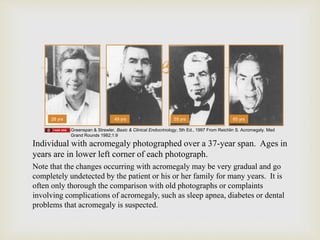
Individual with acromegaly photographed over a 37-year span. Ages in
years are in lower left corner of each photograph.
Note that the changes occurring with acromegaly may be very gradual and go
completely undetected by the patient or his or her family for many years. It is
often only thorough the comparison with old photographs or complaints
involving complications of acromegaly, such as sleep apnea, diabetes or dental
problems that acromegaly is suspected.
Greenspan & Strewler, Basic & Clinical Endocrinology, 5th Ed., 1997 From Reichlin S. Acromegaly. Med
Grand Rounds 1982;1:9
28 yrs 49 yrs 65 yrs55 yrs

Hands of individual with acromegaly (left) compared to
hand of non-acromegalic adult (far right).
University of Iowa Dept. of Dermatology



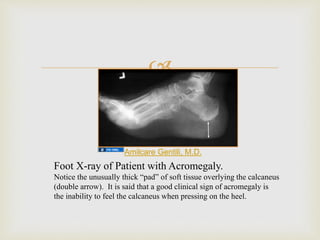
Foot X-ray of Patient with Acromegaly.
Notice the unusually thick “pad” of soft tissue overlying the calcaneus
(double arrow). It is said that a good clinical sign of acromegaly is
the inability to feel the calcaneus when pressing on the heel.
Amilcare Gentili, M.D.

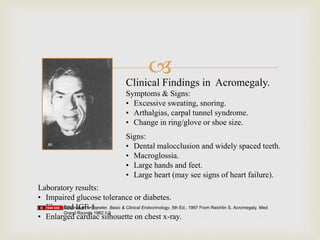
Clinical Findings in Acromegaly.
Symptoms & Signs:
• Excessive sweating, snoring.
• Arthalgias, carpal tunnel syndrome.
• Change in ring/glove or shoe size.
Signs:
• Dental malocclusion and widely spaced teeth.
• Macroglossia.
• Large hands and feet.
• Large heart (may see signs of heart failure).
Laboratory results:
• Impaired glucose tolerance or diabetes.
• Elevated IGF-1.
• Enlarged cardiac silhouette on chest x-ray.
Greenspan & Strewler, Basic & Clinical Endocrinology, 5th Ed., 1997 From Reichlin S. Acromegaly. Med
Grand Rounds 1982;1:9

Belayet Hossain, Willliam M. Drake, Acromegaly, Medicine, Volume 45, Issue 8, 2017, Pages
480-483.




 1.1 We recommend measurement of IGF-1 levels in patients
with typical clinical manifestations of acromegaly, especially
those with acral and facial features. (1|⊕⊕⊕○)
 1.2 We suggest the measurement of IGF-1 in patients without
the typical manifestations of acromegaly,but who have several
of these associated conditions: sleep apnea syndrome, type 2
diabetes mellitus, debilitating arthritis, carpal tunnel syndrome,
hyperhidrosis, and hypertension. (2|⊕⊕○○)
 1.3 We recommend measuring serum IGF-1 to rule out
acromegaly in a patient with a pituitary mass. (1|⊕⊕⊕○)
1.0 Diagnosis

 1.4 We recommend against relying on the use of random
GH levels to diagnose acromegaly. (1|⊕⊕⊕○)
 1.5 In patients with elevated or equivocal serum IGF-1
levels, werecommend
confirmationofthediagnosisbyfinding
lack of suppression of GH to 1 g/L following
documented
hyperglycemia during an oral glucose load. (1|⊕⊕⊕○)

 1.6 Following biochemical diagnosis of acromegaly, we
recommend performing an imaging study to visualize tumor
size and appearance, as well as parasellar extent (1|⊕⊕⊕⊕).
 We suggest magnetic resonance imaging (MRI) as the imaging
modality of choice, followed by computed tomography (CT)
scan when MRI is contraindicated or unavailable. (2|⊕⊕○○)
 1.7 We suggest performing formal visual field testing when the
tumor is found to abut the optic chiasm on an imaging study.
(2|⊕⊕⊕○)
 2.1 We suggest evaluating all patients presenting with acromegaly for
associated comorbidities, including hypertension, diabetes mellitus,
cardiovascular disease, osteoarthritis, and sleep apnea. (2|⊕⊕○○)
 2.2We also recommend that such comorbidities be longitudinally
monitored and rigorously managed. (Ungraded recommendation)
 2.3 We suggest screening for colon neoplasia with colonoscopy at
diagnosis. (2|⊕⊕○○)
 2.4 We suggest a thyroid ultrasound if there is palpable thyroid
nodularity. (2|⊕⊕○○)
 2.5 We recommend assessing for hypopituitarism and replacing
hormone deficits. (1|⊕⊕⊕○)
Presentation and management of
comorbidities and mortality risk

 3.1 We suggest a biochemical target goal of an
agenormalized serum IGF-1 value, which signifies control
of acromegaly. (2|⊕⊕○○)
 3.2 We suggest using a random GH < 1.0 µg/L as a
therapeutic goal, as this correlates with control of
acromegaly. (2|⊕○○○)
 3.3 We suggest maintaining the same GH and IGF-1 assay
in the same patient throughout management.
(2|⊕⊕○○)
Goals of management


Indications
 4.1 We recommend transsphenoidal surgery as the
primary therapy in most patients. (1|⊕⊕⊕○)
 4.2 We suggest that repeat surgery be considered in a
patient with residual intrasellar disease following
initial surgery. (2|⊕⊕○○)
Surgery


Preoperative medical therapy
 4.3 We suggest against the routine use of preoperative
medical therapy to improve biochemical control after surgery.
(2|⊕⊕○○)
 4.4 For patients with severe pharyngeal thickness and
sleep apnea, or high-output heart failure, we suggest medical
therapy with somatostatin receptor ligands (SRLs)
preoperatively to reduce surgical risk from severe
comorbidities. (2|⊕○○○)

Surgical debulking
 4.5 In a patient with parasellar disease making total
surgical resection unlikely, we suggest surgical
debulking to improve subsequent response to
medical therapy.
(2|⊕⊕○○)

Postoperative testing
 4.6 Following surgery, we suggest measuring an IGF-1
level and a randomGH at 12weeks or later (2|⊕⊕⊕○).We
also suggest measuring a nadir GH level after a glucose
load in a patient with a GH greater than 1 g/L. (2|⊕⊕⊕○)
 4.7 We recommend performing an imaging study at
least12weeks after surgeryto visualize residualtumor and
adjacent structures (1|⊕⊕⊕○). We suggest MRI as the
imaging modality of choice followed by CT scan when MRI
is contraindicated or unavailable. (2|⊕⊕○○)

 5.1 We recommend medical therapy in a patient with
persistent disease following surgery. (1|⊕⊕⊕⊕)
 5.2 In a patient with significant disease (ie, with moderate-to-
severe signs and symptoms of GH excess and
without local mass effects), we suggest use of either a SRL
or pegvisomant as the initial adjuvant medical therapy.
(2|⊕⊕○○)
 5.3 In a patient with only modest elevations of serum
IGF-1 and mild signs and symptoms of GH excess, we
suggest a trial of a dopamine agonist, usually cabergoline,
as the initial adjuvant medical therapy. (2|⊕⊕○○)
Medical therapy

 5.4 We suggest against routine abdominal ultrasound to
monitor for gallstone disease in a patient receiving a SRL
(2|⊕⊕○○). Ultrasound should be performed if the patient has
signs and symptoms of gallstone disease. (2|⊕⊕○○)
 5.5 We suggest serial imaging with MRI scan to evaluate tumor
size in a patient receiving pegvisomant. (2|⊕⊕○○)
 5.6 We suggest monitoring liver function tests monthly for the
first 6 months and then every 6 months in a patient receiving
pegvisomant, with consideration of discontinuation of
pegvisomant if the transaminases are greater than 3-fold
elevated. (2|⊕⊕○○)

 5.7 We suggest addition of pegvisomant or cabergoline
in a patient with inadequate response to an SRL.
(2|⊕⊕○○)
 5.8 We suggest use of an SRL as primary therapy in a
patient who cannot be cured by surgery, has extensive
cavernous sinus invasion, does not have chiasmal
compression, or is a poor surgical candidate. (2|⊕⊕⊕○)

 6.1 We suggest use of radiation therapy in the setting of
residual tumor mass following surgery, and if medical
therapy is unavailable, unsuccessful, or not tolerated.
(2|⊕⊕○○)
 6.2 We suggest use of stereotactic radiotherapy (SRT)
over conventional radiation therapy in patients with
acromegaly, unless the technique is not available, there is
significant residual tumor burden, or the tumor is too
close to the optic chiasm resulting in an exposure of more
than 8 Gy. (2|⊕⊕○○)
Radiotherapy (RT)/Stereotactic Radiotherapy
(SRT)

 6.3 To monitor the efficacy of radiation therapy, we
recommend annual GH/IGF-1 reassessment
following medication withdrawal. (1|⊕⊕⊕○)
 6.4 We recommend annual hormonal testing of
patients following RT for hypopituitarism and other
delayed radiation effects. (1|⊕⊕⊕⊕)

Gigantism
 7.1 In patients with the rare presentation of
gigantism, we recommend the standard approaches
to normalizing GH and IGF-1 hypersecretion as
described elsewhere in this guideline. (1|⊕⊕⊕○)
Special circumstances

 Pregnancy
 7.2 We suggest discontinuing long-acting SRL formulations and
pegvisomant approximately 2 months before attempts to
conceive,with use of short-acting octreotide as necessary until
conception. (2|⊕⊕○○)
 7.3 During pregnancy, we recommend that acromegaly medical
therapy be withheld and administered only for tumor and headache
control. (1|⊕⊕○○)
 7.4 During pregnancy, we suggest serial visual field testing in patients
with macroadenomas. (2|⊕⊕⊕○)
 7.5 We suggest against monitoring GH and/or IGF-1 levels during
pregnancy. (2|⊕⊕⊕○)

 Gloria Lugo, Lara Pena, and Fernando Cordido, “Clinical Manifestations and Diagnosis of
Acromegaly,” International Journal of Endocrinology, vol. 2012, Article ID 540398, 10
pages, 2012.
 Katznelson, L., Atkinson, J., Cook, D., Ezzat, S., Hamrahian, A., & Miller, K. (2011).
American Association of Clinical Endocrinologists medical guidelines for clinical practice
for the diagnosis and treatment of acromegaly-2011 update. Endocrine practice,
17(Supplement 4
 Katznelson, L., Laws Jr, E. R., Melmed, S., Molitch, M. E., Murad, M. H., Utz, A., & Wass, J.
A. (2014). Acromegaly: an endocrine society clinical practice guideline. The Journal of
Clinical Endocrinology & Metabolism, 99(11), 3933-3951.
 Belayet Hossain, Willliam M. Drake, Acromegaly, Medicine, Volume 45, Issue 8, 2017,
Pages 480-483, ISSN 1357-3039,
References

Thank you

Acromegaly Guidelines 2014

  • 2.
     Acromegaly: an endocrinesociety clinical practice guideline. 2014 Journal of Clinical Endocrinology & Metabolism By: Alaa El-Deen Mostafa Assistant lecturer of internal medicine Minia university
  • 3.
  • 4.
  • 5.
  • 6.
  • 7.
  • 8.
  • 9.
  • 10.
     Individual with acromegalyphotographed over a 37-year span. Ages in years are in lower left corner of each photograph. Note that the changes occurring with acromegaly may be very gradual and go completely undetected by the patient or his or her family for many years. It is often only thorough the comparison with old photographs or complaints involving complications of acromegaly, such as sleep apnea, diabetes or dental problems that acromegaly is suspected. Greenspan & Strewler, Basic & Clinical Endocrinology, 5th Ed., 1997 From Reichlin S. Acromegaly. Med Grand Rounds 1982;1:9 28 yrs 49 yrs 65 yrs55 yrs
  • 11.
     Hands of individualwith acromegaly (left) compared to hand of non-acromegalic adult (far right). University of Iowa Dept. of Dermatology
  • 12.
  • 13.
  • 14.
     Foot X-ray ofPatient with Acromegaly. Notice the unusually thick “pad” of soft tissue overlying the calcaneus (double arrow). It is said that a good clinical sign of acromegaly is the inability to feel the calcaneus when pressing on the heel. Amilcare Gentili, M.D.
  • 15.
     Clinical Findings inAcromegaly. Symptoms & Signs: • Excessive sweating, snoring. • Arthalgias, carpal tunnel syndrome. • Change in ring/glove or shoe size. Signs: • Dental malocclusion and widely spaced teeth. • Macroglossia. • Large hands and feet. • Large heart (may see signs of heart failure). Laboratory results: • Impaired glucose tolerance or diabetes. • Elevated IGF-1. • Enlarged cardiac silhouette on chest x-ray. Greenspan & Strewler, Basic & Clinical Endocrinology, 5th Ed., 1997 From Reichlin S. Acromegaly. Med Grand Rounds 1982;1:9
  • 16.
     Belayet Hossain, WillliamM. Drake, Acromegaly, Medicine, Volume 45, Issue 8, 2017, Pages 480-483.
  • 17.
  • 18.
  • 19.
  • 20.
      1.1 Werecommend measurement of IGF-1 levels in patients with typical clinical manifestations of acromegaly, especially those with acral and facial features. (1|⊕⊕⊕○)  1.2 We suggest the measurement of IGF-1 in patients without the typical manifestations of acromegaly,but who have several of these associated conditions: sleep apnea syndrome, type 2 diabetes mellitus, debilitating arthritis, carpal tunnel syndrome, hyperhidrosis, and hypertension. (2|⊕⊕○○)  1.3 We recommend measuring serum IGF-1 to rule out acromegaly in a patient with a pituitary mass. (1|⊕⊕⊕○) 1.0 Diagnosis
  • 21.
      1.4 Werecommend against relying on the use of random GH levels to diagnose acromegaly. (1|⊕⊕⊕○)  1.5 In patients with elevated or equivocal serum IGF-1 levels, werecommend confirmationofthediagnosisbyfinding lack of suppression of GH to 1 g/L following documented hyperglycemia during an oral glucose load. (1|⊕⊕⊕○)
  • 22.
      1.6 Followingbiochemical diagnosis of acromegaly, we recommend performing an imaging study to visualize tumor size and appearance, as well as parasellar extent (1|⊕⊕⊕⊕).  We suggest magnetic resonance imaging (MRI) as the imaging modality of choice, followed by computed tomography (CT) scan when MRI is contraindicated or unavailable. (2|⊕⊕○○)  1.7 We suggest performing formal visual field testing when the tumor is found to abut the optic chiasm on an imaging study. (2|⊕⊕⊕○)
  • 23.
     2.1 Wesuggest evaluating all patients presenting with acromegaly for associated comorbidities, including hypertension, diabetes mellitus, cardiovascular disease, osteoarthritis, and sleep apnea. (2|⊕⊕○○)  2.2We also recommend that such comorbidities be longitudinally monitored and rigorously managed. (Ungraded recommendation)  2.3 We suggest screening for colon neoplasia with colonoscopy at diagnosis. (2|⊕⊕○○)  2.4 We suggest a thyroid ultrasound if there is palpable thyroid nodularity. (2|⊕⊕○○)  2.5 We recommend assessing for hypopituitarism and replacing hormone deficits. (1|⊕⊕⊕○) Presentation and management of comorbidities and mortality risk
  • 24.
      3.1 Wesuggest a biochemical target goal of an agenormalized serum IGF-1 value, which signifies control of acromegaly. (2|⊕⊕○○)  3.2 We suggest using a random GH < 1.0 µg/L as a therapeutic goal, as this correlates with control of acromegaly. (2|⊕○○○)  3.3 We suggest maintaining the same GH and IGF-1 assay in the same patient throughout management. (2|⊕⊕○○) Goals of management
  • 25.
  • 26.
     Indications  4.1 Werecommend transsphenoidal surgery as the primary therapy in most patients. (1|⊕⊕⊕○)  4.2 We suggest that repeat surgery be considered in a patient with residual intrasellar disease following initial surgery. (2|⊕⊕○○) Surgery
  • 27.
  • 28.
     Preoperative medical therapy 4.3 We suggest against the routine use of preoperative medical therapy to improve biochemical control after surgery. (2|⊕⊕○○)  4.4 For patients with severe pharyngeal thickness and sleep apnea, or high-output heart failure, we suggest medical therapy with somatostatin receptor ligands (SRLs) preoperatively to reduce surgical risk from severe comorbidities. (2|⊕○○○)
  • 29.
     Surgical debulking  4.5In a patient with parasellar disease making total surgical resection unlikely, we suggest surgical debulking to improve subsequent response to medical therapy. (2|⊕⊕○○)
  • 30.
     Postoperative testing  4.6Following surgery, we suggest measuring an IGF-1 level and a randomGH at 12weeks or later (2|⊕⊕⊕○).We also suggest measuring a nadir GH level after a glucose load in a patient with a GH greater than 1 g/L. (2|⊕⊕⊕○)  4.7 We recommend performing an imaging study at least12weeks after surgeryto visualize residualtumor and adjacent structures (1|⊕⊕⊕○). We suggest MRI as the imaging modality of choice followed by CT scan when MRI is contraindicated or unavailable. (2|⊕⊕○○)
  • 31.
      5.1 Werecommend medical therapy in a patient with persistent disease following surgery. (1|⊕⊕⊕⊕)  5.2 In a patient with significant disease (ie, with moderate-to- severe signs and symptoms of GH excess and without local mass effects), we suggest use of either a SRL or pegvisomant as the initial adjuvant medical therapy. (2|⊕⊕○○)  5.3 In a patient with only modest elevations of serum IGF-1 and mild signs and symptoms of GH excess, we suggest a trial of a dopamine agonist, usually cabergoline, as the initial adjuvant medical therapy. (2|⊕⊕○○) Medical therapy
  • 32.
      5.4 Wesuggest against routine abdominal ultrasound to monitor for gallstone disease in a patient receiving a SRL (2|⊕⊕○○). Ultrasound should be performed if the patient has signs and symptoms of gallstone disease. (2|⊕⊕○○)  5.5 We suggest serial imaging with MRI scan to evaluate tumor size in a patient receiving pegvisomant. (2|⊕⊕○○)  5.6 We suggest monitoring liver function tests monthly for the first 6 months and then every 6 months in a patient receiving pegvisomant, with consideration of discontinuation of pegvisomant if the transaminases are greater than 3-fold elevated. (2|⊕⊕○○)
  • 33.
      5.7 Wesuggest addition of pegvisomant or cabergoline in a patient with inadequate response to an SRL. (2|⊕⊕○○)  5.8 We suggest use of an SRL as primary therapy in a patient who cannot be cured by surgery, has extensive cavernous sinus invasion, does not have chiasmal compression, or is a poor surgical candidate. (2|⊕⊕⊕○)
  • 34.
      6.1 Wesuggest use of radiation therapy in the setting of residual tumor mass following surgery, and if medical therapy is unavailable, unsuccessful, or not tolerated. (2|⊕⊕○○)  6.2 We suggest use of stereotactic radiotherapy (SRT) over conventional radiation therapy in patients with acromegaly, unless the technique is not available, there is significant residual tumor burden, or the tumor is too close to the optic chiasm resulting in an exposure of more than 8 Gy. (2|⊕⊕○○) Radiotherapy (RT)/Stereotactic Radiotherapy (SRT)
  • 35.
      6.3 Tomonitor the efficacy of radiation therapy, we recommend annual GH/IGF-1 reassessment following medication withdrawal. (1|⊕⊕⊕○)  6.4 We recommend annual hormonal testing of patients following RT for hypopituitarism and other delayed radiation effects. (1|⊕⊕⊕⊕)
  • 36.
     Gigantism  7.1 Inpatients with the rare presentation of gigantism, we recommend the standard approaches to normalizing GH and IGF-1 hypersecretion as described elsewhere in this guideline. (1|⊕⊕⊕○) Special circumstances
  • 37.
  • 38.
     Pregnancy  7.2We suggest discontinuing long-acting SRL formulations and pegvisomant approximately 2 months before attempts to conceive,with use of short-acting octreotide as necessary until conception. (2|⊕⊕○○)  7.3 During pregnancy, we recommend that acromegaly medical therapy be withheld and administered only for tumor and headache control. (1|⊕⊕○○)  7.4 During pregnancy, we suggest serial visual field testing in patients with macroadenomas. (2|⊕⊕⊕○)  7.5 We suggest against monitoring GH and/or IGF-1 levels during pregnancy. (2|⊕⊕⊕○)
  • 39.
      Gloria Lugo,Lara Pena, and Fernando Cordido, “Clinical Manifestations and Diagnosis of Acromegaly,” International Journal of Endocrinology, vol. 2012, Article ID 540398, 10 pages, 2012.  Katznelson, L., Atkinson, J., Cook, D., Ezzat, S., Hamrahian, A., & Miller, K. (2011). American Association of Clinical Endocrinologists medical guidelines for clinical practice for the diagnosis and treatment of acromegaly-2011 update. Endocrine practice, 17(Supplement 4  Katznelson, L., Laws Jr, E. R., Melmed, S., Molitch, M. E., Murad, M. H., Utz, A., & Wass, J. A. (2014). Acromegaly: an endocrine society clinical practice guideline. The Journal of Clinical Endocrinology & Metabolism, 99(11), 3933-3951.  Belayet Hossain, Willliam M. Drake, Acromegaly, Medicine, Volume 45, Issue 8, 2017, Pages 480-483, ISSN 1357-3039, References
  • 40.