Oedema
By: Alaa Mostafa
Assistant lecturer of internal medicine

Minia university
Revision
Jaundice is defined as
yellowish discoloration of:
O Skin only
O Sclera only
O Skin, Mucous membranes, and sclera
Jaundice is clinically visible when
bilirubin concentration is more than
O 5 gm/ dl
O 2.5 gm/dl
O 2.5-3 mg /dl
Case 1
O A 20 yrs old Female patient with history of
Thalassemia presented by mild
jaundice,anemia, with normal urine, dark
stool, Total bilirubin 4 mg/dl, direct bilirubin 0.3
mg /dl
What is the type of jaundice
O Hemolytic
O Hepatocellular
O obstructive
Case 2
A 60 yrs old male patient presented with
jaundice, Abdominal distension, Bilateral pitting
lower limb oedema, flapping tremors, bleeding
tendency. Lab shows total bilirubin 6 mg/dl,
direct bilirubin 2.5 mg/dl, Dark urine, clay stool
What is the type of jaundice
O Hemolytic
O Hepatocellular
O obstructive
Case 3
O A 45 yrs female patient presented by deep
jaundice, abdominal colic, dark urine, pale
stool, steatorrhea, itching, total bilirubin
15mg/dl, Direct bilirubin 14.5 mg/dl
What is the type of jaundice
O Hemolytic
O Hepatocellular
O obstructive
Carrotinemia is differentaited
from jaundice by
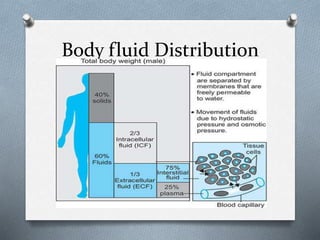
Body fluid Distribution
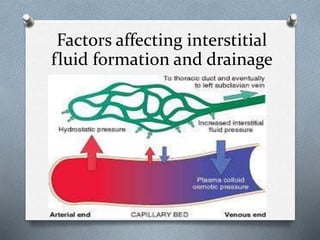
Factors affecting interstitial
fluid formation and drainage
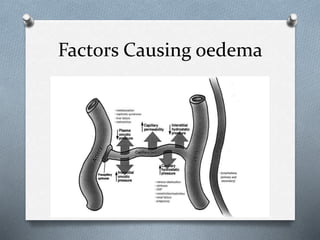
Factors Causing oedema
Definition
O Abnormal accumulation of fluid in the
interstitial tissue due to disturbed
mechanisms of interstitial fluid regulation
Types
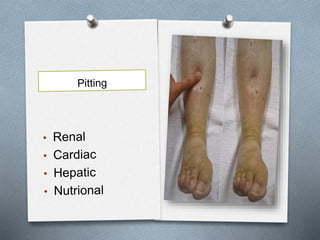
O Pitting
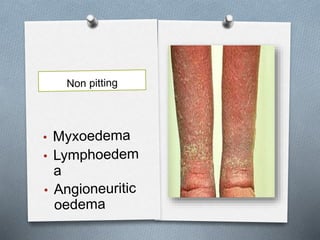
O Non pitting
How to examine?
Unilateral vs bilateral
Dependent or not?
Sacral oedema
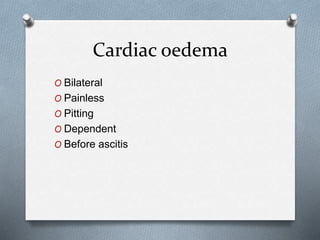
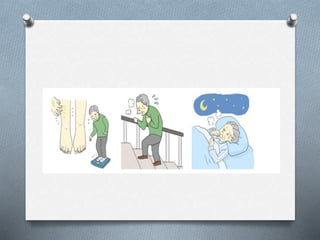
Cardiac oedema
O Bilateral
O Painless
O Pitting
O Dependent
O Before ascitis
Ascitis precox
O Ascitis before onset of oedema
O In cases of
O Oericaerdial effusion
O Constrective pericarditis
O Tricuspid regergue or Tricaspid stenosis
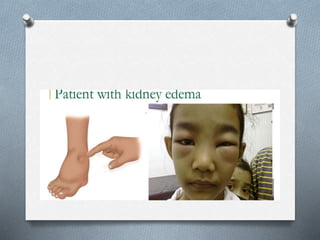
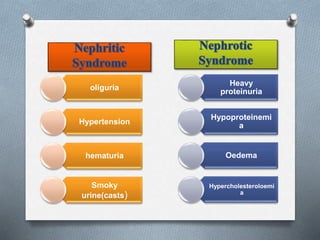
Renal oedema
O Begin by eye lid buffness
O Generalized
O Pitting
O More at the morning
oliguria
Hypertension
hematuria
Smoky
urine(casts)
Heavy
proteinuria
Hypoproteinemi
a
Oedema
Hypercholesteroloemi
a
Hepatic oedema
O Associated with signs and symptoms of
LCF
Nutrional oedema
Angioneuretic oedema
Peri orbital oedema
Management
Localized oedema
O DVT
O Lymphoedema (eg; post mastectomy)
O Varicose veins
O Orthostatic oedema
O Angioneuretic oedema
O Cellulitis
Unilateral oedema
O DVT
O Cellulitis
O Lymphoedema
O trauma
Drugs causing oedema
O CCB
O Steroids
O OCPs
O NSAIDs
Occult oedema
O Up to 3 litres of excess interstitial fluid can
accumulate in the body before oedema is
clinically detectable
Edema

Edema