ACROMEGALY
Presented By
Ramesh Behra
INDEX
 Definition
 Symptoms
 Causes
 Pathogenesis
 Diagnosis
 Treatment
 Case Discussion
 Acro' comes from the Greek word
ákros, meaning topmost or
highest and refers to the extremities
of the body (such as the hands and
feet), 'Megaly' comes from the Greek
word for great, meaning enlarged. So
acromegaly literally means 'large
extremities'.
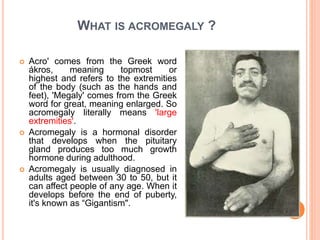
 Acromegaly is a hormonal disorder
that develops when the pituitary
gland produces too much growth
hormone during adulthood.
 Acromegaly is usually diagnosed in
adults aged between 30 to 50, but it
can affect people of any age. When it
develops before the end of puberty,
it's known as “Gigantism".
WHAT IS ACROMEGALY ?
SYMPTOMS
CAUSES
 Pituitary adenoma
 Carcinoid tumor
 Pancreatic islet cell tumor
 Genetic conditions(ex. McCune-Albright syndrome,
MEN-1, neurobromatosis)
 In more than 9 out of 10 cases, acromegaly is
caused by a tumor in the pituitary gland. More
rarely, the cause may be a tumor in another part of
the body.
PATHOGENESIS
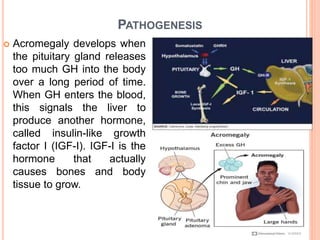
 Acromegaly develops when
the pituitary gland releases
too much GH into the body
over a long period of time.
When GH enters the blood,
this signals the liver to
produce another hormone,
called insulin-like growth
factor I (IGF-I). IGF-I is the
hormone that actually
causes bones and body
tissue to grow.
DIAGNOSIS
 We will ask about their medical history and conduct
a physical exam. Then conduct the following steps:
 IGF-1 measurement. After they've fasted overnight,
we will take a blood sample to measure the IGF-1
level in their blood. An elevated IGF-1 level
suggests acromegaly.
 Growth hormone suppression test. This is the
best method for confirming an acromegaly
diagnosis. During this test, their GH blood level is
measured both before and after they drink a
preparation of sugar (glucose). In people who don't
have acromegaly, the glucose drink typically causes
the GH level to fall. But if they have acromegaly,
their GH level will tend to stay high.
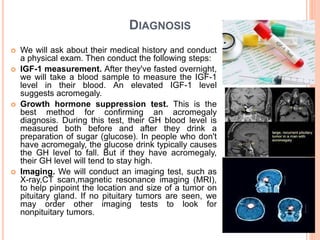
 Imaging. We will conduct an imaging test, such as
X-ray,CT scan,magnetic resonance imaging (MRI),
to help pinpoint the location and size of a tumor on
pituitary gland. If no pituitary tumors are seen, we
may order other imaging tests to look for
nonpituitary tumors.
TREATMENT
 The goals of treatment are to control tumor size,
return GH and IGF-I levels back to normal, improve
symptoms, and manage related health problems.
Treatment options include:
 Surgery
 Medicines
 Radiation therapy
SURGERY
 Surgeons most often use a type of surgery called
transsphenoidal surgery, which involves going through the
patient’s nose and sphenoid sinus, a hollow space in the
skull behind the nasal passages and below the brain, to
perform surgery.
 The goal of surgery is to remove all of a tumor that is causing
excess growth hormone production.
 If surgeon removes enough of the tumor, may not need
further treatment .
 If surgeon can remove only a part of a tumor, may need
medication or radiation therapy to manage symptoms and
reduce the production of growth hormone.
MEDICINES
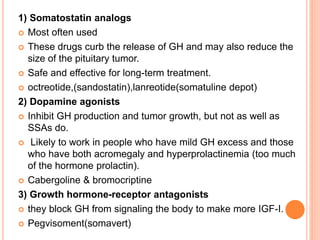
 Currently, three types of medicines are used to treat
acromegaly, but they are not a cure. The medicines may
be used alone or in combination with each other.
1. Somatostatin Analogs
2. Dopamine Agonists
3. Growth hormone-receptor antagonists.
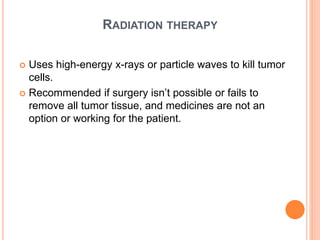
1) Somatostatin analogs
 Most often used
 These drugs curb the release of GH and may also reduce the
size of the pituitary tumor.
 Safe and effective for long-term treatment.
 octreotide,(sandostatin),lanreotide(somatuline depot)
2) Dopamine agonists
 Inhibit GH production and tumor growth, but not as well as
SSAs do.
 Likely to work in people who have mild GH excess and those
who have both acromegaly and hyperprolactinemia (too much
of the hormone prolactin).
 Cabergoline & bromocriptine
3) Growth hormone-receptor antagonists
 they block GH from signaling the body to make more IGF-I.
 Pegvisoment(somavert)
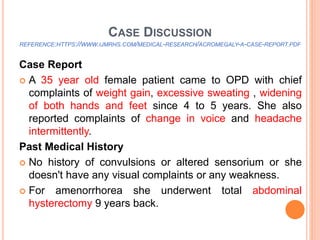
RADIATION THERAPY
 Uses high-energy x-rays or particle waves to kill tumor
cells.
 Recommended if surgery isn’t possible or fails to
remove all tumor tissue, and medicines are not an
option or working for the patient.
CASE DISCUSSION
REFERENCE:HTTPS://WWW.IJMRHS.COM/MEDICAL-RESEARCH/ACROMEGALY-A-CASE-REPORT.PDF
Case Report
 A 35 year old female patient came to OPD with chief
complaints of weight gain, excessive sweating , widening
of both hands and feet since 4 to 5 years. She also
reported complaints of change in voice and headache
intermittently.
Past Medical History
 No history of convulsions or altered sensorium or she
doesn't have any visual complaints or any weakness.
 For amenorrhorea she underwent total abdominal
hysterectomy 9 years back.
PHYSICAL EXAMINATION
 Vitals are normal
 There was no pallor, cyanosis,
clubbing, lymphadenopathy.
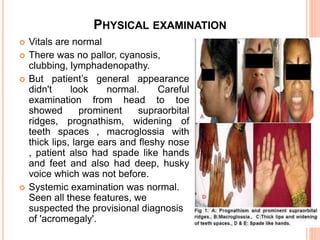
 But patient’s general appearance
didn't look normal. Careful
examination from head to toe
showed prominent supraorbital
ridges, prognathism, widening of
teeth spaces , macroglossia with
thick lips, large ears and fleshy nose
, patient also had spade like hands
and feet and also had deep, husky
voice which was not before.
 Systemic examination was normal.
Seen all these features, we
suspected the provisional diagnosis
of 'acromegaly'.
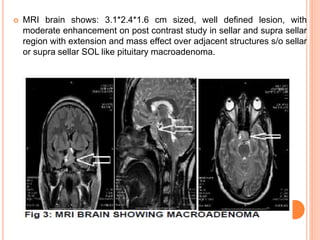
 MRI brain shows: 3.1*2.4*1.6 cm sized, well defined lesion, with
moderate enhancement on post contrast study in sellar and supra sellar
region with extension and mass effect over adjacent structures s/o sellar
or supra sellar SOL like pituitary macroadenoma.
TREATMENT
 Treatment was started with oral hypoglycemic drugs
i.e. metformin 500mg for impaired fasting blood
glucose level before surgery and ‘Transsphenoidal
surgical resection (TSS)' was done.
 Patient is now stable and her postoperative GH level
is 7.94ng/ml. And patient is discharged on tab
prednisolone 5mg half tab daily, and patient is called
for follow up after 3 months.
 There were noticeable changes were seen in patient
after surgery.
 She lost 7kg weight in 2 months.
CONCLUSION
 Acromegaly is a rare disease but not incurable. it is
caused due to excessive secretion of growth
hormone and insulin like growth factor type 1
mostly due to pituitary adenoma.
 Early recognition and treatment of disease helped
in prognosis of disease and arrested the
complications like hypertension, cardiomyopathy,
diabetes mellitus, visual disturbances etc. Hence
early recognition and management is a key to
success in better prognosis and improved quality of
life.
REFERENCES
 [1] Lavrentaki A, Paluzzi A, Wass JA, Karavitaki N. Epidemiology of acromegaly:
review of population studies. Pituitary. 2017;20(1):4–9.
 [2] Chanson P, Salenave S, Kamenicky P. Acromegaly. In: Fliers E, Korbonits M,
Romijn JA, eds. Handbook of clinical neurology. Vol 124. 1st ed. Waltham, MA:
Elsevier B.V.; 2014:197–219.
 [3] Katznelson L, Laws ER Jr, Melmed S, et al. Acromegaly: an endocrine society
clinical practice guideline. Journal of Clinical Endocrinology and Metabolism.
2014;99(11):3933–3951.
 [4] Paragliola RM, Salvatori R. Novel somatostatin receptor ligands therapies for
acromegaly. Frontiers in Endocrinology. 2018;9:78.
Acromegaly.pptx

Acromegaly.pptx

  • 1.
  • 2.
    INDEX  Definition  Symptoms Causes  Pathogenesis  Diagnosis  Treatment  Case Discussion
  • 3.
     Acro' comesfrom the Greek word ákros, meaning topmost or highest and refers to the extremities of the body (such as the hands and feet), 'Megaly' comes from the Greek word for great, meaning enlarged. So acromegaly literally means 'large extremities'.  Acromegaly is a hormonal disorder that develops when the pituitary gland produces too much growth hormone during adulthood.  Acromegaly is usually diagnosed in adults aged between 30 to 50, but it can affect people of any age. When it develops before the end of puberty, it's known as “Gigantism". WHAT IS ACROMEGALY ?
  • 4.
  • 5.
    CAUSES  Pituitary adenoma Carcinoid tumor  Pancreatic islet cell tumor  Genetic conditions(ex. McCune-Albright syndrome, MEN-1, neurobromatosis)  In more than 9 out of 10 cases, acromegaly is caused by a tumor in the pituitary gland. More rarely, the cause may be a tumor in another part of the body.
  • 6.
    PATHOGENESIS  Acromegaly developswhen the pituitary gland releases too much GH into the body over a long period of time. When GH enters the blood, this signals the liver to produce another hormone, called insulin-like growth factor I (IGF-I). IGF-I is the hormone that actually causes bones and body tissue to grow.
  • 7.
    DIAGNOSIS  We willask about their medical history and conduct a physical exam. Then conduct the following steps:  IGF-1 measurement. After they've fasted overnight, we will take a blood sample to measure the IGF-1 level in their blood. An elevated IGF-1 level suggests acromegaly.  Growth hormone suppression test. This is the best method for confirming an acromegaly diagnosis. During this test, their GH blood level is measured both before and after they drink a preparation of sugar (glucose). In people who don't have acromegaly, the glucose drink typically causes the GH level to fall. But if they have acromegaly, their GH level will tend to stay high.  Imaging. We will conduct an imaging test, such as X-ray,CT scan,magnetic resonance imaging (MRI), to help pinpoint the location and size of a tumor on pituitary gland. If no pituitary tumors are seen, we may order other imaging tests to look for nonpituitary tumors.
  • 8.
    TREATMENT  The goalsof treatment are to control tumor size, return GH and IGF-I levels back to normal, improve symptoms, and manage related health problems. Treatment options include:  Surgery  Medicines  Radiation therapy
  • 9.
    SURGERY  Surgeons mostoften use a type of surgery called transsphenoidal surgery, which involves going through the patient’s nose and sphenoid sinus, a hollow space in the skull behind the nasal passages and below the brain, to perform surgery.  The goal of surgery is to remove all of a tumor that is causing excess growth hormone production.  If surgeon removes enough of the tumor, may not need further treatment .  If surgeon can remove only a part of a tumor, may need medication or radiation therapy to manage symptoms and reduce the production of growth hormone.
  • 10.
    MEDICINES  Currently, threetypes of medicines are used to treat acromegaly, but they are not a cure. The medicines may be used alone or in combination with each other. 1. Somatostatin Analogs 2. Dopamine Agonists 3. Growth hormone-receptor antagonists.
  • 11.
    1) Somatostatin analogs Most often used  These drugs curb the release of GH and may also reduce the size of the pituitary tumor.  Safe and effective for long-term treatment.  octreotide,(sandostatin),lanreotide(somatuline depot) 2) Dopamine agonists  Inhibit GH production and tumor growth, but not as well as SSAs do.  Likely to work in people who have mild GH excess and those who have both acromegaly and hyperprolactinemia (too much of the hormone prolactin).  Cabergoline & bromocriptine 3) Growth hormone-receptor antagonists  they block GH from signaling the body to make more IGF-I.  Pegvisoment(somavert)
  • 12.
    RADIATION THERAPY  Useshigh-energy x-rays or particle waves to kill tumor cells.  Recommended if surgery isn’t possible or fails to remove all tumor tissue, and medicines are not an option or working for the patient.
  • 13.
    CASE DISCUSSION REFERENCE:HTTPS://WWW.IJMRHS.COM/MEDICAL-RESEARCH/ACROMEGALY-A-CASE-REPORT.PDF Case Report A 35 year old female patient came to OPD with chief complaints of weight gain, excessive sweating , widening of both hands and feet since 4 to 5 years. She also reported complaints of change in voice and headache intermittently. Past Medical History  No history of convulsions or altered sensorium or she doesn't have any visual complaints or any weakness.  For amenorrhorea she underwent total abdominal hysterectomy 9 years back.
  • 14.
    PHYSICAL EXAMINATION  Vitalsare normal  There was no pallor, cyanosis, clubbing, lymphadenopathy.  But patient’s general appearance didn't look normal. Careful examination from head to toe showed prominent supraorbital ridges, prognathism, widening of teeth spaces , macroglossia with thick lips, large ears and fleshy nose , patient also had spade like hands and feet and also had deep, husky voice which was not before.  Systemic examination was normal. Seen all these features, we suspected the provisional diagnosis of 'acromegaly'.
  • 16.
     MRI brainshows: 3.1*2.4*1.6 cm sized, well defined lesion, with moderate enhancement on post contrast study in sellar and supra sellar region with extension and mass effect over adjacent structures s/o sellar or supra sellar SOL like pituitary macroadenoma.
  • 17.
    TREATMENT  Treatment wasstarted with oral hypoglycemic drugs i.e. metformin 500mg for impaired fasting blood glucose level before surgery and ‘Transsphenoidal surgical resection (TSS)' was done.  Patient is now stable and her postoperative GH level is 7.94ng/ml. And patient is discharged on tab prednisolone 5mg half tab daily, and patient is called for follow up after 3 months.
  • 18.
     There werenoticeable changes were seen in patient after surgery.  She lost 7kg weight in 2 months.
  • 19.
    CONCLUSION  Acromegaly isa rare disease but not incurable. it is caused due to excessive secretion of growth hormone and insulin like growth factor type 1 mostly due to pituitary adenoma.  Early recognition and treatment of disease helped in prognosis of disease and arrested the complications like hypertension, cardiomyopathy, diabetes mellitus, visual disturbances etc. Hence early recognition and management is a key to success in better prognosis and improved quality of life.
  • 20.
    REFERENCES  [1] LavrentakiA, Paluzzi A, Wass JA, Karavitaki N. Epidemiology of acromegaly: review of population studies. Pituitary. 2017;20(1):4–9.  [2] Chanson P, Salenave S, Kamenicky P. Acromegaly. In: Fliers E, Korbonits M, Romijn JA, eds. Handbook of clinical neurology. Vol 124. 1st ed. Waltham, MA: Elsevier B.V.; 2014:197–219.  [3] Katznelson L, Laws ER Jr, Melmed S, et al. Acromegaly: an endocrine society clinical practice guideline. Journal of Clinical Endocrinology and Metabolism. 2014;99(11):3933–3951.  [4] Paragliola RM, Salvatori R. Novel somatostatin receptor ligands therapies for acromegaly. Frontiers in Endocrinology. 2018;9:78.