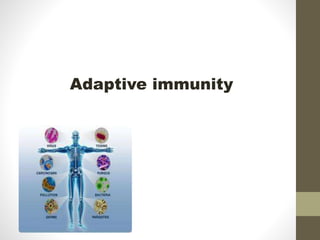
Adaptive immunity
Lecture Outline
• Introduction of Adaptive immunity
• Classification and Characteristics
Definition
• Adaptive immunity: also called as acquired immune response
• Usually the resistance that an individual acquires during life to
various infections
• Develops in response to a natural or artificial stimuli which
able to induce antibody production
• 2 main branches: Active and Passive
Acquired
immunity
Active
Infection (Sub
clinical)
Antibody
production
Vaccination
Passive
Transplacental or
via colostrum
(IgG or IgA)
Administration of
immunoglobulins
(by injection)
Characteristics
• Composed of highly specialized, systemic cells and processes that
eliminate or prevent pathogenic growth
• The major functions of the adaptive immune system include:
1. The recognition of specific “non-self” antigens in the presence of “self”,
during the process of antigen presentation
2. The generation of responses that are tailored to maximally eliminate
specific pathogens or pathogen infected cells
3. The development of immunological memory, in which each pathogen is
“remembered” by a signature antibody
• These memory cells can be called upon to quickly eliminate a pathogen
should subsequent infections occur
Classification
Acquired Immunity
(Specific immunity)
Actively acquired
immunity
Naturally actively
acquired immunity
Artificially actively
acquired immunity
Passively acquired
immunity
Naturally passively
acquired immunity
Artificially passively
acquired immunity
Actively acquiredimmunity
• When B and T cells are activated by a pathogen, memory B-cells and T-
cells develop
• memory cells will “remember” each specific pathogen encountered &
are able to mount a strong response if the pathogen is detected again
• This type of immunity is both active & adaptive because the body's
immune system prepares itself for future challenges
• Active immunity often involves both the cell-mediated and humoral
aspects of immunity
• There may be a negative phase during the development of active
immunity due to combination of the antigen with the produced
antibody
Passively acquired immunity
• Immunity gain in the form of readymade antibodies, from one individual to
another
• Passive immunization is used when there is a high risk of infection & insufficient
time for the body to develop its own immune response
• To reduce the symptoms of ongoing or immunosuppressive diseases
• Passive immunity provides immediate protection, but the body does not develop
memory, therefore the patient is at risk of being infected by the same pathogen
later
• No lag phase as antibodies are readily administered to the body
• applicable in immundeficient patients as they are unable to produce antibodies
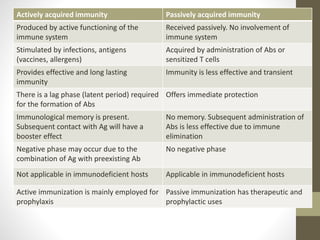
Actively acquired immunity Passively acquired immunity
Produced by active functioning of the
immune system
Received passively. No involvement of
immune system
Stimulated by infections, antigens
(vaccines, allergens)
Acquired by administration of Abs or
sensitized T cells
Provides effective and long lasting
immunity
Immunity is less effective and transient
There is a lag phase (latent period) required
for the formation of Abs
Offers immediate protection
Immunological memory is present.
Subsequent contact with Ag will have a
booster effect
No memory. Subsequent administration of
Abs is less effective due to immune
elimination
Negative phase may occur due to the
combination of Ag with preexisting Ab
No negative phase
Not applicable in immunodeficient hosts Applicable in immunodeficient hosts
Active immunization is mainly employed for
prophylaxis
Passive immunization has therapeutic and
prophylactic uses
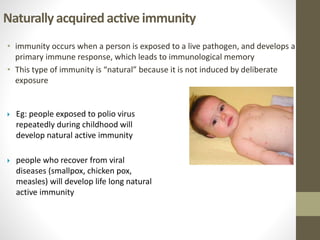
Naturally acquired active immunity
• immunity occurs when a person is exposed to a live pathogen, and develops a
primary immune response, which leads to immunological memory
• This type of immunity is “natural” because it is not induced by deliberate
exposure
 Eg: people exposed to polio virus
repeatedly during childhood will
develop natural active immunity
 people who recover from viral
diseases (smallpox, chicken pox,
measles) will develop life long natural
active immunity
Naturally acquired passive immunity
• Antibody-mediated immunity
conveyed to a fetus by its mother
(maternal IgG antibodies) during
pregnancy
• Passive immunity is also provided
through the transfer of IgA
antibodies found in breast milk
that are transferred to the gut of
the infant, protecting against
bacterial infections
Artificially acquiredactive immunity
• Artificially acquired active immunity can be induced by a
vaccine, a substance that contains antigen
• A vaccine stimulates a primary response against the antigen
without causing symptoms of the disease
• The vaccine usually consists of,
• a) dead or live attenuated microorganisms
• b) altered microorganism
• c) part of the microorganism
• d) a product of the microorganism
Artificially acquiredpassive immunity
• is a short-term immunization induced by the transfer of
antibodies, which can be administered in several forms;
• as human or animal blood plasma, as pooled human
immunoglobulin for intravenous (IVIG), intramuscular (IG) use
& in the form of monoclonal antibodies (MAb)
• there is also a potential risk for hypersensitivity reactions &
serum sickness, especially from gamma globulin of non-
human origin
• Eg: Tetanus antitoxin (Antitetanus serum), Diphtheria antitoxin
Comparison
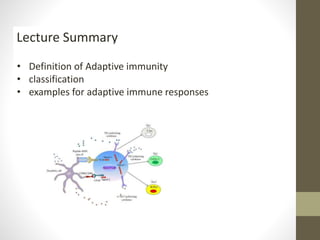
Lecture Summary
• Definition of Adaptive immunity
• classification
• examples for adaptive immune responses
References
• Coico R, Sunshine G (2015) Immunology: A Short Course. John
Wiley & Sons Ltd.
Let’s Talk…….
1. What are the three types of innate immunity? Explain each.
2. What are the mechanisms of innate immunity? Explain
each.
3. What are the types of adaptive immunity? Explain each
with examples.
4. Compare and contrast innate and adaptive immunity.
Recommended reading/Guide for Self-
regulated learning
• Mohanty SK, Leela KS (2014) Text Book of Immunology
Course. Jaypee Brothers Medical Publishers (P) Ltd.
THANK YOU

Adaptive immunity (1).pptx

  • 1.
  • 2.
    Lecture Outline • Introductionof Adaptive immunity • Classification and Characteristics
  • 3.
    Definition • Adaptive immunity:also called as acquired immune response • Usually the resistance that an individual acquires during life to various infections • Develops in response to a natural or artificial stimuli which able to induce antibody production • 2 main branches: Active and Passive
  • 4.
  • 5.
    Characteristics • Composed ofhighly specialized, systemic cells and processes that eliminate or prevent pathogenic growth • The major functions of the adaptive immune system include: 1. The recognition of specific “non-self” antigens in the presence of “self”, during the process of antigen presentation 2. The generation of responses that are tailored to maximally eliminate specific pathogens or pathogen infected cells 3. The development of immunological memory, in which each pathogen is “remembered” by a signature antibody • These memory cells can be called upon to quickly eliminate a pathogen should subsequent infections occur
  • 6.
    Classification Acquired Immunity (Specific immunity) Activelyacquired immunity Naturally actively acquired immunity Artificially actively acquired immunity Passively acquired immunity Naturally passively acquired immunity Artificially passively acquired immunity
  • 7.
    Actively acquiredimmunity • WhenB and T cells are activated by a pathogen, memory B-cells and T- cells develop • memory cells will “remember” each specific pathogen encountered & are able to mount a strong response if the pathogen is detected again • This type of immunity is both active & adaptive because the body's immune system prepares itself for future challenges • Active immunity often involves both the cell-mediated and humoral aspects of immunity • There may be a negative phase during the development of active immunity due to combination of the antigen with the produced antibody
  • 10.
    Passively acquired immunity •Immunity gain in the form of readymade antibodies, from one individual to another • Passive immunization is used when there is a high risk of infection & insufficient time for the body to develop its own immune response • To reduce the symptoms of ongoing or immunosuppressive diseases • Passive immunity provides immediate protection, but the body does not develop memory, therefore the patient is at risk of being infected by the same pathogen later • No lag phase as antibodies are readily administered to the body • applicable in immundeficient patients as they are unable to produce antibodies
  • 11.
    Actively acquired immunityPassively acquired immunity Produced by active functioning of the immune system Received passively. No involvement of immune system Stimulated by infections, antigens (vaccines, allergens) Acquired by administration of Abs or sensitized T cells Provides effective and long lasting immunity Immunity is less effective and transient There is a lag phase (latent period) required for the formation of Abs Offers immediate protection Immunological memory is present. Subsequent contact with Ag will have a booster effect No memory. Subsequent administration of Abs is less effective due to immune elimination Negative phase may occur due to the combination of Ag with preexisting Ab No negative phase Not applicable in immunodeficient hosts Applicable in immunodeficient hosts Active immunization is mainly employed for prophylaxis Passive immunization has therapeutic and prophylactic uses
  • 12.
    Naturally acquired activeimmunity • immunity occurs when a person is exposed to a live pathogen, and develops a primary immune response, which leads to immunological memory • This type of immunity is “natural” because it is not induced by deliberate exposure  Eg: people exposed to polio virus repeatedly during childhood will develop natural active immunity  people who recover from viral diseases (smallpox, chicken pox, measles) will develop life long natural active immunity
  • 13.
    Naturally acquired passiveimmunity • Antibody-mediated immunity conveyed to a fetus by its mother (maternal IgG antibodies) during pregnancy • Passive immunity is also provided through the transfer of IgA antibodies found in breast milk that are transferred to the gut of the infant, protecting against bacterial infections
  • 14.
    Artificially acquiredactive immunity •Artificially acquired active immunity can be induced by a vaccine, a substance that contains antigen • A vaccine stimulates a primary response against the antigen without causing symptoms of the disease • The vaccine usually consists of, • a) dead or live attenuated microorganisms • b) altered microorganism • c) part of the microorganism • d) a product of the microorganism
  • 15.
    Artificially acquiredpassive immunity •is a short-term immunization induced by the transfer of antibodies, which can be administered in several forms; • as human or animal blood plasma, as pooled human immunoglobulin for intravenous (IVIG), intramuscular (IG) use & in the form of monoclonal antibodies (MAb) • there is also a potential risk for hypersensitivity reactions & serum sickness, especially from gamma globulin of non- human origin • Eg: Tetanus antitoxin (Antitetanus serum), Diphtheria antitoxin
  • 17.
  • 18.
    Lecture Summary • Definitionof Adaptive immunity • classification • examples for adaptive immune responses
  • 19.
    References • Coico R,Sunshine G (2015) Immunology: A Short Course. John Wiley & Sons Ltd.
  • 20.
    Let’s Talk……. 1. Whatare the three types of innate immunity? Explain each. 2. What are the mechanisms of innate immunity? Explain each. 3. What are the types of adaptive immunity? Explain each with examples. 4. Compare and contrast innate and adaptive immunity.
  • 21.
    Recommended reading/Guide forSelf- regulated learning • Mohanty SK, Leela KS (2014) Text Book of Immunology Course. Jaypee Brothers Medical Publishers (P) Ltd.
  • 22.