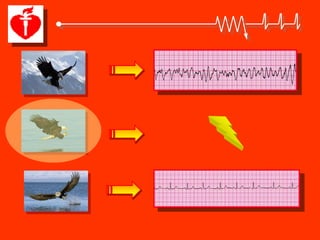
Sense
React
Result !!
TODAY


    Review the latest changes in BLS & ACLS

Review of most common & important EKG Rhythms.

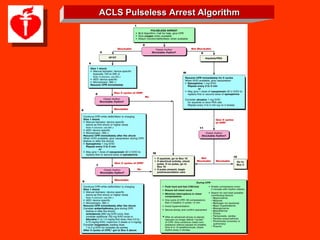
           ACLS pulseless algorithm
Responsiveness
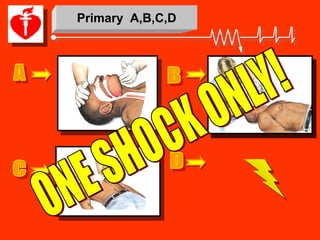
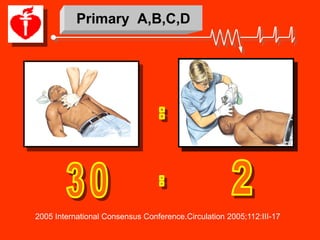
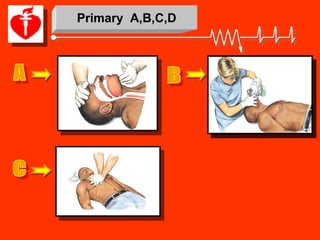
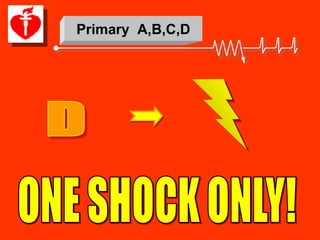
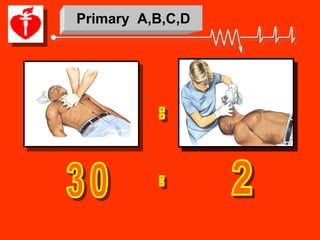
Primary A,B,C,D
Primary A,B,C,D


2005 International Consensus Conference.Circulation 2005;112:III-17
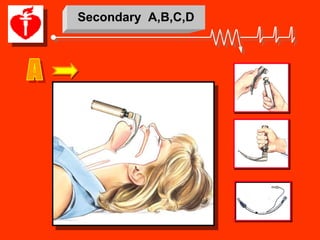
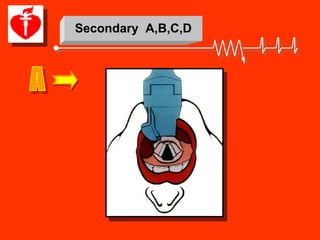
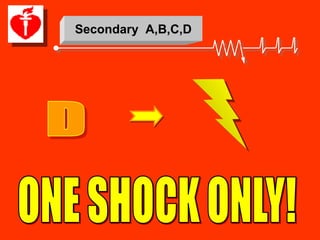
Secondary A,B,C,D
Secondary A,B,C,D


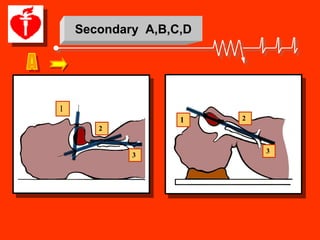
1
                   1    2
       2


                            3
            3
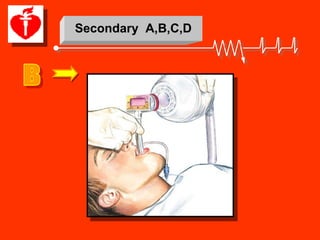
Secondary A,B,C,D
Secondary A,B,C,D


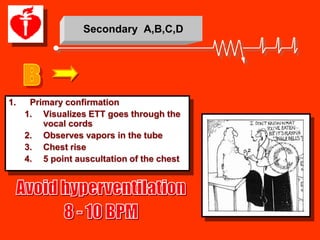
1.    Primary confirmation
     1. Visualizes ETT goes through the
         vocal cords
     2. Observes vapors in the tube
     3. Chest rise
     4. 5 point auscultation of the chest
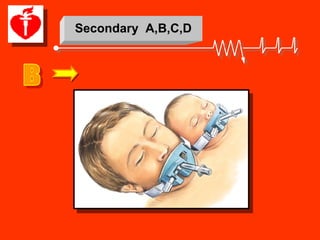
Secondary A,B,C,D
Secondary A,B,C,D
Secondary A,B,C,D


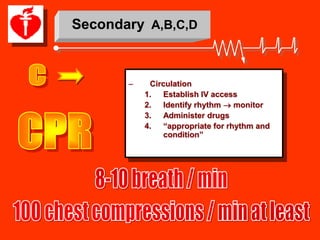
       –    Circulation
           1.   Establish IV access
           2.   Identify rhythm  monitor
           3.   Administer drugs
           4. “appropriate for rhythm and
                condition”
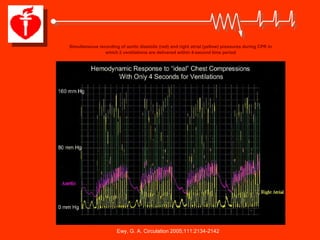
Simultaneous recording of aortic diastolic (red) and right atrial (yellow) pressures during CPR in
                which 2 ventilations are delivered within 4-second time period


                      Ewy, G. A. Circulation 2005;111:2134-2142
Secondary A,B,C,D
Secondary A,B,C,D


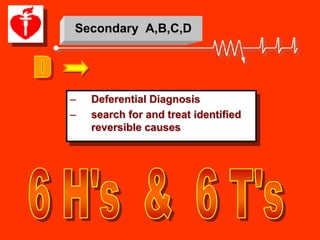
–   Deferential Diagnosis
–   search for and treat identified
    reversible causes
Secondary A,B,C,D


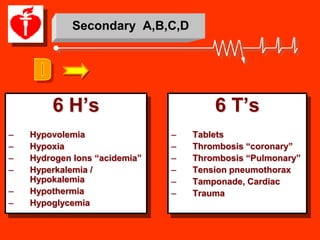
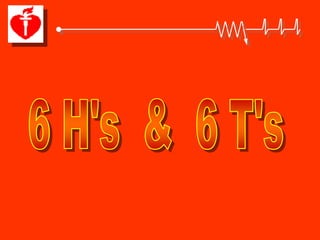
        6 H’s                          6 T’s
–   Hypovolemia                –   Tablets
–   Hypoxia                    –   Thrombosis “coronary”
–   Hydrogen Ions “acidemia”   –   Thrombosis “Pulmonary”
–   Hyperkalemia /             –   Tension pneumothorax
    Hypokalemia                –   Tamponade, Cardiac
–   Hypothermia                –   Trauma
–   Hypoglycemia
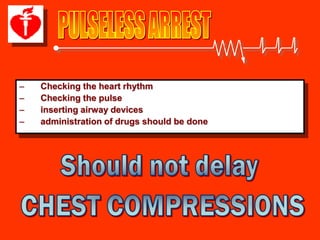
–   Checking the heart rhythm
–   Checking the pulse
–   inserting airway devices
–   administration of drugs should be done
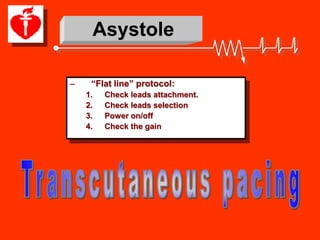
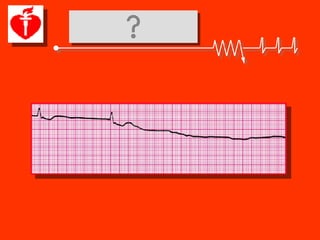
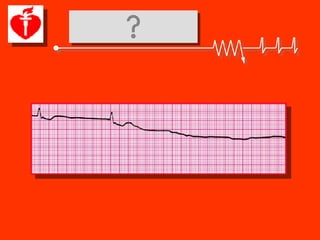
Asystole

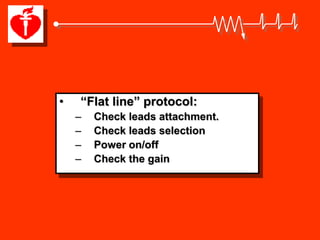
–    “Flat line” protocol:
    1.    Check leads attachment.
    2.    Check leads selection
    3.    Power on/off
    4.    Check the gain
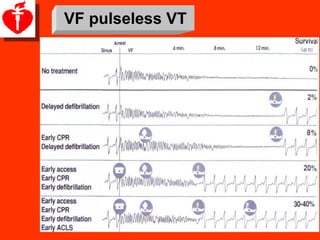
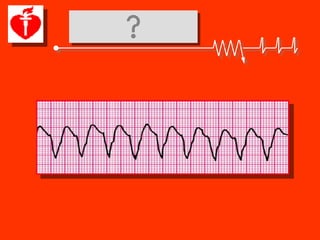
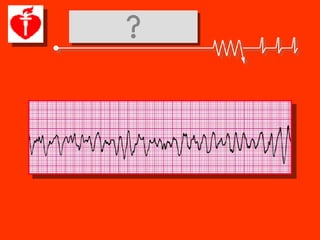
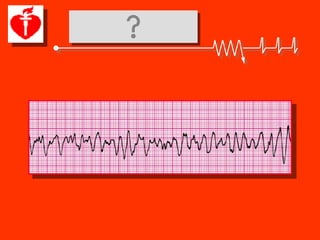
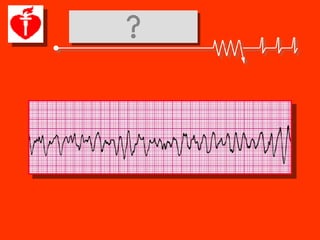
VF pulseless VT
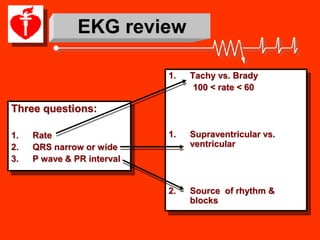
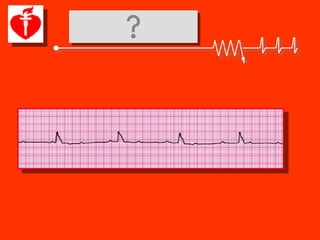
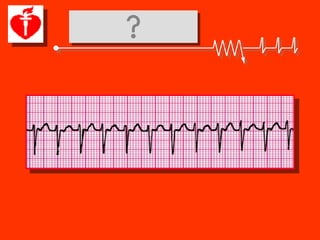
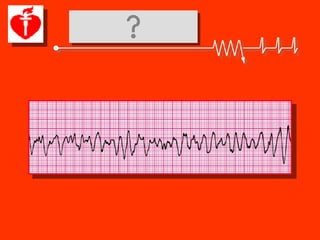
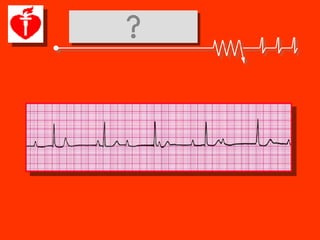
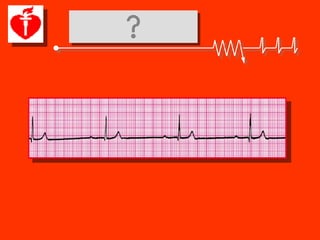
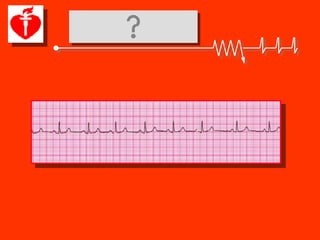
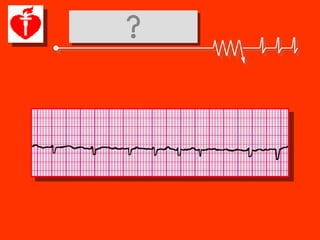
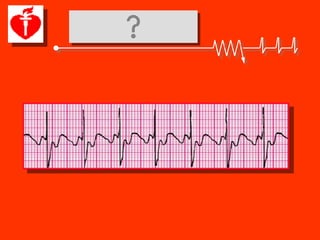
EKG review

                            1.   Tachy vs. Brady
                                  100 < rate < 60

Three questions:

1.   Rate                   1.   Supraventricular vs.
2.   QRS narrow or wide          ventricular
3.   P wave & PR interval


                            2.   Source of rhythm &
                                 blocks
Medications


1.   Why? (Actions)
2.   When? (Indications)
3.   How? (Dose)
4.   Watch Out! (Precautions)
What is the most important medication in the
               cardiac arrest?
O2
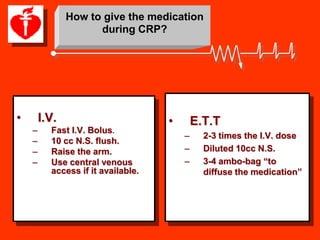
How to give the medication
                     during CRP?


•       I.V.                        •       E.T.T
    –     Fast I.V. Bolus.
                                        –     2-3 times the I.V. dose
    –     10 cc N.S. flush.
    –     Raise the arm.                –     Diluted 10cc N.S.
    –     Use central venous            –     3-4 ambo-bag “to
          access if it available.             diffuse the medication”
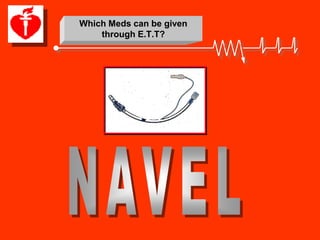
Which Meds can be given
    through E.T.T?
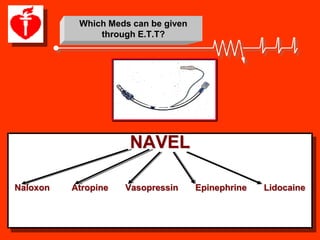
Which Meds can be given
               through E.T.T?


                     NAVEL

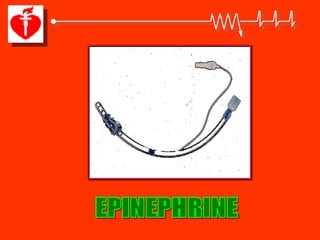
Naloxon   Atropine   Vasopressin     Epinephrine   Lidocaine
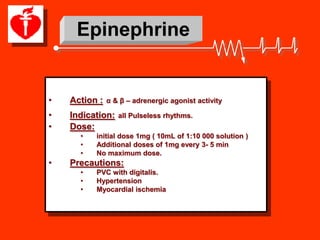
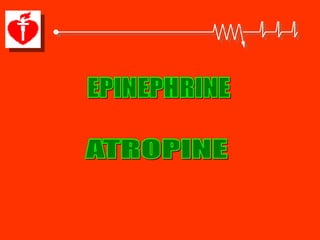
Epinephrine


•   Action :   α & β – adrenergic agonist activity

•   Indication:   all Pulseless rhythms.
•   Dose:
      •   initial dose 1mg ( 10mL of 1:10 000 solution )
      •   Additional doses of 1mg every 3- 5 min
      •   No maximum dose.
•   Precautions:
      •   PVC with digitalis.
      •   Hypertension
      •   Myocardial ischemia
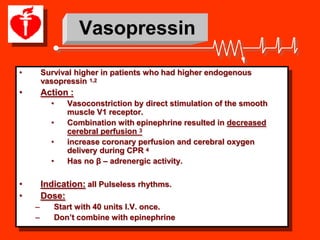
Vasopressin

•       Survival higher in patients who had higher endogenous
        vasopressin 1,2
•       Action :
          •   Vasoconstriction by direct stimulation of the smooth
              muscle V1 receptor.
          •   Combination with epinephrine resulted in decreased
              cerebral perfusion 3
          •   increase coronary perfusion and cerebral oxygen
              delivery during CPR 4
          •   Has no β – adrenergic activity.

•       Indication: all Pulseless rhythms.
•       Dose:
    –      Start with 40 units I.V. once.
    –      Don’t combine with epinephrine
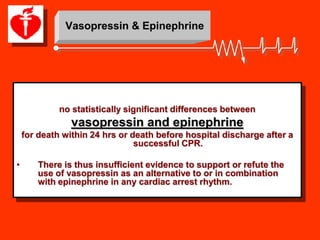
Vasopressin & Epinephrine


             no statistically significant differences between
                vasopressin and epinephrine
    for death within 24 hrs or death before hospital discharge after a
                                successful CPR.

•      There is thus insufficient evidence to support or refute the
       use of vasopressin as an alternative to or in combination
       with epinephrine in any cardiac arrest rhythm.
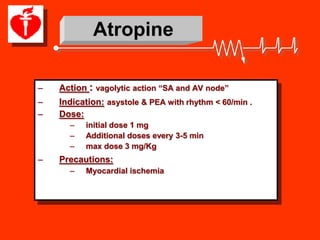
Atropine

–   Action : vagolytic action “SA and AV node”
–   Indication: asystole & PEA with rhythm < 60/min .
–   Dose:
      –   initial dose 1 mg
      –   Additional doses every 3-5 min
      –   max dose 3 mg/Kg
–   Precautions:
      –   Myocardial ischemia
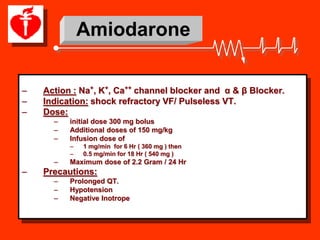
Amiodarone

–   Action : Na+, K+, Ca++ channel blocker and α & β Blocker.
–   Indication: shock refractory VF/ Pulseless VT.
–   Dose:
      –   initial dose 300 mg bolus
      –   Additional doses of 150 mg/kg
      –   Infusion dose of
          –   1 mg/min for 6 Hr ( 360 mg ) then
          –   0.5 mg/min for 18 Hr ( 540 mg )
      –   Maximum dose of 2.2 Gram / 24 Hr
–   Precautions:
      –   Prolonged QT.
      –   Hypotension
      –   Negative Inotrope
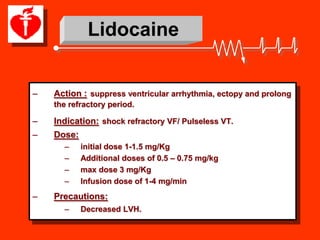
Lidocaine


–   Action : suppress ventricular arrhythmia, ectopy and prolong
    the refractory period.

–   Indication: shock refractory VF/ Pulseless VT.
–   Dose:
      –     initial dose 1-1.5 mg/Kg
      –     Additional doses of 0.5 – 0.75 mg/kg
      –     max dose 3 mg/Kg
      –     Infusion dose of 1-4 mg/min
–   Precautions:
      –     Decreased LVH.
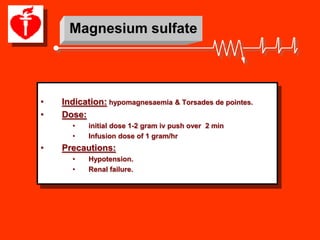
Magnesium sulfate


•   Indication: hypomagnesaemia & Torsades de pointes.
•   Dose:
      •   initial dose 1-2 gram iv push over 2 min
      •   Infusion dose of 1 gram/hr
•   Precautions:
      •   Hypotension.
      •   Renal failure.
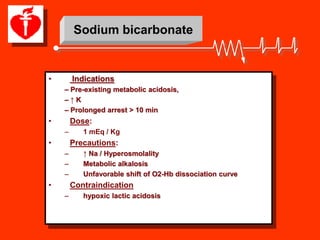
Sodium bicarbonate


•       Indications
    – Pre-existing metabolic acidosis,
    –↑K
    – Prolonged arrest > 10 min
•       Dose:
    –      1 mEq / Kg
•       Precautions:
    –      ↑ Na / Hyperosmolality
    –      Metabolic alkalosis
    –      Unfavorable shift of O2-Hb dissociation curve
•       Contraindication
    –      hypoxic lactic acidosis
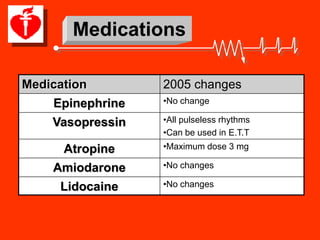
Medications

Medication        2005 changes
    Epinephrine   •No change

    Vasopressin   •All pulseless rhythms
                  •Can be used in E.T.T
      Atropine    •Maximum dose 3 mg

    Amiodarone    •No changes

     Lidocaine    •No changes
References
•   Aung K, Htay T. Vasopressin for cardiac arrest: a systematic review and
    meta-analysis. Arch Intern Med 2005:17-24
•   2005 International Consensus Conference.Circulation 2005;112:III-29
•   Linder KH, Strohmenger HU, Ensinger H, Hetzel WD, Ahnefeld FW,
    Georgieff M, Stress hormone response during and after cardiopulmonary
    resuscitation. Anesthesiology 1992;77:662-668
•   Linder KH, Haak T, Keller A, Bothner U, Lurie KG, Release of
    endogenous vasopressors during and after cardiopulmonary
    resuscitation. Heart 1996;75:145-150
•   Wenzel V, Linder KH, Augenstein S, Prengel AW, Strohmenger HU,
    Vasopressin combined with epinephrine decreases cerebral perfusion
    compared with vasopressin alone during cardiopulmonary resuscitation in
    pigs. Stroke. 1998;29:1462-1467: discussion 1467-1468.
•   Babar SI, Berg RA, Hilwig RW, Kern KB, Ewy GA Vasopressin versus
    epinephrine during CPR: a randomized swine outcome study.
    Resuscitation 1999; 185-192
•   Linder KH, Dricks B, Strohmenger HU, Prengel AW, Lindner IM, Lurie
    KG, Randomized comparison of epinephrine and vasopressin in patients
    with out of hospital VF. Lancet. 1997; 349: 535-537
References

•   Kudenchuk PJet al. Amiodarone for resuscitation after out-of-hospital
    cardiac arrest due to ventricular fibrillation. N Engl J Med. 1999:871-878
•   Dorian P et al. Amiodarone as compared with lidocaine for shock-resistant
    ventricular fibrillation. N Engl J Med 2002:884-90
•   2005 International Consensus Conference.Circulation 2005;112:III-17
•   Paul Dorian, et al. NEJM 2002 Amiodarone as Compared with Lidocaine for
    Shock-Resistant Ventricular Fibrillation
ACLS Pulseless Arrest Algorithm
Primary A,B,C,D
Primary A,B,C,D
Primary A,B,C,D
Primary A,B,C,D
Secondary A,B,C,D
Secondary A,B,C,D
Secondary A,B,C,D
Secondary A,B,C,D
Secondary A,B,C,D
Secondary A,B,C,D
•   “Flat line” protocol:
    –   Check leads attachment.
    –   Check leads selection
    –   Power on/off
    –   Check the gain
Acls mega code pdf
Acls mega code pdf
Acls mega code pdf
Acls mega code pdf
Acls mega code pdf
Acls mega code pdf
Acls mega code pdf
Acls mega code pdf
Acls mega code pdf
Acls mega code pdf
Acls mega code pdf
Acls mega code pdf
Acls mega code pdf
Acls mega code pdf
Acls mega code pdf

Acls mega code pdf

  • 2.
  • 3.
  • 4.
  • 8.
    TODAY Review the latest changes in BLS & ACLS Review of most common & important EKG Rhythms. ACLS pulseless algorithm
  • 9.
  • 10.
  • 11.
    Primary A,B,C,D 2005 InternationalConsensus Conference.Circulation 2005;112:III-17
  • 13.
  • 14.
  • 15.
  • 16.
    Secondary A,B,C,D 1. Primary confirmation 1. Visualizes ETT goes through the vocal cords 2. Observes vapors in the tube 3. Chest rise 4. 5 point auscultation of the chest
  • 17.
  • 18.
  • 19.
    Secondary A,B,C,D – Circulation 1. Establish IV access 2. Identify rhythm  monitor 3. Administer drugs 4. “appropriate for rhythm and condition”
  • 20.
    Simultaneous recording ofaortic diastolic (red) and right atrial (yellow) pressures during CPR in which 2 ventilations are delivered within 4-second time period Ewy, G. A. Circulation 2005;111:2134-2142
  • 21.
  • 22.
    Secondary A,B,C,D – Deferential Diagnosis – search for and treat identified reversible causes
  • 23.
    Secondary A,B,C,D 6 H’s 6 T’s – Hypovolemia – Tablets – Hypoxia – Thrombosis “coronary” – Hydrogen Ions “acidemia” – Thrombosis “Pulmonary” – Hyperkalemia / – Tension pneumothorax Hypokalemia – Tamponade, Cardiac – Hypothermia – Trauma – Hypoglycemia
  • 24.
    Checking the heart rhythm – Checking the pulse – inserting airway devices – administration of drugs should be done
  • 25.
    Asystole – “Flat line” protocol: 1. Check leads attachment. 2. Check leads selection 3. Power on/off 4. Check the gain
  • 26.
  • 27.
    EKG review 1. Tachy vs. Brady 100 < rate < 60 Three questions: 1. Rate 1. Supraventricular vs. 2. QRS narrow or wide ventricular 3. P wave & PR interval 2. Source of rhythm & blocks
  • 40.
    Medications 1. Why? (Actions) 2. When? (Indications) 3. How? (Dose) 4. Watch Out! (Precautions)
  • 41.
    What is themost important medication in the cardiac arrest?
  • 42.
  • 43.
    How to givethe medication during CRP? • I.V. • E.T.T – Fast I.V. Bolus. – 2-3 times the I.V. dose – 10 cc N.S. flush. – Raise the arm. – Diluted 10cc N.S. – Use central venous – 3-4 ambo-bag “to access if it available. diffuse the medication”
  • 44.
    Which Meds canbe given through E.T.T?
  • 45.
    Which Meds canbe given through E.T.T? NAVEL Naloxon Atropine Vasopressin Epinephrine Lidocaine
  • 46.
    Epinephrine • Action : α & β – adrenergic agonist activity • Indication: all Pulseless rhythms. • Dose: • initial dose 1mg ( 10mL of 1:10 000 solution ) • Additional doses of 1mg every 3- 5 min • No maximum dose. • Precautions: • PVC with digitalis. • Hypertension • Myocardial ischemia
  • 47.
    Vasopressin • Survival higher in patients who had higher endogenous vasopressin 1,2 • Action : • Vasoconstriction by direct stimulation of the smooth muscle V1 receptor. • Combination with epinephrine resulted in decreased cerebral perfusion 3 • increase coronary perfusion and cerebral oxygen delivery during CPR 4 • Has no β – adrenergic activity. • Indication: all Pulseless rhythms. • Dose: – Start with 40 units I.V. once. – Don’t combine with epinephrine
  • 48.
    Vasopressin & Epinephrine no statistically significant differences between vasopressin and epinephrine for death within 24 hrs or death before hospital discharge after a successful CPR. • There is thus insufficient evidence to support or refute the use of vasopressin as an alternative to or in combination with epinephrine in any cardiac arrest rhythm.
  • 49.
    Atropine – Action : vagolytic action “SA and AV node” – Indication: asystole & PEA with rhythm < 60/min . – Dose: – initial dose 1 mg – Additional doses every 3-5 min – max dose 3 mg/Kg – Precautions: – Myocardial ischemia
  • 50.
    Amiodarone – Action : Na+, K+, Ca++ channel blocker and α & β Blocker. – Indication: shock refractory VF/ Pulseless VT. – Dose: – initial dose 300 mg bolus – Additional doses of 150 mg/kg – Infusion dose of – 1 mg/min for 6 Hr ( 360 mg ) then – 0.5 mg/min for 18 Hr ( 540 mg ) – Maximum dose of 2.2 Gram / 24 Hr – Precautions: – Prolonged QT. – Hypotension – Negative Inotrope
  • 51.
    Lidocaine – Action : suppress ventricular arrhythmia, ectopy and prolong the refractory period. – Indication: shock refractory VF/ Pulseless VT. – Dose: – initial dose 1-1.5 mg/Kg – Additional doses of 0.5 – 0.75 mg/kg – max dose 3 mg/Kg – Infusion dose of 1-4 mg/min – Precautions: – Decreased LVH.
  • 52.
    Magnesium sulfate • Indication: hypomagnesaemia & Torsades de pointes. • Dose: • initial dose 1-2 gram iv push over 2 min • Infusion dose of 1 gram/hr • Precautions: • Hypotension. • Renal failure.
  • 53.
    Sodium bicarbonate • Indications – Pre-existing metabolic acidosis, –↑K – Prolonged arrest > 10 min • Dose: – 1 mEq / Kg • Precautions: – ↑ Na / Hyperosmolality – Metabolic alkalosis – Unfavorable shift of O2-Hb dissociation curve • Contraindication – hypoxic lactic acidosis
  • 54.
    Medications Medication 2005 changes Epinephrine •No change Vasopressin •All pulseless rhythms •Can be used in E.T.T Atropine •Maximum dose 3 mg Amiodarone •No changes Lidocaine •No changes
  • 55.
    References • Aung K, Htay T. Vasopressin for cardiac arrest: a systematic review and meta-analysis. Arch Intern Med 2005:17-24 • 2005 International Consensus Conference.Circulation 2005;112:III-29 • Linder KH, Strohmenger HU, Ensinger H, Hetzel WD, Ahnefeld FW, Georgieff M, Stress hormone response during and after cardiopulmonary resuscitation. Anesthesiology 1992;77:662-668 • Linder KH, Haak T, Keller A, Bothner U, Lurie KG, Release of endogenous vasopressors during and after cardiopulmonary resuscitation. Heart 1996;75:145-150 • Wenzel V, Linder KH, Augenstein S, Prengel AW, Strohmenger HU, Vasopressin combined with epinephrine decreases cerebral perfusion compared with vasopressin alone during cardiopulmonary resuscitation in pigs. Stroke. 1998;29:1462-1467: discussion 1467-1468. • Babar SI, Berg RA, Hilwig RW, Kern KB, Ewy GA Vasopressin versus epinephrine during CPR: a randomized swine outcome study. Resuscitation 1999; 185-192 • Linder KH, Dricks B, Strohmenger HU, Prengel AW, Lindner IM, Lurie KG, Randomized comparison of epinephrine and vasopressin in patients with out of hospital VF. Lancet. 1997; 349: 535-537
  • 56.
    References • Kudenchuk PJet al. Amiodarone for resuscitation after out-of-hospital cardiac arrest due to ventricular fibrillation. N Engl J Med. 1999:871-878 • Dorian P et al. Amiodarone as compared with lidocaine for shock-resistant ventricular fibrillation. N Engl J Med 2002:884-90 • 2005 International Consensus Conference.Circulation 2005;112:III-17 • Paul Dorian, et al. NEJM 2002 Amiodarone as Compared with Lidocaine for Shock-Resistant Ventricular Fibrillation
  • 57.
  • 59.
  • 61.
  • 63.
  • 64.
  • 65.
  • 66.
  • 67.
  • 70.
  • 73.
  • 76.
  • 80.
    “Flat line” protocol: – Check leads attachment. – Check leads selection – Power on/off – Check the gain