3 BLS –Basic Life Support
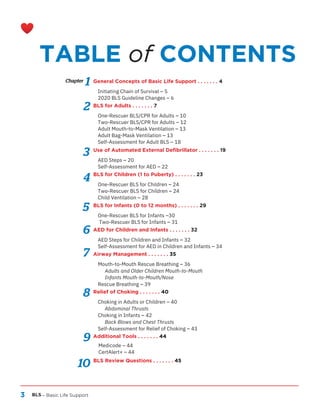
TABLE of CONTENTS
Chapter General Concepts of Basic Life Support . . . . . . . 4
BLS for Adults . . . . . . . 7
Additional Tools . . . . . . . 44
Relief of Choking . . . . . . . 40
Airway Management . . . . . . . 35
BLS Review Questions . . . . . . . 45
AED for Children and Infants . . . . . . . 32
BLS for Children (1 to Puberty) . . . . . . . 23
BLS for Infants (0 to 12 months) . . . . . . . 29
Use of Automated External Defibrillator . . . . . . . 19
Medicode – 44
CertAlert+ – 44
AED Steps – 20
Self-Assessment for AED – 22
Initiating Chain of Survival – 5
2020 BLS Guideline Changes – 6
One-Rescuer BLS for Infants –30
Two-Rescuer BLS for Infants – 31
One-Rescuer BLS for Children – 24
Two-Rescuer BLS for Children – 24
Child Ventilation – 28
One-Rescuer BLS/CPR for Adults – 10
Two-Rescuer BLS/CPR for Adults – 12
Adult Mouth-to-Mask Ventilation – 13
Adult Bag-Mask Ventilation – 13
Self-Assessment for Adult BLS – 18
Choking in Adults or Children – 40
Abdominal Thrusts
Choking in Infants – 42
Back Blows and Chest Thrusts
Self-Assessment for Relief of Choking – 43
Mouth-to-Mouth Rescue Breathing – 36
Adults and Older Children Mouth-to-Mouth
Infants Mouth-to-Mouth/Nose
Rescue Breathing – 39
AED Steps for Children and Infants – 32
Self-Assessment for AED in Children and Infants – 34
9
10
8
1
2
3
4
5
6
7
5.
4 BLS –Basic Life Support
• Quickly start the Chain of Survival.
• Deliver high-quality chest compressions to circulate oxygen to the brain and vital organs.
• Know when and how to use an Automated External Defibrillator (AED).
• Provide rescue breathing.
• Understand how to work with other rescuers as part of a team.
• Know how to treat choking.
According to the Centers for Disease Control (CDC), heart disease continues to be the leading cause
of death in the United States and is responsible for over 600,000 deaths every year. Research
continues to improve how we respond with life-saving techniques to emergencies. These techniques
are based on the most current research and are organized into a systematic response called the Chain
of Survival, which begins with Basic Life Support (BLS). The Chain of Survival provides the victim the
best chance to receive the care needed and return to a healthy life.
The heart pumps blood through the lungs, where blood takes in oxygen and releases carbon dioxide.
This blood then returns to the heart where it is pumped out to vital organs—the heart and brain—as
well as the rest of the body. When the heart stops, blood
flow stops, and the person quickly becomes unconscious.
Without blood flow, the heart and the brain quickly become
damaged due to lack of oxygen. The actions that make up
BLS try to prevent or slow the damage until the cause of the
problem can be corrected. BLS improves a person’s chance
of surviving until advanced care becomes available.
Keys for BLS:
GENERAL
CONCEPTS
OF BASIC LIFE
SUPPORT
CHAPTER
Taking the right action quickly and
confidently can make the difference
between life and death for a person
dealing with cardiac arrest.
1
6.
5
INITIATING CHAIN OFSURVIVAL
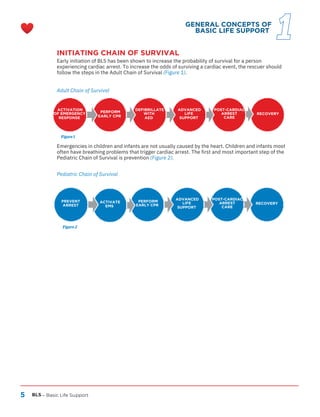
Early initiation of BLS has been shown to increase the probability of survival for a person
experiencing cardiac arrest. To increase the odds of surviving a cardiac event, the rescuer should
follow the steps in the Adult Chain of Survival (Figure 1).
BLS – Basic Life Support
Pediatric Chain of Survival
Adult Chain of Survival
Emergencies in children and infants are not usually caused by the heart. Children and infants most
often have breathing problems that trigger cardiac arrest. The first and most important step of the
Pediatric Chain of Survival is prevention (Figure 2).
GENERAL CONCEPTS OF
BASIC LIFE SUPPORT
PREVENT
ARREST
ACTIVATiON
OF EMERGENCY
RESPONSE
ACTIVATE
EMS
PERFORM
EARLY CPR
DEFIBRILLATE
WITH
AED
ADVANCED
LIFE
SUPPORT
ADVANCED
LIFE
SUPPORT
POST-CARDIAC
ARREST
CARE
POST-CARDIAC
ARREST
CARE
RECOVERY
RECOVERY
Figure 1
Figure 2
PERFORM
EARLY CPR
1
7.
6
2020 BLS GUIDELINESCHANGES
BLS – Basic Life Support
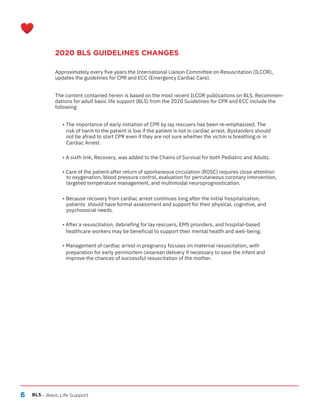
Approximately every five years the International Liaison Committee on Resuscitation (ILCOR),
updates the guidelines for CPR and ECC (Emergency Cardiac Care).
The content contained herein is based on the most recent ILCOR publications on BLS. Recommen-
dations for adult basic life support (BLS) from the 2020 Guidelines for CPR and ECC include the
following:
• The importance of early initiation of CPR by lay rescuers has been re-emphasized. The
risk of harm to the patient is low if the patient is not in cardiac arrest. Bystanders should
not be afraid to start CPR even if they are not sure whether the victim is breathing or in
Cardiac Arrest.
• A sixth link, Recovery, was added to the Chains of Survival for both Pediatric and Adults.
• Care of the patient after return of spontaneous circulation (ROSC) requires close attention
to oxygenation, blood pressure control, evaluation for percutaneous coronary intervention,
targeted temperature management, and multimodal neuroprognostication.
• Because recovery from cardiac arrest continues long after the initial hospitalization,
patients should have formal assessment and support for their physical, cognitive, and
psychosocial needs.
• After a resuscitation, debriefing for lay rescuers, EMS providers, and hospital-based
healthcare workers may be beneficial to support their mental health and well-being.
• Management of cardiac arrest in pregnancy focuses on maternal resuscitation, with
preparation for early perimortem cesarean delivery if necessary to save the infant and
improve the chances of successful resuscitation of the mother.
8.
7 BLS –Basic Life Support
BLS FOR ADULTS
BLS for adults focuses on doing several tasks simultaneously. In previous
versions of BLS, the focus was primarily on one-rescuer CPR. In many
situations, more than one person is available to do CPR. This simultaneous
and choreographed method includes performing chest compressions,
managing the airway, delivering rescue breaths, and using the AED, all as
a team. By coordinating efforts, a team of rescuers can save valuable
seconds when time lost equals damage to the heart and brain.
CHAPTER
2
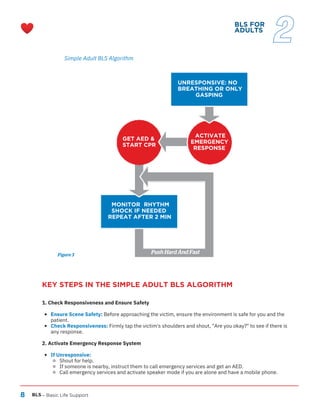
ADULT BLS ALGORITHM
Understanding the adult BLS algorithm is essential for health care professionals and first responders when
dealing with cardiac emergencies. This page provides a simplified overview of the steps of the Simple
Adult BLS Algorithm, ensuring you are prepared to deliver effective Basic Life Support (BLS) to adults in
critical situations.
WHAT IS THE SIMPLE ADULT BLS ALGORITHM?
The Simple Adult BLS Algorithm is a streamlined sequence of actions designed to assess and manage
life-threatening conditions in adults aged puberty and older. By focusing on the most critical steps, the
algorithm enables rescuers to act quickly and confidently during emergencies.
9.
8 BLS –Basic Life Support
BLS FOR
ADULTS
2
Simple Adult BLS Algorithm
Figure 3
GET AED &
START CPR
MONITOR RHYTHM
SHOCK IF NEEDED
REPEAT AFTER 2 MIN
ACTIVATE
EMERGENCY
RESPONSE
UNRESPONSIVE: NO
BREATHING OR ONLY
GASPING
Push Hard And Fast
KEY STEPS IN THE SIMPLE ADULT BLS ALGORITHM
1. Check Responsiveness and Ensure Safety
Ensure Scene Safety: Before approaching the victim, ensure the environment is safe for you and the
patient.
Check Responsiveness: Firmly tap the victim's shoulders and shout, "Are you okay?" to see if there is
any response.
2. Activate Emergency Response System
If Unresponsive:
Shout for help.
If someone is nearby, instruct them to call emergency services and get an AED.
Call emergency services and activate speaker mode if you are alone and have a mobile phone.
10.
9 BLS –Basic Life Support
BLS FOR
ADULTS
2
3. Assess Breathing
Look for Normal Breathing:
Observe the chest for rise and fall.
Listen for normal breathing sounds.
If Not Breathing or Only Gasping:
Begin CPR immediately following the adult BLS algorithm.
4. Begin High-Quality CPR
Chest Compressions:
Place the heel of one hand on the center of the victim's chest (lower half of the sternum).
Place your other hand on top, interlocking your fingers.
Keep your arms straight and shoulders directly over your hands.
Compression Depth: At least 2 inches (5 cm).
Compression Rate: 100 to 120 compressions per minute.
Allow Full Chest Recoil after each compression.
Ventilations:
After 30 compressions, open the airway using the head-tilt-chin-lift method.
Pinch the victim's nose closed and give two breaths, each over 1 second, watching for chest rise.
Avoid Excessive Ventilation to prevent complications.
5. Use an Automated External Defibrillator (AED)
Attach the AED as soon as it is available.
Follow AED Prompts:
Turn on the AED and follow the voice instructions.
Pad Placement:
Apply AED pads to the victim's bare chest as indicated.
Analyze Rhythm:
Ensure no one is touching the victim during analysis.
Deliver Shock if Advised:
If a shock is advised, ensure everyone is clear and press the shock button.
Resume CPR Immediately After Shock:
Continue CPR starting with chest compressions, following the adult BLS algorithm.
6. Continue CPR Cycles
Cycle Ratio: Maintain cycles of 30 compressions and two breaths.
Minimize Interruptions:
Keep pauses in chest compressions to less than 10 seconds.
Reassessment:
Do not stop to check for a pulse or breathing until emergency services arrive or the victim shows
signs of life.
Importance of the Simple Adult BLS Algorithm
The adult BLS algorithm is designed to simplify the rescue process, making it easier to remember and
execute during high-stress situations. Key benefits include:
Immediate Action: Encourages quick response, which is critical for survival.
Standardized Procedure: Provides a consistent approach that all rescuers can follow.
Enhanced Survival Rates: Early and effective CPR using the adult BLS algorithm can significantly
improve outcomes.
11.
10
ONE-RESCUER BLS/CPR FORADULTS
Be Safe
BLS – Basic Life Support
CPR
Call EMS
Defibrillate
Assess the Person
• Attach the AED pads when available.
• Begin sets of compressions and rescue breaths.
• Shake the person, tap their shoulder hard, and talk to them loudly.
• Check to see if the person is breathing. (Agonal breathing, which is occasional gasping and is
ineffective, does not count as breathing.)
• Send someone for help or to call your emergency number and to get an AED.
• If alone, call for help while assessing for breathing and pulse. (The ILCOR emphasizes that cell
phones are available everywhere now and most have a built-in speakerphone. Call for help
without leaving the person.)
• Make sure the scene is safe before proceeding.
• Move the person out of traffic.
• Move the person out of water and dry the person. (Drowning persons should be removed from
the water and dried off; they should also be removed from standing water, such as puddles,
pools, gutters, etc.)
• Be sure you do not become injured yourself.
BLS FOR
ADULTS
2
12.
11 BLS
A
D
B
E
C
F
– BasicLife Support
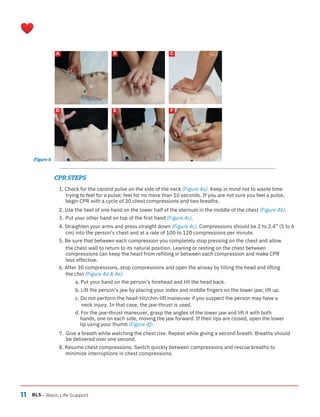
CPR STEPS
1. Check for the carotid pulse on the side of the neck (Figure 4a). Keep in mind not to waste time
trying to feel for a pulse; feel for no more than 10 seconds. If you are not sure you feel a pulse,
begin CPR with a cycle of 30 chest compressions and two breaths.
2. Use the heel of one hand on the lower half of the sternum in the middle of the chest (Figure 4b).
3. Put your other hand on top of the first hand (Figure 4c).
4. Straighten your arms and press straight down (Figure 4c). Compressions should be 2 to 2.4” (5 to 6
cm) into the person’s chest and at a rate of 100 to 120 compressions per minute.
5. Be sure that between each compression you completely stop pressing on the chest and allow
the chest wall to return to its natural position. Leaning or resting on the chest between
compressions can keep the heart from refilling in between each compression and make CPR
less effective.
6. After 30 compressions, stop compressions and open the airway by tilting the head and lifting
the chin (Figure 4d & 4e).
a. Put your hand on the person’s forehead and tilt the head back.
b. Lift the person’s jaw by placing your index and middle fingers on the lower jaw; lift up.
c. Do not perform the head-tilt/chin-lift maneuver if you suspect the person may have a
neck injury. In that case, the jaw-thrust is used.
d. For the jaw-thrust maneuver, grasp the angles of the lower jaw and lift it with both
hands, one on each side, moving the jaw forward. If their lips are closed, open the lower
lip using your thumb (Figure 4f).
7. Give a breath while watching the chest rise. Repeat while giving a second breath. Breaths should
be delivered over one second.
8. Resume chest compressions. Switch quickly between compressions and rescue breaths to
minimize interruptions in chest compressions.
Figure 4
13.
12
TWO-RESCUER BLS/CPR FORADULTS
Many times there will be a second person available that can act as a rescuer. The ILCOR emphasizes
that cell phones are available everywhere now and most have a built-in speakerphone. Direct the
second rescuer to call 911 or Emergency Medical Services (EMS) without leaving the person while
you begin CPR. This second rescuer can also find an AED while you stay with the person. When the
second rescuer returns, the CPR tasks can be shared:
BLS – Basic Life Support
1. The second rescuer prepares the AED for use.
2. You begin chest compressions and count the compressions out loud.
3.
4.
The second rescuer applies the AED pads.
The second rescuer opens the person’s airway and gives rescue breaths.
5. Switch roles after every five cycles of compressions and breaths. One cycle consists of 30
compressions and two breaths.
6. Be sure that between each compression you completely stop pressing on the chest and allow
the chest wall to return to its natural position. Leaning or resting on the chest between
compressions can keep the heart from refilling in between each compression and make CPR
less effective. Rescuers who become tired may tend to lean on the chest more during
compressions; switching roles helps rescuers perform high-quality compressions.
7. Quickly switch between roles to minimize interruptions in delivering chest compressions.
8. When the AED is connected, minimize interruptions of CPR by switching rescuers while the
AED analyzes the heart rhythm. If a shock is indicated, minimize interruptions in CPR.
Resume CPR as soon as possible.
BLS FOR
ADULTS
2
14.
13
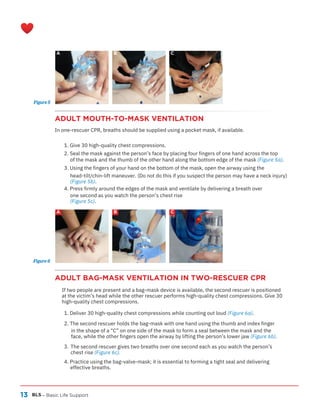
ADULT MOUTH-TO-MASK VENTILATION
Inone-rescuer CPR, breaths should be supplied using a pocket mask, if available.
ADULT BAG-MASK VENTILATION IN TWO-RESCUER CPR
BLS
A
A
B
B
C
C
– Basic Life Support
Figure 6
Figure 5
1. Give 30 high-quality chest compressions.
2. Seal the mask against the person’s face by placing four fingers of one hand across the top
of the mask and the thumb of the other hand along the bottom edge of the mask (Figure 5a).
3. Using the fingers of your hand on the bottom of the mask, open the airway using the
head-tilt/chin-lift maneuver. (Do not do this if you suspect the person may have a neck injury)
(Figure 5b).
4. Press firmly around the edges of the mask and ventilate by delivering a breath over
one second as you watch the person’s chest rise
(Figure 5c).
If two people are present and a bag-mask device is available, the second rescuer is positioned
at the victim’s head while the other rescuer performs high-quality chest compressions. Give 30
high-quality chest compressions.
1. Deliver 30 high-quality chest compressions while counting out loud (Figure 6a).
2. The second rescuer holds the bag-mask with one hand using the thumb and index finger
in the shape of a “C” on one side of the mask to form a seal between the mask and the
face, while the other fingers open the airway by lifting the person’s lower jaw (Figure 6b).
3.
4. Practice using the bag-valve-mask; it is essential to forming a tight seal and delivering
effective breaths.
The second rescuer gives two breaths over one second each as you watch the person’s
chest rise (Figure 6c).
15.
14
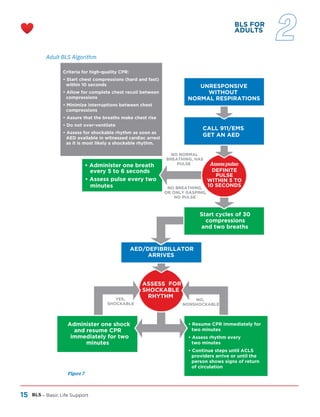
ADULT BASIC LIFESUPPORT ALGORITHM
Knowing the adult Basic Life Support algorithm is crucial for saving lives in emergency
situations involving adults. This guide provides health care professionals and first responders
with a step-by-step approach to delivering high-quality Basic Life Support (BLS) to adult
patients experiencing cardiac arrest or other life-threatening conditions.
BLS – Basic Life Support
BLS FOR
ADULTS
2
UNDERSTANDING THE ADULT BLS ALGORITHM
The adult Basic Life Support algorithm is a systematic sequence of actions designed to assist
rescuers in assessing and managing life-threatening emergencies in individuals aged puberty
and older. It emphasizes early recognition, immediate activation of emergency response
systems, effective chest compressions, timely ventilations, and using Automated External
Defibrillators (AEDs) when appropriate.
16.
15 BLS
Criteria forhigh-quality CPR:
• Start chest compressions (hard and fast)
within 10 seconds
• Allow for complete chest recoil between
compressions
• Minimize interruptions between chest
compressions
• Assure that the breaths make chest rise
• Do not over-ventilate
• Assess for shockable rhythm as soon as
AED available in witnessed cardiac arrest
as it is most likely a shockable rhythm.
• Resume CPR immediately for
two minutes
• Assess rhythm every
two minutes
• Continue steps until ACLS
providers arrive or until the
person shows signs of return
of circulation
– Basic Life Support
Adult BLS Algorithm
BLS FOR
ADULTS
Figure 7
Administer one shock
and resume CPR
immediately for two
minutes
• Administer one breath
every 5 to 6 seconds
• Assess pulse every two
minutes
ASSESS FOR
SHOCKABLE
RHYTHM
AED/DEFIBRILLATOR
ARRIVES
Start cycles of 30
compressions
and two breaths
UNRESPONSIVE
WITHOUT
NORMAL RESPIRATIONS
CALL 911/EMS
GET AN AED
Assess pulse:
DEFINITE
PULSE
WITHIN 5 TO
10 SECONDS
YES,
SHOCKABLE
NO NORMAL
BREATHING, HAS
PULSE
NO BREATHING,
OR ONLY GASPING,
NO PULSE
NO,
NONSHOCKABLE
2
17.
16
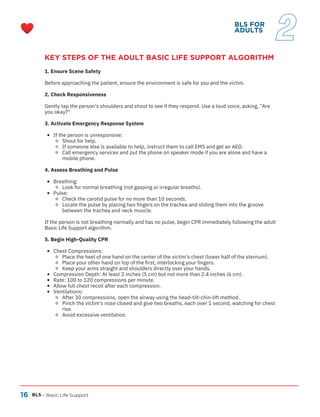
KEY STEPS OFTHE ADULT BASIC LIFE SUPPORT ALGORITHM
1. Ensure Scene Safety
Before approaching the patient, ensure the environment is safe for you and the victim.
2. Check Responsiveness
Gently tap the person's shoulders and shout to see if they respond. Use a loud voice, asking, "Are
you okay?"
3. Activate Emergency Response System
If the person is unresponsive:
Shout for help.
If someone else is available to help, instruct them to call EMS and get an AED.
Call emergency services and put the phone on speaker mode if you are alone and have a
mobile phone.
4. Assess Breathing and Pulse
Breathing:
Look for normal breathing (not gasping or irregular breaths).
Pulse:
Check the carotid pulse for no more than 10 seconds.
Locate the pulse by placing two fingers on the trachea and sliding them into the groove
between the trachea and neck muscle.
If the person is not breathing normally and has no pulse, begin CPR immediately following the adult
Basic Life Support algorithm.
5. Begin High-Quality CPR
Chest Compressions:
Place the heel of one hand on the center of the victim's chest (lower half of the sternum).
Place your other hand on top of the first, interlocking your fingers.
Keep your arms straight and shoulders directly over your hands.
Compression Depth: At least 2 inches (5 cm) but not more than 2.4 inches (6 cm).
Rate: 100 to 120 compressions per minute.
Allow full chest recoil after each compression.
Ventilations:
After 30 compressions, open the airway using the head-tilt-chin-lift method.
Pinch the victim's nose closed and give two breaths, each over 1 second, watching for chest
rise.
Avoid excessive ventilation.
BLS – Basic Life Support
BLS FOR
ADULTS
2
18.
17
6. Use ofAutomated External Defibrillator (AED)
Attach the AED as soon as it is available.
Turn on the AED and follow the prompts.
Pads Placement:
Expose the chest and wipe it dry if necessary.
Attach the AED pads to the victim's bare chest as indicated on the pads.
Analyze Rhythm:
Ensure no one is touching the victim during rhythm analysis.
Shock Delivery:
If a shock is advised, ensure everyone is clear of the victim and press the shock button.
Resume CPR immediately after the shock is delivered or if no shock is advised.
7. Continue CPR Cycles
Continue cycles of 30 compressions and two breaths.
Reassess the victim every 2 minutes or after five cycles of CPR.
Rotate compressors every 2 minutes to reduce fatigue.
Importance of High-Quality CPR in the Adult Basic Life Support Algorithm
High-quality CPR is a critical component of the adult Basic Life Support algorithm and significantly
increases the chances of survival. Key elements include:
Adequate Compression Depth and Rate: Ensures sufficient blood flow to vital organs.
Minimizing Interruptions: Limit pauses in compressions to less than 10 seconds.
Full Chest Recoil: Allows the heart to refill between compressions.
Avoiding Excessive Ventilation: Prevents decreased cardiac output and potential gastric
inflation.
BLS – Basic Life Support
BLS FOR
ADULTS
2
19.
18
ANSWERS
BLS – BasicLife Support
SELF-ASSESSMENT FOR ADULT BLS
1. A
Initiation of the Chain of Survival, which is to call 911/EMS, is the first step in the treatment
of this person.
2. B
The jaw thrust is the maneuver of choice to open this patient’s airway given the concern
of a fall and potential for traumatic injuries.
3. B
Most experts recommend a ventilation rate of 10-12 breaths per minute for adults.
1. A 65-year-old male is on a short ladder changing a light and suddenly collapses. He is
unresponsive. What is the next step?
a. Call 911/EMS.
b. Begin CPR.
c. Begin mouth-to-mouth ventilation.
d. Check pulse.
2. What method should be used to open his airway in the case above?
a. Chin-lift
b. Jaw thrust
c. Head-tilt/chin-lift
d. Head-tilt
3. CPR is initiated and the person’s pulse returns, but he is not breathing. What ventilation rate
should be used for this person?
a. 6-8 breaths per minute
b. 10-12 breaths per minute
c. 18-20 breaths per minute
d. Depends on his color
20.
19 BLS –Basic Life Support
Ventricular fibrillation, caused by disorganized electrical activity in the main pumping chambers
of the heart, is a common cause of cardiac arrest. The treatment for ventricular fibrillation is
defibrillation or the delivery of an electric shock to the heart through the person’s chest wall.
This shock attempts to stop the disorganized electrical activity and allow the heart’s normal
rhythm to resume.
The automated external defibrillator (AED) is a device that recognizes ventricular fibrillation
and other dysrhythmias and delivers an electric shock at the right time. The AED has become
a common sight in public buildings. The AED is nearly foolproof and will not allow you to make
a mistake. It is safe for anyone to use. In a witnessed cardiac arrest, where the person is
observed to suddenly collapse, the most common cause is likely to be ventricular fibrillation and
a defibrillator should analyze the person’s cardiac rhythm as soon as possible.
Using the team concept, one rescuer should coordinate all available rescuers so that one rescuer
performs chest compressions while the second rescuer prepares the AED for use. Although
there are many different brands of AEDs, all are utilized in a similar way. Be sure to move the
person and yourself to a safe place before using the AED. Electricity and water can be lethal
when combined. Ensure that the person is not wet (quickly wipe dry) or in close proximity to
water before using the AED. It is safe to use an AED if the person is lying in snow. If the person
has an implanted device, such as a pacemaker, you will see a bulge over their chest. Place the
defibrillator pads as close to the correct position as possible without being directly over the
device. For persons with medication patches, remove the patch, wipe the skin dry, and
apply the AED pad.
USE OF
AUTOMATED
EXTERNAL
DEFIBRILLATOR
CHAPTER
3
21.
20
AED STEPS
BLS
A
D
B
E
C
F
– BasicLife Support
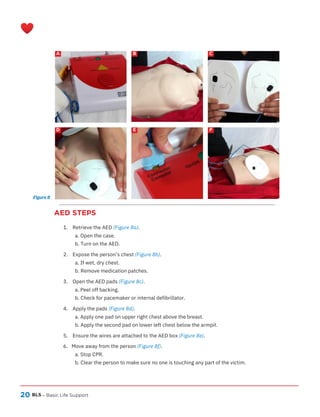
1. Retrieve the AED (Figure 8a).
a. Open the case.
b. Turn on the AED.
2. Expose the person’s chest (Figure 8b).
a. If wet, dry chest.
b. Remove medication patches.
3. Open the AED pads (Figure 8c).
a. Peel off backing.
b. Check for pacemaker or internal defibrillator.
4. Apply the pads (Figure 8d).
a. Apply one pad on upper right chest above the breast.
b. Apply the second pad on lower left chest below the armpit.
5. Ensure the wires are attached to the AED box (Figure 8e).
6. Move away from the person (Figure 8f).
a. Stop CPR.
b. Clear the person to make sure no one is touching any part of the victim.
Figure 8
22.
21 BLS
G H
–Basic Life Support
(Figure 8g).
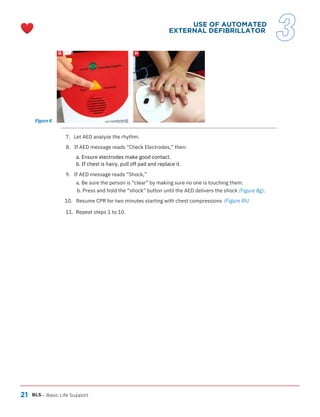
7. Let AED analyze the rhythm.
9. If AED message reads “Shock,”
a. Be sure the person is “clear” by making sure no one is touching them.
b. Press and hold the “shock” button until the AED delivers the shock
11. Repeat steps 1 to 10.
10. Resume CPR for two minutes starting with chest compressions .
(Figure 8h)
8. If AED message reads “Check Electrodes,” then:
a. Ensure electrodes make good contact.
b. If chest is hairy, pull off pad and replace it.
Figure 8
USE OF AUTOMATED
EXTERNAL DEFIBRILLATOR
3
23.
22
ANSWERS
BLS – BasicLife Support
SELF-ASSESSMENT FOR AED
1. What does AED stand for?
a. Automatic Energy Delivery
b. Automated External Device
c. Automated External Defibrillator
d. Autonomous Energy Defibrillator
A 49-year-old female suffers a witnessed cardiac arrest. She has a known cardiac history per her family.
2. You notice a bulge in the upper left chest under the skin. There is a healed incision overlying
that bulge. Which is true of AED use?
a. AED cannot be used in this person.
b. You should put a magnet over the bulge before using the AED.
c. You should place pads over the bulge.
d. You should avoid placing pads over the bulge.
3. The AED indicates “Shock.” What is the next step?
a. Clear the person and deliver the shock.
b. Deliver two additional minutes of CPR before delivering the shock.
c. Ventilate while shock is delivered.
d. Assume error and do not deliver shock.
4. After delivering a shock, what is the next step in caring for this person?
a. Reassess for a pulse.
b. Do chest compressions only.
c. Resume CPR starting with chest compressions.
d. Do ventilation only.
1. C
AED stands for Automated External Defibrillator.
2. D
This person has either a pacemaker or an automated implantable cardioverter-defibrillator
(AICD). Avoid placing AED pads directly over these devices.
3. A
Clear the person and deliver the shock. Do not delay delivery of a shock to perform additional
CPR. All responders should be clear of the person when a shock is delivered. Do not assume error
or delay administration of a shock.
4. C
After delivery of a shock, two minutes of high-quality CPR is performed. Do not perform a
rhythm or pulse check at this point.
24.
23 BLS –Basic Life Support
Many similarities exist between the BLS guidelines for adults and children. Following are the main
differences between the two:
• For children of all age groups, the compression to breaths ratio is 30:2 for one rescuer and
15:2 for two rescuers.
• The depth of compression may be different. For children, compress the chest at least
one-third the depth of the chest. This may be less than two inches for small children (4 -5
cm) but will be approximately two inches for larger children (5 cm).
• If you are the only rescuer at the scene and find an unresponsive child, perform CPR for
two minutes before you call EMS or before you go look for an AED. The ILCOR emphasizes
that cell phones are available everywhere now, and most have a built-in speakerphone, so
you can call EMS while being with the child.
• In children, primary cardiac events are not common. Cardiac arrest is most commonly
preceded by respiratory problems. Survival rates improve with early intervention for
respiratory problems. Remember that prevention is the first link in the Pediatric Chain
of Survival.
• If you witness a cardiac arrest in a child, call EMS and get an AED as you would in the
Adult BLS sequence.
BLS FOR
CHILDREN
(1 TO PUBERTY)
CHAPTER
4
25.
24
ONE-RESCUER BLS FORCHILDREN
If you are alone with a child at the scene, do the following:
TWO-RESCUER BLS FOR CHILDREN
If you are not alone with a child at the scene, do the following:
BLS – Basic Life Support
1. Tap and talk loudly to the child to determine if they are responsive.
2. If the child does not respond and is not breathing (or only gasping), yell for help. If someone
answers, send them to call 911/EMS and to get an AED.
3. Assess for breathing while simultaneously checking for the child’s carotid pulse (on the side
of the neck) or femoral pulse (on the inner thigh in the crease between their leg and groin) for
5 but no more than 10 seconds.
4. If you cannot feel a pulse (or if you are unsure), begin CPR by doing 30 compressions
followed by two breaths. If you can feel a pulse but the pulse rate is less than 60 beats per
minute, you should begin CPR. This rate is too slow for a child.
5. After doing CPR for about two minutes (usually about five cycles of 30 compressions and two
breaths), and if other help has not arrived, call EMS while staying with the child. The ILCOR
emphasizes that cell phones are available everywhere now and most have a built-in
speakerphone. Get an AED if you know where one is.
6. Use and follow AED prompts when available while continuing CPR until EMS arrives or until
the child’s condition normalizes.
1. Tap and talk loudly at the child to determine if they are responsive.
2. If the child does not respond and is not breathing (or if only gasping), have the second
rescuer call 911/EMS and get an AED. (The ILCOR emphasizes that cell phones are available
everywhere now and most have a built-in speakerphone, so you or the second rescuer can
call 911/EMS without leaving the scene).
3. Assess for breathing while simultaneously checking for the child’s carotid pulse (on the side
of the neck) or femoral pulse (on the inner thigh in the crease between their leg and groin) for
5 but no more than 10 seconds.
4. If you cannot feel a pulse (or if you are unsure), begin CPR by doing 15 compressions
followed by two breaths. If you can feel a pulse but the pulse rate is less than 60 beats per
minute, you should begin CPR. This rate is too slow for a child
5. When the second rescuer returns, begin doing CPR by performing 15 compressions by one
rescuer and two breaths by the second rescuer.
6. Use and follow AED prompts when available while continuing CPR until EMS arrives or until
the child’s condition normalizes.
26.
25
PEDIATRIC BLS ALGORITHM
BLS– Basic Life Support
Knowing the pediatric BLS algorithm can make a critical difference in patient outcomes in
emergency situations involving infants and children. This guide provides healthcare
professionals and first responders with a step-by-step approach to delivering high-quality
basic life support (BLS) pediatric patients.
Knowing the pediatric BLS algorithm can make a critical difference in patient outcomes in
emergency situations involving infants and children. This guide provides healthcare
professionals and first responders with a step-by-step approach to delivering high-quality
basic life support (BLS) pediatric patients.
Understanding the Pediatric BLS Algorithm
27.
26 BLS –Basic Life Support
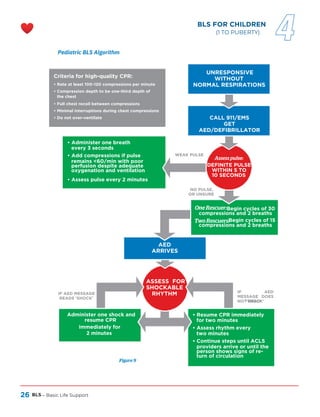
Pediatric BLS Algorithm
BLS FOR CHILDREN
(1 TO PUBERTY)
Figure 9
IF AED MESSAGE
READS ‘SHOCK’
• Rate at least 100-120 compressions per minute
• Compression depth to be one-third depth of
the chest
• Full chest recoil between compressions
• Minimal interruptions during chest compressions
• Do not over-ventilate
WEAK PULSE
NO PULSE,
OR UNSURE
IF AED
MESSAGE DOES
NOT READ
‘SHOCK’
Administer one shock and
resume CPR
immediately for
2 minutes
• Administer one breath
every 3 seconds
• Add compressions if pulse
remains <60/min with poor
perfusion despite adequate
oxygenation and ventilation
• Assess pulse every 2 minutes
AED
ARRIVES
ASSESS FOR
SHOCKABLE
RHYTHM
UNRESPONSIVE
WITHOUT
NORMAL RESPIRATIONS
• Resume CPR immediately
for two minutes
• Assess rhythm every
two minutes
• Continue steps until ACLS
providers arrive or until the
person shows signs of re-
turn of circulation
One Rescuer:
Two Rescuers:
DEFINITE PULSE
WITHIN 5 TO
10 SECONDS
Begin cycles of 30
compressions and 2 breaths
Begin cycles of 15
compressions and 2 breaths
Assess pulse:
Criteria for high-quality CPR:
CALL 911/EMS
GET
AED/DEFIBRILLATOR
4
28.
27 BLS –Basic Life Support
KEY STEPS OF THE PEDIATRIC BLS ALGORITHM
1. Ensure Scene Safety
Before approaching the patient, ensure the environment is safe for you and the victim.
2. Check Responsiveness
Gently tap the child and shout to see if they respond. For infants, tap the bottom of the bare foot.
3. Activate Emergency Response
If you are alone and the collapse was unwitnessed:
Perform 2 minutes of CPR before calling emergency services.
If you are not alone, send someone to activate the emergency response system and retrieve an AED
immediately. If alone and unable to call EMS, Perform 2 minutes of CPR before leaving the scene to call
EMS.
Send someone to activate the emergency response system and retrieve an AED immediately.
4. Assess Breathing and Pulse
Breathing:
Look for normal breathing (not gasping).
Pulse:
Check the brachial pulse in infants or carotid/femoral pulse in children for no more than 10
seconds.
5. Begin High-Quality CPR
If there is no breathing or only gasping and no pulse (or a pulse less than 60 bpm with signs of poor
perfusion), start CPR immediately.
Chest Compressions:
Infants:
Use two fingers in the center of the chest, just below the nipple line.
Children:
Use one or two hands (depending on the child's size) on the sternum's lower half.
Compression Depth:
At least one-third the depth of the chest (about 1.5 inches/4 cm for infants, 2 inches/5 cm for children).
Rate:
100 to 120 compressions per minute.
Allow full chest recoil after each compression.
Ventilations:
Open the airway using the head-tilt-chin-lift method.
Give two breaths after every 30 compressions if you're alone or after every 15 compressions if there
are two rescuers.
Each breath should last about 1 second, making the chest rise visibly.
6. Use of AED
Attach the AED as soon as it is available.
Pediatric Pads:
Use if the child is less than eight years old.
If Pediatric Pads Are Unavailable:
Use adult pads, ensuring they do not touch each other.
Follow the AED prompts and deliver shocks if advised.
29.
28
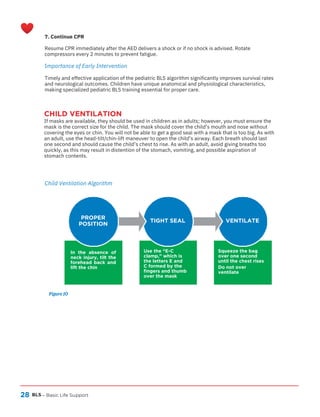
CHILD VENTILATION
If masksare available, they should be used in children as in adults; however, you must ensure the
mask is the correct size for the child. The mask should cover the child’s mouth and nose without
covering the eyes or chin. You will not be able to get a good seal with a mask that is too big. As with
an adult, use the head-tilt/chin-lift maneuver to open the child’s airway. Each breath should last
one second and should cause the child’s chest to rise. As with an adult, avoid giving breaths too
quickly, as this may result in distention of the stomach, vomiting, and possible aspiration of
stomach contents.
BLS
In the absence of
neck injury, tilt the
forehead back and
lift the chin
Use the “E-C
clamp,” which is
the letters E and
C formed by the
fingers and thumb
over the mask
Squeeze the bag
over one second
until the chest rises
Do not over
ventilate
– Basic Life Support
Child Ventilation Algorithm
PROPER
POSITION
TIGHT SEAL VENTILATE
Figure 10
7. Continue CPR
Resume CPR immediately after the AED delivers a shock or if no shock is advised. Rotate
compressors every 2 minutes to prevent fatigue.
Importance of Early Intervention
Timely and effective application of the pediatric BLS algorithm significantly improves survival rates
and neurological outcomes. Children have unique anatomical and physiological characteristics,
making specialized pediatric BLS training essential for proper care.
30.
29 BLS
A BC
– Basic Life Support
BLS for both children and infants is almost identical. Following are the main differences between BLS
for children and BLS for infants:
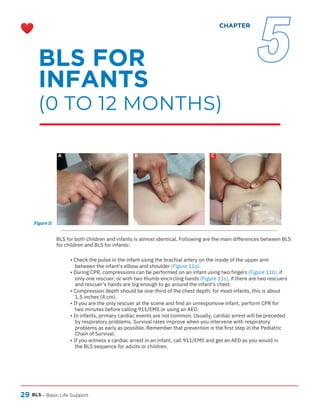
• Check the pulse in the infant using the brachial artery on the inside of the upper arm
between the infant’s elbow and shoulder (Figure 11a).
• During CPR, compressions can be performed on an infant using two fingers (Figure 11b), if
only one rescuer; or with two thumb-encircling hands (Figure 11c), if there are two rescuers
and rescuer’s hands are big enough to go around the infant’s chest.
• Compression depth should be one-third of the chest depth; for most infants, this is about
1.5 inches (4 cm).
• If you are the only rescuer at the scene and find an unresponsive infant, perform CPR for
two minutes before calling 911/EMS or using an AED.
• In infants, primary cardiac events are not common. Usually, cardiac arrest will be preceded
by respiratory problems. Survival rates improve when you intervene with respiratory
problems as early as possible. Remember that prevention is the first step in the Pediatric
Chain of Survival.
• If you witness a cardiac arrest in an infant, call 911/EMS and get an AED as you would in
the BLS sequence for adults or children.
Figure 11
BLS FOR
INFANTS
(0 TO 12 MONTHS)
CHAPTER
5
31.
30
ONE-RESCUER BLS FORINFANTS
If you are alone with the infant at the scene, do the following:
BLS
D E F
– Basic Life Support
1. Tap the heel of their foot and talk loudly at the infant to determine if they are responsive.
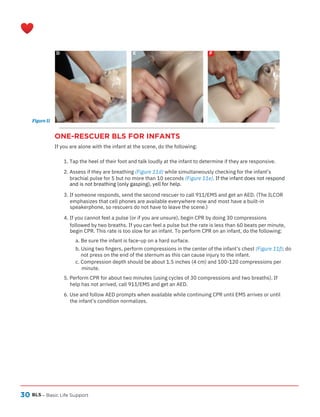
2. Assess if they are breathing (Figure 11d) while simultaneously checking for the infant’s
brachial pulse for 5 but no more than 10 seconds (Figure 11e). If the infant does not respond
and is not breathing (only gasping), yell for help.
3. If someone responds, send the second rescuer to call 911/EMS and get an AED. (The ILCOR
emphasizes that cell phones are available everywhere now and most have a built-in
speakerphone, so rescuers do not have to leave the scene.)
4. If you cannot feel a pulse (or if you are unsure), begin CPR by doing 30 compressions
followed by two breaths. If you can feel a pulse but the rate is less than 60 beats per minute,
begin CPR. This rate is too slow for an infant. To perform CPR on an infant, do the following:
a. Be sure the infant is face-up on a hard surface.
b. Using two fingers, perform compressions in the center of the infant’s chest (Figure 11f); do
not press on the end of the sternum as this can cause injury to the infant.
c. Compression depth should be about 1.5 inches (4 cm) and 100-120 compressions per
minute.
5. Perform CPR for about two minutes (using cycles of 30 compressions and two breaths). If
help has not arrived, call 911/EMS and get an AED.
6. Use and follow AED prompts when available while continuing CPR until EMS arrives or until
the infant’s condition normalizes.
Figure 11
32.
31
TWO-RESCUER BLS FORINFANTS
If you are not alone with the infant at the scene, do the following:
BLS
G
– Basic Life Support
1. Tap the bottom of their foot and talk loudly at the infant to determine if they are responsive.
2. If the infant does not respond, have the second rescuer call 911/EMS and get an AED. (The
ILCOR emphasizes that cell phones are available everywhere now and most have a built-in
speakerphone, so you can call while at the scene.)
3. Assess if they are breathing while simultaneously feeling for the infant’s brachial pulse for 5
but no more than 10 seconds.
4. If you cannot feel a pulse (or if you are unsure), begin CPR by doing 15 compressions
followed by two breaths. If you can feel a pulse but the rate is less than 60 beats per minute,
begin CPR. This rate is too slow for an infant.
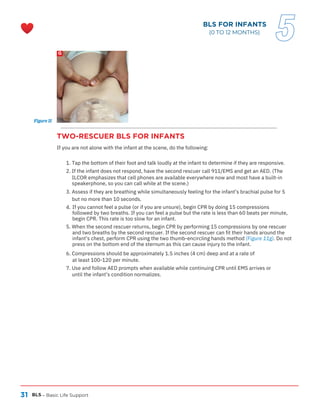
5. When the second rescuer returns, begin CPR by performing 15 compressions by one rescuer
and two breaths by the second rescuer. If the second rescuer can fit their hands around the
infant’s chest, perform CPR using the two thumb-encircling hands method (Figure 11g). Do not
press on the bottom end of the sternum as this can cause injury to the infant.
6. Compressions should be approximately 1.5 inches (4 cm) deep and at a rate of
at least 100-120 per minute.
7. Use and follow AED prompts when available while continuing CPR until EMS arrives or
until the infant’s condition normalizes.
Figure 11
BLS FOR INFANTS
(0 TO 12 MONTHS)
5
33.
32
AED STEPS FORCHILDREN AND INFANTS
BLS
A B
– Basic Life Support
1.
2.
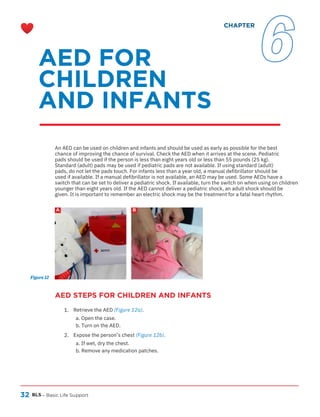
Retrieve the AED (Figure 12a).
a. Open the case.
b. Turn on the AED.
Expose the person’s chest (Figure 12b).
a. If wet, dry the chest.
b. Remove any medication patches.
An AED can be used on children and infants and should be used as early as possible for the best
chance of improving the chance of survival. Check the AED when it arrives at the scene. Pediatric
pads should be used if the person is less than eight years old or less than 55 pounds (25 kg).
Standard (adult) pads may be used if pediatric pads are not available. If using standard (adult)
pads, do not let the pads touch. For infants less than a year old, a manual defibrillator should be
used if available. If a manual defibrillator is not available, an AED may be used. Some AEDs have a
switch that can be set to deliver a pediatric shock. If available, turn the switch on when using on children
younger than eight years old. If the AED cannot deliver a pediatric shock, an adult shock should be
given. It is important to remember an electric shock may be the treatment for a fatal heart rhythm.
Figure 12
AED FOR
CHILDREN
AND INFANTS
CHAPTER
6
34.
33 BLS
C
F G
D
H
E
–Basic Life Support
.
(Figure 12h)
Figure 12
AED FOR CHILDREN
AND INFANTS
6
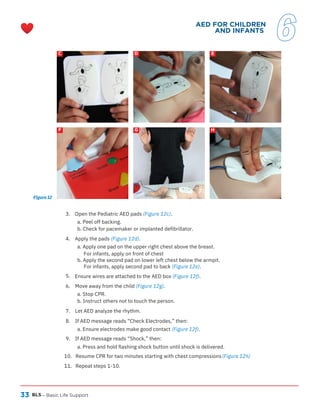
3. Open the Pediatric AED pads (Figure 12c).
a. Peel off backing.
b. Check for pacemaker or implanted defibrillator.
4. Apply the pads (Figure 12d).
a. Apply one pad on the upper right chest above the breast.
For infants, apply on front of chest
b. Apply the second pad on lower left chest below the armpit.
For infants, apply second pad to back (Figure 12e).
5.
6. Move away from the child (Figure 12g).
a. Stop CPR.
b. Instruct others not to touch the person.
7. Let AED analyze the rhythm.
8. If AED message reads “Check Electrodes,” then:
a. Ensure electrodes make good contact (Figure 12f).
9. If AED message reads “Shock,” then:
a. Press and hold flashing shock button until shock is delivered.
10. Resume CPR for two minutes starting with chest compressions
11. Repeat steps 1-10.
Ensure wires are attached to the AED box (Figure 12f).
35.
34
ANSWERS
BLS – BasicLife Support
SELF-ASSESSMENT FOR AED
1.
2.
3.
4.
A For BLS definitions, an infant is under one year of age. A child is 1 year of age to puberty.
The BLS algorithms place children over the age of adolescence into the adult category.
C
Respiratory arrest is the most common cause of cardiac arrest in children. Restoration of
oxygen delivery can be life-saving and prevent a cardiac arrest.
D
If you are alone, unwitnessed arrest in a child requires two minutes of CPR before calling
911/EMS. If assistance is available, send them to call 911/EMS while you begin CPR.
C
CPR should be initiated for pediatrics with a heart rate (pulse) that is 60 or less.
1. What age is considered an infant for BLS purposes?
a. Under one year
b. Two years
c. Three years
d. Four years
2. Why are ventilations delivered to a pediatric arrest victim before seeking assistance in
single-rescuer scenarios?
a. 911/EMS response times are generally slow.
b. The parents are often nearby.
c. Most pediatric cardiac arrests are due to respiratory arrest.
d. The use of an AED is contraindicated in pediatrics.
You are a daycare provider and find a 3-year-old child who is unresponsive. She had laid down
for a nap because she was not feeling well. When you checked on her, she was not breathing
and appeared blue. You are by yourself.
3. What is the first step in managing this case?
a. Give back blows.
b. Do a blind finger sweep.
c. Call 911/EMS.
d. Deliver two minutes of CPR.
4. The child begins to breathe spontaneously at a rate of 18. Her pulse is 50. What is the
next step?
a. Give faster rescue breaths.
b. Do carotid massage.
c. Begin CPR starting with chest compressions.
d. Monitor breathing.
36.
35 BLS
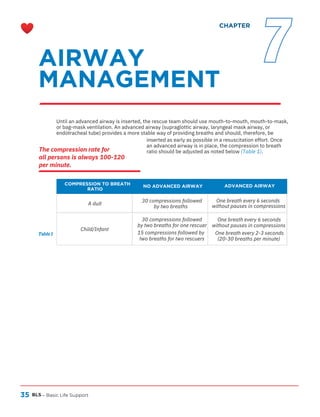
COMPRESSION TOBREATH
RATIO
NO ADVANCED AIRWAY ADVANCED AIRWAY
– Basic Life Support
A dult
Child/Infant
30 compressions followed
by two breaths
30 compressions followed
by two breaths for one rescuer
15 compressions followed by
two breaths for two rescuers
Until an advanced airway is inserted, the rescue team should use mouth-to-mouth, mouth-to-mask,
or bag-mask ventilation. An advanced airway (supraglottic airway, laryngeal mask airway, or
endotracheal tube) provides a more stable way of providing breaths and should, therefore, be
inserted as early as possible in a resuscitation effort. Once
an advanced airway is in place, the compression to breath
ratio should be adjusted as noted below (Table 1).
One breath every 6 seconds
without pauses in compressions
One breath every 6 seconds
without pauses in compressions
One breath every 2-3 seconds
(20-30 breaths per minute)
Table 1
AIRWAY
MANAGEMENT
CHAPTER
The compression rate for
all persons is always 100-120
per minute.
7
37.
36
MOUTH-TO-MOUTH RESCUE BREATHING
Whena pocket mask or bag-mask is not available, it may be necessary to give mouth-to-mouth
breaths during CPR. Mouth-to-mouth breathing is very effective in delivering oxygen into the
person’s lungs without putting the rescuer at a high level of risk. The rescuer’s exhaled air contains
approximately 17% oxygen and 4% carbon dioxide. This is in contrast to the 100% oxygen available
with ventilation with 100% high flow oxygen and the 21% oxygen that is available in room air that we
breathe.
BLS
A B C D
– Basic Life Support
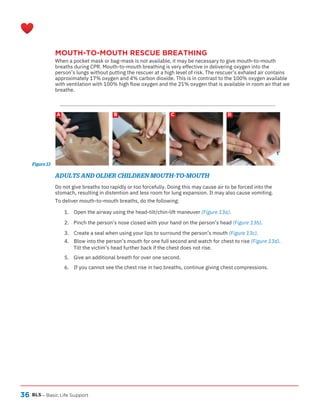
ADULTS AND OLDER CHILDREN MOUTH-TO-MOUTH
Figure 13
Do not give breaths too rapidly or too forcefully. Doing this may cause air to be forced into the
stomach, resulting in distention and less room for lung expansion. It may also cause vomiting.
To deliver mouth-to-mouth breaths, do the following:
1. Open the airway using the head-tilt/chin-lift maneuver (Figure 13a).
2. Pinch the person’s nose closed with your hand on the person’s head (Figure 13b).
3. Create a seal when using your lips to surround the person’s mouth (Figure 13c).
4. Blow into the person’s mouth for one full second and watch for chest to rise (Figure 13d).
Tilt the victim’s head further back if the chest does not rise.
5.
6. If you cannot see the chest rise in two breaths, continue giving chest compressions.
Give an additional breath for over one second.
38.
38 BLS
A BC
– Basic Life Support
Figure 14
AIRWAY
MANAGEMENT
7
INFANTS MOUTH-TO-MOUTH/NOSE
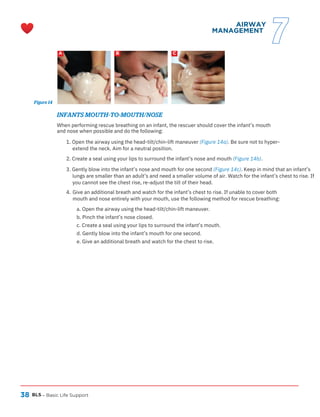
When performing rescue breathing on an infant, the rescuer should cover the infant’s mouth
and nose when possible and do the following:
1. Open the airway using the head-tilt/chin-lift maneuver (Figure 14a). Be sure not to hyper-
extend the neck. Aim for a neutral position.
2. Create a seal using your lips to surround the infant’s nose and mouth (Figure 14b).
Give an additional breath and watch for the infant’s chest to rise. If unable to cover both
mouth and nose entirely with your mouth, use the following method for rescue breathing:
4.
a. Open the airway using the head-tilt/chin-lift maneuver.
b. Pinch the infant’s nose closed.
c. Create a seal using your lips to surround the infant’s mouth.
d. Gently blow into the infant’s mouth for one second.
e. Give an additional breath and watch for the chest to rise.
3. Gently blow into the infant’s nose and mouth for one second (Figure 14c). Keep in mind that an infant’s
lungs are smaller than an adult’s and need a smaller volume of air. Watch for the infant’s chest to rise. If
you cannot see the chest rise, re-adjust the tilt of their head.
39.
39
RESCUE BREATHING
In manycases, cardiac arrest is preceded by respiratory arrest. Therefore, it is important to be
able to recognize respiratory issues in order to take steps to prevent cardiac arrest.
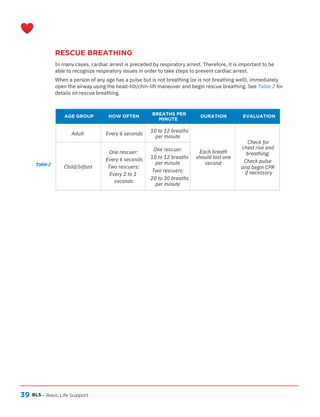
When a person of any age has a pulse but is not breathing (or is not breathing well), immediately
open the airway using the head-tilt/chin-lift maneuver and begin rescue breathing. See Table 2 for
details on rescue breathing.
BLS
AGE GROUP HOW OFTEN BREATHS PER
MINUTE
DURATION EVALUATION
– Basic Life Support
Adult
Child/Infant
Every 6 seconds
One rescuer:
Every 6 seconds
Two rescuers:
Every 2 to 3
seconds
10 to 12 breaths
per minute
One rescuer:
10 to 12 breaths
per minute
Two rescuers:
20 to 30 breaths
per minute
Each breath
should last one
second
Check for
chest rise and
breathing;
Check pulse
and begin CPR
if necessary
Table 2
40.
40 BLS
DEGREE OFOBSTRUCTION PERSON’S RESPONSE RESCUER’S ACTION
– Basic Life Support
Mild Obstruction
Severe Obstruction
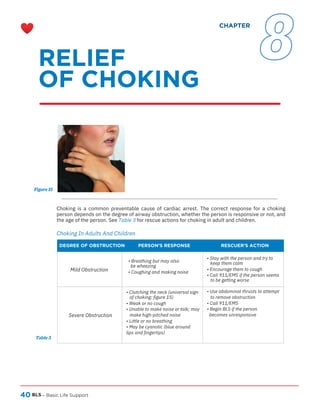
Choking is a common preventable cause of cardiac arrest. The correct response for a choking
person depends on the degree of airway obstruction, whether the person is responsive or not, and
the age of the person. See Table 3 for rescue actions for choking in adult and children.
Choking In Adults And Children
• Breathing but may also
be wheezing
• Coughing and making noise
• Clutching the neck (universal sign
of choking: figure 15)
• Weak or no cough
• Unable to make noise or talk; may
make high-pitched noise
• Little or no breathing
• May be cyanotic (blue around
lips and fingertips)
• Stay with the person and try to
keep them calm
• Encourage them to cough
• Call 911/EMS if the person seems
to be getting worse
• Use abdominal thrusts to attempt
to remove obstruction
• Call 911/EMS
• Begin BLS if the person
becomes unresponsive
Figure 15
Table 3
RELIEF
OF CHOKING
CHAPTER
8
41.
41 BLS
A BC
– Basic Life Support
Figure 16:
Abdominal
Thrusts
If you can see a foreign object in the
individual’s mouth and can easily
remove it, then do it. Watch and
feel for breathing to begin. If the
individual does not begin breath-
ing, continue to provide CPR and
rescue breaths until help arrives.
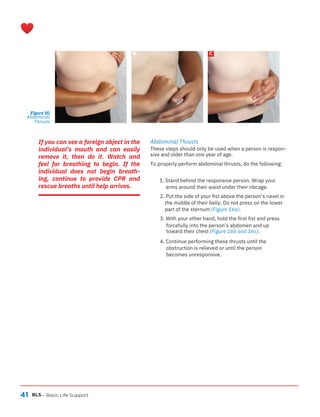
Abdominal Thrusts
These steps should only be used when a person is respon-
sive and older than one year of age.
To properly perform abdominal thrusts, do the following:
1. Stand behind the responsive person. Wrap your
arms around their waist under their ribcage.
3. With your other hand, hold the first fist and press
forcefully into the person’s abdomen and up
toward their chest (Figure 16b and 16c).
4. Continue performing these thrusts until the
obstruction is relieved or until the person
becomes unresponsive.
2. Put the side of your fist above the person’s navel in
the middle of their belly. Do not press on the lower
part of the sternum (Figure 16a).
42.
42 BLS
A BC D
– Basic Life Support
Choking In Infants
DEGREE OF OBSTRUCTION INFANT’S RESPONSE RESCUER’S ACTION
Mild Obstruction
Severe Obstruction
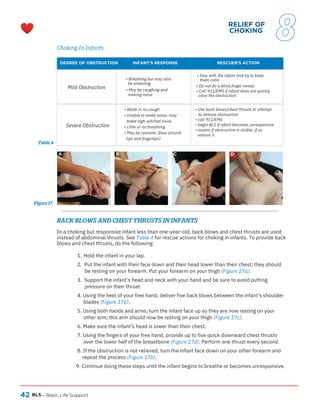
In a choking but responsive infant less than one-year-old, back blows and chest thrusts are used
instead of abdominal thrusts. See Table 4 for rescue actions for choking in infants. To provide back
blows and chest thrusts, do the following:
Hold the infant in your lap.
1.
2. Put the infant with their face down and their head lower than their chest; they should
be resting on your forearm. Put your forearm on your thigh (Figure 17a).
3. Support the infant’s head and neck with your hand and be sure to avoid putting
pressure on their throat.
4. Using the heel of your free hand, deliver five back blows between the infant’s shoulder
blades (Figure 17b).
5. Using both hands and arms, turn the infant face up so they are now resting on your
other arm; this arm should now be resting on your thigh (Figure 17c).
6. Make sure the infant’s head is lower than their chest.
7. Using the fingers of your free hand, provide up to five quick downward chest thrusts
over the lower half of the breastbone (Figure 17d). Perform one thrust every second.
8. If the obstruction is not relieved, turn the infant face down on your other forearm and
repeat the process (Figure 17b).
9. Continue doing these steps until the infant begins to breathe or becomes unresponsive.
• Breathing but may also
be wheezing
• May be coughing and
making noise
• Weak or no cough
• Unable to make noise; may
make high-pitched noise
• Little or no breathing
• May be cyanotic (blue around
lips and fingertips)
• Stay with the infant and try to keep
them calm
• Do not do a blind finger sweep
• Call 911/EMS if infant does not quickly
clear the obstruction
• Use back blows/chest thrusts to attempt
to remove obstruction
• call 911/EMS
• begin BLS if infant becomes unresponsive
• assess if obstruction is visible; if so,
remove it
BACK BLOWS AND CHEST THRUSTS IN INFANTS
Figure 17
Table 4
RELIEF OF
CHOKING
8
43.
43
ANSWERS
BLS – BasicLife Support
SELF-ASSESSMENT FOR RELIEF
OF CHOKING
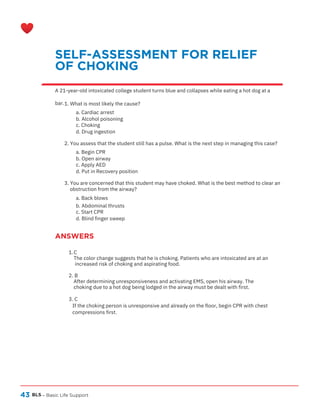
A 21-year-old intoxicated college student turns blue and collapses while eating a hot dog at a
bar.1. What is most likely the cause?
a. Cardiac arrest
b. Alcohol poisoning
c. Choking
d. Drug ingestion
2. You assess that the student still has a pulse. What is the next step in managing this case?
a. Begin CPR
b. Open airway
c. Apply AED
d. Put in Recovery position
3. You are concerned that this student may have choked. What is the best method to clear an
obstruction from the airway?
a. Back blows
b. Abdominal thrusts
c. Start CPR
d. Blind finger sweep
C
1.
The color change suggests that he is choking. Patients who are intoxicated are at an
increased risk of choking and aspirating food.
2. B
After determining unresponsiveness and activating EMS, open his airway. The
choking due to a hot dog being lodged in the airway must be dealt with first.
3. C
If the choking person is unresponsive and already on the floor, begin CPR with chest
compressions first.
44.
44
CERTALERT+
CertAlert+ is theperfect app to minimize a potential area of stress and
distraction in your life. With CertAlert+, you will have all your licenses
and certifications in one place anytime you need them. We will keep
track and remind you when your expiration date approaches, and we
will help you with your registration whenever possible.
With CertAlert+, you can:
BLS – Basic Life Support
• Compile all required licenses and certifications in one location.
• Take photos (front and back) of certification cards and licenses for
simple reference.
• Record all expiration dates and store with ease.
• Choose when you want to be reminded of your approaching
expiration dates.
• Send all license or certification information directly to your email
after exporting from the app.
• Quick access to easily register for online certification
and recertification courses.
With MediCode, you no longer will have to carry a set of expandable cards
with you at all times while at work. You will never have to waste valuable
time in an emergency situation searching through multiple algorithms until
you find the right one. All of the algorithms are now accessible from the
palm of your hand, and you will be selecting your desired algorithm by
memory in no time. Choose between multiple viewing options and easily
share algorithms with co-workers and friends through email and social
media.
To improve functionality and speed in obtaining your desired algorithm as
quickly as possible in an emergency, they have been divided between BLS,
ACLS, PALS, and CPR. All are accessible from the home screen.
The individual algorithms included in this app are:
• Basic Life Support (BLS)
• Advanced Cardiac Life Support (ACLS)
• Pediatric Advanced Life Support (PALS)
• Cardiopulmonary Resuscitation (CPR) AED, and First Aid
ADDITIONAL
TOOLS
MEDICODE
CHAPTER
9
45.
45 BLS –Basic Life Support
1. The 2020 ILCOR Guidelines for CPR changed the recommended compressions to
ventilations ratio for Pediatrics to:
a. 15:2 for all scenarios
b. 30:2 for all scenarios
c. 30:2 for 1 provider, then switch to 15:2 for 2 providers
d. 15:2 for 1 provider, then switch to 30:2 for 2 providers
2. Critical characteristics of high-quality CPR include which of the following?
a. Start chest compressions within 10 seconds of recognition of cardiac arrest
b. Allow complete chest recoil after each compression
c. Minimize interruptions of CPR
d. All of the above
3. At what age is it preferable to use the pediatric AED pads?
a. 8 years of age or older
b. Less than 8 years of age
c. 12 years of age or younger
d. 18 years of age or younger
4. The compression to ventilation ratio for single rescuer giving CPR to an Adult is:
a. 30:1
b. 30:2
c. 15:1
d. 15:2
5. Where should you attempt to perform a pulse check in an adult?
a. Brachial artery
b. Carotid artery
c. Popliteal artery
d. Temporal artery
6. An AED can be used safely in all of the following situations except:
a. Victim lying in the snow
b. Victim with an implanted pacemaker
c. Victim with a transdermal medication patch on
d. Victim lying partially in water
7. The 6 steps in the Adult Chain of Survival include all of the following except:
a. Early CPR
b. Rapid defibrillation
c. Use of cardiovascular medications
d. Integrated post-cardiac arrest care
BLS REVIEW
QUESTIONS
CHAPTER
10
46.
46
ANSWERS
BLS – BasicLife Support
8. You are alone when you encounter a person in what appears to be cardiac or respiratory
arrest. What are the first three steps you should take to stabilize the person? Check for danger,
____________, and send for help.
a. Establish IV access
b. Insert an advanced airway
c. Check for response
d. Start CPR
9. In both children and infants, two minutes of CPR should be given if:
a. Witnessed cardiac arrest
b. Unwitnessed collapse
c. Witnessed choking incident
d. Unresponsive victim with pulse and breathing
10. The proper steps for operating an AED are:
a. Power on the AED, attach electrode pads, shock the person, and analyze the rhythm
b. Power on the AED, attach electrode pads, analyze the rhythm, and shock the person
c. Power on the AED, analyze the rhythm, attach electrode pads, and shock the person
d. Power on the AED, shock the person, attach electrode pads, and analyze the rhythm
1. C
30:2 for 1 provider, then switch to 15:2 for 2 providers
D
All of the above
B
Less than 8 years of age, weighing 55 pounds (25 kg). Eight years old and older (to adult) use
adult pads.
B
30:2
B
Carotid artery
D
Victim lying partially in water
C
Use of cardiovascular medications
C
Check for response.
B.
If you come across a child with unwitnessed collapse, perform 2 minutes of CPR if you are alone
and can’t call for help.
2.
3.
4.
5.
6.
7.
8.
9.
10. B
Power on the AED, attach electrode pads, analyze the rhythm, and shock the person.
47.
47 BLS –Basic Life Support
Who is the
DisqueFoundation?
The Disque Foundation was created
for the sole purpose of empowering
others to save lives! We do this by
providing advanced healthcare
education to underserved
populations of the U.S. and the
world through technology.
To fulfill this mission, we have
created the Save a Life Initiative.
We offer the world’s first free life
support training courses online
through our partnership with
SaveaLife.com (Save a Life
Certifications by NHCPS). Saving
lives means giving others the
chance to make a difference in the
world. Our goal is to empower 10
million people with the ability to
save a life by 2025.
How can I help?
DisqueFoundation.org
Through the help of committed supporters like
yourself, the Disque Foundation will have the ability to
grow and expand our cause across the globe. Please
help us by making a tax-deductible gift to the Disque
Foundation. A donation of any size will help support
our mission and your generous contribution will go
directly to strengthening our efforts to empower
others to save lives.
Donations can be made at
orby mailing a check to:
Disque Foundation Donations Department
1609 W 100 S.
Brownstown, IN 47220
For more information, contact us at
info@disquefoundation.org.
The idea behind the Save a Life
Initiative is simple – take the
same advanced life-saving
training we developed for
health care providers, and give
it to the underserved, at home
and abroad. We work in
conjunction with
SaveaLife.com to fulfill its
mission of advancing health
care education to the
underserved through advanced
technology. When we put the
knowledge, skills, and ability to
perform CPR and other proven
techniques in people’s hands
around the world, the power to
save lives is possible.
DisqueFoundation.org
Learn more at