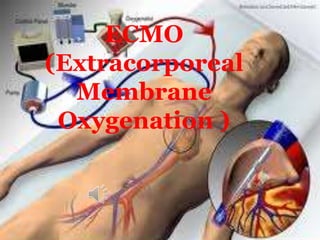
ECMO
(Extracorporeal
Membrane
Oxygenation )
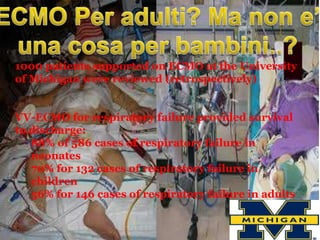
1000 patients supported on ECMO at the University
of Michigan were reviewed (retrospectively)
VV-ECMO for respiratory failure provided survival
to discharge:
88% of 586 cases of respiratory failure in
neonates
70% for 132 cases of respiratory failure in
children
56% for 146 cases of respiratory failure in adults
INIZIALE ESPERIENZA ECMO in UTIC Careggi
07/11/2011 dr Valente
CASISTICA ECMO: 11 PAZIENTI
- Shock cardiogeno: 5 pz

CASISTICA ECMO: 11
PAZIENTI

- ACR: 4 pz

-Rottura di cuore in corso di
STEMI anteriore in 1 pz

- Scompenso cardiaco END-STAGE: 2
pz

-STEMI complicato da shock
cardiogeno: 3 pz

-Occlusione TC in corso di VCG: 1
pz

Età media 54 anni
Rapporto M/F 8:3
IABP, CRRT e ventilazione
meccanica in tutti i pazienti

-NSTE-SCA (occlusione del TC): 1
pz
-Ipertrofica: in 1 pz
- Dilatativa: 2 pz
- Embolia polmonare: 1 pz
- Sindrome di Tako-Tsubo: 1 pz
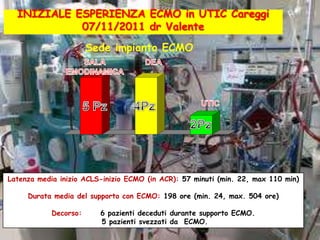
INIZIALE ESPERIENZA ECMO in UTIC Careggi
07/11/2011 dr Valente

Sede impianto ECMO

Latenza media inizio ACLS-inizio ECMO (in ACR): 57 minuti (min. 22, max 110 min)
Durata media del supporto con ECMO: 198 ore (min. 24, max. 504 ore)

Decorso:

6 pazienti deceduti durante supporto ECMO.
5 pazienti svezzati da ECMO.
ECMO is instituted for the management of
life threatening pulmonary or cardiac failure
(or both), when no other form of treatment
has been or is likely to be successful.

ECMO is used as temporary support, usually
awaiting recovery of organs.

ECMO is essentially a modification of the
cardiopulmonary bypass circuit which is used
routinely in cardiac surgery.
MECCANISMO ECMO
 Blood is removed from the venous system

either peripherally via cannulation of a
femoral vein or centrally via cannulation
of the right atrium,
 Oxygenate
 Extract

carbon dioxide

Blood is then returned back to the body
either peripherally via a femoral artery or
centrally via the ascending aorta.
Configurations for ECMO

VENOARTERIOSO

VENO-VENOSO
CONFIGURAZIONE VA
VENO-ARTERIOSA


Blood being drained
from the venous
system and returned
to the arterial system.



Provides both cardiac
and respiratory
support.



Achieved by either
peripheral or central
cannulation
CONFIGURAZIONE VV
VENO-VENOSA
 Provides

oxygenation

 Blood

being drained from venous system and
returned to venous system.

 Only

provides respiratory support

 Achieved

by peripheral cannulation, usually
of both femoral veins.
Central vs. Peripheral
Cannulation
 VANTAGGI
 Flow

from Central ECMO is directly from
the outflow cannula into the aorta provides
antegrade flow to the arch vessels,
coronaries and the rest of the body

 In

contrast, the retrograde aortic flow
provided by peripheral leads to mixing in
the arch.
Central vs. Peripheral Cannulation
 SVANTAGGI


Previously insertion of central ECMO required
leaving chest open to allow the cannulae to exit.
 Increased

the risk of bleeding and infection
 Newer cannulae are designed to be tunneled
through the subcostal abdominal wall allowing
the chest to be completely closed.


Central cannula are costly (approximately 4
times as much as peripheral)
CONSIDERAZIONI
 Mechanical ventilation must be continued during

ECMO support to try to maintain oxygen saturation
of blood ejected from the left ventricle to at least
above 90%.

 ECMO flow can be very volume dependent
 ECMO flow will drop:





Hypovolemia
Cannula malposition
Pneumothorax
Pericardial tamponade.
INDICAZIONI
PER ECMO

INSUFFICIENZA
CARDIACA

INSUFFICIENZA
RESPIRATORIA
INSUFFICIENZA
CARDIACA
• Cardiomiopatia end-stage in terapia medica massimale, in
attesa di trapianto cardiaco;
• Infarto miocardico acuto complicato da shock cardiogeno
refrattario
• Miocardite acuta con severa insufficienza d’organo o aritmie
ventricolari subentranti non controllabili con terapia medica e
IABP;
• Embolia polmonare massiva con grave compromissione della
funzionalità ventricolare destra e shock cardiogeno o ACR
• Arresto cardiaco nel paziente giovane adulto con precoce
rianimazione cardiopolmonare (con verosimile ottima
prognosi neurologica) refrattario a terapia rianimatoria
medica ed elettrica. La durata del supporto con ECMO dovrà
essere il più breve possibile (sconsigliato per più di 3 giorni).
[Da associare ad altre strategie di neuroprotezione come
l’ipotermia terapeutica]
• Grave depressione della funzione cardiaca da intossicazione di
farmaci o sepsi;
Indicazioni ECMO
in UTIC
Si deve tener conto:
• della prognosi, in particolare ripresa della
funzionalità dell’organo [bridge-torecovery],
• dell’eleggibilità per un trapianto
cardiaco [bridge-to-transplantation],
• della possibilità di posizionamento di
assistenze meccaniche più o meno a
lunga durata (come Levitronix
CentriMag, Jarvik 2000, Cardiowest)
[bridge-to-bridge].
• Ma anche ……….. bridge to decision.
INSUFFICIENZA
RESPIRATORIA
• Adult respiratory distress syndrome
(ARDS)
• POLMONITE
• TRAUMA
• Primary graft failure following lung
transplantation.
ECMO is also used for neonatal and
pediatric respiratory support
This is where most of the
research on ECMO has
been done
TREATMENT FOR CHILDREN:
 Hyaline membrane disease
 Meconium Aspiration
 Persistant Fetal Circulation
 Congenital Diaphragmatic Hernia
 Cardiac Anomalies
DECISIONE DI
ATTUARE
ECMO
Possibilità di recupero d'organo:. Appropriato solo se il
processo della malattia è reversibile con la terapia e riposo su
ECMO
Recupero cardiaco: permette un ulteriore recupero cardiaco per
consentire l'impianto del dispositivo (LVAD) o alla lista per il trapianto
CONTROINDICAZIONI

 neoplasia disseminata
 L'età avanzata
 Graft vs host disease

 Gravi lesioni cerebrali
 Arresto cardiaco non testimoniato o di durata prolungata.
 Controindicazioni tecniche da considerare: la dissezione

aortica o dell'aorta incompetenza
Comparison of Pulsatile flow and
Continuous flow LVADs
PATIENTS SELECTION
SVEZZAMENTO DA ECMO

QUANDO?

Lo scambio di gas può essere
mantenuto a valori adeguati con una
bassa FiO2 (<30%)
RR e PEEP impostato sul ventilatore
non sono troppo alti (ad esempio <25
atti / min e <15cmH2O,
rispettivamente).
SANGUINAMENTO
ASSOCIATO A
EPARINIZZAZIONE

COMPLICANZE
DELL’ECMO

SEQUELE
NEUROLOGICHE

COMPLICANZE
MECCANICHE
COAGULOPATIA

TROMBOCITOPENIA

• Continuous activation of
contact and fibrinolytic
systems by the circuit

• Consumption and dilution of
factors within minutes of
initiation of ECMO

• Platelets adhere
to surface
fibrinogen and
are activated
Non-pulsatile
perfusion
to end organs

Kidneys
 Splanchnic circulation seems to be particularly
susceptible
 GI bleeding, ulceration and perforation
 Liver impairment

Intracerebral
bleeds

Mechanical
Complications

• Largely associated with
sepsis
• Manifest as seizures or
brain death

• Tubing rupture
• Pump malfunction
• Cannula related problems

COMPLICANZE
ECMO

Air embolism/
Thromboembolism

Leg
ischemia
• Particularly at peripheral
insertion site of VA
REGOLARI CONTROLLI DI TESTS
EMATOCHIMICI (ogni 6-8h)

•
•
•
•

PREVENZIONE
DELLE
COMPLICANZE

AGGRESSIVO REINTEGRO DEI
FATTORI DI COAGULAZIONE
ELETTROLITI, GRC

Coagulation Profile
Platelet Count
Hemoglobin
Creatinine to evaluate
for renal insufficiency
ECMO
•

Multidisciplinary team evaluation

 (Cardiologist,

Anesthesiologist, Cardiac

Surgeon)
•

Multi-system work-up
Heart disease (Echo, Cath, etc.)
 Respiratory function
 Renal function
 Liver function
 Coagulation cascade and platelet
function

CONCLUSIONE
Mechanical circulatory support represents
a concrete and reliable option in different
scenarios of severe acute and chronic
heart failure
Encouraging results related to
•

•
•
•

new devices and proper management
increasing center-related experience
adequate decision making
implantation
before onset of overt
cardiogenic shock

In severely ill pts, rapid implantation of simple
support (i.e. ECMO) as bridge to decision.
ECMO: PROPOSTA DI RETE
HUB di riferimento
Necessità di:
 Numero telefonico dedicato
 Equipe impianto ECMO H 24
 Disponibilità posto letto dedicato

Priorità:
 Equipe ECMO in centro SPOKE
 Valutazione se impianto ECMO in
centro SPOKE e in quale sede
(UTIC/emodinamica/sala operatoria)
 Stabilizzazione e trasporto protetto
(con o senza ECMO) del paziente

UTIC SPOKE
Necessità di:
 valutazione indicazioni
 stabilizzazione e preparazione del
paziente in accordo con centro HUB






Priorità:
Contattare HUB di riferimento
Concordare modalità di
stabilizzazione con protocolli
condivisi
Stabilire sede di impianto
programmare e concordare
trasporto

Mezzo di trasporto dedicato H 24
ATTUALMENTE ,IN CASI
PARTICOLARI, SI PUO’ PORRE LA
NECESSITA’ DI TRASFERIRE
PAZIENTI IN ECMO
Ecmo
Ecmo
Ecmo
Ecmo
Ecmo
Ecmo

Ecmo

  • 1.
  • 3.
    1000 patients supportedon ECMO at the University of Michigan were reviewed (retrospectively) VV-ECMO for respiratory failure provided survival to discharge: 88% of 586 cases of respiratory failure in neonates 70% for 132 cases of respiratory failure in children 56% for 146 cases of respiratory failure in adults
  • 4.
    INIZIALE ESPERIENZA ECMOin UTIC Careggi 07/11/2011 dr Valente CASISTICA ECMO: 11 PAZIENTI - Shock cardiogeno: 5 pz CASISTICA ECMO: 11 PAZIENTI - ACR: 4 pz -Rottura di cuore in corso di STEMI anteriore in 1 pz - Scompenso cardiaco END-STAGE: 2 pz -STEMI complicato da shock cardiogeno: 3 pz -Occlusione TC in corso di VCG: 1 pz Età media 54 anni Rapporto M/F 8:3 IABP, CRRT e ventilazione meccanica in tutti i pazienti -NSTE-SCA (occlusione del TC): 1 pz -Ipertrofica: in 1 pz - Dilatativa: 2 pz - Embolia polmonare: 1 pz - Sindrome di Tako-Tsubo: 1 pz
  • 5.
    INIZIALE ESPERIENZA ECMOin UTIC Careggi 07/11/2011 dr Valente Sede impianto ECMO Latenza media inizio ACLS-inizio ECMO (in ACR): 57 minuti (min. 22, max 110 min) Durata media del supporto con ECMO: 198 ore (min. 24, max. 504 ore) Decorso: 6 pazienti deceduti durante supporto ECMO. 5 pazienti svezzati da ECMO.
  • 6.
    ECMO is institutedfor the management of life threatening pulmonary or cardiac failure (or both), when no other form of treatment has been or is likely to be successful. ECMO is used as temporary support, usually awaiting recovery of organs. ECMO is essentially a modification of the cardiopulmonary bypass circuit which is used routinely in cardiac surgery.
  • 7.
    MECCANISMO ECMO  Bloodis removed from the venous system either peripherally via cannulation of a femoral vein or centrally via cannulation of the right atrium,  Oxygenate  Extract carbon dioxide Blood is then returned back to the body either peripherally via a femoral artery or centrally via the ascending aorta.
  • 8.
  • 9.
    CONFIGURAZIONE VA VENO-ARTERIOSA  Blood beingdrained from the venous system and returned to the arterial system.  Provides both cardiac and respiratory support.  Achieved by either peripheral or central cannulation
  • 11.
    CONFIGURAZIONE VV VENO-VENOSA  Provides oxygenation Blood being drained from venous system and returned to venous system.  Only provides respiratory support  Achieved by peripheral cannulation, usually of both femoral veins.
  • 13.
    Central vs. Peripheral Cannulation VANTAGGI  Flow from Central ECMO is directly from the outflow cannula into the aorta provides antegrade flow to the arch vessels, coronaries and the rest of the body  In contrast, the retrograde aortic flow provided by peripheral leads to mixing in the arch.
  • 14.
    Central vs. PeripheralCannulation  SVANTAGGI  Previously insertion of central ECMO required leaving chest open to allow the cannulae to exit.  Increased the risk of bleeding and infection  Newer cannulae are designed to be tunneled through the subcostal abdominal wall allowing the chest to be completely closed.  Central cannula are costly (approximately 4 times as much as peripheral)
  • 15.
    CONSIDERAZIONI  Mechanical ventilationmust be continued during ECMO support to try to maintain oxygen saturation of blood ejected from the left ventricle to at least above 90%.  ECMO flow can be very volume dependent  ECMO flow will drop:     Hypovolemia Cannula malposition Pneumothorax Pericardial tamponade.
  • 16.
  • 17.
    INSUFFICIENZA CARDIACA • Cardiomiopatia end-stagein terapia medica massimale, in attesa di trapianto cardiaco; • Infarto miocardico acuto complicato da shock cardiogeno refrattario • Miocardite acuta con severa insufficienza d’organo o aritmie ventricolari subentranti non controllabili con terapia medica e IABP; • Embolia polmonare massiva con grave compromissione della funzionalità ventricolare destra e shock cardiogeno o ACR • Arresto cardiaco nel paziente giovane adulto con precoce rianimazione cardiopolmonare (con verosimile ottima prognosi neurologica) refrattario a terapia rianimatoria medica ed elettrica. La durata del supporto con ECMO dovrà essere il più breve possibile (sconsigliato per più di 3 giorni). [Da associare ad altre strategie di neuroprotezione come l’ipotermia terapeutica] • Grave depressione della funzione cardiaca da intossicazione di farmaci o sepsi;
  • 18.
    Indicazioni ECMO in UTIC Sideve tener conto: • della prognosi, in particolare ripresa della funzionalità dell’organo [bridge-torecovery], • dell’eleggibilità per un trapianto cardiaco [bridge-to-transplantation], • della possibilità di posizionamento di assistenze meccaniche più o meno a lunga durata (come Levitronix CentriMag, Jarvik 2000, Cardiowest) [bridge-to-bridge]. • Ma anche ……….. bridge to decision.
  • 19.
    INSUFFICIENZA RESPIRATORIA • Adult respiratorydistress syndrome (ARDS) • POLMONITE • TRAUMA • Primary graft failure following lung transplantation. ECMO is also used for neonatal and pediatric respiratory support This is where most of the research on ECMO has been done
  • 20.
    TREATMENT FOR CHILDREN: Hyaline membrane disease  Meconium Aspiration  Persistant Fetal Circulation  Congenital Diaphragmatic Hernia  Cardiac Anomalies
  • 21.
    DECISIONE DI ATTUARE ECMO Possibilità direcupero d'organo:. Appropriato solo se il processo della malattia è reversibile con la terapia e riposo su ECMO Recupero cardiaco: permette un ulteriore recupero cardiaco per consentire l'impianto del dispositivo (LVAD) o alla lista per il trapianto CONTROINDICAZIONI  neoplasia disseminata  L'età avanzata  Graft vs host disease  Gravi lesioni cerebrali  Arresto cardiaco non testimoniato o di durata prolungata.  Controindicazioni tecniche da considerare: la dissezione aortica o dell'aorta incompetenza
  • 22.
    Comparison of Pulsatileflow and Continuous flow LVADs
  • 23.
  • 24.
    SVEZZAMENTO DA ECMO QUANDO? Loscambio di gas può essere mantenuto a valori adeguati con una bassa FiO2 (<30%) RR e PEEP impostato sul ventilatore non sono troppo alti (ad esempio <25 atti / min e <15cmH2O, rispettivamente).
  • 25.
  • 26.
    COAGULOPATIA TROMBOCITOPENIA • Continuous activationof contact and fibrinolytic systems by the circuit • Consumption and dilution of factors within minutes of initiation of ECMO • Platelets adhere to surface fibrinogen and are activated
  • 27.
    Non-pulsatile perfusion to end organs Kidneys Splanchnic circulation seems to be particularly susceptible  GI bleeding, ulceration and perforation  Liver impairment 
  • 28.
    Intracerebral bleeds Mechanical Complications • Largely associatedwith sepsis • Manifest as seizures or brain death • Tubing rupture • Pump malfunction • Cannula related problems COMPLICANZE ECMO Air embolism/ Thromboembolism Leg ischemia • Particularly at peripheral insertion site of VA
  • 29.
    REGOLARI CONTROLLI DITESTS EMATOCHIMICI (ogni 6-8h) • • • • PREVENZIONE DELLE COMPLICANZE AGGRESSIVO REINTEGRO DEI FATTORI DI COAGULAZIONE ELETTROLITI, GRC Coagulation Profile Platelet Count Hemoglobin Creatinine to evaluate for renal insufficiency
  • 30.
    ECMO • Multidisciplinary team evaluation (Cardiologist, Anesthesiologist, Cardiac Surgeon) • Multi-system work-up Heart disease (Echo, Cath, etc.)  Respiratory function  Renal function  Liver function  Coagulation cascade and platelet function 
  • 31.
    CONCLUSIONE Mechanical circulatory supportrepresents a concrete and reliable option in different scenarios of severe acute and chronic heart failure Encouraging results related to • • • • new devices and proper management increasing center-related experience adequate decision making implantation before onset of overt cardiogenic shock In severely ill pts, rapid implantation of simple support (i.e. ECMO) as bridge to decision.
  • 32.
    ECMO: PROPOSTA DIRETE HUB di riferimento Necessità di:  Numero telefonico dedicato  Equipe impianto ECMO H 24  Disponibilità posto letto dedicato Priorità:  Equipe ECMO in centro SPOKE  Valutazione se impianto ECMO in centro SPOKE e in quale sede (UTIC/emodinamica/sala operatoria)  Stabilizzazione e trasporto protetto (con o senza ECMO) del paziente UTIC SPOKE Necessità di:  valutazione indicazioni  stabilizzazione e preparazione del paziente in accordo con centro HUB     Priorità: Contattare HUB di riferimento Concordare modalità di stabilizzazione con protocolli condivisi Stabilire sede di impianto programmare e concordare trasporto Mezzo di trasporto dedicato H 24
  • 33.
    ATTUALMENTE ,IN CASI PARTICOLARI,SI PUO’ PORRE LA NECESSITA’ DI TRASFERIRE PAZIENTI IN ECMO