Acids
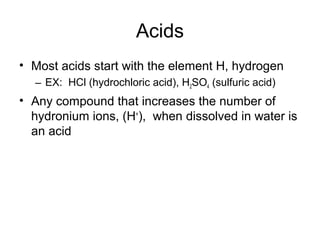
• Most acids start with the element H, hydrogen
  – EX: HCl (hydrochloric acid), H2SO4 (sulfuric acid)
• Any compound that increases the number of
  hydronium ions, (H+), when dissolved in water is
  an acid
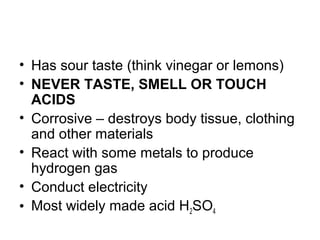
• Has sour taste (think vinegar or lemons)
• NEVER TASTE, SMELL OR TOUCH
  ACIDS
• Corrosive – destroys body tissue, clothing
  and other materials
• React with some metals to produce
  hydrogen gas
• Conduct electricity
• Most widely made acid H2SO4
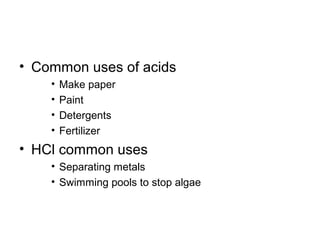
• Common uses of acids
    •   Make paper
    •   Paint
    •   Detergents
    •   Fertilizer
• HCl common uses
    • Separating metals
    • Swimming pools to stop algae
Bases
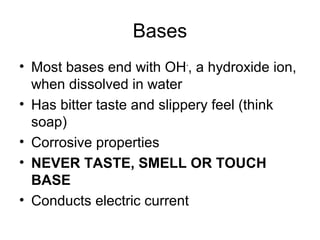
• Most bases end with OH-, a hydroxide ion,
  when dissolved in water
• Has bitter taste and slippery feel (think
  soap)
• Corrosive properties
• NEVER TASTE, SMELL OR TOUCH
  BASE
• Conducts electric current
• Commons uses of bases
  – Make soap
  – Make paper
  – Oven cleaner
  – Drain cleaner
  – Household cleaners
  – Antacids (treat heartburn – rolaids or tums)
Strong -vs- Weak Acids
• Strong acids will have additional Hydrogen
  (H+) molecules in the compound
• All of the Hydrogen molecules break apart
  when dissolved in water
• EX:H2SO4 (sulfuric acid) compared to HCl
  (hydrochloric acid)
• Both are very strong acids but H 2SO4
  would be the strongest of the two
Strong -vs- Weak base
• Strong bases will have additional
  hydroxide (OH-), molecules in the
  compound
• All of the molecules of a base break apart
  when dissolved in water and produce
  hydroxide ions
• EX: NaOH (sodium hydroxide) compared
  to Mg(OH)2 (Magnesium hydroxide)
Salts

• Large group of compounds with similar
  properties
• When a reaction occurs between an acid and a
  base, they neutralize each other
• When an acid neutralizes a base, salt and
  water are produced
• Indicators are use to identify acids and bases
• pH scale is used to determine if an acid or
  base is strong or weak (compared to other
  acids and bases) REMEMBER ALL
  ACIDS AND BASES ARE DANGEROUS
• 7 on the pH scale is neutral (H2O)
• Bases have a pH greater than 7
• Acids have a pH less than 7.

Acids and bases

  • 1.
    Acids • Most acidsstart with the element H, hydrogen – EX: HCl (hydrochloric acid), H2SO4 (sulfuric acid) • Any compound that increases the number of hydronium ions, (H+), when dissolved in water is an acid
  • 2.
    • Has sourtaste (think vinegar or lemons) • NEVER TASTE, SMELL OR TOUCH ACIDS • Corrosive – destroys body tissue, clothing and other materials • React with some metals to produce hydrogen gas • Conduct electricity • Most widely made acid H2SO4
  • 3.
    • Common usesof acids • Make paper • Paint • Detergents • Fertilizer • HCl common uses • Separating metals • Swimming pools to stop algae
  • 4.
    Bases • Most basesend with OH-, a hydroxide ion, when dissolved in water • Has bitter taste and slippery feel (think soap) • Corrosive properties • NEVER TASTE, SMELL OR TOUCH BASE • Conducts electric current
  • 5.
    • Commons usesof bases – Make soap – Make paper – Oven cleaner – Drain cleaner – Household cleaners – Antacids (treat heartburn – rolaids or tums)
  • 6.
    Strong -vs- WeakAcids • Strong acids will have additional Hydrogen (H+) molecules in the compound • All of the Hydrogen molecules break apart when dissolved in water • EX:H2SO4 (sulfuric acid) compared to HCl (hydrochloric acid) • Both are very strong acids but H 2SO4 would be the strongest of the two
  • 7.
    Strong -vs- Weakbase • Strong bases will have additional hydroxide (OH-), molecules in the compound • All of the molecules of a base break apart when dissolved in water and produce hydroxide ions • EX: NaOH (sodium hydroxide) compared to Mg(OH)2 (Magnesium hydroxide)
  • 8.
    Salts • Large groupof compounds with similar properties • When a reaction occurs between an acid and a base, they neutralize each other • When an acid neutralizes a base, salt and water are produced • Indicators are use to identify acids and bases
  • 9.
    • pH scaleis used to determine if an acid or base is strong or weak (compared to other acids and bases) REMEMBER ALL ACIDS AND BASES ARE DANGEROUS • 7 on the pH scale is neutral (H2O) • Bases have a pH greater than 7 • Acids have a pH less than 7.