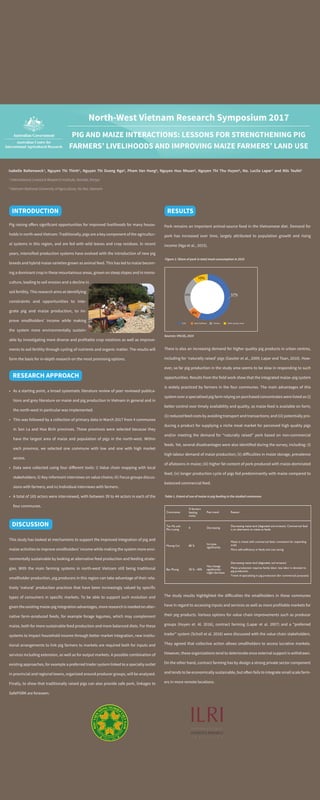
Pig raising offers significant opportunities for improved livelihoods for many house-
holds in north-west Vietnam. Traditionally, pigs are a key component of the agricultur-
al systems in this region, and are fed with wild leaves and crop residues. In recent
years, intensified production systems have evolved with the introduction of new pig
breeds and hybrid maize varieties grown as animal feed. This has led to maize becom-
ing a dominant crop in these mountainous areas, grown on steep slopes and in mono-
culture, leading to soil erosion and a decline in
soil fertility. This research aims at identifying
constraints and opportunities to inte-
grate pig and maize production, to im-
prove smallholders’ income while making
the system more environmentally sustain-
able by investigating more diverse and profitable crop rotations as well as improve-
ments to soil fertility through cycling of nutrients and organic matter. The results will
form the basis for in-depth research on the most promising options.
INTRODUCTION
• As a starting point, a broad systematic literature review of peer reviewed publica-
tions and grey literature on maize and pig production in Vietnam in general and in
the north-west in particular was implemented.
• This was followed by a collection of primary data in March 2017 from 4 communes
in Son La and Hoa Binh provinces. These provinces were selected because they
have the largest area of maize and population of pigs in the north-west. Within
each province, we selected one commune with low and one with high market
access.
• Data were collected using four different tools: i) Value chain mapping with local
stakeholders; ii) Key informant interviews on value chains; iii) Focus groups discus-
sions with farmers; and iv) Individual interviews with farmers.
• A total of 165 actors were interviewed, with between 39 to 44 actors in each of the
four communes.
There is also an increasing demand for higher quality pig products in urban centres,
including for ‘naturally raised’ pigs (Gautier et al., 2009; Lapar and Toan, 2010). How-
ever, so far pig production in the study area seems to be slow in responding to such
opportunities. Results from the field work show that the integrated maize–pig system
is widely practiced by farmers in the four communes. The main advantages of this
system over a specialised pig farm relying on purchased concentrates were listed as (i)
better control over timely availability and quality, as maize feed is available on farm;
(ii) reduced feed costs by avoiding transport and transactions; and (iii) potentially pro-
ducing a product for supplying a niche meat market for perceived high quality pigs
and/or meeting the demand for “naturally raised” pork based on non-commercial
feeds. Yet, several disadvantages were also identified during the survey, including: (i)
high labour demand of maize production; (ii) difficulties in maize storage, prevalence
of aflatoxins in maize; (iii) higher fat content of pork produced with maize-dominated
feed; (iv) longer production cycle of pigs fed predominantly with maize compared to
balanced commercial feed.
The study results highlighted the difficulties the smallholders in these communes
have in regard to accessing inputs and services as well as more profitable markets for
their pig products. Various options for value chain improvements such as producer
groups (Huyen et. Al. 2016), contract farming (Lapar et al. 2007) and a “preferred
trader” system (Scholl et al. 2016) were discussed with the value chain stakeholders.
They agreed that collective action allows smallholders to access lucrative markets.
However, these organizations tend to deteriorate once external support is withdrawn.
On the other hand, contract farming has by design a strong private sector component
and tends to be economically sustainable, but often fails to integrate small scale farm-
ers in more remote locations.
RESEARCH APPROACH
This study has looked at mechanisms to support the improved integration of pig and
maize activities to improve smallholders’ income while making the system more envi-
ronmentally sustainable by looking at alternative feed production and feeding strate-
gies. With the main farming systems in north-west Vietnam still being traditional
smallholder production, pig producers in this region can take advantage of their rela-
tively ‘natural’ production practices that have been increasingly valued by specific
types of consumers in specific markets. To be able to support such evolution and
given the existing maize-pig integration advantages, more research is needed on alter-
native farm–produced feeds, for example forage legumes, which may complement
maize, both for more sustainable feed production and more balanced diets. For these
systems to impact household income through better market integration, new institu-
tional arrangements to link pig farmers to markets are required both for inputs and
services including extension, as well as for output markets. A possible combination of
existing approaches, for example a preferred trader system linked to a specialty outlet
in provincial and regional towns, organized around producer groups, will be analysed.
Finally, to show that traditionally raised pigs can also provide safe pork, linkages to
SafePORK are foreseen.
DISCUSSION
Pork remains an important animal-source food in the Vietnamese diet. Demand for
pork has increased over time, largely attributed to population growth and rising
income (Nga et al., 2015).
RESULTS
PIG AND MAIZE INTERACTIONS: LESSONS FOR STRENGTHENING PIG
FARMERS’ LIVELIHOODS AND IMPROVING MAIZE FARMERS’ LAND USE
North-West Vietnam Research Symposium 2017
Isabelle Baltenweck1, Nguyen Thi Thinh1, Nguyen Thi Duong Nga2, Pham Van Hung2, Nguyen Huu Nhuan2, Nguyen Thi Thu Huyen2, Ma. Lucila Lapar1 and Nils Teufel1
1 International Livestock Research Institute, Nairobi, Kenya
2 Vietnam National University of Agriculture, Ha Noi, Vietnam
Figure 1: Share of pork in total meat consumption in 2010
Table 1. Extent of use of maize in pig feeding in the studied communes
Sources: VHLSS, 2010
57%
10%
8%
24%
Pork Beef, buffaloes Chicken Other poultry meat
Communes
% farmers
feeding
maize
Past trend Reason
Tan My and
Phu Luong
0 Decreasing
Decreasing maize land (degraded and erosion). Commercial feed
is an alternative to maize as feeds
Muong Coi 80 %
Increase
significantly,
Maize is mixed with commercial feed, convenient for expanding
scale.
More self-sufficiency in feeds and cost saving
Bac Phong 30 % - 40%
Not change
significantly/
might decrease
Decreasing maize land (degraded, soil erosion)
Maize production requires family labor; less labor is devoted to
pig production
Trend of specializing in pig production (for commercial purposes)

Pig and maize interactions: Lessons for strengthening pig farmers’ livelihoods and improving maize farmers’ land use

  • 1.
    Pig raising offerssignificant opportunities for improved livelihoods for many house- holds in north-west Vietnam. Traditionally, pigs are a key component of the agricultur- al systems in this region, and are fed with wild leaves and crop residues. In recent years, intensified production systems have evolved with the introduction of new pig breeds and hybrid maize varieties grown as animal feed. This has led to maize becom- ing a dominant crop in these mountainous areas, grown on steep slopes and in mono- culture, leading to soil erosion and a decline in soil fertility. This research aims at identifying constraints and opportunities to inte- grate pig and maize production, to im- prove smallholders’ income while making the system more environmentally sustain- able by investigating more diverse and profitable crop rotations as well as improve- ments to soil fertility through cycling of nutrients and organic matter. The results will form the basis for in-depth research on the most promising options. INTRODUCTION • As a starting point, a broad systematic literature review of peer reviewed publica- tions and grey literature on maize and pig production in Vietnam in general and in the north-west in particular was implemented. • This was followed by a collection of primary data in March 2017 from 4 communes in Son La and Hoa Binh provinces. These provinces were selected because they have the largest area of maize and population of pigs in the north-west. Within each province, we selected one commune with low and one with high market access. • Data were collected using four different tools: i) Value chain mapping with local stakeholders; ii) Key informant interviews on value chains; iii) Focus groups discus- sions with farmers; and iv) Individual interviews with farmers. • A total of 165 actors were interviewed, with between 39 to 44 actors in each of the four communes. There is also an increasing demand for higher quality pig products in urban centres, including for ‘naturally raised’ pigs (Gautier et al., 2009; Lapar and Toan, 2010). How- ever, so far pig production in the study area seems to be slow in responding to such opportunities. Results from the field work show that the integrated maize–pig system is widely practiced by farmers in the four communes. The main advantages of this system over a specialised pig farm relying on purchased concentrates were listed as (i) better control over timely availability and quality, as maize feed is available on farm; (ii) reduced feed costs by avoiding transport and transactions; and (iii) potentially pro- ducing a product for supplying a niche meat market for perceived high quality pigs and/or meeting the demand for “naturally raised” pork based on non-commercial feeds. Yet, several disadvantages were also identified during the survey, including: (i) high labour demand of maize production; (ii) difficulties in maize storage, prevalence of aflatoxins in maize; (iii) higher fat content of pork produced with maize-dominated feed; (iv) longer production cycle of pigs fed predominantly with maize compared to balanced commercial feed. The study results highlighted the difficulties the smallholders in these communes have in regard to accessing inputs and services as well as more profitable markets for their pig products. Various options for value chain improvements such as producer groups (Huyen et. Al. 2016), contract farming (Lapar et al. 2007) and a “preferred trader” system (Scholl et al. 2016) were discussed with the value chain stakeholders. They agreed that collective action allows smallholders to access lucrative markets. However, these organizations tend to deteriorate once external support is withdrawn. On the other hand, contract farming has by design a strong private sector component and tends to be economically sustainable, but often fails to integrate small scale farm- ers in more remote locations. RESEARCH APPROACH This study has looked at mechanisms to support the improved integration of pig and maize activities to improve smallholders’ income while making the system more envi- ronmentally sustainable by looking at alternative feed production and feeding strate- gies. With the main farming systems in north-west Vietnam still being traditional smallholder production, pig producers in this region can take advantage of their rela- tively ‘natural’ production practices that have been increasingly valued by specific types of consumers in specific markets. To be able to support such evolution and given the existing maize-pig integration advantages, more research is needed on alter- native farm–produced feeds, for example forage legumes, which may complement maize, both for more sustainable feed production and more balanced diets. For these systems to impact household income through better market integration, new institu- tional arrangements to link pig farmers to markets are required both for inputs and services including extension, as well as for output markets. A possible combination of existing approaches, for example a preferred trader system linked to a specialty outlet in provincial and regional towns, organized around producer groups, will be analysed. Finally, to show that traditionally raised pigs can also provide safe pork, linkages to SafePORK are foreseen. DISCUSSION Pork remains an important animal-source food in the Vietnamese diet. Demand for pork has increased over time, largely attributed to population growth and rising income (Nga et al., 2015). RESULTS PIG AND MAIZE INTERACTIONS: LESSONS FOR STRENGTHENING PIG FARMERS’ LIVELIHOODS AND IMPROVING MAIZE FARMERS’ LAND USE North-West Vietnam Research Symposium 2017 Isabelle Baltenweck1, Nguyen Thi Thinh1, Nguyen Thi Duong Nga2, Pham Van Hung2, Nguyen Huu Nhuan2, Nguyen Thi Thu Huyen2, Ma. Lucila Lapar1 and Nils Teufel1 1 International Livestock Research Institute, Nairobi, Kenya 2 Vietnam National University of Agriculture, Ha Noi, Vietnam Figure 1: Share of pork in total meat consumption in 2010 Table 1. Extent of use of maize in pig feeding in the studied communes Sources: VHLSS, 2010 57% 10% 8% 24% Pork Beef, buffaloes Chicken Other poultry meat Communes % farmers feeding maize Past trend Reason Tan My and Phu Luong 0 Decreasing Decreasing maize land (degraded and erosion). Commercial feed is an alternative to maize as feeds Muong Coi 80 % Increase significantly, Maize is mixed with commercial feed, convenient for expanding scale. More self-sufficiency in feeds and cost saving Bac Phong 30 % - 40% Not change significantly/ might decrease Decreasing maize land (degraded, soil erosion) Maize production requires family labor; less labor is devoted to pig production Trend of specializing in pig production (for commercial purposes)