2018 ACHD Guidelines- Part II
Left side obstructive lesions
Dr. N. Praveen, MD, DM
Cor triatriatum
 Diagnostic
 I - Evaluation for other congenital abnormalities (ASD,
VSD, anamolous pulmonary venous connection).
 IIa- with prior repair of cor triatriatum sinister and
recurrent symptoms, it is reasonable to evaluate for
pulmonary vein stenosis.
 I - surgical repair is indicated for symptoms attributable to
the obstruction or a substantial gradient across the
membrane.
Important Points
 Cor triatriatum occurs when a membrane divides either the
left atrium (sinister), or right atrium (dexter).
 The left atrial appendage(LAA) is invariably in the same
chamber as the mitral valve, separated from the
pulmonary veins by the membrane.
 Supravalvular mitral stenosis is typically caused by a
fibrous ring on the atrial side of the mitral valve,
separating the mitral valve from both the LAA and the
pulmonary veins.
Important points
 Surgery has been largely successful with relatively few
early or late deaths (usually attributable to associated
congenital abnormalities).
 The gradient across the defect at the time of surgery was at
least 8 mm Hg (mean 17 mm Hg; range 8 to 40 mm Hg).
 After repair, recurrence of stenosis is not expected.
 Pulmonary vein stenosis is not progressive and is not
associated with PAH.
 The mean gradient at the time of surgical repair was at
least 8 mm Hg.
 Clinical circumstances (i.e., symptoms, arrhythmia) would
warrant intervention in patients with lower gradients.
Congenital mitral stenosis
 Other left sided lesions to be evaluated.
 Balloon mitral valvuloplasty is rarely, if ever indicated or
effective in congenital mitral stenosis.
 Parachute mitral valve is most commonly found in the
presence of other congenital abnormalities such as the
components of Shone complex.
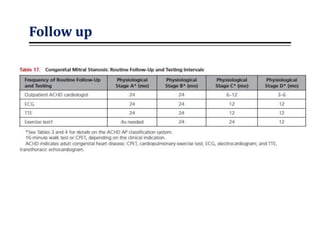
Follow up
Sub aortic stenosis
 Class IIb – stress testing in case of equivocal indications for
intervention
 Class I - subaortic stenosis gradient > 50 mm Hg
 Class I - gradient < 50 mm Hg and presence of HF, ischemic
symptoms
 Class IIb – asymptomatic SubAS, mild AR, gradient > 50mm Hg.
Imp. points
SubAS may occur as a
 discrete membrane below the aortic valve in the LVOT,
 as a longer tunnel-like obstruction,
 as a consequence of chordal attachments in patients with
abnormalities such as AVSD,
 or because of surgical repairs involving VSD baffled to a
transposed aorta (Rastelli operation).
 In adults with Shone complex or its variants, subAS may be one
of several LV obstructive lesions, including variants of
congenital MS, supravalvular MS, val AS, supravalvular aortic
stenosis, and CoA.
 SubAS tends to recur, particularly when initial resection is needed
in childhood.
 Surgical repair for subAS carries a 10% to 15% risk of complete
heart block.
 SubAS may be confused with hypertrophic obstructive
cardiomyopathy when diagnosed in adult.
 Turbulent flow created distal to the subaortic obstruction may
cause barotrauma to the adjacent aortic valve leaflets and result in
progressive AR, which may itself become clinically significant.
 Resection of the subaortic obstruction ideally delays or prevents
the eventual need for aortic valve replacement, and concomitant
aortic valve repair could also help delay the need for aortic valve
replacement in these cases.
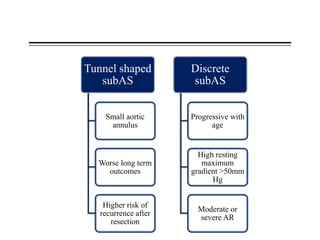
Tunnel shaped
subAS
Small aortic
annulus
Worse long term
outcomes
Higher risk of
recurrence after
resection
Discrete
subAS
Progressive with
age
High resting
maximum
gradient >50mm
Hg
Moderate or
severe AR
Congenital valvular aortic stenosis
 BAV, UAV, AS secondary to hypoplastic aortic annulus.
 Coarctation of aorta to be evaluated (I)
 Screening of first degree relatives of patients with BAV or
UAV by echocardiography. (IIa)
 BAV + non calcified AV (mild AR) - Balloon Aortic
Valvuloplasty (IIb)
 Timing of intervention is as per VHD guidelines.
 Additional – annular enlarging procedures to be done.
Coarctation of aorta and BAV
 Male to female ratio of 1.5:1.
 BAV is present in 50-70% of Coarctation of Aorta.
 BAV is the most prevalent congenital cardiac abnormality with
an estimated prevalence of 4.6 per 1000 live births, and is 1.5
times more prevalent in males than females.
 Spontaneous and has AD inheritance in families
 Prevalence of asymptomatic BAV in first-degree relatives of
patients is 9%, and 32% of first-degree relatives without a BAV
will have an abnormal aorta.
 Calcification of the aortic valve in adults necessitates that most
patients who require therapy for aortic stenosis will require
aortic valve replacement per GDMT.
 In general, the valves that would be amenable to successful
balloon valvuloplasty are found in young patients, who are
often <25 years of age.
 Balloon valvuloplasty of calcified BAV is associated with
decreased efficacy and an increased risk of AR.
 Needs evaluation by ACHD cardiologist in younger age.
Turner syndrome
 Evaluated for BAV, coarctation of aorta, enlargement of the
ascending aorta.
 Prophylactic replacement of the aortic root or ascending aorta in
adults with Turner syndrome is reasonable when the aortic
diameter is 2.5 cm/m2 or greater.
 Aortopathy is a commonly associated condition, and frequently
involves the mid-ascending aorta, which may not be reliably
seen on TTE.
 Side-by-side comparisons are more reliable for detecting
changes over time.
 Pregnancy in Turner syndrome, which often requires assisted
reproductive technology, is associated with an increased risk of
aortic dissection, especially if there is a preexisting abnormality
of the aortic valve or aorta.
 Measurements must take into account the patient's stature
either by indexing to body surface area utilizing Turner-
specific normative data or by using ratio of aortic area to
body height.
Aortopathies
 Several CHD subtypes and/or repairs are associated with
enlargement of the aorta.
 The management of these varies by condition, as some are
perceived to have a stronger association with aortic
dissection or rupture than others, although the true natural
history of most is unknown.
 There is wide heterogeneity of timing of surgical referral,
which makes interpretation of longitudinal studies
problematic
BAV and aortopathy
 Most common CHD associated with aortopathy and is of high
concern for aortic complications.
 In published series of dissection, BAV accounts for a higher
proportion of dissections than expected from prevalence of BAV in
the general population alone.
 The risk of aortic rupture or dissection is 0.5% at 16 years of follow
up, 11% underwent elective aortic surgery.
 Risk factors were age and enlarged aorta at baseline.
 Frequency of dissection in BAV is higher in patients with Turner
syndrome.
 A dilated neoaortic root after a Ross procedure is not uncommon,
although only a single dissection has been reported.
 Because of this, it is generally believed that prophylactic root
replacement strategies based on sinus of Valsalva diameters
can be less aggressive after a Ross procedure than in a native
BAV patient, but practice patterns vary.
 Most patients with a Ross repair had underlying congenitally
abnormal aortic valves (BAV or unicuspid aortic valve) and,
therefore, are at risk of the ascending aortic dilation typical of
those abnormalities.
 Thus, in addition to the dilation at the sinuses of Valsalva
associated with the Ross repair, dilation of the native ascending
aorta above the sinotubular junction can also occur.
 Although patients with conotruncal abnormalities (TOF,
dextrotransposition of the great arteries [d-TGA] after arterial
switch, pulmonary atresia with VSD, truncus arteriosus) commonly
have aortic diameters of 40 mm to 50 mm, aortic complications are
extremely rare (only 6 published case reports).
 Risk factor management such as control of hypertension is
important.
 There are no RCTs evaluating the efficacy of medical therapy to
reduce the rate of progression of aortic dilation or incidence of
aortic dissection in this population.
Supravalvular Aortic Stenosis
Class I
 Aortic imaging using TTE, TEE, CMR, CTA is recommended in
adults with Williams syndrome or patients suspected to have
supravalvular AS.
 Coronary imaging to be done if patients present with symptoms
suggestive of coronary ischemia.
 Surgical repair of SupAS if LV dysfunction is deemed to be
secondary to AS.
 Coronary revascularization is recommended in symptomatic patients
with ostial coronary stenosis.
 Relatively rare condition.
 Seen in patients with Williams syndrome, homozygous familial
hypercholesterolemia.
 Stenotic ridge occurs distal to the origin of the coronary arteries at
the sinotubular junction.
 Coronary abnormalities – coronary ostial obstruction – SCD and
anaesthesia risk.
 Unlike subAS or valvular aortic stenosis, the coronary arteries are
exposed to the higher pressure generated by the supravalvular
obstruction.
 TTE – Apical, suprasternal and right parasternal views.
 TEE,3D TEE – narrowed ascending aorta
 Cardiac MRI and CTA comprehensive imaging
 Impaired coronary perfusion may occur because of varying degrees
of aortic valve leaflet adhesion to the narrowed sinotubular junction
or because of fibrotic thickening in the area immediately surrounding
the coronary ostia – ostial stenosis with restriction of diastolic filling
of the coronary arteries.
 Left coronary artery is mainly involved.
 TEE with Doppler can be used in the assessment of proximal
coronary patency and to search for flow turbulence.
 CMR can also be used in assessing the coronary ostia.
Electrocardiographic-gated CT coronary angiography or invasive
selective coronary angiography provides excellent visualization of
the coronary arterial anatomy.
 Progressive problem – progressive increase in LV systolic
pressure – systolic dysfunction.
 Impaired coronary perfusion may occur because of varying
degrees of aortic valve leaflet adhesion to the narrowed
sinotubular junction with restriction in diastolic filling of
the coronary arteries.
 Surgical coronary revascularization is recommended for
patients with symptoms of coronary ischemia.
Coarctation of the Aorta
Diagnostic
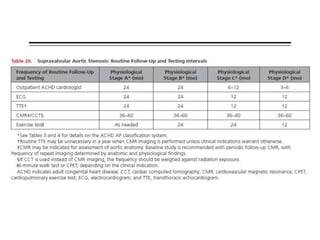
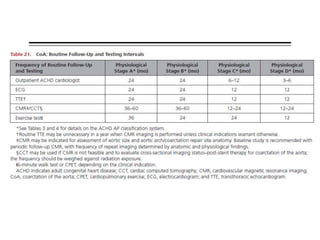
 Initial and follow up aortic dimensions to be imaged by CMR,CTA
in patients with surgical or catheter intervention.
 Upper limb and lower limb BP to be measured in all adults with
CoA.
 Ambulatory BP monitoring for diagnosis and management of
hypertension (IIa)
 Screening for intracranial aneurysms by MRA, CTA (IIB)
 Exercise testing for exercise induced HTN (IIB)
Therapeutic
 Surgical or catheter based stenting is recommended for
adults with hypertension and significant native or recurrent
coarctation of aorta.
 GDMT for HTN
 Balloon angioplasty if stent placement is not feasible and
surgical management is not an option.
Coarctation of Aorta
 Typically occurs at the ductal remnant and the left subclavian artery.
 Hypertension is the most common sequelae (repaired or unrepaired)
 Ascending aortic aneurysms are often found in those with BAV, and
aneurysms are seen at the site of coarctation repair in the descending
thoracic aorta or arch.
 Dissection can occur, presumably more likely in the setting of poorly
controlled hypertension.
 Even with excellent repair, hypertension remains common and
predisposes to later myocardial infarction, stroke, and HF.
 Complications of CoA repair include recoarctation, aneurysm,
pseudoaneurysm, and dissection.
 Around 11% patients may need reintervention
 Who have undergone surgical repair are at increased risk of aneurysms –
CTA,CMR – evaluation of aneurysms.
 After successful transcatheter intervention with stenting or balloon
angioplasty, follow-up CMR or CTA imaging is recommended to evaluate
for long-term complications (eg aneurysm formation, stent fracture, or
stent migration).
 The same CMR or CTA study will also evaluate the ascending aorta,
which may become aneurysmal over the years of follow-up.
 Upper body systemic hypertension is prevalent in patients with unoperated
coarctation and may be present in up to one third of patients who have
undergone operative or transcatheter intervention.
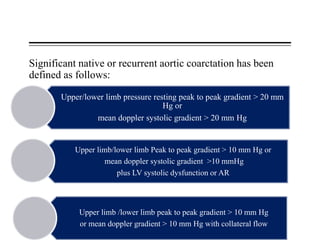
Significant native or recurrent aortic coarctation has been
defined as follows:
Upper/lower limb pressure resting peak to peak gradient > 20 mm
Hg or
mean doppler systolic gradient > 20 mm Hg
Upper limb/lower limb Peak to peak gradient > 10 mm Hg or
mean doppler systolic gradient >10 mmHg
plus LV systolic dysfunction or AR
Upper limb /lower limb peak to peak gradient > 10 mm Hg
or mean doppler gradient > 10 mm Hg with collateral flow
Intracranial aneurysms
 Approximately 10% of patients with CoA have intracranial aneurysms
identified on magnetic resonance angiography or CTA.
 Increasing age has been identified as a risk factor.
 Additionally, there are some data suggesting that intracranial aneurysms
are not commonly found in children and teenagers with CoA,
reinforcing the possibility that coarctation alone may not be sufficient
for development of intracranial aneurysm, and other factors, such as
hypertension and/or age, play a role in development and progression of
aneurysms.
 Up to 80% of patients with prior CoA intervention manifest an
abnormally elevated upper extremity exercise blood pressure response,
and peak blood pressure is correlated with increased LV mass.
 restenosis of the previously repaired or stented region may
be identified by increased peak blood pressure response,
increased upper to lower extremity blood pressure gradient
with exercise, and increased Doppler velocity across the
coarctation site during exercise TTE.
 Multiple factors help determine whether surgery or stenting
is optimal, including anatomic features such as proximity of
native coarctation to head and neck vessels or concomitant
aneurysm, and, if stenting, whether a covered stent is
needed.
 Balloon angioplasty alone is associated with a higher rate
of intimal tears and aneurysm formation compared with
stent placement.
Thank you

ACHD Guidelines part II

  • 1.
    2018 ACHD Guidelines-Part II Left side obstructive lesions Dr. N. Praveen, MD, DM
  • 2.
    Cor triatriatum  Diagnostic I - Evaluation for other congenital abnormalities (ASD, VSD, anamolous pulmonary venous connection).  IIa- with prior repair of cor triatriatum sinister and recurrent symptoms, it is reasonable to evaluate for pulmonary vein stenosis.  I - surgical repair is indicated for symptoms attributable to the obstruction or a substantial gradient across the membrane.
  • 3.
    Important Points  Cortriatriatum occurs when a membrane divides either the left atrium (sinister), or right atrium (dexter).  The left atrial appendage(LAA) is invariably in the same chamber as the mitral valve, separated from the pulmonary veins by the membrane.  Supravalvular mitral stenosis is typically caused by a fibrous ring on the atrial side of the mitral valve, separating the mitral valve from both the LAA and the pulmonary veins.
  • 4.
    Important points  Surgeryhas been largely successful with relatively few early or late deaths (usually attributable to associated congenital abnormalities).  The gradient across the defect at the time of surgery was at least 8 mm Hg (mean 17 mm Hg; range 8 to 40 mm Hg).  After repair, recurrence of stenosis is not expected.
  • 5.
     Pulmonary veinstenosis is not progressive and is not associated with PAH.  The mean gradient at the time of surgical repair was at least 8 mm Hg.  Clinical circumstances (i.e., symptoms, arrhythmia) would warrant intervention in patients with lower gradients.
  • 6.
    Congenital mitral stenosis Other left sided lesions to be evaluated.  Balloon mitral valvuloplasty is rarely, if ever indicated or effective in congenital mitral stenosis.  Parachute mitral valve is most commonly found in the presence of other congenital abnormalities such as the components of Shone complex.
  • 7.
  • 8.
    Sub aortic stenosis Class IIb – stress testing in case of equivocal indications for intervention  Class I - subaortic stenosis gradient > 50 mm Hg  Class I - gradient < 50 mm Hg and presence of HF, ischemic symptoms  Class IIb – asymptomatic SubAS, mild AR, gradient > 50mm Hg.
  • 9.
    Imp. points SubAS mayoccur as a  discrete membrane below the aortic valve in the LVOT,  as a longer tunnel-like obstruction,  as a consequence of chordal attachments in patients with abnormalities such as AVSD,  or because of surgical repairs involving VSD baffled to a transposed aorta (Rastelli operation).  In adults with Shone complex or its variants, subAS may be one of several LV obstructive lesions, including variants of congenital MS, supravalvular MS, val AS, supravalvular aortic stenosis, and CoA.
  • 10.
     SubAS tendsto recur, particularly when initial resection is needed in childhood.  Surgical repair for subAS carries a 10% to 15% risk of complete heart block.  SubAS may be confused with hypertrophic obstructive cardiomyopathy when diagnosed in adult.  Turbulent flow created distal to the subaortic obstruction may cause barotrauma to the adjacent aortic valve leaflets and result in progressive AR, which may itself become clinically significant.  Resection of the subaortic obstruction ideally delays or prevents the eventual need for aortic valve replacement, and concomitant aortic valve repair could also help delay the need for aortic valve replacement in these cases.
  • 11.
    Tunnel shaped subAS Small aortic annulus Worselong term outcomes Higher risk of recurrence after resection Discrete subAS Progressive with age High resting maximum gradient >50mm Hg Moderate or severe AR
  • 12.
    Congenital valvular aorticstenosis  BAV, UAV, AS secondary to hypoplastic aortic annulus.  Coarctation of aorta to be evaluated (I)  Screening of first degree relatives of patients with BAV or UAV by echocardiography. (IIa)  BAV + non calcified AV (mild AR) - Balloon Aortic Valvuloplasty (IIb)  Timing of intervention is as per VHD guidelines.  Additional – annular enlarging procedures to be done.
  • 14.
    Coarctation of aortaand BAV  Male to female ratio of 1.5:1.  BAV is present in 50-70% of Coarctation of Aorta.  BAV is the most prevalent congenital cardiac abnormality with an estimated prevalence of 4.6 per 1000 live births, and is 1.5 times more prevalent in males than females.  Spontaneous and has AD inheritance in families  Prevalence of asymptomatic BAV in first-degree relatives of patients is 9%, and 32% of first-degree relatives without a BAV will have an abnormal aorta.  Calcification of the aortic valve in adults necessitates that most patients who require therapy for aortic stenosis will require aortic valve replacement per GDMT.
  • 15.
     In general,the valves that would be amenable to successful balloon valvuloplasty are found in young patients, who are often <25 years of age.  Balloon valvuloplasty of calcified BAV is associated with decreased efficacy and an increased risk of AR.  Needs evaluation by ACHD cardiologist in younger age.
  • 16.
    Turner syndrome  Evaluatedfor BAV, coarctation of aorta, enlargement of the ascending aorta.  Prophylactic replacement of the aortic root or ascending aorta in adults with Turner syndrome is reasonable when the aortic diameter is 2.5 cm/m2 or greater.  Aortopathy is a commonly associated condition, and frequently involves the mid-ascending aorta, which may not be reliably seen on TTE.  Side-by-side comparisons are more reliable for detecting changes over time.  Pregnancy in Turner syndrome, which often requires assisted reproductive technology, is associated with an increased risk of aortic dissection, especially if there is a preexisting abnormality of the aortic valve or aorta.
  • 17.
     Measurements musttake into account the patient's stature either by indexing to body surface area utilizing Turner- specific normative data or by using ratio of aortic area to body height.
  • 18.
    Aortopathies  Several CHDsubtypes and/or repairs are associated with enlargement of the aorta.  The management of these varies by condition, as some are perceived to have a stronger association with aortic dissection or rupture than others, although the true natural history of most is unknown.  There is wide heterogeneity of timing of surgical referral, which makes interpretation of longitudinal studies problematic
  • 19.
    BAV and aortopathy Most common CHD associated with aortopathy and is of high concern for aortic complications.  In published series of dissection, BAV accounts for a higher proportion of dissections than expected from prevalence of BAV in the general population alone.  The risk of aortic rupture or dissection is 0.5% at 16 years of follow up, 11% underwent elective aortic surgery.  Risk factors were age and enlarged aorta at baseline.  Frequency of dissection in BAV is higher in patients with Turner syndrome.
  • 20.
     A dilatedneoaortic root after a Ross procedure is not uncommon, although only a single dissection has been reported.  Because of this, it is generally believed that prophylactic root replacement strategies based on sinus of Valsalva diameters can be less aggressive after a Ross procedure than in a native BAV patient, but practice patterns vary.  Most patients with a Ross repair had underlying congenitally abnormal aortic valves (BAV or unicuspid aortic valve) and, therefore, are at risk of the ascending aortic dilation typical of those abnormalities.  Thus, in addition to the dilation at the sinuses of Valsalva associated with the Ross repair, dilation of the native ascending aorta above the sinotubular junction can also occur.
  • 21.
     Although patientswith conotruncal abnormalities (TOF, dextrotransposition of the great arteries [d-TGA] after arterial switch, pulmonary atresia with VSD, truncus arteriosus) commonly have aortic diameters of 40 mm to 50 mm, aortic complications are extremely rare (only 6 published case reports).  Risk factor management such as control of hypertension is important.  There are no RCTs evaluating the efficacy of medical therapy to reduce the rate of progression of aortic dilation or incidence of aortic dissection in this population.
  • 22.
    Supravalvular Aortic Stenosis ClassI  Aortic imaging using TTE, TEE, CMR, CTA is recommended in adults with Williams syndrome or patients suspected to have supravalvular AS.  Coronary imaging to be done if patients present with symptoms suggestive of coronary ischemia.  Surgical repair of SupAS if LV dysfunction is deemed to be secondary to AS.  Coronary revascularization is recommended in symptomatic patients with ostial coronary stenosis.
  • 23.
     Relatively rarecondition.  Seen in patients with Williams syndrome, homozygous familial hypercholesterolemia.  Stenotic ridge occurs distal to the origin of the coronary arteries at the sinotubular junction.  Coronary abnormalities – coronary ostial obstruction – SCD and anaesthesia risk.  Unlike subAS or valvular aortic stenosis, the coronary arteries are exposed to the higher pressure generated by the supravalvular obstruction.
  • 25.
     TTE –Apical, suprasternal and right parasternal views.  TEE,3D TEE – narrowed ascending aorta  Cardiac MRI and CTA comprehensive imaging  Impaired coronary perfusion may occur because of varying degrees of aortic valve leaflet adhesion to the narrowed sinotubular junction or because of fibrotic thickening in the area immediately surrounding the coronary ostia – ostial stenosis with restriction of diastolic filling of the coronary arteries.  Left coronary artery is mainly involved.  TEE with Doppler can be used in the assessment of proximal coronary patency and to search for flow turbulence.  CMR can also be used in assessing the coronary ostia. Electrocardiographic-gated CT coronary angiography or invasive selective coronary angiography provides excellent visualization of the coronary arterial anatomy.
  • 26.
     Progressive problem– progressive increase in LV systolic pressure – systolic dysfunction.  Impaired coronary perfusion may occur because of varying degrees of aortic valve leaflet adhesion to the narrowed sinotubular junction with restriction in diastolic filling of the coronary arteries.  Surgical coronary revascularization is recommended for patients with symptoms of coronary ischemia.
  • 27.
    Coarctation of theAorta Diagnostic  Initial and follow up aortic dimensions to be imaged by CMR,CTA in patients with surgical or catheter intervention.  Upper limb and lower limb BP to be measured in all adults with CoA.  Ambulatory BP monitoring for diagnosis and management of hypertension (IIa)  Screening for intracranial aneurysms by MRA, CTA (IIB)  Exercise testing for exercise induced HTN (IIB)
  • 28.
    Therapeutic  Surgical orcatheter based stenting is recommended for adults with hypertension and significant native or recurrent coarctation of aorta.  GDMT for HTN  Balloon angioplasty if stent placement is not feasible and surgical management is not an option.
  • 29.
    Coarctation of Aorta Typically occurs at the ductal remnant and the left subclavian artery.  Hypertension is the most common sequelae (repaired or unrepaired)  Ascending aortic aneurysms are often found in those with BAV, and aneurysms are seen at the site of coarctation repair in the descending thoracic aorta or arch.  Dissection can occur, presumably more likely in the setting of poorly controlled hypertension.  Even with excellent repair, hypertension remains common and predisposes to later myocardial infarction, stroke, and HF.  Complications of CoA repair include recoarctation, aneurysm, pseudoaneurysm, and dissection.
  • 30.
     Around 11%patients may need reintervention  Who have undergone surgical repair are at increased risk of aneurysms – CTA,CMR – evaluation of aneurysms.  After successful transcatheter intervention with stenting or balloon angioplasty, follow-up CMR or CTA imaging is recommended to evaluate for long-term complications (eg aneurysm formation, stent fracture, or stent migration).  The same CMR or CTA study will also evaluate the ascending aorta, which may become aneurysmal over the years of follow-up.  Upper body systemic hypertension is prevalent in patients with unoperated coarctation and may be present in up to one third of patients who have undergone operative or transcatheter intervention.
  • 31.
    Significant native orrecurrent aortic coarctation has been defined as follows: Upper/lower limb pressure resting peak to peak gradient > 20 mm Hg or mean doppler systolic gradient > 20 mm Hg Upper limb/lower limb Peak to peak gradient > 10 mm Hg or mean doppler systolic gradient >10 mmHg plus LV systolic dysfunction or AR Upper limb /lower limb peak to peak gradient > 10 mm Hg or mean doppler gradient > 10 mm Hg with collateral flow
  • 32.
    Intracranial aneurysms  Approximately10% of patients with CoA have intracranial aneurysms identified on magnetic resonance angiography or CTA.  Increasing age has been identified as a risk factor.  Additionally, there are some data suggesting that intracranial aneurysms are not commonly found in children and teenagers with CoA, reinforcing the possibility that coarctation alone may not be sufficient for development of intracranial aneurysm, and other factors, such as hypertension and/or age, play a role in development and progression of aneurysms.  Up to 80% of patients with prior CoA intervention manifest an abnormally elevated upper extremity exercise blood pressure response, and peak blood pressure is correlated with increased LV mass.
  • 33.
     restenosis ofthe previously repaired or stented region may be identified by increased peak blood pressure response, increased upper to lower extremity blood pressure gradient with exercise, and increased Doppler velocity across the coarctation site during exercise TTE.
  • 34.
     Multiple factorshelp determine whether surgery or stenting is optimal, including anatomic features such as proximity of native coarctation to head and neck vessels or concomitant aneurysm, and, if stenting, whether a covered stent is needed.  Balloon angioplasty alone is associated with a higher rate of intimal tears and aneurysm formation compared with stent placement.
  • 36.