AORTIC VALVULAR DISEASES


       PROF. KHWAJA N. MAHMOOD
        HEAD OF THE DEPARTMENT
        CARDIAC SURGERY, NICVD


1
Etiology of Aortic stenosis


    1.   Rheumatic – most common

    2.   Congenital-
             Valvular (calcified bicuspic valve)- next common
             Supravalvular
             subvalvular

    1.   Sclerotic- senile calcific aortic stenosis


2
Etiology of Aortic regurgitation
    1. Primary valve
    disease                                    2. Aortic root disease
    a)   Rheumatic AR                          Annular ectasia from

    b)   Congenital- bicuspid aortic valve
                                               a)    Chronic aortic aneurysm
         or in association with VSD
    c)   Infective endocarditis                b)    Dissecting aortic aneurysm
    d)   Aortitis- syphilitic aortitis or      Annulo aortic ectasia from
         ankylosing spondylitis , Giant cell
                                               c)    Marfan’s syndrome
         arteritis.


3
Causes depending on severitiy of AR

    Acute    ar                 Chronic ar

    1. Infective endocarditis   1.   Rheumatic AR
                                2.   Congenital – bicuspid
    2. Trauma
                                     aortic valve
    3. Dissecting aortic        3.   Aortitis- syphilitic ,
       aneurysm                      ankylosing spondylitis
                                4.   Marfan’s syndrome


4
Natural history of AS & AR                                                 (surgically
                                     untreated )
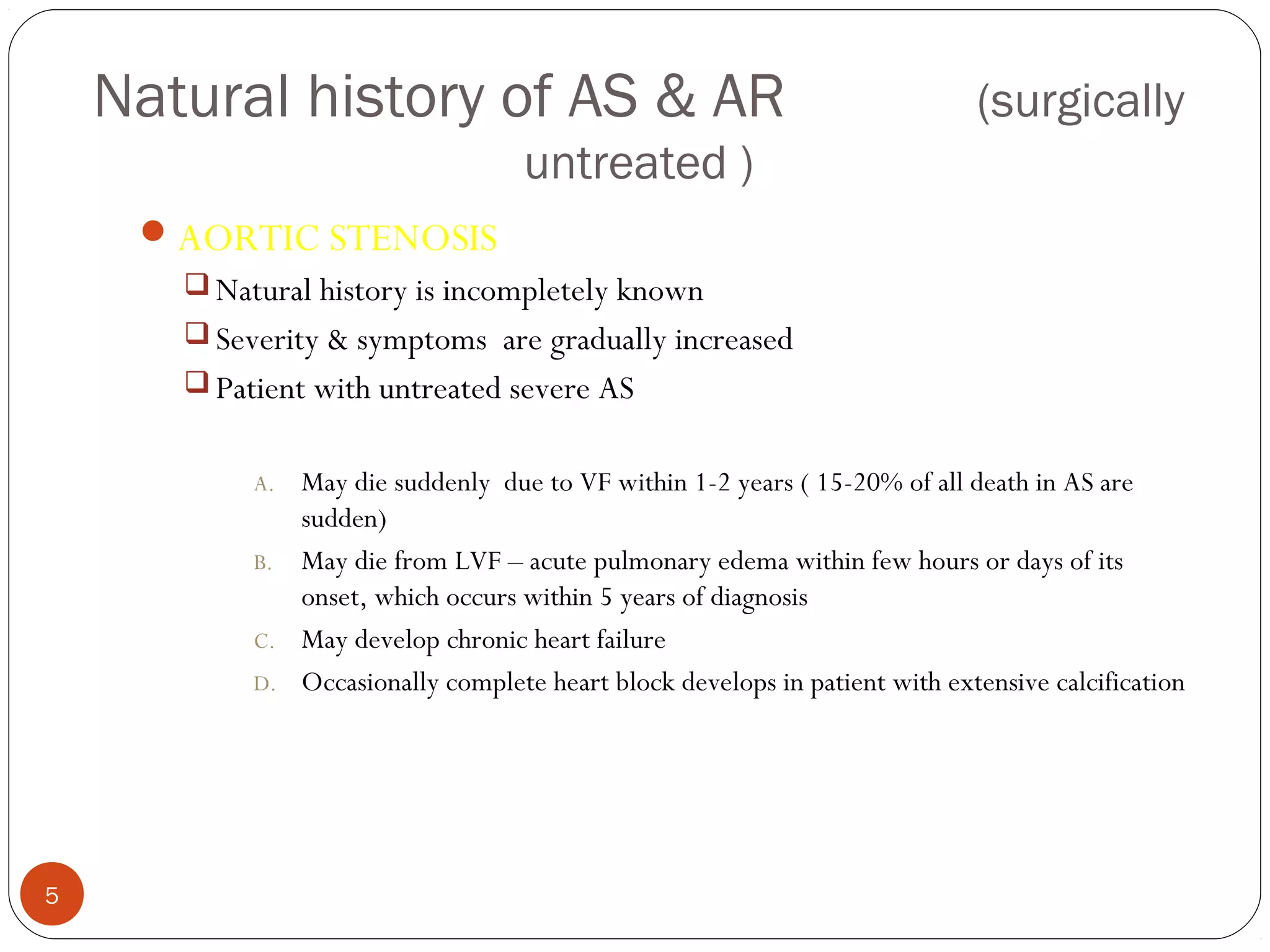
      AORTIC STENOSIS
        Natural history is incompletely known
        Severity & symptoms are gradually increased
        Patient with untreated severe AS


            A.   May die suddenly due to VF within 1-2 years ( 15-20% of all death in AS are
                 sudden)
            B.   May die from LVF – acute pulmonary edema within few hours or days of its
                 onset, which occurs within 5 years of diagnosis
            C.   May develop chronic heart failure
            D.   Occasionally complete heart block develops in patient with extensive calcification


5
Natural history of AS & AR                                         (surgically
                                   untreated )
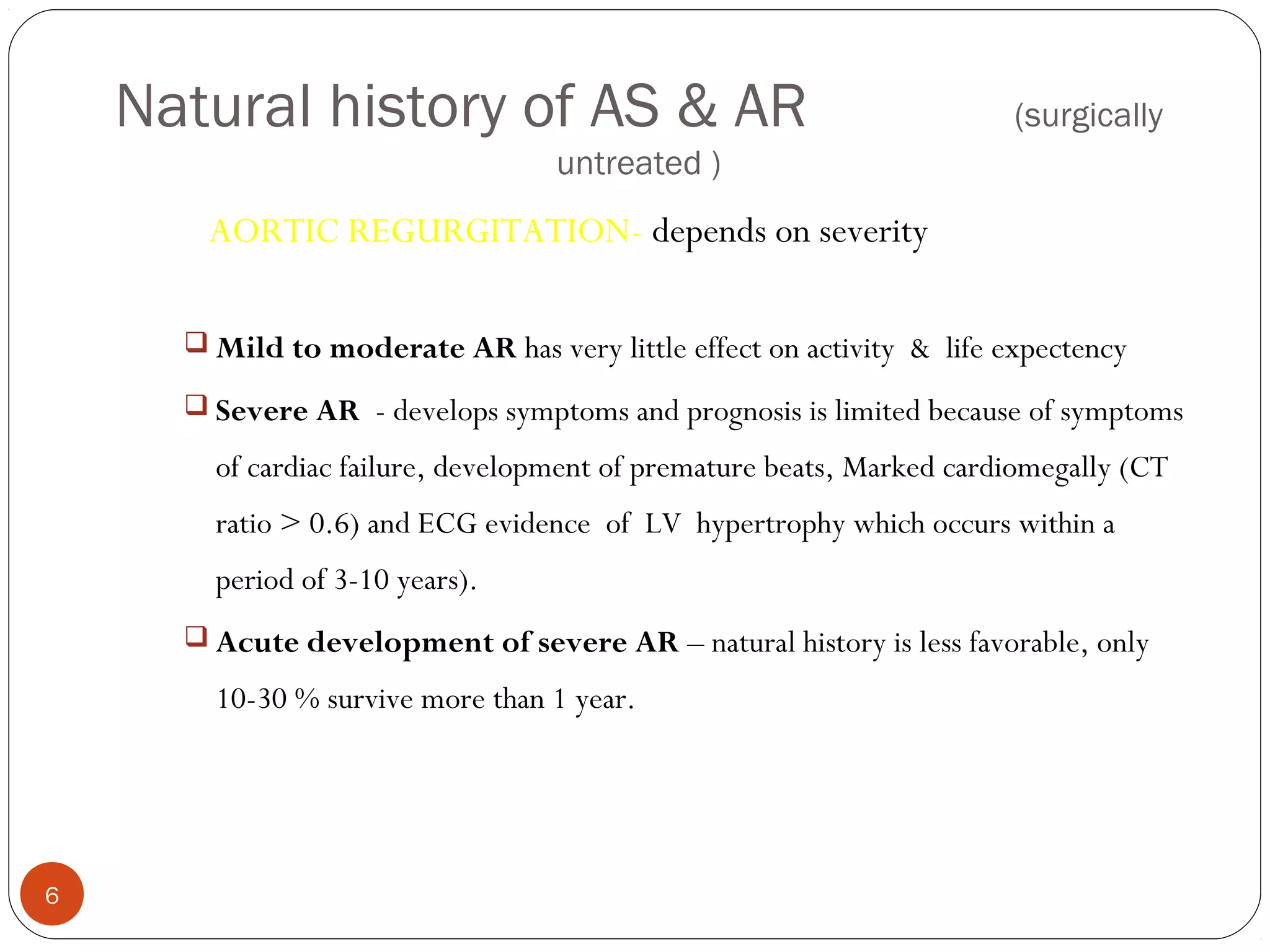
       AORTIC REGURGITATION- depends on severity

       Mild to moderate AR has very little effect on activity & life expectency

       Severe AR - develops symptoms and prognosis is limited because of symptoms

        of cardiac failure, development of premature beats, Marked cardiomegally (CT
        ratio > 0.6) and ECG evidence of LV hypertrophy which occurs within a
        period of 3-10 years).
       Acute development of severe AR – natural history is less favorable, only

        10-30 % survive more than 1 year.


6
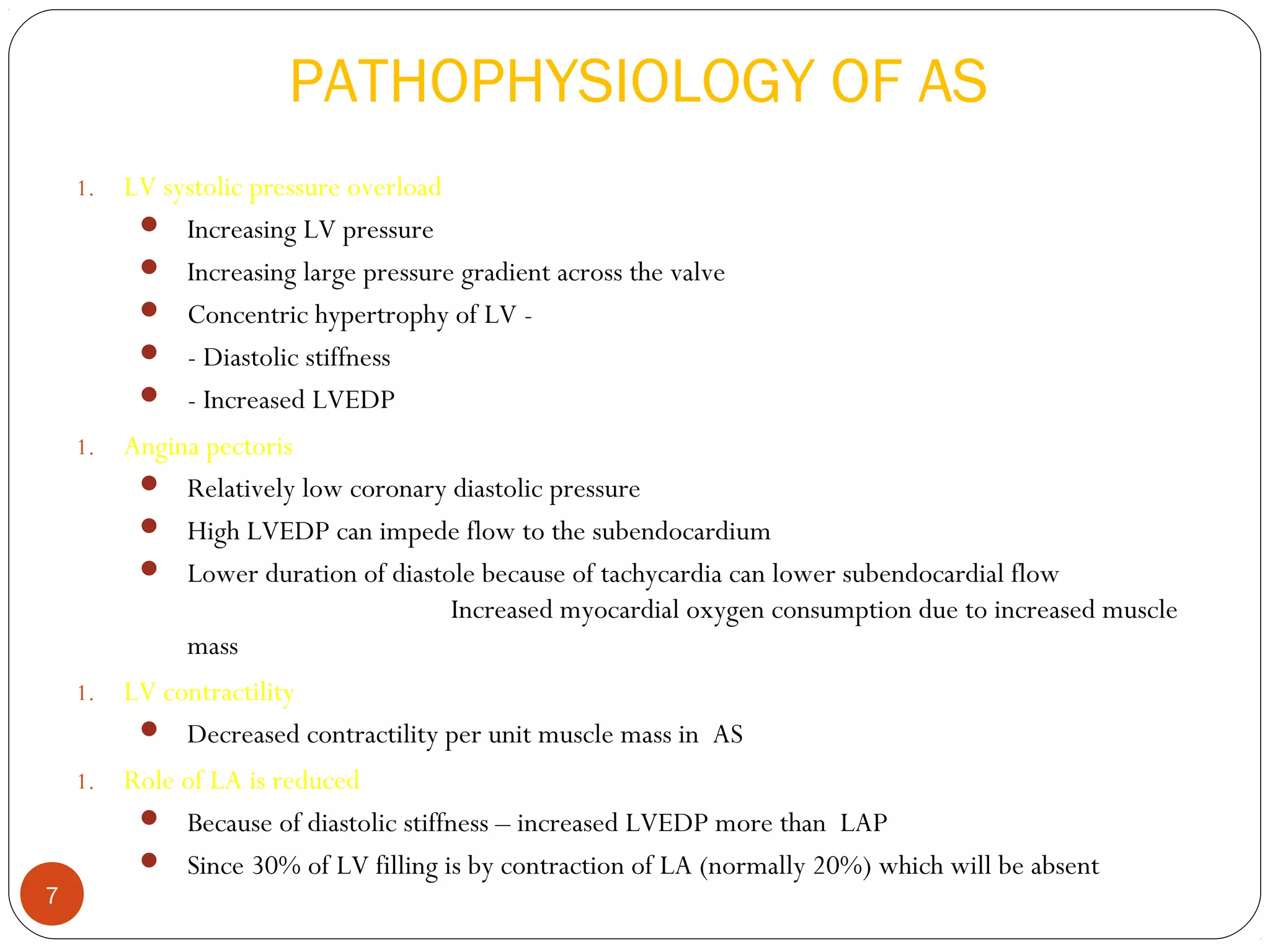
PATHOPHYSIOLOGY OF AS
    1.   LV systolic pressure overload
           Increasing LV pressure
           Increasing large pressure gradient across the valve
           Concentric hypertrophy of LV -
           - Diastolic stiffness
           - Increased LVEDP
    1.   Angina pectoris
           Relatively low coronary diastolic pressure
           High LVEDP can impede flow to the subendocardium
           Lower duration of diastole because of tachycardia can lower subendocardial flow
                                    Increased myocardial oxygen consumption due to increased muscle
              mass
    1.   LV contractility
           Decreased contractility per unit muscle mass in AS
    1.   Role of LA is reduced
           Because of diastolic stiffness – increased LVEDP more than LAP
           Since 30% of LV filling is by contraction of LA (normally 20%) which will be absent
7
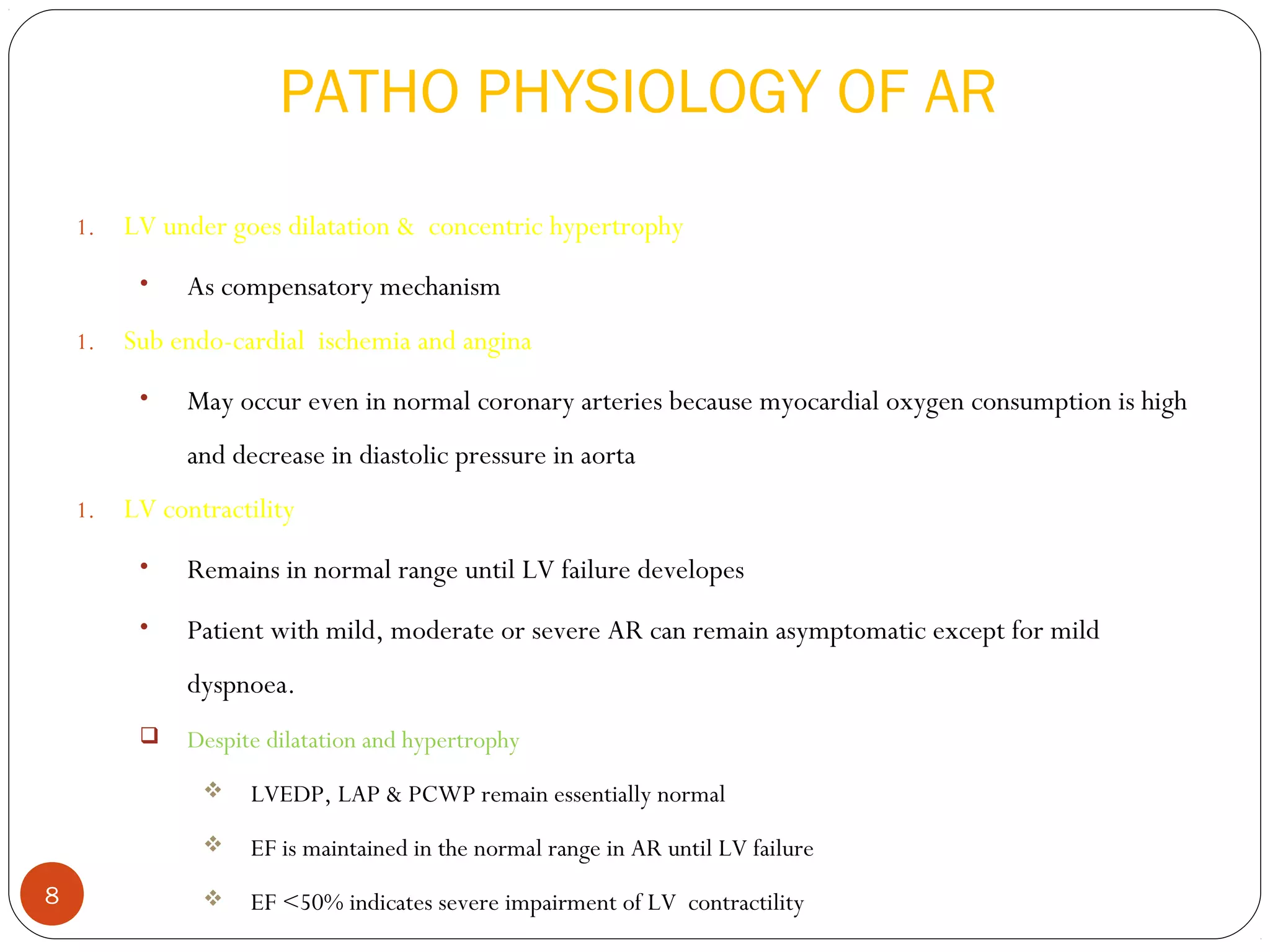
PATHO PHYSIOLOGY OF AR
    1.   LV under goes dilatation & concentric hypertrophy
          •   As compensatory mechanism
    1.   Sub endo-cardial ischemia and angina
          •   May occur even in normal coronary arteries because myocardial oxygen consumption is high
              and decrease in diastolic pressure in aorta
    1.   LV contractility
          •   Remains in normal range until LV failure developes
          •   Patient with mild, moderate or severe AR can remain asymptomatic except for mild
              dyspnoea.
             Despite dilatation and hypertrophy
                   LVEDP, LAP & PCWP remain essentially normal
                   EF is maintained in the normal range in AR until LV failure
8                  EF <50% indicates severe impairment of LV contractility
Classification of AR
     On the basis of regurgitant fraction (RF)

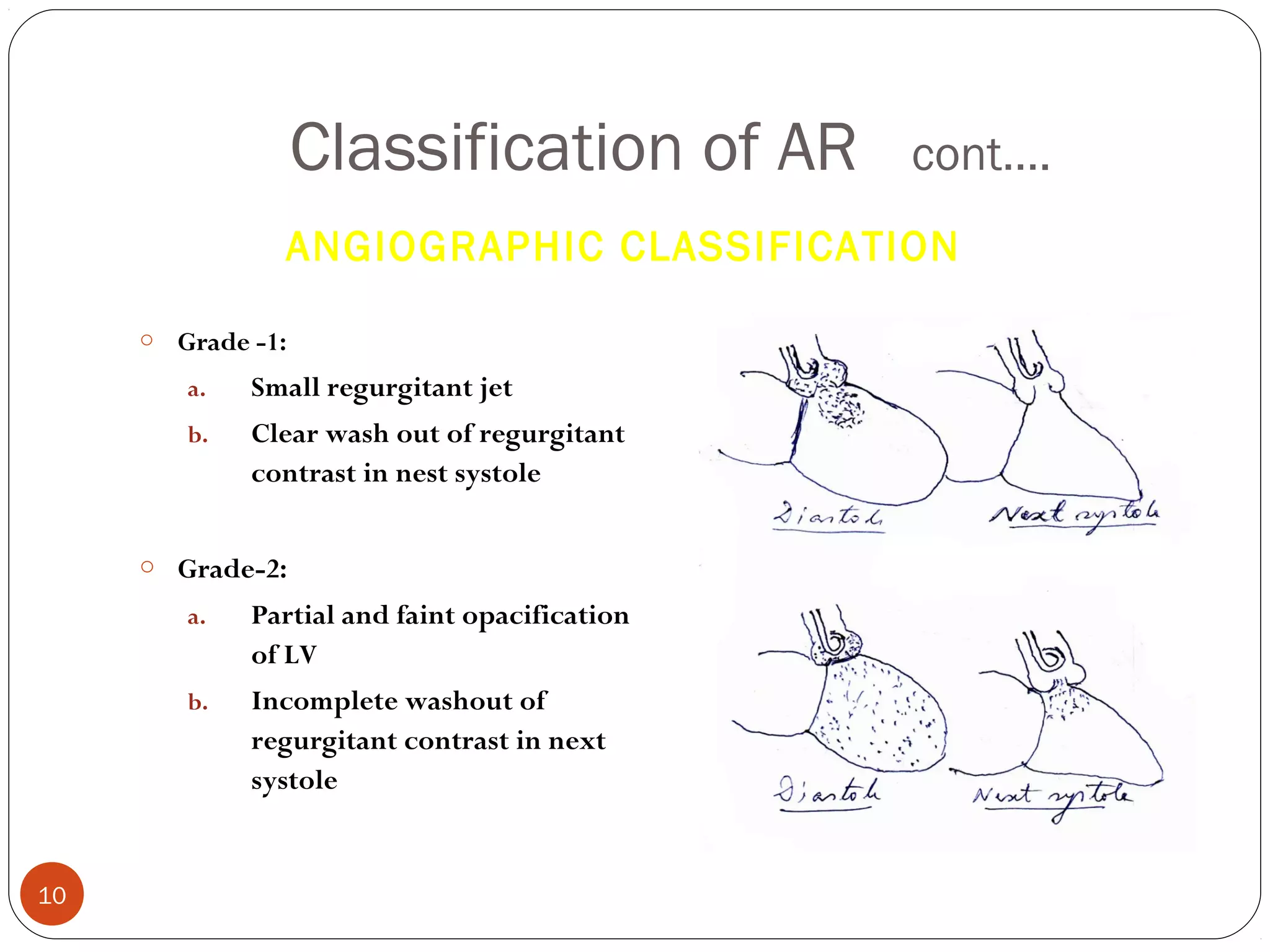
       1. Trival AR- RF less than 10% & regurgitant flow <1 litre/min

       2. Mild AR- RF 10-40% & regurtitant flow around 1-3 litre/min

       3. Moderate AR- RF 40-60 % & regurgitant flow 3-6 litre/min

       4. Severe AR- RF more than 60% & regurgitant flow > 6 litre/min


9
Classification of AR        cont….
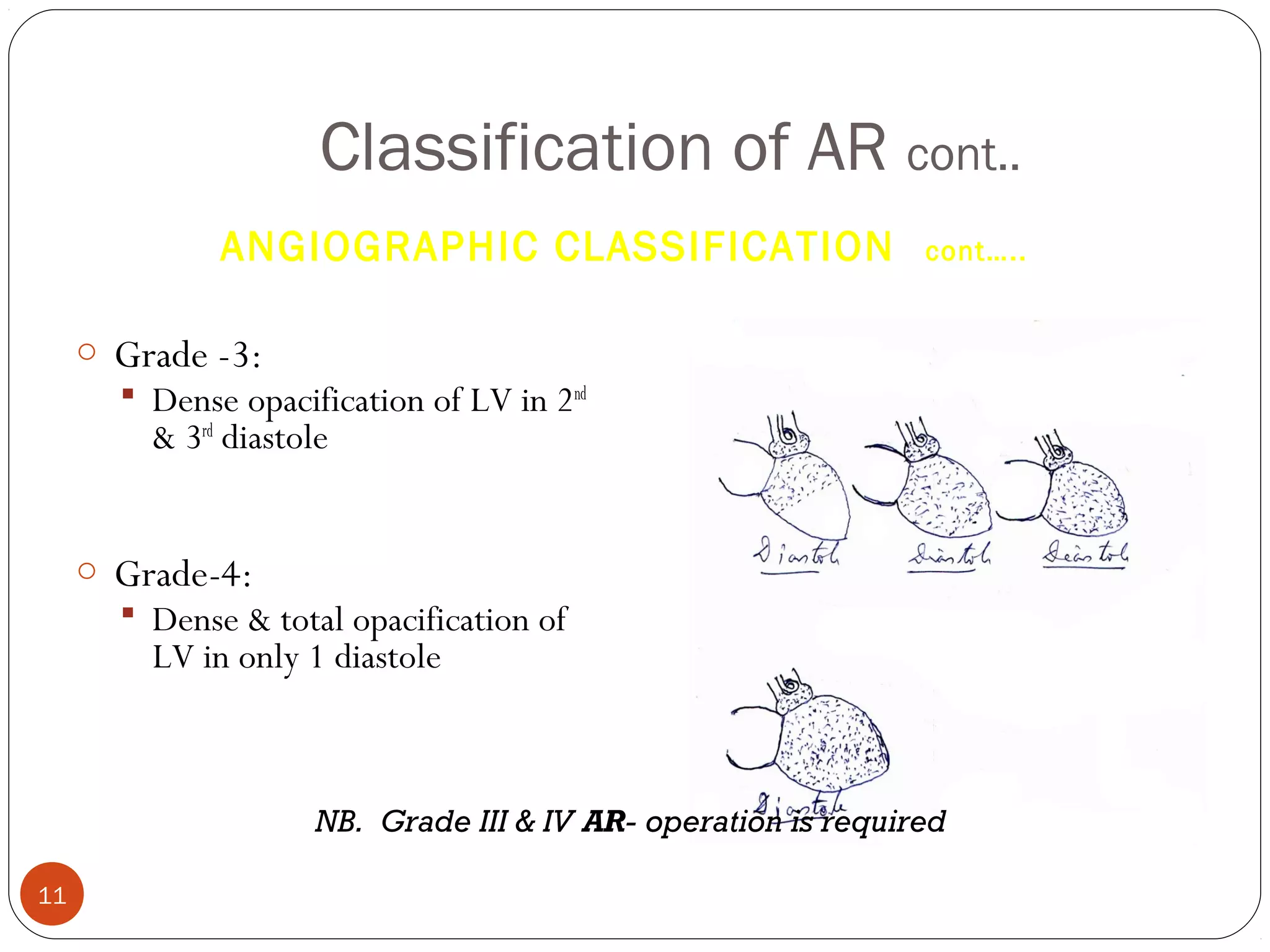
               ANGIOGRAPHIC CLASSIFICATION

     o Grade -1:

        a.   Small regurgitant jet
        b.   Clear wash out of regurgitant
             contrast in nest systole


     o Grade-2:

        a.   Partial and faint opacification
             of LV
        b.   Incomplete washout of
             regurgitant contrast in next
             systole


10
Classification of AR cont..
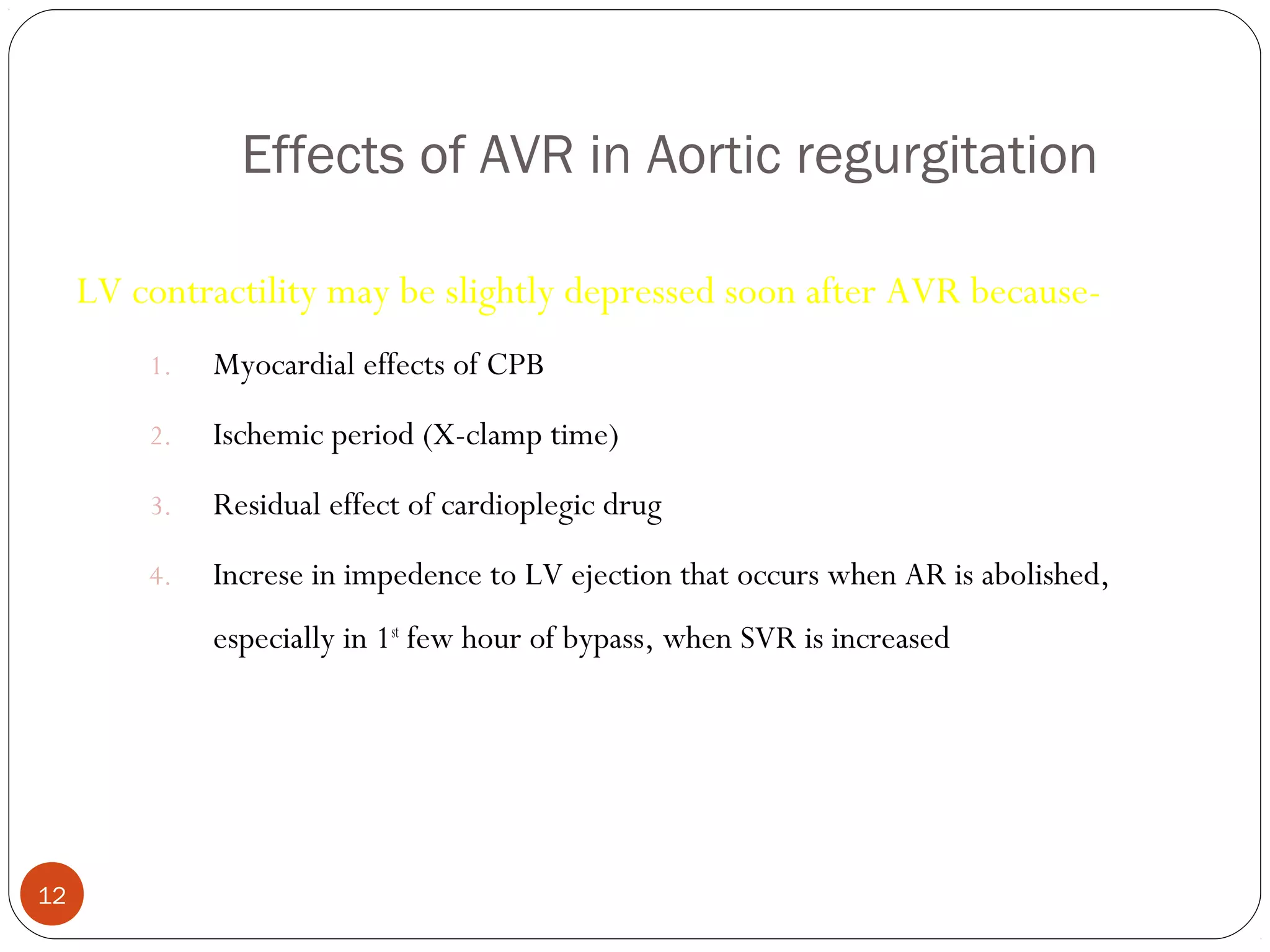
              ANGIOGRAPHIC CLASSIFICATION                      cont…..


     o Grade -3:
        Dense opacification of LV in 2nd
         & 3rd diastole


     o Grade-4:
        Dense & total opacification of
         LV in only 1 diastole


                     NB. Grade III & IV AR- operation is required

11
Effects of AVR in Aortic regurgitation

     LV contractility may be slightly depressed soon after AVR because-
         1.   Myocardial effects of CPB
         2.   Ischemic period (X-clamp time)
         3.   Residual effect of cardioplegic drug
         4.   Increse in impedence to LV ejection that occurs when AR is abolished,
              especially in 1st few hour of bypass, when SVR is increased


12
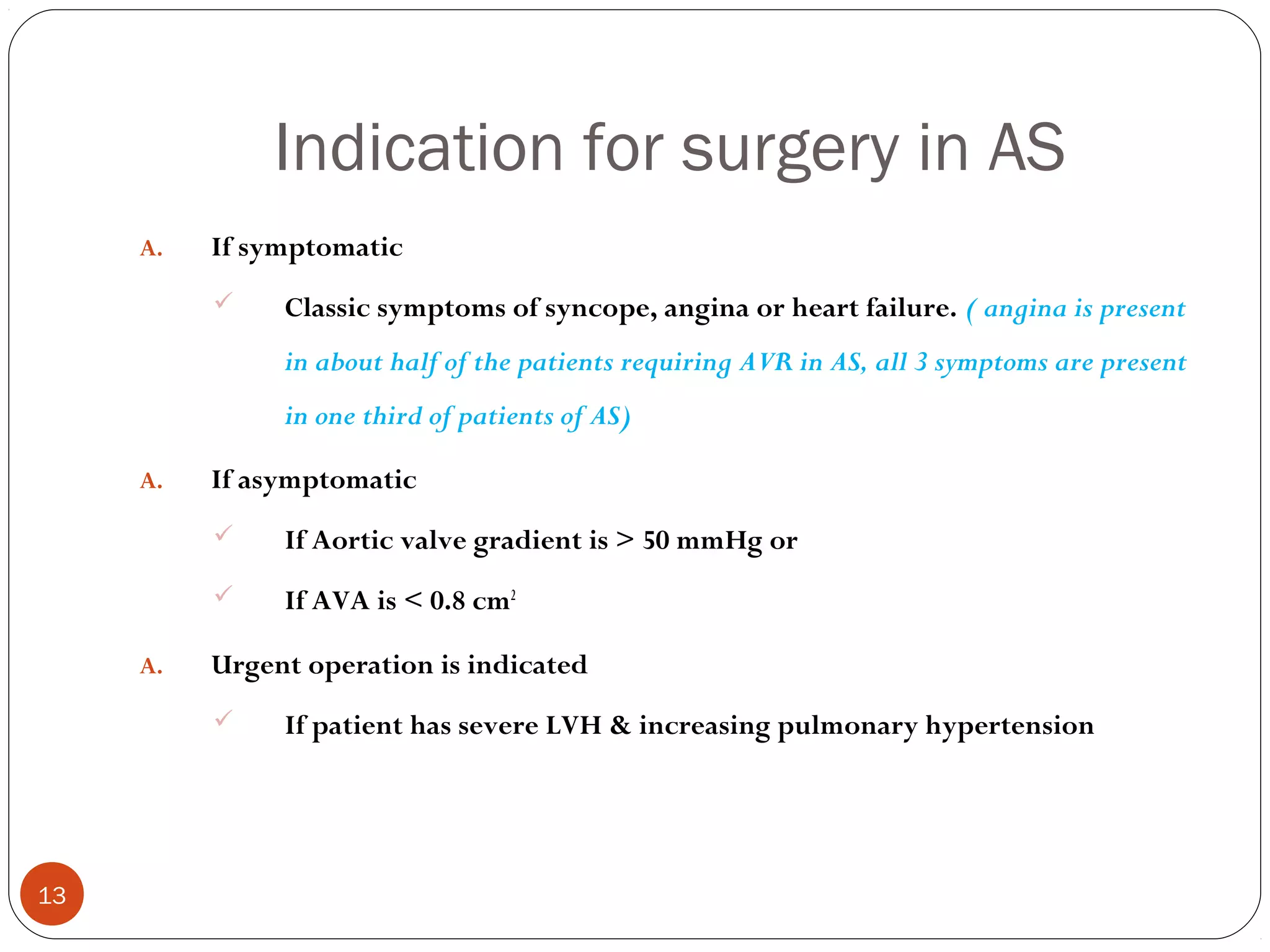
Indication for surgery in AS
     A.   If symptomatic
              Classic symptoms of syncope, angina or heart failure. ( angina is present
               in about half of the patients requiring AVR in AS, all 3 symptoms are present
               in one third of patients of AS)

     A.   If asymptomatic
              If Aortic valve gradient is > 50 mmHg or
              If AVA is < 0.8 cm2

     A.   Urgent operation is indicated
              If patient has severe LVH & increasing pulmonary hypertension


13
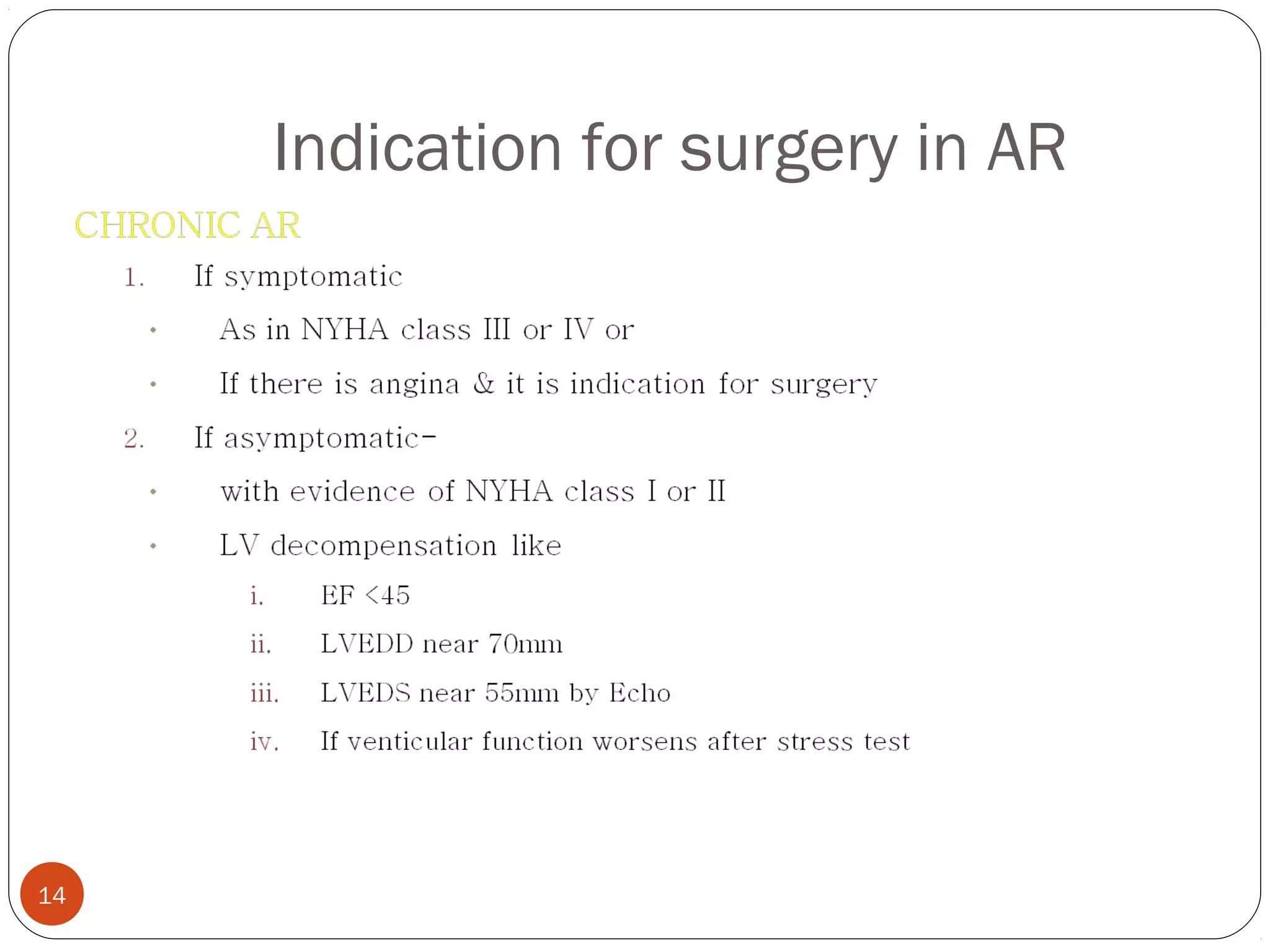
Indication for surgery in AR


14
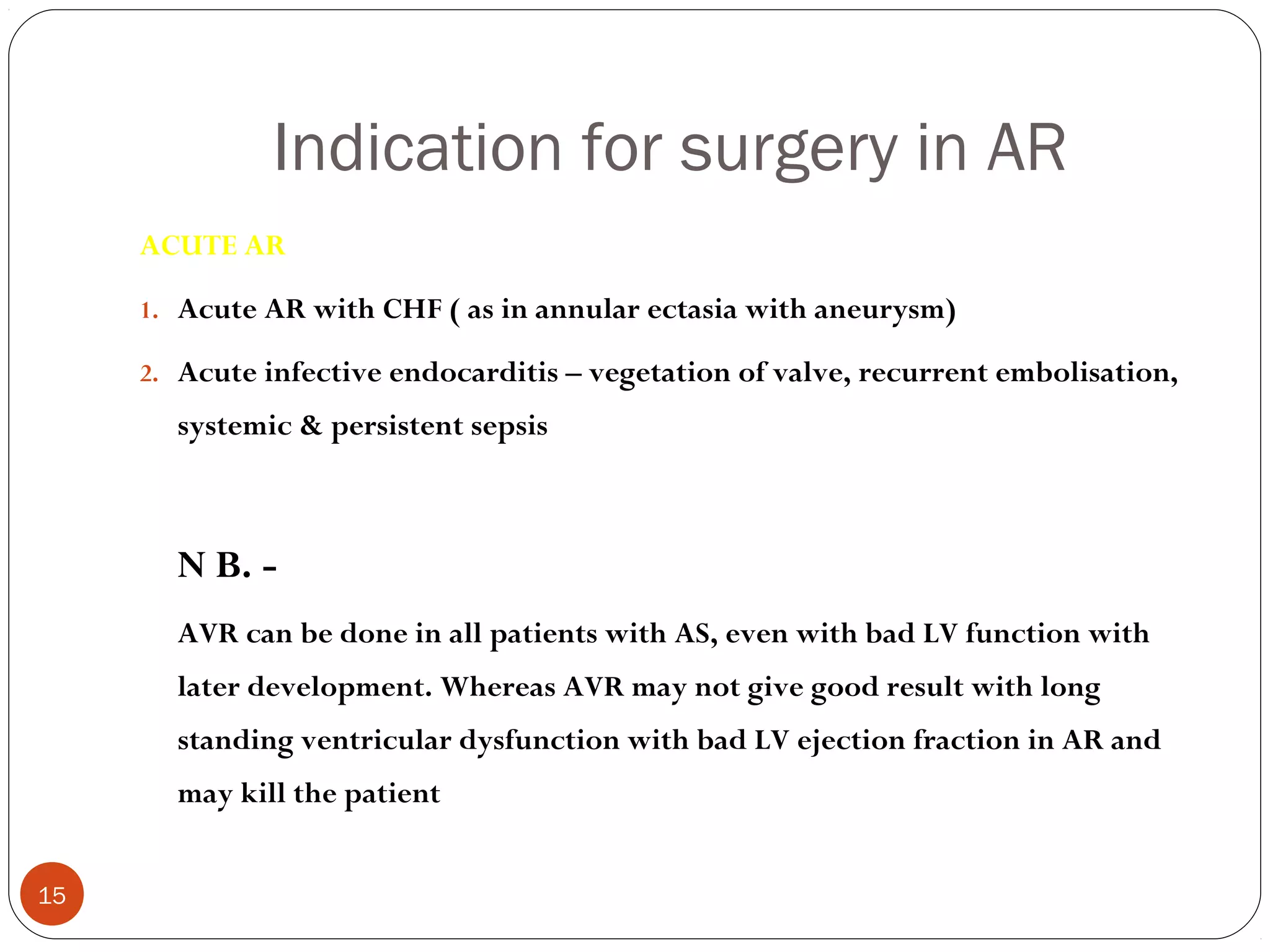
Indication for surgery in AR
     ACUTE AR

     1. Acute AR with CHF ( as in annular ectasia with aneurysm)

     2. Acute infective endocarditis – vegetation of valve, recurrent embolisation,
       systemic & persistent sepsis


       N B. -
       AVR can be done in all patients with AS, even with bad LV function with
       later development. Whereas AVR may not give good result with long
       standing ventricular dysfunction with bad LV ejection fraction in AR and
       may kill the patient


15
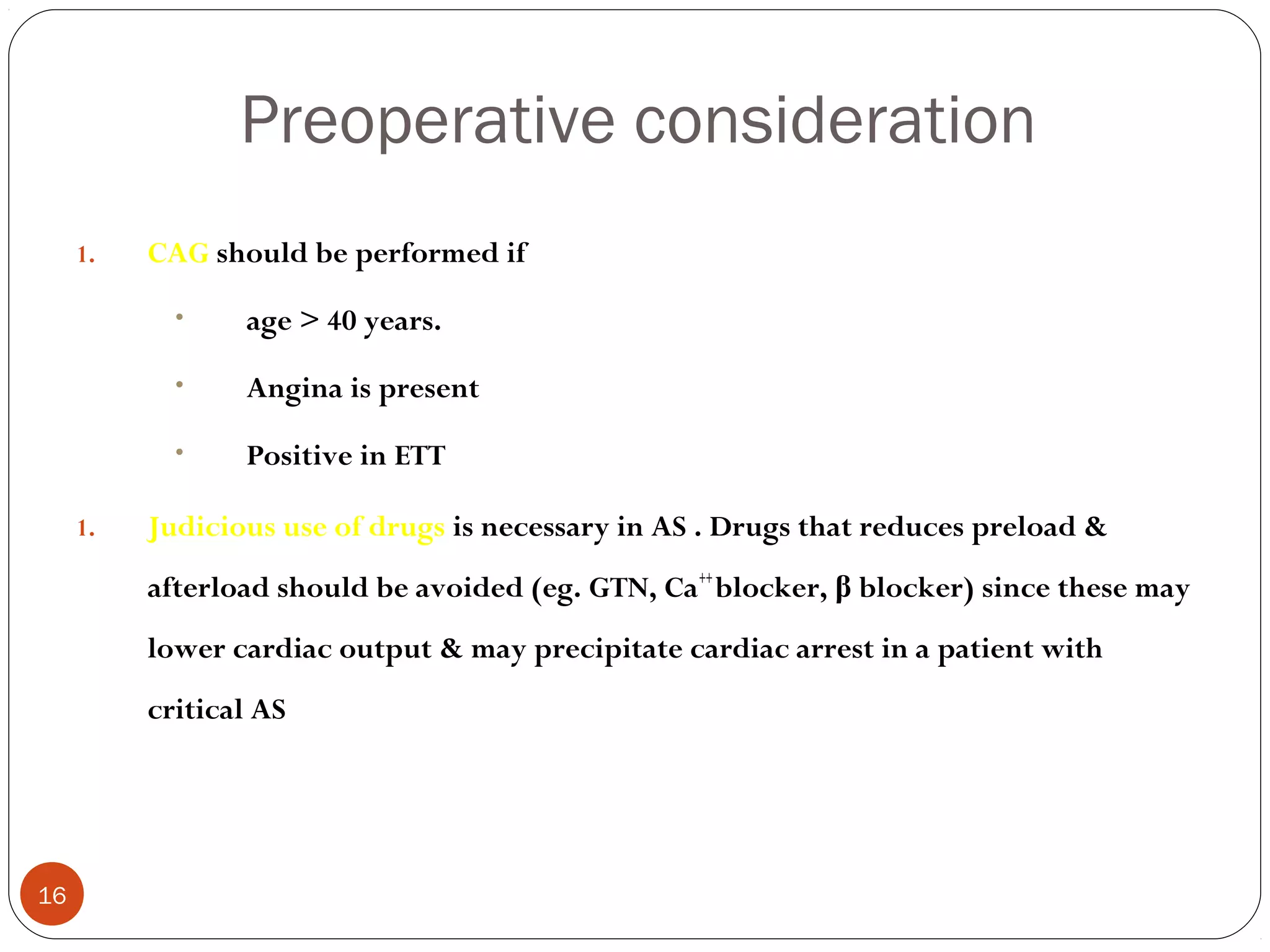
Preoperative consideration
     1.   CAG should be performed if

            •    age > 40 years.

            •    Angina is present

            •    Positive in ETT

     1.   Judicious use of drugs is necessary in AS . Drugs that reduces preload &
          afterload should be avoided (eg. GTN, Ca++ blocker, β blocker) since these may
          lower cardiac output & may precipitate cardiac arrest in a patient with
          critical AS


16
Contd.
3. Dental work should be performed before surgery to minimise the risk of PVE


4. Selection of appropiate procedure & valve type should be done beforehand.
      Depending upon

        •       Age of the patient
        •       child bearing age
            •    Patient desires to avoid anticoagulant or not

            •    Contraindication to long term anticoagulant or not
AVR- operating techniques Tits & Bits


     1.   Approach

     2.   Vent

     3.   Cardioplegia

     4.   Aortotomy

     5.   Insertion of prosthesis


18
AVR- operating techniques Tits & Bits                                 cont……..


     1.        Approach-
          a)     Standard sternotomy
          b)     Mini sternotomy
          c)     Heart port system with mini sternotomy
          d)     Robotic technique with use of heart port system

     1.        Vent-   keeps LV dry, help in maneuver of replacement
          a)     Right superior pulmonary vein (most commonly used)
          b)     Left ventricular apex
          c)     Pulmonary artery

     1.        Cardioplegia
          a)     Antegrade selective cardioplegia to Rt & Lt coronary artery at 20
                 min interval
          b)     Antegrade + retrograde cardioplegia
          c)     Retrograde cardioplegia only

19
AVR- operating techniques Tits & Bits                                 cont……..


     4.        Aortotomy-
          a)     2 cm proximal to annulus in case of prosthetic valve

          b)     4 cm downstream from RCA orifice for space for intra aortic
                 positioning of allograft or autograft valve and to avoid damage of
                 RCA ostium

          Exception- In ‘Mini’ aortic root replacement with Autograft pulmonary
                 valve cylinder, since autograft pulmonary trunk is relatively short,
                 aortotomy can be made close to RCA anteriorly in an idea to
                 preserve as much aorta as possible


20
AVR- operating techniques Tits & Bits                                           cont……..


     5. Insertion of prosthesis
        a)     Interrupted pledgeted 2-0 mattress Ethibond suture are used except those on
               commissures, where non pledgeted suture is used
        b)     Left coronary cusp area is done 1st, then RCC area & lastly NCC area.

        c) Care should be taken while taking suture in commissural area between

             RCC & NCC so that stich doesn’t penetrate more than 2 mm beneath

             the annulus – to prevent injury to bundle of His.
        d) For supra annular positioning, suture should come from ventricular side of the annulus
               up into aorta and then passed through the cusp. At commisure stiches are placed from
               aorta into ventricular side. For infra and intra annular positioning suture is passed
               from aortic side through the annulus down to ventricle and then passed through cuff
               of prosthesis.

21
AVR- operating techniques Tits & Bits                                 cont……..


     Insertion of prosthesis continued….

        e)    Prosthetic valve is slided down to aortic annulus.

        f)    Sutures are 1st tied in the RCC then LCC & then NCC.

             Advantage is if RCC stich or LCC stich breaks then the valve can be lifted
              and it is easy to place another stich. If a suture breaks while tying RCC
              stiches one can salvage the situation by giving a pledgeted stich from
              outside of the aorta up through the aortic valve seweing ring.

        g)    Valve opening is tested to detect any restriction of movement of cusp. If
              any restriction of opening is noted valve is rotated


22
AVR- operating techniques Tits & Bits                                   cont……..

     Insertion of prosthesis continued….
        h)        Deaeration :
             i.      LV vent is stopped
             ii.     Aortic root vent is placed
             iii.    Head end is lowered
             iv.     Valsalva maneuver is done with simultaneous compression of heart
                     to expel air through aortic root vent & pressure on RCA is applied
                     not to allow air to enter into it.
             v.      Aortic X-clamp is removed
             vi.     LV vent stopped again & needle to aspirate the dome of LA & apex
                     of LV is done
             vii.    Partial X-clamp on aorta is placed to allow air to pass through
                     aortic root vent, when heart starts beating.

23
Surgical option of AS
     1.   AVR- is the standard treatment. It should be considered in all patients with
          severe AS, no matter how bad is EF, because these patients will certainly do
          better after AVR. Whereas this may not be true for long-standing ventricular
          dysfunction with AR.


     2.   Repairative procedure - like commisurotomy & debridement either with
          mechanical or ultrasonic device have been performed but result is not good due
          to high prevalence of recalcification & restriction . This is only done in children


24
Surgical option of AR
     1.    AVR
     2.    Bioprosthetic valve
     3.    Stent mounted Allograft
     4.    Valved conduit
     5.    Pulmonary Autograft
     6.    Pulmonary Allograft
     7.    Freehand cryopreserved or antibiotic preserved Allograft
     8.    Insertion of Allograft as a cylinder inside the aorta
     9.    Mini aortic root replacement
     10.   Aortic valve reconstruction procedure

25
Surgical option of AR continued…
     1.        AVR- can be done with prosthetic mechanical valve with anticoagulant

     2.        Bioprosthetic valve – which may be
          a)      Sent mounted Xenograft /Heterograft ( porcine or bovine pericardial) or

          b)      Stenless Xenograft (porcine) valve. This has lower transvalvular gradient,
                  goes near to Homograft valve

     3.        Stent mounted Allograft- is not satisfactory for AVR due to dehisence of the
               Allograft from the struts

     4.        Valved conduit (prosthetic)- is placed in patients with annular ectasia
               from chronic aortic aneurysm or aortic dissection (Bental procedure)


26
Surgical option of AR continued…
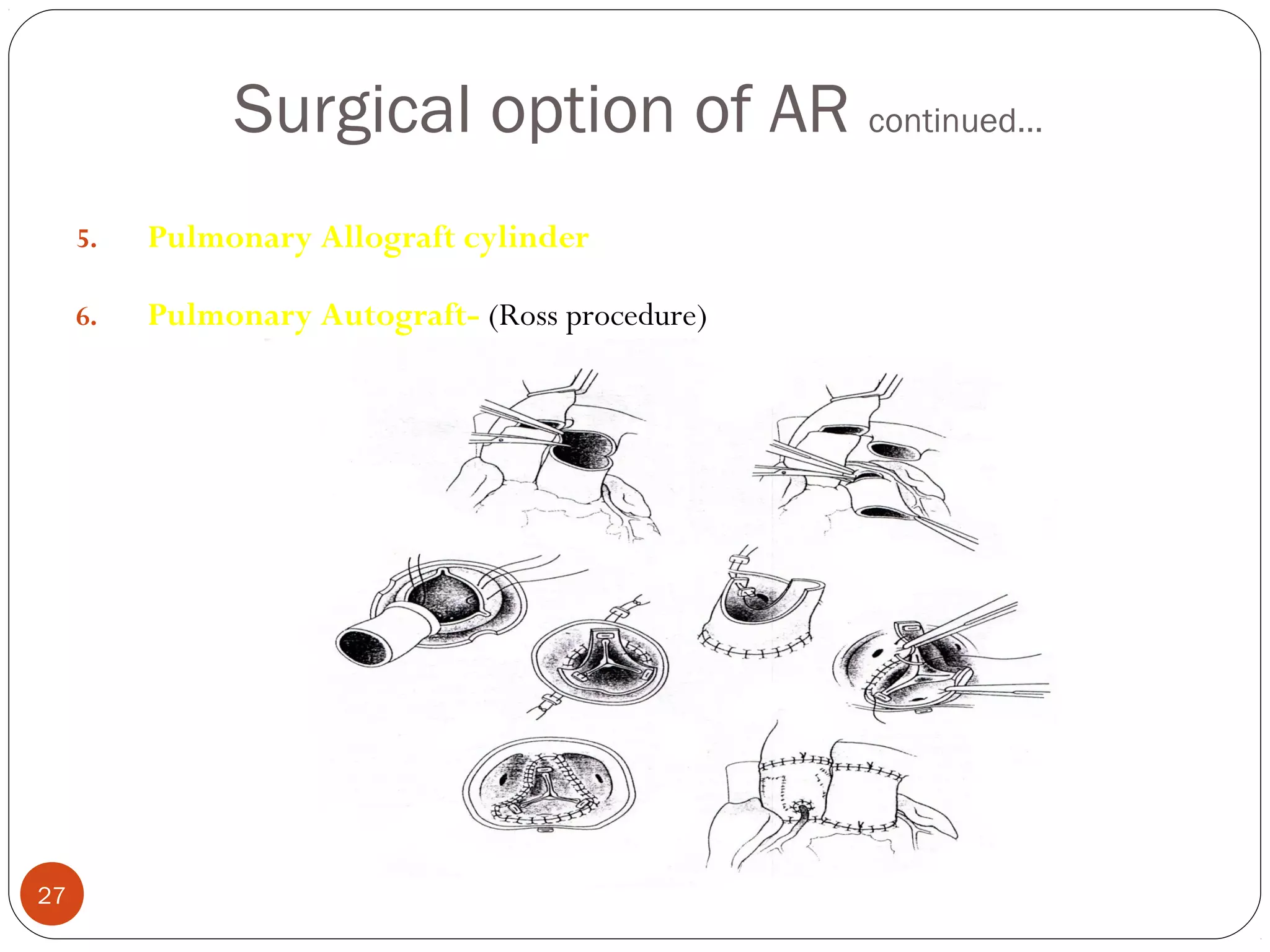
     5.   Pulmonary Allograft cylinder

     6.   Pulmonary Autograft- (Ross procedure)


27
Surgical option of AR continued…
     7.   Freehand cryopreserved or antibiotic preserved allograft
          (Homograft)
             Indication: mandatory in prosthetic valve endocarditis, also in young
              women contemplanting pregnancy
             Contraindication: dilated aortic root (>30mm)
             Less desirable:

              a)    When ascending aorta is diffusely enlarged and thin walled

              b)    When severe uncontrolled systemic HTN is present
             Advantage:

              a)    Absence of gradient

              b)    Removal of increased risk of AV rupture
28
Surgical option of AR continued…
     What is freehand Allovital Homograft?

              Valve that are implanted within 48 hours of death of the donour (also
       known as fresh homograft)

              Current recommendation for storage is by cryopreservation in liquid
       nitrogen at minus(-) 1960 C.

              Alternatively valves are procured & treated with antibiotics to decrease
       the amount of early failure due to thinning & tearing of leaflets, which are more
       common when formaldehyde, chlorhexidine or Gamma radiation is used


29
Surgical option of AR continued…
     10.   Aortic valve reconstruction procedure in AR has been recommended by few
           surgeons, but have not widely acceted, particularly after development of
           prosthetic valves. Stil repair in AR is more promising than AS.
           a)   Trussler repair
           b)   Aortic cusp retraction (by fibrosis or calcification) is treated by extending
                or replacing the cusp with gluteraldehyde treated bovine or autologous
                pericardium
           c)   Cusp prolapse is treated with a triangular resection of prolapsed cusp
           d)   Cusp perforation is repaired with pericardial patch.


               Aortic valve repair is well established in children but not in adults


31
Surgical option of AR continued…
        What are the 3 techniques for Homograft valve insertion?


     1. Sub coronary:
         o       Requires scalloping of the Homograft valve


     1. Cylindrical (mini-root technique):
         o       Implantation of an intact cylinder, less prone to geometric distortion


     1. Aortic root replacement:
             o     Least subject to geometric distortion
             o     Root replacement with Homograft is performed as Bental’s procedure


32
Management of small Aortic Annulus
     1.   If prosthetic valve are used one size larger than aortic annulus cab be used by
          a)    Supra annular positioning- placing pledget on ventricular side by taking suture
                from ventricle to aorta
          b)    Tilting the valve along the non coronary sinus. Here suturing the valve along the
                annulus of left and right coronary sinus pledgeted mattress sutures are placed
                from outside in of aorta
          c)    St. judes HP (hemodynamic plus) valve achieves larger orifice area for a given
                size. The effective orifice are (EOA) of St. judes 19mm HP has nearly EOA of
                standard St. judes 21mm valve.
     2.   Freehand aortic allograft (Homograft) is the best device because small size Allograft is
          available in graft bank. (down to 16mm size). It can be inserted with minimal gradient
     3.   When supraannular AS a patch graft into the non coronary sinus of valsalva is used
          (preformed pericardium)


33
4.   When sub valvar discrete stenosis due to fibro muscular ring- excision of fibrous band
          is necessary ( care must be taken not to injure th AML below, aortic valve above & IVS)
     5.   When supra annular & annular enlargement is necessary it can be done in 2 method
          a)    Manoguian proecedure: done by extending the aortotomy through left coronary
                noncoronary commisural area and into the underlying aortico mitral annulus.
                The incision doesn’t reach the hinge point of mitral leaflet. A broad tear drop
                shaped patch is positioned
          b)    Nicks et al- continues aortic incision into the noncoronary sinus, dividing the
                aortic annulus & extended only as far as the origin of the AML.
          NB. Aortic valve annulus is usually widened a few mm & one size larger than aortic
                annulus can be positioned


34
Management of small Aortic Annulus
                   continued….


35
Management of small Aortic Annulus
                                        continued….

     7.    In congenital obstruction of LVOT

          Mcgoon; Cooley et al., Bernhard et al., used a conduit between left
           ventricle and ascending, thoracic and abdominal aorta

     7.    An alternative to all these method is replacement of the aortic valve and
           first part of the ascending aortra with either

           i.    Allograft aorrtic valve cylinder or

           ii.   Autograft pulmonary valve cylindr


                 NB. A 24-26 mm cylinder will fit in 17-19 mm aortic root


36
Effects of AVR in AS
     1.   LVEDP decreases – fall in pulmonary capillary pressure

     2.   Myocardial oxygen consumption decreases –due to fall in systollic and
          diastolic LV wall tension

     3.   Slight increase in diastolic coronary pressure

     4.   LV contractility increases- after AVR . Due to reduction of hypertrophied LV


              NB. There may be slight decrease of LV contractility immediately after
               AVR, possibly due to myocardial effects of CPB, which may persist for
               first 4 post operative day


37
Effects of AVR in AS cont…
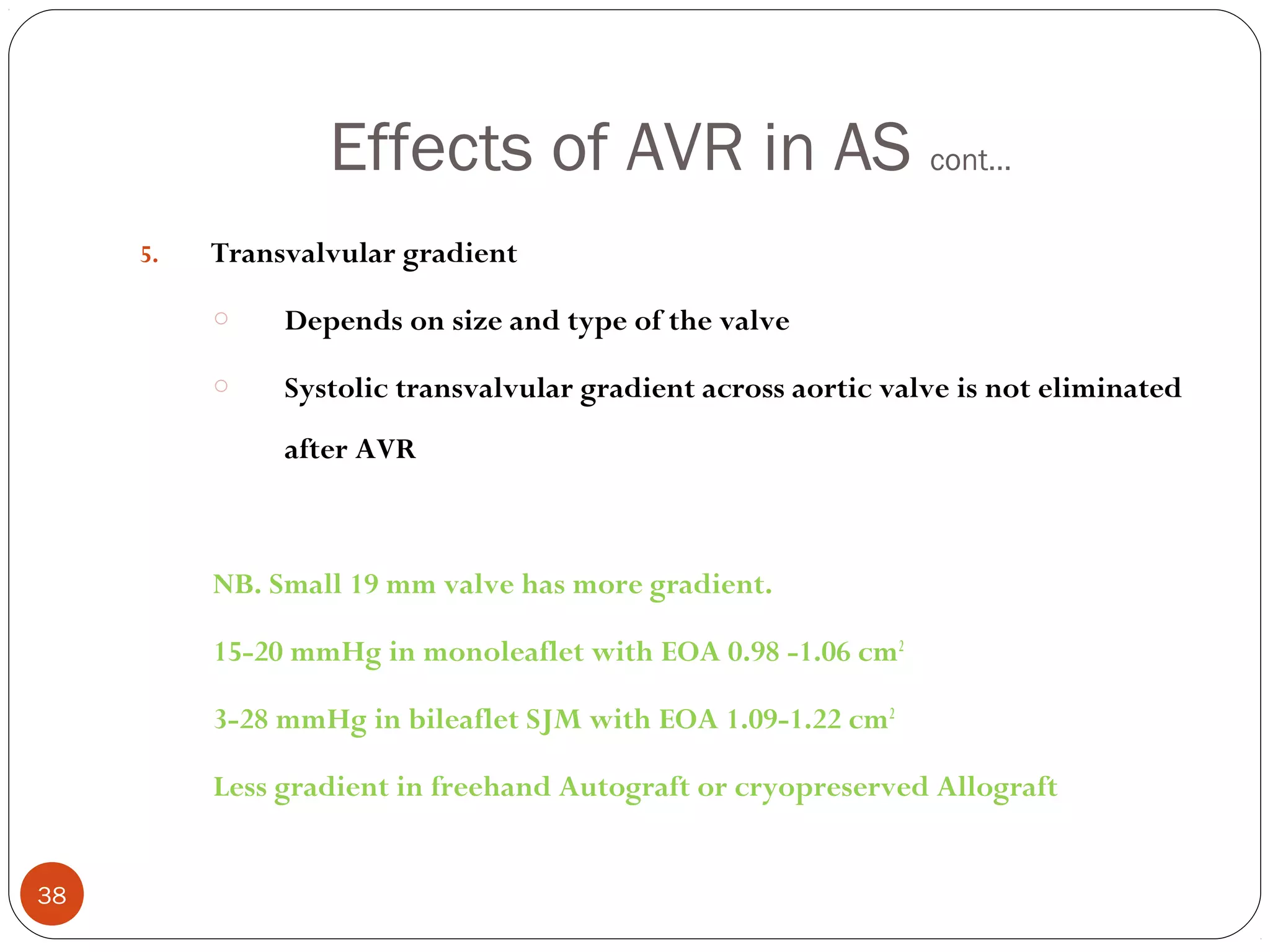
     5.   Transvalvular gradient
          o    Depends on size and type of the valve
          o    Systolic transvalvular gradient across aortic valve is not eliminated
               after AVR


          NB. Small 19 mm valve has more gradient.

          15-20 mmHg in monoleaflet with EOA 0.98 -1.06 cm2

          3-28 mmHg in bileaflet SJM with EOA 1.09-1.22 cm2

          Less gradient in freehand Autograft or cryopreserved Allograft


38
Effects of AVR in AR
     LV contractility may be slightly depressed soon after AVR,
      because
         A.     Myocardial effects of CPB

         B.     Residual effects of cardioplegic drugs

         C.     Ischemic period (X-clamp time)

         D.     Increase in impedence to LV ejection that occurs when AR is
                abolished, especially in first hew hours after bypass, when SVR is
                increased.


39
Modes of death after AVR
     1.   Late death due to cardiac failure & myocardial infarction- commonest
          modes of death

     2.   Sudden death- occurs in 20% of late death and may be due to
          thromboembolism
     3.   Some deaths, perhaps 20% are related to the device inserted
            o    Thromboembolism
            o    Prosthetic thrombosis
            o    Anticoagulant related hemorrhage (10%)
            o    Prosthetic valve endocarditis
            o    Device failure like bioprosthetic degeneration


40
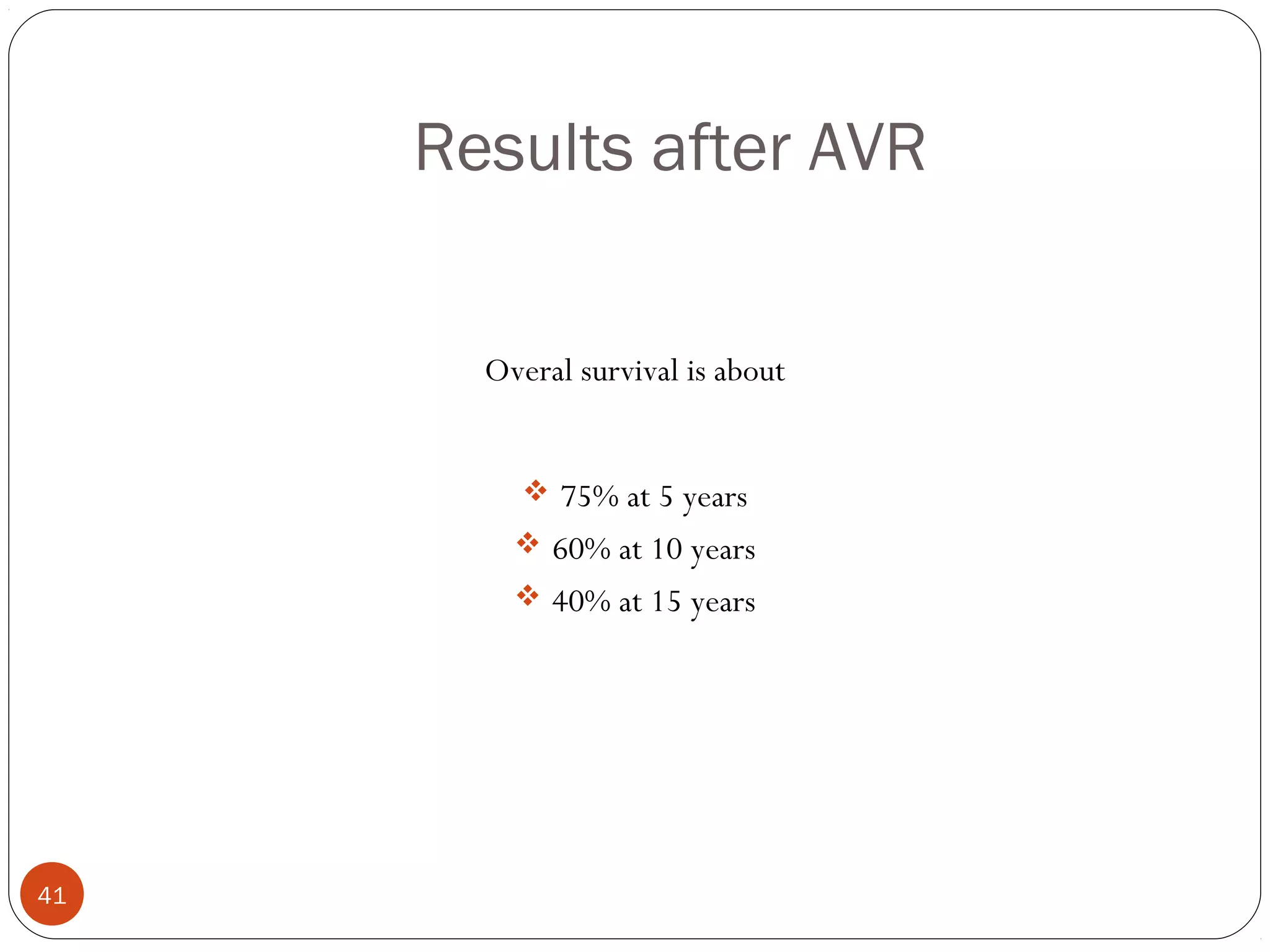
Results after AVR

       Overal survival is about


           75% at 5 years
          60% at 10 years
          40% at 15 years


41
42

Aorticvalve 97 (2)

  • 1.
    AORTIC VALVULAR DISEASES PROF. KHWAJA N. MAHMOOD HEAD OF THE DEPARTMENT CARDIAC SURGERY, NICVD 1
  • 2.
    Etiology of Aorticstenosis 1. Rheumatic – most common 2. Congenital-  Valvular (calcified bicuspic valve)- next common  Supravalvular  subvalvular 1. Sclerotic- senile calcific aortic stenosis 2
  • 3.
    Etiology of Aorticregurgitation 1. Primary valve disease 2. Aortic root disease a) Rheumatic AR Annular ectasia from b) Congenital- bicuspid aortic valve a) Chronic aortic aneurysm or in association with VSD c) Infective endocarditis b) Dissecting aortic aneurysm d) Aortitis- syphilitic aortitis or Annulo aortic ectasia from ankylosing spondylitis , Giant cell c) Marfan’s syndrome arteritis. 3
  • 4.
    Causes depending onseveritiy of AR Acute ar Chronic ar 1. Infective endocarditis 1. Rheumatic AR 2. Congenital – bicuspid 2. Trauma aortic valve 3. Dissecting aortic 3. Aortitis- syphilitic , aneurysm ankylosing spondylitis 4. Marfan’s syndrome 4
  • 5.
    Natural history ofAS & AR (surgically untreated )  AORTIC STENOSIS  Natural history is incompletely known  Severity & symptoms are gradually increased  Patient with untreated severe AS A. May die suddenly due to VF within 1-2 years ( 15-20% of all death in AS are sudden) B. May die from LVF – acute pulmonary edema within few hours or days of its onset, which occurs within 5 years of diagnosis C. May develop chronic heart failure D. Occasionally complete heart block develops in patient with extensive calcification 5
  • 6.
    Natural history ofAS & AR (surgically untreated ) AORTIC REGURGITATION- depends on severity  Mild to moderate AR has very little effect on activity & life expectency  Severe AR - develops symptoms and prognosis is limited because of symptoms of cardiac failure, development of premature beats, Marked cardiomegally (CT ratio > 0.6) and ECG evidence of LV hypertrophy which occurs within a period of 3-10 years).  Acute development of severe AR – natural history is less favorable, only 10-30 % survive more than 1 year. 6
  • 7.
    PATHOPHYSIOLOGY OF AS 1. LV systolic pressure overload  Increasing LV pressure  Increasing large pressure gradient across the valve  Concentric hypertrophy of LV -  - Diastolic stiffness  - Increased LVEDP 1. Angina pectoris  Relatively low coronary diastolic pressure  High LVEDP can impede flow to the subendocardium  Lower duration of diastole because of tachycardia can lower subendocardial flow Increased myocardial oxygen consumption due to increased muscle mass 1. LV contractility  Decreased contractility per unit muscle mass in AS 1. Role of LA is reduced  Because of diastolic stiffness – increased LVEDP more than LAP  Since 30% of LV filling is by contraction of LA (normally 20%) which will be absent 7
  • 8.
    PATHO PHYSIOLOGY OFAR 1. LV under goes dilatation & concentric hypertrophy • As compensatory mechanism 1. Sub endo-cardial ischemia and angina • May occur even in normal coronary arteries because myocardial oxygen consumption is high and decrease in diastolic pressure in aorta 1. LV contractility • Remains in normal range until LV failure developes • Patient with mild, moderate or severe AR can remain asymptomatic except for mild dyspnoea.  Despite dilatation and hypertrophy  LVEDP, LAP & PCWP remain essentially normal  EF is maintained in the normal range in AR until LV failure 8  EF <50% indicates severe impairment of LV contractility
  • 9.
    Classification of AR  On the basis of regurgitant fraction (RF) 1. Trival AR- RF less than 10% & regurgitant flow <1 litre/min 2. Mild AR- RF 10-40% & regurtitant flow around 1-3 litre/min 3. Moderate AR- RF 40-60 % & regurgitant flow 3-6 litre/min 4. Severe AR- RF more than 60% & regurgitant flow > 6 litre/min 9
  • 10.
    Classification of AR cont…. ANGIOGRAPHIC CLASSIFICATION o Grade -1: a. Small regurgitant jet b. Clear wash out of regurgitant contrast in nest systole o Grade-2: a. Partial and faint opacification of LV b. Incomplete washout of regurgitant contrast in next systole 10
  • 11.
    Classification of ARcont.. ANGIOGRAPHIC CLASSIFICATION cont….. o Grade -3:  Dense opacification of LV in 2nd & 3rd diastole o Grade-4:  Dense & total opacification of LV in only 1 diastole NB. Grade III & IV AR- operation is required 11
  • 12.
    Effects of AVRin Aortic regurgitation LV contractility may be slightly depressed soon after AVR because- 1. Myocardial effects of CPB 2. Ischemic period (X-clamp time) 3. Residual effect of cardioplegic drug 4. Increse in impedence to LV ejection that occurs when AR is abolished, especially in 1st few hour of bypass, when SVR is increased 12
  • 13.
    Indication for surgeryin AS A. If symptomatic  Classic symptoms of syncope, angina or heart failure. ( angina is present in about half of the patients requiring AVR in AS, all 3 symptoms are present in one third of patients of AS) A. If asymptomatic  If Aortic valve gradient is > 50 mmHg or  If AVA is < 0.8 cm2 A. Urgent operation is indicated  If patient has severe LVH & increasing pulmonary hypertension 13
  • 14.
  • 15.
    Indication for surgeryin AR ACUTE AR 1. Acute AR with CHF ( as in annular ectasia with aneurysm) 2. Acute infective endocarditis – vegetation of valve, recurrent embolisation, systemic & persistent sepsis N B. - AVR can be done in all patients with AS, even with bad LV function with later development. Whereas AVR may not give good result with long standing ventricular dysfunction with bad LV ejection fraction in AR and may kill the patient 15
  • 16.
    Preoperative consideration 1. CAG should be performed if • age > 40 years. • Angina is present • Positive in ETT 1. Judicious use of drugs is necessary in AS . Drugs that reduces preload & afterload should be avoided (eg. GTN, Ca++ blocker, β blocker) since these may lower cardiac output & may precipitate cardiac arrest in a patient with critical AS 16
  • 17.
    Contd. 3. Dental workshould be performed before surgery to minimise the risk of PVE 4. Selection of appropiate procedure & valve type should be done beforehand. Depending upon • Age of the patient • child bearing age • Patient desires to avoid anticoagulant or not • Contraindication to long term anticoagulant or not
  • 18.
    AVR- operating techniquesTits & Bits 1. Approach 2. Vent 3. Cardioplegia 4. Aortotomy 5. Insertion of prosthesis 18
  • 19.
    AVR- operating techniquesTits & Bits cont…….. 1. Approach- a) Standard sternotomy b) Mini sternotomy c) Heart port system with mini sternotomy d) Robotic technique with use of heart port system 1. Vent- keeps LV dry, help in maneuver of replacement a) Right superior pulmonary vein (most commonly used) b) Left ventricular apex c) Pulmonary artery 1. Cardioplegia a) Antegrade selective cardioplegia to Rt & Lt coronary artery at 20 min interval b) Antegrade + retrograde cardioplegia c) Retrograde cardioplegia only 19
  • 20.
    AVR- operating techniquesTits & Bits cont…….. 4. Aortotomy- a) 2 cm proximal to annulus in case of prosthetic valve b) 4 cm downstream from RCA orifice for space for intra aortic positioning of allograft or autograft valve and to avoid damage of RCA ostium Exception- In ‘Mini’ aortic root replacement with Autograft pulmonary valve cylinder, since autograft pulmonary trunk is relatively short, aortotomy can be made close to RCA anteriorly in an idea to preserve as much aorta as possible 20
  • 21.
    AVR- operating techniquesTits & Bits cont…….. 5. Insertion of prosthesis a) Interrupted pledgeted 2-0 mattress Ethibond suture are used except those on commissures, where non pledgeted suture is used b) Left coronary cusp area is done 1st, then RCC area & lastly NCC area. c) Care should be taken while taking suture in commissural area between RCC & NCC so that stich doesn’t penetrate more than 2 mm beneath the annulus – to prevent injury to bundle of His. d) For supra annular positioning, suture should come from ventricular side of the annulus up into aorta and then passed through the cusp. At commisure stiches are placed from aorta into ventricular side. For infra and intra annular positioning suture is passed from aortic side through the annulus down to ventricle and then passed through cuff of prosthesis. 21
  • 22.
    AVR- operating techniquesTits & Bits cont…….. Insertion of prosthesis continued…. e) Prosthetic valve is slided down to aortic annulus. f) Sutures are 1st tied in the RCC then LCC & then NCC. Advantage is if RCC stich or LCC stich breaks then the valve can be lifted and it is easy to place another stich. If a suture breaks while tying RCC stiches one can salvage the situation by giving a pledgeted stich from outside of the aorta up through the aortic valve seweing ring. g) Valve opening is tested to detect any restriction of movement of cusp. If any restriction of opening is noted valve is rotated 22
  • 23.
    AVR- operating techniquesTits & Bits cont…….. Insertion of prosthesis continued…. h) Deaeration : i. LV vent is stopped ii. Aortic root vent is placed iii. Head end is lowered iv. Valsalva maneuver is done with simultaneous compression of heart to expel air through aortic root vent & pressure on RCA is applied not to allow air to enter into it. v. Aortic X-clamp is removed vi. LV vent stopped again & needle to aspirate the dome of LA & apex of LV is done vii. Partial X-clamp on aorta is placed to allow air to pass through aortic root vent, when heart starts beating. 23
  • 24.
    Surgical option ofAS 1. AVR- is the standard treatment. It should be considered in all patients with severe AS, no matter how bad is EF, because these patients will certainly do better after AVR. Whereas this may not be true for long-standing ventricular dysfunction with AR. 2. Repairative procedure - like commisurotomy & debridement either with mechanical or ultrasonic device have been performed but result is not good due to high prevalence of recalcification & restriction . This is only done in children 24
  • 25.
    Surgical option ofAR 1. AVR 2. Bioprosthetic valve 3. Stent mounted Allograft 4. Valved conduit 5. Pulmonary Autograft 6. Pulmonary Allograft 7. Freehand cryopreserved or antibiotic preserved Allograft 8. Insertion of Allograft as a cylinder inside the aorta 9. Mini aortic root replacement 10. Aortic valve reconstruction procedure 25
  • 26.
    Surgical option ofAR continued… 1. AVR- can be done with prosthetic mechanical valve with anticoagulant 2. Bioprosthetic valve – which may be a) Sent mounted Xenograft /Heterograft ( porcine or bovine pericardial) or b) Stenless Xenograft (porcine) valve. This has lower transvalvular gradient, goes near to Homograft valve 3. Stent mounted Allograft- is not satisfactory for AVR due to dehisence of the Allograft from the struts 4. Valved conduit (prosthetic)- is placed in patients with annular ectasia from chronic aortic aneurysm or aortic dissection (Bental procedure) 26
  • 27.
    Surgical option ofAR continued… 5. Pulmonary Allograft cylinder 6. Pulmonary Autograft- (Ross procedure) 27
  • 28.
    Surgical option ofAR continued… 7. Freehand cryopreserved or antibiotic preserved allograft (Homograft)  Indication: mandatory in prosthetic valve endocarditis, also in young women contemplanting pregnancy  Contraindication: dilated aortic root (>30mm)  Less desirable: a) When ascending aorta is diffusely enlarged and thin walled b) When severe uncontrolled systemic HTN is present  Advantage: a) Absence of gradient b) Removal of increased risk of AV rupture 28
  • 29.
    Surgical option ofAR continued… What is freehand Allovital Homograft? Valve that are implanted within 48 hours of death of the donour (also known as fresh homograft) Current recommendation for storage is by cryopreservation in liquid nitrogen at minus(-) 1960 C. Alternatively valves are procured & treated with antibiotics to decrease the amount of early failure due to thinning & tearing of leaflets, which are more common when formaldehyde, chlorhexidine or Gamma radiation is used 29
  • 30.
    Surgical option ofAR continued…
  • 31.
    Surgical option ofAR continued… 10. Aortic valve reconstruction procedure in AR has been recommended by few surgeons, but have not widely acceted, particularly after development of prosthetic valves. Stil repair in AR is more promising than AS. a) Trussler repair b) Aortic cusp retraction (by fibrosis or calcification) is treated by extending or replacing the cusp with gluteraldehyde treated bovine or autologous pericardium c) Cusp prolapse is treated with a triangular resection of prolapsed cusp d) Cusp perforation is repaired with pericardial patch.  Aortic valve repair is well established in children but not in adults 31
  • 32.
    Surgical option ofAR continued… What are the 3 techniques for Homograft valve insertion? 1. Sub coronary: o Requires scalloping of the Homograft valve 1. Cylindrical (mini-root technique): o Implantation of an intact cylinder, less prone to geometric distortion 1. Aortic root replacement: o Least subject to geometric distortion o Root replacement with Homograft is performed as Bental’s procedure 32
  • 33.
    Management of smallAortic Annulus 1. If prosthetic valve are used one size larger than aortic annulus cab be used by a) Supra annular positioning- placing pledget on ventricular side by taking suture from ventricle to aorta b) Tilting the valve along the non coronary sinus. Here suturing the valve along the annulus of left and right coronary sinus pledgeted mattress sutures are placed from outside in of aorta c) St. judes HP (hemodynamic plus) valve achieves larger orifice area for a given size. The effective orifice are (EOA) of St. judes 19mm HP has nearly EOA of standard St. judes 21mm valve. 2. Freehand aortic allograft (Homograft) is the best device because small size Allograft is available in graft bank. (down to 16mm size). It can be inserted with minimal gradient 3. When supraannular AS a patch graft into the non coronary sinus of valsalva is used (preformed pericardium) 33
  • 34.
    4. When sub valvar discrete stenosis due to fibro muscular ring- excision of fibrous band is necessary ( care must be taken not to injure th AML below, aortic valve above & IVS) 5. When supra annular & annular enlargement is necessary it can be done in 2 method a) Manoguian proecedure: done by extending the aortotomy through left coronary noncoronary commisural area and into the underlying aortico mitral annulus. The incision doesn’t reach the hinge point of mitral leaflet. A broad tear drop shaped patch is positioned b) Nicks et al- continues aortic incision into the noncoronary sinus, dividing the aortic annulus & extended only as far as the origin of the AML. NB. Aortic valve annulus is usually widened a few mm & one size larger than aortic annulus can be positioned 34
  • 35.
    Management of smallAortic Annulus continued…. 35
  • 36.
    Management of smallAortic Annulus continued…. 7. In congenital obstruction of LVOT Mcgoon; Cooley et al., Bernhard et al., used a conduit between left ventricle and ascending, thoracic and abdominal aorta 7. An alternative to all these method is replacement of the aortic valve and first part of the ascending aortra with either i. Allograft aorrtic valve cylinder or ii. Autograft pulmonary valve cylindr NB. A 24-26 mm cylinder will fit in 17-19 mm aortic root 36
  • 37.
    Effects of AVRin AS 1. LVEDP decreases – fall in pulmonary capillary pressure 2. Myocardial oxygen consumption decreases –due to fall in systollic and diastolic LV wall tension 3. Slight increase in diastolic coronary pressure 4. LV contractility increases- after AVR . Due to reduction of hypertrophied LV  NB. There may be slight decrease of LV contractility immediately after AVR, possibly due to myocardial effects of CPB, which may persist for first 4 post operative day 37
  • 38.
    Effects of AVRin AS cont… 5. Transvalvular gradient o Depends on size and type of the valve o Systolic transvalvular gradient across aortic valve is not eliminated after AVR NB. Small 19 mm valve has more gradient. 15-20 mmHg in monoleaflet with EOA 0.98 -1.06 cm2 3-28 mmHg in bileaflet SJM with EOA 1.09-1.22 cm2 Less gradient in freehand Autograft or cryopreserved Allograft 38
  • 39.
    Effects of AVRin AR LV contractility may be slightly depressed soon after AVR, because A. Myocardial effects of CPB B. Residual effects of cardioplegic drugs C. Ischemic period (X-clamp time) D. Increase in impedence to LV ejection that occurs when AR is abolished, especially in first hew hours after bypass, when SVR is increased. 39
  • 40.
    Modes of deathafter AVR 1. Late death due to cardiac failure & myocardial infarction- commonest modes of death 2. Sudden death- occurs in 20% of late death and may be due to thromboembolism 3. Some deaths, perhaps 20% are related to the device inserted o Thromboembolism o Prosthetic thrombosis o Anticoagulant related hemorrhage (10%) o Prosthetic valve endocarditis o Device failure like bioprosthetic degeneration 40
  • 41.
    Results after AVR Overal survival is about  75% at 5 years  60% at 10 years  40% at 15 years 41
  • 42.