Discerning the Pelvis
By Deborah Currier,SPTA, LMT
Staff In-Service
November 5, 2015
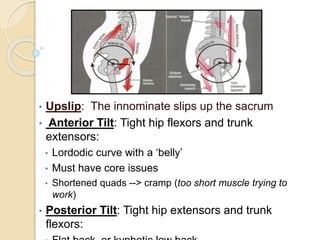
• Upslip: The innominate slips up the sacrum
• Anterior Tilt: Tight hip flexors and trunk
extensors:
• Lordodic curve with a ‘belly’
• Must have core issues
• Shortened quads --> cramp (too short muscle trying to
work)
• Posterior Tilt: Tight hip extensors and trunk
flexors:
Upslip ° Anterior Tilt ° Posterior Tilt
• If only one is present
• Core stability may be only slightly
destabilized.
• If 2 or 3 are present
• Core is usually compromised
• Hip takes over the work of the core for
stabilization with non-uniform effort
Four Basic Puzzle Pieces
• Illiac Crests: Are they level?
• PSIS’s: Are they level?
• PSIS with Movement:
• Flexion, lateral flexion, Gillet’s
• Do they remain level or go up?  hypomobile
• Do they go down?  normal movement
• Leg Length Discrepancy (LLD):
• Which one is shorter?
• How do they move sitting to supine?
Illiac Crests
• Assess from the back
• Move the shirt up so can observe landmarks
and movement in the back
• Come in from the lateral waist – 2nd MCP joints
level?
• Are they level?
• Higher side  Upslip and/or posterior rotation
possible
• Lower side  Anterior rotation possible
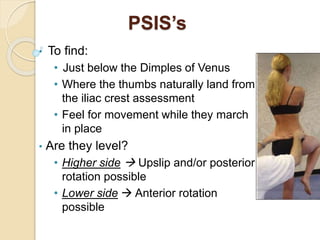
PSIS’s
• To find:
• Just below the Dimples of Venus
• Where the thumbs naturally land from
the iliac crest assessment
• Feel for movement while they march
in place
• Are they level?
• Higher side  Upslip and/or posterior
rotation possible
• Lower side  Anterior rotation
possible
PSIS’s with Movement
• Flexion, Lateral Flexion and Gillet’s
• Thumb not moving, moving up, or moving away
from the other indicates that the innominate is not
moving against the sacrum in the SIJ
Hypomobile SIJ
• Thumb moving down or towards the other
indicates innominate is moving against the sacrum
 preferred
• Observe the back during motion
• Hinges during movement ( especially lateral
flexion)
• Will see a hinge rather than a smooth curve along
the spine
• Rotated spine
• Paraspinals often raised on the side of the rotation
and depressed on the contra side
• L rotated thoracic spine caused tight R paraspinals.
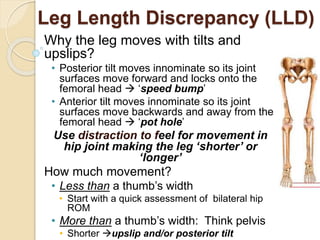
Leg Length Discrepancy (LLD)
Why the leg moves with tilts and
upslips?
• Posterior tilt moves innominate so its joint
surfaces move forward and locks onto the
femoral head  ‘speed bump’
• Anterior tilt moves innominate so its joint
surfaces move backwards and away from the
femoral head  ‘pot hole’
Use distraction to feel for movement in
hip joint making the leg ‘shorter’ or
‘longer’
How much movement?
• Less than a thumb’s width
• Start with a quick assessment of bilateral hip
ROM
• More than a thumb’s width: Think pelvis
• Shorter upslip and/or posterior tilt
Leg Length Discrepancy (LLD)
• Watch (out the ‘tops’ of your eyes) as the
person goes from sit to supine
• If go down on an elbow – makes assessment
invalid
• Modified LLD
• Start in hooklying
• Bridge from supine
• Look at knees for femur length
(longer/shorter)
• Helpful after TKA or hip replacements
• Chronic conditions often have one side with
an anterior tilt and the other side with a
posterior tilt
• After a couple of weeks the body
Edge Pieces
• Posture
• Sway back: Anterior tilt
• Flat back: Posterior tilt
• Tight/Cramped Muscles
• Quads: Anterior tilt
• Hams: Posterior tilt
• Walking: Lose balance, hip gives out, hip feels weird, trip up the stairs
• Think hip flexors and trunk extensors (anterior tilt)
• Sit to Stand (especially when start standing up)
• Pain, “ugh”
• Think hip extensors and trunk flexors (posterior tilt)
• SLS:
• Tendency to lose balance medially – anterior tilt
• Tendency to lose balance laterally – posterior tilt
• Pre-Piriformis Stretch:
• If symptoms worsen, may need to correct innominate/upslip
• Upslip:
• Tight QL
• More distinct crease on one side at the waist visible in low back
Patterns
Both the illiac crests and the PSIS’s indicate the
possibility of an upslip and/or a rotation
Pattern 1:
• Iliac Crest higher with ipsi PSIS level or higher
• LLD: Ipsi LE remains shorter than contra LE in
sitting & supine upslip
• Ipsi LE moves thumbwidth+ shorter to contra LE to supine
 upslip and posterior tilt
Pattern 2:
• Iliac Crest higher with ipsi PSIS level or higher
• LLD: Ipsi LE longer than contra LE in sitting, AND
• Ipsi LE becomes shorter to contra LE in supine AND
• Contra LE does not get shorter upslip & posterior on ipsi
Pattern 3:
• Iliac Crest higher with ipsi PSIS level or higher
• LLD: Ipsi LE is longer than contra LE in sitting
• AND Ipsi LE is longer in supine  upslip and anterior tilt
• OR Ipsi LE is shorter in supine  upslip and posterior tilt
Self-Mobilization for Upslip
• If an upslip is suspected – correct it first
• Then re-evaluate LLD to determine if
concurrent rotations are also present
• Sit in a chair with a back
• Feet evenly on floor
• Buttocks all the way back so they sit against
the back of the chair
• Dowel under contra ischial tuberosity
• Dowel made from a rolled towel
• Sit straight and relaxed for 3-4 minutes
• Lets gravity encourage the upslipped
innominate to slide down along the sacrum
Self-Mobilization for Tilt
Standing
• Standing with something to hold onto for
balance
• Step up with foot on the side with the anterior tilt
(or contra to the posterior tilt) onto a low
bench/stair
• Lean backwards
• Lunge so that the groin goes towards the floor
5x
• Knee flexes no more than 90 degrees
• Pushes pelvis into posterior with the extension.
Prone: POE, press ups
• Stretches hip flexor
• Encourages normal functional motion between
Manual Approaches
Anterior Tilt
• In prone
• One hand stabilizes contralateral innominate
laterally along the SIJ border
• Not on the SIJ
• Other hand pulls straight up (skyward) on the
ASIS
Posterior Tilt
• In prone
• One hand stabilizes contralateral innominate
laterally along the SIJ border
• Other hand pushes down (into the table) on the
innominate laterally and inferiorly
• With the direction of the plain of the joint
• Whole joint capsule get stretched
Other Treatment
Key Factors to Retaining Pelvic Alignment
1. Log roll
2. Core stability and engagement
3. Hip ROM and strength should be balanced
bilaterally
4. Requires life-long commitment to 2x/week
exercise or will get weak and re-injure
Thank You Cheryl!
It has been a wonderful internship!
References
Basheer, A., MD. (nd).The Sacroiliac Joint: To fuse or not to fuse. Retrieved from:
http://www.slideshare.net/AzamBasheer/si-joint-fusion-azam-basheer-md
Neumann, D.A. (February, 2010). Kinesiology of the hip: focus on muscular actions. Journal of
Orthopedic Sports Physical Therapy. 40(2):82-94. doi: 10.2519/jospt.2010.3025.
Parent, C., PT (September-November, 2015) Personal conversations.
Physiopedia. (nd). Leg Length Discrepancy. Retrieved from: http://www.physio-
pedia.com/Leg_Length_Discrepancy

Discerning the Pelvis

  • 1.
    Discerning the Pelvis ByDeborah Currier,SPTA, LMT Staff In-Service November 5, 2015
  • 2.
    • Upslip: Theinnominate slips up the sacrum • Anterior Tilt: Tight hip flexors and trunk extensors: • Lordodic curve with a ‘belly’ • Must have core issues • Shortened quads --> cramp (too short muscle trying to work) • Posterior Tilt: Tight hip extensors and trunk flexors:
  • 3.
    Upslip ° AnteriorTilt ° Posterior Tilt • If only one is present • Core stability may be only slightly destabilized. • If 2 or 3 are present • Core is usually compromised • Hip takes over the work of the core for stabilization with non-uniform effort
  • 4.
    Four Basic PuzzlePieces • Illiac Crests: Are they level? • PSIS’s: Are they level? • PSIS with Movement: • Flexion, lateral flexion, Gillet’s • Do they remain level or go up?  hypomobile • Do they go down?  normal movement • Leg Length Discrepancy (LLD): • Which one is shorter? • How do they move sitting to supine?
  • 5.
    Illiac Crests • Assessfrom the back • Move the shirt up so can observe landmarks and movement in the back • Come in from the lateral waist – 2nd MCP joints level? • Are they level? • Higher side  Upslip and/or posterior rotation possible • Lower side  Anterior rotation possible
  • 6.
    PSIS’s • To find: •Just below the Dimples of Venus • Where the thumbs naturally land from the iliac crest assessment • Feel for movement while they march in place • Are they level? • Higher side  Upslip and/or posterior rotation possible • Lower side  Anterior rotation possible
  • 7.
    PSIS’s with Movement •Flexion, Lateral Flexion and Gillet’s • Thumb not moving, moving up, or moving away from the other indicates that the innominate is not moving against the sacrum in the SIJ Hypomobile SIJ • Thumb moving down or towards the other indicates innominate is moving against the sacrum  preferred • Observe the back during motion • Hinges during movement ( especially lateral flexion) • Will see a hinge rather than a smooth curve along the spine • Rotated spine • Paraspinals often raised on the side of the rotation and depressed on the contra side • L rotated thoracic spine caused tight R paraspinals.
  • 8.
    Leg Length Discrepancy(LLD) Why the leg moves with tilts and upslips? • Posterior tilt moves innominate so its joint surfaces move forward and locks onto the femoral head  ‘speed bump’ • Anterior tilt moves innominate so its joint surfaces move backwards and away from the femoral head  ‘pot hole’ Use distraction to feel for movement in hip joint making the leg ‘shorter’ or ‘longer’ How much movement? • Less than a thumb’s width • Start with a quick assessment of bilateral hip ROM • More than a thumb’s width: Think pelvis • Shorter upslip and/or posterior tilt
  • 9.
    Leg Length Discrepancy(LLD) • Watch (out the ‘tops’ of your eyes) as the person goes from sit to supine • If go down on an elbow – makes assessment invalid • Modified LLD • Start in hooklying • Bridge from supine • Look at knees for femur length (longer/shorter) • Helpful after TKA or hip replacements • Chronic conditions often have one side with an anterior tilt and the other side with a posterior tilt • After a couple of weeks the body
  • 10.
    Edge Pieces • Posture •Sway back: Anterior tilt • Flat back: Posterior tilt • Tight/Cramped Muscles • Quads: Anterior tilt • Hams: Posterior tilt • Walking: Lose balance, hip gives out, hip feels weird, trip up the stairs • Think hip flexors and trunk extensors (anterior tilt) • Sit to Stand (especially when start standing up) • Pain, “ugh” • Think hip extensors and trunk flexors (posterior tilt) • SLS: • Tendency to lose balance medially – anterior tilt • Tendency to lose balance laterally – posterior tilt • Pre-Piriformis Stretch: • If symptoms worsen, may need to correct innominate/upslip • Upslip: • Tight QL • More distinct crease on one side at the waist visible in low back
  • 11.
    Patterns Both the illiaccrests and the PSIS’s indicate the possibility of an upslip and/or a rotation Pattern 1: • Iliac Crest higher with ipsi PSIS level or higher • LLD: Ipsi LE remains shorter than contra LE in sitting & supine upslip • Ipsi LE moves thumbwidth+ shorter to contra LE to supine  upslip and posterior tilt Pattern 2: • Iliac Crest higher with ipsi PSIS level or higher • LLD: Ipsi LE longer than contra LE in sitting, AND • Ipsi LE becomes shorter to contra LE in supine AND • Contra LE does not get shorter upslip & posterior on ipsi Pattern 3: • Iliac Crest higher with ipsi PSIS level or higher • LLD: Ipsi LE is longer than contra LE in sitting • AND Ipsi LE is longer in supine  upslip and anterior tilt • OR Ipsi LE is shorter in supine  upslip and posterior tilt
  • 12.
    Self-Mobilization for Upslip •If an upslip is suspected – correct it first • Then re-evaluate LLD to determine if concurrent rotations are also present • Sit in a chair with a back • Feet evenly on floor • Buttocks all the way back so they sit against the back of the chair • Dowel under contra ischial tuberosity • Dowel made from a rolled towel • Sit straight and relaxed for 3-4 minutes • Lets gravity encourage the upslipped innominate to slide down along the sacrum
  • 13.
    Self-Mobilization for Tilt Standing •Standing with something to hold onto for balance • Step up with foot on the side with the anterior tilt (or contra to the posterior tilt) onto a low bench/stair • Lean backwards • Lunge so that the groin goes towards the floor 5x • Knee flexes no more than 90 degrees • Pushes pelvis into posterior with the extension. Prone: POE, press ups • Stretches hip flexor • Encourages normal functional motion between
  • 14.
    Manual Approaches Anterior Tilt •In prone • One hand stabilizes contralateral innominate laterally along the SIJ border • Not on the SIJ • Other hand pulls straight up (skyward) on the ASIS Posterior Tilt • In prone • One hand stabilizes contralateral innominate laterally along the SIJ border • Other hand pushes down (into the table) on the innominate laterally and inferiorly • With the direction of the plain of the joint • Whole joint capsule get stretched
  • 15.
    Other Treatment Key Factorsto Retaining Pelvic Alignment 1. Log roll 2. Core stability and engagement 3. Hip ROM and strength should be balanced bilaterally 4. Requires life-long commitment to 2x/week exercise or will get weak and re-injure
  • 16.
    Thank You Cheryl! Ithas been a wonderful internship! References Basheer, A., MD. (nd).The Sacroiliac Joint: To fuse or not to fuse. Retrieved from: http://www.slideshare.net/AzamBasheer/si-joint-fusion-azam-basheer-md Neumann, D.A. (February, 2010). Kinesiology of the hip: focus on muscular actions. Journal of Orthopedic Sports Physical Therapy. 40(2):82-94. doi: 10.2519/jospt.2010.3025. Parent, C., PT (September-November, 2015) Personal conversations. Physiopedia. (nd). Leg Length Discrepancy. Retrieved from: http://www.physio- pedia.com/Leg_Length_Discrepancy

Editor's Notes

  • #9 Distraction—what is the point??: