PROGRAM NAME : B.TECH CSE
COURSE NAME: MACHINE LEARNING
NEURAL NETWORKS
CONTENTS
Introduction.
 Artificial Neural Networks.
 Model of Artificial Neurons.
 Neural Network Architecture.
 Single Layer Feed Forward Networks.
 Learning of ANN.
 Applications of ANN.
INTRODUCTION
 Neural networks are the simplified models of the biological
neuron systems.
 Neural networks are typically organized in layers. Layers
are made up of a number of interconnected 'nodes' .which
contain an 'activation function'.
 Patterns are presented to the network via the 'input layer',
which communicates to one or more 'hidden layers' where
the actual processing is done via a system of weighted
'connections'.
 The hidden layers then link to an 'output layer' where the
answer is output
ARTIFICIAL NEURAL
NETWORKSInputs
Output
An artificial neural network is composed of many artificial neurons that
are linked together according to a specific network architecture. The
objective of the neural network is to transform the inputs into meaningful
outputs.
MODEL OF ARTIFICIAL
NEURON
 An appropriate model/simulation of the nervous system should be able
to produce similar responses and behaviours in artificial systems.
 The nervous system is build by relatively simple units, the neurons, so
copying their behaviour and functionality should be the solution.
MODEL OF ARTIFICIAL
NEURON
Neuron consists of three basic components weights, thresholds and a
single activation function
A set or connection link: each of which is characterized by a weight
or strength of its own wkj. Specifically, a signal xj at the input
synapse „j‟connected to neuron „k‟is multiplied by the synaptic wkj
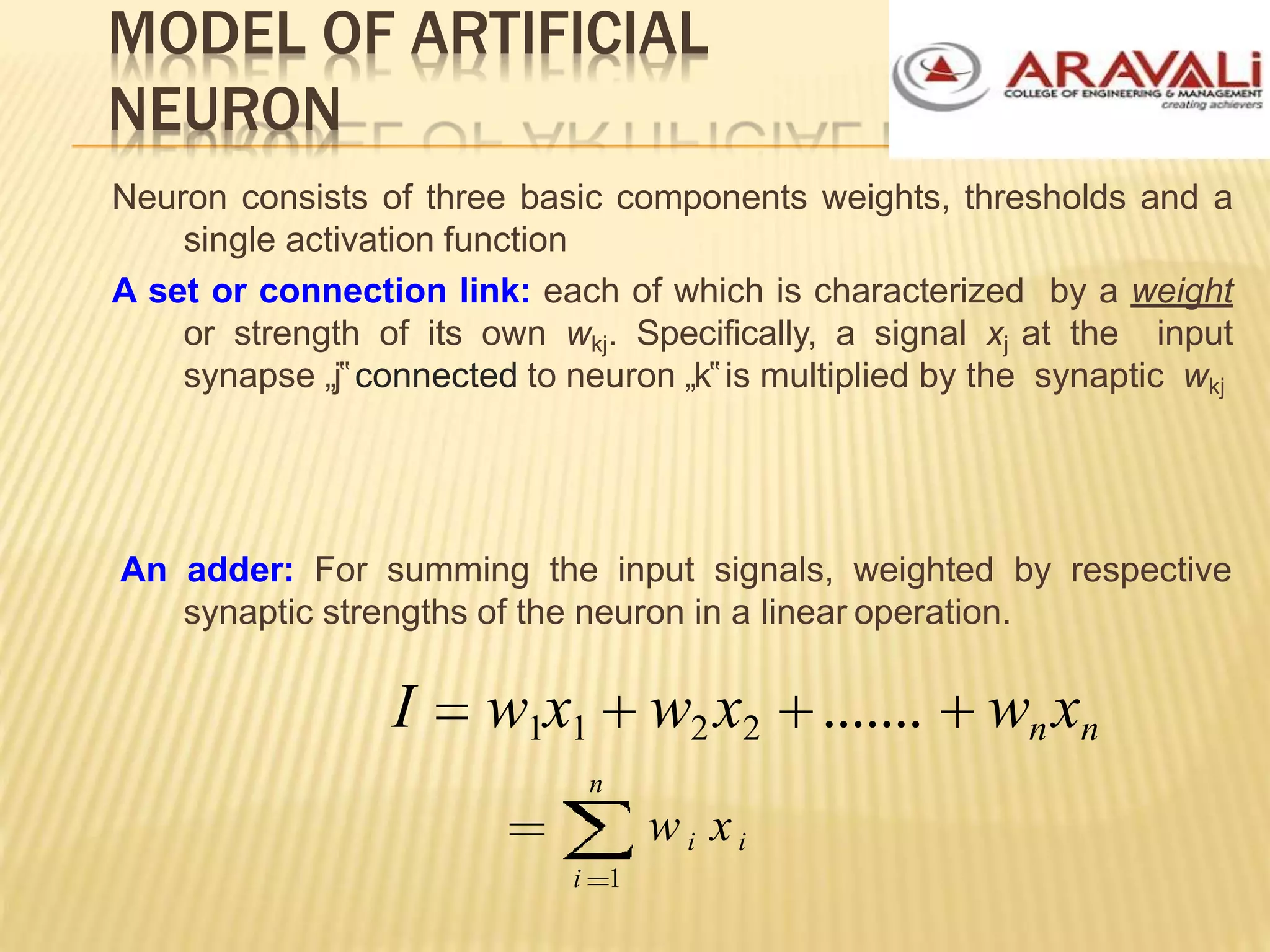
An adder: For summing the input signals, weighted by respective
synaptic strengths of the neuron in a linear operation.
I w1x1
n
w2 x2 ....... wnxn
w i xi
i 1
MODEL OF ARTIFICIAL
NEURON
Threshold for a Neuron:-
The total input for each neuron is the sum of the weighted inputs to
the neuron minus its threshold value. This is then passed through
the sigmoid function. The equation for the transition in a neuron is :
a = 1/(1 + exp(- x)) where
x = ai wi - Q
a is the activation for the neuron
ai is the activation for neuron i
wi is the weight
Q is the threshold subtracted
MODEL OF ARTIFICIAL
NEURON
Activation function: An activation function f performs a mathematical
operation on the signal output. The most common activation
functions are:
- Linear Function,
- Threshold Function,
- Sigmoidal (S shaped) function,
The activation functions are chosen depending upon the type of
problem to be solved by the network.
MODEL OF ARTIFICIAL
NEURON
Activation Functions f – Types:-
Sigmoidal Function (S-shape function):-
The nonlinear curved S-shape function is called the sigmoid function.
This is most common type of activation used to construct the neural
networks. It is mathematically well behaved, differentiable and strictly
increasing function.
This is explained as
≈ 0 for large -ve input values,
1 for large +ve values, with a smooth transition between the two.
α is slope parameter also called shape parameter symbol the λ is also
used to represented this parameter.
1
Y f (I) ,0 f (I) 1
1 e
1/(1 exp( I)),0 f (I) 1
I
NEURAL NETWORK
ARCHITECTURE
 An artificial Neural Network is defined as a data processing system
consisting of a large number of interconnected processing elements or
artificial neurons.
 There are three fundamentally different classes of neural networks.
Those are.
1. Single layer feedforward Networks.
2. Multilayer feedforward Networks.
3. Recurrent Networks.
Here we have to discuss the single layer feed forward network.
SINGLE-LAYER FEED
FORWARD NETWORK
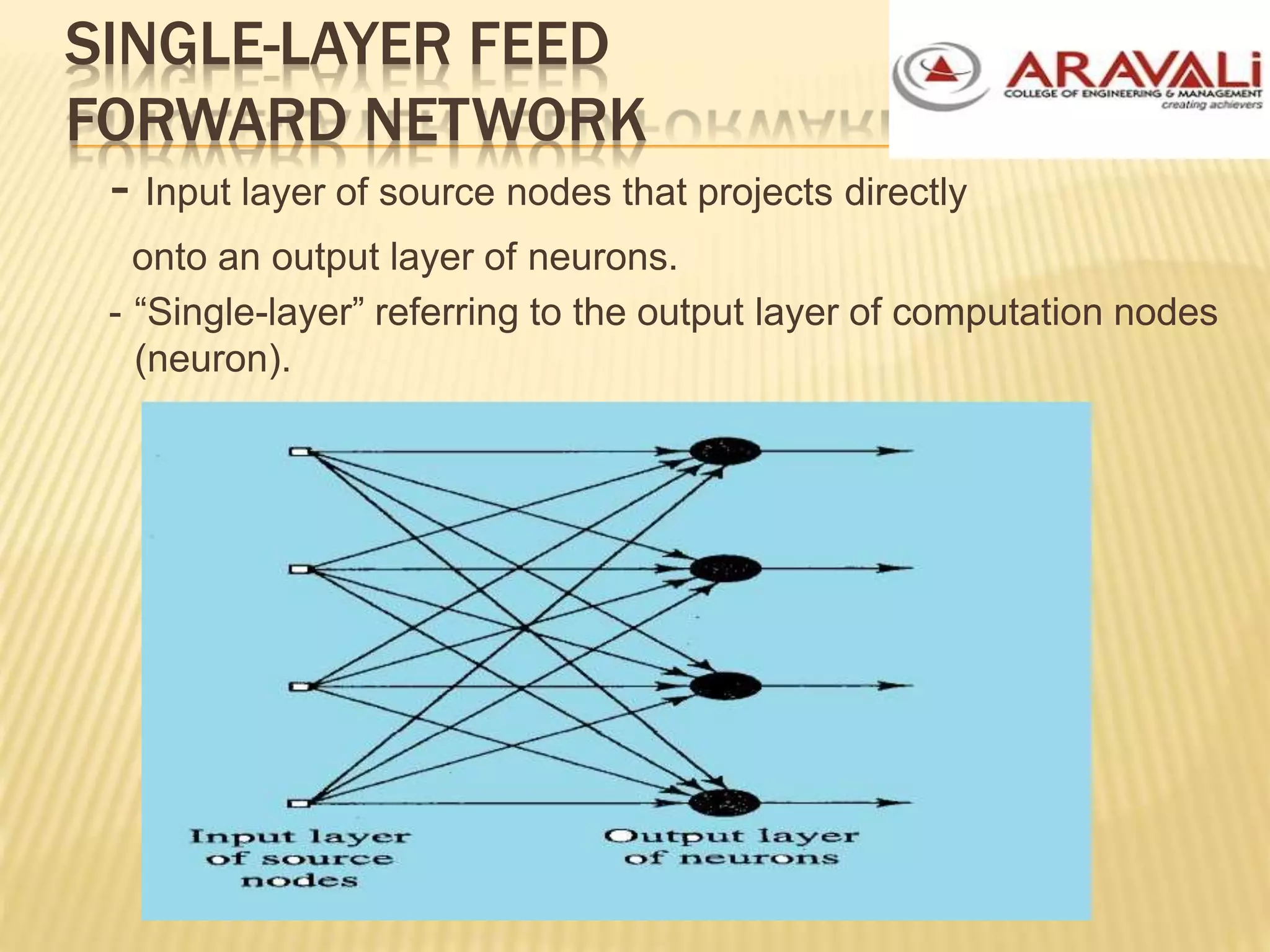
- Input layer of source nodes that projects directly
onto an output layer of neurons.
- “Single-layer” referring to the output layer of computation nodes
(neuron).
20 March 2013
SINGLE-LAYER FEED
FORWARD NETWORK
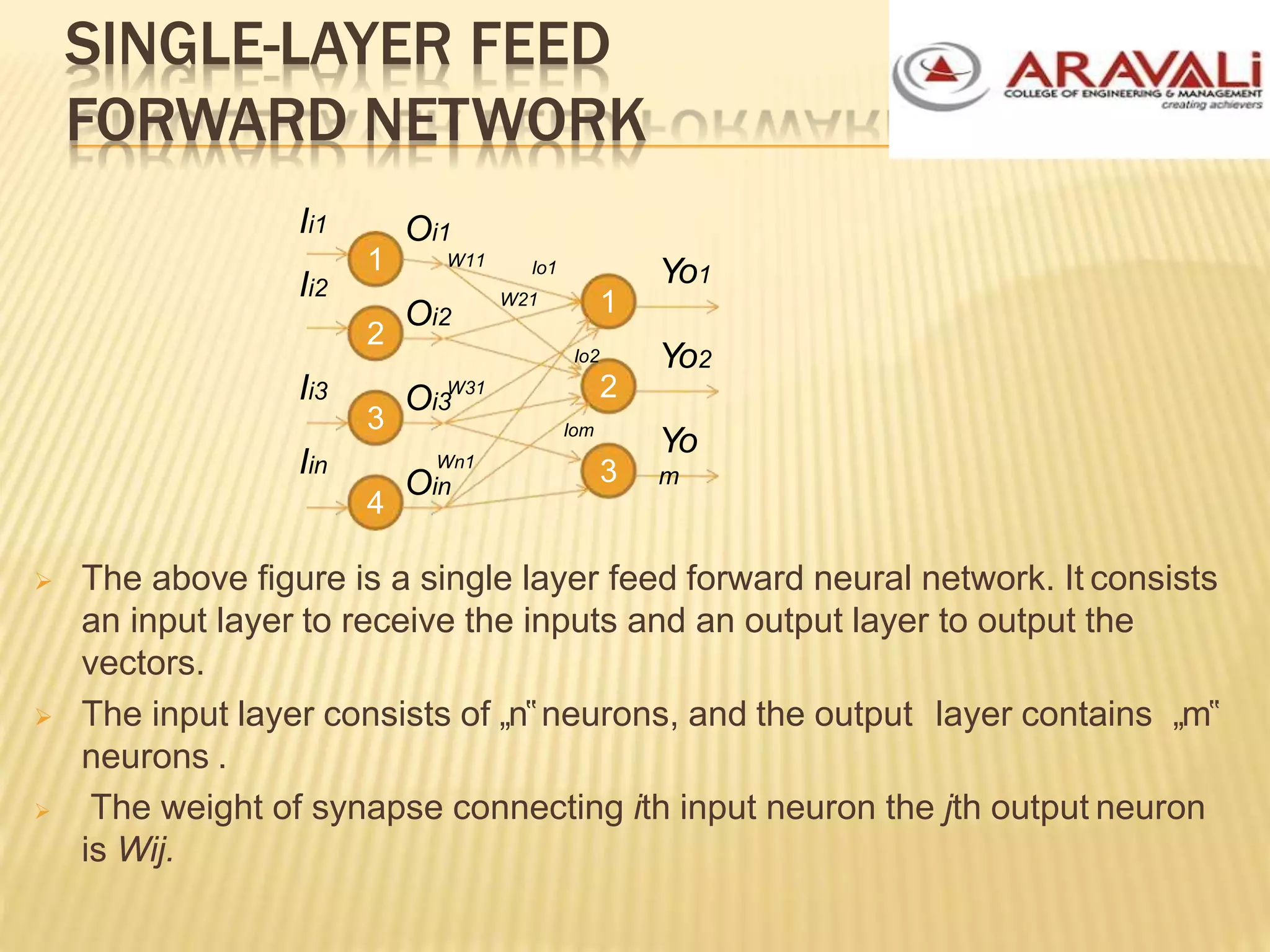
 The above figure is a single layer feed forward neural network. It consists
an input layer to receive the inputs and an output layer to output the
vectors.
 The input layer consists of „n‟neurons, and the output layer contains „m‟
neurons .
 The weight of synapse connecting ith input neuron the jth output neuron
is Wij.
1
2
3
4
1
2
3
Ii1
Ii2
Ii3
Iin
Oi2
Oi3
Oin
Oi1
W11 Io1
W21
Io2
Iom
W31
Wn1
Yo1
Yo2
Yo
m
SINGLE-LAYER FEED
FORWARD NETWORK
Here the inputs of the input layer and the outputs of the output layer is
given as
So
Hence, the input to the output layer can be given as
Because
The block diagram of a single layer feed forward network.
Ioj W1j II1
1
n 1
W2 j II 2 Wnj IIN
Iin
Ii1
Ii2
..
I
m 1
o
Oom
......
Oo1
Oo2
..
O
I Io m 1 m n n 1
O IW T
W T
I
n 1 m 1
IIOI
F(I,W)I O
LEARNING IN ANN
Learning methods in neural networks can be broadly classified in three basic
types.
- Supervised Learning
- Unsupervised Learning
- Reinforcement Learning
Supervised Learning:-

 In supervised learning, both the inputs and the outputs are provided.
The network then processes the inputs and compares its resulting
outputs against the desired outputs
Errors are then calculated, causing the system to adjust the weights
which control the network.
 Here a teacher is assume to be present during the learning process.
LEARNING IN ANN
Unsupervised Learning:-
 Here the target output is not presented to the network, Because there
is no teacher to present the described patterns.
 So the system learns of its own by discovering and adapting to
structural features of the input patterns.
Reinforcement Learning:-
 In this method, a teacher though available, does not present the
expected answer but only indicates if the computed output is correct or
incorrect.
 The information provided helps the network in its learning process.
 Here a reward is given for correct answer computed and a penalty for
a wrong answer.
APPLICATIONS OF NEURAL
NETWORKS
 Character Recognition:- Neural networks can be used to
recognize handwritten characters.
 Image Compression:- Neural networks can receive and process
vast amounts of information at once, making them useful in image
compression.
 Stock Market Prediction:- Neural networks can examine a lot of
information quickly and sort it all out, they can be used to predict
stock prices.
 Travelling Salesman Problem:- Neural networks can solve
the traveling salesman problem, but only to a certain degree
of approximation.
 Security and Loan Applications:- With the acceptation of a
neural network that will decide whether or not to grant a loan.
10/15/2020
17
Aravali College of Engineering And Management
Jasana, Tigoan Road, Neharpar, Faridabad, Delhi NCR
Toll Free Number : 91- 8527538785
Website : www.acem.edu.in

Acem neuralnetworks

  • 1.
    PROGRAM NAME :B.TECH CSE COURSE NAME: MACHINE LEARNING NEURAL NETWORKS
  • 2.
    CONTENTS Introduction.  Artificial NeuralNetworks.  Model of Artificial Neurons.  Neural Network Architecture.  Single Layer Feed Forward Networks.  Learning of ANN.  Applications of ANN.
  • 3.
    INTRODUCTION  Neural networksare the simplified models of the biological neuron systems.  Neural networks are typically organized in layers. Layers are made up of a number of interconnected 'nodes' .which contain an 'activation function'.  Patterns are presented to the network via the 'input layer', which communicates to one or more 'hidden layers' where the actual processing is done via a system of weighted 'connections'.  The hidden layers then link to an 'output layer' where the answer is output
  • 4.
    ARTIFICIAL NEURAL NETWORKSInputs Output An artificialneural network is composed of many artificial neurons that are linked together according to a specific network architecture. The objective of the neural network is to transform the inputs into meaningful outputs.
  • 5.
    MODEL OF ARTIFICIAL NEURON An appropriate model/simulation of the nervous system should be able to produce similar responses and behaviours in artificial systems.  The nervous system is build by relatively simple units, the neurons, so copying their behaviour and functionality should be the solution.
  • 6.
    MODEL OF ARTIFICIAL NEURON Neuronconsists of three basic components weights, thresholds and a single activation function A set or connection link: each of which is characterized by a weight or strength of its own wkj. Specifically, a signal xj at the input synapse „j‟connected to neuron „k‟is multiplied by the synaptic wkj An adder: For summing the input signals, weighted by respective synaptic strengths of the neuron in a linear operation. I w1x1 n w2 x2 ....... wnxn w i xi i 1
  • 7.
    MODEL OF ARTIFICIAL NEURON Thresholdfor a Neuron:- The total input for each neuron is the sum of the weighted inputs to the neuron minus its threshold value. This is then passed through the sigmoid function. The equation for the transition in a neuron is : a = 1/(1 + exp(- x)) where x = ai wi - Q a is the activation for the neuron ai is the activation for neuron i wi is the weight Q is the threshold subtracted
  • 8.
    MODEL OF ARTIFICIAL NEURON Activationfunction: An activation function f performs a mathematical operation on the signal output. The most common activation functions are: - Linear Function, - Threshold Function, - Sigmoidal (S shaped) function, The activation functions are chosen depending upon the type of problem to be solved by the network.
  • 9.
    MODEL OF ARTIFICIAL NEURON ActivationFunctions f – Types:- Sigmoidal Function (S-shape function):- The nonlinear curved S-shape function is called the sigmoid function. This is most common type of activation used to construct the neural networks. It is mathematically well behaved, differentiable and strictly increasing function. This is explained as ≈ 0 for large -ve input values, 1 for large +ve values, with a smooth transition between the two. α is slope parameter also called shape parameter symbol the λ is also used to represented this parameter. 1 Y f (I) ,0 f (I) 1 1 e 1/(1 exp( I)),0 f (I) 1 I
  • 10.
    NEURAL NETWORK ARCHITECTURE  Anartificial Neural Network is defined as a data processing system consisting of a large number of interconnected processing elements or artificial neurons.  There are three fundamentally different classes of neural networks. Those are. 1. Single layer feedforward Networks. 2. Multilayer feedforward Networks. 3. Recurrent Networks. Here we have to discuss the single layer feed forward network.
  • 11.
    SINGLE-LAYER FEED FORWARD NETWORK -Input layer of source nodes that projects directly onto an output layer of neurons. - “Single-layer” referring to the output layer of computation nodes (neuron). 20 March 2013
  • 12.
    SINGLE-LAYER FEED FORWARD NETWORK The above figure is a single layer feed forward neural network. It consists an input layer to receive the inputs and an output layer to output the vectors.  The input layer consists of „n‟neurons, and the output layer contains „m‟ neurons .  The weight of synapse connecting ith input neuron the jth output neuron is Wij. 1 2 3 4 1 2 3 Ii1 Ii2 Ii3 Iin Oi2 Oi3 Oin Oi1 W11 Io1 W21 Io2 Iom W31 Wn1 Yo1 Yo2 Yo m
  • 13.
    SINGLE-LAYER FEED FORWARD NETWORK Herethe inputs of the input layer and the outputs of the output layer is given as So Hence, the input to the output layer can be given as Because The block diagram of a single layer feed forward network. Ioj W1j II1 1 n 1 W2 j II 2 Wnj IIN Iin Ii1 Ii2 .. I m 1 o Oom ...... Oo1 Oo2 .. O I Io m 1 m n n 1 O IW T W T I n 1 m 1 IIOI F(I,W)I O
  • 14.
    LEARNING IN ANN Learningmethods in neural networks can be broadly classified in three basic types. - Supervised Learning - Unsupervised Learning - Reinforcement Learning Supervised Learning:-   In supervised learning, both the inputs and the outputs are provided. The network then processes the inputs and compares its resulting outputs against the desired outputs Errors are then calculated, causing the system to adjust the weights which control the network.  Here a teacher is assume to be present during the learning process.
  • 15.
    LEARNING IN ANN UnsupervisedLearning:-  Here the target output is not presented to the network, Because there is no teacher to present the described patterns.  So the system learns of its own by discovering and adapting to structural features of the input patterns. Reinforcement Learning:-  In this method, a teacher though available, does not present the expected answer but only indicates if the computed output is correct or incorrect.  The information provided helps the network in its learning process.  Here a reward is given for correct answer computed and a penalty for a wrong answer.
  • 16.
    APPLICATIONS OF NEURAL NETWORKS Character Recognition:- Neural networks can be used to recognize handwritten characters.  Image Compression:- Neural networks can receive and process vast amounts of information at once, making them useful in image compression.  Stock Market Prediction:- Neural networks can examine a lot of information quickly and sort it all out, they can be used to predict stock prices.  Travelling Salesman Problem:- Neural networks can solve the traveling salesman problem, but only to a certain degree of approximation.  Security and Loan Applications:- With the acceptation of a neural network that will decide whether or not to grant a loan.
  • 17.
    10/15/2020 17 Aravali College ofEngineering And Management Jasana, Tigoan Road, Neharpar, Faridabad, Delhi NCR Toll Free Number : 91- 8527538785 Website : www.acem.edu.in