Phase Requirements, design and
       validation of phase preserving
        processors for a SAR system

 Michele Belotti (1)                     Silvia Scirpoli   (2)


 Davide D’Aria (1)                       Lorenzo Iannini(2)

 Andrea Monti Guarnieri   (1)(2)


(1)
                                   (2)

Advanced Remote Sensing Systems
a POLIMI spin-off


                                                                 1
Outline
• The need for a set of interferometric quality
  requirements for SAR processors has been
  reccomended (CEOS Calibration meeting –
  Pasadena - 2009)
• The methods could serve as as basis for processor
  performances benchmarking
• Further, the definition of new acquisition modes
  (Sentinel-1 TOPSAR) requires the update and
  customisation of existing phase preservation tests
• Please note that only phase quality is here
  addressed (then being far from an overall suite of
  tests for SAR processing validation)
                                                       2
Outline

• Addressed SAR acquisition modes
  –   Stripmap
  –   SCANSAR
  –   TOPSAR
  –   SPOT
• Proposed phase preserving tests
  – Test definition and applicability
  – verification criteria
  – Brief procedural description
• Conclusions


                                        3
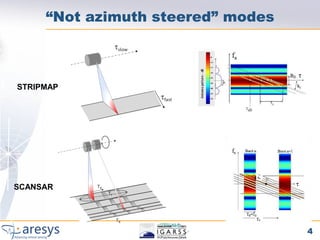
“Not azimuth steered” modes


STRIPMAP


SCANSAR


                                   4
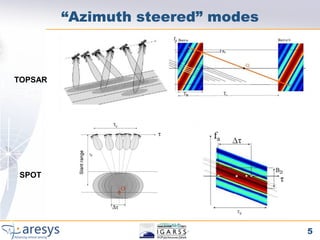
“Azimuth steered” modes


TOPSAR


SPOT


                                   5
Classical CEOS offset test
    Process two SLCs from the same raw data set and with the same orbit, but offset by
    l00 lines in azimuth and l00 sample in range. The interferogram formed from these
    two properly coregistered SLCs should ideally have a constant phase of zero and
    thus reveals processor induced artifacts.


                                                        Pass/Fail criteria:
                                                        •Mean of interferogram phase ≤ 0.1°
                                                        •Standard deviation ≤ 5.5°
                                                        •No discontinuity at block boundaries.


[1] Rosich Tell B. and H Laur. Phase preservation in sar processing: the interferometric offset
test. In IGARSS96, Lincoln, Nebraska, USA, 27-31 May 1996.
                                                                                                 6
Proposed SAR processor phase verification tests

                             Purpose                                                    STRIP       SCAN          TOPS     SPOT

‘Classical’ CEOS             The purpose of the “CEOS offset test“([1]) is to           YES         YES           NO       NO
                             verify the processor phase preservation
                             performances with respect to range and azimuth
                             shifts of the input RAW data. The test as it is
                             defined can be applied to STRIPMAP and
                             SCANSAR data
Extended CEOS offset         The extended CEOS has been introduced in                   YES         YES           YES      YES
                             order to verify the processor phase preservation
                             with respect to shifts and scaling.

                             Further the extended CEOS has been extended
                             to TOPSAR and SPOT modes
Inter Burst/Slice phase      The purpose of this test is to verify the                  YES*        YES           YES      NO
preserving                   processor phase preservation performances
                             when comparing the phase of adjacent bursts.
                             For this purpose , targets in the burst
                             overlapped area are exploited.
Inter Swath phase            Same as inter-burst test but applied to Sub-               NO          YES           YES      NO
preserving                   swaths overlapping areas


      [1] Rosich Tell B. and H Laur. Phase preservation in sar processing: the interferometric offset test. In IGARSS96,
      Lincoln, Nebraska, USA, 27-31 May 1996.

      * For STRIPMAP the InterBurst test is simply performed considering overlapping processing blocks


                                                                                                                                  7
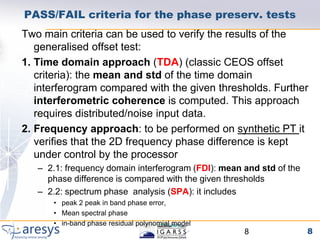
PASS/FAIL criteria for the phase preserv. tests
Two main criteria can be used to verify the results of the
   generalised offset test:
1. Time domain approach (TDA) (classic CEOS offset
   criteria): the mean and std of the time domain
   interferogram compared with the given thresholds. Further
   interferometric coherence is computed. This approach
   requires distributed/noise input data.
2. Frequency approach: to be performed on synthetic PT it
   verifies that the 2D frequency phase difference is kept
   under control by the processor
   – 2.1: frequency domain interferogram (FDI): mean and std of the
     phase difference is compared with the given thresholds
   – 2.2: spectrum phase analysis (SPA): it includes
      • peak 2 peak in band phase error,
      • Mean spectral phase
      • in-band phase residual polynomial model
                                                     8                8
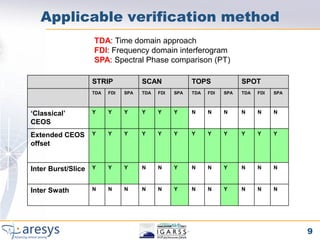
Applicable verification method
                    TDA: Time domain approach
                    FDI: Frequency domain interferogram
                    SPA: Spectral Phase comparison (PT)

                    STRIP             SCAN              TOPS              SPOT
                    TDA   FDI   SPA   TDA   FDI   SPA   TDA   FDI   SPA   TDA   FDI   SPA


‘Classical’         Y     Y     Y     Y     Y     Y     N     N     N     N     N     N
CEOS
Extended CEOS       Y     Y     Y     Y     Y     Y     Y     Y     Y     Y     Y     Y
offset


Inter Burst/Slice   Y     Y     Y     N     N     Y     N     N     Y     N     N     N


Inter Swath         N     N     N     N     N     Y     N     N     Y     N     N     N


                                                                                            9
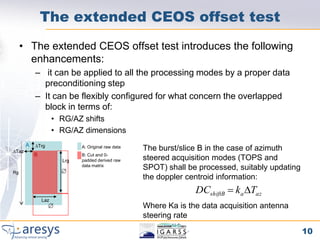
The extended CEOS offset test
     • The extended CEOS offset test introduces the following
       enhancements:
           – it can be applied to all the processing modes by a proper data
             preconditioning step
           – It can be flexibly configured for what concern the overlapped
             block in terms of:
                     • RG/AZ shifts
                     • RG/AZ dimensions
       A   DTrg
DTaz
                             A: Original raw data   The burst/slice B in the case of azimuth
           B                 B: Cut and 0-
                       Lrg   padded derived raw     steered acquisition modes (TOPS and
                             data matrix
                       
                                                    SPOT) shall be processed, suitably updating
Rg
                                                    the doppler centroid information:
                                                                  DCshiftB  ka DTaz
               Laz
                                                   Where Ka is the data acquisition antenna
                                                    steering rate

                                                                                                  10
Processor features tested with CEOS-offset

• The extended CEOS offset test is aimed at
  veryfing the following SAR processing
  performances:
  – phase preservation w.r.t. to azimuth and range
    shifts
  – phase preservation w.r.t to different RAW data
    blocks definition (i.e. verification of any block-
    wise phase artifact introduced by the processor)
  – phase preservation w.r.t changes to the
    processing block geometrical parameters (i.e.
    azimuth-adaptivity test)
                                                     11
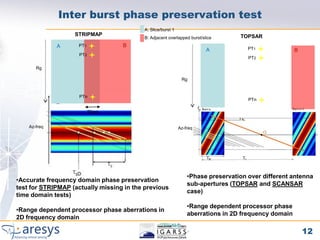
Inter burst phase preservation test
                                          A: Slice/burst 1
                   STRIPMAP                                                       TOPSAR
                                          B: Adjacent overlapped burst/slice
              A     PT1            B
                                                                         A           PT1              B
                     PT2
                                                                                     PT2

       Rg

                                                              Rg


                     PTn
                                                                                     PTn

                           Tfoot


    Az-freq                                                  Az-freq


                                                                 •Phase preservation over different antenna
•Accurate frequency domain phase preservation
                                                                 sub-apertures (TOPSAR and SCANSAR
test for STRIPMAP (actually missing in the previous
                                                                 case)
time domain tests)
                                                                 •Range dependent processor phase
•Range dependent processor phase aberrations in
                                                                 aberrations in 2D frequency domain
2D frequency domain

                                                                                                          12
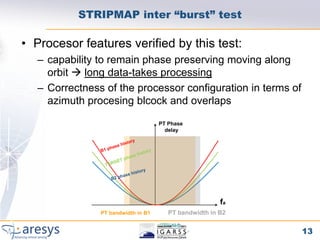
STRIPMAP inter “burst” test

• Procesor features verified by this test:
   – capability to remain phase preserving moving along
     orbit  long data-takes processing
   – Correctness of the processor configuration in terms of
     azimuth procesing blcock and overlaps
                                     PT Phase
                                       delay


                                                        fa
                PT bandwidth in B1      PT bandwidth in B2


                                                              13
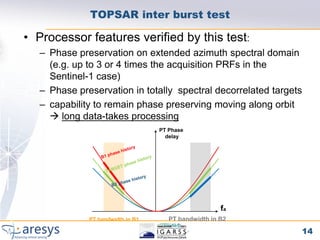
TOPSAR inter burst test

• Processor features verified by this test:
   – Phase preservation on extended azimuth spectral domain
     (e.g. up to 3 or 4 times the acquisition PRFs in the
     Sentinel-1 case)
   – Phase preservation in totally spectral decorrelated targets
   – capability to remain phase preserving moving along orbit
      long data-takes processing
                                   PT Phase
                                     delay


                                                      fa
              PT bandwidth in B1      PT bandwidth in B2

                                                               14
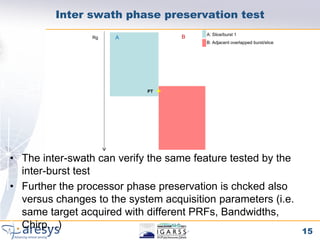
Inter swath phase preservation test
                                        A: Slice/burst 1
                 Rg   A            B
                                        B: Adjacent overlapped burst/slice


                            PT


• The inter-swath can verify the same feature tested by the
  inter-burst test
• Further the processor phase preservation is chcked also
  versus changes to the system acquisition parameters (i.e.
  same target acquired with different PRFs, Bandwidths,
  Chirp…)
                                                                             15
Conclusions
• Phase quality performances for a SAR processor are a key
  point, especially for interferometric applications
• Future SAR mission, like ESA’s Sentinel-1 foresee
  interferometric dedicated acquisition mode based on new
  acquisition schemes ( e.g. TOPSAR Interferometric Wide-
  swath Mode )
• Under these assumption update phase preserving tests for
  a SAR processor have been proposed introducing further
  specialised tests:
   – Extended CEOS offset test
   – Inter slice/burst phase preserving test
   – Inter swath phase preserving test
• These tests should guarantee an accurate screening of
  time-domain and frequency-domain phase aberrations of
  the investigated tool                                   16

PhaseRequirements_v1_2.pdf

  • 1.
    Phase Requirements, designand validation of phase preserving processors for a SAR system Michele Belotti (1) Silvia Scirpoli (2) Davide D’Aria (1) Lorenzo Iannini(2) Andrea Monti Guarnieri (1)(2) (1) (2) Advanced Remote Sensing Systems a POLIMI spin-off 1
  • 2.
    Outline • The needfor a set of interferometric quality requirements for SAR processors has been reccomended (CEOS Calibration meeting – Pasadena - 2009) • The methods could serve as as basis for processor performances benchmarking • Further, the definition of new acquisition modes (Sentinel-1 TOPSAR) requires the update and customisation of existing phase preservation tests • Please note that only phase quality is here addressed (then being far from an overall suite of tests for SAR processing validation) 2
  • 3.
    Outline • Addressed SARacquisition modes – Stripmap – SCANSAR – TOPSAR – SPOT • Proposed phase preserving tests – Test definition and applicability – verification criteria – Brief procedural description • Conclusions 3
  • 4.
    “Not azimuth steered”modes STRIPMAP SCANSAR 4
  • 5.
  • 6.
    Classical CEOS offsettest Process two SLCs from the same raw data set and with the same orbit, but offset by l00 lines in azimuth and l00 sample in range. The interferogram formed from these two properly coregistered SLCs should ideally have a constant phase of zero and thus reveals processor induced artifacts. Pass/Fail criteria: •Mean of interferogram phase ≤ 0.1° •Standard deviation ≤ 5.5° •No discontinuity at block boundaries. [1] Rosich Tell B. and H Laur. Phase preservation in sar processing: the interferometric offset test. In IGARSS96, Lincoln, Nebraska, USA, 27-31 May 1996. 6
  • 7.
    Proposed SAR processorphase verification tests Purpose STRIP SCAN TOPS SPOT ‘Classical’ CEOS The purpose of the “CEOS offset test“([1]) is to YES YES NO NO verify the processor phase preservation performances with respect to range and azimuth shifts of the input RAW data. The test as it is defined can be applied to STRIPMAP and SCANSAR data Extended CEOS offset The extended CEOS has been introduced in YES YES YES YES order to verify the processor phase preservation with respect to shifts and scaling. Further the extended CEOS has been extended to TOPSAR and SPOT modes Inter Burst/Slice phase The purpose of this test is to verify the YES* YES YES NO preserving processor phase preservation performances when comparing the phase of adjacent bursts. For this purpose , targets in the burst overlapped area are exploited. Inter Swath phase Same as inter-burst test but applied to Sub- NO YES YES NO preserving swaths overlapping areas [1] Rosich Tell B. and H Laur. Phase preservation in sar processing: the interferometric offset test. In IGARSS96, Lincoln, Nebraska, USA, 27-31 May 1996. * For STRIPMAP the InterBurst test is simply performed considering overlapping processing blocks 7
  • 8.
    PASS/FAIL criteria forthe phase preserv. tests Two main criteria can be used to verify the results of the generalised offset test: 1. Time domain approach (TDA) (classic CEOS offset criteria): the mean and std of the time domain interferogram compared with the given thresholds. Further interferometric coherence is computed. This approach requires distributed/noise input data. 2. Frequency approach: to be performed on synthetic PT it verifies that the 2D frequency phase difference is kept under control by the processor – 2.1: frequency domain interferogram (FDI): mean and std of the phase difference is compared with the given thresholds – 2.2: spectrum phase analysis (SPA): it includes • peak 2 peak in band phase error, • Mean spectral phase • in-band phase residual polynomial model 8 8
  • 9.
    Applicable verification method TDA: Time domain approach FDI: Frequency domain interferogram SPA: Spectral Phase comparison (PT) STRIP SCAN TOPS SPOT TDA FDI SPA TDA FDI SPA TDA FDI SPA TDA FDI SPA ‘Classical’ Y Y Y Y Y Y N N N N N N CEOS Extended CEOS Y Y Y Y Y Y Y Y Y Y Y Y offset Inter Burst/Slice Y Y Y N N Y N N Y N N N Inter Swath N N N N N Y N N Y N N N 9
  • 10.
    The extended CEOSoffset test • The extended CEOS offset test introduces the following enhancements: – it can be applied to all the processing modes by a proper data preconditioning step – It can be flexibly configured for what concern the overlapped block in terms of: • RG/AZ shifts • RG/AZ dimensions A DTrg DTaz A: Original raw data The burst/slice B in the case of azimuth B B: Cut and 0- Lrg padded derived raw steered acquisition modes (TOPS and data matrix  SPOT) shall be processed, suitably updating Rg the doppler centroid information: DCshiftB  ka DTaz Laz  Where Ka is the data acquisition antenna steering rate 10
  • 11.
    Processor features testedwith CEOS-offset • The extended CEOS offset test is aimed at veryfing the following SAR processing performances: – phase preservation w.r.t. to azimuth and range shifts – phase preservation w.r.t to different RAW data blocks definition (i.e. verification of any block- wise phase artifact introduced by the processor) – phase preservation w.r.t changes to the processing block geometrical parameters (i.e. azimuth-adaptivity test) 11
  • 12.
    Inter burst phasepreservation test A: Slice/burst 1 STRIPMAP TOPSAR B: Adjacent overlapped burst/slice A PT1 B A PT1 B PT2 PT2 Rg Rg PTn PTn Tfoot Az-freq Az-freq •Phase preservation over different antenna •Accurate frequency domain phase preservation sub-apertures (TOPSAR and SCANSAR test for STRIPMAP (actually missing in the previous case) time domain tests) •Range dependent processor phase •Range dependent processor phase aberrations in aberrations in 2D frequency domain 2D frequency domain 12
  • 13.
    STRIPMAP inter “burst”test • Procesor features verified by this test: – capability to remain phase preserving moving along orbit  long data-takes processing – Correctness of the processor configuration in terms of azimuth procesing blcock and overlaps PT Phase delay fa PT bandwidth in B1 PT bandwidth in B2 13
  • 14.
    TOPSAR inter bursttest • Processor features verified by this test: – Phase preservation on extended azimuth spectral domain (e.g. up to 3 or 4 times the acquisition PRFs in the Sentinel-1 case) – Phase preservation in totally spectral decorrelated targets – capability to remain phase preserving moving along orbit  long data-takes processing PT Phase delay fa PT bandwidth in B1 PT bandwidth in B2 14
  • 15.
    Inter swath phasepreservation test A: Slice/burst 1 Rg A B B: Adjacent overlapped burst/slice PT • The inter-swath can verify the same feature tested by the inter-burst test • Further the processor phase preservation is chcked also versus changes to the system acquisition parameters (i.e. same target acquired with different PRFs, Bandwidths, Chirp…) 15
  • 16.
    Conclusions • Phase qualityperformances for a SAR processor are a key point, especially for interferometric applications • Future SAR mission, like ESA’s Sentinel-1 foresee interferometric dedicated acquisition mode based on new acquisition schemes ( e.g. TOPSAR Interferometric Wide- swath Mode ) • Under these assumption update phase preserving tests for a SAR processor have been proposed introducing further specialised tests: – Extended CEOS offset test – Inter slice/burst phase preserving test – Inter swath phase preserving test • These tests should guarantee an accurate screening of time-domain and frequency-domain phase aberrations of the investigated tool 16