Access Control Matrix
Outline Overview Access Control Matrix Model Boolean Expression Evaluation History Protection State Transitions Commands Conditional Commands  Special Rights Principle of Attenuation of Privilege
Overview State The collection of the current values of all memory locations, all secondary storage, and all registers and other components of the system. Protection state of system a subset of the  states  that are relevant to  protection Access control matrix A tool that can describe protection state Matrix describing rights of subjects State transitions change elements of matrix
Overview Access control matrix model The most precise model used to describe a protection state It characterizes the  rights  of each  subject  with respect to every other  entity , which can be active or passive. The set of  objects  = the set of all protected entities The set of  subjects  = the set of active objects, such as processes and users. The ACM captures the relationships between the  subjects  and the  objects . When a command changes the state of the system, a  state transition  occurs.
Description Subjects  S  = {  s 1 ,…, s n  } Objects  O  = {  o 1 ,…, o m  } Rights  R  = {  r 1 ,…, r k  } Entries  A [ s i ,  o j ]    R A [ s i ,  o j ] = {  r x , …,  r y  } means subject  s i  has rights  r x , …,  r y  over object  o j A [ s n ,  o m ] objects (entities) subjects s 1 s 2 … s n o 1  …  o m   s 1   …  s n
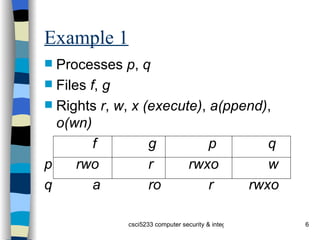
Example 1 Processes  p ,  q Files  f ,  g Rights  r ,  w ,  x (execute) ,  a(ppend) ,  o(wn) f g p q p   rwo r  rwxo w q a ro r  rwxo
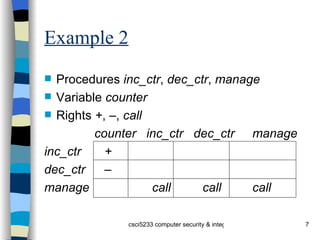
Example 2 Procedures  inc_ctr ,  dec_ctr ,  manage Variable  counter Rights  + ,  – ,  call   counter   inc_ctr  dec_ctr manage inc_ctr + dec_ctr – manage call call call
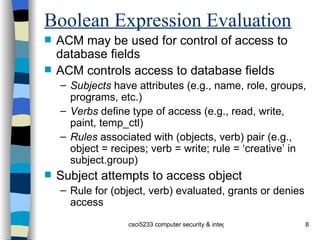
Boolean Expression Evaluation ACM may be used for control of access to database fields ACM controls access to database fields Subjects  have attributes (e.g., name, role, groups, programs, etc.) Verbs  define type of access (e.g., read, write, paint, temp_ctl) Rules  associated with (objects, verb) pair (e.g., object = recipes; verb = write; rule = ‘creative’ in subject.group) Subject attempts to access object Rule for (object, verb) evaluated, grants or denies access
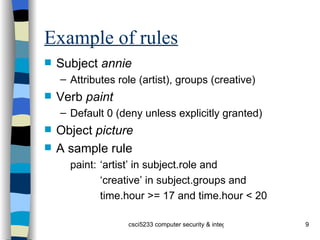
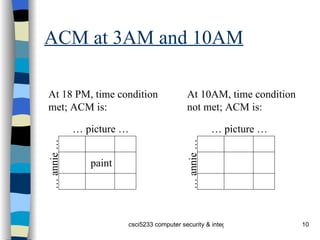
Example of rules Subject  annie Attributes role (artist), groups (creative) Verb  paint Default 0 (deny unless explicitly granted) Object  picture A sample rule paint: ‘artist’ in subject.role and ‘ creative’ in subject.groups and time.hour >= 17 and time.hour < 20
ACM at 3AM and 10AM …  picture … …  annie … paint At 18 PM, time condition met; ACM is: …  picture … …  annie … At 10AM, time condition not met; ACM is:
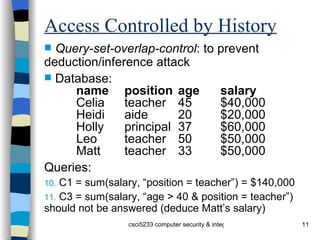
Access Controlled by History Query-set-overlap-control : to prevent deduction/inference attack Database: name position age salary Celia teacher 45 $40,000 Heidi aide 20 $20,000 Holly principal 37 $60,000 Leo teacher 50 $50,000 Matt teacher 33 $50,000 Queries: C1 = sum(salary, “position = teacher”) = $140,000 C3 = sum(salary, “age > 40 & position = teacher”) should not be answered (deduce Matt’s salary)
Access Controlled by History Database: name position age salary Celia teacher 45 $40,000 Heidi aide 20 $20,000 Holly principal 37 $60,000 Leo teacher 50 $50,000 Matt teacher 33 $50,000 O 1  = {Celia, Leo, Matt} O 3  = {Celia, Leo} Check out [Dobkins/Jones, 1979].
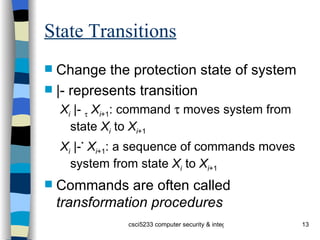
State Transitions Change the protection state of system |- represents transition X i  |-     X i +1 : command    moves system from state  X i  to  X i +1 X i  |- *   X i +1 : a sequence of commands moves system from state  X i  to  X i +1 Commands are often called  transformation procedures
Primitive Operations create subject   s Creates new row, column in ACM;  create object  o creates new column in ACM destroy subject   s Deletes row, column from ACM destroy object  o deletes column from ACM enter   r   into   A [ s , o ] Adds  r  rights for subject  s  over object  o delete   r   from   A [ s , o ] Removes  r  rights from subject  s  over object  o
Create Subject Precondition:  s      S Primitive command:  create subject   s Postconditions: S ´ =  S    {  s  },  O ´ =  O    {  s  } (  y      O ´)[ a ´[ s ,  y ] =   ], (  x      S ´)[ a ´[ x ,  s ] =   ] (  x      S )(  y      O )[ a ´[ x ,  y ] =  a [ x ,  y ]]
Create Object Precondition:  o      O Primitive command:  create object   o Postconditions: S ´ =  S ,  O ´ =  O     {  o  } (  x      S ´)[ a ´[ x ,  o ] =   ] (  x      S )(  y      O )[ a ´[ x ,  y ] =  a [ x ,  y ]]
Add Right Precondition:  s      S ,  o      O Primitive command: enter  r  into  a [ s ,  o ] Postconditions: S ´ =  S ,  O ´ =  O a ´[ s ,  o ] =  a [ s ,  o ]    {  r  } (  x      S ´ – {  s  })(  y      O ´ – {  o  }) [ a ´[ x ,  y ] =  a [ x ,  y ]]
Delete Right Precondition:  s      S ,  o      O Primitive command:  delete   r   from   a [ s ,  o ] Postconditions: S ´ =  S ,  O ´ =  O a ´[ s ,  o ] =  a [ s ,  o ] – {  r  } (  x      S ´ – {  s  })(  y      O ´ – {  o  }) [ a ´[ x ,  y ] =  a [ x ,  y ]]
Destroy Subject Precondition:  s      S Primitive command:  destroy   subject   s Postconditions: S ´ =  S  – {  s  },  O ´ =  O  – {  s  } (  y      O ´)[ a ´[ s ,  y ] =   ], (  x      S ´)[ a ´[ x ,  s ] =   ] (  x      S ´)(  y      O ´) [ a ´[ x ,  y ] =  a [ x ,  y ]]
Destroy Object Precondition:  o      o Primitive command:  destroy   object   o Postconditions: S ´ =  S ,  O ´ =  O  – {  o  } (  x      S ´)[ a ´[ x ,  o ] =   ] (  x      S ´)(  y      O ´) [ a ´[ x ,  y ] =  a [ x ,  y ]]
Creating File Process  p  creates file  f  with  r  and  w  permission command  create•file ( p ,  f ) create object  f ; enter  own  into  A [ p ,  f ]; enter  r  into  A [ p ,  f ]; enter  w  into  A [ p ,  f ]; end
Mono-Operational Commands Single primitive operation in a command Example: Make process  p  the owner of file  g command  make•owner ( p ,  g ) enter  own  into  A [ p ,  g ]; end
Conditional Commands Let  p  give  q   r  rights over  f , if  p  owns  f command  grant•read•file•1 ( p ,  f ,  q ) if  own  in  A [ p ,  f ] then enter  r  into  A [ q ,  f ]; end Mono-conditional command Single condition in this command
Multiple Conditions Let  p  give  q   r  and  w  rights over  f , if  p  owns  f  and  p  has  c  rights over  q command  grant•read•file•2 ( p ,  f ,  q ) if  own  in  A [ p ,  f ] and  c  in  A [ p ,  q ] then enter  r  into  A [ q ,  f ]; enter  w  into  A [ q ,  f ]; end
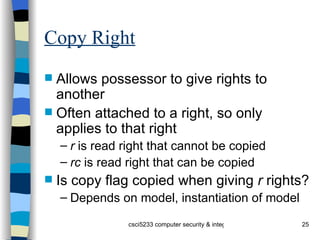
Copy Right Allows possessor to give rights to another Often attached to a right, so only applies to that right r  is read right that cannot be copied rc  is read right that can be copied Is copy flag copied when giving  r  rights? Depends on model, instantiation of model
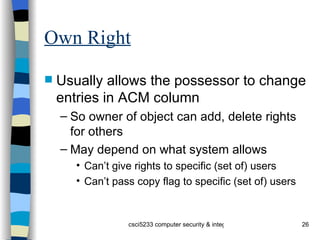
Own Right Usually allows the possessor to change entries in ACM column So owner of object can add, delete rights for others May depend on what system allows Can’t give rights to specific (set of) users Can’t pass copy flag to specific (set of) users
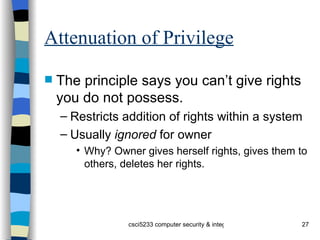
Attenuation of Privilege The principle says you can’t give rights you do not possess. Restricts addition of rights within a system Usually  ignored  for owner Why? Owner gives herself rights, gives them to others, deletes her rights.
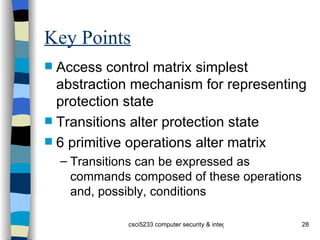
Key Points Access control matrix simplest abstraction mechanism for representing protection state Transitions alter protection state 6 primitive operations alter matrix Transitions can be expressed as commands composed of these operations and, possibly, conditions

Acm

  • 1.
  • 2.
    Outline Overview AccessControl Matrix Model Boolean Expression Evaluation History Protection State Transitions Commands Conditional Commands Special Rights Principle of Attenuation of Privilege
  • 3.
    Overview State Thecollection of the current values of all memory locations, all secondary storage, and all registers and other components of the system. Protection state of system a subset of the states that are relevant to protection Access control matrix A tool that can describe protection state Matrix describing rights of subjects State transitions change elements of matrix
  • 4.
    Overview Access controlmatrix model The most precise model used to describe a protection state It characterizes the rights of each subject with respect to every other entity , which can be active or passive. The set of objects = the set of all protected entities The set of subjects = the set of active objects, such as processes and users. The ACM captures the relationships between the subjects and the objects . When a command changes the state of the system, a state transition occurs.
  • 5.
    Description Subjects S = { s 1 ,…, s n } Objects O = { o 1 ,…, o m } Rights R = { r 1 ,…, r k } Entries A [ s i , o j ]   R A [ s i , o j ] = { r x , …, r y } means subject s i has rights r x , …, r y over object o j A [ s n , o m ] objects (entities) subjects s 1 s 2 … s n o 1 … o m s 1 … s n
  • 6.
    Example 1 Processes p , q Files f , g Rights r , w , x (execute) , a(ppend) , o(wn) f g p q p rwo r rwxo w q a ro r rwxo
  • 7.
    Example 2 Procedures inc_ctr , dec_ctr , manage Variable counter Rights + , – , call counter inc_ctr dec_ctr manage inc_ctr + dec_ctr – manage call call call
  • 8.
    Boolean Expression EvaluationACM may be used for control of access to database fields ACM controls access to database fields Subjects have attributes (e.g., name, role, groups, programs, etc.) Verbs define type of access (e.g., read, write, paint, temp_ctl) Rules associated with (objects, verb) pair (e.g., object = recipes; verb = write; rule = ‘creative’ in subject.group) Subject attempts to access object Rule for (object, verb) evaluated, grants or denies access
  • 9.
    Example of rulesSubject annie Attributes role (artist), groups (creative) Verb paint Default 0 (deny unless explicitly granted) Object picture A sample rule paint: ‘artist’ in subject.role and ‘ creative’ in subject.groups and time.hour >= 17 and time.hour < 20
  • 10.
    ACM at 3AMand 10AM … picture … … annie … paint At 18 PM, time condition met; ACM is: … picture … … annie … At 10AM, time condition not met; ACM is:
  • 11.
    Access Controlled byHistory Query-set-overlap-control : to prevent deduction/inference attack Database: name position age salary Celia teacher 45 $40,000 Heidi aide 20 $20,000 Holly principal 37 $60,000 Leo teacher 50 $50,000 Matt teacher 33 $50,000 Queries: C1 = sum(salary, “position = teacher”) = $140,000 C3 = sum(salary, “age > 40 & position = teacher”) should not be answered (deduce Matt’s salary)
  • 12.
    Access Controlled byHistory Database: name position age salary Celia teacher 45 $40,000 Heidi aide 20 $20,000 Holly principal 37 $60,000 Leo teacher 50 $50,000 Matt teacher 33 $50,000 O 1 = {Celia, Leo, Matt} O 3 = {Celia, Leo} Check out [Dobkins/Jones, 1979].
  • 13.
    State Transitions Changethe protection state of system |- represents transition X i |-  X i +1 : command  moves system from state X i to X i +1 X i |- * X i +1 : a sequence of commands moves system from state X i to X i +1 Commands are often called transformation procedures
  • 14.
    Primitive Operations createsubject s Creates new row, column in ACM; create object o creates new column in ACM destroy subject s Deletes row, column from ACM destroy object o deletes column from ACM enter r into A [ s , o ] Adds r rights for subject s over object o delete r from A [ s , o ] Removes r rights from subject s over object o
  • 15.
    Create Subject Precondition: s  S Primitive command: create subject s Postconditions: S ´ = S  { s }, O ´ = O  { s } (  y  O ´)[ a ´[ s , y ] =  ], (  x  S ´)[ a ´[ x , s ] =  ] (  x  S )(  y  O )[ a ´[ x , y ] = a [ x , y ]]
  • 16.
    Create Object Precondition: o  O Primitive command: create object o Postconditions: S ´ = S , O ´ = O  { o } (  x  S ´)[ a ´[ x , o ] =  ] (  x  S )(  y  O )[ a ´[ x , y ] = a [ x , y ]]
  • 17.
    Add Right Precondition: s  S , o  O Primitive command: enter r into a [ s , o ] Postconditions: S ´ = S , O ´ = O a ´[ s , o ] = a [ s , o ]  { r } (  x  S ´ – { s })(  y  O ´ – { o }) [ a ´[ x , y ] = a [ x , y ]]
  • 18.
    Delete Right Precondition: s  S , o  O Primitive command: delete r from a [ s , o ] Postconditions: S ´ = S , O ´ = O a ´[ s , o ] = a [ s , o ] – { r } (  x  S ´ – { s })(  y  O ´ – { o }) [ a ´[ x , y ] = a [ x , y ]]
  • 19.
    Destroy Subject Precondition: s  S Primitive command: destroy subject s Postconditions: S ´ = S – { s }, O ´ = O – { s } (  y  O ´)[ a ´[ s , y ] =  ], (  x  S ´)[ a ´[ x , s ] =  ] (  x  S ´)(  y  O ´) [ a ´[ x , y ] = a [ x , y ]]
  • 20.
    Destroy Object Precondition: o  o Primitive command: destroy object o Postconditions: S ´ = S , O ´ = O – { o } (  x  S ´)[ a ´[ x , o ] =  ] (  x  S ´)(  y  O ´) [ a ´[ x , y ] = a [ x , y ]]
  • 21.
    Creating File Process p creates file f with r and w permission command create•file ( p , f ) create object f ; enter own into A [ p , f ]; enter r into A [ p , f ]; enter w into A [ p , f ]; end
  • 22.
    Mono-Operational Commands Singleprimitive operation in a command Example: Make process p the owner of file g command make•owner ( p , g ) enter own into A [ p , g ]; end
  • 23.
    Conditional Commands Let p give q r rights over f , if p owns f command grant•read•file•1 ( p , f , q ) if own in A [ p , f ] then enter r into A [ q , f ]; end Mono-conditional command Single condition in this command
  • 24.
    Multiple Conditions Let p give q r and w rights over f , if p owns f and p has c rights over q command grant•read•file•2 ( p , f , q ) if own in A [ p , f ] and c in A [ p , q ] then enter r into A [ q , f ]; enter w into A [ q , f ]; end
  • 25.
    Copy Right Allowspossessor to give rights to another Often attached to a right, so only applies to that right r is read right that cannot be copied rc is read right that can be copied Is copy flag copied when giving r rights? Depends on model, instantiation of model
  • 26.
    Own Right Usuallyallows the possessor to change entries in ACM column So owner of object can add, delete rights for others May depend on what system allows Can’t give rights to specific (set of) users Can’t pass copy flag to specific (set of) users
  • 27.
    Attenuation of PrivilegeThe principle says you can’t give rights you do not possess. Restricts addition of rights within a system Usually ignored for owner Why? Owner gives herself rights, gives them to others, deletes her rights.
  • 28.
    Key Points Accesscontrol matrix simplest abstraction mechanism for representing protection state Transitions alter protection state 6 primitive operations alter matrix Transitions can be expressed as commands composed of these operations and, possibly, conditions