Chapter 3
© The McGraw-Hill Companies, Inc., 2007McGraw-Hill /Irwin
Systems Design: Activity-
Based Costing
3-2
Learning Objective
To understand the basic
approach in activity-
based costing and how
it differs from
conventional costing.
LO1
3-3
When cost systems were developed in the 1800s, the
emphasis was on simplicity because:
1. Cost and activity data had to be collected by
hand and all calculations were done with paper
and pencil.
2. Most companies produced a limited variety of
similar products, so there was little difference
in the overhead costs consumed by each
product.
Assigning Overhead Costs to Products
3-4
Assigning Overhead Costs to Products
Plantwide Overhead Rate
A single overhead rate used
throughout an entire factory.
Direct labor has often been used as the allocation
base for overhead because:
1. Direct labor information was already being recorded.
2. Direct labor was a large component of product costs.
3. Managers believed direct labor and overhead costs
were highly correlated.
3-5
Today, direct labor may no longer be a
satisfactory base for allocation of overhead.
1. Most companies sell a large variety of products that
consume differing amounts of overhead.
2. As a percentage of total costs, direct labor has been
shrinking and overhead has been increasing. Many of the
new overhead costs may not be correlated with direct labor.
3. Technology advancements have reduced the cost and
complexity of gathering diverse sources of data.
Plantwide Overhead Rate
A plantwide overhead allocation system may not be optimal
for many companies in today’s business environment.
3-6
Departmental Overhead Rates
Finishing Department
Shipping Department
Painting Department
Many companies have a system in which
each department has its own overhead rate.
The allocation bases depend on
the nature of the work
performed in each department. In
the machining department,
overhead may be based on
machine-hours, but in the
assembly department, overhead
may be based on labor-hours.
3-7
A more sophisticated approach, such as activity-based
costing, is required to account for these other factors.
Departmental Overhead Rates
The departmental approach relies
exclusively on volume-related allocation bases.
Some overhead costs may be caused by factors
that are not related to the volume of production.
Unfortunately, even departmental rates will not correctly
assign overhead in situations where a company has a
range of products and complex overhead costs.
3-8
Activity-Based Costing (ABC)
A number of
allocation bases are
used for assigning
costs to products.
3-9
Cost
A number of
allocation bases
are used for
assigning costs
to products.
Activity-Based Costing (ABC)
Consumption of Resources
Activities
Cost Objects
(e.g., products and customers)
3-10
Activity
An event that causes the
consumption of overhead
resources
Activity-Based Costing (ABC)
Setting up
machines
Examples of Activities
Admitting
hospital
patients
Opening a
bank account
Billing
customers
3-11
Activity
An event that causes the
consumption of overhead
resources
Activity
Cost Pool
A “cost bucket” in which
costs related to a particular
activity measure are
accumulated
Activity
Measure
Expresses how much of the
activity is carried out and is
used as the allocation base
for applying overhead costs
Activity-Based Costing (ABC)
3-12
Activity
An event that causes the
consumption of overhead
resources
Activity
Cost Pool
A “cost bucket” in which
costs related to a particular
activity measure are
accumulated
Activity
Measure
Expresses how much of the
activity is carried out and is
used as the allocation base
for applying overhead costs
Activity
Rate
A predetermined overhead
rate for each activity cost
pool.
Activity-Based Costing (ABC)
3-13
Activity-Based Costing (ABC)
For each activity in
isolation, this system works exactly
like the job-order costing system
described in Chapter 2.
A predetermined overhead rate is computed for
each activity and then applied to jobs and
products based on the amount of activity
consumed by the job or product.
3-14
Designing an Activity-Based
Costing System
In most companies, hundreds or even thousands
of different activities cause overhead costs.
The challenge is to select a reasonably small
number of activities that explain the bulk
of the variation in overhead costs.
Activities are usually chosen by interviewing
a broad range of managers to find out what
activities they think consume most of the
organization’s resources.
3-15
Designing an Activity-Based
Costing System
Related activities are
frequently combined to reduce
the amount of detail and
record-keeping costs.
An activity dictionary defines each of the activities
that will be included in the activity-based costing
system and how the activities will be measured.
For example, several activities may
be involved in handling and moving
raw materials, but these may be
combined into a single activity
entitled material handling.
3-16
Hierarchy of Activities
Level Activities Activity Measure
Unit-level Processing units on machines Machine-hours
Processing units by hand Direct labor-hours
Consuming factory supplies Units produced
Batch-level Processing purchase orders Purchase orders processed
Processing production orders Production orders processed
Setting up equipment Number of setups
Handling materials Pounds of material handled
Product-level Testing new products Hours of testing time
Administering parts inventories Number of part types
Designing products Hours of design time
Facility-level General factory administration Direct labor-hours
Plant building and grounds Direct labor-hours
3-17
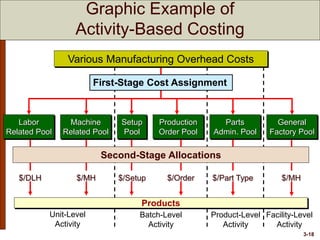
Graphic Example of
Activity-Based Costing
Labor
Related Pool
Machine
Related Pool
Setup
Pool
Production
Order Pool
General
Factory Pool
Parts
Admin. Pool
First-Stage Cost Assignment
Various Manufacturing Overhead Costs
3-18
Unit-Level
Activity
Batch-Level
Activity
Facility-Level
Activity
Product-Level
Activity
Graphic Example of
Activity-Based Costing
Labor
Related Pool
Machine
Related Pool
Setup
Pool
Production
Order Pool
General
Factory Pool
Parts
Admin. Pool
First-Stage Cost Assignment
Various Manufacturing Overhead Costs
Products
$/DLH $/MH $/Setup $/Order $/MH$/Part Type
Second-Stage Allocations
3-19
Using Activity-Based Costing
Comtek Sound, Inc.
 Comtek Sound, Inc. makes two products that are sold to
automobile manufacturers, a radio with a built-in CD
player and a radio with a built-in DVD player.
 The company has been losing bids to supply CD players,
its main product, to lower price competitors.
 The company has been winning all bids to supply DVD
players, its secondary product.
3-20
Using Activity-Based Costing
Comtek Sound, Inc.
 For the current year, Comtek has budgeted sales of
50,000 DVD units and 200,000 CD units.
 Comtek’s traditional cost system applies manufacturing
overhead to products based on direct labor hours.
 Both products require two direct labor-hours to complete,
for a total of 500,000 direct labor hours.
Hours
DVDs: 50,000 units @ 2 hours per unit = 100,000
CDs: 200,00 units @ 2 hours per unit = 400,000
Total direct labor-hours 500,000
3-21
Using Activity-Based Costing
Comtek Sound, Inc.
 Unit costs for materials and labor are:
DVD CD
Units Units
Direct materials 90$ 50$
Direct Labor 20$ 20$
3-22
Total manufacturing overhead costs for the
current year are estimated to be $10,000,000.
The company develops the following
overhead rate based upon labor-hours:
Predetermined
overhead rate
= $20 per DLH=
$10,000,000
500,000 DLHs
Direct Labor-Hours as a Base
3-23
DVD Unit CD Unit
Direct materials 90$ 50$
Direct labor 20 20
Manufacturing overhead 40 40
(2 DLHs x $20 per DLH)
Unit product cost 150$ 110$
Direct Labor-Hours as a Base
Since each product requires two hours of direct
labor, $40 of overhead is assigned to each product.
3-24
Learning Objective
To compute activity
rates for an activity-
based costing system.
LO2
3-25
The ABC project team at Comtek has
developed the following basic information.
Activity and Activity Measures
Estimated
Overhead
Cost
Total DVD CD
Labor related (DLH) 800,000$ 500,000 100,000 400,000
Machine related (MH) 2,100,000 1,000,000 300,000 700,000
Machine setups (setups) 1,600,000 4,000 3,000 1,000
Production orders (orders) 3,150,000 1,200 800 400
Parts administration (part types) 350,000 700 400 300
General factory (MH) 2,000,000 1,000,000 300,000 700,000
10,000,000$
Expected Activity
Computing Activity Rates
3-26
We can calculate the following activity rates:
Activity and Activity Measures
Estimated
Overhead
Cost
Total
Expected
Activity
Labor related (DLHs) 800,000$ ÷ 500,000 = 1.60$ per DLH
Machine related (MHs) 2,100,000 ÷ 1,000,000 = 2.10 per MH
Machine setups (setups) 1,600,000 ÷ 4,000 = 400.00 per setup
Production orders (orders) 3,150,000 ÷ 1,200 = 2,625.00 per order
Parts administration (part types) 350,000 ÷ 700 = 500.00 per part type
General factory (MHs) 2,000,000 ÷ 1,000,000 = 2.00 per MH
10,000,000$
Activity Rate
Using the new activity rates, let’s assign overhead
to the two products based upon expected activity.
Computing Activity Rates
3-27
Learning Objective
To compute product
costs using activity-
based costing.
LO3
3-28
Computing Overhead
Cost per Unit
Activity and Activity Measures
Expected
Activity
Activity
Rate
Labor related (DLHs) 100,000 × 1.60$ = 160,000$
Machine related (MHs) 300,000 × 2.10 = 630,000
Machine setups (setups) 3,000 × 400.00 = 1,200,000
Production orders (orders) 800 × 2,625.00 = 2,100,000
Parts administration (part types) 400 × 500.00 = 200,000
General factory (MHs) 300,000 × 2.00 = 600,000
Total overhead cost assigned 4,890,000$
Number of units produced 50,000
Overhead cost per unit 97.80$
Amount
DVD Units
3-29
Computing Overhead
Cost per Unit
Activity and Activity Measures
Expected
Activity
Activity
Rate
Labor related (DLHs) 400,000 × 1.60$ = 640,000$
Machine related (MHs) 700,000 × 2.10 = 1,470,000
Machine setups (setups) 1,000 × 400.00 = 400,000
Production orders (orders) 400 × 2,625.00 = 1,050,000
Parts administration (part types) 300 × 500.00 = 150,000
General factory (MHs) 700,000 × 2.00 = 1,400,000
Total overhead cost assigned 5,110,000$
Number of units produced 200,000
Overhead cost per unit 25.55$
Amount
CD Units
3-30
Note that the unit product cost of a CD unit
decreased from $110 to $95.55 . . . . .
. . . . . while the unit cost of a DVD unit increased from
$150 to $207.80.
Comparing the Two Approaches
DVD Unit CD Unit DVD Unit CD Unit
Direct material 90.00$ 50.00$ 90.00$ 50.00$
Direct labor 20.00 20.00 20.00 20.00
Manufacturing overhead 97.80 25.55 40.00 40.00
Unit product cost 207.80$ 95.55$ 150.00$ 110.00$
Activity-Based Costing Direct-Labor Costing
3-31
Learning Objective
To contrast the product
costs computed under
activity-based costing
and conventional
costing methods.
LO4
3-32
DVD Unit CD Unit DVD Unit CD Unit
Direct material 90.00$ 50.00$ 90.00$ 50.00$
Direct labor 20.00 20.00 20.00 20.00
Manufacturing overhead 97.80 25.55 40.00 40.00
Unit product cost 207.80$ 95.55$ 150.00$ 110.00$
Activity-Based Costing Direct-Labor Costing
Comparing the Two Approaches
The ABC system assigns $14.45
less overhead than the traditional
system to each CD player.
3-33
Comparing the Two Approaches
DVD Unit CD Unit DVD Unit CD Unit
Direct material 90.00$ 50.00$ 90.00$ 50.00$
Direct labor 20.00 20.00 20.00 20.00
Manufacturing overhead 97.80 25.55 40.00 40.00
Unit product cost 207.80$ 95.55$ 150.00$ 110.00$
Activity-Based Costing Direct-Labor Costing
The ABC system assigns $57.80
more overhead than the traditional
system to each DVD player.
3-34
DVD Unit CD Unit DVD Unit CD Unit
Direct material 90.00$ 50.00$ 90.00$ 50.00$
Direct labor 20.00 20.00 20.00 20.00
Manufacturing overhead 97.80 25.55 40.00 40.00
Unit product cost 207.80$ 95.55$ 150.00$ 110.00$
Activity-Based Costing Direct-Labor Costing
When a company implements activity-based costing,
overhead cost often shifts from high-volume to low-
volume products with a higher unit product cost
resulting for the low-volume products.
Low-volume product
Shifting of Overhead Cost
3-35
DVD Unit CD Unit DVD Unit CD Unit
Direct material 90.00$ 50.00$ 90.00$ 50.00$
Direct labor 20.00 20.00 20.00 20.00
Manufacturing overhead 97.80 25.55 40.00 40.00
Unit product cost 207.80$ 95.55$ 150.00$ 110.00$
Activity-Based Costing Direct-Labor Costing
High-volume product
Shifting of Overhead Cost
The traditional system assigns the same amount of all
overhead costs to each CD or DVD player ($40 per unit).
3-36
Shifting of Overhead Cost
DVD Units CD Units
Number of units produced per year 50,000 200,000
Number of production orders issued per year 800 400
Number of units processed per production order 62.5 500
Consider the Production Orders activity
cost pool (a batch-level cost pool):
The ABC system assigns different amounts of
Production Order-related overhead costs to each product.
This fact can be illustrated in a two-step process.
1. Compute the number of units processed
per production order for each product
3-37
Shifting of Overhead Cost
2. Compute production order cost per unit for each product.
DVD Units CD Units
Cost to issue a production order 2,625$ 2,625$
Average number of units processed per
production order 62.5 500
Production order cost per unit 42.00$ 5.25$
Notice, the costs are being shifted from the high
volume CD players to the low volume DVD players.
3-38
Activity-Based Management
involves focusing on activities to eliminate waste,
decrease processing time, and reduce defects.
Targeting Process Improvements
One of the great benefits derived from using
an ABC system is that it can help identify
areas where the company can benefit
from improving its current processes.
3-39
The first step in any improvement
program is deciding what to improve.
Targeting Process Improvements
The Theory of Constraints
approach targets the
highest impact
improvement opportunities.
Activity rates can be
used to target areas
where costs seem
excessively high.
Benchmarking can be used to compare activity cost
information with world-class standards of performance
achieved by other organizations.
3-40
Benefits of Activity-Based Costing
ABC Improves the accuracy of product costing by:
 Increasing the number of cost pools used to accumulate
overhead costs.
 Using activity cost pools that are more homogeneous than
departmental cost pools.
 Assigning overhead costs using activity measures that
cause those costs, rather than relying solely on direct
labor hours.
Activity-based costing also highlights activities
that could benefit most from process
improvement efforts, such as Six Sigma.
3-41
Costs of implementing an ABC system may outweigh
the benefits. However, the benefits are more likely to be
worth the costs when:
1. Products differ substantially in volume,
batch size, and in activities required.
2. Conditions have changed substantially since
the existing cost system was established.
3. Overhead costs are high and increasing and
no one seems to understand why.
4. Management does not trust the existing cost
system and it ignores data from it when making
decisions.
Limitations Activity-Based Costing
3-42
The cost in each activity pool is strictly
proportional to its activity measure. When
this assumption is violated, the accuracy
of ABC data can be called into question.
Activity-Based Costing
Critical Assumption
For example, managers should be
particularly alert to product costs that
contain allocated facility-level costs.
3-43
Modifying the ABC Model
The illustrations in the chapter assume
that ABC is being used for external reporting
purposes. If the system is used for internal
decision-making purposes, two important
modifications should be made:
1. Selling and administrative costs should be
assigned to products, where appropriate.
2. Facility-level costs should be removed
from product costs.
3-44
Learning Objective
To record the flow of
costs in an activity-
based costing system.
LO5
3-45
Sarvik Company uses activity-based costing.
The company has five cost pools shown below.
Activity Cost Pool Activity Measure
Estimated
Overhead
Cost
Machine related Machine hours 175,000$ 5,000 MHs
Purchase orders Number of orders 63,000 700 orders
Machine setups Number of setups 92,000 460 setups
Product testing Number of tests 160,000 200 tests
General factory Direct labor hours 300,000 25,000 DLHs
790,000$
Expected Activity
Cost Flows in an ABC System
3-46
Activity rates are determined as follows:
Activity Cost Pool
Estimated
Overhead
Cost
Total
Expected
Activity
Machine related 175,000$ ÷ 5,000 MHs = 35$ per MH
Purchase orders 63,000 ÷ 700 orders = 90$ per order
Machine setups 92,000 ÷ 460 setups = 200$ per setup
Product testing 160,000 ÷ 200 tests = 800$ per test
General factory 300,000 ÷ 25,000 DLH = 12$ per DLH
790,000$
Activity Rate
Cost Flows in an ABC System
3-47
Overhead is applied on the basis of actual
activities during the year.
Activity Cost Pool
Activity
Rate
Actual
Activity
Applied
Overhead
Cost
Machine related $35/MH × 4,600 MHs = 161,000$
Purchase orders $90/order × 800 orders = 72,000
Machine setups $200/setup × 500 setups = 100,000
Product testing $800/test × 190 tests = 152,000
General factory $12/DLH × 23,000 DLHs = 276,000
Total Overhead Applied 761,000$
Cost Flows in an ABC System
3-48
Selected transactions recorded by the company:
a. Raw materials purchased on account, $915,000.
b. Raw materials used in production, $900,000 ($810,000
direct and $90,000 indirect).
c. Factory labor costs, $370,000 ($95,000 direct and
$275,000 indirect).
d. Depreciation of factory assets, $180,000.
e. Miscellaneous manufacturing overhead costs
incurred on account, $230,000.
f. Manufacturing overhead applied, $761,000.
g. Goods costing $1,650,000 were manufactured.
Cost Flows in an ABC System
3-49
The following journal entries would be used
to record transactions (a) and (b).
Cost Flows in an ABC System
Description Debit Credit
a. Raw Materials 915,000
Accounts Payable 915,000
b. Work in Process 810,000
Manufacturing Overhead 90,000
Raw materials 900,000
3-50
The following journal entries would be used
to record transactions (c) and (d).
Cost Flows in an ABC System
Description Debit Credit
c. Work in Process 95,000
Manufacturing Overhead 275,000
Wages payable 370,000
d. Manufacturing Overhead 180,000
Accumulated Depreciation 180,000
3-51
Description Debit Credit
e. Manufacturing Overhead 230,000
Accounts Payable 230,000
The following journal entry would be used to
record transaction (e).
Cost Flows in an ABC System
3-52
Description Debit Credit
f. Work in Process 761,000
Manufacturing Overhead 761,000
The following journal entry would be used to
record transaction (f).
Cost Flows in an ABC System
3-53
Description Debit Credit
g. Finished Goods 1,650,000
Work in Process 1,650,000
The following journal entry would be used to
record transaction (g).
Cost Flows in an ABC System
3-54
Bal. 14,000
Manufacturing Overhead
(b) 90,000
(c) 275,000
(d) 180,000
(e) 230,000
(g) 761,000
Underapplied
Overhead Costs
Cost Flows in an ABC System
3-55
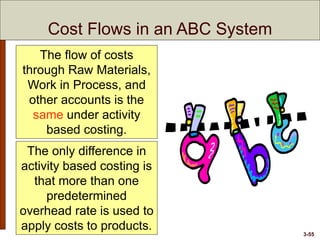
Cost Flows in an ABC System
The flow of costs
through Raw Materials,
Work in Process, and
other accounts is the
same under activity
based costing.
The only difference in
activity based costing is
that more than one
predetermined
overhead rate is used to
apply costs to products.
3-56
End of Chapter 3

Acc mgt noreen03 systems design activity based costing

  • 1.
    Chapter 3 © TheMcGraw-Hill Companies, Inc., 2007McGraw-Hill /Irwin Systems Design: Activity- Based Costing
  • 2.
    3-2 Learning Objective To understandthe basic approach in activity- based costing and how it differs from conventional costing. LO1
  • 3.
    3-3 When cost systemswere developed in the 1800s, the emphasis was on simplicity because: 1. Cost and activity data had to be collected by hand and all calculations were done with paper and pencil. 2. Most companies produced a limited variety of similar products, so there was little difference in the overhead costs consumed by each product. Assigning Overhead Costs to Products
  • 4.
    3-4 Assigning Overhead Coststo Products Plantwide Overhead Rate A single overhead rate used throughout an entire factory. Direct labor has often been used as the allocation base for overhead because: 1. Direct labor information was already being recorded. 2. Direct labor was a large component of product costs. 3. Managers believed direct labor and overhead costs were highly correlated.
  • 5.
    3-5 Today, direct labormay no longer be a satisfactory base for allocation of overhead. 1. Most companies sell a large variety of products that consume differing amounts of overhead. 2. As a percentage of total costs, direct labor has been shrinking and overhead has been increasing. Many of the new overhead costs may not be correlated with direct labor. 3. Technology advancements have reduced the cost and complexity of gathering diverse sources of data. Plantwide Overhead Rate A plantwide overhead allocation system may not be optimal for many companies in today’s business environment.
  • 6.
    3-6 Departmental Overhead Rates FinishingDepartment Shipping Department Painting Department Many companies have a system in which each department has its own overhead rate. The allocation bases depend on the nature of the work performed in each department. In the machining department, overhead may be based on machine-hours, but in the assembly department, overhead may be based on labor-hours.
  • 7.
    3-7 A more sophisticatedapproach, such as activity-based costing, is required to account for these other factors. Departmental Overhead Rates The departmental approach relies exclusively on volume-related allocation bases. Some overhead costs may be caused by factors that are not related to the volume of production. Unfortunately, even departmental rates will not correctly assign overhead in situations where a company has a range of products and complex overhead costs.
  • 8.
    3-8 Activity-Based Costing (ABC) Anumber of allocation bases are used for assigning costs to products.
  • 9.
    3-9 Cost A number of allocationbases are used for assigning costs to products. Activity-Based Costing (ABC) Consumption of Resources Activities Cost Objects (e.g., products and customers)
  • 10.
    3-10 Activity An event thatcauses the consumption of overhead resources Activity-Based Costing (ABC) Setting up machines Examples of Activities Admitting hospital patients Opening a bank account Billing customers
  • 11.
    3-11 Activity An event thatcauses the consumption of overhead resources Activity Cost Pool A “cost bucket” in which costs related to a particular activity measure are accumulated Activity Measure Expresses how much of the activity is carried out and is used as the allocation base for applying overhead costs Activity-Based Costing (ABC)
  • 12.
    3-12 Activity An event thatcauses the consumption of overhead resources Activity Cost Pool A “cost bucket” in which costs related to a particular activity measure are accumulated Activity Measure Expresses how much of the activity is carried out and is used as the allocation base for applying overhead costs Activity Rate A predetermined overhead rate for each activity cost pool. Activity-Based Costing (ABC)
  • 13.
    3-13 Activity-Based Costing (ABC) Foreach activity in isolation, this system works exactly like the job-order costing system described in Chapter 2. A predetermined overhead rate is computed for each activity and then applied to jobs and products based on the amount of activity consumed by the job or product.
  • 14.
    3-14 Designing an Activity-Based CostingSystem In most companies, hundreds or even thousands of different activities cause overhead costs. The challenge is to select a reasonably small number of activities that explain the bulk of the variation in overhead costs. Activities are usually chosen by interviewing a broad range of managers to find out what activities they think consume most of the organization’s resources.
  • 15.
    3-15 Designing an Activity-Based CostingSystem Related activities are frequently combined to reduce the amount of detail and record-keeping costs. An activity dictionary defines each of the activities that will be included in the activity-based costing system and how the activities will be measured. For example, several activities may be involved in handling and moving raw materials, but these may be combined into a single activity entitled material handling.
  • 16.
    3-16 Hierarchy of Activities LevelActivities Activity Measure Unit-level Processing units on machines Machine-hours Processing units by hand Direct labor-hours Consuming factory supplies Units produced Batch-level Processing purchase orders Purchase orders processed Processing production orders Production orders processed Setting up equipment Number of setups Handling materials Pounds of material handled Product-level Testing new products Hours of testing time Administering parts inventories Number of part types Designing products Hours of design time Facility-level General factory administration Direct labor-hours Plant building and grounds Direct labor-hours
  • 17.
    3-17 Graphic Example of Activity-BasedCosting Labor Related Pool Machine Related Pool Setup Pool Production Order Pool General Factory Pool Parts Admin. Pool First-Stage Cost Assignment Various Manufacturing Overhead Costs
  • 18.
    3-18 Unit-Level Activity Batch-Level Activity Facility-Level Activity Product-Level Activity Graphic Example of Activity-BasedCosting Labor Related Pool Machine Related Pool Setup Pool Production Order Pool General Factory Pool Parts Admin. Pool First-Stage Cost Assignment Various Manufacturing Overhead Costs Products $/DLH $/MH $/Setup $/Order $/MH$/Part Type Second-Stage Allocations
  • 19.
    3-19 Using Activity-Based Costing ComtekSound, Inc.  Comtek Sound, Inc. makes two products that are sold to automobile manufacturers, a radio with a built-in CD player and a radio with a built-in DVD player.  The company has been losing bids to supply CD players, its main product, to lower price competitors.  The company has been winning all bids to supply DVD players, its secondary product.
  • 20.
    3-20 Using Activity-Based Costing ComtekSound, Inc.  For the current year, Comtek has budgeted sales of 50,000 DVD units and 200,000 CD units.  Comtek’s traditional cost system applies manufacturing overhead to products based on direct labor hours.  Both products require two direct labor-hours to complete, for a total of 500,000 direct labor hours. Hours DVDs: 50,000 units @ 2 hours per unit = 100,000 CDs: 200,00 units @ 2 hours per unit = 400,000 Total direct labor-hours 500,000
  • 21.
    3-21 Using Activity-Based Costing ComtekSound, Inc.  Unit costs for materials and labor are: DVD CD Units Units Direct materials 90$ 50$ Direct Labor 20$ 20$
  • 22.
    3-22 Total manufacturing overheadcosts for the current year are estimated to be $10,000,000. The company develops the following overhead rate based upon labor-hours: Predetermined overhead rate = $20 per DLH= $10,000,000 500,000 DLHs Direct Labor-Hours as a Base
  • 23.
    3-23 DVD Unit CDUnit Direct materials 90$ 50$ Direct labor 20 20 Manufacturing overhead 40 40 (2 DLHs x $20 per DLH) Unit product cost 150$ 110$ Direct Labor-Hours as a Base Since each product requires two hours of direct labor, $40 of overhead is assigned to each product.
  • 24.
    3-24 Learning Objective To computeactivity rates for an activity- based costing system. LO2
  • 25.
    3-25 The ABC projectteam at Comtek has developed the following basic information. Activity and Activity Measures Estimated Overhead Cost Total DVD CD Labor related (DLH) 800,000$ 500,000 100,000 400,000 Machine related (MH) 2,100,000 1,000,000 300,000 700,000 Machine setups (setups) 1,600,000 4,000 3,000 1,000 Production orders (orders) 3,150,000 1,200 800 400 Parts administration (part types) 350,000 700 400 300 General factory (MH) 2,000,000 1,000,000 300,000 700,000 10,000,000$ Expected Activity Computing Activity Rates
  • 26.
    3-26 We can calculatethe following activity rates: Activity and Activity Measures Estimated Overhead Cost Total Expected Activity Labor related (DLHs) 800,000$ ÷ 500,000 = 1.60$ per DLH Machine related (MHs) 2,100,000 ÷ 1,000,000 = 2.10 per MH Machine setups (setups) 1,600,000 ÷ 4,000 = 400.00 per setup Production orders (orders) 3,150,000 ÷ 1,200 = 2,625.00 per order Parts administration (part types) 350,000 ÷ 700 = 500.00 per part type General factory (MHs) 2,000,000 ÷ 1,000,000 = 2.00 per MH 10,000,000$ Activity Rate Using the new activity rates, let’s assign overhead to the two products based upon expected activity. Computing Activity Rates
  • 27.
    3-27 Learning Objective To computeproduct costs using activity- based costing. LO3
  • 28.
    3-28 Computing Overhead Cost perUnit Activity and Activity Measures Expected Activity Activity Rate Labor related (DLHs) 100,000 × 1.60$ = 160,000$ Machine related (MHs) 300,000 × 2.10 = 630,000 Machine setups (setups) 3,000 × 400.00 = 1,200,000 Production orders (orders) 800 × 2,625.00 = 2,100,000 Parts administration (part types) 400 × 500.00 = 200,000 General factory (MHs) 300,000 × 2.00 = 600,000 Total overhead cost assigned 4,890,000$ Number of units produced 50,000 Overhead cost per unit 97.80$ Amount DVD Units
  • 29.
    3-29 Computing Overhead Cost perUnit Activity and Activity Measures Expected Activity Activity Rate Labor related (DLHs) 400,000 × 1.60$ = 640,000$ Machine related (MHs) 700,000 × 2.10 = 1,470,000 Machine setups (setups) 1,000 × 400.00 = 400,000 Production orders (orders) 400 × 2,625.00 = 1,050,000 Parts administration (part types) 300 × 500.00 = 150,000 General factory (MHs) 700,000 × 2.00 = 1,400,000 Total overhead cost assigned 5,110,000$ Number of units produced 200,000 Overhead cost per unit 25.55$ Amount CD Units
  • 30.
    3-30 Note that theunit product cost of a CD unit decreased from $110 to $95.55 . . . . . . . . . . while the unit cost of a DVD unit increased from $150 to $207.80. Comparing the Two Approaches DVD Unit CD Unit DVD Unit CD Unit Direct material 90.00$ 50.00$ 90.00$ 50.00$ Direct labor 20.00 20.00 20.00 20.00 Manufacturing overhead 97.80 25.55 40.00 40.00 Unit product cost 207.80$ 95.55$ 150.00$ 110.00$ Activity-Based Costing Direct-Labor Costing
  • 31.
    3-31 Learning Objective To contrastthe product costs computed under activity-based costing and conventional costing methods. LO4
  • 32.
    3-32 DVD Unit CDUnit DVD Unit CD Unit Direct material 90.00$ 50.00$ 90.00$ 50.00$ Direct labor 20.00 20.00 20.00 20.00 Manufacturing overhead 97.80 25.55 40.00 40.00 Unit product cost 207.80$ 95.55$ 150.00$ 110.00$ Activity-Based Costing Direct-Labor Costing Comparing the Two Approaches The ABC system assigns $14.45 less overhead than the traditional system to each CD player.
  • 33.
    3-33 Comparing the TwoApproaches DVD Unit CD Unit DVD Unit CD Unit Direct material 90.00$ 50.00$ 90.00$ 50.00$ Direct labor 20.00 20.00 20.00 20.00 Manufacturing overhead 97.80 25.55 40.00 40.00 Unit product cost 207.80$ 95.55$ 150.00$ 110.00$ Activity-Based Costing Direct-Labor Costing The ABC system assigns $57.80 more overhead than the traditional system to each DVD player.
  • 34.
    3-34 DVD Unit CDUnit DVD Unit CD Unit Direct material 90.00$ 50.00$ 90.00$ 50.00$ Direct labor 20.00 20.00 20.00 20.00 Manufacturing overhead 97.80 25.55 40.00 40.00 Unit product cost 207.80$ 95.55$ 150.00$ 110.00$ Activity-Based Costing Direct-Labor Costing When a company implements activity-based costing, overhead cost often shifts from high-volume to low- volume products with a higher unit product cost resulting for the low-volume products. Low-volume product Shifting of Overhead Cost
  • 35.
    3-35 DVD Unit CDUnit DVD Unit CD Unit Direct material 90.00$ 50.00$ 90.00$ 50.00$ Direct labor 20.00 20.00 20.00 20.00 Manufacturing overhead 97.80 25.55 40.00 40.00 Unit product cost 207.80$ 95.55$ 150.00$ 110.00$ Activity-Based Costing Direct-Labor Costing High-volume product Shifting of Overhead Cost The traditional system assigns the same amount of all overhead costs to each CD or DVD player ($40 per unit).
  • 36.
    3-36 Shifting of OverheadCost DVD Units CD Units Number of units produced per year 50,000 200,000 Number of production orders issued per year 800 400 Number of units processed per production order 62.5 500 Consider the Production Orders activity cost pool (a batch-level cost pool): The ABC system assigns different amounts of Production Order-related overhead costs to each product. This fact can be illustrated in a two-step process. 1. Compute the number of units processed per production order for each product
  • 37.
    3-37 Shifting of OverheadCost 2. Compute production order cost per unit for each product. DVD Units CD Units Cost to issue a production order 2,625$ 2,625$ Average number of units processed per production order 62.5 500 Production order cost per unit 42.00$ 5.25$ Notice, the costs are being shifted from the high volume CD players to the low volume DVD players.
  • 38.
    3-38 Activity-Based Management involves focusingon activities to eliminate waste, decrease processing time, and reduce defects. Targeting Process Improvements One of the great benefits derived from using an ABC system is that it can help identify areas where the company can benefit from improving its current processes.
  • 39.
    3-39 The first stepin any improvement program is deciding what to improve. Targeting Process Improvements The Theory of Constraints approach targets the highest impact improvement opportunities. Activity rates can be used to target areas where costs seem excessively high. Benchmarking can be used to compare activity cost information with world-class standards of performance achieved by other organizations.
  • 40.
    3-40 Benefits of Activity-BasedCosting ABC Improves the accuracy of product costing by:  Increasing the number of cost pools used to accumulate overhead costs.  Using activity cost pools that are more homogeneous than departmental cost pools.  Assigning overhead costs using activity measures that cause those costs, rather than relying solely on direct labor hours. Activity-based costing also highlights activities that could benefit most from process improvement efforts, such as Six Sigma.
  • 41.
    3-41 Costs of implementingan ABC system may outweigh the benefits. However, the benefits are more likely to be worth the costs when: 1. Products differ substantially in volume, batch size, and in activities required. 2. Conditions have changed substantially since the existing cost system was established. 3. Overhead costs are high and increasing and no one seems to understand why. 4. Management does not trust the existing cost system and it ignores data from it when making decisions. Limitations Activity-Based Costing
  • 42.
    3-42 The cost ineach activity pool is strictly proportional to its activity measure. When this assumption is violated, the accuracy of ABC data can be called into question. Activity-Based Costing Critical Assumption For example, managers should be particularly alert to product costs that contain allocated facility-level costs.
  • 43.
    3-43 Modifying the ABCModel The illustrations in the chapter assume that ABC is being used for external reporting purposes. If the system is used for internal decision-making purposes, two important modifications should be made: 1. Selling and administrative costs should be assigned to products, where appropriate. 2. Facility-level costs should be removed from product costs.
  • 44.
    3-44 Learning Objective To recordthe flow of costs in an activity- based costing system. LO5
  • 45.
    3-45 Sarvik Company usesactivity-based costing. The company has five cost pools shown below. Activity Cost Pool Activity Measure Estimated Overhead Cost Machine related Machine hours 175,000$ 5,000 MHs Purchase orders Number of orders 63,000 700 orders Machine setups Number of setups 92,000 460 setups Product testing Number of tests 160,000 200 tests General factory Direct labor hours 300,000 25,000 DLHs 790,000$ Expected Activity Cost Flows in an ABC System
  • 46.
    3-46 Activity rates aredetermined as follows: Activity Cost Pool Estimated Overhead Cost Total Expected Activity Machine related 175,000$ ÷ 5,000 MHs = 35$ per MH Purchase orders 63,000 ÷ 700 orders = 90$ per order Machine setups 92,000 ÷ 460 setups = 200$ per setup Product testing 160,000 ÷ 200 tests = 800$ per test General factory 300,000 ÷ 25,000 DLH = 12$ per DLH 790,000$ Activity Rate Cost Flows in an ABC System
  • 47.
    3-47 Overhead is appliedon the basis of actual activities during the year. Activity Cost Pool Activity Rate Actual Activity Applied Overhead Cost Machine related $35/MH × 4,600 MHs = 161,000$ Purchase orders $90/order × 800 orders = 72,000 Machine setups $200/setup × 500 setups = 100,000 Product testing $800/test × 190 tests = 152,000 General factory $12/DLH × 23,000 DLHs = 276,000 Total Overhead Applied 761,000$ Cost Flows in an ABC System
  • 48.
    3-48 Selected transactions recordedby the company: a. Raw materials purchased on account, $915,000. b. Raw materials used in production, $900,000 ($810,000 direct and $90,000 indirect). c. Factory labor costs, $370,000 ($95,000 direct and $275,000 indirect). d. Depreciation of factory assets, $180,000. e. Miscellaneous manufacturing overhead costs incurred on account, $230,000. f. Manufacturing overhead applied, $761,000. g. Goods costing $1,650,000 were manufactured. Cost Flows in an ABC System
  • 49.
    3-49 The following journalentries would be used to record transactions (a) and (b). Cost Flows in an ABC System Description Debit Credit a. Raw Materials 915,000 Accounts Payable 915,000 b. Work in Process 810,000 Manufacturing Overhead 90,000 Raw materials 900,000
  • 50.
    3-50 The following journalentries would be used to record transactions (c) and (d). Cost Flows in an ABC System Description Debit Credit c. Work in Process 95,000 Manufacturing Overhead 275,000 Wages payable 370,000 d. Manufacturing Overhead 180,000 Accumulated Depreciation 180,000
  • 51.
    3-51 Description Debit Credit e.Manufacturing Overhead 230,000 Accounts Payable 230,000 The following journal entry would be used to record transaction (e). Cost Flows in an ABC System
  • 52.
    3-52 Description Debit Credit f.Work in Process 761,000 Manufacturing Overhead 761,000 The following journal entry would be used to record transaction (f). Cost Flows in an ABC System
  • 53.
    3-53 Description Debit Credit g.Finished Goods 1,650,000 Work in Process 1,650,000 The following journal entry would be used to record transaction (g). Cost Flows in an ABC System
  • 54.
    3-54 Bal. 14,000 Manufacturing Overhead (b)90,000 (c) 275,000 (d) 180,000 (e) 230,000 (g) 761,000 Underapplied Overhead Costs Cost Flows in an ABC System
  • 55.
    3-55 Cost Flows inan ABC System The flow of costs through Raw Materials, Work in Process, and other accounts is the same under activity based costing. The only difference in activity based costing is that more than one predetermined overhead rate is used to apply costs to products.
  • 56.