1
PowerPoint Presentation by
Gail B. Wright
Professor Emeritus of Accounting
Bryant University
© Copyright 2007 Thomson South-Western, a part of The
Thomson Corporation. Thomson, the Star Logo, and
South-Western are trademarks used herein under license.
MANAGEMENT
ACCOUNTING
8th EDITION
BY
HANSEN & MOWEN
4 ACTIVITY-BASED PRODUCT COSTING
2
LEARNING GOALS
After studying this
chapter, you should be
able to:
LEARNING OBJECTIVES
3
1. Discuss the importance of unit costs.
2. Describe functional-based costing
approaches.
3. Tell why functional-based costing
approaches may produce distorted costs.
LEARNING OBJECTIVES
Continued
4
4. Explain how an activity-based costing
system works for product costing.
5. Explain how the number of activity rates
can be reduced.
LEARNING OBJECTIVES
Click the button to skip
Questions to Think About
5
QUESTIONS TO THINK ABOUT:
SpringBanc
What are product costs?
6
QUESTIONS TO THINK ABOUT:
SpringBanc
What role do product costs play
in bids?
7
QUESTIONS TO THINK ABOUT:
SpringBanc
What is meant by a traditional
functional-based costing system?
Why might it cause distortions in
product costs?
8
QUESTIONS TO THINK ABOUT:
SpringBanc
Assuming SpringBanc’s
problems are founded in the
way costs are assigned to
products, what can SpringBanc
do to solve the problem?
9
1 Discuss the importance
of unit costs.
LEARNING OBJECTIVE
10
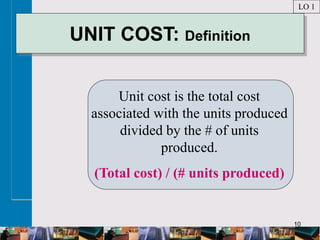
UNIT COST: Definition
Unit cost is the total cost
associated with the units produced
divided by the # of units
produced.
(Total cost) / (# units produced)
LO 1
11
What is meant by “total cost”?
Total cost refers to production
costs: direct materials, direct
labor, manufacturing overhead.
LO 1
12
How do we measure the costs
to be assigned?
Production costs we assign may
be actual or estimated costs.
LO 1
13
How do we assign costs to a
product?
Production costs are assigned by
1 of 2 methods: functional-
based or activity-based costing.
LO 1
14
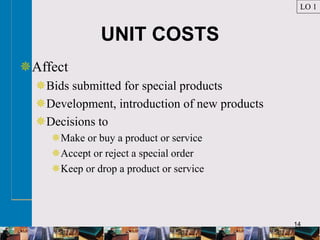
UNIT COSTS
Affect
Bids submitted for special products
Development, introduction of new products
Decisions to
Make or buy a product or service
Accept or reject a special order
Keep or drop a product or service
LO 1
15
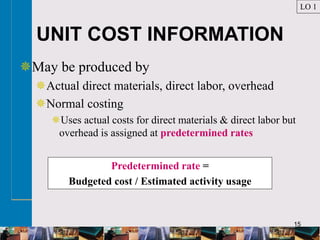
UNIT COST INFORMATION
May be produced by
Actual direct materials, direct labor, overhead
Normal costing
Uses actual costs for direct materials & direct labor but
overhead is assigned at predetermined rates
LO 1
Predetermined rate =
Budgeted cost / Estimated activity usage
16
2 Describe functional-
based costing
approaches.
LEARNING OBJECTIVE
17
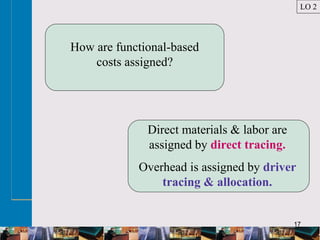
How are functional-based
costs assigned?
Direct materials & labor are
assigned by direct tracing.
Overhead is assigned by driver
tracing & allocation.
LO 2
18
UNIT-LEVEL DRIVERS
Used to assign manufacturing overhead by
Units produced
Direct labor hours
Direct labor dollars
Machine hours
Direct material dollars
LO 2
19
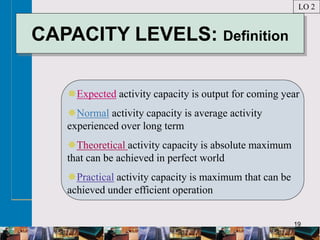
CAPACITY LEVELS: Definition
Expected activity capacity is output for coming year
Normal activity capacity is average activity
experienced over long term
Theoretical activity capacity is absolute maximum
that can be achieved in perfect world
Practical activity capacity is maximum that can be
achieved under efficient operation
LO 2
20
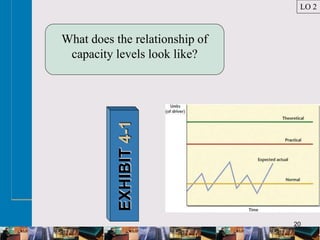
What does the relationship of
capacity levels look like?
LO 2
EXHIBIT
4-1
21
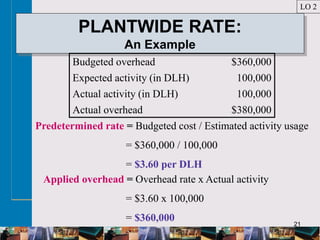
PLANTWIDE RATE:
An Example
Budgeted overhead $360,000
Expected activity (in DLH) 100,000
Actual activity (in DLH) 100,000
Actual overhead $380,000
Predetermined rate = Budgeted cost / Estimated activity usage
= $360,000 / 100,000
= $3.60 per DLH
Applied overhead = Overhead rate x Actual activity
= $3.60 x 100,000
= $360,000
LO 2
22
What if applied overhead
($360,000) differs from actual
overhead ($380,000)?
Underapplied (overapplied)
overhead is a variance that is
added to (subtracted from) cost
of goods sold.
LO 2
23
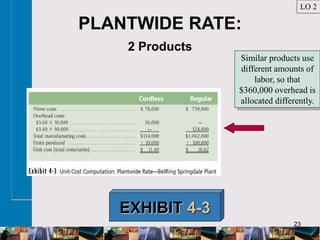
PLANTWIDE RATE:
2 Products
EXHIBIT 4-3
Similar products use
different amounts of
labor, so that
$360,000 overhead is
allocated differently.
LO 2
24
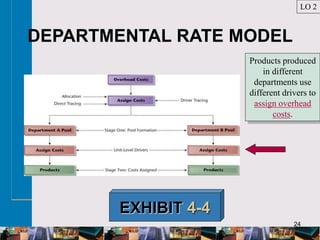
DEPARTMENTAL RATE MODEL
EXHIBIT 4-4
LO 2
Products produced
in different
departments use
different drivers to
assign overhead
costs.
25
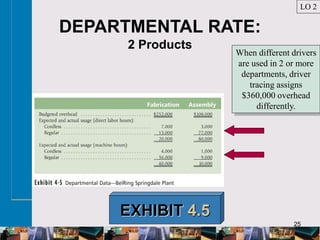
DEPARTMENTAL RATE:
2 Products
EXHIBIT 4.5
When different drivers
are used in 2 or more
departments, driver
tracing assigns
$360,000 overhead
differently.
LO 2
26
3
Tell why functional-
based costing approaches
may produce distorted
costs.
LEARNING OBJECTIVE
27
How does a company know if
its functional-based costing is
producing distorted costs?
There are many symptoms of
distorted costs, such as profit
margins that are difficult to
explain.
LO 3
28
CREATING DISTORTIONS
When a unit-level approach is used to
assign non-unit-level costs
(overhead), cost information can be
distorted.
LO 3
29
NON-UNIT-LEVEL ACTIVITY
DRIVER: Definition
Factors that measure consumption
of non-unit-level activities by
product & can distort product
costs.
LO 3
30
PRODUCT DIVERSITY: Definition
Products consume overhead
activities in systematically
different proportions.
LO 3
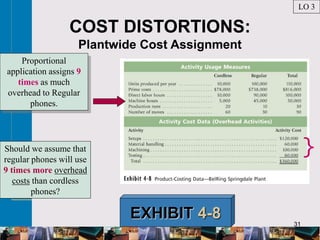
31
COST DISTORTIONS:
Plantwide Cost Assignment
EXHIBIT 4-8
Proportional
application assigns 9
times as much
overhead to Regular
phones.
LO 3
}
Should we assume that
regular phones will use
9 times more overhead
costs than cordless
phones?
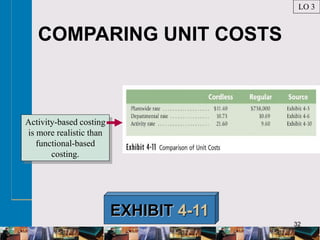
32
COMPARING UNIT COSTS
EXHIBIT 4-11
Activity-based costing
is more realistic than
functional-based
costing.
LO 3
33
4
Explain how an activity-
based costing system
works for product
costing.
LEARNING OBJECTIVE
34
How do you identify activities
& their attributes?
Use a key set of interview
questions and record the
answers.
LO 4
35
KEY QUESTIONS
How many employees are in your department?
What do they do?
Do customers outside your department use any
equipment?
What resources are used by each activity?
What are the outputs of each activity?
Who or what uses the activity output?
How much time do workers spend on each activity?
By equipment?
LO 4
36
RESOURCE DRIVER: Definition
Factors that measure the
consumption of resources by
activities.
LO 4
37
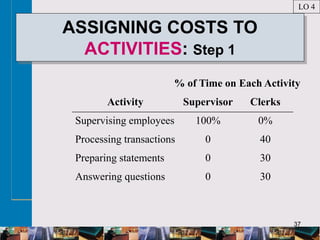
ASSIGNING COSTS TO
ACTIVITIES: Step 1
Activity Supervisor Clerks
Supervising employees 100% 0%
Processing transactions 0 40
Preparing statements 0 30
Answering questions 0 30
% of Time on Each Activity
LO 4
38
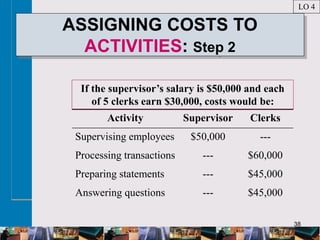
ASSIGNING COSTS TO
ACTIVITIES: Step 2
Activity Supervisor Clerks
Supervising employees $50,000 ---
Processing transactions --- $60,000
Preparing statements --- $45,000
Answering questions --- $45,000
If the supervisor’s salary is $50,000 and each
of 5 clerks earn $30,000, costs would be:
LO 4
39
How do you assign activity
costs?
Activity costs are assigned to
products on the basis of usage.
LO 4
40
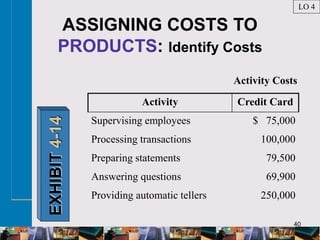
ASSIGNING COSTS TO
PRODUCTS: Identify Costs
Activity Credit Card
Supervising employees $ 75,000
Processing transactions 100,000
Preparing statements 79,500
Answering questions 69,900
Providing automatic tellers 250,000
Activity Costs
LO 4
EXHIBIT
4-14
41
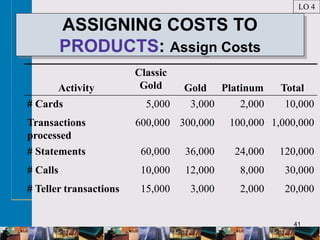
ASSIGNING COSTS TO
PRODUCTS: Assign Costs
Activity
Classic
Gold Gold Platinum Total
# Cards 5,000 3,000 2,000 10,000
Transactions
processed
600,000 300,000 100,000 1,000,000
# Statements 60,000 36,000 24,000 120,000
# Calls 10,000 12,000 8,000 30,000
# Teller transactions 15,000 3,000 2,000 20,000
LO 4
42
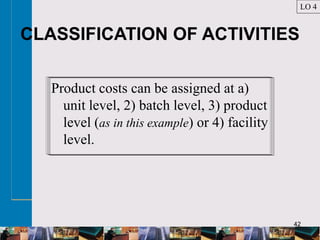
CLASSIFICATION OF ACTIVITIES
Product costs can be assigned at a)
unit level, 2) batch level, 3) product
level (as in this example) or 4) facility
level.
LO 4
43
5
Explain how the number
of activity rates can be
reduced.
LEARNING OBJECTIVE
44
ACTIVITY BASED COST SYSTEM
Reduce size, complexity by reducing rates
Using consumption ratios
By approximating ABC
LO 5
45
COMPARING SYSTEMS
Functional-based system
Overhead uses only unit-based activity drivers or
Splits overhead into fixed and variable and
allocates overhead based on the appropriate unit-
level rate
Activity-based system
Improves product costing by
Looking at cause & effect
Recognizing that some fixed overhead varies in
proportion to changes other than production volume
LO 5
46
THE END
CHAPTER 4

Hansen AISE IM Ch04.ppt

  • 1.
    1 PowerPoint Presentation by GailB. Wright Professor Emeritus of Accounting Bryant University © Copyright 2007 Thomson South-Western, a part of The Thomson Corporation. Thomson, the Star Logo, and South-Western are trademarks used herein under license. MANAGEMENT ACCOUNTING 8th EDITION BY HANSEN & MOWEN 4 ACTIVITY-BASED PRODUCT COSTING
  • 2.
    2 LEARNING GOALS After studyingthis chapter, you should be able to: LEARNING OBJECTIVES
  • 3.
    3 1. Discuss theimportance of unit costs. 2. Describe functional-based costing approaches. 3. Tell why functional-based costing approaches may produce distorted costs. LEARNING OBJECTIVES Continued
  • 4.
    4 4. Explain howan activity-based costing system works for product costing. 5. Explain how the number of activity rates can be reduced. LEARNING OBJECTIVES Click the button to skip Questions to Think About
  • 5.
    5 QUESTIONS TO THINKABOUT: SpringBanc What are product costs?
  • 6.
    6 QUESTIONS TO THINKABOUT: SpringBanc What role do product costs play in bids?
  • 7.
    7 QUESTIONS TO THINKABOUT: SpringBanc What is meant by a traditional functional-based costing system? Why might it cause distortions in product costs?
  • 8.
    8 QUESTIONS TO THINKABOUT: SpringBanc Assuming SpringBanc’s problems are founded in the way costs are assigned to products, what can SpringBanc do to solve the problem?
  • 9.
    9 1 Discuss theimportance of unit costs. LEARNING OBJECTIVE
  • 10.
    10 UNIT COST: Definition Unitcost is the total cost associated with the units produced divided by the # of units produced. (Total cost) / (# units produced) LO 1
  • 11.
    11 What is meantby “total cost”? Total cost refers to production costs: direct materials, direct labor, manufacturing overhead. LO 1
  • 12.
    12 How do wemeasure the costs to be assigned? Production costs we assign may be actual or estimated costs. LO 1
  • 13.
    13 How do weassign costs to a product? Production costs are assigned by 1 of 2 methods: functional- based or activity-based costing. LO 1
  • 14.
    14 UNIT COSTS Affect Bids submittedfor special products Development, introduction of new products Decisions to Make or buy a product or service Accept or reject a special order Keep or drop a product or service LO 1
  • 15.
    15 UNIT COST INFORMATION Maybe produced by Actual direct materials, direct labor, overhead Normal costing Uses actual costs for direct materials & direct labor but overhead is assigned at predetermined rates LO 1 Predetermined rate = Budgeted cost / Estimated activity usage
  • 16.
    16 2 Describe functional- basedcosting approaches. LEARNING OBJECTIVE
  • 17.
    17 How are functional-based costsassigned? Direct materials & labor are assigned by direct tracing. Overhead is assigned by driver tracing & allocation. LO 2
  • 18.
    18 UNIT-LEVEL DRIVERS Used toassign manufacturing overhead by Units produced Direct labor hours Direct labor dollars Machine hours Direct material dollars LO 2
  • 19.
    19 CAPACITY LEVELS: Definition Expectedactivity capacity is output for coming year Normal activity capacity is average activity experienced over long term Theoretical activity capacity is absolute maximum that can be achieved in perfect world Practical activity capacity is maximum that can be achieved under efficient operation LO 2
  • 20.
    20 What does therelationship of capacity levels look like? LO 2 EXHIBIT 4-1
  • 21.
    21 PLANTWIDE RATE: An Example Budgetedoverhead $360,000 Expected activity (in DLH) 100,000 Actual activity (in DLH) 100,000 Actual overhead $380,000 Predetermined rate = Budgeted cost / Estimated activity usage = $360,000 / 100,000 = $3.60 per DLH Applied overhead = Overhead rate x Actual activity = $3.60 x 100,000 = $360,000 LO 2
  • 22.
    22 What if appliedoverhead ($360,000) differs from actual overhead ($380,000)? Underapplied (overapplied) overhead is a variance that is added to (subtracted from) cost of goods sold. LO 2
  • 23.
    23 PLANTWIDE RATE: 2 Products EXHIBIT4-3 Similar products use different amounts of labor, so that $360,000 overhead is allocated differently. LO 2
  • 24.
    24 DEPARTMENTAL RATE MODEL EXHIBIT4-4 LO 2 Products produced in different departments use different drivers to assign overhead costs.
  • 25.
    25 DEPARTMENTAL RATE: 2 Products EXHIBIT4.5 When different drivers are used in 2 or more departments, driver tracing assigns $360,000 overhead differently. LO 2
  • 26.
    26 3 Tell why functional- basedcosting approaches may produce distorted costs. LEARNING OBJECTIVE
  • 27.
    27 How does acompany know if its functional-based costing is producing distorted costs? There are many symptoms of distorted costs, such as profit margins that are difficult to explain. LO 3
  • 28.
    28 CREATING DISTORTIONS When aunit-level approach is used to assign non-unit-level costs (overhead), cost information can be distorted. LO 3
  • 29.
    29 NON-UNIT-LEVEL ACTIVITY DRIVER: Definition Factorsthat measure consumption of non-unit-level activities by product & can distort product costs. LO 3
  • 30.
    30 PRODUCT DIVERSITY: Definition Productsconsume overhead activities in systematically different proportions. LO 3
  • 31.
    31 COST DISTORTIONS: Plantwide CostAssignment EXHIBIT 4-8 Proportional application assigns 9 times as much overhead to Regular phones. LO 3 } Should we assume that regular phones will use 9 times more overhead costs than cordless phones?
  • 32.
    32 COMPARING UNIT COSTS EXHIBIT4-11 Activity-based costing is more realistic than functional-based costing. LO 3
  • 33.
    33 4 Explain how anactivity- based costing system works for product costing. LEARNING OBJECTIVE
  • 34.
    34 How do youidentify activities & their attributes? Use a key set of interview questions and record the answers. LO 4
  • 35.
    35 KEY QUESTIONS How manyemployees are in your department? What do they do? Do customers outside your department use any equipment? What resources are used by each activity? What are the outputs of each activity? Who or what uses the activity output? How much time do workers spend on each activity? By equipment? LO 4
  • 36.
    36 RESOURCE DRIVER: Definition Factorsthat measure the consumption of resources by activities. LO 4
  • 37.
    37 ASSIGNING COSTS TO ACTIVITIES:Step 1 Activity Supervisor Clerks Supervising employees 100% 0% Processing transactions 0 40 Preparing statements 0 30 Answering questions 0 30 % of Time on Each Activity LO 4
  • 38.
    38 ASSIGNING COSTS TO ACTIVITIES:Step 2 Activity Supervisor Clerks Supervising employees $50,000 --- Processing transactions --- $60,000 Preparing statements --- $45,000 Answering questions --- $45,000 If the supervisor’s salary is $50,000 and each of 5 clerks earn $30,000, costs would be: LO 4
  • 39.
    39 How do youassign activity costs? Activity costs are assigned to products on the basis of usage. LO 4
  • 40.
    40 ASSIGNING COSTS TO PRODUCTS:Identify Costs Activity Credit Card Supervising employees $ 75,000 Processing transactions 100,000 Preparing statements 79,500 Answering questions 69,900 Providing automatic tellers 250,000 Activity Costs LO 4 EXHIBIT 4-14
  • 41.
    41 ASSIGNING COSTS TO PRODUCTS:Assign Costs Activity Classic Gold Gold Platinum Total # Cards 5,000 3,000 2,000 10,000 Transactions processed 600,000 300,000 100,000 1,000,000 # Statements 60,000 36,000 24,000 120,000 # Calls 10,000 12,000 8,000 30,000 # Teller transactions 15,000 3,000 2,000 20,000 LO 4
  • 42.
    42 CLASSIFICATION OF ACTIVITIES Productcosts can be assigned at a) unit level, 2) batch level, 3) product level (as in this example) or 4) facility level. LO 4
  • 43.
    43 5 Explain how thenumber of activity rates can be reduced. LEARNING OBJECTIVE
  • 44.
    44 ACTIVITY BASED COSTSYSTEM Reduce size, complexity by reducing rates Using consumption ratios By approximating ABC LO 5
  • 45.
    45 COMPARING SYSTEMS Functional-based system Overheaduses only unit-based activity drivers or Splits overhead into fixed and variable and allocates overhead based on the appropriate unit- level rate Activity-based system Improves product costing by Looking at cause & effect Recognizing that some fixed overhead varies in proportion to changes other than production volume LO 5
  • 46.