Referencing
Referencing using Harvard referencing
system
• Why do we do it?
• How do we do it?
• In text references
• List of references
• NB ‘Referencing’ is sometimes known as
‘Citation’
2
The tradition of scholarship
• Our own ideas are all based on the thoughts of others
• Scholarly thought builds progressively on the work of
respected writers and researchers by carrying out further
research and analysis
• Sources of ideas are always acknowledged
3
4
Five main reasons for providing references:
• Acknowledging the person whose idea or words
have been used or referred to.
• Make it clear that the author is not trying to
pretend somebody else's work as his/her own.
('plagiarising' someone else's work.)
• Helps readdress to find the original texts or
webpages to read themselves.
• Author can easily check something later if
necessary.
• Thoroughness in referencing suggests that
author has been thorough in checking his/her
facts
5
When do you need to give a reference ?
• the source of a particular theory, argument or
viewpoint
• specific information, such as statistics,
examples, or case studies
• direct quotations (reproducing the writer's exact
words)
• texts and electronic information which you
paraphrase rather than quote.
6
How do I reference?
• You MUST attribute all sources to the original author eg ideas,
data, figures, tables, methods,
• Use the Harvard referencing system
(Author Date method)
Note, there are other systems used by some books.
While at Greenwich you must use Harvard
• If you don’t reference, you may be accused of PLAGIARISM
You will go before a plagiarism panel
You may fail the course and have to pay to do it again next
year
7
Using sources
Sources of data, ideas and theories are the basis of your
evidence. You may use them in a variety of ways:
• Quote - using the exact words of the author
• Paraphrase - using your own words to express the
author’s ideas
• Summarise - listing the key ideas from the author’s
work
• Comment - giving your own thoughts on what the
author has said
8
Before you write ……..
• You must READ
• Re-read lecture notes (to focus on topic)
• Read books on reading lists (selectively - use index)
• Look on library shelves for other relevant books
• Use electronic databases to search for articles, reports,
statistics
• Use the WWW (but don’t depend on it)
• Always keep notes on what you read
• Make sure you write down the references
9
The information usually provided includes
• the name and initials of the author(s)
• the title, in full
• the year of publication
• for journal articles, the name of the journal and the
number of the volume
• the edition, if relevant
• the location of the publisher
• the name of publisher
• relevant page numbers
• for electronic materials, the webpage address
10
Types of references
References – sometimes called ‘Citations’ they occur in
different forms
•In-text references (quotations; paraphrasing;
summarising)
Placed within the main body of your writing
•Secondary references
Used where one author has quoted another author
•List of References
Full details of all sources listed at the end
•Bibliography
Books/etc which are relevant but have not been referred to
directly (not common except in longer dissertations)
11
In-text references - Quotations
If you quote (copy) the exact words of an author, use
quotation marks around the quote and at the end write:
author’s surname - year of publication - page
number (in brackets)
eg:
“The matching, or accruals, convention is very
important in the calculation of profit” (Gowthorpe
2005,p152) or (Gowthorpe, 2005:152)
Gowthorpe (2005,p152) states “the matching, or accruals,
convention is very important in the calculation of profit”Gowthorpe (2005:152) states “the matching, or accruals,
convention is very important in the calculation of profit”
Gowthorpe (2005:152) states “the matching, or accruals,
convention is very important in the calculation of profit”
In-text references - Quotations
• Shim et al (2009; p.9) points out that “ managers in high-
tech firms are faced with different sets of performance
expectations such as innovation, new product
development, integration of technology and research and
development management”.
• “Managers in high-tech firms are faced with different sets
of performance expectations such as innovation, new
product development, integration of technology and
research and development management”. (Shim et al,
2009; p. 9)
12
13
In-text references - Paraphrasing
When putting ideas in your own words rather than quoting:
author – date (note – no page number)
Eg: when referring to the author in the sentence:
Gowthorpe (2005) indicates that accrual principle is vital
for proper calculation of profit.
According Shim et al (2009) managers in high-tech
companies are chellenged by different factors such as
innovation, technology integration etc.
or: when not referring to the author in the sentence
The proper estimation of profit requires implementation of
accrual principle. (Gowthorpe 2005)
or: when not referring to the author in the sentence
The proper estimation of profit requires implementation of
accrual principle. (Gowthorpe 2005)
or: when not referring to the author in the sentence
Managers in high-tech companies are challenged by different
factors such as innovation, technology integration etc(Shim et
al, 2009)
or: when not referring to the author in the sentence
Managers in high-tech companies are challenged by different
factors such as innovation, technology integration etc(Shim et
al, 2009)
14
Secondary references
• Authors cited by other authors
Wherever possible you should try to use the original source of an idea
• You may sometimes need to use a quotation or an idea from an
author which you found quoted in a text book written by another
author.
• Show the reference in this way using the word cited
eg:
Bryjne highlights that an international set of
accounting standards are consistent between
competing companies. (Bryjne 1980 cited by Iqbal
2002)
or: when not referring to the author in the sentence
According Balkin et al there is direct relation between R&D and
CEO compensation. (Balkin et al. 2000 cited by Shim et al,
2009)
or: when not referring to the author in the sentence
According Balkin et al there is direct relation between R&D and
CEO compensation. (Balkin et al. 2000 cited by Shim et al,
2009)
15
An electronic source
1995-2006 all rights reserved
VNU Business Publications
http://mobile.vnunet.com
How would you reference a
quotation from this web site?
Over 80% manager's wanted to see common
management information systems to support
IFRS detail ­ including budgets and forecasts ­
while 69% said there was a need for greater
contextual information in annual reports
16
In-text references - websites
• Websites are treated the same as book references
• Use (Author date)
• Do not give the URL address in your text
• The internet is just another publishing medium and
does not need special rules
• If you cannot find an author name, give the company or
institution name, usually at the top of the page, or use
‘Anon’ (Anonymous)
• If there is no date of publication, give the current year
17
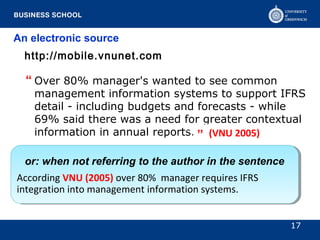
An electronic source
http://mobile.vnunet.com
Over 80% manager's wanted to see common
management information systems to support IFRS
detail ­ including budgets and forecasts ­ while
69% said there was a need for greater contextual
information in annual reports.
or: when not referring to the author in the sentence
According VNU (2005) over 80% manager requires IFRS
integration into management information systems.
or: when not referring to the author in the sentence
According VNU (2005) over 80% manager requires IFRS
integration into management information systems.
“
” (VNU 2005)
18
Useful phrases to introduce references
• As X points out,
• According to X,
• To quote from X, ' ... '
• X states/suggests that
• X tells/shows us that
• In an article entitled Name of Text, X makes the point
that ...
• Referring to ... , X says that ...
• As X stated/wrote/said, ...
• In Name of Text, X wrote that ...
• Writing in Name of Text, X explained that ...
• Writing in 1926, X argued that
19
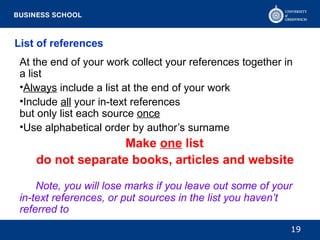
List of references
At the end of your work collect your references together in
a list
•Always include a list at the end of your work
•Include all your in-text references
but only list each source once
•Use alphabetical order by author’s surname
Make one list
do not separate books, articles and website
Note, you will lose marks if you leave out some of your
in-text references, or put sources in the list you haven’t
referred to
20
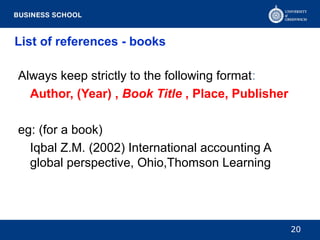
List of references - books
Always keep strictly to the following format:
Author, (Year) , Book Title , Place, Publisher
eg: (for a book)
Iqbal Z.M. (2002) International accounting A
global perspective, Ohio,Thomson Learning
21
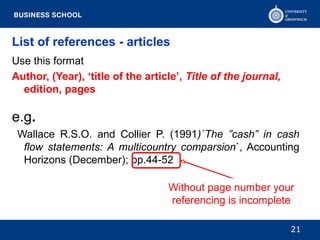
List of references - articles
Use this format
Author, (Year), ‘title of the article’, Title of the journal,
edition, pages
e.g.
Wallace R.S.O. and Collier P. (1991)`The ”cash” in cash
flow statements: A multicountry comparsion`, Accounting
Horizons (December); pp.44-52
Without page number your
referencing is incomplete
22
List of references - websites
Remember, keep these in your main list of references
Author, (Year), Title, [type of resource
eg CD ROM, WWW, e-mail],Available from: URL
address. [date of access]
e.g.
VNU Business Publications (2005) Lease IFRS for update
October 2005 , (online) Available from:
http://mobile.vnunet.com [Accessed: 15th
Aug 2011]
McConnell .P (2011), The objective of financial
reporting and the qualitative characteristics of
useful information - what investors should know,
(online) IFRS, Available from: www.ifrs.org
[Accessed: 26th
Aug 2011]
McConnell .P (2011), The objective of financial
reporting and the qualitative characteristics of
useful information - what investors should know,
(online) IFRS, Available from: www.ifrs.org
[Accessed: 26th
Aug 2011]
23
More Harvard rules
• If there are two authors
Write them both in the order in the book/article
eg:
• Britton A., Alexander D., (2004), Financial reporting,
Thomson Learning
• If there are three or more authors include
all their names or just write the first
author's name and then write et al.
• eg: Samuels J. et al, (2003), Research in
Accounting in Emerging Economies, JAI
Press
24
If an author has published more than once in a
year use a,b,etc
• Marchington, M. Wilkinson, A. (1993a) ‘Waving or
drowning in participation’ Personnel Management, March
p. 30-33
Marchington, M. Wilkinson, A. (1993b) People
management matters, London, Institute of Personnel
Management
Academic paperAcademic paper
BookBook
25
Book with an editor
Danaher, P. (ed.) (1998) Beyond the ferris wheel,
Rockhampton, CQU Press.
If you have used a chapter in a book written 
by someone other than the editor
Byrne, J. (1995) ‘Disabilities in tertiary education’, in
Rowan, L. and McNamee, J. (ed.) Voices of a Margin,
Rockhampton: CQU Press
26
27
List of References/ Bibliography
List of references
Iqbal Z.M. (2002) International accounting A global perspective, Ohio,
Thomson Learning
Saudagaran S.M. (2004) International accounting A user
perspective, Ohio,Thomson Learning
Wallace R.S.O. and Collier P. (1991)`The ”cash” in cash flow
statements: A multicountry comparsion`, Accounting Horizons
(December) pp.44-52
VNU Business Publications (2005) IFRS update October 2005 ,
(WWW) Available from: http://mobile.vnunet.com [Accessed: 15th
Aug 2006]
The list of references at the end of your assignment might look
like this:
List of reference
you only need to list those sources from which you have
either quoted or paraphrased. e.g., you do not have to
list books you used for background reading purposes.  
List of reference
you only need to list those sources from which you have
either quoted or paraphrased. e.g., you do not have to
list books you used for background reading purposes.  
Bibliography
you must list all sources you have consulted,
regardless of whether you cited from them or not.
Bibliography
you must list all sources you have consulted,
regardless of whether you cited from them or not.
28
More information Harvard referencing can
be found:
• University of Greenwich ‘Skills for Learning Handbook’
• http://www.bournemouth.ac.uk/academic_services/documents
• http://www.library.dmu.ac.uk/Images/Selfstudy/Harvard.pdf
• Saunders M., Lewis P., Thomhill A.(2009) Research
methods for Business Students, Prentice Hall

Lecture 3 referencing

  • 1.
  • 2.
    Referencing using Harvardreferencing system • Why do we do it? • How do we do it? • In text references • List of references • NB ‘Referencing’ is sometimes known as ‘Citation’ 2
  • 3.
    The tradition ofscholarship • Our own ideas are all based on the thoughts of others • Scholarly thought builds progressively on the work of respected writers and researchers by carrying out further research and analysis • Sources of ideas are always acknowledged 3
  • 4.
    4 Five main reasonsfor providing references: • Acknowledging the person whose idea or words have been used or referred to. • Make it clear that the author is not trying to pretend somebody else's work as his/her own. ('plagiarising' someone else's work.) • Helps readdress to find the original texts or webpages to read themselves. • Author can easily check something later if necessary. • Thoroughness in referencing suggests that author has been thorough in checking his/her facts
  • 5.
    5 When do youneed to give a reference ? • the source of a particular theory, argument or viewpoint • specific information, such as statistics, examples, or case studies • direct quotations (reproducing the writer's exact words) • texts and electronic information which you paraphrase rather than quote.
  • 6.
    6 How do Ireference? • You MUST attribute all sources to the original author eg ideas, data, figures, tables, methods, • Use the Harvard referencing system (Author Date method) Note, there are other systems used by some books. While at Greenwich you must use Harvard • If you don’t reference, you may be accused of PLAGIARISM You will go before a plagiarism panel You may fail the course and have to pay to do it again next year
  • 7.
    7 Using sources Sources ofdata, ideas and theories are the basis of your evidence. You may use them in a variety of ways: • Quote - using the exact words of the author • Paraphrase - using your own words to express the author’s ideas • Summarise - listing the key ideas from the author’s work • Comment - giving your own thoughts on what the author has said
  • 8.
    8 Before you write…….. • You must READ • Re-read lecture notes (to focus on topic) • Read books on reading lists (selectively - use index) • Look on library shelves for other relevant books • Use electronic databases to search for articles, reports, statistics • Use the WWW (but don’t depend on it) • Always keep notes on what you read • Make sure you write down the references
  • 9.
    9 The information usuallyprovided includes • the name and initials of the author(s) • the title, in full • the year of publication • for journal articles, the name of the journal and the number of the volume • the edition, if relevant • the location of the publisher • the name of publisher • relevant page numbers • for electronic materials, the webpage address
  • 10.
    10 Types of references References– sometimes called ‘Citations’ they occur in different forms •In-text references (quotations; paraphrasing; summarising) Placed within the main body of your writing •Secondary references Used where one author has quoted another author •List of References Full details of all sources listed at the end •Bibliography Books/etc which are relevant but have not been referred to directly (not common except in longer dissertations)
  • 11.
    11 In-text references -Quotations If you quote (copy) the exact words of an author, use quotation marks around the quote and at the end write: author’s surname - year of publication - page number (in brackets) eg: “The matching, or accruals, convention is very important in the calculation of profit” (Gowthorpe 2005,p152) or (Gowthorpe, 2005:152) Gowthorpe (2005,p152) states “the matching, or accruals, convention is very important in the calculation of profit”Gowthorpe (2005:152) states “the matching, or accruals, convention is very important in the calculation of profit” Gowthorpe (2005:152) states “the matching, or accruals, convention is very important in the calculation of profit”
  • 12.
    In-text references -Quotations • Shim et al (2009; p.9) points out that “ managers in high- tech firms are faced with different sets of performance expectations such as innovation, new product development, integration of technology and research and development management”. • “Managers in high-tech firms are faced with different sets of performance expectations such as innovation, new product development, integration of technology and research and development management”. (Shim et al, 2009; p. 9) 12
  • 13.
    13 In-text references -Paraphrasing When putting ideas in your own words rather than quoting: author – date (note – no page number) Eg: when referring to the author in the sentence: Gowthorpe (2005) indicates that accrual principle is vital for proper calculation of profit. According Shim et al (2009) managers in high-tech companies are chellenged by different factors such as innovation, technology integration etc. or: when not referring to the author in the sentence The proper estimation of profit requires implementation of accrual principle. (Gowthorpe 2005) or: when not referring to the author in the sentence The proper estimation of profit requires implementation of accrual principle. (Gowthorpe 2005) or: when not referring to the author in the sentence Managers in high-tech companies are challenged by different factors such as innovation, technology integration etc(Shim et al, 2009) or: when not referring to the author in the sentence Managers in high-tech companies are challenged by different factors such as innovation, technology integration etc(Shim et al, 2009)
  • 14.
    14 Secondary references • Authorscited by other authors Wherever possible you should try to use the original source of an idea • You may sometimes need to use a quotation or an idea from an author which you found quoted in a text book written by another author. • Show the reference in this way using the word cited eg: Bryjne highlights that an international set of accounting standards are consistent between competing companies. (Bryjne 1980 cited by Iqbal 2002) or: when not referring to the author in the sentence According Balkin et al there is direct relation between R&D and CEO compensation. (Balkin et al. 2000 cited by Shim et al, 2009) or: when not referring to the author in the sentence According Balkin et al there is direct relation between R&D and CEO compensation. (Balkin et al. 2000 cited by Shim et al, 2009)
  • 15.
    15 An electronic source 1995-2006all rights reserved VNU Business Publications http://mobile.vnunet.com How would you reference a quotation from this web site? Over 80% manager's wanted to see common management information systems to support IFRS detail ­ including budgets and forecasts ­ while 69% said there was a need for greater contextual information in annual reports
  • 16.
    16 In-text references -websites • Websites are treated the same as book references • Use (Author date) • Do not give the URL address in your text • The internet is just another publishing medium and does not need special rules • If you cannot find an author name, give the company or institution name, usually at the top of the page, or use ‘Anon’ (Anonymous) • If there is no date of publication, give the current year
  • 17.
    17 An electronic source http://mobile.vnunet.com Over80% manager's wanted to see common management information systems to support IFRS detail ­ including budgets and forecasts ­ while 69% said there was a need for greater contextual information in annual reports. or: when not referring to the author in the sentence According VNU (2005) over 80% manager requires IFRS integration into management information systems. or: when not referring to the author in the sentence According VNU (2005) over 80% manager requires IFRS integration into management information systems. “ ” (VNU 2005)
  • 18.
    18 Useful phrases tointroduce references • As X points out, • According to X, • To quote from X, ' ... ' • X states/suggests that • X tells/shows us that • In an article entitled Name of Text, X makes the point that ... • Referring to ... , X says that ... • As X stated/wrote/said, ... • In Name of Text, X wrote that ... • Writing in Name of Text, X explained that ... • Writing in 1926, X argued that
  • 19.
    19 List of references Atthe end of your work collect your references together in a list •Always include a list at the end of your work •Include all your in-text references but only list each source once •Use alphabetical order by author’s surname Make one list do not separate books, articles and website Note, you will lose marks if you leave out some of your in-text references, or put sources in the list you haven’t referred to
  • 20.
    20 List of references- books Always keep strictly to the following format: Author, (Year) , Book Title , Place, Publisher eg: (for a book) Iqbal Z.M. (2002) International accounting A global perspective, Ohio,Thomson Learning
  • 21.
    21 List of references- articles Use this format Author, (Year), ‘title of the article’, Title of the journal, edition, pages e.g. Wallace R.S.O. and Collier P. (1991)`The ”cash” in cash flow statements: A multicountry comparsion`, Accounting Horizons (December); pp.44-52 Without page number your referencing is incomplete
  • 22.
    22 List of references- websites Remember, keep these in your main list of references Author, (Year), Title, [type of resource eg CD ROM, WWW, e-mail],Available from: URL address. [date of access] e.g. VNU Business Publications (2005) Lease IFRS for update October 2005 , (online) Available from: http://mobile.vnunet.com [Accessed: 15th Aug 2011] McConnell .P (2011), The objective of financial reporting and the qualitative characteristics of useful information - what investors should know, (online) IFRS, Available from: www.ifrs.org [Accessed: 26th Aug 2011] McConnell .P (2011), The objective of financial reporting and the qualitative characteristics of useful information - what investors should know, (online) IFRS, Available from: www.ifrs.org [Accessed: 26th Aug 2011]
  • 23.
    23 More Harvard rules •If there are two authors Write them both in the order in the book/article eg: • Britton A., Alexander D., (2004), Financial reporting, Thomson Learning
  • 24.
    • If thereare three or more authors include all their names or just write the first author's name and then write et al. • eg: Samuels J. et al, (2003), Research in Accounting in Emerging Economies, JAI Press 24
  • 25.
    If an authorhas published more than once in a year use a,b,etc • Marchington, M. Wilkinson, A. (1993a) ‘Waving or drowning in participation’ Personnel Management, March p. 30-33 Marchington, M. Wilkinson, A. (1993b) People management matters, London, Institute of Personnel Management Academic paperAcademic paper BookBook 25
  • 26.
    Book with an editor Danaher, P. (ed.)(1998) Beyond the ferris wheel, Rockhampton, CQU Press. If you have used a chapter in a book written  by someone other than the editor Byrne, J. (1995) ‘Disabilities in tertiary education’, in Rowan, L. and McNamee, J. (ed.) Voices of a Margin, Rockhampton: CQU Press 26
  • 27.
    27 List of References/Bibliography List of references Iqbal Z.M. (2002) International accounting A global perspective, Ohio, Thomson Learning Saudagaran S.M. (2004) International accounting A user perspective, Ohio,Thomson Learning Wallace R.S.O. and Collier P. (1991)`The ”cash” in cash flow statements: A multicountry comparsion`, Accounting Horizons (December) pp.44-52 VNU Business Publications (2005) IFRS update October 2005 , (WWW) Available from: http://mobile.vnunet.com [Accessed: 15th Aug 2006] The list of references at the end of your assignment might look like this: List of reference you only need to list those sources from which you have either quoted or paraphrased. e.g., you do not have to list books you used for background reading purposes.   List of reference you only need to list those sources from which you have either quoted or paraphrased. e.g., you do not have to list books you used for background reading purposes.   Bibliography you must list all sources you have consulted, regardless of whether you cited from them or not. Bibliography you must list all sources you have consulted, regardless of whether you cited from them or not.
  • 28.
    28 More information Harvardreferencing can be found: • University of Greenwich ‘Skills for Learning Handbook’ • http://www.bournemouth.ac.uk/academic_services/documents • http://www.library.dmu.ac.uk/Images/Selfstudy/Harvard.pdf • Saunders M., Lewis P., Thomhill A.(2009) Research methods for Business Students, Prentice Hall